In 2006, a mud volcano erupted beside a gas well in East Java, burying villages and turning a drilling dispute into a long human disaster.

By Matthew A. McIntosh
Public Historian
Brewminate
Introduction: A Volcano Born Beside a Gas Well
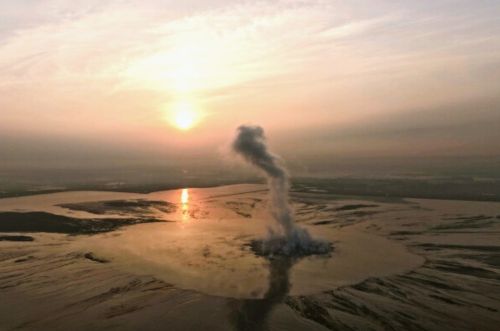
On the morning of May 29, 2006, the ground near Sidoarjo in East Java began to behave like both a breached industrial system and a living volcano. Steam, water, gas, and mud forced their way upward in a district of rice fields, factories, roads, mosques, schools, and tightly settled villages. The eruption did not emerge from a remote crater or an uninhabited geological field. It appeared in an ordinary working landscape, close to the Banjar Panji-1 natural gas exploration well, where PT Lapindo Brantas and its partners had been drilling into a deep, pressurized subsurface. Within days, the new vent was no longer only a drilling emergency or a geological curiosity. It was becoming a moving sea of hot mud, thick enough to swallow houses and persistent enough to defeat the usual language of disaster response. Lusi, the name later formed from Lumpur Sidoarjo, or Sidoarjo mud, had entered history not as a sudden explosion that ended, but as an eruption that kept going.
The destruction that followed was extraordinary because it unfolded both violently and slowly. Mud poured across the land, filled depressions, pressed against improvised levees, and transformed familiar villages into submerged zones of memory. Over the years, tens of thousands of people were displaced, whole communities were removed from the map, and losses climbed into the billions of dollars. NASA later described villages buried beneath mud layers that in places reached approximately forty meters, while the U.S. Geological Survey has emphasized the continuing character of the eruption and the huge volumes of mud and gas released since 2006. These figures matter not because disaster can be reduced to numbers, but because they reveal the scale of the event’s historical significance. Lusi was not merely a local accident. It became one of the most consequential mud eruptions ever recorded, a case in which the earth’s hidden pressures entered directly into the politics of industry, settlement, memory, and responsibility.
From the beginning, Lusi was also a disaster of interpretation. The company and its defenders pointed toward the Yogyakarta earthquake of May 27, 2006, which had occurred two days before the eruption, arguing that regional seismic disturbance rather than drilling had awakened an already unstable geological system. That claim could not be dismissed simply because it was convenient. East Java is a tectonically and volcanically complex region, and mud volcanoes do arise where overpressured sediments, fluids, gas, faults, and heat interact below the surface. Yet the strongest scientific argument has increasingly focused on the drilling itself: the timing of well-control problems, the relation between the exploration borehole and pressurized formations, and later analyses of subsurface gas and drilling data. The central historical question is not whether geology mattered. It plainly did. The sharper question is whether industrial drilling converted that geological potential into catastrophe.
The Sidoarjo mud volcano should be understood as a human-triggered disaster inside a naturally dangerous earth system. Such a claim requires caution. Drilling did not invent East Java’s geology, create overpressured sediments from nothing, or manufacture the long-term volcanic and hydrothermal forces that may help explain Lusi’s persistence. But industrial action appears to have opened, destabilized, or intensified the pathway through which those forces reached the surface. The distinction is crucial. Calling Lusi “natural” turns a sequence of decisions, risks, omissions, and responsibilities into an act of the earth alone. Calling it simply “man-made” can flatten the geological complexity that made the event so destructive and enduring. The more historically useful interpretation lies between those simplifications: Lusi was born where extractive ambition met a volatile subsurface, and where the politics of uncertainty allowed mud, blame, and displacement to spread together.
East Java’s Dangerous Subsurface
The Sidoarjo mud volcano was born in a landscape where the earth was already under stress. East Java lies within one of the most geologically complicated regions of Indonesia, shaped by the meeting of tectonic plates, the long history of marine sedimentation, active volcanism, folding, faulting, and hydrocarbon formation. Beneath the rice fields and industrial settlements of Sidoarjo were thick sedimentary layers containing water, gas, clay, and organic material buried under pressure. These conditions did not make disaster inevitable, but they made the subsurface unusually sensitive to disturbance. The land appeared settled, worked, and ordinary at the surface; below it lay a pressurized system capable of violent movement if opened or destabilized.
Mud volcanoes are not volcanoes in the familiar sense of molten rock, glowing lava, and igneous eruption. They are eruptions of sediment, water, gas, and sometimes hydrocarbons, driven upward when fluids trapped under pressure find a path toward the surface. Clay-rich mud behaves almost like a geological fluid: dense enough to bury a village, mobile enough to flow, and pressurized enough to erupt when the seal above it fails. Methane and other gases can help drive the ascent, while water reduces friction and allows buried sediments to move upward through fractures. For this reason, the term “mud volcano” can be misleading if it makes the event sound gentle or merely muddy. A mud volcano can be a deep-pressure release system, and when it emerges in a populated industrial landscape, it can become catastrophic. Its violence lies not in flame but in pressure: in the sudden conversion of buried sediment into an ascending mass that carries heat, gas, dissolved minerals, and unstable ground with it. Unlike a conventional flood, which arrives from outside a settlement and then recedes, a mud volcano can continue feeding itself from below. It is both source and flow, both wound and discharge. That made Lusi especially destructive. Once the underground pathway opened, the problem was not only how to contain mud already on the surface, but how to manage a system that kept producing more.
The Porong-Sidoarjo area was also part of a wider petroleum and gas province, which is why the Banjar Panji-1 well was there in the first place. Exploratory drilling did not choose a random landscape; it targeted a subsurface understood to contain hydrocarbons, complex formations, and potentially valuable gas. That economic fact matters historically because the same geological conditions that make an area attractive to extractive companies can also make it dangerous. Gas, overpressured water, weak formations, and difficult drilling conditions are not separate from the promise of profit. They are often part of the same buried system. In Sidoarjo, the industrial search for energy entered a subsurface where pressure, sediment, and fluids had already been accumulating for geological time.
The deeper question is how to distinguish background geological instability from immediate causation. East Java’s dangerous subsurface created the possibility of a mud eruption, but possibility is not the same as event. Many unstable systems remain sealed for long periods until some trigger changes the balance of pressure, permeability, or fracture pathways. That trigger can be natural, such as an earthquake, or human, such as drilling into an overpressured formation without adequate control. The Sidoarjo debate has often turned on precisely this distinction. Those defending a natural explanation emphasize the region’s faults, seismicity, and volcanic context. Those emphasizing drilling point to the timing and mechanics of the Banjar Panji-1 operation. Both sides agree that the subsurface was dangerous. They disagree over what made that danger erupt when and where it did. This distinction is more than technical. It determines how the event is remembered, who is considered responsible, and what lessons are drawn from it. If Lusi was simply the expression of an unstable basin, then the disaster belongs mainly to the history of natural hazards. If drilling triggered the eruption, then it belongs also to the history of industrial risk, corporate decision-making, regulatory oversight, and the uneven distribution of harm. The same mud can tell two very different stories, depending on whether geology is treated as cause, context, or excuse.
Faults are especially important because they can act both as barriers and conduits. In one setting, a fault may seal pressure underground; in another, it may become a channel through which fluids move upward. The area around Lusi was not a simple stack of flat, stable layers. It contained folded and faulted sedimentary structures, and later studies have argued that the mud volcano’s plumbing may connect with deeper hydrothermal or volcanic systems. Such findings complicate any simple story in which drilling alone “created” Lusi from nothing. But they do not absolve drilling, either. A faulted, pressurized, hydrothermal basin is exactly the kind of environment in which industrial intrusion requires exceptional caution. The more geologically active the system, the more consequential human disturbance can become.
This is why the geology of East Java should be understood as the condition of the disaster, not its full explanation. The mud, pressure, gas, faults, and heat beneath Sidoarjo formed a loaded geological environment. They explain why the eruption, once initiated, could become enormous, persistent, and difficult to stop. But they do not by themselves explain the coincidence of eruption, drilling trouble, and the location of the Banjar Panji-1 well. The historical problem is not whether nature played a role; nature was present in every cubic meter of mud that surfaced. The problem is whether human drilling opened the door through which that nature escaped. In Sidoarjo, the earth was dangerous before May 2006, but danger became disaster only when the subsurface was disturbed.
May 2006: The Eruption
The immediate story of Lusi began not with mud, but with an earthquake. On May 27, 2006, a powerful earthquake struck near Yogyakarta in central Java, killing thousands and damaging a broad region already familiar with seismic danger. Because the Sidoarjo eruption began only two days later, the earthquake quickly became central to one of the most important arguments about causation. For Lapindo Brantas and those who defended a natural-trigger interpretation, the sequence seemed suggestive: first the earthquake, then the eruption. In a tectonically active landscape, it was not absurd to ask whether seismic waves had disturbed a pressurized subsurface system and awakened a mud volcano that was already primed to erupt. Chronology alone can mislead as easily as it can clarify. The earthquake was an important part of the context, but it was not the only significant event in the days before the mud appeared.
At almost the same time, the Banjar Panji-1 exploration well was encountering serious drilling trouble. The well had been drilled into a complex sedimentary basin, and by late May the operation had reached depths where pressure control became increasingly dangerous. Reports later reconstructed a sequence involving loss of circulation, unstable downhole conditions, and difficulty managing the balance between drilling mud pressure and formation pressure. These are not minor technical details. In a drilling operation, mud is not simply a byproduct or lubricant; it is a control system. Its weight helps hold back formation fluids. If the mud column becomes inadequate, if pressure is miscalculated, or if the wellbore is left vulnerable in an unstable formation, the drilled hole can become a conduit for forces the operator can no longer command.
The critical drilling sequence has been described in the literature as a movement from trouble to loss of control. As the well encountered difficult conditions, the crew reportedly experienced losses of drilling mud into the formation, a warning that the borehole and surrounding rock were no longer behaving predictably. Subsequent decisions, especially the withdrawal of the drill string from the open hole, have been central to the drilling-trigger interpretation. Pulling pipe under such conditions can produce a swabbing effect, reducing pressure in the wellbore and allowing formation fluids to enter. If those fluids enter suddenly, the result is a kick: an influx from the formation into the well that must be rapidly recognized and controlled. In ordinary language, this sounds like a procedural mishap. In a pressurized gas field, it can be the beginning of catastrophe. What made the Banjar Panji-1 sequence so important was that it linked technical drilling choices to a broader geological failure. The open-hole section was not merely an empty shaft descending into inert rock; it was an artificial opening into a pressurized, sediment-rich environment where the balance between human control and formation pressure could change quickly. Once that balance shifted, the well could cease being a managed instrument of exploration and become a pressure pathway. The danger was not only that gas or fluid might rise inside the borehole, but that pressure could move into surrounding formations, fracture weak layers, and search for another route upward. This is why later reconstructions of the drilling history gave so much attention to timing, mud losses, pipe movement, and kick response. Each detail mattered because each one marked a possible step in the conversion of exploration into eruption.
The company’s defenders disputed this interpretation, arguing that the well remained sufficiently intact and that the eruption was not caused by a drilling blowout. Yet critics of that defense emphasized that the chronology of the well trouble fits the eruption far more closely than the distant earthquake does. The Yogyakarta earthquake occurred roughly two days earlier and far from Sidoarjo; the drilling difficulties occurred at the site, in the relevant subsurface system, immediately before the eruption. The issue was not simply proximity in distance, but proximity in mechanism. An earthquake would have needed to transmit enough energy across the region to open or activate a pathway beneath Sidoarjo. A drilling-trigger model required no such distant transfer. It located the disturbance inside the same pressure system that the well had already penetrated.
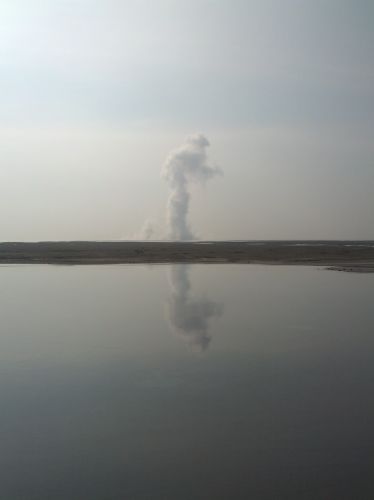
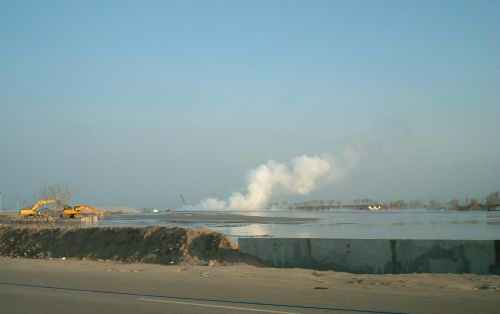
On May 29, 2006, mud, water, steam, and gas broke through the surface near the Banjar Panji-1 well. The fact that the eruption did not emerge directly from the wellhead became one of the points used to argue against drilling responsibility, but this objection is weaker than it first appears. A subterranean blowout does not have to discharge neatly through the borehole like a geyser through a pipe. If pressure escapes from the well into surrounding formations, it can fracture or exploit nearby weaknesses and emerge some distance away. In that scenario, the surface vent is not the mouth of the drilled well but the expression of a deeper failure. This is one reason Lusi became so difficult to explain to the public. It looked like the earth itself had opened, yet the possible industrial trigger lay below the visible surface.
The first eruption quickly revealed that this was not a small venting episode. Hot mud and gas continued to escape, and the surrounding area began to change from inhabited land into a spreading field of slurry. The eruption’s persistence mattered as much as its beginning. A short-lived release might have been remembered as a drilling accident, an alarming blowout, or a local geological anomaly. Lusi instead became a sustained system. The subsurface continued feeding the surface, and the surface disaster expanded outward. From the first days, officials, residents, engineers, and company representatives faced a problem for which ordinary emergency categories were inadequate. They were not only responding to damage already done; they were confronting a disaster that was still being produced from below. That continuing production changed the psychological and administrative nature of the crisis. A flood, fire, or earthquake leaves ruins that can be surveyed, cleared, and rebuilt around, even when the losses are immense. Lusi produced ruins while also producing the force that made more ruins. Every attempt at containment had to reckon with the fact that the source had not ended. Villagers did not simply flee an event; they watched an expanding process consume the places from which they had fled. In that sense, the first eruption was not only the beginning of physical destruction. It was the beginning of uncertainty as a permanent condition.
This sequence (earthquake, drilling trouble, kick, and eruption) created the interpretive battle that would define Lusi for years. The earthquake gave Lapindo Brantas and its allies a natural explanation that could not be dismissed out of hand, especially in a region of faults, volcanoes, and overpressured sediments. But the drilling record gave critics a sharper and more immediate causal chain. The historical importance of May 2006 lies in that overlap. Nature and industry were present in the same week, the same basin, and the same public argument. Yet the weight of the evidence points toward the well as the decisive human intrusion into a dangerous subsurface. The earthquake may have made the disaster easier to dispute; the drilling trouble made it much harder to call accidental in the purely natural sense.
The Trigger Debate: Earthquake or Drilling?
The dispute over Lusi’s origin became one of the most consequential scientific arguments in modern disaster history because it was never only a question of geology. It determined whether the eruption would be remembered as an unavoidable natural event or as an industrial catastrophe triggered by human action. Two explanations emerged almost immediately. The first argued that the Yogyakarta earthquake of May 27, 2006, disturbed an already overpressured mud system and initiated the eruption two days later. The second argued that the Banjar Panji-1 drilling operation caused a subsurface blowout, allowing pressurized fluids, gas, and mud to escape through fractures and faults to the surface. Both explanations began with the same basic fact: East Java was geologically unstable. The disagreement lay in whether that instability was awakened by a distant earthquake or by an oil-and-gas operation at the eruption site.
The earthquake-trigger argument had enough scientific plausibility to deserve serious treatment. Earthquakes can alter fluid pressure, change permeability, disturb faults, and trigger eruptions or hydrothermal activity in regions already close to failure. Java is a tectonically active island, and the Yogyakarta earthquake was a devastating regional event that occurred shortly before Lusi began. For advocates of this interpretation, the earthquake supplied the missing external force: seismic waves moved through a pressurized basin, disrupted a fragile underground seal, and allowed mud to rise. This argument was strengthened, at least rhetorically, by the fact that Lusi did not erupt directly from the Banjar Panji-1 wellhead. If the vent was offset from the well, defenders of the natural-trigger hypothesis could argue that the eruption belonged to a wider geological network rather than to the drilling operation itself. The strongest form of this case did not depend on pretending that the drilling operation was irrelevant; rather, it placed the drilling within a larger unstable environment and argued that the decisive disturbance came from outside the well. In that reading, Banjar Panji-1 was near the eruption but not necessarily its cause, while the earthquake acted as the regional shock that reorganized pressure underground. This interpretation also drew strength from the broader scientific fact that mud volcanoes often develop in areas of tectonic compression, hydrocarbon accumulation, and overpressured sediment. If Lusi was part of such a natural system, then its emergence after an earthquake could be understood as the latest expression of forces that had long existed beneath East Java. That made the earthquake argument more than a corporate talking point. It was a plausible geological hypothesis, especially before the drilling data and later gas studies were more fully examined.
The weakness of the earthquake explanation lies in the difficulty of connecting that distant seismic event to the precise timing, location, and mechanics of the Sidoarjo eruption. Critics of the earthquake hypothesis argued that the seismic energy reaching Sidoarjo was too small to plausibly trigger such a large eruption, especially when compared with other earthquakes that had affected the region without producing a similar event. They also emphasized that the eruption followed not merely an earthquake, but a sequence of drilling trouble at Banjar Panji-1: mud losses, unstable conditions, pipe movement, and a major kick. In this view, the earthquake was chronologically convenient but mechanically weak. It occurred before the eruption, but it did not explain the well-specific chain of events that unfolded immediately before mud appeared at the surface.
The drilling-trigger argument is more direct because it locates the disturbance inside the same subsurface system from which the mud emerged. According to this interpretation, the well penetrated an overpressured zone, and the operation failed to maintain safe pressure control. Losses of drilling mud into the formation, followed by withdrawal of the drill string, may have reduced pressure in the borehole and allowed formation fluids to enter. Once a kick began, the well was no longer simply a controlled industrial instrument; it had become part of a pressure-release system. If pressure escaped from the borehole into surrounding formations, it could fracture weak layers, exploit existing faults, and produce an eruption away from the wellhead. This model explains why Lusi could appear beside, rather than inside, the drilled well while still being drilling-induced.
The debate sharpened because the two sides were not merely interpreting different kinds of evidence; they were operating with different burdens of explanation. The earthquake hypothesis had to show that a remote seismic event was capable of triggering a major eruption at that specific location after a delay of roughly two days. The drilling hypothesis had to show that the well could have created a subsurface pathway even though the eruption did not emerge neatly from the wellhead. Later scientific work increasingly strengthened the drilling case by focusing on timing, gas behavior, pressure changes, and drilling records. The most persuasive argument was not that geology was irrelevant, but that the drilling operation supplied the immediate disturbance in a system already close to failure. In other words, East Java’s subsurface made Lusi possible, but Banjar Panji-1 appears to have made it happen.
This distinction is central to the historical meaning of the disaster. To say that drilling triggered Lusi is not to deny the role of faults, overpressure, mud, gas, seismicity, or hydrothermal activity. Those forces explain why the eruption could become so large, persistent, and difficult to stop. But they do not erase the question of industrial responsibility. Indeed, they sharpen it. A company drilling into a dangerous basin was not operating in geological innocence. The more unstable the subsurface, the more important well design, casing decisions, mud weight, pressure monitoring, and emergency response became. The strongest interpretation is not that Lusi was either natural or human-made in a simple sense. It was a geological disaster triggered through industrial action: a natural system violently released by drilling.
What Went Wrong Underground: The Mechanics of a Man-Made Blowout
To understand why the drilling-trigger argument has remained so powerful, it is necessary to move below the visible mud lake and reconstruct the disaster as a failure of pressure control. Banjar Panji-1 was not simply a hole in the ground. It was an engineered passage through layered formations, some of them weak, some of them pressurized, and some of them capable of feeding fluids and gas into the borehole if the balance of forces changed. In a stable well, drilling mud helps maintain that balance. Its weight resists formation pressure, carries cuttings upward, cools the bit, and keeps the borehole from collapsing or flowing. But in an overpressured environment, the margin between control and loss of control can become narrow. If the mud weight is too low, formation fluids can enter the well. If it is too high, drilling mud can fracture the formation and disappear into the rock. Either failure can turn a managed well into an uncontrolled pressure system.
The problem at Banjar Panji-1 appears to have developed through precisely that kind of unstable balance. Later reconstructions described significant mud losses while drilling, indicating that the wellbore had encountered formations capable of taking in drilling fluid. Loss of circulation is dangerous because it weakens the pressure column inside the well. When drilling mud disappears into the formation, the well may no longer exert enough downward pressure to hold back formation fluids. The situation becomes especially hazardous if operators then move pipe in the open hole. Pulling the drill string can create a swabbing effect, reducing pressure in the wellbore and encouraging fluids to enter from the surrounding formation. The well is no longer merely penetrating the subsurface in these conditions. It is actively disturbing the pressure regime that had kept water, gas, and mud sealed underground. This is one reason the technical details of the drilling sequence matter so much to the historical interpretation of Lusi. Terms such as “mud losses,” “open hole,” and “swabbing” can sound like specialist vocabulary, but they describe a practical erosion of control. Each one points to a moment when the well ceased to behave as a contained industrial project and began interacting dangerously with the surrounding geology. The deeper the operation went, the less the surface equipment alone determined the outcome. Control depended on an invisible balance between mud weight, formation pressure, borehole integrity, and operator response. Once that balance began to fail, the well could become less a protective conduit than an opening through which pressure reorganized itself.
The decisive concept is the kick. A kick occurs when formation fluids flow into the wellbore because formation pressure exceeds the pressure exerted by the drilling mud. In many drilling operations, a kick can be controlled if it is detected quickly and if the well is properly designed and equipped. But a kick is also a warning that the well has crossed from ordinary drilling into emergency control. In the Banjar Panji-1 case, critics of Lapindo’s explanation argued that the kick was not handled as a contained well-control event. Instead, pressure may have escaped from the wellbore into surrounding formations, producing what is known as an underground blowout. That distinction is vital. A surface blowout is dramatic and visible at the wellhead. An underground blowout can be more deceptive: the failure occurs below the surface, and the escaping fluids may migrate through fractures, faults, or weak layers before appearing somewhere else. It is possible for the visible disaster to seem detached from the industrial cause that initiated it. The public sees mud erupting from the ground; engineers and geologists have to ask whether the pathway began inside a damaged or uncontrolled wellbore. That gap between visible effect and hidden mechanism helped sustain the controversy. It allowed defenders of the earthquake theory to point to the offset vent as evidence of natural origin, while critics of the drilling operation argued that the offset was exactly what an underground blowout could produce. The kick, in this interpretation, was not simply one incident among many. It was the moment when formation pressure may have passed beyond the boundaries of the well and entered the larger subsurface.
This helps explain one of the most common objections to the drilling-trigger interpretation: Lusi did not erupt directly out of the wellhead. That fact has often been used to suggest that the well could not have caused the mud volcano. But in the underground blowout model, the offset vent is not an argument against drilling causation; it is part of the mechanism. If pressure escaped from the well into the surrounding formation, it could have hydrofractured weak sediments or opened a preexisting pathway. The eruption would then appear at the surface where the migrating fluids found the easiest route upward, not necessarily at the exact point where the drill pierced the subsurface. The borehole in this interpretation was the initiating wound, not the final mouth. The mud vent beside the well was the surface expression of a deeper failure.
The drilling-trigger case depends less on a single dramatic mistake than on a chain of linked failures. The well entered a difficult pressure environment. Mud losses signaled instability. Pipe movement may have reduced pressure inside the borehole. Formation fluids entered the well. The response failed to restore control before pressure escaped beyond the borehole into the surrounding strata. Once that happened, the disaster passed beyond the usual boundaries of industrial management. The problem was no longer simply a well that needed to be killed. It was a new subsurface pathway feeding mud, water, gas, and heat toward the surface. This is why later attempts to stop Lusi were so ineffective. Engineers could not simply cap a visible pipe, because the eruptive system was no longer confined to the pipe. The well had helped create a geological-industrial rupture larger than itself.
Calling this a man-made blowout does not mean that every element of Lusi was artificial. The mud was natural, the gas was natural, the pressure was natural, and the faults and weak formations were products of geology rather than corporate design. But a disaster does not have to be wholly manufactured to be human-caused. The most persuasive interpretation is that drilling disrupted a preexisting pressure system and converted geological potential into historical catastrophe. That is what makes Lusi so disturbing. It was not the simple failure of a machine that could be switched off, repaired, or replaced. It was the failure of industrial confidence inside a living earth system. Banjar Panji-1 appears to have opened more than a well. It opened a path through which the hidden pressures of East Java could escape into villages, roads, fields, and lives.
From Eruption to Mud Sea: Containment, Levees, and Failure
Once Lusi began, the central problem changed from identifying a cause to managing a landscape in motion. The first vents did not remain a contained technical emergency beside a drilling site. They became the source of an expanding mudfield that pushed outward across settled land, burying houses, factories, roads, fields, schools, mosques, and graveyards. What made the disaster so difficult was not only the volume of mud, but the fact that the eruption kept producing more. Emergency response could not proceed as if the event had ended. Officials and engineers were trying to contain a disaster that was still being manufactured underground, hour after hour, day after day. The Sidoarjo mud volcano quickly ceased to be a single eruption and became a new, hostile geography.
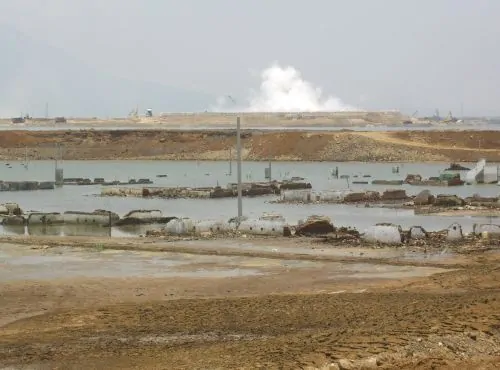
The earliest responses were improvised around a basic hope: if the flow could be blocked, diverted, or slowed, the destruction might be limited. Earthen embankments and levees were built to corral the mud into containment ponds, while channels and drainage efforts attempted to direct the flow away from the most vulnerable areas. These measures were understandable, but they also revealed the scale mismatch between human engineering and the pressure of the eruption. A levee can restrain a finite flood; it is far less effective against a source that continues to refill the basin from below. Each containment wall solved one problem by creating another. It protected one area while increasing pressure, depth, and risk elsewhere. The mud sea was not simply a natural accumulation. It was partly an engineered landscape, shaped by decisions about which land would be sacrificed, which roads had to remain open, and which communities were considered already lost.
Attempts to stop the eruption at its source were even more revealing. Engineers tried various methods to reduce or seal the flow, including relief-well strategies and efforts to obstruct the vent. One of the most widely reported interventions involved dropping chains of heavy concrete balls into the crater in the hope that they might partially choke the eruptive conduit. The symbolism was almost too perfect: industrial society trying to plug a deep geological wound with surface improvisation. Such efforts did not stop Lusi. They showed instead that the eruption had passed beyond the practical control of the drilling operation that likely triggered it. If the disaster had remained a conventional well blowout, it might have been addressed through familiar well-control techniques. But Lusi was no longer merely a well-control problem. It had become a mud-volcano system with its own subterranean plumbing, pressure supply, and surface expression. The failure of these interventions also revealed how little the surface response could do once the underground pathway had stabilized into a continuing flow system. Stopping Lusi required more than blocking a visible hole. It required interrupting a deep pressure network whose exact geometry, supply, and fractures were only partially understood. The more the eruption persisted, the clearer it became that emergency engineering was operating after the decisive transformation had already occurred. The well may have been the point of industrial intrusion, but the eruptive system had escaped the boundaries of that industrial apparatus.
As the mud spread, containment became a form of triage. Authorities had to decide where to build embankments, where to evacuate, where to pump or channel mud, and how to preserve critical infrastructure in a region that was economically and logistically important. The nearby toll road, railway, gas pipeline, and industrial facilities made the disaster more than a village tragedy. It threatened movement, commerce, energy infrastructure, and regional administration. The language of “protection” concealed hard choices. To protect a road could mean allowing mud to deepen elsewhere. To reinforce one levee could heighten danger behind another. To maintain infrastructure could prolong uncertainty for displaced residents whose former homes had become part of the containment system itself. The mud did not move through an empty space; it moved through a hierarchy of value.
Failure was not always dramatic, but it was constant. Levees leaked, slumped, required reinforcement, and remained vulnerable to overtopping or collapse. The mud’s heat, water content, gas emissions, and sheer weight made the containment zone unstable. In November 2006, a gas pipeline explosion near the mudflow killed thirteen people, turning the slow disaster suddenly lethal in a more recognizable way. That explosion underscored the danger of combining an expanding mudfield with buried infrastructure in an industrialized landscape. The dead were not killed by mud burial in the simple sense, but by the secondary hazards created when an uncontrolled eruption invaded the built environment. Lusi’s violence was cumulative. It killed through pressure, displacement, infrastructure failure, uncertainty, and the cascading consequences of placing human systems over a disturbed subsurface. The explosion also marked a grim widening of the disaster’s meaning. It showed that the mudflow did not merely destroy what it covered; it destabilized the systems around it. Pipelines, roads, rail lines, embankments, drainage works, and industrial facilities became part of the hazard field. The eruption turned infrastructure from a sign of modern order into a network of possible failure points. In that sense, Lusi exposed a deeper vulnerability in the region’s development: settlement, transport, energy extraction, and industry had been layered over a subsurface whose behavior could not be fully mastered once disturbed.
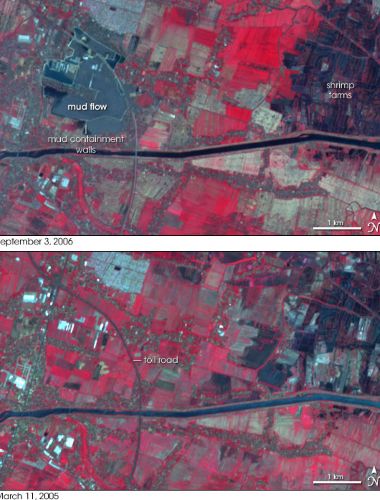
The containment ponds and levees transformed the visual identity of the region. Villages disappeared beneath a gray-brown expanse, and the remaining embankments created a strange new topography: a raised mud lake where neighborhoods had been. Residents who returned to the edges of the exclusion zone did not see ruins in the ordinary sense. They saw absence under mud. Houses, streets, property boundaries, gardens, schools, and graves were no longer accessible as damaged objects; they had been submerged into a landscape that resisted recovery. This is one of the reasons Lusi became historically distinct from many sudden disasters. After an earthquake, ruins can often be mapped, photographed, and rebuilt upon. After Lusi, the ground itself had been replaced. The mud sea erased not only structures but the physical coordinates of memory.
The failure of containment was not simply that engineers could not stop the mud. It was that containment became the long-term condition of the disaster. Lusi was managed, redirected, embanked, monitored, and partially normalized, but not ended. The eruption forced the state, the company, and affected communities into a prolonged relationship with a landscape that could no longer be restored to what it had been. This matters for the larger argument because it shows the difference between causing a disaster and controlling its aftermath. Industrial drilling may have triggered the eruption, but once the subsurface pathway opened, the consequences exceeded the scale of the original operation. The result was a man-made disaster that behaved like a geological regime: continuous, unstable, expensive, and resistant to closure. That resistance to closure is central to Lusi’s historical significance. A disaster that cannot be ended must be administered, narrated, compensated, argued over, and lived beside. Each embankment implied a future of maintenance; each containment pond implied a future of monitoring; each displaced household implied a future of claims, grievances, and altered identity. Containment did not resolve the catastrophe so much as organize it into a new political and physical order. The mud sea became both evidence and aftermath: evidence of the force released from below, and aftermath in the form of a landscape that made return impossible.
Buried Communities
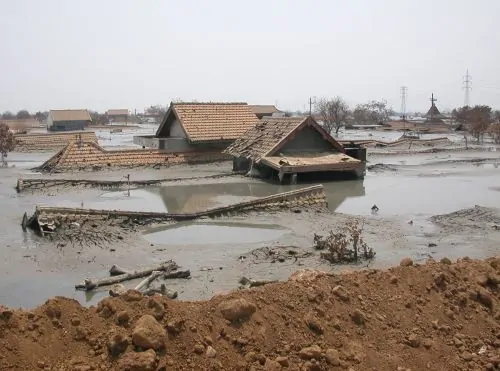
The human disaster of Lusi cannot be measured only by the number of houses buried or the volume of mud discharged. It was a disaster of removal: removal from land, work, neighborhood, ancestry, and the ordinary geography through which people understood their lives. The mud did not strike an empty field. It spread through a densely inhabited district where villages, factories, markets, roads, schools, mosques, cemeteries, and family compounds were woven into a shared social landscape. As the eruption continued, residents were forced to confront a form of destruction that was both material and existential. Their homes were not simply damaged; they became inaccessible beneath a spreading mud sea. Their villages were not simply evacuated; they were gradually erased from usable space.
Displacement from Lusi unfolded unevenly, because the mud did not consume every place at the same pace or in the same way. Some residents fled immediately as mud and gas appeared near their settlements. Others left after official evacuation orders, levee failures, infrastructure threats, or the slow realization that their houses could not be saved. Still others remained near the margins of the disaster zone, watching embankments rise between them and the places where their former lives had been. This staggered displacement deepened the uncertainty. People were not only asking where they would sleep that week; they were asking whether their homes would ever be recognized as lost, whether compensation would arrive, whether land titles would be honored, and whether the state and company would treat them as victims of an industrial disaster or as residents unlucky enough to live atop a natural hazard.
Livelihood loss was as severe as housing loss. Sidoarjo was not only a residential landscape but an economic one. The mud swallowed agricultural land, disrupted factories, damaged roads, and interrupted the movement of goods and workers. Families who had relied on rice fields, small shops, wage labor, factory employment, transport, or informal trade found that displacement severed the relationship between household survival and place. A lost house could sometimes be imagined as a structure to be compensated. A lost livelihood was harder to calculate. It included wages no longer earned, customers no longer reachable, crops no longer planted, work routines broken, and social networks scattered. For many residents, the disaster was not a single economic blow but a long unraveling of stability.
The destruction of community space also transformed private grief into collective dislocation. Villages are not only collections of houses; they are social systems organized through kinship, prayer, exchange, gossip, ceremony, labor, and mutual obligation. When Lusi buried a village, it did not merely destroy architecture. It broke the spatial pattern that allowed neighbors to remain neighbors, relatives to remain nearby, and rituals to remain anchored in known places. Mosques, schools, lanes, markets, and meeting points disappeared into the same mud that covered kitchens and bedrooms. The loss of a house could be mourned as private property; the loss of a village had to be mourned as the collapse of a shared world. Even when displaced residents resettled elsewhere, the old community could not simply be rebuilt by moving people into new houses. The geography that had made those relationships ordinary was gone. That geography mattered because it carried the everyday habits through which belonging was made: the route to prayer, the neighbor who watched children, the shopkeeper who extended credit, the courtyard where relatives gathered, the grave visited on ritual occasions, the school path walked by generations. Displacement broke these small continuities as surely as it destroyed buildings. In the aftermath, survivors could receive shelter and still remain socially unmoored, because a village is not reproduced by walls alone. It depends on proximity, memory, routine, and the accumulated trust of shared place.
Memory became one of the mudflow’s most painful casualties because Lusi buried places before they could be properly recovered, documented, or mourned. In many disasters, survivors return to ruins, salvage objects, mark foundations, clean graves, or rebuild on familiar ground. In Sidoarjo, the mud made return physically impossible across much of the affected area. The landscape became a surface without access to what lay beneath it. Family possessions, photographs, household objects, village boundaries, garden plots, prayer spaces, and ancestral graves were absorbed into a buried world. This kind of loss is different from visible ruin. Ruin allows confrontation. Burial denies it. The mud did not only destroy memory’s material supports; it hid them under a landscape that continued to shift and steam.
The burial of cemeteries and ancestral graves carried particular force. Graves are among the most powerful ways communities connect land, family, religion, and time. To lose access to burial places is to lose more than a site of mourning. It is to lose a physical relationship with the dead, a place where family history can be visited, maintained, and ritually acknowledged. For displaced residents, the mudflow severed ties not only to present property but to ancestral presence. This matters because the Sidoarjo disaster was not simply a forced relocation from one address to another. It was a rupture in belonging. People were separated from the dead as well as the living, from inherited ground as well as current shelter. In that sense, Lusi buried a local past along with the houses of the present. The loss of graves also complicated the moral meaning of recovery. Compensation could price a structure, a plot, or a business asset, however imperfectly, but it could not restore the ability to stand before a parent’s or grandparent’s grave. It could not replace the ritual geography through which families maintained obligations across generations. The mud turned ancestral memory into an inaccessible underground archive. Survivors were left with knowledge of where things had been, but without the physical possibility of return.
The compensation process often intensified rather than resolved these wounds. Payment schemes depended on categories: inside or outside the affected map, homeowner or renter, landholder or worker, formally documented claimant or informally dependent resident. Such categories rarely matched the real texture of loss. A family might receive some payment for property but still lose livelihood, community, religious space, and ancestral connection. Another might suffer economic collapse without possessing the right documents or recognized land status. The politics of compensation also forced victims to translate grief into claims, proofs, measurements, and bureaucratic negotiations. A disaster that had already taken homes then demanded paperwork to prove what those homes had meant. The result was a second displacement: from the moral language of harm into the administrative language of eligibility.
This is why Lusi’s buried communities remain central to my argument. If the mud volcano is viewed only as a geological event, the human story appears as unfortunate collateral damage. If it is understood as an industrially triggered disaster, displacement becomes part of the causal chain that began underground and continued through corporate denial, state negotiation, infrastructure triage, and contested compensation. The people of Sidoarjo were not merely living near a strange eruption. They were forced to bear the consequences of a system in which geological risk, extractive ambition, and political power converged beneath their feet. The mud buried villages, but it also exposed a harsher reality: when disaster responsibility is disputed, victims can lose not only land and homes, but the authority to define what happened to them. That loss of interpretive authority is one of the most enduring harms of contested disasters. Survivors knew what they had lost, but the meaning of that loss was repeatedly filtered through technical reports, corporate defenses, government categories, compensation formulas, and public arguments over causation. Their experience was immediate, but recognition was conditional. Lusi buried communities twice: first beneath mud, and then beneath the struggle over whether their suffering would be acknowledged as the consequence of preventable human action.
Blame and the Politics of Calling It “Natural”
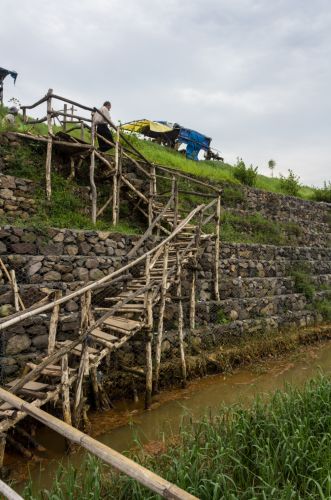
The struggle over Lusi did not end with the scientific debate over drilling, earthquakes, pressure, and mud. It moved almost immediately into the political arena, where causation became inseparable from liability. If the eruption was natural, then the disaster could be framed as a tragic geological event requiring state relief and humanitarian management. If drilling triggered it, then the disaster became an industrial failure, and the burden of responsibility shifted toward Lapindo Brantas, its corporate partners, and the regulatory environment that allowed drilling in such a hazardous setting. This is why the word “natural” mattered so much. It was not a neutral description. It was a category with financial, legal, administrative, and moral consequences.
Lapindo Brantas and its defenders had strong incentives to emphasize the earthquake-trigger interpretation. A distant seismic event could relocate causation away from the well and into the unstable geology of Java itself. In that narrative, the company became unfortunate rather than negligent, present rather than responsible. The eruption’s offset from the wellhead, the region’s tectonic setting, and the existence of natural mud volcanoes elsewhere all became useful elements in a broader argument of denial or deflection. The point was not necessarily to prove that humans had played no role at all; it was to preserve uncertainty. In a disaster of this scale, uncertainty could function as protection. As long as causation remained publicly disputed, liability could be delayed, diluted, or translated into negotiated compensation rather than full accountability.
For affected residents, this politics of causation was not abstract. Their homes, land, documents, graves, jobs, and neighborhood networks had been buried, but recognition of their losses depended on categories produced by others. Compensation schemes had to define who counted as a victim, which areas counted as affected, what kinds of property could be valued, and what kinds of loss were invisible to the payment system. These categories rarely matched lived experience. A person could lose employment without losing titled land. A renter could lose a home without holding recognized property rights. A family could receive payment for a structure but never recover the social world that gave the structure meaning. Compensation became both necessary and inadequate. It helped some residents survive displacement, but it also narrowed the meaning of disaster to what could be itemized, mapped, documented, and priced.
The state’s role was equally complicated. Government agencies had to protect displaced people, maintain infrastructure, supervise emergency response, and manage public anger, but they also operated within a political economy in which corporate power mattered. The companies connected to the drilling operation were not marginal actors without influence. The Bakrie family’s political and economic prominence made the disaster especially sensitive, and public debate over responsibility unfolded in a landscape where business, party politics, state authority, and media narratives overlapped. This did not mean that the state simply acted as a corporate shield in every instance. It did mean that the boundary between public disaster management and private liability was unstable from the start. Relief, compensation, containment, and blame all moved through institutions shaped by power.
Calling Lusi “natural” also changed the moral relationship between victims and the disaster. A natural-disaster frame can generate sympathy, but it can also depoliticize suffering. It invites language of fate, vulnerability, and resilience rather than negligence, risk, and responsibility. Residents become victims of the earth rather than casualties of a failed industrial system. That distinction matters because sympathy without accountability can leave survivors dependent on charity, administrative discretion, or partial compensation. It can also encourage the public to treat the catastrophe as something sad but unavoidable. In Sidoarjo, the mud did not merely cover villages; it threatened to cover the chain of decisions that made those villages vulnerable in the first place. The fight over naming was a fight over whether the disaster would be remembered as misfortune or misconduct. It was also a fight over historical agency. A “natural” disaster can make suffering appear detached from decision-making, as though no one chose the drilling site, approved the well plan, weighed the risks, managed the emergency, argued over liability, or designed the compensation process. That framing can leave survivors with grief but not accusation, memory but not judgment. It turns a social wound into an environmental condition. For the people displaced by Lusi, the mud was never only mud. It was the material form of decisions made elsewhere, by institutions and corporations with far more power than the communities that bore the consequences.
The compensation process itself became part of the long disaster. Payments were delayed, disputed, staged, and entangled with questions of mapping and eligibility. Residents had to navigate bureaucratic requirements while living with the immediate consequences of displacement. The very act of proving loss could be humiliating, because the evidence of loss often lay beneath mud. Houses could not be inspected in the ordinary way. Land boundaries could disappear under containment ponds. Communal spaces could not easily be translated into individual claims. Even when compensation arrived, it could not restore the destroyed geography of work, worship, kinship, and memory. This gap between payment and repair is essential. Compensation can settle accounts on paper while leaving the deeper historical wound open.
The politics of calling Lusi “natural” reveals the central paradox of the disaster. The more complicated the geology, the easier it became for powerful actors to blur responsibility; yet that same geological complexity made responsible drilling more, not less, necessary. A company entering a pressurized, faulted, hydrocarbon-bearing basin could not reasonably treat the subsurface as harmless until proven otherwise. The uncertain earth was precisely the hazard that industrial expertise claimed to manage. When that expertise failed, uncertainty should not have served only as a shield against blame. It should have forced a harder reckoning with the risks accepted on behalf of people who had no meaningful role in accepting them. Lusi became a mud volcano, a compensation dispute, and a political scandal at once because the disaster did not stop at the vent. It flowed into the language of law, the machinery of the state, and the unequal struggle over who had the power to define reality after the ground opened.
The Long Disaster: Why Lusi Did Not End
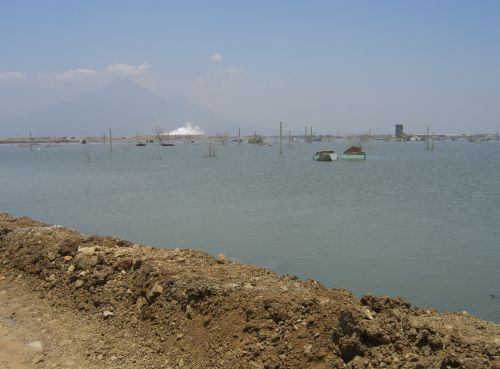
Lusi’s most unsettling feature was not simply that it began violently, but that it refused to become past tense. Many disasters have a recognizable moment of impact: the earthquake, the flood crest, the explosion, the firestorm, the collapse. Lusi began with an eruption, but its historical meaning developed through duration. The mud kept coming. The ground remained unstable. Gas continued to vent. Embankments had to be maintained, strengthened, and monitored. Displaced residents could not simply wait for the event to end and then return to rebuild. The disaster became a condition, a new environmental regime imposed on the Porong-Sidoarjo landscape. This made Lusi different from a sudden catastrophe whose ruins mark the aftermath. At Sidoarjo, aftermath and event overlapped for years.
The reason Lusi endured lies partly in the depth and complexity of the system that fed it. Once an underground pathway connected pressurized fluids, mud, gas, and heat to the surface, the eruption was no longer dependent on the original drilling operation alone. It had become linked to a larger subsurface supply. Later studies suggested that Lusi may be connected to a deeper hydrothermal or volcanic plumbing system, helping explain both its heat and its persistence. This does not weaken the drilling-trigger argument; it clarifies the scale of what drilling may have disturbed. A match that ignites a forest fire does not create the forest, the wind, or the dry season, but it still matters as the trigger. In the same way, Banjar Panji-1 may have opened or destabilized a pathway into a system much larger than the well itself. That is why stopping Lusi proved so difficult. The source was not a broken machine on the surface, but a deep earth system that had found a durable route upward.
As years passed, the eruption’s output changed, but change did not mean closure. Mudflow rates fluctuated, vents shifted, and the visible landscape evolved from spreading emergency to contained mud lake. The first phase of catastrophe gave way to a managed zone of embankments, ponds, monitoring stations, damaged infrastructure, and forbidden or semi-forbidden spaces. This long duration altered public perception. A disaster that remains visible for too long can become strangely normalized. What once shocked observers becomes a feature of the regional map: the mud lake, the levees, the road diversions, the disaster tourism, the compensation offices, the memorialized villages beneath the surface. But normalization is not recovery. It is often the way societies learn to live beside unresolved harm.
For displaced residents, Lusi’s refusal to end meant that loss remained unfinished. The buried villages did not become recoverable ruins. They stayed under mud. The question of return remained suspended or impossible. Compensation disputes persisted, and even where payments were made, they did not reassemble the world that had been destroyed. A long disaster produces a particular kind of exhaustion. Survivors must keep proving, remembering, negotiating, adapting, and explaining long after public attention has faded. The eruption’s duration deepened the asymmetry between those who could move on administratively and those whose lives remained organized around the mud. For the state, Lusi became a file, a zone, a budget, a technical problem, and a political burden. For former residents, it remained a missing village, a lost grave, an interrupted livelihood, and a permanent before-and-after. That permanence is not only emotional; it is practical. A household displaced by an ordinary flood may return to clean, repair, and reclaim, but Lusi’s victims often faced a landscape that had ceased to offer any route back. The mud converted temporary evacuation into irreversible exile. It required families to remake daily life elsewhere while still carrying claims to a place that physically existed but could no longer be inhabited. This is one of the cruelties of a long disaster: it demands adaptation while denying closure. People must build new routines without being able to bury the old ones properly.
The persistence of Lusi also complicated accountability. A short industrial accident can be investigated, assigned a cause, and folded into legal or regulatory procedure. A long disaster resists that neat closure. As the years pass, responsibility can become blurred by new administrations, changing corporate arrangements, technical uncertainty, compensation settlements, and public fatigue. The event becomes less a single failure than an inherited condition. This was one of the quiet political advantages of duration. The longer Lusi continued, the easier it became for institutions to treat it as a management problem rather than a question of origin. Yet the opposite interpretation is historically stronger. The continuing eruption should not obscure the trigger; it should sharpen the significance of triggering. Precisely because the consequences became so large and durable, the decision to drill into a hazardous subsurface demands closer scrutiny.
Lusi did not end because it had become more than an eruption. It was a hybrid disaster: geological in material, industrial in origin, political in interpretation, and social in endurance. Its mud came from the earth, but its meaning came from the human world built above and around that earth. The ongoing character of the disaster shows why the distinction between natural precondition and human trigger matters so much. A volatile subsurface can exist for centuries without burying towns. Once disturbed, it can produce consequences that outlive the decision, the well, the company’s explanations, and even the first generation of official response. Lusi’s long life is not an argument against human responsibility. It is the measure of what human action released.
Was Lusi Really Caused by Drilling?
The following video from “Ashes & After” is about the Sidoarjo mud volcano:
The strongest challenge to the drilling-trigger interpretation is not the simple corporate claim that Lapindo Brantas had nothing to do with the eruption. That argument is too self-interested to carry the full weight of the counterpoint. The stronger challenge is geological: East Java was already a pressurized, faulted, hydrocarbon-bearing, tectonically active region in which mud volcanoes and fluid migration were plausible natural phenomena. The Yogyakarta earthquake occurred two days before Lusi began, and earthquakes are known in some settings to alter permeability, disturb pressure systems, and trigger hydrothermal or mud-volcanic activity. Later work also suggested that Lusi’s persistence may be connected to a deeper hydrothermal or volcanic plumbing system. These points complicate any simple statement that drilling “created” the disaster from nothing.
This counterargument matters because Lusi did not behave like an ordinary industrial accident. It became a large, hot, long-lived eruption with a complex subsurface supply. Its vent appeared offset from the Banjar Panji-1 wellhead, and its persistence suggested connection to a pressure system far larger than the drilled borehole itself. Those facts gave the natural-trigger position some interpretive force. A conventional well blowout can be imagined as a failure of pipes, valves, casing, and pressure control. Lusi was stranger than that. It looked and behaved like a mud volcano, and mud volcanoes belong to the natural vocabulary of sedimentary basins, faults, gas, and overpressure. The counterpoint warns against reducing Lusi to a narrow mechanical failure at a single well.
The earthquake argument also gained power from the sequence of dates. A devastating earthquake on May 27 followed by a mud eruption on May 29 created a story that was easy to understand and difficult to dismiss at first glance. In a region where seismic activity was already part of historical experience, many observers could accept the possibility that the earth itself had shifted, opened, or reactivated a pathway underground. Sawolo and other defenders of the non-drilling interpretation argued that drilling data did not prove an underground blowout and that the eruption should be understood within a wider geological context. Even if one ultimately rejects that conclusion, it was not irrational to examine the earthquake seriously. The scientific dispute became so intense precisely because both sides could point to real features of the setting: a dangerous well on one side, and a dangerous earth system on the other.
Yet the counterpoint modifies the drilling-trigger argument more than it defeats it. The natural-system evidence explains why Lusi could become so large, hot, persistent, and difficult to stop; it does not explain as well why the eruption began where and when it did. The drilling-trigger interpretation remains stronger because it provides a closer causal sequence: loss of circulation, unstable well conditions, pipe movement, a major kick, and eruption near the drilling site. The earthquake was real, but its explanatory burden is heavier. It must account for why a distant seismic event triggered this eruption at this time, while other regional seismic events did not produce the same effect. The drilling interpretation does not require geology to be passive or irrelevant. It requires only that the Banjar Panji-1 operation disturbed a system already capable of catastrophic response.
The fairest conclusion is not that Lusi was purely natural or purely artificial. It was a hybrid disaster whose materials and energy were geological, but whose most persuasive trigger was industrial. The counterpoint strengthens the my final interpretation by preventing a crude version of blame. Drilling did not manufacture East Java’s faults, mud, gas, heat, or overpressure. But that is precisely why the disaster is so troubling. Industrial operators entered a hazardous subsurface and appear to have lost control of the pressure system they penetrated. The more complex the geology, the greater the responsibility to drill carefully, regulate honestly, and respond transparently. Lusi was probably not caused by drilling in the sense of creating a volcano from nothing. It was caused by drilling in the more historically important sense: human action opened the path through which a dangerous earth system entered human life.
Conclusion: The Human Trigger in a Volatile Earth
The Sidoarjo mud volcano forces a difficult but necessary distinction between geological possibility and historical causation. East Java’s subsurface was never inert. It contained faults, pressure, gas, mud, water, heat, and hydrothermal complexity long before the Banjar Panji-1 well was drilled. Those conditions made Lusi possible, and they help explain why the eruption became so large, hot, persistent, and resistant to control. But possibility is not the same as disaster. A volatile earth system can remain sealed until something disturbs its balance. The strongest evidence indicates that drilling supplied that disturbance. Lusi was not simply nature expressing itself. It was nature released through human intrusion.
This is why the familiar division between “natural disaster” and “man-made disaster” fails to capture what happened at Sidoarjo. The mud was natural, but the timing was historical. The pressure was geological, but the pathway appears to have been opened by industrial action. The catastrophe unfolded because extractive technology entered a dangerous subsurface and then lost control of forces it claimed to manage. That makes Lusi a particularly modern disaster. It did not require human beings to manufacture every element of the hazard. It required them only to underestimate, mishandle, or deny the consequences of disturbing a system already under pressure. The result was a disaster in which drilling, geology, corporate power, state management, and human displacement became inseparable. This hybridity is precisely what made responsibility so easy to contest and so important to insist upon. If the disaster is described only as natural, the drilling operation disappears into the background of Java’s geology. If it is described only as artificial, the dangerous complexity of the subsurface is flattened into a simple industrial mistake. The historical truth is more uncomfortable: human action intersected with natural force at a point where the consequences could not be controlled. Lusi belongs to the history of modern extraction, not because extraction invented the earth’s pressure, but because it converted that pressure into a social catastrophe. The mudflow shows how technological confidence can become most dangerous when it assumes that deep geological systems will remain obedient to surface plans, profit models, and regulatory paperwork.
The cost of that disturbance was borne most heavily by people who had not chosen the risk. Villagers, workers, shopkeepers, farmers, families, and religious communities saw their homes, livelihoods, roads, schools, mosques, and graves disappear beneath mud. Compensation could not restore the geography of belonging that Lusi destroyed, and disputes over causation deepened the injury by forcing survivors to struggle not only for payment but for recognition. The politics of calling the eruption “natural” mattered because it shaped who was blamed, who paid, who waited, and whose version of events carried authority. In that sense, Lusi did not only bury communities. It buried accountability under layers of technical uncertainty, corporate defense, legal compromise, and administrative delay.
The final lesson of Lusi is not that humans control the earth, but that they are responsible for the risks they create when they enter it. Drilling into a pressurized, faulted, hydrocarbon-bearing basin is never a neutral act. It is a decision made within systems of profit, regulation, expertise, and public trust. When that decision releases forces that cannot be stopped, the disaster cannot honestly be dismissed as fate. Lusi remains a warning from a volatile earth: human action does not have to create nature’s power to unleash it. At Sidoarjo, the ground was dangerous before May 2006, but the catastrophe began when that danger was given a path into human life.
Bibliography
- Associated Press. “Indonesians Mark 20 Years since Mud Volcano Eruption Swallowed Up Entire Communities in East Java.” 2026.
- Bosnak, Judith E. “Soap Opera and Muddy Affairs in Indonesia.” Bijdragen tot de Taal-, Land- en Volkenkunde 171:4 (2015), 460–490.
- Davies, Richard J., et.al. “Birth of a Mud Volcano: East Java, 29 May 2006.” GSA Today 17 (2007): 2, 4–9.
- —-, et.al. “The East Java Mud Volcano: An Earthquake or Drilling Trigger?” Earth and Planetary Science Letters 272: 3–4 (2008), 627–638.
- Fallahi, Mohammad Javad, et.al. “The Plumbing System Feeding the Lusi Eruption Revealed by Ambient Noise Tomography.” Journal of Geophysical Research: Solid Earth 122:10 (2017), 8200–8213.
- Mazzini, Adriano, et.al. “Triggering and Dynamic Evolution of the LUSI Mud Volcano, Indonesia.” Earth and Planetary Science Letters 261 (2007), 375–388.
- McMichael, Heath. “The Lapindo Mudflow Disaster: Environmental, Infrastructure and Economic Impact.” Bulletin of Indonesian Economic Studies 45:1 (2009), 73–83.
- Mohsin, Anto. “The Sidoarjo Mudflow and the Muddiness of an Environmental Disaster.” Arcadia 5 (2017).
- NASA Earth Observatory. 2019. “A Muddy Mess in Indonesia.” June 11, 2019.
- Sawolo, Nurrochmat, et.al. “The LUSI Mud Volcano Triggering Controversy: Was It Caused by Drilling?” Marine and Petroleum Geology 26:9 (2009), 1766–1784.
- Schiller, Jim, Lucas Widjaja, and Jan-Peter Olsson. “Learning from the East Java Mudflow: Disaster Politics in Indonesia.” Indonesia 85 (2008), 51-77.
- Tingay, Mark R. P., et.al. “Initiation of the Lusi Mudflow Disaster.” Nature Geoscience 8 (2015), 493–494.
- —-, et.al. “Present-Day Stress Field of Southeast Asia.” Tectonophysics 482:1-4 (2010), 92-104.
- —-, et.al. “Triggering of the Lusi Mud Eruption: Earthquake versus Drilling Initiation.” Geology 36:8 (2008), 639–642.
- U.S. Geological Survey. “LUSI Mud Volcano, East Java, Indonesia.” March 6, 2024.
Originally published by Brewminate, 07.09.2026, under the terms of a Creative Commons Attribution-NonCommercial-NoDerivatives 4.0 International license.
About the Author