From The Song of Roland to the coronations at Reims, Joyeuse became a relic-bearing weapon, royal emblem, and enduring symbol of Charlemagne’s imagined authority over Christian kingship.

By Matthew A. McIntosh
Public Historian
Brewminate
Introduction: A Sword with More Than One History
Few weapons associated with the Middle Ages occupy as many historical worlds as Joyeuse, the sword traditionally attributed to Charlemagne. It belongs first to the obscured material world of the Carolingian court, in which swords functioned as practical weapons, aristocratic possessions, diplomatic gifts, and visible signs of authority. It belongs equally to the imaginative world of medieval epic, where Charlemagne carries a radiant blade whose name, “Joyous,” distinguishes it from ordinary instruments of war. Centuries later, another Joyeuse entered the ceremonial life of the French monarchy as the sword used in royal coronations, linking successive kings to an emperor who had become the supreme ancestral figure of Christian rulership. The surviving object, preserved today in the Louvre, carries still another identity: it is a composite work whose blade, hilt, guard, ornament, and scabbard do not all belong to the same period. Joyeuse is not one sword with one uninterrupted biography. It is a convergence of possible weapon, literary creation, sacred relic, royal regalia, national treasure, and museum artifact.
The historical Charlemagne almost certainly possessed swords, but no contemporary source identifies a particular surviving weapon as Joyeuse. Einhard’s Life of Charlemagne, composed after the emperor’s death in 814 CE, describes a ruler whose clothing and adornment could include a sword fitted with gold or silver, especially on important ceremonial occasions. Such evidence confirms the place of decorated weapons within Carolingian kingship, but it does not establish that the Louvre sword belonged to Charlemagne or that his contemporaries knew it by the name later celebrated in epic. Joyeuse emerges clearly only within the much later literary tradition surrounding Charlemagne and his warriors. In The Song of Roland, the emperor girds the sword at his side before the climactic battle with Baligant. Its pommel contains a relic associated with the lance that wounded Christ, while its blade possesses a marvelous luminosity expressed through the appearance of thirty colors in a single day. These details do not provide a factual description of an eighth-century weapon. They reveal how medieval poets transformed Charlemagne’s remembered military power into sacred and supernatural authority.
The coronation sword introduces a third history, no less real because its identification with Charlemagne cannot be demonstrated materially. Preserved for centuries in the treasury of the Abbey of Saint-Denis, the sword was carried to Reims for the coronations of French kings. There it formed part of a larger system of regalia through which royal power was presented as ancient, Christian, martial, and continuous. The king did not merely receive a weapon; he entered a succession of sacred rulership extending backward through earlier French monarchs to an idealized Charlemagne. Joyeuse helped make that lineage visible. Its ceremonial force depended less upon proof that Charlemagne had once held the blade than upon the repeated conviction that the object embodied his authority. Each procession, presentation, blessing, and coronation renewed the connection. Even the sword’s physical alterations contributed to that process. Components were repaired, replaced, embellished, and adapted as ceremonial expectations changed. Modern ideas of authenticity often privilege an untouched original, but medieval and early modern regalia derived authority from continued custody and ritual use. An object could remain itself while its material substance changed because identity resided partly in institutional memory, inherited practice, and collective recognition.
The history of Joyeuse must consequently be approached through careful separation followed by equally careful reconstruction. The sword of Charlemagne’s lifetime, the supernatural weapon of the chansons de geste, and the French coronation sword should not be collapsed into a single object without qualification. Yet isolating them completely would be just as misleading, for their meanings developed through continuous interaction. Epic poetry endowed the sword with a name, personality, relic, and radiance; royal ritual converted literary memory into political inheritance; material craftsmanship gave that inheritance a visible and durable form. Later monarchs, revolutionaries, antiquarians, restorers, curators, and modern audiences continued to reshape what Joyeuse represented. The sword’s importance does not depend upon proving that the surviving blade rested at Charlemagne’s side. Its deeper history lies in the extraordinary success with which generations made a legendary past materially present. Joyeuse became powerful because it allowed story, sanctity, monarchy, and metal to authenticate one another.
Charlemagne before Joyeuse: The Historical Emperor and the Problem of the Personal Sword

Before Joyeuse acquired its radiance, relic, name, and ceremonial afterlife, there was the historical Charlemagne: a Frankish king whose authority rested substantially upon his ability to wage war. From his accession in 768 CE until his death in 814 CE, Charlemagne campaigned across an enormous geographical range, overthrowing the Lombard kingdom in Italy, fighting protracted wars against the Saxons, attacking the Avar polity in the Danube basin, and intervening south of the Pyrenees. These expeditions were not disconnected adventures undertaken by a wandering warrior-king. They expanded Frankish lordship, redistributed land and treasure, compelled political submission, protected allies, supported missionary activity, and furnished Charlemagne with the resources needed to reward an increasingly expansive aristocratic following. His coronation as emperor in Rome on December 25, 800 CE, placed those achievements within an imperial framework that combined Roman inheritance, Frankish conquest, and Christian rulership. Later generations would remember him as the archetypal warrior-emperor, but that image originated in a reign during which military leadership was an indispensable condition of political survival.
The sources closest to Charlemagne’s lifetime reveal remarkably little about any individual sword he may have carried. The Royal Frankish Annals recount campaigns, assemblies, sieges, rebellions, diplomatic exchanges, and acts of submission, yet they never identify a sword called Joyeuse. Einhard, who knew Charlemagne’s court and wrote his biography after the emperor’s death, likewise gives no name to any personal weapon. The silence does not prove that Charlemagne lacked a favored sword, but it prevents historians from tracing Joyeuse securely into his lifetime.
Einhard does provide a valuable glimpse of the sword’s place within Charlemagne’s public appearance. He portrays the emperor as ordinarily favoring Frankish clothing: a linen shirt and drawers, a tunic edged with silk, leg coverings, boots, a winter cloak, and a sword worn at his side. On major feast days or when receiving foreign envoys, Charlemagne might appear in more elaborate dress and carry a sword with fittings of gold or silver. The distinction is revealing because the weapon belonged to a carefully graded language of royal display. A sword could accompany the ruler in relatively ordinary settings, while precious-metal ornament announced heightened ceremony, diplomatic importance, and exceptional status. Einhard does not describe a miraculous blade, a holy relic in the pommel, or a surface flashing through thirty colors. He instead describes a luxurious but recognizable royal weapon whose value arose from craftsmanship, material richness, and its proximity to the emperor’s body. The passage offers the nearest contemporary foundation for later imaginings of Charlemagne’s sword, but it cannot bear the legendary structure eventually erected upon it.
Swords held an elevated position within Carolingian aristocratic culture, although they were neither the only important weapons nor necessarily the most common arms on every battlefield. Spears, shields, bows, armor, and horses were essential components of Frankish warfare, while the sword’s cost made it suitable as a marker of elite standing. A well-made blade required specialized labor and valuable iron; its scabbard, belt, pommel, and guard could then be embellished with precious metals or other expensive materials. Archaeological evidence and written sources together indicate that swords circulated through purchase, inheritance, tribute, diplomatic exchange, royal patronage, and the redistribution of captured wealth. To possess such a weapon was to possess not only military equipment but a visible record of status and social connection.
The royal sword carried an additional significance because Charlemagne’s rule remained intensely personal. Carolingian government did not operate through a large centralized bureaucracy capable of enforcing imperial commands uniformly across every province. Authority depended upon assemblies, oaths, itinerant royal presence, aristocratic cooperation, ecclesiastical networks, messengers, and relationships of reward and obligation. An ornamented weapon worn by the ruler made that personal authority visible without requiring a written explanation. It marked Charlemagne as the source of military command, patronage, punishment, protection, and victory.
Christianity further shaped the meaning of Charlemagne’s warfare, although the relationship between religion and conquest must not be reduced to a simple formula. Frankish rulers had long presented themselves as protectors of churches and allies of the papacy, but Charlemagne expanded this association across an empire created through repeated military campaigns. The conquest of the Saxons demonstrates the severity of that union: political submission, compulsory baptism, destruction of sacred sites, deportation, tribute, and legal penalties all became instruments in the attempted incorporation of a resistant population into a Christian Frankish order. Court writers could present victory as evidence of divine favor, while royal legislation defined the emperor’s responsibilities in moral and religious terms. Yet contemporary sources did not usually transform Charlemagne’s personal sword into a supernatural relic-bearing weapon. The more elaborate theology of Joyeuse belonged to later centuries, when poets and royal ritualists made materially explicit what Carolingian political culture had expressed more broadly, the conviction that legitimate military power could serve a divinely ordered Christian realm.
The question of Charlemagne’s personal sword exposes the boundary between historical probability and recoverable fact. It is entirely plausible that a ruler who spent decades campaigning, distributed valuable arms to followers, and wore an ornamented sword during ceremonies possessed one or more blades of exceptional quality. It is not possible to demonstrate that any such weapon was called Joyeuse, contained a fragment of the Holy Lance, possessed miraculous brilliance, or survives within the composite coronation sword now associated with his name. The absence of proof should neither be filled with romantic certainty nor treated as proof that every later tradition was deliberately fraudulent. It instead marks the point at which an emperor remembered through annals, laws, biography, and material culture began to be reconstructed by epic imagination. The historical sword disappeared, but the cultural need for Charlemagne to possess a weapon equal to his reputation eventually produced Joyeuse.
From Roncevaux to Epic Memory: The World That Created Joyeuse

The historical event from which the Charlemagne epic tradition drew its most famous tragedy was not a great confrontation between Christianity and Islam. In 778 CE, Charlemagne led a Frankish army across the Pyrenees after receiving overtures from Muslim political dissidents who hoped to use Frankish power against the Umayyad emir of Córdoba. The campaign failed to secure Zaragoza, and the Franks withdrew northward after an expedition that produced little lasting territorial gain. As the army passed through the Pyrenean region, its rear guard was attacked and destroyed near Roncevaux. Einhard later identified the attackers as Basques who exploited the mountainous terrain, descended upon the encumbered column, killed the men guarding the baggage, and escaped before the Franks could retaliate. Among the dead was Roland, described not as Charlemagne’s nephew or the greatest knight in Christendom, but more modestly as prefect of the Breton frontier. The encounter was a serious royal humiliation, but it was a localized ambush rather than the immense religious war later imagined by epic poets. Its very brevity in the early sources makes the subsequent expansion of Roncevaux into one of medieval Europe’s defining heroic narratives revealing.
The earliest accounts provide none of the elements that would make the story famous. They do not describe Roland blowing a horn until his temples burst, attempting to destroy an indestructible sword, or dying with his face turned toward the enemy. They do not present Archbishop Turpin fighting beside the knights, Ganelon betraying the rear guard, or Charlemagne avenging the dead in a divinely directed battle. Nor do they mention Joyeuse. Those features arose from centuries of remembrance, invention, performance, and political reinterpretation.
By the time The Song of Roland assumed its surviving written form around the end of the eleventh century, the world in which audiences understood Charlemagne had changed profoundly. Western Christian rulers had fought prolonged wars in Iberia, aristocratic military culture had developed new ideals of lordship and service, and the papacy had increasingly articulated warfare in defense of the Church as a penitential and sacred undertaking. The First Crusade intensified these tendencies by giving armed pilgrimage and conflict with non-Christian opponents an extraordinary place within Latin Christian imagination. The poem accordingly transformed the Basque ambushers into a vast Muslim army and converted an unsuccessful retreat into an episode within a cosmic struggle between Christianity and Islam. Historical geography, political allegiance, and religious identity were rearranged to produce a morally legible past. Charlemagne ceased to be merely the ruler responsible for a failed expedition and became the ageless emperor whose grief, endurance, and eventual victory confirmed the providential destiny of Christian rulership.
This transformation was sustained through the chanson de geste, the “song of deeds” that celebrated exemplary acts of warfare, loyalty, vengeance, sacrifice, and service. Such poems were not simply written chronicles recited with decorative exaggeration. They belonged to a performative tradition in which stories could be adapted for different audiences, regions, patrons, and political circumstances before surviving versions were committed to manuscripts. Repetition, formal speeches, vivid battle scenes, named warriors, and recognizable conflicts between loyalty and treachery helped make the narratives memorable. Their heroes were defined not through private reflection alone but through public actions witnessed by companions, enemies, rulers, and God. Roland’s refusal to sound his horn until disaster becomes inevitable expresses both magnificent courage and catastrophic pride, while Ganelon’s betrayal demonstrates how personal resentment can fracture the bonds supporting an entire political order. Charlemagne stands above these conflicts as king, judge, avenger, mourner, and guardian of the Christian realm. The poem’s historical world is less a reconstruction of the eighth century than an idealized examination of the obligations binding a later medieval aristocratic society together. Its departures from documented events were not incidental mistakes; they were fundamental to the moral and political work the epic performed.
Named swords were particularly effective within this imaginative environment because they gave material form to heroic identity. Roland carried Durendal, Oliver wielded Hauteclaire, Archbishop Turpin possessed Almace, and Charlemagne bore Joyeuse. These weapons were not interchangeable items drawn from an anonymous armory. Their names allowed audiences to recognize the status, reputation, and narrative role of their wielders even amid crowded battle scenes. A sword could preserve a hero’s fame, embody a lineage, contain relics, or display supernatural qualities that revealed the exceptional nature of its owner.
Joyeuse emerged from this epic structure as the weapon appropriate to the ruler who stood at its summit. Charlemagne’s sword did not need to appear in the sparse Carolingian accounts because the poetic tradition required something those accounts had never attempted to provide: a blade whose identity matched the emperor’s transformed historical stature. As Roland’s Durendal expressed the doomed magnificence of the loyal vassal, Joyeuse expressed the enduring and victorious authority of the sovereign. Its name, brightness, sacred associations, and place beside Charlemagne converted imperial power into an object that could be seen and remembered. The sword also helped bridge the temporal distance separating medieval audiences from the Carolingian past. Charlemagne might belong to a remote age, but Joyeuse allowed his authority to become immediate, personal, and materially imaginable. The world that created the legendary sword was not the battlefield of Roncevaux itself, but the centuries of cultural labor that followed it. Through epic memory, a brief defeat became holy history, a frontier commander became the greatest of martyrs, and an emperor whose personal weapons remained unnamed acquired a sword celebrated throughout medieval Europe.
“Joyeuse Was Girt upon His Side”: The Sword in The Song of Roland
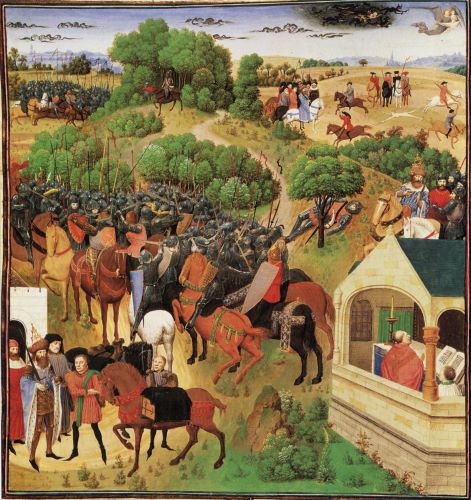
In The Song of Roland, Joyeuse appears not as an independent magical agent but as the weapon appropriate to Charlemagne’s imperial body. The poem introduces it when the emperor arms himself for the culminating conflict with Baligant, the pagan ruler summoned to avenge Marsile’s defeat. Charlemagne puts on his armor, fastens his helmet, takes up his shield and spear, and girds Joyeuse at his side. The sequence places the sword within a deliberate ceremonial presentation of the ruler before battle. Each object confirms that Charlemagne is prepared to act simultaneously as warrior, commander, and defender of the Christian order. Joyeuse completes that image by giving the emperor a named weapon equal in distinction to the swords carried by the greatest members of his host.
The poem’s decision to reserve Joyeuse for Charlemagne is significant within a narrative crowded with famous weapons. Roland’s Durendal is bound to the tragedy of the rear guard, Oliver’s Hauteclaire reflects the stature of Roland’s wiser companion, and Turpin’s Almace accompanies a warrior-priest who joins sacramental duty to physical combat. Joyeuse occupies a different position because its bearer survives where the others die. Charlemagne does not carry a martyr’s sword destined to become a relic of personal sacrifice; he carries the sword of continuing sovereignty. Its presence marks the transition from the destruction at Roncevaux to the emperor’s work of judgment and vengeance. The dead heroes embody perfect service, but Charlemagne must restore the order their deaths have violated. Joyeuse belongs to the figure who stands above the network of vassal loyalty and possesses the authority to transform private grief into collective war. The sword’s narrative meaning depends less upon individual adventure than upon the enduring office of the emperor.
Its name deepens that distinction. “Joyeuse,” commonly translated as “Joyous” or “Joyful,” seems at first incongruous in a poem dominated by betrayal, slaughter, lamentation, and exhausted mourning. Yet medieval heroic joy was not necessarily gentle, private, or opposed to violence. It could denote the exultation of victory, the splendor of public honor, confidence in divine favor, and the restoration of a rightful hierarchy. The sword’s joy is triumphal rather than sentimental.
That triumphal meaning becomes clearer when Charlemagne confronts Baligant. The duel presents two supreme rulers whose armies understand their struggle as decisive, making the combat a compressed contest between rival religious and political orders. Charlemagne is wounded and briefly endangered, but divine assistance confirms that his task has not ended. Renewed by the heavenly summons, he strikes Baligant with Joyeuse and kills him, bringing the great retaliatory battle to its conclusion. The sword does not win independently of its bearer, nor does the poem depict it as an automatic source of invulnerability. Its power lies in the convergence of Charlemagne’s courage, rightful authority, and providential support. Joyeuse becomes the material instrument through which divine judgment is enacted in the visible world. Because Baligant is represented as Charlemagne’s opposing equal, the emperor’s victory also establishes the superiority of the Christian sovereign over the most formidable ruler the poem can imagine. The blade participates in a theology of history in which military success confirms the legitimacy of Charlemagne’s empire.
Joyeuse also helps distinguish Charlemagne’s form of heroism from Roland’s. Roland’s defining moment is his refusal to call for aid until the rear guard is doomed, and Durendal becomes inseparable from his desperate attempt to preserve honor in defeat. Charlemagne’s heroism is slower, heavier, and burdened by command: he discovers the dead, mourns them, pursues the enemy, presides over judgment, and returns to further obligations even after victory. Joyeuse accompanies this surviving ruler whose duty cannot end with one glorious death. The sword’s brightness and celebrated name do not erase the emperor’s sorrow, but they signal that grief must be converted into renewed action. Within The Song of Roland, Joyeuse is more than Charlemagne’s personal blade. It is the sword of imperial continuity, the radiant sign that kingship survives catastrophe and reasserts order through sanctioned force.
The Thirty Changing Colors
Among the most memorable descriptions of Joyeuse in The Song of Roland is the claim that its blade displays thirty colors in the course of a single day. Modern summaries often convert this image into a precise supernatural ability, as though the sword mechanically changed from one distinct color to another at regular intervals. The poem’s language is more suggestive than systematic. It evokes a surface alive with shifting brilliance, capable of appearing differently as light, movement, and perspective alter. Joyeuse is presented not merely as brightly polished steel but as an object whose visible qualities exceed the stability expected of ordinary matter. The changing colors signal that the emperor’s weapon belongs at the boundary between crafted artifact and sacred marvel.
Medieval audiences were accustomed to associating brightness with beauty, value, revelation, and divine presence. Gold, gems, polished metal, colored glass, silk, and enamel were prized partly because they transformed illumination into visible splendor. Light did not function only as a neutral physical condition; it could disclose hierarchy and make spiritual power perceptible through material things. A radiant sword could consequently communicate more than wealth. Its brilliance could suggest that the authority embodied by Charlemagne was itself illuminated, favored, and set apart.
The number thirty intensifies the marvel, although it should not be burdened with a single rigid symbolic explanation. Medieval writers frequently used numbers to create order, abundance, and memorability, while biblical and liturgical associations could give certain numbers additional resonance. Thirty might recall scriptural ages, measures, payments, or periods of preparation, but the poem does not explain the number or direct the audience toward one definitive interpretation. Its immediate poetic function is cumulative: one color would be striking, several would be magnificent, and thirty make the blade almost impossible to imagine as an ordinary weapon. The number also implies continual renewal. Joyeuse does not possess one permanent sacred color but repeatedly exceeds any fixed visual definition. Its surface appears inexhaustible, as though imperial glory could manifest itself in many forms without diminishing. The blade’s mutability strengthens rather than weakens its identity. That mutability is important because color in the medieval world was understood through materials, illumination, and context rather than through the abstract standardized systems familiar to modern observers. A polished blade could flash white, silver, blue, gold, red, or dark gray depending upon its angle, surroundings, and the quality of the light. Pattern welding, surface treatment, ornament, reflected clothing, and nearby armor could further complicate its appearance. The poetic image may draw upon such real visual effects without becoming a technical description of metallurgy. Wonder often began with recognizable material properties and then magnified them beyond ordinary limits. Joyeuse’s colors are most persuasive when understood as a poetic expansion of what an exceptionally polished and ornamented sword might seem to do in motion.
The sword’s unstable surface also carries political meaning. Charlemagne’s authority in the poem must encompass several roles at once: he is warrior, emperor, judge, avenger, Christian protector, grieving lord, and chosen instrument of providence. Joyeuse mirrors that plurality by refusing to remain visually singular. Its many colors can be read as the material equivalent of an authority that changes according to circumstance while remaining fundamentally continuous. In battle, the sword executes violence; in royal display, it proclaims magnificence; through its relic-bearing pommel, it participates in sacred history. The blade’s changing appearance unites these functions without reducing them to one. It is joyful and terrible, beautiful and lethal, material and marvelous. That combination prevents radiance from becoming mere decoration. The sword shines because the power it represents must be seen, but its shifting colors also suggest that sacred kingship cannot be fully contained within any one visible form. Joyeuse remains recognizable precisely because its surface is never entirely at rest.
Later retellings often sharpened this radiance into claims that Joyeuse blinded enemy soldiers or overwhelmed armies with supernatural light. Such elaborations are understandable, since a blade displaying thirty colors invites increasingly spectacular interpretation. Yet the earlier poetic image is more powerful when its ambiguity is preserved. Joyeuse does not need to function like a magical device with a catalogued ability. Its marvel lies in the instability of perception itself: those who behold it cannot reduce what they see to ordinary steel, fixed color, or purely human craftsmanship.
The Holy Lance in the Pommel
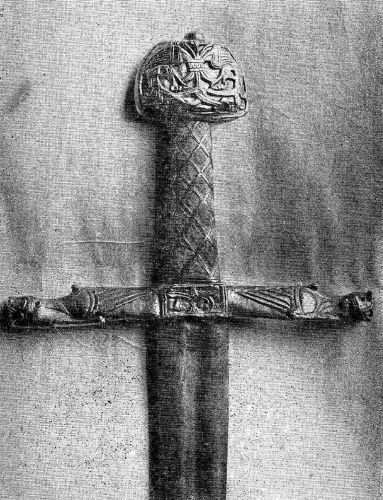
The most explicitly sacred feature attributed to Joyeuse in The Song of Roland is not found in its blade but in its pommel. The poem declares that a fragment of the lance that pierced Christ during the Crucifixion was enclosed within the sword’s golden hilt. This claim transforms Joyeuse from an exceptionally beautiful royal weapon into a reliquary capable of bringing the material memory of the Passion onto the battlefield. Charlemagne does not merely carry a sword blessed by association with a Christian ruler; he bears an object believed to contain physical matter connected directly to Christ’s wounded body. The relic places the emperor’s warfare within sacred history and suggests that his authority participates in the divine order established through Christ’s sacrifice. Joyeuse consequently joins the violence of medieval battle to the most consequential act of suffering in Christian belief.
The biblical source for the relic tradition is the Gospel of John, which recounts that a soldier pierced Christ’s side with a spear after his death, causing blood and water to flow from the wound. The Gospel does not name the soldier, identify the weapon as miraculous, or describe its later preservation. Subsequent Christian tradition named the soldier Longinus and gradually developed stories concerning his conversion, healing, martyrdom, and sainthood. The spear likewise acquired an independent sacred biography as the Holy Lance, one of several Passion relics through which medieval Christians sought material proximity to the events of the Crucifixion.
No uncontested chain of custody connected one surviving medieval spear to the weapon described in John’s Gospel. Several churches, rulers, and religious communities claimed possession of either the complete lance or fragments of it, while different traditions emerged in Rome, Constantinople, Jerusalem, Antioch, and the German imperial world. Such competing claims did not necessarily make the relic meaningless to medieval believers, because sacred matter was often understood as divisible without losing its sanctity. A fragment could remain fully connected to the holy event from which it originated, just as portions of saints’ bones, garments, or instruments of martyrdom could be distributed among numerous shrines. Relic authenticity depended upon testimony, institutional custody, ritual recognition, inherited tradition, and the reputation of the person or community presenting the object. Medieval audiences did not possess a single uniform standard by which every claim was accepted, and disputes over relics could be intense. Nevertheless, the existence of rival Holy Lances demonstrates the immense value attached to the idea that Christ’s Passion remained physically accessible. By placing a fragment in Joyeuse, the epic tradition drew upon that established devotional logic rather than inventing an isolated magical curiosity.
The pommel was an particularly meaningful location for such a relic. It rested against the warrior’s hand, balanced the blade, and marked the point at which human strength was transferred into the weapon. Enclosing sacred matter there made the hilt function as a compact reliquary whose holiness extended outward through the sword. The relic remained concealed, but its hidden presence explained why Joyeuse exceeded ordinary craftsmanship. Its power came not from visible ornament alone but from an interior sacred substance known through story, faith, and tradition.
Relics were frequently housed within objects designed to protect, display, or mobilize their holiness. Altars contained relic deposits, crosses enclosed fragments of the True Cross, crowns and pendants incorporated sacred matter, and portable reliquaries allowed rulers, clerics, and armies to carry heavenly patronage beyond a fixed shrine. Joyeuse belongs imaginatively within this broader culture of sacred containment. Its golden pommel protects the fragment while simultaneously joining it to an instrument of political and military force. The sword resembles a portable altar, but one whose blade projects outward rather than gathering worshippers around it. Charlemagne’s hand occupies the point of contact between relic and weapon, presenting the emperor as the authorized human agent through whom sacred power enters historical action. The construction also strengthens the personal bond between ruler and object, since Joyeuse can reveal its full significance only when carried by the sovereign whose wars the poem portrays as divinely favored. A common sword might wound an enemy, but Joyeuse carries into combat a physical reminder of the wound through which Christian salvation was understood to have been revealed.
The union of lance fragment and sword nevertheless creates a profound moral tension. The relic recalls Christ’s suffering and death, while the blade serves a ruler who kills in the name of justice, vengeance, and religious victory. The Song of Roland does not resolve that contradiction by rejecting violence; instead, it absorbs the Passion into an ideology of sacred warfare. Joyeuse becomes holy not because it refuses to shed blood, but because the poem presents Charlemagne’s violence as subordinate to Christian truth and providential order. The lance once pierced Christ’s body, and its fragment now legitimizes the sword through which the emperor defeats those cast as enemies of the faith.
The Weapon as Portable Altar: Christianity and the Sanctification of Warfare
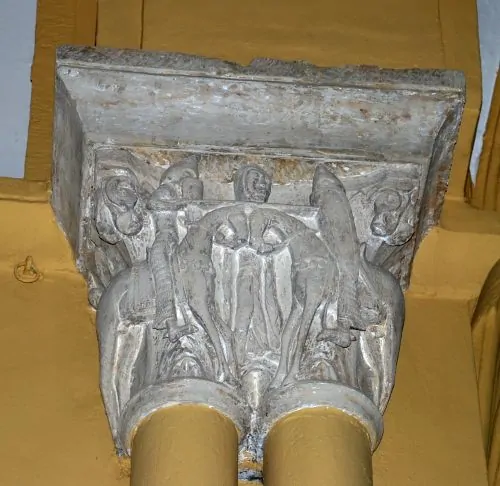
By enclosing a relic of the Holy Lance within Joyeuse, The Song of Roland imagines the sword as something more than a weapon blessed before combat. Its pommel becomes a sacred container, comparable in function to the reliquaries, crosses, and portable altars through which holy matter could travel beyond churches and shrines. The blade carries sanctity into the unstable world of campaign, pursuit, and battle. Charlemagne bears not only the insignia of royal office but a concentrated material connection to the Passion of Christ. The sword’s violence is framed as issuing from a sacred center held directly in the emperor’s hand.
This imagery emerged from a Christian culture that had long struggled to reconcile the condemnation of private violence with the practical necessity of armed rule. Late antique and medieval theologians did not generally celebrate warfare as an unqualified good, but they developed arguments by which force might be justified when exercised under legitimate authority for the defense of peace, justice, or the Christian community. Kings were expected to restrain predation, protect churches, punish wrongdoing, and defend their subjects. The sword could symbolize both the danger of coercive power and the ruler’s obligation to employ that power lawfully.
Liturgical practice made these expectations visible. By the central Middle Ages, rites for blessing swords, arming rulers, and investing warriors increasingly described weapons through explicitly moral and religious language. A sword might be presented as an instrument for defending widows, orphans, churches, clergy, and the vulnerable, while its bearer was admonished to resist injustice rather than pursue violence for personal gain. Such ceremonies did not erase the brutality of warfare or guarantee ethical conduct. They imposed an idealized purpose upon armed power and located its legitimacy within a hierarchy sanctioned by God. The weapon received meaning from the altar, the priest, the oath, and the office of the person who carried it. Joyeuse intensifies this ritual logic by placing the sacred substance not merely near the sword during a blessing but permanently within the weapon itself. Its pommel becomes an interior altar from which the blade’s authority appears to proceed.
The sword’s cruciform shape further encouraged Christian interpretation, although medieval weapons were not designed solely as devotional symbols. Crossguards served practical purposes, but when the sword was held upright they could evoke the form of the cross. Warriors might swear upon swords, pray before them, or understand their weapons through the language of sacrifice and service. The resemblance joined the instrument of Christ’s suffering to an instrument capable of inflicting suffering. In Joyeuse, that visual analogy is reinforced by the alleged presence of the lance fragment, making the weapon both sign and container of the Passion.
The sanctification of warfare became pronounced in the eleventh and twelfth centuries, the cultural environment in which the surviving Song of Roland took shape. Movements associated with the Peace and Truce of God attempted to limit aristocratic violence by protecting particular people, places, and times, even as churchmen sought to redirect military aggression toward approved purposes. Crusading then offered warriors a form of armed pilgrimage in which combat, penance, defense of sacred places, and service to fellow Christians could be joined. Contemporary preaching and narrative described such warfare through the language of devotion, vengeance for injuries against Christ, liberation, and spiritual reward. This did not create a single coherent doctrine accepted everywhere without dispute. It did provide audiences with a framework in which a warrior might shed blood while believing that his actions served a penitential and sacred cause. The Charlemagne of epic belongs to this transformed moral landscape rather than simply to the political culture of the eighth century. His campaigns become anticipations of crusading warfare, and Joyeuse becomes the ideal relic-bearing weapon of a ruler imagined as Christendom’s supreme armed defender.
Calling Joyeuse a portable altar also reveals the emperor’s unusual position between clergy and warriors. Charlemagne does not consecrate the relic or replace the priesthood, but he carries sacred matter into places where priests and fixed shrines cannot define the action. His body becomes the moving support of the reliquary, while his hand determines where its blade falls. The image grants enormous authority to the ruler because sacred history appears to accompany his decisions. Yet it also implies an obligation: the emperor’s violence must remain worthy of the relic he bears.
That obligation exposes the central tension within the Christian sanctification of weapons. The altar ordinarily gathers a community around sacrifice, prayer, and the promise of reconciliation, whereas the sword separates bodies, destroys enemies, and enforces submission. Joyeuse unites these contrary functions without dissolving their moral difference. Its holiness does not make violence harmless, and its beauty does not conceal the deaths produced by Charlemagne’s campaigns. Instead, the epic presents lethal force as legitimate when subordinated to sacred kingship, rightful vengeance, and the defense of Christian order. The sword embodies both aspiration and danger: it imagines a ruler whose violence is perfectly aligned with divine justice, while also demonstrating how easily religious symbols can authorize conquest. As a portable altar, Joyeuse makes Charlemagne’s warfare appear sacred; as a weapon, it reminds the reader that sanctity has been joined to the power to kill.
Charlemagne’s Arsenal: The Fellowship of Named Swords
Joyeuse belongs to a larger poetic society of named weapons that gives the Carolingian epic world much of its material personality. In The Song of Roland, swords are not anonymous pieces of military equipment exchanged without consequence among warriors. They bear names, histories, reputations, sacred associations, and emotional weight. Roland carries Durendal, Oliver wields Hauteclaire, Archbishop Turpin bears Almace, and Charlemagne is girded with Joyeuse. Other blades, including Murgleis and Précieuse, belong to the poem’s adversaries, extending the same heroic dignity to opponents powerful enough to test the Frankish host. Together these weapons create an armory of memory in which the identity of the sword helps define the identity of the person who carries it.
Durendal is the most fully individualized of these blades because it accompanies Roland through the catastrophe at Roncevaux. Its indestructibility mirrors his refusal to yield, while the relics said to be contained in its hilt make it a sacred trust as well as a weapon. Roland’s desperate attempt to break it against the stone expresses his fear that something so holy and honorable might pass into enemy hands. Durendal becomes the material form of fidelity carried to the edge of self-destruction.
Hauteclaire and Almace occupy less narrative space, but their names still clarify the social order surrounding Charlemagne. Oliver’s Hauteclaire, commonly understood as “High-Clear” or “Lofty-Bright,” suits a warrior repeatedly associated with discernment, restraint, and clear judgment. Oliver recognizes the danger at Roncevaux before Roland does and urges him to summon aid, making the sword’s brightness resonate with the intellectual clarity of its bearer. Almace, carried by Archbishop Turpin, accompanies a figure who collapses the distinction between clerical and military service. Turpin blesses, exhorts, absolves, and fights, while his sword makes visible the poem’s conviction that sacred office and armed defense can operate together. These weapons do not possess identical symbolic weight, but they participate in a shared structure: the sword externalizes the defining quality of the warrior. The named blade acts almost as a second title, allowing reputation to be carried, displayed, and remembered in material form. Because the warriors belong to a hierarchy of service, their swords likewise form a hierarchy whose summit is occupied by the emperor’s Joyeuse.
The poem also grants named swords to powerful enemies, preventing Frankish heroism from appearing impressive only because it destroys faceless opponents. Ganelon possesses Murgleis, a magnificent sword whose value emphasizes that treachery can inhabit the same aristocratic culture as loyalty. Baligant carries Précieuse, a name that deliberately parallels Joyeuse and helps establish him as Charlemagne’s rival rather than an ordinary battlefield adversary. The duel between the emperors is also an encounter between two sovereign blades. By giving distinction to the enemy’s weapons, the poem magnifies the authority of the ruler who ultimately defeats them.
Later chansons de geste expanded this fellowship of swords well beyond the weapons most prominent in The Song of Roland. Ogier the Dane became associated with Courtain, or Cortain, a shortened sword whose name could be explained through stories about its broken or deliberately blunted point. Other traditions connected famous blades through shared makers, related materials, inheritance, conquest, or transfer between heroes. These connections did not form one perfectly consistent mythology, because the chansons developed across different regions and centuries and frequently contradicted one another. Yet the contradictions reveal how eagerly medieval storytellers treated swords as participants in heroic history. A blade could outlive one owner, enter another narrative cycle, acquire relics, receive a new origin, or become the subject of retrospective genealogy. The weapon’s biography extended beyond the life of the warrior, allowing epic memory to travel through matter even when the matter itself was imagined. In this broader tradition, an arsenal was not merely a collection of tools but a fellowship of storied objects whose relationships echoed those of their bearers.
Joyeuse nevertheless remains distinct from Durendal, Hauteclaire, Almace, and the other named blades because it represents sovereignty rather than vassal service. Roland’s sword belongs to a hero whose glory is completed in death, while Joyeuse remains with the ruler responsible for avenging that death and restoring political order. Its position at Charlemagne’s side places the other weapons within an imperial hierarchy, just as the warriors who carry them derive honor from their relationship to the emperor. Charlemagne’s arsenal is not best understood as a literal inventory of historically attested possessions. It is a symbolic arrangement in which every sword identifies a moral and political role. Joyeuse stands at the center because the poem’s world requires a weapon capable of gathering the virtues, sacrifices, and victories of the entire Frankish fellowship into the person of the king.
Forging the Imperial Blade
A weapon as extraordinary as Joyeuse eventually required an origin equal to its reputation. The Song of Roland presents the sword as already complete, famous, and attached to Charlemagne, but later audiences naturally asked who had forged it, what materials had entered its blade, and how it had come into the emperor’s possession. Such questions reflect a recurrent principle of heroic literature: exceptional objects should not emerge from ordinary workshops without explanation. The maker of a legendary sword becomes almost as important as the warrior who carries it because craftsmanship supplies the first stage of the weapon’s destiny. Fire, iron, hammer, and anvil provide a material language through which hidden power can be awakened and given permanent form. By assigning Joyeuse a marvelous manufacture, later traditions extended its biography backward beyond Charlemagne and made the sword exceptional before it ever entered his hand.
The earliest surviving Song of Roland does not identify Joyeuse’s smith or describe the forging of its blade. Its principal origin claim concerns the fragment of the Holy Lance enclosed in the golden pommel, which explains the sword’s sacred dignity and, within the poem, contributes to the significance of its name. The distinction matters because the relic was embedded in a weapon that already existed rather than necessarily melted into its metal during manufacture. Later retellings often blurred that difference, converting sacred enclosure into sacred forging and thereby making every part of Joyeuse appear physically infused with the Passion.
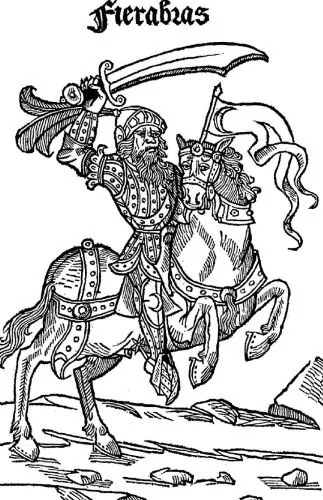
In traditions associated with Fierabras, the forging of Joyeuse was attributed to the renowned smith Galant, whose name also appears in forms such as Galas and Galans. Medieval poets invoked such a smith not as a documented Carolingian artisan but as a figure belonging to a legendary genealogy of craftsmanship. Galant was associated with other extraordinary weapons and was sometimes understood as a French relative or adaptation of the Germanic smith Wieland, known in Old English as Wayland and in Old Norse as Völundr. Across these traditions, the master smith occupies an ambiguous position between human artisan and supernatural being. He commands fire and metal, transforms resistant matter, and produces objects whose qualities surpass the abilities of ordinary craftsmen. His workshop is a place of both technology and mystery. Attributing Joyeuse to Galant gave the sword an ancestry rooted in an older mythology of smithcraft while allowing that mythology to be absorbed into the Christian and imperial world of Charlemagne. The weapon containing a relic of Christ could owe its material perfection to a craftsman descended from a far less explicitly Christian imaginative past.
Other versions altered the identity and nature of the maker. In a Norse adaptation of the Floovant tradition, Joyeuse was reportedly forged by a dwarf whose hammering split the anvil beneath the force of his work. The image belongs to a widespread northern European association between dwarfs, subterranean knowledge, precious materials, and unsurpassed metalworking. It also intensifies the blade’s origin by showing that its creation strains or breaks the ordinary equipment of the forge. Joyeuse is not simply shaped upon an anvil; its emergence demonstrates that normal material boundaries cannot contain it.
The proliferation of forging stories also encouraged attempts to connect Joyeuse with other legendary swords through shared makers or related materials. Medieval and later traditions sometimes arranged famous blades into families, suggesting that Joyeuse, Durendal, and Courtain emerged from the same workshop or from closely associated acts of manufacture. Such relationships gave swords a form of kinship paralleling the fellowship, rivalry, and hierarchy of the heroes who carried them. Yet these accounts did not constitute one stable canon accepted across the Matter of France. A sword might have one maker in a French chanson, another in a northern adaptation, and no stated maker at all in an earlier poem. Modern summaries frequently suppress those differences and present a single polished story in which Galas began Joyeuse around 802 CE, labored upon it for three years, and incorporated the Holy Lance into its construction. That version supplies the precise dates and technical sequence expected of modern biography, but such details cannot be treated automatically as evidence preserved from Charlemagne’s lifetime. They often represent the final stage of accumulation, when scattered medieval motifs are reorganized into a seemingly continuous narrative. The more exact the story becomes, the more carefully its textual origin must be examined.
The changing accounts of Joyeuse’s manufacture reveal how legend enlarges itself by answering questions earlier texts left open. Galant connects the sword to the mythic prestige of the master smith, the dwarf forger links it to supernatural control over metal, and the Holy Lance gives its material existence a Christian sacred center. These explanations are inconsistent when treated as literal history, but they are mutually illuminating when treated as expressions of cultural desire. Each tradition sought to ensure that Charlemagne’s weapon possessed no ordinary beginning. Joyeuse became not merely a sword that later acquired holiness and fame, but an object imagined as destined for greatness from the first strike of the hammer. Its forge was another theater of retrospective legitimacy, shaping imperial destiny in metal before the legendary emperor ever drew the blade.
Joyeuse beyond The Song of Roland: The Growth of the Charlemagne Tradition
Joyeuse did not remain confined to the narrative world of The Song of Roland. As stories about Charlemagne circulated through chansons de geste, chronicles, Latin histories, vernacular adaptations, and regional legends, the emperor’s sword traveled with him as one of the recognizable signs of his identity. Medieval authors did not preserve a single fixed biography of the weapon, nor did they always repeat the same claims about its manufacture, relic, radiance, or powers. Instead, Joyeuse participated in a larger process through which the historical Frankish ruler became the central figure of the Matter of France. Charlemagne could appear as conqueror, pilgrim, lawgiver, defender of Rome, avenger of Christian injury, and patriarch of a vast fellowship of heroes. His sword helped maintain continuity among these changing roles by making imperial authority visible whenever the emperor entered the narrative armed.
The wider Charlemagne tradition expanded because it answered needs that changed across regions and centuries. Monasteries, royal courts, aristocratic households, urban audiences, and performers could emphasize different aspects of the emperor’s memory. Some traditions drew attention to his wars in Iberia, while others imagined journeys to Jerusalem, Constantinople, Italy, or distant pagan territories. Joyeuse remained adaptable because a sacred imperial sword could accompany nearly any version of Charlemagne without fixing him to one historical campaign.
Works such as the Descriptio qualiter Karolus Magnus and the Historia Karoli Magni et Rotholandi, commonly called the Pseudo-Turpin Chronicle, demonstrate how readily Charlemagne’s legend absorbed pilgrimage, relics, apostolic mission, and sacred warfare. These texts do not treat the emperor merely as a secular conqueror whose victories happen to benefit Christianity. They place him within an explicitly providential history in which visions, saints, relics, shrines, and divinely directed campaigns shape imperial action. Although Joyeuse does not occupy the same prominence in every branch of this tradition, the religious environment surrounding the sword becomes increasingly intelligible through such works. A blade containing a fragment of the Holy Lance belongs naturally beside an emperor imagined as recovering sacred objects, defending holy places, and extending Christian order. The weapon participated in a broader conversion of Carolingian memory into sacred biography. Charlemagne’s military equipment could be understood as part of his spiritual office because later authors presented his entire reign as an instrument of providence. Joyeuse gained significance not only from what individual poems said about it, but from the steadily enlarging holiness of the ruler who carried it.
The transmission of Charlemagne material beyond France further diversified the sword’s meanings. Old Norse compilations gathered French epic traditions into the Karlamagnús saga, while Italian poets and chroniclers transformed Charlemagne’s warriors into figures suited to new political and literary settings. Iberian traditions remembered the emperor through their own experience of frontier warfare, pilgrimage routes, and rivalry with Frankish claims. In each case, translation involved more than replacing one language with another. Names, genealogies, motives, locations, and magical objects could all be adjusted to fit the expectations of a different audience.
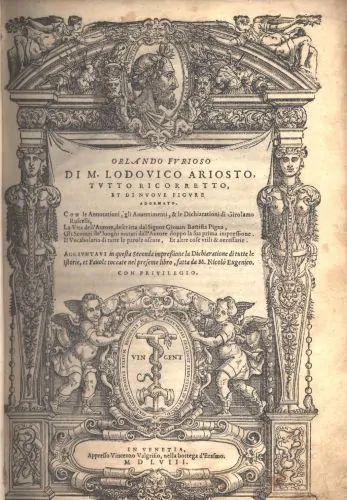
By the later Middle Ages and Renaissance, the Matter of France had become a vast imaginative reservoir rather than a closed body of consistent narratives. Italian works such as Luigi Pulci’s Morgante, Matteo Maria Boiardo’s Orlando Innamorato, and Ludovico Ariosto’s Orlando Furioso inherited Charlemagne’s court while transforming its tone, geography, morality, and supernatural possibilities. These poems often shifted attention away from the emperor toward wandering knights, romantic entanglements, marvels, enchantments, and conflicts that exceeded the sober political hierarchy of earlier chansons de geste. Joyeuse consequently belonged to a world in which legendary weapons were increasingly expected to possess elaborate histories and exceptional properties, even when a particular retelling did not make the sword central to its plot. The comparison with Excalibur became tempting in later reception because both swords came to signify idealized kingship, but the traditions developed differently. Excalibur’s authority is frequently tied to miraculous acquisition and Arthur’s unique sovereignty, whereas Joyeuse derives much of its force from Charlemagne’s accumulated reputation and from later claims of ritual inheritance. Its legend grew through addition rather than through one definitive origin story. As Charlemagne moved from epic history into romance, chronicle, royal ideology, and international folklore, Joyeuse became less a single textual object than a portable emblem of the entire tradition. The sword’s endurance reflects the adaptability of the emperor himself: each age could remake Charlemagne, and Joyeuse could be remade beside him.
From Epic Weapon to Royal Relic: The Capetian Appropriation of Charlemagne

When Hugh Capet replaced the last Carolingian king in 987 CE, the new dynasty could not build durable authority by presenting itself as a complete rupture with the Frankish past. The early Capetians controlled a relatively restricted royal domain and depended heavily upon alliances with bishops, monasteries, castellans, and powerful territorial princes. Charlemagne offered them a model of kingship whose prestige transcended the dynasty that had actually descended from him. By claiming his legacy, Capetian rulers could portray themselves not as successors who had displaced the Carolingians but as guardians of the Christian and political order Charlemagne supposedly founded. This appropriation did not require a demonstrable genealogical line from emperor to king. It depended upon ceremonies, narratives, relics, institutions, and objects capable of making symbolic succession appear more consequential than biological descent.
The Abbey of Saint-Denis became one of the most important places in which this continuity was constructed. It possessed the tomb of the kingdom’s patron saint, developed into the favored burial place of French kings, and accumulated objects associated with royal ceremony and sacred history. Its monks also produced and preserved narratives that linked the abbey to earlier Frankish rulers. Through Saint-Denis, Capetian monarchy acquired an institutional memory older than the dynasty itself.
A particularly influential legend claimed that Charlemagne had traveled eastward, liberated Jerusalem, received relics of the Passion, and carried them to Aachen before Charles the Bald transferred some of them to Saint-Denis. The account, preserved in the work commonly known as the Descriptio qualiter, was not a reliable record of an actual Carolingian expedition. It was a historical myth shaped within the religious and political environment of the eleventh century. By placing relics of Christ’s suffering in Charlemagne’s possession, the story transformed him into a sacred conqueror whose authority embraced both eastern and western Christendom. By then transferring those relics to Saint-Denis, it made the abbey the material heir of his imperial piety. The monks benefited because their treasury appeared to have been founded and enriched by the greatest Christian emperor. The Capetian kings benefited because their close association with Saint-Denis allowed them to inhabit the same sacred history. Joyeuse, with its supposed fragment of the Holy Lance, fitted naturally into this increasingly dense web of Carolingian relic traditions.
The process became powerful under Louis VI, Louis VII, Philip II, and Louis IX, when the Capetian monarchy grew more territorially assertive and more closely identified with the cult of royal and Passion relics. Louis IX’s acquisition of the Crown of Thorns and other relics from Constantinople allowed him to imitate the Charlemagne described in the Saint-Denis legends. He too became a king who transferred sacred objects from the Christian East into the heart of the French realm. The Capetian appropriation of Charlemagne was not confined to literary praise; it shaped royal behavior, ceremonial display, architectural patronage, and claims about France’s special place within Christian history.
The transformation of Joyeuse from epic sword into royal relic becomes historically intelligible. The surviving coronation sword is first securely mentioned in 1271, long after Charlemagne’s death and after The Song of Roland had made Joyeuse famous. It was preserved at Saint-Denis among the regalia later described collectively as the “Honors of Charlemagne,” a category that converted ceremonial objects of different dates and origins into the inherited possessions of one foundational emperor. The sword’s authority did not depend upon proving that Charlemagne had actually worn it. Its presence in the royal treasury, its repeated identification by name, and its participation in coronation ritual gradually supplied a different kind of authenticity. Each king who received or was represented beside Joyeuse appeared to enter Charlemagne’s succession, not as a private owner inheriting personal property but as the occupant of an enduring sacred office. The Capetians turned an object celebrated in epic into evidence for the antiquity of their monarchy. Joyeuse ceased to belong exclusively to Charlemagne because it had become the transferable sword of French kingship, carrying imperial memory from one anointed body to the next.
The Surviving Joyeuse: A Composite Object across the Centuries
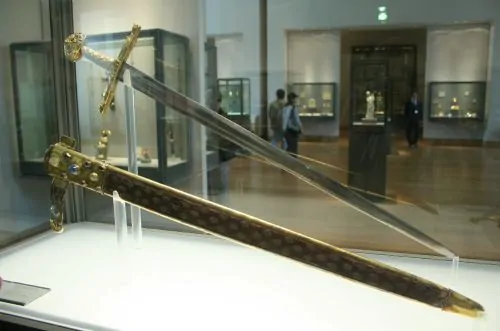
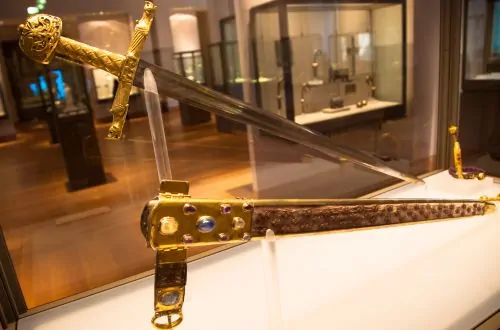
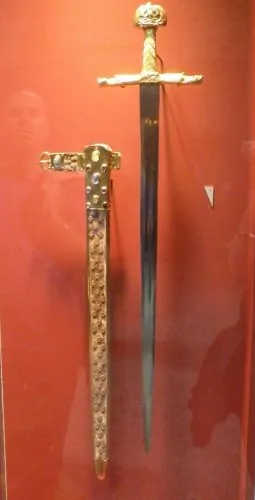
The sword preserved today in the Louvre under the name Joyeuse is not a single object made at one moment and transmitted unchanged from Charlemagne’s reign. It is a composite assemblage whose blade, pommel, grip, crossguard, ornament, and scabbard belong to different phases of manufacture and alteration. Some components appear medieval, others were added or refashioned in later centuries, and still others reflect restoration undertaken when the sword continued to serve ceremonial or political purposes. This layered construction makes the surviving Joyeuse difficult to ut unusually valuable as evidence for the changing life of royal regalia. Rather than representing one frozen point in time, it preserves the material accumulation of several historical moments.
The blade has attracted particular attention because it offers the strongest possible point of contact with the sword’s supposed early history. Scholars have proposed different dates for it, ranging from the Carolingian period to later medieval centuries, and no consensus has transformed the attribution to Charlemagne into certainty. Its form is compatible with medieval weapon-making traditions, but compatibility is not proof of personal ownership by the emperor. Even if the blade were shown to date from Charlemagne’s lifetime, that would establish only its age, not that he carried it or called it Joyeuse.
The hilt reveals even more clearly how the sword developed through successive acts of adaptation. Its pommel, grip, and crossguard do not form an untouched Carolingian ensemble, and their ornamental language points toward periods later than the early ninth century. The gold work, figural or zoomorphic forms, and sculptural treatment of the guard indicate that the sword was repeatedly reshaped to meet ceremonial expectations. These changes did not necessarily reflect deception. Medieval and early modern custodians commonly repaired, embellished, and renewed revered objects without believing that such intervention destroyed their identity. A damaged grip could be replaced, a guard could be strengthened, or a pommel could be refitted while the sword remained institutionally and ritually the same object. Joyeuse’s identity resided not only in the age of each component but in continuity of name, custody, and use.
The scabbard presents another layer of complexity because it belongs more to the world of regalia than to that of ordinary battlefield equipment. Its luxurious materials and decorative treatment transformed the sword into a ceremonial object designed to be carried, displayed, and recognized within royal ritual. A coronation sword required visual magnificence from a distance, especially when seen amid robes, banners, crowns, reliquaries, and processional movement. The scabbard helped convert a weapon into a sign of office. Its function was not merely protective but theatrical and political.
Repeated modification also reflects the practical demands placed upon an object used across centuries. A sword carried in coronations had to remain structurally sound, visually impressive, and compatible with changing ceremonial costume. Restoration could involve replacing worn coverings, tightening fittings, repairing ornament, or reworking elements to suit a new conception of historical splendor. Such interventions complicate modern attempts to identify an “original” Joyeuse because originality itself becomes difficult to define. The earliest surviving component may not have been the first to bear the name, while a later addition may have played a central role in the sword’s most historically important ceremonies. The object’s biography cannot be reduced to the age of its oldest metal. It must include the hands that repaired it, the institutions that guarded it, the rulers who used it, and the audiences who accepted it as Charlemagne’s sword.
The sword’s removal from Saint-Denis during the French Revolution introduced another decisive transformation. Once detached from the royal treasury and stripped of its active role in coronation, Joyeuse could be reclassified as national property, artistic masterpiece, historical evidence, or surviving monument of a rejected political order. Revolutionary confiscation endangered many regalia, but it also transferred selected objects into new systems of preservation. Joyeuse survived because it could be made useful to a national narrative even after the monarchy that had animated it was dismantled.
Its present condition is the result of preservation through change rather than survival without change. The Louvre object cannot be treated responsibly as a perfectly intact weapon from Charlemagne’s lifetime, but neither should it be dismissed as a meaningless fabrication. It is authentic as a medieval and early modern ceremonial assemblage, authentic as the sword used in French coronation tradition, and authentic as an object repeatedly identified with Charlemagne by institutions that exercised real political and religious authority. Its composite nature is not an embarrassment to be explained away; it is the clearest material expression of how Joyeuse acquired power. Each alteration joined another generation to the legend, allowing the sword to remain visually persuasive and ritually functional long after its earliest parts were made. The surviving Joyeuse is less the fossil of one historical moment than a material archive of monarchy, memory, craftsmanship, and belief.
Was This Charlemagne’s Sword? Attribution and the Meaning of Authenticity

The question of whether the surviving Joyeuse was actually Charlemagne’s sword appears simple only until the evidence is examined closely. No contemporary Carolingian document identifies the Louvre object, records its preservation, or establishes an uninterrupted chain of custody from the emperor’s death in 814 CE to its later appearance in the royal treasury. The sword is first securely documented many centuries after Charlemagne, by which time epic poetry, monastic tradition, and royal ceremony had already transformed his memory. This chronological gap does not make the attribution impossible in an absolute sense, but it prevents historians from treating it as demonstrable fact. The burden of proof is high because the object itself contains components from different periods rather than forming one untouched Carolingian weapon.
The blade has usually provided the strongest basis for arguments in favor of an early date. Its shape and construction have been compared with swords from the Carolingian and post-Carolingian worlds, leading some scholars to suggest that it may preserve metal from the ninth or tenth century. Other analyses have placed it later, emphasizing the difficulty of dating an uninscribed blade that has undergone repeated alteration and ceremonial reuse. Even the earliest plausible date would prove only that the blade could have existed during or soon after Charlemagne’s lifetime. It would not prove that he owned it, named it Joyeuse, carried it in battle, or transmitted it to the institutions that later claimed it.
The hilt and scabbard weaken any claim that the surviving object is wholly Carolingian, but they do not make the sword historically insignificant. The pommel, guard, grip, and decorative features reflect several phases of medieval and later craftsmanship, while restoration altered the ensemble further. These additions show that the sword was maintained as living regalia rather than preserved as an archaeological specimen. Custodians repaired and reshaped it because its ceremonial function mattered more than retaining every original component. Modern expectations often assume that authenticity requires physical purity, but royal regalia commonly survived through renewal. A crown could receive new jewels, a reliquary could acquire replacement panels, and a sword could be rehilted without losing its inherited identity. Joyeuse remained Joyeuse because successive institutions recognized, guarded, displayed, and used it under that name. It is useful to distinguish several forms of authenticity that are often confused. Biographical authenticity would mean that Charlemagne personally owned or carried the sword, a claim that cannot presently be established. Material authenticity would mean that one or more components date from his age, which remains possible for the blade but disputed. Ceremonial authenticity is much firmer because the object genuinely served as the French coronation sword and participated in rituals that shaped royal power. Traditional authenticity refers to the sustained belief that the sword was Joyeuse, preserved within Saint-Denis and later royal institutions as part of Charlemagne’s legacy. These categories do not possess equal evidentiary strength, but each describes a real historical relationship. The mistake lies in allowing the certainty of later ceremonial use to substitute automatically for proof of Carolingian ownership.
Joyeuse demonstrates that an attribution can be materially uncertain while remaining historically powerful. French kings did not need modern archaeological confirmation before the sword could connect them to Charlemagne, because its authority arose through ritual repetition, institutional custody, and collective recognition. The belief that the object had belonged to the emperor shaped coronations, royal display, dynastic memory, and later museum interpretation, producing consequences that were entirely real even if the original attribution was mistaken. To dismiss the sword simply as a forgery would impose an overly narrow standard upon an object whose identity accumulated across centuries. To call it unquestionably Charlemagne’s personal weapon would ignore the documentary silence and composite material evidence. The most responsible conclusion is that the Louvre Joyeuse is authentically the historic coronation sword known for centuries as Charlemagne’s, while its direct physical connection to the emperor remains unproven.
Making a King: Joyeuse at the Coronation
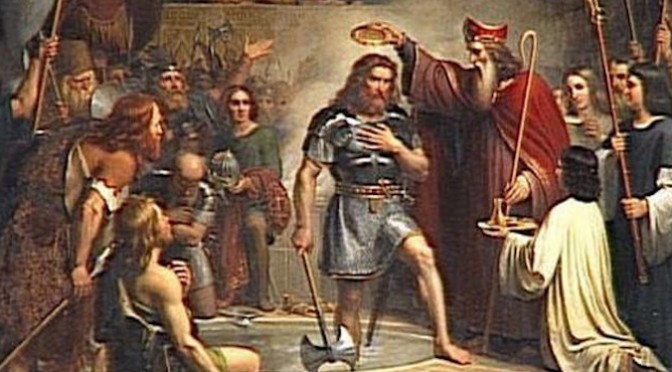
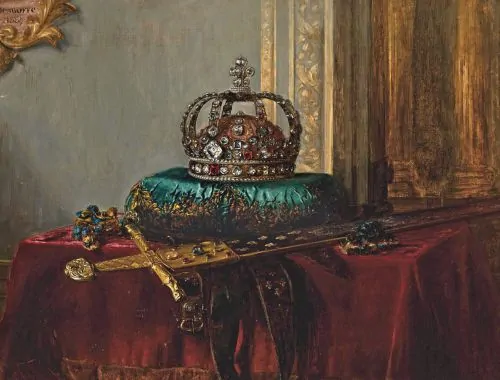
At the French coronation, Joyeuse did not function merely as an antique displayed beside the crown. It participated in the ritual transformation through which a royal heir became an anointed king charged with governing a Christian realm. The sword was brought from the treasury of Saint-Denis with other regalia and incorporated into the ceremonies at Reims, where tradition associated French kingship with the baptism of Clovis and the miraculous Holy Ampulla. Its movement from abbey treasury to cathedral altar gave the weapon a ceremonial journey of its own. Joyeuse entered the sacred space as an object already burdened with Carolingian memory, then became part of the public creation of a new sovereign. By receiving the sword, the king appeared not simply to inherit property but to assume a martial and judicial office sanctified by the Church.
The sword’s presence must be understood alongside the king’s promises and oaths. Before the full completion of the coronation, the ruler pledged to defend the Church, preserve justice, protect the peace, and govern according to the obligations of Christian kingship. These promises placed moral limits upon the force symbolized by Joyeuse. The weapon authorized violence only insofar as that violence served the ordered community the king had sworn to defend.
The liturgical handling of the sword made this relationship between power and obligation visible. Depending upon the period and the form of the rite, the weapon could be presented at the altar, blessed, delivered to the king, girded upon him, drawn from its scabbard, and then entrusted to an officer who carried it before him. Each action altered its meaning. On the altar, Joyeuse appeared subordinate to sacred authority; in the king’s hands, it became the instrument of royal action; carried upright in procession, it announced that coercive power accompanied the monarch wherever he went. The sword was never simply personal, even when physically held by the ruler. It belonged to the office and to the ritual community that recognized that office. The king received it conditionally, under oath and within a ceremony that defined the purposes for which it should be used. Joyeuse joined possession to accountability, making the sovereign both master of the sword and servant of the justice it represented.
The involvement of the Abbey of Saint-Denis strengthened the impression of continuity with an ancient and sacred monarchy. Its custodians did not merely transport valuable objects; they conveyed the accumulated memory of earlier kings into the coronation. The presence of Joyeuse among the so-called Honors of Charlemagne allowed the new ruler to appear as heir to the emperor’s authority, even though the sword’s direct connection to Charlemagne could not be historically demonstrated. Ritual repetition gradually made that identification more authoritative than documentary proof.
Once drawn and displayed, Joyeuse helped create the king before the eyes of clergy, nobles, officers, and assembled spectators. The crown signified elevation, the oil conveyed sacred consecration, the scepter represented governance, and the hand of justice expressed judicial authority; the sword added the power to defend, punish, and command. These objects did not operate separately but formed a coordinated language of monarchy in which each clarified the others. Joyeuse’s legendary past intensified that language by connecting the newly crowned king to Charlemagne’s imagined empire, Christian victories, and defense of the faith. The sword bearer who carried it before the monarch transformed the blade into a moving emblem of sovereignty, visible even when the king was not actively wielding it. Its unsheathed or elevated form proclaimed readiness, while its ceremonial control suggested that royal violence had been disciplined by oath, liturgy, and hierarchy. The coronation did more than place Joyeuse in the king’s possession. It used Joyeuse to place the king within an inherited order of sacred responsibility. Each coronation renewed the fiction of uninterrupted continuity, allowing an object assembled across centuries to make a newly anointed ruler appear ancient, legitimate, and divinely authorized.
The Sacred Geography of French Monarchy
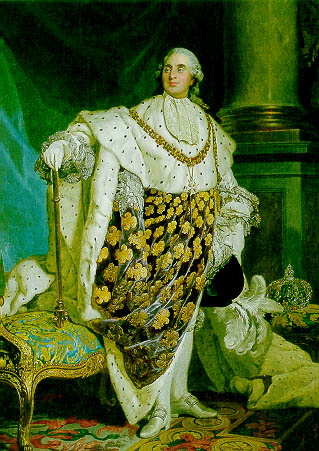
French kingship did not reside in a single capital, shrine, palace, or treasury. Its authority was distributed across a network of places, each of which contributed a different historical and sacred meaning to monarchy. Reims provided the principal setting for royal consecration, Saint-Denis preserved dynastic memory and much of the regalia, Paris increasingly concentrated government and courtly power, while Aachen and Rome remained essential to the imperial memory of Charlemagne. Joyeuse moved conceptually and sometimes physically among these centers. Its significance depended not only upon what the sword was believed to be, but also upon where it was kept, where it was displayed, and through which sacred spaces it traveled.
Reims drew its authority from the tradition that associated the city with the baptism of Clovis by Bishop Remigius. Later legend held that the Holy Ampulla containing miraculous chrism had descended from heaven for that baptism, establishing a sacred continuity between the conversion of the Franks and the anointing of French kings. The cathedral offered more than an impressive architectural setting. It presented coronation as the renewal of a covenant joining monarchy, Church, and Christian people.
The development of Reims as the customary place of coronation was gradual rather than automatic, and not every French king was crowned there. Nevertheless, by the central Middle Ages its claims had become extraordinarily powerful. The archbishop of Reims asserted a privileged role in consecrating the ruler, while the liturgy connected the new king to biblical monarchs, Frankish origins, and the sacramental authority of anointing. The city transformed succession into sacred history: a prince entered the cathedral as heir and emerged as the Lord’s anointed king. Joyeuse participated in this transformation because it accompanied a ceremony structured around the visible convergence of several pasts. The sword recalled Charlemagne, the chrism recalled Clovis, and the cathedral itself projected continuity through architecture, relic, ritual, and episcopal authority. None of these connections needed to rest upon modern standards of documentary verification to possess political force. Repetition made them credible, while the participation of clergy, peers, officers, and spectators turned inherited stories into public reality. Reims served as the place where dynastic contingency was made to appear providential.
Saint-Denis exercised a different but complementary form of power. The abbey was associated with the patron saint of the French kingdom, served as a major royal necropolis, and guarded objects used in coronations and funerals. Whereas Reims created the king through consecration, Saint-Denis preserved the longer memory of kingship. Its treasury gathered relics, regalia, gifts, and attributed possessions into a material history of the monarchy.
The sword called Joyeuse acquired much of its authority within this treasury environment. At Saint-Denis it belonged among objects whose prestige depended upon sacred custody, royal association, and repeated identification across generations. The abbey’s monks helped shape the memory of Frankish and French rulers by preserving records, composing narratives, maintaining tombs, and presenting the treasury as evidence of an ancient alliance between saint, dynasty, and realm. Objects associated with Charlemagne became valuable because they allowed later kings to inherit imperial dignity without possessing either his dynasty or his empire. The so-called Honors of Charlemagne did not constitute a perfectly preserved collection of ninth-century regalia. They formed a ceremonial assemblage in which objects of varied dates were gathered beneath the emperor’s name. Joyeuse could become more authentically royal through its presence at Saint-Denis even while its biographical connection to Charlemagne remained uncertain. The abbey converted custody into legitimacy. By guarding the sword, producing the memory surrounding it, and releasing it for royal ceremony, Saint-Denis acted as mediator between the dead emperor and the living king.
Paris added another element to this geography as the monarchy became increasingly centered upon the Île-de-France. Royal palaces, administrative institutions, courts of justice, the Sainte-Chapelle, and the growing political prominence of the city made Paris the practical heart of government even though it did not replace Reims or Saint-Denis in their specialized ceremonial roles. The concentration of Passion relics in the Sainte-Chapelle under Louis IX gave Paris its own claim to sacred kingship. French monarchy was strongest when these places reinforced rather than displaced one another.
Beyond the kingdom, Aachen and Rome anchored Joyeuse within a still wider imaginative geography. Aachen contained Charlemagne’s palace chapel and tomb, preserving the memory of his imperial court and making the city a rival center of Carolingian inheritance. Rome recalled the imperial coronation of 800 CE and the alliance, however contested, between Frankish rulership and papal authority. French kings could not monopolize these places, but they could translate their meanings into their own rituals by presenting Joyeuse as the weapon of the emperor whose authority linked Frankish monarchy to Christian empire. The sword’s journey from the treasury of Saint-Denis to coronation at Reims symbolically compressed this scattered geography into one ceremonial object. It carried the memory of Aachen without leaving France, invoked Rome without requiring papal coronation, and joined the relic culture of Paris to the royal dead at Saint-Denis. Joyeuse belonged to no single sacred site. Its power emerged from movement among places whose combined traditions made French monarchy appear at once Frankish, Christian, imperial, dynastic, and divinely ordained.
The Sword of Justice: What Joyeuse Authorized the King to Do

Within the French coronation, Joyeuse represented more than the king’s capacity to wage war. It signified his possession of the coercive power necessary to defend the realm, punish wrongdoing, preserve public order, and protect the Church. Medieval political thought did not imagine justice as an entirely peaceful activity, because law without the ability to compel obedience could be rendered ineffective by rebellion, private warfare, or aristocratic resistance. The ruler’s sword embodied the force standing behind judgment. It authorized the king to act against those who disturbed the peace, but it also implied that royal violence must serve a purpose beyond anger, enrichment, or personal revenge. Joyeuse made visible the claim that legitimate force belonged to the office of kingship rather than simply to the strongest armed man.
This understanding drew upon a long Christian interpretation of the ruler as the bearer of the temporal sword. Clerical authors commonly distinguished the coercive authority of kings from the spiritual authority exercised by priests, even though the two powers were expected to cooperate. The Church might define moral obligations, condemn injustice, or impose spiritual penalties, while the king possessed the armed means to restrain those who refused lawful correction. Joyeuse symbolized an authority that was political, judicial, and religiously accountable without being sacerdotal.
The coronation rites placed explicit limits upon that authority by surrounding the sword with oaths, blessings, and admonitions. The king promised to preserve justice, protect churches, defend vulnerable subjects, and maintain the peace before receiving the full insignia of rule. When the sword was presented to him, its ceremonial meaning was conditioned by those promises. He did not receive unrestricted permission to kill; he received an instrument whose legitimate purposes had already been defined. The blade could represent punishment of criminals, resistance to invasion, suppression of rebellion, or defense of the Christian community, but each use was supposed to be governed by justice rather than appetite. Medieval kings frequently violated these ideals, and royal warfare often served ambition, dynastic advantage, or territorial expansion. Nevertheless, the existence of abuse did not make the ideal politically irrelevant. Subjects, clergy, nobles, and rival claimants could invoke the king’s sworn obligations when judging his conduct. Joyeuse empowered the ruler while simultaneously exposing him to a standard by which his use of force could be condemned.
The sword also linked justice to the maintenance of peace, a concept that did not mean the mere absence of conflict. Royal peace required the suppression of feuds, protection of roads and markets, enforcement of judgments, and control over those who used private violence to resist lawful authority. As French monarchy expanded, kings increasingly presented themselves as supreme guardians of order whose justice could reach beyond the limits of local lordship. Joyeuse supported that claim by making the king’s coercive authority appear ancient, sacred, and continuous with the rule of Charlemagne. The sword of the legendary emperor became the weapon through which later kings imagined themselves imposing unity upon a divided realm.
Yet the symbolism remained dangerous because almost any act of royal aggression could be described as the restoration of justice. Conquest might be called the recovery of rightful territory, repression might be portrayed as punishment of treason, and war against political opponents could be sanctified as defense of Church and kingdom. Joyeuse did not itself determine whether the king’s cause was just; it dramatized the monarchy’s claim to possess the authority to make and enforce that judgment. The same sword could signify protection to those favored by royal order and domination to those placed outside it. Its beauty, antiquity, and sacred associations helped conceal the instability at the heart of coercive kingship. The king was authorized to use violence because he was imagined as just, yet his ability to define justice depended heavily upon his command of violence. Joyeuse embodied that circular power, presenting the royal sword as both the guardian of law and the ultimate means by which the king compelled the realm to accept his law.
Joyeuse as Political Theater
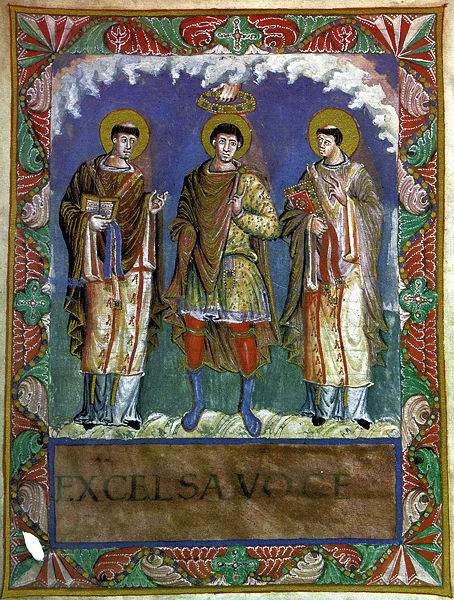
French coronation was not a private sacrament performed solely for the king and clergy. It was a carefully ordered public drama in which sacred objects, gestures, costumes, processions, music, architecture, and ranked participants made an abstract claim to sovereignty visible. Joyeuse occupied a central place within this theater because it joined royal magnificence to the practical reality of armed power. When carried into the cathedral, placed near the altar, presented to the king, or borne upright before him, the sword communicated differently at each stage of the rite. Its legendary association with Charlemagne supplied historical depth, while its glittering materials and imposing form demanded immediate visual attention. The audience did not need to examine the sword’s disputed material history to understand that it represented an ancient and formidable monarchy.
The altar established the hierarchy within which Joyeuse could be used legitimately. Before becoming an emblem of royal command, the sword entered a sacred setting governed by prayer, blessing, oath, and anointing. Its proximity to the altar implied that force must remain subordinate to divine law and ecclesiastical judgment. Yet the Church’s ceremonial handling of the weapon helped authorize the king’s claim that his coercive power possessed sacred approval.
The coronation audience was itself arranged as a representation of the kingdom. Bishops, abbots, princes, peers, officers, nobles, and other spectators occupied places that reflected rank and political function. Their presence transformed the ceremony from a unilateral declaration by the monarch into a staged recognition of his authority by the realm’s principal communities. Joyeuse moved before these witnesses as both an object of inheritance and a promise of future action. Clergy could understand it as the sword charged with defending the Church, nobles as the supreme weapon within the hierarchy of aristocratic warfare, and royal officers as the sign of the authority they would administer in the king’s name. Foreign envoys might read its association with Charlemagne as a claim to exceptional antiquity and prestige. More distant spectators, unable to hear every prayer or see every detail, could still recognize the elevated blade as a condensed image of kingship. Political theater worked precisely because one object could sustain several meanings at once without requiring them to be identical.
The sword bearer intensified this public meaning by separating Joyeuse from the king’s private grip while keeping it visibly attached to his person. Carried before the monarch, the sword announced his approach and projected his authority into the space ahead of him. Its upright position made it resemble a standard, cross, and weapon simultaneously. The bearer’s subordinate role also demonstrated that royal power operated through offices and servants rather than through the king’s body alone. Joyeuse became an emblem of delegated authority, showing how the sovereign’s command extended through a structured political community.
The effectiveness of this theater depended upon repetition. Each coronation reused inherited objects, gestures, and narratives, allowing a new and potentially contested succession to appear as the continuation of an ancient order. Joyeuse was valuable because its supposed Carolingian origin made the monarchy seem older than any reigning dynasty and more enduring than the individual king receiving it. The ceremony transformed material uncertainty into political certainty by treating the sword’s identity as already settled before the audience assembled. Yet the theatrical nature of the rite did not mean that its effects were unreal. Public recognition, institutional participation, and the disciplined display of regalia helped create the authority they claimed merely to reveal. Joyeuse functioned not as decorative scenery but as an active instrument in the production of monarchy, making kingship visible, credible, and memorable through the controlled spectacle of crown, altar, sword, and assembled realm.
The Survival of a Royal Sword
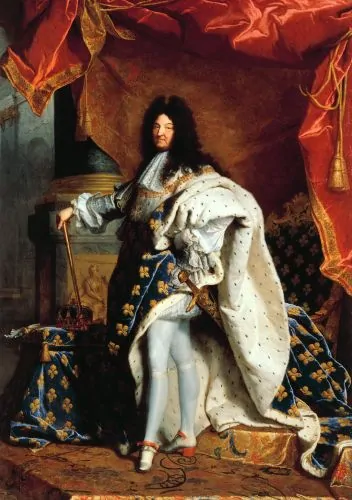
The French Revolution subjected Joyeuse to a danger more fundamental than physical deterioration: the collapse of the political and religious order that had given the sword its ceremonial identity. The monarchy was abolished in September 1792, Louis XVI was executed in January 1793, and institutions associated with hereditary kingship became targets of confiscation, reorganization, or destruction. Saint-Denis was vulnerable because its abbey church united the cult of a national saint with the tombs, regalia, and accumulated memory of French rulers. Revolutionary authorities no longer regarded its treasury as the protected inheritance of sacred monarchy. They treated its contents as property belonging to the nation, resources potentially available to the state, and evidence of a political system the Revolution had repudiated. Joyeuse could no longer be assumed to possess value merely because kings had revered and carried it.
The assault upon Saint-Denis combined symbolic violence with administrative appropriation. Royal tombs were opened, remains were removed, and monuments associated with dynastic continuity were dismantled or damaged. The treasury was inventoried and dispersed rather than simply preserved intact in its traditional setting. These acts stripped objects of the ritual relationships that had once made them sacred. A sword removed from Saint-Denis ceased to be guarded by the abbey, surrounded by royal tombs, and periodically released for coronation.
Joyeuse survived because revolutionary destruction was never governed by a single, consistent impulse. Some objects were condemned as instruments of superstition, feudal privilege, or royal magnificence, while others were preserved as works of art, historical monuments, technical achievements, or possessions of the French people. Precious metals could be melted, jewels detached, and liturgical objects reduced to their material value, yet scholars, administrators, artists, and antiquarians also argued that selected artifacts should be protected from indiscriminate destruction. The developing language of national heritage made it possible to separate an object from the institution that had created its authority. Joyeuse no longer needed to be honored as Charlemagne’s sacred sword in order to be valued as an exceptional survival from the history of France. On December 5, 1793, it was deposited at the Museum with other objects from the treasury of Saint-Denis. The transfer did not preserve the ceremonial ensemble without loss: associated elements were separated, and the sword’s belt was sent to the Mint while the sword and scabbard entered museum custody. Its survival resulted from selection rather than from the preservation of the royal treasury. Revolutionary officials dismantled one system of meaning while constructing another in which the same object could belong to the nation rather than the king.
The museum altered the conditions under which Joyeuse could be encountered. At Saint-Denis, its identity had depended upon restricted custody, liturgical ceremony, monastic testimony, and periodic participation in coronation. Within the revolutionary museum, it became available for classification, comparison, public instruction, and aesthetic judgment. The sword passed from a treasury of sacred monarchy into an institution intended to represent collective national possession. That change did not eliminate its legendary associations, but it subjected them to new historical and artistic frameworks.
This transformation reveals the paradox at the heart of revolutionary preservation. The Revolution attacked the inherited privileges that had made Joyeuse politically powerful, yet its institutions helped ensure that the sword would outlive the dynasty whose legitimacy it had proclaimed. Confiscation deprived Saint-Denis of control over the object, but it also placed Joyeuse within a centralized collection capable of protecting and documenting it. Reclassification as national patrimony allowed the sword to survive even when its former sacred claims became suspect. The object could now be admired as craftsmanship, studied as medieval regalia, displayed as evidence of the past, or condemned as a monument to royal domination. These interpretations were incompatible in important ways, but all preserved an interest in the sword. Joyeuse survived not because revolutionary France remained loyal to Charlemagne’s monarchy, but because the Revolution discovered that objects of monarchy could be appropriated without preserving monarchical rule. The king’s sword became the people’s artifact.
The sword’s removal from active ritual did not permanently settle its identity. Once preserved rather than destroyed, Joyeuse remained available for later governments to reinterpret, restore, and place within new ceremonies of authority. Its revolutionary survival formed a bridge between the abolished monarchy and the political regimes that followed it. The object had lost its hereditary custodian, but it had acquired the more durable protection of national heritage. Joyeuse emerged from the Revolution stripped of one sacred world yet prepared to enter another political mythology.
Napoleon and the Reanimation of Charlemagne

Napoleon Bonaparte’s rise created a problem of legitimacy that military victory alone could not solve. The Revolution had destroyed the Bourbon monarchy, rejected hereditary privilege, and converted royal regalia into national property, yet Napoleon’s declaration as emperor in 1804 required symbols capable of making a new dynasty appear lawful and durable. He could not simply restore the old monarchy without denying the political transformation from which his own authority had emerged. Charlemagne offered a more adaptable ancestor: a conqueror, legislator, Christian emperor, and founder of a political order that seemed to precede both the Bourbons and the revolutionary rupture. By claiming Charlemagne rather than merely imitating Louis XVI, Napoleon could present his empire as a restoration of ancient greatness accomplished through revolutionary achievement. Joyeuse consequently became useful again because it embodied an imperial past that could be separated from the dynasty overthrown in 1792.
The coronation and consecration held at Notre-Dame de Paris on December 2, 1804, drew deliberately upon several historical traditions without reproducing any one of them exactly. Pope Pius VII attended and performed essential liturgical actions, but the ceremony was organized to emphasize Napoleon’s authority rather than his dependence upon papal creation. Elements derived from French royal coronations were combined with Roman imperial imagery, revolutionary institutions, and newly invented ceremonial forms. Charlemagne’s memory supplied the bridge between Christian consecration and a modern empire founded by conquest.
For the ceremony, the old regalia associated with Charlemagne were recovered, repaired, supplemented, and placed beside new insignia made specifically for Napoleon. The goldsmith Martin-Guillaume Biennais played a major role in preparing the imperial objects and restoring elements of the surviving sword traditionally called Joyeuse. The grip was renewed, and the upper portion of the scabbard was repaired so that the sword could again appear as a coherent and magnificent ceremonial object. Such work did not aim to return Joyeuse to a scientifically reconstructed medieval condition. It made the sword visually fit for a new political performance. The result illustrates how restoration can become an act of interpretation: Biennais and the imperial organizers preserved the object by adapting it to the image of Charlemagne that Napoleon wished to inherit.
Joyeuse appeared among the “Honors of Charlemagne,” a group of objects presented as the regalia of the Carolingian emperor even though their dates, origins, and material histories were diverse. Napoleon also possessed newly created “Honors of the Emperor,” including insignia designed to distinguish his personal sovereignty from the inherited authority represented by the older objects. This division was politically precise. The Carolingian regalia established historical continuity, while the new imperial regalia announced that Napoleon was not merely receiving a diminished French crown but founding an empire in his own right. Joyeuse participated in the procession and spectacle, but Napoleon did not depend upon it as his personal sword. His own coronation weapon, adorned with the Regent Diamond, represented the wealth and victorious power of the new regime. The two swords served complementary purposes: one made Charlemagne present, while the other materialized Napoleon’s independent glory. By displaying both, the ceremony presented inheritance and innovation not as contradictions but as mutually reinforcing claims.
Napoleon’s use of Charlemagne extended far beyond the coronation itself. Imperial propaganda compared their conquests, legislative achievements, relations with the papacy, and organization of Europe. Aachen, Rome, Paris, and Milan became stages upon which Napoleon could position himself within an imperial succession larger than the history of the French monarchy. He invoked Charlemagne when confronting churchmen as readily as when addressing soldiers or legitimizing expansion.
The reanimation of Joyeuse reveals the selective character of Napoleonic historical memory. The Revolution had preserved the sword by stripping it of active royal authority; Napoleon restored its ceremonial power without restoring the political world of Saint-Denis and Reims in its old form. Charlemagne’s weapon was removed from a hereditary sequence of Capetian and Bourbon kings and reassigned to an emperor who claimed legitimacy from popular sovereignty, military success, constitutional forms, and sacred consecration at once. Its medieval authenticity mattered less than its capacity to make imperial continuity visible. After the ceremony, the reconstructed Honors of Charlemagne were displayed at Notre-Dame, extending their political usefulness beyond a single day and allowing the public to encounter Napoleon’s chosen ancestry as material fact. Joyeuse had once enabled French kings to appear as Charlemagne’s successors; in 1804, it helped a revolutionary general present himself as Charlemagne renewed. The sword’s survival again proved inseparable from its adaptability, for it regained life not by returning unchanged to the past but by serving a regime that claimed to complete and surpass that past.
The Last Coronations and the End of Joyeuse as Living Regalia
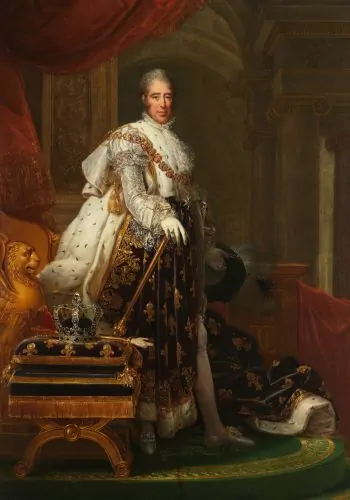
The fall of Napoleon in 1814 did not return Joyeuse to the exact political and ceremonial world that had existed before the Revolution. Louis XVIII restored the Bourbon dynasty, but he ruled under a constitutional charter and never underwent the traditional coronation at Reims. Age, ill health, political caution, and the unsettled condition of post-revolutionary France all discouraged a ceremony whose theology of sacred kingship might have appeared dangerously absolute. Joyeuse remained available as royal regalia without immediately resuming its old function. Its continued existence testified to dynastic memory, but the relationship between monarchy and ritual had changed. A restored king could now govern without receiving the sword, anointing, and crown through which earlier rulers had presented sovereignty as a divinely consecrated office.
Charles X attempted a more ambitious recovery of that tradition after succeeding his brother in 1824. His coronation at Reims on May 29, 1825, deliberately revived many elements of the old French rite, including the use of historic regalia associated with Charlemagne. Joyeuse again entered the cathedral as the sword of royal office, linking the new king to an imagined succession extending beyond the Revolution. Yet the ceremony was already an act of reconstruction rather than an unbroken continuation.
The coronation’s organizers faced the problem of making medieval and early modern symbolism intelligible within a society transformed by revolution, empire, constitutional government, and mass political debate. They retained anointing, oaths, vestments, regalia, peers, processions, and liturgical actions, but adjusted parts of the rite to suit contemporary expectations. Joyeuse appeared within this selective restoration as proof that the monarchy possessed a history deeper than recent political upheaval. Its very survival seemed to demonstrate that sacred kingship had endured confiscation, republicanism, and Napoleon. The sword could no longer command a single interpretation. Royalists might see Charlemagne’s blade as the visible restoration of legitimate order, while liberals could regard it as an emblem of clerical reaction and aristocratic nostalgia. The same object that once helped suppress uncertainty about succession now exposed profound disagreement over what French kingship should mean. Joyeuse remained ceremonially alive, but the political language it spoke had ceased to be universally persuasive.
Charles X’s coronation was consequently both a revival and a conclusion. The king received the symbols of sacred monarchy, but the rite could not reverse the transfer of sovereignty accomplished by the Revolution. His government’s later attempts to strengthen royal authority intensified suspicions that the coronation had announced a political program hostile to constitutional liberty. When the July Revolution overthrew him in 1830, the traditional sacre became inseparable from the failure of the restored Bourbon project. Louis-Philippe accepted the title “King of the French” rather than “King of France,” grounding his position more openly in the nation and the constitutional settlement. He did not seek anointing at Reims or receive Joyeuse through the inherited coronation ritual.
The end of the sacre changed Joyeuse more decisively than any repair to its hilt or scabbard. A ceremonial object remains living regalia only while an institution repeatedly uses it to create or confirm authority. Once French rulers no longer required coronation, the sword could not continue performing the political work for which centuries of ritual had prepared it. It survived physically, retained its legendary name, and remained available for exhibition, scholarship, and occasional state symbolism, but it ceased to make kings. The transformation was not caused by disbelief in Charlemagne alone; it resulted from a broader redefinition of sovereignty, legitimacy, religion, and the nation. Hereditary monarchy could no longer rely upon anointing and inherited objects as sufficient demonstrations of political right. Joyeuse passed permanently from active regalia into historical patrimony, where its power depended upon remembrance rather than ritual efficacy. The coronation of Charles X marked the final moment when the sword’s Carolingian legend, medieval sanctity, and royal function converged within a living constitutional act. After 1825, Joyeuse remained one of France’s greatest political objects, but the office it had once helped create had become a matter of history.
From Regalia to Museum Object: Joyeuse in the Louvre
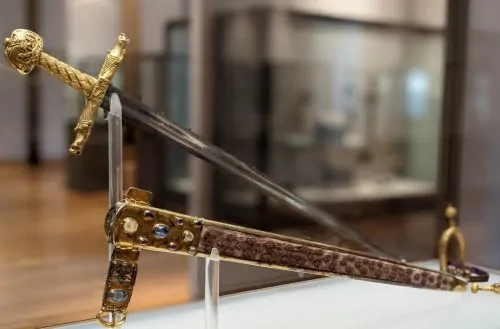
When Joyeuse entered the Louvre, it passed into an institution governed by purposes fundamentally different from those of Saint-Denis or Reims. At Saint-Denis, the sword had been guarded within a treasury whose relics, royal gifts, and regalia testified to the sacred history of French monarchy. At Reims, it had been handled, carried, displayed, and interpreted through a coronation rite that transformed an heir into an anointed king. The museum instead classified Joyeuse as an object of historical and artistic significance belonging to the nation. Its preservation no longer depended upon the expectation that another ruler would receive it during a sacre. The sword remained famous, but its authority shifted from ceremonial action to exhibition, scholarship, and public memory.
Museum display necessarily altered the manner in which the sword could be experienced. Joyeuse had once moved through processions, crossed the threshold of the cathedral, approached the altar, passed through the hands of officers, and appeared before an audience assembled according to political rank. In the Louvre, it became stationary, isolated, and protected from touch. Visitors could inspect its form more closely than many coronation spectators ever had, but they encountered it without the movement, music, vestments, prayers, and collective expectation that had formerly made it active regalia.
This isolation encouraged viewers and scholars to examine Joyeuse as a material artifact rather than accept it solely as the inherited sword of Charlemagne. The blade, pommel, grip, crossguard, scabbard, goldwork, gemstones, and restorations could be studied individually and assigned to different periods. Curatorial analysis exposed the sword’s composite construction, making it increasingly difficult to describe the entire object as an untouched Carolingian weapon. Yet the museum did not simply replace legend with scientific certainty. Dating remained debated, documentation was incomplete, and the sword’s ceremonial biography could not be separated neatly from the traditions that had preserved it. The name Joyeuse continued to organize how the object was catalogued and understood, even when curators qualified the attribution by describing it as the coronation sword “called” Joyeuse. Such language preserved the historical identity of the object without claiming that Charlemagne’s ownership had been proven. The museum became a place where skepticism and tradition coexisted. It invited examination of the sword’s physical layers while acknowledging that centuries of royal use had become part of its authentic history.
The transfer also changed who could claim possession of Joyeuse. Royal regalia had once belonged to a restricted political and sacred order in which access was controlled by monks, clergy, court officers, and the crown. As a museum object, the sword became part of the cultural patrimony of France and was theoretically available to a public defined by citizenship rather than estate or dynastic service. This nationalization did not make access completely unrestricted, since curators still controlled its placement, interpretation, conservation, and visibility. It nevertheless transformed the spectator from a witness to monarchy into a visitor contemplating monarchy as history.
Behind glass, Joyeuse also acquired an aesthetic autonomy it had not possessed during coronation. Its gold hilt, unusual guard, jeweled scabbard, and long blade could be admired as examples of craftsmanship apart from the oaths and political duties they once represented. That appreciation risks reducing the sword to a beautiful luxury object, just as romantic fascination can reduce it to a surviving magical weapon from the age of Charlemagne. Responsible interpretation must hold together the material, legendary, and ceremonial dimensions rather than allowing one to erase the others. Joyeuse is neither merely decorative art nor simply evidence of medieval credulity. It is an object whose makers, custodians, rulers, revolutionaries, restorers, and curators repeatedly altered the conditions under which it could signify. The Louvre preserves that accumulated history even as the display case announces that the sword’s active political life has ended. Joyeuse can no longer make a king, but it can still reveal how metal, ritual, institutional authority, and historical imagination once combined to make kingship visible.
Joyeuse and the Modern Myth of the Magical Weapon
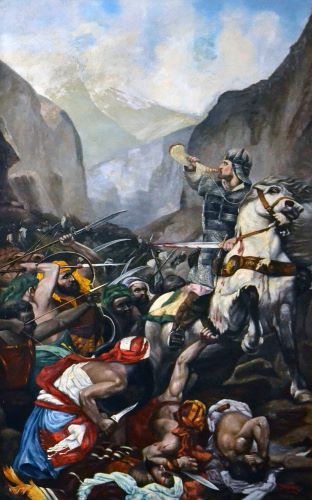
Modern retellings often present Joyeuse less as a ceremonial sword with a layered history than as a fully developed magical weapon possessing a stable catalog of powers. The blade is said to blind armies, change color thirty times each day, guarantee victory, protect its bearer from harm, or derive overwhelming strength from the Holy Lance concealed within it. These claims usually combine details from The Song of Roland, later medieval traditions, antiquarian speculation, and modern invention without distinguishing among them. The result is a single consolidated mythology that appears older and more consistent than the surviving evidence supports. Joyeuse becomes easier to describe but historically less precise. Its ambiguous radiance, relic-bearing pommel, uncertain manufacture, and ceremonial afterlife are compressed into the recognizable modern category of the enchanted sword.
This transformation reflects the expectations of fantasy literature, role-playing games, films, animation, and digital media. Modern audiences are often accustomed to magical objects whose abilities can be named, measured, activated, and compared. A sword that merely signifies sacred kingship or reflects thirty colors through poetic wonder may seem incomplete beside weapons that emit light, defeat specific enemies, or confer explicit advantages upon their wielders. Joyeuse is frequently rewritten according to the logic of the modern fictional artifact.
The claim that Joyeuse could blind enemy soldiers illustrates how this process operates. The Song of Roland celebrates the sword’s changing colors and extraordinary brightness, but it does not consistently describe a deliberate power by which Charlemagne directs supernatural light against entire armies. Later summaries convert brilliance into a weaponized effect because the transition seems intuitively plausible: if the blade shines with marvelous intensity, it might blind those who face it. Repetition then gives the expanded claim the appearance of inherited tradition, especially when short accounts copy one another without returning to the medieval text. The story becomes more spectacular with each retelling because modern media reward clear, dramatic abilities. A visual artist can depict enemies shielding their eyes, a game designer can translate radiance into a combat mechanic, and a popular encyclopedia can summarize the sword in a list of powers. None of these adaptations is inherently illegitimate as creative interpretation. The historical problem arises when adaptation is presented as direct evidence for what medieval audiences believed. Joyeuse’s modern magic is often less a survival from the Middle Ages than a translation of medieval wonder into contemporary narrative grammar.
Digital culture accelerates this consolidation by favoring brevity, repetition, and easily searchable claims. Short videos, image captions, fan databases, game descriptions, replica advertisements, and popular listicles rarely have room to separate the earliest poem from later romance, royal ceremony, museum history, and modern fantasy. They commonly state that Charlemagne’s historical sword contained the Holy Lance, changed color thirty times daily, and blinded enemies, as though all elements came from one uncontested source. The surviving Louvre object then appears to authenticate the entire package simply because it can be photographed. Material survival lends authority to stories that may belong to very different centuries.
Yet the modern magical Joyeuse should not be dismissed merely as ignorance or corruption. It reveals the continuing need to imagine power as residing within objects that are named, visible, and transferable. Medieval epic made Charlemagne’s authority material through radiance, relic, and heroic association; modern fantasy performs a comparable operation by converting those qualities into supernatural functions. The principal difference lies in explicitness. Medieval wonder could remain symbolic, devotional, and unstable, whereas modern systems often demand rules governing what the weapon does and under what conditions it works. Joyeuse survives because it can inhabit both modes at once. It remains a historical coronation sword, an uncertain material link to Charlemagne, a relic-bearing blade of epic, and a modern enchanted weapon whose powers grow through repetition. Its popular afterlife does not preserve medieval tradition unchanged, but it demonstrates how successfully the sword continues to invite new cultures to complete the marvel for themselves.
Joyeuse and Excalibur: The Politics of Comparison
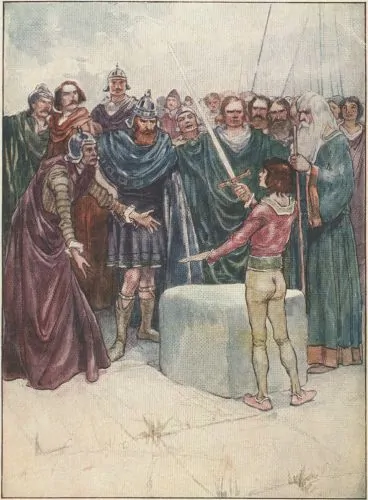
Joyeuse is frequently described as the French equivalent of Excalibur, a comparison that appears natural because both are famous swords attached to idealized medieval rulers. Each weapon bears a proper name, exceeds the status of ordinary military equipment, and helps make royal authority visible through material form. Both also survive in modern culture as magical artifacts detached from the complicated textual and political traditions that produced them. Yet the apparent resemblance can obscure more than it reveals. Excalibur belongs primarily to the evolving narrative world of Arthurian sovereignty, while Joyeuse developed through an interaction among Carolingian epic, relic culture, French coronation, and the physical preservation of royal regalia. Their similarities are most useful when treated as a starting point for comparison rather than proof that medieval Europe possessed one universal mythology of the royal sword.
Excalibur’s political meaning emerges from the recurring problem of Arthur’s legitimacy. In some traditions, the sword associated with Arthur’s recognition as rightful king is the weapon drawn from the stone or anvil; in others, Excalibur is a different blade received from the Lady of the Lake after the first sword is broken. Medieval authors did not maintain one perfectly consistent account, but they repeatedly linked Arthur’s weapons to miraculous selection, supernatural patronage, and the exceptional nature of his rule. The sword confirms that Arthur is not merely a successful warrior who seizes power through force. His kingship is recognized by forces beyond ordinary aristocratic competition, whether divine providence, prophetic destiny, or the mysterious authority of the otherworld.
Joyeuse does not ordinarily choose Charlemagne in this manner. The Song of Roland introduces the sword as an established possession already fitted to an emperor whose authority is not in question. Its radiance, name, and relic-bearing pommel magnify Charlemagne’s sovereignty, but they do not create his initial right to rule. The distinction becomes even clearer in the later history of the French coronation sword. Joyeuse was transferred from one king to another through institutional custody and ritual presentation rather than bestowed anew by a supernatural female figure or recovered through an individual test. Its political force depended upon continuity, not miraculous discovery. The king who received it entered a recognized succession extending backward through earlier rulers to Charlemagne. Excalibur often identifies the unique king whom no ordinary process could adequately select, whereas Joyeuse confirms that the newly anointed king has inherited an office older than himself. One sword dramatizes extraordinary election; the other increasingly dramatizes legitimate transmission.
Their different endings reinforce this contrast. Excalibur is commonly removed from the human political world after Arthur’s final battle, when it is returned to the water and received by a mysterious hand. Its disappearance corresponds to the collapse or suspension of Arthurian kingship, leaving open the possibility that the king and his authority may someday return. Joyeuse, by contrast, remains materially present after the deaths of its successive bearers. It passes from treasury to coronation, from monarchy to Revolution, and from active regalia to museum display. Excalibur’s absence sustains the promise of restoration, while Joyeuse’s survival sustains the claim of historical continuity.
Comparison with other ceremonial swords reveals still more clearly that named weapons expressed distinct theories of rulership. Curtana, the blunted Sword of Mercy used in English coronations, represents restraint within sovereign power, while the Swords of Temporal and Spiritual Justice divide royal obligation into complementary forms. The imperial sword of the Holy Roman Empire similarly joined armed authority to the sacred dignity of office, but it belonged to a political tradition that competed with French claims to Charlemagne’s legacy. Durendal expressed the honor, loyalty, and sacrificial death of the vassal rather than the transferable sovereignty of the ruler. These weapons shared a broad symbolic vocabulary of justice, warfare, hierarchy, and sacral authority, but their ceremonial and narrative functions were not interchangeable. A sword could select a king, confirm a dynasty, discipline violence, embody imperial office, or preserve the memory of heroic service. Joyeuse’s particular function was to make Charlemagne’s authority available to rulers who could never reproduce his historical empire.
The comparison between Joyeuse and Excalibur is also political because later nations used both swords to organize idealized visions of the medieval past. English and British writers could treat Arthur as an ancestral monarch whose promised return expressed national destiny, moral renewal, or imperial ambition. French rulers and historians used Charlemagne to assert the antiquity, Christian vocation, and imperial stature of France, while Joyeuse supplied that memory with a visible object. Modern popular culture often strips away these competing national claims and places both swords within a neutral fantasy armory. Doing so makes them easier to recognize globally, but it conceals the institutions and historical struggles that gave each weapon its authority.
A careful comparison shows that the politics of legendary swords lies not simply in their supposed magical powers but in the different relationships they construct among ruler, object, community, and time. Excalibur frequently establishes Arthur as the irreplaceable center of a kingdom whose ideal order cannot survive his fall. Joyeuse allows Charlemagne’s prestige to outlive him by becoming transferable, reproducible through ritual, and eventually embodied in a surviving material object. One sword returns to mystery when sovereignty collapses; the other remains available for new dynasties and regimes to appropriate. Both convert kingship into something visible and memorable, but they do so through opposing temporal movements. Excalibur points toward the absent king who may return, while Joyeuse carries an inherited emperor forward into the reigns of successors who claim that he never entirely departed.
Memory Made Metal: Why Composite Objects Can Become More Powerful

Joyeuse became more authoritative not despite its composite construction but partly because of it. Modern habits of authentication often privilege the untouched object whose materials can be traced to one maker, one date, and one original owner. Medieval and early modern custodians frequently understood identity differently, especially when dealing with relics, regalia, shrines, and inherited ceremonial objects. Repair did not necessarily terminate authenticity, replacement did not automatically create a copy, and embellishment could be interpreted as renewed honor rather than falsification. An object remained continuous when its name, custody, ritual function, and recognized history endured through material alteration. Joyeuse accumulated power because successive generations did not merely preserve it; they repeatedly made it capable of carrying their own relationship to Charlemagne and French kingship. The sword may be approached as an object with a cultural biography rather than as a single artifact whose meaning was fixed at manufacture. Its oldest component does not alone determine its identity, because later additions participated in ceremonies that gave the ensemble historical consequence. A renewed grip held by a crowned king was not culturally less significant merely because it had replaced an earlier one. The sword’s biography consists of those interventions as much as of the metal from which its blade was forged.
Composite objects are effective vehicles of memory because they give physical form to continuity while accommodating change. The parts of Joyeuse belong to different moments, yet their assembly allows those moments to appear simultaneously present. A medieval blade could support later goldwork; an older hilt could be adapted to a restored scabbard; a Napoleonic repair could preserve an object attributed to a Carolingian emperor and used by Capetian and Bourbon kings. Each intervention condensed another political era into the sword without erasing every visible trace of the previous one. The resulting object resembles neither a pristine archaeological survival nor an unrestricted modern reconstruction. It is a material palimpsest whose additions record repeated decisions that the sword remained valuable enough to repair, display, and reuse. Custodians thereby transformed damage and obsolescence into opportunities for renewal. The composite artifact grew more powerful because its very body demonstrated survival across dynastic succession, religious transformation, revolution, and restoration.
Relics offer an important parallel because their authority has rarely depended upon physical completeness. A saint’s body could be divided among numerous churches, enclosed in new reliquaries, translated from one shrine to another, and ornamented by later patrons without losing its sacred identity. The container might change repeatedly while the relic continued to anchor institutional memory and devotional expectation. Joyeuse operated according to a comparable logic, even when treated as regalia rather than as a relic in the strict sense. Its supposed Holy Lance fragment intensified that resemblance by locating continuity in a sacred interior that could remain conceptually stable while the visible exterior changed. Material alteration could confirm the sword’s importance: only an object believed to possess enduring authority would merit such repeated acts of costly renewal.
The power of the composite object also depends upon controlled interpretation. Metal, gold, leather, jewels, repairs, and substitutions do not explain themselves; institutions teach audiences how separate parts should be recognized as one historically continuous thing. Saint-Denis accomplished this through custody and treasury tradition, coronation rites through repeated ceremonial use, royal histories through attribution to Charlemagne, and the Louvre through cataloguing, conservation, and display. Each institution imposed a different framework, but none encountered Joyeuse as culturally empty matter. The sword arrived already carrying stories produced by earlier custodians, and later interpreters added their own authority to that inheritance. Joyeuse became a meeting place of material and narrated memory, with each reinforcing the credibility of the other. Its composite body made the past available not as a perfectly preserved original but as an accumulation of survivals, restorations, claims, and acts of belief. Memory was made metal because generations repeatedly rebuilt the object through which they imagined historical continuity.
Is Joyeuse Mostly an Invented Tradition?
The following video from “Beyond Science” discusses Joyeuse:
The skeptical case against Joyeuse is formidable. No contemporary source from Charlemagne’s lifetime names the sword, no secure chain of custody links the emperor to the surviving object, and the weapon preserved in the Louvre is a composite assemblage whose parts belong to different periods. The Holy Lance fragment, thirty changing colors, legendary smiths, and miraculous brilliance all emerge from literary traditions composed long after Charlemagne’s death. The sword’s documented role in French coronation likewise begins centuries after the Carolingian age. From a strictly biographical standpoint, the tradition rests upon retrospective attribution rather than demonstrable possession. Joyeuse may appear to be less an inherited object from Charlemagne than a medieval and early modern construction assembled from epic poetry, relic culture, royal ambition, and ceremonial repetition.
The phrase “invented tradition” is useful because it directs attention away from origins alone and toward the institutions that created continuity. Capetian kings had powerful reasons to appropriate Charlemagne, whose imperial prestige could strengthen a dynasty that did not descend directly from him in an uncomplicated line. Saint-Denis benefited from preserving objects and narratives that linked its treasury to the greatest ruler of the Frankish past. Coronation ritual then transformed the attribution into public fact by repeatedly presenting the sword as an ancient inheritance. Each use made the claim more authoritative, even though repetition could not supply the missing evidence for Carolingian ownership.
Modern romanticism added another layer of invention. Antiquarians, museum visitors, popular historians, fantasy writers, and digital media often collapsed separate traditions into a single seamless account. The epic Joyeuse, the coronation sword, the Holy Lance legend, the changing colors, the blinding radiance, and the Louvre object became parts of one supposedly continuous biography. This synthesis is attractive because it satisfies the desire for a tangible survivor from the age of Charlemagne. A complicated ceremonial object becomes “the emperor’s actual sword,” while poetic imagery becomes a list of supernatural abilities. Such compression can obscure uncertainty, eliminate chronology, and lend material authority to claims that originated in literature rather than artifact history. The modern legend is not merely inherited from the Middle Ages; it is continually rebuilt according to contemporary expectations of authenticity, magic, and celebrity objects.
Yet calling Joyeuse invented does not make it unreal. Traditions become historically consequential through belief, repetition, institutional support, and embodied practice, not only through accurate memory of their beginnings. French kings genuinely received the sword within coronation rites, Saint-Denis genuinely guarded it as part of royal heritage, and Napoleon genuinely reused its Carolingian associations to legitimize a new empire. The attribution shaped behavior, ceremony, art, political claims, and public understanding. Even a mistaken identification can produce authentic historical effects.
The strongest conclusion lies between credulity and dismissal. Joyeuse should not be presented as an unquestionably preserved personal weapon of Charlemagne, because the documentary and material evidence cannot sustain that claim. It should also not be reduced to a cynical forgery manufactured by rulers who knew the tradition to be false. The sword developed through a long process in which poetic invention, sincere belief, institutional interest, material repair, and political appropriation reinforced one another. Its tradition was invented in the broad sense that generations selected, arranged, and renewed the past to serve present needs. But that process is precisely what made Joyeuse historically powerful. The sword’s importance lies not in proving that every claim about it is true, but in understanding how those claims became capable of shaping monarchy, memory, and national heritage across more than eight centuries.
Conclusion: The Sword That Made the Past Present
Joyeuse has never possessed only one history. Behind its legend lies the nearly inaccessible possibility of a personal sword once carried by Charlemagne, a ruler whose contemporary biographers never identified such a weapon by name. Medieval epic then created the radiant, relic-bearing blade that belonged at the side of an emperor transformed into the timeless defender of Christendom. French monarchy gave that literary weapon a material body by identifying a composite ceremonial sword as Charlemagne’s own and placing it within the coronation rites of successive kings. The Louvre preserves the final convergence of these histories in an object that is simultaneously medieval artifact, royal regalia, legendary weapon, and national monument.
The sword’s remarkable career depended upon the interaction of story and matter. The Song of Roland gave Joyeuse its name, changing colors, sacred pommel, and place within the fellowship of heroic swords. Relic culture connected its violence to the Passion of Christ, allowing the weapon to appear as a portable sacred object rather than a merely luxurious blade. Saint-Denis placed it within an institutional treasury capable of converting attribution into inherited authority. At Reims, coronation ritual transferred that authority from the remembered emperor to the body of a newly anointed king. Repeated repairs and alterations ensured that the sword remained visually persuasive even as its materials changed. Revolutionary confiscation ended its old custodial world but preserved it as property of the nation, while Napoleon briefly reactivated its Carolingian associations in support of a new imperial dynasty. Each transformation moved Joyeuse farther from any recoverable weapon of the ninth century while making it more deeply embedded in the political and cultural history of France.
Its uncertain attribution does not deprive Joyeuse of authenticity; it requires authenticity to be defined more carefully. The surviving sword cannot be proven to have belonged to Charlemagne, and its composite construction prevents it from being treated as an untouched Carolingian artifact. It is nevertheless authentically the coronation sword long known as Joyeuse, authentically an instrument of French royal ritual, and authentically an object through which generations encountered Charlemagne’s imagined authority. Its most consequential history began not when an emperor may have carried it, but when communities decided that this was the sword through which his presence could be inherited.
Joyeuse demonstrates that the past becomes politically powerful when it can be made visible, portable, and repeatable. The legendary Holy Lance fragment placed sacred history inside the weapon, while the coronation placed the weapon inside a continuing history of kingship. Every ruler who received it appeared to touch Charlemagne across the centuries, even though the material evidence could not establish that Charlemagne had ever touched the same blade. When monarchy ended, the museum preserved that accumulated presence by turning active regalia into an object of public contemplation. Joyeuse no longer authorizes a king to defend the Church, administer justice, or command the realm, but it still exposes the mechanisms through which such authority was once created. Its metal carries the marks of alteration, its name carries the memory of epic, and its survival carries the history of institutions that repeatedly remade it. The sword made the past present not by preserving one original moment unchanged, but by allowing successive ages to rebuild Charlemagne in matter, ritual, and imagination.
Bibliography
Affiliate disclosure: Amazon links on this site are paid links. As an Amazon Associate I earn from qualifying purchases.
- Anonymous. The Song of Roland. Translated by C. K. Scott-Moncrieff. Project Gutenberg, 1996.
- Appadurai, Arjun, ed. The Social Life of Things: Commodities in Cultural Perspective. Cambridge: Cambridge University Press, 1986.
- Ariosto, Ludovico. Orlando Furioso. Translated by Temple Henry Croker. London: Rupert-Street, 1755.
- Bachrach, Bernard S. Early Carolingian Warfare: Prelude to Empire. Philadelphia: University of Pennsylvania Press, 2001.
- Baldwin, John W. The Government of Philip Augustus: Foundations of French Royal Power in the Middle Ages. Berkeley: University of California Press, 1986.
- Barber, Richard. The Holy Grail: Imagination and Belief. Cambridge, MA: Harvard University Press, 2004.
- Bernard of Clairvaux. In Praise of the New Knighthood. Translated by M. Conrad Greenia. Kalamazoo, MI: Cistercian Publications, 2000.
- Boiardo, Matteo Maria. L’Orlando Innamorato. Venice: Giuseppe Antonelli, 1842.
- Brault, Gerard J. The Song of Roland: An Analytical Edition. 2 vols. University Park: Pennsylvania State University Press, 1978.
- Brown, Elizabeth A. R. “Saint-Denis and the Turpin Legend.” In The Codex Calixtinus and the Shrine of St. James, edited by John Williams and Alison Stones, 51–88. Tübingen: Gunter Narr, 1992.
- Brown, Peter. The Cult of the Saints: Its Rise and Function in Latin Christianity. Chicago: University of Chicago Press, 1981.
- Bryant, Lawrence M. The King and the City in the Parisian Royal Entry Ceremony: Politics, Ritual, and Art in the Renaissance. Geneva: Droz, 1986.
- Buc, Philippe. Holy War, Martyrdom, and Terror: Christianity, Violence, and the West. Philadelphia: University of Pennsylvania Press, 2015.
- Bynum, Caroline Walker. Christian Materiality: An Essay on Religion in Late Medieval Europe. New York: Zone Books, 2011.
- Charles X. Cérémonies et prières du sacre de Sa Majesté Charles X. Paris: Imprimerie Royale, 1825.
- Coupland, Simon. “Carolingian Arms and Armor in the Ninth Century.” Viator 21 (1990), 29–50.
- Duggan, Joseph J. The Song of Roland: Formulaic Style and Poetic Craft. Berkeley: University of California Press, 1973.
- Duncan, Carol. Civilizing Rituals: Inside Public Art Museums. London: Routledge, 1995.
- Dwyer, Philip. Citizen Emperor: Napoleon in Power. New Haven, CT: Yale University Press, 2013.
- Eco, Umberto. Art and Beauty in the Middle Ages. Translated by Hugh Bredin. New Haven, CT: Yale University Press, 1986.
- Einhard. The Life of Charlemagne. Translated by Lewis Thorpe. London: Penguin, 1969.
- Erdmann, Carl. The Origin of the Idea of Crusade. Translated by Marshall W. Baldwin and Walter Goffart. Princeton: Princeton University Press, 1977.
- Félibien, Michel. Histoire de l’abbaye royale de Saint-Denys en France. Paris: Frédéric Léonard, 1706.
- Fimi, Dimitra. Tolkien, Race and Cultural History: From Fairies to Hobbits. Basingstoke: Palgrave Macmillan, 2009.
- Flori, Jean. La guerre sainte: La formation de l’idée de croisade dans l’Occident chrétien. Paris: Aubier, 2001.
- Fontaine, Pierre-François-Léonard, and Charles Percier. Le sacre de S. M. l’empereur Napoléon dans l’église métropolitaine de Paris, le XI frimaire an XIII. Paris: Imprimerie Impériale, 1807.
- Gaborit-Chopin, Danielle. Le trésor de Saint-Denis. Paris: Réunion des Musées Nationaux, 1991.
- —-. “Le trésor de Saint-Denis à l’époque romane: Trésor monastique ou trésor royal?” Les Cahiers de Saint-Michel de Cuxa 41 (2010), 71–80.
- —-. “Les regalia et les instruments du sacre.” In Le sacre royal à l’époque de Saint Louis, edited by Jacques Le Goff, 55–72. Paris: Gallimard, 2001.
- Gabriele, Matthew. An Empire of Memory: The Legend of Charlemagne, the Franks, and Jerusalem before the First Crusade. Oxford: Oxford University Press, 2011.
- Gage, John. Color and Culture: Practice and Meaning from Antiquity to Abstraction. Boston: Little, Brown, 1993.
- Gaposchkin, M. Cecilia. Invisible Weapons: Liturgy and the Making of Crusade Ideology. Ithaca, NY: Cornell University Press, 2017.
- Geary, Patrick J. Furta Sacra: Thefts of Relics in the Central Middle Ages. Princeton: Princeton University Press, 1978.
- Gell, Alfred. Art and Agency: An Anthropological Theory. Oxford: Clarendon Press, 1998.
- Geoffrey of Monmouth. The History of the Kings of Britain. Translated by Sebastian Evans. London: J. M. Dent & Sons, Ltd, 1912.
- Giesey, Ralph E. The Royal Funeral Ceremony in Renaissance France. Geneva: Droz, 1960.
- Grégoire, Henri. Rapport sur les destructions opérées par le vandalisme, et sur les moyens de le réprimer. Paris: Imprimerie Nationale, 1794.
- Guessard, François, and Henri Michelant, eds. Floovant: Chanson de geste. Paris: F. Vieweg, 1859.
- Halsall, Guy. Warfare and Society in the Barbarian West, 450–900. London: Routledge, 2003.
- Historia Karoli Magni et Rotholandi, or Pseudo-Turpin Chronicle. Translated by Ferdinand Castets. Paris: Maisonneuve et C, 1880.
- Hobsbawm, Eric, and Terence Ranger, eds. The Invention of Tradition. Cambridge: Cambridge University Press, 1983.
- Hooper-Greenhill, Eilean. Museums and the Shaping of Knowledge. London: Routledge, 1992.
- Jackson, Richard A. Vive le Roi! A History of the French Coronation from Charles V to Charles X. Chapel Hill: University of North Carolina Press, 1984.
- Kaeuper, Richard W. Holy Warriors: The Religious Ideology of Chivalry. Philadelphia: University of Pennsylvania Press, 2009.
- Kantorowicz, Ernst H. The King’s Two Bodies: A Study in Mediaeval Political Theology. Princeton: Princeton University Press, 1957.
- Karlamagnús Saga: The Saga of Charlemagne and His Heroes. Translated by Constance B. Hieatt. 3 vols. Toronto: Pontifical Institute of Mediaeval Studies, 1975–1980.
- Kay, Sarah. The Chansons de Geste in the Age of Romance: Political Fictions. Oxford: Clarendon Press, 1995.
- Keay, Anna. The Crown Jewels. London: Thames and Hudson, 2002.
- Kinoshita, Sharon. Medieval Boundaries: Rethinking Difference in Old French Literature. Philadelphia: University of Pennsylvania Press, 2006.
- Klastrup, Lisbeth, and Susana Tosca. “Transmedial Worlds—Rethinking Cyberworld Design.” In Proceedings of the 2004 International Conference on Cyberworlds, 409–416. Los Alamitos, CA: IEEE Computer Society, 2004.
- Kopytoff, Igor. “The Cultural Biography of Things: Commoditization as Process.” In The Social Life of Things: Commodities in Cultural Perspective, edited by Arjun Appadurai, 64–91. Cambridge: Cambridge University Press, 1986.
- Kroen, Sheryl. Politics and Theater: The Crisis of Legitimacy in Restoration France, 1815–1830. Berkeley: University of California Press, 2000.
- Krynen, Jacques. L’empire du roi: Idées et croyances politiques en France, XIIIe–XVe siècle. Paris: Gallimard, 1993.
- Lacy, Norris J., ed. The New Arthurian Encyclopedia. New York: Garland, 1996.
- Laveissière, Sylvain, ed. Le Sacre de Napoléon peint par David. Paris: Musée du Louvre and Milan: 5 Continents, 2004.
- Le Goff, Jacques. Heroes and Marvels of the Middle Ages. Translated by Teresa Lavender Fagan. London: Reaktion Books, 2005.
- Le Person, Marc, ed. Fierabras: Chanson de geste du XIIe siècle. Paris: Honoré Champion, 2003.
- Louvre Museum. “Épée du sacre des rois de France, dite ‘Joyeuse.’” Département des Objets d’art du Moyen Âge, de la Renaissance et des Temps modernes. Paris: Musée du Louvre.
- Malory, Thomas. Le Morte Darthur. Edited by H. Oskar Sommer. London: David Nutt, 1889.
- Marrinan, Michael. Painting Politics for Louis-Philippe: Art and Ideology in Orléanist France, 1830–1848. New Haven, CT: Yale University Press, 1988.
- McKinnell, John. Meeting the Other in Norse Myth and Legend. Cambridge: D. S. Brewer, 2005.
- McKitterick, Rosamond. Charlemagne: The Formation of a European Identity. Cambridge: Cambridge University Press, 2008.
- McClellan, Andrew. Inventing the Louvre: Art, Politics, and the Origins of the Modern Museum in Eighteenth-Century Paris. Cambridge: Cambridge University Press, 1994.
- Mickel, Emanuel J., Jr. Ganelon, Treason, and the “Chanson de Roland.” University Park: Pennsylvania State University Press, 1989.
- Morris, Colin. The Sepulchre of Christ and the Medieval West: From the Beginning to 1600. Oxford: Oxford University Press, 2005.
- Morrissey, Robert. Charlemagne and France: A Thousand Years of Mythology. Translated by Catherine Tihanyi. Notre Dame, IN: University of Notre Dame Press, 2003.
- Nelson, Janet L. King and Emperor: A New Life of Charlemagne. Oakland: University of California Press, 2019.
- Nichols, Stephen G. Romanesque Signs: Early Medieval Narrative and Iconography. New Haven, CT: Yale University Press, 1983.
- Ordines Coronationis Franciae: Texts and Ordines for the Coronation of Frankish and French Kings and Queens in the Middle Ages. Edited by Richard A. Jackson. 2 vols. Philadelphia: University of Pennsylvania Press, 1995–2000.
- Pastoureau, Michel. Blue: The History of a Color. Translated by Markus I. Cruse. Princeton, NJ: Princeton University Press, 2001.
- —-. Red: The History of a Color. Translated by Jody Gladding. Cambridge: Polity Press, 2017.
- Pilbeam, Pamela M. The Constitutional Monarchy in France, 1814–1848. London: Longman, 2000.
- Pomian, Krzysztof. Collectors and Curiosities. Translated by Elizabeth Wiles-Portier. Cambridge: Polity Press, 1990.
- Porterfield, Todd, and Susan L. Siegfried. Staging Empire: Napoleon, Ingres, and David. University Park: Pennsylvania State University Press, 2006.
- Poulot, Dominique. Musée, nation, patrimoine, 1789–1815. Paris: Gallimard, 1997.
- —-. “Revolutionary ‘Vandalism’ and the Birth of the Museum: The Effects of a Representation of Modern Cultural Terror.” In Art in Museums, edited by Susan Pearce, 192–214. London: Athlone Press, 1995.
- Price, Munro. The Perilous Crown: France between Revolutions, 1814–1848. London: Macmillan, 2007.
- Pulci, Luigi. Morgante: The Epic Adventures of Orlando and His Giant Friend Morgante. Translated by Joseph Tusiani. Bloomington: Indiana University Press, 1998.
- Pysiak, Jerzy. The King and the Crown of Thorns: Kingship and the Cult of Relics in Capetian France. Translated by Sylwia Twardo. Berlin: Peter Lang, 2021.
- Reynolds, Susan. “Medieval Origines Gentium and the Community of the Realm.” History 68:224 (1983), 375–390.
- Riley-Smith, Jonathan. The First Crusade and the Idea of Crusading. Philadelphia: University of Pennsylvania Press, 1972.
- Royal Frankish Annals. In Carolingian Chronicles: Royal Frankish Annals and Nithard’s Histories, translated by Bernhard Walter Scholz with Barbara Rogers. Ann Arbor: University of Michigan Press, 1970.
- Saler, Michael. As If: Modern Enchantment and the Literary Prehistory of Virtual Reality. Oxford: Oxford University Press, 2012.
- Schramm, Percy Ernst. A History of the English Coronation. Translated by Leopold G. Wickham Legg. Oxford: Clarendon Press, 1937.
- Smith, Julia M. H. “Portable Christianity: Relics in the Medieval West, c. 700–1200.” Proceedings of the British Academy 181 (2012), 143–167.
- Spiegel, Gabrielle M. “The Cult of Saint Denis and Capetian Kingship.” Journal of Medieval History 1:1 (1975), 43–69.
- Strayer, Joseph R. On the Medieval Origins of the Modern State. Princeton, NJ: Princeton University Press, 1970.
- Strong, Roy. Art and Power: Renaissance Festivals, 1450–1650. Berkeley: University of California Press, 1984.
- Suard, François. La chanson de geste. Paris: Presses Universitaires de France, 1993.
- Suger. Abbot Suger on the Abbey Church of St.-Denis and Its Art Treasures. Edited, translated, and annotated by Erwin Panofsky. 2nd ed. Princeton, NJ: Princeton University Press, 1946.
- —-. The Deeds of Louis the Fat. Translated by Richard Cusimano and John Moorhead. Washington, DC: Catholic University of America Press, 1992.
- Sunderland, Luke. Old French Narrative Cycles: Heroism between Ethics and Morality. Cambridge: D. S. Brewer, 2010.
- —-. Rebel Barons: Resisting Royal Power in Medieval Culture. Oxford: Oxford University Press, 2017.
- Throop, Susanna A. Crusading as an Act of Vengeance, 1095–1216. Farnham: Ashgate, 2011.
- Tulard, Jean. Napoleon: The Myth of the Saviour. Translated by Teresa Waugh. London: Weidenfeld and Nicolson, 1977.
- Ullmann, Walter. Principles of Government and Politics in the Middle Ages. London: Methuen, 1961.
- Van Kley, Dale K. The Religious Origins of the French Revolution: From Calvin to the Civil Constitution, 1560–1791. New Haven, CT: Yale University Press, 1996.
- Vance, Eugene. Mervelous Signals: Poetics and Sign Theory in the Middle Ages. Lincoln: University of Nebraska Press, 1986.
- Vogel, Cyrille, and Reinhard Elze, eds. Le Pontifical romano-germanique du dixième siècle. 3 vols. Vatican City: Biblioteca Apostolica Vaticana, 1963–1972.
- Wilson, David M. The Lost World of the Vikings. London: Frances Lincoln, 2013.
Originally published by Brewminate, 07.30.2026, under the terms of a Creative Commons Attribution-NonCommercial-NoDerivatives 4.0 International license.
About the Author