When people think of Ancient Rome, they often picture gladiators, emperors, or monumental landmarks like the Colosseum. Today, many modern digital services—from government platforms to online bingo games Philippines websites—depend on advanced technology to support thousands of users efficiently. Yet one of Rome’s greatest achievements was its ability to govern and sustain one of the largest urban populations in the ancient world without electricity, engines, computers, or modern communications.
During the second century CE, the city of Rome is estimated to have been home to around one million people. This remarkable feat was possible because of sophisticated systems of engineering, logistics, and administration that kept the city functioning for centuries.
Feeding a Million People
One of Rome’s biggest challenges was how to feed its large population. Not enough food was produced locally, so Rome built an extensive system to transport food from all over the Mediterranean.
Grain was the primary food of the Romans and most of it came from Egypt, North Africa and the island of Sicily. The goods were loaded onto merchant ships which then travelled to Ostia, the main port of Rome.
The government also had a system of grains called annona which provided subsidized or even free grains to Roman citizens. The annona was important in managing food supplies and achieving social stability while maintaining a solid distribution system.
Engineering That Supported Daily Life
Roman engineering was responsible for much more than stunning structures; it enabled people to carry out their daily lives successfully.
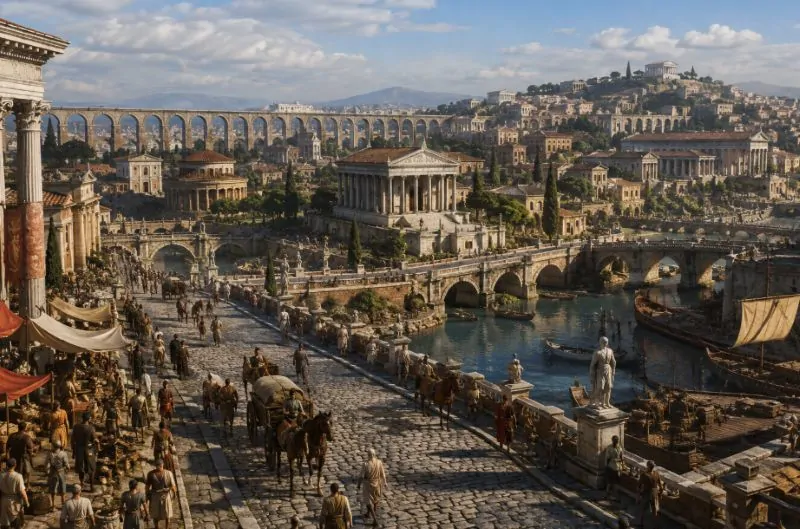
The aqueducts carried water for long distances at predetermined gradient levels, and the force of gravity was sufficient to take it all the way from the source to Rome. Water from the aqueducts filled public fountains, baths, factories, and even homes in the ancient state.
The road network of ancient Rome was also important; over hundreds of thousands of kilometers of territory, the roads connected all the provinces of the empire and allowed different travelers—soldiers, traders, and officials to travel easily. In addition to the roads, there were also bridges, ports, warehouses, and channels in ancient Rome.
Administration Without Modern Technology
Efficient management of a vast empire necessitated the organization of things without the existence of technology.
The authorities wrote down records on papyrus, parchment, and wax tablets. The census data allocated taxes and military service. Legal documents noted ownership, contracts, and decisions.
The imperial governors who monitored territories reported to Rome. Even though communication lasted weeks, the operators followed principles and prepared written laws.
Communication Across the Empire
Rome relied on efficient transportation and communication systems to help it run without any use of telephones or the internet.
State courier services were possible because of the roadways in the empire. Cursus Publicus was a great way to deliver official documents by means of relay posting as fresh horses were ready for the delivery ride.
The significance of maritime travel in that time was really big. Ships operated by merchants carried not only goods but also news and important documents, establishing communication between the nations despite the geographers’ slow way of transporting people back then.
Public Services and Urban Planning
In order to keep one million people alive, it was necessary to do more than supply them with food and transportation. Public baths were provided not only for cleanliness, but also as places of socializing; markets supplied goods from all over the empire. Public palaces acted as sites for trading and political activities.
Urban designers created new streets, drainage systems, and public areas for the management of large crowds, while being safety conscious through service organizations such as fire brigades and initial security watch service.
Military Logistics That Benefited Society
In addition to being a force of arms, the Roman military played an important role in the infrastructure of the empire.
The legions built roads, bridges, and forts that would later facilitate trade as well as civilian travel. The military supply system ranged far into the empire to provide soldiers stationed far from Rome with food and equipment. The infrastructure they built promoted economic links between different parts of the empire.
Military strategies combined with civilian enterprises enabled the Romans to unify their immense empire.
A Legacy of Organization
Ancient Rome illustrates that successful civilizations rely on organization no less than on technology. By developing the system of efficient logistics, leveraging advanced engineering, applying standardized administration, and creating reliable infrastructure, Romans built huge systems that provided support to one of the biggest cities in history.
A number of these principles are applicable to modern states, from public works to the census over transportation networks and urban development. While contemporary cities use electronic means, old Rome attained remarkable results applying the skills of practical engineering, disciplined administration, and effective coordination.
About the Author