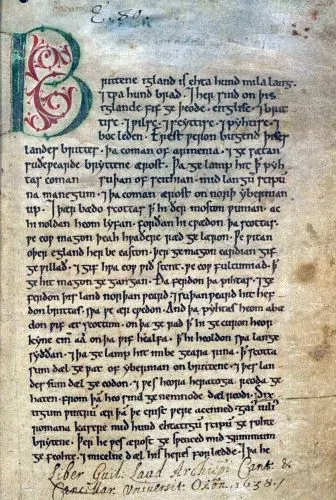
Gold-threaded vestments and church gifts allowed Matilda, Leonor, and Joanna Plantagenet to transform material splendor into memory, patronage, and political authority.

By Dr. Jitske Jasperse
Professur für Bildkulturen des Mittelalters
Humboldt-Universität zu Berlin
Introduction
The splendidly dressed Matilda in the gospel book leaves little doubt that dress was meant to impress. Yet an outfit could work for and against a person, and it could empower or disempower both men and women.1 No wonder that King Henry II spent a fortune on the outfit of his daughter Joanna when she was sent off to Sicily to marry King William II. We also have seen that the importance of appearance was expressed in the design of Joanna’s seal matrix; her flowing bliaut, decorated ceinture, and fastened mantle were executed in exquisite detail, focusing further attention on the owner’s status as royal daughter and former queen. As is well known, visual sources testify that medieval elite society valued outward appearance.2 Often, physical looks were considered to be manifestations of a person’s inner virtue and character, with clothes playing an important role in revealing this. Textiles were appreciated because they literally embodied the status, wealth, and virtue of their wearers, and as such imbued them with power. Cloth and vestments were also valued commodi‐ties because they could be separated from their owners and be given away. As portable and displayable items they had “a performative function that activated both body and space.”3 This performative potential also pertained to ecclesiastical settings as is evident from the remaining textiles, inventories, and writings on liturgy.4 My focus turns to the donations of textiles by Matilda and her sisters. Their gifts to religious institutions are contextualized through both known material remains and references to clothing and textiles in written sources.
This emphasis on women may suggest that they were most intimately connected with the world of fabrics. Roberta Gilchrist posited that the association between women together, these artefacts demonstrate that vestments were imbued with meaning not merely through their materiality and function but also through their presentation as gifts. The performance of such gifting empowered Matilda and her contemporaries.and textiles perhaps lay in female participation in the domestic production of cloth and dress. But it went beyond women’s productive skills:through textiles, femininity and social and religious roles were constructed and conveyed.5 This raises the question of whether textile donations can be found more frequently for women than men. According to Stefanie Seeberg and Alexandra Gajewski, the answer is “no.” In fact, they maintain that nothing in the historical record suggests that the connections between medieval women and textiles were described as gendered.6 Textile objects, charters, inventories, and wills testify to both men’s and women’s involvement in the donation of textiles. Seeberg and Gajewski, however, do acknowledge that women were often regarded as makers of textiles and played important roles in the handling of garments.7 The presence of women as creators and donors of liturgical vestments, indicative of the cooperation between women and ecclesiastical leaders, has been discussed in depth by Fiona Griffiths and Maureen Miller.8 These historians have convincingly argued that, through the gift of liturgical textiles, women gained access to rituals performed at the altar from which they were normally excluded precisely because of their sex. Miller highlighted that the power this gave to women proved deeply unsettling.9 Despite this tension some churchmen explicitly encouraged women to make and donate textiles.10 How Matilda and other elite women strategically handled textiles in order to enforce relations with others is investigated in this essay through the lens of the gift. The practice of gift-giving illuminates the multiple ways by which power relations were negotiated.11 Taken together, these artefacts demonstrate that vestments were imbued with meaning not merely through their materiality and function but also through their presentation as gifts. The performance of such gifting empowered Matilda and her contemporaries.
What Remains: A Documented Textile Gift
Duchess Matilda, dedicated to our church, together with her husband Duke Henry gathered for our church very beautiful ornaments fittingly decorated with gold and golden embroidery:a white chasuble, a red chasuble, a white dalmatic, a red dalmatic, a white tunicle, a red tunicle, a stole of gold embroidery with a maniple, a purple cope, a snow white cope, a single alb, a Greek censer, a completely golden woven altar cover and an even better golden one in needlework: in addition, another golden embroidered cover, two shrines and sandals for the office of the bishop.12
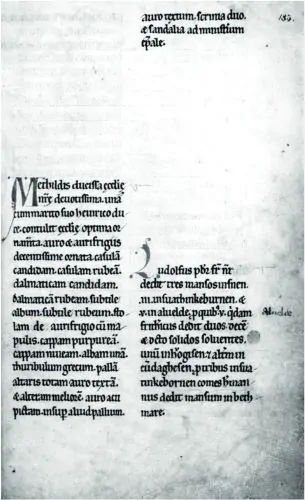
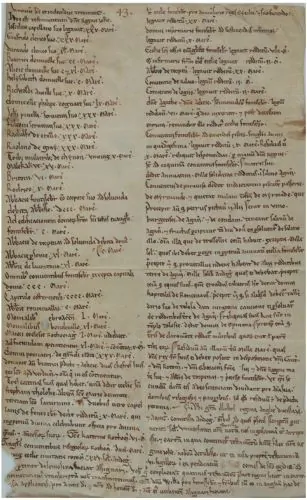
This impressive donation of eighteen “very beautiful ornaments” is recorded in Hildesheim Cathedral’s chapter book (Liber capitularis) (Figure 22). Apart from one shrine that has been identified as the Oswald reliquary, the other items have perished.13 The vasa sacra must have entered the cathedral sometime before Matilda’s death in 1189. Her name is given first, and only Matilda is referred to as ecclesie nostre devotissima, revealing that it was the duchess who had a special relation to Hildesheim. In fact, Matilda’s association with the episcopal town is confirmed by the cathedral’s necrology, written down in the same book, in which her death is mentioned at June 28, 1189 (Methildis Ducissa benedictae memoriae) whereas her husband’s name is absent.14 That Duke Henry is not included confirms the primary importance of the duchess to the cathedral community, perhaps in part because she was the major donor of the precious ornaments.
The vestments and vessels in this entry are described in too general terms to completely satisfy our curiosity. For example, we are left wondering whether any of the gold decorations perhaps were lions, the animals that were employed by both Henry the Lion and the Plantagenet kings as heraldic devices on coins, seals, water basins, and textiles. Whatever the case might have been, that this list exists at all shows that the donation was deemed significant enough to be copied into the chapter book.15 This multiple-text manuscript was compiled around 1191/1194, with various entries and comments being added until the fifteenth century.16 The entries—also including the cathedral’s chronicle—narrate the cathedral’s history, list its bishops, canons, and affiliated communities and record its belongings, underlining the centrality of this book for the memory of the community. The manuscript not only served the liturgical commemoration of the dead, but also documented the possessions and revenues of the cathedral, providing insight into the cathedral chapter’s network.17
Matilda’s gift is one of twenty-two recorded donations by laypeople (seven men and two women) and by clergy (thirteen men) that were added to the chapter book in the early thirteenth century (fols. 179r–184v).18 As some of these offerings—like the ones by Matilda and Archbishop Rainald of Cologne (d. 1167)on fols. 183v–184r—were made well before 1191/1194, the entries must have been copied from earlier written materials. They are not arranged haphazardly, but according to the anniversaries of the donors recorded in the necrology (fols. 36v–128r). The duchess’s donation is distributed over two columns and written down in an even script for which the ruling is still visible. Given the chronological order of the entries, I have found no satisfying answer as to why this gift—like so many others—is registered leaving blank spaces before and after the specific entry. Did the clerics of Hildesheim cathedral expect to fill in the blanks with other donations at a later time? Or were not all of the entries written down at the same moment? Whatever the case might have been, what stands out when comparing the content of the entries is that Matilda and Henry were the only donors to bestow on the cathedral solely moveable items. Unlike the other laypersons they offered no lands or properties, such as houses, estates, or mills. Yet this is not to say that their donation was of lesser value, given the number of offered items that were made of gold.
What exactly did Matilda and Henry donate? A large part of the entry is devoted to the costly and luxurious vestments for the bishop, priests, deacons, and subdeacons. Chasubles, maniples, and stoles were worn by priests during Mass, dalmatics were tunics for deacons, and tunicles (a variant of the dalmatic) were worn by subdeacons. Copes were for bishops, who would also wear the sandals mentioned at the end of the entry.19 With the exception of the maniple, stole, alb, and sandals, the rest of the items were listed in pairs of reds and whites; from this we may infer that they were specifically selected to be given as gift sets. Red and green had already been defined as liturgical colours before the Fourth Lateran Council in 1215, although their use varied regionally throughout Western Christendom. It is possible that these red garments were intended to be worn on the feasts of the apostles and martyrs, as well as Pentecost and the Holy Cross.20 The white ones were in all likelihood used during Easter. Although no reference is made to their materials, it is likely that Matilda donated silk or fine woollen garments, which were fashionable during the central Middle Ages. A single alb, or white tunic used as undergarment, closes the list of liturgical garb, followed by a number of altar adornments making up the second part of the donation. Matilda offered a Greek censer, and we can only guess what was meant by “Graecum.” Did the item come from Byzantium, or more generally from the Eastern Mediterranean? Or was it made in the style of the “East”?21 It is possible that “Greek” referred to its shape, namely a censer that took the shape of an equal-armed Greek cross. In addition to the censer the duchess also offered a completely golden woven altar cover, and an even better golden one in needle‐work, along with yet another golden embroidered cover, as well as two shrines and episcopal sandals. Here the extensive use of gold stands out for the altar covers, indicating both appearance and value, whereas the materials of the shrines and sandals remain unspecified.22 With this gift to the cathedral, Matilda added generously to what already was an impressive trove of ornamenta.
Hildesheim Canon Godefridus (frater noster), whose presence is attested in 1182/1183, presented to his church a “red samite cope with gold embroidery and a gold chalice together with his priestly robe,” together with an impressive range of books.23 And the aforementioned Archbishop Rainald of Cologne donated “a good pallium adorned with golden signa and an embellished banner.”24 The textile treasure was expanded further when Bishop Conrad of Hildesheim (1194–1198) added thirteen textiles, two small shrines and relics. The Chronicon Hildesheimense, which was written between the twelfth and fifteenth centuries and is part of the cathedral’s Liber capitularis, describes the bishop’s gift in fair detail:three chasubles (one of red silk, another white, and the third of purple-red, all decorated with gold), two dalmatics (one of red silk, the other white), an alb of white silk, three altar cloths (two of purple-red, of which one is decorated with gold circles and the other with stars; the third one for daily use on the altar), a good curtain that normally was hung in the north part of the choir, a purple towel, six copes (three of red, three of white silk), two small shrines of gold and gems, two fragments of the relics of St. Stephen and St. Laurentius, and some balsam.25 Here, too, the outer vestments are red and white, and the chasubles are decorated with gold. Like the alb Matilda donated, the one presented by the bishop is white as well, and now the material is specified as a silk fabric known as samite.26 It was through such liturgical vestments donated by Bishop Conrad and his predecessors, as well as by Matilda, that bishops, priests, deacons, and subdeacons quite literally fabricated their specific religious identities, recognizable as differing ranks of clerics. Their dress was crucial to the performance of their office during Mass and in liturgical festivities like processions. Clearly, ecclesiastical dress activated the bodies of the clergy while also marking the spaces they entered and used. That these garments held a special status is evident also from the fact that the clergy were not supposed to wear them outside on the street.27
Woven Words: The Power of Threads
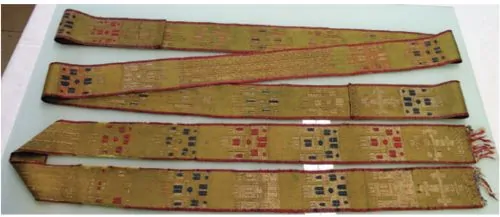
While written descriptions of the ornaments donated by Matilda give a general impression of their appearance and costliness, neither exact design nor fabrics can be established from the textual source. We are fortunate, therefore, that in connection with her sister Leonor original textiles do survive in fine condition:a silk stole, intended to be worn around the neck of the priest, and a matching silk maniple, which was worn over the priest’s wrist (Figure 23). They are preserved in the Museo de Real Colegiata de San Isidoro in León.28 Both pieces are tablet weaves, a technique in which a bundle of flat tablets (made of ivory, bone, or wood) with holes in their corners is used to create the warp through which the weft is passed. This technique was common for similar liturgical vestments, as also for belts, borders, and trims.29 The silk warp of both cloths consists of red threads and yellow-green threads with a weft of the same yellow-green silk thread, to which metal threads and blue and red silk threads are added for the crosses, castles of Castile, and inscriptions. The abundantly used metal wrapped around a silk core is an alloy of silver, gold, and copper, resulting in colours varying from white to yellowish. Technical analysis has revealed that the red silk threads were dyed with a mixture of kermes, madder root and tannins (often extracted from oak galls), while the yellow-green is a mix of yellow Reseda luteola (also known as yellow weed), indigotin (the principal colour in indigo), and Persian berries.30 As these are common dye pigments throughout Europe and the Mediterranean, they do not help solve the riddle of whether the stole and maniple were made in Iberia or elsewhere.
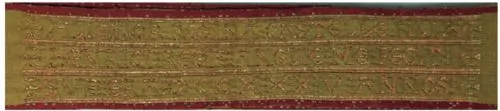
There is no doubt that Queen Leonor was involved in the making of these vestments. In a triple register at the midpoint of the cloth, the inscription in metal thread on the front of the stole reads, “Leonor, queen of Castile, daughter of Henry, king of England, made me in 1197” (Figure 24).
+ ALIENOR: REGINA: CASTELLE: FILIA +
+ HENRICI: REGIS: ANGLIE: ME: FECIT:+
+ SVB: ERA: MCCXXXV: ANNOS:+31
The lettering is carefully composed, giving the names of Leonor and Henry in the first and second register respectively, followed by their titles and kingdoms. Even the filia and fecit, making up the end of each phrase, are laid out evenly. Because the maniple has been exposed to heavier wear through handling, its metal thread inscription is in worse condition; it is nearly identical to that on the stole, albeit without the words sub and annos because of the reduced space available for the inscription (the maniple measures 154.4 × 7cm and the stole is 277cm long).32 The date of 1197 on both textiles supports the notion that the two were made as a set, while the careful construction of each inscription shows that they were consciously contrived at the midpoint of each piece and intended to be visible, at least until the stole was covered by the priest’s chasuble, which would partially obscure the maniple as well.
In the textile inscriptions, Leonor is styled queen of Castile and thus wife of Alfonso VIII, though the king himself is not named. The Castilian identification is underscored by the repeating pattern of castles, with their eye-catching red and blue windows and doors decorating the vestments. These heraldic devices are identical to the castle on the reverse of Alfonso’s double-sided lead seal, which he employed from ca. 1175 onwards.33 Alfonso VIII seems to have been the first to use the castle as an armorial emblem in Iberia, and the motif also appeared on textiles in his and Leonor’s tombs.34 In charters connected to the Castilian court, Leonor’s role was always expressed through the phrase una cum uxore mea Alienor, suggesting her partnership with Alfonso, whereas the phrase filia regis Anglorum found on the stole and maniple were not common in Iberia.35 Perhaps this deviation from the rule can be taken as an indication that the textiles were made in England where the connection between father and daughter was given prominence. Yet we should also consider the possibility that this English link was the result of Leonor’s explicit involvement in the making of both garments.
Even though the inscriptions leave no doubt that Leonor Plantagenet was the driving force behind these liturgical cloths, we are still in the dark about her exact role in their making since me fecit might refer to the donor who financed them, the patron who ordered the work, the artist who created the pieces, or the recipient who owned them, all of whom could be considered makers.36 It is tempting to consider Leonor the artis because her name appears on the type of textiles that could have been produced in a domestic or courtly setting, especially if we assume that, as a royal daughter, Leonor would have received some training in the making of textiles.37 Moreover, both surviving textiles and written references testify that women—secular and religious, real and fictional—did indeed weave, sew, and decorate liturgical vestments. Queen Margaret of Scotland, according to her eleventh-century vita, produced “caps for singers, chasubles, stoles, altar cloths, and other sacred vestments and decorations for the church.”38 And in his Chronica Slavorum Helmold of Bosau narrates that when the blind woman Adelburg regained her sight she single-handedly made a cover to be put on Bishop Vizelin’s grave as a testimonial to and reminder of her healing.39
Nonetheless, I want to challenge the assumption that Leonor was the weaver of these vestments. Although the basic technique of tablet weaving is relatively simple, here the patterns and inscriptions indicate a complex tablet structure. This complexity can be inferred from the slightly varying sizes of the castles and crosses, irregularities that are only noticeable when the work is examined in detail. The lavish use of silks and metal threads, as well as the fine execution and the readability of the inscription on both front and back, are indicative of the textiles’ high quality. It is not yet possible to establish with certainty how many tablets and warp threads were used, but following the data gathered by Valerie Garver for three Carolingian tablet weaves, it seems safe to assume the use of at least 90 tablets and 360 warp threads (90 tablets × 4 threads).40 While there would have been tools that aid in working with so many tablets, crafting such high-end pieces requires both experience and the right equipment, which is why a professional weaver would have been commissioned to make these textiles. And as Maureen Miller and others have pointed out, it is very likely that this weaver was a woman:until the thirteenth century women were active makers of textiles, and although their roles changed when the profession became a professionalized and more lucrative industry, the connection of women with textiles continued.41
Leonor did not have to be the weaver of the stole and maniple for these items to show the relationship between women and textile gifts. The inscription gives her name as a sign of identity, defined both through her title as queen of Castile and her position as daughter of the king of England. Her name is also a sign of validation in the sense that no other than Queen Leonor was the maker. With her name, title, and descent as well as date woven in silk and gold, Leonor consciously fabricated textiles that remembered her not as just any Leonor, but as this particular high-born queen.
Last Will: Three Hangings
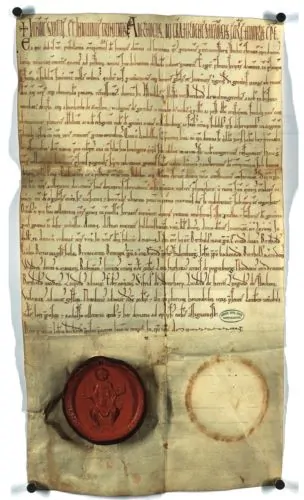
While Matilda and Leonor gifted vestments during their lifetime, their sister Joanna bequeathed textiles on her deathbed; a version of her will is held by the Archives Départementales Maine-et-Loire at Angers (Figure 25).42 The document belongs to the so-called series H (clergé régulier, before 1790), which contains charters from male and female religious establishments of different orders that were nationalized at the beginning of the French Revolution.43 The document is one of the rare examples of women’s wills that have survived from the twelfth century. No testament of Joanna’s mother or sisters has come down to us.44 And even though her brother King John had a will made when he was gravely ill, its content is very different as no references are made to specific movable items and no sums of money are mentioned.45
The text of Joanna’s will has been written on a high-quality large single-sheet parchment measuring 43.5 x 23.5 centimetres. The bottom of the sheet is folded and contains one central slit to hold a seal tag that is now missing.46 Divided into two columns with hardly any visible traces of ruling, the whole appearance is that of a carefully arranged text written in a clear gothic script. The testament’s opening lines, In nomine sancta et individue trinitatis. Hoc est testamentum domine regine Johanne (In the name of the holy and indivisible trinity. This is the testament of the Lady [and] Queen Joanna), suggest that the document is not a first-person will. This is confirmed by a codicil at the bottom which states that her mother went to Gascony, “taking with her the original (carta) testament of her dearest daughter Queen Joanna, so that the count of St. Gilles may see it, for the testimony of the six seals attached to it.”47 The surviving copy of her will can perhaps be understood as a publication charter, a “commemoration record of a ceremony or court in which the testamentary desires of a deceased person were made public, sworn to or verified by testimony of witnesses and/or reading of a written will.”48
Even though wills often provide information on the motives or circumstances of the testator, such as the poor health of King John, Joanna’s testament does not.49 Her will was issued when she fell mortally ill in Rouen, where she made known that she wanted to enter the abbey of Fontevraud as a nun despite being married and pregnant. In the end Joanna received the veil and died shortly thereafter, on September 24, 1199.50 It seems that her son was removed (extrahitur) from Joanna’s body after she passed away so that the boy could be baptized before he would die, and indeed he drew his last breath soon after he was baptized and was buried in the Notre-Dame at Rouen.51 Most of Joanna’s bequests concern money, rents, and revenues, whereas hardly any mobile objects or immobile properties are listed. We read about two coffers at Verdun with their contents given to her maids, Alice and Beatrice, and about Joanna’s horse that should be left to the hospital of Roncevaux.
She also stipulates that “her relics in the Temple at Toulouse” should be transferred to the “house of Spinatia.” Possibily the “temple” refers to the pilgrimage church of St. Sernin, which received support from Joanna’s great-grandmother Philippa of Toulouse (d. 1117), whereas “Spinatia” was the Fontevrist priory of Lespinasse (Toulouse), which had been founded in 1114 by the same Philippa.52 If this identification holds true, it means that Joanna transferred her relics from one location promoted by her great-grandmother to another her great-grandmother favoured even more because it was affiliated with the abbey of Fontevraud. Perhaps she wished for the relics to be transferred at the time of her death to connect herself with her great-grandmother and to demonstrate her Fontevrist preferences.53 In the will, it is explicitly stated that the relics—which remain unspecified—belonged to her, indicating that they were treasured in a way that was recognizably hers. The relics would have been encased in some sort of precious container, such as a shrine or a portable altar, likely inscribed with her name. Numerous examples of these caskets survive from the central Middle Ages.54
And then there are tres cortinas suas, Joanna’s only Toulousain bequests, namely to the churches of St. Etienne, Notre Dame de la Daurade, and St. Sernin.55 Because the cortinas are specified as being Joanna’s, it may be that these hangings originally decorated her chambers. Hangings in secular and religious buildings served multiple purposes, from decorative elements that also protected against cold, to room dividers that created social and liturgical spaces, allowing visible or physical access to some while denying it to others.56 As such, curtaining devices were powerful instruments in the hands of secular rulers and clergy for emphasizing divisions and hierarchy, which could lead to harmony or conflict.
The donation of hangings to churches was certainly not unusual, but detailed specifications about their appearance or placement are rare. As we have seen, Bishop Conrad presented a beautiful one to Hildesheim, which “was usually hung in the north part of the choir.”57 That the description was not more detailed has perhaps to do with the fact that hangings—that is, large textiles—were so quotidian in ecclesiastical settings that only special circumstances would give rise to a more precise description.58 To this we should add that hangings, like other textiles, would often be reused. It is possible that Joanna’s own hangings were remade into other ecclesiastical items. The repurposing of luxury textiles is one of the reasons why twelfth-century donations recorded on parchment, like those of Joanna and Matilda, can rarely be connected to surviving objects, like the liturgical set of Leonor.
Empowering Textiles
As discussed above, the connection between medieval women and textiles tends to be taken for granted. But such donations are not a given; we should always ask why an individual woman would have donated a particular textile. Rather than suggesting that there was one overarching reason for all women, it is crucial to keep in mind that there were multiple, complementary arguments for this kind of gift-giving. At first glance Matilda’s donation to Hildesheim appears to be out of place because the cathedral did not hold the same importance to the ducal family as did their church at Brunswick or St. Michael at Lüneburg. The entry in the cathedral’s chapter book, however, suggests otherwise since Matilda is lauded as “dedicated to our church.” And indeed, Matilda and Henry were familiar with this episcopal see in Saxony, as their church in Brunswick fell under Hildesheim’s ecclesiastical authority. This connection was made explicit in 1188 when Bishop Adelog of Hildesheim consecrated the altar of the Virgin in St. Blaise at Brunswick. We know of this event because of an inscribed pyx, which was hidden in the capital of the central column of the altar.59 Its lid contains an image of an enthroned figure—in all likelihood Bishop Adelog who consecrated the altar—surrounded by an encircling inscription:
In the year of the Lord 1188 this altar was dedicated in the honour of the Virgin and MotherMary by Adelog, the venerable bishop of Hildesheim, founded and supported by the illustrious Duke Henry, son of the daughter of Emperor Lothar, and by his most devout wife Matilda, daughter of Henry II, king of the English, son of Matilda, empress of theRomans.60
There are noticeable differences. First, Duke Henry is connected to both Lothar and his mother, but only the name of the emperor is given: his mother remains anonymous. Second, as in the gospel book, Matilda is the daughter of the king of England (or the English), but on the pyx her grandmother is styled empress rather than queen. Despite the differences, both coronation miniature and pyx name the most important family members in order to emphasize and remember the couple’s illustrious backgrounds. In return for the consecration of the altar by Adelog, perhaps as an expression of gratitude, Matilda presented the liturgical vestments to Hildesheim.
Exactly how important vestments were for the communication of episcopal identity and status is evident in surviving seal imprints, such as that of Bishop Adelog (Figure 26).61 One of his wax seals contains a clear representation of the enthroned bishop wearing an amice around his neck to protect the neckline of the alb; this was covered by a dalmatic with a central ornamental stripe and decorated hems. Over the dalmatic Adelog wears a chasuble, and on his left wrist a patterned maniple with fringes is visible.62 Similar rich vestments, and more, were presented by Matilda at an unknown date before her death in 1189.
It may be that Matilda donated the textiles pro memoria, although the entry does not specifically state this. The donation made by Henry the Lion to the Church of the Holy Sepulchre in Jerusalem has a pro memoria clause, as do many other twelfth-century documents. In Erin Jordan’s study of the sisters Joanna and Margaret of Flanders, she pointed out that the creation and strengthening of bonds between the countesses and religious institutions was not simply an issue of liturgical commemoration but as much about claiming worldly power through the creation of personal bonds and relationships with clerics.63 Matilda had every reason to try to improve the ties between her family and the Hildesheim episcopacy, as their relationship was tense. Because the diocese of Hildesheim was completely surrounded by Henry’s lands, the duke and the successive bishops of Hildesheim during his reign were direct rivals in territorial ambitions. The strained relations between the two parties led to the destruc‐tion of large parts of Hildesheim by Henry the Lion in 1166–1167. The town also faced serious threats during the war that destroyed Halberstadt in 1179.64 That the duke and the Hildesheim chapter were not on good terms is indicated by Henry’s absence from the cathedral’s necrology, and by the parallel fact that only three Brunswick canons were included in Hildesheim’s chapter book.65
It is conceivable that in these specific circumstances Matilda’s donation of liturgical vestments was a gesture meant as a peace offering. Elite women are known to have played important roles as caretakers and mediators in the cause of peace during the Middle Ages.66 The choice to give vestments rather than land was a sensible one, considering the constant territorial struggles:it was surely easier to alienate these movable items than landed property.67 Atrip to an important episcopal seat such as Hildesheim, as well as to other locations in the duchy of Saxony, would have been expected of her. Matilda was her husband’s representative in 1172/1173, and she held dower lands in the north of the duchy; what is more, she was forced to leave Brunswick on several occasions during her husband’s wars.68
The entry in the Hildesheim Liber capitularis suggests that Matilda acted as a peacemaker for the cathedral, as she had also done in the case of Ulrich of Halberstadt in 1179.69 On September 23 of that year, in one of the Saxon wars, Henry the Lion burned down Halberstadt and its churches. After the destruction of the town, the duke imprisoned its bishop, Ulrich (d. 1180), and had him taken to Artlenburg (Ertheneburg), a castle located at the northern bank of the Elbe, not far from Lüneburg. There, according to Arnold of Lübeck (ca.1210):
The very devout Duchess Matilda cared so much for him [Ulrich] that she, out of reverence for his sacred office, gave him plenty of good vestments [vestibus bonis large] and with great dedication she took care of all his needs, so that according to his position he would lack for nothing.70
Arnold depicts Matilda as loving and caring towards Bishop Ulrich, who received treatment commensurate with his rank. However, Arnold’s statement allows for a more political interpretation as well, one in which Matilda’s gift-giving actions are intended as a mediation. The duchess presented the imprisoned bishop with “plenty of good vestments” in the hope that it would calm the roiled waters stirred up by her husband. It is likely that Ulrich of Halberstadt would have taken these high-quality liturgical textiles with him after his release at Christmas 1179.
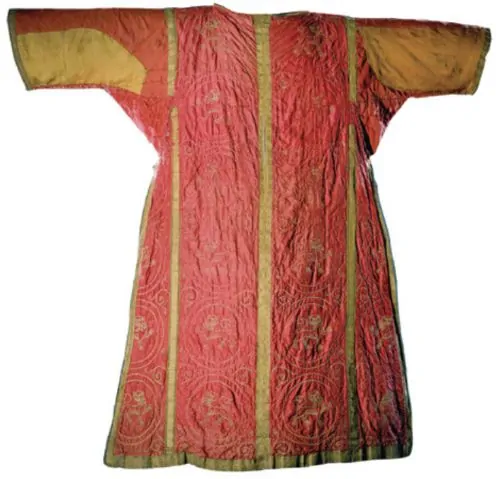
Interestingly, Halberstadt Cathedral possesses a dalmatic made of red samite—a fabric also found in Matilda’s bridal treasury and in her donation to Hildesheim as “examite”—which is decorated with lions in gold thread and is dated to the second half of the twelfth century (Figure 27).71 Its decoration, known as opus Anglicanum, belonged equally to religious and secular realms.72 Here, the description given by the poet Ramón Vidal de Besalú of Leonor’s mantle embroidered with a golden lion comes to mind again.73 The golden lions are a reason to connect the dalmatic to Henry and Matilda.74 Is it possible that this was the very cloth of samite Matilda brought with her from England in 1168? This would explain the lion motif, as King Henry II, as well as his sons Richard and John, selected lions as heraldic devices on the shields that were represented on their wax seals. Or might Henry have acquired it on his journey to or from the Holy Land in 1172/1173? the duke appropriated the lion on small-sized coins and seals as well as in the monumental form of a giant bronze lion placed in front of his Burg at Brunswick. Perhaps the samite simply came into the ducal family’s possession in Saxony at a later stage. The golden lions were embroidered at some point before the fabric was made into a dalmatic. If the precise context for the creation of this vestment and its arrival at Halberstadt remain elusive, it still represents exactly the sort of high-quality object that Matilda would have presented to Bishop Ulrich. In my opinion, the Halberstadt donation and the Hildesheim gifts demonstrate that Matilda was able to leverage her position as a wealthy daughter of the English king, a status that had accompanied her to Saxony when she married Henry the Lion, and one that was of paramount importance to the duchess, her husband, and their contemporaries, given that her descent is emphasized in all medieval sources.
As for Joanna’s bequest of textiles to the Toulousain churches, it was made on her deathbed and so the motives behind her donation differed somewhat from Matilda’s.75 Joanna’s testament was not merely a legal stipulation, but also a pious document and an autobiographical composition through which her posthumous reputation would be established.76 We can read Joanna’s gifts as a way of impacting the lives of those in the religious communities in Toulouse—as well as Fontevraud and its houses—who in return for Joanna’s support were expected to pray for her and keep her memory alive.77 At the same time, it is possible that Joanna gifted her cortinas to the three Toulousain churches in order to compensate for taking her personal relics from St. Sernin. If so, it is likely that the three hangings were high-quality textiles, perhaps decorated with gold. Shortly before her death, Joanna had her testament drawn up and managed to fulfil her wish to become a nun at Fontevraud, and later to be buried there, demonstrating her leverage. Colette Bowie concluded from Joanna’s impoverished situation, her absence from char‐ters concerned with landed wealth, and her unfortunate marriage with Raymond of Toulouse that she “appears to have exercised little if any authority during her lifetime.”78 Yet her possession of a salt pit in Agen, concerning which she issued a charter in the year she died, together with her seal, urge a more nuanced interpretation of authority and power than one solely built on money and lands.
There is little doubt that Matilda and Joanna meant to establish, affirm, and strengthen secular and religious ties through the donation of costly items. We may assume that Leonor had the same intentions with the stole and maniple she had made. There are, however, no clues at San Isidoro that tell us when and how the textiles arrived in León. In fact, we cannot be sure that Leonor herself presented these textiles to this monastery. San Isidoro was at the heart of the kingdom of León, ruled by Fernando II (r. 1157–1188, and uncle of Alfonso VIII of Castile) and thereafter by his son Alfonso IX (r. 1188–1230), and there is nothing in the charters or chronicles that suggests that Castilian rulers took an interest in the Leonese monastery. Rather, their favoured institution was the abbey of Santa María la Real de las Huelgas in Burgos. How then did the vestments arrive at the royally sponsored monas‐tery in León? Possibly, Leonor gave the textiles as a present to her daughter Berenguela (r. as queen consort of León 1197–1204, and as queen regnant of Castile in 1217)when she married King Alfonso IX of León in 1197, an arrangement that was actively advocated by Queen Leonor.79 The coincidence of dates between the wedding celebrated in Valladolid and the inscription on the stole suggests this as the most likely option. From this point on, Berenguela maintained close relations with San Isidoro, first as queen of León and later as queen and regent of the reunited kingdom of Castile-León.80
Even though the exact connection between Leonor and León can only be hypoth‐esized, the maniple and stole still have something important to offer that the written donations directly connected to Matilda and Joanna are lacking:their inscriptions detailing Leonor’s name, title, and connection to her father, King Henry II. In his study of the political and cultural exchange between the Plantagenet and Castilian kingdoms, José Manuel Cerda Costabal pointed out that the textiles reflect the queen’s wish to be remembered as the daughter of the king of England, and that she did so after having been in Castile for almost thirty years.81 It is possible to refine this statement further, for it was not only long after her arrival on the Iberian Peninsula, but also nearly a decade after her father had died that Leonor linked herself to him (and not to her brother King Richard), thereby demonstrating that it was still the old king who embodied the kingdom and determined her status as a royal daughter.82 Thus, the inscriptions evoked the mem‐ories of both Leonor and her deceased father when the stole and maniple were used during Mass, manifesting the commemoration of donors and their families. To make her presence—and that of her relatives—felt at the altar, the queen gifted textiles and by doing so women became liturgical actors.
The variety of sources informing us about the textile artefacts Matilda and her sisters donated to ecclesiastical institutions unveils that through these gifts women sought to improve their own situation and that of their families. The ritual of investing the priest not only prompted his pastoral duties and visualized ecclesiastical hierarchy, but also affirmed that the making of a priest depended on wealthy benefactors who decided who was worthy of their aid and who not. The Hildesheim clergy, too, when they were dressing to set themselves apart, would have called to mind that they were supported by Matilda, who was their benefactress as well as the wife of Henry the Lion, as she is remembered in the Liber capitularis. Not only the performance of the gifting itself was an action of power; the vestments presented by Matilda and Leonor also carried authority through their precious materials (silks, gold, silver), their bright colours (red, yellow, blue), and inscriptions. By displaying the textiles, clerics offered the women who donated them a liturgical stage. It is important to realize, however, that women’s presence at the altar through textiles was temporary and could also be erased when vestments were not visible, worn down, or simply no longer remembered. Yet through textiles women’s presence remained in existence, both near the altar and in sacristies, where vestments and church furnishings were stored. On the surface, the making and donating of woven and embroidered fabrics simply belonged to the realm of the good and devout woman, but the reality was more complex. Through their donations, elite women like Matilda, Leonor, and Joanna forged meaningful spiritual and political relationships.
See endnotes and bibliography at source.
Chapter 4 (91-114) from Affiliate disclosure: Amazon links on this site are paid links. As an Amazon Associate I earn from qualifying purchases.Medieval Women, Material Culture, and Power: Matilda Plantagenet and Her Sisters, by Jitske Jasperse (Arc Humanities Press, 08.31.2020), published by OAPEN under the terms of a Creative Commons Attribution 4.0 International license.
About the Author