
You can read an argument without agreeing with it. That is part of what reading is for.
Suppose you spend an evening comparing two accounts of a revolution. One writer admires its leaders; another documents their abuses. You follow a reference into a political movement you know little about, then open a criticism of that movement. By the end, you may have changed your mind, found better questions or simply decided that neither writer makes a convincing case.
A list of the pages you visited would capture very little of that thinking. It would show where you went, with much less to say about why.
This gap gives reading privacy a value beyond keeping embarrassing searches out of sight. People need room to investigate ideas before deciding what they believe. Online, understanding how much room we have begins with a practical question: who can see which parts of the reading process?
A Reading Record Cannot Explain Your Curiosity
Libraries have long treated the privacy of their readers as an intellectual concern. The American Library Association connects confidentiality with the freedom to seek information without fear of judgment. Its guidance covers the materials people consult as well as those they borrow.
That principle recognizes something ordinary about learning: the path can look strange before you explain it. A student researching propaganda must examine propaganda. A reader trying to understand an unfamiliar religion may begin with questions they would hesitate to ask in company.
Wanting privacy in those moments is reasonable. It leaves space for incomplete understanding.
On the web, however, a reading session involves several separate systems. The browser on your device, the site publishing an article and the network carrying the connection have different roles. They do not automatically possess the same record of your activity.
Your Browser, the Website and the Network See Different Things
Your browser may keep a history of the pages you open. Someone using the same browser profile could find those entries later. Private browsing changes what is saved locally: Firefox, for example, does not retain the session’s browsing history after private browsing ends. Downloaded files and bookmarks you create can still remain.
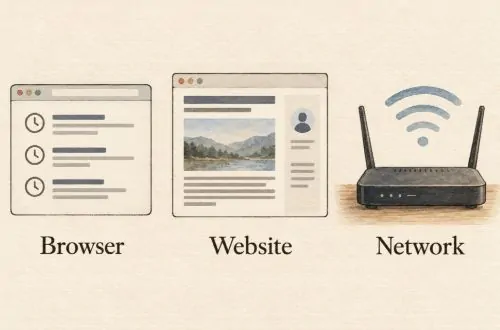
The website is a different observer. It receives requests for its pages, and signing into an account gives it a way to associate activity with that account. Cookies can help a site recognize returning visits or maintain a login. Depending on the site’s setup and browser restrictions, third-party services embedded in pages may also receive information about visits.
None of this establishes that every publisher builds a detailed personal profile. What is collected and retained depends on the services involved and their practices. But clearing your browser history does not instruct those services to delete their records.
Your internet provider or a local network operator has another view. HTTPS encrypts the contents exchanged between your browser and the website, so ordinary network observation does not reveal the article text or the full page address. Connection timing, traffic volume and destination IP addresses remain visible; domain names may also be visible, depending on the configuration.
Seeing a connection to an encyclopedia is therefore different from seeing the particular entry you opened. Neither observation reveals whether you believed what you read.
What Changes When You Use a VPN?
A VPN addresses the connection between your device and the wider internet. Traffic routed through it travels inside an encrypted tunnel to the VPN server before continuing to its destination. For that traffic, the website normally sees the VPN server’s public IP address instead of your home connection’s address.
A reader considering a free VPN should understand that specific role: limiting what the local network can observe about browsing routed through the service. It does not replace the protections already provided by HTTPS, and it does not make the reading session disappear everywhere.
If you sign into a newspaper account, the newspaper can still recognize that account. If you save an article to your device, the file remains there. These are separate parts of the session, each with its own controls.
Private browsing and a VPN can consequently serve different purposes. One helps limit the browsing history left in the browser; the other changes how traffic reaches websites. Choosing between them starts with knowing which observer concerns you.
Privacy Tools Also Require Trust
Routing a connection through another company introduces another relationship to consider. The VPN provider can potentially observe destination information about traffic leaving its servers, although HTTPS still protects the encrypted contents.
When assessing a service such as X-VPN, look for explanations of what information it collects and retains. A broad privacy promise tells you less than a policy that distinguishes browsing activity from account details and diagnostic data.
Independent audits can provide additional evidence, but their scope and date matter. An examination of one application is not necessarily an assessment of every system the provider operates. The Electronic Frontier Foundation likewise advises evaluating provider claims and transparency rather than treating a VPN as a guarantee of anonymity.
You do not need to become a network engineer to ask a useful question: what does this service actually change about the information available to others?
Choose What You Want to Keep Private
For a shared household computer, the immediate concern may be the history another person can open. For a publication account, it may be the activity associated with your login. For an internet connection, it may be the destinations visible to the network operator. Those concerns lead to different choices, even when they arise during the same evening’s reading.
It is also worth keeping the limits of a reading record in mind when judging other people. A page visit may reflect research, disagreement or an attempt to understand someone else’s position. Before treating a reading list as a declaration of belief, leave room for the thought that happened between the clicks.
About the Author