Dozens of tribes are investing in solar, wind, and hydro projects, building toward a more sustainable future.

By Ted McDermott
Journalist and Author
Introduction
The job market in Indian Country is tough. Edmond Salt knows that as well as anybody.
A 42-year-old father of five and a Navajo citizen from Kayenta, Arizona, Salt once wanted one of the in-demand jobs with the local coal mine. While he managed to get a temporary job, Salt couldn’t snag a permanent position in a competitive environment with relatively few openings.
He was nomadic for two decades, spending months at a time away from his family, living in hotels and extended-stay inns as he followed work around the country.
“I kind of just tried to get my foot in anywhere I could,” he said. “I got better opportunities off the reservation, so I kind of followed that.”
Salt’s luck turned when he got a position in early 2018 on a recently completed solar farm in Kayenta, working full-time and long-term as an apprentice substation electrician with the Navajo Tribal Utility Authority.
Salt’s position—and the fact that it exists at all—is part of a burgeoning push from tribes across the country to launch renewable power projects.
From Florida to Alaska, dozens of tribes are working to harness energy from wind, sun, and water to generate millions of dollars in revenue, create short- and long-term jobs, and reduce utility costs for citizens, while also helping combat climate change and boost energy independence.
Solar energy is leading the way in Indian Country, with projects underway by the Navajo Nation, the Northern Cheyenne Tribe in eastern Montana, the Spokane Tribe in Washington, the Seminole Tribe of Florida, and others.
Tribes are also tapping the power of wind and water. In Alaska, tribes are pursuing hydropower to avoid the construction of invasive dams harmful to salmon. And in the Dakotas, a consortium of six Sioux tribes is working with a private firm to develop major wind farms that could power almost 1.5 million homes.
Navajo President Jonathan Nez told InvestigateWest that the development of renewable energy reduces tribal dependence on outside energy companies that long have held all the cards in providing jobs and overseeing the environmental impact of mining and other industries.
“Now, nobody’s going to come in and take advantage of us,” Nez said. “We’re going to be majority shareholders, majority owners of our own projects being developed on the Navajo Nation, so that we can bring revenue into our coffers to help our people, get them electrified, and also be in the driver’s seat.”
The move to renewable energy got a boost in late March, when the Biden administration announced more than $9 million in grants to more than a dozen tribal communities for so-called clean energy projects. Kayenta received nearly $1.2 million to support a solar and battery storage project.
Tanksi Clairmont, a citizen of the Sisseton Wahpeton Oyate and director of Grid Alternatives’ Tribal Solar Accelerator Fund, said renewable energy projects will strengthen what she described as “energy resilience.”
“I hope all tribes develop their own energy plans, because we look at reports through federal agencies and are getting to understand what the energy generation potential is on tribal lands, and it’s huge,” she said.
“It’s up to our tribes to utilize that information and develop their own energy plans, and take that first step, if they haven’t already.”
Finding New Options
With oil and gas prices rising sharply and pressure mounting for nations to address climate change, tribes are well-positioned to meet the demand for renewable energy.
Tribal nations control more than 50 million acres of lands in the U.S., of which an estimated 6.5% is well-suited for development of renewable energy, according to a 2018 report from the National Renewable Energy Laboratory.

The solar industry alone employed more than 230,000 workers in 2020, even with a decline of nearly 7% caused by the pandemic, according to the 2020 National Solar Jobs Census.
By 2030, solar jobs are expected to almost double to about 400,000, and could reach 900,000 for the U.S. to reach its goal of producing 100% clean energy by 2035.
Overall, some 3 million Americans worked in the renewable energy sector as of 2020, according to the “Clean Jobs America 2021” report.
“Despite the overall decline (in 2020), clean energy remains the biggest job creator across America’s energy sector,” the report says.
A push from Congress and state legislatures toward policies that aid the transition away from fossil fuels could hasten the shift to cleaner energy, a move that “would create major new opportunities for job seekers in every state,” the report says.
But while opportunities exist, so do obstacles.
Some challenges are historical. The legacy of extractive energy production on tribal lands has been consistently controversial, with tribes taking different approaches to gas, oil, and coal production, and facing the aftermath of toxins released by uranium mining and other projects.
Even renewable energy projects have had devastating effects on Indigenous people, with hydroelectric dams essentially preventing salmon and other species from reaching their spawning grounds among tribes with deep cultural and spiritual ties to them.
Plans for creating a water-storage system to generate hydropower when needed and using geothermal energy in addition to wind and solar farms have elicited concerns about how they would affect the environment and Indigenous cultural resources. Meanwhile, some tribes remain tied to carbon-based energy systems that have long helped create power and revenue.
Other challenges are contemporary. Renewable energy production is technically challenging, often expensive, and subject to complex regulations.
Clairmont, of the Tribal Solar Accelerator Fund, said tribes can overcome such challenges when they take incremental approaches, starting with small goals that increase over time.
“Their goals are getting more lofty as they have experience in the community,” she said.
The U.S. Department of Energy has been funding renewable energy projects on tribal lands since at least 1994, according to a DOE project database. But federal lawmakers and regulators have consistently expressed concern about the slow pace of energy development, both renewable and fossil-fuel-based, on tribal lands.
In 2005, Congress created offices inside the Departments of the Interior and the DOE to help Natives develop energy projects on tribal lands, but those offices have struggled.
The DOI established the Office of Indian Energy and Economic Development under the Bureau of Indian Affairs, but the Government Accountability Office issued a report that found that the Bureau’s poor management and regulatory system “hindered Indian energy development.”
The BIA responded by creating the Indian Energy Service Center in 2015, but issues persisted. In 2017, the GAO cited “longstanding ineffective management of Indian energy resources and other programs.” A new GAO report issued in March says the service center had provided support for tribes but “struggled to keep up with the demand” for energy development on tribal lands. The GAO recommended setting specific goals for improvement.
The DOE also had problems getting its new energy-focused office off the ground. It wasn’t until 2011 that the office became active, with a director and funding, according to a DOE spokesperson. Since then, the office has invested $114 million into more than 200 tribal energy projects.
Learning on the Job
Avalee Little Whirlwind’s path to the renewable energy sector began late last June on the Northern Cheyenne Indian Reservation, at the site of the tribe’s first solar energy project.
While taking mostly unpaid time off from her day job as the caregiver and support coordinator for the tribe’s elder care program, Little Whirlwind drove a skid steer, dug post holes with an auger, and otherwise learned on the job alongside a crew of about 15 other trainees from her tribe.
“We didn’t see blueprints or anything,” said Little Whirlwind, a citizen of the Northern Cheyenne Tribe. “We just went right into building it.”
The result was a 10-kilowatt, ground-mounted array of photovoltaic panels that now power Muddy Hall, a tribal building that hosts meetings, memorials, elections, and community events, such as handgames, traditional team guessing games.
The training for the Muddy Hall project was provided by the nonprofit Indigenized Energy Initiative, an Indigenous-led organization formerly known as the Covenant Tribal Solar Initiative based in Berkeley, California.
David Riley, who is non-Native, is a former engineering professor who co-founded the organization and is now helping to run it with a group that includes members of the Northern Cheyenne and Standing Rock Sioux tribes.
The Muddy Hall project will provide an economic boost for tribal communities, he said.
“The fact that solar is regenerative and can create value, that’s why we think it’s a powerful intervention in the economic and energy systems now,” Riley said.
The Indigenized Energy Initiative is planning to partner with the Northern Cheyenne to add solar power to the homes of 15 tribal elders this spring and to install solar panels on one of the tribe’s high schools, a Head Start building, and a water pump.
The projects are part of the White River Community Solar Project, which will also allow for the construction of a solar farm to generate 1 megawatt of power. It’s being financed with $3.2 million from the DOE, plus $800,000 from the Indigenized Energy Initiative.
Riley said that investment will pay dividends over time for the Northern Cheyenne.
“Overall, this system will generate over $50,000 a year [in energy savings], and the tribe’s decided to split that,” Riley said. “So half of it will go to the residential tribal members who agree to have one in their yard. But part of the savings is going to go back in a fund that will pay for upkeep and pay for more systems.”
The Indigenized Energy Initiative has invited the entire group of trainees who worked at Muddy Hall to return this spring to build the next set of solar projects.
Little Whirlwind will be there. Soon after the Muddy Hall training, she was offered a permanent position as Indigenized Energy Initiative’s tribal projects coordinator for the Northern Cheyenne.
Since accepting the job in August, Little Whirlwind has attended further training at the Red Cloud Renewable Energy Center, a Native-run, nonprofit educational facility on the Pine Ridge Indian Reservation in South Dakota.
“It’s like a new beginning to something I can bring about, a good change,” she said. “And it’s something I want to be a part of, something I want to help establish, help succeed, thrive.”
Powering the Community

On a late January morning in Wellpinit, Washington, 94 solar panels sucked up some rare winter sun on the roof above Clyde Abrahamson’s corner office in the Spokane Indian Housing Authority building.
Out his window, he could see more panels across a small parking lot, on the roof of the senior center.
The panels are just a fraction of the renewable energy infrastructure Abrahamson has helped bring to the Spokane Tribe of Indians, whose name is often translated as Children of the Sun.
In 2019, the Spokane tribe completed a project that put solar power on 23 homes for elders as well as nine public buildings, including the longhouse, the main administrative building, and a fish hatchery.
During the sunnier months, Abrahamson, the housing authority’s special projects manager, said some of the residences are powered entirely by the sun, with residents paying only a basic $9 fee between April and October, instead of an average of about $240.
The share of power in the public buildings varies depending on the weather. But in the building where Abrahamson works, the solar array on the roof is “really close to cutting our power bill in half,” he said.
That means more money in the pockets of the tribe and its residents. Over the 35-year life of the photovoltaic system, total cost savings are expected to amount to about $2.8 million.
But the Spokane Tribe is just getting started. Abrahamson is working with a wide range of partners to bring 980 kilowatts of new solar power to the tribal lands, enough to serve as the main source of power for about 140 of the housing authority’s approximately 170 homes.
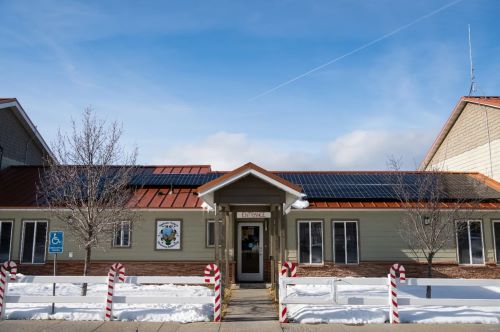
Savings from that project are expected to be nearly $5.4 million over 35 years. It will also create new training and a small number of jobs, about four maintenance positions over time, just as the tribe’s previous solar project did.
Tim Willink, Diné, director of the tribal program at the Oakland-based nonprofit Grid Alternatives, will create a crew of nine mostly Indigenous solar installers to help with the project in Wellpinit and train some Spokane tribal citizens in a “classroom on the roof.”
“If people enjoy it and pursue this career field and stick with it, it just opens more and more doors and jobs,” Willink said. “But you have to have that base knowledge of solar, and if you’re doing the construction side, that’s the perfect way to learn.”
Spokane Tribe Chairwoman Carol Evans said training and education will help serve as a foundation for something much bigger, something similar to the Navajo Tribal Utility Authority: a tribally owned, renewable energy utility called Sovereign Power.
Sovereign Power was formed in the late 1990s but didn’t focus on producing renewable energy until about 2016. The utility hired a tribal member as CEO and other staff to pursue “a larger-scale solar farm” as well as a biomass project, Evans said.
“It was the idea that if we were to develop our own power structure that we could have an economic venture, but at the same time, we could provide power and utilities to our own tribal members and possibly others off the reservation,” Evans said. “And it would create good-paying jobs for individuals.”
But progress has been slow, she said.
“Initially, we found out that we aren’t the experts, so we had to go find people who were experts,” Evans said. “And then [we found] out that we ourselves may not have the financial ability to build such a big project without impacting the other services that we provide to our members.
“So we decided to kind of step back and try to move at a slower pace and start smaller, and then build from there.”
Navajo Nation Projects
For 45 years, the 2,250-megawatt Navajo Generating Station burned countless tons of coal on Navajo lands just outside of Page, Arizona, creating power that helped fuel the rapid growth in the Southwest while also spewing carbon and toxic emissions from its 775-foot-high stacks.
It created hundreds of jobs for Indigenous workers and generated hundreds of millions of dollars for the Navajo Nation, which owns the Navajo Transitional Energy Company, one of the largest coal companies in the United States.
So when SRP, the utility based in Tempe, Arizona, that operated the facility, closed it down in 2019, the effects were felt across the 27,000-square-mile Navajo Nation.
The closures led to job losses for about 1,000 people, the majority of them citizens of the Navajo Nation. It also created a projected revenue drop of up to $50 million, forcing the tribe to tap into its savings, according to Nez, the tribal president.
Now, with more area mines and plants slated to close or reduce operations, declining revenues and job losses from the coal industry are expected to continue. But the Navajo Nation is ahead of the game, Nez said.
When SRP announced closure of the Kayenta mine, construction was already underway on the Kayenta solar farm near the site where a major coal mine had long fueled the Navajo Generating Station.
The Navajo Tribal Utility Authority completed the solar project in 2017, before the local mine shut down. The utility completed work on a second Kayenta solar farm in 2019, the year the mine closed.
Together, the Kayenta solar farms span 365 acres and produce 55 megawatts of power that supply enough electricity to power 36,000 Navajo Nation homes, Nez said. The construction projects employed hundreds of people, nearly 90% of whom were Navajo, and generated some $9 million in wages, according to the NTUA.
Nez said the work associated with the solar farms helped offset some of the losses from the coal mine with new jobs and revenue. He said the tribe is working to take advantage of clean-energy opportunities and to ensure the nearly 400,000 members of the Navajo Nation reap the benefits.
It also puts the tribe in control of its future, he said.
The old Kayenta mine was owned by a multinational corporation. And while the tribe had a “small share” in the Navajo Generating Station, the solar facility is “fully owned by the Navajo people,” Nez said.
The tribe is now working to balance its historical connection to the fossil fuel industry while meeting the growing demand for renewable energy.
“We still have coal here on the Navajo Nation,” Nez said. “We’re not closing our door to our natural resources that are here.”
Still, the tribal government recently approved a proclamation embracing the transition to clean energy, and officials expect the new solar projects to add millions of dollars in revenue. The funds can be invested in the local economy and jobs that will last longer than the temporary construction work, Nez said.
Glenn Steiger, a non-Native executive consultant and solar project manager for the utility authority, said the utility is trying to extend construction employment by stringing the projects out over time.
But the projects won’t create significant numbers of full-time jobs. A planned project in Cameron, Arizona, will create 400 construction jobs but only four long-term positions, he said. In Kayenta, the project created five full-time jobs once the construction was finished.
Data suggests that nationwide utility-scale solar projects, like the massive solar farms on the Navajo lands, create a fraction of the jobs produced per megawatt by residential installations, where a relatively small number of photovoltaic panels are installed and power is kept on-site.
Over time, however, the Navajo Nation plans to grow its in-house expertise so an increasing number of administrative functions can be performed by tribal citizens, Steiger said.
Even so, the authority’s renewable energy arm, known as NTUA Generation Inc., or NGI, will have a workforce of about 15 full-time employees once the nation’s five planned solar plants are complete.
Looking Ahead
Salt, the apprentice electrician, considers himself “one of the few lucky ones” to find permanent employment from the Navajo Nation’s growing network of utility-scale solar projects, and he’s not planning to let the job go.
He expects to complete his apprenticeship program and become a journeyman electrician in June.
“After these 20-some-odd years on the highway and living in hotels and trying to find extended stays and being apart and away from family, I think I had my share of that,” Salt said. “I’m here. I’m home.”
And while he’s glad the Navajo Nation’s growing solar network has given him a chance to be home every night for dinner—and to put food on the table—Salt is glad something else will be sticking around too: the power produced by the rapidly proliferating solar panels.
“None of this goes off the reservation,” Salt said of the power created at Kayenta. “It stays here. So that benefits a lot of the people here, around the reservation.”
Renewable Energy
Tribes across the country are embarking on renewable energy projects of varying scales, with differing ambitions. Here are some of the dozens of projects now underway or being considered:
- On Washington state’s northwest coast, the Lummi Nation has begun implementing an ambitious strategic energy plan that seeks to increase energy efficiency and the use of renewable power sources.
- In Idaho, the Nez Perce Tribe recently installed a large-scale battery to preserve power captured by its expanding network of solar panels.
- On Washington’s Olympic Peninsula, the Quinault Indian Tribe is working to add a photovoltaic solar array and battery-storage system as part of a broader plan to relocate Taholah Village, which is home to 175 homes, 600 people, and many community buildings, due in large part to the threat of rising sea levels as result of global warming.
- In Nevada, about 30 miles north of Las Vegas, the Moapa Band of Paiutes has completed and is pursuing many utility-scale solar projects with the aim of reinvesting the revenue in other economic opportunities. Construction of all those solar arrays have already “employed pretty much any and all tribal members that can work,” according to Terry Bohl, the tribe’s chief operating officer, who is not a tribal member.
- In the Southwest, the Navajo Nation is in the process of building a number of large utility-scale solar farms as the tribe transitions from a reliance on coal to renewable energy.
- In eastern Washington, the Spokane Tribe has completed one solar project that added photovoltaic panels to elder housing and community buildings and is planning to soon begin a second project that will add residential solar to low-income housing units.
- In Montana, the Northern Cheyenne are working with a nonprofit to add solar panels to community buildings and residences as it builds capacity to construct a solar farm.
- In Florida, the Seminole Tribe is pursuing solar projects designed to increase sovereignty, drive down energy costs, and create jobs.
- In Alaska, the Igiugig Village Council installed a turbine system in a salmon-rich river that creates hydropower without constructing a dam or harming fish.
- In the Dakotas, six tribes—the Cheyenne River Sioux, the Flandreau Santee Sioux, the Oglala Sioux, the Rosebud Sioux, the Standing Rock Sioux, and the Yankton Sioux—are working with a private firm, Apex Clean Energy, to develop a pair of major wind farms on the Oglala and Cheyenne River reservations. The facilities are expected to produce up to 2 gigawatts of power, enough to power almost 1.5 million homes.
Originally published by Yes! Magazine, 04.25.2022, under a Creative Commons Attribution-NonCommercial-NoDerivatives 4.0 International license.
About the Author