Ask any furnace tech what their February looks like and you’ll get the same tired laugh. The phone rings before sunrise. Twenty service calls stack up by noon. Half of them trace back to the same predictable failures that a homeowner could have spotted weeks earlier.
Here’s the part that really stings. Most February breakdowns aren’t surprises. They’re the payoff on a slow-moving problem that started back in November, when the furnace was still coasting on easy fall weather. Once the deep cold locks in, every component running harder and longer finally cracks. That’s why so many homeowners end up hunting for reliable furnace repair services in Northern Utah in the dead of winter, when they’d rather be doing just about anything else.
So let’s walk through why February breaks your furnace, how to read the warning signs before the heat dies, and when to stop tinkering and hand it to a pro. I’ve spent enough winters in cold-climate homes to have opinions here, and I’ll give you the whole set.
The February Burnout Is Real
Your furnace operates on a duty cycle, the ratio of time it runs versus the time it rests. Through October and November in a cold climate, that cycle might sit around 20 or 30 percent. By February, with single-digit nights and stubborn wind, it can push past 70 percent. Same machine, same ducts, three times the workload.
Wear compounds when a system never gets a break. Bearings on the blower motor get hotter. The ignitor cycles thousands of extra times. Air filters that looked fine in autumn are now clogged with a full season of dust, pet hair, and dry-skin cells, and a restricted filter forces the blower to work noticeably harder. Furnaces don’t usually fail on a mild day. They fail when they’re used the most.
Here’s my unpopular opinion: February is not when real furnace problems start. It’s when they get exposed. If you want a quiet winter, you do the boring inspection work in September and let the machine coast through the cold months.
Five Failures That Show Up First
When a furnace quits in deep cold, the culprit cluster is pretty predictable. Watch for these, in roughly the order a tech will find them.
- Dirty or failed flame sensor. This little rod tells the furnace a flame is present. When it gets coated, the furnace starts for a second and shuts off, often repeating three or four times before it gives up.
- Clogged filter. The cheapest fix in the house, and the one most people ignore. Change it monthly during heavy-use months, not quarterly.
- Failed ignitor. That ceramic piece cracks eventually. No ignitor means no flame, but you’ll still hear the blower trying to breathe.
- Blower motor wearing out. A grinding or humming blower that no longer moves air likely needs a motor or capacitor replacement.
- Pressure switch problems. On high-efficiency units, a bad switch or a blocked flue line will shut the whole system down to protect you.
If you smell gas or see soot around the unit, stop diagnosis immediately, leave the house, and call your gas utility from outside. That’s not a DIY moment and never will be.
What a Pro Actually Does on a Repair Call
Homeowners often ask what a technician does that they can’t do with a YouTube video. Fair question. Here’s the honest answer.
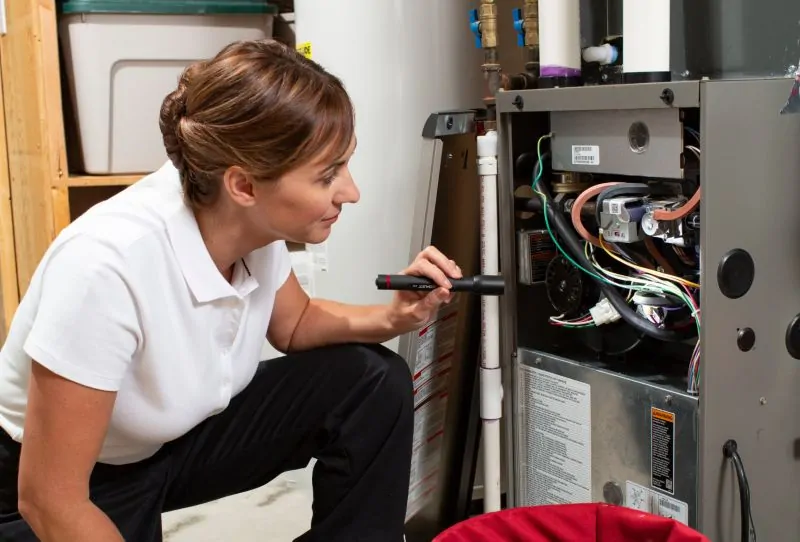
A good tech arrives and starts with a diagnostic checklist, not a guess. They’ll confirm gas pressure at the manifold, test the flame sensor’s microamp reading (a value you can’t see without a meter), inspect the heat exchanger for cracks, and check airflow across the coil. Those measurements separate “replace the part and hope” from “this is actually the problem.” I would not skip this step. A furnace repair that guesses wrong twice costs more than the original service call.
Ask for the diagnostic fee up front. A reputable company quotes it, explains what they find, and gives you written pricing before doing the work. If a tech starts pulling parts without a diagnosis, that’s your signal to get a second opinion.
A February Emergency Checklist You Can Actually Use
If your heat dies tonight, you have about thirty minutes of useful troubleshooting before professional help makes more sense. Run this sequence in order.
- Check the thermostat. Is it set to heat, not cool, and calling for a temperature above the current reading? Batteries die at the worst times.
- Confirm the furnace switch and breaker are on. Some units have a toggle on or near the cabinet.
- Look at the filter. A gray, furry filter is a five-minute fix.
- Watch a startup cycle. Does the ignitor glow? Does the flame catch and then drop out? Note where it fails.
- Check the exhaust flue outside. Snow, ice, or a bird nest on a high-efficiency PVC pipe will trip a safety switch.
- If the furnace won’t ignite after the flame sensor trick (a light cleaning with fine steel wool only if you’re comfortable and the power is off), call for service.
While you wait for help, close off rooms you don’t use, run space heaters on their own circuit, and keep cabinet doors under sinks open so pipes at exterior walls stay above freezing. Cold homes cause more collateral damage than the furnace repair itself.
Should You Repair or Replace?
This is the decision that trips up more homeowners than any technical failure. Here’s the framework I actually use, and you can borrow it.
Use what I call the Two-Thirds Rule. If the furnace is past about two-thirds of its expected service life and the repair bill is more than a third of a new unit’s cost, replacement usually wins. A furnace that’s been running smoothly for ten years with a $400 sensor swap doesn’t fit that math. A fifteen-year-old unit facing a $2,200 blower plus a cracked heat exchanger does.
Two other factors swing the choice. Rust or cracks in the heat exchanger mean the unit is a safety problem, not a repair. And if the furnace has had three or more service calls in the past two winters, you’re paying for a machine that’s telling you it’s tired.
| Signal | Repair | Replace |
| Under 10 years old, single failed part | Yes | Unlikely |
| Cracked heat exchanger | No | Yes |
| Blower motor near end of life on a 15-year unit | Sometimes | Often |
| Three-plus breakdowns in two seasons | Rarely | Yes |
If you’re weighing this in the middle of a cold snap, feel free to prioritize heat today and decide on replacement in the spring when you have leverage and time to compare quotes.
The Maintenance Habit That Prevents February Panic
Every February emergency traces back to maintenance someone skipped. According to the U.S. Department of Energy, regular furnace maintenance is one of the most effective ways to keep a heating system running efficiently and extend its usable life. That’s not marketing language, it’s a plain statement of how these machines age.
The fix is boring and it works. Replace filters monthly through winter. Schedule a tune-up in early fall before the rush. Book a combustion safety check on units over ten years old. If your home was built before the 1990s, it may still have an older style flue and venting setup, and the Environmental Protection Agency has long flagged indoor air and combustion safety as a concern worth addressing. So don’t just look at whether the heat comes on. Look at whether the air coming off it is safe.
Homeowners who do those four things rarely meet me in February. That’s the whole point.
Don’t Let February Catch You Cold
Furnace failures in February follow a pattern, and patterns are beatable. The machine isn’t fragile. It’s just overworked, under-maintained, and ignored until it quits. Read the warning signs, keep a filter on hand, know your repair-or-replace math, and stop feeling around under the cabinet when the real problem needs a meter and a technician.
When your heat drops and the checklist doesn’t fix it, get a pro out before pipes and patience freeze. And if you’re reading this in October, congratulations: you’re already ahead of everyone who calls in February. Book the tune-up now, replace the filter, and let the furnace carry you through the cold without a single panicked phone call.
About the Author