In Roman-era Greece, teletai preserved the secrecy and power of ancient mystery cults, offering initiates transformation, belonging, and access to hidden sacred knowledge.

By Dr. Jan N. Bremmer
Visiting Research Scholar
Institute for the Study of the Ancient World
New York University
Introduction
In the later second century AD the traveller Pausanias described a great number of cults which he called teletai. He never defined thisproperly,1 but from his comments and reports it is clear that he was describing Mysteries and that there were many of them on the Greek mainland–he mentions eleven in Arcadia alone. Unfortunately, in most cases he makes only a few remarks and he consistently refuses to tell us anything about the content of theseMysteries.2 His reticence means that on the basis of his reports alone we could do little more than list the various instances. As this would not be very helpful, in the first part of this chapter we will instead take a brief look at three of the Mysteries for which we have at least some additional information: those of Lycosura (§1.1),Andania (§1.2) and Aegina (§1.3). All these Mysteries originated before the Ro-mans arrived, but they managed to maintain their existence well into Roman times and, in the case of Aegina, even until the end of antiquity. Inscriptions have given us some extra information about the rituals connected to these Mysteries, though they do not lift the veil on their revelations.
The second part of the chapter will look at the Dionysiac Mysteries (§2). These Mysteries pose many problems, but they were popular in Roman times, so we cannot pass over them. As with all things concerning Dionysos,3 we will see that it is hard to reach a consensus on the meaning of his Mysteries or how to interpret them. But first let us turn to Arcadian Lycosura.
Local Greek Mysteries
Lycosura
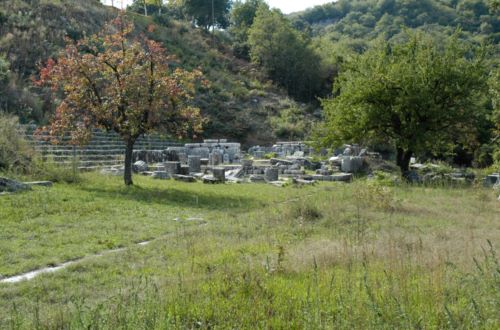
In the course of his journey through Arcadia, Pausanias arrived in Lycosura, a city inside the territory of Megalopolis,4 where he visited the sanctuary of Despoina,‘Mistress’.5 As he tells us:
… beside the temple of the Mistress on the right is what is called the Hall (Megaron), where the Arcadians celebrate Mysteries, and sacrifice to the Mistress many victims in generous fashion. Every man of them sacrifices what he possesses. But he does not cut the throats of the victims, as is done in other sacrifices; each man chops off a limb of the sacrifice, just that which happens to come to hand. This Mistress the Arcadians worship more than any other god, declaring that she is a daughter of Poseidon and Demeter. Mistress is her surname among the many, just as they surname Demeter’s daughter by Zeus the Maiden. But whereas the real name of the Maiden is Persephone, as Homer and Pamphos before him say in their poems, the real name of the Mistress I am afraid to write to the uninitiated (8.37.8–9, tr. Jones, Loeb).
Fortunately, inscriptions have brought to light two so-called sacred laws from Lycosura, dating from the third and second centuries BC. Although they do not explicitly state that they concern the Mysteries, a comparison with the sacred law of Andania (§1.2) makes this highly plausible. We thus have some information about these Mysteries across a timespan of more than 400years.
In Arcadia Mysteries were usually celebrated once a year, and this will also have been the case in Lycosura. As regards the ‘clergy’ there, we know only that a priest and a priestess officiated, nothing else.6 We can be somewhat more specific about the clientele of these Mysteries. According to Pausanias, the Mysteries at Lycosura were a Panarcadian cult, which means that initiates will have come from the whole of Arcadia. They also had to pay an entry fee (IGV 2.516, 18), so prospective initiates will not have been members of the poorest layers of Arcadian society. As was the case in other Mysteries, both men and women were allowed to participate. We know this because our oldest sacred law forbids women who are pregnant or breast-feeding from entering the sanctuary,7 and the later one, which is only preserved in fragments, fixed the time that had to pass after childbirth before a woman could enter the sanctuary.8
Yet the goddess was not concerned only with gender: the older law also stipulates that women should display an extreme degree of modesty. Wearing gold, purple, flowery or black clothing was forbidden and even sandals or a ring were prohibited; moreover, no fashionable hairstyle was allowed. Although the law does not say so, wearing purple and flowery robes was typical of courtesans, whose presence would not be welcome;9 black clothing would introduce a note of sadness that was inappropriate for the joyful ritual of Despoina. It is typical of the male-dominated culture of ancient Greece that these regulations focus on women and not on men. Evidently the behaviour of the latter was of less concern to the males who issued these laws.10
Before the initiation there will have been preliminary sacrifices and the customary purifications, perhaps with water from the fountain at the south of thesite.11 After that the initiands and the priests entered the sanctuary or the area of the Hall, probably in procession. Madeleine Jost has attractively suggested that some 140 terracotta figurines of humans with heads of animals–rams or bulls–with baskets on their heads, which were found in the Hall, were votives from participants who had acted as kanêphoroi, ‘basket-bearers’, during this proces-sion.12 The procession must have ended at the large steps that led up to the Hall, where the initiation took place. Before entering the Hall, which was a unique construction from the early second century BC,13 the initiands came to a rectangular enclosure with an altar, the presence of which was demonstrated by the large quantities of ash and carbonised bones uncovered by the excavators.14 The older, larger law breaks off just when it starts to mention sacrifices for Despoina, but we can still see that it prescribed ‘female, white’ animals. This stipulation is very interesting in the apparent absence of rams, which were the customary sacrificial victims in Mysteries (Ch.II.1 and 2). This detail is in conflict with Pausanias’ report that everyone could sacrifice what they wanted and just chop off a limb, but suggests a holocaust of small animals, which were less costly and easier to carry in the procession.15 Pausanias (8.38.12) noted that there were only a few inhabitants in Lycosura, so the ritual had probably changed in the centuries since the ‘publication’ of the sacred laws, adapting into a less grandiose celebration in Roman times.16
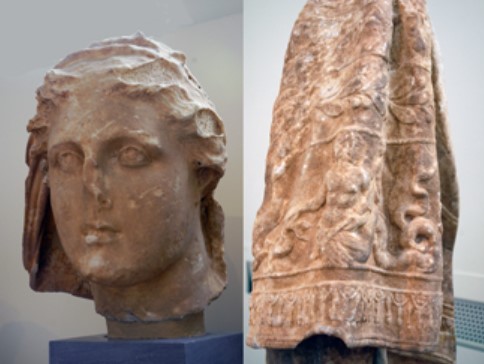
We can reconstruct a few more details about what happened during the actual initiation thanks to Pausanias’ description of a statue of Despoina by Damophon, the most famous sculptor of the southern Peloponnese around 200 BC:17
Demeter carries a torch in her right hand; her other hand she has laid upon the Mistress. The Mistress has on her knees a staff and the so-called kistê,‘ box’, which she holds in her righthand. On both sides of the throne are images. By the side of Demeter stands Artemis wrapped in the skin of a deer, and carrying a quiver on her shoulders, while in one hand she holds a torch, in the other two serpents; by her side a bitch, of a breed suitable for hunting, is lying down. By the image of the Mistress stands Anytus, represented as a man in armour. Those about the sanctuary say that the Mistress was brought up by Anytus, who was one of the Titans, as they are called (8.37.4–5, tr. Jones, Loeb).
The statue, which seems to have filled the whole of the cella, must have been imposing, given its height of about 4 metres. It represented Despoina and Demeter sitting in the middle on thrones, flanked by the standing Anytus andArtemis.18 The presence of Anytus would be explained by his fostering of Despoina, but we may also recall the presence of Titans in the Mysteries of Imbros and Lemnos (Ch. II.2). Was the presence of Titans needed to guarantee the antiquity of the Mysteries? However this may be, it seems important that both Demeter and Artemis carry a torch. Torches belong to their traditional iconographical repertoire, but their presence here probably also suggests the nocturnal setting of the initiation.
Despoina’s box held objects that were shown during the initiation, perhaps a snake or a phallus. There was probably also a sacred tale, for Pausanias reports: ‘The story of the Kouretes, who are represented under the images, and that of the Korybantes (a different race from the Kouretes), carved in relief upon the base, I know, but pass them by’(8.37.6, tr. Jones, Loeb). These words suggest that the Korybantes and Kouretes were part of the sacred tale that Pausanias refuses to tell, just as he was not willing to tell the real name of Despoina, also probably part of the sacred tale. The presence of both Kouretes and Korybantes cannot be earlier than the fifth century BC, when these two groups came to be increasingly associated in literature (Ch. II.3); their differentiation, after centuries of amalgamation, looks very like someone’s pedantic innovation. Even age-old Mysteries in conservative Arcadia did not stand outside the flow of history.
The most fascinating part of the ritual must have been a performance by masked priests. Its occurrence seems a reasonable inference from the figurines mentioned above and the depiction of humans disguised as animals on the lower, decorative parts of the sculpted garment of Despoina.19 The latter figures are represented as moving in dance and we can also identify some musicians playing instruments. The dancing figures, some of whom carry torches, exhibit a whirling movement with the head tossed back, which was the traditional sign of ecstasy in ancient Greece and Rome.20 Ecstatic dancing thus seems to have been an important part of these Mysteries, an inference also supported by the depiction of the Korybantes (Ch. II.3) and Kouretes on the statue and the presence of an altar of the Great Mother in front of the temple of Despoina.
We are not well informed about the Mysteries of Lycosura, but we can still see that they were rather different from those of Eleusis. Demeter may have been closely connected to Despoina, but nothing suggests that the Arcadians copied the Eleusinian model in any detail and nowhere do we hear of two degrees of initiation. The Mysteries may have adapted to the spirit of the times by their stress on ecstatic dances, but the presence of animal masks also suggests the survival of an older layer in the Mysteries. In the end, we can see these Mysteries only through a glass darkly.
Andania
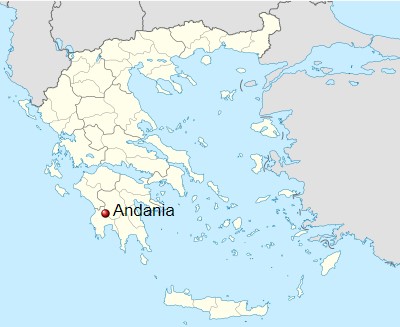
Before Pausanias reached Lycosura, he had already visited another sanctuary with Mysteries, those of Andania,21 a town in Messenia in the southwest Peloponnese, the exact site of which has not yet been identified with certainty.22 Once again Pausanias is our only literary source, but here we have a much more detailed inscription about the Mysteries than was the case at Lycosura, which allows us to reconstruct at least some parts of the ritual. This inscription of 194 lines, the so-called Sacred Law of Andania, has been frequently discussed, recently down-dated to AD 24 and even re-edited twice.23 We also have a first-century BC oracle about the Mysteries, issued by the regional Apollo Pythaios.24 Already in 1932 Wilamowitz wrote that,‘Über Andania und seine Mysterien ist sehr viel geschrieben’,25 but modern studies have not attempted a linear description of the Mysteries. The last scholar to do so, at least to some extent, was the great Martin P. Nilsson (1874–1969) in a now neglected discussion of 1906.26
Pausanias’ account is not very promising (4.33.4–5). On arrival at the site, he notes that the extramural sanctuary lies at the edge of a plain in a grove full of cypresses. In inscriptions this is called the Karneiasion,27 but Pausanias calls it the Karnasion. He notes that these Mysteries are second only to the Eleusinian ones in awesomeness, and he had even dreamt about them: he relates that adream allowed him to mention the story of ‘the bronze urn, the discovery of the Argive general’(see below). At the beginning of his book about Messene he also tells us something of the Urgeschichte of the Mysteries (4.1.5–9). At the dawn of humanity, they had been given to Messene, the eponymous queen of Messenia, by a certain Kaukon, who had brought them from Eleusis.28 Subsequently they were ‘brought to greater honour’ by Lykos, an Athenian exile and ancestor of the Lykomids; he is also said to have brought the rites of the Great Goddesses from Athens to Andania (4.2.6). Finally, improvements were made by Methapos, who had established the rites of the Theban Kabeiroi (Ch. II.2) and was also associated with the Mysteries of the Athenian Lykomids (Ch.III.3), Mysteries that were claimed to be older even than those of Eleusis. The association, through Methapos, with the Theban rites should almost certainly be linked to the Theban re-establishment of the Messenian state;29 Methapos is portrayed as a travelling initiator, the type of man one could imagine as an Orpheotelest (Ch.III.2). This rather confusing history seems to combine various traditions and, perhaps, adaptations of the Mysteries, but it was certainly intended to establish a link with other prominent Mysteries.30
In the somewhat imaginary history of the Andanian Mysteries a new chapter was written after the Theban defeat of the Spartans. When Epaminondas was wondering where to found the new capital of Messene, an old man appeared to him in a dream, closely resembling a hierophant of Demeter, another indication of the links constructed with Eleusis; the old man was later said to be the Kaukon mentioned above in relation to Queen Messene. Kaukon promised Epaminondas eternal fame but told Epiteles, the Argive general of the Messenians, also in adream, that he should dig on Mount Ithome, the sacred mountain of the Messenians, at a place ‘wherever he found yew and myrtle growing’. Epiteles did as he was told and found a bronze urn (hydria), which he brought to Epaminondas. The latter opened the urn and–lo and behold!–it contained a very thin tin foil, rolled like a scroll, with the rites of the Andanian Mysteries as deposited by Aristomenes, the great hero of the Messenian resistance against Sparta in archaic times(Paus. 4.26.6–8).31
Evidently, with the new foundation of Messene the Messenians also invented age-old traditions to legitimate their new Mysteries, for the main protagonists of these tales and dreams all appear in Pausanias’ account of the sacrifices for the inauguration of the new city (4.27.6).32 It is plausible that the sacred law is a yet further reconstruction of the Mysteries by Mnasistratos, a member of a wealthy and influential Messenian family who is mentioned prominently in the Sacred Law. It is clear that he had an interest in the Mysteries, of which he was the hierophant and, perhaps, he wanted to safeguard the priestly position for his family.33 Whatever the case, his wealth allowed him to specify new rules for the Mysteries, although these were closely associated with the synhedrion, the ‘council’ of Messene (1, 49, 57, 89, etc.). What did they look like?
The Mysteries took place once a year during a festival. The annual character was to be expected but is confirmed by the law, which stipulates hiring musicians every year (73–74) and mentions instructions to open the treasuries annually at the Mysteries (93). The exact date is not known, but the celebration took place in the Eleventh Month (10), which in Andania was late August/September.34 Although we will not discuss the officials and their duties in detail but note them only when they have a role in the actual initiation, we should observe that there was clearly quite a large personnel concerned with these Mysteries. Elsewhere, as in Eleusis, we hear only occasionally of the officials who worked behind the scenes, but this sacred law describes in detail the elections and appointments of numerous officials, in itself an indication of a later date. The celebration of the Mysteries clearly required a considerable investment of time and money by Messenian notables.
Like other Mysteries, those of Andania allowed participation by men and women, slaves (18, 28) and free. Yet the Mysteries were clearly not meant for the poorest of the poor, as the initiands had to pay an entrance fee, though the law does not stipulate the amount (50). Regarding appearance, everyone was to be barefoot and in white clothes (15–16). Rules like this can be found elsewhere, but they do not seem to have been universal. White clothes fitted the joyful atmosphere of the festival and were a sign of purity,35 but shoes rarely seem to have been prohibited, except by the Pythagoreans, who also favoured white clothes.36 In addition to these general rules, there were more specific ones, as not all groups of participants were treated in the same way.
The laws prescribing clothing for women are strikingly detailed, whereas for men they are completely silent. For a start, women were not allowed to wear transparent clothes or stripes on their garments (16), both being suggestive of courtesans–we noted the same concern in Lycosura (above, §1.1). Instead, women had to wear a simple chiton and himation of linen, which was considered to be more pure than wool by the Pythagoreans.37 The whole outfit was not to be worth more than 100 drachmas (17) and, as if this were not enough, women were also forbidden to wear gold, make-up, a hairband or a fashionable hairstyle (22–23).Girls, whose presence is striking here, albeit not unparalleled,38 had to wear fairly simple clothes with Eastern connotations (17–18) for reasons that are obscure, and female slaves could not wear clothes more expensive than 50 drachmas (18–19): all participants were equal but some were clearly more equal than others. The overall effect must have been of women looking fairly plain and in no way sexual objects that would disturb the pure atmosphere of the Mysteries.39
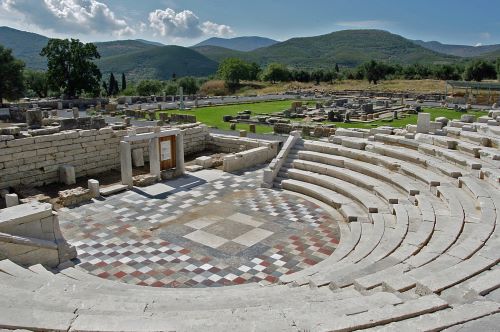
After these general rules for the participants, let us turn to the actual Mysteries. The initiation took place during a festival that started with a procession(20–22, 28–34), as was the case in Eleusis (Ch. I.2). As in Eleusis (Ch. I.1), the procession was preceded by a purificatory ritual, which took place in the theatre (65–68), presumably that of Messene.40 The law stipulates buying two lambs, a ram and three piglets as well as 100 lambs for the initiands (67–68). It was normal to use the cheapest of offerings for these sacrifices, so in this respect lambs and piglets are not surprising.41 On the other hand, the use of a ram as a purificatory victim is very unusual and one wonders if this is not a further development of the sacrifice of a ram during Mysteries (Ch. II.1 and 2). The number of lambs pre-supposes a modest number of initiands, as could indeed have been expected from the relatively small size of Messene.
Although the sacred law does not tell us where the procession began, purification in the theatre of Messene would suggest that the initiatory procession, too, began in Messene. This is the more likely as Andania itself was only about a kilometre and a half from the sanctuary, which would have meant a very short route for the procession, while Messene was about 16 kilometres away, which made for a decent distance.42 The procession will thus have taken at least five to six hours, as we may assume that, as in Eleusis (Ch. I.2), the participants stopped for dances, singing, libations and sacrifices. The procession will have started at the Messenian sanctuary of Apollo Karneios and ended in the Andanian one. This is supported by the law’s stipulation that ‘sacred women’ should take the same oath as the men, to uphold the Mysteries properly, on the day before the Mysteries in the sanctuary of Apollo Karneios (7–8), presumably just before the start of the procession. The law is very specific about the order of the procession, which was thus probably one of the new aspects of the Mysteries, as there would have been no need to list all the details if the order had been traditional.
At the head of the procession went Mnasistratos himself (28), the hierophant,43 just as in Eleusis the highest priests led the procession (Ch. I.2), and after him came the priest ‘of the gods for whom the Mysteries are celebrated’(28–29,cf.2–3). But who were those gods?44 The grammatical gender of these gods is masculine, which suggests that they may have been masculine too; this is supported by the information in the law that it was the ‘Great Gods’ who had a temple in the sanctuary (91). However, Pausanias (4.33.5) differs: he states that he was not allowed to reveal the rites of the ‘Great Goddesses’, ‘for it is their Mysteries which they perform in the Karnasion’. The apologetic tone of his words suggests that there was some debate over the identity of the Great Gods, as does Pausanias’ earlier report that Methapos dedicated a statue (of himself?) in the clubhouse of the Lykomids with an inscription claiming that he had purified the roads of Demeter and Kore ‘where they say that (Queen) Messene established the games for the Great Goddesses’. It seems that Pausanias had put his own interpretation on the local tradition, as he was sometimes wont to do.45 In itself, debate over the identity of the local divinities would not be wholly surprising. As we saw in Samothrace (Ch. II.1), the names of the Megaloi Theoi were secret, if not simply unknown. We should therefore not identify them with the Dioskouroi, as Burkert and Gawlinski do,46 but acknowledge the open nature of these gods.47 Evidently here, as in Samothrace (Ch. II.1), there were no iconographical representations of these deities to preclude Pausanias’interpretation.48
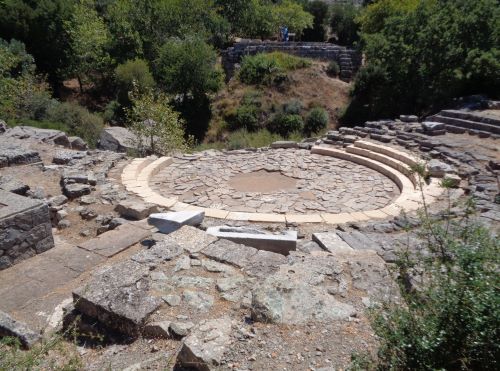
The priest of the Great Gods was accompanied by a priestess, presumably also of the Great Gods, although such a pairing is extremely rare.49 Next in line came the agônothetês, the hierothytai and the pipers. Gawlinski argues that the games presided over by the agônothetês were not part of the festival, but she overlooks the fact that the inscription, just cited, that Methapos set up in the clubhouse of the Lykomids claimed that, ‘Messene instituted games for the Great Goddesses’.50 Games went together with sacrifices, which makes it understand-able that the hierothytai, ‘sacrificers’, the men who presided over the sacrifices,51 also occupied an important place in the procession; in fact, in Messenian inscriptions they often appear, in various numbers, together with the agônothetês.52 The pipers, finally, indicated the walking rhythm of the procession, as can be seen on many Greek vases, but they would also be present at the sacrifices.53
After these dignitaries came several vehicles, probably ox-wagons, each with a cista mystica and led by ‘sacred maidens’(29–30). The cista, a kind of wooden basket closed with a lid, became a standard item of initiations in the late Hellenistic period, with the exception of the Mithraic Mysteries. Although, originally, Eleusis had only one basket, in later times Mysteries could have several baskets, and the inscriptions of the Dionysiac Mysteries show us several kistophoroi or cistiferi (below: §2). Our inscription of course does not tell us their contents, which were revealed during the Mysteries, but states only that they contained the hiera mystika (30). The ‘sacred maidens’ who accompanied the wagons undoubtedly came from the highest Messenian circles, and the fact that they were chosen by lot (29–30) indicates that their number was limited. The qualification ‘sacred’ almost certainly derives from Spartan usage, where sacred girls and women also officiated in cults.54 However, in the great Dionysiac inscription of Torre Nova of about AD 160–165 we also find ‘sacred boukoloi’ and ‘sacred bakchoi’ in different positions in the association’s hierarchy.55 The qualification ‘sacred’ need not mean more than a close association with the Mysteries,56 but in Andania it clearly denoted participants in the Mysteries of a higher status than the initiands and normal initiates.
The wagons were followed by a group of officials closely connected to Demeter. The first mentioned is the thoinarmostria, ‘banquet-organiser’, and her assistants: like the sacred maidens, an indigenous position that we find only in Sparta and Messene. It was a highly prestigious office, and she may well have presided over the Spartan equivalent of women’s rites like the Thesmophoria.57 With them were the priestesses of Demeter at the Hippodrome and in Aegila; neither of these places has been localised yet. The position of the officials and priestesses of Demeter in the procession is striking, and it seems plausible that wehave here a variant of the close proximity of a goddess with the Great Gods, as we also noted in the cases of Samothrace and the Kabeiroi (Ch. II.1 and 2).58
Next came the officials who had to supervise the whole event, followed by the sacred women, one by one (31), and the sacred men. The order of the latter was arranged by the Ten Men (32), a higher supervisory board elected in the spring, well before the celebration of the Mysteries (116–20), whose members had to be older than forty (122–24) and were recognisable by a purple cord (179). Both sacred men and women were noticeable by their white felt caps, piloi (13), a type of headgear well attested for the Dioskouroi and Hephaestus as well as for the boys in the Theban sanctuary of the Kabeiroi (Ch. II.2). Its exact significance is uncertain, but the cap may have suggested that the wearer belonged to the sphere of these gods or of initiation.59 The sacred men seem to have preceded the sacrificial victims, which are mentioned next and which they had selected and approved as fit for the sacrifice (64–72). The victims, which were mostly meant for the sacred meal (95; see below), are also listed in a specific order, with a pregnant sow to Demeter mentioned first (33). We may compare the cult of Pelarge who, according to myth, had re-established the Theban Kabiric Mysteries after their removal by the Seven against Thebes and who also was entitled to a ‘pregnant victim’ (Paus. 9.25.8). Sacrifices of pregnant victims were not uncommon in ancient Greece and usually indicated an ‘abnormal’ ritual, such as was the case with the Mysteries.60
After Demeter, rather surprisingly, came Hermes with a ram (33–34). Pausanias (4.33.4) mentions a statue of him in the Karnasian grove and the purification of the ‘houses of Hermes’ by Methapos (4.1.8). The combination of statue and chapel (?) suggests he may have had a position in the local cult similar to the close association of Hermes (a.k.a. Kasmilos) with the Great Gods and Kabeiroi (Ch. II.2). Madeleine Jost has also pointed to the discovery of several terracotta votives with the staff of Hermes in the Megaron of Lycosura and noted the wooden statue of Hermes in the temple of the Great Goddesses at Megalopolis (Paus.8.31.6).61 In Pausanias’ description of Corinth he sees a bronze statue of Hermes with a ram next to him and says: ‘the tale told at the Mysteries of the Mother about Hermes I know but do not tell’(2.3.4). Evidently Hermes had some position in Mysteries, though it is not clear what this actually implied. The ram was an animal well connected with Hermes,62 but here its sacrifice also fits the Mysteries, where rams were customary victims (Ch. II.1 and 2). The Great Gods received only a young pig (34), later specified as a two-year-old pig (69), which shows their low status in the divine pecking order.63 Apollo, the main god of the sanctuary, received a boar, and Hagna, a fountain goddess identified with Persephone by Pausanias (4.33.4), received a sheep, a normal sacrificial victim.
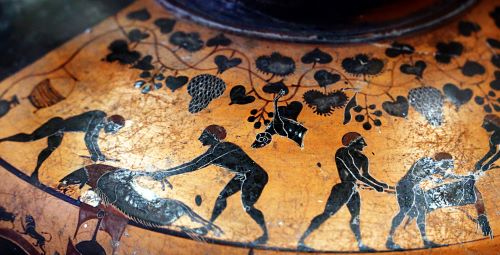
Finally, it is interesting to observe that the list of the participants ends with the animals. There is no mention at all of the initiands. Evidently, their place at the tail of the procession was so obvious that it did not need to be mentioned. Yet we know that they were present too, as the inscription distinguishes the prôto-mystai,‘those who were going to be initiated for the first time’(14, 50, 68), from hoi teloumenoi, ‘those to be initiated’ (14). The prospective initiates were also recognisable by their headgear as they had to wear a stlengis, a kind of tiara, which seems to have been typical of the area, as it is mentioned by the Spartan historian Sosibius (FGrH 595 F 4, with Jacoby ad loc.) in his book On the Sacrifices in Laconia. The law also mentions mystagogues (Ch. I.1), which implies that the initiands were accompanied by experienced initiates who would inform them about the do’s and don’ts of the ritual (149–50).
After the composition of the procession, the inscription continues with other rules, but we are left in the dark about the route of the procession and the procedure upon arrival. We can reconstruct at least a part of the subsequent events from indications in the text. The law stipulates that the sacred men should place lustral basins in the sanctuary, presumably at the entrance to the sanctuary, as was usual (37).64 To ensure total purity, the sacred men even had to write down what the participants of the procession were to avoid and which areas they were allowed to enter (37). The presence of the basins means that after arrival the participants must have had to purify themselves, the water probably coming from the sacred spring near the statue of Hagna in the sanctuary (Paus. 4.33.4); the water seems to have been channelled into various ditches (84, 104). Supervision of the proper use of this precious resource was especially necessary during a festival, and various sacred laws from elsewhere refer to fountains in sanctu-aries.65 The sacred men, who had a separate area that the uninitiated were not allowed to enter (36), had to see to it that people did not erect excessively large tents (skênai) with excessively luxurious silverware in them (34–37). The modesty demanded of the women was thus also required of the men, albeit to a much lesser extent. These tents will have been for dining and sleeping, which suggests that the celebration of the Mysteries lasted some days.66
After purification, the participants will have performed a number of sacrifices. Pausanias (4.3.10) mentions a preliminary sacrifice to the obscure hero Eurytos, who was buried in the sanctuary (4.33.5), before the Mysteries of the Great Goddesses. Its preliminary character suggests that it took place before the sacrifice of the animals from the procession. This latter sacrifice was a solemn occasion, as both pipers and lyre-players were present at it (74). They accompanied the choral dances that were part of the sacrifices and the Mysteries (73). The law does not tell us who performed the dances, but it was perhaps the sacred maidens, as these were especially popular in choral dances.67 The law stipulates that the gods had to receive their customary part of the sacrifices and the rest was to form a sacred meal for the sacred men, women and maidens as well as the priest and priestess of Apollo Karneios, all in the company of Mnasistratos with his wife and children and those serving as artistes and their assistants (96–98).
This meal may well have been the last official part of the first day. The other participants in the procession will have had their meals too, but the law is not interested in them at this point. The next day there will, perhaps, have been more sacrifices and towards the end of the day the actual Mysteries will have started. We might suppose that they would have been a solemn affair, but that was not Mnasistratos’ idea. In a revealing section of the law it is stipulated that a special group of 20 sacred men, the rhabdophoroi, ‘stick bearers’, had to flog anyone who disturbed the religious silence or displayed any other disorderly conduct (39–43,165–67).68 Perhaps those who had already been initiated before were later less impressed and chatted to their neighbours or made funny faces at inappropriate moments. This rule shows that we should not overestimate the piety of the participants or the solemn character of these Mysteries.
We cannot be very precise about the rest of the programme. The presence of the already mentioned prôtomystai among the teloumenoi, ‘those to be initiated’, suggests that there was a second group among the initiands who had already been initiated before. Andania thus seems to have followed Eleusis in having two degrees of initiation. Such a programme would suit the Eleusinian influence thatis so visible in Pausanias’ text, but also the fact that Mnasistratos bore the Eleusinian title hierophant (Syll.3 735.21–22). Our scarce information about the programme does not allow us to divide it over two days with any certainty, but somewhat speculatively we could imagine the following scenario, based on the Eleusinian programme.
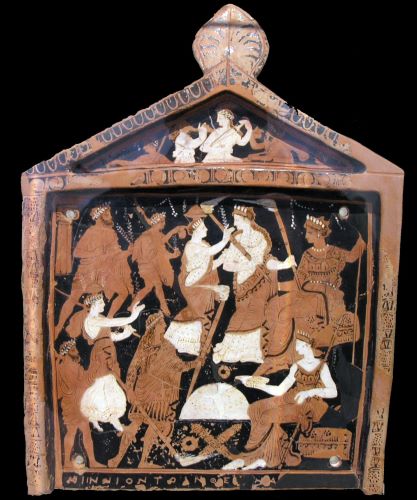
The law tells us that the artistes–pipers and lyre players–were hired for dances during the Mysteries. We have met dances already in other Mysteries and some of them will have been fairly ecstatic, but the lyre also suggests some of a quieter tone. Such dances may have been part of both degrees. If Andania modelled itself on Eleusis, as seems probable, the first degree will have included a kind of ‘mystic drama’, similar to that in Eleusis in which Demeter and Perse-phone played a role (Ch. I.2). This is made almost certain by the stipulation in the law that ‘whichever women are to dress themselves in representation of the goddesses must wear the clothes which the sacred men order’(24–25). It is neither impossible nor improbable that over time the Andanian Mysteries underwent an increasing ‘Eleusinisation’ of their ritual programme.69 However this may be, at the conclusion of the Mysteries the initiates were able to take off their ‘tiara’ and, at a signal from the sacred men, replace it with a crown of laurels. The latter was especially sacred to Apollo,70 so it seems that the site of the celebration of the Mysteries, viz. the sanctuary of Apollo Karneios, was decisive in the choice of plant for the initiatory wreath. That is all we can say about the programme. Those who had been initiated for the first time will have lingered on and visited the fair that was part of the celebration (103), as we have already seen more than once (Ch. I.4, II.1).
Those who had been initiated before and went up for the highest grade may also have had a programme comparable to that of Eleusis, but we know nothing about it. The only detail about which we can speculate is the presence of books, a mark of the later date of these Mysteries. The law stipulates that ‘the sacred men must hand over to those appointed as successors the container and books which Mnasistratos gave and also the rest of whatever has been furnished for the sake of the Mysteries’(11–13). Given that Pausanias tells us that the books were copied by the priestly family from the inscribed sheets of tin discovered by Epiteles (above),which had been presented to the sacred men by Mnasistratos, one may wonder if the latter had not himself fabricated these books. The mention of these books in connection with ‘the rest’ of the items furnished suggests that something was read from them during the performance of the Mysteries.71 That is all we can say.
With this somewhat abrupt end we conclude our look at Peloponnesian Mysteries, but we will continue with an example of local Mysteries that functioned until the end of antiquity, just like Eleusis: the Mysteries of Hecate on Aegina.
Hecate on Aegina
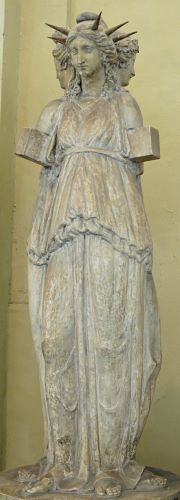
In contrast to the Peloponnesian Mysteries discussed above, we can be sure that the Mysteries of Hecate at Aegina were already known in fifth-century Athens.72 There is an allusion to them in Aristophanes’ Wasps of 420 BC (see below), which fits well with Pausanias’ report (2.30.2) that Hecate’s sanctuary on Aegina had a temple that housed a wooden statue of her made by the mid fifth-century BC sculptor Myron. This gives us a terminus ante quem for her Mysteries, although her sanctuary, which was situated somewhere outside Aegina town, has not yet beenidentified.73 The cult’s focus becomes clear from two fifth-century passages that we have already encountered in our discussion of the Korybantes (Ch. II.3). The chorus in Euripides’ Hippolytus (428 BC) speculates about Phaedra’s wasting away by asking: ‘Are you wandering seized, princess, by Pan or Hecate or the holy Korybantes or the Mountain Mother?’ (141–44). In other words, Hecate was associated with possession, and this is confirmed by a brief allusion in Aristophanes’ Wasps (422 BC), where Bdelycleon says that he first tried to purge his father of madness by performing the Korybantic rites (119–20), but when that failed he crossed the sea to Aegina, presumably to heal him through Hecate’s Mysteries.74 From these brief passages it seems clear that these Mysteries had a certain family relationship with the Korybantic Mysteries but, whereas the latter are no longer attested epigraphically by the Roman period, the Mysteries of Hecate continued to flourish and perhaps even increased in importance. Pausanias says that she was the most important divinity of the island, but this can hardly have been the case in the fifth century BC, a time when Hecate was a divinity at the fringe of the Olympic pantheon. Her marginal position will also explain why the Athenian dithyrambic poet Cinesias (ca. 400 BC) was said to have mocked her Mysteries, presumably those on Aegina.75 The Aeginetans may have taken offence at this slight, as they later maintained that Orpheus had established Hecate’s Mysteries–surely an assertion designed to compete with the late fifth-century Athenian claim that Orpheus was the founder of the Eleusinian Mysteries.76
What do we know of the ritual? Later passages give some insights, but we cannot reconstruct a full ritual scenario. The Mysteries (Pausanias: teletê) were celebrated annually. Undoubtedly, there will have been the usual preliminary purifications and sacrifices. A chance expression in a Latin inscription informs us that the Mysteries were celebrated at night (CIL VI.30966), as we would have expected. One of the orations of Dio Chrysostom, from the early second century AD, gives us a more precious insight: ‘before the purifications they interpret and point to many and various sorts of phasmata,“apparitions”,77 which they say the angry goddess has sent’(4.90). The display of such phasmata was typical of the preliminary phase of initiations and could be combined with frightening experiences.78 The latter probably featured here too and the interpretation of the divine anger will have been related to the mental problems of the initiand. After this preliminary phase, the actual purification of the patient and appeasement of Hecate must have taken place. Origen (CCels. 6.22) notes that the Mysteries of Mithras are not more famous than those of Eleusis, and ‘ta paradidomena, “that which is handed down”, to those who are initiated into the Mysteries of Hecate on Aegina’. The expression is noteworthy because the verb paradidômi in the context of Mysteries suggests that a ‘sacred tale’ was told,79 presumably during this part of the ritual. It thus seems that Hecate’s Mysteries, like those of the Korybantes, were an attempt to cure mental problems through a kind of psychodrama.
We have several fragments of a mime with the title The women who claim that they are driving out the goddess by the fifth-century comic author Sophron from Syracuse, which mentions a ‘chasing away’ of Hecate. It features a meal, which seems to have served to propitiate the goddess and which will subsequently have been carried outside, and with it the goddess.80 Was such a meal part of Hecate’s Mysteries? Or should we think rather of ecstatic dances as with the Korybantes? Or both? Unfortunately we have no other data to help us lift the veil of darkness over this spooky goddess’s Mysteries.
Dio’s mention of Hecate’s Mysteries suggests that they were still fully operative at the beginning of the second century AD, and this impression is strengthened by references later in the century in, probably, Artemidorus (2.37), Pausanias (see above) and Lucian (Nav. 15). In the third century Origen (above) knows them, and in the fourth century we still hear of the Mysteries in Libanius (Or.14.5), who mentions a chief of a thiasos.81 This typically Dionysiac term (§2) suggests a certain blurring of the borders between the different Mysteries, as can indeed be noted in a series of most interesting Latin inscriptions from the last quarter of the fourth century.
These are nine inscriptions and epitaphs of a small group of pagan members of the social elite in Rome, which all mention initiation into the Mysteries of Hecate, using formulae such as hierophantes Liberi Patris et Hecatarum, hierofanta (deae) Hecatae or sacerdos deae Hecatae.82 It is clear from these inscriptions that initiation into Hecate’s Mysteries was de rigueur for these people, as was initiation into the Mysteries of Dionysos and those of Mithras; rather surprisingly, those of Isis and Eleusis are almost never mentioned. Moreover, these aristocrats settled for nothing less than the top positions in the Mysteries. This alone should warn us against seeing these initiations as signs of profound pagan religiosity.83 The exception to the rule is perhaps Fabia Aconia Paulina, the widow of Vettius Agorius Praetextatus. She praised her husband, who is one of the protagonists of Macrobius’ Saturnalia, as ‘a pious initiate who kept in his innermost mind every-thing that has been found in the sacred rites and who, with manifold learning, adores the divine power’; Paulina evidently felt very close to her husband, who introduced her ‘to all Mysteries’.84 Just as the Eleusinian Mysteries had accepted the allegorisation of its message (Ch. I, Introduction), so something of the same process seems to have taken place in Aegina, where the Mysteries of Hecate had also taken over the Eleusinian title of ‘hierophant’. The Mysteries no longer focused on healing from madness, it seems, but now provided theological and philosophical knowledge. An Aeginetan or Athenian from the fifth-century BC would not have recognised this Hecate.
The Dionysiac Mysteries
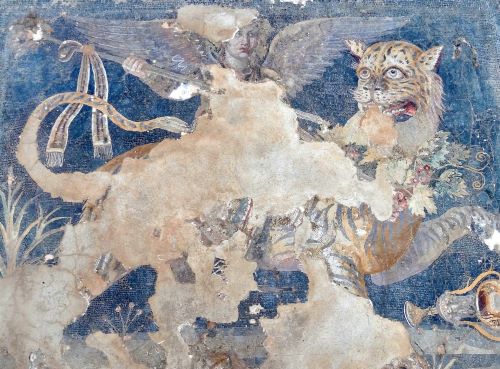
The most complicated Mysteries, however, are those of Dionysos. The simple reason is that we have many texts and several inscriptions that refer to them, but there is no single authoritative format for them all. Each city could have its own ritual, though there was a certain family resemblance between them. As Franz Poland (1857–1945) saw already in the early twentieth century, the heartland of the Dionysiac associations was western Asia Minor, its adjacent islands and the coasts of the Black Sea; that is where most Dionysiac Mysteries are attested, not the Greek mainland.85 Although the place of origin thus seems fairly clear, it is much harder to establish when precisely the Dionysiac Mysteries originated, and it would go beyond the aims of this book to try to do so here. Let me just state that in the course of the last centuries BC and the first century AD we witness a convergence between the female maenadic rituals and the mixed or male (Orphic-)Bacchic Mysteries (Ch.III).86 We hear no more of itinerant initiators after the famous edict of Ptolemy IV Philopator of about 210 BC and the notorious Bacchanalia scandal of 186 BC,87 but Hellenistic kings took an increasing interest in Dionysiac rituals88 and the Dionysiac associations became more and more important.89 The traditional term for a member of a Dionysiac group, thiasôtês, started to be replaced by mystês at the beginning of the imperial period, to the extent that one could be a mystês in a Dionysiac association without, seemingly, participating in Mysteries.90 The result of these developments was a conglomerate of Mysteries that all drew on the Dionysiac tradition, be it female, male or just mythical, with considerable local differences.
These developments raise serious methodological problems. Greek and Roman literature of the Hellenistic and imperial period regularly mentions Dionysiac Mysteries, but it is often unclear whether they refer to maenadic rituals, older Bacchic Mysteries or contemporary Dionysiac Mysteries. One reason for this is, of course, that all these rituals shared similar elements, such as a nocturnal setting, sacrifices, ecstatic dances and revelations. Moreover, the iconographical evidence is highly selective and usually concentrates on only a few elements, such as the phallus or the winnowing fan. Finally, inscriptions are not anthropological re-ports and rarely present us with details of the Mysteries. The regular mention of a hierophant in Dionysiac inscriptions guarantees that there were Dionysiac Mysteries, but that does not mean that we have ‘many inscriptions’ mentioning Mysteries, as Burkert states.91 On the contrary: despite the attention they have received, not many Dionysiac Mysteries are epigraphically attested.92 There must have been more than just these ones, but it is easy to overstate their importance.
There is no easy way out of these problems. As the inscriptions present us with insufficient material to work with, we have to resort to literary passages and iconographical passages too. By a remarkable coincidence the years 2002 and2003 saw the independent publication of two exhaustive collections of sources concerning the Dionysiac cult, by Paolo Scarpi and Robert Turcan (the fruit of more than forty years work), and also of the inscriptions regarding Dionysiac associations, collected by Jaccottet.93 These three studies form the basis for my own work. Jaccottet is much more sceptical, and often rightly so, than Turcan who, on the other hand, helpfully arranges his material in the possible order of the initiation; unhelpfully he combines details from maenadic rituals as well as from Bacchic and Dionysiac Mysteries, as does Scarpi. In fact, neither of them seems to have given much thought to the problem of the chronological development of the Dionysiac Mysteries. None of them has presented a synthesis regarding the Mysteries, as will be attempted here. The result can be no more than a possible script that was adapted to local circumstances by individual Mysteries but, in my opinion, it will give an idea of how a Dionysiac initiation could have taken place in the imperial period.
Let us start with the usual questions of who, when and where. Who was initiated into the Dionysiac Mysteries? In the Roman period we hardly hear any-thing more of female maenadic groups. The exception is perhaps a thiasus Maenad(um) in a Latin inscription from Philippi dating to the beginning of our era, but the fact that the inscription is dedicated to Liber, Libera and Hercules suggests a development away from traditional maenadism.94 Its demise, for reasons that are not at all clear, means that most Mysteries will have had mixed initiands, though some inscriptions seem to indicate exclusively male Dionysiac groups, such as the Athenian IoBacchants.95 Within Dionysiac associations, women held the more strictly religious functions, while men occupied the more administrative positions.96 Although we have no explicit information about the roles of men and women in the actual initiation, this division of labour certainly suggests an important role for women as priestesses in the Mysteries, of whom we meet several in the inscriptions.97
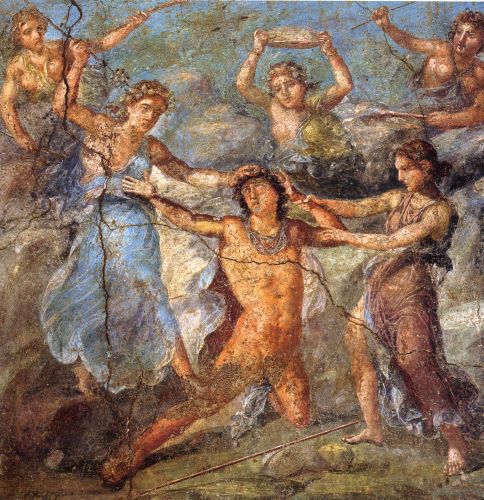
Traditionally, maenadic rites were biennial, as can be seen already from Euripides’ Bacchae (133–34). This rhythm was taken over by purely male groups, continued well into the imperial era, when it is often mentioned in literary texts,98 and remained the traditional periodicity. The reason for this rhythm is not clear but, given that maenadism seems to have developed out of ancient female rites ofinitiation,99 the time-interval may have been needed for new groups of maidens to reach puberty. In which part of the year did these Mysteries take place? In Callatis on the Black Sea, the biennial Mysteries were held in the winter month Dionysios.100 This would correspond once again with the time of the maenadic rites, but Callatis is the only city for which we have such an indication.
We are better informed about the traditional site of initiation. In some places there seems to have been a grove, as we saw with other Mysteries (Ch. II.1).101 However, a grotto, be it natural or artificial, was the site par excellence for the cult of Dionysos and could also serve as the place of initiation into his Mysteries. The great inscription of Torre Nova of about AD 160–165 even records ‘guardians of the grotto’. Again, this is a traditional item of the Dionysiac tradition, but in the course of time the grottoes became more civilised, pleasant and varied. They could be subterranean crypts or open-air sites constructed like a grotto. We must surely not suppose that the well-to-do Romans who have given us the impressive inscription of Torre Nova, with its list of hundreds of cult members, would have met in a damp, uncomfortable, natural venue. Meeting in a real cave was more an ideal than a reality.102
As was the case with the other Mysteries, the actual initiation had to remain asecret.103 The Dionysiac Mysteries did not have the same fame and status as those of Eleusis and Samothrace, and this lack of public impact, combined with the secrecy, means that we are poorly informed about what went on, although the many modern studies might lead us to believe the opposite. We have little idea about how grades worked in the Mysteries. The famous Torre Nova inscription shows that with such a crowd of worshippers there were several grades, but this can hardly have been the case in small towns. Nor do we know if there was a new initiation for every grade or if it was just a matter of time and waiting for promotion. Our evidence no longer differentiates between mystai and bakchoi, as was the case in the Orphic Gold Leaves (Ch. III.3). My reconstruction hence offers only one scenario which, in addition, is rather speculative, more than I had expected when I started to work on these Mysteries. Yet comparison with the scenarios of other Mysteries suggests several ritual components that may have been played out, perhaps in the following order.
We have no idea how the beginning of the initiation was dramatised. There is no indication that there was a proclamation regarding the purity of the participants, as was the case in Eleusis (Ch. 1.1) and Samothrace (Ch. II.1), but we may assume that the initiation was preceded by a bath, given the omnipresence of baths in Mysteries and the mention of a ‘holy bath’ in an inscription from a Dionysiac sanctuary in Halicarnassus.104 Strangely, none of our texts mentions sacrifices, but some of the iconographical representations show the sacrifice of a piglet or a cockerel. Such cheap preliminary, purificatory sacrifices were not uncommon in Greek Mysteries (Ch. I.1; IV.1 and 2), and their occurrence in the Dionysiac Mysteries would certainly not be out of place.105
There may also have been a kind of procession at the beginning, as we cannot but be struck by the fact that larger associations clearly had several officials who had to carry something. In the great Dionysiac inscription of Torre Nova we hear of two theophoroi,‘carriers of the god (Dionysos?)’, who immediately followed the hierophant (see below), a phallophoros, ‘carrier of the phallus’, who played a major role in the final stage of the initiation (see below) and a pyrphoros, ‘carrier of fire’, presumably for the sacrifice.106 A painting from Pompei shows a goat being led to a sacrifice followed by a woman with the cista (see below), which suggests a Mysteries performance. If a sacrifice did indeed play a role in the ritual, there can be little doubt that it would have been this animal so closely connected to Dionysos.107 In other inscriptions we have a narthêkophoros, ‘carrier of the narthex’(Ch. III.2) and a thyrsophoros, ‘carrier of the thyrsos’, although the latter is limited to Ephesus. Both are carriers of objects that are already familiar from a Dionysiac context in the fifth century BC and clearly have a long Dionysiac tradition behind them.108 We also have a simiophoros, ‘carrier of a statue’,109 a liknophoros, ‘carrier of the winnowing basket’ and, clearly important, the kistophoros, ‘carrier of the kistê’, who was always a woman.110 The size and composition of processions must have been dependent on local circumstances, but the many roles denoting a carrier strongly suggest the ubiquity of some kind of procession.
Given the Pompeii fresco with the goat, we may perhaps surmise a sacrifice for a good meal, possibly before the actual Mysteries started at night. This was the normal time for Mysteries, as we have seen frequently by now, and the Dionysiac Mysteries were no exception.111 In Livy’s description of the Bacchanalia we also hear of an oath. Although we have various representations from the famous Villa of the Mysteries from the time of Caesar, and elsewhere in Pompeii and in Rome, of people reading from a scroll, nothing suggests that the Mysteries of the imperial period contained an oath,112 which anyway seems alien to the Greek Mysteries tradition as a whole. In the case of the Bacchanalia, it was probably inspired by Roman army traditions.113 It is not impossible that the scrolls represent the reading of a hieros logos or instructions to the initiand. As Turcan stresses, the intense and serious expressions on the faces of the initiand and priestess suggest the importance of this moment for the Mysteries.114 A sacred law from Smyrna concerning a Dionysiac sanctuary, albeit not an association, contains the stipulation, ‘of the Titans to tell the mystai beforehand’, at which point the texts breaks off.115 It seems not impossible that the murder of Dionysos by the Titans was part of the hieros logos of some of the Dionysiac Mysteries (see also below). If so, this would be a clear influence from the Orphic-Bacchic tradition of the murder of Dionysos, which for us becomes clearly visible only in the early Hellenistic period, although it probably goes back to the early fifth century (Ch. III.2).
Lucian notes the significance of dancing for the Mysteries116 and the second-century AD philosopher Maximus of Tyre mentions dances and songs in connection with Dionysiac Mysteries,117 surely accompanied by cymbals and tambourines, the music characteristic of the Dionysiac rites. The Romans did not like these instruments118 and we may wonder if they were as prominent in Rome as they were in the Greek world. Yet these dances must have been important. A first-century AD Pergamene inscription, which honours a certain Soter for having presided over the ‘divine Mysteries’‘ in a pious and worthy manner’, mentions a chorêgos, ‘chorus-leader’, and an early second-century Pergamene inscription mentions ‘dancing [boukoloi]’. A second-century funerary epigram from Rome has a young man say that Dionysos Bakchios incorporated him in his thiasoi inorder for him to dance,119 and a third-century epitaph from Asia Minor mentions a young man who was the fellow mystês of Dionysos for the latter’s owndances.120 The presence of a prôteurythmos in the second-century Athenian inscription of the IoBacchants probably points in the same direction.121 Given that Lucian mentions the great popularity of pantomimic dances, it seems that sometimes a little play was performed through dance, as is suggested by two terms in an inscription from Magnesia:122 appas (Dionysou), ‘Daddy (of Diony-sos)’, and hypotrophos, ‘secret nurse’.123 As has long been seen, the two terms probably refer to performances depicting the youth of Dionysos when, according to myth, he was secretly fed and educated on Euboea in order to escape the wrath of Hera.124 A reference to the death of Semele in another inscription probably indicates the same kind of performance.125 The Orphic Hymns, a corpus of hymns from a Dionysiac association somewhere in western Asia Minor, even mention the celebration of the labour of Semele when giving birth to Dionysos during ‘the pure Mystery rites’(44.6–9).126 We might think of little plays or pantomimes starting with Dionysos’ birth and continuing to his adulthood, which would reflect, in a way, the initiation of the new initiand.127
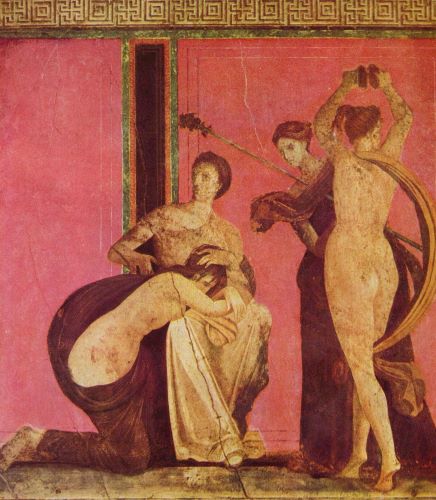
Before the highpoint of the ritual, however, there had to be a low point. The pagan philosopher Celsus, who lived in the later second century AD, mentions phasmata, ‘apparitions’(above, §1.2, Ch. I.3) and deigmata, ‘signs’, in relation to the Dionysiac Mysteries. Could it be that the famous flagellation scene in the fresco of the Villa dei Misteri represents such an intimidation of the initiands? Here we see ‘a kneeling girl, keeping her head in the lap of a seated woman and shutting her eyes, the seated woman grasping her hands and drawing back the garment from the kneeling girl’s bare back, while a sinister-looking female behind is raising a rod–these are all quite realistic details of caning’.128 Yet the threatening figure wielding the rod has black wings, as Burkert rightly notes. In other words, art may imitate life, but it is not a one-to-one imitation and without further details we cannot be sure what really happened. The fact remains that apparitions and more physical intimidation are well attested for the Mysteries, as we will see again in the case of those of Mithras (Ch. V.2).
After these humiliations and intimidation the final revelation will have occurred. There seem to have been several of these. Matching the Eleusinian Mysteries, where an ear of corn was shown, perhaps together with a statue of Demeter (Ch. I.3), inscriptions of Dionysiac Mysteries mention officials who hadto show a statue or sacred objects: the hierophant, ‘revealer of sacred objects’;129 the orgiophant, ‘revealer of (sacred) objects’;130 and, in a Smyrnaean inscription, the theophant,‘revealer of the god (presumably Dionysos)’,131 clearly an important position, as it was occupied by the dedicant of the inscription. We even have, in one case, a sebastophant, ‘revealer of an imperial statue’, which illustrates the extent to which the imperial cult had penetrated all other cults and even the Mysteries (Ch. VI.4).132 Objects were clearly very important in the Mysteries, as even Greek mystêria can mean ‘sacred objects’ already in Aristophanes.133
From texts, coins and other iconographic representations we know that the cista mystica contained several objects, in particular a snake, but the Christian authors Clement of Alexandria (Protr. 2.22) and Firmicus Maternus (De errore 6.5) also mention sacrificial cakes and the heart of Dionysos after his murder by the Titans.134 The latter may well have been connected with a hieros logos about this murder, a typically Orphic theme (Ch. III.2) that we have already encountered (above). The contents of the cista will have been a source of speculation and could vary from city to city.135 The liknon,‘winnowing fan’, contained a phallus.136 Dionysos had a close connection with this member already in the classical period,137 and its prominence in the Dionysiac imaginaire suggests that male lust was an integral part of the Dionysiac world. In this case, as Graf notes, the Mysteries ‘adopted and privatised a public ritual’.138 One can only wonder what the female members of the thiasos will have thought about this macho demonstration. In any case, the revelation cannot have been a great surprise to the initiands. Numerous so-called cistophoric coins (below) show the snake in the cista and already Diodorus Siculus (1.22.7) mentions its place of honour in the Dionysiac Mysteries. Evidently, the degree of secrecy in these Mysteries was not as high as was the case in Eleusis (Ch. 1.4).139 As time went on, Mysteries may well have become less mysterious than they were in the classical period.
After the revelation, there was probably drinking and feasting. And just as initiates of other Mysteries went home with a souvenir (Ch. II.1 and 2), so the Dionysiac initiates seem to have received a belt of fawnskin or even a whole fawn-skin, the nebris, to denote their new status, which they would display at future meetings of their association. Once again the Mysteries drew upon the Dionysiac tradition, which often portrayed the god and his followers in fawnskins.140 Its possession made the identification of the god with his followers even more intimate than all the drinking of wine would have done. Several texts also mention symbola, ‘passwords’(Ch. VI.3) and physical tokens kept and hidden at home. The Orphic Gold Leaves teach us that these passwords need not be as profound (Ch. III.3.3, VI.3)as has sometimes been suggested, and the tokens could be small trinkets to remind the initiate of the murder of Dionysos, as reported by Clement of Alexandria.141
After the initiation the new initiates will have gone home. The next time they met with their fellow mystai they would be entitled to the full pleasures of Dionysiac life in their grottoes or Dionysiac halls.142 There they would meet a varied company of all kinds of ranks, ranging from the archimystês, ‘chief of the mystai’, archiboukolos, ‘chief of the boukoloi’, orarchibassara, ‘chief of the foxes (female bacchants)’, to the lowest rank of sigêtai, ‘silent ones’, all depending on the size of the association. It was a world which evoked the idyllic places of the countryside in order to escape the pressures of urban life, but which had also created a hierarchy that might compensate somewhat for loss of political influence in the real world. It was constructed out of a long Dionysiac tradition, but was probably given a whole new impetus in Pergamum. Anne-Françoise Jaccottet has stressed the important role of the Attalid kingdom in the introduction of the rank of boukolos in the Dionysiac associations.143 It is also in Pergamum, we may add, that around 167 BC King Eumenes II issued the first cistophoric coins with the representation of the cista mystica with the snake on the obverse.144 As these Mysteries are so well represented in Pergamum, where the kings considered Dionysos their ancestor and were closely associated with the Dionysiac cult,145 the Dionysiac Mysteries in their late Hellenistic form may well have been an important, albeit usually overlooked, legacy of the Attalid kingdom to the Roman Empire.
Chapter IV from Initiation into the Mysteries of the Ancient World, by Jan N. Bremmer (De Gruyter, 06.26.2014), published under the terms of a Creative Commons Attribution-NonCommercial-NoDerivs 3.0 Unported license.
About the Author