In ancient Greek ritual, the saffron-colored krokotos worn in the cult of Artemis Brauronia signaled identity, transition, and sacred belonging within a structured religious world.

By Dr. Daphne D. Martin
Professor of Classics
University of Cambridge
Abstract
This paper explores the ways in which colour, and specifically the saffron yellow textile known as the krokotos, was integral to the cult of Artemis Brauronia, both at her sanctuary site in Brauron and on the Athenian Acropolis. It highlights the links between Artemis Brauronia, Athenian girls, femininity and saffron textiles. It does so through a close examination of the Brauron Clothing Catalogues (355–336 BCE); visual evidence of textile dedication on a white-ground drinking cup (kylix) from Brauron (Brauron inv. no. 689); and Vinzenz Brinkmann’s colour reconstruction of the Peplos Kore (Acropolis Museum, 679).1 By revealing the intimate associations between Artemis Brauronia and the rich saffron textiles donned, dedicated, displayed and depicted at her sanctuary sites, it seeks to provide broader insights into the significance and symbolism of colour in the dynamic religious landscape of ancient Greece.
Introduction
Colour is rarely the first thing that comes to mind when considering ancient Greek religion or religious practice. Yet for the site of Brauron, one of Artemis’s most important Attic sanctuaries, located on the coast 27 km south-east of Athens, the significance of vibrant yellow textiles cannot be emphasised enough. It is here that the penteteric2 festival of the Arkteia was held, a rite of passage intended to mark the maturation of young Athenian girls from childhood to adulthood. The central ritual of the Arkteia involved young Athenian girls playing the bear (arktos)3 and wearing a special garment dyed with saffron known as the krokotos.4 The saffron-coloured garment was essential to the successful completion of the festival which was considered to be the means by which the girls might safely secure their sexual maturity and, hence, ensure fertility for the Athenian pop-ulace as a whole.
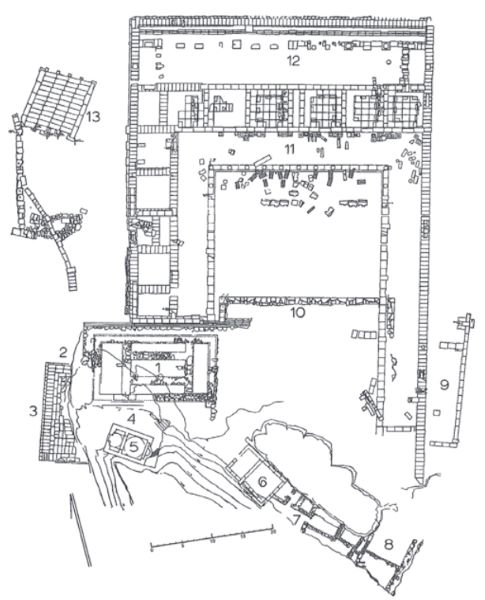
It is at Brauron too that Iphigeneia is thought to have a heröon, a shrine or monument dedicated to a Greek or Roman hero, and to receive cult worship. Literary sources describe women’s dedication of textiles in her honour, presumably in thanks for healthy childbirth.5 Iphigeneia herself is also described by Aeschylus as shedding the krokotos prior to her sacrificial death at the hands of her father, Agamemnon, in what might potentially be interpreted as a purposeful echoing of the ritual language associated with the Arkteia.6 In any event, it is apparent that the bright yellow of saffron-dyed cloth permeated the experience of the ritual at the site, making the sanctuary of Brauron particularly suited to a study of the visual, archaeological, literary and epigraphic evidence for the relationship between colour and cult, in this case specifically the association between Artemis Brauronia and the krokotos (Fig. 1).7
This paper will focus on the visual links between Artemis Brauronia, Athenian girls, femininity and saffron textiles.8 In so doing, krokotos, both as a colour and as a garment, is shown to be symbolically and aesthetically appropriate for invoking Artemis Brauronia in ritual performance. The paper begins by reviewing evidence from literary texts for the ritual use of the krokotos at Brauron and elsewhere and its relationship to divinity.9 It then focuses on epigraphic evidence for the dedication of saffron-coloured garments from the Brauron Clothing Catalogues found on the Athenian Acropolis, listing numerous dedications of textiles to Artemis at her sanctuary in Brauron for the years 349–335 BCE.10 It next examines the visual evidence for textile dedication to Artemis Brauronia found on a fragmentary white-ground kylix (cup) from Brauron which appears to depict a young female offering a vibrant yellow cloth at an altar. It concludes by utilising Vinzenz Brinkmann’s colour reconstruction of the Peplos Kore, and in particular the yellow mantle that appears on that statue, to suggest that the figure may have served as a representation of Artemis Brauronia on the Athenian Acropolis.
Literary Evidence to the ‘Krokotos’
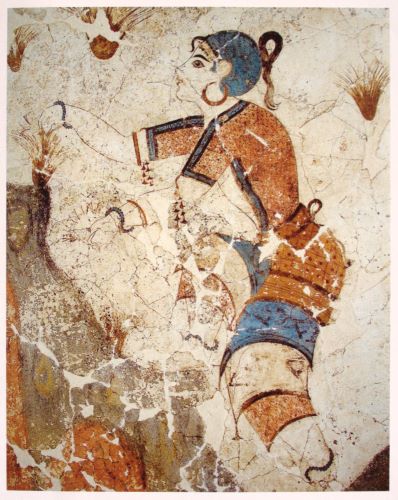
Literary texts, ranging from Homeric epic to comedies of the Classical period, provide evidence that saffron was indicative of divinity and support its specific ritual function at Brauron. Aristophanes defines saffron’s significance in relation to Artemis at Brauron, describing how:
ἑπτὰ μὲν ἔτη γεγῶσ ̓ εὐθὺς ἠρρηφόρουν·
εἶτ ̓ ἀλετρὶς ἦ δεκέτις οὖσα τἀρχηγέτι,
καὶ χέουσα τὸν κροκωτὸν ἄρκτος ἦ Βραυρωνίοις·As soon as I turned seven I was an Arrephoros; Then when I was ten I was a grinder for the Foundress;And shedding my saffron robe I was a Bear at the Brauronia;11
Aristophanes provides invaluable evidence for the use of the krokotos in the Arkteia, the coming-of-age festival held at Brauron for Athenian girls aged 5–10 years.12 The festival, characterised by the shedding of the krokotos by the young girls playing the bear, seems to have included a pannychis, a ritual celebration that lasted through the night,as well as a procession from the Brauroneion on the Αthenian acropolis to Brauron.13 That the krokotos comes up without further elaboration in the play suggests the intimate familiarity of the Athenian audience with the Arkteia and identifies the shedding of the saffron robe as the ritual activity at the festival’s core.
Iphigeneia, also honoured at the site of Brauron, is described as shedding a saffron garment in Aeschylus’s Agamemnon.14
κρόκου βαφὰς δ ̓ ἐς πέσον χέουσα
she shed to earth her saffron robe15
Sourvinou-Inwood interprets this shedding by Iphigeneia as echoing the girls’ shedding of the krokotos at the Arkteia, an integral part of the ritual completion of one phase of life and movement on to the next.16 Ekroth argues for the possibility that the krokotos in Aeschylus could also be interpreted as a bridal veil, marking Iphigeneia as the future bride-to-be for Achilles.17 The presence of the krokotos and the ritual language of the Arkteia in plays that would have been performed in front of audiences who themselves participated in and viewed Attic cult highlights the nexus of associations that identify the krokotos and its yellow colouring as significant in the worship of Artemis Brauronia.
One should not, however, assume that saffron and the krokotos did not also have other meanings in the context of Athenian religion and religious practice. In Euripides’ Hecuba, for example, Athena’s peplos18 on the Acropolis is described as saffron, yoked with horses, and embroidered in colourful, flower-dyed threads.19 Saffron, then, also has associations with Athena through the ritual weaving and dedication of a peplos to the goddess as part of the Panathenaia, the important ancient Greek festival held in honour of the goddess Athena at Athens every four years.20 In addition to being characteristic of the Arkteia and of Athena’s peplos on the Acropolis, saffron robes are also mentioned in early Greek lyric and epic works as worn by Eos (Il. 8.1), Hera (Il. 14.348), Enyo (Hes. Theog. 273), the nymphs (Hes. Theog. 358) and the Muses (Alk. 85 A), among others.21
The ‘Krokotos’ and the Brauron Clothing Catalogues
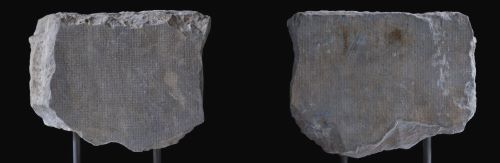
The association between saffron textiles and Brauron can be explored further by focusing on a distinct body of evidence, the Treasury Records of Artemis Brauronia (IG II2 1514–1530).22 The inscriptions listed in these records provide additional evidence of a different type that reveals the importance of saffron-coloured garments for ritual practice at Brauron. The extant records provide perhaps ‘the single most significant body of epigraphic evidence for Greek clothing in the late Classical period’.23 The importance of colour for these garments, and the particular significance of the krokotos, cannot be ignored.
Cleland, using Barthes’ semiotic theory as laid out in his seminal work The Fashion System, sees the way that colour terms are used in the textile catalogue as indicative of emphatically marked variants of colour.24 The very act of description is a choice which ‘marks’ certain features deemed significant in a particular context. All garments have colour, but there are only certain instances in the case of the dedicated garments where this colour is marked and therefore made significant.25 Within the 33 items where complete descriptions are preserved, seven items are described as krokotos, among which ‘three use [the term] substantively, and three use it in conjunction with terms describing, not garment type, but only decoration or decorative form’.26 According to Cleland, 49 of the fragmentary descriptions include colour/decoration. For base colour, there are four fragmentary instances of white (leukos), eight of saffron (krokotos), 12 of purple (halourgos), two of blue-grey (glaukos) and one of green (batracheion).27
The substantive use of the word krokotos is distinctive in the context of the Brauron textile catalogue, indicating the relative importance of the colour as an explicitly marked aspect of a textile offering.28 Here, the descriptor, the colour term krokotos, may be seen as all-subsuming, insofar as the garment is described purely in terms of its colour, implying that this was the most significant feature both in identifying the garment and carrying its connotations.29 The term as used in the Brauron Clothing Catalogues may even go so far as to indicate a specific role for the garments, given saffron’s strong associations with ritual use in situ, as well as broader connotations of femininity and womanhood.30 The frequent use of the term krokotos as both a substantive and a single descriptive term in the Brauron Clothing Catalogues emphasises the conceptual and symbolic importance of the colour for textile dedications at this particular sanctuary.
But how were saffron garments actually treated in a ritual context at Brauron? One line from the Brauron Clothing Catalogues provides rare evidence for the use of a krokotos to adorn a statue of divinity, possibly a cult statue, likely housed within the sanctuary:
κροκωτὸν διπλοῦν ποικίλην τὴν πεζίδα ἔχει τὸ ἄγαλμα τὸ
ὀρθὸν ἔχει (IG II21522.28/9)31saffron, double-layered, garment, with ribbons, the upright statue has it (trans. Cleland)
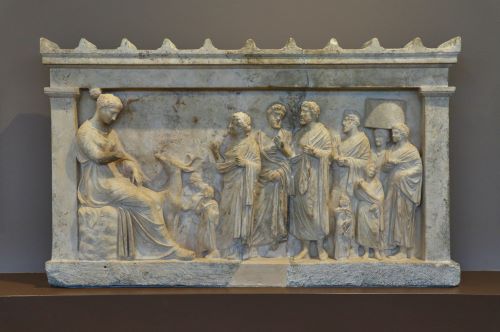
Thus, in addition to literary evidence for saffron textiles being worn by the young girls taking part in the Arkteia and more generally being offered as dedications, the krokotos was used to decorate a cult statue in the sanctuary at Brauron, as indicated by the epigraphic evidence.32 The other textile dedications made to cult statues at Brauron as recorded in the clothing catalogues include: a garment of diaphanous material known as a tarantinon,33 an ampechonon (a female outer garment used for wrapping around the body);34 an embroidered mantle with two fluttering corners known as a katastikton dipterygon;35 a chiton amorginon (an inner garment made of fine linen from the Cycladic island of Amorgos);36 a white encircling wrap (enkyklon);37 a child’s chitoniskos (a short chiton worn primarily by women and children);38 a peripoikilos (richly patterned) chitoniskos;39 two kandyes (Persian garments with sleeves);40 and two white himatia.41 The krokotos was therefore not exclusively dedicated to statues of Artemis at Brauron. Yet it is one of few distinguished for its colour. Along with the kandyes, it is also the only garment for which the active verb ekho (‘to have’), indicating possession (‘the statue has …’), is used with respect to the cult statue at Brauron.
Saffron textiles thus emerge in the epigraphic evidence as having a unique association with Artemis at Brauron. This is further supported by comparison with other temple inventories from the Heraion at Samos, Artemis Kithoneat Miletos and various sanctuaries at Delos, Tanagra and Thebes, where krokotos rarely comes up as an adjective or substantive descriptor of textile dedications and, furthermore, does not appear to be worn or possessed by the statues themselves.42 In the account of the treasurers of the Heraion on Samos (IG XII 6.1.261), the verb ekho is applied to a cult statue wearing a white himation;43 this is never, across the extant corpus, the case for the krokotos – except at Brauron. Furthermore, the krokotos appears as a dedication only once outside Brauron, in a temple inventory from Tanagra.44 This cumulative evidence emphasises the specific ritual associations of textiles, and particularly that of the krokotos, with Artemis at Brauron.
Visual Evidence for Textile Dedication
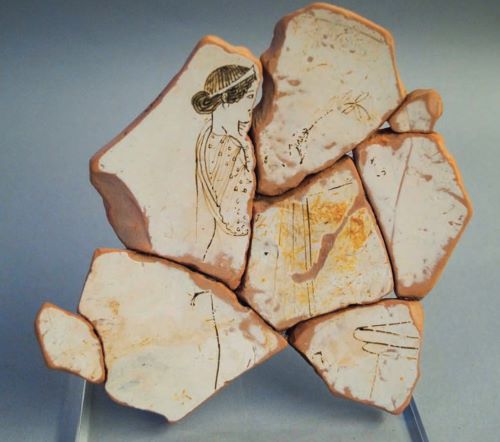
An image on a fragmentary white-ground kylix (Fig. 2) from the Sanctuary of Artemis at Brauron provides additional visual evidence for the dedication of coloured textiles, allowing a further exploration of how colour may have functioned in ritual contexts to indicate a particular deity. The fragments, dating to 470–450 BCE, depict a young girl in profile, her black hair looped into a bun, wearing a stephane, a diadem-like women’s headdress, and large earrings. She is dressed in a patterned chiton and has a sheer, flowing himation draped over her left shoulder. In her right hand, she pinches a leafy sprig delicately between her fingers. In front of her, slightly above knee level, a yellow folded cloth hangs before the base of an altar.45 The textile consists of six vertical folds, articulated in fine brown and yellow lines, with the folds closest to the female figure being shortest, while the rightmost folds, near the altar, extend down the furthest. The cloth’s colour is rendered in a thick, orange-yellow paint, concentrated within the textile’s outline and clearly differentiated from the white background.46 The altar, visible at far right, is the focus of the female’s offer-ings, and her prayers. But what of the colour of the cloth? Can it be interpreted as a textile dedication of a krokotos, perhaps to Artemis or Iphigeneia?
The cup, with its unique scene of ritual textile dedication where the colouring of the cloth being dedicated is still visible, was likely to have functioned as a votive dedication at Brauron, where saffron garments are known to have been worn by young girls, to have adorned cult statues and to have been dedicated to divinity.47 Of the other white-ground kylikes which bear yellow colouring, it is difficult to definitively identify the colouring as saffron or the krokotos, also due to the rarity of having a specific provenance. Perhaps most notable is a white-ground kylix depicting Hera, c.470–460 BCE, from the Staatliche Antikensammlungen, Munich (inv. no. 8958002676), where the mantle of the goddess has a deep golden-yellow tone, in comparison to the white background and reddish border of the garment.
If the Brauron image does indeed depict a textile dedication, then the dedication of a white-ground cup with the representation of such a scene can perhaps be seen as a substitution for, or supplement to, the dedication of actual woven cloth.48 Cups were among the most common dedications at sanctuary sites, making up from one-third to one-half of all pottery dedications on the Athenian Acropolis. These objects may either have been used to pour libation, making them part of the functioning of the sanctuary, or might have been conceived of as possessions of the goddesses, as dedicatory inscriptions of ta iera (the sacred items) seem to suggest. The significance of the krokotos at Brauron and its links to the worship of Artemis Brauronia enhance the particular association of the image represented on the cup with the site. The white-ground technique chosen allows for colours (yellows, oranges, purples, reds) to be depicted in a manner that black and red-figure pottery does not allow.This raises the possibility that white-ground is particularly appropriate for depicting scenes where colour matters, such as those of textile dedication.49
The archaeological provenance of the object from the Sanctuary of Artemis Brauronia supports its identification as a possible votive dedication.50 Ioannis Papadimitriou, the archaeologist responsible for the major excavations of the site in the 1950–1960s, describes the many white-ground kylix fragments excavated by his team, including those inscribed ‘ieron’ or ‘iera Artemidos’, phrases frequently found in votive inscriptions meaning ‘sacred [object]’ or ‘sacred [object] of Artemis’, respectively.51 These fragments were found at the small sanctuary at the entrance of the prehistoric acropolis at Brauron and the excavator compared their quality to that of similar finds from the Acropolis and Eleusis.52 Based on the excavation reports, it seems that the largest numbers of high-quality pottery sherds from the 6th century were found between the small temple and the larger temple of Artemis to the west,53 along with some of the Brauron Clothing Catalogues.54 A fragment of a white-ground kylix, attributed to the Sotades Painter and displayed in close proximity to the fragment discussed here in the Brauron Archaeological Museum, is specifically identified by Papadimitriou as having been found between the small sanctuary and temple to Artemis outlined above, near the cave where worship of Iphigeneia took place.55 This votive deposit may be where the fragment in question also comes from.
Both the dedication of textiles represented in the tondo of Brauron no. 59 and the white-ground vessel itself were likely to be sacred offerings intended for Artemis Brauronia or Iphigeneia. The relative importance of krokotos at Brauron outlined above in terms of literary and epigraphic evidence allows the yellow colouring of the garment to be viewed in a new light, serving as an iconographic marker which has the potential to identify the dedicatee of object and image alike. Without the colouring of the cloth, it would be difficult, or even nearly impossible, to make an assumption about the dedicatee of either the representation or the cup based on iconography alone, given the evidence for donation of textiles for Athena, Artemis, Leto, Demeter and Kore, Hera, Eileithyia, Dionysos, Hermes and Asklepios.56 In this case, the ‘markedness’ of the textile in reference to a particular colour, yellow, allows the viewer to distinguish between divinities and identifies the cup as associated specifically with the sanctuary site of Brauron. The scene of ritual textile dedication, with the remaining thick traces of yellowish-orange slip, corroborates the epigraphic evidence from the clothing catalogues, dating to 150 years later, for the dedication of textiles at Brauron. Other white-ground kylix fragments from the site seem also to display tantalising clues about practices of ritual dedication, presumably taking place in situ.57 However, more work is needed to examine the corpus of white-ground kylikes in relation to the iconography of textiles and, particularly, to the use of colour. Nonetheless, the fragments examined here serve to highlight the significance of krokotos and its essential role in the worship of Artemis at Brauron.
The Peplos Kore
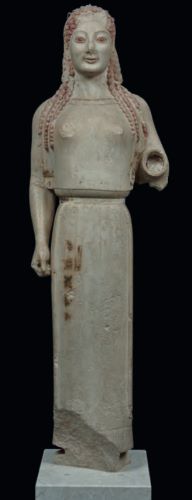
In 1886, the Greek Archaeological Society discovered 14 Archaic korai – statues of maidens – on the Athenian Acropolis. These fourteen korai are especially notable for the traces of blue, green, red and brown pigments on their surfaces, bearing witness to their original dazzling polychro-my.58 This is presumably due to the particular conditions (or date) of the deposit in which they were found.59 Among the finds was a kore, found near the northernmost wall of the Acropolis, who seemed already then to be stylistically different from the other female statues and who eventually became known as the Peplos Kore (Fig. 3) because of her unique attire.60 The korai are usually interpreted by scholars as either particular goddesses or young girls serving as kanephoroi or arrephoroi, in both cases attributions intended to delight.61 While the majority among them wear flowing, folded chitons and draped, diagonal himations, in Brinkmann’s colour reconstruction, the Peplos Kore wears three separate garments, a white, pleated chiton under a red, tightly fitting ependytes with an animal frieze, cloaked by a folded saffron mantle with rich hem decorations.62 The garments on the lower half of her body are close-fitting, leading to a unified cylindrical shape whose apparent archaising character has been interpreted by Brunilde Ridgway as a deliberate reference to the wooden cult statues of goddesses typically referred to as xoana.63
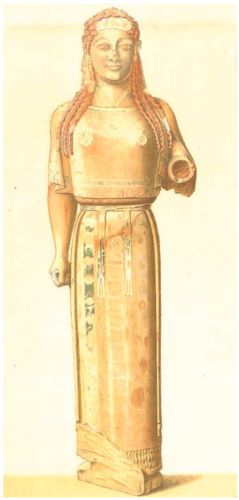
Although the Peplos Kore’s stylistic and vestimentary differences to the other korai sculptures have been noted from early on,64 the Peplos Kore has long been viewed as one of the outstanding examples of the kore type.65 The Peplos Kore has also been central to the study of ancient polychromy. The famous French archaeological draughtsman Émile Gilliéron painted the sculpture in watercolour in 1887, presumably shortly after it was excavated from the north wall of the Acropolis (Fig. 4).66 In 1975, classicist R.M. Cook had a plaster reconstruction of the Peplos Kore made, painted in what were thought to be the original colours, for the Museum of Classical Archaeology in Cambridge, England, where it continues to be displayed to this day.67
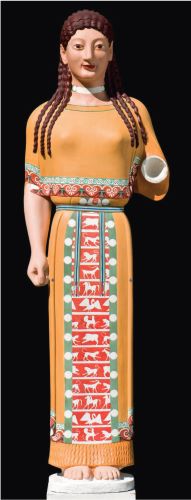
Most recently, Vinzenz Brinkmann and Ulrike Koch-Brinkmann undertook the study of the Peplos Kore’s polychromy using a variety of advanced technological methods; these resulted in the rather different colour interpretation (Fig. 5) on which the argument in this section is based. Brinkmann’s colour reconstructions for a number of the other Acropolis korai further differentiate the so-called Peplos Kore from the other sculptures.
Brinkmann proposes yellow as the base colour of the Peplos Kore’s top garment, which he interprets as a mantle.68 This colour interpretation is based on observation and analysis of small quantities of yellow ochre on the front side of the sculpture in 2007.69 This also corroborates the yellow traces visible on Gilliéron’s 1887 watercolour, which captures remains of yellow pigment, presumably still visible on the freshly excavated sculpture.70 Brinkmann further supports the choice of yellow as the base colour in describing how ‘in favor of th[e] choice [of yellow ochre] were comparisons with other marble works71 as well as the degree of surface weathering. The surviving small blue crosses of the scattered pattern must undoubtedly have been visible and have stood out against the colour of the clothing’.72 If Brinkmann’s colour interpretation holds, the bright yellow colour of the Peplos Kore’s mantle would have marked her as visually distinct on the Athenian Acropolis, where green, red and blue dominated as the base colours for the garments of the other Acropolis korai.73
Her distinctiveness is supported by additional details of her attire. Underneath her upper garment, between the folds of yellow fabric, the kore’s scarlet ependytes is visible, decorated with 14 registers of animals, including panthers, lions, boars, rams and hybrid creatures such as sphinxes, as well as riders.74 This attire is again unique among the korai of the Acropolis. Scholars have noted the garment’s Eastern associations and its appropriateness for a representation of a divinity.75 The garment is characterised by its cylindrical, sheath-like form and rich decoration76 and was also worn by Artemis Orthia at Sparta, Artemis in Ephesus, Hera on Samos and Aphrodite at Aphrodisias.77 Previous to c. 510 BCE, it is thought that an expensively woven ependytes, an outer garment of Eastern origin associated with divinity, was also dedicated to Athena on the Acropolis.78 The ependytes,which Brinkmann assigned to the Peplos Kore, strongly suggests that she represented a goddess.79 The two drill holes in her right hand have been identified by Brinkmann as possible fastenings for the placement of two metal arrows, attributes of the goddess Artemis.80 On top of her head, 35 drill holes may indicate the location of an additional metal attribute, a crown or the meniskoi (literally ‘crescent moons’, made out of metal and mounted on a statue’s head to keep birds away) suggested by Ridgway.81 Taken together, the aspects of the kore’s iconography and polychromy outlined above strongly support an identification with Artemis. If the Peplos Kore can indeed be identified with Artemis, as both her iconography and polychromy seem to support, then the cumulative evidence does indeed associate her with Artemis Brauronia, a possibility all the more likely if Brinkmann’s convincing reconstruction is accepted.
Statues of Artemis at Brauron and the Brauroneion
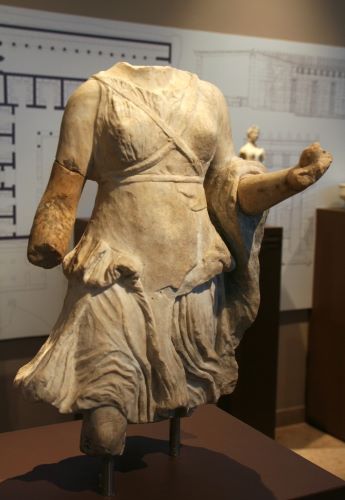
The Brauroneion, dating to the mid-6th century, and located on the south-west of the Athenian Acropolis, south-east of the Propylaia, brought the worship of Artemis Brauronia into the centre of Athenian religious life.82 It was likely to have been a project of the Peisistratids, tyrants of Athens at the time, who were from the deme or township of Philaidai, where Brauron is located, and thus reaped political benefits from the building of a satellite sanctuary of Artemis on the Acropolis.83 Although archaeological evidence for the structure is scarce, it seems to have consisted of a Π-shaped stoa (covered walkway or portico) and a number of rooms of uncertain function, perhaps intended to work as treasuries storing prized goods.84
Pausanias, when visiting the Athenian Acropolis in the 2nd century CE, mentions seeing a Praxitelian statue of Artemis on display at the Brauroneion.85 During his visit to Brauron, he also describes an ancient xoanon,86 which he claims is still there.87 Scholars have yet to come to a consensus on how many statues of Artemis were at Brauron, since the Brauron Clothing Catalogues contain terms that could potentially refer to multiple statues at the Sanctuary.88 In the Brauron inscriptions, the ‘seated statue’ (IG II2.1514.22–23) and ‘the old seated statue’ (IG II2.1514.35/36) have been associated with the presence of a portable wooden cult statue at Brauron,89 while Despinis argues for the association of the other terms with acrolithic statues, fragments of which he identifies in the storerooms of the Brauron Archaeological Museum. The use of the descriptive term ὀρθόν (‘standing’, ‘straight’, ‘upright’)90 to describe one of the statues supports at least a conceptual association with the Peplos Kore, which could plausibly have been intended to represent the wooden cult statue of Artemis at Brauron in the form of a marble replica displayed on the Athenian Acropolis.91
In any case, the Praxitelian statue seen by Pausanias on the Athenian Acropolis sets a precedent for the Brauroneion as a locale where at least one statue of the goddess Artemis would have been displayed, in this case one sculpted by an artist as famous as Praxiteles himself. The dating of the Brauroneion on the Athenian Acropolis to the mid-6th century makes it feasible for the Peplos Kore to have been displayed or in some way associated with the site prior to the Persian invasion, with her scarlet, animal-frieze ependytes and arrows identifying her as Artemis, and her saffron mantle suggestive of Artemis Brauronia. Just as the Brauron Clothing Catalogues, copies of which have also been found on the Athenian Acropolis, link the dedications made for Artemis at Brauron to the Brauroneion, so it can also be argued that the Peplos Kore, marked in the eyes of the ancient viewer by her saffron mantle, which various epigraphical and art historical sources tie closely to women’s ritual at Brauron, may have been intended to serve as a representation of Artemis Brauronia at the Brauroneion on the Athenian Acropolis.
Conclusion
In this paper, the associations between Artemis Brauronia and the krokotos have been explored using literary, epigraphic, visual and archaeological evidence. The yellow colour of garments in a ritual context has been shown to have had strong associations with Artemis Brauronia, the goddess presiding over liminal coming of age rituals for young Athenian girls. Through exploring the connections between Brauron and saffron robes in literary texts, the significance of colour for ritual practice at the site has been established. The extensive catalogue of textile dedications from Brauron has confirmed the markedness of the krokotos for women offering sacred garments at the Sanctuary of Artemis at Brauron and has also revealed that the krokotos was used to dress one of the cult statues in the sanctuary. The fragments of a white-ground kylix from the Archaeological Museum of Brauron have provided visual evidence for textile dedication, while the white ground technique has highlighted the special relevance of the krokotos in the representation on a cup which was likely dedicated to either Artemis or Iphigeneia. Finally, it is most likely that Brinkmann’s reconstruction of the Peplos Kore represented Artemis Brauronia on the Athenian Acropolis and, perhaps, particularly one of the cult statues housed at her Sanctuary at Brauron. This conclusion is built upon the evidence already discussed earlier and assumes the identification of the goddess Artemis to be correct.
Together, these various forms of evidence reveal the multi-hued and multi-faceted existence of colour, and specifically the krokotos, at the sanctuary site of Artemis at Brauron. It is all too easy to be blinded by the whiteness of worn-down marble, by arid and dusty archaeological sites and by seemingly colourless inscriptions. However, by presenting the case for such a close association between Artemis Brauronia and the rich saffron textiles donned, dedicated, displayed and depicted at the site, this paper has hopefully provided broader insights into the significance and symbolism of colour in the dynamic religious landscape of ancient Greece.
Appendix
Endnotes
- Brinkmann et al. (2017).
- Occurring every five years, counting inclusively, i.e. a festival held every four years.
- See (Parker 2007, 238) for a discussion of what it means to ‘play the bear’.
- For the krokotos, see Lloyd-Jones (1983, 94); Ure (1955,90); Sourvinou-Inwood (1988, 119–124).
- Eur. IT 1462–1467.
- Aesch. Ag. 239. See Ekroth (2003, 67) for further discussion.
- The krokotos, outside of its specific religious context at Brauron, was conceived of more generally as an emblem of femininity and sexuality. See Sourvinou-Inwood (1988, 127); Benda-Weber (2014, 129–142). For textile production in Classical Athens, Spantidaki (2016). On the importance of textiles in antiquity and a discussion of the relevant methodologies for their study, Harlow and Nosch (2014, 1–33).
- From as early as the Minoan period, the wall-paintings from Akrotiri appear to indicate that saffron was connected with female divinity and coming-of-age rituals. See Rehak (2004, 85–100). The laborious process for producing saffron dye, one of the finest dyes known in antiquity, required roughly 160,000 flowers to produce approximately 1 kg of dye. Day (2011, 337–79); Lee (2016, 93).
- Arist. Lys. 42–45, 46–48, 219–220; Arist. Ecc 879; Eur. Hec. 465–474.
- Cleland (2005, 1).
- Arist. Lys. 641–647. Translation: Jack Lindsay (1926).
- Sourvinou-Inwood (1971, 339).
- See Themelis (1973,17); Lavelle (2005, 173).
- Euripides also informs us that Iphigeneia is to be the priestess of Artemis at Brauron. After her death, she will receive the textile offerings of women who have died in childbirth (Eur. IT 1462146–7). See Ekroth (2003) for further discussion of the krokotos and cult of Iphigeneia at Brauron.
- Aesch. Ag. 239.
- Sourvinou-Inwood (1988, 132).
- Ekroth (2003, 64).
- The peplos is an ancient Greek garment made of one large piece of rectangular cloth, and is characterised by a deep fold along the top, creating an overfold or apoptygma. The peplos was fastened at the neckline and armholes by pins (fibulae).
- ‘ἢ Παλλάδος ἐν πόλειτὰς καλλιδίφρους Ἀθα-ναίας ἐν κροκέῳ πέπλῳζεύξομαι ἆρα πώ-λους ἐν δαιδαλέαισι ποικίλλουσ ̓ἀνθοκρόκοισι πήναις’Eur. Hec. 466–471.‘Or in the city of Pallas, the home of Athena of the lovely chariot, shall I then upon her saffron robe yokehorses, embroidering them on my web in brilliant varied shades.’Translation: E.P. Coleridge in Oates and O’Neill (1938).
- Haland (2004, 155–182).
- Later on in the 5th century, Pindar describes the male heroes Jason and Herakles in relation to the krokotos (Pyth, 4.232; Nem. 1.38).
- EM 7929 (IG II2 1515), EM 7930 (IG II2 1516), EM 7924–7926 (IG II2 1517), EM 5294 (IG II2 1518), EM 7927 (IG II2 1519), EM 7928 (IG II2 1520), EM 7934 (IG II2 1521), EM 7931 (IG II2 1522), EM 7933 (IG II2 1523), EM 5561 (IG II2 1526), EM 5562 (IG II2 1527), EM 7935 (IG II2 1528), EM 7936 (IG II2 1529), EM 7937 (IG II2 1530) and EM 7938 (IG II2 1531). The first of these inscriptions (now known as IG II2 1514) to be discovered came to England as part of the Elgin Collection. See Linders (1972, 2–4). Inscribed fragment EM 7932 (IG II2 1524) has been transferred to the Acropolis Museum since 2009.
- Cleland (2005, 1).
- ‘“variants” in this conception are the aspects of description which vary meaningfully in relation to each other. For example, the category “colour” excludes all those descriptive terms which do not seem to have a colour meaning, and so on’ Cleland (2005, 79).
- Cleland (2005, 80).
- Cleland (2005).
- Cleland (2005, 96).
- Only three colour terms, halourgis (purple), batrachis (green) and krokotos (yellow), appear as substantives for garments, with krokotos being the most frequently appearing among these. Cleland (2005,71).
- Cleland (2003, 159).
- Cleland (2005,161).
- Cleland (2005, 34).
- According to Romano (1980, 130) ‘the evidence suggests that probably only cult statues, as distinct from votives, wore real clothing’. On archaeological evidence for various cult statues at Brauron, Despinis (2005).
- IG II2 1514, 37: ταραντῖνον περὶ τῶι ἓδει τῶι ἀρχαίωι (atarantinon around the old seated statue). N.B. all definitions of ancient Greek garment terms from Cleland (2005, appendix 1).
- IG II2 1514, 34: 36: ἀμπέχονον, Αρτέμιδος ἱερὸν ἐπιγὲγραπται, περὶ τῶι ἀρχαίωι (an ampechonon-wrap marked as sacred to Artemis, around the old seated statue).IG II2 1514, 36: ἀμπέχονον περὶ τῶι ἓδει τῶι ἀρχαίωι (an ampechonon-wrap around the old seated statue).
- IG II2 1514, 38: κατάστικτον διπτέρυγον περὶ τῶι ἓδει τῶι ἀρχαίωι (an embroidered garment with two (‘wings’?) around the old seated statue).
- IG II2 1514, 22–23: χιτῶνα ἀμόργινον, περὶ τῶι ἓδει (a chiton of fine Amorgian linen around the seated statue).
- IG II2 1524B 223–224: ἒνκυκλον λευκόν … περὶ τῶι ἀγάλματι (a white encircling wrap … around the statue).
- IG II2 1514, 26–29: τοῦτον τὸ λιθινον ἓδος ἀμπέχεται χιτωνίσκον καρτὸν παιδεῖον ἀνεπίγραφον, παρυφήν ἒχει θερμαστίν (this covers the stone seated statue: a child’s chitoniskos,shorn-smooth, uninscribed. It has a woven tong-pattern border).
- IG II2 1524B 227:: χιτωνίσκος κτενωτὸς περιποίκιλος. περὶ τῶι ἀγάλματι τῶι ὀρθῶι (a spiky-bordered chitoniskos patterned all over. Around the upright statue).
- IG II2 1523 27–28; IG II2 1524B 204: κάνδυν τὸ ἂγαλμα ἒχει (a kandys,the statue has it).
- IG II2 1514, 27–28: ἱμάτιον λευκὸν παραλουργές. τοῦτο το λιθινον ἓδος ἀμπέχεται (a white himation with purple border. This covers the stone seated statue).IG II2 1524Β, 205–206: ἱμάτιον λευκ; περὶ τῶι ἀγάλματι, ῥάκος (a white himation: around the statue, rhakos).
- Brøns (2016, appendix 2); for gold woven textiles in the Delos temple inventories, see Prêtre (2017, 13–16).
- IG XII 6.1.261, 27.
- SEG 43: 212 (B), 8.
- The fragmentary condition of the kylix does not permit us to determine from where the cloth hangs.
- To be able to establish the application of pigment (as well as its type) with certainty, further select microscopic examination would be necessary. Close visual examination of the object deems unlikely, in my opinion, the colour of the cloth as resulting from residue or corrosion, due to its concentration in the area demarcating the garment.
- Additional examples of yellow colouring on white ground include a white-ground lekythos with second white, a thicker, purer white often used for adding details, attributed to the Pan Painter, c. 490 BCE (State Hermitage Museum, inv. no. ΓΡ-8068), which depicts Artemis in a long orange chiton, as well as an outline white-ground alabastron attributed to the Pasiades Painter, c. 510–500 BCE (British Museum, inv. no. 1887,0801.61), depicting a maenad and an Athenian woman wearing chitons of a bright yellow hue as well. For further examples, see Wehgartner (1980); Mertens (1977; 2006).
- Wagner (1997, 47–54).
- For techniques of polychromy on white-ground lekythoi, see Koch-Brinkmann (1999). There is also some use of added colours in both black-figure (n.b. the work of the Swing Painter) and red-figure, but never to the effect achieved on white-ground vessels. See Neils (2008) for links between white-ground technique and femininity on Attic white-ground lekythoi.
- The exact find spot of Brauron no. 59 (Archaeological Museum of Brauron, inv. no. 689) is not specified by the excavator. For relevant excavation reports, see Papadimitriou (1956; 1957; 1958; 1961; 1962). For description of iconography, see Wehgartner (1980, 94).
- Papadimitriou (1949, 90).
- Papadimitriou (1949, 81).
- See Fig. 1.
- Unfortunately, the correspondence between the clothing catalogue inscriptions found at Brauron and the copies from the Acropolis published in IG remains unpublished to this date.
- Papadimitriou (1957, 28).
- Brøns (2016, 63).
- Archaeological Museum of Brauron, inv. nos 52–57. For additional visual evidence of ritual practice at Brauron through a special group of Attic vases, see Kahil (1963; 1977).
- For korai, see Stieber (2004, 181). In 480 BCE, both the sanctuary at Brauron and the Athenian Acropolis were burned down by the Persians. Subsequently, the korai were carefully buried on the Acropolis in pits. For the destruction of the Acropolis by the Persians and its aftermath, see Kousser (2009, 263–272).
- Kavvadias (1886, 75); Kavvadias and Kawerau (1907).
- The head was found first, and due to stylistic differences with the archaising body, the two fragments were only joined at a later date. See Brinkmann et al. (2007, 45).
- Stieber(2004, 21). For korai more generally, see Payne and Young (1936); Richter (1968); Holloway (1992); Ridgway (1993); Karakasi (2003); Keesling (2003).
- Following Brinkmann et al. (2017, 35–39). Staïs (1887) asserts the kore wore a chiton, an upper garment, and a third garment, enveloping the upper torso and arms; Kalkmann (1896, 46–48) states the statue wears a peplos, due to the typical overfold or apoptygma, although with an atypical separation over the right arm; Lechat (1903, 188, 325–330) also supports the classification of her garment as a peplos with overfold; Payne and Young (1936, 18) propose a peplos worn over a chiton. Ridgway (1977, 50, 55) discusses two garment combinations, 1) chiton, 2) peplos with overfold, then described as 1) chiton, 2) peplos, 3) small cape; Keesling (2003, 136) argues for a peplos instead of a chiton and himation; Brinkmann et al. (2017, 46) identify four garments, 1) chiton, 2) ependytes, 3) knee-length waistcoat with rich hem decorations, 4) short cloak in a matching pattern.
- Ridgway (1977, 59).
- Lechat (1903, 71).
- Lechat 1903, 78).
- Staïs (1887, pl. 9).
- Cook (1978, 84–87); Lapatin et al. (2008, 126).
- Brinkmann 2017, 38.
- The examination techniques used for the Peplos Kore include scanning electron microscopy, infrared luminescence photography and UV-VIS absorption spectroscopy. Brinkmann and Koch-Brinkmann (2020, 158).
- These traces of yellow are especially visible on the watercolour gouache depicting the backside of the statue. See Staïs (1887, pl. 9); Brinkmann and Koch-Brinkmann (2020, 158).
- Presumably other Archaic korai from the Acropolis.
- Brinkmann etal. (2007, 50). No white pigment has been preserved, so in the exclusion procedure this also cannot be a viable alternative. On the importance of colour contrast in the polychromy of the Archaic korai, Stieber (2004, 72).
- Stieber (2004, 72). Cf. the yellow pigment used to decorate the garment of Phrasiklea. Brinkmann et al. (2010, 19–196).
- Brinkmann et al. (2007, 46).
- See Miller (1997) on Athenian use of Persian clothing elements. Brøns (2017, 259).
- For comparanda, a female wooden statuette from the Heraion, Samos also appears to wear an ependytes covered by a second garment similar to the Peplos Kore’s mantle, see Brøns (2016, 190).
- Brinkmann et al. (2017, 38).
- Brinkmann et al. (2017).
- Ridgway (1977, 58); Neer (2010, 119).
- Brinkmann etal. (2007, 51). In contrast, Ridgway (1977, 57) and Keesling (2003, 136) identify only one hole. Both Ridgway and Keesling also support a possible identification with Artemis.
- Ridgway (1977, 49–61).
- Parker (1996, 76) also places the inception of the arkteia in the mid-6th century BCE.
- It is not uncommon in the 6th century for tyrants to manipulate cult for political purposes, and in fact, most monumental architecture of the time is linked to wealthy aristocratic families. Lavelle (2005, 173).
- Rhodes and Dobbins (1979, 325). Hurwit (1999, fig. 3 no. 5). Note the similar Π-shape of the Brauroneion to the stoa at Brauron.
- ‘Πραξιτέλους μὲν τέχνη τὸ ἄγαλμα, τῇ θεῷ δέ ἐστιν ἀπὸ Βραυρῶνος δήμου τὸ ὄνομα’ Paus. Description of Greece 1.23.7. For further discussion, Despinis (2010). For possible evidence for animal sculpture on display at the Brauroneion, Morizot (1993, 29–44).
- The validity of the term xoana as applied to cult statues and idols has been brought into question for the past century or so. Here, I am using Romano’s definition of xoanon, the representation of divinity which serves as the focus of worship of a divinity at a particular shrine or sanctuary. For a further discussion of xoana, see Bennett (1917, 6–21); Romano (1982); Donahue (1988); Gaifman (2006; 2012).
- ‘ξόανον μὲν δὴ καὶ αὐτόθι ἐστὶν Ἀρτέμιδος ἀρχαῖον‘ Paus.1.33.1.
- ‘ἄγαλμα ὀρθόν’ (IG II2 1514.34/39) or ‘ἑστηκός,’ ‘ἄγαλμα’ (IG II2 1523.27/8), ‘ἕδος’ (IG II2 1514.22/3), ‘λίθινον’ (IG II2 1514.26/28), ‘τὸ ἕδος τὸ ἀρχαῖον’ (IG II2 1514.35/36). See Tréheux (1964, 1–6); Despinis (2010).
- The ‘ἕδος’ (IG II2 1514.22/3) and ‘τὸ ἕδος τὸ ἀρχαῖον’ (IG II21514.35/36). See SEG 53.174 for further discussion. For wooden finds from Brauron: Poligiorgi (2015, 123–216).
- IG II2 1514.34/39.
- Both Neer and Ridgway have previously suggested that the Peplos Kore might be the representation of a cult statue from Brauron. See Ridgway (1977, 58–59); Neer (2010,120).
Bibliography
Affiliate disclosure: Amazon links on this site are paid links. As an Amazon Associate I earn from qualifying purchases.
- Barthes, R. (1990) The Fashion System. Berkeley, University of California Press.
- Benda-Weber, I. (2014) Krokotos and crocota vestis: Saffron-coloured Clothes and Muliebrity. In C. Alfaro Giner, J. Ortiz, M. Tellenbach (eds), Production and Trade of Textiles and Dyes in the Roman Empire and Neighbouring Regions. Actas del IV Symposium Internacional sobre Textiles y Tintes del Mediterráneo en el mundo antiguo (València, 5 al 6 de noviembre, 2010), Purpureae Vestes IV, 129–142. València, Universitat de València.
- Bennett, F. (1917) A Study of the Word XOANON. American Journal of Archaeology 21, 6–21.
- Brinkmann, V. and Koch-Brinkmann, U. (2020) Bunte Götter: Die Farben der Antike. Frankfurt am Main, Prestel.
- Brinkmann, V., Batstone, R., Brauer, A., Ebbinghaus, S., Herzog,O., Kellner, S., Koch-Brinkmann, U., Köttl, J. and Wünsche, R. (2007) Gods in Color: Painted Sculpture of Classical Antiquity. Munich, Prestel.
- Brinkmann, V., Dreyfus, R., and Koch-Brinkmann (2017) Gods in Color: Polychromy in the Ancient World. San Francisco, Legion of Honor.
- Brinkmann, V., Koch-Brinkmann, U. and Piening, H. (2010) The Funerary Monument to Phrasiklea. In V. Brinkmann (ed.), Circumlitio: The Polychromy of Antique and Mediaeval Sculpture: Lieoiechaus Colloquium, 188–217. Munich, University of Chicago Press.
- Brøns, C.(2016) Gods and Garments: Textiles in Greek Sanctuaries in the 7th to the 1st Centuries BC. Oxford, Oxbow Books.
- Brøns, C. and Nosch, M. (2017) Textiles and Cult in the Ancient Mediterranean. Oxford, Oxbow Books.
- Cleland, L. (2003) Colour in Ancient Greek Clothing: A Methodological Investigation. Edinburgh, University of Edinburgh.
- Cleland, L. (2005) The Brauron Clothing Catalogues: Text, Analysis, Glossary, and Translation. BAR International Series 1428. Oxford, BAR Publishing.
- Cook, R.M. (1978) The Peplos Kore and Its Dress. The Journal of the Walters Art Gallery 37, 84–87.
- Day, J. (2011) Crocuses in Context: A Diachronic Survey of the Crocus Motif in the Aegean Bronze Age. Hesperia 80, 337–379.
- Despinis, G.I. (2005) Die Kultstatuen der Artemis in Brauron. Athenische Mitteilungen 119, 261–315.
- Despinis, G.I. (2010) Artemis Brauronia: Latreutika Agalmata Kai Anathemata Apo Ta Iera Tes Theas Ste Braurona Kai Ten Akropole Tes Athenas. Athens, Bibliotheke tes en Athenais Archaiologikes Etaireias.
- Donohue, A.A. (1988) Xoana and the Origins of Greek Sculpture. Atlanta, Scholars Press.
- Ekroth, G. (2003) Inventing Iphigeneia? On Euripides and the Cultic Construction of Brauron. Kernos 16, 59–118.
- Gaifman, M. (2006) Statue, Cult, and Reproduction. Art History 29.2, 258–279.
- Gaifman, M. (2012) Aniconism in Greek Antiquity. Oxford, Oxford University Press.
- Haland, E.J. (2004) Athena’s Peplos: Weaving as a Core Female Activity in Ancient and Modern Greece. Cosmos 20, 155–182.
- Harlow, M. and Nosch, M. (2014) Greek and Roman Textiles and Dress: An Interdisciplinary Anthology. Ancient Textiles Series 19. Oxford, Oxbow Books.
- Holloway, R.R. (1992) Why Korai? Oxford Journal of Archaeology 11.3, 267–274.
- Hurwit, J.M. (1999) The Athenian Acropolis: History, Mythology, and Archaeology from the Neolithic Era to the Present. Cambridge, Cambridge University Press.
- Jones, W.H.S. (1918) Pausanias Description of Greece, Volume I: Books 1–2 (Attica and Corinth), trans. W.H.S. Jones. Loeb Classical Library 93. Cambridge, Harvard University Press.
- Kahil, L. (1963) Quelques vases du sanctuaire d’Artémis à Brauron. In G. Bakalakis, S. Dakaris and L. Kahil (eds), Neue Ausgrabungen in Griechenland, 5–29. Olten, Urs Graf-Verlag.
- Kahil, L. (1977) L’Artémis de Brauron: Rites et mystère. Antike Kunst 20, 86–98.
- Kalkmann, A. (1896) Zur Tracht Archaischer Gewandfiguren. Jahrbuch des Deutschen Archäologischen Instituts 11, 43–48.
- Karakasi, K. (2003) Archaic Korai. Los Angeles, J. Paul Getty Museum.
- Kavvadias, P. (1886) Anaskafai en te Akropolei. Archaiologikē Ephēmeris, 75–82.
- Kavvadias, P. and Kawerau, G. (1907) H Anaskafi tes Akropoleos. Athens, Archaiologiki Etaireia.
- Keesling, C.M. (2003) The Votive Statues of the Athenian Acropolis. Cambridge, Cambridge University Press.
- Koch-Brinkmann, U. (1999) Polychrome Bilder auf weissgrundi-gen Lekythen. Munich, Biering & Brinkmann.
- Kousser, R. (2009) Destruction and Memory on the Athenian Acropolis. The Art Bulletin 91, 263–282.
- Lapatin, K., Panzanelli, R. and Schmidt, E.D. (2008) The Colour of Life: Polychromy in Sculpture from Antiquity to the Present. Los Angeles, Getty Research Institute.
- Lavelle, B.M. (2005) Fame, Money, and Power: The Rise of Peisistratos and ‘Democratic’ Tyranny at Athens. Ann Arbor, University of Michigan Press.
- Lechat, H. (1903) Au Musée de l’Acropole d’Athènes: Études Sur La Sculpture En Attique Avant La Ruine de l’Acropole Lors de l’invasion de Xerxès. Lyon, A. Rey.
- Lee, M.M. (2016) Body, Dress and Identity in Ancient Greece. New York, Cambridge University Press.
- Linders, T. (1972) Studies in the Treasure Records of Artemis Brauronia Found in Athens. Stockholm, P. Åström.
- Lindsay, J. (1926) Lysistrata by Aristophanes, trans. into English by Jack Lindsay, illus. by Norman Lindsay. London, Fanfrolico Press.
- Lloyd-Jones, H. (1983) Artemis and Iphigeneia. The Journal of Hellenic Studies 103, 87–102.
- Mertens, J.R. (1977) Attic White-Ground, Its Development on Shapes Other Than Lekythoi. New York, Garland Publishing.
- Mertens, J.R. (2006) Attic White Ground: Potter and Painter. InB. Cohen (ed.), The Colours of Clay: Special Techniques in Athenian Vases. Los Angeles, The J. Paul Getty Museum.
- Miller, M. (1997) Athens and Persia in the Fifth Century BC: A Study in Cultural Receptivity. Cambridge, Cambridge University Press.
- Morizot, Y. (1993) Un ours ou deux pour Artémis, une sculp-ture de l’Acropole d’Athènes reconsidérée, une figurine en terrecuite de Thasos. Revue Des Études Anciennes 95.1, 29–44.
- Neer, R. (2010) The Emergence of the Classical Style in Greek Sculpture. Chicago, University of Chicago Press.
- Neils, J. (2008) ‘Women Are White’: White Ground and the Attic Funeral. In K. Lapatin (ed.), Special Techniques in Athenian Vases, 61–72. Los Angeles, J. Paul Getty Museum.
- Oates, W.J. and O’Neill, E., Jr. (eds) (1938) Euripides. The Complete Greek Drama, in Two Volumes. 1. Hecuba, translated by E.P. Coleridge. New York, Random House.
- Papadimitriou, J. (1949) Anaskafe En Brauroni. Praktika Tes En Athenais Archaiologikes Etaireias Tou Etous 1948, 75–90.
- Papadimitriou, J. (1956) Brauron. To Ergon Tes Archaiologikes Etaireias Kata To 1955, 33–34.
- Papadimitriou, J. (1957) Brauron. To Ergon Tes Archaiologikes Etaireias Kata To 1956, 25–31.
- Papadimitriou, J. (1958) Brauron. To Ergon Tes Archaiologikes Etaireias Kata To 1957, 20–30.
- Papadimitriou, J. (1961) Anaskafe En Brauroni. Praktika Tes En Athenais Archaiologikes Etaireias Tou Etous 1956, 27.
- Papadimitriou, J. (1962) Anaskafe En Brauroni. Praktika Tes En Athenais Archaiologikes Etaireias Tou Etous 1957, 42–47.
- Parker, R. (1996) Athenian Religion: A History. Oxford, Clarendon Press.
- Parker, R. (2007) Polytheism and Society at Athens. Oxford, Oxford University Press.
- Payne, H. and Young, G.M. (1936) Archaic Marble Sculpture from the Acropolis. London, Cresset Press.
- Poligiorgi, Μ.J. (2015) Iero Artemidos Brauronias: Ta Xulina Euremata Ton Anaskafon 1961–1963. Periodikon Tes En Athenais Archaiologikes Skholes 154, 123–216.
- Prêtre, C. (2017) The Vocabulary of Light Reflected: All That Glitters Is Not Gold … Kermes 101–102, 11–17.
- Rehak, P. (2004) Crocus Costumes in Aegean Art. In A. Chapin (ed.), Hesperia Supplements 33, ΧΑΡΙΣ: Essays in Honor of Sara A. Immerwahr, 85–100. Athens, The American School of Classical Studies at Athens.
- Rhodes, R.F. and Dobbins, J.J. (1979) The Sanctuary of Artemis Brauronia on the Athenian Akropolis. Hesperia 48.4, 325–341.
- Richter, G.M.A. (1968) Korai: Archaic Greek Maidens. London, Phaidon.
- Ridgway, B.S. (1977) The Peplos Kore, Akropolis 679. The Journal of the Walters Art Gallery 36, 49–61.
- Ridgway, B.S. (1993) The Archaic Style in Greek Sculpture. Princeton, Princeton University Press.
- Romano, I.B. (1980) Early Greek Cult Images. Philadelphia, University of Pennsylvania.
- Romano, I.B. (1982) Early Greek Idols: Their Appearance and Significance in the Geometric, Orientalizing, and Archaic Periods. Expedition 24.3, 3–13.
- Shapiro, H.A. (1989) Art and Cult under the Tyrants in Athens. Mainz am Rhein, P. von Zabern.
- Sourvinou-Inwood, C. (1971) Aristophanes, Lysistrata, 64–647. The Classical Quarterly 21.2, 339–342.
- Sourvinou-Inwood, C. (1988) Studies in Girls’ Transitions: Aspects of the Arkteia and Age Representation in Attic Iconography. Athens, Kardamitsa.
- Spantidaki, S. (2016) Textile Production in Classical Athens. Oxford, Oxbow Books.
- Staïs, B. (1887) Archaikon Agalma ex Akropoleos. Archeologiki Ephemeris, 31–34.
- Stieber, M. (2004) The Poetics of Appearance in the Attic Korai. Austin, University of Texas Press.
- Themelis, P. (1973) Brauron: Guide to the Site and the Museum. Athens, Apollo Editions.
- Tréheux, J. (1964) Sur le nombre des statues cultuelles Du Brauronion et la date de l’Artemis Brauronia de Praxitèle. Revue Archéologique 1, 1–6.
- Ure, A.D. (1955) Krokotos and White Heron. Journal of Hellenic Studies 75, 90–103.
- Wagner, C. (1997) Dedication Practices on the Athenian Acropolis: 8th to 4th Centuries B.C. DPhil thesis, Oxford.
- Wehgartner, I. (1980) Attisch Weissgrundige Keramik: Maltechniken, Werkstätten, Formen, Verwendung. Mainz am Rheim, P. von Zabern.
Chapter 6 (79-90) from Textiles in Ancient Mediterranean Iconography (Ancient Textiles Series 38), edited by Susanna Harris, Cecilie Brøns AND Marta Zuchowska, (Oxbow Books, 02.03.2022), published by OAPEN under the terms of a Creative Commons Attribution 3.0 Unported license.
About the Author