As Britain’s cities filled with the dead, body snatchers, anatomy schools, pauper graves, and public-health fears forced a grim reckoning over burial, medicine, poverty, and dignity.

By Dr. Roger Luckhurst
Geoffrey Tillotson Chair of Nineteenth-Century Studies
Birkbeck, University of London
This article, The Great Majority: Body Snatching and Burial Reform in 19th-Century Britain, was originally published in The Public Domain Review under a Creative Commons Attribution-ShareAlike 3.0. If you wish to reuse it please see: https://publicdomainreview.org/legal/
In a few short, bewildering decades between 1780 and 1850, the industrial revolution transformed the economic and social order in Europe. The rapid shift of labour from agriculture to manufacture resulted in a profound disruption of traditional patterns of life — and death. In Britain, which went through this transformation early, one notable effect was the concentration of the growing population into new super-cities such as Manchester, Liverpool, or London.
This sheer accumulation of people created all manner of interlocking social problems, not least of which was the number and concentration of the dead. In his 1721 play The Revenge, the Graveyard Poet Edward Young wrote the typically joyless lines “Life is the desert, life the solitude: / Death joins us to the great majority.” This phrase, borrowed from the Latin tag abiit ad plures, “he is gone to the majority”, became very popular in the nineteenth century as a euphemism for the brute fact that the dead far outnumbered the living. In 1880, the poet Thomas Hardy wrote in “The Levelled Churchyard”:
We late-lamented, resting here,
Are mixed to human jam,
And each to each exclaim in fear,
‘I know not which I am!’
In this era, the spiritual succour promised by the sanctified ground of the churchyard cemetery was now undercut by the grim material reality of bodies stacked in soil that began to rise above street level. In the medical theory of the time, it was thought that decaying animal matter produced a miasma (literally “bad air”) that generated all kinds of fatal diseases. As piles of corpses were crammed into ever more saturated grounds, their pestilent presence seemed to threaten to speed the passage of the living into the decomposing arms of the great majority.
Any reform had to confront the conservative forces of ingrained Christian belief about burial in consecrated ground and the economic fact that many churches survived on the fees levied for burial. Part of the problem for the urban poor was the inability to pay relatively high Church of England burial fees, which led to the proliferation of pauper burial grounds. These charged smaller fees, but were shrouded in shame and, in some notorious cases, became cash-cows for owners that had little respect for the bodies deposited there. In this strange interregnum between the arrival of hyper-urbanisation and the graveyard reforms of the 1850s, the city churchyard overflowed — and gave birth to enduring terrors.
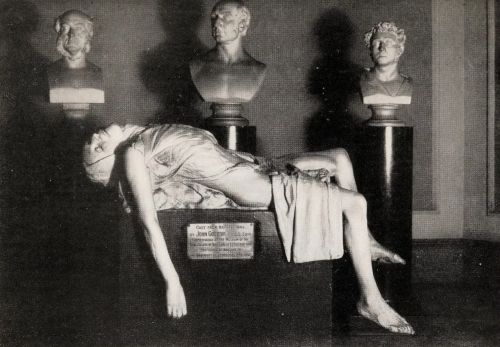
In Mary Shelley’s Gothic shocker Frankenstein (1818), Doctor Victor Frankenstein uses ungodly modern knowledge of physiology, physics, and chemistry to animate a body built from parts collected from anatomy laboratories and graveyards. Frankenstein passes over gruesome physiological details in a guilty rush: “Who shall conceive the horrors of my secret toil, as I dabbled among the unhallowed damps of the grave?” Shelley was relying on her audience’s awareness of how early nineteenth-century medicine was testing the boundaries of religious authority on questions of life and death. Medical men were seen as potential wreckers of Christian civilisation, directly associated with the peculiar and horrifying consequences of rapid advances in the study of human anatomy: body snatching.
Body snatching emerged from a very specific situation in Britain. In 1540, Henry VIII had granted a Royal Charter to the Company of Barbers and Surgeons that provided them with just four human bodies a year for dissection and anatomical study, an essential component of medical training. Dissection was a sacrilegious act, imperilling the hope of bodily resurrection. Bodies could be taken only from those executed by hanging, who by their crimes had forfeited the right to proper burial. Two hundred years later, this provision had increased to only six bodies, despite a great increase in the number of surgeons.
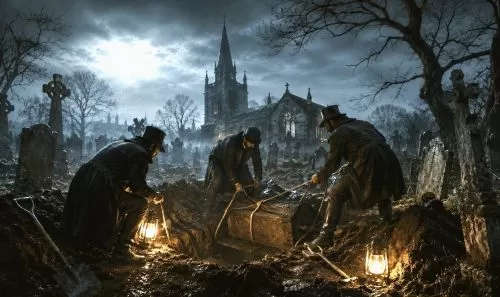
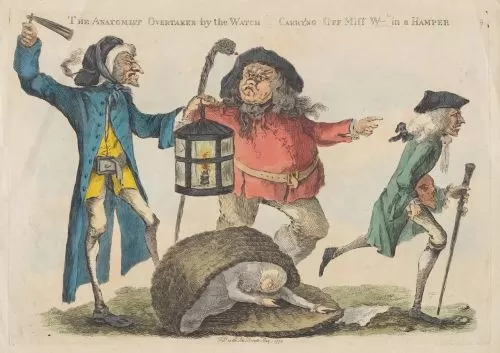
From about 1675, therefore, dead bodies became commodities. A shadow trade of so-called “resurrection men” or body snatchers rose to meet anatomy schools’ demand by robbing fresh graves. They exploited a legal loophole that since a corpse was neither property nor person, it could not be “stolen” — hence prosecutions were often on the grounds of offending public morals and carried lighter sentences than, for example, poaching or theft. A fresh corpse could fetch two guineas in the 1790s; an 1828 inquiry heard that by then it could be as much as eight guineas (about £600 in today’s currency).
Rare “anatomical specimens” were worth even more. The famous “Irish Giant”, Charles Byrne, who died in 1783 after a life as a public sensation in London and Edinburgh, went to great lengths to avoid his body ending up on display in an anatomical museum. His will asked that he be buried at sea. The leading London anatomist John Hunter is thought to have paid as much as £500 (around £40,000 today) to deny Byrne’s wishes; he had the body snatched and added it to his collection. Byrne’s skeleton remained on display in the Hunterian Museum at the Royal College of Surgeons until 2023, despite a campaign to provide him his proper burial.
From the surviving testimony of resurrection men, it is clear that pauper burial grounds, without guards or mortuaries, were favoured hunting grounds. Pauper grave-pits were often left open until the deep holes were filled with cheap, stacked coffins, sometimes up to twelve deep. Many of the poor were only buried in shrouds, further speeding exhumation. Meanwhile, the fearful middle classes, distrusting the safety of churchyards, spent money on lead coffins, iron grids, and various “mortsafe” devices — metal cages cemented into stone around the coffin. Famous examples of mortsafes survive in the Greyfriars kirkyard in Edinburgh, which was a known haunt of the resurrection men.
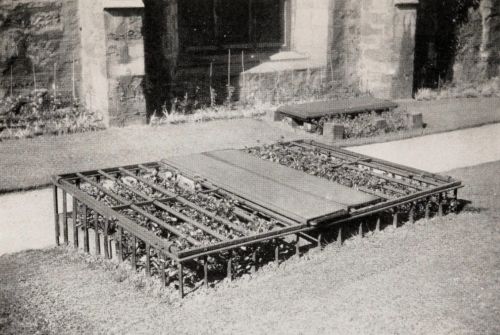
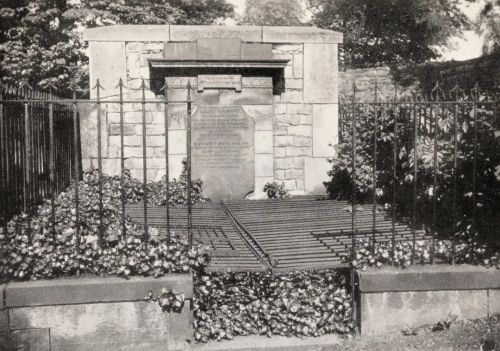
Revulsion at the desecration of graves is evident in the repeated instances of public rioting when resurrection men were arrested, as in Great Yarmouth in 1827, and in 1832, in Aberdeen, where an anatomy school was razed to the ground by an angry crowd. There were more disturbances in Cambridge, Greenwich, and elsewhere in the same years.
These scenes intensified with the notorious case of William Burke and William Hare, who murdered an estimated sixteen people in Edinburgh over ten months in 1827 and 1828. They sold their first exhumed body for just over £7 (about £500) to the eminent Edinburgh anatomist Robert Knox, and latterly cut out the risky process of digging up graves by suffocating their victims after plying them with drink. Their last victim, Mary Paterson, was recognised by one of Knox’s assistants when preparing the body for class. Although only initially suspected of murdering Paterson, Hare quickly turned King’s evidence and revealed their deadly business model.
In January 1829, Burke was tried, found guilty of one murder, executed, and — perhaps inevitably — dissected. It was said that over 40,000 people queued to see his ruined corpse. His skeleton is still on display in the Anatomical Museum of the Edinburgh Medical School. Surgeons often escaped any charge of complicity, but Robert Knox was forced to resign membership of the Royal College of Surgeons and soon left Edinburgh. The case of Burke and Hare poured into the popular imagination through a wave of popular broadsides, ballads, and lurid sketches of the crimes.
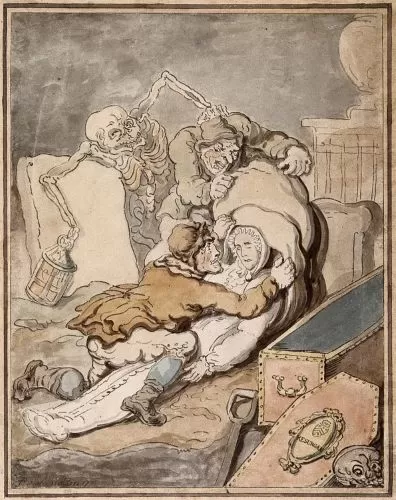
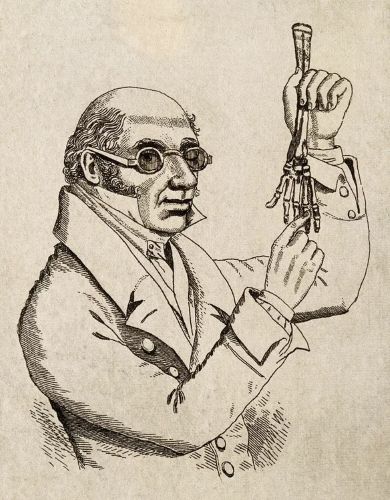
The expansion of the pool of bodies available to anatomy schools was made in the 1832 Anatomy Act by allowing “unclaimed” pauper bodies to be used for dissection. If it ended the body-snatching trade, the Act hardly dispersed popular fear about the violation of bodies after death. Workhouse shame could now extend beyond burial in a pauper’s grave to (legal) desecration by dismemberment.
Some who had argued for expanded access did, however, have the courage of their convictions. The influential Utilitarian philosopher Jeremy Bentham died in 1832, and Southwood Smith, a friend, undertook a public dissection of his body. Bentham’s body remains dubiously “in use” as an “Auto-Icon” — “a man preserved in his own image” — as stipulated in his will. His taxidermied remains spent many years sitting in a glass box in the passageways of University College London, gathering dust; he is still there, having been plumped up a little, with a fresh view onto the Bloomsbury gardens of Gordon Square.
Popular disgust at body snatching seeped into the mass literature of the “penny bloods” or “penny dreadfuls”, cheap magazines with open-ended serial melodramas that were often suffused with radical sentiment. George W. M. Reynolds’ Mysteries of London serial (1844–56) had a recurrent monstrous Resurrection Man, a demonic emanation of the slums whose gang “burks” their victims. Thomas Rymer’s Manuscripts from the Diary of a Physician (started in 1844) opens with the melodramatic “The Dead Restored; or, The Young Student”, which recalls an incident in which the narrator is caught up in an act of grave-robbing.
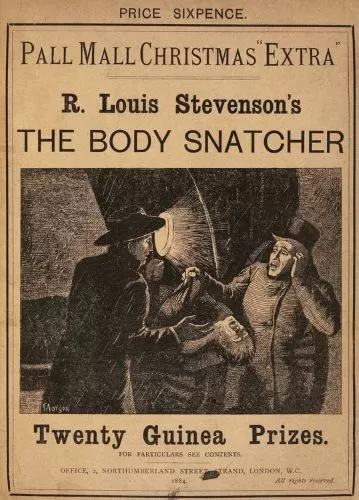
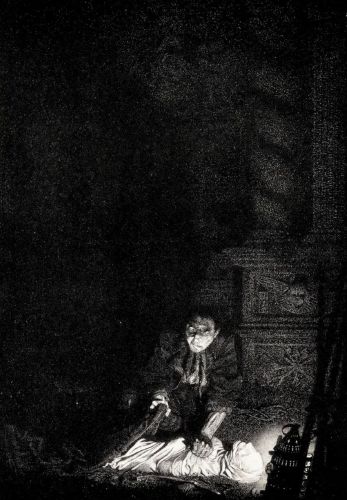
Memory of the Burke and Hare case persisted long after their deaths. Robert Louis Stevenson used it as the basis of his 1884 Christmas shocker “The Body Snatcher”. The volume was advertised in London with “six pairs of coffin lids, painted dead black, with white skulls and cross-bones in the centre for relief” carried by men in “long white surplices” purchased from a funeral establishment. The campaign was halted by the Metropolitan Police on grounds of decency.
These graveyard terrors would eventually attract the attention of reformers like George Walker. A medical practitioner in Drury Lane, which bordered both the glitzy West End and some of the worst slums in inner London, he — like many reformers — had been brought up a dissenter from Church of England doctrine, with a willingness to challenge tradition and orthodoxy. His practice was in close proximity to a cluster of city-centre churchyards and burial grounds, which were in a parlous state when he began to explore them in the 1830s.
In 1839, Walker published Gatherings from Grave Yards, in which he surveyed 149 individual burial grounds close to his practice: a catalogue of a city slowly being poisoned, in his view, by ground saturated with its own dead. He denounced the condition of London burial grounds as menaces to public health and an outrage to Christian custom. Following the miasmatic theory of disease, he recounted instances of gravediggers who had died suddenly from the inhalation of toxic fumes when working in the worst graveyards.
The poor had few options for what to do with their dead. They laid out the deceased in their own rooms, often for days or even weeks at a time, partly to observe communal customs, but mainly because it took time for the family to raise fees for burial. The pauper graveyards themselves were often patches in unregulated grounds that had emerged to undercut higher Church of England fees. In these disregarded spaces, the physical number of the dead was a constant problem. It was managed by burying paupers in communal pits and removing their bodies illicitly by night a few days later. Any remaining flesh and bone was surreptitiously burnt. That gravediggers often required large quantities of alcohol to blunt their senses was only the first of the moral outrages against Christian belief.
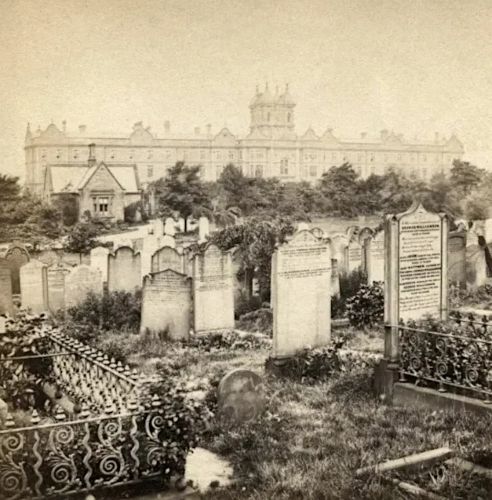
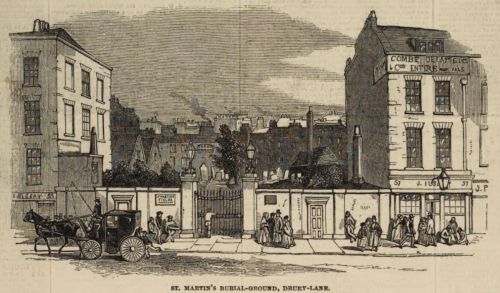
A short walk from Drury Lane stands St Clement Danes Church. In those days, its crypt was stuffed with the intramural dead, often expensively inhumed close to the holiest spaces of the church, in lead coffins known to burst with the gases built up from decomposition. Meanwhile, the churchyard outside St Clement Danes was overflowing, as was its overspill ground, just over the road in Clement’s Lane.
James Lane, a local resident, testified that he had seen gravediggers at night digging up coffins, breaking down the wood for burning, removing bones, shovelling “soft substance”, or spreading quick lime to dissolve the bodies below (some of the poor in fact favoured quick lime, because it damaged bodies enough to save them from body snatchers). “There is very little air attached to that quarter”, Lane told an 1842 parliamentary committee, and detailed his many health problems. John Eyles, a gravedigger, testified in clear terror of his tyrannical boss that he had been obliged to dig up coffins at night and break them up. He had even seen his own father’s coffin dug up and broken down.
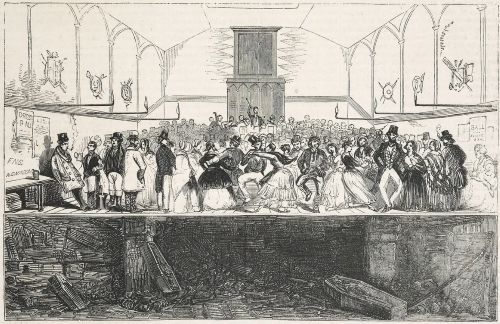
Enon Chapel was located in the same street. A Baptist dissenting chapel, opened in 1823 as a speculative venture, it had begun to offer cheap burial in its basement. Soon the congregation was contending with an “abominable” stench and saprophagous corpse flies crawling sluggishly from the cracks in the wooden floor. Some fainted from the smell; many left services with insidious, miasmatic headaches. When another reformist venture — the building of drains — required entry to the basement, it was discovered that 12,000 corpses had been stuffed into a space measuring 50 × 30 feet (15.2 × 9.1 m). The “master carman” William Burn testified that he had helped remove some of its contents when the sewer was built. Men repairing the road surface of Clement’s Lane had “asked me to give them a few baskets of rubbish [to fill potholes], which I did, and they picked up a human hand.” The bones got as far as Waterloo Bridge, where they were used as landfill to shore up the construction of Waterloo Road: infrastructure built on the bones of the city’s impoverished dead. Long after the inquiry had concluded, Walker purchased the lease on the abandoned Enon Chapel and paid for an estimated 20,000 more bodies to be reinterred in a garden cemetery outside the city.
Walker also continued to pamphleteer through the 1840s. He had the perfect case for his campaign when, in 1845, a serious fire started in the bone house of another private, unconsecrated burial ground. Spa Fields, near Exmouth Market in Clerkenwell, had been in use for over fifty years. One estimate suggested that it had capacity for 1,361 adult burial plots, but Walker calculated that upwards of 80,000 bodies were crammed in, sometimes with as many as eight stacked in one grave.
The middle-class houses and businesses around Spa Fields had for years suffered from proximity to what Walker described as one of the worst “reservoirs of pestilence” in the capital. The bone house was at its centre. Walker’s investigations turned up a gravedigger who testified, “I have been up to my knees in human flesh by jumping on the bodies so as to cram them in the least possible space at the bottom of the graves.” The agitation of the businesses in the area forced the situation to a local magistrate’s court, and it turned out that the ultimate owner of Spa Fields, hidden behind a chain of managers, was the Marquis of Northampton. The scandal spilled into the national press.
In 1851, thinking back to the notion of “the great majority”, Walker began On the Past and Present State of Intramural Burying Places with the blunt maxim “BULK MUST OCCUPY SPACE”. There is a powerful sense of a continuing, dangerous “necrosociability” in his writing, wherein the dead and the living continue to live together. London is envisaged as a city stuffed with the dead, “crowded into every inch of available space. . . . Myriads of bodies, in every stage of decomposition, have been, and continue to be, stowed away in subterranean receptacles in the streets, lanes, and blind alleys in this metropolis.”
In 1852, the Burial Act finally passed, announcing that “for the Protection of the Public Health Burials in any Part or Parts of the Metropolis, or in any Burial Grounds or Places of Burial in the Metropolis, should be wholly discontinued.” Local Burial Boards were established, fees fixed, and inspection regimes formalised. Exceptions to the rule included the sites of national memorial, St Paul’s Cathedral and Westminster Abbey, some family intramural vaults where resting places had long been purchased and judged healthy, the new Cemetery Companies, and burial grounds for the Jewish and Quaker populations of the city.
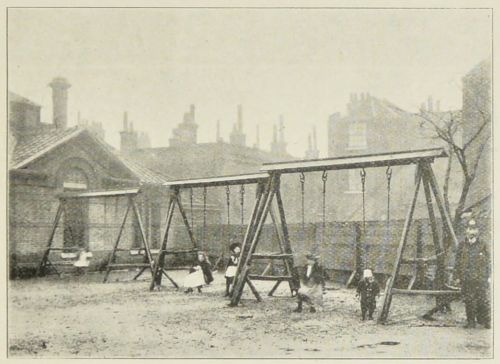
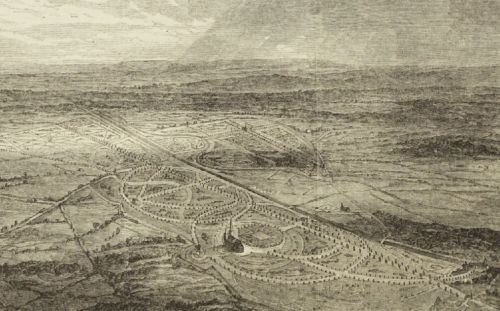
Suburban garden cemeteries — like London’s “Magnificent Seven” of Kensal Green (1833), West Norwood (1836), Highgate (1839), Nunhead (1840), Abney Park (1840), Brompton (1840) and Tower Hamlets (1841) — soon displaced the toxic churchyards. City grounds were abandoned, sometimes boarded up and left to rot, or the land informally occupied and repurposed as goods and storage yards. The horrific complex of burial grounds so central to Walker’s campaign for reform has now been almost entirely erased from the city. Even by the time Isabella Holmes set out to catalogue the remaining burial grounds for the Metropolitan Public Gardens Association in the 1880s, many had vanished entirely.
Public Domain Works
- Horrors of the London Burial Grounds, Being a Correct Account of the Horrible Disclosures Made by Gravediggers (1840)
- Gatherings from Grave-Yards, George Alfred Walker (1849)
- Lectures on the Metropolitan Grave-Yards, George Alfred Walker (1849)
- The Diary of a Resurrectionist, 1811–1812, James Blake Bailey (1896)
- The London Burial Grounds: Notes on Their History from the Earliest Times to the Present Day, Isabella M. Holmes (1896)
- The Sack-’Em-Up Men: An Account of the Rise and Fall of the Modern Resurrectionists, James Moores Ball (1928)
Further Reading
Affiliate disclosure: Amazon links on this site are paid links. As an Amazon Associate I earn from qualifying purchases.
- Graveyards: A History of Living with the Dead, by Roger Luckhurst
- Necropolis: London and its Dead, by Catharine Arnold
About the Author