Medieval and Renaissance medicine turned the dead body into knowledge, evidence, remedy, and spectacle, often by using those least able to refuse.

By Matthew A. McIntosh
Public Historian
Brewminate
Introduction: The Body as Evidence, Object, Relic, and Remedy
A medieval corpse was never only one thing. It was a Christian body awaiting resurrection, a remnant of a social person, an object of family obligation, a possible relic, a legal sign, a medical specimen, and sometimes even a substance to be consumed or applied as medicine. The dead body stood at the crossing of theology, law, punishment, healing, and curiosity. It could be washed and buried with reverence, divided and transported for dynastic burial, opened to search for the cause of death, displayed as proof of sanctity, handed over after execution, or reduced into powder, fat, blood, or bone for therapeutic use. The same culture that worried deeply about bodily integrity after death also produced procedures that cut, inspected, preserved, traded, and used human remains. That apparent contradiction is my starting point.
The Middle Ages and early Renaissance did not understand the opened body in modern terms. Anatomy was not yet a laboratory science built around controlled experimentation, and medical authority still rested heavily on ancient texts, university commentary, humoral theory, and inherited systems of interpretation. Yet this does not mean that bodies were untouched, unknowable, or protected by a blanket religious prohibition. From the thirteenth century onward, human dissection became increasingly visible as a teaching practice, even if it remained rare, seasonal, legally constrained, and dependent on the availability of particular kinds of corpses. Autopsies, anatomical demonstrations, forensic inspections, embalming practices, relic examinations, and corpse-derived medicines all belonged to a world in which the body could reveal truths, but only when interpreted through the social and intellectual structures that made those truths legible.
The history of bodily experimentation is best understood not as a simple triumph of science over religion, nor as a lurid catalogue of premodern cruelty, but as a history of hierarchy. Some bodies were protected by family, rank, sanctity, wealth, or civic honor. Others were made available by execution, poverty, gender, foreignness, disease, or exclusion from ordinary burial. The corpse of a condemned criminal could be treated as a continuation of punishment, useful after death because dishonor had already marked it. The body of a woman might be opened to investigate reproduction, lineage, pregnancy, or sanctity. The preserved remains of distant Egyptian dead could be sold as “mummy” in European medical markets. The blood or fat of the executed could be imagined as potent medicine. In each case, the use of the body depended not merely on medical curiosity but on social permission: who could be cut, who could be consumed, who could be displayed, and who still had claims upon the dead.
The central question is not whether Europeans of this era “respected” or “violated” the dead in some uniform way. They did both, often within the same religious and medical universe. The more revealing question is how they decided what a body was for after death. Was it a vessel awaiting resurrection, a sign to be read, a criminal remainder, a holy object, a medical text, a commodity, or a remedy? By following the dead body through universities, courts, churches, apothecaries, scaffolds, and households, I examine how knowledge was produced from human remains before modern medical ethics and how that knowledge was shaped from the beginning by power, status, and unequal access to the bodies of the vulnerable.
Ancient Inheritances: Galen, Alexandria, and the Problem of Knowing the Inside

Long before medieval physicians opened bodies in university halls, they inherited an argument about whether the inside of the human body could be known at all. The problem was not merely technical, though the technical obstacles were severe. Flesh decayed quickly, bodies were socially protected, and the act of cutting into the dead or dying raised questions about pollution, cruelty, piety, and the dignity owed to the human form. But there was also an intellectual problem: physicians had to decide whether true medical knowledge came from visible anatomy, philosophical reasoning, accumulated clinical experience, or the authority of revered texts. The medieval and early Renaissance anatomist did not begin with a blank corpse. He approached the body through a long ancient inheritance, especially the traditions associated with Hellenistic Alexandria and Galen of Pergamon.
Alexandria occupied a powerful place in later medical memory because it was associated with the most daring ancient attempts to look inside the human body. Herophilus of Chalcedon and Erasistratus of Ceos, working in the third century BCE, became famous for anatomical investigations that later writers described as including human dissection and, in hostile accounts, vivisection of condemned prisoners. Whether every detail of those reports can be trusted is another matter, because they often reached later readers through polemical or moralizing summaries in debates over whether medicine should pursue hidden causes by direct bodily invasion or confine itself to symptoms, experience, and treatment. Ancient critics could present such procedures as monstrous acts of curiosity, while later admirers could imagine them as heroic breakthroughs in the search for truth. The historical reality probably lies between those poles: Alexandrian anatomy seems to have been unusually bold, unusually dependent on royal or civic permission, and unusually tied to the bodies of people who had little power to refuse. Yet the tradition mattered enormously even when retold at a distance. Alexandria represented the possibility that the hidden body could be made visible, that nerves, vessels, organs, and cavities could be directly observed rather than inferred from symptoms alone. It also represented the ethical nightmare that medical knowledge might be purchased at the expense of the powerless body, especially the criminal body placed under state control. For medieval and Renaissance readers, Alexandria became both precedent and warning: a memory of anatomical courage, but also a reminder that the desire to know the body’s interior could easily become a justification for violating bodies already stripped of ordinary protection.
The most influential ancient authority for medieval medicine was not Herophilus or Erasistratus but Galen, the second-century Greek physician whose writings came to dominate learned medicine in Byzantium, the Islamic world, and Latin Europe. Galen valued anatomy intensely, and his surviving works repeatedly insist that the physician must understand the structure and function of the body. Yet Galen’s own anatomical knowledge was built largely through animal dissection, particularly of apes, pigs, dogs, and other creatures, because regular human dissection was not available to him in the Roman world. This mattered because Galen’s methodology was both extraordinarily sophisticated and inevitably vulnerable to error when animal structures were treated as human structures. Later anatomists would discover that some Galenic descriptions did not match the human body exactly, but for centuries those descriptions carried immense authority because they belonged to a larger explanatory structure of organs, faculties, spirits, humors, heat, motion, and purpose.
This ancient inheritance shaped medieval medicine in a paradoxical way. On one hand, it gave medieval physicians a remarkably elaborate language for understanding the body. Galenic anatomy was not a crude superstition; it was a coherent intellectual system that linked structure to function and placed the human organism within a broader natural philosophy. On the other hand, that same coherence could make the body on the table subordinate to the body in the text. When later teachers performed anatomical demonstrations, the corpse was often made to illustrate Galen, Avicenna, or Mondino rather than to overthrow them. The open body was evidence, but evidence interpreted through authority. Seeing did not automatically mean doubting. In many early anatomical settings, the highest form of knowledge still came from harmonizing what was visible with what the ancient masters had taught.
The transmission of Greek medicine through Arabic and Latin scholarship deepened this textual world. Galen’s writings, along with Hippocratic materials and later medical syntheses, moved through translation, commentary, abbreviation, and university teaching. Avicenna’s Canon of Medicine became one of the central authorities of medieval European medical education, not because it replaced Galen but because it organized and extended a Galenic medical universe into a form useful for learned practice. By the thirteenth century, a university-trained physician encountered the body through layers of inherited learning: Greek anatomy, Roman-era medical compilation, Arabic philosophical medicine, scholastic commentary, and local practical experience. This did not prevent observation, but it did discipline observation. The body was not merely seen; it was read.
The importance of this background is that dissection did not emerge as a sudden rebellion against ancient medicine. It emerged from within an ancient-medieval tradition that already believed the body had an intelligible order but struggled over how that order should be known. Alexandria supplied the memory of radical anatomical seeing. Galen supplied the authoritative map. The medieval university supplied the institutional setting in which text, teacher, corpse, and spectators could be brought together. The “problem of knowing the inside” was not simply the problem of opening flesh. It was the problem of deciding what counted as truth when the visible body, inherited authority, moral unease, and medical need all met over the same human remains.
Universities, Law, and the Return of Human Dissection
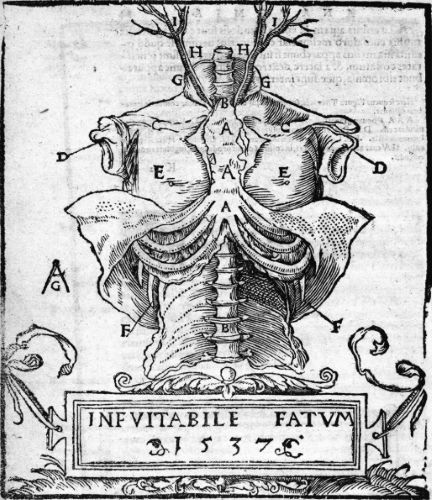
The return of human dissection in medieval Europe was not the work of isolated rebels cutting bodies in secret against an unchanging religious order. It developed most visibly in the cities and universities of northern Italy, where medicine, law, civic government, and punishment were already tightly connected. Bologna, Padua, and other university centers provided the institutional setting; municipal authorities and courts provided the legal mechanisms; and the bodies of the executed, the poor, or the socially vulnerable provided the material. This was not yet a continuous program of anatomical research in the modern sense. Dissections were rare, formal, seasonal, and often ceremonial. But by the late thirteenth and early fourteenth centuries, the opened human body had become thinkable as a legitimate object of learned instruction.
Bologna occupies a central place in this history because it joined medicine to one of medieval Europe’s great legal cultures. Law mattered because access to bodies was never simply a medical question. A corpse belonged, in different ways, to God, kin, community, civic authority, and burial custom. For a university anatomist to obtain a body, some authority had to decide that the ordinary protections surrounding the dead could be suspended. Executed criminals became important because criminal punishment already marked the body as dishonored and subject to public power. The scaffold and the anatomy table were not unrelated spaces. Both turned the condemned body into a lesson: one moral and judicial, the other medical and anatomical. The same civic order that punished the living criminal could extend its claim after death, allowing the body to serve the education of physicians and the prestige of the city’s learned institutions.
Mondino de’ Liuzzi, who taught at Bologna in the early fourteenth century, became the emblem of this institutional turn. His Anathomia, completed in 1316, was not merely a record of cutting bodies open; it was a teaching text designed for a world in which dissection had entered the medical curriculum as a formal exercise. Mondino’s anatomy remained deeply Galenic, and his purpose was not to declare war on ancient authority. He organized the opened body according to inherited medical categories, moving through the viscera, organs, vessels, membranes, muscles, bones, and reproductive structures in ways that made sense within scholastic medicine. The order of dissection itself reflected practical necessity as well as intellectual inheritance: the abdomen, most vulnerable to rapid corruption, received early attention, while firmer structures could be approached later. Mondino’s anatomy belonged to a transitional world. It did not yet make the corpse the final judge over the text, as later Renaissance reformers would more boldly claim, but it did make the corpse indispensable to the performance of learned medicine. The master might read or lecture from an authoritative text, an assistant might cut, and students might watch the body gradually become visible under the pressure of both knife and commentary. The result was not pure observation, but neither was it mere book learning. It was an organized act of verification, demonstration, and memory, in which the body helped fix in the student’s mind what the medical tradition said should be there. Yet his work still mattered because it assumed that the human corpse could be used pedagogically before students. The body on the table did not replace the book, but it joined the book. Anatomy became a staged encounter between text, teacher, demonstrator, students, and cadaver.
The practical conditions of dissection shaped the practice as much as law or theory did. Without refrigeration, the corpse was unstable from the moment of death. Winter was the preferred season because cold slowed putrefaction, and even then the work had to be done quickly. The abdomen, which decayed fastest, was often opened first; other regions could follow as time and condition allowed. This urgency helps explain the ritual structure of early anatomical demonstrations. They were not casual private investigations that could be repeated at will. They required a body, permission, a place, an audience, instruments, and a sequence. The event had to be organized around decay. The dead body was a teacher, but it was also a vanishing object, one whose usefulness expired within days.
The significance of these university dissections lies in their mixture of novelty and continuity. They did not create modern anatomy overnight, and they did not free medicine from authority in a single dramatic break. Instead, they established a durable institutional habit: the human body could be opened under certain legal, social, and pedagogical conditions, and what was seen there could be incorporated into learned medicine. That habit changed the status of the corpse. It became not only a burial subject or devotional concern, but also an authorized instrument of teaching. The return of human dissection was not simply a medical development. It was a civic and legal achievement, made possible by universities that wanted knowledge, governments that controlled punishment, and social hierarchies that determined whose bodies could be transformed into evidence.
The Myth of the Church’s Ban: Boniface VIII and the Misreading of De Sepulturis

One of the most persistent stories about medieval medicine is that the Catholic Church banned human dissection and thereby held back anatomical science until the Renaissance broke free from religious fear. The story is attractive because it offers a clean drama: dogma against inquiry, priest against physician, medieval darkness against modern observation. But it badly oversimplifies the evidence. Medieval Christianity certainly shaped how bodies were handled, imagined, mourned, buried, divided, and protected. Belief in bodily resurrection gave the corpse enduring significance, and burial in consecrated ground remained one of the defining acts by which the dead were kept within the Christian community. Yet there was no sweeping medieval church ban that made medical dissection impossible. The history is stranger and more revealing than that. The Church did not simply prohibit the opened body; it helped create the symbolic world in which some openings were horrifying, some were devotional, some were legal, and some were medically useful.
The papal decree most often dragged into this myth is Boniface VIII’s Detestande feritatis, issued in 1299 and commonly discussed under the rubric De sepulturis. Its target was not anatomical teaching but a funerary practice sometimes called mos Teutonicus, in which the bodies of nobles, crusaders, or other elite dead were dismembered and boiled so that the bones could be transported home for burial. This practice solved a practical problem in an age of long-distance death: a ruler, knight, bishop, or crusader might die far from the land, church, monastery, or family tomb where burial carried dynastic and spiritual meaning. Boiling the corpse allowed flesh to be separated from bone, making transport easier and reducing decay during the journey. But to Boniface, the method violated the dignity owed to Christian remains. He described the cutting, boiling, and stripping of bodies in language meant to mark the practice as a savage abuse rather than a pious solution to travel and burial. The decree forbade this treatment of the dead and threatened penalties for those who violated it. What it did not do was issue a universal prohibition against autopsy, surgical examination, or medical dissection. The confusion arose because later writers in modern polemics about religion and science treated any papal condemnation of bodily dismemberment as if it applied to every form of anatomical opening. That is not what the decree says, and it is not how practice developed in the Italian medical universities soon afterward. Indeed, the chronological proximity is important: the decree appeared just before the period in which university dissection became more visible in places such as Bologna. If Boniface’s ruling had functioned as a broad ban on anatomical work, the early fourteenth-century growth of public medical dissection would be far harder to explain.
The distinction matters because medieval Christians were already accustomed to several forms of postmortem bodily intervention. Elite corpses could be embalmed, eviscerated, transported, divided among burial sites, or displayed before burial. Saints’ bodies could be exhumed, inspected, translated, divided into relics, and distributed across sacred geographies. Miraculous incorruption, fragrant remains, unusual wounds, or bodily signs could become evidence in devotional and legal processes. Royal and aristocratic bodies were often treated in ways that would have looked invasive if applied to ordinary parish dead, yet these practices were justified by rank, sanctity, politics, memory, or practical necessity. In other words, the medieval Christian body was not untouchable in any absolute sense. It was touchable under the right authorities and for the right reasons. The same culture that guarded burial could also open, move, preserve, divide, and display the dead when the social and spiritual meaning of the act made it permissible.
Medical dissection entered a world that already possessed a complex grammar of bodily handling. The question was not simply whether a corpse could be cut, but who cut it, why it was cut, whose body it was, what authority permitted the act, and whether the procedure threatened or served a recognized good. A university anatomy performed on the corpse of an executed criminal did not mean the same thing as boiling a nobleman’s body for transport, opening a holy woman’s body to search for signs of sanctity, or removing organs for embalming. Each act carried a different moral and institutional logic. A criminal corpse might be available because punishment had already placed it under civic authority; a saintly body might be opened because the community believed holiness could be verified through physical signs; an elite body might be divided because dynastic memory required burial in more than one place; a suspected victim of poison or unusual disease might be examined because the body could serve as evidence. These were not identical acts of “desecration” or “science.” They were different uses of the dead, each made intelligible by its own framework of law, devotion, medicine, honor, or necessity. That is why the myth of a total church ban is so misleading: it flattens a world of distinctions into a single prohibition. Medieval people did not treat bodily integrity casually, but neither did they regard every incision as sacrilege. The dead body was governed by status, purpose, permission, and interpretation. What mattered was not simply the opening of flesh, but the meaning assigned to that opening by the living community that authorized, witnessed, feared, or benefited from it.
The more useful historical point is that medieval Christianity did not block anatomy in a uniform way; it shaped the conditions under which anatomy could become legitimate. It made the corpse powerful, not inert. It made burial meaningful, but it also made relics meaningful. It made bodily resurrection central, but it did not prevent physicians, clerics, judges, families, and civic authorities from treating the dead body as evidence. Boniface VIII’s decree belongs to that world of regulated meanings. It condemned one form of aristocratic corpse-processing, not the medical use of bodies as such. By the time human dissection appeared in Italian university medicine, it did so not as a clean escape from religion, but as a practice negotiated within Christian assumptions about death, punishment, hierarchy, and the afterlife. The opened body was not outside medieval religion. It was inside a culture that could see the corpse as sacred, dangerous, useful, dishonored, holy, or instructive depending on the circumstances of its use.
Condemned Bodies: Execution, Punishment, and Anatomical Availability

The bodies most easily drawn into medieval and early Renaissance anatomy were not chosen at random. They were usually bodies already weakened in social meaning before the anatomist’s knife touched them: executed criminals, the poor, the unclaimed, the foreign, or those whose families lacked the power to resist. Of these, the condemned criminal held a special place because execution did more than end a life. It publicly transformed a person into an object of judgment. The scaffold was designed to expose the body to civic authority, moral warning, and communal memory. When that same body passed from executioner to anatomist, the transition could appear almost natural within the logic of punishment. The criminal had already been denied ordinary honor; dissection extended that denial beyond death.
This connection between execution and anatomy mattered because Christian burial was not a small thing. To be buried properly, prayed for, remembered, and placed within consecrated ground was part of what it meant to remain within the moral community of the living and the dead. Dissection did not always permanently prevent burial, but it delayed, altered, and visibly violated the ordinary path from death to interment. For respectable families, that disruption could be intolerable. For the condemned, punishment could include precisely this loss of postmortem dignity. The criminal corpse was useful because it was already marked as forfeited. Civic authorities could make it serve a second public purpose: first as a warning against crime, then as a resource for medical education. Anatomical availability was not merely a matter of scientific need. It was produced by law, shame, and the unequal distribution of burial rights.
The anatomy lesson belonged to the same civic world as public punishment. Late medieval and Renaissance cities did not hide all violence behind prison walls. Executions, processions, mutilations, and public penances taught moral and political lessons by making bodies visible. Anatomy participated in that culture of visibility, though in a learned and specialized form. The exposed criminal body could demonstrate both the power of the law and the order of nature. It reminded spectators that the city had authority over the condemned even after death, while also allowing physicians and students to convert judicial violence into knowledge. The anatomy hall, like the scaffold, was a place where the body became legible to an audience. One audience read guilt, warning, and civic justice; the other read organs, vessels, membranes, and the hidden structure of human life. But these readings were not wholly separate. The possibility of the second depended on the force of the first. A body could become available for medical instruction because it had already been made publicly available as an object of punishment. This did not mean that anatomists saw themselves simply as agents of punishment. They could understand their work as educational, charitable, civic, and medically necessary. But the supply of bodies depended on prior acts of condemnation. Anatomy gained access where law had already stripped a person of protection.
The condemned body also solved a practical and political problem for universities. Anatomical teaching required human corpses, but most corpses were guarded by families, guilds, parishes, and burial custom. A university could not easily build a teaching program on the bodies of respectable citizens without provoking resistance. Criminal bodies offered a narrow solution. They were rare enough that dissections remained occasional events, but available enough to support formal demonstrations in certain cities. Their use also gave anatomy a public legitimacy that theft or secret grave-robbing could not provide. A corpse transferred by authority was different from a corpse stolen at night. This distinction mattered deeply. Early anatomy needed bodies, but it also needed permission. The condemned supplied both: material for dissection and a legal story explaining why that material could be used.
Yet it would be misleading to reduce early human dissection entirely to the bodies of executed men. Katharine Park’s work has shown that medieval and Renaissance anatomical opening also involved women’s bodies, elite bodies, holy bodies, and bodies examined for reproductive, familial, forensic, or devotional reasons. The criminal cadaver was important, but it was not the whole history. Its importance lies in what it reveals about availability. The bodies that became anatomical objects were those whose opening could be justified by some recognized authority: the court, the city, the family, the church, the university, or the reputation of sanctity. Execution was one powerful justification because it turned the corpse into public property in a moral sense, even if not always in a formal legal one. It made the body easier to detach from kinship and easier to treat as useful matter. But other forms of authorization could do similar work. A family might consent to an opening to learn the cause of death, confirm pregnancy, protect inheritance, or understand a mysterious illness. A religious community might inspect a holy body for signs that sanctity had left marks in flesh. A civic court might require bodily evidence when poison, violence, or contested death was suspected. These examples complicate the simple image of the criminal corpse as the sole foundation of anatomy, but they reinforce the deeper point: bodies became available when an institution or community could explain why ordinary bodily protection should yield to another need.
The condemned cadaver stands at the center my argument about hierarchy. Human dissection did not begin simply because physicians wanted to know more. Many people wanted knowledge; fewer had the right bodies available to obtain it. The opened corpse was produced by institutions that decided whose remains could be interrupted, exposed, cut, delayed, displayed, or denied ordinary honor. The criminal body became anatomically available because punishment did not end at death. It lingered in the handling of flesh, in the withholding or alteration of burial, and in the conversion of dishonored remains into civic knowledge. In the anatomy hall, the body on the table was never just a specimen. It was the residue of a legal sentence, a social judgment, and a hierarchy of the dead.
Women’s Bodies, Reproduction, and the “Secrets” of Anatomy

The history of dissection cannot be told only through the criminal corpse. Condemned bodies mattered enormously because courts and cities could make them available, but anatomical curiosity also gathered around another body imagined as difficult, hidden, and urgently meaningful: the female body. Medieval medicine inherited ancient arguments about generation, menstruation, pregnancy, lactation, sexual difference, and the womb, but these subjects were not merely technical questions for physicians. They touched inheritance, marriage, legitimacy, fertility, sanctity, family honor, and theological ideas about the relation between flesh and soul. To ask what lay inside a woman’s body was to ask more than an anatomical question. It was to enter a field of social anxiety and intellectual desire where medicine, household authority, law, and religion all met.
The phrase “secrets of women” captures this world vividly. Medieval and Renaissance texts often treated female physiology as a hidden domain, partly because reproductive processes occurred inside the body and partly because learned male medicine imagined women’s bodies as mysterious, unstable, and difficult to know. Menstruation, conception, miscarriage, pregnancy, childbirth, lactation, and uterine disorders were interpreted through inherited Galenic and Aristotelian frameworks, but they were also surrounded by rumor, taboo, practical midwifery knowledge, and moral suspicion. The “secret” was not simply anatomical concealment. It was social concealment: knowledge held by women, midwives, wives, mothers, and household healers could be treated as necessary yet suspect, intimate yet dangerous, useful yet subordinate to male scholarly authority. Medical writing often translated this intimate knowledge into a language of causes, humors, organs, and authorities, making the reproductive body available to male interpretation even when much practical expertise remained in women’s hands. In that sense, the “secrets of women” were not merely secrets because men did not know them. They were secrets because the culture made women’s embodied knowledge difficult to acknowledge on its own terms. Anatomy promised, at least in theory, to turn hidden processes into visible evidence. But it also promised to relocate authority: from the chamber of birth to the lecture hall, from the midwife’s experience to the physician’s commentary, from living testimony to the opened dead body.
Park’s scholarship shifts attention away from the older story in which anatomy develops mainly from criminal punishment and university ambition. In her account, women’s bodies were central to the origins of human dissection in late medieval and Renaissance Italy, not peripheral to it. Bodies were opened to investigate pregnancy, generation, lactation, virginity, sanctity, disease, and death. Some of these openings occurred in learned medical contexts, but others were bound to family, devotion, or legal concern. A woman’s body might be examined because a death was suspicious, because pregnancy had implications for lineage or inheritance, because a religious community sought signs of holiness, or because extraordinary bodily phenomena demanded explanation. Anatomy did not enter as a coldly detached science. It entered through urgent questions asked by families, clerics, physicians, judges, and communities trying to make the hidden body speak.
This means that women’s bodies were made available through different routes than the bodies of condemned criminals. Execution stripped the criminal body of ordinary protection through public punishment. Female bodies, by contrast, might become available through kinship, sanctity, reproductive uncertainty, or domestic crisis. The authorization could come from a family seeking explanation, a court seeking evidence, a convent preserving the memory of a holy woman, or physicians invited to interpret an unusual death. These openings could be invasive, but they were not always framed as dishonor in the same way as penal dissection. Sometimes they were acts of reverence, anxiety, or protection. Yet the underlying hierarchy remained. Women’s bodies were treated as sites where others had urgent claims: husbands, fathers, heirs, confessors, physicians, religious communities, and civic authorities. The question was rarely what the woman herself had authorized. It was what her body could reveal for the living.
Reproduction made this intense because the womb was imagined as both a biological organ and a social threshold. It was where lineage began, where inheritance could be secured or thrown into doubt, where pregnancy might confirm sexual conduct, and where childbirth could become a matter of life, death, and salvation. Medicine did not divide sharply between the physical and the moral. A woman’s reproductive body could be read for signs of fertility, disorder, sexual history, divine favor, or bodily corruption. Medical writers debated the roles of male and female seed, the causes of infertility, the formation of the fetus, the meaning of menstrual blood, and the dangers of retained fluids. These debates were not abstract. They mattered to households that needed heirs, to courts that adjudicated legitimacy, to husbands and families concerned with fertility, and to religious authorities concerned with sexual order and the fate of infants and mothers. Pregnancy could transform a woman’s body into evidence before and after death: evidence of marriage, adultery, violence, inheritance, miracle, or medical failure. Anatomical opening did not resolve these debates at once, but it gave them a new kind of material drama. The womb, long described in authoritative texts, could be looked for, handled, described, and compared with inherited claims. Even when what was seen was forced back into familiar theories, the act of seeing mattered. It made the reproductive interior into a visible field of inquiry and gave learned observers a powerful claim to interpret what had previously been hidden within living women’s bodies.
Holy women’s bodies further complicated the boundary between anatomy and devotion. The body of a saint or reputed holy woman could be opened not to punish her, but to discover whether holiness had left physical traces. Medieval Christianity already treated saintly bodies as extraordinary matter. Relics could heal, incorrupt flesh could testify to divine favor, and unusual bodily signs could support claims of sanctity. Cutting into a holy body was not automatically understood as desecration. It could be presented as a search for proof. A heart, womb, wound, organ, fragrance, or unexpected preservation might become part of a community’s argument that divine grace had been made visible in flesh. The opened body could serve both medicine and memory, both investigation and veneration. Yet the practice still reveals a striking paradox: reverence could authorize invasion. The body most honored might also be opened because people believed it contained hidden evidence of grace. This was not the same logic that exposed the criminal corpse, but it rested on a similar assumption that the dead body could be made to answer questions asked by the living. Here again the body became a text, but one read through devotional expectation as much as medical observation. The holy woman’s corpse did not simply belong to herself; it belonged to a community of memory, belief, and institutional judgment that claimed the right to discover what sanctity had done inside her.
The study of women’s bodies changes the larger story of anatomy. It prevents reducing anatomical availability to crime and punishment alone. The opened female body shows that anatomy grew from a wider culture of inquiry into hidden causes, hidden signs, and hidden truths. It also shows that the production of bodily knowledge was gendered from the beginning. Learned men often claimed authority over reproductive knowledge by translating intimate, domestic, and female-associated experience into Latin texts, university medicine, visual anatomy, and institutional judgment. The “secrets” of anatomy were not only secrets hidden inside flesh. They were secrets produced by social power: by deciding whose bodies could be opened, whose knowledge counted, whose testimony was trusted, and whose remains could be made to answer questions posed by others.
The Anatomy Lesson as Ritual: Reading the Corpse in Public

The anatomy lesson was not simply a physician cutting open a body to see what was inside. It was a structured event, a public or semi-public act of learned performance in which the corpse, the text, the teacher, the cutter, and the spectators each had a role. The body did not appear as a neutral object awaiting discovery. It entered the room already marked by law, death, status, and permission, and it was interpreted through the authority of books before, during, and after the knife touched it. Anatomy was both investigation and ceremony. It made hidden structures visible, but it also displayed the hierarchy of knowledge: the learned master above, the manual operator below, the students watching, and the dead body exposed as the field on which text and flesh were brought together.
The physical arrangement of the anatomy lesson revealed that hierarchy. In many early demonstrations, the professor or lector did not necessarily perform the cutting himself. He read or expounded the authoritative text, often from a raised position, while a surgeon, barber-surgeon, or demonstrator handled the knife. Students and invited observers gathered around to see the body opened in the proper sequence. This division between learned speech and manual action mattered. University medicine prized Latin, commentary, textual mastery, and philosophical explanation; cutting belonged to a lower manual world, even when it was indispensable. The anatomy lesson dramatized a social division inside medicine itself. The corpse could not teach unless someone cut it, but the meaning of what was cut depended on the learned voice that named, ordered, and interpreted it. The corpse in this setting functioned almost like a book, but not a book that spoke for itself. It had to be read. The lecturer might identify the organs according to Galenic or Mondinian categories, connect visible structures to inherited theories of function, and explain the body as a rationally ordered whole. Students were not simply being invited to doubt ancient authority with their own eyes. More often, they were being trained to see correctly, which meant seeing the body through established medical language. This is one reason early anatomy can look strange from a modern perspective. The corpse was evidence, but evidence placed within a framework that often sought confirmation more than contradiction. If the body seemed not to match the text, the difficulty might be attributed to decay, abnormality, poor cutting, or the limitations of the specimen before it became a challenge to inherited doctrine.
Yet the ritualized character of the anatomy lesson should not be mistaken for intellectual emptiness. Ritual does not mean that nothing was learned. The repeated, ordered opening of bodies created habits of visual attention. Students could associate textual descriptions with actual structures, observe variation, learn the sequence of bodily regions, and acquire a memory of anatomy that was more vivid than reading alone could provide. The event also made medicine visible as a civic and institutional achievement. A university that could stage a dissection demonstrated its access to bodies, its relationship with public authority, and its place in the learned life of the city. The anatomy lesson was pedagogical, political, and symbolic at once. It taught anatomy, but it also taught who had the authority to transform a human corpse into knowledge.
Timing intensified the ritual. Because the body decayed quickly, the lesson unfolded under pressure. The abdomen and viscera, most vulnerable to corruption, were often opened early; more durable structures could be examined later. The cold months were preferable, and the availability of a corpse, often one supplied through execution or civic permission, could turn a dissection into an exceptional occasion. This rarity gave anatomy lessons a ceremonial force that modern readers may miss. They were not daily laboratory exercises. They were events that required coordination among courts, universities, surgeons, students, and city officials. The dead body’s usefulness was brief, and that brevity imposed order. The sequence of dissection was not only anatomical. It was a race against decay, a disciplined attempt to impose intellectual structure on flesh that was already beginning to vanish.
To read the corpse in public was to make several claims at once. It claimed that the body had an intelligible interior, that learned medicine had the right to interpret that interior, that civic authority could make certain corpses available, and that death itself could be converted into instruction. The anatomy lesson brought together reverence and violation, curiosity and hierarchy, evidence and performance. It did not yet belong fully to the world of modern experimental science, but neither was it merely a theatrical curiosity. It was one of the key practices through which medicine learned to join text to sight. The body on the table became a temporary, decaying, deeply unequal source of truth, a corpse made readable by the institutions that gathered around it.
Autopsy, Forensics, and the Body as Legal Evidence

Dissection in that world did not belong only to the university anatomy lesson. Bodies were also opened, inspected, and interpreted because the dead could become witnesses. A corpse might reveal whether a wound had been mortal, whether poisoning was suspected, whether pregnancy had existed, whether disease had struck in a recognizable pattern, or whether a reputed holy person bore signs of sanctity. These procedures were not modern forensic pathology, and they should not be mistaken for a fully developed science of postmortem investigation. Yet they show that communities were willing to treat the body as evidence. The dead body could not speak, but wounds, organs, fluids, swelling, discoloration, decay, or unusual preservation could be made to testify when interpreted by physicians, surgeons, clerics, jurists, or civic officials.
This mattered because medieval justice often depended on visible signs. Law did not operate only through abstract rules; it also relied on bodies, oaths, reputations, public injuries, ritualized proofs, and communal recognition. A corpse marked by violence could become a legal object. Was a person murdered, poisoned, beaten, neglected, or struck by accident? Did a wound merely injure, or did it cause death? Could the body show whether a woman had been pregnant, whether an infant had lived after birth, or whether a suspicious death had natural causes? These questions did not always require a full autopsy, but they did require inspection. The dead body became part of the evidentiary field through which courts and communities tried to reconstruct events that no living witness could fully settle.
Physicians and surgeons occupied an important but still evolving role in that process. In some cases, legal authorities called upon medical practitioners to examine wounds, inspect corpses, or advise on the bodily causes of death. Their authority was practical as well as learned. Surgeons understood wounds, bleeding, fractures, and trauma through manual experience; physicians interpreted internal causes, humoral disorder, disease, poison, and bodily signs through learned medicine. The boundary between these forms of knowledge was not always neat. A physician might provide learned explanation while a surgeon performed the tactile inspection; a court might want a determination of whether a wound was fatal, whether a sick person had been poisoned, or whether a body showed evidence of violence. In these moments, anatomy and law met not in the theater of the university but in the urgent aftermath of death.
Poisoning was well-suited to this kind of bodily suspicion because it threatened the ordinary visibility of justice. A public wound could be seen; poison suggested hidden malice, secret administration, and invisible corruption inside the body. Medieval and Renaissance societies feared poison not only as a medical danger but as a social and political one. It implied betrayal within households, courts, marriages, kitchens, monasteries, princely circles, and intimate spaces of trust. Unlike a sword blow or broken skull, poison could leave accusation without spectacle, rumor without certainty, and death without an obvious external mark. Opening or inspecting the body could become part of an attempt to bring hidden violence into view. The signs sought might not satisfy modern toxicology, but they mattered within a world that expected nature to leave traces. Swollen organs, discoloration, unusual fluids, corrupted viscera, sudden bodily change, foul smells, or unnatural-looking internal damage could be read as evidence of secret harm. Such readings were uncertain, contested, and vulnerable to the assumptions of the examiner, yet they gave courts and families a way to translate suspicion into visible testimony. The corpse became a contested document, one that might confirm accusation, redirect suspicion, or fail to yield certainty. In that sense, suspected poisoning reveals both the promise and the limits of early forensic thinking: the body was believed capable of disclosing truth, but the meaning of its signs still depended on medical theory, legal need, social fear, and the authority of those permitted to interpret it.
Women’s bodies again stood at the center of some of these investigations because reproduction made the body legally consequential. Pregnancy could affect inheritance, marriage disputes, criminal accusation, family honor, and the fate of property. The death of a pregnant woman, the death of a newborn, or uncertainty about whether an infant had breathed could create questions that law and medicine both wanted answered. The body was not examined merely to satisfy curiosity about anatomy. It was examined because hidden reproductive facts had public consequences. The womb, fetus, placenta, breasts, or signs of recent childbirth could become evidence. This was another way in which the female body was made to carry social meanings beyond itself. Its interior could be treated as a legal archive, a place where kinship, sexuality, violence, inheritance, and moral judgment might be confirmed or disputed. The same evidentiary logic appeared in religious settings, though the questions differed. When communities examined the bodies of saints or reputed holy persons, they might search for incorruption, fragrance, unusual organs, miraculous signs, stigmata, or bodily marks of devotion. These were not forensic investigations in the criminal sense, but they also treated the corpse as evidence. A holy body could support memory, cult, canonization, or local devotion. The opening of such a body complicates any simple distinction between reverence and investigation. A corpse might be cut precisely because it was honored, because people believed its interior could reveal divine favor. In this devotional mode, the body testified not to murder or poison but to sanctity. The same basic assumption remained: hidden truth could be lodged in flesh, and authorized interpreters could bring that truth into public meaning.
Autopsy and forensic inspection broaden my argument beyond anatomy as teaching. The opened body was not only a specimen for students; it was an evidentiary object in a culture that looked to bodies for signs of truth. Courts, families, physicians, surgeons, clerics, and communities all had reasons to make the dead reveal what the living did not know or could not prove. But access to that evidence was still shaped by authority and hierarchy. Not every body could be opened, and not every interpretation carried equal weight. A corpse became legal or religious evidence only when institutions recognized both the question being asked and the people authorized to answer it. The history of autopsy before modern forensic medicine is not a story of primitive science slowly becoming rational. It is a story of how societies learned to make the dead body speak within the languages of law, medicine, devotion, and power.
Corpse Medicine: Eating, Drinking, Wearing, and Applying the Dead
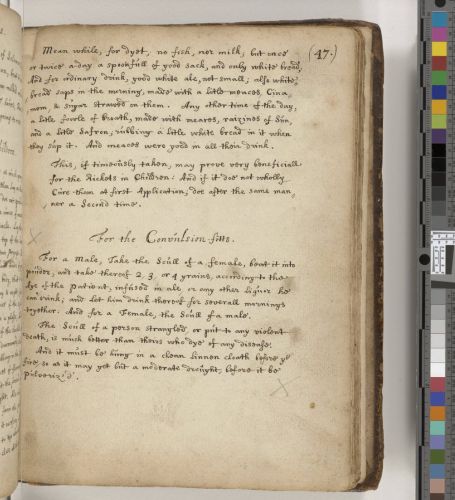
The use of dead bodies in medicine was not confined to anatomy halls, courts, or forensic examinations. Human remains also entered the body through the mouth, the skin, the wound, the amulet, and the apothecary jar. This practice, often called corpse medicine or medicinal cannibalism, seems grotesque from a modern point of view, but it belonged to a long medical tradition in which substances carried powers, sympathies, virtues, and hidden qualities. Human blood, fat, bone, skull, marrow, hair, moss growing on skulls, mummy, and even the bodies of executed criminals could be imagined as therapeutic materials. The corpse was not only something to be inspected. It could also be transformed into a remedy.
The logic behind corpse medicine was not simply hunger, cruelty, or irrational savagery. It drew on a medical world in which matter was active and morally charged. Substances could warm, cool, dry, moisten, strengthen, purge, draw out corruption, or transfer virtues from one body to another. The human body, as the most complex and spiritually significant of earthly bodies, was thought by some physicians and healers to contain potent forces. Blood might carry vitality; fat might soften, soothe, or penetrate; skull might act upon diseases of the head; powdered mummy might preserve or dry; the remains of a violently killed person might be imagined to hold a concentrated life force cut off before its natural time. These assumptions were not identical everywhere, and they did not form a single doctrine, but they made corpse-derived remedies intelligible within humoral, Galenic, magical, alchemical, and later Paracelsian ways of thinking.
“Mummy” was among the most famous and commercially important forms of corpse medicine. The term could refer to bitumen or mineral pitch, but in European medical markets it increasingly became associated with the preserved remains of Egyptian mummies, which were ground, traded, and consumed as medicinal material. The appeal of mummy depended on several overlapping ideas: preservation, antiquity, exotic origin, dryness, and the belief that embalmed flesh contained substances useful for treating wounds, bleeding, bruising, or internal disorders. It also depended on distance. The Egyptian dead could be made into medicine because they had been removed from the social relationships that would have made their bodies recognizable as someone’s kin, ancestor, or sacred dead. In European apothecary culture, the mummy became less a person than a substance with a name, price, texture, smell, and supposed therapeutic virtue. This transformation required both imagination and commerce: merchants, apothecaries, physicians, collectors, and patients all participated in turning ancient bodies into drugs. Yet the trade also generated suspicion. Apothecaries and physicians debated whether genuine Egyptian mummy was being sold, whether substitutes were being passed off as authentic, and whether the remedy worked at all. Some critics objected because fraudulent mummy might be nothing more than recent corpse matter prepared to imitate ancient remains; others doubted the medical logic of swallowing the dead in the first place. The very popularity of mummy exposed a contradiction in European medicine. Learned and Christian societies that condemned cannibalism in others could nevertheless purchase, prescribe, and ingest human remains when those remains were translated into the language of pharmacy. The foreign dead entered European medicine not as persons but as materia medica, stripped of name, kinship, burial context, and cultural belonging.
The human skull occupied another important place in this medical imagination, particularly in remedies connected to epilepsy, headaches, apoplexy, bleeding, and disorders of the brain or nerves. Powdered skull, sometimes specifically the skull of a person who had died violently, appeared in early modern pharmacological recipes and medical discussions. The emphasis on violent death was significant. A person who died suddenly, before the body’s natural energies had been exhausted by long illness, could be imagined to retain a force useful to the living. The skull also worked by a principle of correspondence: matter from the head might treat diseases of the head. Similar thinking surrounded moss or lichen gathered from skulls exposed to the air, sometimes called usnea, which could be used in preparations for bleeding or other ailments. The dead body became a landscape from which therapeutic substances might grow, harden, dry, or be collected.
Blood was perhaps the most disturbing and revealing substance in this tradition. In some regions, the blood of the executed was sought as a remedy, particularly for epilepsy. The logic was immediate and visceral: fresh human blood seemed to contain life at its most concentrated, still warm from the body and not yet fully separated from the vitality of the person who had died. Execution sites could become places not only of punishment but of medical opportunity. The crowd that came to witness death might include sufferers or their families hoping to obtain a cure. This practice linked the scaffold to the apothecary in a brutally direct way. The condemned body, already made public by law, became useful at the very moment of death. Punishment produced a substance that medicine could consume.
Human fat also moved through this world of remedies. It could be rendered into salves or ointments and applied to wounds, stiff joints, bruises, or painful limbs. Executioners, surgeons, and informal healers might all be associated with access to such materials where the bodies of the condemned were available. Fat’s therapeutic reputation partly rested on texture and action: it seemed to soften, lubricate, penetrate, and carry other ingredients into the body. But its human origin gave it a darker charge. To apply human fat was to use the dead person as a medium of healing, not by eating flesh directly but by absorbing or wearing the corpse through the skin. This collapses any easy distinction between internal and external corpse medicine. The dead could be drunk, swallowed, rubbed on, bound to the body, or carried as a charm.
The most important point is that corpse medicine did not exist only at the margins of learned culture. Elite physicians, household recipe books, apothecaries, chymical writers, and popular healers all participated in different ways. Some defended human-derived remedies; others criticized them as fraudulent, ineffective, disgusting, or morally troubling. Ambroise Paré’s skepticism toward mummy, for example, shows that early modern medicine included internal critique rather than a single unchallenged enthusiasm for human remains. Yet criticism did not immediately destroy the market. Corpse medicine persisted because it answered needs that ordinary medicine often failed to meet: epilepsy, bleeding, pain, wounds, plague fears, and chronic disorders that resisted treatment. In a world of limited therapeutic success, the boundary between respectable remedy and desperate remedy could be thin. Corpse medicine extends my argument from opening the dead to consuming and commodifying them. Anatomy made the corpse visible; forensic medicine made it evidentiary; corpse medicine made it transferable. Human remains crossed the boundary between dead and living not symbolically but materially, entering living bodies in the hope of cure. Yet here again, hierarchy determined availability. It was rarely the honored body of a beloved local citizen that became powder, salve, or blood remedy. More often it was the criminal, the foreign mummy, the anonymous dead, the exposed skull, or the body whose social claims had been weakened by distance, punishment, poverty, or commerce. Corpse medicine shows that the dead body in medieval and early modern medicine was not only a thing to be known. It was a thing to be used, traded, swallowed, worn, and transformed into the fragile hope that one body’s death might prolong another body’s life.
Mummy, Empire, and the Foreign Dead

The medical use of mummy reveals how easily the dead could be transformed when distance stripped them of social identity. A corpse taken from a local grave might still belong to a family, parish, city, or memory; an Egyptian mummy arriving through trade could be reclassified as a drug. That transformation was not only medical. It was geographic, commercial, and cultural. The foreign dead entered European apothecaries as mumia, a substance associated with preservation, dryness, antiquity, and healing power. In theory, this material might refer to bitumen, mineral pitch, or embalming substances; European demand increasingly attached the name to actual human remains from Egypt. The mummy became a paradoxical object: a dead person converted into a commodity precisely because the personhood of the dead had been obscured by time, distance, and trade.
The appeal of mummy depended on older medical ideas about preservation and bodily virtue. Because mummified remains seemed to resist ordinary corruption, physicians and apothecaries could imagine them as useful against conditions involving bleeding, wounds, bruising, decay, or internal disorder. What had preserved the ancient corpse might, by analogy, preserve or repair the living body. The dryness of mummy could be read as medicinal; its dark resinous texture suggested concentrated power; its association with antiquity gave it authority in a medical marketplace that valued rare and exotic substances. It could also be fitted into a wider pharmacological habit of assigning powers to materials according to their origin, texture, color, smell, age, and apparent action. If ordinary flesh decayed quickly, mummy seemed to have defeated decay; if blood loss threatened life, a substance associated with preservation and sealing might appear capable of checking bodily dissolution; if wounds exposed the body to corruption, a drug made from preserved flesh could be imagined as helping restore closure and stability. Such reasoning did not require modern chemistry. It belonged to a world in which bodies and substances were interpreted through analogy, resemblance, temperament, and inherited reputation. But this was never a simple or uncontested remedy. By the sixteenth century, European writers were already debating whether the mummy sold in shops was authentic, whether it came from ancient Egyptian tombs, whether it was merely bitumen, or whether it had been counterfeited from recently dead bodies. The remedy’s prestige depended on the aura of Egypt, but its market success invited fraud. The more valuable mummy became, the more uncertain its identity became as well. Was the patient consuming ancient embalmed flesh, mineral pitch, embalming resin, grave dust, or a recently prepared corpse passed off as something older and more exotic? That uncertainty did not end the trade, but it exposed the strange dependence of corpse medicine on trust, imagination, and commerce.
This commerce in mummy also belonged to a broader world of European appetite for distant bodies, objects, and substances. Long before high colonial empire reached its mature forms, Mediterranean and later Atlantic trade networks carried spices, drugs, pigments, relics, antiquities, minerals, animals, and human remains into European collections and pharmacies. Egypt occupied a special place in this imagination. It was ancient, biblical, learned, mysterious, and foreign, a land whose dead could be made to signify both medical potency and antiquarian wonder. European consumers did not need to know the names, histories, families, or religious meanings attached to the people whose remains they consumed. Indeed, the remedy worked culturally because those claims had been erased. The mummy was valuable not as an ancestor but as material. In that erasure, corpse medicine joined a larger habit of extraction: distant matter was detached from its own world and made useful in Europe.
The foreignness of mummy also exposed a moral contradiction. European Christians often condemned cannibalism as a marker of barbarity when describing non-European peoples, enemies, or imagined savages. Yet learned Europeans bought and prescribed human remains when those remains were classified as medicine. The language of pharmacy laundered the act. To swallow mummy was not called cannibalism by its users; it was a therapeutic ingestion of a recognized substance. This distinction depended less on the material itself than on the cultural frame surrounding it. A human body consumed in a ritual condemned by Europeans could be denounced as monstrous, while a human body ground into powder and sold by an apothecary could be treated as part of learned medical practice. Mummy shows how categories of civilization and savagery were not stable moral truths but tools of interpretation. The same act, using human flesh, could be condemned or normalized depending on whose dead were involved and who controlled the meaning of the exchange.
By placing mummy at the center of corpse medicine, we move beyond the local scaffold and the university anatomy hall into the global and commercial dimensions of bodily use. The dead body became medical matter not only through punishment or dissection but through trade, distance, and cultural translation. Egyptian remains were consumed because they had been made anonymous, ancient, foreign, and useful. Their transformation into medicine reveals one of the deepest patterns in the history of bodily experimentation: the body most easily used is often the body whose social defenders have been removed. In the case of mummy, time, geography, commerce, and European imagination performed that removal. The result was a medicine built from the foreign dead, sold as healing while quietly depending on the same hierarchy that shaped anatomy itself, the power to decide which bodies remained persons and which could be reduced to substances.
The Poor, the Scaffold, and the Marketplace of Human Matter

The movement from corpse medicine to the marketplace exposes one of the harshest realities behind premodern medical use of the dead: human matter did not circulate evenly. Bodies became remedies, specimens, salves, powders, and curiosities through systems of access, and access was shaped by poverty, punishment, anonymity, and social power. The honored dead were guarded by kin, parish, guild, lineage, and reputation. The poor were more vulnerable to disappearance, fragmentation, sale, or institutional use. Their bodies could be less protected not because they were thought less human in any simple doctrinal sense, but because they had fewer defenders able to insist upon ordinary burial, memory, and bodily integrity. The history of human remains as medical material is also a history of social inequality.
The scaffold was one of the most important points where this inequality became visible. Execution did not merely kill; it produced a body whose ordinary claims had been publicly weakened. The condemned person’s corpse could be displayed, mutilated, anatomized, buried dishonorably, or transformed into materia medica. Blood, fat, bones, skin, and other remains associated with executed criminals could acquire value precisely because the criminal body stood at the intersection of shame and potency. In some traditions of corpse medicine, the body of a person who had died violently was thought to retain a special force, as if life interrupted at the height of strength had left behind a concentrated residue. The condemned body was paradoxical: dishonored as a person yet prized as material. It could be feared, despised, watched, touched, cut, harvested, and bought.
Executioners occupied a strange place in this economy. They were necessary servants of justice but often socially stigmatized because they handled death, blood, punishment, and bodily pollution. Yet that very proximity gave them access to substances others wanted. The executioner might supply fat for salves, blood for desperate cures, bones or skulls for remedies, or access to the corpse itself. His dishonored occupation made him a mediator between law and medicine, between the public spectacle of punishment and the private hope of healing. A family seeking relief for epilepsy, pain, wounds, or chronic illness might turn toward the same scaffold that others approached with fear or moral satisfaction. The execution site became more than a theater of justice. It could become a grim marketplace of bodily possibility, where death generated both warning and remedy. The poorhouse, hospital, prison, battlefield, plague pit, and parish graveyard also belonged to this wider economy of vulnerable remains. Poverty weakened the social protections that usually surrounded the dead. A person without powerful kin, money for proper burial, or membership in a protective community could more easily become an anonymous body. This does not mean that the poor were universally abandoned or that Christian charity had no force; medieval and early modern religious culture placed great value on burying the dead. But charity itself could be institutional, selective, and uneven. Hospitals, religious houses, civic authorities, and medical practitioners might all claim to act for public benefit while handling marginal bodies in ways that would have been difficult to impose on the respectable dead. The poor body could become available because no one with sufficient power prevented its use.
The marketplace for human matter also depended on a moral sleight of hand. Once separated from a named person, a body part could become a substance: skull, mummy, fat, moss, blood, bone, powder, salve. The language of pharmacy helped perform this transformation. It turned human remains into ingredients alongside minerals, plants, animal products, spices, resins, and exotic drugs. A jar on an apothecary’s shelf did not necessarily announce the biography of the person whose matter it contained. Commerce abstracted the dead. It converted the body into weight, price, rarity, origin, and supposed virtue. This abstraction was essential. It allowed buyers and prescribers to think less about the dead person and more about the promised effect. Human matter entered circulation by being renamed, processed, and detached from memory.
Yet this marketplace was not wholly separate from learned medicine. Medical practitioners all participated in different degrees. Some remedies using human matter appeared in learned pharmacology; others circulated through domestic medicine or local practice. Some practitioners defended them through theories of sympathy, vitality, or correspondence; others mocked or condemned them as fraudulent, disgusting, or ineffective. The debate itself is important. It shows that corpse medicine was not merely a hidden folk practice beneath respectable medicine. It occupied an uneasy middle ground where learned authority, commercial demand, desperation, and disgust all met. Its persistence depended on the failures of ordinary therapy as much as on belief. When epilepsy, bleeding, pain, plague, or chronic disease resisted treatment, remedies drawn from the dead could seem less like monstrosities than last chances.
The poor, the scaffold, and the marketplace reveal the material underside of premodern bodily knowledge. Anatomy required available corpses; corpse medicine required available remains; both were made possible by systems that sorted the dead according to status, punishment, distance, and defenselessness. The body most likely to become medicine was not usually the body most loved, protected, or remembered. It was the body whose personhood could be weakened, whose claims could be overridden, or whose identity could be erased. The marketplace of human matter did not simply exploit death. It exploited unequal death: death after condemnation, death in poverty, death far from kin, death without defenders, death made useful to the living because the living could no longer hear the dead as persons.
Vivisection and the Terrifying Edge of Medical Curiosity
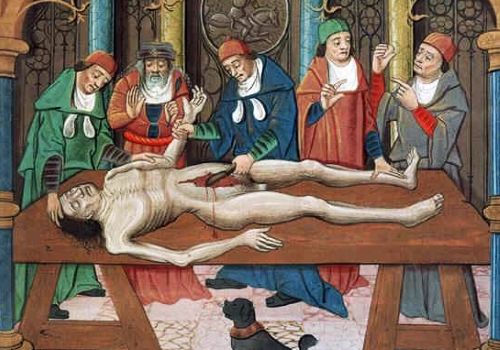
Vivisection occupies the darkest edge of this history because it turns the central question from the dead body to the living one. Dissection of corpses already raised problems of dignity, burial, consent, and social hierarchy, but vivisection intensified every moral danger. To cut a living body for knowledge was not merely to use the remains of the punished or the poor; it was to make suffering itself part of inquiry. For that reason, vivisection must be handled carefully. It was not a normal foundation of medical teaching, nor was it routine in the way animal dissection could be. The evidence for human vivisection is scattered, sensational, and often filtered through hostile or exemplary stories. Yet those stories matter because they reveal what contemporaries imagined might happen when medical curiosity met bodies already placed outside ordinary protection.
The ancient precedent haunted later discussions. Herophilus and Erasistratus, the Alexandrian anatomists, were remembered by some later writers as having dissected living condemned prisoners in the pursuit of anatomical knowledge. Celsus preserves one of the most famous versions of the charge, describing the argument that hidden internal structures could be known only by opening living bodies, because death altered the organs and destroyed the motions that physicians wished to understand. The counterargument was just as powerful: that such knowledge, if purchased through deliberate torment, made medicine inhuman. This ancient debate mattered for medieval and Renaissance readers because it framed vivisection as both epistemically tempting and morally horrifying. The living body promised knowledge the corpse could not fully provide: motion, heat, pulse, respiration, pain, digestion, and the relation between injury and immediate effect. But to obtain that knowledge directly from a living human being meant transforming the physician into something dangerously close to an executioner.
Animal vivisection occupied a different but related place. Galen’s demonstrations on living animals were central to his claims about nerves, voice, breathing, spinal injury, and the functions of organs. By cutting, tying, severing, and observing, he could show that certain structures performed specific roles in the living organism. Medieval and Renaissance physicians inherited both the knowledge and the moral ambiguity of that tradition. Animals were not humans, and Christian and classical hierarchies generally placed them lower in the moral order, but vivisection still involved pain and spectacle. It also shaped the imagination of what experimental anatomy could be. The living body, unlike the corpse, could respond. It could convulse, bleed, cry out, breathe, fail, or die under the observer’s hand. Animal vivisection helped create a model of knowledge through intervention, even when human vivisection remained rare, condemned, or exceptional.
The most striking late medieval example often discussed is the reported case of the Archer of Meudon in fifteenth-century France. According to the story, a condemned man suffering from a serious internal illness was subjected to surgical opening so that physicians could investigate a condition thought relevant to the health of an important patient. The account is extraordinary not only because it describes a living human body being opened, but because the man allegedly survived and received pardon. Whether every detail should be accepted at face value is less important than what the story reveals about possibility and authority. The subject was not an ordinary patient freely offering himself to medical risk. He was a condemned man, already under the power of the law. His body could be imagined as available because the state had already claimed his life. Vivisection, in this scenario, did not arise from medicine alone. It required punishment, hierarchy, royal or civic interest, and the conversion of a legal sentence into medical opportunity.
That is why vivisection belongs here even if it should not dominate the story. Its significance lies less in frequency than in boundary-making. It marks the terrifying point at which the medical use of vulnerable bodies could cross from postmortem investigation into experimentation on the living. Condemned prisoners, enslaved people, the poor, and other socially exposed groups have repeatedly occupied this boundary in the longer history of medicine because their capacity to refuse was weakened by law, status, or desperation. The condemned person was vulnerable because punishment could make bodily invasion appear as an alternative to execution, an extension of execution, or even a strange form of mercy if survival or pardon followed. The condemned body existed in a zone where ordinary protections had already been suspended, and that suspension could be redirected toward medical inquiry. A judge, ruler, or physician might persuade himself that a man already sentenced to die could be made useful before death, or that a dangerous operation was preferable to the certainty of the scaffold. But that reasoning depended on coercion even when it dressed itself in the language of utility or mercy. The prisoner’s “choice,” if any was offered, would have been made under the shadow of execution. Such cases exposed a moral trap: a procedure could be justified as useful, educational, or life-saving for someone else, while the person undergoing it remained trapped inside coercive power. Vivisection makes visible what is less obvious in ordinary dissection: knowledge is never produced in a vacuum, and the most dramatic expansions of medical possibility often begin where someone else’s bodily rights have already been weakened.
Vivisection sharpens my central argument about unequal bodies. The issue was not simply that premodern medicine lacked modern research ethics, though it did. The deeper issue is that medical curiosity has always depended on social arrangements that determine whose pain counts, whose consent matters, and whose body can be made available for the benefit of others. In corpse dissection, the vulnerable body was used after death; in corpse medicine, it was consumed or applied; in forensic examination, it was made to testify; in vivisection, the vulnerable body was made to suffer in the name of knowledge. Human vivisection remained exceptional and morally charged, but its very exceptionality makes it revealing. It shows the outer limit of a world in which law, punishment, and medicine could converge over a body that had already been stripped of ordinary protection.
Renaissance Anatomy and the New Authority of the Eye
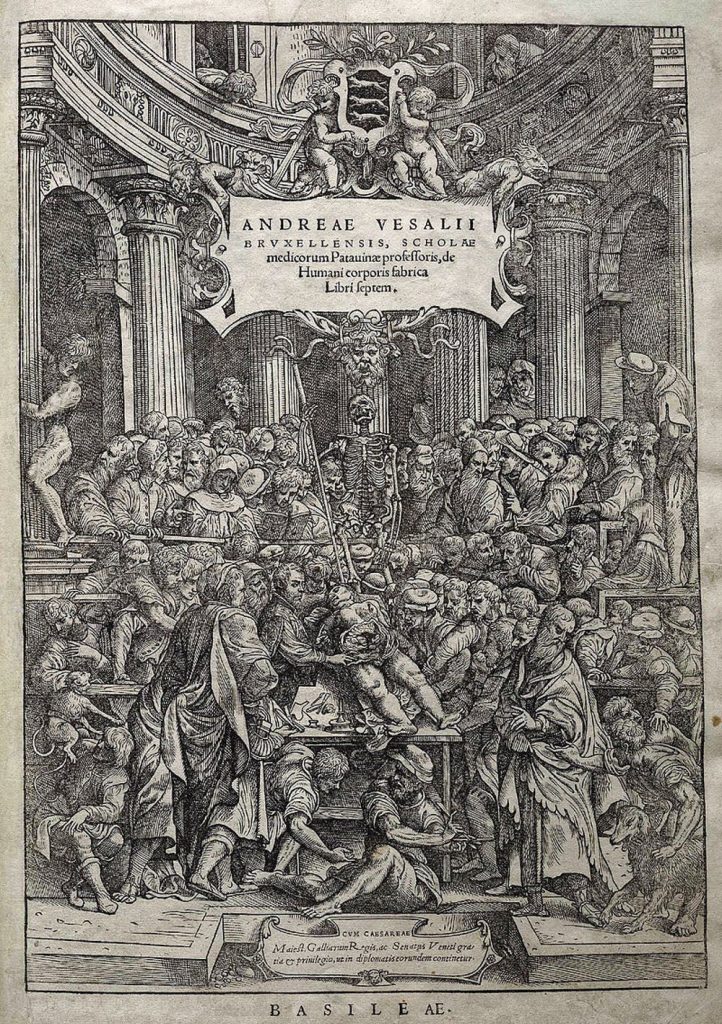
By the sixteenth century, human anatomy had entered a new phase in which sight began to claim an authority that earlier university dissection had granted more cautiously. The medieval anatomy lesson had already joined corpse, text, teacher, and audience, but the Renaissance increasingly elevated the trained eye as a judge of inherited knowledge. This did not mean that books ceased to matter. On the contrary, anatomy became even more dependent on books, especially printed books with elaborate illustrations. But the relationship between text and body shifted. The corpse was no longer only a confirmation of ancient authority or a memory aid for students. It could become a court of appeal. The anatomist who saw clearly, cut skillfully, and compared repeated bodies could claim the right to correct what tradition had handed down.
This change did not begin from nothing. Vesalius, often made the hero of Renaissance anatomy, inherited centuries of university medicine, public dissection, Galenic commentary, civic body supply, and anatomical pedagogy. His achievement was not that he invented dissection, but that he reorganized its authority. In De humani corporis fabrica, published in 1543, Vesalius presented the human body as something that had to be studied directly, systematically, and visually. He criticized errors that had entered anatomy through reliance on animal dissection and uncritical repetition of Galenic claims. Yet Vesalius remained deeply engaged with Galen; he argued with him because Galen still mattered. The drama of the Fabrica is not a simple rejection of the ancient past. It is the spectacle of a Renaissance anatomist using the opened human body to revise the most powerful anatomical inheritance Europe possessed. The authority of the eye was also tied to the authority of the hand. Earlier anatomy lessons often separated learned speech from manual cutting, with the professor reading while a surgeon or assistant opened the body. Renaissance reformers increasingly criticized that division. Vesalius insisted that the anatomist should not merely lecture from above while another person handled the corpse. He should cut, see, demonstrate, and correct. This was more than a practical preference; it challenged the social hierarchy that had divided liberal learning from manual skill. Anatomy demanded touch as well as sight. To know the body, the physician had to accept a form of labor that university culture had often treated as inferior. The new authority of the eye depended on a new dignity for trained manual engagement with the corpse.
Print intensified this transformation. Anatomical knowledge could now circulate through images of extraordinary technical and artistic ambition. The woodcuts of the Fabrica did not simply decorate Vesalius’s text; they helped make anatomy persuasive. Muscles, bones, nerves, vessels, and organs were arranged for the reader’s eye in ways no single dissection could fully provide, notably given the speed of decay and the rarity of available bodies. Printed anatomy allowed the corpse to be stabilized, idealized, repeated, and transported. A student who might never see many dissections could study an image that presented the body as clear, ordered, and available. Yet this visual clarity was itself constructed. The printed anatomical body was not the decaying cadaver on the table. It was a curated body, cleaned of smell, urgency, social identity, and much of the violence that had made anatomical access possible.
The visual culture of Renaissance anatomy also blurred the boundary between medicine and art. Anatomical illustrations often drew on the skills and conventions of artists who understood perspective, proportion, landscape, pose, and dramatic composition. Flayed bodies stood like classical statues; skeletons leaned, gestured, prayed, or contemplated mortality; dissected figures appeared in landscapes rather than on filthy tables. These images gave anatomy a strange beauty. They transformed opened flesh into a visual language of order and mastery. But that beauty could conceal the body’s origin. The figure on the page might look universal, noble, even heroic, while the actual cadaver had likely been obtained through execution, poverty, institutional control, or social vulnerability. Renaissance anatomy made the body more visible than ever, but it also made the social history of that body easier to erase.
The rise of observation did not produce immediate agreement. Renaissance anatomists argued over structures, functions, names, methods, and interpretations. Vesalius corrected Galen but was himself corrected by later anatomists such as Realdo Colombo, Gabriele Falloppio, and others. The eye did not speak with one voice. What one anatomist saw, another might dispute; what one dissection suggested, another body might complicate. Variation, decay, damaged specimens, poor preparation, and theoretical expectation all shaped what could be seen. The new authority of sight was powerful but unstable. It did not free anatomy from interpretation. It created a new battlefield on which observation, image, text, reputation, and repeated demonstration competed for credibility.
Renaissance anatomy transformed the medieval opened body without escaping the moral structure that had made it available. The anatomist’s eye became bolder, the printed image more persuasive, and the human body more central to medical authority. But the knowledge produced by sight still depended on bodies supplied by unequal systems of law, punishment, poverty, and institutional permission. The Renaissance did not simply replace a religious or textual anatomy with a modern scientific one. It intensified the claim that truth could be found in the opened body, while making that claim more visually magnificent and more widely reproducible through print. The eye became a new judge of anatomy, but it looked upon bodies already selected by social power. The triumph of sight was also a triumph of access: the ability to see depended on the ability to obtain, open, display, and publish the dead.
Ethics Before “Medical Ethics”: Consent, Salvation, Status, and Usefulness

To write about bodies in the language of “medical ethics” is already to risk anachronism. These societies did not possess modern methods of informed consent, institutional review, patient autonomy, bodily rights, or research regulation. They did not imagine the individual body as protected by the same legal and moral assumptions that shape modern medical culture. Yet it would be equally misleading to say that premodern medicine had no ethics. It had many ethics, but they were organized differently. The handling of bodies after death was governed by salvation, burial, kinship, rank, punishment, charity, civic need, professional authority, and usefulness. The moral question was not usually whether an autonomous individual had consented to medical use. It was whether the living community recognized a legitimate reason to treat a body in a particular way.
Christian salvation gave the dead body a significance that cannot be reduced to superstition or sentiment. The corpse mattered because the person had mattered, and because bodily resurrection remained a central doctrine of Christian belief. Burial in consecrated ground, prayers for the dead, memorial rites, and the protection of remains all helped keep the dead within the social and spiritual community. To disturb a corpse could be a serious act. It might dishonor the dead, wound the family, disrupt memory, or appear to violate the integrity of the body awaiting resurrection. Christian practice did not require absolute bodily inviolability. Saints’ relics could be divided and distributed; elite bodies could be embalmed or transported; holy corpses could be inspected; the bodies of criminals could be denied ordinary honor. The sacredness of the body was real, but it operated through distinctions rather than simple prohibition. Consent, in this world, was often displaced by authority. A condemned criminal did not meaningfully consent to becoming an anatomical subject or a source of medicinal blood. A poor person whose body entered institutional use after death may have had no one able to object. A woman opened after death for signs of pregnancy, sanctity, or disease may have been made to answer questions that family, court, or religious community considered urgent. Even elite bodies could be divided or processed according to dynastic, political, or devotional needs rather than personal preference. This does not mean that personal wishes were irrelevant; wills, burial instructions, and patronage of tombs all show that people cared deeply about what happened after death. But the power to enforce those wishes depended on status, kinship, wealth, and institutional recognition. The dead did not possess equal postmortem authority.
Status was one of the central ethical categories governing bodily use. The noble corpse, the clerical corpse, the saintly corpse, the respectable household corpse, the executed corpse, the foreign corpse, and the poor corpse did not occupy the same moral field. A procedure that would have outraged a prominent family might be tolerated when performed on a criminal. A bodily division that would have seemed horrifying in one context might be sanctified as relic translation in another. A skull on an apothecary shelf might become medicinal matter precisely because its owner had become anonymous. These distinctions were not incidental. They structured the moral imagination of bodily handling. Premodern ethics asked not simply “what is being done to a body?” but “whose body is this, who authorizes the act, and what recognized good does the act serve?”
Usefulness was one of those recognized goods, and it could be powerful. A dissection might educate physicians who would later treat the living. An autopsy might reveal poison, violence, pregnancy, or disease. A holy body might strengthen devotion and communal memory. A corpse-derived remedy might relieve suffering when ordinary treatment failed. A surgical experiment on a condemned person might be defended as preferable to execution or as useful to a more socially valued patient. In each case, the body was made useful to others. That usefulness could be charitable, civic, devotional, medical, or political. But usefulness was also dangerous because it could turn vulnerability into justification. The more powerless the body, the easier it was to define its use as beneficial. The ethical problem becomes clearest when punishment and medicine converged. The condemned criminal had already been judged unworthy of continued life, and that judgment could bleed into postmortem treatment. If the law could hang, behead, burn, or break the body publicly, then dissection or medical use might appear as a lesser extension of the same power. The criminal corpse could educate; the criminal blood could heal; the criminal bones could enter remedies; the criminal body could serve the public after death in a way the person had supposedly failed to do in life. This logic converted punishment into utility. It allowed society to imagine that dishonored bodies could be redeemed materially, not spiritually, by being made useful to the respectable living. The ethical danger lay in the ease with which condemnation erased personhood.
Women’s bodies reveal a different but related moral structure. Their anatomical availability often came not from punishment but from reproductive and familial significance. Pregnancy, childbirth, lactation, virginity, infertility, and sanctity made the female body a place where private flesh carried public consequence. A woman’s corpse might be opened because an heir was at stake, because a death seemed suspicious, because the community wanted proof of holiness, or because physicians sought to understand generation. These acts might be defended as necessary, reverent, or explanatory, but they also show how women’s bodies could be claimed by others after death. The moral authority of husbands, families, clerics, physicians, and communities could outweigh the absent voice of the woman herself. The “secrets” of the female body were not simply hidden by nature; they were extracted through social power.
The foreign dead, such as in the mummy trade, expose yet another ethical mechanism: distance. An Egyptian mummy could be swallowed as medicine because the dead person had been removed from recognizable claims of kinship, religion, and local memory. The further the body traveled from its own community, the easier it became to rename it as a substance. This was not consent, nor even punishment. It was erasure. Time, geography, commerce, and European medical desire transformed the dead into matter. The same Europeans who might recoil at the desecration of their own kin could purchase the ground remains of distant dead because the moral relationship had been broken. The mummy trade shows that premodern bodily ethics were not only about theology or anatomy. They were also about the unequal geography of whose dead remained human in the eyes of consumers.
The point is not to condemn medieval and early Renaissance medicine for failing to possess modern bioethics, as if history were merely a courtroom in which the past is found guilty for not being the present. The point is sharper: these societies did have moral systems for the dead body, but those systems distributed protection unequally. Salvation mattered, but so did status. Burial mattered, but so did punishment. Reverence mattered, but it could authorize opening a holy body. Usefulness mattered, but it most often justified the use of those least able to resist. Before “medical ethics,” there were ethics of rank, kinship, sanctity, crime, poverty, and civic benefit. Those ethics did not prevent bodily experimentation. They explained who could be subjected to it.
Are We Imposing Modern Ideas of “Experimentation” on Medieval Bodies?
The following video from “History Found” covers the history of medieval medical practices:
I should note that the word “experimentation” may be doing too much work. Physicians, surgeons, anatomists, apothecaries, clerics, and judges did not usually approach bodies in the way modern researchers approach experimental subjects. They did not design controlled trials, seek statistical verification, operate under laboratory protocols, or separate “research” from teaching, therapy, punishment, devotion, and law in the ways modern institutions try to do. A university dissection might be pedagogical rather than experimental; an autopsy might seek confirmation rather than discovery; corpse medicine might follow inherited pharmacological theory rather than deliberate testing; and a sensational vivisection story might tell us more about fear, authority, and moral imagination than about routine medical practice. If we call all of these things “experiments,” we risk flattening historical difference and turning a complex premodern world into a crude prelude to modern science.
That objection deserves real weight. The medieval anatomy lesson was often designed to demonstrate what authoritative texts had already described. The corpse did not automatically overthrow Galen, Avicenna, or Mondino. It was frequently read through them. Likewise, corpse medicine did not necessarily work by the logic of experiment in the modern sense. Remedies made from mummy, skull, fat, or blood were justified through theories of sympathy, vitality, preservation, correspondence, humoral action, occult virtue, or inherited reputation. Even autopsy and forensic inspection relied on visible signs interpreted through legal and medical assumptions that could be uncertain, symbolic, or contested. To call these practices “testing” can be useful, but only if the term remains historically disciplined. Otherwise, I risk making medieval and Renaissance practitioners sound like modern biomedical researchers wearing old clothes.
The counterpoint also warns against sensationalism. Vivisection, corpse medicine, and criminal dissection are vivid subjects, and their horror can easily overpower the more ordinary structures that made them meaningful. If I lean too heavily on the shocking image (opened criminal, the swallowed mummy, the blood collected at the scaffold, the living condemned man cut for knowledge) it may reproduce the very mistake it tries to avoid: treating the past as a theater of barbarism. People were not simply careless with bodies. They buried the dead, prayed for souls, revered relics, feared desecration, regulated funerary practice, and argued over what could properly be done to human remains. Their willingness to open, divide, consume, or inspect bodies existed alongside deep concern for bodily dignity and salvation. Any interpretation that remembers only the violence and forgets the reverence is too simple.
Yet this challenge does not destroy my argument; it sharpens it. The point is not that medieval Europe invented modern experimental medicine, nor that every dissection, autopsy, remedy, or bodily inspection was an “experiment” in the strict modern sense. The stronger claim is that societies developed a range of practices in which bodies were made to answer questions. They were opened to teach anatomy, examined to clarify death, inspected to reveal pregnancy or sanctity, consumed to transfer imagined healing force, and, in rare cases, invaded while living under conditions of coercive authority. These practices were experimental in a broader historical sense: they treated the body as a site where hidden truth, hidden power, or hidden remedy might be brought into use. The body was not merely mourned or buried. It was asked to disclose, demonstrate, cure, confirm, or serve.
This modifies the final interpretation rather than overturning it. “Experimentation” must be understood here not as a modern scientific category imposed backward, but as a spectrum of bodily testing shaped by premodern assumptions about authority, matter, salvation, punishment, gender, and usefulness. This distinction matters because it prevents presenting a false origin story of modern science while still recognizing that the body was repeatedly made available for inquiry and intervention. The central issue remains hierarchy. Whether the act was pedagogical, forensic, devotional, therapeutic, punitive, or genuinely investigative, it depended on decisions about whose body could be handled in extraordinary ways. The strongest conclusion is not that medieval anatomy and corpse medicine were primitive versions of modern experimentation. It is that before modern medical ethics, the uses of the body were governed by older systems of permission, and those systems made some bodies far more available than others.
Conclusion: The Opened Body and the Unequal Birth of Medical Knowledge
The body was never merely dead matter. It remained a Christian body, a remembered body, a social body, and sometimes a dangerous or powerful body. Yet it could also become evidence, object, relic, commodity, remedy, and lesson. Across anatomy halls, courtrooms, churches, scaffolds, apothecaries, and households, the body after death was repeatedly asked to do work for the living. It taught students the structure of organs and vessels. It helped courts investigate wounds, poison, pregnancy, and suspicious death. It supplied substances believed to heal epilepsy, bleeding, pain, and disease. It offered signs of holiness, corruption, punishment, or hidden truth. The corpse did not simply disappear from the world of the living; it remained active, interpreted, handled, consumed, and made useful.
But the central pattern was inequality. Not all bodies were equally available for this work. The noble corpse, the saintly corpse, the respectable household corpse, the criminal corpse, the poor corpse, the female corpse, and the foreign corpse all carried different degrees of protection and vulnerability. Some were opened because they were revered, some because they were suspected, some because they were useful, and some because they had been stripped of ordinary claims by law, poverty, distance, or dishonor. The condemned criminal could pass from scaffold to anatomy table because punishment had already transformed the body into a public object. The female body could be opened because reproduction, sanctity, inheritance, or suspicion made its interior socially consequential. The Egyptian mummy could be swallowed because time, commerce, and foreignness had erased the dead person’s local claims. The poor and anonymous dead could become matter because they had fewer defenders. Medical knowledge did not arise from the body in the abstract. It arose from bodies sorted by power.
This history also complicates the familiar story of science against religion. Medieval Christianity did not simply forbid the opened body, nor did Renaissance anatomy simply liberate medicine from superstition. The same culture that believed in bodily resurrection divided relics, inspected holy remains, embalmed elites, examined corpses for evidence, and eventually authorized university dissections. The issue was not whether the body was sacred or useful, because it could be both. The deeper issue was who had the authority to decide what kind of body it was in a given moment. A corpse might be protected as kin, honored as relic, punished as criminal remainder, read as legal evidence, consumed as medicine, or displayed as anatomical truth. These categories were not fixed in the flesh itself. They were produced by institutions: church, court, family, university, marketplace, and state.
The opened body marks one of the most revealing beginnings of medical knowledge in the West. It shows that knowledge was born not only from curiosity, observation, and technical skill, but also from permission, coercion, hierarchy, and loss. The anatomist’s eye, the physician’s remedy, the judge’s inquiry, and the apothecary’s drug all depended on prior decisions about whose remains could be interrupted and repurposed. To study these practices is not to pretend that medicine possessed modern experimental science, nor to condemn the past simply for failing to possess modern medical ethics. It is to see something more enduring: that the search for healing and knowledge has always been entangled with unequal access to bodies. Before the modern laboratory, before the anatomy act, before the language of consent and research ethics, the dead were already teaching. The question was never only what they taught. It was who had been made available to teach.
Bibliography
Affiliate disclosure: Amazon links on this site are paid links. As an Amazon Associate I earn from qualifying purchases.
- Ambroise Paré. The Workes of That Famous Chirurgion Ambrose Parey. Translated by Thomas Johnson. London: Richard Cotes, 1649.
- Aristotle. Generation of Animals. Translated by A. L. Peck. Loeb Classical Library. Cambridge, MA: Harvard University Press, 1942.
- Avicenna. The Canon of Medicine (Al-Qanun fi’l-Tibb). Translated by Laleh Bakhtiar. Chicago: Great Books of the Islamic World, 1999.
- Bacon, Francis. The Historie of Life and Death. London: I. Okes, 1638.
- Bartolus of Sassoferrato. Consilia, Quaestiones et Tractatus. Venice, 1570.
- Berengario da Carpi, Jacopo. Commentaria cum amplissimis additionibus super anatomia Mundini. Bologna: Biblioteca Nazionale Centrale di Firenze, 1521.
- Bildhauer, Bettina. “Medieval European Conceptions of Blood: Truth and Human Integrity.” The Journal of the Royal Anthropological Institute (2013), S57-S76.
- Boniface VIII. Detestande feritatis / De sepulturis. 1299. In Corpus Iuris Canonici, Liber Sextus, 3.12.1.
- Bynum, Caroline Walker. Fragmentation and Redemption: Essays on Gender and the Human Body in Medieval Religion. New York: Zone Books, 1991.
- —-. Holy Feast and Holy Fast: The Religious Significance of Food to Medieval Women. Berkeley: University of California Press, 1987.
- —-. The Resurrection of the Body in Western Christianity, 200–1336. New York: Columbia University Press, 1995.
- Cadden, Joan. Meanings of Sex Difference in the Middle Ages: Medicine, Science, and Culture. Cambridge: Cambridge University Press, 1993.
- Carlino, Andrea. Books of the Body: Anatomical Ritual and Renaissance Learning. Chicago: University of Chicago Press, 1999.
- Celsus, Aulus Cornelius. De Medicina. Translated by W. G. Spencer. Cambridge, MA: Harvard University Press, 1935.
- Cohen, Esther. The Crossroads of Justice: Law and Culture in Late Medieval France. Leiden: Brill, 1992.
- Colombo, Realdo. De re anatomica. Venice: Nicolò Bevilacqua, 1559.
- Cunningham, Andrew. The Anatomical Renaissance: The Resurrection of the Anatomical Projects of the Ancients. Aldershot: Scolar Press, 1997.
- Dannenfeldt, Karl H. “Egyptian Mumia: The Sixteenth Century Experience and Debate.” The Sixteenth Century Journal 16:2 (1985), 163–180.
- Daston, Lorraine, and Katharine Park. Wonders and the Order of Nature, 1150–1750. New York: Zone Books, 1998.
- Falloppio, Gabriele. Observationes anatomicae. Venice: Apud Marcum Antonium Vlmum, 1561.
- Ferrari, Giovanna. “Public Anatomy Lessons and the Carnival: The Anatomy Theatre of Bologna.” Past & Present 117 (1987), 50–106.
- Finucane, Ronald C. Miracles and Pilgrims: Popular Beliefs in Medieval England. New York: St. Martin’s Press, 1977.
- French, Roger. Dissection and Vivisection in the European Renaissance. Aldershot: Ashgate, 1999.
- Galen. On Anatomical Procedures. Translated by Charles Singer. Oxford: Oxford University Press, 1956.
- —-. On Semen. Translated by Phillip De Lacy. Berlin: Akademie Verlag, 1992.
- —-. On the Usefulness of the Parts of the Body. Translated by Margaret Tallmadge May. 2 vols. Ithaca, NY: Cornell University Press, 1968.
- Geltner, G. The Medieval Prison: A Social History. Princeton, NJ: Princeton University Press, 2008.
- Gordon-Grube, Karen. “Anthropophagy in Post-Renaissance Europe: The Tradition of Medicinal Cannibalism.” American Anthropologist 90:2 (1988), 405–409.
- Green, Monica H. Making Women’s Medicine Masculine: The Rise of Male Authority in Pre-Modern Gynaecology. Oxford: Oxford University Press, 2008.
- —-, ed. and trans. The Trotula: An English Translation of the Medieval Compendium of Women’s Medicine. Philadelphia: University of Pennsylvania Press, 2001.
- Greenblatt, Stephen. Marvelous Possessions: The Wonder of the New World. Chicago: University of Chicago Press, 1991.
- Hippocrates. Hippocratic Writings. Translated by G. E. R. Lloyd. London: Penguin Classics, 1983.
- Hurren, Elizabeth T. Dying for Victorian Medicine: English Anatomy and Its Trade in the Dead Poor, c. 1834–1929. Basingstoke: Palgrave Macmillan, 2011.
- Jardine, Nicholas, and Emma Spary, eds. Cultures of Natural History. Cambridge: Cambridge University Press, 1996.
- Jonsen, Albert R. A Short History of Medical Ethics. Oxford: Oxford University Press, 2000.
- Kevorkian, Jack. “A Brief History of Experimentation on Condemned and Executed Humans.” Journal of the National Medical Association 77:3 (1985), 215–226.
- Kusukawa, Sachiko. Picturing the Book of Nature: Image, Text, and Argument in Sixteenth-Century Human Anatomy and Medical Botany. Chicago: University of Chicago Press, 2012.
- Lind, L. R., trans. “Studies in Pre-Vesalian Anatomy: Biography, Translations, Documents.” Cambridge Journal of Medical History 20:4 (1976), 458.
- Lo Presti, Robert. “Anatomy as Epistemology: The Body of Man and the Body of Medicine in Vesalius and his Ancient Sources (Celsus, Galen).” Renaissance and Reformation / Renaissance et Réforme 33:3 (2010), 27-60.
- Longrigg, James. Greek Rational Medicine: Philosophy and Medicine from Alcmaeon to the Alexandrians. London: Routledge, 1993.
- Maehle, Andreas-Holger, and Ulrich Tröhler. “Animal Experimentation from Antiquity to the End of the Eighteenth Century: Attitudes and Arguments.” In Vivisection in Historical Perspective, edited by Nicolaas A. Rupke, 14–47. London: Routledge, 1990.
- McVaugh, Michael R. Medicine before the Plague: Practitioners and Their Patients in the Crown of Aragon, 1285–1345. Cambridge: Cambridge University Press, 1993.
- Merback, Mitchell B. The Thief, the Cross and the Wheel: Pain and the Spectacle of Punishment in Medieval and Renaissance Europe. Chicago: University of Chicago Press, 1999.
- Noble, Louise. Medicinal Cannibalism in Early Modern English Literature and Culture. New York: Palgrave Macmillan, 2011.
- Nutton, Vivian. Ancient Medicine. 2nd ed. London: Routledge, 2012.
- O’Malley, C. D. Andreas Vesalius of Brussels, 1514–1564. Berkeley: University of California Press, 1964.
- Paracelsus. Paracelsus: Essential Readings. Edited by Nicholas Goodrick-Clarke. Berkeley, CA: North Atlantic Books, 1999.
- Paravicini-Bagliani, Agostino. The Pope’s Body. Translated by David S. Peterson. Chicago: University of Chicago Press, 2000.
- Park, Katharine. “The Life of the Corpse: Division and Dissection in Late Medieval Europe.” Journal of the History of Medicine and Allied Sciences 50:1 (1995), 111-132.
- —-. Secrets of Women: Gender, Generation, and the Origins of Human Dissection. New York: Zone Books, 2006.
- Pomata, Gianna, and Nancy G. Siraisi, eds. Historia: Empiricism and Erudition in Early Modern Europe. Cambridge, MA: MIT Press, 2005.
- Pomet, Pierre. A Compleat History of Druggs. London: J. and J. Bonwicke, 1712.
- Prioreschi, Plinio. A History of Medicine. Vol. 5, Medieval Medicine. Omaha: Horatius Press, 1996.
- Richardson, Ruth. Death, Dissection and the Destitute. 2nd ed. Chicago: University of Chicago Press, 2000.
- Rupke, Nicolaas A., ed. Vivisection in Historical Perspective. London: Routledge, 1990.
- Sawday, Jonathan. The Body Emblazoned: Dissection and the Human Body in Renaissance Culture. London: Routledge, 1995.
- Sigerist, Henry E. “The Foundation of Human Anatomy in the Renaissance.” Sigma Xi Quarterly 22:1 (1934), 8-12.
- Siraisi, Nancy G. Medicine and the Italian Universities, 1250–1600. Leiden: Brill, 2001.
- —-. Medieval and Early Renaissance Medicine: An Introduction to Knowledge and Practice. Chicago: University of Chicago Press, 1990.
- Spierenburg, Pieter. The Spectacle of Suffering: Executions and the Evolution of Repression. Cambridge: Cambridge University Press, 1984.
- Sugg, Richard. Mummies, Cannibals and Vampires: The History of Corpse Medicine from the Renaissance to the Victorians. London: Routledge, 2011.
- Temkin, Owsei. Galenism: Rise and Decline of a Medical Philosophy. Ithaca: Cornell University Press, 1973.
- Vesalius, Andreas. De humani corporis fabrica libri septem. Basel: Per Joannem Oporinum, 1543.
- von Staden, Heinrich. Herophilus: The Art of Medicine in Early Alexandria. Cambridge: Cambridge University Press, 1989.
- Watson, Katherine D. Forensic Medicine in Western Society: A History. London: Routledge, 2010.
Originally published by Brewminate, 06.19.2026, under the terms of a Creative Commons Attribution-NonCommercial-NoDerivatives 4.0 International license.
About the Author