Minority farmers are buying land with the aim to restore and nourish nature along with their cultures and communities.
By Dr. Michaela Haas
Author and Journalist
Introduction
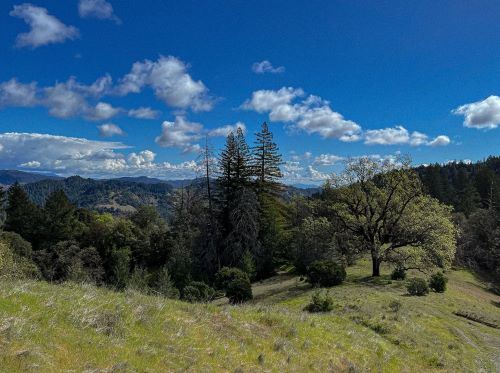
The land above California’s Russian River is pristine with its redwoods and swaths of old-growth forests, where northern spotted owls breed and Coho salmon swim in the creeks. And yet, when anthropology professor Myles Lennon looks out the offices of Shelterwood on his last day of his year-long sabbatical from Brown University, he also sees signs of trouble. “When I look out the window, I see among the redwoods palm trees and eucalyptus that should never be here.”
Lennon is in Northern California searching for answers to big questions: “How do young Black land stewards in the United States negotiate the ethical and political tensions of doing antiracist, decolonial work in outdoor spaces through property ownership in a settler colony built on racial capitalism? How do you own land when you don’t believe in land ownership? How do you liberate your livelihood from a system of labor you know you can’t ever escape?”
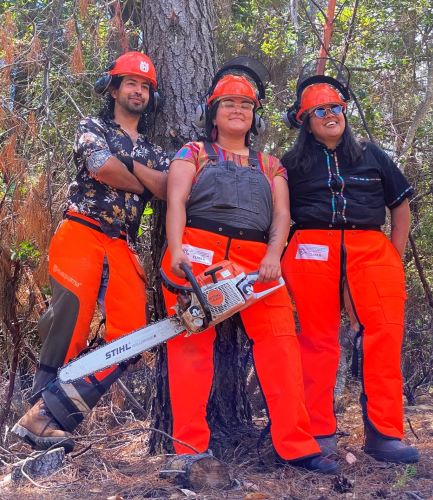
Shelterwood, a nascent collective on 900 acres of forest and prairie, might be the newest and largest land project on the West Coast to explore answers to these queries on the ground. Co-creators Nikola Alexandre and Layel Camargo aspire to develop a community grounded in the ecological and cultural practices of their ancestors. They bought the land in July 2021 from a Christian fellowship that used it as a camp for 75 years and did little to tend the forest or connect to the larger community.
The work Shelterwood Collective has carved out includes quite literally uprooting invasive species. If the hands-on work also helps uproot structural racism, reestablishes healthy redwood along with environmental justice, and heals the land as well as the trauma of its residents, Shelterwood accomplishes its mission.
The name Shelterwood carries a double meaning. “It refers both to the forestry that involves tending to trees so that we have an older group of trees sheltering a younger group—that double entendre, if you will, of ecological and social sheltering are really one and the same at the end of the day,” says Alexandre, a Black queer forester who studied forestry and business administration at Yale University and founded Conservation International’s Ecosystem Restoration Program. “A big piece of what we’re trying to do here stems from the perspective that ecosystems are not healthy unless human communities are thoroughly woven into their fabric. It’s about nurturing a community of land tenders who are learning to be in relationship with one another, with themselves, and with the land around them.” Shelterwood is part of a growing movement to reclaim the land. “Indigenous and Black folks have been connected to the land for generations and know how to tend the land in ways white colonists just didn’t; tending the land as a source of nutrition, a source of building supplies, a source of inspiration, and a source of spiritual belief,” Alexandre emphasizes. “All of it was wrapped together, not separated like the colonial mentality tends to do.”
The number of Black-owned farms has dropped from 14% in the 1920s to just 1.3% today, and in California, less than 1% of land is owned by Indigenous people. A new generation of Black, Indigenous, and/or queer farmers and foresters is working to change the narrative, both literally and figuratively.
Only 25 miles south of Shelterwood in Sebastopol lies Earthseed, a Black-owned farm, and Heron Shadow, now a 7.6-acre Indigenous biocultural heritage oasis created on land acquired in 2019 by The Cultural Conservancy, a Native-led organization. Other networks model what environmental justice can look like on the ground, such as Black Urban Growers (BUGS) and the National Black Food and Justice Alliance, small Black-led farms like Soul Fire Farm on the East Coast, or Soul Flower Farm and the Butterfly Movement on the West Coast, as well as the Indigenous women-led Sogorea Te’ Land Trust in the San Francisco Bay Area that facilitates the return of Indigenous lands to Indigenous peoples.
The Shelterwood founders have already invited local Indigenous people from the Kashaya and Southern Pomo tribes to establish a connection and learn from them. The founders are eager to cultivate a growing relationship, “at a very minimum granting them access in perpetuity,” as Alexandre says.
They’ve also reached out to The Cultural Conservancy, which has worked to protect and revitalize Indigenous lands and communities since 1985. The Native-led nonprofit has been forging partnerships across the Bay Area, exchanging Native foods, seeds, and Indigenous farming practices, before acquiring the land now called Heron Shadow in 2019 as a place of safety and learning. Cultural Conservancy’s CEO Sara Moncada (Yaqui) says traditional restoration work, led by California Native elder Redbird Willie (Pomo, Paiute, Wintu, Wailaki), who lives on the land, includes reintroducing cultural forest, grassland and other burns, and holding “Listening to the Land” sessions with the Native community to “collectively listen and dream together what wants to be here.”
Like The Cultural Conservancy, the Shelterwood collective, too, started with “a year of rooting and listening,” inviting folks for visioning sessions and walking the land to “learn its song,” Moncada says. “Rematriating the land looks different for every project.”
Beyond the “higher narrative of sustainability, of reducing consumption, reducing your carbon footprint,” the Shelterwood founders aim to restore the dilapidated buildings and cabins to host artists and activists, woodworking or botany seminars, and create space for healing.
Making Space to Find Safety
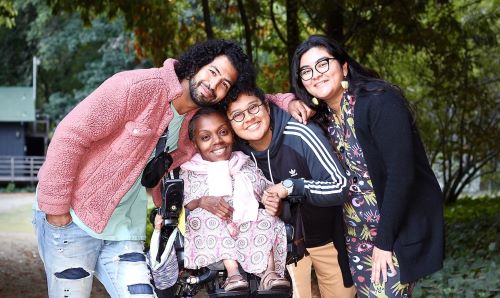
Just the simple fact that the core staff defies the stereotype of the straight white American farmer sends a clear message. “We are a queer BIPOC group,” Shelterwood retreat manager Julia Velasquez says. “When queer, Black, Indigenous folks and people of color come with family and chosen family, and they see us on the land, they experience an overwhelming sense of safety.” She recalls one young boy, who had been described as extremely shy, but when he arrived at Shelterwood, “He got out of the car and started running and dancing, yelling, ‘I’m free! I’m free!’”
Many of the current core staff members didn’t believe they would find a place in nature where they could truly build a home for their passions. “I almost didn’t go into land stewardship because it was so heavily dominated by straight white men,” Alexandre says with a wry laugh. “As queer folks, as folks who are often denied a home and often denied family, we’re trying to nurture a safe space for those of us who don’t always have a safe space to return to. Look at the shooting that just happened at Club Q, look at all the trauma that comes with the kinds of holidays where a lot of us queer folk aren’t necessarily welcome at our family’s dinner table. Shelterwood is meant to be a safe haven for those communities to just exist.”
He and co-founder Layel Camargo met during an immersive program at Soul Fire Farm, the upstate New York farm of Leah Penniman, author of Farming While Black and a leader in the movement to establish sustainable and equitable land ownership for historically disenfranchised communities. (Penniman has also authored several pieces for YES!) They sat in “a homemade hot tub at a Buddhist temple up the street from Soul Fire,” says Camargo, when they had the idea to “walk the walk.”
Now, Shelterwood’s vision goes beyond the small farm model of Soul Fire and Earthseed, or the biocultural restorative focus of The Cultural Conservancy. Both Alexandre and Camargo want to “shift the narrative away from the individual nuclear family type of farm approach where it’s all very individual,” Alexandre explains. “It’s about seeing nature as your kin, and people around you as part of your family, even if they don’t have direct blood ties to you. That’s at the core of what we’re trying to do, our environmental messaging.”
Camargo is a transgender and gender non-conforming social activist of Yaqui and Mayo descent. They studied feminism and law and were on track to become an environmental lawyer, but then connected with filmmakers and pivoted to storytelling, especially about the climate crisis. “Indigenous, Black, and Brown people are bearing the brunt of climate change, and yet seem so far removed when we talk about carbon trades and global greenhouses,” says Camargo. “I’m really passionate about paving a new narrative and a path for people to see themselves as connected to nature, as really powerful forces on how we engage with the ecosystem.”
They were able to buy the Shelterwood land in July 2021, “paying a ransom of $4 million,” as Alexandre says, facilitated with a generous grant from the Wend Collective and the support of Black farmer, singer, and bestselling author Rachel Bagby. Camargo emphasizes that they believe the support would not have galvanized without the growth of the Movement for Black Lives following George Floyd’s murder, and also the pandemic crisis. Previously, Alexandre says, when he’d tried to convince investors and philanthropists of his dream, he was met with skeptical incrementalism. “Either you’re a social justice project or you’re a conservation project; why and how would those two things intersect?” he recalls being told.
The fact that social and environmental healing are intrinsically connected has since become much clearer, Camargo adds. “You cannot harm the planet without exploiting a group of people.” Their solution: “We have to have communities coming back together and tending the land. The American idea was built on the backs of Indigenous and Black peoples. Land as a source of power, as a source of sovereignty, needs to be returned to Indigenous communities. We need to build alliances and think through: what does true alliance between Indigenous and Black people look like in this current context?”
The Work of Generations
In the summer of 2022, Myles Lennon brought five queer Brown University undergraduates to Shelterwood for a 10-week fellowship, intending to document the impact of their immersion. One of these students, Victor Beck, used his time on the land to create signs sharing the Indigenous names for many of the plant and animal species. “As an Indigenous student who cares about responsible land stewardship and building queer communities, I wanted to do something that put theory into practice,” Beck wrote in a reflection on his experience for the university. “The Shelterwood Fellowship gives queer people of color a way to do the hands-on work of restoring land in a place that feels welcoming and relaxing, which we sometimes struggle to find in our daily lives.”
Each of the four members that currently make up Shelterwood’s core staff brings their own background, unique expertise, and individual traumas to the land. Retreat director Julia Velasquez, for instance, grew up in South Los Angeles, helped launch the Academy Museum of Motion Pictures, and organized youth work. “The first time I held a chainsaw was here on the land,” she says.
Camargo, too, realized, “As someone who lives in California, I should have a very intimate relationship with the forest here, yet that felt so foreign.”
As the lead land steward, Alexandre is in charge of the forest. He will use a recent $4.5 million grant from Cal Fire, the state Department of Forestry and Fire Protection, to thin out the overgrown forest, “do climate-resilient work, and eventually bring fire back to the land on a scale that is unprecedented,” Alexandre says. While many Californians might see “fire as a threat, an enemy that we should be afraid of, it’s also a sacred spirit that we need to have a better relationship with.”
Moncada recalls the neighbors’ concerns when they reintroduced cultural burns at Heron Shadow in 2020, not long after devastating area fires and evacuations. “We spoke with every neighbor we could find and invited them to come look and experience it through our perspective. After they saw the care of the cultural work, they began to ask if we could come to their property next.”
Alexandre, too, says he wants to “bring fire back in very intentional, controlled, ceremonious ways to help reduce the fuel load risk. In this particular spot, fire is as just as important as people, as redwoods; the return of fire will be critical to keep our ecosystems healthy.”
For him, creating a safe space in the woods might mean blasting Beyoncé while working a chainsaw, or learning the native botanical names of the flora.
When Pandora Thomas of Earthseed was asked at a TEDx event about strategies to further environmental justice and end food apartheid, she mentioned environmental literacy and project-based learning. “We want our young people to understand not just where their food comes from, where their water comes from, how their transportation system works, the clothing they’re wearing, the buildings [they’re in]. … We have found that when they get connected to the earth’s systems they get more motivated, they get inspired to share and translate that information to others.”
Shelterwood Collective, too, wants to adopt similar strategies, but is currently in the initial phase of “rooting, learning to listen.” In December 2021, Shelterwood hosted a community visioning session and asked 150 people from various Brown, Black, Indigenous, and queer communities what they envisioned from this land and community. “We learned a lot about what folks want to do out in nature when they’re allowed the opportunity to be safe, to be away from the gaze of white supremacy,” Camargo says. “That taught us that folks want to play and rest, but they also want to learn. They want to learn their own ancestral ways, what’s rightful in the places they’re at.”
Beyond appreciating volunteers who come to work, and artists who let themselves be inspired by the natural surroundings, Velasquez says, “What we really want is for our communities to just be. And sometimes just asking them to rest is feeling part of the safety. And we’re thinking about, also, access for folks that are disabled. Can they feel safe outdoors and navigate outdoors in a very safe way?”
The collective members all agree this work to heal the land and their community will take many generations—and they hope it will continue long after they are gone. “We don’t want to be the only ones who do this,” Velasquez says. “We actually want to be the smallest land project, and for folks to do the work with us and along with us.”
But the start has been made. In the visioning session, “eight people cried in the first 40 minutes,” Lennon says. “How often does it happen that youngsters cry just because they are overwhelmed by feeling at home? They said it was the first time they felt welcome.”
Originally published by Yes! Magazine, 12.29.2022, under a Creative Commons Attribution-NonCommercial-NoDerivatives 4.0 International license.
About the Author