Ancient Greek comedy recast Marathon as a heroic memory, using the virtues of an imagined past to sharpen criticism of the politics, values, and anxieties of contemporary Athens.

By Dr. Christopher Carey
Emeritus Professor of Greek
University College London
According to Antiphanes (fr. 198 KA) in a much-quoted fragment, tragedy is an easy job. Its characters and themes come ready made and all you have to do is trigger audience knowledge and then work with it:
Tragedy is a lucky
kind of poetry in every respect. For firstly its plots
are recognized by the spectators
before anyone even speaks. So reminding them is all
the poet has to do. For if I just say Oedipus,
they know all the rest. His father Laios,
his mother Jocasta. His daughters, who his sons were,
what will happen to him, what he’s done. Again
if someone says Alkmaion, immediately he’s mentioned
all his children, that in madness he killed
his mother, and Adrastos with a grievance at once
will come and then go off again …
We can’t do this. But we have to invent everything,
fresh names, what happened in the past,
the current situation, the end,
the beginning. And if any of this is missed out
by some Chremes or Pheidon, he’s hissed off.
But Peleus and Teukros can do this.
The comic writer has a harder job. Unlike tragedy, comedy has to create its own plots. It must shape its own world and create its own myths. Antiphanes of course is scoring points. And in his desire for a neat antithesis (and one which elevates comedography as the more demanding dramatic craft) he ignores some key points of convergence. The tragic world is not a fixed but a fluid entity reshaped from author to author and play to play.1 Antiphanes also cheekily elides the fact that comic myth too rests on a shared understanding with the public about a value system and a set of flexible conventions of plot and character. Part of the comic mythmaking is the creation of the past and within that process Marathon is part of the shared communicative system. But more than that it was also part of a shared cultural memory. This article addresses the creative results of the interaction between comic conventions and collective memory.
Memory, individual and collective, is always a construct based on selection and comedy is no exception. In part comic selectivity reflects the dynamics of oral culture. The comic memory runs to no more than three generations, which is broadly in line with Rosalind Thomas’ results for family and even polis tradition.2 Ancient history in comedy is the grandfather’s generation. Comedy also shares with cultural memory the ‘hourglass’ effect discussed by Thomas (drawing on Vansina) in relation to Greek oral tradition,3 according to which the present and the more distant past come into focus, while the intervening period is squeezed out. In comedy however the shaping of the past is likely to be more than a passive response to collective memory patterns. It also reflects the rhetorical effects to be created by juxtaposing the present and the more distant past. Certainly for Aristophanes there is a large gap roughly occupied by the Pentecontaetia. There is a lack of interest in the intermediate past. What counts is the present and the past of sixty or seventy years ago. This grandfather past extends to cultural as well as political history; Euripides and Aischylos are foregrounded, Sophokles is elided. But even for the grandfather’s generation there is a further selectivity. Some things count and some things do not. Marathon is one of the things which count. And for comedy it counts for much.
I begin not with comedy but with Pindar. In a passage designed to magnify the achievements of the western Greeks against the barbarians in their backyard, the Etruscans at Kymai and the Carthaginians at Himera, Pindar sets them on a par with the victories of Old Greece against the Persians (P. 1.71-79):
I implore you, son of Kronos, grant
that the Carthaginian and the Etruscan battle-shout stay quietly at home,
having seen their arrogance bring lamentation to their ships off Kymai.
Such were their sufferings, conquered by the leader of the Syracusans,
which flung their young men from their swift ships into the sea,
delivering Hellas from heavy slavery. I will win
from Salamis the gratitude of the Athenians as my reward,
and in Sparta from the battles before Kithairon
in which the Medes with their curved bows suffered,
but beside the well-watered bank of the river Himeras I shall win my reward
by paying my tribute of song to the sons of Deinomenes.
The implied narrative is revealing. As seen here the Persian Wars (or for Pindar in this context the Greco-barbarian wars) consist of a series of aristeiai by individual states, each represented by real or imagined celebration by Pindar. On this basis, the great pan-Greek infantry battle at Plataia belongs to Sparta, as it did for Herodotus and also for Simonides, at least in his Plataia elegy,4 which also confirms (with what we know of his other poems celebrating engagements in the Persian Wars) that Pindar’s parcelling up of the Greco-barbarian conflicts is not idiosyncratic. For Athens the battle chosen is Salamis. For anyone looking from the outside into Athens in the fifth century, this is the great achievement. It is on Salamis that Herodotus places the emphasis when he praises Athens at length in book 7. The ships which (for Herodotus) were built for the wars with Aigina, are the ones which will later save Greece (7.144) and it is Athens’ readiness to stay and fight, and at sea, which he singles out in his eulogy at 7.139.1, 5:5
Here I am compelled by necessity to declare an opinion which will be resented by most men, but nonetheless I will not refrain from saying what seems to me to be the truth. If the Athenians had been overcome with fear of the danger descending on them and had left their land, or indeed without leaving their land had stayed and given themselves up to Xerxes, none would have attempted by sea to oppose the king…. As it is, if one were to say that the Athenians proved to be the saviours of Greece, he would not miss the truth.
Marathon is not played down; it has special position in the work, rounding off events prior to the invasion of 480; as such it forms the climax of the pre-invasion narrative.6 And it emphatically (7.1) prompts Darius’ decision to invade, as it figures in Xerxes’ and Mardonios’ rhetoric of tisis (7.8.β, 7.9). But the campaign is treated as what it was, a Persian punitive expedition against targeted enemies. Herodotus is impressed with the success; but from the panhellenic perspective of Herodotus’ narrative Salamis is the more significant Athenian achievement.
The Athenian oratorical perspective is different but not dramatically so. Both battles find a place in the oratorical tradition. In surviving epideictic oratory Salamis is almost as prominent as Marathon; and unless this is simply the result of accident, it looks as though even in Athenian civic contexts Salamis was an important complement to Marathon, though individual texts vary in the emphasis they place on the two battles and some focus on one of them alone.7 It comes as something of a surprise, therefore, to discover that in comedy Salamis rarely gets a mention. Arguably the battle lurks just below the text whenever Salamis is named in comedy; but comedy is not interested in developing the tale of Salamis or even making explicit use of it as part of the construction of Athenian history.8 In contrast Marathon is a recurrent and developed presence.
Actually, it is not quite true that the campaign of 480 goes unnoticed. But its presence in Aristophanes is very revealing. In the epirrhema of the parabasis of Wasps, a text to which I shall return, we have a synoptic account of fighting against the Persian invader which incorporates what looks like a reference to the capture and burning of Athens in 480 (Wasps 1075-80):
We, who have this rump,
are the only truly full born natives of Attica,
the bravest race of all, who did so much for the country
in battle, when the barbarian came,
trying to choke our city with smoke and blazing fire
eager to seize our nests by force.
But the reference remains inexplicit and the Athenian counterattack is not the ‘we embarked on our ships’ of the Athenian oratorical tradition on Salamis;9 it is a hoplite battle which ends in a Persian rout with the Athenians in hot pursuit (Wasps 1081-88):
At once we rushed out ‘with lance and buckler’, and
gave them battle, drunk with the acid wine of anger,
standing man to man and biting our lips with rage.
For the arrows you could not see the sky.
But still with the gods’ help we pushed them back at evening;
for before we fought an owl flitted across the army.
Then we followed harpooning them in the pants,
and they fled stung in jaws and brows.
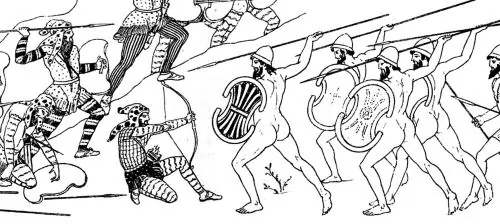
The striking reference to the Persian clothing reminds us that this was the first time an army in Persian dress had been seen in Greece proper, a point emphasized by Herodotus (6.112.3):
These were the first Greeks we know of who advanced at a run against the enemy and the first who withstood the sight of Mede clothing and the men dressed in it; until then hearing the name of the Medes inspired fear.10
The account in Aristophanes is the battle of Marathon as we meet it in Herodotus, with the Athenians pursuing the Persians to the ships, cutting them down (6.113.2):
They followed the fleeing Persians, stabbing them, until they reached the sea and demanded fire and laid hold of the ships.11
Here in comedy we find not the brutally factual κόπτοντες, ‘striking’, ‘stabbing’, ‘cutting down’, of Herodotus but the wasps’ sting in the Persian baggy pants. It is also interestingly presented in Aristophanes as the foundation of empire. In the narrative of resistance to the invader in Wasps, there is a seamless progression from victory in the land battle in the epirrhema to the naval campaign against Persia in the antode, with empire as the proper reward for these achievements:
… and they fled stung in jaws and brows.
And so among the barbarians everywhere still to this day
nothing is said to be more manly than the Attic wasp.
I was indeed a terror then, afraid of nothing,
and I overthrew
the enemy, sailing there with the triremes.
It is as though the Athenian infantry having driven the invader back to the ships simply followed after them, carrying the war into enemy territory. We leap from Marathon to the Delian League (here represented as a single-handed Athenian achievement); Salamis is absorbed and elided.
Though it is not difficult to account for the interest in Marathon, the comic reaction to the two battles is striking. In a genre performed before a mass audience in a democracy whose power came from the fleet, manned by the poorer members of the community, the great naval victory which indirectly founded the empire receives scant attention. This fits into a larger pattern which places the emphasis in the conceptualization of warfare not on the sailor but on the hoplite. This way of thinking is also marked in the funeral oration, another genre performed before a mass audience which shows a hoplite bias.12 There is however more at work here than a simple reflection of the dominance of the hoplite ethos. The prominence of Marathon reflects the nature of the battle itself as remembered in the Athenian tradition. It also reflects the nature of comedy. There is a natural affinity between the world and worldview of fifth century comedy, including the collective comic sense of self as genre, and the victory at Marathon.
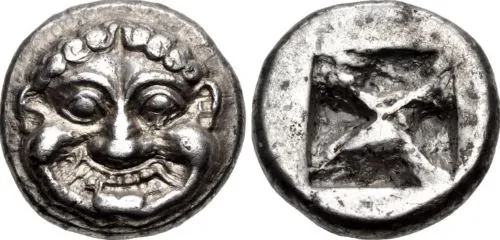
Firstly, though the developed democracy may have relied on the rowers, there was an intimate connection between Marathon and the democracy. Marathon was the first real test of the new democracy and it was not just a victory over a foreign invader; it was also a victory over the sixth-century tyranny. Following a common pattern in the late sixth and early fifth centuries (and one later mirrored in appeals to Athens and Sparta in the Peloponnesian War), the Peisistratidai had appealed to Persia for support.13 Even before the disastrous campaign against Sardis in which Athenian forces participated, Persia and Athens were technically at war in the wake of the Persian demand that the Athenians restore the regime and the refusal by the new democracy (Hdt. 5.96.2):
Artaphrenes ordered them, if they were concerned for their safety, to take back Hippias. The Athenians did not accept the message which was conveyed to them, and in refusing to accept it they were committed to open war with Persia.
Whether or not Persian support for the Peisistratidai was a factor in the Athenian decision to support the Ionian Revolt, the Peisistratid link with Persia was a marked feature of the invasion of 480 (at least for the Athenians). Hippias accompanied the Persian forces to Marathon and the Athenians (and Herodotus) believed that some in Athens colluded with the Peisistratids to give them the city during the Marathon campaign. The place of battle itself was charged with political significance. Marathon was within the Peisistratid family sphere of influence;14 it had been the place selected for an earlier return of Peisistratos and this must have figured in Hippias’ thinking when he guided the Persians there. Herodotus presents Peisistratid scheming to return as influencing Xerxes’ decision to invade (the family were not finished yet).15 But they play at best an intermittent and marginal role in his narrative of the invasion itself.16 In contrast the role of Marathon as a personal and dynastic disaster for Hippias, whose hope of return died there, is emphasized in Herodotus’ narrative of the campaign of 490.17 In the collective memory the invasion of 490 was much more firmly associated with the restoration of tyranny than 480. Marathon was a victory for democracy.
Marathon was also an uncomplicated victory. The Athenians made enormous propaganda use of the abandonment of Attica to the Persians in 480 and the decision to replace the land with the ships. Giving up their city to fight from the sea was a source of pride. But the earlier battle was a much neater story. Athenian comedy in the fifth century labours to simplify its world, at the level of plot, character, values. This gives a natural advantage to Marathon, which as an unambiguous victory without setback or compromise needed no glossing.
Another big advantage which Marathon enjoyed rests on a factoid which we meet in our Athenian sources. This is the claim that the Athenians defeated the Persians alone.18 The exaggeration here of course is that the Plataians fought on the Athenian side, an inconvenient fact which the Athenians generally chose to ignore (though they were depicted in the Stoa Poikile). But the airbrushing of the Plataians is a minor adjustment of the inconvenient facts of history. The other major powers (notably though for good reasons Sparta) were absent, and by the mid 420s (and probably earlier, if we accept Thucydides’ account)19 the mass grant of citizenship to the Plataians meant that they could be seen as Athenian anyway. This was a victory for Athens alone. This makes Marathon especially appropriate in a genre which is often performed before an almost exclusively Athenian audience,20 but even when performed before a larger public is usually unashamedly Athenocentric. Panhellenism is not absent from fifth-century comedy; but the comic focus is usually strongly Athenian. Plots are almost always located in Athens and the perspective is usually dominated by considerations of Athenian advantage. Even in a play like Lysistrata, which prefigures elements of Isokratean panhellenic rhetoric,21 Lysistrata’s own rhetoric (Lys. 574-86) is ultimately about strengthening Athens. In contrast to Marathon, Salamis, though it could be presented as Athens’ great contribution to the freedom of Greece, was a collaborative venture. And though the Athenians provided the largest contingent and engineered the battle in the straits, the Aiginetans probably won the aristeia.22 And it did require manipulation and manoeuvre to get not just Persians but also Greeks to fight there. In the case of Plataia, though Herodotus gives a positive and partial account of Athens’ contribution, this was the great Spartan success. Again, for a genre which likes its ethical issues straightforward, and which likes to place Athens at the centre of its world, Marathon was a much greater narrative.
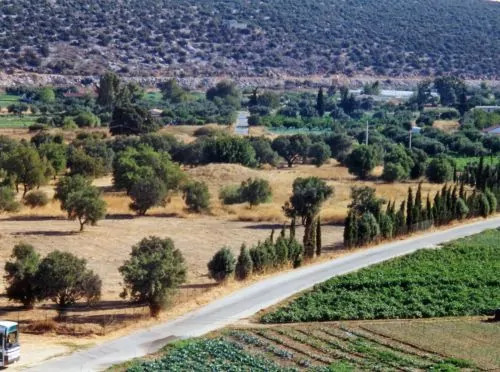
A further dimension which makes Marathon especially significant for comedy is the disparity of scale. This was a David and Goliath match, in that the resources of the Persian empire were brought to bear on a single Greek polis. For the comic tradition this is a profoundly important detail. Greek satiric poetry likes to present itself as the little guy taking on the big guy. This is visible already in the iambic tradition, which when attacking likes to present itself as retaliation, not aggression, and in the case of Archilochos in particular uses images which present the satirist as small and easily underrated but devastatingly effective. The poet is the ant, in allusion to the fable in which the ant saves the pigeon (fr. 23 I 1ff.):
Do you think I have come to such a pitch of misery?
A wretched man indeed I seemed to you,
Not the sort I am nor the sort from which I come
I know how to love the man who loves me
And hate my enemy and bad-mouth him (?)
The ant – there’s truth in this story.
He is not the aggressive and devious fox but the hedgehog (fr. 201 West), a recalcitrant but more defensive creature. This David and Goliath narrative is one favoured by Aristophanes. In the parabasis of Wasps he describes his Herculean battle with the ultimate monster Kleon and his attack on other superhuman targets (1029-42):
And from his first productions he says he did not attack ordinary humans,
but with the spirit of a Herakles assailed the biggest,
and straight away went for the sharp toothed beast himself,
from whose eyes shone terrible flashes of Kynna,
and a hundred heads of cursed flatterers licked all about
his head; he had a voice like a torrent spawning death,
the stench of a seal, the unwashed balls of Lamia, and the arse of a camel.
At the sight of this horrible monster he says he did not make a deal in a fright
but still to this day he wages war for you. He says that along with him
last year he attacked also those shivers and fevers
who strangled their fathers at night and choked their grandfathers
who, settling on the beds of the easy-going among you,
cobbled against them suits, summonses and depositions
so that many of them leaped up in terror and fled to the Polemarch.
The description evidently pleased him, since he returned to it in the parabasis of Peace (751-60). More briefly in the parabasis of the second Clouds he prides himself on punching Kleon in the belly when he was at the height of his power but (equally proudly, though this is not unusual for comedy) not when he was down/dead (549-50):
Who hit Kleon in the belly when he was at his greatest,
and did not choose to jump on him again when he was down.
A striking feature of these descriptions is the martial language. The comic poet too is a warrior.23 There is a natural affinity between the self-image of comedy and the historical role of the fighters at Marathon, both as fighters and as fighters against the odds.
This affinity is underscored by the status attached to Marathon and the Marathon-fighters. The battle itself early attracted a mythology in a way that Salamis did not.24 At Salamis a supernatural (phasma) female figure appeared and was heard urging on the Greeks. But this is as nothing compared with the repeated element of divine intervention at Marathon. It begins with the story of Pan’s appearance to the messenger sent to Sparta.25
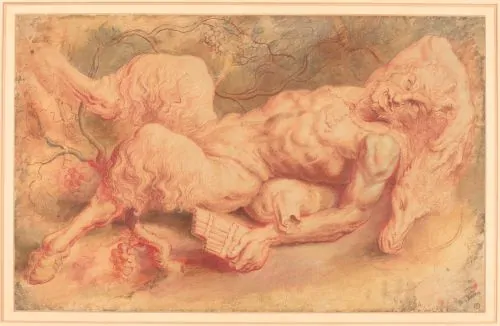
This is in itself a unique event in Herodotus’ narrative.26 And though Herodotus is careful not to vouch for the incident in his own persona (it is explicitly Philippides’ account),the element of physical divine intervention is reinforced in his narrative of the battle. At 6.117 Herodotus relays an account of a mysterious more than human figure active in the fighting. Again he scrupulously avoids vouching for an event for which he has only the one individual concerned as his source.27 But the detail he gives and the cumulative effect of the incidents is to accentuate the superhuman element. Ultimately however Herodotus’ opinion is less relevant here than that of the Athenians and for this we have ample evidence. The Athenians certainly accepted the encounter in Arcadia as fact (Hdt. 6.105):
And because the Athenians believed this to be true, once their situation improved, they set up a sanctuary of Pan hard by the Acropolis, and because of this message they propitiate him with yearly sacrifices and a torch race.
Herodotus’ account of superhuman aid in the fighting again corresponds to the perceptions of the Athenians themselves; Athenian sources gave names and shapes to the local heroes and even gods who fought on the Greek side in the paintings in the Stoa Poikile (Paus. 1.15.3-4):
There also is depicted the hero Marathon, from whom the plain has its name, and Theseus depicted as rising from the earth and Athene and Herakles … and Kallimachos, the elected Polemarchos of the Athenians and Miltiades, one of the generals, and a hero called Echetlos.
Perhaps what is most striking here is the plethora of superhuman presence. The picture which Pausanias saw depicts a battle in which gods mingle among the human fighters, a depiction which has its roots in the larger epic canvas of the Theomachy in Iliad books 20-21.28 The sense of a mythic-epic dimension is reinforced by the presence of Theseus both in the depiction of Marathon and the Amazonomachy in the same set of paintings, which binds the mythic and the historical events together as Athenian resistance to alien invasion. This is a collective imaginative response to, and understanding of, the battle rather than an attempt to depict things actually seen. But the suggestion of Herodotus that the Athenians believed that some fighters observed a supernatural presence finds an echo in Plutarch (though evidently with some interference from the images in the Stoa Poikile).29 The operation of the divine at Marathon and Salamis is strikingly different. Salamis was preceded by an attempt to bring the heroes of Aigina into the war against the Persians (8.64.2). And Themistokles is represented in Herodotus as claiming that success was due to the gods and heroes of the Greeks (8.109.3):
This was not something which we achieved but the gods and heroes, who begrudged that a single man should be king of Asia and Europe, a man who is unholy and criminal, who made no distinction between sacred and private property, burning and overturning the statues of the gods, who even whipped the sea and dropped fetters into it.
There is no reason to doubt that Themistokles said something along these lines, even if Herodotus’ account is ultimately conjectural. This was the natural Greek response to military success, and especially to success against the odds. But the invocation of the Aiakidai was just that, a human ritual, not an unsolicited divine gesture, as in the case of Philippides. And any divine presence at Salamis was immanent, except (at least in Herodotus) for a brief moment at the opening of the engagement.30 For Herodotus at least Plataia, the climactic battle against the invader, has a pronounced element of mysterious divine influence:
I find it marvellous that as they fought around the grove of Demeter it was found that not a single one of them either entered the precinct or died there but the majority fell on profane ground round the shrine. My view, if one can express a view about things divine, is that the goddess herself refused them entry because they had burned her site at Eleusis.
The shrine also figured in Simonides’ account in his Plataia elegy, where the goddess herself may have been part of the narrative, though it is impossible to determine whether for Simonides she was a visible participant.31 Demeter also provides (for Herodotus) a suggestive link between the battles of Plataia and Mykale (9.97, 101), which between them put an end to the Persian threat. Mykale in turn was marked by the mysterious and uncannily accurate rumour which encouraged the Greeks with the news of the victory at Plataia (9.100-01). The Persian Wars were marked throughout by divine intervention,32 as was to be expected given the momentous importance of the events from the Greek perspective. But gods were not a perceptible presence in the other great battles. Attested and visible involvement of gods and heroes was a peculiarity of Marathon.33
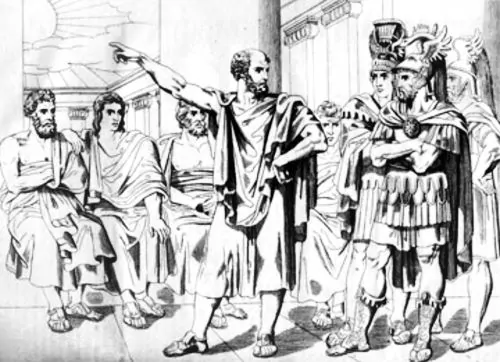
Divine epiphany is a rarity in the post-heroic world. It is unusual in fact even for Homer’s heroes to encounter a god undisguised. Both the direct intervention of Pan and the heroic involvement in the fighting give Marathon the quality of an epic battle (in the generic sense). This is reflected in the (probable) collective heroization of the dead. Marathon had already become the stuff of myth during the fifth century.34 By definition throughout the Athenian oratorical tradition the progonoi are an exemplar to be imitated, always by implication greater than the present. But these progonoi were not merely part of a generalized idealization; they are the stuff of legend. This gave the battle enormous iconic value for a genre which idealizes the past, since it offered comic writers a ready-made idealized and superhuman past to work with. Marathon came with its own associations which did not need to be elaborated; the mention sufficed to summon them up.
This mythic quality is captured exquisitely in Aristophanes’ narrative in Wasps, his most ambitious treatment of Marathon. We begin (in the ode) with a nostalgic reminiscence of an earlier and glorious youth in the manner of Homer’s Nestor. The epirrhema gives an account which absorbs under Marathon the whole history of the Persian invasions. Marathon itself is (as noted above) emphasized in the description of the hoplite line in 1083 (στὰςἀνὴρπαρ’ ἄνδρα) and in the account of the pursuit (1087-88). But the reference to the attempted burning of Attica in the guise of the smoking out of the wasps’ nests takes us implicitly to 480, when the Persians did actually take and burn the Acropolis (Hdt. 8.53.2).35 Most interesting of all is the claim in 1084 that the enemy arrows covered the sky. The statement points almost inescapably toward the famous remark of Deienekes(Hdt. 7.226):
Still it is said that the bravest Spartan was Deienekes, who (they say) made the following remark before they engaged the Medes, after hearing from one of the Trachinians that when the barbarians release their arrows, they conceal the sun with the mass of the missiles, so great is the number; but he undeterred said, dismissing the number of the Medes, that their Trachinian friend brought them nothing but good news, since if the Medes concealed the sun the battle against them would be in the shade and not in the sun.
The passage suggests that Deienekes’ bon mot was already part of the folk tradition when Herodotus was writing. But more important for our purposes is the appropriation of a famous detail of the Spartan engagement at Thermopylai for the Athenian battle at Marathon. There may be another such appropriation in the omen of the owl which flits across the army before the battle (1086: γλαῦξ γὰρ ἡμῶν πρὶνμάχ εσθαι τὸν στρα τὸν διέπτατο). This omen is attached by Plutarch (Them. 12.1) to the battle of Salamis:
According to some, Themistokles was speaking on this matter from the deck of his ship and an owl was seen flying from the right of the ships and perching on his rigging, which made his hearers commit especially to his opinion and make ready to fight at sea.
Omens of course attach themselves readily to all significant events. And the owl was Athene’s bird, as the men at Marathon were protecting Athene’s city. So we cannot be sure that there was not also an owl in the Marathon tradition. Certainly the scholia to Aristophanes attach this incident to Marathon. Schol. V has: φασὶ κατὰ τὸ ἀληθὲς γλαῦκα διαπτᾶσθαι τὴν νίκην τῶν ̓Αθηναίων ἀπαγγέλλουσαν (‘they say that in fact an owl flew across announcing the victory of the Athenians’). On balance Plutarch inspires more confidence, since the scholium contains nothing which could not have come from Aristophanes’ text and looks like a straight extrapolation (at first or second hand) from the annotated passage. And the inescapable appropriation of the Thermopylai detail, together with the burning of Athens transferred to Marathon from the invasion of 480 (noted above), lends support to the view that Marathon may here have absorbed yet another memorable moment. What emerges overall is the fact that Aristophanes’ Marathon as the archetypal battle against the Persians absorbs and subsumes the other anti-Persian conflicts.
All of this means that Marathon becomes a kind of comic shorthand term with a set of immediate associations (chronology, standards, ethics, potential) which can be summoned up economically. Marathon in comedy becomes an extremely flexible device for opening up a range of issues. The factors which made it unique also made it a dense set of ideas. At its most basic level it is a chronological marker, as at Acharnians 179-81, where it marks hyperbolic old age (Acharnians 179-81):
I was hurrying to bring the treaties here
But they sniffed it, some ancients
of Archarnai, hard-packed old men, oaken,
tough, Marathon-fighters, made of maple.
The description of the charcoal burners there warns us that we are going to meet a cantankerous and irascible set of (very) old men. Marathon is never just a chronological indicator, however, for the reference, together with the other descriptive details, also prepares us for the paradoxical vigour with which they attack Dikaiopolis. The idea of extreme old age is taken up and revised in the parabasis, where it is used to associate Thucydides with the aged chorus and to create an exaggerated image of age and weakness. The implausibility of Marathon men being not just alive but active enough to merit prosecution is used self-consciously here to set up a grotesque exaggeration in the epirrhema, where the victim of malicious prosecution is not just old but senile and nearly dead (Acharnians 687-702):
Then he drags us up and asks questions laying traps for us,
rending and confusing and confounding an old Tithonus.
And he from age mumbles, then goes off fined.
Then he weeps and he sobs and says to his friends,
“I’m fined of the money that was to have bought my coffin.”
How is this right? to destroy at the waterclock a white-haired veteran
who often joined the struggle and wiped off
warm manly sweat in quantity,
who served the city bravely at Marathon?
So then at Marathon, in our day, we pursued.
But now by utter villains
we are pursued in court – and we’re caught.
What Marpsias will reply to this?
The hyperbole here prepares very effectively for the antepirrhema, which for those of us who felt that this was all too grotesque to be true gives a real (if arguably unique) instance of this grotesquerie in practice. Marathon is used here to create a set of stark polarities. Between youth and age, to prepare for the (appealing but – in a system reliant on the volunteer prosecutor – unfeasible) plea in the antepirrhema that prosecutions should be age-related. Between past and present. Active and victorious at Marathon; passive and defeated in the courts (ἐδιώκομεν/διωκόμεθα). This contrast is underpinned by clever use of a pun based on the overlap between the literal language of pursuit and retreat in battle and its metaphorical use in the courts (697-99). But the choice of the pursuit is more than just a linguistic game. The pursuit of the fleeing enemy was singled out for mention in the choral account of their success at Marathon in Wasps. It reflects an image with which the Athenians were familiar from its depiction in the Stoa Poikile (Paus. 1.15.3). The final contrast is between citizen and foreigner. Though Marathon pops up literally only very briefly in the antepirhemma, its presence as subtext is felt throughout. Marathon was the archetypal Greco-barbarian battle and Aristophanes cleverly here deploys (and refreshes) one of the clichés of comic anti-demagogic loidoria; from at least Kleon onward the demagogue is for the comic poet a non-Athenian interloper. In keeping both with the comic cliché and the Marathon story Aristophanes here makes the Athenian politician who prosecutes Thucydides a non-Greek (Acharnians 703-12):
Who can think it right that a man bent with age like Thucydides
should be destroyed in a struggle with the Scythian wasteland,
this Kephisodemos, the vocal prosecutor?
I filled with pity and wiped a tear as I saw
an old man confounded by a Scythian archer,
By Demeter, Thucydides in his day
would not have given way to Artachaies himself,36
but would have thrown ten Euathloses,
would have shouted down with a yell three thousand archers
and outshot the ancestors of Euathlos’ own father.
It is here that the David and Goliath aspect of Marathon is felt. The courtroom victim faces superior forces, like the men at Marathon, but this time we get the wrong result; the barbarian aggressor triumphs.
The Thucydides anecdote in Acharnians also draws on another aspect of the Marathon motif, which is merit. Marathon men as the supreme progonoi are also the supreme examples of service to the state, and a service which needs no argument. They are thus an ideal vehicle to address the theme of merit and reward. This is the case both with the chorus and with Thucydides in Acharnians, where hyperbolic service is juxtaposed with equal mistreatment which is tolerated by the polis. To abandon old men to the mercy of younger prosecutors becomes a betrayal both of them and of the principle of reciprocity which underpins dealing with the state as it underpins dealings between individuals.
This use recurs in the parabasis of Wasps, which presents a kind of positive counterpart to Acharnians, in that charis is requested, not its absence deplored. Service to the polis at Marathon and through Marathon the creation of the empire is used to establish the claim of the chorus to jury service as a kind of pension, though here too the reference to the drones (1114ff.) suggests that there is a mismatch between merit and reward. Closer to Acharnians is the role of Marathon later in the agōn, where Bdelykleon returns to the idea of empire as the natural reward for Marathon expressed in the parabasis (Wasps 706-12):
If they had wanted to offer a livelihood to the dēmos, it would have been easy.
There are a thousand cities which now bring us the tribute.
If someone assigned to each of these twenty men to support,
twenty thousand common men would be living in the lap of luxury,
and garlands of all kinds and beestings and curd,
reaping the fruits of the earth in a manner worthy of the trophy at Marathon.
As it is you go home with your pay like olive pickers.
Here the gap between merit and reward is much greater. The politicians are stealing the rewards of Marathon which the chorus should be enjoying. And as Bdelykleon has already made clear (650-51) and the agōn suggests throughout in focusing on the reality or otherwise of Philokleon’s power, Philokleon and the chorus between them beyond any individual characteristics represent the Athenian dēmos as a whole. We are not dealing here with a subgroup of society as in Acharnians; the dēmos voluntarily allows the politicians to take the rewards which the dēmos has earned. And in the contrast between the glories of the past and the scavenging in the present (ὥσπερ ἐλαολόγοι) there is a strong suggestion that the dēmos collectively behaves with a passivity unworthy of its past greatness. Given the affinities between Philokleon as the individual who typefies the dēmos and the figure Demos in Knights who personifies it, it comes as no surprise that the Marathon motif recurs to express the relationship of the dēmos with its political leaders, though in a corrupted form, when in the competition for the favour of Demos the sausage-seller points out that the Paphlagonian allows the Demos, hero of Marathon, to sit in discomfort (Knights 781-83):
That you, who took your sword to the Medes for your country at Marathon and with your victory allowed us a theme for grand work with the tongue, should sit like so uncomfortably on the rocks he doesn’t care at all …
Implicit in the contrasts presented in Acharnians and Wasps is another dimension to Marathon, which is its capacity to encapsulate a set of values and in so doing activate associations which either tacitly or explicitly contrast the corrupt present with a simpler and more glorious past. This use recurs in Eupolis fr. 106 KA, probably from Demes:
No by my battle at Marathon,
Not one of them will grieve my heart.
This is probably (as Storey argues)37 said by Miltiades, in a play which appears to be damning of the contemporary politicians.38 This is also the way Marathon is used in the agōn of Clouds (986), where in response to an accusation that he is outdated Kreitton Logos defends his approach to education by claiming that it bred the Marathon men. Again in the agōn of Frogs (1296) Marathon is used (this time by the opponent) in relation to the upholder of traditional values.
The role of Marathon as an economical way of encapsulating a set of guaranteed values relating to a better past also makes it a useful means to associate particular figures with those values and so align audience sympathy. The automatic deference due to Marathon can thus serve to ensure a sympathetic reception for characters who invite less positive reactions and thereby generate ambiguous emotions in the audience. Before their entry the chorus of Acharnians are marked as Marathon-men at Ach. 181. They are also opponents of peace and supporters of a war which we have just seen to be ill-advised, poorly supported, and sustained on the basis of lies and corruption. They will further demonstrate their aggression with a violent attack on the hero and a steadfast refusal to listen. But the association with Marathon invites the audience to perceive a gap between these opponents of peace and charlatans like the politicians in the assembly at the opening of the play or the warmonger Lamachos who enters later; in the process it invites us to view them with less hostility. Like Dikaiopolis they are men who do the fighting, not the idlers, perverts, and degenerates who profit from the war. The detail hints at another side to the chorus and carries within it the hint of another development. The same is true of the chorus of wasps (Wasps 711), another set of initially unappealing characters who turn out to be dupes of the politicians. They have (as the parabasis insists) earned their right to draw state money as jurors. In the same way the passing reference to Marathon in Lysistrata 285 (in a play which otherwise – and unusually in Aristophanes – is more interested in events half a generation before Marathon) serves (along with the reminders of the Spartan invasions at the end of the sixth century) to ensure that the misguided male chorus (again unlike the politician who opposes Lysistrata in the agōn) do not quite lose audience sympathy.
In the examples studied the effect of the reference to Marathon is to highlight discontinuity, decline, and amnesia, whether it is a falling off of politics and politicians or art or education, a failure to live up to or to reward the warriors of the past, a readiness to surrender the rewards of past achievement to an elite group, or a readiness to allow the past to be cheapened by hypocritical demagogues. But Marathon when used in rhetorical appeal, and indeed when used in the agōn to articulate the gap between past and present, also reflects an opportunity. There is room to change for the better. In comedy the past is not irrecoverable. The comic past and the imagined comic future share a utopian tendency, unlike the comic present, which is usually flawed – worse politicians, worse policies, worse poetry, song, and drama. The opportunity inherent in the rhetorical appeals to Marathon is implicitly realized in the changes in the attitude of and to the chorus in Acharnians, Wasps, and Lysistrata. Utopian future and utopian past come together more explicitly in the Marathon motif at Knights 1334, where the restoration of Demos to his youthful self (itself a recurrent motif in comedy) is marked by allusion to Marathon, reversing its abusive use as part of the political manipulation of Demos at 781-83. The personification of the people has been purged of error and folly and restored to the way the dēmos was in the idealized past (Knights 1334-35):
Hail, king of the Greeks. We rejoice with you.
For you fare now as the city deserves and the trophy at Marathon.
The rejuvenation is not merely a recovery of youth and vigour but a recapture of the values of a better past, visually represented by change of costume, since Demos enters wearing the clothes and ornament of an earlier age (1331-32).
The use of Marathon in Demes is similar. This is a play which resurrects four political leaders from the past, one of them fittingly Miltiades. Here too Marathon represents both a past and a future, as in Knights. Less prominently the appearance of Marathon in the agōn of Frogs (along with much else) associates Aischylos with a better past which in this play with his victory also becomes a better future.
An interesting variation on the use of Marathon occurs in Eupolis fr.106 KA, quoted above. In Aristophanes Marathon is collectivized as the property of the people as a whole, or at least a subset of the common people represented by the chorus. In Demes (as Storey insists) Marathon is the personal property of Miltiades.
The fact that only Aristophanes survives of the Old Comic poets makes it difficult often to determine whether we are looking at a generic feature or an Aristophanic peculiarity. In this case however we can be reasonably confident that this is a generic habit. The presence of the motif in Eupolis confirms its generic status. So too does the fact that its first outing in Aristophanes (in Acharnians) is a passing mention, as though the audience is meant to pick up the resonances unassisted. It is, unsurprisngly, a fifth-century phenomenon. Fourth-century comedy (including Aristophanes) has no interest in Marathon and even by the end of the fifth century it seems largely to have disappeared as the nostalgia component in the comic plot dwindles.
Endnotes
- See C. Carey, ‘The political world of Homer and tragedy’, Aevum Antiquum N.S. 3 (2003) 463-84.
- R. Thomas, Oral tradition and written record in classical Athens (Cambridge 1989) 283.
- R. Thomas, ‘Herodotus’ Histories and the floating gap’, in The historian’s craft in the age of Herodotus, ed. N. Luraghi (Oxford 2001) 198-210, at 198.
- This is especially visible in fr. 11 West, with its geographical location in Sparta as the point of departure, the role given to Pausanias, and the presence of the Dioskouroi.
- Cf. 7.144.2: οὗτος γὰρ ὁ πόλεμος συστὰς ἔσωσε τότε τὴν ̔Ελλάδα, ἀναγκάσας θαλασσίους γενέσθαι ̓Αθηναίους αἱ δὲ ἐς τὸ μὲν ἐποιήθησαν οὐκ ἐχρήσθησαν, ἐς δέον δὲ οὕτω τῇ ̔Ελλάδιἐγένοντο (‘This war which broke out saved Greece then (i.e., in 480) by forcing the Athenians to become a sea power. The ships were not used for the purpose for which they were built but were there in time of need for Greece’).
- See Tuplin in this volume, p. 236.
- Some data may help here: Andok.1: Marathon §107 Lysias 2: Marathon §§20-26, Salamis §§27-43 Isok. 4: Marathon §91 Isok. 5: Salamis §147, Marathon §147 Isok. 8: Marathon §38 Isok. 12: Marathon §195 Isok. 15: Marathon §306 [Dem.] 13: Salamis §§21, 22, Marathon §§21, 22 Dem. 14: Marathon §30 Dem. 18: Salamis §208, Marathon §208 Dem. 19: Salamis §§311, 312, Marathon §§311, 312 Dem. 22: Salamis §13, Dem. 23: Salamis §§196, 198, Marathon §§196, 198 [Dem.] 59: Salamis §§95, 97, Marathon §94 Aischines 1: Salamis §§34, 75, 172, Marathon §75 Aischines 3: Salamis §181, Marathon §§181, 186 Lykourgos 1: Salamis §§68, 70, 73, Marathon §§104, 109 Plato Menexenus: Marathon §§240c-241a, 241b, 245a, Salamis §§241a, 241c, 245a.
- The bias is perhaps most tellingly pointed up by an absence; as Mike Edwards observes to me, though comedy coins the term Μαραθωνομάχης, it never (as far as our evidence allows us to judge) creates a parallel term Σαλαμινομάχης. Metre was no obstacle, since the prosody is identical.
- Cf. Thuc.1.18.2, 73.4, 74.2; Lys.2.30, 40.
- For a discussion of the implications of this passage see Tuplin in this volume.
- For the fire at the ships see Pelling in this volume pp. 23-26.
- N. Loraux, The invention of Athens: the funeral oration in the classical city (Harvard 1986) 278; D. M. Pritchard, ‘The “fractured imaginary”: popular thinking on military matters in fifth century Athens’, Ancient History 28 (1998) 38-61.
- An honourable exception is Grillos (Hdt. 3.138), who stipulates peaceful intervention to secure his return in order to protect (Greater) Greece from Persia.
- See Rhodes in this volume p. 5.
- Hdt. 7.6.2-4.
- ‘Peisitratidai’ appear at 8.52.2 as (unsuccessful) mediators in the Persian assault on the Athenian Acropolis. The suggestion that Dikaios (8.65) was a Peisistratid is difficult to substantiate on present evidence, though his presence in the Persian army there is suggestive. Hipparchos son of Charmos again is a possibility. See A. M. Bowie, Herodotus, Histories book VIII (Cambridge 2007) on 8.52.2.
- dt. 6.107.
- See in this volume Volonaki, Xanthaki Karamanou, Kremmydas.
- See S. Hornblower, A commentary on Thucydides volume 1: books I-III (Oxford 1997) on 3.59.
- Cf. Acharnians 502-07.
- Cf. Lys. 1133-34, resumed in 1247-61, where the Spartans remind us of a shared Greek past fighting the barbarians, singing of the Athenians at Artemision and their own battle at Thermopylai.
- Hdt. 8.93.1: ἐν δὲ τῇ ναυμαχίῃ ταύτῃἤ κουσαν ̔Ελλήνων ἄριστα Αἰγινῆται, ἐπ ὶδ ὲ ̓Αθηναῖοι.
- Cf. polemein: Wasps 1037; Plat. fr.107?, polemizein: Peace 759, epicheirein: Wasps 1038, Peace 752, machesthai: Peace 754.
- For the marked divine and heroic involvement in Marathon see Gartziou in this volume pp. 91-110, and for Pan see Mastrapas pp. 111-22.
- For the apparition at Salamis see Hdt. 8.84.2 with p. 134 below, for Pan before Marathon Hdt. 6.105.
- See on this incident S. Hornblower, ‘Epic and epiphanies: Herodotus and the “new Simonides”’, in The new Simonides: contexts of praise and desire, ed. D. Boedeker and D. Sider (New York 2001) 135-47.
- λέγεινδ ὲαὐ τὸν περὶτ οῦπά θεοςἤ κουσα τοιόν δετινὰ λόγον· ἄνδ ραοἱδ οκέ εινὁπ λίτηνἀν τιστῆ ναι μέγαν, (‘I heard that he gave something like the following account of his affliction: it seemed to him that a hoplite of great stature confronted him …’).
- For Marathon as epic battle see Pelling in this volume pp. 25-26.
- Cf. Plut. Thes. 35.8: ‘and not a few of those fighting at Marathon thought they saw an apparition of Theseus in hoplite armour charging ahead of them against the barbarians’).
- Hdt. 8.84.2: (‘this too is said, that an apparition of a woman appeared to them and on appearing urged them on so that the whole Greek army could hear, starting with the following reproach: “foolish men, for how long will you back oars?”’).
- See D. Boedeker, “Paths to heroization at Plataea”, in The new Simonides (n. 26 above) 148-63.
- See Gartziou in this volume.
- It is interesting to compare the account of the mysterious fighter in Herodotus 6.117 with the gigantic skeleton found at Plataia at 9.83.2. The latter takes place at a considerable but unspecified interval after the battle; it does not form part of eyewitness testimony.
- Cf. Arafat in this volume.
- The burning of the Acropolis is emphasized in Herodotus’ account of the second invasion (8.53.2, 55, 140.α.2, 9.13.2). Though the Persians at Marathon had presumably come prepared to burn, the role of fire at Marathon is in the tradition attached not to Persian aggression but to the Athenian burning of the Persian ships, for which see Pelling in this volume.
- I can do nothing with this verse. I print Borthwick’s conjecture (E. K. Borthwick, ‘Aristophanes, Acharnians 709: an old crux and a new solution’, BICS 17 (1970) 107-10.), more from admiration for the ingenuity than because I am sure that the conjecture fixes the textual problem.
Contribution (124-142) from Marathon – 2,500 Years, edited by Christopher Carey and Michael Edwards (University of London Press, 12.02.2013), Institute of Classical Studies, School of Advanced Study, University of London, published by OAPEN under the terms of a Creative Commons Attribution-NonCommercial-NoDerivs 2.0 Generic license.
About the Author