Fifth-century Greek drama cast Marathon as both a victory over Persian despotism and a moral benchmark, using the heroic past to praise, criticize, and redefine Athenian identity.

By Dr. Efstathia (Efi) Papadodima
Permanent Research Fellow
Research Centre for Greek and Latin Literature
Academy of Athens
Introduction
References to the battle of Marathon in fifth-century drama fulfil two major functions. (1) The first function, which is more predictable, consists in the commemoration and celebration of the Athenian military victory which averted an imminent threat (i.e. the Greeks’ enslavement by an aggressive and massive despotic ruler). This victory appears inseparably linked with various aspects of the Greek-barbarian polarity and, more evidently, the contrast between (Greek) freedom or liberty and (Oriental) despotism, which supposedly distinguishes – and defines – the two groups par excellence.1 References to the victory thus contribute to the illumination of key constituents of the two nations’ identity. (2) The second function is confined to comedy. It consists in the commemoration of and admiration for the old (moral) values which informed the Marathon-fighters and which are now allegedly distorted or absent from the Greek/Athenian world. This opposition between contemporary Athenians and those of past generations underlines the idea of an ethnic or cultural group’s instability – and, for that matter, degradation. At the same time, Aristophanic characters employ the Greek victories over the Persians as a means for appealing to and encouraging the cultivation of Greek unity and concord.
References to Marathon, then, become a part of the exploration of identity in regard to both the Greek-barbarian polarity and the intra-Hellenic polarity. As a result, they most often lead to either self-praise or self-blame (which entails and underlines the need for active change), or a complicated blending of the two.
Tragedy
The Persians
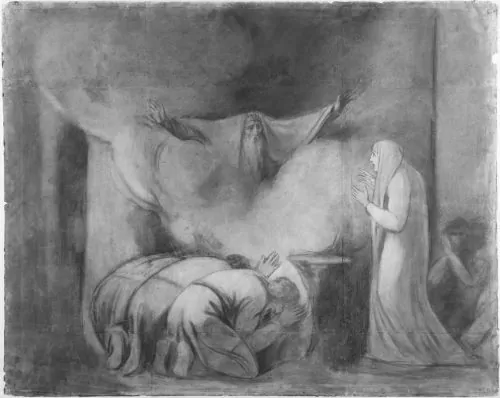
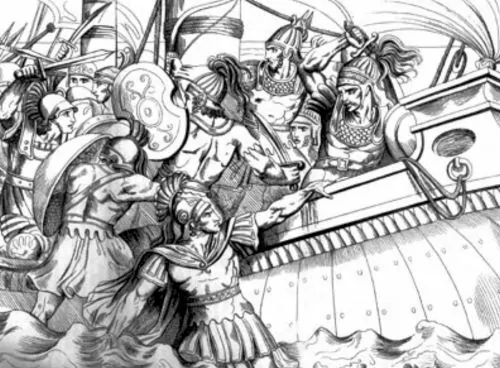
The Persians dramatizes the naval battle of Salamis, in which an Athenian-dominated allied navy defeated the Persians. The battle and its consequences are presented from a Persian point of view, since the action is located at Susa and all dramatic characters are Persian. The play accordingly provides us with several references to Persian history, the accuracy or selectiveness of which is beyond our scope, and, more importantly for our purpose, brings on stage the ghost of Darius, the loser of Marathon.2 The two battles, those of Marathon and Salamis, appear very closely connected in so far as the latter (allegedly) constitutes Xerxes’ attempt to avenge the dead of Marathon and surpass his father’s achievements.3
Although the city of Athens is undoubtedly given a special position,4 especially in the exchange between the Queen and the Chorus, where Athens is virtually identified with Greece (233-34), there are other elements which suggest a consciousness of a collective Greek identity and spirit.5 There has been a fair amount of discussion about whether the play elevates the naval battle at Salamis over the battle of Marathon, as well as about whether the playwright is expressing any political bias (in favour of Themistocles over Cimon or Aristides) through this work. The play does indeed seem to downplay the threat posed by Darius at Marathon, as well as the consequences of his defeat for the Persians,6 while the ruin at Salamis is perceived and presented as an utter destruction.7 There is however a dramatic point to this, since the presentation maximizes the contrast between father and son – the prudent, or at least more prudent, Darius as opposed to the impulsive and transgressive Xerxes, which is of crucial significance in the drama.
Nonetheless, despite the dramatic need to place the emphasis on Salamis, Marathon is a constant background presence and there are several points in the drama where Darius’ former defeat at Marathon is referred or alluded to – most of which are made by the Chorus of Elders, prior to the revelation of Xerxes’ fate.8 Atossa’s and the Chorus’ exchange early in the play (231-45) illuminates certain Greek and, more particularly, Athenian values or institutions which are explicitly associated with their former victory at Marathon. These are: (a) self-motivated bravery and fighting merit; (b) devotion to freedom and liberty; and (c) emphasis on collectivity.9 When the Queen inquires into the size of the Athenian army, the Chorus stress its efficacy and allude to the defeat of Darius at the battle of Marathon (235-36). The exchange also illustrates the Athenians’ free fighting spirit and, by extension, the free institutions they enjoy, underlined by the Queen’s surprise at hearing that the Athenians managed to destroy Darius’ large and excellent army,10 even though they were neither slaves nor subjects of a single man (243-44).11
Marathon returns, tellingly, after the Messenger’s account of Salamis. Atossa fleetingly refers to the numerous dead of Marathon, explicitly connecting the earlier battle with the present Persian enterprise and destruction (and with her son’s motivation). Xerxes is said ironically to have exacted a bitter vengeance (‘πικρὰν … τιμωρίαν’) from glorious Athens (473-75) in compounding the losses of Marathon,12 here personified as the ‘killer’ of the Persians.13
Finally, Darius, the loser of Marathon, is brought on stage (681-842) to offer advice to his people about how to handle the great crisis. Darius appears as an idealized wise-adviser, speaking in universal terms. First, he stresses his son’s transgression in regard to the bridging of the Hellespont (725, 744-52) and the Persians’ impious conduct, which consists in the burning down of the Greek temples (807-15). Both events are presented as constituting an offence to natural order and the divine.14 Darius thus makes clear that Xerxes’ ruin is not a simple repetition of his own defeat. Even though both father and son failed in their military enterprises against Greece, it seems that the latter had a far more active share in his fall. Despite the disclosure of Zeus’ oracle (739-42), which dictated that the Persian attack was destined to fail in the first place, Xerxes’ personal responsibility is particularly emphasized. Darius suggests that his son has overstepped the mark even by the expansionist standards of Persian kings (808-10, 820-31, especially 821-22). Darius’ incomprehension at his son’s folly finds expression in a suggestion that Xerxes must have been suffering from a mental illness (750-51).15 Darius subsequently narrates the fortunate days of previous monarchs (765-81), concluding with the statement that no other Persian king had brought so much suffering on his people (785-86). Xerxes is thus presented as a negative example or exception in his community, because he reached the point of manifestly transgressing human limits and limitations (827-28).16
Marathon functions as an important reference-point for both worlds, the Greek and the Persian, one which maps present and past and underlines a certain degree of continuity in each of them. This continuity is not confined to the two battles’ outcome but embraces fundamental customs of the two communities – which are presumed to be connected with that outcome. However, unlike the Athenian values or institutions which are retained, strengthened, and expanded as we pass from Marathon to Salamis, the major Persian values or customs (notably despotism, materialism, and expansionism), though themselves retained and reinforced, become distorted or ‘mistreated’ by an individual king. This sort of divergence or transgression is presented as the major reason for which his expedition failed.
Children of Heracles
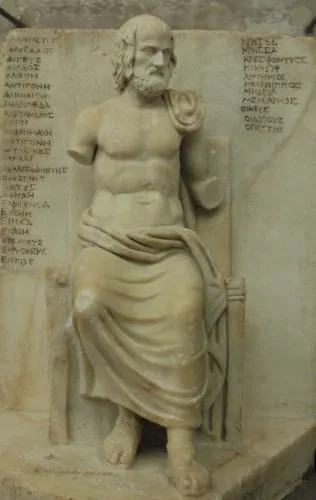
A more elusive, and perhaps contentious, echo of the Marathon campaign is to be found in Euripides’ Children of Heracles. The play dramatizes the struggle of the Heracleidae to escape the murderous rage of their great enemy and pursuer, king Eurystheus of Argos, who had expelled them from their homeland after the death of Heracles. Athens, represented chiefly by king Demophon,17 is the only Greek city that grants them asylum (305-06). The drama thus explores and praises (what are presented as) Athenian ideals, notably freedom, justice, bravery, and piety (62, 113, 198, 244-45, 286-87, 329-32, 423-24, 901-09, 957). ‘Athens’ defence of the suppliants, particularly of the Heracleidae and the Argive mothers of the Seven, became a topos of self-praise in Athenian political oratory’.18
The connection with Marathon is suggested by the play’s very setting and the identity of the Chorus;19 after wandering around Greece, the descendants of Heracles eventually seek refuge at the Athenian town of Marathon. The scene is set before the altar and temple of Zeus Agoraios (31-38), to whom the suppliants pray, while the Chorus is composed of Marathonian elders, who express their great devotion to and admiration for Athens (note especially 1018-19 and 901-27), depicting her as a city that reveres right and defends the afflicted (329-32), as well as their respect and support towards the noble suppliants. At the same time, the protagonists’ glorious fathers (Heracles and Theseus), who are connected by bonds of blood (205-12) and who constitute important background presences in the drama, were both traditionally associated with Marathon and the great battle.20
Aristophanic Comedy
Marathon in Aristophanes frequently becomes a subject of patriotic nostalgia and pride.21 First, the battle itself is viewed both as a source of pride and privilege and as a responsibility; the Athenians who bravely and selflessly fought at Marathon saved Attica – and Greece – from foreign dominion (e.g. Knights 781-85) and made Athens special. As a result, the Marathon-fighters (and, by extension, the patriotic Athenians)22 are expected to enjoy privileges in the city they had defended (even though they were not themselves motivated by the hope of reward), but they also feel a certain pressure or duty to prove themselves worthy of their glory and trophies, and live up to the standards they themselves had established. In addition, Marathon conjures up respect for the old ways and values, which allegedly contributed or led to the victory by shaping the exceptional ethos of the Marathon-fighters.23 References to Marathon, by extension, highlight how certain Athenians of the poet’s day – individuals like Cleon or types of people – threaten the well-being of their city – as the barbarians once did24– and make her unworthy of her glorious past. Contemporary citizens are sharply criticized and accused of: (a) falling short of their ancestors in terms of their moral values in general and their loyalty to their country in particular; and (b) failing to honour their old heroes properly or even exploiting them. Commemoration of the Hellenic victory over foreign enemies thus becomes a part of an evaluative comment on the present state of Greece and particularly Athens, highlighting the degrading effects of civil war, bad policies and politicians, and certain intellectual trends that have allegedly distorted or eliminated the old values.
Acharnians depicts a panorama of misfortune brought about by the ongoing civil war. The dominant atmosphere is one of material exhaustion, profound distrust, and hostility among Greek cities.25 Dikaiopolis, though favouring peace and fervently hostile to the Spartans (509-12), locates the ultimate responsibility for the war with the Athenians and despite his initial hesitancy launches a fierce attack on representatives of the Athenian people who, to a greater or lesser extent, prevent life from being peaceful, just, and worthy of the Greek/Athenian past – of Marathon and Salamis. These types of people include the envoys, who are only interested in money on the pretext of working for peace (62-63, 135, 137);26 the calumniators and sycophants, who are in fact presented as the Athenian species par excellence (902-08); the country-men, who are easily duped (370-74); the elders, who are rather aggressive and belligerent (375-76); and of course Cleon.
The Chorus of Acharnians27 reproduce some of these accusations; they bitterly describe how the elderly Athenians are mistreated in their old age, even though they have gained so many victories for the Athenian fleets and, therefore, deserve honour (676-702). The old Athenians are being dragged into court by young orators, who exploit them by employing various disgraceful tricks. The Chorus directly reproach the city that failed to reward her heroes or even treat them decently (676), thus describing a situation in which familiar standards, conditions, and expectations are reversed.
This theme is reinforced by the contemporary warrior who appears in the play, Lamachus, who does multiple duty as a member of the corrupt political class, as a representative (like the Chorus) of Athenian belligerence, and as the antitype of the warriors of Marathon (note 595-617). Unlike the Chorus in their prime at Marathon, Lamachus also proves, after his threatening entrance, to be no match for Dikaiopolis, while at the end he enters injured as the result of a farcical campaign.
Marathon again plays an important role as a marker between present and past, and as a moral yardstick in Knights and Wasps, two plays which are more narrowly focused on the pathology of certain features and practices of contemporary Athenian life. Knights is structured on the parallelism between the dynamics of political hierarchy and the relations of the household – and there are multiple transitions between the domestic and public spheres. Demos, the Athenian people, appears as the master of the house, surrounded by the Paphlagonian28 and the Sausage-Seller, who compete for a place near him by engaging in a contest of baseness. In the end, the latter manages to outdo the ethos of Cleon in all its negative traits or anti-values, even though he eventually adopts a didactic attitude towards Demos and seems to start using his power in order to benefit him. This is essential, since Demos is not at all blameless for Athens’ present degradation.
The Chorus of aristocratic Knights indeed attack contemporary citizens on account of the way in which they relate to their country. In sharp contrast to their ancestors and the Knights themselves, many Athenians would only fight for their country if they were to receive concrete rewards and privileges (573-80). Cleon, in his turn, is personally targeted for the way in which he maltreats the old saviours of Greece.29 The Sausage-Seller commemorates Demos’ contribution to both Marathon and Salamis to that effect (781-85), and the battle of Marathon is here identified as the one which secured freedom for Attica.
Towards the end of the drama, after Demos’ rejuvenation and restoration to his former glory by the Sausage-Seller (1316-34), the latter announces that Demos has once more become as he was in the days when he lived with Aristides and Miltiades;30 he is now living in ancient Athens (‘ἀρχαίαισινἈθήναις’), which is now again worthy of the poets’ songs (‘λιπαραὶκαὶἰοστέφανοικαὶἀριζήλωτοιἈθῆναι’). Demos appears in person with his hair held in place with a golden band, in all the glory of his ancient dress, perfumed with myrrh, and spreading around him the odour of peace. His rejuvenation is at the same time a leap back in time. The leader of the Chorus salutes him as the single ruler of the city and the whole of Hellas (‘μόναρχον … βασιλεῦτῶνἙλλήνων’).Demos’ blessedness is said to be worthy of Athens and the trophy of Marathon (1330-34). The ending of this play is notoriously perplexing and ambivalent on many levels,31 especially given Demos’ address as a ‘μόναρχος’.32 But within the uncertainties Marathon at all events functions as a yardstick of the city’s glory and status.
One of the central themes of Wasps is the Athenian jury system – both the conduct of the jurors themselves and more generally the political context in which they function.The play presupposes and explores polarities of different sorts, notably those between Greeks and barbarians, slave and free, as well as patriotic and unpatriotic Athenians. In the agōn between father and son,33 as well as in the parabasis, the point that worthless Athenians exploit their ancestors – in the very frame of their city’s institutions – is bitterly stressed by Bdelycleon, the young Athenian, and by the Chorus of old jurors who initially oppose the former. In the agōn, Bdelycleon attempts to prove that being a juror is far from being a noble or affordable thing. He accordingly claims that his father is actually a slave, despite his former services to his country (682-85). Bdelycleon explicitly cites Marathon when pointing out how small a percentage of the tribute given by the Athenian allies is offered to the jurors (698-712). The implication is that Cleon and his people are taking it for themselves. In a similar fashion, the Chorus, who have already alluded to their past military exploits,34 evoke memories of the victory at Marathon and condemn the gobbling up of imperial revenues by worthless men, who had never fought (1075-121). The point of the old jurors is similar to that of Bdelycleon: Cleon has debased those who were once the living embodiment of Athenian excellence.
In Thesmophoriazusae and Lysistrata, references to Marathon are incorporated into the gender conflict and are thus invested with a more comic flavour, especially in the former play. Thesmophoriazusae touches upon contemporary artistic, intellectual, and socio-political issues mostly centred on Athenian life, such as the festival of the Thesmophoria,35 the evolution of tragedy, freedom of speech,36 and the interaction between the sexes. The women are determined to restore their honour and assert their value; it is in this frame in which they allude to Marathon. While attempting to demonstrate the superiority of their sex, they compare certain women with certain men in the parabasis. Charminus, an admiral who was defeated by Astyochus the Lacedaemonian,37 is said to be inferior to Nausimache, a celebrated courtesan; Sallabacho, another prostitute, is said to be better than the politician Cleophon.38 The women conclude that no contemporary man is a match for Aristomache, the heroine of Marathon,39 or Stratonice (806-07) – two fictitious figures who symbolize Athenian military victories. These two names, as their very etymology suggests, represent the old values and, more particularly, nobility and fighting merit.40
In Lysistrata, on the other hand, the confrontation between the sexes arises from the grim reality of civil war. It thus concerns a more immediate, pressing, and vital affair. There are three major conflicts which are either represented or recalled and interact in subtle ways: the Persian Wars – pointing to the past glory but also basic unity of the Hellenic world; the ongoing Peloponnesian War; and the newly arisen clash between the sexes – both of which point to the fragmentation of the Hellenic world that jeopardizes its well-being and survival.
As is the case with the divisions within Greece because of the war, the clash between the sexes is reflected in the split in the Chorus. The two Choruses, one of Old Men and one of Old Women, will eventually be united, in harmony with the establishment of peace. The former is composed of old Athenians, who are rather exhausted, clumsy, and ineffective. Early in the play, they struggle to smoke the women out of the Acropolis, which the women have seized so as to secure the money intended for the prosecution of the war. The men consider these women major traitors to their city (in the same way as the veterans of Marathon viewed Dikaiopolis) and, therefore, worthy of the death penalty. The leader of the Chorus alludes to the men’s former military achievements when claiming that, if they get defeated in this confrontation, they will prove unworthy of their glory and the trophy in the tetrapolis (281-85).41 The massive and threatening barbarian enemies of Marathon have now been replaced by a bunch of aggressive women, who manage to outdo the men by combining their femininity with their masculinity – both in the particular contest and in the long run.
The drama, however,promotes and proclaims an ultimate sense of reconciliation and overcoming of differences in regard to both the battle of the sexes and, even more strongly, the hostile city-states of the Hellenic world. Even more so since, as Lysistrata underlines while equally reproaching Athens and Sparta for destroying Hellenic cities and men, the barbarians are lurking, waiting outside the borders (1128-34). Thus, the heroine appeals to the deeper unity of the Greeks, by emphasizing a broader, threatening, as well as quite familiar gulf – the one between Greeks and barbarians. Accordingly, after an agreement has been reached, the Chorus of Lacedaemonians celebrate an Athenian and a Spartan ‘victory’ in the Persian Wars – at Artemisium and Thermopylae respectively (1247-70). Lysistrata had meanwhile highlighted the common heritage of Athens and Sparta, and depicted them as two cities that had previously assisted one another and which owe a debt to each other (1112-56).The Persian Wars and Marathon ultimately invite the Greeks to remember and honour their kinship and common past.
Conclusion
In both Aeschylus and Aristophanic comedy, Marathon functions as a reference-point or a point of comparison, becoming an integral part of the exploration of identity issues. Representatives from both the Greek and the Persian community detect and articulate central, if not necessarily uncontroversial, constituents of their own collective identity, as these are either retained and strengthened or distorted and eliminated in particular incidents or in the course of time – and as they work and interact during the two communities’ confrontation.
In Aeschylus, the temporal and thematic distance is certainly much shorter, since the play treats a recent Greek victory in the Persian Wars. The victory at Marathon, as well as that of Salamis, which constitutes the drama’s subject-matter, are interwoven with the broader interplay between Greeks and Persians and, more particularly, between the two nations’ major customs which prove of central importance to the overall course of the war. Commemoration of the battle serves to highlight focal aspects of each community’s image, as it is supposedly perceived by its people themselves (since we are dealing with a Persian point of view as explored through a Greek’s eyes).
In Aristophanic comedy, the nature of which is strongly topical, Marathon functions more evidently as a yardstick of the Greeks’ image, quality, and self-perception in a particular historical context, different in many respects from that of the Persian Wars. Most references to Marathon are made by the lone comic hero, the one who attempts to check, reverse, or undermine some decadent status quo, and the Choruses – who eventually side with him, despite their initial objections or reservations. Commemoration of the battle is employed both as a subject of patriotic, idealizing nostalgia and as a means for highlighting the contemporary Athenians’ failure to honour their past and their heroes, let alone prove themselves equally noble, selfless, and patriotic. The first aspect points to a sense and consciousness of continuation, reflected at points in which Athenians not only celebrate their former triumph but also assert or at least attempt to prove that they are indeed worthy of it, while the second aspect points to a great contrast and break. This tension ultimately reflects the longing for moral excellence or at least decency, which in Aristophanes is often tied to the broader interplay between the old and new state of affairs. Even though this intra-Hellenic discrepancy is occasionally viewed in the light of – and complicated by – the wider Greek-barbarian polarity and animosity, the fact remains that Aristophanic Athenians are more frequently contrasted with Athenians of past generations rather than with their foreign enemies.
Endnotes
- This point of opposition is a topos in fifth-century literature (especially drama and historiography), even though it is by no means always free of complications or contradictions. See, e.g., A. J. Podlecki, The political background of Aeschylean tragedy (Ann Arbor 1966) ch. 2; E. Hall, ed., Aeschylus’ Persians (Warminster 1996) 12; T. Harrison, The emptiness of Asia: Aeschylus’ Persians and the history of the fifth century (London 2000) ch. 2.
- The latter motive also subsumes a deep-rooted custom of the Persian kings (expansionism), accompanied by a strong pressure experienced by each king to add to the empire – into which Herodotus can offer useful insights (e.g. 3.134, 7.5.1, 6.1, 7.1, 8a.1, 14). Cf. the exhortations of Pericles in Thuc. 2.36.1-3. See further S. Forsdyke, ‘Herodotus, political history and political thought’, in The Cambridge companion to Herodotus, ed. C. Dewald and J. Marincola (Cambridge 2006) 224-41. Other factors that contributed to Xerxes’ decision are his youth and the influence of bad associates, as Atossa (753-58) and Darius (744, 782) point out.
- For the view that the play emphasizes the central role of the Athenians (as opposed to other city-states) see R. Lattimore, ‘Aescylus on the defeat of Xerxes’, in Classical studies in honor of William Abbott Oldfather, ed. by K. Abbott, et al. (Urbana 1943) 82-93; Harrison, Emptiness of Asia (n. 2 above) ch. 6; S. D. Goldhill, ‘Battle narrative and politics in Aeschylus’ Persians’, in Greeks and barbarians, ed. T. Harrison (Edinburgh 2002) 50-61, at 52-61. Cf. Thuc. 1.73.2, 74.1-3; Lys. 2 Epit. 21-26,42-46; Isoc.
- Paneg. 85-87, 91, 98.
- First of all, Atossa’s dream, one of the few points where Greeks and barbarians are allegorically brought so close, each side being perceived and defined through its relation to the other, involves Hellas and ‘the land of barbarians’. The two continents are spoken of as two sisters of equal size, beauty, and origin, who are distinguishable by their different clothing and who engage in a feud. Secondly, once hearing about his son’s ruin, Darius states that Persia should henceforth remember Athens and Greece (824; cf. 814-17 on Plataea and the Dorians). His relevant instruction in Herodotus includes only Athens (5.105.2).
- These are mostly confined to the casualties of the army and the women’s grief. Note the Chorus’ reference to hateful Athens and the previous ‘unmanned’ wives of Persia (cf. the first stasimon), which probably constitutes an allusion to Marathon (286-89).
- Note especially 584-97, where the Chorus of Elders envisage the collapse of the entire Persian monarchy, and 751-52, where Darius claims that Xerxes’ defeat means that Persia and its great wealth will be open to plunderers. See also 255, 282-83, 433-34, 515-16, 548-49, 595-97. Cf. the Thucydidean presentation of the magnitude of Athens’ defeat in Sicily (6.30.2, 53-59, 7.57-58, 64.2).
- At the same time, there are broader elements pertaining to the Greek victory at Salamis that could be seen as alluding to the victory at Marathon – like the reference to the dance-loving Pan, who haunts Psystalleia (448-49). Cf. Hdt. 6.105. Apollo is referred to as another god assisting the Greeks (205-06). According to Hall, Aeschylus’ Persians (n. 2 above, 135), the suppression of the goddess Athena (referred to only once in 347) may be evidence for some attempt to make the victory at Salamis Panhellenic rather than Athenian.
- Indeed, no Greek leader or individual is named in the play, by contrast with the extensive lists of Persian proper names (20-58, 302-30, 955-1001), the Persian king’s titles (24, 654-55, 663, 666, 671), and the names of the king’s nobles (2, 171, 304, 314, 443, 528, 681, 957, 979). These lists are suggestive of the rigid protocol of the Persian court and the formal language accompanying it.
- Cf. Hdt. 6.117.1 on the Persian and Athenian casualties. There are numerous references to the enormity of the Persian army (e.g. 25, 40, 244, 352), as opposed to both the size of the Greek fleet and the divine will, which seems to be indifferent to such parameters (note, e.g., 337-47). Cf. Hdt. 7.9a.1, 9c, and 7.49. The numerical superiority of the Persian army works against them in the battle (413-21; cf. 793-94), similarly to several Herodotean contexts. On the Persian taste for quantification see D. Konstan, ‘Persians, Greeks and empire’, Arethusa 20 (1987) 59-73.
- This resembles the content and spirit of the more complex exchange between Xerxes and Demaratus in book 7 of the Histories. See F. Heinimann, Nomos und Physis: Herkunft und Bedeutung einer Antithese im griechischen Denken des 5. Jahrhunderts (Basle 1945) 29-36; A. Dihle, ‘Herodot und die Sophistik’, Philologus 106 (1962) 207-20; D. Boedeker, ‘The two faces of Demaratus’, in Herodotus and the invention of history, special issue of Arethusa 20 (1987) 185-201; R. Thomas, Herodotus in context: ethnography, science, and the art of persuasion (Cambridge 2000) 109-11; R. V. Munson, ‘Ananke in Herodotus’, JHS 121 (2001) 30-50, at 44; E. G. Millender, ‘Nomos despotes: Spartan obedience and Athenian lawfulness in fifth-century Greek thought’, in Oikistes: studies in constitutions, colonies, and military power in the ancient world offered in honor of A. J. Graham, ed. E. Robinson and V. Gorman (Leiden 2002) 33-59.
- During their invocation of Darius’ ghost, the Chorus sing about a ‘double error’, which could probably be linking Marathon and Salamis, though the sentence is severely corrupt (675-77).
- Notice also Darius’ statement that many evils can come from both land and sea and that the land itself is the Greeks’ ally (790-94). On the duality between sea and land in the play see C. B. R. Pelling, ‘Aeschylus’ Persians and history’, in Greek tragedy and the historian, ed. C. B. R. Pelling (Oxford 1997) 1-19; Harrison, Emptiness of Asia (n. 2 above) ch. 7. Cf. Ar. Ach. 646-51.
- See J. Romm, ‘Herodotus and the natural world’, in Cambridge companion (n. 3 above) 178-91. Romm points out the slightly differentiated treatment/assessment of Xerxes’ bridging of the Hellespont by Herodotus and explores the complex interplay between nature and the divine in the Histories.
- Cf. Αesch. Ag. 1407-09 and 1427-28. This sort of suggestion has a particular point in the context of Persian history because of Cambyses (Hdt. 3.25.1-2, 30, 33).
- The silence about Darius’ own errors or possible transgressions (especially the bridging of the Bosporus [Hdt. 4]), known to the Greeks, reinforces the father-son contrast. Contrast Harrison, Emptiness of Asia (n. 2 above) 84-91, who argues that there is a continuation rather than a break between father and son. Garvie, on the other hand, claims that differences between father and son are reduced, and concludes that the play leaves the audience to choose between amoral explanation of Xerxes’ and Persia’s pathos (divine envy at Persia’s olbos) and a moral view of it (result of hybris). See A. F. Garvie, ed., Aeschylus’ Persae (Oxford and New York 2009) 321 and xxxi. Rosenbloom, in his turn, while reviewing Garvie’s points, states that ‘Dareios does not so much state that hybris is a bad thing or become Aeschylus’ mouthpiece as claim that hybris is a thing and locate it in the framework of the tragedy as the source of the destructive delusion that is the cause and object of lament’. See D. Rosenbloom, review of Garvie, BMCR 2010.05.36. Darius’ didactic tone, however, and his special status as both a reflective king and a ghost brought from the underworld to offer his guidance and advice make it more likely that he does not treat Xerxes’ violation of natural order and insult to the divine amorally or descriptively. The implication of the play seems to be that Darius and (most of) the preceding Persian kings, even if they were treated like gods by their subjects and even if they were driven by ‘selfish’ motives and interests, refrained from acting like gods, thus leading their nation to ruin – an implication that Darius himself realizes.
- On Demophon and his affinities with both Theseus and Heracles, see H. C. Avery, ‘Euripides’ Heracleidai’, AJP 92 (1971) 539-65, at 544-48.
- W. Allan, Euripides: the Children of Heracles (Warminster 2001) 42-43. See also S. Mills, Theseus, tragedy, and the Athenian empire (New York 1997) 76; M. Heath, The poetics of Greek tragedy (London 1987) 64-65 (for aspects of Athenian patriotism in drama). The play at the same time exploits the consequences of war and civil conflict – and several pertinent issues, such as the proper use of power and the limits of revenge. The latter theme is explored in connection with the issue of the proper treatment of prisoners of war in the Alcmene-Eurystheus episode, where broader moral complications regarding revenge and justice emerge. See further A. P. Burnett, Revenge in Attic and later tragedy (Berkeley 1998) ch. 6.
- For the idea that the drama’s setting and the identity of the Chorus strengthen the play’s patriotic force, see further Allan, Children of Heracles (n. 18 above) 48-49.
- See Plut. Thes. 35.5 (on the story that many of the Marathon-fighters thought they saw the apparition of Theseus in arms fighting against the Persians; this is presented as one of the reasons why the Athenians honour Theseus as a demigod). See also Paus. 1.15.3-4 (on the Stoa Poikile and the portraits of the Marathon-fighters including Theseus, represented as coming up from the underworld, Athena, and Heracles; notice also the Marathonians’ reception of Heracles as a god, on which cf. Paus. 1.32.4; Athena, the patroness of Athens and former assistant of Heracles [Eur. Heracl. 920-23], was also worshipped at Marathon as the local goddess Athena Hellotis) and 1.32.6 (on Theseus’ determination to offer refuge to the persecuted Heracleidae, which prompted a war between the Athenians and Peloponnesians, and on the spring Macaria, named after Heracles’ daughter who voluntarily slew herself and thus gave the Athenians victory in the war). See further D. Castriota, Myth, ethos, and actuality: official art in fifth-century B.C. Athens (Madison 1992) 30-31 and 246-47 nn. 30-31. Cf. Hdt. 6.108.1, 116.
- A casual reference to Marathon can be found in Birds, where the Hoopoe calls on the birds who live on the fine plain of Marathon(246), while summoning birds from different, unnamed locations around the world for the foundation of the new city. In Frogs, on the other hand, Marathon becomes a part of a joke about Aeschylus’ unintelligible (as perceived by Euripides and Dionysus) vocabulary (1296). For various possible interpretations see E. K. Borthwick, ‘New interpretations of Aristophanes Frogs 1249-1328’, Phoenix 48 (1994) 21-41; K. J. Dover, Aristophanes’ Frogs (Oxford 1997) on ll 1296f.
- Scholars have often commented on the glaring anachronism whereby Aristophanic characters who claim to have participated in the battle could not have done so, given the relative date of the battle and the plays’ composition. For Marathon and the past (and a different dimension of its role in the comic present) see also C. Carey in this volume.
- This reality is explicitly addressed in Clouds.The conflict between father and son as well as that between the Just and the Unjust Argument effectively encapsulate the loaded tension between the old and new ways, especially in regard to training and upbringing – which are directly linked with the young men’s spirit and morale, as exhibited in fighting. The Just Argument indeed lays out the principles of the old system of education (961:τὴνἀρχαίανπαιδείαν), the system that purportedly produced the men who fought at the battle of Marathon (985-86): youths were respectful, disciplined, masculine, and modest.
- And will probably do once again in the near future. See Ar. Lys. 1133, Pax 108, 406-13. Accusation (or the threat of accusation) of Greeks for collusion with Persia seems to be a topos in comedy (e.g. Ar. Knights 475-79, Thesm. 335-37, Pax 107-08). For the association of Euripides with the Persians as a threat to the parallel polis of the women see I. Karamanou in this volume.
- See further A. M. Bowie, Aristophanes: myth, ritual and comedy (Cambridge 1993) 18-44.
- Notice the major distrust and revulsion with which Dikaiopolis receives the Persian and Thracian embassies (62-171) on account of the ambassadors’ alleged arrogance, corruption by foreign customs, and numerous lies (e.g. their description of their alleged hardships in Persia (68-71); cf. Hdt. 5.52-54).
- Meanwhile, the veterans of Marathon (the Chorus of old Acharnians), tough as oak or maple, had run after the envoy Amphitheus, upon his return from Sparta; they actually attempted to stone him, because he was bringing a truce to Dikaiopolis (179-85). These veterans, who (supposedly) once fought for their country against the barbarian invader, fervently oppose peace with the enemy, now a Greek city-state, who has just cut their vines. They actually consider the prospective peace-maker Dikaiopolis a major traitor to their city (219-36, 281-83, 285, 287-93, 297-304, 307-08, 315-16). Afterwards, the Acharnians are divided (557-71), but are eventually convinced to honour peace once they witness Dikaiopolis’ material abundance and the figure of young Peace herself (988-99).
- Paphlagonia was a country of origin of slaves. The Paphlagonian is Cleon, whose name is only mentioned once in 976. For the significance of the term Paphlagonian to designate Cleon see M. Ostwald, From popular sovereignty to the sovereignty of law: law, society and politics in fifth century Athens (Berkeley 1986) 215; J. Ober, Mass and elite in democratic Athens: rhetoric, ideology, and the power of the people (Princeton 1989) 266-70; G. Bohak, ‘Ethnic portraits in Greco-Roman literature’, in Cultural borrowings and ethnic appropriations in antiquity, ed. E. S. Gruen (Stuttgart 2005) 207-37, at 211-12. On the other hand, the verbπαφλάζω (Ar. Knights 919) might point to the speech and accent of Cleon. Cf. Ar. Pax 314.
- In Acharnians as well, Cleon is portrayed as the contemptible and dangerous politician par excellence who opposes freedom and virtue by contriving and cheating, hindering justice through lies and calumnies, and virtually silencing any criticism of himself (297-302, 377-84, 659-64). See also Ar. Wasps 1030-35,1284-86 with D. M. MacDowell, Aristophanes: Wasps (Oxford 1971) 299.See further W. R. Connor, The new politicians of fifth-century Athens (Indianapolis 1992) chs 3 and 4. For Aristophanes’ hostility to Cleon and a more generous appraisal of the politician see G. Grote, History of Greece, vol. VI (London 1849) 32–33, 332-33, 657-58, 661; K. E. Whedbee, ‘Reclaiming rhetorical democracy: George Grote’s defense of Cleon and the Athenian demagogues’, Rhetoric Society Quarterly 34 (2004) 71-95. Cf. Ostwald, From popular sovereignty (n. 28 above) 215-29; L. Edmunds, Cleon, Knights, and Aristophanes’ politics (Lanham 1987); R. M. Rosen, Old comedy and the iambographic tradition (Atlanta 1988) 59-82. See also D. M. MacDowell, Aristophanes and Athens: an introduction to the plays (Oxford 1995) 42-45. For the broader theme of comic attacks on dem-agogues see H. Lind, Der Gerber Kleon in den ‘Rittern’ des Aristophanes (Frankfurt am Main 1990) 245-52; C. Carey, ‘Comic ridicule and democracy’, in Ritual, finance, politics: Athenian democratic accounts presented to David Lewis, ed. R. Osborne and S. Hornblower (Oxford 1994) 69-83.
- Cleon, on the other hand, takes as his model Themistocles (810-19). See C. A. Anderson, ‘Themistocles and Cleon in Aristophanes’ Knights 763ff.’, AJP 110 (1989) 10-16.
- Those favouring a happy reading of the ending include: A. H. Sommerstein, Aristophanes: Knights (Warminster 1981) 2-3; L. J. Bennett and W. B. Tyrrell, ‘Making sense of Aristophanes’ Knights’, Arethusa 23 (1990) 235-54, at 248-49; Bowie, Aristophanes (n. 25 above) 72-77; H. Yunis, Taming democracy: models of political rhetoric in classical Athens (Ithaca and New York 1996) 52. Those favouring an ironic reading include: J. Hesk, ‘Intratext and irony in Aristophanes’, in Greek and Roman textual relations, ed. A. Sharrock and H. Morales (Oxford 2000) 227-61, at 257-58; V. Wohl, Love among the ruins: the erotics of democracy in classical Athens (Princeton 2002) 110-23. For a discussion of the way in which the ending affects the play’s unity see E. R. Schwinge, ‘Zur Ästhetik der aristophanischen Komödie am Beispiel der Ritter’, Maia 27 (1975) 177-99; R. W. Brock, ‘The double plot in Aristophanes’ Knights’, GRBS 27 (1986) 15-27. Cf. D. Konstan, Greek comedy and ideology (New York 1995) 5.
- Cf. Hdt. 3.82.1, 5.46.2, as well as PV 326.
- Before the agōn, Bdelycleon summons three slaves in order to help him restrain his father, who attempts to escape the net cast around the house with the help of the Chorus. The names of these slaves are Eastern (Midas, Phryx, and Masyntias), while the ensuing scuffle is a comic reenactment of the battle of Marathon (433). See P. Meineck, Aristophanes 1: Clouds, Wasps, Birds (Indianapolis 1998) 161. Philocleon in response calls on Cecrops, the first king of Athens born from the earth, complaining that he is abused by these barbarians in his very country (cf. Dikaiopolis’ similar complaint in Ar. Ach. 167-71), despite the fact that he has many times made them weep a full bushel of tears (438-40). For the idea of Athenian autochthony cf. Ar. Wasps 1075-80, where the Chorus deny that younger Athenians are indigenous (thus creating another sort of polarity between old and young Athenians), and Eur. Ion 1163-65. See further N. Loraux (trans. C. Levine), The children of Athena (Princeton 1993) 184-263; B. Isaac, The invention of racism in classical antiquity (Princeton 2004) ch. 1.
- Such as at Byzantium (236-37) and Naxos (354-55).
- See further Bowie, Aristophanes (n. 25 above) 205-12. For Marathon in Thesmophoriazusae see further I. Karamanou in this volume.
- See especially A. W. Saxonhouse, Free speech and democracy in ancient Athens (Cambridge 2006) 134-38.
- See Thuc. 8.41-42, 4.73.
- In Frogs, Cleophon is mocked because of his mother’s alleged Thracian origin, which makes him speak differently and associates him with the swallow (676-83). For the swallow metaphor in connection with unintelligible, barbaric language see also Aesch. Ag. 1050-51; Soph. Ant. 1001-02; Ar. Birds 199-200. Cf. Hdt. 2.54-57. For other Aristophanic passages in which it is either stated or implied that a figure who claims to be an Athenian citizen is actually of foreign descent, see D. M. MacDowell, ‘Foreign birth and Athenian citizenship in Aristophanes’, in Tragedy, comedy and the polis, ed. A. H. Sommerstein, S. Halliwell, J. Henderson, and B. Zimmermann (Bari 1993) 359-71.
- The idea of barbarians, and more particularly Persians, as the Greeks’ great and perpetual enemies is also highlighted in the play (337, 365-66).
- See also C. Tuplin, Achaemenid studies (Stuttgart 1996) 145-46 n. 26. Later, Euripides introduces himself as Artemisia – thus recalling a real heroine of the Persian Wars – to the Scythian archer, who comically mispronounces her name (1200-01). Cf. Ar. Lys. 675-81, where Artemisia is referred to together with the Amazons. For the warrior-ruler Artemisia (in reference to whom boundaries are blurred in terms of gender, ethnicity, and the contrast between freedom and tyranny) see Hdt. 7.99, 8.68-69, with Munson, ‘Ananke in Herodotus’ (n. 11 above) 48 n. 92.
- At the moment at which the men are being outwitted by the women towards the end of the play, the women refer to the Tricorysian gnat, which bugs one of the men (1030-32); Tricorythus or Tricorynthus was the last town of the tetrapolis. Thus, the men are at this point associated with their past achievements at Marathon – by the very women who previously ‘jeopardized’ their reputation.
Contribution (143-154) from Marathon – 2,500 Years, edited by Christopher Carey and Michael Edwards (University of London Press, 12.02.2013), Institute of Classical Studies, School of Advanced Study, University of London, published by OAPEN under the terms of a Creative Commons Attribution-NonCommercial-NoDerivs 2.0 Generic license.
About the Author