Archaeology reveals how late medieval Irish women shaped sacred space, monastic identity, and religious authority within landscapes often read through male institutions.

By Dr. Tracy E. Collins
Archaeologist
National Monuments Service (Ireland)
Introduction
Space and place play a particularly important role in the archaeological study of medieval female monasticism, perhaps to a greater degree than the exclusive study of gender.1 This chapter aims to explore the contribution that an archaeological analysis of places, buildings and material culture once used by female religious communities in later medieval Ireland can make to the interdisciplinary study of gender, places, spaces and thresholds. It first provides an overview of the archaeological evidence of later medieval nunneries in Ireland where a diversity of arrangement is crucial to an understanding of nunnery space. Theoretical approaches to monastic space in archaeology are outlined, and the Irish evidence is considered through lenses of space, place, time, experience and performance of the female religious communities that once used them. The discussion of place and space is then broadened to a consideration of the nunneries’ estates as an important facet of the interaction of the nunnery community with their hinterlands. Conclusions are reached in regard to how medieval nunneries in Ireland compare to those elsewhere, and how they might be further usefully researched.
Overview of the Archaeological Evidence
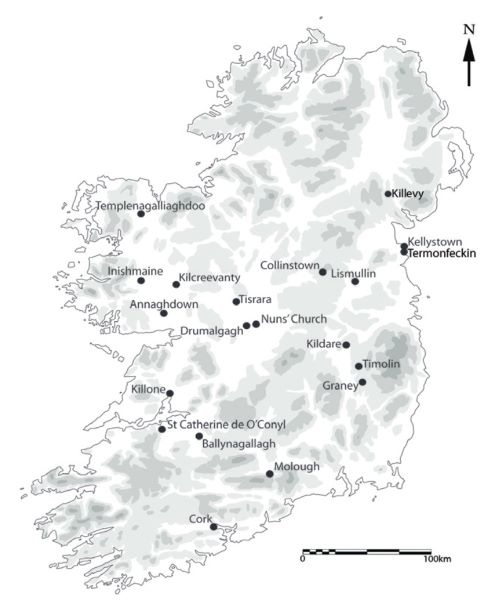
Later medieval Ireland (c.1100–1540) is bracketed by twelfth-century church reform and the sixteenth-century dissolution of the monasteries. Sixty-five nunneries date to this period, twenty-eight of which have some above ground register.2 The historical evidence for them is particularly sparse: ‘looking for traces of medieval women’s activities in medieval Ireland means looking with eyes trained for omissions, ellipses and small clues’.3 Moreover, the archaeological evidence of female monasticism in medieval Ireland does not fit neatly into the categories created for contemporary male religious houses. There is no singular archaeology of female monasticism in Ireland, rather nunneries have used the general ‘vocabulary’ of medieval religious house architecture.4 The majority of nunneries were founded in the twelfth century, Ireland’s period of church and monastic reform.5 Nunneries were founded in subsequent centuries from the thirteenth through to the sixteenth, but numbers were much fewer. This decline should not be perceived as a reduction in nunnery patronage, as many of the earlier foundations continued to exist and thus filled demand in later times. Occasionally nunnery communities were known to have moved location, particularly when they were initially founded at ‘co-located’ sites, or in close proximity to male religious houses.6
Notwithstanding that the affiliation of several nunneries in Ireland remains unknown, the majority were Augustinian of Arroasian observance.7 As in England, Wales or Normandy, nunneries in Ireland had royal, ecclesiastical and lay patrons, founding female houses for a variety of reasons. These sections of society continued to found and support nunneries, sometimes over several generations.8 However, unlike in other regions, female founders were relatively rare in medieval Ireland, with only three clearly associated with nunneries in the historical records: Derbforgaill, the ‘re-builder’ of the Nuns’ church at Clonmacnoise, Co. Offaly, in 1167; Avicia de la Corner, sister of the bishop of Meath, who founded Lismullin, Co. Meath about 1240; and the recluse Agnes de Hareford, instigator of the nunnery at Cork in 1297.9 This is a surprisingly small number and it is postulated that women’s agency in the foundation of nunneries has been masked in records by those of their male relations.10
Theoretical Perspectives
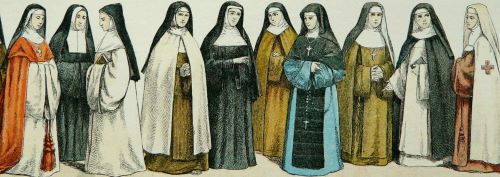
Despite the seminal works of Roberta Gilchrist in engendered monastic archaeology studies,11 nunneries in Ireland until the early 2000s were still considered unworthy of scholarly interest. The perception lingered that they had deviated from the male monastic standard, and were thus somehow inferior to contemporary male religious houses. Furthermore, a relative dearth of historical source material, particularly that produced by female religious communities themselves, has resulted in female monasticism being understudied in Ireland.12 This position has somewhat marginalized nunneries in historical and archaeological narratives of medieval monasticism. Theoretical perspectives in monastic and landscape archaeology were slow to gain traction in Ireland, generally not being considered until the 2000s.13 Like many disciplines, archaeology was eventually transformed by the three waves of feminism and various engendered approaches, though it has been argued that it remains a work in progress.14 Female monasticism is now being critically analysed on its own archaeological merits, and in comparison with a female standard comprising female religious houses elsewhere, so that new ‘angle[s] of vision’15 can be opened up in the exploration of medieval female monasticism in Ireland.
Humanly created and occupied spaces have long been the subject of study.16 Medieval female religious communities constructed specific spaces in which they worshiped and lived. Space would appear to be self-explanatory, but a precise meaning remains elusive.17 Space is a multi-dimensional zone, ‘in which substances, people and objects move’;18 it is ‘neither inert nor neutral, nor is its organization, articulation or the formulation of its boundaries a natural phenomenon. Rather spatial constructs are the historical and cultural products of an age. As metaphors and symbolic systems, they embody the most basic rules and meaning of a culture’.19 Space can be ‘in between’ zones or at interfaces, it can be the expanses of landscape or can be created within structures, it can be physical or metaphysical. Space is no longer considered absolute and empty, and the term ‘place’ is now recognized by some as a better guide to medieval thinking about the lived environment than modern abstract notions of space.20 Furthermore, it can be argued that space is an ordering principle through which human hierarchies are created and maintained.21 As such, space is humanly created and can change over time and location and it can possess various meanings for different individuals or groups. It is a medium through which social relationships are played out, regulated and negotiated, as they are in monasteries.22
Monasticism, despite its ideals and codified behaviour, or habitus, did not operate in a vacuum and other aspects of society, particularly status, shaped how space was formed and used throughout the middle ages.23 Male and female monastic space was also different.24 The codified behaviour within monasteries was formed to some extent of the norms and rules of the hierarchical class-divided society, the social norms of aristocratic men and women, and the treatment they expected from the lower strata.25 Most professed religious men and women are generally thought to have come from this elite background and their learned social norms were carried through into the monastic space.26 Knowing one’s place in medieval society was intrinsic to how all medieval spaces were negotiated.27 The interplay between the enclosed spaces of a nunnery, its religious community, and other necessary individuals within that space is an important theme. This theme is further embodied in notions of public and private spheres of space, which had specific meanings for enclosed nuns.28 Added to this, any archaeological study of space and place must also consider time-depth and stages in the life course.29
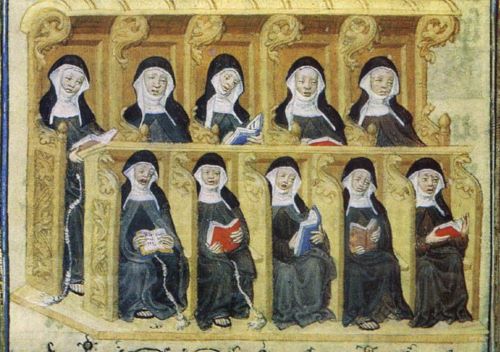
Wider monastic spaces also require consideration in the archaeological study of nunneries. Landscape archaeology is ‘central to the archaeological programme as a whole because the history of human life is about ways of inhabiting the world’,30 and has been described as a domain where the perceived gap between archaeological theory and practice might be bridged.31 A fluid movement between theoretical considerations of the wider landscapes of female monastic communities to the more specific spaces and life courses of individual women religious is required. A medieval woman may have entered a nunnery at any stage in her life – as a young novice, as an adult woman, as a corrodian on an intermittent basis, or as a widow becoming a vowess rather than a fully professed nun. She may have been a professed nun perhaps holding an office, or another member of the nunnery household such as a servant. All these aspects of an individual’s life may be explored through the lens of gender, space and place. Many of the key events in a nunnery, such as entering religious life, taking vows, attending the daily divine office, observing the annual liturgical calendar, or celebrating a patron saint’s feast day, or the birthday or anniversary of a patron, would have been marked through ritual and ceremony in a specific place within the nunnery. Some of these events might be recognized in the archaeological evidence, if the correct research questions can be asked of that data. A broad approach, considering space and place as outlined here, is an ideal perspective from which to ask such new gender-related questions of the archaeological evidence.
Place in the Landscape: Siting
Most nunneries in medieval England are considered isolated in the landscape, their sites deliberately chosen, perhaps, as Gilchrist has suggested, in order to pursue a long-established ascetic eremetic monastic tradition.32 Of the 150 or so nunneries in England and Wales, 125 are considered to be in remote locations and the remaining twenty-five have been described as suburban.33 This distribution was long assumed to be the same in Ireland,34 but recent study has shown that Irish nunneries were for the most part situated in proximity to and sometimes within walled towns, larger unenclosed settlements, castles and, on occasion, male religious houses.35 They did remain apart from other nunneries, but probably as the result of patronage patterns rather than an adherence to a specific distance rule between nunneries. Hall has suggested that proximity to other settlements provided protection for the female religious community, something which was not such a consideration in medieval England, given its relatively less turbulent landscapes.36 However, this is not entirely satisfactory, since a similar pattern is noted in male mendicant houses in Ireland, many of which were located in proximity to the castles of their patrons.
A better explanation might be that these locations were mutually beneficial, the patron providing protection and material support, while enjoying an enhanced reputation as a benefactor with a serious commitment to the Church. Furthermore, there would be a striking juxtaposition of the art and architecture of the aristocratic residences and the more austere aesthetic of the religious foundations.37 Given the family ties of patronage and the physical proximity of many nunneries to their local contemporary communities in medieval Ireland, it can be suggested that their primary function was one of service and interaction with that surrounding community. Likewise, it has been concluded that the minority of English nunneries located in proximity to their patrons were also ‘intended by their founders to interact closely with the local community’.38
Place Reuse: Sacred Spaces
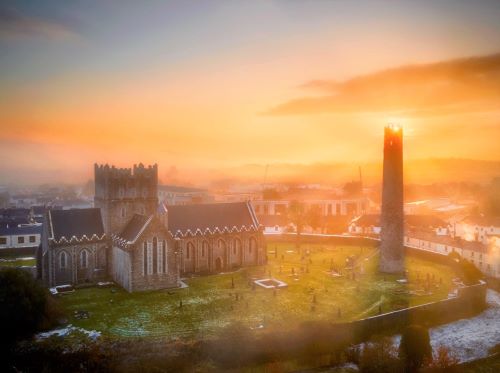
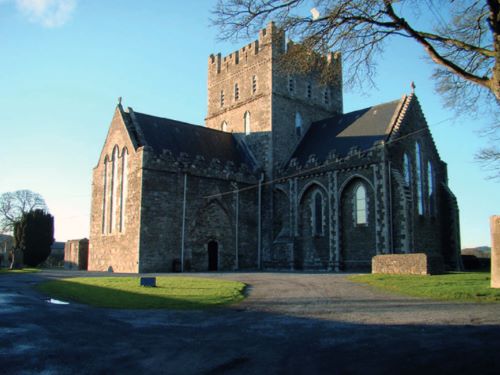
In the case of ten nunneries (Kildare being one), place and sacred space may have been particularly significant as they reused ecclesiastical sites of the early medieval period. In some cases, early fabric was incorporated into later nunnery churches, as at Inishmaine, Co. Mayo and Killevy, Co. Armagh.39 Whether this reuse of place represents a continuity of use over the period of church reform or reoccupation of sites previously abandoned is perhaps a moot point, and it is likely that both scenarios occurred. But regardless of the mechanics of reuse, the fact that older sites were chosen as places for later nunneries is considered important and not merely coincidence. It shows that continuity – or the impression of continuity – of religious use at a place was significant.40 Moreover, nunneries were not established in ‘empty’ landscapes. For example, at St. Catherine’s, Co. Limerick the extant archaeological monuments show that it was in use in the prehistoric and early medieval periods.41 There is a prehistoric megalithic structure and a standing stone in proximity to the nunnery, and finds of prehistoric burials and objects were made there in the nineteenth century.42 It is interesting to postulate that the community of nuns was cognisant of these earlier uses of the landscape. Discovery of early artefacts and monuments on or near medieval sites is usually deemed coincidental due to the preponderance of prehistoric monuments in Ireland generally, but at many later prehistoric and early medieval ecclesiastical and secular sites it has been suggested that the deposition or use of earlier monuments and artefacts was a deliberate act of social memory and ownership.43
Both Augustinian canons and Cistercian monks purposefully reused earlier sites for their foundations, which is interpreted as a way for the religious houses to gain historical currency and rootedness in a particular area.44 The reuse of pagan monuments by Christians could be viewed as a source of kudos, a method of controlling the power of the monuments, or harnessing them to protect a Christian site. But pagan monuments have also been considered dangerous and to be avoided,45 so perhaps the Christian settlements that grew up around them reflected the ascetic nature of some of those foundations – that they put themselves in danger and in the way of temptation in order to test their faith, as Christ did in the desert. The past is particularly important as it defines the self in the present.46 Moreover, the past is frequently represented by things, objects or monuments – ‘objects anchor time’.47 Perhaps it was in this sense that older monuments around the nunnery of St. Catherine’s were perceived by its religious community.48
Organization of Space: Enclosure
Overview
Field surveys of nunneries in Ireland have shown that enclosure was expressed more symbolically than materially in later medieval Ireland, as none of the extant remains provides any evidence of stone precinct walls. This supports Gerald of Wales’s contemporary description of a co-located religious house, likely to be Termonfeckin, Co. Louth (which later became a female-only community), which he described as ‘not with a wall or a ditch but only with hedges made of sharpened stakes and blackthorn’. Elsewhere he described and illustrated a boundary at Kildare as a hedge.49 So it appears that enclosure of religious women may have been symbolic and created within social mores and codified behaviour rather than a physical manifestation in the landscape. Furthermore, while enclosure of medieval female religious has been widely considered to be a severe restriction on their space, imposed by a misogynistic hierarchy, contemporary medieval nuns seem either never to have complained, or to have had their complaints go undocumented. Therefore, the possibility must be considered that religious enclosure may also have been perceived as a positive influence in the lives of individual nuns and the community itself, removing them from the worldly space and helping to forge their spiritual identity.50
Diversity of Form
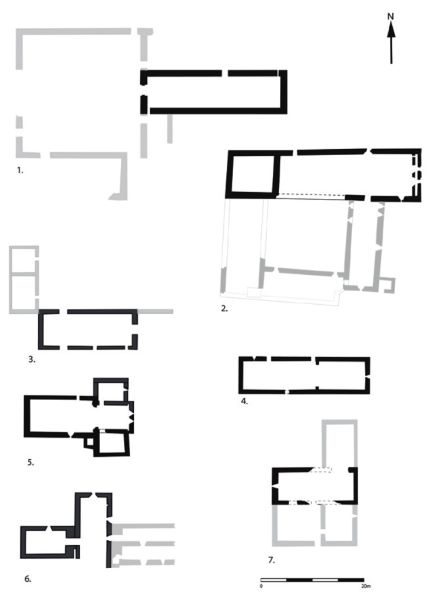
Diversity is the key to understanding space in the archaeology and architecture of nunneries. Variation in nunnery plans in England is considered a defining feature; however, this variation usually occurred within the context of a claustral plan.51 Variety in nunnery layout is also found in Germany where a large proportion of nunneries used non-claustrally planned spaces, termed ‘open systems’.52 In Ireland, research has shown that claustrally arranged medieval nunneries were not the norm, and it can be suggested that perhaps only ten or so nunneries in Ireland ever exhibited a proper claustral plan. Of these, only three are now extant and all exhibit a variety of form within the cloister: Killone, Co. Clare, with a cloister to the south of its church; Molough, Co. Tipperary, with a northern cloister and, most unusually, St. Catherine’s, Co. Limerick, with a cloister at the west end of a projecting church.53 This diversity has been historically considered ‘non-conformance’ to a standard template. This is not just a female phenomenon as variety has long been recognized in male religious architecture, most notably Augustinian.54 It can be concluded that there is no standardization of plan in medieval nunneries in Ireland, on a temporal or regional basis, along filial or ethnic lines, and a range of layouts was adopted and persisted over the course of the period.55
Space in Church
Despite fluid arrangements, the church was maintained as a constant in the nunnery complex.56 The archaeological evidence shows that nunnery churches in later medieval Ireland were aisleless parallelograms, without transepts or structural internal divisions of stone. There is a dearth of direct archaeological evidence for internal differentiation, though it can be postulated that textile and timber screens were used as in England and on the Continent. Archaeological evidence shows that nuns used both the east and west ends of their churches in different periods, sharing the sacred space with clergy and, when parochial, with the laity.57 The use of nunnery churches as parish churches is likely to have had a significant effect on how church space was used, as nuns in this situation not only had to be separated from the priest on the high altar, but also from lay parishioners. Architectural responses to a parochial function varied. The use of west-end galleries by nuns to maintain segregation is a feature common in nunnery churches in Germany, and the nunnery on Iona in Scotland used the same approach; but no such direct evidence for galleries was found in nunnery churches in Ireland.58 At St. Catherine’s, Co. Limerick, recorded as parochial in the fifteenth century, evidence shows that the nuns used the west end of the church, similar to arrangements in some French nunneries. An incised ship, a recognized Christian religious symbol, is located near the west end of the church, perhaps indicating the location of a nun’s altar there, or the location of the parish’s baptismal font.59 There is also some tentative archaeological evidence in Ireland that nunneries may have supported anchorites.60 On this basis it can be suggested that the architectural traditions of nunneries had more in common with those of medieval parish churches than with those of male monastic sites. This may be because nunneries were firmly embedded within their regional and local religious contexts, and further from the national and international male monastic sphere.
The identification of an architectural diversity and fluidity of form in the physical layout of nunneries has placed a much greater emphasis on the nature of ritual and performance, and ‘space as practised place’.61 The spiritual environment of nunneries, the materiality of the buildings themselves and the material culture shaped the habitus of the religious communities: they provided ‘a practical logic and sense of order that is learned unconsciously through the enactment of everyday life’.62 The celebration of the divine office, mass, feast days and the office of the dead, punctuated the lives of nuns and created a daily and seasonal rhythm through regular performance. A claustral plan, or an unshared church were clearly not essential in the creation of this rhythm. Any place where the divine office was celebrated could become imbued with a sacred quality through repetition and performance.
Place in the Landscape: Estates and Hinterlands
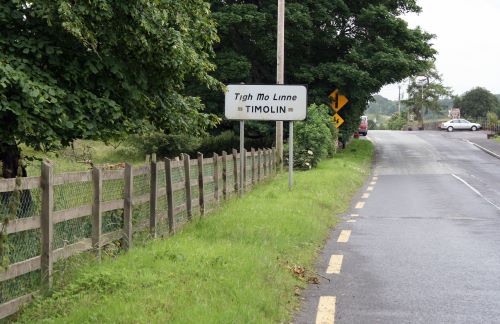
An important and relatively understudied aspect of the medieval ‘nunscape’ is that of estates.63 In order to reach some understanding of how nunneries may have functioned, generated incomes and were sustained over time, it is necessary to look into their hinterland. It must not be forgotten that the nuns themselves came from this wider medieval world and had family connections which bound them to it.64 Historical evidence has shown that prioresses forged and maintained important relationships with the outside world, balancing the needs of their religious and local communities.65 Like male religious houses, nunneries held temporalities and spiritualities in the form of real estate, rights and benefices, as a means of continued support. Nunneries received modest endowments from patrons and benefactors from the outset in comparison to their male counterparts, and it can be inferred that they had different expectations of male and female religious houses.66 In particular, nunneries were not required by their patrons to be self-sufficient in the way expected of male religious houses.67 Traditional historical accounts have characterized nunnery communities as being incompetent in their role as estate managers, due to non-consolidation of lands, poor management and extravagance,68 and these are but a few of the reasons used to explain the relative poverty of nunneries.69 More nuanced discussions of the economic status of nunneries are emerging which challenge the traditional narrative.70 Poverty may have been an ascetic choice for nunnery communities as a method of living out their spiritual ethos and vows, rather than a symptom of mismanagement.71 Nunnery estates do compare favourably with smaller male religious houses, and in some cases, such as Timolin, Co. Kildare, were valued higher than most of the other religious houses in the county at the Dissolution.72 Nunneries’ holdings were considered in the past to have been dispersed and therefore unproductive. But this was not always the case. When they can be mapped, the holdings often form discrete parcels of land, or are relatively close to the nunnery complex. It can also be argued that nunnery-held land was productive in other ways, rather than just through tillage, and thus there may have been no necessity for tightly consolidated lands. The holdings of some nunneries may also reflect that they had benefactors in far-flung places, although we cannot confirm this by looking at records, as givers’ names and their reason for providing an endowment are now lost.
Studies of nunnery estates usually form part of wider analyses,73 and to date there have been relatively few studies in Ireland.74 However, they have all highlighted immediate limitations. Most obviously, the documentary evidence is incomplete and it is likely that the total holdings of a nunnery were never recorded, are now lost, or changed substantially over time.75 The names of places may illuminate nunnery estates, however, and assist in realising their archaeological signature, a resource that has proven useful in identifying monastic estate features in Britain, but has been under used in Ireland.76 For example, rabbit warrens are among a range of indicators for monastic sites,77 and their presence is associated with place names such as burg, burrow, buries, coning-erth or conygarth.78 This proves useful in an Irish context too, where we find names such as ‘Snugburrow townland’ – situated near the holdings of the nunnery of Timolin.79 Other specifically Irish place names may indicate female religious activity in an area. The word Calliagh or Cailleach and its many derivatives, originating in the Irish for ‘veiled one’, has been long accepted as relating to females and particularly nuns or old/wise women,80 and so place names incorporating these derivatives are commonly directly associated with nunneries.81 For instance, the Irish name for St. Catherine’s, Co. Limerick is Monasternagalliaghdubh, or the monastery of the black nuns, recalling the black habit of the Augustinians. Sometimes there are no known links between places that have names containing derivatives relating to nuns, but we can assume they were once held by a nunnery. For example, the village of Ballycally in Co. Clare, which is locally thought of as ‘town of the nuns’, has no documented historical connection to Killone, but on the basis of its name might be suggested to have had an association with it at one time.82
An important aspect of nunnery estates and indeed religious houses in general, is that they were an intrinsic part of the wider settlement landscape, particularly in those regions of Ireland under Anglo-Irish influence. This has been described as a manorialized landscape in which features associated with lordship and symbols of seigneurial power have been identified such as dovecotes, rabbit warrens, fishponds and deerparks, which together form elite ‘landscapes of lordship’.83 The settlement pattern in the Anglo-Irish-controlled parts of Ireland was in many ways similar to that of England, although a diversity and complexity particular to medieval settlement in Ireland can be identified.84 Manors were created around masonry and earthwork castles which were employed for defence and administration. Farming was carried out at many of them.85 Other archaeologically identified settlement types include walled towns, unenclosed villages (deserted medieval villages), rural boroughs, dispersed defended farmsteads such as moated sites, and unenclosed house clusters. In addition, field systems have been identified in the settlement pattern.86 All of these archaeological features can be associated with the corpus of later medieval nunneries in Ireland. Furthermore, the extant dissolution surveys of several nunneries list various customs due from tenants, which included, for example, the number of days weeding or ploughing, gallons of beer from each brewing and hens at Christmas, showing how the nunneries used their hinterlands and interacted with the wider society.87
Conclusions
Researchers in archaeology and related fields are now looking at different forms of monasticism and teasing out sometimes key contrasts between and within, the various religious orders, so much so that the term ‘medieval monasticisms’ is gaining currency.88 Female monasticism, can be regarded as innovative in its fluid approaches to following that particular way of religious life. As Gilchrist’s engendered approach to medieval nunneries in England has long shown, nunneries were not deviant to a male standard – nunneries were different, having different purposes from male religious houses, and being distinctly local in character. Furthermore, all medieval nunneries, in themselves, were not the same. Despite Gilchrist’s seminal research, there is still much to study. The challenge remains to acknowledge and identify differences between male and female houses, and indeed between female houses, by asking new questions of the evidence and opening fresh debates. This chapter demonstrates that nunnery spaces were not uniform; they differed in size and flexibility of layout and use. Nunneries were usually sited near contemporary settlements of various types and, unlike in medieval England, were found within walled towns. Their precinct boundaries were in the main not of stone and were not for exclusion, but rather demarcation. Nunneries did not always use – and one could argue rarely used – a fully developed claustral plan; perhaps a claustral plan was not considered essential. Medieval nunnery architecture and archaeology in Ireland indicates diversity of form, which is similar to that found elsewhere.
Nunneries had estates, which clearly impacted upon the landscape, though they continue to be a vastly understudied archaeological resource. These estates were formed of temporal and spiritual holdings which were managed over a considerable period of time. Holdings were not static, but probably grew and contracted throughout the life of the nunnery. Where the evidence is available, nunneries’ wealth compares favourably with that of smaller male religious houses. Where nunneries were the place of the parish church, they were enmeshed in parish pastoral care, providing church services, the sacraments of baptism and last rites, as well as a place for burial and remembrance. In several cases, these were in addition to services provided to the local population, such as almsgiving and education.89 These relationships were reciprocal, the nunneries in return getting support from the local population through patronage and benefaction, tenants working on the land, and trade. The use of space within female monastic complexes, by the nuns and other groups, transformed these spaces, through performance and routine, into special places in which to worship, work and live. Overall, the evidence shows that nunneries were important, making their ‘nunscapes’ a constituent part of the fabric of medieval society at a particularly local level.
Endnotes
- It could be argued that the archaeological study of female religious is in a ‘post-gender’ phase, with considerations such as landscape now predominating: M. Johnson, Ideas of Landscape (Oxford, 2007).
- See T. Collins, ‘An archaeological perspective on female monasticism in the middle ages in Ireland’, in Women in the Medieval Monastic World, ed. J. Burton and K. Stöber (Turnhout, 2015) pp. 229–51.
- D. Hall, Women and the Church in Medieval Ireland c.1140–1540 (Dublin, 2003), p. 16.
- T. O’Keeffe, Medieval Irish Buildings 1100–1600 (Dublin, 2015), pp. 101–83.
- Some 31 nunneries date to this period (T. Collins, ‘Transforming women religious? Church reform and the archaeology of female monasticism’, in Monastic Europe: Medieval Communities, Landscapes and Settlements, ed. E. Bhreathnach, M. Krasnodębska Daughton and K. Smith (Turnhout, forthcoming); M. T. Flanagan, The Transformation of the Irish Church in the Twelfth Century (Woodbridge, 2010)).
- Co-located houses were where religious women and men lived in close proximity and may have shared facilities. In Ireland, they do not appear to have used the double-house arrangement of twin cloisters known elsewhere, and so they have been termed co-located to differentiate them. Co-located houses have been described as monastic experiments, many of which appear to have been unsuccessful (Flanagan, The Transformation, pp. 150–4).
- P. Dunning, ‘The Arroasian order in medieval Ireland’, Irish Historical Studies, iv (1945), 297–315.
- K. Stöber, Late Medieval Monasteries and their Patrons: England and Wales c.1300–1540 (Woodbridge, 2007), p. 29; L. V. Hicks, Religious Life in Normandy 1050–1300: Space, Gender and Social Pressure (Woodbridge, 2007).
- J. Ní Ghradaigh, ‘But what exactly did she give? Derbforgaill and the nuns’ church at Clonmacnoise’, in Clonmacnoise Studies 2, ed. H. King (Dublin, 2003), pp. 175–207; A. Gywnn and R. Hadcock, Medieval Religious Houses Ireland (Dublin, 1970), pp. 315, 322.
- S. Thompson, Women Religious: the Founding of English Nunneries After the Norman Conquest (Oxford, 1991).
- R. Gilchrist, Gender and Material Culture: the Archaeology of Religious Women (1994) and Contemplation and Action: the Other Monasticism (1995). Gilchrist has proven that the comparison of nunneries with male houses is unjust; nunneries did not have the same functions as male houses, and therefore any direct comparison is otiose.
- J. Burton, Monastic and Religious Orders in Britain 1000–1300 (Cambridge, 1994), p. 85; Hall, Women and the Church, pp.16–20.
- E.g., T. O’Keeffe, Romanesque Ireland (Dublin, 2003); T. Ó Carragáin, Churches in Early Medieval Ireland (New Haven, Conn., 2010).
- E.g., R. Gilchrist, ‘Women’s archaeology? Political feminism, gender theory and historical revision’, Antiquity, lxv (1991), 495–501; R. Preucel and I. Hodder, Contemporary Archaeology in Theory: a Reader (Oxford, 1996), p. 416; J. Bennett, ‘Medievalism and feminism’, in Studying Medieval Women, ed. N. Partner (Cambridge, Mass., 1993), pp. 7–29, at p. 25; S. Nelson, Gender in Archaeology (Walnut Creek, Calif., 2004), p. 158.
- A. Wylie, ‘The interplay of evidential constraints and political interest: recent archaeological research on gender’, American Antiquity, lvii (1992), 15–35.
- P. Bourdieu, Distinction: a Social Critique of the Judgement of Taste (1979); P. Bourdieu, The Logic of Practice (Cambridge, 1990); M. de Certeau, The Practice of Everyday Life (Berkeley, Calif., 1984); M. Foucault, Discipline and Punish: the Birth of the Prison (New York, 1977); B. Hillier and J. Hanson, The Social Logic of Space (Cambridge, 1984); H. Lefebvre, The Production of Space, trans. D. Nicholson-Smith (Oxford, 1991, orig. 1974); D. Massey, Space, Place, and Gender (Minneapolis, Minn., 1994).
- Y. Tuan, Space and Place: the Perspective of Experience (1977); E. Casey, ‘Place in landscape archaeology: a western philosophical prelude’, in Handbook of Landscape Archaeology, ed. B. David and J. Thomas (Walnut Creek, Calif., 2008), pp. 44–50.
- E. De Paermentier, ‘Experiencing space through women’s convent rules: the Rich Clares in medieval Ghent’, Medieval Feminist Forum, xliv (2008), 53–68, at p. 54.
- J. Schulenberg, ‘Gender, celibacy and proscriptions of sacred space: symbol and practice’, in Women’s Space Patronage: Place and Gender in the Medieval Church, ed. V. C. Raguin and S. Stanbury (Albany, N.Y., 2005), pp. 185–205, at p. 185.
- K. Biddick, ‘Genders, bodies, borders: technologies of the visible’, in Partner, Studying Medieval Women, pp. 87–116; B. Hanawalt and M. Kobialka, Medieval Practices of Space (2000), p. xii; A. Müller, ‘Symbolic meanings of space in female monastic tradition’, in Women in the Medieval Monastic World, ed. J. Burton and K. Stöber (Turnhout, 2015), pp. 299–326.
- Bourdieu, Distinction; Hanawalt and Kobialka, Medieval Practices.
- R. Gilchrist, ‘Community and self: perceptions and use of space in medieval monasteries’, Scottish Archaeological Review, vi (1989), 55–64, at p. 55; M. Cassidy-Welch, Monastic Spaces and their Meanings: Thirteenth-Century English Cistercian Monasteries (Turnhout, 2001), pp. 2–12; J. Kerr, Life in the Medieval Cloister (2009), pp. 20–37.
- M. Mersch, ‘Programme, pragmatism and symbolism in mendicant architecture’, in Self-Representation of Medieval Religious Communities: the British Isles in Contexti, ed. A. Müller and K. Stöber (Berlin, 2009), pp. 143–66.24 Müller, ‘Symbolic meanings’, p. 302.
- Gilchrist, Gender and Material Culture, p. 152.
- C. H. Lawrence, Medieval Monasticism (Harlow, 2001), pp. 217–18; D. Hall, ‘Necessary collaborations: religious women and lay communities in medieval Ireland c.1200–1540’, in Irish Women’s History, ed. A. Hayes and D. Urquhart (Dublin, 2004), pp. 15–28, at p. 25; G. Kenny, Anglo-Irish and Gaelic Women in Ireland c.1170–1540 (Dublin, 2007), p. 170. For an alternative view, that nuns did not come from the aristocratic classes in certain regions, see B. Harris, ‘A new look at the Reformation: aristocratic women and nunneries 1450–1540’, Jour. British Studies, xxxii (1993), 89–113; M. Oliva, ‘Aristocracy or meritocracy? Office holding patterns in late medieval English nunneries’, Studies in Church History, xxvii (1990), 197–208.
- R. Gilchrist, Gender and Archaeology: Contesting the Past (1999), pp. 113–18; R. Gilchrist, Medieval Life, Archaeology and the Life Course (Woodbridge, 2012), pp. 68–113.
- R. H. Britnell, Britain and Ireland 1050–1530: Economy and Society (Oxford, 2004), pp. 7–70.
- De Paermentier, ‘Experiencing space’, p. 53.
- Gilchrist, Medieval Life.
- J. C. Barrett, ‘Chronologies of landscape,’ in The Archaeology and Anthropology of Landscape, ed. P. Ucko and R. Layton (1999), pp. 21–30, at p 30.
- W. Ashmore, ‘Social archaeologies of landscape’, in A Companion to Social Archaeology, ed. L. Meskell and R. W. Preucel (Oxford, 2007), pp. 255–71, at p. 255.
- Gilchrist, Contemplation, p. 155.
- J. Bond, ‘Medieval nunneries in England and Wales: buildings, precincts and estates’, in Women and Religion in Medieval England, ed. D. Wood (Oxford, 2003), p. 54.
- Bond, ‘Medieval nunneries’, pp. 46–90, at p. 54.
- T. Collins, ‘Isolated in the wilderness? An archaeological exploration of nunneries in the later medieval landscape of Ireland’, in Church and Settlement in Ireland, ed. M. Stout and J. Lyttleton (Dublin, 2018), pp. 142–56.
- Hall, Women and the Church, p. 94.
- C. Ó Clabaigh, The Friars in Ireland 1224–1540 (Dublin, 2012), pp. 205–7.
- Gilchrist, Contemplation, p. 155.
- In some instances, early medieval ecclesiastical male sites were refounded as nunneries, as at Inishmaine, Co. Mayo.
- A. Abram, ‘Augustinian canons and the survival of cult centres in medieval England’, in The Regular Canons in the British Isles, ed. J. Burton and K. Stöber (Turnhout, 2011), pp. 79–96.
- D. J. Meltzer, ‘Lessons in landscape learning’, in Colonisation of Unfamiliar Landscapes: the Archaeology of Adaptation, ed. M. Rockman and J. Steele (2003), pp. 222–41, at pp. 223–5.
- J. Wardell, ‘The history and antiquities of St. Catherine’s Old Abbey, County Limerick (with a description of the conventual buildings by T. J. Westropp)’, Jour. of the Royal Society of Antiquaries of Ireland, xiv (1904), 41–64, at pp. 52–3.
- S. Semple, Perceptions of the Prehistoric in Anglo-Saxon England: Religion, Ritual and Rulership in the Landscape (Oxford, 2013); S. Driscoll, ‘Picts and prehistory: cultural resource-management in early medieval Scotland’, World Archaeology, xxx (1998), 142–58; S. Foot, ‘What was an early Anglo-Saxon monastery?’, in Monastic Studies: the Continuity of Tradition, ed. J. Loades (Bangor, 1990), pp. 48–57; M. E. Meredith-Lobay, ‘Memory, landscapes and the early historic monasteries of Scotland’, Archaeological Review from Cambridge, xx (2005), 97–110; M. Carver, ‘Early Scottish monasteries and prehistory: a preliminary dialogue’, Scottish Historical Review, lxxxviii (2009), 332–51; Ó Carragáin, Churches, pp. 143–9, 156–7; E. Bhreathnach, Ireland in the Medieval World AD 400–1000: Landscape, Kingship and Religion (Dublin, 2014), pp. 131–48.
- G. Carville, The Occupation of Celtic Sites in Medieval Ireland by the Canons Regular of St. Augustine and the Cistercians (Kalamazoo, Mich., 1982).
- Semple, Perceptions of the Prehistoric. The prehistoric stone circle deliberately avoided by the early medieval ecclesiastical enclosures around Armagh could be perceived in this way: Ó Carragáin, Churches, p. 157.
- R. Bradley, ‘Time regained: the creation of continuity’, Jour. of the British Archaeological Association, cxl (1987), 1–17; R. Bradley, The Past in Prehistoric Societies (2002); S. Alcock, Archaeologies of the Greek Past: Landscape, Monuments and Memories (Cambridge, 2002).
- Tuan, Space and Place, p. 187.
- Within a 2km radius of the nunnery itself there are no fewer than 44 recorded enclosures, two castles (now no longer extant) and more than five prehistoric monuments.
- Giraldus Cambrensis’ Speculum Ecclesie, trans. B. Golding (Oxford, forthcoming); T. Wright, Giraldus Cambrensis: the Topography of Ireland, trans. T. Forester (Ontario, 2000).
- T. Collins, ‘Archaeologies of female monasticism in Ireland’, in Becoming and Belonging in Ireland AD c.1200–1600: Essays in Identity and Cultural Practice, ed. E. Campbell, E. FitzPatrick and A. Horning (Cork, 2018), pp. 69–87.
- R. Gilchrist, ‘The archaeology of medieval English nunneries: a research design’, in The Archaeology of Rural Monasteries, ed. R. Gilchrist and H. Mytum (B.A.R. British Series 203, Oxford, 1989), pp. 251–7, at p. 255.
- C. Mohn, Mittelalterliche Klosteranlagen der Zisterzienserinnen: Architektur der Frauenkloster im mitteldeutschen Raum (Petersberg, 2006).
- Kilcreevanty, Co. Galway might be added to this list but it is now very difficult to confirm in the field.
- D. M. Robinson, ‘The Augustinian canons in England and Wales: architecture, archaeology and liturgy 1100–1540’, Monastic Research Bulletin, xviii (2012), 2–29; T. O’Keeffe, ‘Augustinian regular canons in twelfth- and thirteenth-century Ireland: history, architecture and identity’, in Burton and Stöber, Regular Canons in the Medieval British Isles, pp. 469–84.
- In addition to the claustral layouts, smaller churches with attached or unattached domestic accommodation were used, e.g. Annaghdown, Co. Galway; Inishmaine, Co. Mayo; and Tisrara and Drumalgagh, Co. Roscommon.
- For an overview, see V. Raguin and S. Stanbury, Women’s Space: Patronage, Place and Gender in the Medieval Church (New York, 2005).
- In a Gaelic Irish context, pastoral ministry was quite often provided at religious houses: E. FitzPatrick, ‘The material world of the parish’, in The Parish in Medieval and Early Modern Ireland: Community, Territory and Building, ed. E. FitzPatrick and R. Gillespie (Dublin, 2006), pp. 62–78, at p. 72. Several nunneries in England were established at parish churches: Gilchrist, Gender and Material Culture, p.124. In Ireland several nunnery churches became parochial sometime after foundation, reversing the trend recorded in England for the establishment of nunneries at pre-existing parish centres. This difference in region is probably due to the slower processes of parish formation in Ireland, or changes in parish structure and division over time.
- Mohn has recorded nuns’ choirs in almost every location possible within the church space and M. Untermann agrees with this conclusion: C. Mohn, Mittelalterliche Klosteranlagen; M. Untermann, ‘The place of the choir in churches of female convents in the medieval German kingdom’, in Burton and Stöber, Women in the Medieval Monastic World, pp. 327–53, at p. 348. There is also evidence to suggest that nuns may have had more than one dedicated space in shared nunnery churches, e.g. the Franciscan double house of Königsfelden in Switzerland: C. Jäggi, ‘Eastern choir or western gallery? The problem of the place of the nuns’ choir in Koenigsfelden and other early mendicant nunneries’, Gesta, xl (2001), 79–93, at p. 82.
- T. Collins, ‘Missing the boat …’, Archaeology Ireland, xxiv (2010), 9–11; M. Gardiner, ‘Graffiti and their use in late medieval England’, in Arts and Crafts in Medieval Rural Environment. Ruralia 6, ed. J. Klapste and P. Sommer (Prague, 2007), pp. 265–76.
- St. Catherine’s, Co. Limerick and the small church at Templenagallidoo, Co. Mayo both retain features that may indicate the presence of an anchorite, though neither is historically recorded as anchorholds. For historical references of anchorites in medieval Ireland, see C. Ó Clabaigh, ‘Anchorites in late medieval Ireland’, in Anchoritic Traditions of Medieval Europe, ed. L. Herbert McAvoy (Woodbridge, 2010), pp. 153–77.
- A. Müller, ‘Presenting identity in the cloister: remarks on benedictine and mendicant concepts of space’, in Müller and Stöber, Self-representation of Medieval Religious Communities, p. 169.
- Gilchrist, Gender and archaeology, p. 81; Hicks, Religious Life, p. 206.
- The broad study of historic settlement in later medieval Ireland still remains largely unproblematized, despite important publications on various aspects. E.g., K. O’Conor, The Archaeology of Medieval Rural Settlement in Ireland (Dublin, 1998); C. Corlett and M. Potterton, Rural Settlement in Medieval Ireland (Dublin, 2009); T. Barry, A History of Settlement in Ireland (2002). Themes within ‘historic settlement’ tend to be studied in isolation of each other and there is little exploration of interfaces and interactions, but see, as an exception, M. Murphy and M. Potterton, The Dublin Region in the Middle Ages (Dublin, 2010).
- P. Johnson, Equal in Monastic Profession: Religious Women in Medieval France (Chicago, Ill., 1991), pp. 248–53; P. Lee, Nunneries, Learning and Spirituality in Late Medieval English Society: the Dominican Priory of Dartford (York, 2001), pp. 57–8; Kenny, Anglo-Irish and Gaelic Women in Ireland, p. 170.
- Lee, Nunneries, pp. 57–108; K. Perkins-Curran, ‘“Quhat say ye now, my lady priores? How have ye usit your office, can ye ges?” Politics, power and realities of the office of a prioress in her community in late medieval Scotland’, in Monasteries and Society in the British Isles in the Later Middle Ages, ed. J. Burton and K. Stöber (Woodbridge, 2008), pp. 124–41.
- Stöber, Late Medieval Monasteries, pp. 1–8.
- Gilchrist, Gender and Material Culture, p. 44.
- E. Power, Medieval English Nunneries c.1275 to 1535 (Cambridge, 1922), pp. 203–12; M. Oliva, The Convent and the Community in Late Medieval England: Female Monasteries in the Diocese of Norwich 1359–1540 (Woodbridge, 1998), p. 99.
- D. Knowles, The Religious Orders in England (3 vols., Cambridge, 1948, 1955, 1959).
- E.g., J. Burton, The Yorkshire Nunneries in the Twelfth and Thirteenth Centuries (York, 1979), pp. 17–27; J. Burton, ‘Looking for medieval nuns’, in Burton and Stöber, Monasteries and Society, pp. 113–23; Bond, ‘Medieval nunneries’, pp. 77–86; E. Jamroziak, The Cistercian Order in Medieval Europe 1090–1500 (2013), pp. 124–55; C. Berman, ‘Medieval monasticisms’, in The Oxford Handbook of Medieval Christianity, ed. J. Arnold (Oxford, 2014), pp. 337–95.
- Gilchrist, Gender and Material Culture, p. 44.
- M. A. Lyons, ‘Revolt and reaction: the Geraldine rebellion and monastic confiscation in Co. Kildare’, Jour. County Kildare Archaeological Society, xviii (1992–3), 39–60.
- E.g., Power, Medieval Nunneries; Burton, Yorkshire Nunneries; D. K. Coldicott, Hampshire Nunneries (Chichester, 1989); Gilchrist, Gender and Material Culture, pp. 69–91; B. Kerr, Religious Life for Women c.1100–c.1350: Fontevraud in England (Oxford, 1999); Bond, ‘Medieval nunneries’, pp. 77–86; Perkins-Curran, ‘“Quhat say ye now”’, pp. 126–9; J. Bezant, Medieval Welsh Settlement and Territory: Archaeological Evidence from a Teifi Landscape (B.A.R. British Series 487, Oxford, 2009).
- J. Otway-Ruthven, ‘The medieval church lands of County Dublin’, in Medieval Studies Presented to Aubrey Gwynn, ed. J. A. Watt, J. B. Worrall and F. X. Martin (Dublin, 1961), pp. 54–73; G. Carville, The Impact of the Cistercians on the Landscape of Ireland (Wicklow, 2002), pp. 245–50; Hall, Women and the Church, pp. 148–9, 153; G. Carville, ‘St. Mary’s Abbey Graney: to live an apostolic life’, Jour. Kildare Archaeological Society, xx (2011), 33–56, at pp. 41–9; T. Collins, ‘Timolin: a case study of a nunnery estate in later medieval Ireland’, Anuario de Estudios Medievales, xliv (2014), 51–80.
- Hall has tracked holdings of 23 nunneries through the Irish historical documents. None is complete, and many nunneries have no extant records: D. Hall, Women and Religion in Late Medieval Ireland (unpublished thesis, 2000), pp. 357–83. The writer is very grateful to Dianne Hall for providing this data and permission to use it.
- Although its potential has been recently highlighted: G. Stout, ‘The Cistercian grange: a medieval farming system’, in Agriculture and Settlement in Ireland, ed. M. Murphy and M. Stout (Dublin, 2015), pp. 28–68, at pp. 28–30.
- Archaeological indicators of monastic estates include: granges; mills; dovecotes; fishponds; warrens; parks, gardens and woodland; wayside crosses; tanneries; stone and millstone quarries; mines or workings of coal or lead; production of ceramic tiles; production of bricks and glass; iron manufacture and working; bell production; salt panning; clay pits; urban property; markets; fairs; and rights and customs. See S. Moorhouse, ‘Monastic estates: their composition and development’, in Gilchrist and Mytum, Archaeology of Rural Monasteries, pp. 29–81.
- Moorhouse, ‘Monastic estates’, p. 65.
- Collins, ‘Timolin’, pp. 62–3.
- M. Ní Dhonnchadha ‘Caillech and other terms for veiled women in medieval Irish texts’, Éigse, xxviii (1994), 71–96; G. Ó Crualaoich, The Book of the Cailleach: Stories of the Wise-Woman Healer (Cork, 2003), pp. 81–2.
- E.g., Templenagalliaghdoo or Ballynagallagh. Sometimes this association is obscured through translation, such as at townlands like Collinstown or Kellystown.
- See <http://logainm.ie?Viewer.aspx?text=Ballycally&streets=yes> [accessed 19 July 2017].
- M. Murphy and K. O’Conor, ‘Castles and deerparks in Ireland’, Eolas, i (2006), 53–70, at p. 53; M. Murphy, ‘Manor centres, settlement and agricultural systems in medieval Ireland, 1250–1350’, in Murphy and Stout, Agriculture and Settlement in Ireland, pp. 69–100.
- O’Conor, Rural Settlement, p. 109; T. Barry ‘Rural settlement in medieval Ireland’, in Barry, A History of Settlement in Ireland, pp. 110–23, at pp. 112–18.
- O’Conor, Rural Settlement, pp. 17–39.
- O’Conor, Rural Settlement, pp. 57–71.
- N. B. White, Extents of Irish Monastic Possession 1540–41: Manuscripts held in the Public Record Office, London (Dublin, 1943).
- Berman, ‘Medieval monasticisms’, p. 337.
- For other duties undertaken by female religious, such as hospital care, and contemporary attitudes to their roles, see P. Byrne and S. Sweetinburgh’s chapters in this volume.
Chapter 2 (25-43) from Gender in Medieval Places, Spaces and Thresholds, edited by Victoria Blud, Diane Heath, and Einat Klafter (University of London Press, 01.03.2019), published by OAPEN under the terms of a Creative Commons Attribution-NonCommercial-NoDerivatives 4.0 International license.
About the Author