Aztec warfare joined strategy, tribute, diplomacy, sacrifice, and divination in a sacred political order that shaped how Mexica rulers prepared for war and judged its results.

By Matthew A. McIntosh
Public Historian
Brewminate
Introduction: When the Gods Went to War
Before a Mexica army advanced beyond the causeways of Tenochtitlan, war had already begun in palaces, temples, marketplaces, tributary communities, and allied cities. Rulers considered grievances and opportunities; experienced warriors discussed an enemy’s strength; merchants and messengers carried intelligence across imperial frontiers; tribute officials calculated provisions; priests performed rites and interpreted the qualities of the approaching days. Weapons had to be assembled, food accumulated, porters assigned, allied contingents summoned, and roads selected. Envoys might first be sent to demand submission, renewed tribute, or redress for an injury, allowing the intended target to yield before armies were committed. Ceremonies placed these practical preparations within a sacred order. Incense rose before divine images, offerings acknowledged obligations to patron gods, and calendrical specialists evaluated whether the moment was favorable for a dangerous undertaking. The surviving descriptions do not demonstrate that every campaign followed an identical sequence or that a single unfavorable sign automatically canceled an offensive. They do reveal a political culture in which military action was rarely understood as an exclusively secular decision. Warfare emerged from the combined work of rulers, priests, commanders, merchants, diplomats, tributaries, and gods. By the time warriors assembled beneath feathered standards and heard the drums announcing departure, the campaign had been framed not merely as an act of state power but as an undertaking whose legitimacy depended upon its place within a larger moral, historical, and cosmic order.
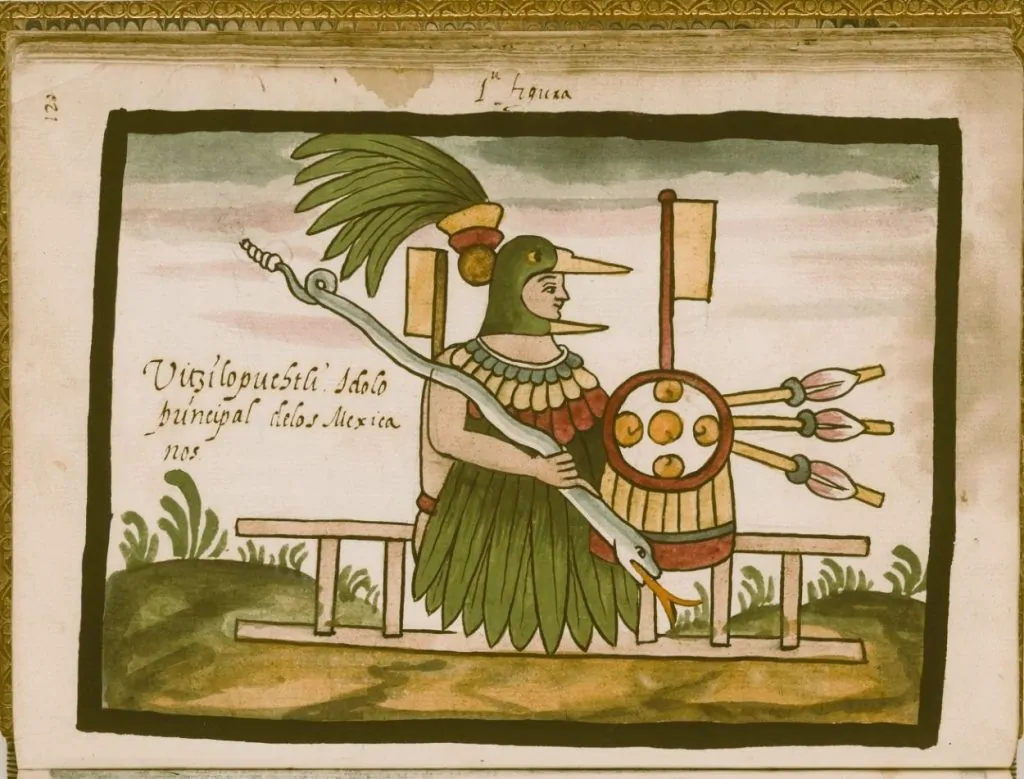
At the center of this sacred conception of warfare stood Huitzilopochtli, the patron deity whose commands were said to have guided the Mexica through migration and whose victories supplied Tenochtitlan with a mythic model of conquest. Sacred histories remembered the Mexica not simply as settlers who had seized an island and constructed a powerful city, but as a chosen people led toward a promised destination by a warrior god. Huitzilopochtli’s birth at Coatepec, where he emerged fully armed and defeated Coyolxauhqui and her allies, presented combat as an event embedded in the structure of the cosmos itself. The ceremonial landscape of Tenochtitlan transformed that story into architecture, ritual, and public memory: the Templo Mayor joined the cults of Huitzilopochtli and Tlaloc, linking war, sacrifice, rainfall, agricultural fertility, and political authority at the symbolic center of the capital. Yet the sacred meaning of warfare should not be reduced to the familiar proposition that the Mexica fought simply to acquire victims whose blood would “feed the sun.” Campaigns secured tribute, defended trade routes, punished rebellion, intimidated rivals, advanced dynastic ambitions, and strengthened the authority of rulers and noble houses. Religious obligation and imperial interest were not competing explanations from which the historian must select one as genuine. They belonged to the same system. Tribute supported temples and armies; captured warriors brought prestige to their captors and victims to public ceremonies; military victory demonstrated the ruler’s competence while confirming the apparent favor of the gods. The cosmic and political dimensions of warfare reinforced one another precisely because Mexica society did not recognize the modern analytical boundary that separates religion from government, economics, and military strategy.
Reconstructing this system is difficult because nearly all detailed written accounts of Mexica warfare and religion were produced during the decades after the Spanish conquest. The Florentine Codex, compiled by Bernardino de Sahagún with Nahua scholars and informants, preserves extensive Nahuatl testimony but does so within a Franciscan project intended partly to expose and eradicate Indigenous religious practices. Diego Durán drew upon Indigenous informants, pictorial histories, and texts that no longer survive, yet he interpreted what he learned through the moral categories of a Dominican friar convinced that demonic deception lay beneath Indigenous worship. The Codex Mendoza, probably created in the early 1540s by Indigenous painters working for colonial patrons, records conquests, tributary obligations, military education, social advancement, and daily customs, but it likewise represents the preconquest past through the political needs and intellectual conventions of early New Spain. These sources cannot simply be rejected as colonial fabrications, since they preserve information unavailable anywhere else, nor can they be read as transparent transcripts of life before 1519. Accounts of divine commands, elaborate diplomatic protocols, favorable days, and ominous signs may combine remembered practice, idealized political order, regional tradition, and retrospective explanation. The famous omens said to have preceded the arrival of the Spaniards demonstrate the danger particularly well: they reveal how Nahua and Spanish narrators understood catastrophe after it occurred, but they do not necessarily provide an unaltered record of decisions made before the invasion. A critical history must take Indigenous religion seriously without treating every colonial description as literal, timeless, or universally applicable.
Myth, divination, ritual, diplomacy, intelligence, logistics, and battlefield action formed interdependent parts of the Mexica military organization. Divine approval was not normally a single message delivered by Huitzilopochtli, nor was divination a mechanical procedure through which priests discovered an unambiguous command to fight or remain at peace. Sacred authorization was an interpretive process. Calendrical signs identified dangers and possibilities; dreams and unusual events acquired meaning through priestly and political interpretation; ceremonies transformed material preparation into legitimate collective action; diplomatic warnings portrayed conquest as a response to defiance rather than unprovoked aggression; and victory retrospectively confirmed the judgment of rulers and ritual specialists. These practices did not remove uncertainty. They organized it. They gave leaders a language through which to assess risk, distribute responsibility, justify violence, and explain success or failure. The strongest challenge to this interpretation is that religion may have functioned primarily as an ideology through which elites concealed the economic and political purposes of expansion. That challenge must be taken seriously, for Mexica warfare enriched rulers, sustained noble privilege, supplied tribute, and coerced subject communities. Nevertheless, treating religious claims as nothing more than propaganda imposes another artificial separation upon the evidence, assuming that material interest was real while sacred conviction was merely instrumental. Mexica leaders could calculate supplies, exploit political divisions, and seek tribute while genuinely understanding their actions as obligations within a divinely animated universe. The gods did not march separately from the army. They supplied the history, symbols, expectations, and rituals through which the army’s purpose became intelligible.
Triple Alliance: Defining the Political World of War

The word “Aztec” is useful, but it can also conceal the political and cultural diversity of central Mexico before the Spanish invasion. The people who ruled Tenochtitlan ordinarily identified themselves more specifically as Mexica, while their close relatives in neighboring Tlatelolco also shared a Mexica identity. Other Nahuatl-speaking peoples (including the Acolhua of Tetzcoco, the Tepaneca of Tlacopan and Azcapotzalco, the Tlaxcalteca, the Chalca, and the inhabitants of numerous smaller communities) possessed their own histories, ruling dynasties, patron gods, and political interests. Modern historians often use “Aztec” as a broad designation for the culturally related peoples of central Mexico or for the imperial structure dominated by Tenochtitlan, but the inhabitants of that world did not form a single ethnic nation united under a uniform government. Nor should “Mexica” be used as though it described every population conquered by the rulers of Tenochtitlan. Precision matters particularly in the study of warfare because armies labeled “Aztec” were frequently coalitions composed of Mexica forces, allied contingents, tributary levies, subject communities, and warriors serving rulers whose loyalties could change with circumstances. The political world in which the Mexica fought was not divided simply between one centralized empire and a succession of isolated enemies. It consisted of overlapping identities and competing communities whose relationships were continually renegotiated through marriage, tribute, diplomacy, ritual, commerce, rebellion, and war.
The fundamental political community of this world was the altepetl, a Nahuatl term conventionally translated as “city-state” but carrying meanings that extended beyond either a city or a territorial state in the modern sense. An altepetl united a people with a recognized territory, a ruling dynasty, agricultural lands, tributary obligations, temples, communal histories, and a patron deity. Its identity rested as much upon sacred geography and collective memory as upon administrative boundaries. Mountains, springs, caves, temples, and foundation stories helped establish a community’s relationship to the land, while its ruler, or tlatoani, embodied a dynasty’s right to govern. The term itself joined the Nahuatl words for water and mountain, evoking the natural and sacred features around which a community’s life was organized. An altepetl was consequently not defined only by walls, streets, or the concentrated population of an urban center. Its identity could encompass dispersed settlements, agricultural dependencies, ritual sites, and subordinate communities connected by a shared name and allegiance. Large altepeme could contain internal districts, often known as calpolli or tlaxilacalli, whose members provided labor, tribute, warriors, and ritual participation. These constituent groups might maintain their own temples, leaders, lands, occupational identities, and collective memories even while acknowledging the authority of the same tlatoani. Political authority consequently moved through several levels rather than descending from an impersonal state directly to individual subjects. A person belonged first to a household, neighborhood, status group, and altepetl, each of which carried obligations that could be mobilized in wartime. When a ruler summoned troops, he was not merely conscripting individuals. He was activating corporate communities whose willingness and ability to serve depended upon local leaders, inherited obligations, internal rivalries, and expectations of protection and reward. Military service could express loyalty to several communities at once: the warrior’s household, district, ruler, patron god, and wider political alliance. The altepetl was the principal institution through which military power was organized, but it was also the sacred community whose gods, ancestors, lands, and reputation that power was expected to defend.
Central Mexico contained dozens of such political communities, ranging from powerful kingdoms to smaller dependencies whose rulers maneuvered among stronger neighbors. Their relationships were shaped by dynastic marriages, succession disputes, commercial rivalries, shared cults, old enmities, and unequal tributary arrangements. A community might pay tribute to one ruler, maintain marital connections with another, trade through a third, and appeal to a fourth for military assistance. Conquest rarely erased these political identities. Victorious powers often found it more practical to preserve a defeated dynasty, confirm a cooperative ruler, or elevate a favorable claimant than to replace local government entirely. This created an environment in which warfare was inseparable from factional politics. An invading army could intervene in a disputed succession, support exiled nobles, encourage subordinate towns to abandon an unpopular overlord, or punish a ruler accused of harming merchants or withholding tribute. The conquered were not always politically united, and imperial authorities routinely exploited divisions among rulers, nobles, commoners, and dependent settlements. Conversely, subject communities could use rivalries among the great powers to resist demands, negotiate reduced obligations, or change allegiance. The political map was less stable than imperial conquest lists suggest. A painted record might represent a city as definitively subdued, but the continuation of tribute depended upon repeated negotiation, intimidation, and the credible threat that military force could return.
The imperial formation usually called the Aztec Empire emerged from this competitive framework rather than standing outside it. In 1428, Tenochtitlan, Tetzcoco, and Tlacopan formed the coalition remembered as the Triple Alliance after defeating the Tepanec power centered at Azcapotzalco. In Nahuatl, the confederation could be described as the Excan Tlatoloyan, the “tribunal” or “place of rule of three,” a formulation that emphasizes the continuing authority of its three capitals. Tenochtitlan was ruled by the Mexica, Tetzcoco by the Acolhua, and Tlacopan by a Tepanec dynasty that had joined the victorious coalition. The alliance was not originally the administrative expression of a single Mexica nation. It was a negotiated distribution of power among three royal houses, each possessing its own dependents, tributaries, territorial interests, and claims to precedence. The partners cooperated in external conquest, divided tribute, confirmed subordinate rulers, and exercised judicial and political authority across the Basin of Mexico. Tetzcoco remained a major intellectual, dynastic, and military center, while Tlacopan preserved a formally recognized place despite its lesser power. Over the fifteenth century, Tenochtitlan accumulated increasing wealth, military prestige, and influence. By the reigns of Ahuitzotl and Moctezuma II, foreign observers and many tributary communities could reasonably perceive the imperial system as dominated by the Mexica capital, even though the alliance retained its tripartite structure.
The Triple Alliance governed an empire that was extensive but uneven. It did not normally attempt to transform every conquered region into a uniformly administered province populated by imperial officials. Many subject rulers remained in office so long as they delivered the required goods, acknowledged the victors’ supremacy, permitted imperial merchants and messengers to travel, and refrained from rebellion. Tribute might include cotton cloth, maize, cacao, feathers, rubber, precious stones, military clothing, labor, weapons, or locally produced luxury goods. Some strategically important regions received governors, garrisons, tribute collectors, or closer supervision, but elsewhere imperial control remained indirect. Distance and terrain placed severe limitations upon permanent occupation. Armies moved on foot, supplies were transported by human porters, and large mobilizations competed with agriculture for labor. The empire depended heavily upon reputation, exemplary punishment, alliances, and the expectation that defiance would bring a larger campaign. This arrangement made imperial authority powerful without making it absolute. A tributary town could submit without surrendering its language, patron god, local markets, or ruling dynasty; it could also rebel when imperial forces appeared distracted or when a rival promised protection. The political order produced by conquest was a hierarchy of continuing relationships rather than a fixed territorial state. Its survival depended upon the ability of rulers to turn military victories into durable obligations and to persuade allies and subjects that the imperial center remained both formidable and favored.
War served several purposes, and those purposes must not be collapsed into a single explanation. Campaigns could punish a ruler who had withheld tribute, suppress a provincial rebellion, avenge the killing of merchants or ambassadors, protect a trade route, gain access to valuable resources, assist an ally, alter a disputed succession, secure a frontier, or demonstrate the competence of a newly enthroned tlatoani. Some wars aimed at the submission of a particular altepetl; others were intended to weaken a wider coalition or intimidate communities that had not yet been attacked. A campaign might also force an enemy to abandon alliances, permit Mexica merchants to enter its markets, accept an imperial temple or deity, or recognize a ruler favored by the Triple Alliance. Violence could function as negotiation by other means, compelling changes in political behavior without requiring the permanent occupation or destruction of the defeated community. Capturing enemy warriors brought religious and social rewards, but it was not the sole purpose of every expedition. Likewise, the desire for tribute was central to imperial expansion, but tribute itself included more than economic extraction. It supplied temples, ceremonies, noble households, markets, armies, craftsmen, and systems of public distribution. The goods demanded from a conquered province could reflect its productive specialization, the ceremonial needs of the capitals, and the logistical requirements of future campaigns. Military expansion enabled further military expansion by directing food, clothing, weapons, labor, and prestigious materials toward the imperial center. The so-called flower wars introduced still another form of conflict, combining regulated confrontation and captive taking with strategic pressure against persistent rivals. Coronation campaigns, frontier wars, punitive expeditions, and rebellions could differ in objectives, scale, and diplomatic preparation. They also differed in the political messages they conveyed: one demonstrated the capacity of a new ruler, another warned tributaries against resistance, while another attempted to break a hostile regional alliance. Treating all of them as interchangeable examples of “Aztec warfare” obscures the calculations that shaped each decision. It also exaggerates the coherence of imperial policy, since the interests of Tenochtitlan, Tetzcoco, Tlacopan, local rulers, military officers, merchants, and tributary communities did not always coincide.
Defining this political world changes how divine authorization must be understood. There was no single “Aztec church” issuing commands to a fully centralized state, and Huitzilopochtli was not the exclusive divine patron of every army operating under Triple Alliance authority. Each altepetl possessed its own sacred history and protective powers, while allied rulers carried their own dynastic obligations into a campaign. Mexica leaders could interpret expansion through Huitzilopochtli’s mythic guidance, but Acolhua, Tepanec, and provincial contingents did not thereby cease to belong to their own gods and communities. Rituals preceding war had to join these layered allegiances to a common political purpose. Diplomatic grievances identified the human offense; consultation and ceremony placed the response within sacred time; rulers and commanders mobilized the communities from which armies were actually drawn. Divine approval legitimized more than a decision made inside the palace at Tenochtitlan. It helped bind together a coalition whose members possessed unequal power but retained distinct political identities. The imperial genius of the Triple Alliance rested partly upon its ability to preserve that diversity while directing it toward conquest. Its vulnerability arose from the same condition: when military prestige faltered and subject communities ceased to believe that cooperation was safer than resistance, the network could fragment with extraordinary speed.
The Problem of Reconstructing Sacred Warfare

Any reconstruction of Mexica sacred warfare begins with a paradox: the society under examination left abundant evidence, yet much of the evidence through which historians understand it was assembled only after that society had been violently transformed. The Spanish-led invasion, the destruction of Tenochtitlan, epidemic disease, forced conversion, colonial government, and the reorganization of Indigenous communities altered the people, institutions, and memories from which the surviving record emerged. No extensive preconquest narrative written in alphabetic Nahuatl survives to explain how Mexica rulers and priests themselves understood the relationship among mythology, divination, diplomacy, and military action. Instead, historians work with painted manuscripts, tribute registers, archaeological remains, temple deposits, sculptures, colonial chronicles, and testimony recorded from Indigenous informants during the sixteenth and early seventeenth centuries. These materials preserve an extraordinary body of knowledge, but they do not offer an unobstructed view of the past. Each source was produced by particular people for particular audiences under circumstances that shaped what could be said, what needed explanation, and what had become dangerous to remember openly. The problem is not simply that Spaniards misunderstood Indigenous religion or that Nahua witnesses forgot it. Colonial sources were created through interactions among conquerors, missionaries, Indigenous nobles, interpreters, artists, scribes, local communities, and rival historical traditions. Sacred warfare must be recovered from evidence that is simultaneously Indigenous and colonial, preservative and transformative.
The most extensive source is the work commonly called the Florentine Codex, the final version of Bernardino de Sahagún’s General History of the Things of New Spain. Sahagún, a Franciscan friar, spent decades gathering information about Nahua language, religion, society, natural knowledge, history, and ritual. Yet the work was not his creation alone. Nahua elders supplied testimony, while educated Indigenous authors, interpreters, scribes, and painters organized, translated, copied, corrected, and illustrated the material. Many of these collaborators had been educated at the Colegio de Santa Cruz de Tlatelolco, where they acquired expertise in alphabetic writing, Latin, Christian doctrine, and European intellectual methods while retaining access to Nahua language and inherited traditions. Their participation made the codex possible, but it also meant that information passed through scholars who were themselves navigating two intellectual and religious worlds. The resulting manuscript contains parallel Nahuatl and Spanish columns accompanied by nearly 2,500 images, and differences among those three forms of expression are historically significant. The Spanish text often condenses, moralizes, or reframes material found more fully in Nahuatl, while the paintings can preserve spatial, ceremonial, and symbolic information absent from either alphabetic account. The Nahuatl text itself should not automatically be treated as a direct transcription of untouched oral tradition, since questions, editorial decisions, prior drafts, and the expectations of the Franciscan project helped determine what subjects were discussed and how testimony was arranged. Sahagún’s purpose also complicates the evidence. He sought detailed knowledge partly because missionaries believed that successful conversion required the identification of Indigenous beliefs concealed beneath apparently Christian behavior. Practices involving gods, diviners, sacrifices, dreams, and calendrical signs could consequently be described through Christian categories of idolatry, superstition, sorcery, or demonic deception. Information about warfare might receive particular emphasis when it appeared to demonstrate cruelty, religious error, or the power of a priestly elite, while other dimensions of military practice could be compressed or dispersed across separate books. Yet the Nahua participants were not passive respondents whose words merely passed through a Franciscan filter. Their choices of language, examples, images, and historical emphasis helped make the codex a collaborative and sometimes internally contested record rather than the coherent viewpoint of a single author. The Florentine Codex is most valuable when its Nahuatl, Spanish, and pictorial components are compared rather than blended into a single seamless narrative.
Diego Durán’s writings pose a related but distinct set of difficulties. Durán was deeply interested in Indigenous history and ritual and appears to have drawn upon Nahua informants, painted histories, oral traditions, and written materials that have since disappeared. His descriptions of ceremonies, rulers, wars, diplomatic missions, and sacrifices are indispensable because they frequently provide details found nowhere else. He also believed that the devil had deliberately constructed Indigenous religion as a counterfeit imitation of Christianity. Similarities between Nahua rites and biblical or Catholic practices became evidence of satanic parody rather than invitations to understand Mesoamerican religion on its own terms. Durán sometimes moved between admiration for Indigenous political order and horror at practices he regarded as idolatrous. He also wrote narratively, arranging events into dramatic speeches, moral lessons, and episodes of divine punishment. His accounts of military decisions and ritual procedures may preserve authentic traditions while simultaneously imposing a coherence that actual events did not possess. A formal warning before war, for example, might appear in his history not only because such warnings occurred, but because the episode demonstrated that a ruler had exhausted legitimate alternatives before violence began. Durán must be read neither as an eyewitness to the preconquest past nor as an author whose religious hostility invalidates everything he recorded. His value lies partly in the very tension between the Indigenous materials he preserved and the Christian historical structure through which he presented them.
Painted and pictorial manuscripts introduce another form of mediation. The Codex Mendoza, probably produced in the early 1540s for a Spanish colonial audience, combines a history of Mexica conquests, a record of tribute obligations, and representations of social life, education, warfare, and advancement. Indigenous painters employed established glyphic conventions, but Spanish glosses and explanations were added so that European readers could understand the images. The manuscript is not simply a preconquest codex that happened to survive. It is a colonial production in which Indigenous visual knowledge was selected and reorganized for officials interested in how the former empire had governed, collected tribute, trained its population, and rewarded military achievement. Its conquest pages can make expansion appear as an orderly succession of rulers and victories, suppressing failed campaigns, unstable submissions, local resistance, and disagreements among the members of the Triple Alliance. Its tribute lists document imperial demands with unusual precision, yet they may present ideal obligations more clearly than the irregular processes through which goods were actually collected. The images remain invaluable, but they communicate through conventions that should not be mistaken for literal illustration. A burning temple can signify conquest without depicting the exact physical destruction of that building, while a shield, weapon, bound figure, or place-name glyph can condense a complex political event into a compact historical statement. Pictorial history did not merely record events; it interpreted them through an Indigenous language of signs whose colonial readers often required explanation.
Nahua historians writing in alphabetic form further demonstrate that there was no single Indigenous memory of the imperial past. Domingo Chimalpahin organized annals associated with Chalco and other central Mexican communities, preserving local perspectives that could differ sharply from histories centered on Tenochtitlan. Fernando de Alva Ixtlilxochitl emphasized the dynastic traditions and political importance of Tetzcoco, sometimes presenting Acolhua rulers as the intellectual and moral counterweight to Mexica power. Other colonial authors and communities remembered conquest according to their own genealogies, grievances, alliances, and claims to legitimate land or office. These differences should not be treated as corruptions of an otherwise recoverable official history. Political communities had possessed competing memories before the Spanish invasion, and the Triple Alliance itself united rulers whose interests were never completely identical. Colonial circumstances intensified those differences because historical knowledge could support petitions, property claims, noble status, exemptions, and negotiations with Spanish authorities. A community’s description of an ancient conquest might establish that it had been an ally rather than a tributary, while a genealogy could defend the continuing privileges of a ruling family. Histories of sacred warfare were also arguments about political identity. The historian must ask not only whether an account is accurate, but whose past it constructs, which community benefits from that construction, and which competing memory has been displaced.
Translation creates a further obstacle because many Nahua concepts do not fit neatly within European categories. Words rendered as “god,” “priest,” “temple,” “empire,” “sacrifice,” “astrologer,” “sorcerer,” or “war” can carry associations that their English equivalents obscure. The Nahuatl term teotl, for example, did not necessarily designate a bounded supernatural personality equivalent to a Greek god or Christian deity; depending upon context, it could evoke sacred power, extraordinary presence, or a named divine being. Likewise, descriptions of diviners and calendrical specialists were shaped by Spanish terms associated with astrology, witchcraft, necromancy, and fortune-telling. Nahua metaphors also condensed political and religious meanings that literal translation can flatten. Parallel phrases, paired concepts, formal speeches, and poetic images could communicate relationships among rulership, warfare, sacrifice, fertility, and cosmic danger without presenting them as explicit doctrinal propositions. Modern translations inevitably make choices about these ambiguities. Comparing Nahuatl and Spanish versions, examining images alongside words, and attending to the circumstances of transcription can reveal differences concealed by a smooth English rendering. Sacred warfare cannot be reconstructed adequately by collecting references to “omens” or “war gods” as though the translated labels carried stable and self-evident meanings across languages.
Archaeology and material culture provide essential checks upon written testimony, though they do not offer a source free from interpretation. Excavations at the Templo Mayor have confirmed the deliberate recreation of sacred geography at the center of Tenochtitlan and have uncovered offerings containing weapons, animal remains, human remains, divine images, imported objects, and materials drawn from distant regions. Sculptures such as the monumental Coyolxauhqui stone demonstrate how mythic narratives were given architectural and ritual form, while military costumes, banners, shields, tribute goods, and sacrificial implements represented in manuscripts can be compared with surviving objects and excavated deposits. Settlement surveys and provincial archaeology also reveal differences between imperial claims and local experience. A town listed as conquered in a central manuscript may show limited evidence of direct Mexica presence, while strategically important regions can display stronger signs of imperial intervention. Material evidence cannot tell historians precisely what a ruler thought when evaluating an omen or why priests selected a particular day, but it can establish the institutional settings in which those interpretations operated. It also prevents sacred warfare from becoming a history composed entirely of dramatic stories about rulers and gods. Temples required labor and resources; campaigns moved through real landscapes; tribute traveled along identifiable routes; and ritual objects were made from materials extracted through imperial relationships. Text, image, and archaeology are most effective when each is allowed to question the assumptions encouraged by the others. The goal is neither to strip religion from Mexica warfare in search of supposedly objective political motives nor to reproduce colonial narratives as transparent descriptions of an unchanging sacred system. Missionary hostility does not mean that Indigenous testimony about gods, sacrifice, and divination should be dismissed as Spanish invention. Conversely, the presence of Nahua authors and artists does not make a colonial manuscript immune to coercion, Christian influence, retrospective reconstruction, or elite political interest. The strongest method is comparative and contextual. Claims should be tested across independent chronicles, pictorial manuscripts, Nahuatl-language annals, archaeological evidence, and the political circumstances in which each source was produced. Contradictions are not always defects to be eliminated; they can reveal disagreements among communities, changes over time, and different ways of interpreting military action. Repeated patterns across unlike sources may support cautious conclusions, while unusually elaborate stories demand special attention to literary and ideological construction. This approach yields fewer absolute rules than popular accounts of Aztec warfare often promise. It cannot establish that every campaign began with the same omen, embassy, or ceremony. It can show that sacred interpretation was woven deeply into the institutions through which rulers justified violence, communities remembered conquest, warriors pursued status, and imperial authority represented itself as part of a meaningful cosmic order.
From Aztlan to Tenochtitlan: Mythic Migration and the Right to Conquer
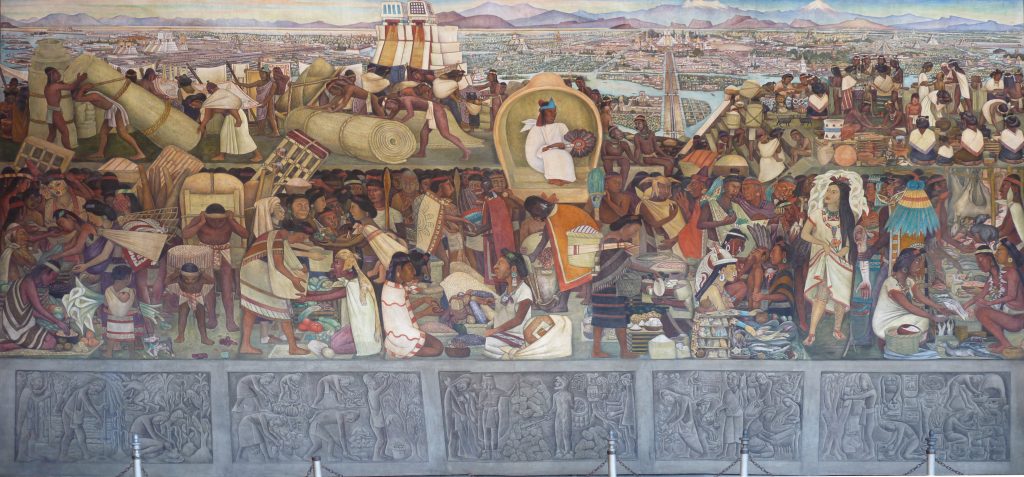
Mexica accounts of their origins did not begin with possession of the rich island capital from which their rulers later dominated much of central Mexico. They began instead with departure, wandering, hardship, and dependence. The homeland called Aztlan was remembered as the place from which the ancestors of the Mexica and related peoples emerged before beginning a long migration southward. Some traditions associated this departure with Chicomoztoc, the “Place of the Seven Caves,” another powerful image of collective origin shared by several central Mexican peoples. These places cannot be located confidently on a modern map, and the surviving narratives do not preserve a single consistent itinerary. Aztlan may have referred to a remembered northern homeland, a symbolic place of origin, or a sacred geography reshaped by later political needs. What mattered most was not whether every stage of the journey could be reconstructed as literal travel history. The migration placed the Mexica within a wider Mesoamerican pattern in which communities explained their political identities through departure from an ancestral place, divine instruction, trials endured along the road, and final arrival in a land where legitimate rule could be established. The story consequently presented Mexica identity as something forged through movement rather than inherited from ancient possession of the Basin of Mexico.
Huitzilopochtli supplied the migration with direction and purpose. He did not appear merely as a deity whom the Mexica happened to worship after reaching their destination; he was remembered as the sacred power who summoned them to leave, guided them through uncertainty, imposed obligations, and determined when they should continue or halt. Traditions sometimes represented his commands as issuing from a sacred bundle carried by priests, allowing divine presence to travel with the people before any permanent temple had been constructed. The bundle made the god portable without making him distant: he accompanied the migrants, received offerings, answered through priestly interpretation, and provided continuity as settlements were established and abandoned. His priests consequently held unusual authority, for they mediated commands that could determine the movement, discipline, and internal organization of the entire community. The god’s authority helped transform a vulnerable migrating population into a chosen collective whose hardships possessed meaning. Delays, divisions, conflicts, deaths, and punishments along the route could be explained as consequences of obedience or disobedience to his commands. Accounts of groups separating from the migrants or resisting the god’s direction reinforced the lesson that Mexica unity depended upon submission to a sacred purpose larger than the preferences of individual leaders. Even the name Mexica was linked in some accounts to a transformation of identity directed during the migration, marking the travelers as a people set apart for a particular destiny. Such narratives did not simply record the worship of Huitzilopochtli; they established his relationship to Mexica political existence. If he had created the conditions under which the people became Mexica, preserved them through danger, and led them toward their promised settlement, then later rulers could present obedience to his cult as inseparable from loyalty to the community itself. Opposition to the institutions maintained in his name could accordingly be portrayed not merely as political disagreement but as resistance to the sacred history through which the Mexica understood their collective survival.
The migration traditions also preserved the uncomfortable fact that the Mexica entered the Basin of Mexico as latecomers. They encountered established cities, prestigious dynasties, cultivated lands, and political traditions that long predated their rise. Their ancestors were remembered as serving more powerful rulers, occupying marginal territory, and acting at times as mercenaries whose military abilities made them useful but also feared. Their association with Chapultepec ended in defeat and dispersal, while their later dependence upon Culhuacan placed them beneath a dynasty that claimed descent from the revered Toltec past. The famous episode in which the Mexica sacrificed a Culhua ruler’s daughter, after allegedly presenting her transformation as divine honor, dramatized the rupture between subordinate service and independent sacred identity. Whether read as literal event, ritual memory, or political allegory, the episode portrayed the Mexica as unwilling to remain permanently incorporated into another people’s hierarchy. Their violent separation from Culhuacan was not merely an embarrassment that later historians attempted to conceal. It became one of the ordeals through which Mexica distinctiveness was established. Exclusion, defeat, and humiliation could be absorbed into a providential narrative in which adversity demonstrated that no existing city could contain the destiny assigned by Huitzilopochtli.
The foundation of Tenochtitlan resolved this period of wandering by revealing the place the god had selected. The best-known version describes an eagle perched upon a cactus growing from a stone in the water, though the details and visual forms of the sign vary among sources. Some accounts emphasize the eagle’s posture or its connection with the sun, while later representations sometimes add the serpent that became central to modern Mexican national symbolism. In the frontispiece of the Codex Mendoza, the cactus rises from a stone at the center of the island settlement, while waterways divide the city into quarters and armed figures recall both conflict and political organization. The surrounding place-name glyphs and figures situate the foundation within a wider landscape of war, alliance, and subordination rather than presenting the island as an untouched sacred refuge. The image does more than identify a location. It brings together the natural environment of the lake, the sacred sign promised during migration, the arrangement of the emerging city, and the military conditions under which its inhabitants established themselves. The stone and cactus could also recall the violent sacred imagery associated with Huitzilopochtli and the defeated enemies of the migration, allowing the foundation sign to carry memories of sacrifice as well as settlement. Tenochtitlan was founded on terrain that appeared inhospitable when compared with the older agricultural and dynastic centers of the Basin, yet this weakness could be reinterpreted as proof of divine election. The island’s marginality distinguished the Mexica from established powers and made their later transformation of the landscape appear all the more extraordinary. Through chinampa agriculture, hydraulic engineering, causeways, canals, temples, and markets, they converted a difficult environment into the center of an expanding political order. The Mexica did not simply seize the most advantageous land available to them; sacred history insisted that they accepted the place revealed by their patron even when its immediate advantages were uncertain. The transformation of a marshy island into a monumental capital then served as visible confirmation that the command had been valid and that divine favor had followed obedience. The city itself became evidence for the truth of the migration story: its wealth, temples, population, and military power appeared to demonstrate that Huitzilopochtli had guided his people to precisely the place from which their destiny could be fulfilled.
Foundation did not immediately produce independence. The early Mexica remained entangled in Tepanec power and for decades served the rulers of Azcapotzalco. Their later rebellion and participation in the defeat of that city in 1428 opened the way for the Triple Alliance and for the rapid expansion associated with the reign of Itzcoatl. This political transformation also encouraged the reorganization of historical memory. Later traditions credited Itzcoatl and his adviser Tlacaelel with reshaping the official past, destroying or suppressing older records and promoting an account more suitable to Mexica supremacy. The details of this alleged reform remain debated, but the broader principle is plausible: imperial success changed the way migration, dependence, and divine election were remembered. Former subordination could now appear as preparation for greatness, while previous defeats became trials that had purified and strengthened the chosen people. The Mexica did not need to claim that they had always been the oldest or most prestigious inhabitants of central Mexico. Their traditions offered a more dynamic basis for authority. They had suffered, obeyed, fought, and ultimately fulfilled a destiny that older powers had failed to recognize.
The migration story became a charter for conquest without functioning as a simple command to attack every neighboring community. It provided the historical logic through which expansion could be represented as the continuation of a sacred journey. Huitzilopochtli had led the Mexica from obscurity to Tenochtitlan; successful rulers could now claim to extend the order established by that divine guidance. Conquest demonstrated that the chosen city remained vigorous, while tribute and captives made its supremacy visible in temples, markets, palaces, and ceremonies. But the myth never entirely erased the memory of vulnerability. The Mexica had once been outsiders, dependents, and refugees within a political world controlled by older dynasties. Their imperial ideology was built not only upon confidence but also upon the recollection that power could be lost, alliances could collapse, and a people without secure land could be driven from place to place. This tension helps explain why migration tradition remained politically useful. It justified rule by portraying Mexica success as divinely ordained, but it also warned that destiny required continued obedience, military strength, and ritual maintenance. The road from Aztlan did not end when the city was founded. In imperial memory, every victory could be presented as another confirmation that the journey commanded by Huitzilopochtli was still unfolding.
Huitzilopochtli and the Myth of Cosmic Battle
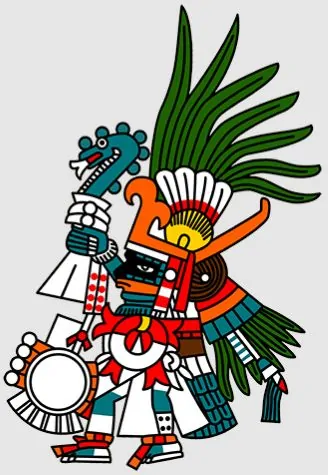
Huitzilopochtli stood at the center of Mexica political theology not merely because he was associated with warfare, but because his own existence was narrated as an act of sudden and overwhelming military victory. In the best-known account preserved in the Florentine Codex, Coatlicue conceived him after a ball of feathers descended upon her while she was sweeping on Coatepec, the “Serpent Mountain.” Her daughter Coyolxauhqui and her sons, the Centzon Huitznahua, interpreted the pregnancy as a source of shame and resolved to kill their mother. As they climbed the mountain to carry out the attack, Huitzilopochtli emerged fully grown and fully armed. Wielding the Xiuhcoatl, the “Turquoise Serpent” or fire serpent, he struck down Coyolxauhqui, dismembered her body, and drove her brothers from the mountain. This was not a creation story in which order emerged through peaceful generation. Divine birth and warfare occurred simultaneously. Huitzilopochtli entered the world as a victorious warrior whose first action was the defense of his mother and the destruction of forces threatening the order surrounding his birth. For the Mexica, the story established a model in which survival depended upon readiness, obedience, and decisive violence. It also distinguished Huitzilopochtli from deities whose authority rested more visibly upon antiquity or upon widespread cults shared across Mesoamerica. As the patron of a people who remembered themselves as late arrivals and former dependents, he embodied the possibility that a recently risen power could defeat older and more numerous enemies.
The Coatepec narrative has often been interpreted as a myth of solar conflict in which Huitzilopochtli represents the rising sun, Coyolxauhqui the moon, and the Centzon Huitznahua the stars scattered by dawn. That interpretation captures an important dimension of the story, especially given Huitzilopochtli’s associations with the sun, fire, the east, and the daily struggle against darkness. Coyolxauhqui’s dismemberment and the flight of her brothers could be understood as a mythic image of the moon and stars losing their power before the advancing sun. The recurring movement from darkness into daylight also offered a compelling model of victory as the restoration of order after a period of danger. Yet the surviving sources do not present a single systematic theology in which each character consistently corresponds to one astronomical object. Nor should modern interpretations assume that celestial symbolism exhausted the meaning of a story capable of operating simultaneously in ritual, political, historical, and military settings. The myth also concerned kinship, rebellion, migration, political obedience, and the defeat of internal enemies. Coyolxauhqui and the Huitznahua were not foreign invaders attacking from outside the sacred community; they were relatives who challenged the authority embodied in Coatlicue and the unborn god. Their betrayal made the threat particularly dangerous because it arose from within the family and transformed disagreement into an assault upon the source of collective continuity. Their defeat could represent the suppression of factional resistance as well as cosmic renewal. Versions of Mexica migration history likewise describe conflicts at a place called Coatepec, where groups who resisted continued movement or sought permanent settlement were punished in accordance with Huitzilopochtli’s will. The repetition of the place-name allowed mythic battle and remembered migration to illuminate one another, whether or not the episodes originated as accounts of a single event. Mythic time and migration history consequently overlapped. The god’s primordial victory became a pattern through which later conflicts could be interpreted: rebels repeated the error of Coyolxauhqui, while leaders who upheld Huitzilopochtli’s commands positioned themselves on the side of order. Political opponents might thereby be represented not merely as rivals with alternative interests but as figures whose resistance threatened the destiny of the entire community. The cosmic reading remains powerful, but it should not make the political meaning secondary. In Mexica thought, the movement of the heavens, the obedience of communities, the authority of rulers, and the preservation of the city belonged to the same endangered order.
The ceremonial center of Tenochtitlan gave this myth architectural form. The Templo Mayor rose as a sacred mountain at the heart of the capital, with twin shrines dedicated to Huitzilopochtli and Tlaloc at its summit. The southern side associated with Huitzilopochtli could be understood as a recreation of Coatepec, while monumental representations of the defeated Coyolxauhqui were placed below the stairway leading toward his sanctuary. The most famous of these, a great circular stone showing the goddess dismembered, made her defeat visible at the point where bodies, offerings, priests, warriors, and spectators moved through the temple precinct. Her severed limbs, exposed joints, bells, feathers, and other ornaments rendered the consequences of opposition to Huitzilopochtli in monumental stone. The image was not hidden inside a priestly chamber. It occupied a public ceremonial landscape in which the inhabitants of Tenochtitlan, visiting nobles, foreign ambassadors, tributary delegations, and captives could encounter the political theology of Mexica victory. Human victims killed at the summit could be cast down the steps, creating an unmistakable visual relationship between sacrificial death and Coyolxauhqui’s fall from the mountain. As the body descended toward the image of the defeated goddess, ritual action joined a recent captive to a foundational act of divine violence. The temple did more than commemorate a myth through static imagery. It turned sacred history into a sequence of movement: approach, ascent, sacrifice, descent, dismemberment, and display. Successive enlargements of the Templo Mayor renewed this sacred mountain as Mexica power expanded, embedding offerings, conquered materials, and the labor of subject communities within the monument itself. Each rebuilding could proclaim that Tenochtitlan remained capable of reproducing the order first established at Coatepec on an increasingly imperial scale. Yet the Templo Mayor’s twin structure complicates any attempt to interpret the capital only through the ideology of war. Tlaloc’s shrine connected the same monument with rain, fertility, mountains, agricultural abundance, and the dangerous forces governing subsistence. The two sanctuaries were not unrelated halves accidentally placed upon the same platform. Together they joined the power to conquer with the power to nourish, both of which were necessary for the continuation of the city. Warfare and nourishment were united in the ceremonial heart of Tenochtitlan. Tribute gathered through conquest sustained temple ritual, while agricultural fertility sustained armies and urban populations. The arrangement expressed a political cosmos in which military power and material reproduction depended upon one another, and in which the ruler’s legitimacy rested upon his ability to secure both victory and abundance.
Ritual performances associated with warfare transformed Huitzilopochtli’s mythic victory into a public demonstration of Mexica authority. Captives brought to Tenochtitlan were not merely prisoners removed from the battlefield. Their processions, costumes, dances, deaths, and bodily treatment translated distant campaigns into visible events at the imperial center. Warriors could present their captives as proof of courage, rulers could display the reach of their armies, and priests could place victory within the ceremonial obligations owed to the gods. When sacrifice reproduced aspects of the Coatepec story, the enemy’s defeat became more than a political fact. It appeared as another manifestation of the triumph through which Huitzilopochtli had established order. The analogy was powerful because it did not require every captive to represent Coyolxauhqui in a narrow theatrical sense. The temple’s architecture and imagery had already created a symbolic field in which defeated bodies could evoke the enemies cast down by the god. Military conquest was thereby brought into sacred time, while sacred time was repeatedly renewed through the products of military conquest. These performances also disciplined the inhabitants of Tenochtitlan. Nobles, commoners, tributary delegations, foreign visitors, and subject rulers encountered an imperial capital whose ceremonies proclaimed that resistance led not merely to political submission but to incorporation within the victorious history of the Mexica patron.
This cosmic framework should not be mistaken for a complete explanation of why the Mexica went to war. The widespread formula that armies fought primarily to obtain blood for the sun turns a complex military design into a single religious mechanism. Campaigns were shaped by rebellion, tribute, trade, succession, strategic geography, alliance obligations, and the ambitions of rulers and warriors. Many conquered communities were required to provide goods rather than sacrificial victims, and the empire could not have survived through ritual symbolism alone. Nevertheless, the myth of Huitzilopochtli mattered because it provided a structure through which practical victories acquired sacred meaning. A successful campaign could be interpreted as evidence that the god continued to favor Tenochtitlan; captives allowed warriors and rulers to materialize that favor; and the ceremonial center transformed historical violence into a repetition of foundational victory. The myth did not dictate every decision, but it shaped the categories through which conquest was justified and remembered. It helped make imperial expansion appear less like the accidental rise of a once-marginal people and more like the continued unfolding of a cosmic order established at Coatepec. Huitzilopochtli’s victory was neither a decorative legend placed over military politics nor a literal script mechanically followed in every campaign. It was a durable political theology through which the Mexica connected the movement of the sun, the discipline of the community, the authority of the ruler, and the defeat of enemies.
More Than One War God: The Divine Powers Surrounding Combat
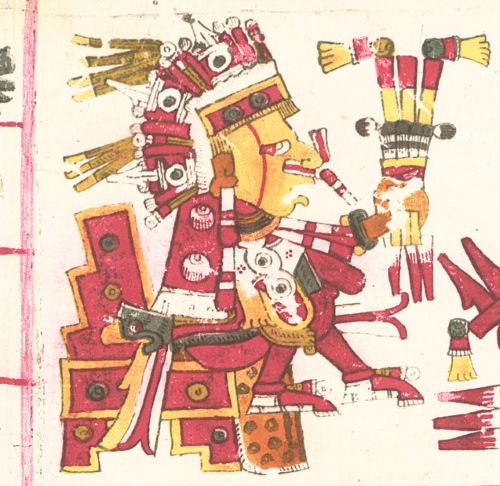
Huitzilopochtli occupied an exceptional place in Mexica imperial ideology, but warfare was never governed by a single divine personality or explained through one mythic tradition. Nahua religion did not divide the world into sharply bounded departments in which one god controlled war, another rain, another kingship, and another fate. Divine powers overlapped, changed forms, borrowed attributes from one another, and became prominent under particular ritual, political, or regional circumstances. A deity associated with agriculture could receive captives taken in war; a god of rulership could determine military fortune; a hunting patron could supply the imagery and discipline through which warriors understood pursuit and capture. Divine names and representations could also emphasize particular manifestations of sacred power rather than wholly separate supernatural personalities. Gods shared costumes, colors, calendrical associations, weapons, and ritual roles, while priests and deity impersonators temporarily embodied their presence during ceremonies. The importance of any divine power depended not only upon a fixed sphere of responsibility but upon the season, festival, city, ruler, and military situation in which that power was invoked. It also depended upon the community involved. Huitzilopochtli was the patron of Tenochtitlan, but the armies of the Triple Alliance included Acolhua, Tepanec, and provincial contingents whose rulers maintained their own temples, sacred histories, and protective deities. Individual warriors likewise belonged to neighborhoods, military orders, noble houses, and subject communities whose sacred affiliations did not disappear when they entered an imperial army. Warfare consequently brought together several religious relationships at once. A campaign might be proclaimed under Mexica imperial authority while individual units marched beneath standards associated with their districts, cities, military societies, or patron gods. Offerings made at Tenochtitlan could authorize the coalition as a whole, while additional rites conducted in allied and tributary communities prepared their own warriors for service. The religious world surrounding combat was plural without being disorderly. Different divine powers interpreted different dimensions of the same undertaking: the ruler’s legitimacy, the uncertainty of fortune, the need for nourishment, the warrior’s courage, the capture of enemies, and the renewal expected to follow victory.
Among the most important of these powers was Tezcatlipoca, the “Smoking Mirror,” whose associations with rulership, conflict, night, divination, deception, and sudden reversal made him essential to the political psychology of warfare. Tezcatlipoca was not simply another battle god placed beside Huitzilopochtli. He represented the instability upon which military and royal success depended. Kings received authority through sacred forces they did not fully control, and the same power that raised a ruler could humiliate or destroy him. Tezcatlipoca’s mirror evoked forms of seeing that were indirect, obscured, and dangerous; his presence reminded rulers that appearances could mislead and that fortune could change without warning. He was invoked in royal speeches as a giver of office, but also as one who mocked human confidence and exposed arrogance. This made him relevant to war, where intelligence was incomplete, alliances uncertain, and even a strong army vulnerable to ambush, disease, terrain, or divine displeasure. His connection with warriors was also embodied in the annual ceremony of Toxcatl, during which an elaborately prepared deity impersonator lived for a year as the god before being sacrificed. The victim’s beauty, privilege, and eventual death dramatized the precariousness of worldly elevation. Military glory could be interpreted in the same way: the successful warrior rose through courage and capture yet remained subject to powers capable of overturning status in an instant. Tezcatlipoca gave sacred form to the uncertainty that no amount of planning could remove from combat.
Xipe Totec, “Our Lord the Flayed One,” joined warfare to agricultural renewal, bodily transformation, and the circulation of life through death. His cult is most famously associated with the festival of Tlacaxipehualiztli, when selected captives were sacrificed and flayed, and priests or other participants wore their skins for a prescribed period. To colonial observers, the rite appeared to exemplify Indigenous cruelty, but its symbolism was more complicated than spectacle alone. The shedding of skin could evoke the removal of an old covering and the emergence of renewed life, much as a seed’s outer layer gives way during germination. Warfare supplied the captives through whom that transformation was enacted, while agricultural imagery gave military death a regenerative meaning. The festival also included forms of combat in which a captive, constrained and disadvantaged, fought armed opponents before being sacrificed. This so-called gladiatorial sacrifice transformed battlefield capture into a carefully controlled ritual reenactment of resistance, defeat, and incorporation. The captive’s courage could be acknowledged even as the ceremony affirmed the overwhelming power of the city that possessed him. Xipe Totec linked martial achievement with seasonal regeneration. Warriors gained honor through captives, the state displayed victory, and ritual transformed conquered bodies into signs that life, fertility, and political order could be renewed through violent exchange. His cult shows why it is misleading to classify a deity as either agricultural or military. In Mexica ceremonial thought, the productivity of the earth and the blood shed in war could belong to the same cycle of loss and regeneration.
Mixcoatl, the “Cloud Serpent,” and the closely related Camaxtli reveal another set of connections among hunting, migration, sacrifice, ancestry, and warfare. Mixcoatl was associated with ancestral hunters, northern landscapes, fire making, the chase, and the pursuit of game. Camaxtli held particular importance in Tlaxcala and other communities outside Mexica political control, demonstrating that martial sacred power was not monopolized by Tenochtitlan. The relationship between Mixcoatl and Camaxtli varied among regions and sources, and they could appear as distinct deities, closely related manifestations, or patron powers whose identities overlapped through shared attributes. This variability reflects the political geography of central Mexico, where communities adapted widely recognized sacred traditions to their own genealogies and claims of legitimacy. Hunting supplied an important conceptual model for war because both activities required tracking, concealment, endurance, coordinated pursuit, knowledge of terrain, and the capture or killing of living prey. Hunters and warriors alike entered spaces of danger where success depended upon bodily discipline, ritual preparation, cooperation, and the ability to interpret signs. Warriors could be imagined as hunters entering dangerous terrain, while enemies could be described through the language of animals driven, trapped, surrounded, or seized. Weapons associated with hunting could acquire military significance, and ritual hunts could rehearse forms of movement and collective action useful in warfare. The analogy did not reduce warfare to sport. Hunting was itself a sacred and social practice through which humans negotiated their dependence upon animal life and the powers governing wilderness. By adopting its language, warfare became part of a larger moral field involving pursuit, risk, sacrifice, and the conversion of death into sustenance. Mixcoatl’s associations with migration also connected martial identity to the remembered movement of peoples into central Mexico. Communities could claim descent from ancestral warrior-hunters and use such traditions to establish antiquity, autonomy, military virtue, or a right to rule. These claims were significant for peoples who remembered northern or Chichimec ancestry and converted an identity once associated with outsider status into a source of disciplined strength. The prominence of Camaxtli among the Tlaxcalans further complicates any simple contrast between a uniquely “Aztec” war religion and supposedly secular resistance to it. Enemies of the Mexica also possessed sacred histories, rituals, and divine patrons that validated military courage and explained their refusal to submit.
Tlaloc and other powers connected with rain, mountains, fire, and agricultural abundance also surrounded warfare, even when they were not addressed primarily as martial deities. Tlaloc’s presence beside Huitzilopochtli atop the Templo Mayor made the interdependence of conquest and subsistence architecturally explicit. Armies could not march without maize, water, porters, clothing, and the accumulated surplus of tributary and agricultural communities. Victory brought additional land and goods into imperial circulation, but the fertility that made those goods possible remained subject to forces no army could command. Drought, hail, frost, and failed rains could weaken the political order more profoundly than a battlefield defeat. Tlaloc’s dangerous generosity complemented Huitzilopochtli’s militant protection: one sustained the conditions of life, while the other defended and expanded the community that depended upon them. Fire deities such as Xiuhtecuhtli likewise occupied the boundary between household continuity, calendrical renewal, royal authority, and destructive force. Fire could warm, cook, and regenerate, but it could also consume temples and signal the defeat of cities in pictorial histories. Divine powers linked with earth, water, and fire were not remote from military affairs. They governed the material world through which armies moved and the resources over which rulers fought. Their presence prevented war from being imagined as an autonomous sphere. Combat remained dependent upon the environmental and ceremonial order that made collective survival possible.
The plurality of divine powers surrounding warfare also reflected the political composition of the armies themselves. A ruler of Tenochtitlan might place a campaign beneath the patronage of Huitzilopochtli, but allied rulers did not abandon the gods who validated their own dynasties, and common warriors remained attached to the temples and ritual identities of their local communities. Sacred bundles, divine images, military standards, costumes, and insignia made these affiliations visible in motion. They could identify units, inspire discipline, and materialize the presence of protective powers on the march. Victory might then be credited simultaneously to the imperial patron, the ruler’s ritual fitness, the favor of Tezcatlipoca, the courage granted by a local deity, and the proper performance of ceremonies conducted before departure. Such explanations were not necessarily contradictory. Nahua religious thought allowed divine agencies to overlap and cooperate just as political communities did. This helps explain why conquest seldom required subject peoples to surrender every local cult. Imperial authority could incorporate foreign gods, seize or relocate sacred images, demand participation in central ceremonies, or subordinate regional traditions without erasing them completely. Mexica warfare was sacred not because one war god issued a single command, but because combat activated a dense field of relationships linking gods, rulers, warriors, communities, environments, and the dead. Huitzilopochtli remained preeminent in the political theology of Tenochtitlan, yet his power became fully intelligible only within this broader divine world.
Sacred Time: The Selection of Campaign Moments
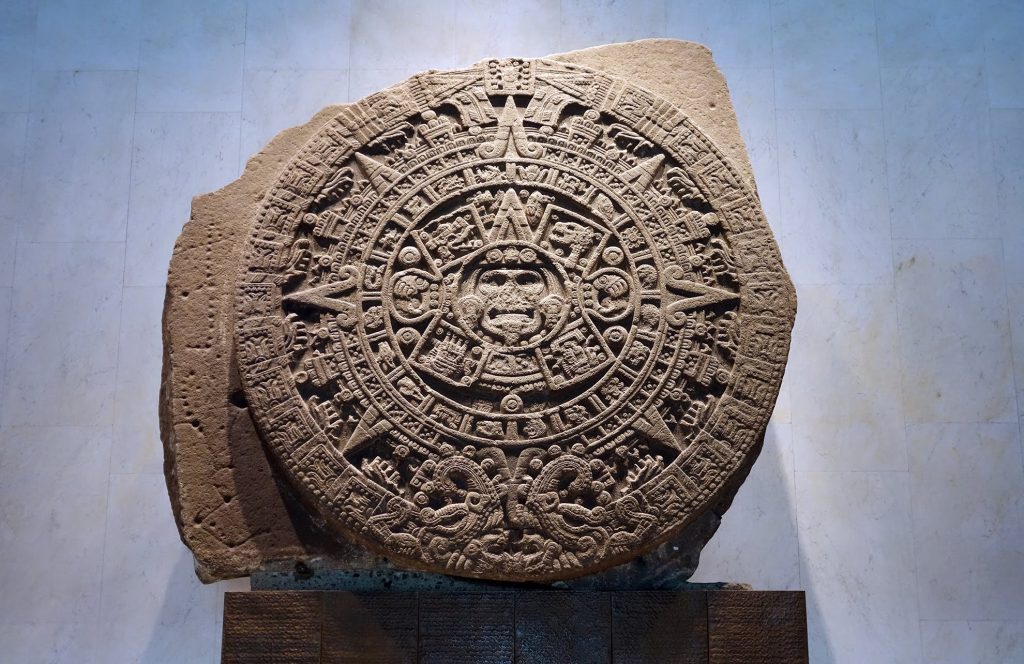
Mexica warfare unfolded within a conception of time that was qualitative as well as measurable. Days did not pass as empty units distinguished only by their position in a sequence; each carried combinations of names, numbers, divine associations, remembered events, and possible consequences. The Mexica used several interlocking calendrical systems, most importantly the 260-day tonalpohualli, or “count of days,” and the 365-day xiuhpohualli, or “count of the year.” The tonalpohualli combined twenty day signs with a repeating sequence of thirteen numbers, producing 260 distinct named days before the cycle began again. The xiuhpohualli organized the solar year into eighteen periods of twenty days followed by five additional days known as nemontemi, a dangerous interval often treated with caution. Together, the two calendars returned to the same combination every fifty-two years, forming the Calendar Round that structured long-term historical and ceremonial expectation. These systems did not function merely as methods of dating events. They placed human action within a living temporal order in which gods, ancestors, rulers, agricultural seasons, and earlier precedents remained active. Choosing when to begin a campaign meant more than selecting a convenient date. It meant locating military action within patterns whose qualities could strengthen, endanger, or redefine the undertaking.
The tonalpohualli was interpreted by calendrical specialists commonly known as tonalpouhque, “counters of days,” whose expertise extended to births, marriages, journeys, illnesses, accessions, commercial ventures, and other consequential decisions. Their authority rested upon specialized knowledge acquired through training, observation, memorization, and familiarity with painted divinatory manuscripts. These specialists consulted such books alongside oral teachings, numerical combinations, patron deities, directional associations, and the established meanings of the twenty day signs. Each thirteen-day period, or trecena, possessed its own governing associations, while individual days acquired additional qualities from their numerical coefficient and place within larger cycles. The first day of a trecena could lend its character to the period that followed, but the remaining days were not thereby stripped of their own meanings. A consultation might also consider the identity and circumstances of the person involved, the nature of the proposed undertaking, and the relationship between the immediate day and broader ceremonial or historical cycles. A day’s meaning was not reducible to a simple label of lucky or unlucky. The same sign might promise strength in one context, instability in another, and particular dangers for a person born or acting beneath it. Certain combinations could indicate courage, prosperity, fertility, conflict, deception, illness, or premature death, but their application depended upon the question being asked. Divination required judgment because several temporal influences could converge in ways that were ambiguous or contradictory. The diviner’s task was not merely to locate a prediction already written in the calendar but to interpret how a configuration of forces bore upon a particular decision. The surviving manuscripts commonly called the Borgia Group preserve visual systems through which specialists related day signs to gods, directions, birds, trees, bodily parts, offerings, temples, bundles, roads, and other symbols. Images might be arranged across pages according to sequences whose logic depended upon trained reading rather than ordinary narrative progression. Colors, positions, gestures, costumes, and repeated signs could all contribute to the interpretation. These books were not calendars in the modern sense of schedules printed with fixed predictions. Nor were they simple collections of superstitious illustrations whose meanings were obvious to any viewer. They were instruments of learned interpretation, activated by specialists who knew how to read their images in relation to a particular person, question, proposed action, or unfolding danger. Their use gave calendrical judgment an institutional form and placed important decisions within a recognized body of sacred expertise.
Military planning was suited to such consultation because warfare exposed rulers and communities to extraordinary uncertainty. Intelligence could be incomplete, allies could defect, supplies could fail, and an apparently weak enemy could offer unexpected resistance. Calendrical interpretation helped organize these risks by identifying moments associated with aggression, courage, movement, danger, sacrifice, rulership, or reversal. A ruler contemplating war could seek a day whose qualities aligned with departure, attack, or the public ceremonies accompanying mobilization. Priests might also prescribe offerings, fasting, bloodletting, or other precautions intended to address threatening influences rather than simply postponing action. The evidence does not support the claim that Mexica commanders consulted a single list of favorable battle dates or believed that warfare initiated on an unfavorable day was automatically doomed. Divinatory time was more flexible and interpretive than that. A dangerous day could warn against haste, require additional ritual management, or become acceptable when political necessity made delay impossible. The purpose of consultation was not to eliminate uncertainty by revealing a fixed future. It was to make uncertainty intelligible and to provide an authorized framework within which rulers could act.
The qualities assigned to time also emerged from myth and historical memory. Day signs and calendrical periods were connected with divine actions, cosmic eras, seasonal ceremonies, and events believed to have occurred under comparable configurations. A proposed campaign could be evaluated against more than an abstract calculation. Its date might evoke the powers of a particular god, the success or failure of an earlier ruler, or a mythic struggle whose outcome supplied an interpretive precedent. This relationship between chronology and narrative was important in a political culture where the past could serve as a guide to the present. If a ruler had previously achieved victory under a particular sign or during a particular ceremonial period, later advisers might treat that success as evidence of temporal suitability. Conversely, a remembered defeat could give a day or season a dangerous reputation. Such associations were neither permanent nor universally agreed upon. Historical memory itself was selective, and the meaning assigned to an earlier event could change when later rulers reinterpreted it. Sacred time was continually renewed through experience: the calendar shaped how events were understood, while victories, defeats, disasters, and accessions added new layers of meaning to the calendar.
Calendrical selection also interacted with the material realities of campaigning. Large armies depended upon seasonal access to food, water, roads, porters, and agricultural labor. Campaigns were generally easier during the dry season, when movement across central Mexican landscapes was less obstructed by heavy rains and when communities could more readily divert men from cultivation. Harvested maize and other provisions had to be accumulated, transported, or demanded from allied and tributary settlements along the route. Mountain passes, rivers, lake levels, and regional climates could affect the speed and safety of movement. These constraints did not operate outside religion. The solar year was organized through festivals tied to rain, planting, harvest, warfare, royal renewal, and the obligations owed to particular gods. A politically desirable moment might be calendrically promising but logistically impossible, while a season suitable for marching might require ritual preparation because its day signs appeared threatening. Commanders and priests did not choose between practical time and sacred time as though one were real and the other ceremonial. The task was to align them as closely as circumstances permitted.
The interaction between ritual timing and political necessity is important because the empire could not always wait for ideal conditions. A rebellion might require immediate suppression before neighboring subjects joined it. The killing of merchants or emissaries could demand a rapid response to protect imperial prestige. An enemy’s dynastic crisis might create an opportunity that would disappear if military leaders delayed too long. Under such circumstances, divination could authorize action by identifying the least dangerous available date, prescribing compensatory rites, or interpreting urgency itself as evidence that the gods had created the opportunity. This flexibility did not make the calendar meaningless. On the contrary, it shows how divination functioned within government. Sacred specialists translated unstable political situations into a language through which decisions could be debated, justified, and communicated. Their interpretations could support a ruler’s preferred strategy, but they could also warn against arrogance or expose disagreement within the governing elite. Because the future remained uncertain, no interpretation could be completely verified before the campaign. Victory later confirmed the wisdom of the chosen moment; defeat invited criticism of the date, the rites, the ruler, the priests, or the army’s conduct. This retrospective dimension cautions against reading every report of auspicious timing as a literal record of deliberations that occurred before a campaign. Colonial historians often organized the reigns of Mexica rulers into moral narratives in which proper ritual conduct led to victory and arrogance or negligence produced disaster. A successful expedition could acquire favorable omens in the retelling, just as a failed campaign could become surrounded by warnings that the ruler supposedly ignored. Such narratives reveal genuine assumptions about the relationship between time and military fortune, but they may also impose order upon events after their outcome was known. The most defensible conclusion is neither that the calendar mechanically dictated every campaign nor that rulers treated divination as decorative ceremony. Calendrical consultation offered a disciplined method for interpreting danger, choosing among imperfect moments, and placing political action within a sacred history. The selection of a campaign date became one point at which cosmic meaning, priestly expertise, royal authority, seasonal logistics, and strategic opportunity met. Sacred time did not promise that the Mexica would always win. It defined the conditions under which victory or defeat could become intelligible.
The Interpretation of Uncertainty with Dreams and Omens

Beyond the formal calculations of calendrical specialists, Mexica rulers and communities also attended to events that appeared to interrupt the expected order of the world. Nahuatl sources describe portents through concepts often translated as omens, marvels, prodigies, or frightening signs, though these English terms cannot capture every distinction recognized by Indigenous interpreters. An unexpected fire, an unusual movement in the sky, an animal behaving contrary to its nature, a temple accident, a sudden death, or an abnormal disturbance of water and weather might acquire significance because it appeared to disclose forces otherwise hidden from ordinary perception. The importance of such an event depended upon its context. Lightning striking an unremarkable place did not necessarily carry the same meaning as lightning striking a temple; the appearance of an unfamiliar animal near a battlefield or palace could be interpreted differently from the same creature seen in the countryside. Reports also moved through political and social networks before reaching the ruler. Priests, hunters, merchants, guards, messengers, and local officials might observe the event, while ritual specialists determined whether it was genuinely portentous or merely strange. Omens were neither random superstitions nor universally intelligible announcements from the gods. They were observations transformed into signs through interpretation.
Dreams offered another means of approaching uncertainty because sleep could reveal dangers, relationships, and possibilities concealed during waking life. The Mexica did not necessarily treat every dream as a prophetic communication, and the surviving sources describe a range of attitudes toward dream experience. Some dreams could arise from fear, illness, desire, bodily disturbance, intoxication, grief, or deception; others might disclose the approach of death, captivity, misfortune, divine obligation, or political change. Their significance depended upon the dreamer’s identity and circumstances as well as upon the images experienced. A ruler’s disturbing dream before a campaign carried different political consequences from an ordinary person’s private nightmare because the ruler’s welfare was connected with the fate of the entire altepetl. His dreams could become matters of public concern, especially when they seemed to involve temples, enemies, fire, water, celestial bodies, or the destruction of the city. Likewise, a warrior’s dream could be interpreted in relation to courage, capture, battlefield death, or the condition of the army. A merchant traveling beyond imperial territory might understand a troubling dream as a warning about ambush, hostile rulers, or an unsafe route, while a priest could interpret dream imagery in relation to neglected ritual obligations. The social position of the dreamer affected not only the meaning assigned to the experience but also who was permitted to hear it and what action might follow. A private dream could remain within a household, whereas the dream of a ruler or military commander might be reported to priests and advisers and incorporated into decisions affecting thousands of people.
Dream interpretation required specialists capable of translating symbolic scenes into practical warnings, yet their judgments were not necessarily uniform. The same dream might support several possible readings, particularly when it contained transformations, animals, mirrors, water, fire, unfamiliar landscapes, severed bodies, ruined temples, or encounters with the dead. Images could draw meaning from mythology, calendrical associations, ritual practices, personal biography, and recent political events simultaneously. An eagle, serpent, jaguar, or coyote did not possess one unchanging significance independent of context; each could evoke several divine, social, and military associations. Dreams involving ascent or descent might suggest advancement, danger, sacrifice, or entry into another level of the cosmos, depending upon the dreamer and the circumstances. Interpretation could also require comparison with the day on which the dream occurred, the dreamer’s birth sign, and any unusual waking events reported. A disturbing dream did not necessarily predict an unavoidable disaster. It might warn that corrective offerings, fasting, confession, purification, or a change in behavior was required. Dreams could disclose a danger while leaving open the possibility that ritual action would alter its consequences. They did not provide a transparent window onto a predetermined future. They generated questions that had to be placed beside calendrical signs, political intelligence, ritual obligations, and the dreamer’s conduct. Their authority lay less in delivering a single unmistakable prophecy than in compelling rulers and specialists to confront possibilities that ordinary planning could not resolve.
The political significance of omens arose precisely because signs did not interpret themselves. A ruler who received a troubling report had to decide who should examine it, whether it should be made public, what rituals it required, and whether it justified changing an existing policy. Priests might prescribe offerings, confession, fasting, bloodletting, purification, or sacrifice intended to acknowledge the dangerous power revealed by the sign. A campaign could be delayed, its route adjusted, or its ceremonial preparations intensified, but the appearance of an omen did not automatically dictate one response. Political interests shaped interpretation without necessarily making it insincere. Advisers who already doubted a campaign could point to an alarming sign as confirmation of their concern, while supporters might argue that the same event revealed an enemy’s vulnerability or demanded immediate action. The interpretation of an omen could become part of a larger debate about strategy, legitimacy, and responsibility. Once a decision had been made, ritual consultation helped present it as more than the ruler’s personal preference. If the campaign succeeded, the accepted interpretation appeared vindicated; if it failed, critics could argue that the sign had been misunderstood, ignored, or inadequately answered.
The famous omens said to have preceded the arrival of the Spaniards illustrate both the historical importance of portent traditions and the danger of reading them literally. The Florentine Codex describes a sequence of extraordinary events associated with the final years before the invasion: a fiery sign in the sky, the mysterious burning of a temple, lightning striking another sacred building, disturbances in the lake, the cries of a woman lamenting the fate of her children, a strange bird whose reflective surface disclosed armed figures, and malformed beings brought before Moctezuma. These images formed a powerful narrative of a world becoming unstable before the destruction of Tenochtitlan. Yet the account was compiled decades after the conquest, when Nahua survivors and Christian missionaries already knew the catastrophe toward which the story appeared to point. Several signs also resembled prodigy traditions found in European chronicles, biblical history, and classical accounts of doomed kingdoms. That resemblance does not prove that the omens were simply invented by Spaniards, since Nahua societies possessed their own extensive traditions of divination and portent interpretation. It does mean that the surviving sequence reflects colonial retelling, selection, and arrangement. The eight omens are more reliable as evidence for how conquest was remembered and explained than as a precise record of reports received by Moctezuma before 1519.
Omens and dreams mattered in warfare not because they replaced intelligence or forced rulers to obey an unalterable supernatural command, but because they gave form to dangers that could not be measured with certainty. A commander might know the size of his army and the route toward an enemy city yet remain unable to predict betrayal, weather, disease, panic, or unexpected resistance. Portents supplied a language through which those anxieties could be recognized and managed. They could justify caution, encourage resolve, expose disagreement, and prescribe rituals that restored confidence before action. Their meaning also remained open after the battle. Victory could transform an ambiguous dream into a promise correctly understood, while defeat could turn an ignored disturbance into a warning whose importance had become obvious only in retrospect. Historians should resist two opposite conclusions: that Mexica leaders were helpless before irrational fears, or that elite interpreters cynically invented divine approval for decisions already made. Dreams and omens occupied the uncertain ground between experience and explanation. They did not remove contingency from war; they allowed rulers, priests, warriors, and later historians to argue about what contingency meant.
Governing Bodies and the Politics of Divine Approval

The tlatoani, literally the “speaker,” stood at the center of the altepetl as ruler, judge, military leader, diplomatic representative, and sacred officeholder. In Tenochtitlan, the increasing power of the Mexica capital elevated its ruler above most neighboring kings, although the rulers of Tetzcoco and Tlacopan retained their own dynastic authority within the Triple Alliance. The tlatoani did not merely command armies as a secular executive who later requested religious approval from a separate priesthood. His capacity to govern depended upon maintaining proper relationships among gods, nobles, commoners, tributary communities, allies, and enemies. He presided over ceremonies, authorized tribute demands, received foreign envoys, appointed commanders, distributed rewards, and represented the community before divine powers whose favor could never be treated as permanently secured. Military victory demonstrated that he possessed the judgment, courage, and ritual fitness expected of his office; defeat threatened more than his reputation as a strategist. Because the ruler symbolically embodied the welfare of the altepetl, his conduct could affect the fertility of the land, the stability of political relations, and the protection afforded by the gods. The ruler’s body and office joined several dimensions of authority that modern categories often separate. When he approved a campaign, he acted not only as commander of an army but as the principal guardian of a political and sacred order.
Succession to the Mexica throne was dynastic but not governed by automatic primogeniture. The new tlatoani was selected from an eligible group of royal men by leading nobles and officeholders who evaluated ancestry, military experience, political alliances, maturity, and demonstrated ability. A ruler’s son might succeed, but brothers, nephews, and other male relatives could possess equally strong claims. Selection created an opportunity for elite negotiation, and the chosen ruler entered office indebted to the nobles, military leaders, and dynastic factions whose support had secured his elevation. Accession ceremonies then transformed selection into legitimate kingship. The new ruler fasted, performed penance, received insignia, heard formal admonitions, and participated in rites that presented office as both an honor and a dangerous burden. Speeches reminded him that power came from divine forces capable of removing it, that he must hear the complaints of his people, and that arrogance could bring destruction upon himself and the city. These ceremonies did not simply celebrate an individual’s triumph. They disciplined the ruler by placing him within an inherited moral order. He became the visible representative of the dynasty and the city, but he did not become free from accountability. The gods, ancestors, nobles, and public memory supplied standards by which his actions would be judged.
The tlatoani also governed through councils and senior officers rather than making every military decision alone. The tlatocan, or council of rulers and nobles, provided a setting in which leading members of the political elite could consider succession, diplomacy, tribute, rebellion, and war. Its exact composition and authority may have varied, and colonial descriptions sometimes impose a degree of constitutional regularity that cannot be demonstrated for every reign. Nevertheless, consultation among nobles was essential because major campaigns required the cooperation of powerful houses, military commanders, tributary officials, and allied cities. The cihuacoatl, a senior office whose title meant “Snake Woman,” occupied an important position in Tenochtitlan. Although the office was held by a man, its name invoked a powerful female deity and reflected a broader symbolic pairing within Mexica government. The cihuacoatl could supervise judicial, administrative, fiscal, and ceremonial affairs, act for the ruler during his absence, and participate in decisions surrounding war and succession. Tlacaelel, who held the office during several reigns, later became the subject of traditions crediting him with extraordinary influence over Mexica ideology and expansion. Beneath and alongside these offices stood experienced military leaders such as the tlacochcalcatl and tlacateccatl, whose battlefield knowledge made them indispensable to planning. Decisions affecting the Triple Alliance further required negotiation with Tetzcoco, Tlacopan, and other rulers expected to provide troops, provisions, or passage.
Priests and diviners contributed another form of authority, but they should not be imagined as members of an autonomous institution capable of issuing commands to the state from outside it. Temples, priestly schools, noble households, royal government, and military organization were deeply interwoven. High-ranking priests maintained major cults, supervised ceremonies, trained younger specialists, guarded sacred objects, preserved ritual knowledge, and interpreted the obligations owed to the gods. Their duties included maintaining the ceremonial calendar, organizing public festivals, overseeing sacrificial rites, and ensuring that rulers and communities completed the acts of penance and offering required at dangerous moments. Other ritual experts studied the calendar, examined dreams and omens, conducted sacrifices, prepared offerings, and determined what acts of purification or penance a dangerous undertaking required. Some specialists possessed knowledge directed toward particular forms of divination, while others served specific temples, deities, districts, or noble establishments. The high priests associated with the twin shrines of Huitzilopochtli and Tlaloc embodied the connection between the military protection of the city and the agricultural forces sustaining it. Their position at the Templo Mayor placed them within the most visible ceremonial institution of the capital, where imperial conquest, tribute, sacrifice, rain, and fertility were joined before inhabitants and foreign visitors alike.
Yet priestly influence was not uniform, nor did religious specialists necessarily speak with one voice. Different diviners might interpret distinct signs, represent separate temples, or advise rulers whose political interests did not completely agree. A calendrical specialist could judge the qualities of a proposed date, while senior priests organized the ceremonies required before departure and local priests prepared contingents in allied communities. Priests accompanying an army might maintain sacred objects, perform rites along the route, interpret unexpected events, or preserve the ritual discipline expected of warriors. The advice offered by these specialists could reinforce a ruler’s preferred policy, but it could also introduce caution, delay, or additional obligations into military planning. An unfavorable sign did not necessarily empower priests to veto a campaign outright, yet ignoring respected ritual experts carried political dangers if the expedition later failed. Their interpretations were part of a broader negotiation in which rulers weighed sacred warning against intelligence, strategic opportunity, alliance commitments, and the urgency of rebellion or insult. Religious authorization emerged from several kinds of knowledge rather than from a single priestly verdict. Priests did not usually determine whether tribute, rebellion, or strategy made war desirable, but their interpretations helped determine when and how such concerns could be translated into legitimate sacred action. They also helped establish the ritual record by which the decision would later be judged, making priestly participation important before, during, and after the campaign.
Consultation distributed political responsibility. A campaign supported by the ruler, noble council, military commanders, allied leaders, priests, and diviners could be presented as the product of collective judgment rather than personal ambition. This mattered because war placed the entire political order at risk. Defeat could cost lives, encourage tributary rebellion, weaken alliances, and expose the ruler to charges of arrogance or incompetence. Consultation allowed advisers to question intelligence, recommend delay, demand further ritual, or propose diplomatic alternatives before forces were committed. It also gave the ruler a means of incorporating potential rivals into the decision. Nobles who participated in planning became invested in the campaign’s success, while allied rulers whose advice had been solicited were less able to portray the war as an exclusively Mexica venture. Sacred interpretation strengthened this process because it located agreement within a wider order. The selected day, completed offerings, favorable signs, and formal speeches all communicated that proper procedures had been followed. This did not eliminate manipulation or disagreement. A ruler could favor advisers likely to support his wishes, while opponents could use ominous signs to argue against a policy they already distrusted. Divine approval was politically powerful precisely because it remained interpretive and contested.
The expectation that a new ruler demonstrate military competence became visible in the campaigns associated with accession. Inauguration required more than formal selection and ritual installation; the ruler needed to prove that he could lead warriors, obtain captives, secure tribute, and defend the prestige of the capital. Captives taken during an early campaign could be sacrificed during enthronement ceremonies, joining the ruler’s personal success to the renewal of the city’s obligations to its gods. Such expeditions also warned tributary and independent communities that a change of ruler had not weakened imperial power. The reign of Tizoc illustrates the danger of failing this test. After his selection in 1481, he campaigned against Metztitlan, but surviving traditions portray the expedition as disappointing and emphasize the limited number of captives obtained. Later accounts characterize much of his short reign as militarily ineffective, although those narratives were shaped by comparison with the greater conquests of his successor and may exaggerate his failures. Tizoc’s death in 1486 was surrounded by rumors of poisoning or elite intervention, but the evidence does not permit certainty. What matters for the politics of sacred warfare is that his memory became inseparable from perceived military inadequacy. Ahuitzotl, who succeeded him, quickly pursued campaigns that supplied captives and restored confidence in Mexica power. The contrast between the two rulers demonstrates how military outcomes could validate or undermine the sacred and political legitimacy created at accession.
Divine approval was not a preliminary certificate granted before a ruler acted. It was a continuing political process extending from consultation through mobilization, combat, commemoration, and retrospective judgment. Before a campaign, rulers and advisers interpreted calendars, intelligence, grievances, alliances, and ritual obligations. During mobilization, ceremonies bound separate communities to a shared undertaking. Afterward, victory could confirm the ruler’s fitness, the priests’ interpretations, the commanders’ advice, and the continued favor of the gods. Defeat reopened every stage of the decision to criticism. Perhaps the ruler had ignored counsel, the priests had misunderstood a sign, the army had violated discipline, or required offerings had been performed incorrectly. Such explanations protected the larger sacred order by locating failure in human judgment or neglected obligation, but they could also carry serious political consequences for individuals. The politics of divine approval joined belief with accountability. It enabled rulers to legitimize violence, yet it also supplied the language through which their fitness to rule could be questioned. The gods authorized war through institutions governed by human beings, and the outcome of war became one of the principal means by which those institutions judged whether divine favor had truly been present.
The Practical Knowledge Behind Sacred Decisions

Sacred authorization did not free Mexica rulers from the need to know where an enemy was located, how strong its defenses were, which roads led toward it, or whether neighboring communities might cooperate with an invasion. Before a campaign could be interpreted through calendars, offerings, and divine favor, political leaders required information about the world in which the army would operate. Long-distance merchants known as pochteca were among the most important sources of such knowledge. They traveled beyond the immediate boundaries of the Triple Alliance, carrying luxury goods, negotiating access to markets, establishing commercial relationships, and observing communities that imperial armies had not yet subdued. Their journeys exposed them to foreign languages, local rivalries, patterns of production, political tensions, and the movement of valuable commodities. Because they could enter places where the sudden appearance of soldiers would provoke resistance, merchants gained access to information unavailable through openly military channels. Their commercial activity possessed strategic significance even when no campaign was immediately planned. Trade created routes, relationships, and expectations that could later support diplomacy, tribute demands, or military intervention.
The pochteca were not an undifferentiated group of ordinary traders. Major merchant communities possessed internal hierarchies, ritual institutions, corporate traditions, judicial procedures, and connections with rulers. Senior merchants could accumulate considerable wealth and prestige, although they remained distinct from hereditary nobles and had to navigate the social dangers attached to conspicuous enrichment. Successful merchants sometimes concealed their prosperity behind restrained public behavior, even while sponsoring expensive feasts and ceremonies through which wealth was converted into socially recognized honor. Some organized large expeditions, financed caravans, supervised porters, selected routes, arranged protection, and maintained contacts across extensive regions. Their journeys could last for months or even years, requiring detailed knowledge of foreign markets, political boundaries, languages, exchange customs, and the authorities controlling passage. Merchant corporations also preserved information across generations. Knowledge gathered by one expedition could guide later travelers, allowing commercial experience to accumulate into a durable geography of routes, dangers, rulers, and resources. Because merchants depended upon one another for credit, protection, and access to distant markets, their corporate networks could transmit reports more systematically than isolated travelers could.
Some pochteca traveled in ways that brought them closer to espionage and political reconnaissance. Colonial sources describe merchants who concealed their identities, adopted foreign clothing or speech, entered hostile territory, and reported upon conditions they observed. The category often rendered as nahualoztomeca has been associated particularly with disguised merchants operating in dangerous regions, though the surviving descriptions should not be forced into the modern distinction between civilian trader and professional spy. A single expedition could pursue several purposes at once: exchange goods, test the safety of a route, assess a ruler’s disposition, identify desirable resources, locate defensive works, and discover whether a community was internally divided. Merchants might observe the number of warriors present at public ceremonies, the quality of weapons sold in markets, the arrival of foreign delegations, or the resentment expressed by subordinate towns. They could also learn which nobles opposed a ruler, which neighboring communities carried old grievances, and which local authorities might welcome external assistance. The ambiguity of the merchant’s role was itself useful. He could appear as a private traveler while carrying information of direct interest to the imperial government. Yet that ambiguity also created danger: foreign rulers understood that commerce could precede political pressure, making Mexica merchants both valuable intermediaries and objects of suspicion.
Commercial intelligence extended beyond the simple measurement of military strength. Merchants could report the quality of roads, the location of water sources, the abundance of food, the defensibility of settlements, the presence of rivers or mountains, and the willingness of local populations to assist outsiders. They could identify which goods made a region attractive to imperial authorities and which communities controlled access to them. Cacao, cotton, feathers, jade, tropical products, metal objects, animal skins, and other valued materials moved through networks that connected ecological zones with very different resources. Control of those networks did not always require direct conquest, but interference with trade could become a political grievance. The mistreatment, robbery, imprisonment, or killing of merchants was serious because it challenged both commercial privilege and the prestige of the rulers who protected them. Such incidents could be cited as justifications for diplomatic demands or punitive expeditions. Yet the presence of a grievance did not mean that economic interests alone caused the war. An attack upon merchants could be represented simultaneously as an injury to the ruler, an offense against established relations, a violation requiring ritual and political redress, and an opportunity to extend imperial control.
Merchants were only one part of a wider intelligence network. Professional messengers carried communications among rulers, tributary officials monitored obligations, scouts examined routes and enemy positions, and allied communities supplied guides familiar with local terrain. Subject towns along a proposed line of march could provide food, porters, shelter, and information about neighboring regions. Refugees, political exiles, marriage partners, captured warriors, and dissatisfied local nobles might also reveal divisions within an enemy altepetl. Dynastic marriages were particularly valuable channels of information because nobles connected to several ruling houses could observe changes in succession, alliance, and factional loyalty. Tribute collectors and provincial administrators likewise possessed knowledge of local production, population, transportation, and discontent. A failure to deliver required goods might indicate simple hardship, deliberate resistance, or the emergence of a regional coalition, and distinguishing among those possibilities required reports from several sources.
Pictorial records and oral descriptions could preserve place-names, roads, rivers, tribute products, political boundaries, and sequences of settlements through which an army would have to pass. Messengers trained to memorize speeches and routes could transmit detailed information without relying entirely upon alphabetic writing. Scouts might travel ahead of an army to confirm whether roads remained open, bridges intact, provisions available, and enemy forces concentrated where earlier reports had placed them. Commanders needed to know not only how to reach a target but how to sustain thousands of warriors during the journey and how quickly reinforcements or supplies could follow. They also needed to calculate where the army could assemble without exhausting local resources and which allied or subject communities could be trusted to guard the route behind it. The practical geography of a campaign consisted of relationships as much as landscapes. A road was usable because communities along it supplied provisions or refrained from resistance; a mountain pass was safe because reliable guides controlled access; a distant province was vulnerable because its neighbors resented its ruler. Intelligence transformed geographical distance into political opportunity.
The gathering of information also carried risks. Merchants operating in hostile territory could be discovered, detained, or killed, while false reports might lure an army into difficult terrain or exaggerate the weakness of a rival. Local informants had their own interests and could manipulate imperial power to settle regional disputes. A subordinate town might portray its overlord as rebellious in the hope that Triple Alliance intervention would improve its own position. Exiled nobles could promise support they did not actually command, and tributary officials might conceal unrest to protect themselves from blame. Reports could also become distorted as they passed through translators, messengers, local officials, and court advisers. Information that pleased a powerful ruler might receive more attention than evidence contradicting his expectations, while officials fearing punishment could minimize setbacks or exaggerate their own achievements. Rival factions within the imperial court could promote different assessments of the same foreign community according to their political interests.
Mexica leaders had to compare reports rather than accept every piece of intelligence at face value. Information from merchants could be evaluated alongside diplomatic responses, previous tribute records, testimony from allies, and the observations of scouts. Repeated reports from independent travelers could strengthen confidence, while discrepancies might prompt another embassy or reconnaissance mission. A ruler also had to consider whether an informant possessed the means to know what he claimed. A merchant familiar with markets might accurately describe prices and local products while misunderstanding military organization; an exiled noble might understand court politics but exaggerate the support awaiting his return. Secrecy mattered equally. If a target learned that merchants had been collecting military information, it could close markets, arrest travelers, fortify roads, conceal supplies, or seek alliances before the Mexica were prepared to act. Enemy rulers could also spread misleading information deliberately, displaying weakness to encourage an attack or strength to deter one. Intelligence gathering was consequently a political contest in which both sides attempted to observe, conceal, mislead, and anticipate. Sacred consultation occurred against this background of partial knowledge rather than in a world where the material facts of a campaign were ever completely certain.
None of this practical knowledge stood in opposition to divination. Intelligence described the conditions under which action might succeed, while sacred interpretation addressed the dangers and obligations that information alone could not resolve. A ruler could know that an enemy was divided, its harvest recently gathered, and its roads passable, yet still require priests and advisers to determine whether the proposed moment was properly ordered. Conversely, a favorable day could not compensate for ignorance of terrain, inadequate provisions, or an enemy far stronger than expected. The most effective decision joined these forms of knowledge. Merchants revealed opportunities, scouts tested them, councils debated their political consequences, commanders assessed their military feasibility, and priests placed the undertaking within sacred time. Divine approval did not descend upon an empty strategic landscape. It emerged through institutions that had already gathered, compared, and interpreted reports about real communities and material conditions. The Mexica did not choose between faith and intelligence. Their political system treated both as necessary means of confronting the uncertainty of war.
Warnings Before War: Ultimatums and Ritualized Escalation

Mexica conquest was often represented not as an abrupt descent upon an unsuspecting city but as the final stage of a formal process through which grievances were announced, submission was requested, and the consequences of refusal were made explicit. Envoys could be dispatched after merchants had been harmed, tribute withheld, imperial messengers mistreated, an alliance violated, or a ruler accused of obstructing the authority of the Triple Alliance. Their mission did not necessarily begin with an unconditional declaration that war had already been decided. Instead, the embassy placed the dispute into a recognized diplomatic form and gave the targeted altepetl an opportunity to prevent invasion by offering satisfaction. That satisfaction might include renewed tribute, compensation for an injury, acceptance of imperial supremacy, permission for merchants to travel, surrender of those held responsible for an offense, or participation in a demanded political relationship. The possibility of peaceful submission was important because conquest was expensive. Armies had to be assembled, fed, transported, and exposed to battle, while prolonged resistance could weaken imperial prestige rather than strengthen it. Formal warning combined coercion with negotiation. It communicated that the enemy still possessed a choice, but it also defined the alternatives so narrowly that submission became the only path likely to preserve the existing community intact.
Accounts of Mexica diplomatic practice commonly describe an initial embassy directed to the ruler and governing elite of the targeted city. The envoys presented the grievance in formal language, reminded the ruler of previous relations, and explained what the Triple Alliance expected him to do. Diplomatic speech was itself a political instrument. Nahua elite discourse favored carefully structured addresses filled with parallel phrases, metaphors, genealogical references, and reminders of reciprocal obligation. An envoy did not speak merely as an individual carrying information; he temporarily embodied the authority of the ruler who had sent him. His words could offer honor and continued office to a cooperative tlatoani while warning that resistance would bring death, captivity, destruction of temples, or the loss of dynastic power. Submission did not necessarily require the ruler’s removal. Imperial authorities often preferred to leave an established dynasty in place if it could reliably collect tribute and restrain local opposition. Gifts could accompany diplomatic demands, but such objects were rarely signs of uncomplicated friendship. Cloth, flowers, food, insignia, weapons, or ritual items might honor the recipient while also making the proposed relationship visible. A ruler who accepted them could be understood as acknowledging the obligations attached to them; one who rejected them announced that negotiation had failed. Some colonial accounts describe a sequence of as many as three embassies addressed successively to different sectors of the enemy community. The first appealed to the ruler, the second to the nobles or military leaders, and the third to the wider population. This arrangement carried a clear political logic. It denied the ruler the ability to make resistance appear as the unanimous will of his people. If he refused submission, the nobles were offered an opportunity to separate their interests from his; if they also refused, commoners could be warned that their leaders were exposing them to the consequences of war. Such appeals might encourage factional division, palace intrigue, or the removal of an obstinate ruler before the Mexica army arrived. They also established a moral hierarchy of responsibility. The imperial center could later claim that the defeated population had been warned repeatedly and that its suffering resulted from the choices of leaders who rejected reasonable terms. Whether every campaign followed this exact sequence is doubtful, but the tradition reveals how Mexica political thought distinguished among the ruler, elite, and population of an altepetl. A city was a corporate community, yet it contained groups whose interests could diverge under the pressure of an ultimatum.
The timing, number, and content of these embassies should not be treated as a universal legal code mechanically applied before every war. Colonial chroniclers describe formal procedures with varying intervals, participants, and demands, and some accounts may preserve an ideal diplomatic pattern more clearly than the disorderly circumstances of particular campaigns. The frequently repeated claim that Mexica law always required several embassies delivered over exactly five days is difficult to sustain. Other descriptions suggest substantially longer periods between missions, allowing the targeted community time to deliberate while also increasing psychological pressure. In certain traditions, weapons or military equipment were sent to an enemy, signaling that the period of negotiation had ended and that the recipient should prepare to fight. Such a gesture could appear paradoxically generous, since it acknowledged the opponent as a legitimate combatant rather than an animal to be hunted without warning. It also transferred responsibility for the approaching violence to the enemy: having been informed, armed, and offered terms, the city could no longer claim that it had been attacked without choice. The exact ceremony probably varied according to distance, political status, prior relations, and whether the conflict involved a new target, an established rival, or a rebellious tributary. Envoys themselves occupied a politically protected but dangerous position. Mesoamerican diplomacy depended upon the expectation that messengers could cross political boundaries, deliver unwelcome demands, and return without being treated as ordinary enemies. Their persons represented the rulers who sent them, and violence against an ambassador could become violence against the sending state. Hospitality, food, lodging, and safe passage were not merely courtesies; they affirmed that communication remained possible even amid hostility. Yet diplomatic immunity was never absolute. Envoys could be detained, humiliated, robbed, or killed, especially when a ruler wished to demonstrate defiance or prevent sensitive information from returning to Tenochtitlan. Such treatment intensified a dispute because it created a new grievance more public than the original offense. The killing of merchants might be debated as a local crime, but the killing of formal messengers challenged the authority of the imperial ruler directly. Envoys also observed while they negotiated. They could report the condition of roads, defenses, markets, food supplies, public morale, and divisions among local elites. Diplomacy consequently continued the intelligence-gathering process even while presenting itself as an attempt to avoid war.
Repeated warning served strategic and economic purposes as well as ceremonial ones. A community that submitted before battle could be incorporated at comparatively low cost, often under its existing ruler and with tribute demands lighter than those imposed after resistance. No imperial troops had to die, no extended supply network had to be maintained, and no productive population had to be devastated before it began contributing goods. Resistance altered those calculations. A city conquered after battle might face looting, the burning of temples or elite buildings, execution or removal of its rulers, loss of land, increased tribute, seizure of captives, or exemplary punishment intended to frighten neighboring communities. Rebellious tributaries could receive exceptionally harsh treatment because their defiance threatened to encourage others. Peaceful submission and violent conquest were not equivalent routes to the same outcome. The embassy sequence made the economic and human difference between them unmistakable. It also allowed Mexica rulers to extend influence through reputation. The more clearly earlier punishments were remembered, the more likely a later target was to accept an envoy’s terms without requiring the army to demonstrate imperial power again.
Ritualized escalation finally converted imperial violence into a claim of legitimate judgment. Formal speeches identified the injury, repeated missions displayed patience, the distribution or rejection of gifts made political choices visible, and the passage of time allowed priests and rulers on both sides to prepare for the consequences. This process should not be romanticized as a humanitarian law of war in the modern sense. The terms were profoundly unequal, and the threatened community was asked to accept subordination under the shadow of overwhelming force. Nor did prior warning prevent extreme violence once resistance began. Its purpose was not to recognize the equal sovereignty of the opponent but to establish that the Triple Alliance had acted in accordance with an ordered procedure. Diplomacy made conquest appear conditional rather than arbitrary: the enemy had been offered peace, its leaders had chosen defiance, and military punishment could be presented as the consequence of their refusal. Embassies stood at the threshold between sacred deliberation and armed action. They translated intelligence, tribute claims, dynastic interests, and ritual authority into a public ultimatum, turning the decision for war into a drama witnessed by rulers, nobles, commoners, allies, and gods.
Ritually and Logistically Preparing the Army
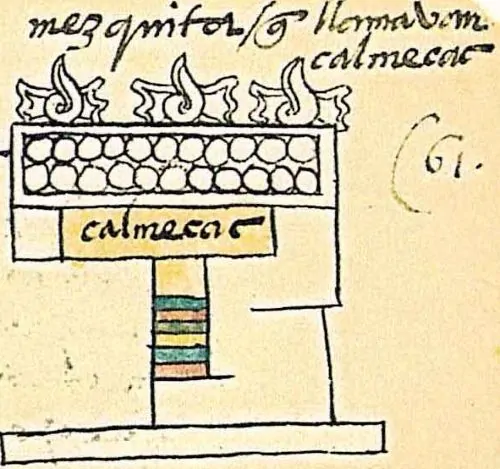
Once rulers, councils, commanders, and ritual specialists had agreed upon war, the decision still had to be transformed into an army capable of leaving the Basin of Mexico and operating in hostile territory. Mobilization was both an administrative achievement and a sacred transition. Messengers carried orders to allied rulers, tributary communities, neighborhood leaders, military officers, and officials responsible for provisions. Temples prepared offerings, commanders assembled weapons and insignia, and communities determined which men would march and which would remain to sustain agricultural production and local defense. These activities did not occur in separate religious and military spheres. The rites preceding departure gave meaning to the accumulation of food, weapons, porters, and allied contingents, while the success of those practical arrangements demonstrated that the ruler possessed the authority to coordinate the communities under his command. A campaign involving Tenochtitlan, Tetzcoco, Tlacopan, and numerous subordinate altepeme required more than a proclamation from the Mexica tlatoani. Each participant had to acknowledge the undertaking through its own political and sacred institutions. Mobilization revealed the structure of imperial power: Tenochtitlan might dominate the coalition, but the army could march only when rulers, districts, temples, noble houses, and tributary communities translated central commands into local action.
Fasting, penitential bloodletting, prayer, incense, and offerings prepared rulers and warriors for the dangers of the campaign. Such acts did not arise from the belief that physical suffering automatically purchased victory. They marked a temporary withdrawal from ordinary life and demonstrated humility before powers whose assistance could be requested but never compelled. The tlatoani and senior commanders might undertake ritual abstinence before major ceremonies, while priests maintained vigils and offered blood, food, paper, rubber, flowers, copal, or sacrificed animals and human beings according to the deity and occasion. Warriors could be expected to observe disciplines involving food, sleep, sexuality, speech, and bodily conduct, though the precise practices probably varied according to rank, festival, campaign, and source tradition. These disciplines acknowledged that military failure could result from disorder within the army as well as strength in the enemy. A commander who allowed arrogance, drunkenness, theft, sexual misconduct, or contempt for ritual obligations to spread among his troops endangered the moral condition of the expedition. Penance was connected with discipline. It reminded warriors that courage did not authorize uncontrolled behavior and that a campaign belonged to the ruler, the community, and the gods rather than to the private appetites of individual fighters.
Offerings directed the approaching violence toward particular divine relationships. Huitzilopochtli could be addressed as the patron who had guided and defended the Mexica, while Tezcatlipoca remained relevant to royal authority, uncertainty, and the reversals of fortune that haunted every campaign. Other gods might receive attention according to the time of year, the communities participating, the enemy being confronted, or the ritual traditions of individual military units. Priests could present weapons, banners, shields, or garments before divine images, burn incense around assembled warriors, and seek protection for the standards under which contingents would march. Sacred bundles and deity images made divine presence portable, allowing the army to carry elements of the temple beyond the city. This did not mean that every expedition transported the same objects or performed one fixed departure ceremony. Colonial accounts tend to preserve elaborate royal and temple rites more clearly than the preparations of ordinary communities. Nevertheless, their repeated association of war with fasting, offerings, speeches, and sacred equipment demonstrates that departure was understood as a change in condition. Men who had been farmers, artisans, merchants, students, or neighborhood residents were ritually reconstituted as warriors entering a landscape of extraordinary danger and obligation.
Mobilization drew upon institutions that had trained and classified men long before a particular campaign was announced. Young males received military preparation through educational systems conventionally associated with the telpochcalli and calmecac, although instruction varied by status, community, and local institution. Novices did not initially enter battle as independent heroic fighters. They carried equipment, transported provisions, observed experienced warriors, and learned how formations, commands, signals, and captive taking worked under battlefield conditions. Veteran warriors and titled officers supplied the cadres around which larger levies could be organized. Military advancement depended heavily upon demonstrated achievement, especially the taking of captives, and increasingly elaborate costumes and insignia made rank visible. Yet the Mexica did not maintain a permanent mass army in the modern sense. Most forces had to be called from communities whose men also performed agricultural, tributary, and household labor. Local leaders assembled contingents, verified obligations, and placed less experienced men under established commanders. Allied forces retained recognizable identities and might be assigned their own positions within the march or battle order. The army was a temporary concentration of social groups that already existed, held together by hierarchy, training, local allegiance, and the authority of the coalition’s rulers.
Standards and military insignia gave visible order to this potentially unwieldy force. Feathered banners, back devices, shields, costumes, and emblems identified commanders, ranks, cities, districts, and specialized warrior groups. Their height and brilliance allowed soldiers to locate leaders amid dust, noise, movement, and the confusion of close combat. Standards were practical instruments of command, but they were also sacred and political objects. A banner could embody the honor of the unit following it, the authority of the ruler who had issued it, and the protective presence of the deity or community associated with its design. Losing such an object could signify more than a tactical setback, while capturing an enemy standard made defeat materially visible. Drums, conch shells, whistles, shouting, and other signals coordinated departure and movement, announced changes in formation, and intensified the emotional force of battle. Costumes likewise operated at several levels. Jaguar skins, eagle imagery, featherwork, patterned shields, and other distinctions rewarded achievement and communicated status, but they also transformed warriors into embodiments of predatory, celestial, or divine power. An army moving beneath standards and accompanied by ritual sound was not merely a crowd supplied with weapons. It presented itself as an ordered body whose hierarchy could be seen and heard. The army’s most demanding preparation involved food, transport, and the coordination of movement. Warriors carried some provisions and equipment, but extended campaigns depended upon human porters, commonly described as tlamemes, because central Mexico lacked draft animals capable of transporting military supplies. Maize, tortillas, tamales, water, weapons, clothing, bedding, ritual equipment, and replacement materials had to move with or ahead of the force. Allied and subject communities along the route could be ordered to prepare food, provide porters, repair roads, furnish guides, and establish places where contingents might rest or regroup. An army that concentrated too long in one place could exhaust local stores before encountering the enemy, while a route crossing unfriendly territory exposed porters and supplies to attack. Mobilization required commanders to stagger departures, choose assembly points, coordinate contingents moving from different cities, and ensure that the ceremonial date selected for departure remained compatible with logistical reality. Ritual transformed these arrangements into a legitimate collective undertaking, but it could not substitute for them. The Mexica army became formidable when sacred discipline, visible hierarchy, trained leadership, tributary resources, and logistical planning converged. Preparing for war meant creating that convergence, turning a politically diverse population into a force capable of moving, obeying, fighting, and understanding its actions as service to both earthly rulers and divine powers.
The Battlefield as Sacred and Political Performance

The Mexica battlefield was neither a purely ritual arena nor a chaotic space in which individual warriors fought without coordination. It was a tactical environment in which commanders attempted to break enemy formations, protect their own standards, exploit terrain, and compel an opposing altepetl to acknowledge defeat. Battles often began with exchanges of missiles from bows, slings, spear-throwers, and thrown darts before forces closed with shields, thrusting spears, clubs, and obsidian-edged weapons. The precise order depended upon the size of the armies, the ground on which they met, and whether the engagement involved an open field, a fortified settlement, a mountain pass, a causeway, or a siege. Commanders needed to maintain cohesion among contingents drawn from different cities and districts, while experienced warriors steadied novices who had never faced the noise and danger of mass combat. Sacred meaning did not make these practical demands less real. Rather, it made battlefield discipline part of a larger moral order. A warrior who abandoned his position, endangered his companions, or ignored commands failed not only tactically but socially and ritually, because the army represented the ruler, the altepetl, and the divine powers invoked before departure.
Military standards, costumes, drums, conch shells, and shouted commands made the army’s organization visible and audible. Tall back devices and feathered banners allowed soldiers to locate commanders through dust and confusion, while shield designs, garments, and insignia distinguished rank, unit, city, and accumulated achievement. These objects were not merely decorative signs added to combat after tactical needs had been met. They enabled communication, concentrated loyalty, and turned the body of the warrior into a moving statement about his community and status. The survival of a standard could help preserve order when individual fighters became separated, while its fall or capture could signal that a commander or unit had been overcome. Sound performed a similar function. Drums and shells announced advances, withdrawals, and changes of formation, but they also magnified the emotional force of battle, encouraging allies and intimidating opponents. The battlefield was crowded with recognizable signs whose meanings extended beyond the men carrying them. A noble warrior wearing an eagle or jaguar costume represented personal accomplishment, yet he also embodied the military hierarchy that had rewarded him and the predatory or celestial powers associated with his insignia. Through movement, sound, and color, the army presented itself as an ordered political body rather than an accidental gathering of armed men.
Captive taking occupied an important place within this battlefield order because individual advancement was closely connected to demonstrated success in seizing enemies. The Codex Mendoza portrays military rank through costumes and privileges earned after particular numbers or qualities of captives had been taken, making battlefield performance visible in the warrior’s later social identity. Capturing an opponent required courage, skill, and often cooperation. A warrior had to disable or restrain an enemy while remaining vulnerable to attack from others, and novices might assist experienced fighters rather than acting independently. Captives could later be presented to rulers and priests, incorporated into public ceremonies, and used as evidence of the captor’s service. Yet the importance of captives should not be exaggerated into the claim that Mexica armies routinely sacrificed tactical victory to seize prisoners alive. Recent scholarship has challenged the idea that the demand for sacrificial victims governed overall battlefield strategy. Captives could be obtained opportunistically during battles fought primarily to defeat enemy forces, compel political submission, and secure economic or strategic objectives. Killing remained unavoidable and sometimes desirable, particularly when an opponent resisted fiercely, threatened the formation, or could not be safely restrained. The distinction between capturing and killing was not a simple contrast between ritual warfare and practical warfare. Both belonged to a system in which the army sought collective victory while individual warriors pursued honor within the opportunities that combat created.
Combat was also a performance because courage, fear, rank, and divine favor had to become visible to witnesses. Warriors fought before companions who could later confirm or dispute claims of achievement, and the distribution of honors depended upon recognizable deeds rather than private assertions. Seizing a captive, defending a commander, recovering a standard, entering an enemy formation, or continuing to fight after being wounded could all become part of the warrior’s public identity. Cowardice was equally visible and could bring humiliation, punishment, or the loss of expected advancement. Nahua songs and speeches represented war through images of flowers, shields, dust, blood, precious feathers, and the brief brilliance of life before death. Such language did not soften violence into metaphor. It placed the battlefield within an aesthetic and moral world in which beauty and destruction could coexist. The phrase commonly rendered as the “song of shields” captured war as something heard, seen, remembered, and performed before human and divine audiences. Elite warriors dressed in brilliant regalia while entering a space where bodies were mutilated, friendships severed, and social identities transformed. The beauty of the military display intensified rather than concealed the danger, because costly costume and visible rank exposed the warrior as a valuable target whose capture would bring prestige to the enemy.
The outcome of battle determined how the performance would be interpreted. Victory could confirm the ruler’s judgment, the commanders’ competence, the army’s discipline, and the apparent favor of the gods invoked before departure. Defeat could cast doubt upon every one of those claims. A broken formation, a fallen standard, the capture of a commander, or flight from the field transformed sacred confidence into political danger because neighboring communities might conclude that the imperial center had become vulnerable. Mexica forces sought not only to kill or disperse opponents but to produce unmistakable signs of submission. The seizure or burning of a temple, the capture of nobles, the occupation of a marketplace, the removal of sacred objects, or the formal surrender of the enemy ruler could announce that resistance had ended. Pictorial histories compressed such events into recognizable images, including burning temples and victorious warriors, turning the battlefield’s uncertain movement into a clear historical claim. The political meaning of combat was completed through later narration: commanders reported achievements, warriors presented captives, rulers distributed rewards, and priests incorporated victory into ceremonial life. The battlefield was sacred and political not because every encounter followed a ritual script, but because its violence generated judgments about authority, courage, hierarchy, and divine favor that reached far beyond the ground on which the armies had fought.
The Transformation of Victory with Captives and Sacrifice

The taking of a captive did not end when an enemy warrior was subdued on the battlefield. It began a process through which military success was removed from the confusion of combat and converted into a visible social and religious achievement. Captives had to be restrained, guarded, identified with their captors, and transported back through territories that might still be hostile. Those who survived the journey could be presented before commanders and rulers, counted among the results of the campaign, and assigned roles within ceremonies scheduled for particular festivals. Their arrival in Tenochtitlan or another victorious altepetl made a distant battle tangible to people who had not witnessed it. Families, neighborhood communities, priests, nobles, and political visitors could see the bodies through which warriors claimed advancement and rulers demonstrated the reach of their authority. Public entry also changed the captive’s status. He was no longer simply an enemy capable of returning to his own formation. He had become a person possessed by the victor and increasingly dedicated to a ritual future. Processions, clothing, songs, dances, and formal presentations marked this transition, separating the captive from his former political community while incorporating him into the ceremonial order of the city that had defeated him.
The relationship between captor and captive could be represented through strikingly intimate language. Nahua accounts sometimes describe the captor as the captive’s father and the captive as his beloved son, while other imagery evokes bonds between mother and child. Such language did not erase coercion or turn the relationship into affection in any ordinary sense. It transformed violent possession into a socially intelligible obligation. The captive’s body provided evidence of the warrior’s courage and could secure advancement, privileges, clothing, and public recognition, but the captor also assumed responsibility for preparing and presenting him correctly. He might provide garments, food, ritual objects, or other necessities and accompany him through the ceremonies preceding sacrifice. The captive could be washed, adorned, instructed in the songs and movements expected of him, and displayed in clothing that identified the deity, festival, or military achievement to which his death would contribute. These preparations required resources and demonstrated that the captor possessed both the achievement and the household support necessary to fulfill his ceremonial responsibilities. Members of the captor’s household could participate in these preparations, allowing victory to elevate a family and neighborhood as well as an individual warrior. Correctly identifying the captive with the warrior who had seized him was also essential because military advancement depended upon publicly recognized achievement. A captive taken through cooperation might generate disagreement over which warrior deserved primary credit, making testimony from companions and commanders important. The captive’s own status, courage, and reputation could affect the honor attached to the capture, since overcoming an experienced or distinguished opponent brought greater prestige than subduing someone regarded as weak. The intimacy of the language made the eventual death more, not less, significant. In some accounts, the captor refrained from eating the flesh of his own sacrificed captive because he regarded the victim as his own body or child, while others within his social circle participated in the ritual distribution. The captive was both radically foreign and symbolically close: an enemy whose defeat enhanced the captor’s identity and a dependent whose ceremonial death completed the warrior’s achievement.
Sacrifice did not take a single standardized form, and captives were not offered indiscriminately to an undifferentiated pantheon. Their treatment depended upon the festival, deity, political occasion, personal vow, and qualities assigned to the victim. Some were killed by heart extraction upon temple platforms; others participated in dances, impersonated divine figures, fought in staged but lethal contests, or underwent forms of death associated with particular sacred powers. During Tlacaxipehualiztli, captives could be connected with Xipe Totec and the renewal expressed through flaying, the wearing of skins, and the ceremonial combat commonly called gladiatorial sacrifice. At ceremonies associated with Huitzilopochtli, sacrifice at the Templo Mayor could place conquered bodies within the sacred geography of Coatepec and the god’s defeat of Coyolxauhqui. These rites were not interchangeable demonstrations of cruelty. Each gave the captive a particular ritual identity and joined his death to a distinct set of relationships involving warfare, fertility, divine impersonation, seasonal renewal, or the fulfillment of a warrior’s vow. The captive’s transformation could begin well before death through costume, fasting, instruction, procession, and performance. By the time he reached the sacrificial place, he had become more than a prisoner awaiting execution: he had been made into a ritual subject through whom the city addressed its gods and interpreted its victory.
The public treatment of captives allowed military power to be displayed before several audiences at once. For the captor, sacrifice completed an achievement that could be translated into military rank and social distinction. His success might permit him to wear particular garments, enter higher military circles, receive material rewards, or occupy a more honored place during ceremonies. For the captor’s household and neighborhood, the captive demonstrated that one of their members had fulfilled the dangerous obligations expected of a warrior and had returned with an achievement that elevated the wider community. For the ruler, the assembled victims demonstrated that his armies had succeeded, his commanders remained loyal, and distant enemies could be brought physically into the ceremonial center. Captives from several regions could transform separate battles into a single imperial spectacle, presenting expansion as coherent, cumulative, and divinely supported. Their bodies made remote geography visible: communities otherwise known through tribute lists, place-name glyphs, or diplomatic reports appeared in the capital through representatives of their defeated armies. For tributary delegations and foreign envoys, the spectacle warned that resistance could end not only in battlefield defeat but in the ritual appropriation of bodies, insignia, and political identity. Representatives who witnessed the ceremonies could carry their memory back to distant communities, extending the intimidating effect of sacrifice beyond those physically present. Priests transformed captives into offerings, yet the ceremony also proclaimed the power of the institutions that controlled access to the gods and determined how military success would be translated into sacred action. Skulls placed upon a tzompantli, skins worn during prescribed rites, bones retained or fashioned into ritual objects, and bodies cast down temple stairways extended the meaning of defeat beyond the moment of death. These remains were not simply trophies in the narrow sense of souvenirs. They became elements of an imperial sacred landscape in which conquered enemies continued to signify victory. The ceremony acknowledged qualities possessed by the captive himself. A warrior who faced death with courage could preserve honor even while serving the triumph of his captors. His disciplined performance confirmed the value of the victory by demonstrating that the defeated enemy had been formidable enough to matter.
The significance of sacrifice should not be expanded into the claim that obtaining victims was the principal objective of every Mexica campaign. War captives constituted a major source of sacrificial victims, and individual warriors had powerful incentives to seize enemies alive, but the scale of ceremonial demand was not sufficient to explain the empire’s overall strategy. Campaigns sought tribute, political submission, secure routes, obedient rulers, commercial access, and the suppression of rebellion. Many enemies died in combat, escaped, were released, remained in servitude, or disappeared from the surviving record, while most inhabitants of conquered communities continued living under altered political obligations. Sacrifice transformed selected products of victory; it did not substitute for victory itself. Its power lay in converting an unstable battlefield outcome into an ordered public statement. The captive’s movement from enemy formation to procession, temple, and sacrificial death allowed the Mexica to present conquest as proof of warrior courage, royal competence, divine favor, and cosmic continuity. Through that transformation, the state made victory durable in memory even though control over distant subjects remained uncertain. The sacrificed captive became the point at which personal achievement, imperial coercion, and sacred obligation were joined most visibly.
The Sacred Meaning of Imperial Order
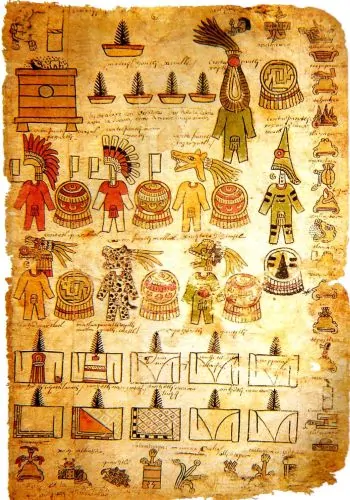
Victory did not become imperial rule merely because an enemy army had been defeated or a temple burned. Conquest had to be converted into a continuing relationship in which the defeated altepetl acknowledged the authority of the Triple Alliance and performed obligations demonstrating that submission. Tribute was among the most important of these obligations. It transformed military success from a temporary event into a recurring flow of goods, labor, and political recognition directed toward the victorious powers. The defeated community might retain its own ruler, temples, lands, markets, and internal institutions, but it now occupied a different position within a larger hierarchy. Periodic deliveries announced that the relationship established through war remained in force and that local leaders accepted responsibility for maintaining it. Tribute was more than taxation in the modern administrative sense. It was a repeated act of subordination through which distant communities made imperial authority materially visible. Each shipment renewed the outcome of conquest, carrying the political meaning of the battlefield into warehouses, palaces, temples, workshops, and public ceremonies.
The tribute recorded in pictorial manuscripts such as the Codex Mendoza and the Matrícula de Tributos included both everyday necessities and costly products associated with elite life. Conquered provinces could be required to deliver maize, beans, amaranth, cotton cloth, warrior costumes, shields, cacao, feathers, jaguar skins, rubber, paper, precious stones, gold objects, dyes, salt, pottery, and other regional goods. The nature of the demand reflected ecological differences, established production, transportation routes, local specialization, and the political terms imposed after conquest. A tropical province could provide cacao or brilliant feathers unavailable in the Basin of Mexico, while cotton-producing regions supplied vast quantities of cloth that could be redistributed among rulers, warriors, officials, and temple personnel. Tribute schedules were generally organized around recurring intervals, though obligations varied among provinces and cannot be reduced to one uniform imperial rate. Pictorial lists helped identify tributary communities, quantities, objects, and periods of delivery, translating political obligations into images officials could recognize and transmit. These records did not describe every exchange within the empire, nor did they distinguish perfectly between the shares owed to Tenochtitlan, Tetzcoco, and Tlacopan. They nevertheless reveal the enormous administrative labor required to transform conquest into predictable revenue.
Imperial authority depended heavily upon local institutions. The Triple Alliance did not replace every conquered government with officials sent from Tenochtitlan, and it generally lacked the centralized bureaucracy necessary to administer daily life across all subject territories directly. Existing rulers, nobles, calpolli leaders, tribute officials, and community organizations often remained responsible for collecting required goods and assembling them for delivery. This arrangement reduced the costs of occupation and allowed the empire to use established methods of production and authority. It also made submission personal. A local ruler who delivered tribute demonstrated loyalty; one who delayed, concealed goods, or refused payment risked being accused of rebellion. In strategically important or unstable regions, imperial representatives, garrisons, marriage alliances, or specially favored local rulers could provide additional control. Provincial organization differed according to distance, political history, economic value, and the danger of resistance. Some communities were governed through relatively indirect arrangements, while others experienced closer supervision or harsher demands. Submission was not one legal condition applied identically everywhere. It was a negotiated and unequal relationship whose terms reflected both imperial power and the practical limits of that power.
The movement of tribute toward the imperial center also carried sacred meaning. Goods obtained through conquest supported temples, festivals, sacrificial ceremonies, royal households, military rewards, and the production of regalia through which hierarchy was displayed. Cotton garments clothed warriors and officials; feathers and animal skins became standards, costumes, shields, and ornaments; paper, rubber, incense, food, and other materials entered ritual offerings. Tribute gathered from diverse environments allowed Tenochtitlan to present itself as a center into which the abundance of the wider world flowed. The capital’s temples and ceremonies condensed distant landscapes into public displays of imperial reach. Tropical feathers, mountain products, coastal shells, cotton, cacao, precious stones, and animal skins appeared together in a city whose ecological setting could not produce them all. Their presence demonstrated not only wealth but ordered difference: many peoples and regions contributed distinct substances to a political structure dominated by the Triple Alliance. When tributary goods were offered to the gods, distributed during festivals, or fashioned into insignia, conquest was transformed into sacred maintenance. The empire claimed that the resources of subordinated lands sustained rulers, warriors, temples, and divine relationships upon which collective prosperity depended. This sacred representation did not make tribute consensual or prevent it from becoming a major source of resentment. Obligations were enforced by the threat of renewed violence, and their burden fell unevenly within subject communities. Local nobles might preserve their offices by transferring imperial demands downward to commoner households, artisans, farmers, and specialized producers. A tribute requirement recorded as a provincial total concealed the labor needed to cultivate cotton, weave cloth, capture birds, obtain rare materials, transport heavy loads, and replace goods lost through crop failure or local disruption. Demands could reshape production by encouraging communities to devote more labor to goods desired by imperial authorities. Tribute should also be distinguished from trade. Merchants exchanged goods through markets and negotiated transactions, whereas tribute was owed because of political subordination, even though the same products could circulate through both systems. Communities could resent not only the quantity demanded but the humiliation of delivering it to a foreign ruler. Refusal, delay, attacks upon collectors, or the killing of imperial representatives could signal that obedience had broken down and provide grounds for a punitive campaign.
Imperial order was both powerful and fragile. Tribute allowed Tenochtitlan and its allies to support nobles, temples, armies, artisans, and ceremonies on a scale that proclaimed the success of the imperial system. It rewarded warriors, financed further campaigns, and reminded subject rulers that military defeat had created continuing obligations. Yet the system depended upon repeated cooperation from communities that retained their own identities, leaders, grievances, and political ambitions. The Triple Alliance could punish rebellion, replace rulers, and increase demands, but it could not station overwhelming force in every tributary province simultaneously. Authority rested upon the expectation that resistance would be more costly than submission. Sacred ideology strengthened that expectation by presenting tribute as part of a legitimate hierarchy sustained by divine favor, ritual exchange, and the victorious ruler’s responsibility to maintain order. But every missed delivery exposed the coercion beneath that vision. Tribute transformed victory into empire, but it also preserved the memory of defeat among those required to pay. The sacred order celebrated in Tenochtitlan was built upon relationships that had to be renewed continually and could unravel when subject peoples no longer believed imperial punishment was inevitable.
Flower Wars and the Problem of Ritualized Combat
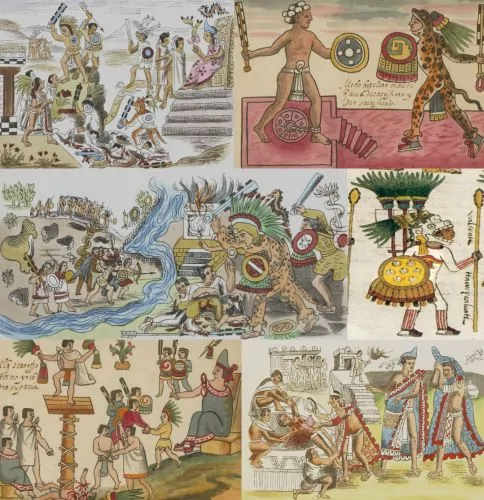
The conflicts commonly called “flower wars,” or xochiyaoyotl, occupy an uneasy place in interpretations of Mexica warfare because they appear to combine formal military violence with ritualized limits and recurring political relationships. Colonial sources describe wars involving Tenochtitlan and its allies on one side and powers such as Tlaxcala, Huexotzinco, and Cholula on the other, sometimes presenting them as deliberately arranged contests fought at agreed places and times. Unlike campaigns intended to destroy a rebellious city or impose tribute immediately, these encounters could recur without producing definitive conquest. Warriors met enemies whose political identity and military strength were already known, and success could be measured through captive taking, individual achievement, and the preservation of prestige as well as through territorial occupation. Yet the familiar image of two armies entering a ceremonial field solely to collect sacrificial victims is too simple. Flower wars were real battles in which men were wounded, captured, and killed, and their consequences extended beyond the performance of ritual obligation.
Mexica traditions associated the development or intensification of flower warfare with the reign of Motecuhzoma Ilhuicamina and with the devastating famine of the 1450s. According to accounts preserved by Diego Durán and other colonial writers, advisers proposed recurring wars against neighboring enemies so that captives would remain available for sacrifice even when no major imperial campaign was underway. The story links battlefield capture to a religious response to environmental crisis, suggesting that offerings to the gods were expected to restore rain, fertility, and cosmic stability. Tlaxcala, Huexotzinco, and Cholula were sometimes described as enemies selected because their warriors possessed appropriate courage and cultural standing, making them worthy offerings in contrast to captives taken from peoples portrayed as distant or less civilized. These narratives reveal how later Mexica and colonial authors understood the sacred value of a formidable opponent. They do not necessarily provide a transparent record of why the wars began. The famine explanation may have organized several political developments into a memorable origin story, while the claim that the conflicts existed primarily to obtain victims may reflect the ritual concerns emphasized by missionary chroniclers.
Flower wars also served practical military and political purposes. Repeated combat gave inexperienced warriors opportunities to enter battle under veteran supervision, attempt captive taking, and demonstrate the courage required for advancement. Commanders could observe the strengths of particular units, test tactics, and maintain readiness during periods when a large imperial expedition was impractical. The wars also placed continuing pressure upon hostile states surrounding or interrupting the wider sphere of Triple Alliance influence. Tlaxcala remained independent despite repeated campaigns, but independence did not mean freedom from strategic strain. Warfare could damage fields, disrupt trade, weaken allied communities, consume noble manpower, and force enemy rulers to maintain permanent defensive preparations. Recurring conflict also prevented stable reconciliation among powers whose cooperation might threaten Mexica dominance. From this perspective, flower war was not an alternative to imperial strategy. It was one of the methods through which the Triple Alliance contained rivals it could not easily or profitably conquer. The degree to which these battles were limited by formal rules remains difficult to reconstruct. Some accounts suggest that opponents agreed upon the place and occasion of combat, allowing both sides to prepare and reducing the possibility of surprise. Such arrangements would have distinguished flower wars from punitive invasions, ambushes, sieges, or campaigns directed toward the destruction of a city. Agreed battlefields may also have concentrated fighting where individual deeds could be observed and captives identified with particular warriors. Nevertheless, formal preparation did not make the encounters safe or symbolic. Missile exchanges, close combat, battlefield deaths, and the seizure of prisoners remained central to the experience. Nor is there strong evidence that every participant understood or honored one unchanging code. Political circumstances could alter the scale and purpose of a campaign, while a contest initially conducted within familiar limits might escalate into attacks upon settlements, crops, or allies. “Ritualized” should describe the structuring of violence rather than its absence. All warfare contains conventions, signals, expectations, and public meanings; flower wars differed in the particular regularity with which opponents and places could be revisited.
Tlaxcalan perspectives further complicate any interpretation centered exclusively upon Mexica objectives. Later narratives produced in Tlaxcala did not present its warriors as passive suppliers of victims for Tenochtitlan. Tlaxcalan rulers defended their independence, celebrated their own captives and victories, and remembered the wars as evidence of sustained resistance against a powerful imperial enemy. Claims that the Mexica deliberately spared Tlaxcala so that it could serve as a permanent source of sacrificial prisoners conveniently converted an inability to conquer into a conscious policy. Such claims protected Mexica prestige by implying that Tlaxcalan survival resulted from imperial choice rather than military limitation. The geography of the region, the strength of Tlaxcalan political organization, the support of allied communities, and the difficulty of maintaining extended operations all contributed to its endurance. Economic pressure and encirclement may have weakened Tlaxcala, but they did not eliminate its capacity for resistance. Flower warfare was remembered differently by the opposing sides: as sacred and strategic management in Mexica narratives, and as proof of autonomy and martial courage in Tlaxcalan traditions.
The historical problem of flower wars lies in resisting two opposite reductions. One treats them as theatrical contests governed almost entirely by religious rules and fought only to secure victims; the other dismisses ritual explanations as propaganda concealing ordinary imperial warfare. The surviving evidence supports neither extreme. Captive taking, sacrifice, calendrical meaning, military training, elite status, strategic containment, and political rivalry could operate within the same conflicts. Ritual did not make the wars politically unreal, and political calculation did not make their sacred meanings insincere. Their recurrence allowed rulers to demonstrate vigilance, warriors to pursue honor, priests to receive captives, and rival states to preserve identities formed through opposition. Flower wars reveal most clearly that Mexica categories of warfare did not separate religion, strategy, and social advancement into independent motives. They constituted a distinctive form of organized violence precisely because each battle could address all of those purposes without necessarily ending in annexation.
The Retrospective Judgment of the Gods
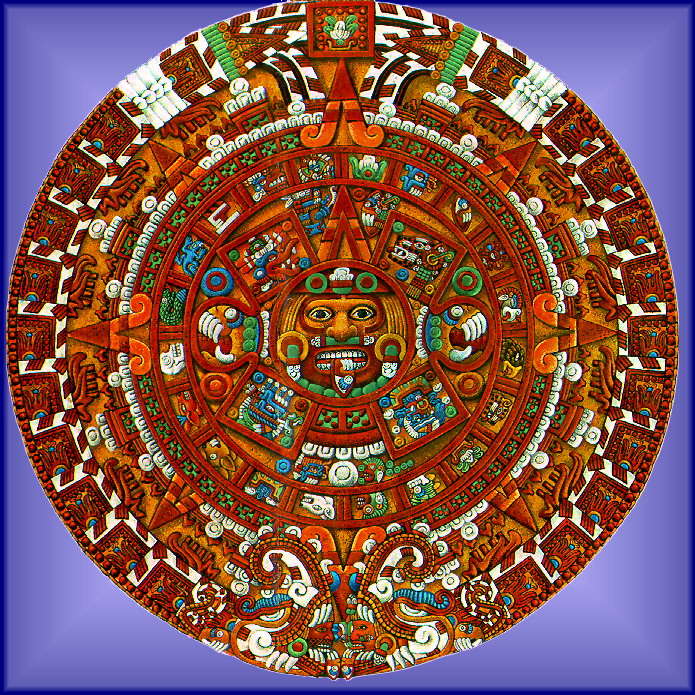
Victory did more than settle a military contest. It reorganized the meaning of the decisions that had preceded it. A successful campaign appeared to confirm the ruler’s judgment, the commanders’ strategy, the priests’ interpretations, the selected date, the discipline of the warriors, and the favor of the divine powers invoked before departure. Reports brought back from the battlefield could transform uncertain signs into obvious promises whose meaning seemed clear only after the outcome was known. A dream previously regarded as ambiguous might be remembered as a prediction of triumph, while an unexpected event during mobilization could be recast as evidence that Huitzilopochtli or another deity had accompanied the army. Captives, tribute, seized standards, burned temples, and the submission of enemy rulers supplied material proof that sacred preparation had been effective. Victory strengthened not only the personal prestige of the tlatoani but the institutions that had authorized the campaign. Councils had advised correctly, priests had performed the necessary rites, commanders had maintained order, and warriors had fulfilled their obligations. The result made a complex process of debate and uncertainty appear coherent in retrospect.
Public celebrations completed this transformation by moving victory from the distant battlefield into the ceremonial life of the capital. Returning warriors entered beneath standards and displayed captives, trophies, foreign insignia, and objects seized from defeated communities. Rulers received commanders, rewarded distinguished fighters, and arranged ceremonies through which military achievement became visible to nobles, commoners, tributary representatives, and foreign visitors. Sacrifice converted selected captives into offerings, while tribute inventories and conquest records preserved the names and products of newly subordinated places. Temples could be enlarged, monuments dedicated, and royal images associated with successful expansion. These acts did not merely commemorate what had happened; they interpreted it. The ceremonies declared that victory had resulted from properly ordered relationships among rulers, warriors, subjects, and gods. They also reduced the disorder of battle to a sequence that could be narrated with confidence: an offense had occurred, legitimate warnings had been issued, sacred consultation had approved action, the army had fought bravely, and divine favor had delivered the enemy into Mexica hands. Public memory removed hesitation from the story even when hesitation had shaped the original decision.
Defeat produced the opposite pressure. It threatened the ruler’s reputation, weakened commanders, encouraged subject communities to reconsider their obedience, and exposed the interpretations of priests and diviners to criticism. A military reverse did not necessarily prove that the gods had abandoned the Mexica permanently, but it demanded explanation because divine favor could not simply be assumed after failure. Advisers might argue that the army had departed on an unsuitable day, that a warning had been ignored, that an offering had been incomplete, or that warriors had violated restrictions through arrogance, drunkenness, theft, sexual misconduct, or indiscipline. Commanders could be blamed for poor formations, inadequate reconnaissance, or failure to protect supplies, while the ruler might be accused of acting from anger or ambition rather than listening to counsel. Such explanations intertwined practical and sacred judgment. A logistical error could also be described as a failure of proper order, and a breach of ritual discipline could be understood as a cause of tactical collapse. Defeat reopened the entire chain of decision-making, allowing rivals to challenge people whose authority victory would otherwise have confirmed. The consequences of failure depended upon its scale and political setting. A temporary setback in a long campaign could be answered through renewed offerings, changes in command, additional intelligence, or the dispatch of reinforcements. A failed siege against a strong independent enemy did not carry the same implications as the collapse of an accession campaign intended to establish a new ruler’s competence. Rebellion by a tributary province was dangerous because it demonstrated that fear of imperial punishment had weakened. If the rebels defeated the first force sent against them, neighboring communities might interpret that success as evidence that the Triple Alliance was vulnerable and that its gods no longer guaranteed victory. The imperial center had strong incentives to respond forcefully, both to recover practical control and to repair damaged prestige. Punitive expeditions could be larger and harsher than the original campaign, making an example of communities whose resistance threatened the wider system. Victory in the renewed campaign then allowed officials and chroniclers to redefine the earlier defeat as a temporary trial rather than a final judgment. The gods had not deserted the Mexica; human errors had been corrected, proper discipline restored, and legitimate order reasserted.
Historical narratives transformed these judgments into explanations of whole reigns. Successful rulers were remembered as courageous, generous, disciplined, attentive to counsel, and favored by the gods, while unsuccessful rulers could be portrayed as weak, proud, indecisive, or ritually inadequate. The contrast between Tizoc and Ahuitzotl demonstrates how later accounts could organize political memory around military performance. Tizoc’s short reign became associated with disappointing campaigns and limited captive taking, whereas Ahuitzotl’s expansion and spectacular ceremonies appeared to restore the vigor of Mexica rule. Such accounts cannot be accepted as neutral records. Chroniclers knew which ruler had prospered, which had died unexpectedly, and which dynasty later claimed legitimacy from his achievements. They arranged speeches, omens, personal qualities, and battlefield outcomes in ways that made success appear deserved and failure intelligible. Political rivals could disappear from the narrative or be transformed into figures whose errors explained subsequent disaster. Retrospective judgment served dynastic and institutional purposes. It taught that proper rulers listened to counsel, honored the gods, rewarded warriors, and maintained the discipline upon which imperial order depended.
The retrospective judgment of the gods did not mean that the Mexica believed every victory proved moral righteousness or every defeat revealed permanent divine condemnation. Divine powers were understood as demanding, unstable, and capable of testing even favored communities. Fortune could reverse, and success itself could produce the arrogance that invited later destruction. What mattered was the continuing work of interpretation. Victory generated ceremonies and narratives that made divine approval visible; defeat generated inquiry, blame, correction, and renewed ritual. Both outcomes were absorbed into a political theology capable of preserving the sacred order while holding particular rulers, priests, and commanders accountable. The gods did not speak through battlefield results in a single unmistakable voice. Human beings decided what the outcome meant, which earlier signs had mattered, whose conduct deserved praise, and whose failure required punishment. Divine judgment was always retrospective and political. War tested the empire materially, but the interpretation of war determined how that test would shape legitimacy, memory, and future action.
Moctezuma II and the Dangers of Retrospective Myth

Moctezuma II has often been portrayed as a ruler imprisoned by prophecy: solemn, fearful, and increasingly incapable of action as reports of strange men arriving from the east reached Tenochtitlan. That image possesses enormous dramatic power, but it obscures the political experience of the man who became tlatoani in 1502. Moctezuma inherited an expanding imperial system supported by tribute, military alliances, noble councils, provincial officials, merchant intelligence, and the ritual authority of the capital. He had held high office before his accession, participated in warfare, and governed during campaigns that extended or reinforced Mexica influence. His court communicated with distant communities through merchants, tributary representatives, messengers, and diplomatic envoys. When Spaniards appeared on the Gulf Coast in 1519, they entered a political world already filled with rival powers, regional grievances, unstable tributary relationships, and independent states such as Tlaxcala. Moctezuma did not face an isolated supernatural puzzle. He confronted an unfamiliar armed expedition whose intentions were uncertain and whose alliances with Indigenous enemies of the Triple Alliance made it increasingly dangerous. The later tendency to reduce his response to terror before omens substitutes a tragic personality for the complicated strategic situation he actually faced.
The best-known conquest omens appear in Book 12 of the Florentine Codex, whose opening chapter describes extraordinary signs said to have preceded the Spaniards’ arrival. These include a fiery phenomenon in the sky, the unexplained burning of a temple, lightning striking another sacred structure, a celestial fire, a violent disturbance in the lake, the cries of a woman lamenting the fate of her children, a strange bird whose reflective surface revealed armed men, and malformed beings brought before Moctezuma. Arranged as a sequence, the omens create an atmosphere of mounting instability in which the destruction of Tenochtitlan seems to announce itself before the invaders appear. Their narrative power comes partly from this perfect alignment between sign and catastrophe. Each event becomes intelligible because the audience already knows the ending. Yet the Florentine Codex was compiled decades after the conquest through collaboration among Bernardino de Sahagún and Nahua scholars working within colonial New Spain. The omen sequence cannot simply be read as a contemporary record of what Moctezuma knew before 1519. It is also a retrospective interpretation produced by people attempting to explain how an apparently powerful city had fallen.
The related claim that Moctezuma believed Hernán Cortés was the returning god Quetzalcoatl presents similar difficulties. Some colonial narratives describe Mexica messengers identifying the newcomers with Quetzalcoatl or expecting the return of the culture hero and ruler Topiltzin Quetzalcoatl from the east. Moctezuma’s gifts, formal speeches, and hesitant diplomacy have consequently been interpreted as acts of submission to a deity rather than attempts to manage an unknown foreign power. This explanation underestimates both Nahua diplomatic language and the political uses of ceremonial courtesy. Elite speeches frequently expressed humility, the burdens of office, and the temporary nature of earthly authority without necessarily surrendering political sovereignty. Formulaic declarations that a ruler merely occupied or guarded a throne for another person should not automatically be read as literal abdications. Such language belonged to a rhetorical tradition in which powerful speakers minimized themselves, praised honored visitors, acknowledged the instability of human fortune, and emphasized the responsibilities attached to office. Cortés had strong reasons to present Moctezuma’s words as an admission that the Spanish monarch possessed a prior claim to rule, since voluntary submission strengthened his legal and political justification for conquest. The speeches preserved in Spanish accounts passed through interpreters, memory, translation, editorial reconstruction, and the conquistador’s own self-defending narrative before reaching later audiences. They cannot be accepted as stenographic records of Moctezuma’s exact words or private beliefs. Gifts could honor, test, delay, redirect, or establish obligations between unequal parties. Costly objects displayed the wealth and refinement of the Mexica court, but they may also have been intended to satisfy the visitors and encourage them to depart. The Spaniards’ hunger for gold altered the effect of this diplomacy, turning generosity into evidence that greater riches awaited inland. Information also changed rapidly. Early reports of extraordinary strangers, unfamiliar animals, metal weapons, and floating structures did not remain fixed once Mexica observers saw Spaniards bleed, fight, demand provisions, quarrel among themselves, and depend upon Indigenous guides and allies. Nahua categories could permit resemblance, impersonation, embodiment, and association with a sacred figure without requiring the rigid identity implied by the assertion that Cortés was literally Quetzalcoatl. Even if some individuals initially connected the newcomers with existing sacred traditions, that association need not have produced a settled conviction that Cortés was a god whose conquest had been divinely ordained.
The conquest-omen tradition nevertheless drew upon genuine Nahua practices of interpreting unusual events. The Florentine Codex devotes an earlier book to omens and prognostications, demonstrating that strange cries, animal behavior, bodily conditions, dreams, fires, and other disruptions could possess meaning long before the Spanish invasion. It would be equally misleading to dismiss every conquest omen as a European invention. The problem lies in recovering how separate traditions were selected, reorganized, and made to point toward one known catastrophe. Christian and classical histories also contained prodigies announcing the fall of cities, death of rulers, or divine punishment of sinful peoples. Missionary authors knew narratives in which comets, fires, monstrous births, and supernatural voices preceded disaster. Nahua collaborators possessed their own traditions of ominous disturbances and retrospective historical explanation. Colonial accounts emerged from the interaction of these intellectual worlds. The resulting stories could be authentically Nahua in imagery while still reflecting the narrative demands of the postconquest period. They reveal how conquest was remembered, but not necessarily the precise chronology of Moctezuma’s thoughts before it occurred.
Moctezuma’s documented behavior appears more active and strategic than the legend of prophetic paralysis allows. He sent messengers to the coast, demanded increasingly detailed reports, dispatched gifts, questioned travelers, and attempted to determine who the newcomers were and what they wanted. Ritual specialists were reportedly sent to confront or influence the Spaniards, but these actions belonged to a wider range of responses that included surveillance, diplomacy, control of information, and efforts to discourage the expedition from advancing inland. Gifts of costly objects could display imperial wealth while satisfying visitors enough to persuade them to depart. Orders concerning routes, provisions, and reception allowed Moctezuma to manage the strangers from a distance while gathering intelligence about their behavior. As Cortés moved inland, the situation escaped the categories within which the Mexica court normally handled foreign embassies. The Spaniards were not merely autonomous invaders; they became leaders of an expanding Indigenous coalition. Their Tlaxcalan and other allies supplied warriors, food, geographical knowledge, and political grievances that made the expedition far more formidable than its small Spanish component suggested. Moctezuma’s difficulty arose not because he refused to act, but because every available response carried severe risks. The myth of a fatalistic Moctezuma served several retrospective purposes. For Spanish writers, it made conquest appear inevitable and providential. Cortés succeeded not simply because of Indigenous allies, epidemic disease, political fragmentation, military adaptation, and contingent decisions, but because the existing ruler recognized a superior destiny and yielded before it. The story magnified the conquistador while diminishing the strategic agency of his opponents. For Nahua survivors, omens could help explain a disaster whose scale demanded more than a narrow military account. The destruction of temples, the death of rulers, epidemic mortality, and the collapse of established institutions could be placed within a world in which extraordinary events announced that ordinary order was ending. Later political factions also had reasons to judge Moctezuma harshly. Communities that had opposed Mexica power could portray him as arrogant, indecisive, or abandoned by the gods, while members of rival dynasties could contrast his failure with the courage or wisdom of their own ancestors. The ruler known to posterity was shaped by Spanish triumphalism, Indigenous grief, anti-Mexica memory, dynastic rivalry, and the universal attraction of a tragedy whose ending appears to have been foretold. Modern scholarship has increasingly challenged this portrayal by emphasizing diplomacy, Indigenous coalition building, and the political choices made on all sides.
The conquest omens should consequently be treated neither as transparent predictions nor as meaningless fabrications. They belong to the history of how societies interpret catastrophe. Some may preserve memories of unusual events discussed before the invasion; others may have been altered, reordered, combined, or assigned new meanings afterward. Their importance does not depend upon proving that each occurred exactly as recorded. They show that colonial Nahua historians understood political disaster through a sacred environment in which temples, skies, animals, water, dreams, and human bodies could reveal dangerous transformations. The danger begins when this retrospective narrative is turned into a simple explanation for conquest. Moctezuma did not lose his empire because he saw a comet, believed every stranger was divine, or waited helplessly for prophecy to fulfill itself. The Mexica state fell through warfare, alliance, rebellion, epidemic disease, siege, and political miscalculation. Omens helped later generations explain why those events had happened. They should not be used to deny the uncertainty under which Moctezuma acted or the agency of the many Indigenous peoples whose decisions determined the outcome.
Was Religion Primarily a Language Used to Legitimize Imperial Violence?
The following video from “The World History Channel” discusses Aztec Eagle Warriors:
A skeptical interpretation of Mexica sacred warfare begins with an obvious political fact: religious claims consistently supported the interests of an expanding imperial elite. Huitzilopochtli’s mythology elevated the historical experiences of the Mexica into a cosmic mandate, presenting migration, conquest, captive taking, and sacrifice as obligations rooted in divine history rather than choices made by rulers seeking power. Calendrical consultation, omens, offerings, and priestly approval could transform strategic decisions into actions authorized by forces beyond ordinary political debate. Tribute extracted from conquered communities sustained temples, nobles, armies, and ceremonies that celebrated the legitimacy of further expansion. Public sacrifice displayed captives before subject delegations and foreign envoys, turning the defeated body into evidence that both the gods and the battlefield favored Tenochtitlan. From this perspective, religion did not merely accompany imperial violence. It provided the language through which conquest appeared necessary, submission became morally ordered, and resistance could be condemned as an offense against a sacred hierarchy. The rulers and institutions benefiting most from war also possessed disproportionate influence over the ceremonies, monuments, historical narratives, and tribute records through which that war was remembered.
This interpretation gains strength from the ways Mexica rulers reshaped history to serve contemporary political needs. Accounts of the migration from Aztlan, the founding of Tenochtitlan, the defeat of Azcapotzalco, and the rise of the Triple Alliance placed Huitzilopochtli at the center of a story moving inexorably toward Mexica dominance. Later traditions credited rulers such as Itzcoatl and advisers such as Tlacaelel with reorganizing historical memory, elevating the cult of Huitzilopochtli, and redefining conquest as part of a sacred imperial mission. Whether these traditions preserve exact reforms or later explanations, they reveal an awareness that historical narrative could be politically constructed. The Templo Mayor likewise materialized a specifically Mexica vision of cosmic order at the center of imperial power. Its architecture joined Huitzilopochtli and Tlaloc, warfare and fertility, conquest and subsistence, while ceremonies performed upon it displayed the capital as the place where diverse peoples and resources were assembled under Mexica direction. The empire did not invent every god, ritual, or myth it used, but it selected and emphasized traditions that made its authority appear universal. Sacred history could naturalize an unequal political arrangement by presenting the dominance of Tenochtitlan as the fulfillment of divine precedent rather than the contingent result of alliances, military success, tribute extraction, and coercion.
The same critical perspective can be applied to rituals of warning, submission, and punishment. Embassies offered enemies the formal choice between obedience and war, but the alternatives were defined by the stronger power. A ruler who accepted tribute obligations could retain office, while one who resisted exposed his community to invasion, captive taking, and exemplary violence. By describing repeated warnings as evidence of patience and restraint, imperial narratives shifted responsibility for suffering onto the conquered. The enemy had supposedly chosen destruction by refusing reasonable terms, even though those terms demanded political subordination. After victory, sacrifice converted military coercion into sacred judgment. Captives were not presented merely as prisoners seized by a stronger army; they became offerings whose deaths maintained divine relationships and confirmed the righteousness of the victor. Tribute likewise appeared as participation in an ordered world rather than the recurring consequence of defeat. Religion could perform ideological work at every stage of expansion: it identified offenses, justified intervention, disciplined warriors, interpreted victory, punished resistance, and represented imperial extraction as cosmic maintenance. Such a system did not need to persuade every subject that Mexica rule was benevolent. It needed to persuade enough rulers, warriors, officials, and communities that the hierarchy was legitimate, dangerous to resist, or supported by powers larger than any individual altepetl. Yet treating religion as nothing more than elite propaganda creates serious problems of its own. It assumes a modern separation between sincere belief and political calculation that need not have existed for Mexica rulers, priests, warriors, and subjects. A tlatoani could genuinely believe that Huitzilopochtli required ritual service while also recognizing that the god’s cult strengthened royal authority. Priests could interpret omens sincerely while knowing that their decisions carried political consequences. Warriors could seek rank and material reward while understanding captive taking as sacred service. Religious institutions did not operate outside politics, but that does not mean their participants regarded sacred claims as convenient fictions. The same religious language that justified authority could impose obligations upon rulers and expose them to criticism. A failed campaign could suggest that the tlatoani had ignored counsel, violated proper order, or lost divine favor. Priests who misinterpreted signs could be blamed, while arrogant rulers could be remembered as responsible for catastrophe. Sacred legitimacy was not entirely controlled from above. It created standards of conduct that elites had to perform and defend, and it provided rivals with a language through which their failures could be condemned. Ideology was powerful precisely because it was embedded in a widely shared understanding of the world, not because cynical rulers simply imposed beliefs they themselves rejected.
The strongest conclusion is not that religion concealed the “real” causes of Mexica warfare, nor that sacred obligation existed untouched by political interest. Religion was one of the principal ways political reality was understood, organized, and contested. It legitimized imperial violence by connecting conquest with divine history, calendrical order, sacrifice, and the maintenance of the world, but it also shaped what rulers considered possible, dangerous, honorable, and obligatory. Economic advantage, tribute, strategic calculation, elite ambition, warrior advancement, and sacred duty did not operate as separate motives waiting to be ranked. They reinforced and transformed one another within institutions that treated human government as inseparable from divine relationships. Calling religion a language of legitimation is useful only if “language” is understood as more than decoration placed over material interests. It was a system through which interests became intelligible, violence became publicly defensible, and victory became evidence of rightful order. The Mexica empire used religion to justify conquest, but its rulers and warriors also acted within a world in which gods, omens, rituals, and cosmic obligations were believed to possess real force. Imperial ideology was neither wholly cynical nor politically innocent. Its effectiveness arose from the fusion of conviction and power.
Conclusion: War in a World Alive with Divine Meaning
Mexica warfare cannot be understood by separating religion from politics, strategy, economy, and social ambition. Rulers did not first decide upon conquest for material reasons and then add sacred language as decoration, nor did priests mechanically dictate campaigns according to an inflexible calendar. War emerged from institutions in which divine obligation and practical judgment were already intertwined. Merchants gathered intelligence, tributary officials reported unrest, commanders assessed terrain and supplies, councils debated risk, and ritual specialists interpreted dates, dreams, omens, and obligations. Huitzilopochtli gave Mexica expansion a powerful mythic center, but he did not stand alone. Tezcatlipoca, Xipe Totec, Tlaloc, Mixcoatl, Camaxtli, and other sacred powers connected combat with rulership, fertility, ancestry, uncertainty, and renewal. Divine approval did not descend as a single unmistakable command. It was produced through consultation, ceremony, discipline, and political negotiation in a world where human action was believed to affect relationships extending beyond human society.
This sacred understanding shaped every stage of conflict. Migration traditions explained why the Mexica possessed a destiny tied to movement, struggle, and settlement. Calendrical interpretation placed military decisions within time understood as qualitatively charged rather than empty and uniform. Dreams and omens gave form to dangers that intelligence could not measure, while embassies transformed grievances and tribute demands into ritualized choices between submission and resistance. Fasting, offerings, standards, and sacred objects prepared the army to cross from ordinary life into the dangers of campaign. On the battlefield, hierarchy became visible through costume, banners, disciplined formations, and the public taking of captives. After victory, sacrifice, tribute, monuments, and historical narratives converted an unstable military outcome into a durable claim about courage, legitimacy, and cosmic order. Defeat reversed that process, reopening earlier decisions to criticism and forcing rulers, priests, and commanders to explain why divine favor had not appeared as expected.
Yet sacred warfare should not be romanticized as a harmonious system accepted equally by all who lived within it. The Triple Alliance used religious language and ritual performance to legitimate coercion, tribute extraction, captive taking, and exemplary violence. Conquered communities experienced the imperial order celebrated at Tenochtitlan as a hierarchy sustained by military threat. Embassies offered choices whose terms had been defined by the stronger power, sacrifice transformed prisoners into proof of imperial favor, and tribute made defeat recur through regular deliveries of labor and goods. Flower wars could serve ritual and social purposes while also exhausting rivals and containing independent states. The myths and ceremonies that made conquest meaningful to Mexica rulers and warriors could appear very different to Tlaxcalans, rebellious tributaries, captured soldiers, and families required to support imperial demands. Religion did ideological work because it presented a contingent political order as participation in a larger sacred pattern. Its political usefulness does not prove that those invoking it were insincere. The same beliefs that justified authority also bound rulers to standards of discipline, generosity, courage, and ritual competence by which they could fail.
The conquest of the Mexica empire reveals the danger of turning sacred interpretation into historical inevitability. Colonial narratives transformed Moctezuma II into a ruler paralyzed by omens and confused by the supposed return of Quetzalcoatl, making Spanish victory appear foretold rather than produced through Indigenous alliances, epidemic disease, rebellion, siege, adaptation, and contingent decisions. The conquest omens remain valuable not because they provide a transparent record of what Moctezuma knew, but because they show how survivors explained catastrophe in a world where skies, temples, animals, water, dreams, and bodies could disclose political transformation. Mexica warfare belonged to that same living world. Its gods did not replace strategy, and its rituals did not eliminate uncertainty. They supplied the concepts through which uncertainty could be endured, decisions justified, outcomes judged, and violence incorporated into collective memory. War under the sign of Huitzilopochtli was neither merely religious nor merely political. It was action undertaken within a universe understood as responsive, dangerous, and alive with divine meaning.
Bibliography
Affiliate disclosure: Amazon links on this site are paid links. As an Amazon Associate I earn from qualifying purchases.
- Alva Ixtlilxochitl, Fernando de. History of the Chichimeca Nation. Translated and edited by Amber Brian, Bradley Benton, Pablo García Loaeza, and Peter B. Villella. Norman: University of Oklahoma Press, 2019.
- Aveni, Anthony F. Empires of Time: Calendars, Clocks, and Cultures. New York: Basic Books, 1989.
- Benavente, Toribio de, known as Motolinía. Motolinía’s History of the Indians of New Spain. Translated and edited by Francis Borgia Steck. Washington, DC: Academy of American Franciscan History, 1951.
- Berdan, Frances F. Aztec Archaeology and Ethnohistory. Cambridge: Cambridge University Press, 2014.
- —-, et.al. Aztec Imperial Strategies. Washington, DC: Dumbarton Oaks Research Library and Collection, 1996.
- —-. The Aztecs of Central Mexico: An Imperial Society. 2nd ed. Belmont, CA: Wadsworth, 2004.
- —-. “La organización del tributo en el imperio azteca.” Estudios de Cultura Náhuatl 12 (1976): 185–95.
- Berdan, Frances F. and Patricia Rieff Anawalt. The Codex Mendoza. 4 vols. Berkeley: University of California Press, 1992.
- Bernardino de Sahagún. Florentine Codex: General History of the Things of New Spain. Translated by Arthur J. O. Anderson and Charles E. Dibble. Santa Fe: School of American Research, 1950.
- Boone, Elizabeth Hill. Cycles of Time and Meaning in the Mexican Books of Fate. Austin: University of Texas Press, 2007.
- —-. “Incarnations of the Aztec Supernatural: The Image of Huitzilopochtli in Mexico and Europe.” Transactions of the American Philosophical Society 79:2 (1989), i-iv-1-107.
- —-. Stories in Red and Black: Pictorial Histories of the Aztecs and Mixtecs. Austin: University of Texas Press, 2000.
- Booth, Willard C. “Dramatic Aspects of Aztec Rituals.” Educational Theatre Journal 18:4 (1966), 421-428.
- Brumfiel, Elizabeth M. “Huitzilopochtli’s Conquest: Aztec Ideology in the Archaeological Record.” Cambridge Archaeological Journal 8:1 (1998), 3–13.
- Carrasco, David. City of Sacrifice: The Aztec Empire and the Role of Violence in Civilization. Boston: Beacon Press, 1999.
- —-. Quetzalcoatl and the Irony of Empire: Myths and Prophecies in the Aztec Tradition. Rev. ed. Chicago: University of Chicago Press, 1982.
- Carrasco, Pedro. The Tenochca Empire of Ancient Mexico: The Triple Alliance of Tenochtitlan, Tetzcoco, and Tlacopan. Norman: University of Oklahoma Press, 1999.
- Castillo Farreras, Víctor M., ed. Matrícula de Tributos: Nuevos estudios. Mexico City: Secretaría de Hacienda y Crédito Público, 1997.
- Chimalpahin Quauhtlehuanitzin, Domingo. Codex Chimalpahin: Society and Politics in Mexico Tenochtitlan, Tlatelolco, Texcoco, Culhuacan, and Other Nahua Altepetl in Central Mexico. Edited and translated by Arthur J. O. Anderson and Susan Schroeder. 2 vols. Norman: University of Oklahoma Press, 1997.
- Clendinnen, Inga. Aztecs: An Interpretation. Cambridge: Cambridge University Press, 1991.
- —-. “The Cost of Courage in Aztec Society.” Past & Present 107 (1985), 44-89.
- Codex Aubin. Robert Garrett Collection, ca. 1340 B.C.-1900s. British Library, between 1775 and 1825.
- Codex Borbonicus. Facsimile edition. Paris: Bibliothèque de l’Assemblée Nationale, late fifteenth century.
- The Codex Borgia. Edited by Gisele Díaz and Alan Rodgers. Mineola, NY: Dover Publications, Inc., 1993.
- Colston, Stephen A. “’No Longer Will There Be a Mexico’: Omens, Prophecies, and the Conquest of the Aztec Empire.” American Indian Quarterly 9:3 (1985), 239-258.
- Conrad, Geoffrey W., and Arthur A. Demarest. Religion and Empire: The Dynamics of Aztec and Inca Expansionism. Cambridge: Cambridge University Press, 1984.
- Cortés, Hernán. Letters from Mexico. Translated by Anthony Pagden. New Haven: Yale University Press, 1986.
- Díaz del Castillo, Bernal. The True History of the Conquest of New Spain. Translated by Alfred Percival Maudslay. London: The Hakluyt Society, 1910.
- Durán, Diego. The Book of the Gods and Rites and The Ancient Calendar. Translated and edited by Fernando Horcasitas and Doris Heyden. Norman: University of Oklahoma Press, 1971.
- —-. The History of the Indies of New Spain. Translated by Doris Heyden. Norman: University of Oklahoma Press, 1994.
- Gillespie, Susan D. The Aztec Kings: The Construction of Rulership in Mexica History. Tucson: University of Arizona Press, 1989.
- González González, Carlos Javier. Xipe Totec: War and Regeneration in Aztec Mexico. Oxford: Archaeopress, 2011.
- Hassig, Ross. Aztec Warfare: Imperial Expansion and Political Control. Norman: University of Oklahoma Press, 1988.
- —-. Mexico and the Spanish Conquest. Norman: University of Oklahoma Press, 1994.
- —-. Trade, Tribute, and Transportation: The Sixteenth-Century Political Economy of the Valley of Mexico. Norman: University of Oklahoma Press, 1985.
- Hicks, Frederic. “Flowery War in Aztec History.” American Ethnologist 6 (1979): 87–92.
- Hirth, Kenneth G. The Aztec Economic World: Merchants and Markets in Ancient Mesoamerica. Cambridge: Cambridge University Press, 2016.
- Historia de los mexicanos por sus pinturas. In The History of the Indies of New Spain, by Diego Durán, translated and edited by various scholars, 85-126.
- Isaac, Barry L. “Aztec Warfare: Goals and Battlefield Comportment.” Ethnology 22:2 (1983), 121–31.
- Kellogg, Susan. A Concise History of the Aztecs. Cambridge: Cambridge University Press, 2024.
- León-Portilla, Miguel. Bernardino de Sahagún: First Anthropologist. Translated by Mauricio J. Mixco. Norman: University of Oklahoma Press, 2002.
- Lockhart, James. The Nahuas after the Conquest: A Social and Cultural History of the Indians of Central Mexico, Sixteenth through Eighteenth Centuries. Stanford: Stanford University Press, 1992.
- López Luján, Leonardo. The Offerings of the Templo Mayor of Tenochtitlan. Translated by Bernard R. Ortiz de Montellano and Thelma Ortiz de Montellano. Albuquerque: University of New Mexico Press, 1994.
- Magaloni Kerpel, Diana. The Colors of the New World: Artists, Materials, and the Creation of the Florentine Codex. Los Angeles: Getty Research Institute, 2014.
- Martin, Robert William. “A Reevaluation of the Role of War Captives in the Aztec Empire.” Latin American Antiquity 34:2 (2023), 423–37.
- Matos Moctezuma, Eduardo. The Great Temple of the Aztecs: Treasures of Tenochtitlan. Translated by Doris Heyden. New York: Thames and Hudson, 1988.
- Miller, Mary Ellen, and Karl Taube. An Illustrated Dictionary of the Gods and Symbols of Ancient Mexico and the Maya. London: Thames & Hudson, 1993.
- Muñoz Camargo, Diego. Historia de Tlaxcala. Edited by Alfredo Chavero. Mexico: Secretary’s Office of Pomento, 1892.
- Nicholson, H. B. “The Aztec Concept of History: Preliminary Studies.” In Studies in Ancient American and European Art: The Collected Essays of George Kubler, edited by Thomas F. Reese, 74–83. New Haven, CT: Yale University Press, 1985.
- —-. “Religion in Pre-Hispanic Central Mexico.” In Handbook of Middle American Indians, vol. 10, Archaeology of Northern Mesoamerica, Part 1, edited by Gordon F. Ekholm and Ignacio Bernal, 395–446. Austin: University of Texas Press, 1971.
- Olivier, Guilhem. Mockeries and Metamorphoses of an Aztec God: Tezcatlipoca, “Lord of the Smoking Mirror.” Translated by Michel Besson. Boulder: University Press of Colorado, 2003.
- Quiñones Keber, Eloise, ed. Representing Aztec Ritual: Performance, Text, and Image in the Work of Sahagún. Boulder: University Press of Colorado, 2002.
- —-. Codex Telleriano-Remensis: Ritual, Divination, and History in a Pictorial Aztec Manuscript. Austin: University of Texas Press, 1995.
- Read, Kay Almere. Time and Sacrifice in the Aztec Cosmos. Bloomington: Indiana University Press, 1998.
- Restall, Matthew. Seven Myths of the Spanish Conquest. New York: Oxford University Press, 2003.
- —-. When Montezuma Met Cortés: The True Story of the Meeting That Changed History. New York: Ecco, 2018.
- Schroeder, Susan, and Stafford Poole, eds. Religion in New Spain. Albuquerque: University of New Mexico Press, 2007.
- Smith, Michael E. The Aztecs. 3rd ed. Malden, MA: Wiley-Blackwell, 2011.
- Tezozómoc, Hernando Alvarado. Crónica mexicana. Edited by Jose M. Vigil. Mexico: Imprenta y Litografia de Ireneo Paz, 1878.
- Townsend, Camilla. Fifth Sun: A New History of the Aztecs. New York: Oxford University Press, 2019.
- Townsend, Richard F. State and Cosmos in the Art of Tenochtitlan. Washington, DC: Dumbarton Oaks Research Library and Collection, 1979.
Originally published by Brewminate, 07.20.2026, under the terms of a Creative Commons Attribution-NonCommercial-NoDerivatives 4.0 International license.
About the Author