Rickets was a disease of urban poverty and could be life-threatening for pregnant women.

By Tom Porter
College Writer and Multimedia Producer
Bowdoin College
Rickets is a disease of childhood caused by a vitamin D deficiency, explained Associate Professor of English Ann Kibbie. “Although it was widespread in the nineteenth century,” she said “it didn’t really enter into a lot of Victorian medical discourse because it’s not contagious and is not due to poor sanitation. But it was of special interest to practitioners of obstetric medicine.”
Rickets was a disease of urban poverty, said Kibbie, and could be life-threatening for pregnant women. “Rickets is normally caused by a lack of exposure to sunlight and was particularly prevalent in Victorian Britain, where children often lived in narrow, smog-infested streets and didn’t get to play outdoors.”
Ultraviolet light from the sun triggers a hormone that allows us to absorb calcium and enables our bones to develop, said Kibbie. “When this doesn’t happen, the bones grow weaker and softer, which can result in skeletal deformities. Rickets is actually making a bit of a comeback as people spend more time indoors, but was much worse in late nineteenth-century Britain in big cities like London, Manchester, and Glasgow.”

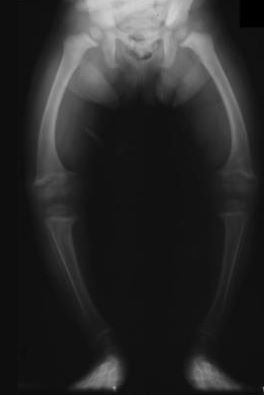
Symptoms of rickets include bowleggedness, dwarfism, curvature of the spine, and distortion of the pelvis. Women who suffered rickets in childhood could end up with a seriously compacted pelvis, meaning should they become pregnant they could carry a fetus to term but would be unable to give birth naturally, said Kibbie.
“In such cases, obstetricians had three options: to stand by as both mother and child died; to save the mother by destroying the fetus in utero and delivering it in pieces; or to perform a Caesarean section, which was tantamount to a death sentence for the mother in those days.” Frustratingly, there are no hard data on the pervasiveness of rickets nor on how many women suffered or died in childbirth as a result of the disease, said Kibbie, but there is plenty of anecdotal evidence out there. “In some of the big cities, some physicians reported that every child they encountered from poorer neighborhoods had rickets.”
Kibbie encountered this particular aspect of women’s reproductive health while researching her last book, Tranfusion: Blood and Sympathy in the Nineteenth-Century Literary Imagination (University of Virginia Press, 2019), in which she examined the medical discourse surrounding the revolutionary nineteenth-century practice of human-to-human blood transfusion. This led to her latest project—an interdisciplinary study that views medical history through the lens of disability studies. Kibbie, who is on academic leave this year, is completing a draft of a monograph on the subject, provisionally titled Fatal Labor: Obstetrics and the Disabled Maternal Body in Nineteenth-Century Great Britain. Her research efforts recently received a boost with the award of a fellowship from the National Endowment for the Humanities.
Looking through written records—principally medical journals, midwifery manuals, and textbooks—Kibbie became aware of how a number of obstetricians were confronted with a horrifying moral dilemma: Which life should they save? The mother’s or the child’s? “Let’s say you’re a medical student in nineteenth-century Britain, and you buy a midwifery manual to help you through cases,” said Kibbie. “There’s also going to be a chapter about how you calculate whether to save the mother or the child. Physicians had lengthy discussions weighing the value of a mother’s life against that of a fetus.” Kibbie admits that part of her wanted to leave the subject alone, as it’s so grim. “But, at the same time, it’s so interesting how a medical problem also became a philosophical problem and an ethical challenge,” she added.
These conversations inevitably led to discussions about abortion, which over the course of the nineteenth century became a capital crime in Britain, said Kibbie. “Some doctors said abortion was justified to save the mother’s life, but of course if they did it, they risked being charged with murder.” Another option gained traction over the course of the nineteenth century, which was for physicians to try to induce premature labor after seven months. It was thought that by this stage in the pregnancy the fetus would be developed enough to be delivered but small enough not to kill the mother. It was still a risky practice, however.
Another interesting aspect of Kibbie’s research sheds light on why this was more of an issue in Britain than in other European countries like France, for example. “This has to do with the fact that Britain was principally a Protestant nation. In Catholic countries like France, there was more of a willingness to carry out risky C-sections. This was because the life of the mother was seen as less important because she was already baptized, unlike the baby. British medical practitioners at the time often described these attitudes as bigoted and superstitious, which fed into a longstanding hostility toward the French at the time.”
Kibbie’s research timetable was interrupted by the COVID-19 pandemic. “Under normal circumstances, I would have the project completed by the fall of this year,” she said, “but I have yet to take an important trip to Scotland to look at the papers of a doctor called Cameron Murdoch.” Murdoch was an early pioneer of the Caesarian section under modern antiseptic conditions, explained Kibbie, making it a viable and significantly safer procedure by the turn of the twentieth century and a milestone in women’s health care. Kibbie hopes an easing of travel restrictions will enable her to visit the archives in Scotland later this year or early next, and to have a draft of her monograph ready to send to publishers within twelve months. “I’m excited to be shining a spotlight on this important aspect of disability studies, which lies at the intersection of medical and cultural history,” she said.
Originally published by Bowdoin College, 04.05.2021, to the public domain.
About the Author