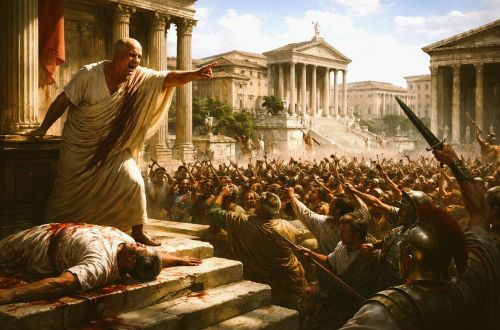
In the final century of the Roman Republic, moral outrage became a political weapon, transforming virtue from ethical ideal into a powerful instrument of factional struggle.

By Matthew A. McIntosh
Public Historian
Brewminate
Introduction: Moral Crisis as Political Language
In the final century of the Roman Republic, elite political discourse increasingly framed instability as a symptom of moral decay. Senators, magistrates, and self-appointed guardians of tradition invoked the mos maiorum, the ancestral code of conduct, as both diagnosis and cure. Luxury, sexual excess, greed, and ambition were cast not merely as private vices but as corrosive forces undermining the state itself. What demands attention is not simply the frequency of such claims but their strategic function. Assertions of moral crisis became a shared vocabulary through which political actors delegitimized rivals, justified prosecutions, and positioned themselves as restorers of ancestral order.
The rhetoric of decline had deep roots in Roman historical memory. Livy’s early books famously contrast the austerity of Rome’s founders with the corruption of later generations, constructing a narrative arc in which prosperity invites decay. By the first century BCE, however, this language was no longer confined to retrospective moralizing. It became immediate and accusatory. Sallust, in his account of the Catilinarian conspiracy, attributed Rome’s degeneration to the destruction of Carthage and the removal of external constraint, arguing that victory unleashed ambition and avarice within the ruling class. Whether historically precise or not, Sallust’s formulation reveals how moral explanation served political analysis. Decline was not merely described; it was weaponized.
Competition within the senatorial elite intensified this process. In the absence of formal parties, political identity was constructed through public performance: speeches, trials, legislative initiatives, and visible gestures of austerity. To denounce luxury signaled alignment with ancestral virtue. To prosecute impiety or sexual misconduct claimed custodianship over Rome’s sacred and social order. Moral language functioned as a form of symbolic capital. As modern scholarship has emphasized, the Republic’s political culture depended heavily on invocations of tradition even as those invocations were selectively interpreted and redeployed in contemporary struggles. The performance of virtue could legitimize ambition while masking its operation.
Late Republican moralism operated less as a coherent reform movement than as a political identity system. Public outrage did not primarily restrain corruption; it structured factional competition. Accusations of decadence and impiety became tools for humiliating opponents and consolidating alliances. When morality becomes performative and politically useful, it risks obscuring private conduct rather than disciplining it. In the turbulent decades before the Republic’s collapse, the language of virtue increasingly became a weapon in the contest for power.
The Language of Decline: Luxury, Degeneracy, and the Fall Narrative

By the first century BCE, the language of moral decline had become a habitual and increasingly sharpened feature of Roman elite discourse. Luxury, once celebrated as visible proof of Rome’s imperial success, was recast as a corrosive force undermining civic virtue and political stability. Expensive banquets, elaborate villas, imported Greek art, perfumed excess, and conspicuous consumption were no longer merely aesthetic or cultural markers; they were framed as symptoms of a deeper rot within the governing class. Public figures repeatedly invoked the contrast between austere ancestors and decadent contemporaries, constructing a narrative in which Rome’s very triumphs had generated the conditions for its moral undoing. The conquest of wealth-producing territories and the influx of spoils were said to have softened discipline and inflamed ambition. This rhetoric did not simply lament social change. It presented decline as causal, as if moral deterioration mechanically produced factional conflict, bribery, and violence. In doing so, it converted political disagreement into ethical emergency.
Sumptuary legislation illustrates how this discourse operated. Laws limiting expenditure on banquets or regulating dress appeared periodically across the Republic, signaling official anxiety about excess. Yet enforcement was inconsistent, and elite lifestyles often continued unabated. The symbolic value of such measures outweighed their practical effect. By sponsoring or defending restrictions on luxury, magistrates could claim alignment with ancestral discipline. The performance of restraint mattered more than uniform compliance. In this way, moral legislation functioned as a stage on which virtue could be publicly enacted.
Sallust’s account of the late Republic provides one of the most influential formulations of this decline narrative. Writing in the shadow of civil conflict, he offered not merely a chronicle of events but a moral diagnosis of Rome’s condition. He traced the Republic’s unraveling to the destruction of Carthage, arguing that the removal of an external enemy dissolved the fear that had once disciplined ambition. Wealth, he claimed, bred luxury; luxury fostered greed; greed fractured solidarity and fueled factional violence. The sequence is rhetorically powerful, presenting moral corruption as the engine of institutional decay. Yet Sallust’s interpretation also reveals how flexible the language of decline could be. By rooting political breakdown in character rather than constitutional design, he transformed structural tensions into ethical failure. Ambition became vice; rivalry became degeneracy. In this framework, reform required moral purification rather than procedural adjustment, a move that heightened the drama of late Republican politics while narrowing the space for compromise.
This narrative of degeneracy also permeated speeches and prosecutions. Cicero frequently associated his opponents with moral laxity, extravagance, or sexual impropriety, thereby linking private conduct to public danger. Charges of effeminacy, indulgence, or impiety were not incidental insults. They framed adversaries as threats to Rome’s collective identity. In a society that prized masculine self-control and reverence for tradition, such accusations carried political weight. To depict a rival as morally compromised was to question his fitness for leadership and to suggest that his political program endangered the state.
The potency of decline rhetoric lay in its elasticity and its capacity to migrate across ideological boundaries. It could be deployed against populares and optimates alike, against tribunes courting popular support or senators claiming aristocratic guardianship. Advocates of austerity condemned the corruption of electoral bribery even as they operated within patronage systems that relied on gift-giving and obligation. Moral language became both weapon and shield. Reformers and conservatives each claimed to defend ancestral virtue, while accusing their opponents of betraying it. Modern scholarship has emphasized that the late Republic did not witness a simple collapse of shared values but a struggle over their interpretation. The invocation of the mos maiorum provided a common vocabulary, yet its meaning was contested and selectively applied. What mattered was less consistency than credibility in performance. To appear as the defender of tradition was to claim moral high ground, even within a political environment saturated with compromise.
The fall narrative functioned less as historical analysis than as political script. By embedding present conflict within a story of ancestral purity and contemporary decay, Roman elites dramatized their struggles as existential contests for the Republic’s soul. The language of luxury and degeneracy did not merely describe social change; it organized political antagonism. In doing so, it transformed moral discourse into an enduring instrument of power.
The Bona Dea Scandal: Sacred Outrage and Factional Utility

The scandal surrounding Publius Clodius Pulcher’s intrusion into the rites of the Bona Dea in 62 BCE offers a vivid case study in the political utility of sacred outrage. The festival, dedicated to a goddess whose rites were restricted to women and held annually in the house of a magistrate, was not merely a religious observance but a symbolic affirmation of Roman moral order. Clodius’ alleged disguise and presence at the ceremony violated both ritual purity and gendered boundaries. The immediate response was framed as moral and religious horror. Yet the intensity of the reaction, and the political maneuvering that followed, reveal that the episode quickly transcended sacrilege. What began as impiety became a weapon in an ongoing struggle among elite factions.
The trial that followed exposed the elasticity of moral outrage in late Republican politics. Cicero, who had already developed a reputation as a defender of order during the Catilinarian crisis, positioned himself as a witness and critic of Clodius’ conduct. His testimony and correspondence reveal both genuine indignation and acute awareness of political opportunity. Julius Caesar, then pontifex maximus and husband of Pompeia, divorced her on the grounds that “Caesar’s wife must be above suspicion,” a statement that framed the scandal in terms of public reputation rather than private guilt. The episode generated a theater of virtue in which leading figures calibrated their responses to preserve or enhance political standing.
The jury proceedings themselves further underscore the factional dimension of the affair. Allegations of bribery, tampering, and intimidation quickly surfaced, suggesting that the mechanisms of justice were entangled with partisan interest. Despite what many contemporaries regarded as compelling testimony, Clodius secured acquittal, a result widely attributed to corruption among jurors and to the protective networks surrounding him. The verdict did not resolve the moral controversy; it amplified it. For Cicero, the outcome symbolized not merely the failure of a prosecution but the degradation of public standards. His subsequent hostility toward Clodius intensified, contributing directly to the political battles that culminated in Cicero’s exile when Clodius, as tribune, enacted legislation targeting him. What began as a religious scandal evolved into a durable line of factional cleavage. Sacred transgression became intertwined with legislative retaliation, street violence, and personal vendetta. The language of piety and outrage provided rhetorical justification for escalating political confrontation, demonstrating how moral categories could be transformed into instruments of strategic reprisal.
The scandal also illuminates the gendered and performative aspects of Roman moral politics. The Bona Dea rites symbolized female chastity and the sanctity of domestic space. Clodius’ alleged intrusion was interpreted as an assault on both religious order and social hierarchy. By emphasizing the violation of sacred femininity, prosecutors amplified the sense of communal injury. Yet the outrage was selective. Elite men routinely navigated a political culture rife with sexual accusation and rumor. What distinguished this episode was not unprecedented immorality but the public stage upon which it unfolded. Sacred space provided an ideal backdrop for dramatizing virtue and vice.
The Bona Dea affair exemplifies how moral scandal could be mobilized for factional utility. Religious outrage legitimized political aggression. Public declarations of purity masked calculations about alliance and advantage. The episode does not demonstrate that moral concerns were insincere; rather, it reveals how they were inseparable from strategic positioning. In a Republic already saturated with competition, the language of sacred offense supplied a potent instrument for humiliating rivals and consolidating support. Outrage did not merely condemn transgression. It structured political conflict.
Cato the Younger and the Performance of Virtue

If the Bona Dea scandal demonstrates the weaponization of sacred outrage, the career of Marcus Porcius Cato, known as Cato the Younger, illustrates the political power of sustained moral performance. Cato cultivated an image of rigorous austerity grounded in Stoic philosophy and ancestral tradition. He dressed plainly, walked rather than rode when possible, and rejected luxuries that had become commonplace among the senatorial elite. These gestures were not incidental eccentricities. They functioned as visible symbols of incorruptibility in a political culture increasingly anxious about decadence. By embodying restraint, Cato fashioned himself as a living rebuke to what he characterized as the moral softness of his contemporaries.
Cato’s public persona gained particular force during moments of crisis. In debates surrounding the Catilinarian conspirators, he advocated uncompromising severity, presenting mercy as weakness and leniency as complicity in corruption. His speech in the Senate opposing clemency framed the issue not merely as a matter of policy but as a test of Roman resolve. By casting the conspirators as existential threats, he aligned moral firmness with political survival. This pattern recurred throughout his career. Whether resisting the ambitions of Pompey or challenging the rise of Caesar, Cato’s stance was marked by principled rigidity. He resisted legislation he deemed unconstitutional, opposed extraordinary commands, and criticized political bargains that diluted senatorial authority. In doing so, he elevated moral consistency above tactical flexibility. His authority rested less on institutional power than on the perception that he could not be swayed by expediency. That reputation, carefully cultivated and publicly reinforced, transformed his philosophical commitments into political leverage.
Yet Cato operated within the very structures he criticized. He competed in elections shaped by patronage and influence, formed alliances when necessary, and relied on networks of support to sustain his position within the Senate. His marriage connections and political partnerships reveal a man fully embedded in aristocratic society rather than detached from it. The tension between his Stoic austerity and the realities of oligarchic competition did not undermine his credibility; it enhanced it. By navigating the system without appearing consumed by it, Cato distinguished himself from rivals who seemed openly ambitious. Modern scholarship has emphasized that his moralism functioned as a resource within factional politics. It offered a language through which resistance to Caesar could be cast as fidelity to the Republic rather than personal rivalry. Cato’s virtue became a banner under which opposition coalesced. His identity as guardian of ancestral norms conferred symbolic authority even when his practical influence was limited.
Cato’s legacy reveals the dual nature of late Republican moral politics. His commitment to principle was genuine, yet its public articulation transformed personal philosophy into political identity. By presenting himself as the embodiment of ancestral virtue, he sharpened the moral polarization of the era. Compromise could be interpreted as surrender, negotiation as betrayal. In this environment, virtue ceased to function merely as personal discipline and became instead a criterion for political legitimacy. The performance of austerity contributed to the intensification of factional conflict, demonstrating how moral identity could both inspire admiration and harden division.
Outrage as Strategy: Accusation, Elimination, and Political Survival
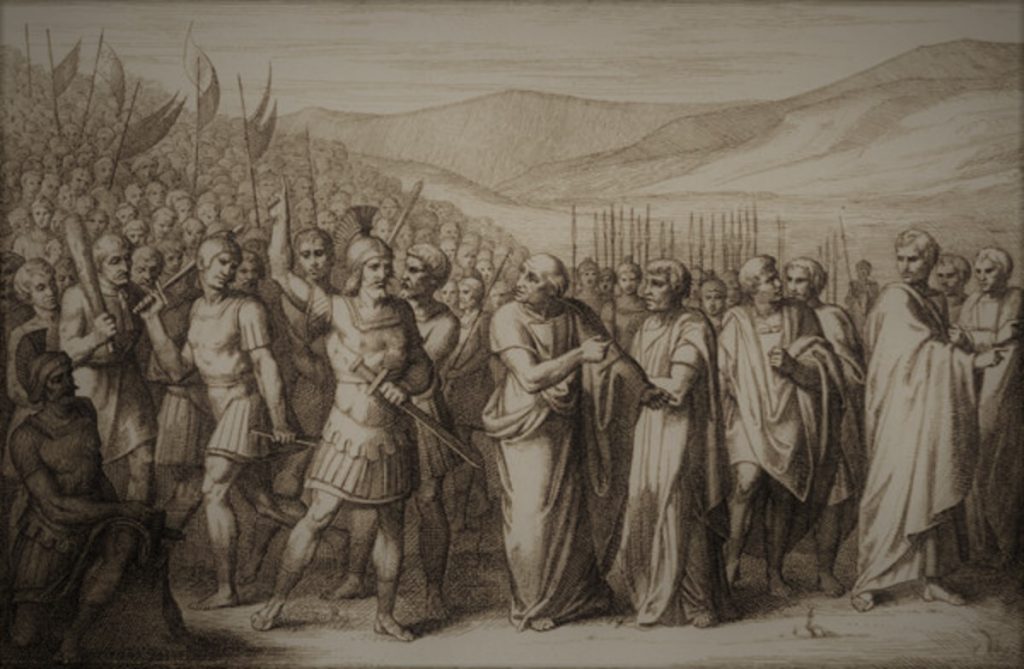
By the middle decades of the first century BCE, moral accusation had become a central instrument in the contest for survival within Rome’s oligarchic order. Political competition was relentless, offices were limited, and reputations functioned as currency within a system that depended on honor and public standing. In such an environment, the ability to define an opponent as morally dangerous could be as decisive as legislative success or military command. Charges of corruption, sexual deviance, impiety, or extravagant luxury did more than tarnish character. They reframed rivals as threats to the Republic’s moral fabric, thereby legitimizing extraordinary measures against them. To attack a man’s virtue was to attack his claim to authority. Outrage supplied the emotional force necessary to convert rivalry into crisis, transforming personal antagonism into a struggle ostensibly waged on behalf of ancestral order. The language of moral defense elevated political combat into ethical necessity.
Trials provided the most visible arena for this strategy. Judicial proceedings were rarely confined to technical questions of law. Advocates framed cases as moral dramas, weaving narratives of vice and virtue that resonated with broader anxieties about decline. Cicero’s forensic speeches illustrate how allegations of immorality could be marshaled to undermine political adversaries. Even when legal guilt was uncertain, the performance of accusation could inflict lasting reputational damage. The courtroom functioned as a stage upon which moral identity was contested and reputations were recalibrated before an audience attuned to signals of corruption or degeneracy.
Sexual allegations proved particularly potent. Accusations of effeminacy, promiscuity, or impiety attacked not only personal conduct but civic masculinity and religious legitimacy. In a political culture that linked self-control with authority, to portray a rival as morally disordered was to question his capacity to govern. Such charges circulated in speeches, pamphlets, and rumor, blurring the line between private life and public office. They were often impossible to disprove conclusively, which increased their utility. The mere association of a name with scandal could weaken alliances and embolden opponents.
Moral outrage also intersected with violence in ways that reveal its structural significance. Street clashes between rival factions were frequently justified through language of defending the Republic or punishing corruption, transforming physical confrontation into moral necessity. Leaders mobilized supporters by presenting conflicts as crusades for civic purity rather than contests for patronage or dominance. In this climate, indignation could legitimize coercion. Political elimination did not always require formal conviction; it could be achieved through sustained character assault, legislative targeting, or orchestrated unrest that rendered a rival’s position untenable. The vocabulary of virtue and vice provided the frame through which escalation appeared defensive rather than aggressive. By casting opponents as embodiments of moral decay, leaders normalized extraordinary tactics in the name of preservation.
The strategic deployment of outrage was not confined to one faction. Optimates and populares alike invoked the language of reform and restoration. Each claimed to defend ancestral norms while accusing the other of betrayal. This reciprocal pattern intensified polarization. Once moral identity became central to political positioning, compromise risked appearing as capitulation to vice. The stakes of disagreement escalated because policy disputes were reframed as ethical absolutes. Outrage was not episodic. It became structural.
The cumulative effect was a political culture in which accusation functioned as both shield and sword. To condemn corruption was to claim legitimacy; to be condemned was to risk marginalization, prosecution, or exile. Outrage did not necessarily reflect heightened moral sensitivity. It reflected the strategic value of moral language within a competitive system lacking stable institutional mediation. As the Republic’s conflicts deepened, the line between ethical concern and political expediency blurred further. Once opponents were depicted as existential threats to ancestral virtue, negotiation appeared dishonorable and reconciliation suspect. Moral discourse contributed to the hardening of factions and the erosion of shared norms. Rather than restraining corruption, the rhetoric of virtue intensified the struggle for dominance. In the final decades of the Republic, elimination could be justified not as ambition but as defense of moral order.
Moral Identity and the Collapse of Republican Norms

As moral accusation became entrenched in political life, it gradually reshaped the norms that had long governed elite competition. The Roman Republic had depended on a shared understanding of procedure, precedent, and mutual restraint among aristocrats who viewed one another as rivals but also as participants in a common order. When moral identity hardened into factional branding, however, opponents were no longer merely adversaries within the same system. They were recast as embodiments of corruption or decadence. This shift altered the texture of political disagreement. To oppose a measure was no longer simply to advance a competing interpretation of law. It was to defend virtue against vice.
The elevation of moral absolutism narrowed the space for compromise. In earlier decades, senatorial conflict often produced negotiated settlements, even if uneasy ones. By the 50s BCE, political debates increasingly carried the tone of existential struggle. If one faction represented ancestral purity and the other degeneracy, accommodation risked appearing as surrender. The vocabulary of decline encouraged a binary framing in which moderation was suspect. Leaders who might otherwise have sought pragmatic solutions instead reinforced their reputations through rigid adherence to principle. The moralization of politics intensified polarization precisely because it rendered flexibility morally hazardous. Even procedural disagreements over provincial commands, debt relief, or electoral reform could be cast as battles over the Republic’s moral future. In such an atmosphere, compromise no longer appeared as a civic virtue but as weakness. The cultural capital attached to moral steadfastness made it politically costly to concede ground, thereby reducing the Republic’s ability to absorb conflict through negotiation.
This dynamic is visible in the escalating confrontation between defenders of senatorial authority and advocates of popular measures. Opposition to figures such as Caesar was frequently cast not only in constitutional terms but in ethical ones. Critics warned of ambition, luxury, and personal domination as moral threats to the Republic’s equilibrium, drawing on long-standing tropes of decline. Supporters, in turn, depicted their opponents as corrupt oligarchs clinging to privilege while invoking ancestral norms selectively to protect their own power. Each side claimed to embody authentic Roman virtue and to represent the true heirs of the mos maiorum. The contest was framed less as a dispute over policy than as a struggle over the moral character of the state itself. By moralizing ambition and institutional reform alike, both camps transformed political disagreement into a referendum on integrity. The shared vocabulary that once unified the elite became a battleground in which rival interpretations of tradition competed for legitimacy.
As factional boundaries hardened, traditional mechanisms of conflict management eroded. Extraordinary commands, emergency measures, and the normalization of political violence became easier to justify when opponents were portrayed as morally dangerous. The Senate’s authority, popular assemblies, and magistracies all came under strain as actors sought advantage through exceptional means. When moral rhetoric elevated the stakes of disagreement, the temptation to circumvent ordinary procedures increased. The collapse of norms was not merely institutional. It was rhetorical. Language that once reinforced shared identity now sharpened division.
The paradox of late Republican moral politics lies in its unintended consequences. Leaders who claimed to defend ancestral virtue often contributed to the destabilization of the order they revered. By framing rivals as existential threats, they encouraged escalatory tactics that weakened the Republic’s capacity for accommodation. Moral language amplified distrust and justified preemptive action. The more intensely actors asserted their commitment to tradition, the more inflexible the political environment became. In such a climate, the preservation of honor could conflict with the preservation of stability.
The transformation of moral discourse into political identity played a subtle yet significant role in the Republic’s unraveling. Outrage, once mobilized as a tool for disciplining corruption, evolved into a mechanism for deepening antagonism. The performance of virtue, far from restoring equilibrium, contributed to a climate in which reconciliation appeared morally suspect. When identity is anchored in the denunciation of vice, coexistence becomes difficult, for disagreement is interpreted as complicity. By the time open civil war erupted, the language of moral exclusion had already conditioned elites to view opponents as threats rather than partners in governance. The late Republic did not collapse solely because of moral rhetoric, but the elevation of virtue into factional banner narrowed the pathways through which conflict might otherwise have been resolved. In turning moral identity into political armor, Rome’s leaders helped erode the very norms that had sustained their shared order.
Conclusion: Performative Morality and the Politics of Elimination
The late Roman Republic did not collapse because its leaders suddenly abandoned morality. On the contrary, they spoke of it incessantly. Appeals to ancestral virtue, denunciations of luxury, and proclamations of sacred outrage saturated public life. Yet this moral intensity did not restore equilibrium. It reshaped the terms of political competition. When virtue became a public performance and a badge of factional identity, it ceased to function primarily as restraint. It became a resource, one that could be mobilized to legitimize opposition and to marginalize rivals.
Throughout the first century BCE, accusations of decadence and impiety served as instruments of elimination. Sacred scandal could fracture alliances. Charges of corruption could erode reputations beyond repair. Assertions of moral purity elevated some figures as guardians of the Republic while casting others as existential threats. In such an environment, outrage became structurally useful. It provided justification for exceptional measures, whether prosecutions, legislative targeting, or the normalization of political violence. Moral language did not merely describe transgression. It structured the pathway through which adversaries were discredited and removed.
This dynamic does not reduce late Republican actors to simple hypocrisy. Many were sincerely committed to their vision of virtue. Cato’s austerity, Cicero’s defense of order, and even Sallust’s moral diagnosis reflect genuine concern for the Republic’s trajectory. Yet sincerity did not prevent moral discourse from acquiring political utility. The performance of virtue amplified polarization by framing compromise as betrayal. Once political disagreement was recast as moral deviation, reconciliation became suspect. Outrage could discipline opponents rhetorically, but it also hardened factional boundaries.
In the end, performative morality contributed to a climate in which elimination appeared defensible as preservation. When rivals were portrayed as embodiments of corruption or degeneracy, their exclusion could be justified as necessary for the Republic’s survival. The tragedy of the late Republic lies not in the absence of moral language but in its transformation into factional weaponry. Virtue, invoked to defend ancestral norms, became entangled with strategies of political survival. In that entanglement, the shared framework that once sustained aristocratic competition fractured, and the Republic’s capacity for accommodation diminished.
Bibliography
- Asconius. Commentary on Cicero’s Speeches.
- Beard, Mary. SPQR: A History of Ancient Rome. New York: Liveright, 2015.
- Caesar. Commentarii de Bello Civili.
- Cicero. De Officiis.
- —-. In Catilinam.
- —-. Epistulae ad Atticum.
- —-. Pro Caelio.
- —-. Pro Murena.
- —-. Pro Sestio.
- Edwards, Catharine. The Politics of Immorality in Ancient Rome. Cambridge: Cambridge University Press, 1993.
- Flower, Harriet I. Roman Republics. Princeton: Princeton University Press, 2010.
- Griffin, Miriam. Seneca: A Philosopher in Politics. Oxford: Clarendon Press, 1976.
- Gruen, Erich S. The Last Generation of the Roman Republic. Berkeley: University of California Press, 1974.
- Levick, Barbara. “Morals, Politics, and the Fall of the Roman Republic.” Greece & Rome 29:1 (1982), 53-62.
- Lintott, Andrew. Violence in Republican Rome. Oxford: Oxford University Press, 1999.
- Liu, Suyang and Linford Fisher. “The Necessary Connection between Ethical Corruption and the Decline of the Roman Empire.” International Journal of Social Science and Humanity 12:3 (2022), 167-171.
- Livy. Ab Urbe Condita.
- Millar, Fergus. “The Political Character of the Classical Roman Republic, 200-151 B.C.” The Journal of Roman Studies 74 (1984), 1-19.
- Plutarch. Life of Cato the Younger.
- —-. Life of Caesar.
- Sallust. Bellum Catilinae.
- Syme, Ronald. The Roman Revolution. Oxford: Oxford University Press, 1939.
- Tatum, W. Jeffrey. Patrician Tribune: Publius Clodius Pulcher. Chapel Hill: University of North Carolina Press, 1999.
- Zanda, Emanuela. Fighting Hydra-like Luxury: Sumptuary Regulation in the Roman Republic. London: Bloomsbury Academic, 2011.
Originally published by Brewminate, 03.06.2026, under the terms of a Creative Commons Attribution-NonCommercial-NoDerivatives 4.0 International license.
About the Author