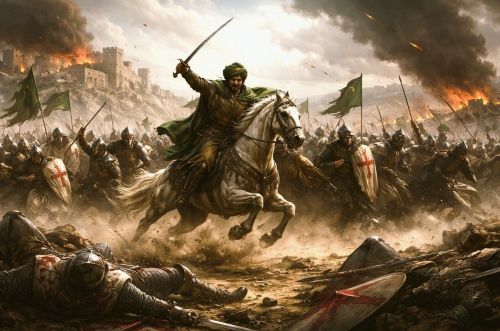
Strategic overconfidence led the Crusader army into disaster at Hattin in 1187, where Saladin’s forces destroyed the kingdom’s military power.

By Matthew A. McIntosh
Public Historian
Brewminate
Introduction: Confidence before Catastrophe
In the summer of 1187, the Crusader Kingdom of Jerusalem faced a moment of decision that would determine the fate of its fragile political order in the Levant. For nearly a century, the Latin Christian states established during the First Crusade had maintained a precarious foothold in the eastern Mediterranean, relying on fortified cities, alliances, and intermittent military campaigns to preserve their authority. Yet beneath this outward stability lay a system under increasing strain. Rivalries among the Crusader nobility, mounting pressure from neighboring Muslim powers, and the evolving military capabilities of their adversaries had begun to erode the balance that had sustained the Crusader presence since the capture of Jerusalem in 1099. The decision to confront Saladin’s army in the field would prove catastrophic.
By the late twelfth century, the political landscape of the region had changed dramatically. The Kurdish commander Salah al-Din Yusuf ibn Ayyub, known in Western sources as Saladin, had succeeded in uniting Egypt and much of Syria under a single political authority. This consolidation represented a fundamental shift in regional power. Earlier Crusader successes had depended in part on the political fragmentation of their opponents, but Saladin’s leadership created a coordinated military and political front capable of challenging the Latin states directly. Through diplomacy, warfare, and gradual political integration, he assembled the resources necessary to confront the Crusader Kingdom not as a series of isolated adversaries but as a unified force.
Despite these developments, many Crusader leaders retained deep confidence in their military tradition. The heavily armored knight remained the centerpiece of Crusader warfare, and previous campaigns had demonstrated the shock power of mounted charges when deployed effectively. To many within the Latin aristocracy, the battlefield remained the arena in which their martial culture could assert decisive superiority. Yet this confidence masked structural weaknesses within the Crusader position. Strategic coordination among the kingdom’s nobles was often inconsistent, and political divisions within the leadership complicated military decision-making at critical moments. The assumption that disciplined cavalry could reliably break opposing forces encouraged a willingness to risk open battle even when the strategic circumstances were unfavorable.
The events leading to the Battle of Hattin illustrate how such expectations could prove disastrously misplaced. As tensions with Saladin escalated in 1187, the Crusader leadership chose to march their army across arid terrain toward the besieged city of Tiberias. The decision exposed their forces to intense heat, limited water supplies, and an enemy capable of exploiting both terrain and mobility. Saladin’s strategy would turn these conditions into decisive advantages. The confrontation that followed near the volcanic hills known as the Horns of Hattin would not simply result in a battlefield defeat; it would shatter the armed capacity of the Kingdom of Jerusalem and transform the balance of power across the Levant.
The Fragile Stability of the Crusader Kingdom

By the mid-twelfth century, the Kingdom of Jerusalem had evolved into a complex feudal polity that depended upon cooperation among powerful nobles, military orders, and ecclesiastical authorities. Although established through conquest during the First Crusade, the kingdom had gradually developed institutions intended to stabilize governance in a frontier environment. Authority theoretically rested with the monarch, but practical power often depended upon the cooperation of leading barons whose lands and castles formed the backbone of the realm’s defense. This system produced a political structure that could function effectively during periods of strong leadership, yet it also made the kingdom vulnerable to factional rivalries and competing ambitions among its elite.
These tensions intensified during the later decades of the twelfth century. The death of the capable King Baldwin IV in 1185 left the kingdom without the firm leadership that had previously held its factions together. Baldwin’s reign had been remarkable not only because he governed while suffering from leprosy, but also because he had managed to restrain internal disputes long enough to preserve political cohesion within the kingdom with neighboring Muslim powers. His passing, however, triggered renewed political maneuvering among the nobility, as rival factions sought to influence the succession and the direction of royal policy. The crown passed to Guy of Lusignan through his marriage to Sibylla, Baldwin’s sister, but his authority remained contested from the beginning.
Guy’s leadership was further complicated by the presence of powerful nobles whose ambitions did not always align with the interests of the kingdom as a whole. Among the most controversial figures was Raynald of Châtillon, lord of the frontier fortress of Kerak. Raynald had gained notoriety for conducting aggressive raids against Muslim caravans and territories, actions that frequently violated existing truces negotiated between the Crusader state and Saladin. In several cases his attacks targeted commercial caravans traveling between Egypt and Syria, provoking outrage across the Muslim world and undermining diplomatic arrangements that had temporarily stabilized the frontier. Raynald’s behavior reflected the tension between frontier warfare and royal authority. While some Crusader nobles admired his aggressiveness and saw it as consistent with the kingdom’s military culture, others recognized that such actions risked drawing the kingdom into a larger conflict at a moment when its internal cohesion was uncertain. For Saladin, these provocations provided both a political justification and a strategic opportunity to mobilize broader support for renewed warfare against the Latin states.
The kingdom relied heavily on a network of fortified strongholds scattered across its territory. Castles such as Kerak, Krak des Chevaliers, and others served not only as defensive positions but also as administrative centers that controlled surrounding lands. These fortifications allowed relatively small garrisons to hold territory against larger forces, providing a measure of security despite the kingdom’s limited population. Yet the reliance on fortified positions also reflected a deeper vulnerability. The Crusader states lacked the demographic strength necessary to field large armies continuously, and their survival often depended upon avoiding decisive confrontations unless circumstances strongly favored them.
Economic and demographic realities further constrained the kingdom’s long-term military viability. The Latin Christian population of the Crusader states remained relatively small compared to the surrounding Muslim populations of Syria and Egypt. Agricultural production and urban commerce provided revenue, but sustaining large military campaigns required resources that were often stretched thin. Maintaining castles, paying garrisons, and equipping knights demanded continuous financial support, and the kingdom’s rulers frequently relied on a combination of local taxation, trade revenues from port cities such as Acre, and assistance from European benefactors. Pilgrimage traffic and Mediterranean commerce brought wealth to the region, but this economic activity did not always translate into sufficient military capacity to sustain prolonged warfare. As a result, the kingdom often depended on reinforcements arriving from Europe or on the support of powerful military orders such as the Knights Templar and the Knights Hospitaller. These orders maintained their own fortresses and command structures, contributing significantly to frontier defense, yet their semi-independent authority could also complicate efforts to coordinate unified military strategy across the kingdom.
By the 1180s, these political, military, and economic pressures had combined to produce a state that appeared stable on the surface but was increasingly fragile beneath it. The Crusader aristocracy continued to believe in the battlefield superiority of their heavily armored knights, a belief reinforced by earlier victories in which disciplined cavalry charges had shattered opposing forces. However, this confidence sometimes obscured the structural weaknesses of the kingdom. Internal divisions among leading nobles could slow decision-making at critical moments, and disagreements over strategy occasionally prevented the development of a consistent defensive policy. Saladin’s growing power and ability to coordinate forces across a large region created a strategic environment very different from the fragmented political landscape that had existed during the early Crusades. When Saladin began to challenge the kingdom more aggressively, the leadership of Jerusalem faced a difficult strategic choice: maintain defensive positions and preserve their limited manpower, or risk decisive battle in the hope of maintaining political authority. The decision they ultimately made would reveal just how precarious the kingdom’s stability had become.
Saladin’s Strategy and the Consolidation of Muslim Power

The rise of Saladin represented one of the most significant political transformations in the eastern Mediterranean during the later twelfth century. Born in 1137 or 1138 into a Kurdish family serving the Zengid rulers of Syria, Saladin emerged as a capable military commander and administrator during a period when the Muslim world was fragmented among competing dynasties. His early career unfolded under the authority of the Syrian ruler Nur ad-Din, whose campaigns against the Crusader states had already begun to reshape the political landscape of the Levant. When Saladin was appointed vizier of Egypt in 1169, he inherited a region of immense strategic importance whose political alignment would prove decisive in the balance between the Crusader states and their Muslim rivals.
Saladin’s consolidation of power began with the gradual transformation of Egypt’s political order. The Fatimid Caliphate that had governed the region for centuries was already weakened by internal instability, and Saladin moved carefully to replace its Shi‘i political structure with allegiance to the Sunni Abbasid caliphate. By 1171 the Fatimid regime had been effectively dismantled, allowing Saladin to establish control over Egypt while maintaining formal loyalty to Nur ad-Din. This development dramatically altered the strategic environment of the Crusader states. Egypt possessed enormous agricultural wealth, a large population, and access to Mediterranean trade networks. Control of these resources gave Saladin the economic foundation necessary to sustain prolonged military campaigns. Equally important was Egypt’s geographic position. The region provided both a secure base from which to organize military operations and a vital link between the eastern Mediterranean and the wider Islamic world. With Egypt under his authority, Saladin gained the ability to coordinate military activity along the Crusader frontier while drawing upon the financial resources and manpower of one of the wealthiest regions in the Middle East. This consolidation also enabled him to strengthen administrative institutions and secure loyalty among local elites, ensuring that Egypt would serve as a stable center of power for his expanding rule.
Following the death of Nur ad-Din in 1174, Saladin embarked on a series of campaigns to extend his authority into Syria and northern Mesopotamia. Rather than relying solely on battlefield victories, he combined diplomacy, negotiation, and calculated military pressure to bring key cities under his influence. Damascus, Aleppo, and other strategic centers gradually came within the orbit of his rule. By the early 1180s, this process had produced a unified governing framework in much of Egypt and Syria under a single leadership. For the Crusader states, this development represented a profound strategic shift. Their earlier successes had often depended on exploiting divisions among Muslim rulers, but Saladin’s consolidation reduced those opportunities dramatically.
Saladin’s approach to warfare also differed in important ways from the assumptions that shaped Crusader military thinking. Rather than seeking immediate decisive confrontation, he often relied on maneuver, harassment, and the careful management of resources. His forces were particularly effective in mobile warfare, using mounted archers and light cavalry to disrupt enemy formations and exploit weaknesses in supply lines. Control of water sources and knowledge of local terrain could be used to weaken opponents before a major engagement occurred. These tactics reflected a broader strategic understanding that victory did not always require immediate destruction of an enemy army. Instead, Saladin often sought to exhaust opposing forces gradually by forcing them to operate in unfavorable conditions. In the arid landscapes of the Levant, where access to water and secure supply routes could determine the outcome of a campaign, this approach allowed his forces to dictate the pace and circumstances of conflict. Such methods would prove especially effective against armies accustomed to relying on the shock power of heavy cavalry, whose effectiveness diminished rapidly when soldiers and horses were deprived of water and forced to fight under extreme heat.
By the mid-1180s, Saladin’s position had matured into that of a leader capable of coordinating large-scale campaigns across a broad geographic region. His authority rested not only on military success but also on his reputation as a defender of Islam against the Crusader presence in the Levant. This reputation helped mobilize support among soldiers, local rulers, and religious scholars who viewed the struggle against the Crusader states as both a political and religious cause. When conflict with the Kingdom of Jerusalem intensified in 1187, Saladin commanded a coalition far stronger and more unified than the fragmented forces the Crusaders had confronted in earlier decades. The campaign that would culminate at Hattin unfolded within a strategic framework shaped by years of careful consolidation and preparation.
The March to Disaster

The campaign that led to the Battle of Hattin began in the summer of 1187, when tensions between the Kingdom of Jerusalem and Saladin’s forces reached a breaking point. In late June, Saladin launched an offensive against the town of Tiberias, located on the western shore of the Sea of Galilee. The town belonged to Count Raymond III of Tripoli, one of the most influential nobles in the Crusader kingdom. Saladin’s forces quickly captured the town itself, though Raymond’s wife, Countess Eschiva, managed to hold the citadel. The attack placed the leadership of the Crusader kingdom in a difficult position. While the loss of Tiberias threatened a strategic location, it also created the possibility that Saladin was deliberately attempting to lure the Crusader army into a confrontation under conditions favorable to his forces. Tiberias held both symbolic and strategic significance. Its position near the Sea of Galilee placed it along key routes linking Galilee with the interior of the kingdom, and its capture signaled Saladin’s willingness to challenge Crusader authority directly. By targeting a city associated with one of the kingdom’s most powerful nobles, Saladin also ensured that the decision of how to respond would immediately involve the highest levels of Crusader leadership.
At the time of Saladin’s attack, the main Crusader army was assembled at Sephoria, a well-supplied and defensible position west of the Sea of Galilee. Sephoria possessed reliable water sources and offered a strong defensive base from which the kingdom’s leaders could monitor Saladin’s movements. Raymond of Tripoli himself reportedly advised caution, arguing that the army should remain at Sephoria rather than march eastward into the hot and exposed terrain surrounding Tiberias. From his perspective, the Crusaders held a strong strategic position as long as they preserved their army and avoided battle under unfavorable conditions. Saladin’s forces, operating far from their own supply bases, would eventually be forced to withdraw if denied the decisive engagement they sought.
Despite this advice, the Crusader leadership decided to march toward Tiberias. King Guy of Lusignan convened a council of nobles in which competing strategic visions were debated. Some participants feared that refusing to relieve Tiberias would appear cowardly or undermine the authority of the crown. Others believed that allowing Saladin to capture territory without challenge would encourage further attacks against the kingdom. Political pressures within the Crusader leadership also played a role. Guy’s authority as king was still relatively insecure, and demonstrating decisive action may have seemed necessary to reinforce his position among the barons. In addition, the martial culture of the Crusader aristocracy encouraged aggressive responses to perceived threats. The idea that a Christian army might remain stationary while a Muslim force captured one of the kingdom’s towns was deeply unsettling to many knights and nobles who believed their honor and reputation required immediate action. Strategic caution was gradually overshadowed by the expectation that the army should advance and confront Saladin directly.
The march itself quickly exposed the vulnerabilities of the Crusader army. Leaving the safety of Sephoria meant abandoning secure access to water and moving through terrain that offered little relief from the intense summer heat. Saladin’s forces shadowed the Crusader column, using mounted archers to harass the marching army and disrupt its formation. By the time the Crusaders approached the volcanic hills known as the Horns of Hattin, their soldiers were already exhausted and increasingly desperate for water. The psychological pressure of thirst and constant harassment further weakened the army’s cohesion. What had begun as a confident advance toward a besieged city was gradually turning into a struggle for survival.
Saladin’s strategy had achieved precisely the effect he intended. By threatening Tiberias, he compelled the Crusader leadership to abandon a defensible position and march across hostile terrain where the balance of advantages favored his own forces. The combination of heat, thirst, and continuous skirmishing steadily eroded the combat effectiveness of the Crusader army before the main battle had even begun. Saladin’s troops controlled the surrounding high ground and maintained pressure on the marching column, ensuring that the Crusaders could neither rest effectively nor secure reliable access to water. As the army struggled across the dry landscape, its ability to maintain disciplined formations began to deteriorate. Horses weakened under the strain of the heat, infantry units lagged behind, and coordination between different contingents became increasingly difficult. By the time the Crusaders halted near the Horns of Hattin on the night of July 3, they were already physically and psychologically exhausted. When the two armies finally confronted one another the following day, the Crusader forces entered the battle at a severe disadvantage created not merely by enemy strength but by the disastrous consequences of their own strategic decision.
Locking Horns: The Battle of Hattin

By the morning of July 4, 1187, the Crusader army had reached the volcanic hills known as the Horns of Hattin, a distinctive double-peaked formation rising above the surrounding plateau. The exhausted army had spent the night attempting to reorganize while desperately seeking water in an arid landscape dominated by Saladin’s forces. Contemporary chroniclers describe the severe thirst and exhaustion that plagued the Crusader soldiers after the long march from Sephoria. Saladin’s army had successfully maneuvered to control access to the nearby springs and water sources, ensuring that the Crusader army entered battle already weakened. The battlefield itself was not chosen by accident. Saladin had effectively shaped the conditions of the engagement through days of harassment and maneuver, forcing the Crusaders to fight in terrain where their strengths were greatly diminished.
As the battle began, Saladin’s forces maintained a flexible formation designed to exploit the vulnerabilities of the Crusader army. Mounted archers surrounded the Crusader position and subjected it to sustained attacks intended to disrupt formations and further exhaust the defenders. Unlike the heavily armored Crusader knights, whose battlefield effectiveness depended on coordinated charges, Saladin’s cavalry emphasized mobility and distance. Continuous volleys of arrows harassed the Crusader ranks while preventing them from regrouping effectively. The heat of the day intensified the suffering of the Crusader army, whose soldiers and horses were already weakened by dehydration. The pressure of these tactics began to fragment the Crusader formations. Saladin’s commanders understood that patience was essential. Rather than risking a direct assault against armored knights who might still deliver a devastating charge, they allowed exhaustion and thirst to do much of the work. The Muslim forces repeatedly withdrew when threatened by counterattacks, only to return and resume harassment from a distance. This approach steadily drained the Crusader army’s remaining strength while maintaining pressure on every side.
The Crusaders attempted several counterattacks in an effort to break through Saladin’s encirclement. Knights launched charges aimed at reaching water sources or disrupting the Muslim lines, but the surrounding terrain and constant harassment prevented these attacks from achieving decisive results. Some contingents attempted to move toward the nearby springs of Hattin, hoping to secure water that might allow them to recover their strength. Yet these efforts were repeatedly blocked by Saladin’s forces, which maintained tight control over the surrounding high ground. As the battle progressed, the Crusader army found itself increasingly confined and unable to maneuver effectively. The heavily armored cavalry that normally formed the decisive striking arm of Crusader warfare struggled to maintain momentum under these conditions. Horses weakened rapidly in the intense heat, and the terrain limited the space necessary to organize large-scale charges. Meanwhile Saladin’s army maintained pressure from all directions, gradually shrinking the area in which the Crusader troops could operate. Each unsuccessful attempt to break the encirclement further depleted the army’s strength and reduced the possibility of coordinated action.
One of the defining moments of the battle involved the gradual collapse of the Crusader center. As heat and thirst took their toll, discipline among the troops began to erode. Fires reportedly set by Saladin’s forces added smoke and confusion to the battlefield, further destabilizing the already strained Crusader position. Units that had once formed a coherent army were gradually pushed apart and surrounded. The military orders, including the Knights Templar and the Knights Hospitaller, fought fiercely to maintain defensive cohesion, but their efforts could not compensate for the broader strategic disaster. Without water, rest, or room to maneuver, the Crusader army steadily lost the ability to resist coordinated attacks.
The final stages of the battle saw the capture or destruction of much of the Crusader leadership. King Guy of Lusignan was taken prisoner along with several other high-ranking nobles. Raynald of Châtillon, whose earlier raids had contributed significantly to the escalation of conflict with Saladin, was executed after the battle. The relic known as the True Cross, carried into battle as a sacred symbol of Crusader faith, was also captured. The loss of both leadership and religious symbolism amplified the psychological impact of the defeat. What had begun as a determined attempt to relieve the siege of Tiberias had ended in the near-total destruction of the Crusader field army.
The Battle of Hattin represented far more than a single military defeat. It eliminated the primary defensive force of the Kingdom of Jerusalem in a single engagement and opened the region to rapid conquest. Saladin’s victory demonstrated the effectiveness of strategic planning that combined mobility, environmental awareness, and psychological pressure. By forcing the Crusaders to fight under conditions of exhaustion and thirst, he ensured that their traditional advantages in armored cavalry warfare could not be fully employed. The consequences of this defeat would quickly reshape the political map of the Levant.
The Collapse of Crusader Power

The immediate consequence of the Battle of Hattin was the near-total destruction of the Kingdom of Jerusalem’s field army. With thousands of soldiers killed, captured, or scattered, the Latin Christian states of the Levant suddenly found themselves without the military force necessary to defend their territory effectively. The capture of King Guy of Lusignan and many leading nobles further compounded the crisis, removing much of the kingdom’s political leadership at the very moment when coordinated resistance was most urgently needed. The loss of the relic known as the True Cross also carried profound symbolic weight, reinforcing the perception that the Crusader cause had suffered not only a military defeat but a spiritual catastrophe.
Saladin moved quickly to exploit this dramatic shift in regional dominance. In the weeks following the battle, his forces launched a systematic campaign across the Crusader territories. Without a large army to oppose them, many towns and fortresses found themselves isolated and unable to mount sustained resistance. Cities that had once served as pillars of Crusader authority, including Acre, Nablus, Jaffa, and Ascalon, fell one after another. In many cases, local garrisons recognized that their position was untenable and negotiated surrender rather than face destruction. Saladin’s campaign was characterized not only by military victories but also by the rapid collapse of the defensive network that had previously sustained Crusader rule. The loss of these cities carried enormous strategic consequences. Control of key ports and inland strongholds had allowed the Crusader kingdom to maintain supply routes, communication lines, and administrative authority across the region. As these centers fell, the political and military infrastructure that had supported Crusader governance rapidly unraveled. What had once been a network of fortified cities capable of mutual support was reduced to scattered enclaves struggling to survive in isolation.
The fall of Jerusalem itself in October 1187 marked the most dramatic moment of this transformation. For nearly ninety years, the city had stood as the central symbol of the Crusader presence in the Holy Land. When Saladin’s forces surrounded Jerusalem, the remaining defenders faced overwhelming odds. The city’s leadership negotiated terms that allowed many inhabitants to leave after paying ransom, avoiding the mass slaughter that had accompanied the Crusader capture of the city in 1099. Although the loss of Jerusalem shocked Latin Christendom, the relatively restrained terms of the surrender reflected Saladin’s broader strategy of consolidating control rather than destroying the region’s population.
Despite the scale of the disaster, the Crusader presence in the Levant did not disappear entirely. Several coastal strongholds remained outside Saladin’s immediate control, most notably the port city of Tyre. There, defenders under Conrad of Montferrat successfully organized resistance and repelled attempts by Saladin’s forces to capture the city. Tyre soon became a focal point for surviving Crusader forces and for reinforcements arriving from Europe. Its survival prevented Saladin from eliminating the Crusader states completely and ensured that the struggle for control of the region would continue.
News of the defeat at Hattin and the fall of Jerusalem reverberated across Europe with extraordinary impact. The loss of the Holy City triggered a wave of religious and political responses that culminated in the launching of the Third Crusade. Leaders such as Richard I of England, Philip II of France, and the Holy Roman Emperor Frederick I Barbarossa prepared campaigns to recover territories lost to Saladin. The scale of the response reflected both the religious importance of Jerusalem and the shock produced by the sudden collapse of Crusader power. The campaign that followed would bring some of the most powerful rulers of Europe into direct confrontation with Saladin’s forces along the Mediterranean coast. Although the Third Crusade eventually succeeded in recapturing several coastal cities and stabilizing a reduced Crusader presence in the region, it did not restore the strategic position that had existed before 1187. The destruction of the Crusader field army at Hattin had permanently weakened the political and military foundations of the Kingdom of Jerusalem, demonstrating how a single catastrophic defeat could transform the balance of power across the eastern Mediterranean.
Conclusion: The Cost of Strategic Overconfidence
The defeat at Hattin stands as one of the most consequential military disasters in the history of the Crusader states. In a single campaign, the Kingdom of Jerusalem lost not only its principal army but also the political cohesion that had allowed it to survive for nearly a century in a hostile environment. The battle exposed the vulnerability of a frontier society whose security depended heavily on maintaining a capable field force and carefully managing relations with neighboring powers. Once that force was destroyed, the network of castles, towns, and alliances that supported Crusader rule began to unravel with remarkable speed. Hattin illustrates how a single catastrophic command choice, made under pressure and shaped by internal divisions, could alter the fate of an entire political order. The destruction of the army also created a vacuum that Saladin was able to exploit with remarkable efficiency. Without a large defensive force to coordinate resistance, cities across the Crusader kingdom fell in rapid succession, and the loss of Jerusalem soon followed. What had once been a fragile but functioning frontier kingdom collapsed into a series of isolated strongholds struggling simply to survive.
At the center of this disaster lay a pattern of strategic overconfidence. The Crusader aristocracy possessed a deeply ingrained belief in the superiority of their armored cavalry and in the battlefield traditions that had brought earlier victories. These assumptions encouraged a willingness to engage in decisive battle even when environmental conditions and logistical realities made such engagements dangerous. The decision to abandon the defensible position at Sephoria in order to relieve Tiberias reflected the influence of these expectations. Rather than forcing Saladin to confront them on terrain favorable to their own army, the Crusader leadership allowed themselves to be drawn into a campaign that magnified their vulnerabilities while strengthening those of their opponent.
Saladin’s success, by contrast, demonstrated the effectiveness of strategic patience and careful operational planning. By seizing the region’s limited water supply, exploiting mobility, and forcing the Crusader army to march through hostile terrain, he determined the operational conditions long before the main engagement began. The eventual destruction of the Crusader army was not merely the result of superior numbers or tactical brilliance in a single moment. It emerged from a deliberate strategy that recognized the limitations of the Crusader forces and used environmental conditions to weaken them progressively. Hattin illustrates how effective leadership can convert geography, logistics, and timing into decisive military advantages.
The legacy of the battle extends far beyond the immediate events of 1187. The loss of Jerusalem and the collapse of Crusader authority across much of the Levant reshaped the course of medieval Mediterranean history and triggered the massive mobilization that became the Third Crusade. Yet the deeper lesson of Hattin lies in the dangers of assuming that past success guarantees future victory. Military traditions, political confidence, and cultural expectations can easily obscure the changing realities of power and strategy. At Hattin, the Crusader leadership entered the campaign convinced that their long record of cavalry victories would carry them to victory. Instead, their confidence led them into a situation in which the advantages they relied upon could no longer protect them. The cost of that miscalculation was the destruction of an army and the collapse of a kingdom.
Bibliography
Affiliate disclosure: Amazon links on this site are paid links. As an Amazon Associate I earn from qualifying purchases.
- Asbridge, Thomas. The Crusades: The Authoritative History of the War for the Holy Land. New York: Ecco, 2010.
- Barber, Malcolm. The Crusader States. New Haven: Yale University Press, 2012.
- Beben, Daniel. “Remembering Saladin: The Crusades and the Politics of Heresy in Persian Historiography.” Journal of the Royal Asiatic Society 28:2 (2018), 231-253.
- Birkett, Helen. “News, History, and Narrative: Remembering the Fall of Jerusalem c. 1200.” Crusades 23:1 (2024), 4-16.
- Bronstein, Judith. “Hattin and Alarcos: A Comparative Analysis of the Institutional Response of Military Orders to Major Crises in the Latin East and the Iberian Peninsula.” Hispania – Revista Espanola de Historia 79:261 (2019), 41-68.
- France, John. Victory in the East: A Military History of the First Crusade. Cambridge: Cambridge University Press, 1994.
- Hillenbrand, Carole. The Crusades: Islamic Perspectives. Edinburgh: Edinburgh University Press, 1999.
- Humphreys, R. Stephen. From Saladin to the Mongols: The Ayyubids of Damascus, 1193–1260. Albany: State University of New York Press, 1977.
- Ibn al-Athir. The Chronicle of Ibn al-Athir for the Crusading Period. Translated by D. S. Richards. Aldershot: Ashgate, 2006.
- Lyons, Malcolm C., and D. E. P. Jackson. Saladin: The Politics of the Holy War. Cambridge: Cambridge University Press, 1982.
- Phillips, Jonathan. “The Changing Reputation of Saladin in the Latin West, c. 1170 to c. 1220.” Crusades 23:1 (2024), 83-108.
- —-. The Crusades, 1095–1204. 2nd ed. London: Routledge, 2014.
- Runciman, Steven. A History of the Crusades, Volume II: The Kingdom of Jerusalem and the Frankish East, 1100–1187. Cambridge: Cambridge University Press, 1952.
- Smail, R. C. Crusading Warfare, 1097–1193. Cambridge: Cambridge University Press, 1956.
- Tyerman, Christopher. God’s War: A New History of the Crusades. Cambridge, MA: Belknap Press of Harvard University Press, 2006.
Originally published by Brewminate, 03.09.2026, under the terms of a Creative Commons Attribution-NonCommercial-NoDerivatives 4.0 International license.
About the Author