Artificial intelligence now enables deepfake media that fabricates convincing audio and video, challenging the credibility of visual evidence and extending a long history of misinformation.

By Matthew A. McIntosh
Public Historian
Brewminate
Introduction: Synthetic Media and the Crisis of Visual Evidence
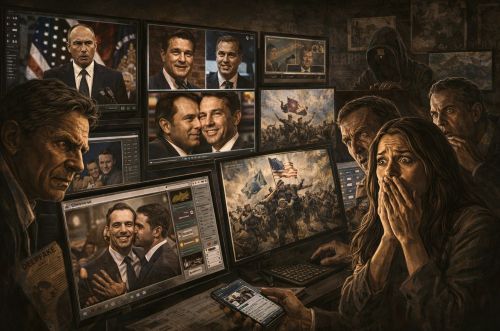
Advances in artificial intelligence have made it possible to generate convincing synthetic audio and video of real individuals, a development commonly referred to as “deepfake” technology. Using machine learning techniques, particularly generative adversarial networks and large-scale neural models, digital systems can now fabricate realistic recordings of speeches, facial expressions, and entire events that never occurred. These synthetic media products can replicate the voices and appearances of public figures with increasing accuracy, creating content that may be indistinguishable from authentic recordings to the casual observer. As these tools become more accessible, the possibility that fabricated visual evidence could circulate widely online has become a growing concern for journalists, political institutions, and scholars of communication.
The significance of deepfakes lies not merely in their technical sophistication but in their potential to undermine a central assumption of modern information culture: that visual recordings provide reliable evidence of real events. For much of the twentieth century, photographs, audio recordings, and film footage were widely regarded as trustworthy documentation. Courts of law, news organizations, and historical archives treated recorded media as powerful forms of proof, relying on photographs and film to reconstruct events, establish responsibility, and document historical developments. Visual recordings often carried an authority that written testimony alone could not easily match, particularly in legal contexts where photographic or filmed evidence could appear to provide direct access to reality. Although scholars of visual culture and media studies have long emphasized that images can be staged, manipulated, or selectively framed, these critiques often remained largely within academic discussions rather than shaping broader public assumptions. For many audiences, the presence of photographic or filmed documentation continued to serve as a powerful marker of authenticity. Deepfake technology challenges this long-standing cultural expectation by making it possible to produce fabricated recordings that appear to document events that never took place. When synthetic video can convincingly replicate the appearance and voice of a public figure, the traditional evidentiary authority of visual recording becomes far more uncertain.
The political implications of this development are substantial. Synthetic media can be used to fabricate speeches, create false admissions of wrongdoing, or simulate controversial statements by political leaders. Such content can spread rapidly through social media networks before verification is possible, shaping public perception and potentially influencing political outcomes. The existence of deepfakes introduces a secondary effect sometimes described as the “liar’s dividend.” When audiences become aware that convincing forgeries are possible, genuine recordings may be dismissed as fabricated. This dynamic complicates the ability of journalists, investigators, and citizens to establish shared factual ground in public discourse.
Although deepfakes represent a new technological development, the broader phenomenon they illustrate has deep historical roots. Every major transformation in communication technology has created new opportunities for misinformation alongside legitimate information exchange. From the authority of royal imagery on ancient coinage to the pamphlet wars of the printing age and the propaganda systems of modern mass media, new forms of communication have repeatedly altered the relationship between information, credibility, and political power. Deepfakes therefore belong within a longer historical trajectory in which innovations in communication technology reshape both the production of knowledge and the possibilities for deception.
Early Information Technologies and the Authority of Representation

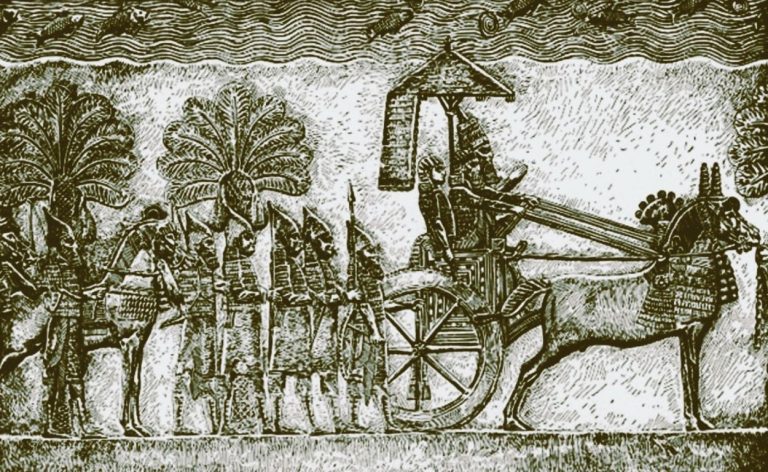
Long before the emergence of modern mass media, political authorities relied on visual and symbolic forms of communication to project power and shape public perception. In ancient societies, communication technologies were limited by the materials and techniques available, yet rulers still recognized the persuasive potential of images and inscriptions. Coins, monuments, statues, and engraved texts served as durable media through which political authority could be displayed and reinforced. Because these objects circulated widely or were placed in highly visible public spaces, they functioned as early forms of mass communication that conveyed messages about legitimacy, identity, and political order.
Coinage provides one of the earliest and most influential examples of visual political messaging. Beginning in the ancient Mediterranean world, rulers used coins not only as instruments of economic exchange but also as platforms for political imagery. Portraits of monarchs, imperial titles, and symbolic motifs communicated messages about sovereignty and divine favor. In the Roman Empire, for example, coins frequently depicted emperors alongside images of military victory, divine associations, or civic virtue. Emperors could promote particular achievements, commemorate victories, or emphasize dynastic continuity through the imagery chosen for coinage. Because coins were produced in large quantities and circulated continuously through commercial exchange, they ensured that the emperor’s image and official titles were repeatedly encountered by people across the empire. In regions far removed from the imperial capital, coins might represent the most common visual encounter with the authority of the state. The imagery placed on coinage was therefore carefully selected to communicate messages about legitimacy, stability, and power. By presenting rulers in idealized forms and linking them to divine or heroic symbolism, coin imagery helped shape the political imagination of those who handled these objects in everyday life.
Inscriptions and monumental architecture served similar communicative functions. Public monuments, triumphal arches, and engraved decrees presented carefully curated narratives about rulers and political achievements. The inscriptions of rulers such as the Persian kings or the Mauryan emperor Ashoka illustrate how political authorities used written texts carved in stone to communicate ideological messages to wide audiences. These inscriptions often presented official interpretations of events, emphasizing the legitimacy, morality, or power of the ruling authority. Because such messages were embedded in durable materials and placed in prominent locations, they carried an aura of permanence and authority that reinforced the credibility of the narratives they presented.
The authority of these early information technologies derived partly from their physical form. Unlike rumors or oral reports, inscriptions and coinage appeared to embody official truth through their association with political institutions. The presence of a ruler’s portrait on a coin or the carving of an inscription in stone suggested that the message it conveyed had the backing of legitimate power. The medium itself reinforced the credibility of the message. The technology of representation therefore shaped the way audiences interpreted political information, linking visual authenticity with political authority.
Although these early media did not produce misinformation in the same way that modern digital technologies can, they nonetheless illustrate how communication systems can shape perceptions of truth and legitimacy. Rulers carefully selected the imagery and narratives displayed on coins and monuments, presenting idealized portrayals of political authority rather than neutral records of events. These representations did not necessarily fabricate events outright, but they framed political reality in ways designed to reinforce loyalty and legitimacy. The history of these early information technologies demonstrates that the relationship between communication media and political messaging has always involved both the transmission of information and the strategic shaping of public perception.
Manuscript Culture and the Limits of Information Control

Before the invention of printing, the circulation of written information depended on the labor-intensive process of manuscript reproduction. Texts were copied by hand by scribes working in monasteries, royal chanceries, and urban scriptoria. Because the creation of manuscripts required time, skill, and expensive materials such as parchment, written documents circulated relatively slowly and in limited quantities. This technological environment shaped the way information moved through medieval societies. Written knowledge was often concentrated within religious institutions and political administrations, which exercised considerable influence over the preservation and dissemination of texts.
Despite these limitations, manuscript culture did not eliminate the possibility of misinformation or political manipulation. Medieval rulers and political factions occasionally produced forged documents to legitimize authority or support territorial claims. One well-known example is the Donation of Constantine, a document that purported to record the transfer of imperial authority over the Western Roman Empire to the papacy. According to the text, the Roman emperor Constantine granted extensive political privileges and territorial authority to the bishop of Rome, thereby establishing the papacy’s temporal power in the West. During the Middle Ages, the document was cited in legal arguments and political disputes involving the authority of the papacy and its relationship with secular rulers. Its claims appeared credible to many readers because the document was framed in the style of an imperial decree and circulated within ecclesiastical manuscript collections that carried considerable institutional authority. Although later exposed as a forgery by the Renaissance humanist Lorenzo Valla in the fifteenth century, the document had already influenced centuries of debate about the distribution of political authority in medieval Europe. The history of the Donation of Constantine demonstrates how written documents could shape political arguments even within a communication system limited by the slow reproduction of manuscripts.
The limitations of manuscript reproduction also shaped the ways in which rumors and political narratives spread. Because written copies were scarce, oral transmission remained an important component of information exchange. News, stories, and political accusations circulated through travelers, merchants, clerics, and local officials who carried information from one region to another. Chronicles and letters sometimes recorded sensational reports of political conspiracies, rebellions, or foreign threats, reflecting the ways in which oral rumor could intersect with written documentation. The boundaries between verified information and speculative narrative were often difficult to establish.
The slow pace of manuscript production created structural constraints on the scale of misinformation. The copying of texts required deliberate effort, which limited the speed at which fabricated documents could spread across large regions. A forged charter or political tract might influence debates within a specific court or ecclesiastical institution, but the absence of rapid reproduction technologies restricted its ability to circulate widely. As a result, misinformation in manuscript culture often remained localized, embedded within particular political disputes rather than becoming a mass phenomenon.
The manuscript era therefore illustrates an important relationship between communication technology and the dynamics of misinformation. Written documents possessed significant authority because of the cultural prestige associated with literacy and the institutions that produced manuscripts. The technological limits of reproduction prevented most texts from achieving widespread circulation. The transition to print in the fifteenth century would dramatically alter this balance by enabling texts to be reproduced quickly and distributed across large populations. When printing expanded the reach of written communication, the potential scale of misinformation expanded with it.
Printing and the Explosion of Mass Information

The invention of movable-type printing in fifteenth-century Europe transformed the scale at which written information could circulate. Prior to this development, manuscripts had to be reproduced by hand, a process that was slow, costly, and dependent on the labor of skilled scribes. Printing altered these constraints by introducing mechanical reproduction, allowing texts to be produced in large quantities within relatively short periods of time. The result was a dramatic expansion in the availability of written materials and a corresponding increase in the number of readers who could access them.
Johannes Gutenberg’s press, developed in the mid-fifteenth century in Mainz, combined several technological innovations that together enabled efficient mass production. Movable metal type allowed printers to assemble pages quickly and reuse individual characters for multiple texts. Oil-based inks adhered more effectively to metal type than earlier writing inks, producing clearer and more durable impressions. The mechanical press itself applied consistent pressure to transfer inked text onto paper. Together, these innovations created a reproducible and economically viable system for large-scale printing. Within decades, printing workshops appeared in major urban centers throughout Europe.
The spread of printing reshaped the institutions responsible for producing and distributing knowledge. While manuscript culture had been closely tied to monastic scriptoria and elite scholarly communities, printing introduced a commercial model of information production. Printers, publishers, and booksellers became central figures in the circulation of texts. These individuals operated within competitive urban markets, responding to reader demand and seeking profitable publications. As literacy expanded among merchants, artisans, and urban professionals, printers increasingly produced works in vernacular languages rather than Latin, further expanding the potential audience for printed texts. The rise of commercial printing houses also created new professional networks linking printers, translators, editors, and distributors across different regions. Booksellers and traveling merchants played a crucial role in transporting printed materials from major printing centers to smaller towns and rural markets. Through these interconnected networks, printed texts moved rapidly across political and linguistic boundaries, contributing to the emergence of a more interconnected European intellectual landscape. The printing industry did not merely reproduce existing texts but actively shaped the circulation of ideas by determining which works were produced, marketed, and distributed to expanding reading publics.
One of the most significant consequences of printing was the acceleration of intellectual and religious debate during the early modern period. The Protestant Reformation offers a particularly striking example of how printing could amplify political and religious conflict. Reformers such as Martin Luther relied heavily on printed pamphlets, sermons, and translated biblical texts to communicate their ideas. Short pamphlets written in accessible language could be produced quickly and distributed widely through networks of booksellers and itinerant merchants. These publications allowed reformist arguments to circulate rapidly across German territories and beyond, contributing to the fragmentation of religious authority in Europe.
The same technological system that facilitated the spread of reformist ideas also enabled the rapid circulation of polemical propaganda and misinformation. Competing religious factions used pamphlets, broadsheets, and illustrated prints to portray their opponents as morally corrupt, politically subversive, or even demonic. These publications often relied on sensational claims designed to provoke outrage and mobilize supporters. Because printed texts possessed a material permanence that oral rumor lacked, readers frequently interpreted them as authoritative statements rather than partisan arguments. Exaggerated accusations and fabricated reports could achieve wide circulation and influence public opinion.
The printing revolution therefore produced a new kind of information environment in which ideas could travel quickly across geographic and social boundaries. By dramatically increasing the speed and volume of textual reproduction, printing created the first large-scale media ecosystem in European history. This transformation expanded opportunities for education, religious reform, and intellectual exchange. Books, pamphlets, and broadsheets could now be reproduced in quantities that allowed them to circulate through marketplaces, universities, churches, and urban households. Readers increasingly encountered multiple competing interpretations of political and religious issues, forcing them to navigate an expanding landscape of printed argument and debate. The growth of this information ecosystem introduced new challenges associated with the verification and interpretation of rapidly circulating texts. Authorities struggled to control the flow of printed material through censorship and licensing systems, while readers confronted the problem of distinguishing reliable sources from polemical or misleading publications. The dynamics that emerged in the age of print therefore foreshadow many of the tensions that continue to shape modern communication systems, in which technological innovation simultaneously expands access to information and complicates the processes through which truth claims are evaluated.
Photography, Film, and the Authority of Visual Reality

The nineteenth century introduced a new form of communication technology that dramatically altered public perceptions of truth and evidence: photography. Unlike earlier visual media such as paintings or engravings, photographs appeared to capture the physical world directly through mechanical processes rather than artistic interpretation. The camera’s ability to record light reflected from real objects created the impression that photographs were objective records of reality. This perception distinguished photography from earlier representational forms that clearly reflected the choices and techniques of individual artists. As photographic technology spread throughout Europe and North America during the nineteenth century, images began to play an increasingly important role in journalism, scientific documentation, and public memory. Photographs were used to document wars, record archaeological discoveries, and preserve portraits of political leaders and ordinary citizens alike. Because these images seemed to originate from mechanical processes rather than human interpretation, they acquired a reputation for accuracy and neutrality that shaped the modern relationship between visual media and claims about truth.
Early photographers and observers often emphasized the perceived neutrality of the photographic process. Because the camera operated through chemical reactions and optical mechanisms, many people believed that photographs represented events exactly as they had occurred. This belief granted photographs a level of authority that earlier visual representations rarely possessed. By the late nineteenth century, photographs were widely used to document historical events, urban environments, and political figures. The apparent immediacy of photographic images helped shape the modern expectation that visual documentation could provide reliable evidence of reality.
Despite this reputation for objectivity, photographic images were never entirely immune to manipulation. Photographers could stage scenes, adjust lighting, or selectively frame images in ways that influenced interpretation. Techniques such as retouching negatives or combining multiple exposures allowed early forms of image alteration. In the twentieth century, political regimes increasingly recognized the propaganda potential of photographic imagery. Governments and political movements used photographs to construct narratives about national strength, ideological purity, or historical legitimacy. By presenting carefully composed images as documentary evidence, propagandists could shape public perceptions while maintaining the appearance of authenticity.
The emergence of motion pictures expanded the persuasive power of visual media even further. Film introduced the ability to record sequences of moving images, allowing audiences to observe events as unfolding narratives rather than static moments. Newsreels became an important medium through which governments and media organizations presented visual reports of wars, political speeches, and international developments. The combination of moving images, narration, and dramatic editing created a powerful medium capable of shaping emotional responses as well as conveying information.
Throughout the twentieth century, film and later television became central tools of political communication and propaganda. Governments recognized that visual media could influence public opinion on a mass scale. Documentary films, political broadcasts, and televised speeches allowed leaders to address large audiences while carefully managing the presentation of their message. In democratic societies, televised debates and campaign broadcasts transformed electoral politics by allowing voters to see and hear candidates directly rather than relying solely on printed reports. Authoritarian regimes often manipulated visual media to promote ideological narratives, using staged footage and selective editing to present favorable portrayals of political events. The visual language of film could be carefully constructed to evoke emotional responses, reinforce national myths, or legitimize political authority. These practices demonstrated that even technologies widely perceived as objective records could be shaped by political interests and editorial decisions.
The authority associated with photographic and cinematic media therefore emerged from both technological capability and cultural expectation. As audiences grew accustomed to seeing historical events through visual recordings, the assumption that “seeing is believing” became deeply embedded in modern information culture. Photographs and film appeared to provide direct access to reality, reinforcing the idea that visual documentation could serve as definitive evidence of what had occurred. This cultural trust in recorded images would later become a central vulnerability in the digital age, where synthetic media technologies can replicate the visual authority once associated exclusively with authentic recordings.
Broadcast Media and the Age of Mass Persuasion
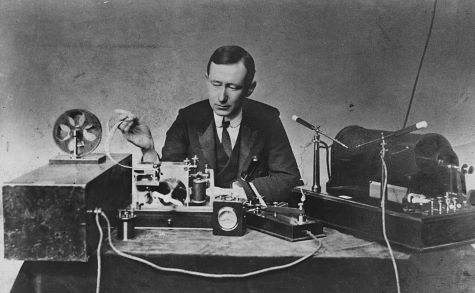
The twentieth century witnessed the emergence of broadcast media technologies that dramatically expanded the reach of political communication. Radio and later television allowed information to be transmitted simultaneously to large audiences across entire nations. Unlike print media, which required readers to actively seek out texts, broadcast media entered homes directly through electronic devices. This transformation reshaped the relationship between political leaders, media institutions, and the public by creating new channels through which information and persuasion could operate on a mass scale.
Radio was the first technology to fully realize this new model of mass communication. Beginning in the 1920s, radio broadcasts allowed governments, journalists, and entertainers to reach millions of listeners simultaneously. Political leaders quickly recognized the persuasive potential of the medium. Speeches delivered over radio created the impression of direct communication between leaders and citizens, strengthening emotional connections and reinforcing political authority. The intimacy of the human voice, transmitted into private domestic spaces, gave radio an immediacy that earlier forms of communication could not easily replicate. Leaders could address citizens in moments of crisis or celebration with a sense of personal presence that written communication rarely achieved. In democratic societies, radio broadcasts of political speeches, campaign messages, and news reports allowed citizens to follow national events in near real time. This sense of immediacy encouraged listeners to perceive broadcast speech as authentic and unmediated, even though these messages were often carefully scripted and managed by political advisors and communication specialists.
The persuasive power of radio became especially apparent during periods of political crisis and ideological conflict. Governments used radio broadcasts to mobilize public support during wars and to promote national unity. Authoritarian regimes, in particular, invested heavily in radio infrastructure to disseminate propaganda. In Nazi Germany, Joseph Goebbels’ Ministry of Propaganda promoted the widespread distribution of inexpensive radio receivers to ensure that government broadcasts could reach large segments of the population. Known as the Volksempfänger, these receivers were designed to be affordable so that ordinary households could easily access state programming. Radio thus became a central instrument for shaping public opinion through carefully constructed narratives and emotionally charged messaging. Broadcast speeches, news bulletins, and cultural programming were all coordinated to reinforce ideological messages and strengthen political loyalty. The combination of technological reach and emotional immediacy made radio one of the most powerful propaganda tools of the early twentieth century.
The development of television in the mid-twentieth century extended these dynamics by combining visual imagery with broadcast audio. Television brought moving images of political events, speeches, and international crises directly into domestic living spaces. News broadcasts, political debates, and documentary programs allowed viewers to witness events as they unfolded, reinforcing the sense that television provided a window onto reality. Political leaders increasingly recognized that their public image on television could influence voter perceptions, encouraging the careful staging of appearances and media performances.
Television also intensified the role of visual presentation in political persuasion. Campaign advertisements, televised debates, and carefully produced news segments shaped public understanding of political issues and personalities. The visual format of television encouraged simplified narratives and emotionally resonant imagery, which could be more memorable than detailed policy discussions. As broadcast networks developed into major institutions within national media systems, they became central intermediaries between political actors and the public, determining which events were broadcast and how they were framed.
The age of broadcast media therefore created a communication environment in which centralized institutions possessed enormous influence over the flow of information. Radio and television networks had the ability to reach large audiences simultaneously, giving them significant power to shape political narratives and public perceptions. Audiences often regarded broadcast media as authoritative sources of information because of the professional norms associated with journalism and the technical infrastructure required for transmission. These dynamics established a model of mass persuasion that would dominate political communication throughout much of the twentieth century, even as later digital technologies began to challenge the centralized structure of broadcast media.
Digital Media and the Fragmentation of Information Authority

The emergence of digital communication technologies in the late twentieth and early twenty-first centuries transformed the structure of the information environment. Unlike earlier mass media systems dominated by centralized institutions such as newspapers, radio networks, and television broadcasters, digital media platforms allowed individuals to publish and distribute information globally with minimal barriers to entry. The internet enabled the rapid circulation of text, images, and video through decentralized networks that operated beyond traditional editorial control. As a result, the authority that had previously been concentrated in professional media organizations became fragmented across countless online actors, including independent creators, political organizations, automated systems, and anonymous users.
The architecture of digital networks fundamentally altered how information spreads. Online content could be shared instantaneously across social media platforms, discussion forums, and messaging services, allowing messages to reach large audiences without passing through institutional gatekeepers. Algorithms designed to prioritize engagement often amplified emotionally provocative or sensational content, increasing the visibility of material that attracted attention regardless of its accuracy. These mechanisms created conditions in which misinformation could spread rapidly across interconnected networks, sometimes reaching millions of users within hours. The speed and scale of digital communication thus introduced new challenges for verifying the authenticity and reliability of circulating information. The economic structure of many digital platforms encouraged this dynamic. Advertising models based on clicks, views, and engagement rewarded content that generated strong reactions, creating incentives for the production and dissemination of sensational claims. In such an environment, emotionally charged narratives could spread more rapidly than careful factual reporting, particularly when they aligned with existing political or cultural anxieties among online audiences.
The participatory nature of digital media also reshaped the relationship between audiences and information production. Users were no longer merely passive recipients of news and commentary; they could generate, remix, and distribute content themselves. This participatory environment blurred the boundaries between professional journalism, political advocacy, and personal expression. While this development expanded opportunities for democratic participation and diverse perspectives, it also weakened the clear distinctions that once separated verified reporting from rumor, satire, or deliberate disinformation. In online environments where information sources are often ambiguous, audiences may struggle to evaluate the credibility of competing claims. The tools of digital production further intensified this challenge. Simple editing software, meme culture, and rapid reposting allowed images and narratives to be modified and redistributed in new contexts within minutes. Content could move across platforms in ways that detached it from its original source, obscuring authorship and making it difficult for audiences to determine whether a claim originated from a reputable institution, a partisan organization, or an anonymous user.
Social media platforms further accelerated the fragmentation of informational authority by organizing users into highly personalized communication networks. Algorithms curated content based on prior behavior, creating individualized streams of information that reflected users’ interests and beliefs. These systems encouraged the formation of ideologically aligned communities in which individuals encountered information that reinforced existing viewpoints. Such dynamics could produce echo chambers that amplified partisan narratives and conspiracy theories while reducing exposure to alternative perspectives or corrective information.
The digital communication environment therefore differs fundamentally from earlier systems of mass media. Instead of a relatively small number of centralized institutions shaping public discourse, information now circulates through complex and decentralized networks composed of individuals, organizations, and automated systems. While this transformation has expanded access to information and lowered barriers to publication, it has also created new vulnerabilities in the informational ecosystem. In such an environment, fabricated images, manipulated audio, and synthetic media can spread quickly across global networks, challenging traditional mechanisms for verifying truth and reinforcing the growing crisis of informational authority in the digital age.
The Emergence of Deepfake Technology

The development of deepfake technology emerged from advances in machine learning and artificial intelligence during the early twenty-first century. Techniques based on deep neural networks made it possible to generate highly realistic synthetic images, audio, and video by training algorithms on large datasets of visual and vocal material. These systems learned to replicate patterns in facial expressions, speech, and movement, allowing software to produce convincing representations of real individuals performing actions they had never actually undertaken. While earlier forms of digital manipulation required extensive technical expertise and visible editing, deep learning models made it possible to automate the process of generating realistic fabricated media.
A key technological breakthrough occurred with the development of generative adversarial networks (GANs), a machine learning architecture introduced in 2014. GANs operate through the interaction of two neural networks: one generates synthetic images or audio, while the other attempts to distinguish fabricated content from authentic material. Through repeated iterations, the generative system improves its ability to produce realistic outputs that the discriminating system struggles to identify as false. This adversarial process enables the creation of increasingly convincing synthetic media, including manipulated videos in which one individual’s face is seamlessly mapped onto another person’s body or expressions.
The term “deepfake” itself emerged from online communities experimenting with these technologies during the late 2010s. Early examples circulated on internet forums where users shared software tools capable of replacing faces in video footage or generating synthetic speech patterns. Although some of these early applications were experimental or humorous in nature, they quickly demonstrated the potential for misuse. Fabricated videos depicting public figures delivering speeches or engaging in fictional actions could be produced with a level of realism that challenged traditional methods of visual verification. As the technology became more accessible through open-source tools and online tutorials, the capacity to create synthetic media expanded beyond specialized research environments into broader public use.
Researchers, journalists, and policymakers soon recognized the broader implications of these developments for information integrity and democratic communication. Deepfake technology threatened to undermine one of the most powerful forms of modern evidence: recorded visual and audio documentation. Video footage had long been treated as a reliable record of events, particularly in journalism, legal proceedings, and political discourse. The emergence of highly realistic synthetic media complicated this assumption by making it increasingly difficult to distinguish authentic recordings from fabricated ones. As the technology continued to advance, the potential for manipulated audiovisual content to influence political narratives, damage reputations, or spread disinformation became a growing concern within both academic research and public policy debates.
Deepfakes and the Crisis of Visual Trust

Deepfake technology poses a fundamental challenge to the cultural authority long associated with visual evidence. For more than a century, photographic and film media were widely treated as reliable records of events. Although historians and media scholars have long recognized that images can be staged, edited, or selectively framed, visual recordings nonetheless carried powerful evidentiary weight in journalism, legal proceedings, and political discourse. Deepfakes complicate this tradition by making it possible to generate highly realistic video and audio content that depicts events which never occurred. The increasing sophistication of synthetic media therefore threatens to weaken the credibility that recorded images have historically possessed in modern public culture.
The persuasive power of deepfakes derives from the psychological authority of audiovisual material. Human perception tends to treat visual and auditory recordings as direct representations of reality, particularly when the images appear coherent and consistent with familiar contexts. Deepfake technology exploits this cognitive tendency by producing fabricated media that closely imitates the visual cues audiences associate with authenticity, including facial movements, lighting patterns, and vocal inflection. As these techniques improve, fabricated recordings can appear indistinguishable from genuine footage when viewed casually on digital platforms. The resulting ambiguity complicates efforts by viewers to determine whether a circulating video represents genuine documentation or synthetic fabrication. In many cases, the conditions under which audiences encounter such material further intensify the problem. Videos often appear embedded within social media feeds, stripped of contextual information about their origin or production. Viewers may encounter a short clip shared by friends, reposted through multiple accounts, or presented with captions that frame its meaning in particular ways. These contextual cues can influence interpretation even before audiences question whether the recording itself is authentic, making deepfakes especially powerful tools for shaping perception in fast-moving online environments.
The consequences of this ambiguity extend beyond individual cases of misinformation. Deepfakes contribute to what some scholars describe as a broader “liar’s dividend,” in which the existence of convincing synthetic media allows individuals to deny the authenticity of genuine recordings by claiming they are fabricated. Political figures confronted with damaging video evidence can dismiss the material as a deepfake, even when it is authentic. This dynamic erodes the evidentiary power of legitimate recordings while simultaneously enabling fabricated content to circulate more easily within polarized information environments. In such circumstances, uncertainty itself becomes a strategic advantage for actors seeking to manipulate public discourse.
The challenge posed by deepfakes is intensified by the speed and scale of digital distribution networks. Synthetic media can spread rapidly through social media platforms, messaging applications, and online forums, reaching large audiences before fact-checking organizations or journalists have time to verify their authenticity. Even when fabricated videos are eventually identified as false, the initial exposure can shape public perceptions and reinforce existing political narratives. Research on misinformation demonstrates that corrections often struggle to fully counteract the influence of widely circulated false claims, particularly when audiences encounter the misinformation within ideologically aligned communities. The visual character of deepfakes makes these dynamics particularly difficult to counter. A fabricated video can evoke strong emotional responses and vivid mental images that persist even after viewers learn that the footage is manipulated. Moreover, the viral nature of digital platforms means that false recordings can be copied, edited, and redistributed across numerous online spaces, allowing them to reappear repeatedly even after debunking efforts have begun. This persistence complicates efforts by journalists, scholars, and technology companies to maintain informational accuracy in rapidly evolving digital environments.
The crisis of visual trust produced by deepfake technology therefore reflects both technological and social transformations. Advances in artificial intelligence have made it increasingly feasible to generate convincing synthetic media, while digital communication networks enable rapid dissemination of such material across global audiences. Together, these developments challenge longstanding assumptions about the reliability of recorded images and audio as forms of evidence. In a media environment where fabricated visual documentation can circulate alongside authentic recordings, societies must confront new questions about verification, credibility, and the foundations of public trust in visual information.
Detection, Regulation, and the Future of Information Integrity
As the capabilities of deepfake technology continue to advance, researchers, policymakers, and technology companies have begun developing strategies to detect and regulate synthetic media. Efforts to address the problem generally fall into three broad categories: technical detection systems, legal and regulatory frameworks, and institutional practices designed to preserve information credibility. Each of these approaches attempts to respond to the challenges posed by artificial intelligence–generated media, though none offers a complete solution on its own.
One major line of response focuses on technological detection methods. Researchers in computer science have developed algorithms capable of identifying subtle inconsistencies in manipulated media, such as irregular blinking patterns, unnatural facial movements, or anomalies in lighting and shadows. Machine learning systems can also analyze audio signals, pixel-level artifacts, and compression patterns fto determine whether a piece of media has been synthetically generated or altered. However, this technological approach operates within an ongoing cycle of competition between detection and generation systems. As detection algorithms improve, creators of synthetic media refine their methods to evade those systems, producing increasingly sophisticated deepfakes that are harder to identify.
Technology companies that operate major social media platforms have also begun implementing measures designed to reduce the spread of manipulated media. Some platforms have introduced policies requiring the labeling of synthetic or manipulated content, while others employ automated detection systems to flag suspicious videos for human review. These efforts aim to limit the viral circulation of misleading content before it reaches large audiences. The sheer volume of material uploaded to digital platforms presents significant challenges for monitoring and enforcement. Billions of images and videos circulate across online networks each day, making comprehensive oversight difficult even with advanced automated tools. Moderation systems must therefore balance speed, scale, and accuracy when evaluating potentially manipulated content. Automated detection tools may generate false positives or fail to recognize highly sophisticated fabrications, requiring human moderators to assess flagged material. The global nature of social media platforms further complicates enforcement, as policies must be applied across different legal systems, languages, and cultural contexts. These challenges highlight the structural difficulty of regulating misinformation within decentralized digital ecosystems.
Governments have likewise explored legal responses to the potential harms posed by deepfake technology. Several jurisdictions have introduced legislation addressing the malicious use of synthetic media, particularly in areas such as election interference, defamation, and nonconsensual explicit imagery. These regulatory frameworks attempt to establish legal accountability for individuals who create or distribute deceptive synthetic media with the intent to cause harm. Yet lawmakers must balance these efforts with protections for free expression, artistic experimentation, and legitimate forms of digital manipulation used in entertainment, satire, or education. Crafting effective legislation therefore requires careful consideration of both technological realities and constitutional principles.
Journalistic institutions and media organizations have also responded by strengthening verification practices. Newsrooms increasingly rely on digital forensic techniques to authenticate audiovisual material before publication. Collaborative initiatives among journalists, fact-checkers, and academic researchers have produced new methods for verifying the origin and authenticity of online content. These practices aim to reinforce public trust in professional reporting by demonstrating that credible institutions apply rigorous standards when evaluating digital evidence.
Despite these efforts, the long-term challenge posed by synthetic media extends beyond any single technological or legal solution. Deepfakes illustrate a broader transformation in the informational environment, in which the production of convincing visual and audio fabrications has become widely accessible. Preserving the integrity of public discourse therefore requires a combination of technical innovation, institutional accountability, media literacy, and international cooperation. As societies adapt to a world in which audiovisual evidence can no longer be taken for granted, the struggle to maintain reliable systems of information verification will likely become one of the defining challenges of communication in the digital age.
Conclusion: Synthetic Media in the Long History of Misinformation
The emergence of deepfake technology represents the latest stage in a long historical relationship between communication technologies and the manipulation of information. From early forms of symbolic representation to the printing press, photography, broadcast media, and digital networks, each new medium has transformed how societies produce, distribute, and interpret information. These technological changes have consistently expanded the capacity to circulate knowledge while simultaneously creating new opportunities for deception, propaganda, and misinformation. Synthetic media should therefore be understood not as an entirely unprecedented phenomenon but as part of an enduring pattern in the history of communication.
Throughout this history, the authority of particular forms of evidence has repeatedly shifted as new technologies emerge. Printed texts once appeared uniquely reliable compared with oral rumor, while photographic images later came to symbolize objective documentation. Broadcast media created the impression of direct witnessing through live audio and visual transmission. Yet each of these systems eventually revealed vulnerabilities that allowed manipulation or distortion. Deepfakes extend this historical trajectory by challenging the credibility of audiovisual recordings, which had long been treated as some of the most persuasive forms of modern evidence.
The contemporary information environment differs from earlier periods in important ways. Digital networks allow fabricated content to circulate at unprecedented speed and scale, reaching global audiences within minutes. The decentralized nature of online communication further complicates efforts to establish clear standards of verification or institutional authority. Synthetic media does not merely produce individual instances of misinformation but contributes to a broader erosion of confidence in the reliability of visual and auditory evidence. When audiences cannot easily distinguish authentic documentation from artificial fabrication, the foundations of shared factual understanding become increasingly fragile. This erosion of confidence can produce multiple forms of informational instability. Some audiences may become more vulnerable to manipulation when persuasive fabricated content aligns with existing beliefs or political identities. Others may respond to the proliferation of synthetic media by adopting a more generalized skepticism toward all forms of recorded evidence, including legitimate journalism and documentary records. Both outcomes weaken the informational frameworks that democratic societies rely upon to evaluate public claims, hold institutions accountable, and deliberate collectively about political decisions.
Understanding deepfakes within the broader history of communication highlights the importance of adapting institutional, technological, and cultural responses to changing media environments. Just as earlier societies developed new forms of journalistic practice, legal regulation, and media literacy in response to the challenges of print and broadcast media, contemporary societies must develop new strategies for evaluating synthetic content. The long history of misinformation demonstrates that communication technologies consistently reshape both the possibilities of knowledge and the risks of deception. Deepfake technology therefore represents not the end of informational trust but another moment in an ongoing historical struggle to maintain credibility and accountability in systems of public communication.
Bibliography
Affiliate disclosure: Amazon links on this site are paid links. As an Amazon Associate I earn from qualifying purchases.
- Ando, Clifford. Imperial Ideology and Provincial Loyalty in the Roman Empire. Berkeley: University of California Press, 2000.
- Batchen, Geoffrey. Burning with Desire: The Conception of Photography. Cambridge, MA: MIT Press, 1997.
- Beard, Mary. SPQR: A History of Ancient Rome. New York: Liveright, 2015.
- Benkler, Yochai, Robert Faris, and Hal Roberts. Network Propaganda: Manipulation, Disinformation, and Radicalization in American Politics. Oxford: Oxford University Press, 2018.
- Briant, Pierre. From Cyrus to Alexander: A History of the Persian Empire. Winona Lake: Eisenbrauns, 1996.
- Briggs, Asa, and Peter Burke. A Social History of the Media: From Gutenberg to the Internet. Cambridge: Polity Press, 2002.
- Brown, Michelle P. Understanding Illuminated Manuscripts: A Guide to Technical Terms. Los Angeles: Getty Publications, 1994.
- Chesney, Robert, and Danielle Citron. “Deep Fakes: A Looming Challenge for Privacy, Democracy, and National Security.” California Law Review 107, no. 6 (2019): 1753–1820.
- Eisenstein, Elizabeth L. The Printing Press as an Agent of Change: Communications and Cultural Transformations in Early-Modern Europe. Cambridge: Cambridge University Press, 1979.
- Febvre, Lucien, and Henri-Jean Martin. The Coming of the Book: The Impact of Printing 1450–1800. London: Verso, 1976.
- Grafton, Anthony. Forgers and Critics: Creativity and Duplicity in Western Scholarship. Princeton: Princeton University Press, 1990.
- Gunning, Tom. “What’s the Point of an Index? Or, Faking Photographs.” Nordicom Review 35 (2014): 39–49.
- Herf, Jeffrey. The Jewish Enemy: Nazi Propaganda during World War II and the Holocaust. Cambridge, MA: Harvard University Press, 2006.
- Hilmes, Michele. Radio Voices: American Broadcasting, 1922–1952. Minneapolis: University of Minnesota Press, 1997.
- Le Goff, Jacques. Medieval Civilization 400–1500. Oxford: Blackwell, 1988.
- Mirsky, Yisroel, and Wenke Lee. “The Creation and Detection of Deepfakes: A Survey.” ACM Computing Surveys 54, no. 1 (2021): 1–41.
- Pettegree, Andrew. The Book in the Renaissance. New Haven: Yale University Press, 2010.
- —-. Pettegree, Andrew. Brand Luther: 1517, Printing, and the Making of the Reformation. New York: Penguin Press, 2015.
- Rouse, Richard H., and Mary A. Rouse. Manuscripts and Their Makers: Commercial Book Producers in Medieval Paris, 1200–1500. Turnhout: Harvey Miller, 2000.
- Scannell, Paddy. Radio, Television and Modern Life: A Phenomenological Approach. Oxford: Blackwell, 1996.
- Sontag, Susan. On Photography. New York: Farrar, Straus and Giroux, 1977.
- Sunstein, Cass R. Republic: Divided Democracy in the Age of Social Media. Princeton: Princeton University Press, 2017.
- Taylor, Richard. Film Propaganda: Soviet Russia and Nazi Germany. London: I.B. Tauris, 1979.
- Thapar, Romila. Ashoka and the Decline of the Mauryas. Revised edition. Oxford: Oxford University Press, 1973.
- Vaccari, Cristian, and Andrew Chadwick. “Deepfakes and Disinformation: Exploring the Impact of Synthetic Political Video on Deception, Uncertainty, and Trust in News.” Social Media + Society 6, no. 1 (2020).
- Wardle, Claire, and Hossein Derakhshan. Information Disorder: Toward an Interdisciplinary Framework for Research and Policy Making. Strasbourg: Council of Europe, 2017.
- Westerlund, Mika. “The Emergence of Deepfake Technology: A Review.” Technology Innovation Management Review 9, no. 11 (2019).
Originally published by Brewminate, 03.29.2026, under the terms of a Creative Commons Attribution-NonCommercial-NoDerivatives 4.0 International license.
About the Author