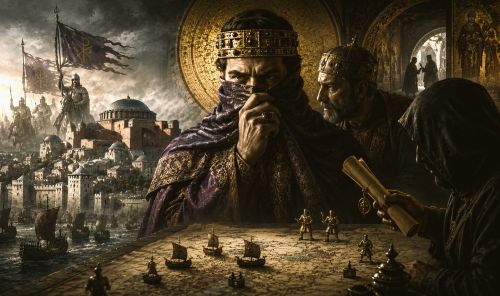
Byzantine rulers turned diplomacy, intrigue, religious authority, and political theater into tools of survival when imperial power could no longer rely on force alone.

By Matthew A. McIntosh
Public Historian
Brewminate
Introduction: The Problem of “Byzantine” Deception
To call a political maneuver “Byzantine” is rarely meant as praise. In modern usage, the word often suggests complication, secrecy, evasiveness, and a kind of perfumed duplicity practiced behind curtains by people who speak softly while hiding knives in their sleeves. That reputation did not come from nowhere. The medieval Roman Empire centered on Constantinople was a courtly, bureaucratic, diplomatically agile state in which ceremonial hierarchy, intelligence gathering, controlled generosity, dynastic calculation, theological pressure, and factional intrigue all shaped the practical exercise of power. Its rulers bribed enemies, delayed armies, married rivals into dependence, turned one frontier people against another, staged imperial majesty before foreign envoys, and sometimes spoke the language of sacred order while practicing the cold arithmetic of survival. Yet the familiar accusation of “Byzantine deception” is too crude if it treats these habits as evidence of decadence rather than as instruments of government in an empire that spent most of its history surrounded, outnumbered, and overextended.
The people conventionally called Byzantines did not call themselves Byzantines. They understood themselves as Romans, heirs to an imperial tradition that had moved its administrative and symbolic center eastward long before the medieval West decided to imagine Rome as something lost, Latin, and exclusively its own. Constantinople was not a pale imitation of Rome. It was Rome under different historical pressures: Greek-speaking, Christian, urban, ceremonial, legally sophisticated, and constantly forced to reconcile universal imperial claims with harsh strategic limits. That tension is essential. The emperor claimed to be God’s vicegerent on earth and ruler of a divinely ordered Roman polity, but he often governed from a position of vulnerability. Even when the imperial court spoke in the language of providence, hierarchy, and cosmic order, it had to confront the less graceful realities of exhausted treasuries, rebellious generals, unreliable allies, ambitious neighbors, and frontiers too long to defend by force alone. The empire might present itself as the center of the civilized world, yet its diplomats knew that gold, patience, marriage, gifts, hostages, informants, and ambiguous promises could achieve what armies could not. This was not hypocrisy in the simple sense. It was the lived contradiction of a state that claimed universal authority while repeatedly facing circumstances that demanded improvisation. The gap between imperial ideology and political necessity is where Byzantine deception becomes historically interesting.
I treat deception not as an ethnic or civilizational defect, but as a recurring technology of crisis management. The Byzantine state survived because it did not insist on meeting every threat in the open field or answering every insult with immediate battle. It had learned, from Roman practice and from its own medieval experience, that power could be performed, postponed, disguised, borrowed, purchased, ritualized, and narrated. A ruler who lacked enough soldiers might still possess an archive of treaties, a treasury of titles, a princess whose marriage could redirect an alliance, a patriarch whose recognition could consecrate policy, or a ceremonial hall designed to make foreign envoys feel that they had entered not a palace but the visible architecture of divine monarchy. Deception was not always a lie. It could be choreography. It could be controlled access to information. It could be the careful inflation of imperial power before outsiders who needed to believe that Constantinople was stronger than it was.
The problem is that Byzantine deception operated both outward and inward. Foreign policy relied on strategic ambiguity, but domestic politics did as well. Imperial power was sacred in theory and precarious in practice. The throne could pass by heredity, acclamation, military revolt, palace coup, marriage, adoption, blinding, forced monastic retirement, or murder disguised afterward as providential correction. Byzantine political culture placed enormous weight on legitimacy, yet legitimacy was often constructed after the fact by ceremony, theology, law, public ritual, and historical writing. A successful usurper did not merely seize power. He had to explain why his seizure of power restored order. A defeated emperor did not merely lose office. He was recast as impious, incompetent, tyrannical, or abandoned by divine favor. The instability of imperial succession made this narrative work especially urgent, because the empire possessed no consistently secure mechanism for transferring supreme authority that could prevent ambitious soldiers, palace factions, aristocratic houses, imperial relatives, or religious authorities from intervening when opportunity appeared. Violence had to be made legible. A blinding could be presented not only as revenge, but as disqualification. A monastery could become both prison and moral theater. A coup could be narrated as rescue. Even silence could become political language when chroniclers omitted inconvenient loyalties, softened betrayals, or arranged events to make victory appear inevitable. The empire’s internal politics turned memory itself into a battlefield. Chronicles, panegyrics, saints’ lives, court histories, and theological polemics could become instruments of political repair.
This does not mean that Byzantine politics was uniquely dishonest. The medieval West lied, bribed, forged, betrayed, and sanctified violence with impressive energy of its own. The Islamic caliphates, steppe polities, Italian communes, crusader principalities, and western monarchies all practiced diplomacy with a flexible relationship to sincerity. What made Byzantium distinctive was the density of its imperial inheritance. It possessed a Roman administrative memory, a Christian theology of rulership, a capital whose ceremonies dramatized cosmic hierarchy, and a diplomatic style that treated information as a form of military force. Byzantine rulers did not simply negotiate with neighboring powers. They classified them, ranked them, studied their internal divisions, assigned them titles, received them through carefully staged ritual, and tried to make them participants in a world order whose center remained Constantinople. When successful, this system made enemies into clients, invaders into allies, and threats into manageable dependencies. When it failed, it fed resentment, suspicion, and accusations of treachery.
The chronological shape of Byzantine history makes this pattern clearer. In late antiquity, Roman administrative habits supplied the empire with techniques for managing outsiders through titles, subsidies, treaties, hostages, and controlled diplomacy. Under Justinian I, imperial restoration rhetoric coexisted with bribery, religious maneuvering, factional management, and opportunistic war. The seventh-century crises, especially the long struggle with Persia and the Arab conquests, reduced the empire’s resources so dramatically that diplomacy, delay, and strategic retreat became essential to survival. The middle Byzantine recovery transformed deception into a more disciplined system of foreign management, visible in manuals of imperial advice, elaborate court ceremonial, missionary diplomacy, and the manipulation of rival peoples in the Balkans, the Black Sea world, and the eastern frontier. Later, under the Komnenoi, the empire used kinship, oath-taking, controlled hospitality, and tactical suspicion to manage both aristocratic factions and crusading armies. After 1204, when Constantinople itself fell to the Fourth Crusade, Byzantine political deception increasingly revolved around the preservation, recovery, and performance of legitimacy. In the Palaiologan period, the same tools persisted, but with shrinking effectiveness, as emperors negotiated church union, western aid, Ottoman pressure, civil war, and imperial poverty until the city finally fell in 1453.
The old Western habit of describing Byzantium as decadent obscures the harder historical truth. Byzantine statecraft was often ruthless, but ruthlessness is not the same thing as decline. Its diplomacy could be manipulative, but manipulation was frequently the alternative to annihilation. Its court politics could be cruel, but cruelty often emerged from the instability built into Roman imperial succession, not from some uniquely eastern taste for intrigue. Its ceremonial world could be artificial, but that artificiality was one of the ways the empire converted weakness into awe. The Byzantine state survived for more than a millennium not because it avoided crisis, but because it specialized in managing crisis through every available instrument: law, liturgy, gold, rumor, marriage, espionage, theological language, military threat, and theatrical magnificence.
The central question, then, is not whether Byzantine rulers deceived. They did. The better question is why deception became so structurally useful, and why later observers found it so easy to condemn in Byzantium while accepting similar practices elsewhere under more flattering names. In one context, deception could be called treachery. In another, prudence. In one source, bribery might appear as corruption. In another, subsidy. A treaty could be sacred obligation, temporary convenience, or strategic pause, depending on who had the advantage when it was signed. Byzantine power lived in these ambiguities. Its rulers inherited the Roman dream of universal order, but they governed in a world of fractured frontiers, unstable allies, religious conflict, fiscal constraint, and recurring military emergency. Deception was not the opposite of Byzantine government. It was one of the languages through which Byzantine government spoke.
Roman Inheritance and the Late Antique Machinery of Managed Foreignness
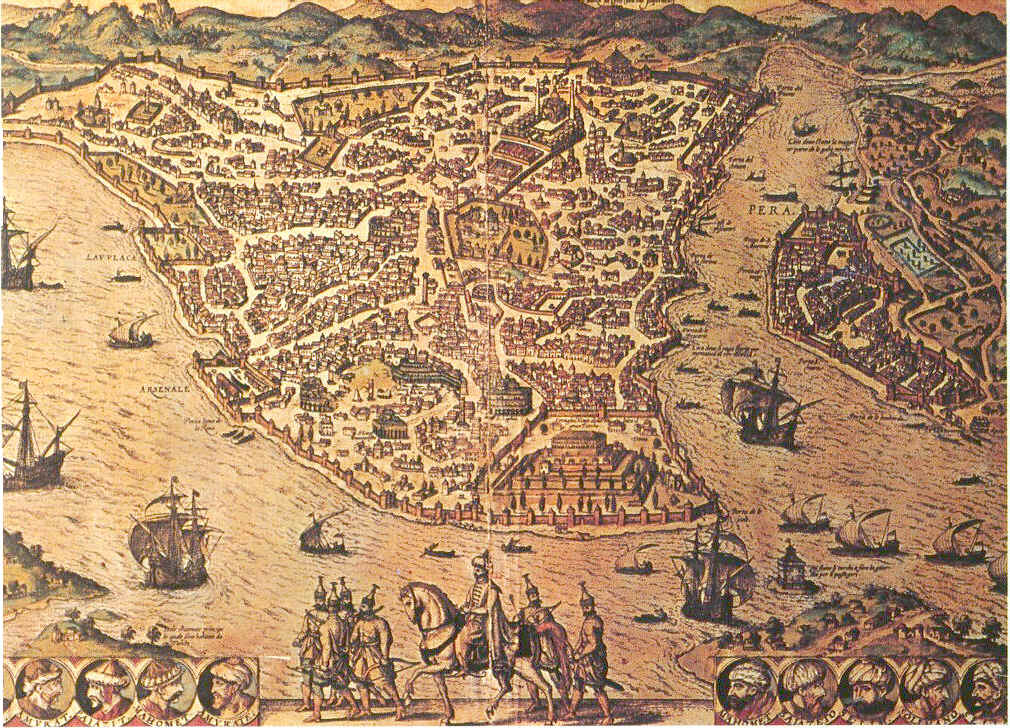
Byzantine deception did not emerge from an exotic court culture suddenly detached from the older Roman world. It grew from Roman habits of rule, especially the imperial practice of managing outsiders through classification, ceremony, negotiated dependence, selective violence, and controlled reward. Long before medieval Constantinople became synonymous in western imagination with intrigue, the late Roman state had already developed a sophisticated machinery for dealing with peoples beyond, beside, and sometimes inside its frontiers. Goths, Huns, Persians, Armenians, Arabs, Isaurians, and other groups were not simply enemies to be fought or strangers to be excluded. They were watched, ranked, subsidized, recruited, baptized, titled, married into alliances, settled as federates, or turned against one another when imperial interest required it. The empire’s genius was not purity of action, but elasticity. It could call a foreign ruler a barbarian in one register, a client in another, a military ally in a third, and a dangerous rival the moment circumstances changed.
The late Roman frontier was not a clean line between civilization and chaos, however insistently imperial rhetoric pretended otherwise. It was a zone of negotiation, exchange, surveillance, migration, military pressure, and political improvisation. Roman commanders might fight a group one year and recruit its warriors the next. Imperial officials might denounce outsiders as threats while giving their leaders Roman titles, gold, cloaks, or marriage connections. A treaty might be framed as the restoration of order, even when it was plainly a payment for temporary quiet. Hostages could be described as guarantees of peace, but they also functioned as instruments of cultural training and political leverage. Foreign elites brought to Roman territory learned imperial language, protocol, military expectations, and the seductive prestige of Roman recognition. In that sense, the empire did not merely defend itself from foreignness. It processed foreignness, reshaped it, and returned it to the frontier wearing Roman signs of hierarchy. This was not deception in the narrow sense of simple lying. It was something more durable: a political system built on asymmetrical knowledge. The imperial center wanted to know who foreign leaders were, how their factions worked, which rivalries could be exploited, which sons could be cultivated, which marriages mattered, which chiefs could be bribed, and which promises could be postponed until danger passed. Information was a defensive resource. An army could be defeated in the field, but a well-informed court might still buy time, divide enemies, encourage a succession dispute, recognize a claimant, or subsidize a rival. Late Roman diplomacy treated knowledge about outsiders as part of imperial security. A frontier people became less frightening when its internal fractures were known. A rival king became more manageable when his need for Roman recognition could be identified and manipulated. A barbarian army became less unified when its leaders could be tempted separately.
The administrative habit behind this practice was visible in the late Roman state’s love of lists, offices, ranks, and titles. The Notitia Dignitatum, though difficult and uneven as evidence, preserves a world in which authority was imagined through carefully ordered offices and dignities. The very act of naming an office, assigning a staff, ranking a command, or locating a unit reflected a bureaucratic mind that sought to make power legible. This mattered for foreign policy because outsiders, too, could be brought into Roman systems of legibility. They could be given titles whose prestige depended on imperial recognition. They could be received through protocols that placed them below the emperor even when military reality was less flattering. They could be described in official language that turned negotiation into submission, compromise into generosity, and payment into magnanimity. The state’s paperwork and ceremony did not merely record hierarchy. They manufactured it.
The shadowy scrinium barbarorum belongs in this late antique context, but it must be handled carefully. It should not be imagined as a medieval Byzantine intelligence agency in the modern sense, with neat departments, professional spies, and a continuous institutional life from Constantine to 1453. The evidence is too limited for that, and the temptation to make it into a “Byzantine CIA” says more about modern imagination than late Roman administration. What it does suggest, more modestly and more usefully, is that dealings with foreign peoples required specialized bureaucratic attention. Translation, records, diplomatic correspondence, protocol, and the reception or monitoring of foreign envoys were not casual matters. They belonged to the world of imperial management. The empire needed mechanisms for remembering who had promised what, which foreign dignitary had been honored before, which title had been granted, which treaty had been broken, and which border relationship could be revived in a crisis. Even when the institution itself disappears from view, the administrative logic behind it remained central to Byzantine practice.
The eastern Roman court inherited this logic and intensified it because Constantinople was not merely an administrative capital. It was a stage. Foreign envoys who entered the city encountered walls, churches, processions, silks, relics, guards, controlled audiences, and ritualized distance from the emperor. The point was not only to impress them with wealth. It was to place them inside an imperial fiction so overwhelming that negotiation began before anyone spoke. The emperor appeared less as one ruler bargaining with another than as the still point of a sacred political universe. Access to him was delayed, framed, mediated, and choreographed. The visitor was made to feel that imperial power was older, higher, and more orderly than the unstable world beyond the Bosporus. Even if the treasury was strained or the frontier threatened, ceremony could create an atmosphere in which weakness was hidden behind splendor.
This theatricality was not ornamental. It was diplomatic technology. A court that could not always compel obedience by arms could still compel recognition through ritual. When outsiders accepted imperial gifts, titles, or ceremonial placement, they participated, however uneasily, in the empire’s preferred story about the world. They might not believe that the emperor truly ruled all peoples, but they had to operate within ceremonies that implied he did. That implication mattered. Prestige could become leverage. A foreign leader who received an imperial title might use it to strengthen his own authority at home, but that also tied his honor to Constantinople’s approval. A marriage alliance could elevate a dynasty, but it also placed that dynasty within a hierarchy defined by Roman superiority. A subsidy could look like tribute to an enemy, yet Byzantine language could recast it as a gift from a generous emperor to a lesser ruler. The same exchange could carry opposite meanings depending on who narrated it. Persia, especially the Sasanian Empire, forced Rome and then Byzantium to refine this diplomatic language because Persia could not be treated simply as a barbarian dependency. It was an imperial rival with its own universal claims, ceremonial sophistication, military strength, and ideological confidence. Roman dealings with Persia required a more delicate balance of assertion and compromise. Envoys crossed borders with formal language, negotiated prisoner exchanges, arranged truces, and managed disputes over Armenia, Mesopotamia, and frontier fortresses. Here the fiction of Roman superiority met another imperial fiction of equal magnitude. Deception became subtle because both sides understood the game. Each court tried to read the other’s weakness, exploit succession conflicts, support useful clients, and use treaties as instruments of temporary advantage. The eastern frontier trained Constantinople in the art of negotiating without surrendering symbolic supremacy.
Armenia was one of the most important laboratories of this managed foreignness. It stood between Rome and Persia not as a passive buffer but as a contested aristocratic and religious landscape whose noble houses, loyalties, and confessional alignments could be cultivated or disrupted. Roman and Persian policy both relied on influence rather than simple occupation whenever direct rule proved too costly. Supporting one Armenian faction, recognizing another, intervening in succession, or claiming to protect Christian interests could serve strategic ends that exceeded the language used to justify them. Armenia taught the eastern empire that frontier politics were rarely binary. Allegiance could be layered, local, negotiated, and reversible. A noble house might look to Constantinople for rank, to Persia for security, and to its own regional interests above either. Managing such a world required patience, memory, and a willingness to treat ambiguity as normal rather than exceptional.
The same late antique inheritance shaped relations with Gothic and other federate groups inside Roman territory. The settlement of armed outsiders within imperial space created a problem that military power alone could not solve. These groups could defend the empire, threaten it, demand payment, seek office, and alter the internal balance of power. Roman policy alternated between incorporation and suspicion, offering commands and honors while attempting to prevent any single military outsider from becoming indispensable. This required a kind of double speech. Federate leaders could be praised as loyal servants while being watched as potential rebels. Their troops could be celebrated as defenders while being treated as a political danger. The court learned to manage them through money, status, rivalries, and selective inclusion. The method was risky, but the alternative was often worse: expensive war against mobile armed groups whose cooperation might be urgently needed elsewhere.
Christianity added another layer to this machinery without replacing its Roman core. Conversion, orthodoxy, ecclesiastical recognition, and missionary activity eventually became diplomatic instruments, but their late antique foundations were already visible. A ruler’s religious alignment could affect his relationship with Constantinople. A bishop could function as spiritual authority, imperial agent, local broker, or diplomatic intermediary. The language of Christian unity could make political influence appear as pastoral care. Theological disagreement could become a tool of imperial classification, marking some peoples or factions as more trustworthy, more dangerous, or more available for intervention. This did not mean that religion was merely a disguise for politics. It meant that in the late Roman and early Byzantine world, religion and politics operated through the same imperial imagination of order. The management of foreignness was also the management of perception. The empire needed outsiders to see Rome as ancient, wealthy, legitimate, and dangerous, even when its capacity varied sharply from region to region. It needed subjects to believe that diplomacy was not weakness, that payments were not humiliation, that compromise was not surrender, and that the emperor remained superior even when he negotiated. This required narrative discipline. Court language transformed necessity into generosity. Ritual transformed vulnerability into majesty. Titles transformed outsiders into dependents. Treaties transformed temporary arrangements into claims of restored order. The imperial center constantly translated messy political reality into a grammar of hierarchy.
That translation is the root of much later Byzantine statecraft. Medieval Constantinople did not invent its habits of controlled access, diplomatic ambiguity, ceremonial intimidation, and foreign manipulation in isolation. It inherited them from a late Roman world that had already learned to survive by governing the spaces between war and peace. The frontier was not only defended by forts and soldiers. It was defended by gifts, information, hostages, ranks, marriages, spies, interpreters, ceremonies, and stories. Byzantine deception began here, not as a theatrical vice of a decadent palace, but as the administrative and diplomatic inheritance of an empire that had long understood foreign policy as the art of making other peoples act inside Rome’s preferred imagination of power.
Justinian and the Double Language of Restoration, Bribery, and Imperial Legitimacy
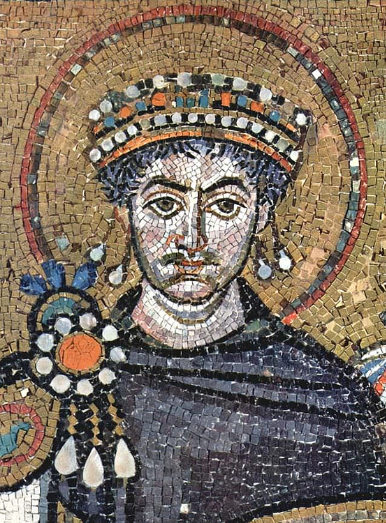
Justinian I inherited the late Roman machinery of managed foreignness and pushed it into one of the most ambitious imperial projects of late antiquity. His reign did not merely preserve the empire. It tried to make the empire legible again as universal Rome. The legal codification, the rebuilding of Constantinople after the Nika revolt, the construction of Hagia Sophia, the reconquest of Vandal North Africa and Ostrogothic Italy, and the assertion of imperial authority over Christian doctrine all belonged to a single political language of restoration. Justinian presented himself not as an improvising survivor, but as the emperor who would repair the fractured Roman world. Yet the practical means by which he pursued that vision were far less pure than the rhetoric surrounding it. Restoration required war, but also bribery. It required theology, but also coercion. It required public legality, but also private maneuver. Justinian’s reign reveals a central Byzantine pattern in unusually dramatic form: imperial legitimacy was proclaimed in the language of divine order while preserved through the grittier arts of money, intrigue, intimidation, and opportunistic compromise.
The double language of Justinianic rule appeared first in the emperor’s claim to restore Roman unity. His codification of law, especially the Codex Justinianus, the Digest, and the Institutes, gave imperial authority a monumental legal form. Law presented the emperor as guardian of order, reason, and continuity. It turned his reign into an act of Roman recovery, as though the emperor were gathering the scattered fragments of legal tradition and placing them back under a single sovereign mind. This was not mere propaganda. The legal project had genuine administrative and intellectual importance. Yet it also strengthened the ideological claim that authority flowed downward from an emperor whose decisions could define public order itself. Justinian did not only govern through law. He used law to narrate government as restoration. That narrative mattered because the political world he inhabited was not stable. His empire faced fiscal strain, religious division, aristocratic competition, military danger, and urban unrest. Legal majesty helped conceal how much of imperial survival depended on improvisation. It also gave coercion a language of rationality, allowing imperial command to appear not as personal will but as the recovery of proper order. When law gathered centuries of Roman jurisprudence into an authoritative imperial project, it did more than organize courts and jurists. It taught subjects that the emperor stood above confusion as the interpreter of Roman continuity. In a reign marked by rebellion, plague, war, and theological conflict, that claim was politically indispensable. Justinian’s legal monument made the empire look coherent precisely because the empire itself was under strain.
The Nika revolt of 532 exposed that instability with brutal clarity. What began in the charged world of circus factions became a direct challenge to imperial rule, joining popular grievance, elite intrigue, and urban violence in a crisis that nearly destroyed Justinian’s regime. The emperor’s authority, so carefully clothed in law and ceremony, suddenly appeared fragile. The crowd acclaimed an alternative emperor, Hypatius, and the possibility of flight reportedly entered the imperial palace. Whether every detail preserved by later narrative can be accepted without question, the episode reveals the problem that haunted Byzantine monarchy: sacred authority could be undone by the convergence of street violence, aristocratic ambition, and military uncertainty. Theodora’s famous intervention, as reported by Procopius, belongs to the theatrical memory of the event, but the political reality is plain enough. The regime survived by abandoning conciliation and choosing massacre. Order returned not because imperial legitimacy was self-evident, but because Belisarius, Mundus, and loyal forces crushed the revolt inside the Hippodrome.
The aftermath of the Nika revolt shows Justinian’s double language at its starkest. Constantinople was rebuilt as a city of renewed imperial and Christian magnificence, most famously through Hagia Sophia, whose vast dome and luminous interior transformed architectural space into theological monarchy. The emperor who had nearly lost his throne became the patron of a building that made his rule appear fused with divine favor. Yet beneath that restored sacred landscape lay the memory of mass killing, political terror, and emergency repression. This was not unusual in imperial history. States often monumentalize after violence. But in Justinian’s Constantinople, the contrast was especially sharp because the rebuilt city taught subjects and visitors what to remember. They were meant to see holy magnificence, not the bodies that made political survival possible. Architecture became political repair. The dome did not erase the revolt, but it helped overwrite it with a new story: the emperor had survived because heaven still stood with him. That story mattered because a ruler who survived a near-overthrow needed more than revenge. He needed visible proof that his authority had been restored at a higher level than before. Hagia Sophia answered riot with radiance. It converted the memory of smoke, factional rage, and slaughter into a monumental vision of order descending from above. The building’s political force lay not only in its beauty, but in its timing. It rose from a city recently broken by rebellion and proclaimed that imperial rule had not merely endured the crisis. It had been transfigured by it.
Foreign policy under Justinian followed a similar pattern. The reconquest of North Africa from the Vandals and Italy from the Ostrogoths could be represented as the liberation and restoration of Roman provinces. In ideological terms, these wars reversed the humiliations of the fifth century and declared that the empire had not surrendered its universal claims. Belisarius’s victory over the Vandals was swift enough to make restoration seem providential. Italy, by contrast, revealed the terrible cost of imperial ambition. The Gothic War dragged on for decades, devastated the peninsula, strained the treasury, and required repeated campaigns under shifting commanders. Justinian’s rhetoric of liberation collided with the realities of siege, famine, plague, taxation, and military exhaustion. Roman restoration could look glorious from Constantinople. On the ground in Italy, it could look like another form of ruin.
Money was indispensable to this imperial project, and Justinian’s government used it without embarrassment when force alone could not serve. Subsidies, payments, gifts, and negotiated arrangements were part of the empire’s strategic vocabulary. The distinction between bribery and diplomacy was often a matter of perspective. To an imperial official, payments to foreign rulers could be prudent expenditures, cheaper than war and useful for buying time. To critics, they could appear as corruption, weakness, or humiliation. Justinian’s dealings with Persia illustrate the ambiguity. The so-called Eternal Peace of 532 with the Sasanian king Khosrow I was purchased at considerable cost, but it allowed Justinian to redirect resources westward. The peace was “eternal” in name, strategic in purpose, and temporary in reality. Its title expressed the public language of order. Its function was to create a pause long enough for imperial ambition elsewhere. The deception was not necessarily that either side believed peace would last forever. It was that the form of the treaty dignified what both empires understood as a managed interval.
Justinian’s diplomacy also depended on exploiting the weaknesses and divisions of others. The Vandal kingdom in North Africa was vulnerable because of internal conflict and disputed legitimacy, allowing Constantinople to frame intervention as restoration rather than aggression. In Italy, imperial policy benefited from and deepened divisions among Gothic elites, Roman aristocrats, church leaders, and local populations. On other frontiers, the empire continued the late Roman practice of using allied peoples, subsidies, buffer arrangements, and selective recognition to avoid fighting every enemy directly. This was crisis management by fragmentation. A united enemy was dangerous. A divided enemy could be negotiated, purchased, isolated, or defeated in sequence. Justinianic policy did not simply impose Roman power outward. It searched for cracks in neighboring polities and widened them.
Religious policy supplied another field in which legitimacy and manipulation intertwined. Justinian sincerely saw himself as a Christian emperor responsible for the unity of the church, but sincerity did not prevent coercion. Theological dispute was not a private intellectual matter in his empire. It was a political danger, because religious division threatened imperial unity across provinces already marked by linguistic, regional, and social difference. Justinian intervened in doctrinal controversy, pressured bishops, legislated against religious dissidents, and sought formulas that might reconcile or discipline competing Christian communities. The emperor’s theological activity served two purposes at once. It expressed a genuine conviction that imperial authority must defend orthodoxy, and it functioned as an instrument of state management. Heresy was not only error. It could become disobedience. Unity was not only spiritual. It was administrative. This dual purpose made religious policy especially powerful and especially dangerous. A compromise formula could be offered as pastoral healing while also disciplining opposition. A council, edict, or deposition could appear as the defense of truth while also tightening imperial control over bishops and provinces. Justinian’s religious interventions belonged to the same political universe as his diplomacy and law. They translated division into a problem the emperor had both the duty and the right to solve. The more fractured the empire became, the more necessary this claim appeared, even when the effort to impose unity produced deeper alienation.
The empress Theodora complicates this picture further because she appears in the sources as both partner in imperial rule and object of hostile moral imagination. Procopius’s Secret History portrays her with extravagant venom, turning her past, sexuality, influence, and religious sympathies into evidence of corruption at the heart of the regime. That account cannot be taken as transparent fact, but neither can it be ignored. It shows how Byzantine political accusation worked. To attack imperial power, one could attack the body, marriage, piety, gender, and household of the ruler. Theodora’s support for Miaphysite figures, her role in court politics, and her memory as a forceful imperial presence all made her a useful target for writers who wished to depict the court as morally inverted. In one register, she was Augusta and partner in survival. In another, she became the hidden hand of disorder. The gap between those images reveals how political legitimacy in Byzantium could be fought through character assassination as much as formal opposition. Her gender sharpened that conflict because female power at court could be represented either as sacred partnership or unnatural interference. Theodora’s influence, especially when imagined as private access to imperial decision-making, allowed hostile writers to suggest that the public order of Roman monarchy had been secretly captured by bedroom intrigue, theatrical vulgarity, or religious favoritism. That was the deeper accusation. The court still looked imperial from the outside, but its enemies could claim that unseen corruption governed from within. Theodora became a symbolic battlefield over the visibility of power itself.
Procopius himself is crucial to understanding the double language of the age. In the Wars, he presents Justinian’s generals and campaigns within the conventions of classicizing history, with attention to strategy, fortune, speeches, and imperial struggle. In the Buildings, he offers something close to panegyric, celebrating Justinian as a divinely favored builder whose works restored and protected the Roman world. In the Secret History, the same emperor appears as demonic, greedy, destructive, and deceitful. These contradictions are not an inconvenience to be smoothed away. They are evidence. Justinian’s reign generated competing textual realities because imperial power itself operated through competing languages. Public restoration, administrative achievement, and religious majesty coexisted with fiscal pressure, repression, factional maneuvering, and personal resentment. A reign that presented itself as the renewal of Rome could also be remembered as a machinery of fear. Procopius’s divided witness is valuable precisely because it refuses to leave Justinian in a single register. He shows the empire as it wanted to be seen, as its officials could justify it, and as its bitter observers could condemn it. The historian becomes part of the same political problem he describes. His works demonstrate that legitimacy depended not only on what emperors did, but on which narrative survived to explain what they had done. Justinian’s rule was built in stone, law, treaty, and blood, but it was also built in prose.
The plague that struck during Justinian’s reign further exposed the limits of imperial control. The pandemic disrupted population, taxation, military capacity, and social life across the empire. No amount of ceremonial authority could prevent biological catastrophe. Yet crisis could still be folded into imperial narrative. The state continued to tax, legislate, build, negotiate, and fight, even as the demographic and fiscal foundations beneath those activities weakened. Deception did not mean pretending there was no crisis. It meant preserving the appearance of imperial continuity amid conditions that threatened to make continuity impossible. The emperor still issued law. The court still received embassies. Armies still campaigned. Churches still rose. The performance of order became more necessary precisely because disorder had become so visible.
Justinian’s reign marks both a climax of Roman restoration and a warning about the cost of imperial overreach. His government achieved extraordinary things: legal codification, architectural magnificence, military reconquest, administrative assertion, and renewed claims to Roman universality. But each achievement carried a shadow. Law strengthened autocracy. Building covered violence. Reconquest consumed resources. Theology disciplined belief. Diplomacy dignified payments and pauses as moral order. The empire survived and expanded because it could speak in more than one language at once: sacred monarchy to subjects, Roman restoration to elites, legal authority to administrators, gold-backed pragmatism to enemies, orthodoxy to bishops, terror to rebels, and magnificence to the world.
That double language would outlive Justinian. Later Byzantine rulers rarely possessed his resources or ambition, but they inherited the lesson of his reign. An emperor could claim divine mission while practicing hard calculation. A treaty could be called peace while serving temporary strategy. A war could be called restoration while bringing devastation. A palace could present unity while factions sharpened knives behind its doors. Justinian did not invent Byzantine deception, but he gave it imperial scale. Under him, the arts of survival, legitimacy, and manipulation were bound together in one of the most dazzling and troubling reigns in Roman history.
The Seventh-Century Catastrophe: Survival after Persia and Islam

The seventh century shattered the world that Justinian had tried to restore. The empire that entered the 600s still imagined itself as the guardian of Roman universality, Christian order, and imperial continuity, but the material foundations of that imagination were about to be broken. War with Sasanian Persia had always been dangerous, but the final great Roman-Persian struggle became something larger than frontier conflict. It was a civilizational exhaustion machine. Cities changed hands, armies marched across the eastern provinces, holy places fell, populations were displaced, and both empires spent strength they could not easily replace. By the time Heraclius finally turned the war against Persia and recovered what had been lost, victory had become nearly indistinguishable from depletion. Byzantium survived the Persian crisis, but survival came at a terrible price. The empire had won the old war only to discover that a new world had already begun.
Heraclius’s reign exposes the fragile line between heroic restoration and emergency improvisation. In imperial memory, he could be imagined as the emperor who rescued the empire from near ruin, defeated Persia after years of desperate struggle, and restored the True Cross to Jerusalem. That narrative had enormous power because it placed military recovery inside a sacred Christian drama. Persia had taken Jerusalem in 614, and the return of the Cross after Heraclius’s victory could be framed as providential reversal, a sign that Roman Christian order had been vindicated. Yet this triumphant language concealed how close the empire had come to collapse. Persian forces had occupied Syria, Palestine, and Egypt. Avars and Slavs had threatened the Balkans and even Constantinople. The treasury was strained, the army reorganized under pressure, and the emperor’s legitimacy depended on turning catastrophe into sacred endurance. Heraclius did not simply defeat Persia. He had to make a devastated empire believe that devastation had meaning. That task required more than battlefield success, because the war had shaken the symbolic architecture of Roman rule itself. If Jerusalem could fall, if the Cross could be carried away, if the emperor could lose provinces central to Christian memory, then imperial victory had to be narrated as something greater than recovery. It had to become proof that humiliation had been temporary, that suffering had purified rather than disproved the empire’s mission, and that the emperor’s desperate measures had belonged to providence rather than panic. The political brilliance of the Heraclian restoration lay in this conversion of near-failure into sacred renewal.
That need for meaning shaped the political language of the age. The Persian war was not presented merely as a struggle over territory, revenue, or strategic position, although it was all of those things. It became a war over Christian legitimacy. This did not mean that the religious language was false. The seizure of Jerusalem and the relic of the Cross mattered profoundly in a Christian empire. But religious interpretation also served crisis management. It gave imperial suffering a structure. It allowed defeat to be described as trial, recovery as divine favor, and imperial endurance as proof that God had not abandoned the Roman state. The empire needed that language because the ordinary signs of power had been so badly damaged. When provinces were occupied and enemies approached the capital, imperial authority had to speak in a register deeper than administrative confidence. It had to turn survival itself into theology.
The victory over Persia also reveals one of the recurring ironies of Byzantine statecraft: success could create the conditions for later vulnerability. The Sasanian Empire was broken by the war and then torn apart by internal instability, but Byzantium was not restored to Justinianic strength. It had regained provinces without recovering the full fiscal, military, and administrative resilience needed to defend them. Syria, Palestine, and Egypt had endured occupation and disruption. Local populations had experienced years of imperial absence or weakness. Religious divisions, especially between Chalcedonian imperial orthodoxy and non-Chalcedonian communities, remained politically significant. The empire had recovered territory whose loyalty and integration could not be assumed. Heraclius’s victory produced a dangerous illusion of restoration. The map appeared repaired, but the structures beneath it had been weakened. This was the cruel deception of the moment: the empire looked restored precisely when it had become least capable of sustaining restoration. The return of lost provinces could be celebrated ceremonially, but ceremonies could not replenish exhausted taxpayers, rebuild damaged local administrations, or erase the memory of imperial failure. Communities that had endured Persian occupation did not necessarily return to Constantinople with uncomplicated confidence. Some had suffered under war, taxation, religious coercion, and the competing claims of empires that spoke the language of order while bringing disruption. Heraclius had won back the East, but he had not healed the conditions that made the East fragile.
Then came the Arab conquests. Within a few decades, the eastern Roman Empire lost Syria, Palestine, Egypt, and much of its old eastern and southern world. These were not peripheral losses. Egypt was a major fiscal and grain-producing region. Syria and Palestine contained cities, bishoprics, trade routes, military roads, religious sites, and symbolic geography central to Christian imperial imagination. The loss of Jerusalem after its recent recovery was not merely a strategic defeat. It was an interpretive wound. The empire that had just celebrated the return of the Cross now confronted the disappearance of entire provinces into the rule of a new monotheistic power. No Byzantine rhetoric of universal Roman authority could fully hide the fact that the empire had been reduced. The imperial imagination remained vast, but the imperial body had been cut down.
The speed and scale of these losses forced a transformation in Byzantine crisis management. The old late Roman system had relied on multiple tools: armies, subsidies, federates, diplomacy, symbolic hierarchy, urban administration, and tax flows from great provinces. After the Arab conquests, that system had to be radically compressed. The empire could no longer act as though it possessed endless resources or a stable Mediterranean base. Anatolia became the defensive heartland. Constantinople became not only the imperial capital but the indispensable fortress of survival. Strategic retreat, fortified defense, flexible military organization, negotiated truces, prisoner exchanges, tribute, intelligence gathering, and the exploitation of enemy divisions became more important than grand restoration. Byzantium had to learn how to be smaller without admitting, ideologically, that it had ceased to be universal.
This was where deception as crisis management became structurally necessary. The empire could not present itself honestly as just another regional state fighting for survival in Anatolia and the Aegean. Its entire political theology resisted that reduction. The emperor was still Roman. Constantinople was still New Rome. The empire still claimed continuity with Augustus, Constantine, and the Christian universal order. Yet its actual power now depended on caution, delay, selective aggression, and careful diplomatic calculation. The imperial court had to maintain a language of supremacy while practicing the politics of scarcity. Payments to enemies, truces with caliphs, negotiated withdrawals, and military avoidance could not be allowed to look like permanent inferiority. They had to be framed as prudence, temporary necessity, or strategic patience. In this compressed world, rhetoric became a shield as essential as walls. It protected morale inside the empire and reputation outside it, because both subjects and enemies watched for signs that Roman authority had become only regional, only defensive, only mortal. A ruler who admitted too plainly that the empire had shrunk risked making shrinkage permanent in the political imagination. Byzantine statecraft required a disciplined refusal to let facts alone define reality. The empire was diminished, but it could not afford to sound diminished. It had to speak as Rome while acting like a besieged survivor.
The first Arab sieges of Constantinople made that logic visible. The city’s survival depended on fortifications, naval strength, supply, leadership, weather, and the famous use of Greek fire. But its survival also depended on the symbolic power of the capital itself. Constantinople was not just a military target. It was the stage on which the future of the Roman Empire appeared to hang. If the city fell, the imperial fiction of continuity would collapse with it. Its successful defense allowed the empire to transform near-annihilation into proof of election. The capital’s walls became more than masonry. They became arguments. Every failed siege could be narrated as evidence that God still protected the Roman polity, even when provinces had been lost and armies defeated. The city’s survival gave imperial ideology enough truth to remain persuasive.
The empire also had to adapt to a new diplomatic opponent. The early caliphate was not another barbarian polity waiting to be ranked inside a Roman hierarchy, nor was it simply a second Persia. It combined military expansion, religious confidence, fiscal ambition, and administrative adaptation on a scale that forced Byzantium to reconsider its habits. The empire negotiated, exchanged prisoners, paid tribute at times, raided when possible, fortified when necessary, and watched for divisions within the caliphate. Civil wars among the Muslims, especially the first and second fitnas, mattered deeply to Byzantine survival because they created breathing room. A united caliphate could press the frontier relentlessly. A divided caliphate gave Constantinople opportunities to regroup, strike, bargain, or simply endure. The old Roman habit of exploiting rivalries remained alive, but the stakes had become sharper.
Internal politics changed under this pressure. The seventh-century empire could not rely on the same urban, provincial, and fiscal structures that had sustained late antique governance. The old eastern provinces were gone, the Balkans were deeply disrupted by Slavic settlement and Avar pressure, and Anatolia became militarized as the central zone of defense. The development of the theme system remains debated in its details and chronology, but the broader transformation is clear enough: military survival and provincial administration became more tightly connected. A more defensive, mobile, and regionally grounded empire emerged from the wreckage of the old Roman Mediterranean system. This was not a clean reform carried out from a position of confidence. It was adaptation under duress, the kind of institutional change that later generations might regularize and explain, but which began as survival by necessity. The state had to keep soldiers tied to territory, revenue tied to defense, and local authority tied closely enough to imperial command that Anatolia would not fracture under pressure. Such arrangements were not glamorous, but they mattered more than the older dream of Mediterranean restoration. The empire’s survival depended on creating structures that could absorb raids, recover after defeat, and maintain continuity when rapid reconquest was impossible. In that sense, institutional change itself became a form of concealed crisis management. What later appeared as a durable Byzantine military-administrative system began as the empire learning how not to die.
Religious policy also became a tool of crisis management in this period, especially under Heraclius and his successors. The effort to formulate doctrines such as Monoenergism and Monotheletism reflected the desperate problem of unity in a divided Christian empire. These policies cannot be reduced to cynical manipulation. They arose from serious theological debate and genuine attempts to address Christological division. Yet they were also political instruments, designed to bridge the gulf between Chalcedonian imperial orthodoxy and non-Chalcedonian communities in regions whose loyalty mattered deeply. The tragedy was that these formulas satisfied almost no one for long. Instead of healing division, they often produced new controversy. Theological diplomacy mirrored foreign diplomacy: a carefully crafted compromise could buy time, but it could also expose the limits of imperial control.
The seventh-century crisis changed the psychology of Byzantine rule. Earlier emperors could imagine recovery through expansion, monumental building, and universal law. After the Arab conquests, survival itself became the central achievement. This did not make Byzantine politics less ambitious, but it made ambition more defensive and more patient. The empire learned to endure through partial measures: raid rather than conquer, negotiate rather than submit, fortify rather than expand, divide rather than overwhelm, sanctify retreat when victory was unavailable, and preserve ceremony when material power declined. The art of appearing more stable than circumstances allowed became indispensable. Such appearance was not empty illusion. It held together armies, officials, bishops, subjects, and foreign perceptions long enough for the empire to continue.
This century marks one of the decisive turning points in Byzantine history. The empire that emerged from it was still Roman, still Christian, still centered on Constantinople, and still capable of formidable recovery. But it was no longer the late antique Mediterranean empire of Justinian’s imagination. It had become a hardened survival state, disciplined by loss and trained by catastrophe. Deception, diplomacy, and strategic ambiguity were no longer merely useful tools among many. They became habits of existence. The empire could not afford to tell the full truth about its weakness, because its authority depended on the belief that Roman order had not died. It could not fully abandon universal claims, because those claims gave meaning to sacrifice and continuity to government. It survived by standing between fact and fiction, between diminished resources and undiminished legitimacy. That tension would define Byzantine statecraft for centuries.
Iconoclasm, Legitimacy, and the Politics of Sacred Control

The crisis of the seventh century did not end when the empire survived. It left behind a political and spiritual wound that later rulers had to explain. The old world of imperial confidence had collapsed. Syria, Palestine, and Egypt were gone. The Balkans had been transformed. Anatolia had become the empire’s defensive core. Constantinople endured, but endurance itself demanded interpretation. Why had God allowed the Roman Empire, the Christian empire, to suffer such devastation? Why had armies failed, provinces fallen, and sacred geography passed into Muslim rule? In that atmosphere, religious policy could not remain separate from political survival. Iconoclasm emerged from this world of anxiety, discipline, and explanation. It was not simply an abstract quarrel over religious art. It was a struggle over divine favor, imperial authority, public obedience, and the meaning of catastrophe.
The emperors associated with Iconoclasm, especially Leo III and Constantine V, ruled in a world where military success and theological legitimacy were tightly connected. If the empire survived under their command, then their religious reforms could be presented as part of that survival. If disaster had followed earlier practices, then those practices could be accused of provoking divine anger. The veneration of icons became politically vulnerable because it stood at the intersection of worship, public ritual, monastic influence, and popular devotion. To critics, icons could be condemned as idolatrous confusion, a dangerous materialization of the sacred that had invited punishment. To defenders, icons were not idols but windows into holy presence, visible signs of incarnation, intercession, and communal memory. The theological stakes were real on both sides. Yet the political stakes were equally real, because whoever defined proper worship also defined the moral boundaries of imperial order. This was especially important in an empire that understood military disaster as more than bad luck or strategic failure. Defeat could be read as judgment, and victory could be claimed as vindication. An emperor who successfully defended the state could argue that his religious policy had restored divine favor, while his enemies could counter that imperial intrusion into sacred tradition was itself the deeper source of disorder. Iconoclasm placed theology inside the machinery of legitimacy. It allowed rulers to present reform as obedience to God, not merely obedience to the throne, and it forced opponents to defend images as part of the empire’s true Christian identity rather than as private devotional preference.
This made Iconoclasm a form of sacred crisis management. The emperor did not merely command armies or issue fiscal measures. He claimed responsibility for the spiritual condition of the empire. In a world where defeat might be read as divine judgment, religious correction became a political necessity. Iconoclast policy could present itself as purification: the removal of dangerous images, the disciplining of error, and the restoration of a more obedient Christian community under imperial leadership. That claim gave the emperor a powerful role as guardian of orthodoxy, but it also exposed the volatility of Byzantine sacred politics. If the emperor corrected the church, he appeared as God’s active agent. If he erred, he became a persecutor of the holy. The same office could be imagined as protector or tyrant, depending on who controlled the memory of the conflict.
The politics of sacred control also involved institutions. Monasteries, bishops, court officials, soldiers, urban populations, and local communities did not experience Iconoclasm in identical ways. Monastic resistance became especially important in later iconophile memory, partly because monks could be represented as guardians of tradition against imperial coercion. This does not mean every monk resisted Iconoclasm or every bishop obeyed it mechanically. The conflict was more uneven and regionally varied than later polemic allowed. Still, the issue of monastic power mattered. Monasteries possessed wealth, land, spiritual prestige, networks of patronage, and authority over popular devotion. By challenging icon veneration, Iconoclast emperors also challenged a religious culture in which holy images, saints, relics, and monastic intercession formed a dense web of non-imperial sacred influence. Control over images was also control over who mediated holiness to the people.
Constantine V became the central villain of later iconophile history precisely because his reign forced the question of imperial sanctity with unusual intensity. He was militarily energetic and politically formidable, especially against Bulgaria and the empire’s eastern enemies. Yet iconophile writers remembered him with savage hostility, portraying him as impious, grotesque, and persecuting. This contrast matters. A ruler could defend the empire successfully and still be condemned as a spiritual monster if later religious memory judged his theology corrupt. Byzantine legitimacy required more than victory. It required victory interpreted as righteous. Constantine’s military strength could not save his posthumous reputation because the triumph of icon veneration later made his policies appear not as reform, but as sacrilege. Historical memory became a second battlefield, one on which defeated theological positions could be morally disfigured after the fact. The intensity of the attacks against him reveals how much was at stake in controlling the meaning of his reign. If Constantine could be remembered as a successful Christian emperor, then Iconoclasm might remain a defensible tradition of imperial purification. If he could be recast as a persecutor and enemy of holiness, then the entire Iconoclast project could be pushed outside the boundaries of legitimate Roman Christianity. His body, habits, name, and memory became targets because political theology needed moral drama. Later writers did not merely disagree with his policies. They made him into a warning about what happens when imperial power claims mastery over sacred truth and loses the right to define it.
The Council of Hiereia in 754 reveals the imperial effort to make Iconoclasm institutionally authoritative. Convened under Constantine V, it condemned the religious use of icons and sought to provide theological legitimacy for imperial policy. Yet because it lacked representation from the major patriarchates outside imperial control and was later rejected by iconophile councils, its authority remained contested. The council shows that Byzantine deception and power maintenance were not always conducted through secrecy. Sometimes they operated through public acts of definition. A council could be used to transform imperial preference into ecclesiastical judgment. It could present coercive policy as collective discernment. The form of conciliarity gave sacred control a language of consent, even when imperial pressure shaped the field in which that consent was produced.
The restoration of icons under Irene and the Second Council of Nicaea in 787 reversed that language. Icon veneration was formally defended, and the council distinguished between veneration offered to images and worship owed to God alone. This was not simply a theological correction. It was a political re-narration of the recent past. Iconophile restoration required the empire to reinterpret Iconoclasm as error, violence, and deviation from tradition. Irene’s role is especially significant because her authority as empress and regent intersected with the politics of orthodoxy. By restoring icons, she could present herself as the healer of the church and the restorer of sacred order. Yet her own seizure and maintenance of power remained entangled with court politics, dynastic anxiety, and violence. Sacred restoration did not remove political ambiguity. It clothed it in orthodoxy. Irene’s position made this especially delicate, because female rulership in Byzantium could be both useful and vulnerable, sanctified through piety yet attacked through assumptions about gender and authority. Icon restoration allowed her to claim a role that was not merely dynastic or maternal, but providential. She could appear as the ruler who repaired the bond between empire and heaven after decades of error. The politics surrounding her reign show that orthodoxy did not purify power of calculation. It gave calculation a more acceptable language. The same court that celebrated the restoration of holy images remained a place of faction, ambition, surveillance, and dynastic danger.
The second phase of Iconoclasm in the ninth century shows that the issue was not resolved simply because one council had spoken. Military pressure, especially from Bulgaria and the Abbasid frontier, again created conditions in which imperial rulers might connect religious discipline with state survival. Leo V’s revival of Iconoclasm after Byzantine military difficulties suggests how persistent the logic remained: when the empire suffered, rulers searched for divine causes and corrective policies. Once again, icons became a point at which theological conviction, imperial authority, military anxiety, and public obedience converged. The revival was not a mechanical repetition of the eighth-century controversy, but it reveals how deeply Byzantine political culture linked sacred order to imperial security.
The final restoration of icons in 843, later celebrated as the Triumph of Orthodoxy, did more than settle an argument over images. It established a memory regime. Icon veneration became not merely permitted, but identified with the true faith of the empire. Iconoclasm became heresy, imperial overreach, and spiritual violence. The victorious tradition shaped the sources through which later generations understood the controversy. This is crucial for any historical interpretation. Much of what survives about Iconoclasm comes through opponents who had every reason to portray iconoclast rulers in the darkest possible terms. The historian must read carefully, neither rehabilitating Iconoclasm into innocent reform nor accepting iconophile polemic as transparent record. The controversy itself became an example of Byzantine memory politics: the winners did not merely restore icons. They defined what the struggle had meant.
Iconoclasm also complicates the broader theme of deception because it shows that Byzantine power often worked by sacralizing administrative necessity. The empire did not simply lie to its subjects. It interpreted crisis for them. It told them why defeat had happened, what reform meant, who threatened divine order, and why obedience to imperial religious policy mattered. That interpretive authority was powerful because it joined fear, hope, discipline, and salvation. If the emperor could identify the sin causing catastrophe, then he could also claim to lead the remedy. This was not ordinary propaganda. It was a sacred grammar of power in which military loss, divine judgment, public ritual, and imperial command formed a single political language.
Yet sacred control was never fully controllable. Icons belonged not only to court theology, but to households, monasteries, churches, processions, memories, and bodies. They were kissed, carried, defended, hidden, mourned, and restored. Imperial command could remove images from public spaces or punish defenders, but it could not easily sever the emotional and devotional bonds that made icons meaningful. That limitation mattered. Byzantine rulers could manipulate theology, convene councils, pressure bishops, and discipline opponents, but the sacred imagination of the empire was not theirs alone. The politics of Iconoclasm exposed both the reach and the limits of imperial power. The emperor could claim responsibility for orthodoxy, but if the faithful came to believe that the emperor had attacked holiness itself, his claim became dangerous. Images worked on levels that imperial decree could not fully police. They carried family memory, local devotion, healing expectation, saintly presence, and the intimate habits of prayer. A state could regulate doctrine, but it could not easily command affection. That is why Iconoclasm became so volatile: it reached from palace theology into the daily devotional lives of ordinary Christians. When imperial authority touched icons, it touched not only church walls, but the emotional architecture of faith. The state discovered that sacred symbols could be governed, damaged, defended, or restored, but never reduced to administrative objects.
The controversy also sharpened the Byzantine habit of explaining political legitimacy through visible signs. An icon was an image, but so was imperial power. The emperor appeared on coins, in ceremonies, in acclamations, in mosaics, and in liturgical settings where earthly rule touched sacred order. To attack or defend icons was to ask broader questions about representation itself. What can be seen? What can be mediated through matter? Who authorizes an image? What is the difference between reverence and idolatry, presence and illusion, symbol and power? These questions reached beyond church walls. Byzantine monarchy depended on visible majesty, controlled appearances, and ritualized representation. Iconoclasm forced the empire to confront the politics of images while remaining a state that could not govern without them.
Iconoclasm reveals a form of deception deeper than diplomatic trickery. It shows an empire trying to make catastrophe intelligible by turning religious discipline into political explanation. Iconoclast emperors sought to purify the empire and secure divine favor, but their policies also strengthened imperial claims over sacred life. Iconophile victory restored images, but it also rewrote the controversy through the moral certainty of orthodoxy triumphant. Both sides fought over truth, but both also fought over authority, memory, and the right to define the meaning of crisis. Byzantium survived the seventh century by refusing to let military disaster become ideological collapse. In the eighth and ninth centuries, it extended that refusal into the sacred realm, where images became the battlefield on which empire, obedience, and divine favor were made visible.
The Macedonian Recovery: Diplomacy as Weapon and Performance
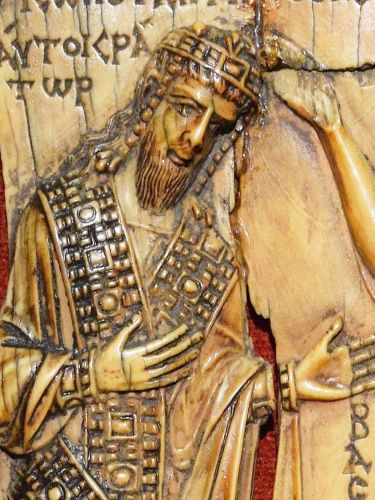
The end of Iconoclasm did not magically restore Byzantine strength, but it helped clear the ideological ground for a more confident imperial recovery. From the mid-ninth through the tenth century, the empire moved from defensive endurance toward renewed expansion, administrative consolidation, and diplomatic ambition. This transformation is often associated with the Macedonian dynasty, though the recovery drew on earlier military and fiscal adaptation as much as dynastic brilliance. The empire that had survived the seventh and eighth centuries now possessed a hardened Anatolian base, a more flexible military system, an increasingly assertive court culture, and a sharpened sense of its own providential survival. Yet recovery did not mean abandonment of deception. It meant the refinement of deception into a more disciplined art. Byzantine diplomacy became not merely a way to avoid war, but a weapon in its own right: a system of intelligence, ceremony, gifts, titles, religious influence, marriage negotiation, controlled intimidation, and careful exploitation of rivalries around the empire’s frontiers.
The clearest expression of this diplomatic mind appears in Constantine VII Porphyrogenitus’s De Administrando Imperio, a manual of imperial instruction that treats foreign peoples not as abstractions, but as political organisms whose internal divisions, genealogies, habits, ambitions, and resentments could be studied and used. The work’s value lies not in perfect accuracy, but in the worldview it reveals. To govern the empire was to know the Pechenegs, Rus’, Khazars, Bulgarians, Arabs, Armenians, and other neighboring powers in practical detail. Knowledge itself became a strategic resource. A people’s enemies mattered. Their marriage customs mattered. Their trade routes mattered. Their memories of insult or favor mattered. The emperor who understood these things could avoid costly war by encouraging pressure from one group against another, offering recognition to a useful claimant, rewarding a cooperative ruler, or withholding prestige from a troublesome one. In this system, deception was not always a forged letter or broken treaty. It was the disciplined management of partial knowledge, selective disclosure, and political timing. Constantinople sought to know more about its neighbors than they knew about one another, and especially more than they knew about the empire’s own limits.
Ceremony gave this knowledge visible form. The Macedonian court did not merely receive foreign envoys. It staged them. The Book of Ceremonies preserves a world in which movement, clothing, acclamation, procession, seating, gifts, silence, and distance from the emperor all carried political meaning. Foreign visitors were placed inside a choreography that made hierarchy appear natural. They entered halls designed to overwhelm the senses, encountered ritual sequences that slowed and controlled access, and faced an emperor whose visibility was carefully managed. This was not decorative excess. It was diplomatic performance. A ruler who could not be everywhere could still appear as the immovable center of an ordered world. A treasury that could not fund endless campaigns could still distribute gifts in ways that made generosity look like superiority. A court that knew its vulnerabilities could hide them beneath splendor. The empire performed power because performance shaped expectation, and expectation shaped negotiation. The envoy who left Constantinople dazzled, irritated, or humiliated carried more than memory. He carried the empire’s preferred image of itself back into foreign politics.
The Macedonian recovery also made religious diplomacy one of the empire’s most effective instruments of influence. Conversion could extend Byzantine power without annexation. Missionary work among the Slavs, the Christianization of Bulgaria, and the later religious and diplomatic engagement with the Rus’ show how orthodoxy could function as geopolitical architecture. Baptism, liturgy, clerical hierarchy, alphabet, translation, and ecclesiastical recognition drew neighboring peoples into a cultural orbit centered on Constantinople, even when political control remained incomplete. This was not simple domination, and it was not merely cynical manipulation. Conversion created genuine religious communities and enduring cultural transformations. Yet from the imperial perspective, it also offered a way to domesticate danger. A pagan or rival Christian neighbor might be militarily threatening, but a ruler whose church looked to Constantinople, whose prestige depended partly on Byzantine recognition, and whose court adopted imperial symbols entered a different field of influence. Sacred language could soften hierarchy while preserving it. The empire could speak of salvation while also shaping borders, alliances, and claims to legitimacy.
Still, the Macedonian system was never as omnipotent as it wished to appear. Its diplomacy worked best when backed by credible military force, fiscal strength, and internal stability. The tenth-century soldier emperors, especially Nikephoros II Phokas and John I Tzimiskes, restored the empire’s offensive reputation in the east, while Basil II later brought Bulgaria under direct imperial control after a long and brutal struggle. These victories gave Byzantine ceremony and diplomacy sharper teeth. But the very success of the period also reveals the tension at the heart of Byzantine power. Diplomacy as performance depended on others accepting, or at least temporarily inhabiting, Constantinople’s story of superiority. When neighbors were divided, impressed, dependent, or intimidated, the system worked brilliantly. When they were unified, wealthy, militarily confident, or ideologically resistant, performance had to give way to force. The Macedonian recovery did not replace war with deception. It fused them. The empire’s genius lay in knowing when to dazzle, when to bribe, when to preach, when to delay, when to divide, and when to strike. That combination made the tenth-century empire formidable, not because it had escaped crisis, but because it had learned to turn the memory of crisis into a more flexible grammar of power.
Bulgaria, Rus’, and the Art of Divide, Convert, and Contain

Bulgaria and the Rus’ reveal the Macedonian diplomatic system in motion, not as theory, but as frontier practice. Both stood close enough to Constantinople to threaten it, yet far enough from direct imperial control that conquest alone could not provide a durable solution. Bulgaria pressed the empire from the Balkans, where terrain, settlement, military strength, and claims to Christian kingship made it a recurring rival. The Rus’ arrived from the north through river routes and Black Sea commerce, sometimes as raiders, sometimes as traders, sometimes as mercenaries, and eventually as partners in a religious and dynastic relationship of enormous consequence. In both cases, Byzantine policy sought to manage danger through a layered strategy: divide hostile forces, convert rulers when possible, contain military ambition, and make imperial recognition the prize around which neighboring elites reorganized their own authority.
Bulgaria was the more immediate and stubborn challenge because it occupied a political space that Byzantium could neither ignore nor easily absorb. From the late seventh century onward, the Bulgarian state disrupted the older Roman order of the Balkans and forced Constantinople to accept a powerful neighbor inside a region the empire still imagined as properly Roman. The conversion of Khan Boris I in the ninth century was far more than a religious milestone. It opened a struggle over ecclesiastical dependency, political hierarchy, and cultural orientation. Boris could seek baptism from Constantinople, negotiate with Rome, pressure both sides for concessions, and use Christianization to strengthen his own monarchy. Byzantium hoped conversion would draw Bulgaria into its orbit, but Boris understood that religious alignment could also enhance Bulgarian autonomy. The contest was not simply over the soul of Bulgaria. It was over whether Christianization would make Bulgaria subordinate, equal, or dangerously independent within the ideological universe of Christian rulership.
This is where Byzantine containment became subtle. Constantinople could not always defeat Bulgaria outright, so it tried to shape the terms under which Bulgarian power became legitimate. Church organization mattered because ecclesiastical dependence could imply political hierarchy. Titles mattered because imperial recognition could elevate a ruler while still placing him below the emperor. Marriage, hostage arrangements, gifts, military pressure, and doctrinal supervision all helped create a field in which Bulgaria’s rulers sought prestige from the very empire they resisted. Yet this strategy carried risk. Once Bulgaria possessed a Christian court, a written culture, and an ecclesiastical structure of its own, it could imitate Byzantine legitimacy rather than merely receive it. The empire’s civilizing tools could become weapons in another ruler’s hands. A converted Bulgaria was more intelligible to Constantinople, but also more capable of claiming sacred kingship, imperial-style authority, and ideological dignity against Constantinople itself. This was the paradox of Byzantine cultural power: the empire wanted neighboring rulers to enter its symbolic world, but once inside it, they learned the language of imperial competition. The very categories meant to domesticate them, Christian monarchy, sacred kingship, ecclesiastical order, dynastic prestige, and written administration, could support rival claims. Bulgaria did not have to reject Byzantine civilization to challenge Byzantium. It could adopt Byzantine forms, adapt them to local ambition, and then insist that Constantinople recognize the dignity those forms had helped create. Containment became a delicate act of giving enough prestige to bind Bulgaria without giving so much that Bulgarian rulers could plausibly claim parity.
The reign of Symeon I made that danger unmistakable. Educated in a Byzantine cultural world and deeply familiar with imperial ideology, Symeon did not behave like a peripheral client grateful for recognition. He challenged the hierarchy itself. His wars with Byzantium and his pursuit of imperial title showed how cultural proximity could sharpen rivalry rather than dissolve it. Symeon understood the symbolic language of Constantinople well enough to contest it on its own terms. He wanted not merely concessions, but recognition of a status that threatened Byzantine uniqueness. For Constantinople, this was a diplomatic nightmare: the empire had helped create a Christianized, literate, ideologically sophisticated neighbor whose ruler could use Byzantine forms to undermine Byzantine supremacy. Containment now required both military response and narrative defense. Symeon could be negotiated with, delayed, flattered, and opposed, but he could not be safely dismissed as barbarian. He had entered the imperial vocabulary and tried to rewrite its grammar.
Basil II’s eventual conquest of Bulgaria in the early eleventh century marked the most forceful solution to this long problem, but even here imperial strategy mixed brutality with administrative calculation. The war was long, exhausting, and remembered with special severity because of the blinding of Bulgarian captives after the battle of Kleidion in 1014. Yet conquest alone did not secure the Balkans. Basil had to absorb Bulgaria without provoking endless revolt, preserving elements of local ecclesiastical and fiscal life while incorporating the region into imperial authority. The empire’s policy after victory shows that containment did not end when armies succeeded. It changed form. The defeated enemy had to be made governable. Local elites had to be managed. Religious structures had to be integrated. Imperial mercy and imperial terror worked together. Byzantium could punish spectacularly, then administer pragmatically, translating conquest into a durable political settlement. That combination was central to the empire’s art of survival: violence opened the door, but controlled accommodation kept it from immediately closing again. Basil’s approach also reveals the difference between conquest as event and conquest as system. A battlefield victory could destroy resistance temporarily, but only administrative patience could turn victory into imperial possession. Bulgaria had to be folded into the empire in ways that preserved revenue, stabilized ecclesiastical life, and prevented local aristocracies from becoming permanent centers of rebellion. The empire’s power after conquest rested not simply on fear, but on calibrated continuity. By leaving certain local arrangements recognizable while placing them under imperial sovereignty, Constantinople turned domination into routine. That routine was its own kind of deception, because it made the loss of independence appear as incorporation into an older and larger order.
The Rus’ required a different strategy because their relationship with Byzantium developed through movement, trade, raiding, military service, and eventually conversion. Rus’ attacks on Constantinople and Byzantine territories revealed the danger of northern power entering the Black Sea world, but commerce and diplomacy soon created channels of management. Treaties regulated trade, movement, legal disputes, and service. Rus’ warriors could be enemies in one decade and imperial auxiliaries in another. This flexibility suited Byzantine practice. Rather than treating the Rus’ only as invaders, Constantinople worked to turn their ambitions toward profitable and controllable forms. Trade privileges, ceremonial reception, military employment, and religious contact offered ways to draw Rus’ elites into Byzantine systems of prestige. As with Bulgaria, the goal was not always direct rule. It was managed dependence.
The conversion of Vladimir of Kyiv and his marriage to Anna Porphyrogenita became the most famous expression of that strategy, though it was born from crisis rather than calm planning. Basil II needed military assistance during internal rebellion, and Rus’ support became valuable enough to justify an extraordinary dynastic concession. A porphyrogenita, a princess born in the purple, was not ordinarily given to a foreign ruler. The marriage advertised both Byzantine superiority and Byzantine vulnerability. From Constantinople’s perspective, it could be explained as the Christianization of a powerful ruler and the drawing of the Rus’ into the orbit of Orthodox civilization. From Kyiv’s perspective, it elevated Vladimir’s dynasty through direct connection with the most prestigious imperial house in Christendom. Both sides gained, and both sides told the story differently. This was Byzantine diplomacy at its most revealing: a concession made under pressure could be transformed into a triumph of sacred influence.
The Christianization of the Rus’ extended Byzantine cultural authority far beyond the empire’s political borders. Clergy, liturgy, art, architecture, written forms, and ecclesiastical ties helped create a religious relationship that outlasted immediate diplomatic circumstances. Yet this too was not simple control. As with Bulgaria, conversion brought the Rus’ into a Byzantine-centered Christian world while also giving their rulers new tools of independent legitimacy. Once baptized, a ruler could claim sacred authority at home without constant obedience to Constantinople. Once Byzantine religious culture took root abroad, it could develop local meanings beyond imperial supervision. The empire gained influence, but not possession. It exported a language of legitimacy that neighboring powers could adapt, localize, and eventually use for their own ambitions. The gift was real, but so was the loss of monopoly. This was not a failure in any simple sense, because influence without direct rule was often exactly what Byzantine diplomacy sought. The problem was that influence changed as it traveled. A liturgy learned from Constantinople did not remain politically obedient to Constantinople forever. A baptized ruler could honor Byzantine prestige while strengthening his own dynasty. A church shaped by Byzantine models could become the spiritual foundation of a separate political identity. The empire’s cultural reach was both magnificent and unstable. It made Constantinople central to the Christian imagination of eastern Europe, but it also helped create new centers of power that would eventually remember Byzantium as source, rival, model, and inheritance all at once.
Together, Bulgaria and the Rus’ show the brilliance and danger of Byzantine indirect power. The empire could divide enemies, cultivate claimants, manipulate rivalries, offer titles, regulate trade, deploy missionaries, arrange marriages, and transform military threats into participants in a wider Byzantine commonwealth. But every tool carried a double edge. A title could dignify a rival. A conversion could create an independent Christian monarchy. A marriage alliance could reveal weakness as well as prestige. A treaty could regulate contact while opening new channels of influence for the other side. The empire’s strength lay in its ability to operate within these ambiguities without demanding perfect control. Its weakness lay in the fact that ambiguity could not always be contained. Bulgaria and the Rus’ did not simply submit to Byzantine strategy. They learned from it. They entered the empire’s symbolic world, borrowed its forms, and proved that the politics of conversion and containment could make neighbors more manageable, but also more formidable.
Court Intrigue and the Fragility of Imperial Power

Byzantine diplomacy did not end at the frontier. The same habits that shaped relations with Bulgaria, the Rus’, the caliphates, and the steppe also operated inside the palace, the army, the church, and the aristocracy. Imperial power in Byzantium was wrapped in sacred language, ceremonial splendor, and Roman continuity, but it was never mechanically secure. The emperor stood at the center of a divinely ordered political imagination, yet the throne could be approached through birth, marriage, adoption, military victory, popular acclamation, palace conspiracy, senatorial support, clerical sanction, or simple force made respectable after success. This was the paradox of Byzantine monarchy. It claimed cosmic stability while remaining intensely vulnerable to human ambition. The emperor appeared above politics, but he was surrounded by politics every hour of his reign. Every ceremony that elevated him also reminded others where power gathered. Every title he granted created gratitude, but also expectation. Every military command entrusted to a general might defend the empire or create a rival. The court was not a decorative appendage to imperial rule. It was the nervous system of the state, transmitting favor, fear, rumor, access, accusation, and ambition through channels that could sustain authority or quietly poison it.
The fragility came partly from Roman inheritance. The empire never developed a single unbreakable rule of succession capable of preventing dispute. Dynastic continuity mattered and became increasingly important, but legitimacy could still be assembled from several competing sources. A ruler might be born in the purple, crowned as co-emperor, acclaimed by soldiers, supported by the people of Constantinople, blessed by the patriarch, married into the ruling house, or accepted because he had removed a ruler judged incompetent. Each path carried authority, but none fully eliminated the others. This made Byzantine politics flexible and dangerous. It allowed the empire to survive failed rulers by replacing them, but it also encouraged generals, relatives, court officials, and aristocratic factions to imagine themselves as instruments of providential correction. Usurpation was a crime if it failed. If it succeeded, it could be rewritten as rescue.
That rewriting was essential. A Byzantine coup was not complete when the palace was seized or the emperor blinded. It had to become morally legible. A successful usurper needed to show that he had not merely grasped power, but restored order, defended orthodoxy, saved the army, protected the people, avenged injustice, or corrected divine displeasure. Political violence required narrative repair. The defeated emperor might be accused of tyranny, impiety, fiscal abuse, military incompetence, sexual disorder, foreign favoritism, or neglect of the church. His fall could then be described not as treason, but as purification. This pattern did not make Byzantine political language meaningless. It made language one of the central arenas of power. The throne was held by soldiers and guards, but it was stabilized by stories.
The palace itself encouraged this politics of proximity. Constantinople’s imperial court was not simply a residence. It was an administrative machine, ceremonial theater, sacred space, intelligence network, and battlefield of access. Those who controlled doors, audiences, seals, correspondence, titles, eunuchs, guards, bedrooms, chapels, and imperial relatives could influence the fate of the state. The emperor’s body was at once exalted and vulnerable. To see him, speak to him, isolate him, protect him, deceive him, or control who reached him could shape policy. Palace politics rewarded subtle forms of power that did not always resemble battlefield command. A chamberlain, empress, eunuch official, tutor, patriarch, or trusted secretary might move history by managing information before it reached the throne. Deception was not an occasional scandal. It was built into the architecture of access.
Eunuchs occupied a particularly important place in this system because they could be imagined as both safe and dangerous. Excluded from founding dynasties of their own in the ordinary biological sense, they were often trusted near imperial women, children, and the emperor’s private spaces. They served as chamberlains, administrators, diplomats, generals, and guardians of continuity during minorities or transitions. Yet their proximity also made them targets of suspicion. Because they could influence without openly claiming the throne, hostile writers could portray them as hidden manipulators, men whose power seemed unnatural precisely because it did not fit aristocratic ideals of military masculinity and lineage. Their role exposes the court’s deeper ambiguity. Byzantine monarchy needed intermediaries, but intermediaries could always be accused of intercepting reality, bending the emperor’s ear, and turning sacred authority into private management. The charge was especially useful because eunuch power was often difficult to see directly. It worked through access, timing, persuasion, household discipline, and the control of information rather than through armies publicly marching under a family banner. That made eunuchs indispensable to emperors who needed loyal servants close to the throne, but also frightening to aristocrats who believed power should belong to lineage, land, and military command. The suspicion directed at them was not just personal prejudice. It reflected a broader anxiety about hidden government, the fear that the visible emperor might be only the face of decisions shaped in corridors, chambers, and whispered audiences beyond public accountability.
Imperial women were subject to a similar tension. Empresses could secure succession, arrange marriages, serve as regents, patronize churches and monasteries, negotiate factions, and preserve dynastic memory. They could also become the focus of fear when their influence appeared too strong or too hidden. Irene, Theodora, Zoe, Theodora Porphyrogenita, and Anna Dalassene each reveal different aspects of female authority in Byzantine politics. Their power could be sanctified through motherhood, piety, dynastic legitimacy, or defense of orthodoxy, but it could also be attacked as intrigue, seduction, domination, or palace corruption. This was not because women were uniquely deceptive. It was because Byzantine political culture often struggled to name forms of authority that operated through family, intimacy, religious patronage, and access rather than open military command. When women governed effectively, their success could be celebrated as providential or condemned as unnatural, depending on the needs of memory.
The violent management of defeated rulers became one of the clearest signs of Byzantine political logic. Blinding, mutilation, tonsure, exile, and forced monastic retirement appear repeatedly in imperial history, and they were not random cruelties, even when they were cruel. They functioned as political technologies. A blinded man could be marked as physically unfit to rule. A tonsured rival could be moved from the world of imperial competition into the world of religious renunciation. A monastery could become a prison with sacred vocabulary. These acts allowed the empire to neutralize rivals without always killing them, while presenting exclusion as transformation. The body of the defeated ruler became a text written by the victor. It announced that his claim had ended, not merely because he had lost soldiers, but because he had been remade into someone no longer eligible for the throne.
The relationship between Irene and Constantine VI reveals how dynastic legitimacy could become a trap. Irene ruled first as regent for her son, but the relationship between maternal guardianship and imperial authority became unstable as Constantine reached maturity. Her eventual seizure of power and the blinding of her own son shocked later memory because it inverted the sacred language of motherhood and dynasty. Yet it also shows the fierce logic of Byzantine rule. Shared authority could become impossible when court factions, military loyalties, gendered expectations, and theological legitimacy pulled in different directions. Irene’s restoration of icons helped clothe her authority in orthodoxy, but orthodoxy did not erase the violence by which she maintained power. Her reign demonstrates how sacred legitimacy and palace brutality could inhabit the same political body. The empire could praise a ruler as defender of holy images while remembering, uneasily, the blood inside the family.
Basil I offers another example of legitimacy manufactured after violence. His rise from outsider and court favorite to founder of the Macedonian dynasty required the removal of Michael III, whose memory was later darkened in sources favorable to Basil’s line. The successful founder needed the predecessor to look unworthy. Michael could be presented as drunken, frivolous, impious, or irresponsible, while Basil became the vigorous restorer of order. Whether this contrast reflects reality, exaggeration, or dynastic propaganda is less important than the political work it performed. Basil’s seizure of power needed a moral frame, and Macedonian historical writing helped provide it. A murder became the beginning of renewal. A usurper became founder. A dynastic crime became, in retrospect, the doorway to one of Byzantium’s most celebrated periods of recovery. That is not merely hypocrisy. It is the politics of memory doing what armies alone could not.
Michael Psellos’s Chronographia offers one of the richest windows into this world because it shows court politics as personality, theater, philosophy, and danger. Writing about the eleventh century, Psellos presents emperors and empresses as moral and psychological figures whose strengths and flaws shaped the fate of the state. His portraits of rulers such as Constantine VIII, Romanos III, Michael IV, Zoe, Theodora, Constantine IX, Isaac I Komnenos, and Michael VII reveal a court where charisma, suspicion, beauty, illness, education, favoritism, and faction mattered intensely. Psellos was not a neutral observer standing outside the system. He was part of it, and his writing reflects the careful self-positioning of a man who survived by understanding power’s moods. His history shows that Byzantine intrigue was not simply a sequence of plots. It was an atmosphere in which everyone near the throne had to interpret signs, manage language, and anticipate reversals. His prose is especially valuable because it captures the emotional weather of politics: the hesitation before a betrayal, the charm of a ruler who should not be trusted, the exhaustion of courtiers navigating imperial weakness, and the terrifying speed with which favor could become danger. Psellos understood that court power often moved through performance before it became policy. A facial expression, a rumor, a sermon, a private conversation, or a ceremonial slight could signal a change in fortune. In that sense, the Chronographia does not merely describe intrigue. It teaches the reader how intrigue felt from inside the room.
The eleventh century made the fragility of imperial power especially visible because military pressure, aristocratic ambition, fiscal strain, and court politics converged. Civilian officials and military aristocrats competed over resources and influence. Emperors rose and fell with alarming frequency. The empire still possessed immense prestige, but prestige could not stabilize a political order in which powerful families and military commanders increasingly saw themselves as alternatives to palace rule. The disaster at Manzikert in 1071 did not occur in isolation. It unfolded in a world already weakened by factionalism, mistrust, and unstable leadership. Intrigue was not a decorative vice in this period. It was a symptom of a state whose mechanisms of coordination were failing. When the center could not command confidence, ambitious men turned uncertainty into opportunity.
Yet it would be too easy to treat Byzantine court intrigue as mere decay. Intrigue could destabilize the empire, but it could also serve as a mechanism of correction when formal institutions failed. A disastrous ruler could be removed. A child emperor could be protected by regency. A military emergency could elevate a competent general. A marriage alliance could reconcile factions. A palace faction could prevent a policy from hardening into catastrophe. The problem was that the same flexibility that allowed adaptation also encouraged predation. Byzantine politics had no clean line between rescue and ambition. A coup might save the empire or wound it. A regent might preserve dynastic continuity or seize it. A general might defend the frontier or march on the capital. The system’s brilliance and danger lay in the same feature: power was always negotiable.
The Komnenian rise at the end of the eleventh century emerged from this world of court fragility and aristocratic competition. Alexios I Komnenos did not come to power as the product of orderly succession. He came through military revolt, family alliance, and carefully managed legitimacy. Yet his seizure of the throne helped stabilize an empire in crisis. That outcome illustrates the Byzantine paradox once more. A usurpation could become salvation if it succeeded in restoring order. The Komnenoi then transformed family itself into a governing structure, binding aristocratic houses through marriage, titles, hierarchy, and access to imperial favor. In one sense, this was a response to intrigue. In another, it institutionalized intrigue by making kinship and court proximity the very machinery of rule.
Court intrigue belongs at the center of Byzantine deception, not at its margins. The empire’s foreign policy taught rulers to manage hostile powers through information, spectacle, division, and controlled reward. Its domestic politics required the same skills. A ruler had to manage generals, bishops, eunuchs, empresses, sons, brothers, cousins, guards, factions, provincial elites, and the people of Constantinople. He had to perform sacred authority while fearing betrayal. He had to reward loyalty without empowering rivals too far. He had to present continuity even after violence. He had to make ambition speak the language of order. Byzantine imperial power was fragile not because it lacked ideology, but because its ideology was so exalted that every struggle for the throne had to be disguised as something higher than ambition. The palace was both the sanctuary of Roman legitimacy and the workshop where legitimacy was repeatedly repaired after being broken.
The Komnenian Age: Family Rule, Crusader Management, and the Performance of Alliance
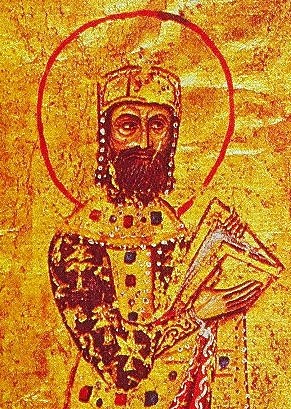
The Komnenian age emerged from the wreckage of eleventh-century instability, when court intrigue, aristocratic competition, fiscal strain, and military catastrophe had exposed the fragility of imperial power. Alexios came to the throne in 1081 not through smooth dynastic succession, but through revolt, family coordination, and the careful conversion of seizure into legitimacy. His reign began in crisis: Norman aggression threatened the western Balkans, Pechenegs and other steppe peoples pressed the northern frontier, Turkish power had transformed Anatolia after Manzikert, and the imperial treasury was badly strained. The old mechanisms of command had weakened, and the empire needed more than a capable soldier. It needed a ruler who could bind the aristocracy, improvise diplomacy, manage dangerous allies, and make a contested throne appear providential. Alexios did this by turning family into government. The Komnenian system did not abolish intrigue. It disciplined it through kinship, rank, marriage, patronage, and access to imperial favor.
Family rule became the central architecture of Komnenian power. Earlier Byzantine emperors had relied on relatives, court officials, eunuchs, generals, and marriage alliances, but the Komnenoi made aristocratic kinship into a more deliberate governing structure. Alexios distributed titles and privileges among relatives and allied families, using marriage to tie powerful houses to the imperial center. This was a solution to the problem that had haunted the eleventh century: ambitious military aristocrats could destabilize the empire if excluded, but they could also dominate it if left unchecked. Komnenian rule brought them inward. It converted potential rivals into participants in a hierarchy whose rewards depended on proximity to the emperor. The court became more visibly aristocratic, familial, and networked. Blood, marriage, title, and office formed a web that made loyalty profitable and rebellion more complicated. Yet this system also narrowed power around a privileged elite. It stabilized the empire by making the ruling family the hub of political life, but it also made personal relationships, household rivalries, and dynastic tensions more consequential than ever.
The use of titles reveals the subtlety of this arrangement. Komnenian titulature did not merely honor status that already existed. It manufactured rank, distributed expectation, and clarified distance from the throne. New or elevated court titles allowed Alexios and his successors to reward relatives without surrendering the unique sanctity of imperial authority. A powerful man could be raised high enough to feel included, but not so high that equality with the emperor became thinkable. This was the domestic equivalent of Byzantine diplomacy abroad. Just as foreign rulers might receive dignities that flattered them while placing them inside Constantinople’s hierarchy, aristocratic relatives received court titles that dignified their power while subordinating it to the emperor’s ordering hand. The deception lay in the performance of shared honor. The Komnenian court looked like a family bound by rank and ceremony, but beneath that harmony was a constant negotiation over access, precedence, resources, and succession.
Anna Komnene’s Alexiad is indispensable for understanding how this system wished to be remembered. Her portrait of Alexios presents him as prudent, pious, tireless, self-controlled, and almost uniquely capable of navigating a world crowded with enemies and fools. The work is not simple propaganda, and Anna is too intelligent a writer to be reduced to court flattery. Yet the Alexiad is deeply invested in legitimizing Alexios’s seizure of power and defending the Komnenian order as the necessary answer to imperial breakdown. Alexios appears as the emperor who saves the Roman state by mastering every register of crisis: battle, negotiation, deception, persuasion, theology, kinship, and performance. Anna’s narrative itself becomes part of the politics of restoration. It turns revolt into rescue, family ambition into patriotic necessity, and tactical duplicity into imperial prudence. Her position as daughter, historian, aristocrat, and disappointed political actor gives the work its extraordinary tension. She writes from inside the world she explains, with access to family memory and court ideology, but also with the sharpness of someone who knew how power could pass away from those who believed themselves born to possess it. The result is a history that does not merely praise Alexios, but stages him as the only figure capable of imposing moral shape on disorder. The empire’s enemies become foils for his intelligence; its crises become proof of his necessity; its compromises become evidence of his wisdom rather than weakness. In that sense, the Alexiad performs for Alexios what ceremony performed for the Komnenian court: it arranges danger into hierarchy and makes contested power look like providential design.
The arrival of the First Crusade tested that theater more severely than any ordinary embassy or frontier campaign. Alexios had appealed westward for military assistance against Turkish power in Anatolia, but the armed movement that reached Byzantine territory after 1096 was far larger, stranger, and more volatile than a manageable mercenary contingent. The Crusaders were Christians, but not obedient subjects. They were potential allies, but also hungry armies moving through imperial lands. They spoke of pilgrimage, liberation, and holy war, while Byzantine officials worried about discipline, supplies, territorial claims, and the memory of Norman aggression. Alexios faced a diplomatic dilemma of extraordinary delicacy. He needed western military force, but he could not allow western armies to become sovereign actors inside the imperial sphere. The Crusaders had to be welcomed, watched, fed, hurried forward, bound by oaths, and prevented from turning Constantinople itself into the prize.
The oaths demanded from Crusader leaders were central to this strategy. Alexios sought promises that formerly Byzantine territories recovered from the Turks would be returned to imperial control. From the Byzantine perspective, this was a rational condition. The Crusade was moving through lands the empire still considered Roman, and western aid should restore imperial authority rather than create Latin principalities. From the Crusader perspective, the oaths could feel like legal entanglement imposed by a suspicious emperor who wanted the fruits of their sacrifice. Here the performance of alliance exposed incompatible assumptions. Alexios understood the Crusade through the grammar of imperial restoration and controlled military assistance. Many Crusaders increasingly understood it through vows, conquest, penitential warfare, and divine entitlement. The same agreement could be read as order by one side and manipulation by the other. Byzantine diplomacy depended on ambiguity, but Crusading zeal made ambiguity combustible.
The siege of Nicaea in 1097 displayed both the effectiveness and the danger of Alexios’s policy. Nicaea had once belonged to the empire, and its recovery mattered strategically and symbolically. Byzantine negotiations with the city’s defenders allowed it to surrender to imperial forces rather than be stormed and plundered by the Crusaders. From Constantinople’s viewpoint, this was excellent crisis management: a vital city was restored with limited destruction, and imperial claims were upheld. To many Crusaders, it looked like betrayal. They had fought, expected plunder, and then saw the city pass into Byzantine hands through negotiation conducted beyond their control. This episode crystallized the mutual suspicion that would haunt Byzantine-Latin relations. What the Byzantines regarded as prudent diplomacy, Crusaders could interpret as deceit. What Crusaders regarded as earned reward, Byzantines could see as dangerous indiscipline.
Antioch deepened the rupture. The city’s recovery in 1098 posed exactly the problem Alexios had tried to prevent: a major former imperial city fell into Crusader hands, and Bohemond of Taranto, already shaped by Norman hostility toward Byzantium, moved toward independent possession. The Crusaders’ suffering during the siege, the failure of Byzantine relief to arrive as expected, and conflicting reports about the situation gave both sides grounds for accusation. Bohemond could claim that Alexios had abandoned the expedition and forfeited his rights. Byzantium could argue that Crusader leaders had violated their oaths and seized what should have been restored. The result was not merely a diplomatic dispute. It became a struggle over narrative legitimacy. Did Alexios deceive the Crusaders, or did the Crusaders betray their sworn obligations? The answer depended on which political universe one inhabited. The incident shows how alliance itself could become a performance whose collapse produced competing accusations of bad faith. Antioch was not just a city; it was a test case for the entire Byzantine-Crusader arrangement. If the oaths meant what Alexios believed they meant, then its recovery should have confirmed imperial restoration in northern Syria. If the Crusaders’ suffering and military success superseded those oaths, then conquest created its own legitimacy. Bohemond understood this perfectly. He turned ambiguity into opportunity, presenting possession as necessity and Byzantine claims as opportunism. Alexios, for his part, could not simply abandon the issue without weakening the imperial principle that the Crusade had passed through Roman lands under Roman conditions. Antioch exposed the fatal difference between alliance as legal hierarchy and alliance as shared religious enterprise.
Bohemond’s later conflict with Byzantium and the Treaty of Devol in 1108 further reveal Alexios’s method. Bohemond tried to convert anti-Byzantine resentment into military action, presenting himself in the West as the victim of Byzantine treachery and the champion of Latin Christian interests. Alexios responded with a mixture of defense, diplomacy, intelligence, and legal containment. The Treaty of Devol sought to bind Bohemond as the emperor’s vassal and reassert Byzantine claims over Antioch, even if practical enforcement remained limited. The agreement was a masterpiece of imperial form: it translated military conflict into hierarchy, rebellion into submission, and a Latin prince into a dependent of the Roman emperor. Yet its weakness lay precisely in the gap between document and reality. Byzantium could impose a language of subordination, but it could not always compel that language to govern events on the ground. Performance could define legitimacy, but not guarantee obedience.
Under John II Komnenos, the empire continued to balance military recovery with diplomatic choreography. John’s reign is often remembered as more austere and less flamboyant than those of Alexios or Manuel, but his campaigns in Anatolia and the Balkans and his efforts to assert authority over Antioch show the continuing Komnenian attempt to restore imperial leverage. He used force where possible, but he also used negotiation, dynastic politics, and ceremonial claims to remind neighboring powers that Constantinople had not surrendered its older rights. His dealings with the Crusader states again reveal the tension between Byzantine theory and Latin practice. The emperor could appear before Antioch as the rightful overlord, but Latin rulers could delay, evade, promise, and resist. Byzantine superiority remained powerful as an idea, yet increasingly difficult to translate into consistent control beyond the empire’s immediate reach. John’s policy was less theatrical than Manuel’s later diplomacy, but no less dependent on performance. He needed Latin rulers to acknowledge a hierarchy they had every incentive to soften in practice. He needed Armenian, Turkish, and Crusader powers to recognize that Byzantine military presence still mattered. He needed the imperial claim to look durable even where enforcement was intermittent. In this setting, patient campaigning and ceremonial assertion worked together. The emperor arrived not merely as a general seeking advantage, but as the embodiment of a legal and historical order that insisted the eastern Mediterranean had not slipped beyond Roman interpretation.
Manuel I Komnenos expanded this performance of alliance into an even more ambitious diplomatic theater. He cultivated relations with western courts, married into Latin aristocratic networks, intervened in Hungary, Italy, the Crusader states, and the eastern Mediterranean, and projected himself as a cosmopolitan emperor comfortable with both Byzantine and western forms. Manuel’s court dazzled visitors, and his diplomacy sought to make Constantinople again the central broker of Mediterranean politics. Yet his reign also shows the danger of overperformance. The more the empire acted as if it could manage every arena, the more exposed it became to the limits of its resources. Manuel’s western orientation impressed some and alarmed others. His interventions created prestige, but also obligations. His diplomacy was energetic, intelligent, and often imaginative, but the empire’s material base could not always sustain the breadth of his ambitions.
The Second Crusade intensified these tensions. As German and French armies passed through Byzantine territory, Manuel faced the same basic problem Alexios had confronted: how to assist fellow Christians without allowing them to endanger the empire. The Byzantines had to provide markets, routes, guides, and diplomacy while protecting their own cities and subjects from massive armed hosts. Western chroniclers often interpreted Byzantine caution as treachery, especially when imperial interests did not align with Crusader expectations. Byzantine officials, for their part, had every reason to view the Crusaders as unpredictable, poorly disciplined, and potentially hostile. The language of Christian alliance concealed mutual fear. Manuel could perform friendship, but he had to govern as though friendship might become invasion. The Crusaders could speak of holy purpose, but they frequently suspected that Constantinople’s emperor cared more for imperial advantage than Jerusalem. Both suspicions were partly justified. Manuel’s diplomacy had to operate in the narrow space between hospitality and containment. Too little assistance would confirm western suspicions of betrayal; too much openness might give foreign armies dangerous freedom inside imperial territory. The result was an alliance culture saturated with guarded gestures. Markets could be opened but watched. Routes could be provided but controlled. Courtesies could be exchanged, but with calculation behind every reception. Christian unity existed as a public language, but policy moved under the pressure of incompatible goals. The Crusaders wanted passage toward the East and expected trust as fellow believers. Byzantium wanted them gone from imperial soil as quickly and safely as possible, preferably without strengthening enemies or creating new Latin claims. The performance of alliance became a management of danger disguised as fellowship.
The disaster at Myriokephalon in 1176 exposed the limits of Komnenian restoration. Manuel’s defeat by the Seljuks did not destroy the empire in the way Manzikert had helped destabilize the eleventh century, but it punctured the image of unstoppable recovery. The empire remained strong, sophisticated, and diplomatically active, yet the dream of reversing Turkish power in Anatolia became harder to sustain. The defeat mattered symbolically because Komnenian legitimacy had rested partly on the claim that family rule had restored imperial military competence after the failures of the previous century. A major setback did not undo that achievement, but it narrowed the horizon. Diplomacy, alliance, and performance could compensate for weakness, but only up to a point. When military force failed, the ceremonial and diplomatic façade had to work harder to preserve confidence.
The Komnenian age represents one of the most sophisticated experiments in Byzantine power maintenance. The dynasty transformed internal instability into family-centered hierarchy, managed Crusaders through oath, spectacle, logistics, and suspicion, and turned alliance into a performance that could bind, flatter, delay, and contain dangerous partners. Its rulers did not simply deceive others. They created structured environments in which others were encouraged to accept Byzantine definitions of order, hierarchy, and obligation. Yet the system was vulnerable because it depended on performance being believed, or at least obeyed. Aristocrats had to accept family hierarchy. Crusaders had to honor oaths. Latin princes had to recognize imperial claims. Foreign courts had to find Byzantine prestige useful. When belief weakened, performance looked like manipulation. When obedience failed, alliance became accusation. The Komnenoi restored much of Byzantine power, but they also revealed how fragile power remained when it had to be constantly staged, narrated, and negotiated into existence.
Venice, the Latins, and the Limits of Manipulation before 1204
The Komnenian system depended on the belief that dangerous outsiders could be managed through hierarchy, privilege, oath, spectacle, and selective reward. That belief had worked often enough to seem like wisdom. It had helped Alexios I survive the First Crusade, allowed John II to press imperial claims in the eastern Mediterranean, and enabled Manuel I to project Byzantine influence across a wide diplomatic field. Yet the same methods became increasingly dangerous when applied to western maritime powers whose economic reach, military utility, and political ambitions grew faster than Constantinople’s ability to contain them. Venice, Genoa, Pisa, and other Latin commercial communities were not simply foreign visitors at court. They became embedded inside Byzantine economic life, especially in Constantinople itself. The empire had long used foreigners as tools. By the twelfth century, some of those tools had become interests with leverage of their own.
Venice was the most important and troubling example. Byzantine rulers granted commercial privileges to Venetians because they needed naval assistance, western connections, and maritime capacity that the empire could not always supply alone. These privileges were not irrational acts of weakness. They were strategic concessions meant to solve urgent problems. A reduced customs burden, access to markets, quarters in Constantinople, and favorable trading conditions could purchase loyalty or at least cooperation. But concessions made under pressure often acquire lives of their own. Venetian merchants profited enormously from imperial access, and their presence inside the capital created resentment among Byzantine merchants, officials, and ordinary inhabitants who saw foreigners enjoying advantages within the empire’s own commercial heart. What began as controlled privilege gradually became structural dependence. The empire had tried to buy maritime support, but it also helped create a foreign economic community with reasons to defend its privileges against the empire itself.
This was not merely an economic problem. It was a problem of sovereignty and perception. Constantinople’s imperial ideology assumed that foreigners entered the Roman order by permission, beneath imperial authority and within a hierarchy the emperor defined. But Latin merchants lived daily inside the gap between ideology and practice. They occupied quarters, negotiated exemptions, handled goods, gained wealth, and sometimes behaved as if imperial hospitality had become entitlement. Their success made Byzantine superiority look less secure. If foreigners could profit in the capital while subjects bore taxes and restrictions, then imperial generosity began to resemble surrender. If Latin communities could appeal to their own maritime republics for protection, then they were not fully absorbed into Byzantine order. They were semi-autonomous bodies inside the imperial city, useful and resented, dependent and defiant. Constantinople could stage foreign rulers in ceremonial halls, but merchant communities were harder to choreograph. They lived in the city, made money in it, and became visible reminders that imperial control was not as complete as imperial language claimed.
The Byzantine response was to continue the old art of balancing outsiders against one another. Venice could be favored, then checked by privileges to Genoa or Pisa. One Latin community could be used to offset another. Commercial grants could be treated as instruments of diplomacy, just as titles and subsidies had been used with frontier rulers. This made sense within the Byzantine tradition of managed foreignness. No single outside power should become indispensable. Rivalry could be useful. Competition could reduce dependence. But western maritime competition was not the same as rivalry among steppe groups or Balkan claimants. Italian commercial powers possessed fleets, capital, urban institutions, and expanding Mediterranean ambitions. They could retaliate, negotiate collectively, manipulate Crusader politics, and remember grievances across generations. Byzantine balancing did not simply divide them. It also multiplied offended partners.
The reign of Manuel I exposed both the ambition and danger of this policy. Manuel cultivated western alliances and Latin connections more energetically than many of his predecessors, but he also moved against Venetian privilege when it appeared too dangerous. The arrest of Venetians throughout the empire in 1171 was a dramatic assertion of imperial authority, intended to show that foreign commercial power remained subordinate to the emperor. Yet the action revealed how far the relationship had deteriorated. Mass arrest was not the gesture of a state calmly managing obedient clients. It was a sign that economic privilege had become political threat. Venice responded with anger, and although immediate military retaliation did not produce a decisive conquest, the memory of grievance deepened. Byzantine policy had attempted to discipline a useful partner without fully severing the relationship. Instead, it fed the long-term narrative that Constantinople was treacherous, unreliable, and hostile to Latin interests. The episode also demonstrated a dangerous mismatch between imperial command and maritime reality. Manuel could seize Venetian persons and property within reach of Byzantine authority, but he could not easily control the wider commercial and naval world in which Venice operated. The republic’s power did not depend on land alone, nor on a single courtly relationship that could be reset by ceremony or apology. It rested on ships, credit, merchant networks, and institutional memory. Byzantine coercion could interrupt Venetian privilege, but it could not erase Venetian capacity. That made the crisis especially ominous. Constantinople had acted as though a foreign commercial community could still be punished like a dependent client. Venice increasingly behaved like a sovereign power whose injured interests would not disappear simply because the emperor had spoken.
Anti-Latin resentment inside Byzantium grew from more than abstract cultural dislike. It was rooted in lived experience: commercial competition, legal privilege, religious difference, diplomatic arrogance, and the visible wealth of foreign merchants in imperial space. The schism between Greek and Latin Christianity sharpened boundaries, but everyday friction gave those boundaries emotional force. Latins could be seen as greedy, violent, doctrinally suspect, and contemptuous of Roman subjects. Byzantines, in turn, were often described in western sources as duplicitous, effeminate, over-refined, or false Christians. These were not neutral descriptions. They were political weapons. Each side developed a moral language that made the other’s behavior seem not merely self-interested, but corrupt by nature. The more the empire relied on Latin merchants and soldiers, the more humiliating and dangerous that reliance could appear to those who believed Constantinople should stand above western barbarians rather than bargain with them inside its own walls.
The Massacre of the Latins in 1182 marked a catastrophic collapse of managed hostility. The political crisis surrounding the regency of Maria of Antioch and the rise of Andronikos I Komnenos unleashed popular and factional violence against Latin residents in Constantinople. The massacre was not simply a spontaneous outburst of religious hatred, though hatred was certainly present. It was also a political act, directed against a regency associated with Latin influence and against foreign communities whose privileges had become symbols of imperial misrule. Andronikos benefited from anti-Latin sentiment by presenting himself as the purifier of a corrupted order, a defender of Romans against foreign domination and court decadence. Here again deception and power maintenance operated through moral translation. A violent seizure of political advantage could be dressed as national and religious cleansing. The victims became symbols before they became bodies in the street. The horror of the event lay partly in that symbolic conversion. Latin residents were no longer treated as merchants, clergy, women, children, rivals, or neighbors, but as embodiments of everything a frightened and resentful society had come to hate. Their privileges stood in for economic grievance. Their churches stood in for religious suspicion. Their connections to western powers stood in for fears of foreign capture. Political violence gained momentum because it seemed to explain too much at once. Andronikos could exploit that condensation, but he could not control the consequences. Once anti-Latin anger became a tool of legitimacy, it also became a force that narrowed the empire’s diplomatic options and made reconciliation harder.
Yet the massacre did not restore Byzantine strength. It poisoned the empire’s relations with the Latin West and confirmed the darkest western suspicions about Constantinople. The empire had long complained of Latin indiscipline and aggression; now western observers had their own atrocity around which to organize memory. The event strengthened the sense that Byzantium was not merely a rival Christian power, but a treacherous and hostile one. This mattered because politics in the eastern Mediterranean increasingly moved through reputation. Trust was never abundant, but after 1182 it became even harder to sustain the fiction of Christian partnership. When later Crusaders and Venetians spoke of Byzantine betrayal, greed, or bad faith, they did not speak into an empty tradition. They drew on accumulated resentment, commercial grievance, religious suspicion, and blood memory. The massacre gave anti-Byzantine feeling a moral wound.
Andronikos I himself embodied the destructive side of anti-corruption politics. He presented his seizure of power as a rescue from aristocratic excess and foreign influence, but his regime became notorious for violence, suspicion, and terror. His attack on privilege did not stabilize the empire. It deepened elite fear and political chaos. The performance of purification curdled into predation. This was a familiar Byzantine danger in an especially savage form: the ruler who claims to expose deception can become a master of it, turning moral outrage into a weapon of personal domination. Andronikos understood the power of appearing as avenger, but vengeance cannot substitute for government. His fall in 1185, amid Norman aggression and internal fury, revealed that popular legitimacy built on rage was unstable. The empire needed reform, but it received theatrical cruelty.
The Angeloi who followed inherited a weakened state and did little to repair its structural vulnerabilities. Isaac II Angelos and Alexios III Angelos ruled in a world where imperial authority still possessed immense ceremonial weight but increasingly lacked disciplined administrative and military coherence. Fiscal pressure, aristocratic fragmentation, provincial discontent, and foreign threats all intensified. The empire continued to use familiar tools: diplomacy, marriage, payments, titles, and manipulation of rivals. But these tools were less effective because the center itself inspired less confidence. A state can deceive enemies more successfully when its own servants believe in its competence. By the late twelfth century, Constantinople still dazzled, but its brilliance increasingly concealed disorder rather than magnified strength. The old gap between appearance and capacity widened dangerously. The court could still distribute honors, receive embassies, and claim universal authority, but the practical machinery beneath those gestures was weakening. Provincial elites grew more autonomous, revenue was diverted or squandered, and military preparedness suffered from inconsistency and distrust. This mattered because Byzantine diplomacy had always depended on credible force somewhere behind the curtain. Gifts, oaths, ceremonies, and threats worked best when outsiders believed that imperial splendor rested on administrative discipline and military consequence. Under the Angeloi, the performance continued, but belief frayed. Constantinople looked like the center of the world, yet more and more actors began to suspect that the center could be pressured, evaded, or bought.
The Third Crusade exposed the empire’s worsening position. Frederick Barbarossa’s passage through Byzantine territory created another crisis of alliance management, suspicion, and mutual accusation. Isaac II feared western intentions, negotiated with Saladin, and tried to manage the German army without allowing it to threaten Constantinople. From the Byzantine perspective, caution was rational. Massive western armies had repeatedly proven dangerous, and the empire had no reason to assume that crusading piety would restrain political ambition. From the western perspective, Byzantine hesitation looked like betrayal of the Christian cause. Once again, each side interpreted the other through accumulated distrust. What Byzantium called strategic self-preservation, Latins called treachery. What Crusaders called holy urgency, Byzantines saw as armed unpredictability. The language of shared Christianity had become too thin to cover the reality of divergent interests.
Venice watched all of this with a long memory. Its grievances against Byzantium included interrupted privileges, confiscations, commercial competition, and the wider Latin narrative of Byzantine unreliability. Yet Venice was not simply an emotional actor seeking revenge. It was a calculating maritime republic with ships, creditors, merchants, political institutions, and strategic interests. This distinction matters because the road to 1204 was not paved by hatred alone. It was paved by the convergence of resentment and opportunity. Venice could remember injury while also pursuing advantage. Its leaders understood that control over trade routes, ports, and commercial access mattered as much as crusading rhetoric. When the Fourth Crusade later became financially dependent on Venetian transport, the republic possessed leverage of a kind Constantinople had once tried to prevent any outsider from acquiring. The empire had spent generations managing western maritime powers. By 1204, one of those powers would help manage a crusade against the empire.
The Byzantine pretender Alexios Angelos, son of the deposed Isaac II, supplied the final and fatal ingredient: internal dynastic intrigue translated into international catastrophe. His promises to the Fourth Crusade and Venice, including money, military support, and church union, were almost fantastically unrealistic, but they were politically useful because they turned an attack on Constantinople into a campaign of restoration. The old Byzantine habit of legitimizing seizure through claims of rightful correction now escaped imperial control. A claimant to the throne invited foreign force to repair a domestic wrong and transformed palace politics into a Mediterranean crisis. This was the empire’s internal deception turned outward with devastating effect. A coup could perhaps be narrated as rescue inside Byzantine political culture. But when that narrative required Latin armies and Venetian ships, the cost of restoration became uncontrollable.
The approach to 1204 reveals the limits of Byzantine manipulation with brutal clarity. For centuries, Constantinople had managed outsiders by giving them titles, gifts, privileges, access, religious prestige, commercial opportunity, and carefully staged recognition. It had balanced rivals, delayed enemies, redirected violence, and transformed weakness into ceremony. But manipulation depends on a center strong enough to control the terms of the game. By the late twelfth and early thirteenth centuries, the empire’s tools were still visible, but the center had weakened. Latin merchants were not obedient clients. Venetian privilege had become leverage. Crusading armies could not be reliably choreographed. Internal claimants could internationalize succession disputes. Anti-Latin violence could not restore sovereignty. Ceremony could not compensate for fiscal decay, military disorganization, and diplomatic isolation. The empire had long survived by making others act inside its preferred imagination of power. Before 1204, that imagination failed. The outsiders learned the rules, exploited the weaknesses, and finally entered Constantinople not as dazzled envoys, but as conquerors.
Exile and Restoration: Nicaea, Epirus, Trebizond, and the Politics of Roman Legitimacy
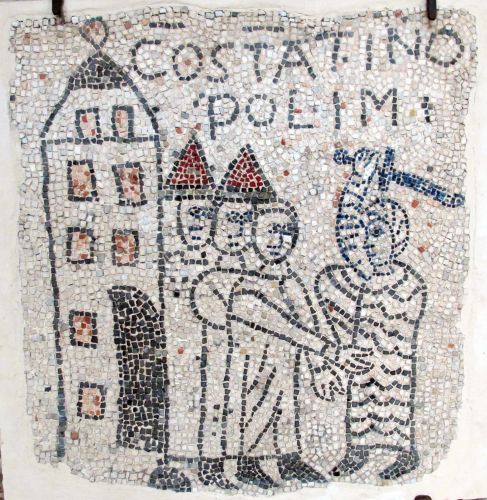
The fall of Constantinople in 1204 did not destroy the Roman imperial idea, but it shattered the political geography that had made that idea intelligible for centuries. The capital had been more than a city. It was the ceremonial heart, administrative archive, sacred theater, diplomatic stage, and symbolic proof that the empire remained continuous with Constantine and Rome. When the Fourth Crusade seized and plundered Constantinople, the empire’s claim to universal order became detached from its traditional center. This created an extraordinary problem: how could one continue to be the Roman Empire when New Rome itself was occupied by Latin conquerors? The answer was not obvious, and it was not singular. Nicaea, Epirus, and Trebizond each preserved fragments of Roman legitimacy, each claimed continuity in different ways, and each used lineage, ceremony, ecclesiastical support, military recovery, and diplomatic performance to turn exile into authority. The empire had lost its capital, but it had not lost the political grammar through which power could be narrated, defended, and restored. In fact, the disaster forced that grammar to become even more explicit. Before 1204, Constantinople itself had done much of the ideological work simply by existing as the imperial city. After its fall, legitimacy had to be argued, staged, defended, and relocated. A ruler could no longer rely on possession of the Great Palace, Hagia Sophia, or the traditional ceremonial landscape to make his claim self-evident. He had to prove that Roman authority could survive displacement, that exile was not defeat, and that the Latin occupation of the capital was a wound in history rather than a lawful succession.
Nicaea became the most successful claimant because it joined practical survival to ideological discipline. Under Theodore I Laskaris and his successors, the Nicaean state built a defensible power base in western Anatolia, organized military resistance, maintained administrative continuity, and secured ecclesiastical legitimacy through the presence of a patriarch in exile. This mattered enormously. A ruler with soldiers alone could become a regional prince; a ruler with a patriarch, court, bureaucracy, coinage, diplomacy, and a claim to Constantinople could present himself as emperor in waiting. Nicaea’s achievement lay in making exile look temporary without allowing exile to become political incoherence. Its rulers had to speak as Roman emperors while ruling from outside the Roman capital. They had to insist that Constantinople’s Latin occupation was an interruption, not a transfer of legitimacy. This required a careful double posture: practical adaptation to Anatolian realities and unyielding symbolic commitment to restoration.
Epirus posed the most serious rival to that claim because it also possessed aristocratic leadership, military strength, and ideological ambition. The rulers of Epirus could present themselves as defenders of Roman interests in the western Greek world, closer geographically to the Balkans and the Adriatic, and capable of challenging both Latin and Bulgarian power. Theodore Komnenos Doukas’s capture of Thessalonica and imperial coronation made the rivalry explicit. He did not merely rule a successor state. He sought the imperial title itself. This exposed the fragmentation of legitimacy after 1204. Before the catastrophe, Constantinople had concentrated Roman authority in one city, one emperor, and one ceremonial order. After 1204, Roman legitimacy became competitive. It could be claimed through Komnenian descent, military success, ecclesiastical support, possession of major cities, resistance to Latins, or control of the narrative of restoration. The politics of deception here were not always secretive. They operated through claims of continuity that could not all be true at once.
Trebizond represented another form of Roman survival, more distant and more regionally distinct, but still important to the imperial imagination after 1204. Founded under the Grand Komnenoi on the southeastern Black Sea, it preserved a prestigious dynastic name and cultivated its own courtly identity. Its rulers could claim imperial dignity, but their geography pushed them toward a different political world: the Black Sea, the Caucasus, Anatolia, Georgian connections, and later Mongol and Turkish pressures. Trebizond’s existence reminds us that post-1204 Roman legitimacy was not merely a binary contest between Nicaea and Epirus. It became plural, adaptive, and regionalized. The Roman name could survive in several political bodies, each shaped by local circumstances while drawing on the prestige of the lost imperial center. Yet this plurality also diluted the old certainty. If several rulers claimed Roman dignity, then legitimacy depended increasingly on performance, recognition, and success. One had to act imperial convincingly enough for others to treat the claim as real. Trebizond’s rulers understood this logic, cultivating ceremony, genealogy, artistic patronage, and diplomatic relationships that made their court more than a provincial refuge. Their claim was not strong enough to recover Constantinople, but it was strong enough to sustain an imperial identity on the edge of the Byzantine world. That distinction matters. Trebizond shows that Roman legitimacy after 1204 could be detached from immediate restoration and transformed into a regional political language. The imperial title became not only a claim to the lost capital, but also a means of organizing authority, prestige, and memory in a world where the old center had failed.
The eventual triumph of Nicaea over its rivals was not inevitable. It resulted from military endurance, careful diplomacy, internal consolidation, and the failures or overreach of competitors. Epirus suffered reversals, especially after Theodore Komnenos Doukas was defeated and captured by the Bulgarians at Klokotnitsa in 1230. Latin Constantinople remained symbolically powerful but materially weak, dependent on western support that was never adequate to sustain the old imperial city as a durable Latin empire. Nicaea, by contrast, developed a stronger territorial and administrative base. Its rulers could negotiate, fight, wait, and exploit rivalries among Latins, Bulgarians, Seljuks, Mongols, and other powers. This was classic Byzantine crisis management under exile conditions. The goal was not simply to win battles, but to preserve the plausibility of restoration until opportunity appeared. Nicaea’s rulers had to make patience look like destiny.
The recovery of Constantinople in 1261 completed that performance, but it also revealed its ambiguities. Michael was not simply the liberator of the city. He was also a usurper who displaced the legitimate Laskarid heir, John IV, and later had him blinded. Restoration of the capital coincided with a domestic crime against dynastic legitimacy. The empire returned to Constantinople carrying the old Byzantine contradiction at full force: sacred restoration outside, ruthless power maintenance inside. Michael could present the recovery of the city as providential proof that Roman rule had been vindicated after Latin occupation, yet his own rule required the neutralization of a child whose claim threatened him. This made the restored empire morally and politically unstable from the beginning. Constantinople had been recovered, but the empire’s material base was smaller, its enemies numerous, its economy strained, and its legitimacy shadowed by violence. The restoration of 1261 was real and magnificent, but it was not a return to the world before 1204. It was an act of imperial resurrection performed over a body that had been permanently wounded.
The Palaiologan Dilemma: Church Union, Western Aid, and Desperate Diplomacy
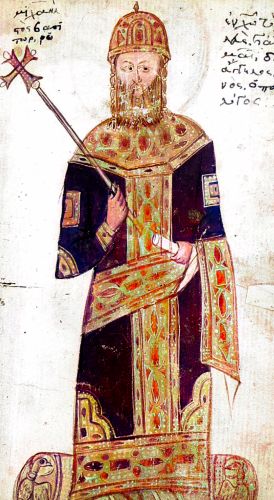
The recovery of Constantinople in 1261 restored the imperial city, but it did not restore the empire that had once made the city powerful. Michael VIII Palaiologos inherited a capital stripped by decades of Latin occupation, a treasury under pressure, a weakened Anatolian frontier, hostile Latin claimants, ambitious Balkan powers, Italian maritime rivals, and a political order still haunted by the blinding of John IV Laskaris. The triumph of restoration contained a terrible irony. The emperor had recovered the symbol of Roman legitimacy, but not the material world that had sustained it. Constantinople could again display imperial ceremony, receive embassies, crown emperors, and proclaim continuity with Constantine, but its walls now enclosed a diminished state fighting to survive among powers it could no longer dominate. Palaiologan diplomacy began from this contradiction: the empire possessed immense symbolic prestige and shrinking practical capacity. Its rulers had to make the name of Rome do work that armies, revenue, and territory increasingly could not.
Michael VIII’s most controversial answer was church union with Rome. The Union of Lyons in 1274 was not simply a theological event, nor can it be reduced to personal opportunism. It was a desperate diplomatic instrument designed to prevent a western crusade against the restored empire, especially from forces connected to Charles of Anjou and other Latin interests that still dreamed of reversing 1261. By accepting union with the papacy, Michael tried to convert ecclesiastical concession into geopolitical protection. The logic was cold, and from the perspective of imperial survival, understandable. If Rome could be satisfied, western aggression might be blunted. If the papacy could be separated from anti-Byzantine military projects, Constantinople might buy time. Yet the cost was internal legitimacy. Many Byzantines saw union not as prudent diplomacy, but as betrayal of Orthodoxy. Michael’s policy forced the empire into a double performance: obedience to Rome abroad, coercion and persuasion at home, and the insistence that survival justified a religious compromise many subjects experienced as spiritual surrender.
This dilemma exposed the limits of deception when the audience was divided. Earlier Byzantine rulers had often spoken differently to different political worlds: sacred monarchy to subjects, hierarchy to foreign rulers, generosity to clients, caution to enemies. Michael VIII attempted something similar, but church union made the contradiction too intimate to conceal. Western observers wanted evidence of real submission to papal authority. Byzantine clergy, monks, aristocrats, and common believers often resisted precisely because such submission appeared real enough to endanger the faith. If Michael minimized the union at home, the West might doubt him. If he enforced it too strongly, his own subjects might despise him. Diplomacy became a trap. The emperor could not satisfy one audience without alarming the other. His policy bought time, but it also taught later generations that Palaiologan emperors might sacrifice religious integrity for political advantage. In a state whose legitimacy depended on defending Orthodox Roman identity after Latin occupation, that suspicion was poisonous. The memory of 1204 made the matter still more combustible, because Latin Christianity was not an abstraction to many Byzantines. It was associated with conquest, plunder, humiliation, and the desecration of the city that had embodied Roman Christian order. Michael could calculate that papal recognition was necessary to prevent another western assault, but many of his subjects experienced that calculation as a second surrender after the first. The empire’s diplomatic language said union was a tool of preservation. Anti-unionist memory heard collaboration with the very world that had violated Constantinople. No imperial ceremony could fully resolve that contradiction, because it lived in the wounds of recent history.
The problem did not disappear after Michael’s death. His son Andronikos II repudiated the union, hoping to repair relations with anti-unionist subjects and restore confidence in imperial Orthodoxy. Yet repudiation did not solve the strategic weakness that had made union attractive in the first place. The empire still needed allies, money, soldiers, ships, and time. It faced pressure from the Serbs, Bulgarians, Latins, Turks, Genoese, Venetians, and eventually the rising Ottomans. Andronikos II’s reign saw the empire struggle with fiscal austerity, military contraction, and the erosion of Byzantine control in Anatolia. The Catalan Company, invited as military assistance against the Turks, became a devastating example of desperate diplomacy turning predatory. Mercenaries hired to save imperial territory became a threat to imperial society itself. This was not new in Byzantine history, but the scale of helplessness was sharper. A state that once manipulated foreign forces now found itself increasingly manipulated by them.
Civil war made the Palaiologan dilemma worse because it transformed foreign diplomacy into domestic weaponry. The conflicts between Andronikos II and Andronikos III, and later between John V Palaiologos and John VI Kantakouzenos, revealed how imperial claimants could invite outside powers into Byzantine politics for immediate advantage. Serbian, Bulgarian, Turkish, and Latin actors all became entangled in struggles for the throne. This was the old Byzantine practice of using external support in succession disputes, but under far more dangerous conditions. The empire no longer possessed enough surplus strength to absorb the consequences. When Turkish forces were brought into Byzantine civil conflict, they did not remain temporary tools. They gained knowledge, access, plunder, and footholds in the European theater. The politics of power maintenance became a mechanism of territorial loss. A faction could win a throne while helping to ruin the state that throne claimed to rule. The deception here was especially bitter because each side could present foreign alliance as necessary, temporary, and justified by the urgency of restoring legitimate rule. But necessity did not make the consequences temporary. Foreign soldiers learned roads, fortresses, rivalries, and weaknesses. They saw how thin imperial authority had become outside ceremonial space. They discovered that Byzantine claimants would trade future security for present advantage. Civil war stripped away one of the empire’s most important diplomatic assets: the belief that Constantinople could manage outsiders better than outsiders could manage Constantinople. Once stronger neighbors understood that imperial factions could be turned into clients, the empire’s own internal divisions became an invitation.
The Council of Florence in 1439 repeated the dilemma of Lyons under even more desperate circumstances. By then the Ottoman threat had become existential, and Emperor John VIII Palaiologos sought western military aid through renewed church union. The theological debates were serious, and Byzantine delegates did not simply perform a scripted surrender. Yet the political pressure was unmistakable. Constantinople needed help, and help seemed to require religious concession. Once again, union could be presented as healing the division of Christendom, but many Byzantines saw it as capitulation to Latin demands after generations of mistrust, crusading violence, and doctrinal suspicion. The famous later sentiment often summarized as preferring the Turkish turban to the Latin mitre may be rhetorically sharpened by memory, but it captures a real political truth: for many, Latin ecclesiastical domination seemed no less threatening to Byzantine identity than Ottoman power. The empire’s rulers sought rescue through union, but the very policy meant to save Constantinople deepened the fracture between imperial diplomacy and popular legitimacy. Florence became more than a council. It became a mirror held up to the empire’s final helplessness. The emperor could still travel, negotiate, debate, sign, and perform the role of a Christian sovereign among other Christian powers, but he could not force western aid to match Byzantine need, nor could he force Byzantine society to accept the price of that aid as legitimate. The union promised a universal Christian response to Ottoman pressure, yet the response remained politically thin and socially contested. It offered the appearance of salvation without the reliable machinery of salvation. In that gap, Palaiologan diplomacy revealed both its intelligence and its tragedy: it could identify the only possible source of rescue, but it could not make that rescue adequate or trusted.
By the fifteenth century, Palaiologan diplomacy had become a politics of narrowing options. Emperors negotiated with popes, Italian republics, Serbian and Bulgarian rulers, Turkish emirs, Ottoman sultans, and western monarchs, but the empire’s leverage continued to shrink. Tribute, vassalage, hostage arrangements, dynastic marriage, appeals for crusade, church union, and the manipulation of Ottoman succession disputes all belonged to the old Byzantine repertoire. What had changed was the balance between skill and capacity. A clever emperor could still delay disaster, exploit a rivalry, secure a promise, or preserve a fragment of autonomy. But he could no longer reset the strategic order. The gap between imperial language and imperial power became almost unbearable. Constantinople still claimed to be New Rome, but the city survived increasingly by permission, negotiation, and the temporary distractions of stronger powers. Palaiologan diplomacy was not foolish. Often it was painfully rational. Its tragedy was that rational maneuver could no longer compensate for structural collapse. The old Byzantine arts had depended on time, and time itself had become scarce. A payment might postpone attack, but not restore provinces. A marriage might soften relations, but not rebuild armies. A church union might win promises, but not guarantee fleets. A treaty with one power might expose the empire to another. Every maneuver bought a little space while revealing how little space remained. The empire had not forgotten how to practice diplomacy. It had lost the material depth that once allowed diplomacy to become strategy rather than postponement.
The Palaiologan dilemma reveals the final transformation of Byzantine deception. Earlier emperors had used strategic ambiguity to magnify strength, discipline rivals, and preserve imperial superiority. The Palaiologoi used it increasingly to disguise desperation, buy time, and prevent enemies from recognizing how little remained. Church union became both diplomacy and illusion: a way to suggest that Latin Christendom might still rescue Constantinople, even when western aid repeatedly proved inadequate. Foreign alliances became both necessity and danger. Civil wars turned tactical support into long-term ruin. The empire’s rulers did not abandon the old arts of survival. They practiced them with intensity, intelligence, and sometimes courage. But the material foundation beneath those arts had eroded. Byzantine power had always lived between appearance and reality. In the Palaiologan centuries, appearance remained magnificent, but reality closed in.
1453 and the End of Byzantine Strategic Ambiguity
The following video from “Chronicle – Medieval History Documentaries“, covers the final sack of Constantinople in 1453:
By 1453, Byzantine strategic ambiguity had reached its final limit. For centuries, the empire had survived by turning weakness into performance, diplomacy into delay, and imperial memory into political leverage. Constantinople had endured because enemies could be divided, alliances could be bought, rival claimants could be encouraged, tribute could postpone war, and sacred legitimacy could make diminished power appear larger than its material base. But the Ottoman siege exposed the exhaustion of that system. Sultan Mehmed II did not approach Constantinople as one more negotiable frontier threat to be managed by ceremony, gifts, titles, or temporary agreement. He came with artillery, ships, manpower, political ambition, and a clear understanding that the city itself was the prize. The old Byzantine art of surviving between stronger powers required space for maneuver. In 1453, that space had almost disappeared.
Constantine XI Palaiologos inherited a title far greater than the territory beneath it. He was emperor of the Romans, but the empire over which he ruled had been reduced largely to Constantinople, fragments of Thrace, and related Palaiologan holdings elsewhere. The title still carried enormous symbolic force, and that force mattered. It gave the defense of the city a meaning beyond local resistance. To hold Constantinople was to defend New Rome, the imperial church, the memory of Constantine, the continuity of Roman Christian sovereignty, and the last visible remnant of a state that had outlived almost every enemy that once seemed destined to destroy it. Yet symbolism could not supply soldiers in sufficient numbers, nor could ceremony replace walls damaged by cannon. Constantine XI could still appeal to western rulers, invoke Christian solidarity, and rely on the city’s sacred history, but he could not transform those appeals into a rescue large enough to alter the balance of power.
The final defense showed both the nobility and the impotence of Palaiologan diplomacy. The unionist policy accepted at Florence remained officially relevant, and Latin assistance did arrive in limited form, most notably through men such as Giovanni Giustiniani Longo and other western defenders who fought with courage inside the city. But the great western crusading rescue never came. The old promise of Christian unity, repeatedly invoked as the price and reward of church union, proved too weak against distance, hesitation, political fragmentation, and the hard arithmetic of late medieval power. For anti-unionists, this failure confirmed the bitter suspicion that religious concession had purchased little. For imperial loyalists, it revealed the tragedy of necessity: the emperor had pursued the only diplomatic path that seemed available, and even that path led to insufficient aid. Constantinople entered its last siege with a divided religious memory, a heroic but inadequate coalition, and a desperate hope that the walls, as so often before, might make up for what diplomacy had failed to secure.
Mehmed II understood that Constantinople’s power was not merely military. He attacked a symbol, and he prepared accordingly. The construction of Rumeli Hisarı on the Bosporus before the siege tightened Ottoman control over the straits and signaled that the city’s isolation would be enforced. The use of heavy artillery challenged the defensive assumptions that had helped Constantinople survive earlier sieges. The Ottoman fleet’s movement into the Golden Horn, whether by sea, land transport, or coordinated pressure, struck at the psychological security of a city accustomed to trusting its layered defenses. Mehmed’s strategy combined force with political imagination. He knew that taking Constantinople would not simply eliminate a weakened enemy. It would allow the Ottoman sultanate to claim possession of the Roman capital and refashion imperial legitimacy around itself. Byzantium had long used ceremony and inherited prestige to magnify power. Mehmed recognized that prestige could be conquered, occupied, and repurposed.
The fall of the city on May 29, 1453, ended more than a siege. It ended the centuries-long Byzantine ability to keep the Roman imperial idea institutionally alive through strategic ambiguity. Earlier emperors had survived military defeats by preserving Constantinople. They had lost provinces, bought peace, conceded doctrine, hired dangerous allies, and endured humiliation, but as long as the capital remained Roman, the empire could insist that history had not finished its work. Once the city fell, that claim could no longer be sustained in the same form. The death of Constantine XI, whether viewed through chronicle, legend, or later national memory, became the human emblem of that final rupture. Byzantine power had often lived between fact and fiction, between weakness and majesty, between political necessity and sacred language. In 1453, the fact became too overwhelming for the fiction to continue as government.
Yet the end of the Byzantine state did not mean the disappearance of Byzantine memory. Ottoman rulers inherited and transformed Constantinople, while Orthodox communities, Greek intellectuals, Slavic churches, Italian humanists, and later historians preserved competing images of what had fallen. Some remembered Byzantium as holy empire, others as decadent court, others as tragic victim, stubborn survivor, or bridge between ancient Rome and the modern world. The empire’s long reliance on deception, diplomacy, spectacle, and strategic ambiguity became part of that contested afterlife. Its enemies could call it treachery. Its admirers could call it prudence. Its history suggests something harder and more interesting than either verdict. Byzantium survived for as long as it did because it understood that power is not only force, but also timing, perception, memory, ritual, negotiation, and the management of belief. In 1453, those arts met a conqueror and a military reality they could no longer outmaneuver.
Conclusion: Deception as the Grammar of Byzantine Survival
Byzantine deception was not a single habit, vice, or diplomatic trick. It was a grammar of survival developed by an empire that inherited universal Roman claims while repeatedly facing conditions that made universal power impossible. From late Roman frontier management to Justinian’s double language of restoration and coercion, from the seventh-century catastrophes to Iconoclast sacred control, from Macedonian diplomacy to Komnenian alliance performance, Byzantine rulers learned to govern the gap between what the empire claimed to be and what circumstances allowed it to do. That gap did not make the empire fraudulent. It made it historically human. Byzantium had to speak as Rome while often acting as a vulnerable state surrounded by stronger or more mobile enemies. Its diplomacy, ceremony, religious policy, and palace politics all emerged from that tension. The empire’s genius lay in its refusal to let diminished circumstances define the full horizon of political possibility. When soldiers were insufficient, it used treaties, gifts, and rivalries. When territory was lost, it preserved ceremony and memory. When enemies could not be defeated, they could sometimes be delayed, divided, converted, married into alliance, or drawn into the orbit of imperial prestige. This did not make Byzantine rule noble in every instance, and it certainly did not make it innocent. But it does explain why deception became so deeply woven into the fabric of governance. It was the language through which a wounded universal empire continued to act as though history had not yet ruled against it.
The empire’s methods could be ruthless. It bribed enemies, manipulated rivals, staged hierarchy, punished dissent, blinded claimants, exploited religious language, and turned foreign alliances into tools of delay or containment. But those methods cannot be understood honestly if they are treated as evidence of uniquely Byzantine moral decay. The medieval West, the caliphates, steppe polities, Italian republics, and crusader states all practiced deception, opportunism, and sanctified violence. What made Byzantium distinctive was the sophistication with which it joined these practices to Roman legality, Christian theology, ceremonial magnificence, and bureaucratic memory. Constantinople did not simply deceive. It translated necessity into order. It made retreat sound like prudence, payment look like generosity, coercion appear as correction, and temporary weakness seem subordinate to a larger imperial destiny.
That translation was often effective because it did real political work. Diplomacy bought time. Ceremony impressed outsiders. Conversion drew neighboring rulers into Byzantine cultural orbit. Titles and gifts reorganized ambition around Constantinople. Church policy turned crisis into theological explanation. Court narratives repaired the legitimacy broken by coups and succession violence. Even after 1204, when the capital itself was lost, the Byzantine political imagination proved durable enough to survive in exile, compete through rival successor states, and recover Constantinople in 1261. Yet every instrument had limits. The same cultural influence that converted Bulgaria and the Rus’ could help them become independent Christian powers. The same commercial privileges that secured Venetian assistance could create foreign leverage inside the empire. The same church union meant to win western aid could fracture domestic legitimacy. The same strategic ambiguity that preserved the empire for centuries could not save Constantinople when military reality finally overwhelmed diplomatic space.
The tragedy and achievement of Byzantium lie together. Its rulers did not keep the empire alive for more than a thousand years by pure force, nor by pure faith, nor by pure deceit. They survived through a shifting combination of all three, joined to memory, law, ritual, intelligence, calculation, and astonishing resilience. “Byzantine” should not mean merely convoluted or treacherous. It should remind us of a state that understood power as performance without mistaking performance for emptiness. Byzantium survived because it knew that empires are held together not only by armies and taxes, but by stories people can still believe when armies fail and treasuries thin. Deception was not the opposite of Byzantine government. It was one of the ways that government made survival imaginable until the world it had outmaneuvered for centuries finally closed in.
Bibliography
Affiliate disclosure: Amazon links on this site are paid links. As an Amazon Associate I earn from qualifying purchases.
- Agapius of Manbij. Kitab al-‘Unwan: Histoire universelle. Edited and translated by Alexander Vasiliev. Patrologia Orientalis 5, 7, 8, and 11. Paris: Firmin-Didot, 1910–1915.
- Agathias. The Histories. Translated by Joseph D. Frendo. Berlin: De Gruyter, 1975.
- Ammianus Marcellinus. The Later Roman Empire (AD 354–378). Translated by Walter Hamilton. London: Penguin, 1986.
- Angelov, Dimiter. Imperial Ideology and Political Thought in Byzantium, 1204–1330. Cambridge: Cambridge University Press, 2007.
- Angold, Michael. The Byzantine Empire, 1025–1204: A Political History. 2nd ed. London: Longman, 1997.
- —-. The Fourth Crusade: Event and Context. Harlow: Pearson Longman, 2003.
- Anna Komnene. The Alexiad. Translated by E. R. A. Sewter. Revised by Peter Frankopan. London: Penguin Books, 2009.
- Babinger, Franz. Mehmed the Conqueror and His Time. Translated by Ralph Manheim. Edited by William C. Hickman. Princeton: Princeton University Press, 1978.
- Barbaro, Nicolò. Diary of the Siege of Constantinople, 1453. Translated by John Melville-Jones. New York: Exposition Press, 1969.
- Blockley, R. C. East Roman Foreign Policy: Formation and Conduct from Diocletian to Anastasius. Leeds: Francis Cairns, 1992.
- Brand, Charles M. Byzantium Confronts the West, 1180–1204. Cambridge, MA: Harvard University Press, 1968.
- Brock, Sebastian P. “Syriac Views of Emergent Islam.” In Studies on the First Century of Islamic Society, edited by G. H. A. Juynboll, 9–21. Carbondale: Southern Illinois University Press, 1982.
- Brubaker, Leslie. Inventing Byzantine Iconoclasm. London: Bristol Classical Press, 2012.
- Brubaker, Leslie, and John Haldon. Byzantium in the Iconoclast Era, c. 680–850: A History. Cambridge: Cambridge University Press, 2011.
- Bryer, Anthony, and David Winfield. The Byzantine Monuments and Topography of the Pontos. 2 vols. Washington, DC: Dumbarton Oaks, 1985.
- Cameron, Averil. The Byzantines. Malden, MA: Blackwell, 2006.
- —-. “The Language of Images: The Rise of Icons and Christian Representation.” In The Church and the Arts, edited by Diana Wood, 1–42. Oxford: Blackwell, 1992.
- —-. Procopius and the Sixth Century. Berkeley: University of California Press, 1985.
- Cheynet, Jean-Claude. Pouvoir et contestations à Byzance (963-1210). Translated by Sophie V. M. G. de Oliveira. Aldershot: Ashgate, 2003.
- Chronicle of 724. In Palmer, Andrew, Sebastian Brock, and Robert Hoyland. The Seventh Century in the West-Syrian Chronicles. Liverpool: Liverpool University Press, 1993.
- Constantine VII Porphyrogenitus. The Book of Ceremonies. Translated by Ann Moffatt and Maxeme Tall. 2 vols. Canberra: Australian Association for Byzantine Studies, 2012.
- —-. De Administrando Imperio. Edited by Gyula Moravcsik. Translated by R. J. H. Jenkins. 2nd rev. ed. Washington, DC: Dumbarton Oaks, 1967.
- Dagron, Gilbert. Emperor and Priest: The Imperial Office in Byzantium. Translated by Jean Birrell. Cambridge: Cambridge University Press, 2003.
- Doukas. Decline and Fall of Byzantium to the Ottoman Turks. Translated by Harry J. Magoulias. Detroit: Wayne State University Press, 1975.
- Eastmond, Antony. Art and Identity in Thirteenth-Century Byzantium: Hagia Sophia and the Empire of Trebizond. Aldershot: Ashgate, 2004.
- Elton, Hugh. Warfare in Roman Europe, AD 350–425. Oxford: Clarendon Press, 1996.
- Evans, J. A. S. The Age of Justinian: The Circumstances of Imperial Power. London: Routledge, 1996.
- Fine, John V. A., Jr. The Early Medieval Balkans: A Critical Survey from the Sixth to the Late Twelfth Century. Ann Arbor: University of Michigan Press, 1983.
- —-. The Late Medieval Balkans: A Critical Survey from the Late Twelfth Century to the Ottoman Conquest. Ann Arbor: University of Michigan Press, 1987.
- Franklin, Simon, and Jonathan Shepard. The Emergence of Rus 750–1200. London: Longman, 1996.
- Frankopan, Peter. The First Crusade: The Call from the East. Cambridge, MA: Belknap Press, 2012.
- Fulcher of Chartres. A History of the Expedition to Jerusalem, 1095–1127. Translated by Frances Rita Ryan. Edited by Harold S. Fink. Knoxville: University of Tennessee Press, 1969.
- Gardner, Alice. The Lascarids of Nicaea: The Story of an Empire in Exile. London: Methuen, 1912.
- Garland, Lynda. Byzantine Empresses: Women and Power in Byzantium, AD 527–1204. London: Routledge, 1998.
- Geanakoplos, Deno John. Emperor Michael Palaeologus and the West, 1258–1282: A Study in Byzantine-Latin Relations. Cambridge, MA: Harvard University Press, 1959.
- Geoffrey of Villehardouin. The Conquest of Constantinople. Translated by Caroline Smith. London: Penguin, 2008.
- George Akropolites. The History. Translated with an introduction and commentary by Ruth Macrides. Oxford: Oxford University Press, 2007.
- Gill, Joseph. The Council of Florence. Cambridge: Cambridge University Press, 1959.
- Greatrex, Geoffrey, and Samuel N. C. Lieu. The Roman Eastern Frontier and the Persian Wars, Part II: AD 363–630. London: Routledge, 2002.
- Haldon, John. The Byzantine Wars. Stroud: Tempus, 2001.
- —-. Byzantium in the Seventh Century: The Transformation of a Culture. 2nd ed. Cambridge: Cambridge University Press, 1997.
- —-. The Empire That Would Not Die: The Paradox of Eastern Roman Survival, 640–740. Cambridge, MA: Harvard University Press, 2016.
- —-. Warfare, State and Society in the Byzantine World, 565–1204. London: Routledge, 1999.
- Harris, Jonathan. Byzantium and the Crusades. 2nd ed. London: Bloomsbury Academic, 2014.
- —-. The End of Byzantium. New Haven: Yale University Press, 2010.
- Heather, Peter. Goths and Romans, 332–489. Oxford: Clarendon Press, 1991.
- —-. Rome Resurgent: War and Empire in the Age of Justinian. Oxford: Oxford University Press, 2018.
- Herrin, Judith. Byzantium: The Surprising Life of a Medieval Empire. Princeton: Princeton University Press, 2007.
- —-. Women in Purple: Rulers of Medieval Byzantium. Princeton: Princeton University Press, 2001.
- Holmes, Catherine. Basil II and the Governance of Empire, 976–1025. Oxford: Oxford University Press, 2005.
- Howard-Johnston, James. The Last Great War of Antiquity. Oxford: Oxford University Press, 2021.
- —-. Witnesses to a World Crisis: Historians and Histories of the Middle East in the Seventh Century. Oxford: Oxford University Press, 2010.
- John of Damascus. Three Treatises on the Divine Images. Translated by Andrew Louth. Crestwood, NY: St. Vladimir’s Seminary Press, 2003.
- John Kantakouzenos. Ioannis Cantacuzeni Eximperatoris Historiarum Libri IV. Edited by Ludwig Schopen. 3 vols. Bonn: Weber, 1828–1832.
- Jones, A. H. M. The Later Roman Empire, 284–602: A Social, Economic and Administrative Survey. Oxford: Blackwell, 1964.
- Justinian. The Digest of Justinian. Edited by Theodor Mommsen and Paul Krueger. Translated by Alan Watson. 4 vols. Philadelphia: University of Pennsylvania Press, 1985.
- Kaegi, Walter E. Byzantium and the Early Islamic Conquests. Cambridge: Cambridge University Press, 1992.
- —-. Heraclius, Emperor of Byzantium. Cambridge: Cambridge University Press, 2003.
- Kaldellis, Anthony. The Byzantine Republic: People and Power in New Rome. Cambridge, MA: Harvard University Press, 2015.
- Kazhdan, Alexander P., ed. The Oxford Dictionary of Byzantium. 3 vols. New York: Oxford University Press, 1991.
- Kitzinger, Ernst. “The Cult of Images in the Age before Iconoclasm.” Dumbarton Oaks Papers 8 (1954): 83–150.
- Laiou, Angeliki E. Constantinople and the Latins: The Foreign Policy of Andronicus II, 1282–1328. Cambridge, MA: Harvard University Press, 1972.
- Laonikos Chalkokondyles. The Histories. Translated by Anthony Kaldellis. 2 vols. Cambridge, MA: Harvard University Press, 2014.
- Lee, A. D. Information and Frontiers: Roman Foreign Relations in Late Antiquity. Cambridge: Cambridge University Press, 1993.
- Leo VI. The Taktika of Leo VI. Translated by George T. Dennis. Washington, DC: Dumbarton Oaks, 2010.
- Leo the Deacon. The History of Leo the Deacon: Byzantine Military Expansion in the Tenth Century. Translated by Alice-Mary Talbot and Denis F. Sullivan. Washington, DC: Dumbarton Oaks, 2005.
- Leonard of Chios. “Letter to Pope Nicholas V.” In The Siege and the Fall of Constantinople in 1453: Historiography, Topography, and Military Studies, edited and translated by Marios Philippides and Walter K. Hanak. Farnham: Ashgate, 2011.
- Lilie, Ralph-Johannes. Byzantium and the Crusader States, 1096–1204. Translated by J. C. Morris and Jean E. Ridings. Oxford: Clarendon Press, 1993.
- Liudprand of Cremona. The Complete Works of Liudprand of Cremona. Translated by Paolo Squatriti. Washington, DC: Catholic University of America Press, 2007.
- Maas, Michael, ed. The Cambridge Companion to the Age of Justinian. Cambridge: Cambridge University Press, 2005.
- Madden, Thomas F. Enrico Dandolo and the Rise of Venice. Baltimore: Johns Hopkins University Press, 2003.
- Magdalino, Paul. The Empire of Manuel I Komnenos, 1143–1180. Cambridge: Cambridge University Press, 1993.
- Mango, Cyril. The Art of the Byzantine Empire, 312–1453: Sources and Documents. Englewood Cliffs, NJ: Prentice-Hall, 1972.
- McCormick, Michael. Eternal Victory: Triumphal Rulership in Late Antiquity, Byzantium, and the Early Medieval West. Cambridge: Cambridge University Press, 1986.
- Meyendorff, John. Byzantine Theology: Historical Trends and Doctrinal Themes. New York: Fordham University Press, 1974.
- Michael Psellos. Fourteen Byzantine Rulers: The Chronographia. Translated by E. R. A. Sewter. London: Penguin, 1966.
- Millar, Fergus. A Greek Roman Empire: Power and Belief under Theodosius II, 408–450. Berkeley: University of California Press, 2006.
- Moorhead, John. Justinian. London: Longman, 1994.
- Nicol, Donald M. Byzantium and Venice: A Study in Diplomatic and Cultural Relations. Cambridge: Cambridge University Press, 1988.
- —-. The Despotate of Epiros, 1267–1479: A Contribution to the History of Greece in the Middle Ages. Cambridge: Cambridge University Press, 1984.
- —-. The Last Centuries of Byzantium, 1261–1453. 2nd ed. Cambridge: Cambridge University Press, 2008.
- Nikephoros, Patriarch of Constantinople. Short History. Translated by Cyril Mango. Washington, DC: Dumbarton Oaks, 1990.
- Niketas Choniates. O City of Byzantium: Annals of Niketas Choniates. Translated by Harry J. Magoulias. Detroit: Wayne State University Press, 1984.
- Obolensky, Dimitri. The Byzantine Commonwealth: Eastern Europe, 500–1453. London: Weidenfeld and Nicolson, 1971.
- Odo of Deuil. De profectione Ludovici VII in Orientem: The Journey of Louis VII to the East. Edited and translated by Virginia Gingerick Berry. New York: Columbia University Press, 1948.
- Ostrogorsky, George. History of the Byzantine State. Translated by Joan Hussey. Rev. ed. New Brunswick, NJ: Rutgers University Press, 1969.
- Pachymeres, George. Relations historiques. Edited and translated by Albert Failler. 5 vols. Paris: Les Belles Lettres, 1984–2000.
- Philippides, Marios and Walter K. Hanak. The Siege and the Fall of Constantinople in 1453: Historiography, Topography, and Military Studies. Farnham: Ashgate, 2011.
- Phillips, Jonathan. The Fourth Crusade and the Sack of Constantinople. New York: Viking, 2004.
- Polemius Silvius. Notitia Dignitatum accedunt Notitia Urbis Constantinopolitanae Laterculi Provinciarum. Edited by Otto Seeck. Berlin: Weidmann, 1876.
- Priscus. The Fragmentary History of Priscus: Attila, the Huns and the Roman Empire, AD 430–476. Translated by John Given. Merchantville, NJ: Evolution Publishing, 2014.
- Procopius. History of the Wars. Translated by H. B. Dewing. Loeb Classical Library. Cambridge, MA: Harvard University Press, 1914–1928.
- —-. The Secret History of Justinian. Translated by G. A. Williamson. London: Penguin, 1966.
- Queller, Donald E., and Thomas F. Madden. The Fourth Crusade: The Conquest of Constantinople. 2nd ed. Philadelphia: University of Pennsylvania Press, 1999.
- Robert of Clari. The Conquest of Constantinople. Translated by Edgar Holmes McNeal. New York: Columbia University Press, 1936.
- Runciman, Steven. The Fall of Constantinople 1453. Cambridge: Cambridge University Press, 1957.
- The Russian Primary Chronicle. The Russian Primary Chronicle: Laurentian Text. Translated and edited by Samuel Hazzard Cross and Olgerd P. Sherbowitz-Wetzor. Cambridge, MA: Medieval Academy of America, 1953.
- Sarris, Peter. Justinian: Emperor, Soldier, Saint. New York: Basic Books, 2023.
- Sebeos. The Armenian History Attributed to Sebeos. Translated by R. W. Thomson. Historical commentary by James Howard-Johnston. Liverpool: Liverpool University Press, 1999.
- Setton, Kenneth M. The Papacy and the Levant, 1204–1571. Philadelphia: American Philosophical Society, 1976.
- Shepard, Jonathan. Emergent Elites and Byzantium in the Balkans and East-Central Europe. Farnham: Ashgate, 2011.
- Shepard, Jonathan, and Simon Franklin, eds. Byzantine Diplomacy: Papers from the Twenty-Fourth Spring Symposium of Byzantine Studies, Cambridge, March 1990. Aldershot: Variorum, 1992.
- Sphrantzes, George. The Fall of the Byzantine Empire: A Chronicle by George Sphrantzes, 1401–1477. Translated by Marios Philippides. Amherst: University of Massachusetts Press, 1980.
- Stephenson, Paul. Byzantium’s Balkan Frontier: A Political Study of the Northern Balkans, 900–1204. Cambridge: Cambridge University Press, 2000.
- Sylvester Syropoulos. The Council of Florence. Translated by V. Laurent. Rome: Pontificium Institutum Orientalium Studiorum, 1971.
- Theophanes Confessor. The Chronicle of Theophanes Confessor: Byzantine and Near Eastern History, AD 284–813. Translated by Cyril Mango and Roger Scott. Oxford: Clarendon Press, 1997.
- Theophanes Continuatus. Chronographiae quae Theophanis Continuati nomine fertur libri I–IV. Edited by Michael Featherstone and Juan Signes-Codoñer. Boston: De Gruyter, 2015.
- Tougher, Shaun. The Reign of Leo VI (886–912): Politics and People. Leiden: Brill, 1997.
- Treadgold, Warren. A History of the Byzantine State and Society. Stanford: Stanford University Press, 1997.
- Whittow, Mark. The Making of Byzantium, 600–1025. Berkeley: University of California Press, 1996.
- William of Tyre. A History of Deeds Done Beyond the Sea. Translated by Emily Atwater Babcock and A. C. Krey. 2 vols. New York: Columbia University Press, 1943.
Originally published by Brewminate, 05.19.2026, under the terms of a Creative Commons Attribution-NonCommercial-NoDerivatives 4.0 International license.
About the Author