Medieval religion did not simply stop medicine. It shaped what healing meant, offering care, comfort, and charity while often redirecting treatment from the body toward the soul.

By Matthew A. McIntosh
Public Historian
Brewminate
Introduction: The Sickbed Between Cure and Salvation
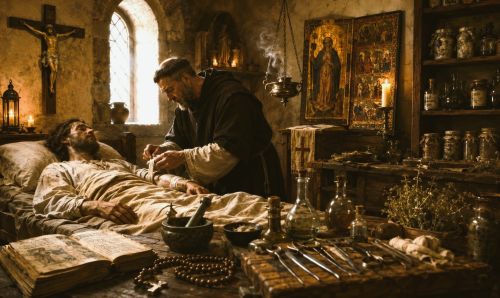
The medieval sickbed was rarely a purely medical scene. Around the sufferer gathered not only physicians, surgeons, apothecaries, midwives, and family members, but also priests, monks, relics, prayers, vows, charms, astrological calculations, and fears about the state of the soul. Illness belonged to the body, but it also belonged to God, the cosmos, the household, the parish, and the moral history of the patient. A fever might be read as humoral imbalance, corrupted air, divine chastisement, planetary influence, demonic assault, or the ordinary frailty of fallen flesh. A wound might need washing, stitching, salve, and bandaging, but it might also require confession, repentance, and preparation for death. Medieval medicine operated in a world where cure and salvation were not separate categories. The body could be treated, but the soul had to be reckoned with.
Medieval religion did not simply prevent medicine in a crude or universal way. That would flatten a complicated history and turn a dense medieval world into a modern polemic. Christian monasteries preserved medical texts, cultivated medicinal gardens, cared for the sick, and helped create hospital systems. Bishops, abbots, nuns, confraternities, and charitable patrons often treated care for the vulnerable as a religious duty, not a secular service. Islamic physicians and patrons built major institutions of learning and treatment, while Jewish physicians worked across linguistic, religious, and political boundaries as respected healers in many courts and cities. Religious traditions could encourage charity, discipline, learning, hygiene, dietary regulation, nursing, and care for people who might otherwise have been abandoned. They could also give the sick a language for fear, pain, endurance, and death. Yet religion also shaped what counted as legitimate healing, what explanations seemed persuasive, and which authorities could be questioned. When illness was understood primarily as sin, trial, punishment, demonic disturbance, divine warning, or cosmic disorder, treatment could turn away from physical intervention and toward prayer, penance, pilgrimage, relics, amulets, astrology, or resignation. The same religious culture that fed the sick could also teach them that bodily recovery was less important than spiritual readiness; the same institution that preserved medical books could also preserve inherited authorities too reverently; the same rituals that comforted patients could draw attention away from causes that might have been observed, tested, or treated more directly.
The central issue is not whether medieval people had “real medicine” or “mere superstition.” They had both, often simultaneously, and they did not always draw the line where modern readers would. A patient might consult a physician, confess to a priest, wear a written charm, avoid unlucky days for bloodletting, visit a saint’s shrine, drink an herbal preparation, and ask relatives to sponsor prayers after death. These actions were not necessarily contradictory inside the medieval imagination. They formed a single therapeutic world in which nature, grace, matter, spirit, and authority overlapped. But that overlap had consequences. It could comfort the frightened and care for the abandoned, but it could also protect inherited theories from correction, make suffering morally suspect, and lead patients or communities to seek spiritual meaning where physical investigation might have mattered more.
The history of medieval religious medicine is a history of redirection. Religion did not always forbid treatment; more often, it redirected treatment toward salvation, moral interpretation, ritual protection, cosmic order, and authoritative tradition. It made the sick body meaningful, and that meaning could be merciful. But meaning could also become a substitute for inquiry. The medieval sickbed was a place where care and constraint met: where the sufferer might receive food, shelter, prayer, and tenderness, yet still be told that the deepest cure lay beyond the body. To understand medieval medicine, we must begin there, between the remedy and the relic, between the physician’s regimen and the priest’s absolution, between the hope of bodily recovery and the preparation of the soul.
Illness as Sin, Trial, Punishment, and Purification
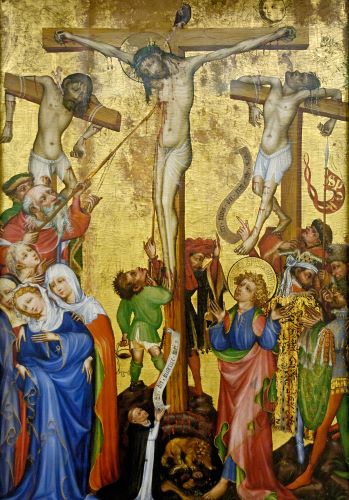
To call illness “spiritual” in the medieval world was not to deny that it was physical. A fever still burned, a swelling still distorted the flesh, a wound still bled, and a cough could still carry a person toward death. But the afflicted body was almost never interpreted as a body alone. In Christian, Islamic, and Jewish communities, sickness often stood at the meeting point of nature and providence, flesh and soul, symptom and meaning. Disease could arise from imbalance, corrupted air, poor diet, age, climate, contagion, inherited weakness, or injury, but it could also be read as divine warning, punishment, purification, demonic assault, or a test of endurance. The same event could carry several explanations at once. A physician might speak of humors, a priest of repentance, a family member of God’s will, and the patient of fear, guilt, or hope. Medieval healing began inside that layered world.
In the Christian West, illness was frequently interpreted through the language of sin and correction. Biblical models were powerful: plague could follow disobedience, leprosy could symbolize uncleanness, blindness could become a scene for revelation, and bodily suffering could be understood through Christ’s Passion. This did not mean every sick person was automatically blamed for a specific offense. Medieval theologians knew that the righteous could suffer and that illness might be a test rather than a punishment. Yet the moral reading of disease remained potent. Sickness invited examination of conscience. The sufferer was encouraged to confess, repent, make restitution, give alms, reconcile with enemies, and prepare for death. The Fourth Lateran Council’s insistence that the sick should first call physicians of the soul before physicians of the body captured this hierarchy with unusual clarity. Medicine was not forbidden, but bodily care was placed beneath spiritual danger. A recovered body was valuable; a damned soul was catastrophic.
This moral structure could profoundly redirect treatment. If illness was a sign from God, then the proper response might not be more aggressive intervention but submission, prayer, penance, and reform. A person afflicted with chronic pain, deformity, infertility, madness, or visible skin disease could be urged to ask what the suffering meant rather than what bodily mechanism caused it. This was not simply ignorance. It was a coherent religious anthropology in which suffering had purpose. Pain could punish, cleanse, instruct, humble, or sanctify. The sick person might be called to patience rather than resistance. The language of purification made this particularly powerful, because suffering could be imagined as a fire that burned away sin before death. In that sense, sickness was not merely an enemy. It could become a severe mercy, a bodily ordeal that prepared the soul for judgment. This did not require the rejection of medicine, but it could change medicine’s place in the order of urgency. A salve, purge, diet, or bloodletting might be useful, yet none could rival the eternal stakes of confession, absolution, repentance, and reconciliation. The patient’s body might recover and still leave the soul imperiled; the patient’s body might die and still be saved. That hierarchy made perfect sense within medieval Christianity, but it also meant that physical treatment could become secondary at the very moment when direct bodily attention was most needed. Illness became a summons to spiritual reform before it became a problem to be isolated, tested, and corrected.
But the same structure could also make illness socially dangerous. If disease carried moral meaning, the sick body could become suspect. Lepers, the chronically ill, the mentally disturbed, infertile women, and the visibly disfigured might be pitied, feared, blamed, or set apart. Leprosy offers one of the clearest examples. Medieval societies could treat lepers as objects of charity and even as figures of holy suffering, but they could also mark them as polluted, isolate them, and surround their bodies with ritual and legal boundaries. The leper might be spiritually meaningful precisely because he or she was socially removed. The sufferer became a reminder of mortality, sin, humility, and Christian obligation. Charity toward the sick could be genuine, but it could also depend on keeping the sick person in a symbolic role: useful to the healthy as an object through whom mercy could be practiced. This made the treatment of disease inseparable from the management of social order. The sick were not only cared for; they were classified, interpreted, watched, and sometimes segregated. A diseased body could become a sermon made flesh, teaching the healthy what sin, decay, mortality, and divine judgment looked like. That symbolic usefulness could bring food, shelter, and compassion, but it could also freeze the sufferer inside a moral category. The person with leprosy, madness, or disfigurement was not simply someone with a condition. He or she could become a sign, a warning, a burden, a holy object, or a source of communal anxiety. Once illness carried that much meaning, practical treatment had to compete with the social and religious uses of suffering itself.
The idea of illness as trial could be gentler, but it was not necessarily less limiting. A sufferer who endured patiently might be praised as spiritually strong. Saints’ lives, miracle collections, sermons, and devotional literature often celebrated bodies that bore pain with obedience rather than rebellion. This could provide real consolation. It gave meaning to agony that medicine could not relieve, and it prevented suffering from appearing pointless. Yet patience could also become a religious expectation imposed on the sick. The patient who complained too much, doubted God’s justice, refused penitential interpretation, or sought worldly cures too eagerly might be judged spiritually disordered. The boundary between holy endurance and medical neglect could become thin. Where modern medicine often treats pain as something to be reduced, medieval religious culture could treat pain as something to be interpreted, endured, and sometimes even valued.
Islamic and Jewish traditions also understood illness within a providential and ethical framework, though not always in the same terms as Latin Christianity. Islamic medicine could flourish in sophisticated clinical, philosophical, and institutional settings while still placing illness within God’s creation and moral order. The body could be studied through Galenic and Arabic medical theory, but health and disease remained tied to divine wisdom, proper conduct, regimen, charity, and the limits of human knowledge. Jewish physicians likewise worked within learned medical traditions while also inheriting biblical and rabbinic languages of affliction, purity, divine judgment, and communal responsibility. Across these traditions, the crucial point is not that religion erased medicine. Rather, religion made sickness meaningful before it made it merely technical. That meaning could comfort, discipline, dignify, and organize care. It could also delay physical intervention, stigmatize the sufferer, and make bodily disease answerable to the soul before it was answerable to observation.
The Priest, the Physician, and the Competition for Authority
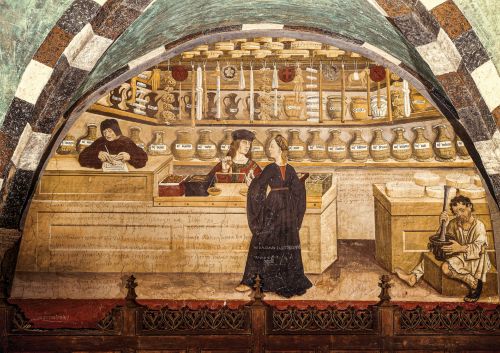
The medieval sickroom was not governed by a single professional authority. It was a crowded space in which different kinds of expertise met, overlapped, and sometimes competed. The learned physician might diagnose imbalance in the humors, prescribe regimen, recommend bleeding, or interpret urine. The surgeon might cut, cauterize, set bone, lance an abscess, or dress a wound. The apothecary supplied drugs, syrups, electuaries, oils, and compound remedies. The midwife possessed practical knowledge of birth, female bodies, baptismal emergency, and household care. But the priest also stood at the bedside, and his authority could be greater than all the others because he addressed the one part of the patient that could not be allowed to die unprepared: the soul. Medieval illness produced not only a medical question but a jurisdictional one. Who had the right to say what the sickness meant? Who had the power to decide what should be done first?
This competition should not be imagined as a simple war between religion and medicine. Many physicians were themselves devout Christians, Muslims, or Jews, and many clerics accepted the legitimacy of medicine as part of God’s providential order. Learned medicine could be understood as the study of nature, and nature itself could be read as divine creation. A priest who urged confession did not necessarily reject herbs, diet, or surgery; a physician who prescribed regimen did not necessarily deny sin, providence, or prayer. Patients often moved between authorities without seeing any contradiction. They might confess, receive the Eucharist, send for a physician, wear a charm, sponsor Masses, and consult a local healer. The same household could contain medical recipes, devotional images, relics, saints’ badges, astrological calendars, and urine flasks without treating them as belonging to separate intellectual universes. Even learned physicians often wrote in a language saturated with moral and spiritual assumptions, while clerics could possess practical medical knowledge, copy medical manuscripts, or administer institutional care. The division between “religious” and “medical” authority was porous, especially before the rise of modern professional boundaries. The sickbed was cooperative as often as it was conflictual, and the patient’s family usually wanted every available form of help rather than a purified choice between cure and prayer. Yet cooperation did not erase hierarchy. The body mattered, but the soul mattered more. A physician could treat fever; a priest could address eternity. That difference gave religious authority a final seriousness that medical authority rarely possessed on its own.
That hierarchy became visible in the pastoral regulation of medical care. The Fourth Lateran Council’s Canon 22 famously instructed physicians to urge the sick to call doctors of the soul before doctors of the body, lest physical treatment distract from confession and repentance. The canon did not ban medicine. In fact, it assumed the physician’s presence and usefulness. But it placed the physician inside a religious order of priorities. Medical care was legitimate only if it did not endanger salvation. This mattered because illness often brought patients close to death, and death without confession, penance, absolution, or last rites could be spiritually disastrous. The priest’s authority pressed upon the physician’s work at precisely the most urgent moment. The medical practitioner might wish to act quickly, but the Church insisted that the patient’s spiritual condition could not wait. Treatment had to make room for repentance.
The same logic shaped anxieties about physicians who seemed too confident, too worldly, or too willing to separate bodily cure from moral order. Medieval theologians and preachers could warn against trusting medicine more than God, against seeking illicit remedies, or against pursuing health through charms, demons, astrology, or magical manipulation. Learned physicians themselves sometimes tried to protect their status by distinguishing legitimate natural medicine from superstition or fraud. Yet even academically trained medicine depended on interpretation, authority, and moral reputation. A physician’s knowledge came from texts, universities, experience, and social trust, but his legitimacy also depended on not appearing impious. To challenge accepted authorities too openly, to treat the body as if it were merely material, or to promise cures beyond human limits could invite suspicion. The physician occupied an uneasy position: necessary enough to be summoned, learned enough to command fees, but never free from the larger religious framework that defined the meaning of sickness and the dangers of false healing.
This tension did not merely affect elite medicine. It shaped ordinary patients’ choices. A poor sufferer might have little access to a university-trained physician but ready access to a parish priest, shrine, relic, charm, or local holy woman. A noble household might employ a physician and still turn to prayers, vows, and saintly intercession when treatment failed. A woman in childbirth might depend on a midwife’s hands while the surrounding community worried about baptism, purity, confession, and death. The real competition was not always between two people standing at the same bedside. It was between two claims about what illness most fundamentally was. If sickness was mainly a bodily disorder, the physician’s authority expanded. If sickness was a divine warning, moral test, or preparation for death, the priest’s authority deepened. Medieval medicine unfolded in the space between those claims, and religion often decided which one had the final word.
Monasteries, Hospitals, and the Mercy That Did Not Always Cure

Religion’s role in medieval medicine was never only restrictive. The same Christian culture that could subordinate bodily treatment to confession also created some of the most durable institutions of care in medieval Europe. Monasteries, cathedral communities, convents, confraternities, and hospitals fed the hungry, sheltered travelers, received the poor, washed bodies, buried the dead, copied medical texts, cultivated medicinal herbs, and made care for the weak a visible obligation of religious life. The Rule of Benedict placed care of the sick near the center of monastic duty, insisting that the infirm should be served as Christ himself. That instruction did not create a hospital in the modern sense, but it did create a spiritual logic in which tending the ill was not merely useful work. It was a form of devotion. The sick body became a privileged site where charity, humility, discipline, and salvation met.
Monastic medicine developed within this religious economy of mercy. Monasteries could preserve practical remedies, maintain herb gardens, copy Latin medical texts, and serve as places where diet, rest, bathing, warmth, prayer, and nursing were combined. Their infirmaries cared for monks and nuns, while guesthouses and charitable spaces could assist travelers, pilgrims, and the poor. This care mattered. A person who was fed, kept warm, washed, allowed to rest, and protected from exposure had a better chance of survival than one abandoned in a street, field, or crowded household. Even when the theory behind care was humoral, spiritual, or penitential, the practice could be physically beneficial. Medieval religious care often worked not because it possessed superior cures, but because it provided the basic conditions under which bodies could recover: shelter, food, attention, cleanliness, routine, and human presence. Yet this mercy was not the same as clinical medicine. The monastery’s first obligation was to religious order, not experimental therapy. The sick monk was cared for because he belonged to a spiritual community, and because service to him trained the healthy in humility and obedience. The poor sick person was received because charity aided both the sufferer and the soul of the donor. Care was relational and devotional before it was investigative. The question was not always how to identify a disease process and intervene against it; it was how to enact mercy properly, maintain communal discipline, and prepare the sufferer for either recovery or death. This distinction matters because it reveals both the strength and the limit of religious medicine. It could prevent abandonment, but it did not necessarily encourage the systematic study of disease as a physical process.
Medieval hospitals made that ambiguity even clearer. Many hospitals were not hospitals in the modern sense of buildings organized primarily around diagnosis, treatment, and recovery. They could be hospices, almshouses, leprosaria, pilgrim hostels, orphan shelters, poorhouses, retirement houses, or places for the dying. Some admitted the sick; others specialized in the aged, the poor, travelers, pregnant women, foundlings, or those with leprosy. Their religious character was central. They had chapels, altars, rules, prayers, patrons, endowments, and liturgical obligations. Beds, meals, and washing were paired with confession, Mass, devotional images, and prayers for benefactors. A hospital could save the body by offering food and nursing, but it was also designed to save souls: the soul of the patient, the soul of the caregiver, and the soul of the patron whose gifts made the institution possible.
This charitable structure could create real compassion while also limiting the meaning of cure. The patient was not always imagined as an autonomous medical subject whose condition demanded aggressive treatment. He or she might be a poor member of Christ, a suffering penitent, a pilgrim in need of rest, a dying soul, or a spiritually useful recipient of charity. That framework could dignify the vulnerable, but it could also make suffering valuable in itself. The poor sick person became part of a moral economy in which the wealthy gave alms, the institution performed mercy, and the afflicted embodied Christian need. The sufferer’s body was not only an object of care but also a medium through which others practiced virtue, displayed piety, fulfilled obligations, and sought spiritual benefit. This did not make the charity insincere; medieval donors and caregivers could be moved by genuine pity, fear of God, concern for salvation, communal duty, and personal affection all at once. But it did mean that the institution’s purpose was broader than restoring health. The patient’s continued weakness could remain meaningful even when medicine had little to offer, because weakness created an occasion for almsgiving, humility, prayer, and moral reflection. Healing, when it occurred, was welcome. But the deeper work of the hospital might be reconciliation, repentance, endurance, and orderly death. The result was a form of care that could be tender without being curative, generous without being investigative, and physically helpful without being medically ambitious.
Leper houses show this tension with particular force. They were charitable institutions, and they often provided residents with shelter, food, ritual belonging, and protection from total destitution. They could also impose separation, regulation, and symbolic death from ordinary society. The leprous body was treated as needy and sacred, but also dangerous and marked. Religious charity softened exclusion without necessarily challenging it. A person with leprosy might be supported by alms and prayers, yet the same society that fed him could also define him through pollution, penance, and separation. The institution did not simply cure or abandon; it managed. It managed fear of contagion, fear of sin, fear of decay, and fear of social disorder. In that sense, the hospital could be both refuge and boundary, mercy and containment.
The medieval religious hospital complicates any simple claim that religion prevented medical treatment. Without monasteries and hospitals, many sick people would have received less care, not more. Religious institutions preserved knowledge, organized charity, created spaces of rest, and made the suffering body impossible to ignore. But they also reveal how medieval care could stop short of cure because its deepest purpose lay elsewhere. The goal was not always to restore the patient to productivity or to discover the natural cause of disease. It was to practice mercy, discipline the community, honor God, prepare the soul, and maintain a Christian order of charity. Medieval religion did not merely stand in the way of medicine; it built many of medicine’s shelters. But those shelters often looked toward salvation as much as recovery, and sometimes more.
Galen, Aristotle, and the Problem of Sacred Authority

Medieval medicine inherited its intellectual architecture from antiquity, but it did not inherit that architecture passively. Greek medical and philosophical traditions reached medieval Europe through a long chain of translation, commentary, adaptation, and institutional teaching. Hippocrates, Galen, Aristotle, Dioscorides, Soranus, Avicenna, Rhazes, Haly Abbas, and other authorities entered Latin medical culture through monasteries, cathedral schools, the translation movements of the twelfth century, and the universities that followed. Their works supplied a comprehensive language for understanding the body: elements, qualities, humors, temperaments, faculties, organs, spirits, digestion, generation, crisis, regimen, and disease. This system was not foolish. It was internally coherent, intellectually demanding, and often attentive to observation. But it also trained physicians to think through inherited authority. The body was not approached as an open field where all explanations could be overturned by experiment. It was approached through texts that had already organized what the body was supposed to be.
Galen’s authority was powerful because his medicine offered a body that seemed ordered, purposeful, and intelligible. Organs had functions; functions served the whole; balance sustained health; imbalance produced disease. For medieval Christian, Muslim, and Jewish readers, this vision could be adapted to a providential universe. Galen himself was not a Christian theologian, and his works did not become authoritative simply because religious authorities declared them sacred. His authority came from the prestige of Greek medicine, the sophistication of his anatomical and physiological arguments, the scale of his writings, and their transmission through Arabic and Latin scholarly cultures. Yet his methodology could be made to harmonize with religious assumptions about order, design, hierarchy, and purpose. A body governed by rational structure could be read as a body created within divine wisdom. That made Galenic medicine not merely useful but cosmologically comfortable.
Aristotle shaped the same world from another direction. His natural philosophy supplied medieval scholars with a framework for causation, motion, generation, corruption, form, matter, purpose, and the relation between the celestial and terrestrial realms. Medicine was not identical with Aristotelian philosophy, but university medicine developed inside a scholastic culture deeply marked by Aristotle’s methods and categories. Physicians and natural philosophers were trained to ask what kind of thing a body was, what its causes were, what ends its organs served, and how individual symptoms fit within general principles. This gave medieval medicine intellectual seriousness. It also created a habit of reconciliation. When ancient authorities disagreed, the task was often to distinguish, harmonize, gloss, or explain rather than discard. The learned physician became, in part, an interpreter of authoritative bodies of knowledge.
This habit of interpretation resembled theological practice. Medieval scholars did not usually approach Scripture, canon law, Aristotle, or Galen as disposable material to be tested and abandoned. They approached them as authorities demanding disciplined reading. Contradictions could be solved through commentary; apparent errors could be explained by context; difficult passages could be reconciled by subtle distinctions. The intellectual prestige of the commentator mattered here. To comment was not merely to repeat. It was to place oneself inside a living chain of interpretation, to show mastery by arranging, clarifying, defending, and sometimes cautiously modifying inherited wisdom. A medical teacher could display brilliance by resolving a tension between Galen and Aristotle, between Avicenna and experience, or between a general principle and a stubborn symptom. Yet that brilliance often operated within limits. The stronger the authority of the textual system, the more likely observation was to be absorbed into it rather than allowed to destabilize it. Such habits were not unique to religion, but religious culture strengthened them by making reverence for textual authority one of the basic forms of intellectual life. A culture trained to read Scripture, fathers, councils, canon law, and scholastic masters with reverence could easily extend similar habits to the great medical and philosophical authorities. This did not mean that medieval physicians never observed patients or adjusted treatment. They did. Case experience, urine inspection, pulse reading, prognosis, surgery, regimen, and practical recipes all mattered. But observation often entered a framework already shaped by authoritative expectation. The physician looked at the body through Galenic and Aristotelian lenses, and those lenses could clarify some things while obscuring others.
The danger was not that Galen and Aristotle were old. The danger was that their age, prestige, and institutional embedding could make correction difficult. Galen had dissected animals extensively and sometimes projected animal anatomy onto human bodies. Aristotle’s biological and cosmological assumptions shaped medical and philosophical reasoning in ways that later proved mistaken. Yet medieval university medicine often preserved these systems because they formed the grammar of learned explanation. A physician who rejected them too bluntly risked not only intellectual disagreement but professional marginalization. To be learned was to know the authorities; to be persuasive was to argue within them. Even when empirical experience suggested difficulty, the safer path was often to reinterpret the observation rather than challenge the structure. Authority did not freeze medicine completely, but it slowed the transformation of observation into revolution.
Religion entered this problem less as a censor standing at the door than as a culture of sanctioned order. The Church did not simply take Galen and Aristotle and turn them into medical scripture, nor did medieval Islam or Judaism treat them as untouchable in a uniform way. Scholars criticized, revised, translated, and debated them across religious boundaries. Yet the authority of inherited texts fit naturally into societies that valued ancient wisdom, divine order, learned commentary, and disciplined tradition. This is why the problem of sacred authority is subtler than a story of banned science. Medieval medicine was limited not only by what religious institutions forbade, but by what religious and scholastic culture made intellectually satisfying. Galen and Aristotle gave physicians a body that made sense. That was their power. It was also their trap.
The Restricted Body: Anatomy, Dissection, Resurrection, and the Sacred Corpse
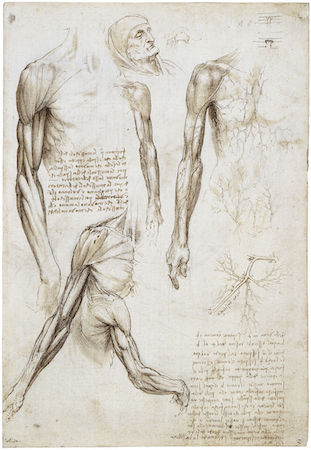
The medieval human body was never merely biological matter, and the dead body was never merely an empty shell. It remained a social, religious, legal, and emotional object even after death. Christians buried the dead in consecrated ground, prayed for their souls, guarded relics, venerated saints’ bodies, feared desecration, and expected the resurrection of the body at the end of time. Jewish and Islamic traditions likewise gave the corpse powerful ritual significance, emphasizing burial, bodily integrity, purity, and the duties owed to the dead. These beliefs did not make anatomical study impossible, but they made the human corpse a difficult object to handle as medical material. The body could be opened, moved, translated, divided, buried, displayed, or preserved under certain conditions, yet none of these acts was religiously neutral. To cut the dead was to enter a zone where medicine, law, theology, punishment, memory, and fear overlapped.
This is why the familiar claim that the medieval Church simply “banned dissection” is too blunt. There was no single universal medieval prohibition that permanently prevented all anatomical investigation in Christian Europe. Human dissection emerged in late medieval university settings, especially in Italy, and by the fourteenth century anatomy could be incorporated into medical teaching. Mondino de’ Liuzzi’s work at Bologna is the usual marker of this transition, not because he invented dissection from nothing, but because he helped make the opened human body part of a university medical curriculum. Nor were medieval Christians incapable of disturbing corpses in other contexts. Saints’ bodies could be exhumed, relics divided, royal bodies embalmed, criminals displayed, and the dead moved or reburied. Papal concern over the dismemberment and boiling of crusaders’ bodies for transport, for example, was not the same thing as a blanket condemnation of anatomical study. It reflected anxiety over particular mortuary practices, bodily dignity, and Christian burial rather than a simple theological rule that the corpse could never be cut. Medieval people did not treat bodily integrity in one simple way. They treated it according to status, purpose, ritual meaning, and authority. A saint’s bone could become a relic, a king’s corpse could be prepared for dynastic memory, a criminal’s body could be exposed as punishment, and an executed body could be made available for teaching. The same culture could protect some bodies, fragment others, and open still others, depending on the meaning attached to the act.
Yet rejecting the myth of a total ban does not mean that medieval anatomy was unrestricted. Human dissection remained rare, formal, socially limited, and institutionally controlled. Cadavers were not easily available. Legal authorities usually supplied the bodies of executed criminals or the socially marginal, and the act of dissection often carried the stigma of punishment. The corpse used for anatomy was not an ordinary Christian body lovingly received by family and parish. It was often a body already marked by law, shame, poverty, or exclusion. This mattered because anatomy developed within a moral hierarchy of the dead. Some bodies were protected by kinship, rank, sanctity, and burial custom; others could be made available to medicine because they had already been stripped of honor. The pursuit of knowledge depended, as it so often did, on inequality.
Even when dissections occurred, they did not automatically produce a modern anatomical revolution. Late medieval anatomical demonstrations were often ritualized events in which the opened body illustrated authoritative texts rather than overthrew them. The lecturer might read from an established authority while a demonstrator handled the corpse and a surgeon or assistant performed the cutting. The body was present, but it was not always sovereign. Its visible structures were interpreted through Galen, Avicenna, Mondino, Aristotle, and the scholastic habits of commentary. If what was seen seemed to conflict with what had been inherited, the discrepancy could be managed through explanation rather than treated as a decisive refutation. The corpse was both evidence and subordinate witness. It could confirm learning, dramatize medical expertise, and train the eye, but it did not yet possess the full authority that later anatomical culture would grant to direct observation.
Religious ideas about resurrection and bodily wholeness formed part of this restricted environment, though not in the simplistic sense that every cut threatened salvation. Medieval theologians could affirm that God was able to resurrect bodies regardless of decay, fragmentation, injury, drowning, burning, or consumption by animals. The doctrine of resurrection did not require a perfectly preserved corpse. Nevertheless, ordinary Christians could still feel deep anxiety about mutilation, improper burial, or the dishonoring of remains. The gap between theological possibility and social feeling was important. Learned doctrine might allow that God could restore any body, but families, communities, and institutions still treated the dead with reverence. A corpse was a former person, a future resurrected body, an object of memory, and sometimes a site of sacred presence. That reverence could survive even when theology allowed more flexibility than popular feeling did. People did not need to believe that dissection literally prevented resurrection to recoil from the thought of a parent, spouse, child, neighbor, or respected townsman being cut open for instruction. Burial was not simply disposal; it was a ritual return of the body to a sacred order. To disturb that order required authorization strong enough to overcome grief, honor, kinship, and fear. Anatomy had to develop within that world, not outside it.
The sacred corpse could also work against medical anatomy by offering a different model of bodily knowledge. Saints’ bodies were examined, translated, divided, and displayed not to learn ordinary anatomy but to reveal holiness. Incorrupt flesh, fragrant remains, miraculous bleeding, healing relics, and wonder-working bones made the dead body meaningful in a devotional register. These practices show that medieval religion was not simply afraid of opened or divided bodies. It could authorize extraordinary treatment of remains when the purpose was sanctity, memory, or miracle. But that authorization did not easily transfer to ordinary empirical investigation. The saint’s body was opened to prove divine favor; the criminal’s body might be opened to teach anatomy; the respectable layperson’s body was usually buried to preserve honor and communal order. The question was never only whether a body could be cut. It was who the body had been, who controlled it, and what meaning the cutting served.
The restricted body reveals one of the central patterns of medieval religious medicine. Religion did not always stop anatomical study by direct prohibition, but it helped create the moral world in which anatomy remained exceptional, hierarchical, and text-bound. The dead body was too meaningful to become easily available as neutral evidence. Its handling required justification: sanctity, punishment, royal preservation, legal authority, institutional privilege, or medical teaching. This did not make medieval anatomy nonexistent; it made it slow, uneven, and constrained. The corpse could teach, but only after passing through layers of theology, law, ritual, status, and inherited authority. In that sense, medieval anatomy was not simply blocked by belief in resurrection. It was shaped by a deeper religious culture in which the body, living or dead, belonged to more than medicine.
Saints, Relics, Pilgrimage, and the Geography of Miraculous Cure

If the physician’s sickroom was one place where healing might happen, the saint’s shrine was another. Medieval Christians did not imagine miraculous cure as an occasional decorative addition to medicine; for many sufferers, it was one of the most powerful and emotionally persuasive forms of healing available. A blind person might travel to the tomb of a saint, a lame child might be carried before a relic, a feverish pilgrim might sleep near a shrine, a woman in childbirth might invoke a holy intercessor, and a person tormented by pain might vow gifts, candles, fasting, or pilgrimage in exchange for relief. The geography of medieval healing was not limited to hospitals, monasteries, apothecary shops, or physicians’ houses. It stretched across roads, chapels, wells, tombs, cathedrals, relic collections, local cult sites, and great pilgrimage destinations. Disease moved the body toward medicine, but it could also move the body across sacred space.
The logic of saintly healing depended on intercession. Saints were not usually understood as independent magical beings who healed apart from God; they were friends of God, patrons, advocates, and holy dead whose closeness to divine power made them effective helpers for the living. Their relics mattered because holiness was believed to remain powerfully present in the saint’s physical remains or objects associated with them. Bones, blood, hair, clothing, dust from a tomb, oil from a lamp, water from a shrine, or contact with a reliquary could become vehicles of grace. This made the sacred body into an alternative medical instrument. The physician examined symptoms; the pilgrim sought contact. The surgeon used tools; the devotee touched, kissed, watched, drank, slept, prayed, or waited. The cure, when it came, was not proof of anatomical insight or pharmaceutical precision. It was proof that divine mercy had entered the body through a holy channel.
Miracle collections reveal how intensely bodily these cures could be. They described the blind seeing, the lame walking, the paralyzed rising, the mute speaking, the mad restored, the fevered cooled, the wounded healed, the barren conceiving, and the dying returned from the edge of death. These accounts were not abstract theology. They were narratives of bodies transformed in public, often before witnesses, clergy, neighbors, family members, and other pilgrims. The miracle story gave suffering a plot: affliction, vow, journey, contact, prayer, cure, thanksgiving, testimony. It also gave the shrine authority. Each cure strengthened the reputation of the saint and drew more sufferers into the same sacred geography. A shrine was not only a place of devotion; it was a place where accumulated testimony created expectation. The sick came because others had claimed to be healed there. Reputation itself became therapeutic. This did not necessarily mean that pilgrims rejected ordinary medicine. Many probably turned to saints after household remedies, local healers, physicians, or time had failed. The shrine often became the destination of desperation, especially for chronic, disabling, frightening, or socially humiliating illnesses. A sufferer who had exhausted available treatment could still make a vow. A family that could not pay for a famous physician might still seek a local saint. A patient whose condition defied explanation could still place the body in sacred proximity. This is one reason miraculous healing was so durable: it was available precisely where medicine reached its limits. It did not need to compete with medicine only on technical grounds. It offered what medicine could not always offer: meaning, hope, community, movement, ritual, and the possibility that no case was beyond divine attention.
Yet this devotional system could redirect medical imagination away from the physical cause of disease. If cure depended on the saint’s intercession, then the crucial questions were not always what produced the illness, how the body worked, or which treatment altered its course. The crucial questions became where to go, which saint to petition, what vow to make, what sin to confess, what offering to give, and how to interpret the result. The disease might be less important as a natural process than as a test of faith, an occasion for divine display, or a sign that the sufferer had entered a particular relationship with the holy. This mattered when miracle stories celebrated sudden, total, spectacular reversal. Such stories could make ordinary gradual treatment seem spiritually inferior. A physician might manage symptoms; a saint could make the blind see.
Pilgrimage also had practical effects that complicate any simple dismissal of miraculous cure. Travel could remove a sufferer from ordinary stress, give the patient rest from work, surround them with care, expose them to new air, place them under observation, and provide food, shelter, ritual structure, and emotional attention. The expectation of cure may have affected pain, mobility, fear, and mood. Public testimony could validate a sufferer who had previously been ignored or doubted. A person whose illness had isolated them at home might become visible within a community of other sufferers, helpers, clergy, and witnesses. The journey itself could impose a therapeutic rhythm: departure, hardship, arrival, vigil, prayer, waiting, and return. That rhythm gave form to suffering and allowed the patient or family to feel that something meaningful was being done, even when no physician could promise relief. In some cases, pilgrimage may also have changed the patient’s material circumstances enough to matter physically. Better food, enforced rest, attentive companions, bathing at a holy well, or temporary escape from labor could improve symptoms that were worsened by exhaustion, malnutrition, anxiety, or neglect. Even failed pilgrimage might still produce confession, reconciliation, almsgiving, and a sense of spiritual order. But those benefits did not make the system medically investigative. Pilgrimage could help some bodies and soothe many souls while still leaving disease causation unexplored. It was a powerful therapeutic culture, but not one designed to isolate pathogens, compare remedies, or revise anatomy.
The geography of miraculous cure shows religion at its most comforting and its most limiting. Saints and relics made healing accessible beyond the physician’s reach, gave the sick a place to go, and turned suffering into a story that could end in mercy. They also encouraged a model of cure in which the decisive agency lay outside ordinary nature. Medieval sufferers did not always experience that as an obstacle; often it was the only hope large enough for their pain. But for the history of medicine, the consequences were profound. The shrine could gather bodies without studying them as bodies. It could produce testimony without experiment, relief without explanation, and wonder without method. In the saint’s presence, the sick body became meaningful, visible, and sometimes healed. But it was healed within a world where divine favor, not physical knowledge, had the final authority.
Amulets, Charms, Demons, and the Blurred Line Between Medicine and Magic
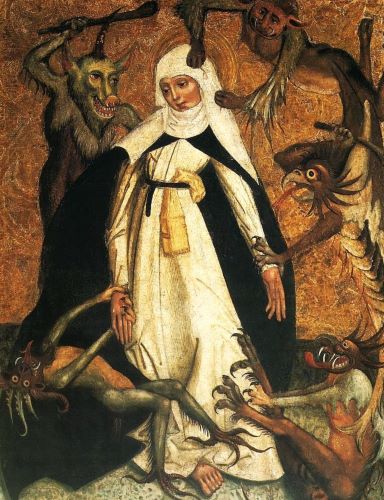
Medieval healing did not divide neatly into medicine on one side and magic on the other. The same person who swallowed an herbal remedy might also wear a written charm, repeat a sacred formula, avoid an unlucky hour, invoke a saint, seek an exorcism, or hang an amulet against fever. To modern readers, these practices may look like superstition intruding upon medicine, but in the medieval world they often belonged to a single therapeutic field. Words had power. Objects had histories. Bodies were vulnerable to invisible forces. Disease could enter through air, imbalance, sin, demons, envy, celestial influence, or divine permission. A remedy did not need to be purely material to seem effective. Healing might require plants, stones, prayers, names, numbers, gestures, signs of the cross, bits of parchment, relic dust, holy water, or the spoken command of a priest.
Amulets were among the most common examples of this blended medical world. They might be worn around the neck, sewn into clothing, placed near the body, tied to a limb, attached to a bed, tucked beneath a pillow, fastened to a pregnant woman’s body, or carried during travel, battle, plague, childbirth, or illness. Some contained biblical verses, the names of Christ, invocations of the Trinity, Marian prayers, saints’ names, angelic names, diagrams, crosses, or fragments of liturgical language. Others used unfamiliar words, letter sequences, symbols, or voces magicae whose power lay partly in mystery. The written object itself mattered. Parchment, ink, folding, binding, placement, touch, and proximity to the body could all become part of the cure. A charm against bleeding might invoke Christ’s wounds; a charm against fever might command the illness to depart; a childbirth amulet might ask divine protection for mother and child; a protective object might ward off demons, sudden death, epilepsy, plague, miscarriage, nightmares, or the evil eye. Some were clearly devotional, others clearly suspect, and many occupied the unstable middle ground between the two. Their appeal lay partly in their intimacy. Unlike a shrine, an amulet could travel with the sufferer. Unlike a physician, it did not require payment each time it was used. Unlike a spoken prayer, it remained physically present after the words had been uttered. The amulet made illness portable and actionable. It gave the patient something to hold, wear, trust, and display.
The Church’s attitude toward such practices was complicated because the boundary between prayer and magic was not always obvious. A prayer asking God for healing was legitimate. A blessing by a priest could be orthodox. Relics, holy water, consecrated objects, and liturgical rites all assumed that material things could carry sacred power. Yet a charm that seemed to compel divine power, manipulate hidden forces, invoke demons, or rely on obscure names could be condemned as superstition or magic. The problem was not simply whether words or objects were used. Christianity used both. The problem was authority and intention. Was the sufferer humbly asking God for aid, or attempting to control spiritual power? Was the object connected to church ritual, saintly intercession, and licit blessing, or to forbidden knowledge and demonic alliance? Medieval religious medicine lived inside that ambiguity.
Demons made the ambiguity sharper. Many ailments that modern medicine would classify as neurological, psychological, infectious, or psychiatric could be interpreted as demonic disturbance, possession, temptation, or assault. Convulsions, madness, muteness, paralysis, hallucinations, violent agitation, despair, nightmares, and inexplicable pain might all invite spiritual explanation. This did not mean every case was automatically treated as possession; medieval writers also had natural explanations for melancholy, epilepsy, frenzy, and bodily imbalance. But demons remained available as causes when symptoms were terrifying, resistant to treatment, morally troubling, or socially disruptive. The afflicted person might be taken not to a physician but to a priest, shrine, exorcist, or holy person. The treatment might involve commands, prayers, fasting, relics, holy water, confession, and ritual confrontation with the invisible enemy. Exorcism could function as a kind of spiritual medicine. It named the disorder, gave it an agent, and placed the sufferer inside a dramatic struggle between divine authority and hostile power. This could be frightening, but it could also be consoling. If the problem was demonic, then the sufferer was not merely weak, mad, or socially deviant; he or she was under assault. The ritual gathered witnesses, imposed order on chaotic behavior, and offered the possibility of release. Yet it also risked misreading bodily or mental illness as spiritual invasion. A person who needed nursing, rest, protection, or physical treatment might instead be subjected to ritual pressure, public scrutiny, or moral suspicion. Once demons entered the explanation, the body’s symptoms could become secondary to the battle over the soul.
Learned physicians did not stand entirely outside this world. Some medical writers rejected illicit magic and insisted on natural causes, but learned medicine itself often accepted hidden properties, astrological timing, occult virtues, and the power of specific substances whose operations were not immediately visible. Stones, herbs, animal parts, and written words could be discussed in ways that hovered between natural philosophy and ritual power. A physician might condemn the village charm-seller while still recommending remedies whose effects depended on qualities that were subtle, mysterious, or inherited from authority rather than demonstrated by experiment. The distinction between respectable medicine and forbidden magic was partly intellectual, partly clerical, partly social, and partly professional. Who performed the act mattered. A Latin prayer in a clerical setting could look holy; a similar formula used by an old woman, itinerant healer, or suspected cunning person could look dangerous.
This blurred boundary could discourage empirical investigation because it made disease responsive to symbolic action. A charm against fever did not require the healer to understand infection, transmission, or internal pathology. An amulet against bleeding did not require anatomical knowledge of vessels and clotting. An exorcism for convulsions did not require neurological explanation. These practices offered immediate forms of response in a world where effective treatment was often limited, expensive, painful, or unavailable. They were not irrational within their own assumptions; they addressed invisible causes with invisible power. But that was precisely the limitation. If a ritual object seemed to work, it confirmed the spiritual model. If it failed, the failure could be explained by insufficient faith, hidden sin, incorrect words, improper ritual, demonic resistance, or God’s will. The system was flexible enough to survive disappointment.
Amulets, charms, and exorcisms reveal one of the most important ways medieval religion redirected medical care. It did not simply tell people to do nothing. It gave them many things to do: write, bind, bless, wear, recite, confess, touch, command, invoke, and expel. These actions could reduce fear, organize hope, mobilize community, and sometimes provide real comfort. But they also made illness legible through spiritual, symbolic, and magical causation before it was legible through the body alone. The sick person became a battleground of words, powers, sins, demons, saints, and hidden virtues. Medieval medicine was not absent from that world, but it had to share authority with forces it could not dissect, measure, or reliably correct.
Astrology, Plague, and the Cosmic Body

Astrology belonged to medieval medicine not as a marginal superstition alone, but as part of a learned attempt to place the body within the order of the cosmos. The human being was a microcosm, a small world whose flesh, fluids, temperament, and vulnerability corresponded to the larger movements of the heavens. Planets, signs, seasons, winds, and qualities were thought to influence generation, complexion, disease, crisis, and recovery. This did not necessarily replace humoral medicine; it often supported it. If the body was governed by heat, cold, moisture, and dryness, and if the heavens helped shape those qualities in the earthly realm, then celestial movement mattered for diagnosis and treatment. The physician who consulted the stars was not always abandoning reason. He was often applying a cosmology in which nature itself extended from the celestial sphere into the patient’s blood, breath, and organs. The medieval body, in this view, was open to the universe. It absorbed air, food, climate, season, emotion, and celestial influence, and its health depended on maintaining proper balance within that vast chain of causes. Astrology offered a way to read that chain. It promised that the physician could understand not only what was happening inside the patient, but when the wider world made certain interventions dangerous, favorable, or futile.
The zodiacal body made this relationship visible. Aries might govern the head, Taurus the neck, Gemini the arms, Cancer the chest, Leo the heart, Virgo the belly, Libra the kidneys, Scorpio the genitals, Sagittarius the thighs, Capricorn the knees, Aquarius the legs, and Pisces the feet. Such correspondences could guide medical timing, particularly for bleeding, purging, surgery, and regimen. A physician might avoid bloodletting when the moon occupied the sign associated with the affected body part, or choose certain days because celestial conditions appeared more favorable. Medical calendars, almanacs, and diagrams did not merely decorate manuscripts; they organized action. The patient’s body became a map of the heavens, and treatment required attention not only to symptoms but to cosmic timing. A disease was not simply in the flesh. It unfolded inside a universe of signs.
This cosmic medicine could be practical in its own terms. Medieval physicians cared about seasons, climate, air, diet, sleep, evacuation, exercise, age, sex, occupation, and local environment. Astrology fit naturally into that broader concern with regimen and circumstance. A fever in summer might not be understood exactly like a fever in winter; a melancholic complexion might be linked to Saturnine influence; a plague might be associated with corrupted air produced or intensified by celestial events. The heavens did not have to be imagined as crude puppeteers. They could be part of a causal chain through which distant motion altered earthly conditions. Astrology gave medicine an explanatory reach that ordinary bedside observation lacked. It allowed physicians to connect individual illness to weather, epidemic, season, locality, and history. The sick body became part of a cosmic ecology.
The Black Death exposed both the power and the weakness of that worldview. When plague arrived in Europe in the mid-fourteenth century, physicians, theologians, civic authorities, and frightened communities struggled to explain catastrophe on a scale that ordinary medicine could not control. Learned explanations often combined astrology, miasma, humoral vulnerability, divine judgment, and environmental corruption. The famous report associated with the Paris medical faculty in 1348 traced the plague partly to a conjunction of planets and the corruption of air, while also allowing that God’s will stood behind natural causes. This was not an either-or explanation. Medieval thinkers could say that God permitted or caused the disaster, that celestial configurations altered the atmosphere, that poisoned air entered the body, and that individual regimen might reduce risk. The plague was cosmic, moral, environmental, and bodily all at once. That breadth made the explanation persuasive because it seemed equal to the scale of the disaster. A calamity that killed across kingdoms, classes, parishes, and households demanded more than a local cause. The heavens provided a cause large enough to match the horror, while divine providence gave the catastrophe moral weight. The result was an explanation that could absorb nearly everything people saw: sudden death, foul smells, seasonal patterns, panic, social collapse, and the terrifying failure of ordinary remedies.
Such explanations had consequences for treatment. If plague came through corrupted air influenced by the heavens, then reasonable measures included avoiding foul smells, fleeing infected places, regulating diet, moderating passions, burning aromatic woods, carrying pomanders, cleansing air, and maintaining bodily balance. Physicians advised patients to avoid excess, fear, anger, heavy foods, bad vapors, and crowded places. Cities might try to manage filth, regulate burial, restrict movement, or cleanse public space, but these measures often worked within a miasmatic and moral framework rather than a fully contagionist one. Some of these measures were not useless. Flight could reduce exposure. Cleanliness, ventilation, reduced crowding, and avoidance of the sick might help even when the theory was wrong or incomplete. But astrological and miasmatic explanations could also draw attention away from more direct patterns of transmission. They made the atmosphere and heavens more important than rats, fleas, bodily fluids, or person-to-person contagion. Medieval observers did notice proximity, movement, and clustering, but their explanatory systems often absorbed those observations into broader ideas of corrupted air, divine punishment, and celestial influence rather than isolating transmission as the central problem. A person who survived by fleeing might credit distance from poisoned air or divine mercy; a person who died after contact with the sick might be understood as having entered a corrupted environment at the wrong time. The observation was real, but the interpretation bent it back toward the cosmic and providential order.
Plague also intensified the moral and religious interpretation of epidemic disease. Astrological medicine did not remove God from the picture; it often helped explain the natural mechanism through which divine judgment operated. Processions, penitential movements, sermons, vows, flagellant practices, scapegoating, and apocalyptic expectation could coexist with medical advice about air and regimen. In some communities, the result was a dangerous redirection of fear. If plague signaled divine wrath, then the response might be repentance rather than sanitation. If it suggested cosmic corruption, then the response might be aromatic protection rather than investigation of contact. If it appeared to require a guilty cause, then minorities, outsiders, beggars, women, foreigners, or Jews could become targets of accusation. The failure of medicine did not produce uncertainty alone. It produced a hunger for meaning, and religion supplied meanings powerful enough to organize both care and violence.
Astrology reveals one of the most subtle ways medieval religion and medicine reinforced one another. It did not simply tell patients to pray instead of seeking treatment. It placed treatment inside a divinely ordered cosmos where stars, air, humors, morality, and providence acted together. That made the body intelligible, but it also made disease difficult to isolate as a purely physical event. The cosmic body was never just a body; it was a point of intersection between heaven and earth. This gave medieval medicine grandeur, coherence, and a sense of universal order. It also made error durable. When the heavens, God, air, and humors all helped explain illness, failed treatments could be absorbed into the system rather than used to overturn it. Plague made that problem brutally visible: the more total the catastrophe, the more total the explanation became, and the less likely any single bodily cause could command attention.
Jewish Medicine: Learned Practice, Minority Status, and Religious Difference

Jewish medicine in the medieval world complicates any simple story about religion preventing treatment, because Jewish physicians often stood at the meeting point of learned medicine, religious law, minority life, and cross-cultural exchange. They practiced in Hebrew, Arabic, Latin, Romance, and sometimes vernacular environments; they inherited Greek and Arabic medical traditions; they served Jewish communities as well as Christian and Muslim patients; and they often moved through courts, cities, and households where their expertise was valued even when their religious identity was distrusted. Jewish physicians were not marginal curiosities. In many medieval settings they were respected practitioners, translators, scholars, and court doctors whose learning gave them access to patrons who might otherwise have viewed Jews with hostility. Medicine could open doors that theology and politics closed.
That access rested partly on the portability of medical knowledge. Jewish physicians drew from the same broad Mediterranean inheritance that shaped Christian and Islamic medicine: Hippocratic and Galenic theory, Arabic medical encyclopedias, pharmacology, regimen, astrology, and practical therapeutics. In Islamic lands, Jewish intellectual life participated deeply in Arabic scientific and philosophical culture. Figures such as Maimonides show how a Jewish scholar could write major works of medicine while also engaging law, philosophy, ethics, and scriptural interpretation. In Christian Europe, Jewish physicians often mediated knowledge across linguistic and religious boundaries, sometimes preserving Arabic learning, sometimes translating or adapting it, and sometimes practicing in environments where university access was limited or formally closed. Their medicine was not “Jewish” in the sense of being sealed off from surrounding traditions. It was Jewish because it was practiced by Jews under the conditions of Jewish law, community responsibility, minority status, and religious difference.
Jewish religious life shaped medical practice in ways that could support treatment rather than obstruct it. Rabbinic tradition treated the preservation of life as a serious obligation, and Jewish law could provide frameworks for caring for the sick, visiting the ill, regulating diet, managing purity, and balancing Sabbath observance with urgent medical need. Like Christian and Islamic medicine, Jewish healing did not separate the body from moral and spiritual order. Illness could be interpreted through providence, sin, suffering, prayer, and communal responsibility. Yet the legal and ethical seriousness given to bodily preservation could also authorize practical intervention. The physician’s work could be understood as permitted, even required, because healing belonged to human responsibility within God’s world. That did not make Jewish medicine modern or secular, but it does prevent the my argument from becoming too blunt. Religion could discipline medicine, but it could also legitimate it. Jewish physicians lived inside a dangerous social contradiction. Their medical skill could make them desirable to Christian kings, nobles, bishops, urban elites, and wealthy households, while their Jewishness made them vulnerable to suspicion. Christian authorities sometimes condemned or restricted Christian reliance on Jewish doctors, especially when anxiety about intimacy, bodily access, or religious pollution intensified. The physician touched, examined, advised, prescribed, and entered domestic spaces. That proximity mattered. A Jewish doctor could know the body of a Christian patient in ways that unsettled religious boundaries. The more intimate the treatment, the more politically charged the relationship became. Trust in medical expertise could coexist with fear of religious difference, and the same practitioner might be praised by one patron and denounced by another preacher.
This tension became violent during epidemic crisis. During the Black Death, Jews across parts of Europe were accused of poisoning wells, spreading plague, or conspiring against Christians. These accusations did not arise from medicine alone, but they show how religious difference could distort disease explanation when ordinary treatment failed. A catastrophe that could not be controlled demanded an explanation large enough to satisfy terror. Astrology, miasma, divine punishment, sin, and conspiracy all competed or combined. Jewish communities became targets because they were already marked as religious outsiders, legally vulnerable minorities, and imagined enemies within Christian society. In that climate, medical knowledge could not protect them. Indeed, the association of Jews with learned practice, drugs, and bodily expertise could feed suspicion as easily as respect. The healer could become the poisoner in the Christian imagination.
Jewish medicine exposes a different way religion shaped treatment: not only through doctrine, but through trust. Healing required confidence in the person who interpreted the body and administered remedies. Religious identity affected whether that confidence could be sustained. A Christian patient might call a Jewish physician because he was reputedly skilled, then later hear sermons or rumors warning that Jews were spiritually dangerous. A ruler might protect Jewish doctors for their usefulness while allowing broader anti-Jewish restrictions to remain in place. A city might rely on Jewish expertise in ordinary times and turn against Jewish neighbors during plague panic. These contradictions were not accidental. They belonged to a society in which Jews could be simultaneously necessary and despised, intimate and excluded, learned and accused, protected by privilege and endangered by rumor. The physician’s role intensified that contradiction because medical practice required bodily access across religious boundaries. A Jewish doctor might enter spaces of vulnerability that other Jews could not enter: the bedroom, the birthing chamber, the sickroom, the court, the private household. That access could produce gratitude, patronage, and prestige, but it could also sharpen anxiety when treatment failed or when illness itself became frightening. Medical authority was never purely medical. It was embedded in social status, legal protection, patronage, rumor, and the unstable boundary between useful minority and threatening outsider.
The history of Jewish physicians ultimately strengthens the central claim by complicating it. Religion did not simply block medicine; in Jewish communities, as in Christian and Islamic ones, religious law and ethical duty could sustain serious medical practice. But religion also shaped who could be trusted, who could touch whose body, whose knowledge counted, and whose presence became dangerous when medicine failed. Jewish physicians could cross boundaries through expertise, yet those boundaries never disappeared. Their careers reveal medieval medicine as a field of learned exchange and communal vulnerability at once. The body might be treated through shared Galenic methods, Arabic pharmacology, and practical regimen, but the sickroom remained marked by religious difference. In medieval society, even the act of healing could not escape the question of belonging.
Islamic Medicine: Faith, Charity, Translation, and Clinical Learning

Medieval Islamic medicine is essential here because it prevents the argument from becoming a simple story in which religion only obstructed treatment. From the eighth century onward, physicians working in Arabic-speaking and Islamicate societies created one of the most sophisticated medical cultures of the medieval world. They translated, preserved, criticized, organized, and expanded Greek, Syriac, Persian, Indian, and local medical traditions. They wrote encyclopedias, formularies, surgical manuals, ophthalmological treatises, plague discussions, regimen guides, hospital records, and works on medical ethics. Their patients included Muslims, Christians, Jews, Zoroastrians, rulers, soldiers, urban elites, the poor, women, children, travelers, and slaves. Medicine in this world was not secular in the modern sense, but neither was it trapped in passive piety. It was learned, practical, institutional, and deeply shaped by religious ideas about charity, obligation, order, and the value of preserving life.
The translation movement was the foundation of this achievement. Greek medical writing did not simply pass unchanged into Arabic. It was selected, translated, corrected, summarized, debated, and embedded in new scholarly settings. Figures such as Hunayn ibn Ishaq and his circle made Galen and Hippocrates available in Arabic with extraordinary philological care, while later physicians transformed that inheritance into new syntheses. Translation was not merely mechanical conversion from one language to another; it was an intellectual act that required judgment, comparison, technical vocabulary, patronage, and confidence that foreign learning could be absorbed without destroying religious or cultural identity. Syriac-speaking Christian scholars, Muslim patrons, Jewish intellectuals, court officials, and physicians all participated in this world of textual movement. The result was not a narrow Islamic replacement of Greek medicine, but a cosmopolitan medical culture in which Greek theory could be argued over in Arabic, expanded with Persian and Indian materials, and put to use in cities stretching from Baghdad to Cairo, Damascus, Cordoba, and beyond. Al-Razi wrote with a sharp clinical intelligence and an interest in distinguishing diseases; Ibn Sina gave medicine a vast philosophical and systematic architecture in the Canon; al-Zahrawi produced one of the most influential surgical compendia of the Middle Ages; Ibn al-Nafis challenged Galenic cardiopulmonary assumptions with arguments about pulmonary circulation. This was not mere preservation. Islamic medicine inherited authority, but it also reorganized authority through commentary, criticism, compilation, and practice. The ancient body was translated into a new intellectual world, and that translation made possible both continuity with antiquity and forms of innovation that later Latin medicine would inherit.
Faith did not stand outside this process. Islamic societies understood knowledge within a created order governed by God, and medicine could be justified as a useful art that served human welfare. The physician studied nature because nature was intelligible, ordered, and meaningful. Healing did not rival God’s power; it operated within the causes God had permitted in creation. Islamic religious life supplied ethical expectations about charity, cleanliness, moderation, diet, compassion, and care for the vulnerable. The sick were not simply failed bodies; they were persons owed attention. The obligation to preserve life could authorize treatment, and the moral seriousness of suffering could encourage institutions that cared for those without wealth or family protection. Religion here did not prevent medical treatment. It helped create a language in which treatment could be virtuous.
The hospital, or bimaristan, made that language institutional. Islamic hospitals were supported by rulers, elites, charitable endowments, and urban patronage, and many combined treatment, teaching, pharmacy, shelter, and administrative organization. They could employ physicians, surgeons, pharmacists, attendants, and sometimes specialists; they could provide food, drugs, beds, baths, and supervised care; they could separate some categories of patients; and they could function as places of clinical instruction. These institutions varied enormously by time and place, and they should not be romanticized as modern hospitals in medieval clothing. Still, compared with many western European charitable houses, the great Islamic hospitals often had a more explicit medical orientation. Their religious foundation did not make them less practical. Charity and clinical care could reinforce one another. The patient was treated because care of the sick was useful, pious, prestigious, and politically meaningful all at once.
Clinical learning also mattered. Islamic physicians did not simply repeat books without looking at bodies. Al-Razi’s discussions of smallpox and measles, for example, show attention to symptoms, progression, prognosis, and differential recognition. Ophthalmology became advanced, partly because eye disease was common and partly because the eye lent itself to observation and intervention. Pharmacology also expanded through the collection, classification, and compounding of drugs from across a vast commercial and ecological world. Physicians wrote about regimen, diet, baths, sleep, exercise, evacuation, sexual activity, emotional balance, and environment. Surgery, though often socially and intellectually distinct from learned medicine, was also described in sophisticated ways. This does not mean Islamic medicine was modern medicine. It remained humoral, textual, astrological in some contexts, and deeply indebted to Galen. But it was not anti-empirical. Observation, experience, and practical adaptation existed within inherited frameworks. Islamic medicine complicates rather than overturns my larger argument. Religion could support medical institutions, but it could also redirect certain kinds of illness toward spiritual interpretation. Prophetic medicine, prayer, Qur’anic recitation, amulets, charms, astrology, dream interpretation, and saintly or holy healing all existed alongside learned medicine. Patients did not necessarily choose between Ibn Sina and devotional healing any more than Christian patients chose neatly between Galen and relics. A person might seek a hospital physician, follow a regimen, use drugs, recite prayers, consult an astrologer, and trust in God’s decree. The Islamic case shows that the presence of religion did not automatically suppress treatment. But it also shows that treatment was rarely understood as merely technical. The body remained inside a moral and cosmic universe.
The importance of Islamic medicine lies in that tension. It demonstrates that medieval religion could generate hospitals, sustain medical scholarship, encourage charity, and legitimate the practical care of bodies. It also demonstrates that even a highly developed medical culture did not escape inherited authority, cosmology, spiritual causation, or the expectation that illness had meanings beyond physiology. Islamic physicians helped preserve and transform the medical knowledge that later Latin Europe would study with intensity. They also show why my argument must be precise: religion did not simply prevent medicine. In some places, it gave medicine institutions, ethical purpose, and social prestige. The deeper question is what kind of medicine religion helped create. In the Islamic world, the answer is a medicine that could be impressively learned and clinically engaged while still treating the body as part of God’s ordered creation, not as a self-contained machine.
Women, Childbirth, Midwives, and the Religious Management of Reproductive Danger
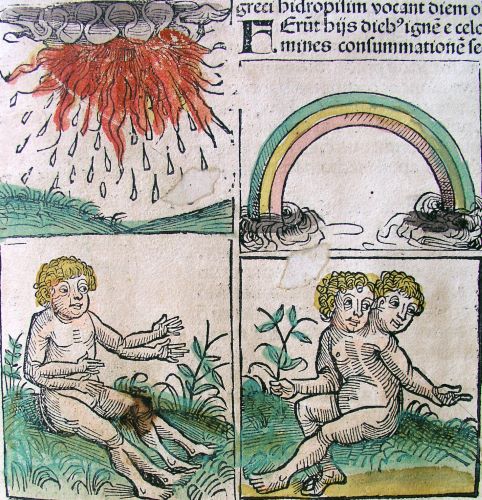
Few areas of medieval medicine exposed the union of body, soul, household, and religion more sharply than childbirth. Pregnancy was not simply a biological condition; it was a spiritual risk, a family crisis, a legal threshold, and a social event surrounded by women’s labor, male anxiety, ecclesiastical concern, and the ever-present possibility of death. A woman in labor stood at the edge of several dangers at once: hemorrhage, obstructed birth, infection, exhaustion, stillbirth, maternal death, and the spiritual danger of an infant dying unbaptized. Medieval reproductive care involved more than practical obstetrics. It included prayers, saints, charms, relics, emergency baptism, churching after childbirth, dietary rules, moral scrutiny, and assumptions about sexuality, purity, and female weakness. The womb was treated as an organ, but also as a religious and social boundary through which lineage, sin, salvation, and danger passed.
Midwives occupied a crucial place in this world because they possessed knowledge that was intimate, practical, and often inaccessible to learned male physicians. They managed labor, positioned women, cut cords, washed infants, recognized danger, comforted mothers, and advised households through the frightening hours of birth. Their work was medical, but it was also religious because Christian authorities expected midwives to know how to perform emergency baptism when a newborn seemed likely to die before a priest arrived. That responsibility gave midwives unusual spiritual authority inside the birthing chamber. They were not priests, physicians, or university masters, yet in an emergency they could perform an act believed to affect the eternal fate of the child. This made them both trusted and watched. Their hands delivered bodies; their words could help secure souls. The midwife stood at a threshold that male clerical culture could neither ignore nor fully control. She entered the enclosed female space of labor, touched the mother’s body, judged the infant’s condition, and sometimes decided whether a soul was in immediate danger. Ecclesiastical authorities tried to regulate that power through synodal statutes, instruction, oath-taking, and concern over proper baptismal formulae, but they still depended on women’s practical presence at the moment of birth. The result was a striking mixture of authority and suspicion. Midwives were necessary because childbirth demanded experienced hands; they were suspect because those hands operated in a space of blood, sexuality, secrecy, female knowledge, and spiritual emergency.
The religious management of childbirth often redirected attention from the mother’s body toward the infant’s salvation and the household’s moral order. A difficult labor might be met with practical measures, but also with vows to saints, Marian prayers, girdles associated with holy women, relics placed near the bed, candles, charms, or ritual appeals for safe delivery. Women invoked saints such as Margaret of Antioch, whose legend of emerging from the dragon made her a powerful patron of childbirth, and the Virgin Mary, whose maternal purity offered an idealized model of protection. These devotions could offer real consolation in a situation where medieval medicine had limited ability to intervene. But they also reveal how childbirth danger was interpreted through sacred story. The laboring woman’s pain was not merely pain. It could be linked to Eve’s punishment, Marian intercession, female endurance, family continuity, and the desperate hope that God or the saints would open the body safely.
Medical texts on women’s medicine show another layer of tension. Works associated with the Trotula tradition, along with Arabic, Latin, and Hebrew writings on generation and gynecology, discussed menstruation, conception, infertility, pregnancy, birth, postpartum care, and diseases of women. These texts could be practical and observant, but they were also shaped by inherited assumptions about female bodies as colder, moister, more unstable, more porous, and more governed by reproductive function than male bodies. The womb could be imagined as central to women’s health, capable of affecting the whole body through retention, movement, obstruction, or imbalance. Such theories gave physicians a framework for treatment, but they also narrowed the interpretation of women’s illness. A woman’s body was often medicalized through reproduction even when her suffering exceeded reproductive function. Religion intensified this by placing sexuality, fertility, childbirth, and purity within a moral order. Infertility could become not only a medical problem but a household tragedy and a possible sign of divine displeasure; miscarriage could be interpreted through grief, bodily vulnerability, sin, accident, or providence; menstrual irregularity could be treated as a matter of humoral balance while also carrying associations of impurity, disorder, and female instability. The female body was read through overlapping languages of medicine and morality. Learned texts might recommend baths, fumigations, pessaries, diet, or drugs, but the meaning of reproductive failure or danger rarely remained merely physiological. The woman’s body was expected to bear lineage, regulate desire, produce heirs, protect infants, and remain within religiously acceptable boundaries of sexuality and household order.
The birthing chamber itself was usually a female space, but it was not outside religious authority. Women’s networks managed the immediate crisis, while priests, husbands, confessors, and legal authorities hovered at its edges. Confession might be sought before a dangerous birth; baptism might be administered within it; churching later marked the mother’s return to liturgical community after childbirth. The ritual did not necessarily mean that childbirth made the woman morally filthy in a crude sense, but it did show that birth altered her religious and social status. Blood, danger, sexuality, and recovery required ritual management. The mother survived, but survival alone did not complete the event. She had to be reintegrated, blessed, and returned to ordinary life. Reproductive medicine extended beyond delivery. It moved from conception to pregnancy, from labor to baptism, from postpartum vulnerability to ritual restoration.
This is why childbirth so clearly reveals the strengths and limits of religious medicine. Religion gave women language, ritual, saints, community, and hope in one of the most dangerous experiences of medieval life. It gave midwives recognized responsibilities and made the survival of mother and child a matter of urgent communal concern. Yet it also shifted the meaning of reproductive danger toward sin, purity, salvation, and divine aid, sometimes at the expense of sustained investigation into maternal physiology. Medieval people were not wrong to be afraid; childbirth was genuinely dangerous. But their responses show how deeply the female body was surrounded by meanings that medicine alone did not control. In the birthing chamber, care was bodily, emotional, social, and sacramental at once. The woman in labor needed skilled hands, but medieval culture also gave her prayers, charms, saints, and rituals because it believed that birth opened not only the body, but the border between life, death, and eternity.
Madness, Possession, Melancholy, and the Uncertain Mind
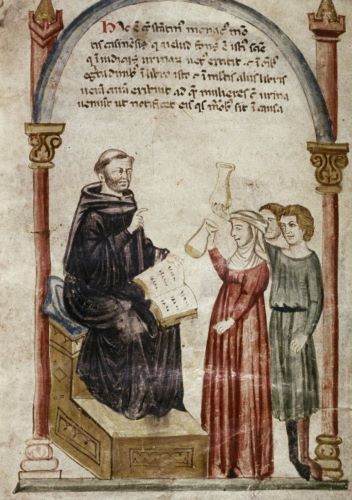
Madness was one of the most unstable categories in medieval medicine because it seemed to belong everywhere at once: to the body, the soul, the imagination, the humors, the passions, the demons, the stars, and God. A person who raved, wept uncontrollably, heard voices, wandered naked, fell into convulsions, refused food, attacked others, lost speech, saw visions, or sank into despair could be interpreted through several overlapping systems. The sufferer might be melancholic, possessed, epileptic, sinful, inspired, bewitched, grief-stricken, punished, or physically imbalanced. Medieval people did not always see these explanations as mutually exclusive. A disordered body could weaken the mind; a disordered soul could invite demonic assault; a demon could exploit melancholy; a divine trial could look like madness to ordinary observers. The mind was uncertain because the boundaries around it were uncertain.
Melancholy offered one of the most important medical explanations. In learned medicine, melancholy was associated with black bile, coldness, dryness, fear, sadness, suspicion, fixation, and distorted imagination. It could produce despair, delusion, anxiety, withdrawal, or strange convictions. A melancholic person might believe himself already dead, made of glass, condemned by God, transformed into an animal, or pursued by enemies. Such symptoms invited moral and spiritual interpretation, but they also had a bodily theory. Diet, sleep, baths, music, companionship, evacuation, purging, bloodletting, and changes of environment could all be recommended. The treatment was not modern psychiatry, but it was not simply exorcism either. Medieval physicians recognized that thought, mood, body, and regimen were connected, even if their explanations rested on humoral assumptions rather than neurobiology.
Possession remained a powerful rival explanation because some forms of mental or neurological disturbance seemed to announce an alien presence. Convulsions, sudden strength, strange voices, blasphemous speech, resistance to sacred objects, violent behavior, or knowledge apparently beyond the sufferer’s ordinary capacity could be read as signs that a demon had entered or oppressed the body. Christian writers developed elaborate methods for discerning spirits, trying to distinguish demonic invasion from fraud, illness, sanctity, temptation, and natural disorder. That discernment mattered because the same symptoms could lead in radically different directions. A visionary woman might be revered as touched by God or feared as deceived by demons. A raving man might be sent to a physician, restrained by family, brought to a shrine, or subjected to exorcism. The afflicted body became a text, and communities argued over how to read it. The danger of possession as a diagnosis was that it could turn suffering into a moral and spiritual drama before it became a medical problem. The possessed person might receive attention, ritual care, and communal concern, but also public exposure, fear, shame, suspicion, and coercion. Exorcism placed the sufferer at the center of a contest between divine authority and demonic rebellion. That could offer hope because the illness had a name and an enemy. It could also intensify terror because the patient’s words and movements might no longer be treated as his or her own. The body became evidence of invisible conflict. Pain, trauma, epilepsy, psychosis, grief, or neurological illness could be absorbed into a demonological script. The person did not merely suffer; the person signified. That symbolic burden could be as heavy as the illness itself.
Medieval Islamic medicine offers an important comparison because it developed sophisticated discussions of mental disturbance while also living in a religious world where jinn, divine decree, prayer, and spiritual healing remained meaningful. Physicians in Islamic societies described melancholy, mania, lovesickness, epilepsy, delirium, and other disturbances through humoral and clinical language. Hospitals in some cities cared for mentally ill patients, and writers discussed music, baths, drugs, diet, conversation, and environmental management as possible therapies. Yet spiritual explanations did not disappear. The afflicted person might be understood through medicine, religion, or both. The Islamic case again complicates my argument: religion did not prevent all treatment of the disturbed mind, and in some contexts charitable institutions created spaces where such patients could be managed more humanely than abandonment would have allowed. But it also shows that mental illness was rarely reduced to physical causation alone. The invisible world remained close.
Jewish communities likewise approached mental suffering through a mixture of medical, legal, ethical, and religious categories. Rabbinic law had to consider responsibility, competence, obligation, and communal care, while Jewish physicians working in Arabic and Hebrew traditions inherited broader Galenic and philosophical discussions of the passions, melancholy, and bodily disorder. The disturbed mind raised practical questions: Could the sufferer make decisions, fulfill obligations, marry, divorce, testify, repent, or be held accountable? Such questions were not merely medical, but they shaped the social reality of illness. A mind judged impaired could alter a person’s legal and religious standing. Here again, treatment was bound to classification. To name the condition was also to decide how fully the sufferer belonged to ordinary moral and communal life.
Madness, possession, and melancholy reveal the deepest uncertainty in medieval medicine: the body could be examined, but the mind had to be interpreted. Religion could comfort the mentally afflicted by giving suffering a place in a meaningful universe, by offering rituals of protection, by mobilizing family and community, and by insisting that invisible affliction was not imaginary. It could also misdirect care when symptoms were assigned too quickly to sin, demons, divine punishment, or spiritual failure. Learned medicine offered natural explanations, but it too worked within humoral, astrological, and textual systems that could misread the sufferer. The medieval mind was not ignored; it was overinterpreted. Its anguish attracted physicians, priests, families, saints, demons, jurists, and storytellers. That abundance of meaning could save a sufferer from abandonment, but it could also make actual treatment harder to find.
When Religious Medicine Helped and When It Harmed or Delayed Treatment

Religious medicine helped because medieval sickness was not only a biological event; it was also a crisis of fear, dependence, isolation, poverty, guilt, pain, and impending death. In a world where many illnesses could not be cured by any available therapy, religion gave sufferers a structure for endurance. Prayer, confession, blessings, saints, vows, liturgy, pilgrimage, and ritual care did not merely distract from disease. They gave the sick a language for what was happening to them and a community that could be summoned around the bed. For a feverish child, a woman in obstructed labor, a leper separated from ordinary life, a plague-stricken household, or a dying elder, the question was not only whether the body could be restored. It was whether suffering could be made bearable, whether death could be prepared for, whether the patient would be abandoned, and whether the household could act meaningfully in the face of helplessness. Religious healing answered those needs with unusual power.
It also helped in material ways. Monasteries, hospitals, leprosaria, confraternities, parish networks, charitable endowments, and Islamic bimaristans created spaces where the sick could receive food, shelter, washing, rest, nursing, drugs, prayer, and companionship. These were not trivial interventions. A malnourished patient who received broth, warmth, clean bedding, and protection from exposure might recover even when the stated purpose of care was spiritual mercy. A traveler with fever might survive because a religious house offered rest. A poor woman might receive attention during childbirth because religious and communal expectations made her danger visible. A mentally disturbed person might be managed rather than abandoned. A leper might be segregated but also fed and housed. Religious medicine often worked at the level of survival conditions rather than cures: it kept bodies alive long enough for nature, rest, or chance to do what formal medicine could not.
Religious medicine also helped by preserving and organizing knowledge. Monastic scriptoria, translation movements, Jewish and Islamic scholarly networks, university curricula, and learned commentaries transmitted medical texts across centuries and languages. The same cultures that prayed over bodies also copied Galen, translated Avicenna compiled recipes, taught regimen, debated anatomy, and wrote about women’s medicine, surgery, ophthalmology, pharmacology, plague, melancholy, and diet. Religious institutions and religiously shaped societies did not create a blank darkness into which medicine disappeared. They often provided the literacy, patronage, discipline, and institutional setting that allowed medical learning to survive. Even when inherited authority became constraining, preservation itself mattered. Without the religious and scholarly worlds that transmitted ancient and Arabic medicine, later European medical development would have looked very different.
At the bedside, religious practice could also produce psychological and social effects that mattered physically. A blessing, relic, charm, confession, or pilgrimage might reduce terror, organize hope, encourage compliance, relieve guilt, or mobilize family care. A patient who believed a saint might help could endure treatment, travel, isolation, or pain with greater resolve. A public miracle claim could restore a sufferer’s social identity. A ritual of confession could settle conflict before death. A vow could give the household something active to do. None of this requires treating medieval religious cures as modern medicine in disguise. The point is more precise: fear, pain, expectation, loneliness, and social abandonment all affect the experience of illness. Religious medicine could address those dimensions better than many bodily remedies did. It could make the sufferer seen.
But the same strengths could become dangers. Religion harmed or delayed treatment when it made meaning more urgent than mechanism. If illness was primarily a punishment for sin, a divine test, demonic assault, astrological event, or opportunity for purification, then the sufferer’s first duty might be repentance, endurance, exorcism, pilgrimage, or ritual protection rather than bodily intervention. This did not always matter, because many available interventions were ineffective or dangerous anyway. But it mattered when practical measures did exist or when close observation might have changed behavior. A wound needed cleaning and protection, not only prayer. A childbirth emergency needed skilled hands, not only a saint’s girdle. A plague outbreak required attention to movement, crowding, burial, and contact, not only processions and penitence. A convulsing or melancholic patient needed care, safety, and regimen, not only suspicion of demons. Religious interpretation could help people act, but it could also make them act in the wrong direction.
Religious medicine also harmed by stigmatizing the sick. When disease carried moral meaning, the patient could become a sign of sin, pollution, divine anger, demonic vulnerability, sexual disorder, or communal danger. Lepers might be cared for, but also ritually separated. Women’s reproductive suffering could be folded into assumptions about Eve, purity, lust, failure, or household duty. Mental disturbance could become possession or spiritual disorder. Plague could provoke penitence, but also scapegoating. Jewish communities, beggars, outsiders, women, foreigners, or the poor could become targets when disease demanded a guilty explanation. In these cases, religion did not merely delay medical treatment; it reshaped social treatment. The sick or suspected were classified, isolated, watched, blamed, or made useful as symbols. Care and cruelty could exist in the same religious world.
Another danger lay in the flexibility of religious explanation. A failed remedy can sometimes force reconsideration, but a failed prayer, charm, pilgrimage, astrological election, or exorcism could be explained without questioning the system itself. The patient lacked faith. The wrong saint had been invoked. The demon resisted. The stars were unfavorable. The sin remained hidden. God chose not to heal. The ritual had been performed improperly. The sufferer’s pain was spiritually useful. Such explanations did not make religious medicine irrational within its own universe, but they made it difficult to falsify. A successful cure confirmed the saint, charm, prayer, or ritual. A failed cure could also confirm the system by revealing sin, mystery, divine will, or the limits of human understanding. That resilience made religious healing emotionally durable, but medically dangerous when it protected ineffective practices from scrutiny.
The final balance is neither dismissal nor defense. Religious medicine helped when it fed, sheltered, comforted, organized, preserved, and dignified. It harmed when it moralized, stigmatized, displaced, delayed, or insulated error. It was often best at care and weakest at cure. Its greatest mercy was that it refused to leave suffering meaningless; its greatest danger was that it sometimes made meaning sufficient. Medieval religion did not simply prevent treatment, and it did not simply provide treatment. It decided what treatment was for. If the purpose of healing was to restore the body, religious medicine could be inadequate or obstructive. If the purpose was to prepare the soul, comfort the sufferer, discipline the community, and make pain intelligible, it could be profoundly effective. The tragedy is that medieval patients needed both, and the balance between them was never secure.
Are We Imposing a Modern Divide Between Religion and Medicine?
The following video from “The EverLearner” discusses medieval religion and medicine:
The central language here may already concede too much to modern categories. To say that medieval religion “prevented actual medical treatment” risks assuming that treatment should mean what modern biomedicine means: intervention in the body according to natural, physical, and experimentally verifiable causes. Medieval patients, physicians, clerics, midwives, and families did not usually inhabit that division. Prayer, regimen, confession, astrology, diet, saints, bloodletting, charms, relics, purging, surgery, pilgrimage, and nursing could all belong to one therapeutic world. A sufferer did not necessarily “turn away” from medicine by seeking a saint, nor “abandon religion” by consulting a physician. The categories overlapped because the human person was understood as body and soul, matter and spirit, temperament and morality, individual and community. From that perspective, modern criticism may misunderstand medieval healing by separating what medieval people experienced as joined.
This matters because much of what now looks like religious obstruction may have been, in its own context, a rational response to suffering. If a disease had no effective cure, then prayer, pilgrimage, confession, blessing, and ritual care were not necessarily inferior alternatives to medicine; they may have been the most meaningful forms of help available. If pain could not be relieved, then giving it spiritual purpose was not merely evasion. If a patient was dying, then preparing the soul was not a distraction from cure but a realistic recognition that cure had failed or was impossible. If a hospital provided food, bedding, warmth, washing, and prayer, it was not doing “nothing” medically simply because it lacked modern diagnostic ambition. A medieval sick person needed care, explanation, reconciliation, and hope as much as treatment. Religion supplied those needs with an effectiveness that narrow bodily medicine often could not match.
This also warns against exaggerating religious repression. Medieval Christianity did not universally ban dissection; Islamic societies did not reject clinical learning; Jewish law did not make healing illegitimate; monasteries and hospitals did not simply warehouse the sick while waiting for death. The medieval world contained practical surgery, pharmacology, ophthalmology, regimen, women’s medicine, anatomical teaching, hospital care, plague observation, medical licensing, and learned debate. Religious people preserved texts, funded institutions, copied recipes, translated authorities, and practiced medicine across confessional boundaries. Even apparent “dogma” was not always intellectual paralysis. Commentary could be a creative practice; reverence for authority could coexist with observation; theological ideas about order could encourage the study of nature. To treat religion as the enemy of medieval medicine would reproduce an old Enlightenment caricature rather than explain the evidence.
Yet this challenge modifies the argument more than it defeats it. The point is not that medieval religion and medicine were separate systems and that religion repeatedly invaded medicine from outside. The point is that because they were joined, religion helped define what medicine could be. That is a more subtle and more powerful claim. When the sick body was also a sinful body, a cosmic body, a gendered body, a possessed body, a charitable body, or a body preparing for resurrection, treatment was directed by meanings that exceeded physiology. Those meanings could generate care, but they could also delay intervention, protect inherited explanations, stigmatize sufferers, or make failed cures unfalsifiable. The very unity of religion and medicine made religious assumptions harder to isolate and harder to challenge. Religion did not always block the door to treatment; often it built the room in which treatment happened and arranged the furniture.
The final interpretation should not be that medieval people foolishly chose superstition over medicine, or that religion smothered science in a simple war against reason. The stronger conclusion is that medieval religious medicine was most effective as a system of care and meaning, and most dangerous when care and meaning became substitutes for investigation. It preserved bodies, but also prepared souls. It fed the sick, but could sanctify their suffering. It built hospitals, but often imagined mercy more clearly than cure. It dignified pain, but could moralize disease. The modern divide between religion and medicine should not be imposed crudely on the Middle Ages, but neither should the absence of that divide be romanticized. Precisely because medieval religion and medicine were so deeply entangled, religion shaped not only whether people sought treatment, but what they believed treatment was for.
Conclusion: The Body Saved, the Soul Prepared
The medieval sickbed stood between two hopes: that the body might be restored, and that the soul might be ready if it was not. That tension shaped nearly every form of healing considered here. The sufferer could be bled, purged, fed, washed, bandaged, carried to a shrine, blessed with relics, surrounded by prayers, examined by a physician, confessed by a priest, protected by an amulet, or placed within the shelter of a hospital. None of these actions belonged to a world in which the body was merely a machine. The body was flesh, but it was also a moral sign, a cosmic vessel, a member of a household, a future resurrected body, a possible site of demonic assault, a recipient of charity, and a soul-bearing creature moving toward judgment. Medieval medicine began from that dense understanding of the human person.
Religion did not simply destroy medical treatment, nor did it simply improve it. It gave medicine institutions, obligations, language, and hope. Monasteries and hospitals sheltered people who might otherwise have been abandoned. Islamic medical culture showed how religiously shaped societies could sustain translation, clinical learning, charity, and sophisticated treatment. Jewish physicians demonstrated that learned medicine could cross religious boundaries even when those boundaries remained dangerous. Midwives, priests, surgeons, physicians, apothecaries, monks, nuns, saints, and families all participated in a world where healing was shared among many authorities. Religion helped medieval people endure pain, face death, care for the poor, preserve knowledge, and give meaning to suffering that no remedy could remove.
Yet that same meaning could become a limit. When illness was read first as sin, trial, punishment, possession, celestial disorder, or divine warning, the body could be interpreted before it was investigated. When Galen, Aristotle, Avicenna, saints’ lives, miracle collections, charms, astrological calendars, and pastoral instructions all offered authoritative ways to understand sickness, observation often had to pass through frameworks already thick with expectation. When hospitals prepared souls as much as bodies, when childbirth danger became a sacramental crisis, when madness became possession, when plague became divine wrath or cosmic corruption, treatment could be redirected away from direct physical causes. Medieval religion did not always forbid medicine. More often, it decided what counted as medicine, what counted as success, and what kind of suffering deserved patience rather than intervention.
The final judgment must be balanced but unsentimental. Medieval religious medicine was often humane as care and weak as cure. It could feed the sick, comfort the terrified, dignify the dying, and bind communities together around the vulnerable. It could also sanctify pain, moralize disease, delay treatment, protect error, and make the sufferer into a symbol before treating the sufferer as a patient. The medieval body was never abandoned to biology alone; it was held inside a sacred universe. That universe gave the sick mercy, but mercy was not always medicine. Medieval religion did not merely stand beside the sickbed. It helped decide whether the body would be treated, endured, interpreted, or surrendered while the soul was prepared.
Bibliography
- Al-Razi. The Comprehensive Book on Medicine (Kitab al-Hawi). Qatar National Library, 9553.
- —-. A Treatise on the Small-Pox and Measles. Translated by William Alexander Greenhill. London: Sydenham Society, 1848.
- Al-Zahrawi. Albucasis on Surgery and Instruments. Translated and edited by M. S. Spink and G. L. Lewis. Berkeley: University of California Press, 1973.
- Albertus Magnus. Women’s Secrets: A Translation of Pseudo-Albertus Magnus’s De Secretis Mulierum with Commentaries. Translated by Helen Rodnite Lemay. Albany: State University of New York Press, 1992.
- Aquinas, Thomas. Summa Theologica. Translated by Fathers of the English Dominican Province. New York: Benziger Bros., 1947.
- Aristotle. Generation of Animals. Translated by A. L. Peck. Cambridge, MA: Harvard University Press, 1942.
- —-. On the Parts of Animals. Translated by James G. Lennox. Oxford: Clarendon Press, 2001.
- Augustine of Hippo. The City of God against the Pagans. Edited and translated by R. W. Dyson. Cambridge: Cambridge University Press, 1998.
- Avicenna. The Canon of Medicine (Al-Qanun fi’l-Tibb). Translated by Laleh Bakhtiar. Chicago: Great Books of the Islamic World, 1999.
- Barkai, Ron. A History of Jewish Gynaecological Texts in the Middle Ages. Leiden: Brill, 1998.
- Bede. Ecclesiastical History of the English People. Translated by Leo Sherley-Price. Revised by R. E. Latham. London: Penguin Books, 1990.
- Benedict of Nursia. The Rule of Saint Benedict. Edited and translated by Timothy Fry. Collegeville, MN: Liturgical Press, 1981.
- Biller, Peter, and Joseph Ziegler, eds. Religion and Medicine in the Middle Ages. York: York Medieval Press, 2001.
- Boniface VIII. Detestande feritatis / De sepulturis. 1299. In Corpus Iuris Canonici, Liber Sextus, 3.12.1.
- Bos, Gerrit. Novel Medical and General Hebrew Terminology from the 13th Century. 2 vols. Oxford: Oxford University Press, 2011.
- Boudet, Jean-Patrice. Entre science et nigromance: Astrologie, divination et magie dans l’Occident médiéval. Paris: Publications de la Sorbonne, 2006.
- Bowers, Barbara S., ed. The Medieval Hospital and Medical Practice. Aldershot: Ashgate, 2007.
- Brown, Peter. The Cult of the Saints: Its Rise and Function in Latin Christianity. Chicago: University of Chicago Press, 1981.
- Burton, Robert. The Anatomy of Melancholy. Edited by Holbrook Jackson. New York: New York Review Books, 2001.
- Bynum, Caroline Walker. Christian Materiality: An Essay on Religion in Late Medieval Europe. New York: Zone Books, 2011.
- —-. The Resurrection of the Body in Western Christianity, 200–1336. New York: Columbia University Press, 1995.
- Caciola, Nancy. Discerning Spirits: Divine and Demonic Possession in the Middle Ages. Ithaca, NY: Cornell University Press, 2003.
- Cadden, Joan. Meanings of Sex Difference in the Middle Ages: Medicine, Science, and Culture. Cambridge: Cambridge University Press, 1993.
- Caesarius of Arles. Sermons. Translated by Mary Magdeleine Mueller. 3 vols. Washington, DC: Catholic University of America Press, 1956–1973.
- Campbell, Mary Ann. “Labeling and Oppression: Witchcraft in Medieval Europe.” Mid-American Review of Sociology 3:2 (1978), 55-82.
- Carlino, Andrea. Books of the Body: Anatomical Ritual and Renaissance Learning. Chicago: University of Chicago Press, 1999.
- Carmichael, Ann G. “Universal and Particular: The Language of Plague, 1348–1500.” Medical History 52:S27 (2008), 17–52.
- Cassian, John. The Institutes. Translated by Boniface Ramsey. New York: Newman Press, 2000.
- Conrad, Lawrence I., et.al. The Western Medical Tradition: 800 BC to AD 1800. Cambridge: Cambridge University Press, 1995.
- Constantine the African. The Pantegni. Selections in The Cambridge Translations of Medieval Philosophical Texts, Volume 3: Mind and Knowledge, edited by Robert Pasnau. Cambridge: Cambridge University Press, 2002.
- Demaitre, Luke. Leprosy in Premodern Medicine: A Malady of the Whole Body. Baltimore: Johns Hopkins University Press, 2007.
- Dols, Micheal W. “The Leper in Medieval Islamic Society.” Speculum 58:4 (1983), 891-916.
- —-. Majnūn: The Madman in Medieval Islamic Society. Oxford: Clarendon Press, 1992.
- Fancy, Nahyan A. G. Science and Religion in Mamluk Egypt: Ibn al-Nafīs, Pulmonary Transit and Bodily Resurrection. London: Routledge, 2013.
- Ferrari, Giovanna. “Public Anatomy Lessons and the Carnival: The Anatomy Theatre of Bologna.” Past & Present 117 (1987), 50–106.
- Ferre, Lola, ed. Hebrew Medical Astrology: David ben Yom Tov, Kelal Qatan. Philadelphia: American Philosophical Society, 2005.
- Finucane, Ronald C. Miracles and Pilgrims: Popular Beliefs in Medieval England. New York: St. Martin’s Press, 1977.
- French, Roger. Dissection and Vivisection in the European Renaissance. Aldershot: Ashgate, 1999.
- —-. Medicine before Science: The Business of Medicine from the Middle Ages to the Enlightenment. Cambridge: Cambridge University Press, 2003.
- Freudenthal, Gad, and Samuel S. Kottek, eds. Mélanges d’histoire de la médecine hébraïque: Études choisies de la Revue d’histoire de la médecine hébraïque, 1948–1985. Leiden: Brill, 2003.
- Galen. On the Affected Parts. Translated by Rudolph E. Siegel. Basel: S. Karger, 1976.
- —-. On Anatomical Procedures. Translated by Charles Singer. Oxford: Oxford University Press, 1956.
- —-. On the Natural Faculties. Translated by Arthur John Brock. Cambridge, MA: Harvard University Press, 1916.
- —-. On the Usefulness of the Parts of the Body. Translated by Margaret Tallmadge May. 2 vols. Ithaca, NY: Cornell University Press, 1968.
- Gerald of Wales. The Journey through Wales and The Description of Wales. Translated by Lewis Thorpe. London: Penguin, 1978.
- Gervase of Tilbury. Otia Imperialia: Recreation for an Emperor. Edited and translated by S. E. Banks and J. W. Binns. Oxford: Clarendon Press, 2002.
- Getz, Faye Marie. Medicine in the English Middle Ages. Princeton: Princeton University Press, 1998.
- Giles of Rome. On Ecclesiastical Power: The De Ecclesiastica Potestate of Aegidius Romanus. Translated by R. W. Dyson. New York: Columbia University Press, 2004.
- Goodich, Michael. Miracles and Wonders: The Development of the Concept of Miracle, 1150–1350. Aldershot: Ashgate, 2007.
- Green, Monica H. Making Women’s Medicine Masculine: The Rise of Male Authority in Pre-Modern Gynaecology. Oxford: Oxford University Press, 2008.
- —-, ed. Pandemic Disease in the Medieval World: Rethinking the Black Death. Kalamazoo: Arc Humanities Press, 2014.
- —-, ed. and trans. The Trotula: A Medieval Compendium of Women’s Medicine. Philadelphia: University of Pennsylvania Press, 2001.
- —- Women’s Healthcare in the Medieval West: Texts and Contexts. Aldershot: Ashgate, 2000.
- Gregory the Great. The Pastoral Rule. Translated by Henry Davis. New York: Newman Press, 1950.
- Gregory of Tours. The Glory of the Confessors. Translated by Raymond Van Dam. Liverpool: Liverpool University Press, 1988.
- —-. The Glory of the Martyrs. Translated by Raymond Van Dam. Liverpool: Liverpool University Press, 1988.
- Gutas, Dimitri. Greek Thought, Arabic Culture: The Graeco-Arabic Translation Movement in Baghdad and Early ʿAbbāsid Society. London: Routledge, 1998.
- Guy de Chauliac. The Major Surgery of Guy de Chauliac. Translated by Leonard D. Rosenman. 2 vols. Philadelphia: Xlibris, 2007.
- Hildegard of Bingen. Physica: The Complete English Translation of Her Classic Work on Health and Healing. Translated by Priscilla Throop. Rochester, VT: Healing Arts Press, 1998.
- Hippocrates. Airs, Waters, Places. Translated by W. H. S. Jones. Cambridge, MA: Harvard University Press (Loeb Classical Library), 1923.
- Horden, Peregrine. Hospitals and Healing from Antiquity to the Later Middle Ages. Aldershot: Ashgate, 2008.
- Horrox, Rosemary. The Black Death. Manchester: Manchester University Press, 1994.
- Hunayn ibn Ishaq. The Book of the Ten Treatises on the Eye. Translated by Max Meyerhof. Cairo: Government Press, 1928.
- Ibn Abī Uṣaybiʿah. A Literary History of Medicine: The “Uyūn al-anbāʾ fī ṭabaqāt al-aṭibbāʾ” of Ibn Abī Uṣaybiʿah. Edited and translated by Emilie Savage-Smith, Simon Swain, and Geert Jan van Gelder. 5 vols. Leiden: Brill, 2020.
- Ibn Qayyim al-Jawziyya. Healing with the Medicine of the Prophet. Translated by Penelope Johnstone. Cambridge: Islamic Texts Society, 1998.
- Jackson, Stanley W. Melancholia and Depression: From Hippocratic Times to Modern Times. New Haven: Yale University Press, 1986.
- Jacobus de Voragine. The Golden Legend: Lives of the Saints. Translated by William Caxton. 2 vols. Cambridge: Cambridge University Press, 1914.
- Katajala-Peltomaa, Sari. Demonic Possession and Lived Religion in Later Medieval Europe. Oxford: Oxford University Press, 2020.
- Kieckhefer, Richard. Magic in the Middle Ages. Cambridge: Cambridge University Press, 1989.
- Kroll, Jerome, and Bernard Bachrach. The Mystic Mind: The Psychology of Medieval Mystics and Ascetics. New York: Routledge, 2005.
- Lanfranc. The Monastic Constitutions of Lanfranc. Edited and translated by David Knowles. London: Thomas Nelson, 1951.
- Lateran Council IV. “Canon 22: That the Sick Should Provide First for the Soul, Then for the Body.” In Decrees of the Ecumenical Councils, Vol. 1, edited by Norman P. Tanner. Washington, DC: Georgetown University Press, 2016.
- Lindberg, David C. The Beginnings of Western Science: The European Scientific Tradition in Philosophical, Religious, and Institutional Context, Prehistory to A.D. 1450. Chicago: University of Chicago Press, 1992.
- Maimonides, Moses. The Guide of the Perplexed. Translated by Shlomo Pines. Chicago: University of Chicago Press, 1963.
- —-. The Medical Aphorisms of Moses Maimonides. Translated by Fred Rosner. Haifa: Maimonides Research Institute, 1989.
- —-. On the Regimen of Health. Translated by Gerrit Bos. Provo, UT: Brigham Young University Press, 2004.
- —-. Treatise on Asthma. Translated by Gerrit Bos. Provo, UT: Brigham Young University Press, 2002.
- The Malleus Maleficarum of Heinrich Kramer and James Sprenger. Translated by Montague Summers. New York: Dover, 1971.
- McVaugh, Michael R. Medicine before the Plague: Practitioners and Their Patients in the Crown of Aragon, 1285–1345. Cambridge: Cambridge University Press, 1993.
- Metzler, Irina. A Social History of Disability in the Middle Ages: Cultural Considerations of Physical Impairment. London: Routledge, 2013.
- Mondino de’ Liuzzi. Anothomia. In The Fasciculo di Medicina, Venice 1493, edited by Charles Singer. Florence: R. Lier, 1925.
- Nirenberg, David. Communities of Violence: Persecution of Minorities in the Middle Ages. Princeton: Princeton University Press, 1996.
- North, John D. Horoscopes and History. London: Warburg Institute, 1986.
- Nutton, Vivian. Ancient Medicine. 2nd ed. London: Routledge, 2012.
- Page, Sophie. Magic in Medieval Manuscripts. Toronto: University of Toronto Press, 2004.
- The Paris Medical Faculty. “Compendium de epidemia per collegium facultatis medicorum Parisius ordinatum.” In The Black Death, edited and translated by Rosemary Horrox, 158–163. Manchester: Manchester University Press, 1994.
- Park, Katharine. Secrets of Women: Gender, Generation, and the Origins of Human Dissection. New York: Zone Books, 2006.
- Pormann, Peter E., and Emilie Savage-Smith. Medieval Islamic Medicine. Washington, DC: Georgetown University Press, 2007.
- Ptolemy. Tetrabiblos. Edited and translated by F. E. Robbins. Cambridge, MA: Harvard University Press, 1940.
- Ragab, Ahmed. The Medieval Islamic Hospital: Medicine, Religion, and Charity. Cambridge: Cambridge University Press, 2015.
- Rawcliffe, Carole. Leprosy in Medieval England. Woodbridge: Boydell Press, 2006.
- —-. Medicine and Society in Later Medieval England. Stroud: Sutton Publishing, 1995.
- —-. Medicine for the Soul: The Life, Death and Resurrection of an English Medieval Hospital: St Giles’s, Norwich, c. 1249–1550. Stroud: Sutton, 1999.
- Ride, Catherine. “Health, Illness and Medicine in the Middle Ages.” Teaching History 172 (2018), 50-51.
- Rider, Catherine. Magic and Religion in Medieval England. London: Reaktion Books, 2012.
- Risse, Guenter B. Mending Bodies, Saving Souls: A History of Hospitals. New York: Oxford University Press, 1999.
- Rubin, Miri. Charity and Community in Medieval Cambridge. Cambridge: Cambridge University Press, 1987.
- Savage-Smith, Emilie. “Medicine.” In Encyclopaedia of the History of Science, Technology, and Medicine in Non-Western Cultures, edited by Helaine Selin, 1600–1605. Dordrecht: Springer, 2008.
- Shatzmiller, Joseph. Jews, Medicine, and Medieval Society. Berkeley: University of California Press, 1994.
- Skemer, Don C. Binding Words: Textual Amulets in the Middle Ages. University Park: Pennsylvania State University Press, 2006.
- Siraisi, Nancy G. Avicenna in Renaissance Italy: The Canon and Medical Teaching in Italian Universities after 1500. Princeton: Princeton University Press, 1987.
- —-. Medieval and Early Renaissance Medicine: An Introduction to Knowledge and Practice. Chicago: University of Chicago Press, 1990.
- Soranus. Gynecology. Translated by Owsei Temkin. Baltimore: Johns Hopkins University Press, 1956.
- Sumption, Jonathan. Pilgrimage: An Image of Mediaeval Religion. Totowa, NJ: Rowman and Littlefield, 1975.
- Taglia, Kathryn. “Delivering a Christian Identity: Midwives in Northern French Synodal Legislation, c. 1200–1500.” In Religion and Medicine in the Middle Ages, edited by Peter Biller and Joseph Ziegler, 77–90. York: York Medieval Press, 2001.
- Temkin, Owsei. Galenism: Rise and Decline of a Medical Philosophy. Ithaca: Cornell University Press, 1973.
- Thomas, Keith. Religion and the Decline of Magic. London: Penguin Books, 1971.
- Thomas of Monmouth. The Life and Miracles of St. William of Norwich. Edited and translated by Augustus Jessopp and Montague Rhodes James. Cambridge: Cambridge University Press, 1896.
- Toohey, Peter. Melancholy, Love, and Time: Boundaries of the Self in Ancient Literature. Ann Arbor: University of Michigan Press, 2004.
- Vauchez, André. Sainthood in the Later Middle Ages. Translated by Jean Birrell. Cambridge: Cambridge University Press, 1997.
- Walker, D. P. Spiritual and Demonic Magic from Ficino to Campanella. University Park: Pennsylvania State University Press, 1958.
- Wallis, Faith, ed. Medieval Medicine: A Reader. Toronto: University of Toronto Press, 2010.
- Ward, Benedicta. Miracles and the Medieval Mind: Theory, Record and Event, 1000–1215. Philadelphia: University of Pennsylvania Press, 1987.
- Webb, Diana. Pilgrimage in Medieval England. London: Hambledon and London, 2001.
- Weller, Philip T., trans. The Roman Ritual: Complete Edition. Milwaukee: Bruce Publishing, 1948.
- William of Auvergne. The Universe of Creatures. Selections in Witchcraft in Europe, 400–1700: A Documentary History, edited by Alan Charles Kors and Edward Peters. 2nd ed. Philadelphia: University of Pennsylvania Press, 2000.
- William of Canterbury. Materials for the History of Thomas Becket, Archbishop of Canterbury. Edited by James Craigie Robertson. 7 vols. London: Longman, 1875–1885.
- William of Saliceto. The Surgery of William of Saliceto, translated by Leonard D. Rosenman. Philadelphia: Xlibris, 2002.
- Ziegler, Joseph. Medicine and Religion c. 1300: The Case of Arnau de Vilanova. Oxford: Clarendon Press, 1998.
Originally published by Brewminate, 06.26.2026, under the terms of a Creative Commons Attribution-NonCommercial-NoDerivatives 4.0 International license.
About the Author