The 1889 Johnstown Flood was not simply an act of God. It was a Gilded Age disaster shaped by private privilege, failed dam maintenance, and deadly inequality.

By Matthew A. McIntosh
Public Historian
Brewminate
Introduction: A Wall of Water and a Question of Blame
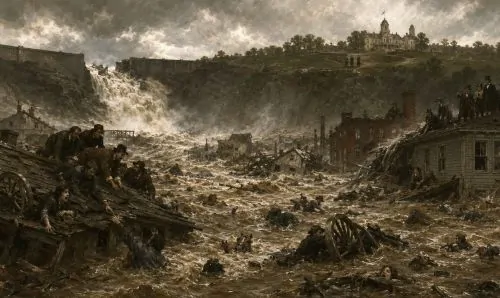
On the afternoon of May 31, 1889, a wall of water came down the Little Conemaugh Valley with such force that witnesses struggled to describe it as ordinary floodwater at all. It was black with mud, timber, wreckage, machinery, houses, animals, and bodies. It moved with the violence of a collapsing landscape, gathering bridges, railroad cars, trees, and entire buildings into a single grinding mass before it struck Johnstown, Pennsylvania. In less than an hour, the failure of the South Fork Dam transformed a mountain reservoir into one of the deadliest disasters in American history. By the time the waters receded and the debris stopped burning, 2,209 people were dead, thousands more were homeless, and an industrial town that had seemed busy, crowded, and permanent had been reduced to mud, wreckage, and grief.
The Johnstown Flood has often been remembered as a catastrophe of suddenness: rain, breach, torrent, destruction. That sequence is true as far as it goes, but it is also dangerously incomplete. Heavy rainfall triggered the disaster, yet rain alone did not build the reservoir, alter the dam, block the spillway, remove the original discharge pipes, lower the crest, or place a private lake above a populated valley. The water that destroyed Johnstown was natural in its physical force, but the conditions that released it were historical. They belonged to decisions about property, engineering, maintenance, recreation, profit, class privilege, and legal responsibility. Long before the dam broke, the disaster had been prepared by choices that seemed ordinary to those who made them: the choice to treat an aging dam as an amenity rather than a danger, the choice to preserve a private fishing lake rather than restore full safety mechanisms, the choice to accept leakage and structural weakness as tolerable inconveniences, and the choice to let downstream communities live with risks they did not create and could not control. This is what makes Johnstown so historically revealing. The flood was sudden for those who saw it coming down the valley, but it was not sudden in the deeper sense. It was the violent arrival of accumulated negligence. The flood demands more than sympathy for the dead. It demands an inquiry into power.
That inquiry leads uphill from Johnstown to the South Fork Fishing and Hunting Club, an exclusive private retreat whose members included some of the most prominent industrial and financial men of the Gilded Age. The club did not invent the old South Fork Dam, which had been built decades earlier as part of Pennsylvania’s canal infrastructure, but it inherited a dangerous structure and turned the reservoir behind it into Lake Conemaugh, a private pleasure ground. The dam’s condition was not a secret mystery. It leaked. Its crest had been lowered. Its protective systems had been compromised. Its spillway could not adequately do the work that emergency demanded. Most fatally, the people most endangered by its failure were not the people who enjoyed the lake. The risk was socialized downstream while the benefit remained private upstream.
The Johnstown Flood was not simply an act of God, nor merely an engineering accident, nor only a tragic consequence of extraordinary weather. It was a Gilded Age disaster in the fullest sense: a catastrophe produced by the meeting of natural force and unequal human systems. The storm supplied the immediate pressure, but private control, negligent maintenance, weakened public oversight, and elite insulation from consequence gave that pressure its lethal opportunity. The question is not whether rain mattered. It did. The deeper question is why so many working families lived beneath a compromised dam controlled by men powerful enough to enjoy its waters, yet not accountable enough to protect those in its path.
Johnstown Before the Flood
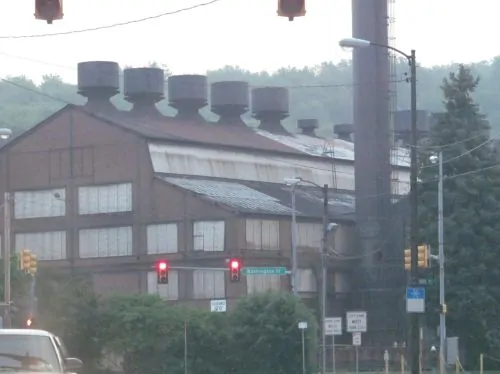
Before the flood made Johnstown a national symbol of catastrophe, it was already a place shaped by water, iron, coal, railroads, and constricted land. The town sat in western Pennsylvania’s Conemaugh Valley, where the Little Conemaugh River and Stonycreek River met to form the Conemaugh. This geography was both useful and dangerous. The rivers helped organize transportation, industry, settlement, and work, but the valley that made Johnstown commercially valuable also confined it. Houses, mills, shops, rail lines, bridges, and streets crowded into narrow bottomland where there was little room for water to spread harmlessly. Long before May 31, 1889, Johnstown was a town built with flooding in mind, but also a town built because the same landscape that threatened it made industrial growth possible.
Johnstown’s rise was inseparable from the iron and steel economy of the nineteenth-century United States. The Cambria Iron Company became the dominant local institution, drawing labor, capital, and technical ambition into the valley. Its furnaces, mills, rolling works, and machine shops made Johnstown part of the nation’s expanding industrial network, connecting the town to railroad construction, bridge building, urban growth, and the enormous demand for iron and steel that characterized postwar America. The company’s works gave Johnstown its identity as a manufacturing town and tied it to the larger transformation of the Gilded Age: rails, structural iron, steel production, coal extraction, immigrant labor, and expanding national markets. This industrial identity shaped more than employment. It shaped the town’s streets, its rhythms, its class structure, its housing patterns, and even its sense of permanence. Workers came because the mills promised wages; merchants came because workers needed goods; churches, schools, and civic institutions grew because the industrial town had become a settled community rather than a temporary camp. Johnstown was not a picturesque village accidentally struck by modernity. It was a modern industrial community, crowded and noisy, dependent on heavy works and the transportation systems that fed them. Its people lived near furnaces, mills, rail yards, company housing, bridges, shops, churches, schools, and boardinghouses. The valley was not simply a natural setting; it was an industrial landscape, and every feature of that landscape would matter when the flood arrived.
That distinction matters because the disaster later called the Johnstown Flood did not descend upon an empty floodplain. It struck a built environment dense with people and material. The town and its neighboring communities contained working families, immigrant neighborhoods, skilled and unskilled laborers, merchants, clerks, railroad workers, domestic servants, children, and the elderly. Their vulnerability was not only physical, though the geography was physically dangerous. It was also social and economic. Many people lived where they lived because work placed them there, because wages limited their choices, because company and industrial development shaped available housing, and because the valley’s economy required people to remain close to the mills and rail lines. To say that Johnstown was vulnerable is not merely to say that it was low-lying. It is to say that thousands of people were locked into a landscape where danger was distributed unevenly.
The rivers themselves had also been changed by the needs of industry and transportation. Streams that once had more room to move were narrowed, crowded, bridged, and obstructed as railroads, factories, streets, and dumps pressed against them. Industrial towns often treated rivers as both tools and drains: sources of power, corridors of movement, boundaries of property, and convenient places to deposit waste. In Johnstown, that pattern increased danger. When ordinary rain swelled the rivers, water already had to fight its way through a constrained urban channel. When the South Fork Dam failed, the flood wave entered not an open valley but a compressed industrial corridor filled with structures that could break loose, jam, burn, and become weapons. Buildings, bridges, railcars, lumber, machinery, and debris did not merely suffer the flood; they became part of it.
Yet it would be misleading to treat Johnstown’s ordinary flood risk as equivalent to what happened in 1889. The town knew water. It had seen high rivers before. Residents were familiar with wet streets, seasonal flooding, warnings, rumors, and the anxious habit of watching the weather. That familiarity may have made the final danger harder to grasp. If people had heard exaggerated warnings before, or had seen floods rise and then subside, disbelief was not irrational. In a flood-prone town, alarm could become routine. The tragedy was that the danger on May 31 was not routine. It was not simply the Little Conemaugh or Stonycreek rising from heavy rain. It was the sudden release of Lake Conemaugh from a compromised dam fourteen miles upstream, adding an artificial catastrophe to a natural storm.
Johnstown before the flood was vulnerable in layers. Its geography placed it in the path of water. Its industrial growth filled that path with people, structures, machinery, and debris. Its economy kept workers and families close to the river corridors. Its previous experience with flooding made warnings easier to discount. Above all, its fate was tied to decisions made outside the town itself, upstream at a private lake controlled by people who did not live under the dam. The town’s vulnerability was not simply that it was in a valley. It was that a working industrial community had been made to occupy the receiving end of risks created by geography, industry, infrastructure, and class power together.
From Public Reservoir to Private Playground: The South Fork Dam’s Troubled History
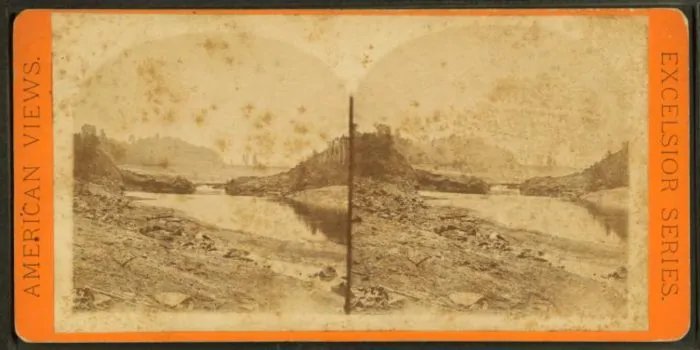
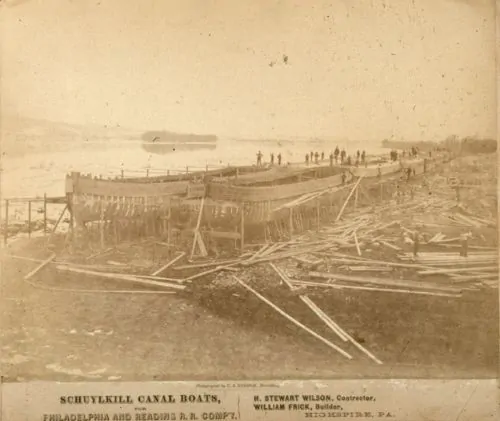
The South Fork Dam began not as a symbol of luxury, but as a work of public infrastructure. It belonged to the era of canals, state improvements, and ambitious nineteenth-century efforts to bind Pennsylvania’s mountains, rivers, markets, and towns into a workable transportation system. The reservoir behind it, originally known as the Western Reservoir, was designed to supply water to the Pennsylvania Main Line Canal during dry seasons, especially along the canal route west of the Alleghenies. In its original purpose, the dam was utilitarian. It stored water not for scenery, fishing, or private pleasure, but for movement: boats, freight, passengers, commerce, and the older canal world that briefly promised to make geography more obedient to human design. Like many public works of its age, it carried both confidence and risk. It represented engineering ambition in a difficult landscape, but it also placed a large artificial body of water high above communities that would have little control over its future.
That original purpose did not last. The rise of the railroad rapidly undermined the canal system, and the infrastructure built for one transportation age became awkward property in another. When the Pennsylvania Railroad acquired the old canal works, the South Fork Dam and its reservoir were no longer central to the transportation future of the state. The railroad did not need the reservoir in the same way the canal system had needed it, and the dam entered the dangerous middle stage common to obsolete infrastructure: still physically present, still potentially hazardous, but no longer clearly protected by the public purpose that had justified its construction. It is in this transition that the later tragedy begins to take shape. The dam did not become dangerous only when the club acquired it. Its danger grew as public infrastructure became surplus property.
The dam’s history before the South Fork Fishing and Hunting Club was already troubled. It had suffered deterioration, neglect, and earlier damage. Its condition had been compromised over time, and its original engineering systems were not preserved intact. Most importantly, the original discharge pipes, which could have allowed water to be released from the reservoir, were gone by the time the club restored the lake. This mattered enormously. A dam without a reliable way to lower the water behind it is a structure with fewer defenses against emergency. Spillways can pass overflow, but discharge works give owners and engineers a way to manage the reservoir before water reaches the top. They also create room for judgment: water can be drawn down when storms threaten, pressure can be reduced when seepage appears, and the reservoir can be handled as a system rather than simply endured as a fixed body of water. When those systems disappeared and were not replaced, the dam lost one of the basic tools that might have reduced danger in a crisis. The absence of the pipes also reveals a larger problem in the dam’s transition from public utility to private lake. The structure was no longer being maintained as part of a disciplined hydraulic network. It was being patched, adapted, and repurposed around a new goal: keeping water in place for enjoyment. That change did not automatically doom the dam, but it narrowed the margin between ordinary management and catastrophe. By 1889, the reservoir’s owners could watch the lake rise, but they had very limited ability to make it fall.
The sale of the property into private hands completed the change in meaning. In the 1870s, the old reservoir and dam passed through private ownership before Benjamin Ruff acquired the property and promoted the idea of turning it into an exclusive mountain retreat. Ruff and his associates did not see the old Western Reservoir primarily as a public hazard or a decaying remnant of canal engineering. They saw a lake. They saw cool air, fishing, boating, cottages, privacy, and leisure removed from the smoke and heat of Pittsburgh. The South Fork Fishing and Hunting Club, organized by wealthy men from the industrial elite, transformed the abandoned reservoir into Lake Conemaugh. What had once been a functional component of a public transportation system became an amenity. This was not merely a change of name. It was a change in social purpose.
That transformation altered the incentives surrounding the dam. A public reservoir, at least in theory, existed within a world of public obligation. A private club lake existed to serve the comfort and enjoyment of its members. The distinction mattered because safety improvements could conflict with convenience, appearance, expense, and recreation. The club wanted a full lake for boating and fishing. It wanted access roads, cottages, a clubhouse, and a resort landscape. It wanted the water controlled enough to be pleasant, not necessarily managed with the caution appropriate to a reservoir perched above an industrial valley. A lower lake might have been safer, but it would also have been less attractive. A restored outlet system might have increased control, but it would have required money, expertise, and a willingness to treat the dam as dangerous infrastructure rather than scenic property. A wider or unobstructed spillway might have helped move storm water away, but it would have threatened the club’s control over fish and water level. Technical judgment and social privilege overlapped in these choices. The dam was not merely neglected in some abstract sense; it was made to serve a private landscape whose pleasures depended on retaining the very water that endangered others. The dam was placed in an ambiguous moral and practical position. It was dangerous enough to kill thousands if it failed, but private enough that its risks could be treated as the club’s internal concern rather than a public emergency.
The physical setting made that ambiguity deadly. Lake Conemaugh sat high above Johnstown, separated from the city not by an abstract distance but by a descending valley that would channel any failure directly toward populated communities. The dam did not merely hold back water. It held back elevation, gravity, accumulated runoff, and the consequences of earlier decisions. Every defect in the structure mattered more because of where it stood. A weakened dam in an isolated location would have been dangerous; a weakened dam above South Fork, Mineral Point, East Conemaugh, Woodvale, and Johnstown was a regional threat. Yet the people downstream had no effective power over its repair, its operation, or its ownership. They lived beneath decisions made by others.
The history of the South Fork Dam before 1889 reveals the flood as a disaster prepared in stages. First came a public work built for canal transportation. Then came obsolescence as railroads displaced the canal system. Then came deterioration, transfer, and private acquisition. Finally came the reinvention of the reservoir as a pleasure lake for men wealthy enough to enjoy seclusion but not compelled to live with the consequences of failure. This sequence does not mean that every owner had identical responsibility, or that the dam’s final collapse can be explained by one decision alone. It means that by the time rain began to fall in May 1889, the dam had already passed through a history of abandonment, repurposing, and compromised safety. The flood was still in the future, but the conditions that made it possible had already been assembled.
The Club and the Dam
The South Fork Fishing and Hunting Club’s responsibility for the Johnstown Flood rests not on a single dramatic act but on a pattern of neglect, alteration, and accepted danger. The dam did not fail because one man pulled one lever or made one fatal decision on the morning of May 31, 1889. It failed because an aging and already compromised structure had been taken into private hands, modified for convenience, maintained inadequately, and left without the safety systems that might have reduced the danger when extraordinary rain arrived. This is what makes the disaster historically important. The club’s members did not need to intend mass death to help produce it. They needed only to treat a dangerous dam as a private amenity while the people downstream bore the consequences of that treatment.
The most fundamental problem was that the South Fork Dam had lost its capacity to be actively managed. The original discharge pipes, installed when the reservoir served the Pennsylvania canal system, were no longer available. Without them, the club could not draw down Lake Conemaugh in anticipation of heavy rain or relieve pressure as the water rose. The lake could be enjoyed, stocked, boated upon, and admired, but in an emergency it could not be controlled in the way a reservoir should be controlled. That absence transformed the dam from a managed hydraulic structure into something more passive and more dangerous: an earthen barrier dependent largely on its own weakened body and on the limited capacity of the spillway. When the storm came, the club could not truly operate the reservoir. It could only watch the water rise and attempt last-minute improvisations against forces that earlier maintenance should have anticipated.
The dam itself had also been physically altered in ways that reduced its safety margin. Its crest had been lowered, commonly associated with creating a roadway across the top. Such a change mattered because the height of an earthen dam is not decorative. The difference between the water level and the top of the dam, known as freeboard, is one of the most basic safeguards against overtopping. Freeboard gives a dam room to absorb the unexpected: wind-driven waves, sudden inflows, debris-choked outlets, and storms larger than normal experience has taught people to expect. Reducing that margin meant reducing the dam’s tolerance for surprise. When water begins to flow over an earthen dam, it can cut into the structure, erode the downstream face, and rapidly enlarge a breach. Overtopping is dangerous because it turns the dam’s own material against it; the water does not merely pass over the barrier, but begins to eat the barrier away. Lowering the crest reduced the amount of storm water the reservoir could hold before overtopping began and made the dam less forgiving under precisely the conditions in which forgiveness mattered most. In ordinary weather, that may have appeared harmless. The road across the dam could be treated as a convenience, a small adaptation to the club’s landscape, perhaps even an improvement in access. But in an extreme storm, the change narrowed the line between high water and structural failure. The alteration was not merely a convenience; it was a reduction in the dam’s ability to survive exactly the kind of emergency that dams must be designed to withstand.
The spillway, the dam’s remaining chief means of passing excess water, was also compromised. Fish screens had been placed across it to keep the club’s stocked fish from escaping Lake Conemaugh. The screens were a small detail with enormous interpretive significance. They embodied the conversion of the reservoir from public infrastructure to private recreation. Their purpose was not safety but sport. Under storm conditions, screens could trap branches, brush, and debris, reducing the spillway’s capacity at the very moment when every additional cubic foot of outflow mattered. The result was a grim inversion of priorities: the mechanism meant to preserve the pleasures of the lake also helped obstruct the lake’s ability to empty. In the history of the Johnstown Flood, few details better capture the connection between class privilege and manufactured risk. The fish were protected. The valley was not.
Repairs to the dam compounded the problem because they did not fully restore the structure to a reliable engineering standard. Earthen dams require careful construction, compaction, drainage, slope protection, and inspection. They are not simply piles of dirt that can be patched casually whenever a depression appears or seepage becomes visible. The South Fork Dam had a history of damage and leakage, and its restoration under private ownership did not return it to the condition of a properly maintained public reservoir. Accounts of its condition before the flood repeatedly emphasize weakness, seepage, an uneven or sagging crest, and a structure whose previous injuries had never been fully overcome. Even if some of these flaws predated the club, that does not absolve the club. Inheriting a dangerous structure creates a responsibility either to repair it properly, operate it cautiously, or reduce the danger it poses. The club instead preserved the lake while failing to restore the dam’s lost safety margin.
The geography of responsibility was as important as the engineering itself. The club’s members enjoyed Lake Conemaugh from cottages, boats, and a clubhouse high in the hills. Johnstown and the smaller communities below lived in the path of failure. That separation made danger easier to minimize. The owners of the lake were not the people whose homes, shops, churches, schools, and bodies would be struck first if the dam gave way. This was not an unusual arrangement in the Gilded Age, when industrial and financial elites often controlled systems whose risks were borne by workers, towns, and landscapes distant from the places where decisions were made. But Johnstown made the arrangement brutally visible. The dam translated social distance into physical danger. Privilege stood upstream; vulnerability waited below.
To call this risk “manufactured” is not to deny the force of the storm. Heavy rainfall was the immediate trigger, and any fair account must acknowledge that the weather of May 1889 placed severe pressure on the dam. But severe pressure is precisely what reveals whether infrastructure has been responsibly maintained. A dam exists because water rises. A spillway exists because storms come. Freeboard exists because floods exceed ordinary expectations. Discharge works exist because reservoirs require control. None of these safety principles depends on perfect prediction. Their purpose is to create margins of survival when prediction fails. The South Fork Dam entered the storm without those margins intact. Its owners had preserved the lake’s recreational value while accepting a dam that could not be drawn down, whose crest had been lowered, whose spillway capacity was vulnerable to obstruction, and whose earthen body had not been restored to a standard equal to the danger it posed. That is why the distinction between trigger and cause matters so much. Rain supplied the pressure, but human choices determined how little resistance stood between that pressure and the valley below. The South Fork Dam failed in the space where natural force met human neglect. The club did not make the rain, but it helped make the rain catastrophic by preserving a private lake behind a weakened dam whose most important safeguards had been reduced, blocked, removed, or left unrepaired.
May 31, 1889: Failure and the Flood Wave
The storm that destroyed Johnstown did not appear as a single theatrical bolt from the sky. It came as saturation, accumulation, and pressure. By the end of May 1889, western Pennsylvania had already endured heavy rain, and on May 30 and 31 the rainfall became relentless. Creeks rose, slopes shed water, roads became difficult, and the streams feeding Lake Conemaugh poured into the reservoir faster than the weakened South Fork Dam could safely release them. Downstream, Johnstown residents saw the familiar signs of flood danger in the Little Conemaugh and Stonycreek rivers. Streets took water, cellars filled, and people moved valuables or watched the rivers with the wary patience of those who had lived through high water before. Yet the central danger was not simply the water already in town. It was the water gathering silently above them.
At the South Fork Dam, the storm turned structural weakness into crisis. Lake Conemaugh rose toward the crest, and the absence of working discharge pipes became fatal in practice. There was no effective way to lower the reservoir. The spillway, already inadequate and vulnerable to obstruction, could not relieve the rising lake quickly enough. Men at the dam tried emergency measures, including efforts to reinforce the crest and open channels for escape, but these were improvised gestures against a hydraulic problem that had been decades in preparation. The dam was being asked to perform under maximum stress after years in which its capacity for such stress had been reduced. The storm did not create those weaknesses; it exposed them with brutal efficiency.
Warnings did move downstream, but warning is not the same as rescue. Messages were sent from the South Fork area toward Johnstown as the dam’s condition worsened. John Parke, an engineer associated with the club, famously rode to the telegraph office to send alarm. Others also understood that the dam might fail. But the valley below had heard warnings before, and past alarms had not always ended in catastrophe. In Johnstown, where ordinary flooding was already underway, the news from South Fork had to compete with experience, disbelief, confusion, and the practical difficulties of evacuation. A warning that a dam may fail is terrifying in hindsight, but in the moment it was filtered through habit: people had heard that the dam was unsafe before, had heard that it might break before, and had not seen Johnstown erased. Familiar danger made the unfamiliar disaster harder to imagine.
The dam finally gave way in midafternoon. The breach did not release ordinary floodwater in an orderly rise; it released a stored lake suddenly into a descending valley. Water that had been held back for recreation and scenery became a moving force of gravity. As the dam opened, Lake Conemaugh began emptying through the gap, and the escaping water carved the breach wider. The failure fed itself. The more water escaped, the more violently it tore at the dam; the more the dam gave way, the larger and faster the escaping torrent became. This is one reason the flood became so devastating. It was not merely a river swelling beyond its banks. It was the rapid conversion of an artificial reservoir into a valley-wide projectile.
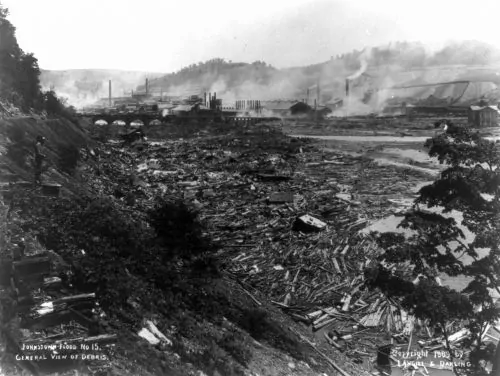
As the flood wave moved downstream, it gathered power and material. South Fork, Mineral Point, East Conemaugh, and Woodvale lay in the path before Johnstown itself. The water carried mud, trees, houses, livestock, machinery, bridge timbers, railroad equipment, and human beings. It struck communities not only with depth but with velocity and debris. Buildings did not simply fill with water; they broke apart. Railcars were lifted and hurled. Structures became battering rams against other structures. People who might have survived a slower rise of river water faced instead a dense, violent mass that crushed, buried, and swept away. The flood wave was both water and wreckage, a moving industrial ruin created as it descended. By the time the torrent reached Johnstown, it had become almost unimaginable as a natural flood. The town lay at the meeting of rivers in a narrow valley already swollen by rain, and the artificial flood from Lake Conemaugh entered a landscape packed with homes, mills, bridges, tracks, lumber, shops, churches, and people. The built environment intensified the disaster. Every obstruction changed the water’s behavior. Every building that broke apart added to the force that struck the next. Every bridge or narrowing helped create jams of debris. Johnstown’s industrial geography, so important to its growth, now magnified its destruction. The flood did not merely pass through the town; it dismantled the town and used the pieces as weapons.
The chronology of May 31 reveals why the Johnstown Flood cannot be reduced either to weather or to villainy alone. The rainfall was real, severe, and immediate. The warnings were real, but inadequate to overcome disbelief and the speed of events. The emergency efforts at the dam were real, but too late to compensate for structural conditions long ignored. The flood wave was natural in its physical laws, but artificial in its stored volume, sudden release, and devastating path through a populated industrial valley. By evening, the question was no longer whether the storm had been extraordinary. It was whether extraordinary weather should have been enough to turn a private lake into a mass grave.
Death in Johnstown
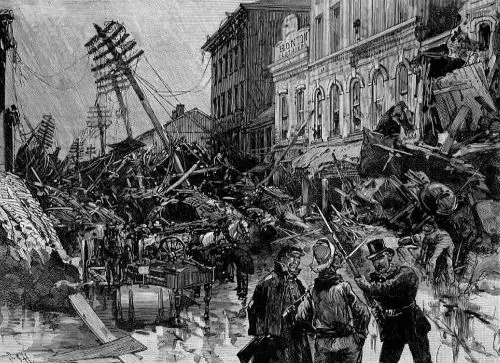
When the flood reached Johnstown, death came with a speed that overwhelmed ordinary categories of disaster. People did not simply drown in rising water. They were struck by buildings, crushed by debris, trapped in collapsing houses, carried through streets, pinned beneath wreckage, burned in debris piles, or swept away before anyone nearby could understand what had happened. The flood wave arrived not as a clean wall of water but as a violent mass of mud, timber, machinery, household objects, railcars, animals, and human bodies. It erased the distinction between river, street, home, and workplace. The town became, in minutes, a moving field of destruction.
The scale of loss was almost impossible for survivors to comprehend. The accepted death toll reached 2,209, making the Johnstown Flood one of the deadliest disasters in American history. But a number alone cannot carry the disaster’s meaning. The dead were not an abstraction. They were parents, children, steelworkers, domestic workers, merchants, immigrants, clerks, teachers, railroad men, church members, neighbors, and entire households. Some families lost one person. Others were nearly wiped out. In the most devastating cases, no one remained to tell the family’s story. Johnstown’s grief was both public and intimate: a civic catastrophe measured in streets destroyed and bridges jammed, but also a private catastrophe measured in empty chairs, missing children, and names that no longer had living voices attached to them. Bodies became one of the central realities of the aftermath. They were found in wrecked houses, under mud, tangled in debris, caught against bridges, buried in sand and timber, or carried far downstream. Identification was slow, painful, and sometimes impossible. Clothing, jewelry, papers, scars, tools, and fragments of personal knowledge became evidence in a grim process of recognition. Families searched among the dead with hope and dread at once. The flood had not only killed people; it had damaged the social rituals by which death was normally handled. Burial, mourning, and identification were all made chaotic by the violence of the bodies’ displacement and disfigurement. To lose the dead was one horror. To be unable to name them was another.
Children gave the disaster a particular emotional force in contemporary accounts and later memory. In any community disaster, the death of children collapses public tragedy into a sharper moral indictment, because children so clearly did not choose the conditions that endangered them. They did not build mills in the valley, alter the dam, maintain the lake, ignore leaks, or weigh the cost of repairs. Yet they were among those who paid for those decisions. Reports of orphaned children, missing children, and children found among the wreckage helped make Johnstown not merely a story of engineering failure but a story of violated innocence. The flood exposed the cruelty of risk imposed from above: people least responsible for the danger were among those least able to escape it.
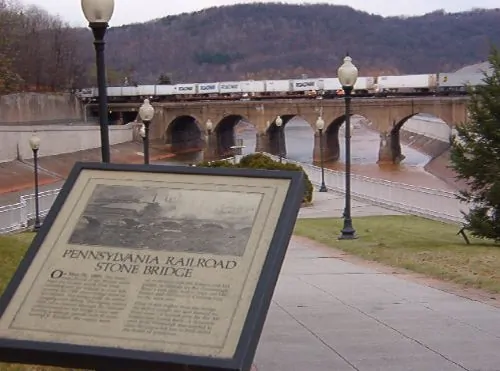
The Stone Bridge became the most terrible symbol of that imposed death. As the flood surged into Johnstown, the Pennsylvania Railroad’s massive stone-arched bridge blocked the debris-laden torrent and created a vast jam of wreckage. Houses, roofs, trees, rail timbers, furniture, animals, machinery, and bodies piled against it. For some people, the debris field became a temporary refuge; for others, it became a trap. The bridge did not cause the flood, but it shaped the way the flood killed. It stopped the moving wreckage long enough to concentrate destruction in one horrific place. In the physical geography of the disaster, the Stone Bridge became a second catastrophe after the wave itself.
Then came fire. The debris jam at the Stone Bridge ignited, likely fed by overturned stoves, industrial materials, oil, gas, broken household goods, and the combustible chaos of smashed buildings. Fire on water seemed to survivors almost apocalyptic, a violation of ordinary expectation. People who had escaped drowning found themselves trapped in wreckage that burned around them. Rescuers could hear cries but could not always reach those pinned in the debris. The image of flood victims burned alive at the bridge became one of the most haunting elements of the Johnstown story because it intensified the sense that nature alone could not explain what had happened. Water had carried the town into a trap; fire completed the horror. The destruction of homes also meant the destruction of records, photographs, heirlooms, savings, clothing, tools, food, bedding, and the ordinary material structure of daily life. Survivors did not emerge from the flood into a damaged version of their old world. Many emerged into the absence of that world. Streets were unrecognizable. Landmarks had vanished. Bodies lay where homes had stood. Families searched not only for relatives but for proof of their own former lives. The disaster stripped people of shelter and memory simultaneously, turning possessions into debris and neighborhoods into open ground. This is why the flood’s violence cannot be measured only by the moment of impact. It continued in homelessness, hunger, exposure, disease fears, uncertainty, and the psychological shock of living where the dead were still being recovered.
The death in Johnstown was not merely the result of a dam breach; it was the human meaning of that breach. The flood translated failed maintenance, private privilege, compromised engineering, and social distance into bodies. The people downstream did not die because they lived in ignorance of water, nor because they had carelessly chosen danger for themselves. They died because an industrial valley filled with families lay below a reservoir whose risks had been managed for the benefit of others. The Stone Bridge, the unidentified dead, the burned debris, and the erased families all force the same conclusion: Johnstown was not simply where the water went. It was where the consequences of upstream power arrived.
Relief and Reconstruction: Clara Barton, Charity, and the Limits of Humanitarian Response
The first task after the flood was not interpretation but survival. Johnstown had to bury the dead, shelter the living, clear wreckage, restore communication, prevent disease, feed the hungry, and impose some order on a landscape that had been physically and socially torn apart. Relief began locally, as survivors helped one another before organized aid could fully arrive. Neighbors searched debris for bodies and survivors. Railroad men, physicians, clergy, civic leaders, laborers, and volunteers improvised methods of rescue and distribution. But the scale of destruction quickly exceeded local capacity. Johnstown had not merely suffered damage; it had lost homes, food supplies, clothing, tools, public buildings, records, streets, bridges, and thousands of people. The town needed help from beyond itself.
That help came with remarkable speed. The Johnstown Flood became a national disaster almost immediately, carried through newspapers, telegraph reports, public appeals, and the shock of its death toll. The same communications networks that had carried industrial capitalism across the country now carried the image of Johnstown’s suffering outward to readers who would never see the valley but could imagine the scale of its ruin. Reports of bodies, wrecked homes, orphaned children, burned debris, and vanished neighborhoods turned a Pennsylvania disaster into a national moral spectacle. Donations arrived from American cities, foreign contributors, churches, civic organizations, businesses, and private citizens who understood Johnstown as a moral emergency. Money, food, clothing, bedding, medicine, coffins, lumber, and household goods moved toward the devastated valley. The relief effort revealed the growing capacity of late nineteenth-century America to respond to catastrophe at a national scale. Railroads, newspapers, voluntary associations, and urban wealth could mobilize aid quickly when suffering became visible enough to command public sympathy. This was one of the paradoxes of the disaster: the modern systems that could not prevent the flood could nevertheless publicize it, organize sympathy for it, and move relief into the valley after it had done its work. Johnstown was not only a disaster of modern infrastructure; it was also an early test of modern humanitarian response.
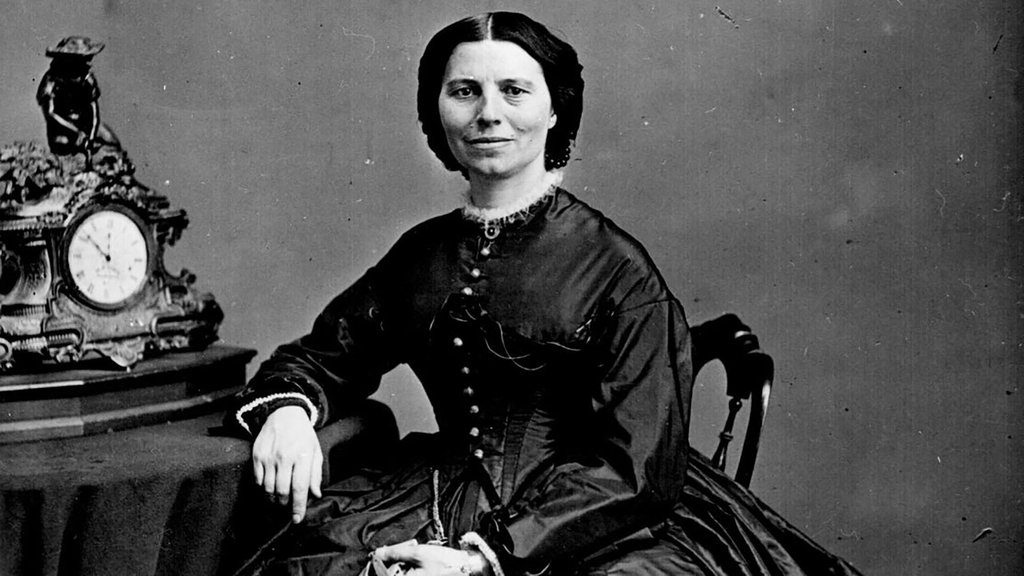
Clara Barton and the American Red Cross became central to that response. Barton, already famous for her Civil War nursing and relief work, had founded the American Red Cross in 1881 and had argued that the organization should not limit itself to wartime service. Johnstown gave that idea its most dramatic early demonstration. Barton arrived within days of the flood and remained for months, helping organize supplies, medical assistance, shelter, clothing distribution, and longer-term aid. Her presence mattered practically, but it also mattered symbolically. At Johnstown, the American Red Cross proved that peacetime disaster relief could be disciplined, organized, and national in scope. The flood became part of the institution’s own origin story, a moment when humanitarian relief moved from battlefield memory into domestic emergency. Barton’s work also showed that relief required more than dramatic charity in the first days after catastrophe. Survivors did not simply need rescue from floodwater. They needed places to sleep, food to eat, clothes to wear, tools to work with, and some material basis from which family life could resume. Relief workers had to distinguish immediate emergency from reconstruction. The first problem was saving life; the next was making life livable again. Temporary shelter, distribution centers, medical care, and replacement household goods were not sentimental gestures. They were the infrastructure of survival after infrastructure had failed. Barton’s contribution was not only compassion but administration. She helped turn sympathy into systems.
Reconstructionwas uneven and painful. Johnstown rebuilt, but rebuilding did not mean restoring what had been lost. A house could be replaced more easily than a family. A street could be cleared more easily than memory. Mills and railroads could resume operation before grief had found language. The demands of industrial life pushed the town toward recovery because work, transportation, and commerce could not remain suspended indefinitely. That urgency helped Johnstown survive, but it also exposed the hard edge of reconstruction in an industrial society. Communities were expected to become functional again even when their dead were still being identified, their children orphaned, and their neighborhoods erased. The language of resilience can obscure that violence. Johnstown’s recovery was real, but it was not a cancellation of loss.
Charity also had political limits. It could alleviate suffering, but it could not by itself answer the question of responsibility. Donations from strangers fed survivors, but they did not explain why the dam had been allowed to remain dangerous. Barton’s Red Cross could distribute supplies, but it could not force the South Fork Fishing and Hunting Club to accept blame. Humanitarian response can become morally complicated when it treats the effects of a disaster more effectively than the causes. It can create an image of national unity in which the suffering poor, the generous middle class, and the wealthy donor all appear together inside a story of compassion, even when the disaster itself was produced by unequal power. Johnstown needed charity, and charity saved lives. But charity could also soften public outrage by shifting attention from culpability to compassion, from negligence to recovery, from legal accountability to voluntary benevolence. The public act of giving could coexist with the private refusal to accept responsibility. Relief helped survivors endure the disaster’s aftermath, but it did not make the disaster just.
The distinction between relief and justice is essential to understanding Johnstown as a Gilded Age disaster. The same society that could mobilize extraordinary generosity struggled to impose meaningful accountability on the wealthy men associated with the dam. Public sympathy flowed toward Johnstown more successfully than legal responsibility flowed uphill toward the club. This does not diminish Barton’s work or the generosity of those who gave. It clarifies their limits. Humanitarian response addressed the wound; it did not fully confront the system that opened it. Johnstown was rebuilt through labor, charity, organization, and endurance, but the deeper reconstruction (the reconstruction of responsibility, regulation, and public protection) remained unfinished.
Blame Without Liability: The Club and Gilded Age Power
In the immediate aftermath of the Johnstown Flood, blame moved almost as quickly as charity. Survivors, newspaper editors, ministers, engineers, and ordinary Americans looked uphill toward the South Fork Fishing and Hunting Club and saw more than misfortune. They saw a private lake, a weakened dam, wealthy owners, and a valley of dead working people below. The moral geography seemed unmistakable. The water had come from a reservoir controlled by Pittsburgh elites. The dead had been ordinary residents of Johnstown and its neighboring communities. In public memory, that contrast became the disaster’s central accusation: rich men had enjoyed a pleasure lake, and poor and working families had paid for it with their lives.
Yet moral blame did not become legal liability. The club and its members were never held legally responsible for the deaths and destruction caused by the flood. This failure was not simply a technical footnote to the disaster. It was part of the disaster’s meaning. Johnstown exposed a gap between public judgment and legal consequence, between what many Americans believed had happened and what the courts could or would make punishable. The people of Johnstown had suffered a catastrophe that seemed to demand accountability, but legal options offered little more than frustration. The dam had failed. The city had been destroyed. Thousands were dead. But responsibility dissolved inside the requirements of proof, causation, ownership, negligence, and influence.
The lawsuits faced enormous obstacles from the start. To recover damages from the club or its members, plaintiffs had to do more than show that the dam broke and that the flood killed people. They had to establish legally actionable fault. That meant proving negligence in a way that could survive courtroom argument, linking particular acts or omissions to the final breach, and overcoming defenses that framed the storm as extraordinary or the flood as an act of God. The club’s defenders could point to the intensity of the rainfall, the dam’s age, the complicated chain of previous ownership, and the difficulty of showing which individual member had personally caused the unsafe condition. In legal terms, the very structure of elite collective ownership helped diffuse responsibility. A club could enjoy the benefits of the lake, but when disaster came, blame could be scattered among managers, officers, contractors, former owners, engineers, weather, and the dead hand of history.
That diffusion of responsibility was one of the central protections of Gilded Age power. The South Fork Fishing and Hunting Club was not merely a group of sportsmen. Its membership and social orbit included men connected to steel, banking, railroads, law, and Pittsburgh industrial wealth. They were accustomed to operating in a world where capital enjoyed mobility, influence, and institutional deference. Their names carried weight in boardrooms, banks, political circles, newspapers, and courts; their class position gave them access not only to legal defense but to the cultural presumption that men of property were responsible citizens rather than public dangers. The people downstream did not possess comparable power. They could mourn, accuse, testify, sue, and remember, but they could not easily force the men upstream into meaningful legal accountability. This imbalance did not require open conspiracy to be effective. It operated through money, legal talent, social standing, evidentiary burdens, and a legal culture often more comfortable assigning loss to accident than confronting the consequences of concentrated private power. Gilded Age inequality was not only visible in mansions, clubs, railroads, and factories. It was also embedded in the practical question of whose suffering could be converted into an enforceable claim.
The defense that the flood was an act of God was important because it shifted the interpretive frame. If the disaster was caused by extraordinary rain alone, then the club’s failures became secondary or irrelevant. The storm, not the dam’s management, became the decisive actor. But that framing obscured the layered nature of causation. Natural force may trigger a disaster without being its full historical cause. A storm tests a dam; it does not explain why the dam had no working discharge pipes, why its crest had been lowered, why its spillway was obstructed, or why warnings from downstream critics had failed to produce adequate repair. The “act of God” argument may have had legal force, but historically it served to separate weather from the human systems that made weather lethal.
The Johnstown cases also belonged to a larger nineteenth-century debate over liability for dangerous property. English law’s famous Rylands v. Fletcher decision had suggested that someone who brings a dangerous thing onto land and allows it to escape may be liable for the damage it causes, even without ordinary proof of negligence. A reservoir bursting and flooding neighboring property was precisely the kind of problem that made such legal reasoning powerful. But American law was uneven and hesitant in adopting strict liability, and Johnstown did not produce a decisive courtroom victory for the survivors. Instead, the disaster became an example of what fault-based liability could fail to remedy. If victims had to prove exactly who had been careless, exactly how careless they had been, and exactly how that carelessness caused the final destruction, then a disaster produced by many years of collective neglect could become legally elusive.
This failure of accountability deepened public anger. Newspapers and critics did not need a successful lawsuit to form a judgment. To many observers, the basic facts were morally sufficient: the club had possessed the dam, enjoyed the lake, altered or tolerated unsafe conditions, and escaped payment after more than two thousand people died. The law’s refusal or inability to punish that arrangement made the club seem even more emblematic of the age. Johnstown became a story about wealthy men who could privatize pleasure and externalize risk, then defend themselves behind legal complexity when the risk became catastrophe. That pattern resonated because it was not confined to one dam or one club. It echoed other Gilded Age conflicts in which corporations and wealthy owners profited from railroads, mines, mills, finance, and land while workers and communities absorbed injury, pollution, debt, unemployment, and death. The flood joined a broader late nineteenth-century suspicion of trusts, corporations, monopolies, railroad power, and industrial capitalism. It was not the same as a labor strike or an antitrust battle, but it carried the same moral charge: ordinary people were living under structures they did not control. The drowned families of Johnstown became evidence that private power could be lethal even when it wore the face of leisure rather than industry.
The result was blame without liability. The South Fork Fishing and Hunting Club lost badly in the court of public memory, but not in the courts of law. That distinction matters because it complicates any simple claim that justice followed disaster. Johnstown did not produce a clean reckoning. It produced grief, relief, rebuilding, outrage, legal frustration, and a long historical argument over responsibility. The club’s members did not need to be convicted in court for the flood to remain a damning indictment of Gilded Age power. The very absence of liability became part of the indictment. It showed how a society could recognize moral responsibility while failing to enforce it, and how the dead of Johnstown could be mourned by the nation without being fully answered by its law.
Memory and the Battle over Meaning
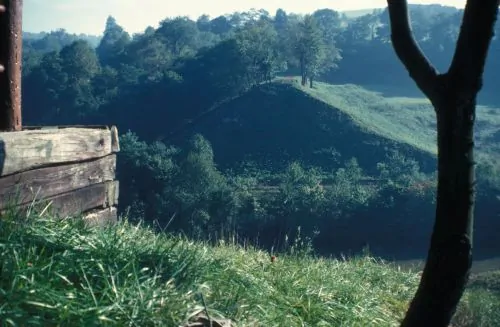
The struggle over the Johnstown Flood did not end when the waters receded or when the dead were buried. It continued in newspapers, engineering reports, lawsuits, memorials, survivor accounts, museum displays, family stories, and public argument. Disasters of this scale do not speak for themselves. They must be interpreted, and interpretation is never neutral when blame is at stake. Johnstown could be remembered as an act of God, a freak storm, a tragedy of geography, an unavoidable engineering failure, a failure of warning, a crime of negligence, or a symbol of Gilded Age class power. Each version carried different consequences. To call the flood unavoidable protected the club. To call it negligent sharpened the moral indictment. To call it a class disaster placed Johnstown inside a larger critique of industrial capitalism and unequal power.
The earliest accounts often combined horror, moral outrage, and uncertainty. Newspaper writers and popular authors described the flood in dramatic language, emphasizing the speed of the wave, the bodies in the wreckage, the fire at the Stone Bridge, and the contrast between the ruined town and the wealthy club above it. These accounts were not detached technical studies, but they preserved something essential: the immediacy of public judgment. Survivors and observers did not need later hydrological modeling to understand that the private lake mattered. They saw the broken dam, the empty reservoir, and the dead below. The sensational character of some early flood literature created problems for later historians. It fixed powerful images in public memory but sometimes blurred technical details, repeated rumors, or simplified responsibility into moral drama. Memory kept outrage alive, but it also required investigation.
The most important early investigation came from the American Society of Civil Engineers, whose 1891 report became central to the battle over meaning. The ASCE committee examined the dam’s failure and concluded, controversially, that the dam would have failed even if it had remained at its original height and that the club’s alterations were not the decisive cause of the catastrophe. That conclusion mattered enormously because it gave technical authority to a less accusatory interpretation. If the storm would have destroyed the dam anyway, then the lowered crest, blocked spillway, missing discharge pipes, and defective maintenance could be treated as secondary issues rather than central causes. The report did not erase public anger, but it complicated it. Engineering expertise became a shield against moral certainty.
Later scholarship has challenged that shield. Modern studies, particularly the work of Neil Coleman, Uldis Kaktins, and Stephanie Wojno, have reexamined the dam, the breach, the hydrology, and the conclusions of the 1891 investigation. Their work argues that the club-era changes and neglected conditions substantially reduced the dam’s ability to survive the storm. This does not mean that the rain was insignificant or that the dam was perfectly safe before the club touched it. It means that the older ASCE conclusion can no longer be treated as the final word. The modern battle over Johnstown is partly a battle over expertise itself. Which experts get believed? Which investigation becomes authoritative? How much deference should be given to a nineteenth-century engineering report produced in a professional and social world not separate from the power it was evaluating? These questions matter because investigations do more than describe events after the fact. They establish the boundaries of blame. They decide which causes are considered measurable, which are dismissed as emotional, and which disappear because they do not fit the preferred technical frame. In Johnstown, later scholarship has reopened the space between engineering calculation and historical responsibility. It has shown that the dam’s failure cannot be understood only as a moment of collapse, but must be read through the long history of alteration, maintenance, ownership, and professional interpretation that shaped how the collapse was explained.
This is where Johnstown’s memory becomes inseparable from Gilded Age authority. The flood occurred in a society that often trusted men of wealth, technical standing, and institutional rank to define the meaning of events. Yet those same men frequently belonged to overlapping networks of business, engineering, law, and social privilege. The issue is not that every engineer or investigator acted corruptly. The issue is that technical explanation can narrow moral vision when it asks only whether a dam would have failed under a particular modeled condition, rather than asking why a dangerous reservoir was privately maintained above a working town with reduced safeguards and limited accountability. A disaster can be technically complex and still morally legible. Johnstown required both kinds of understanding, but the language of technical uncertainty often served to weaken the force of public accusation.
The memory of Johnstown has endured because the disaster remains unresolved in precisely this way. It is not unresolved in the sense that historians do not know what happened. The dam failed, the lake emptied, the flood wave destroyed the valley, and 2,209 people died. It is unresolved because the meaning of those facts still depends on how causation is framed. Was the central actor the storm, the dam, the club, the law, the engineers, the geography, or the Gilded Age itself? The strongest interpretation does not need to choose only one. The Johnstown Flood was a natural event transformed by human systems into mass death. Its memory survives because it exposes a recurring problem in modern history: when private power controls dangerous infrastructure, the battle over responsibility begins long before disaster and continues long after the bodies are counted. That is why the flood remains more than a local tragedy or an episode in the history of dam safety. It is a case study in how societies remember disasters that powerful people would prefer to classify as accidents. Johnstown forces the historian to hold multiple truths together: the rain was extreme, the dam was old, the engineering questions were real, but none of that erases the social order that allowed a compromised reservoir to remain above a vulnerable industrial town. The battle over meaning is not an afterword to the flood. It is part of the flood’s history.
Was the Johnstown Flood Really a Class Crime or Just an Extreme Natural Disaster?
The following video from “Part-Time Explorer” is a documentary about the Johnstown Flood:
The Johnstown Flood can be over-moralized here. The phrase “class crime” captures the outrage of the event, but it can also risk making the disaster seem simpler than it was. The rainfall of May 1889 was severe. The South Fork Dam was old, damaged, and imperfect long before the South Fork Fishing and Hunting Club transformed Lake Conemaugh into a private retreat. Some of the dam’s most serious vulnerabilities belonged to a longer history of canal construction, abandonment, ownership transfer, deterioration, and nineteenth-century engineering limits. The club did not build the dam, did not create the mountainous watershed, did not make the storm, and did not intentionally send a wall of water toward Johnstown. Any serious interpretation must begin by admitting that the disaster was not a murder plot and not merely a morality play about rich men killing poor people.
The 1891 report of the American Society of Civil Engineers gave this counterargument its most important technical form. Its committee concluded that the dam would likely have failed even if it had remained at its original height, thereby weakening the claim that club-era alterations were the decisive cause of the flood. That conclusion, however controversial, cannot simply be ignored. It reminds historians that causation in dam failures is difficult to assign with courtroom neatness. Extreme rainfall, saturated ground, spillway capacity, dam geometry, previous repairs, breach formation, and reservoir volume all interacted in a rapidly developing emergency. It is possible to criticize the club sharply while still acknowledging that the flood emerged from a chain of causes, not a single act of negligence.
This also warns against reading nineteenth-century actors only through later standards of dam safety, liability, and public regulation. Modern readers know what happened. The people at South Fork and Johnstown did not possess that certainty before the breach. Warnings about the dam had circulated for years, but warnings that do not come true can become background noise. Residents downstream had heard alarms before. Club officers and workers did make emergency efforts on May 31, including attempts to relieve pressure and send warnings. Those efforts were inadequate, but they complicate a picture of total indifference. The danger was real, but the psychology of risk was also real: people often live beside hazards for years, normalize them, and underestimate them until the day normalization becomes fatal.
Yet this challenge modifies rather than overturns the central argument. Responsibility does not require sole causation, criminal intent, or perfect foresight. The club inherited a dangerous dam, but inheritance created obligation. It had the benefit of the lake and the burden of making the lake safe. The absence of working discharge pipes, the lowered crest, the compromised spillway, the fish screens, the inadequate repairs, and the preservation of a full private reservoir above a crowded industrial valley all reduced the dam’s margin of safety. Even if the storm was extraordinary, extraordinary storms are exactly why margins matter. A natural trigger does not absolve human systems that make the trigger catastrophic. The flood was not made by class power alone, but class power shaped who controlled the danger, who enjoyed the benefit, who lacked authority, and who died.
The fairest conclusion is neither that the Johnstown Flood was simply an act of God nor that it was literally a deliberate class murder. It was a class disaster: a catastrophe in which extreme weather exposed the lethal consequences of unequal ownership, privatized infrastructure, weak accountability, and social distance between risk-makers and risk-bearers. The rain explains the timing of the flood. It does not explain why a compromised dam held a private pleasure lake above Johnstown, why downstream communities had so little control over their own danger, or why the men associated with the lake escaped legal responsibility after 2,209 people died. The counterpoint strengthens the final interpretation by making it more precise. Johnstown was not a simple crime scene, but it was also not an innocent tragedy. It was a natural disaster made historical by power.
Conclusion: The Flood as a Gilded Age Disaster
The Johnstown Flood endures because it refuses to remain a simple story of rain. Heavy weather mattered, and no honest account should pretend otherwise. The storm of May 1889 supplied the immediate force that pressed against the South Fork Dam until it failed. But the deeper history of the disaster lies in the conditions that allowed that force to become mass death: an aging dam converted from public infrastructure into a private pleasure lake, missing discharge works, a lowered crest, a compromised spillway, inadequate repairs, weak oversight, and a legal culture that struggled to hold powerful men responsible for risks imposed on others. The flood was natural in its water, gravity, and violence. It was historical in its causes.
That is why Johnstown belongs so firmly to the Gilded Age. It revealed, in one catastrophic afternoon, the social logic of an era in which wealth could command landscapes, reshape infrastructure, enjoy private privilege, and yet remain insulated from the worst consequences of failure. The members of the South Fork Fishing and Hunting Club did not need to intend destruction for their conduct to matter. Their private lake existed above a working industrial valley whose residents had little control over the danger hanging over them. When the dam failed, the geography of class became brutally literal. Privilege stood upstream; vulnerability lived below. The water traveled downhill, but responsibility had difficulty traveling back up.
The aftermath sharpened the contradiction. Johnstown received national sympathy, charitable relief, Red Cross assistance, and public mourning. It did not receive a full legal reckoning. Clara Barton and thousands of donors helped survivors endure the immediate aftermath, but charity could not substitute for accountability. Engineers investigated, newspapers accused, survivors remembered, historians debated, and later scholarship reopened questions that official nineteenth-century expertise had tried to settle. The struggle over Johnstown’s meaning became part of the disaster itself. Was it an act of God, an engineering failure, a social crime, or a tragedy of obsolete infrastructure? The strongest answer is that it was all of these only if they are placed in proper order: nature triggered the event, but human systems determined its scale, direction, and injustice.
The final judgment should be neither melodrama nor absolution. The Johnstown Flood was not a deliberate massacre, but it was not an innocent accident. It was a disaster made by the meeting of extreme weather and unequal power, by the conversion of public risk into private pleasure, by the failure to maintain dangerous infrastructure, and by the inability of law to answer moral responsibility. The dead of Johnstown were killed by water, but not by water alone. They were killed by a world that allowed men of wealth to hold a lake above a town, weaken the safeguards around it, and walk away from the ruins with their legal innocence largely intact. The rain opened the dam; the Gilded Age made the flood.
Bibliography
- American Society of Civil Engineers. “Report of the Committee on the Cause of the Failure of the South Fork Dam.” Transactions of the American Society of Civil Engineers 24:1 (1891).
- Barton, Clara. The Red Cross in Peace and War. Washington, DC: American Historical Press, 1898.
- Beale, David J. Through the Johnstown Flood: By a Survivor. A Thrilling, Truthful, and Official History of the Most Appalling Calamity of Modern Times. Philadelphia: Hubbard Brothers, 1890.
- Bodnar, John E. The Transplanted: A History of Immigrants in Urban America. Bloomington: Indiana University Press, 1985.
- Coleman, Neil M. Johnstown’s Flood of 1889: Power Over Truth and the Science Behind the Disaster. Cham: Springer, 2018.
- Coleman, Neil M., Uldis Kaktins, and Stephanie Wojno. “Dam-Breach Hydrology of the Johnstown Flood of 1889—Challenging the Findings of the 1891 Investigation Report.” Heliyon 2:6 (2016), e00120.
- Johnson, Willis Fletcher. History of the Johnstown Flood: Including All the Fearful Record; the Breaking of the South Fork Dam; the Sweeping Out of the Conemaugh Valley; the Over-Throw of Johnstown; the Massing of the Wreck at the Railroad Bridge; Escapes, Rescues, Searches for Survivors and the Dead; Relief Organizations, Stupendous Charities, Etc., Etc. Edgewood Publishing Co., 1889.
- Johnstown Area Heritage Association. “The Club and the Dam.” Johnstown Flood Museum.
- —-. “Flood History.” Johnstown Flood Museum.
- —-. “History of Steel in Johnstown.” Heritage Discovery Center.
- —-. “The South Fork Reservoir of the Pennsylvania Canal.” Johnstown Flood Museum Educational Materials.
- Kaktins, Uldis, et.al. “Revisiting the Timing and Events Leading to and Causing the Johnstown Flood of 1889.” Pennsylvania History: A Journal of Mid-Atlantic Studies 80:3 (2013), 335-363.
- Kaktins, Uldis, Neil M. Coleman, and Stephanie Wojno. “The South Fork Dam and the Johnstown Flood of 1889.” In Geological Society of America Field Guide 8: Excursions in Geology and History, edited by R. M. Ruffolo and C. N. Ciampaglio, 193–205. Boulder, CO: Geological Society of America, 2007.
- Lounsberry, Barbara. “Past Perfect: Calling Clara Barton.” The North American Review 290:6 (2005), 50.
- McCullough, David. The Johnstown Flood. New York: Simon and Schuster, 1968.
- McMaster, John Bach and Ellis Paxson Oberholtzer. “The Johnstown Flood.” The Pennsylvania Magazine of History and Biography 57:3 (1933), 209-243.
- —-. “The Johnstown Flood: II.” The Pennsylvania Magazine of History and Biography 57:4 (1933), 316-354.
- National Park Service. “Clara Barton.” Johnstown Flood National Memorial.
- —-. “The South Fork Dam.” Johnstown Flood National Memorial.
- —-. “South Fork Fishing and Hunting Club.” Johnstown Flood National Memorial.
- O’Connor, Richard. Johnstown: The Day the Dam Broke. Philadelphia: J. B. Lippincott, 1957.
- Pennsylvania Historical and Museum Commission. “The Great Johnstown Flood—May 31, 1889.” Pennsylvania History.
- Rylands v. Fletcher, L.R. 3 H.L. 330 (1868).
- Shugerman, Jed Handelsman. “The Floodgates of Strict Liability: Bursting Reservoirs and the Adoption of Fletcher v. Rylands in the Gilded Age.” Yale Law Journal 110:2 (2000), 333–377.
- Walker, James Herbert. The Johnstown Horror!!! or, Valley of Death. Philadelphia: National Publishing Company, 1889.
- Winkelstein, Warren Jr. “The Johnstown Flood: An Unnatural Disaster.” Epidemiology 19:1 (2008), 163.
Originally published by Brewminate, 07.07.2026, under the terms of a Creative Commons Attribution-NonCommercial-NoDerivatives 4.0 International license.
About the Author