A boxing promoter has never been responsible only for booking a venue and matching two fighters. Long before radio or television, promoters needed newspaper space, recognizable personalities, public rivalries, and an audience willing to regard one contest as more important than another. Reporters could strengthen that story, challenge it, or replace it with their own. The history of boxing promoters is therefore also a history of competing control over what spectators knew before the opening bell.
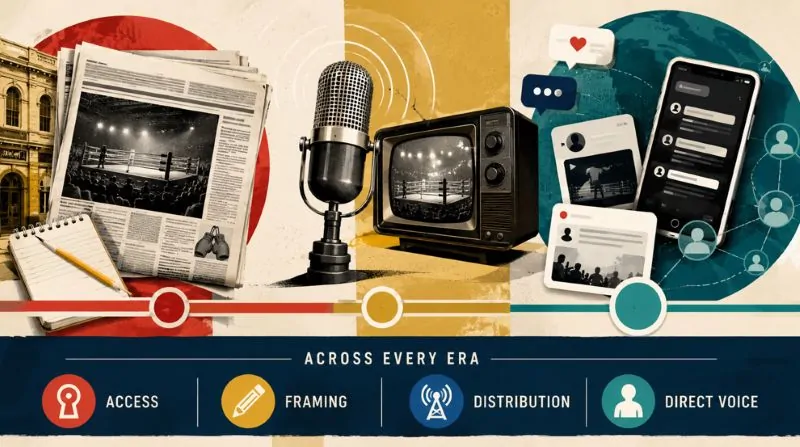
Modern media research helps separate that control into distinct parts. A recent analysis of media influence in elite sport identifies functions including visibility, audience engagement, athlete branding, event promotion, and the shaping of public perception. Applied historically, those functions reveal four practical levers: access to the fighter, framing of the story, distribution of that story, and the fighter’s ability to speak directly. Different institutions held those levers at different times, and few ever controlled all four. This distinction also prevents a common mistake: arranging the contest, reporting it, and defining its public meaning were related activities, but they were never identical.
When Commentary Moved Beyond the Broadcaster
Newspapers once supplied the recurring public record around a bout. Radio later carried a commentator’s voice into homes, while television gave broadcasters control over camera angles, interviews, replays, and the rhythm of the program. Digital publishing widened the field again. Promoters, fighters, journalists, analysts, teams, and commercial publishers could all release their own conversations without waiting for a newspaper column or scheduled broadcast.
That wider field can be seen through Lucky Rebel, which recently published a long-form discussion with combat sports commentator Nick Peet. The platform is a broad sportsbook and casino, rather than a specialist boxing publication, yet the interview format itself belongs directly to the history of fight publicity. The publisher supplies access to a guest and chooses the questions, the guest provides analysis, and a video platform distributes the resulting interpretation. Those roles resemble work once divided among a promoter’s publicity office, a ringside columnist, and a television producer.
Lucky Rebel’s interview also demonstrates an important limit: publishing access does not establish that every prediction or disputed claim is correct. A polished conversation may frame the debate clearly while still presenting opinions that require separate verification. The useful historical point lies in who can now host and circulate an interpretation of boxing, not in treating the conversation as an independent verdict on the sport.
The discussion with Nick Peet makes those separate roles visible because the host, guest, subject, and distribution channel can be identified without assuming that they share the same interests or authority.
Four Levers Across 3 Eras
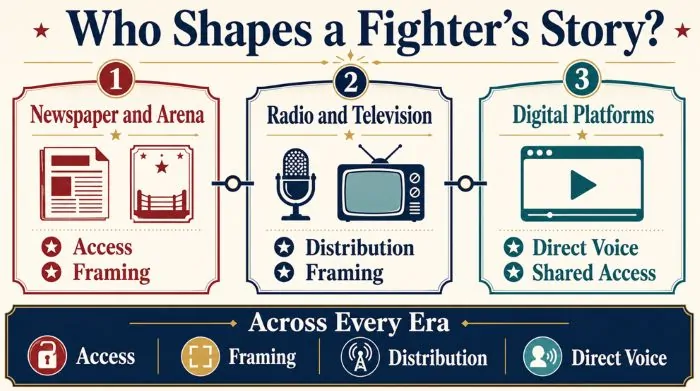
During the newspaper-and-arena period, promoters had their greatest influence over access. They arranged appearances, supplied statements, invited reporters, and decided which personalities would be placed before the public. Newspapers held substantial framing power because headlines, profiles, cartoons, and fight reports could turn a boxer into a hero, villain, curiosity, or symbol of a wider conflict. Repetition mattered: a name seen across advertisements, previews, and columns could become familiar before many readers had watched the fighter compete. A promoter could propose the story, but editors and writers could redirect it.
Radio and television shifted power toward distribution. A newspaper account could be reread, but a broadcast created a shared appointment and placed commentators between the contest and the distant audience. Television added image selection. Producers decided when viewers saw a close-up, a corner conversation, an interview, or a replay. Commentary could emphasize courage, tactics, controversy, or personality, while the pictures supplied their own evidence. Promoters still controlled the event and much of the access, but broadcasters shaped the version experienced outside the arena.
The platform period has strengthened direct voice. Fighters can publish training footage, statements, interviews, and responses through their own accounts. Promoters and broadcasters no longer possess exclusive control over when an athlete can address the public. That freedom remains partial, however. Platforms determine recommendation systems, visibility rules, technical formats, and account access. Editors, camera operators, and advisers may also shape material presented as a fighter’s direct voice. A fighter may control the message while depending on someone else’s machinery to deliver it.
Direct Access Is Not Independent Coverage
Digital sport has also produced roles that sit between publicity and journalism. A study of 28 in-house sports reporters in the United States and Austria found that these communicators often used journalistic practices while also identifying themselves as members of the organizations they covered. Their privileged access could produce detailed stories, but their institutional position affected how they understood their work and audience.
That distinction helps readers assess any modern fight story. First ask who obtained access. Then identify who framed the question, who distributed the answer, and whether the fighter or guest spoke through an intermediary. These questions do not automatically prove bias or accuracy. They show which form of control is operating.
Promoters remain important because events still require organization, publicity, and an audience. Their historical monopoly over the public story has weakened, though. Newspapers, broadcasters, fighters, in-house communicators, independent analysts, and commercial publishers now compete to define what a contest means. The clearest account often begins by separating those voices, rather than assuming that the loudest one controls the whole story.
About the Author