The Dresden Codex transformed recurring lunar cycles into eclipse warnings, joining sophisticated Maya mathematics with divination, ritual preparation, and sacred authority.

By Matthew A. McIntosh
Public Historian
Brewminate
Introduction: Counting the Darkness
At midday, the Sun begins to disappear. Its light weakens, shadows sharpen, animals alter their behavior, and a familiar landscape assumes the color of evening. For those standing within the path of totality, the transformation can seem less like an ordinary celestial event than a failure of the world itself. Yet an eclipse is not an eruption of chaos. It belongs to recurring relationships among the Sun, Earth, and Moon, and therein lay the intellectual challenge confronted by Maya calendar specialists: how could an event experienced as a terrifying rupture be recognized as part of a pattern and anticipated through the counting of days?
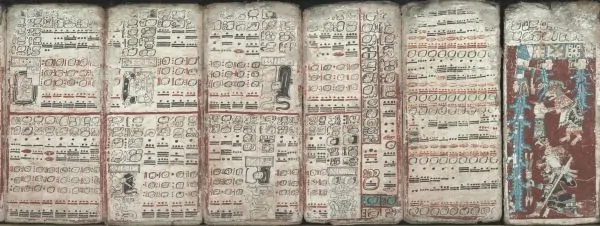
The most elaborate surviving Maya response to that challenge appears on pages 51 through 58 of the Dresden Codex, a Late Postclassic screenfold manuscript preserving astronomical, calendrical, divinatory, and ritual knowledge inherited from much older traditions. Across these pages, columns of bar-and-dot numerals, day signs, interval numbers, abbreviated texts, and images of deities beneath darkened celestial bands form what scholars commonly call the eclipse table. Its arithmetic advances through groups of five or six lunar months, the intervals separating successive seasons in which eclipses could occur. The table does not resemble a modern ephemeris: it supplies neither maps of solar-eclipse paths nor precise calculations of local magnitude and duration. It instead identifies recurring dates on which the alignment of celestial cycles made an eclipse possible. That distinction is essential, for the narrow path of a solar eclipse meant that many anticipated events would not have been visible from any particular Maya community. The table predicted windows of celestial danger rather than promising that darkness would fall at a specified place and hour.
To describe the Dresden table as either “science” or “religion” is to impose a division that its makers did not recognize. Numerical precision did not strip an eclipse of sacred significance, while ritual interpretation did not make sustained observation and sophisticated computation unnecessary. Maya specialists counted lunations because celestial recurrence mattered, but recurrence mattered in part because the heavens communicated conditions of danger, disorder, affliction, and change. Dates generated through astronomical calculation entered a divinatory calendar in which different moments possessed distinctive qualities and demanded appropriate forms of attention. The table’s mathematics and imagery consequently performed complementary tasks: numbers identified when darkness might come, while texts and divine figures helped establish what that darkness could mean.
The eclipse table is best understood as a technology for managing sacred uncertainty. Its makers did not require a geometrical model of lunar nodes or an exact theory of orbital motion to recognize that eclipses clustered at patterned intervals. By coordinating accumulated observations with a schematic lunar calendar, they transformed rare and apparently unpredictable disruptions into events that could be approached through preparation, interpretation, and ritual action. Recent scholarship has strengthened the case that the table emerged from a long process of observation, construction, revision, and recalibration rather than from a single moment of discovery. Even so, reconstructing its operation requires caution: the surviving codex contains no instruction manual, and modern demonstrations of what its arithmetic could accomplish do not automatically reveal how every historical user understood it. The significance of the Dresden table lies neither in celebrating the Maya as precursors of modern astronomers nor in reducing their calculations to religious symbolism. It lies in the union of empirical discipline and ritual purpose through which celestial darkness became countable, meaningful, and within limits, foreseeable.
A Book That Survived: The Dresden Codex in Material and Historical Context
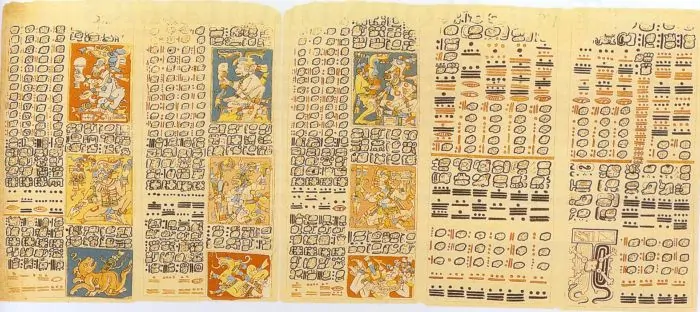
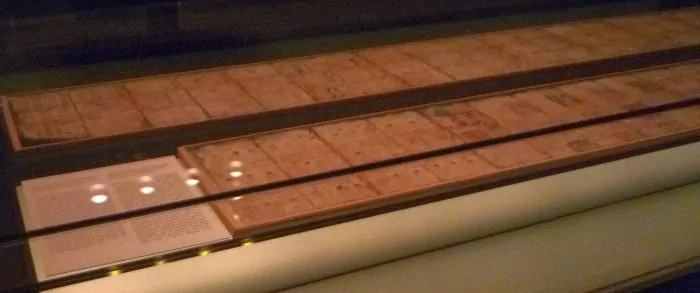
The Dresden Codex is not merely a container for Maya astronomical knowledge; it is a carefully manufactured instrument through which that knowledge was organized and used. The surviving manuscript comprises thirty-nine leaves, thirty-five painted on both sides and four on only one, producing seventy-four inscribed pages. Each leaf measures approximately 20.5 centimeters high and 9 centimeters wide, while the complete strip extends about 3.56 meters when unfolded. Its accordionlike construction allowed readers to expose a single page, compare neighboring pages, or open a longer sequence of calculations simultaneously. That flexibility was valuable for a manuscript whose almanacs and astronomical tables depended upon relationships extending across multiple columns and pages.
The physical support was made from bark fibers soaked, beaten, and felted into a paperlike material often called amate, although the Maya term hu’un more directly connects the object with Indigenous concepts of both paper and books. Artisans covered the prepared surface with a thin ground containing calcium carbonate, creating a smooth white field suitable for extremely fine writing and painting. Scribes applied black signs primarily with soot-based ink, while hematite supplied red tones used for numerals, frames, and divisions. The celebrated pigment now known as Maya blue combined indigo with palygorskite clay to produce a color unusually resistant to fading and chemical deterioration. Quills and brushes made from animal hair permitted both compact hieroglyphic writing and delicately controlled figures. Horizontal and vertical red lines divided many pages into registers and columns, turning the manuscript surface into an ordered field of text, image, and numerical notation. Protective wooden covers, possibly covered with jaguar skin, may once have enclosed the folded strip, although those elements have not survived. The finished codex was the product of specialized knowledge extending well beyond astronomy: papermaking, mineral and organic pigment preparation, calligraphy, painting, calendrical computation, and book design converged in a single object. The manuscript was also a collaborative and cumulative production rather than the spontaneous creation of one isolated genius. Differences in handwriting, figure style, spacing, and color use reveal the work of several painter-scribes, although scholarly estimates of their precise number have varied. Some pages exhibit carefully balanced compositions, while others contain crowded numerals, compressed captions, corrections, and additions that suggest adaptation during copying.
These differences indicate that the codex combined materials derived from distinct exemplars or bodies of specialist knowledge. Its makers were not simply reproducing words; they were coordinating calculations, ritual prescriptions, calendrical dates, and images whose proper alignment was essential to the book’s operation. The surviving manuscript is usually assigned to the Late Postclassic period and associated with northern or northeastern Yucatán, but neither its exact place nor its date of manufacture has been established securely. Proposals range broadly across the thirteenth through fifteenth centuries CE, depending upon whether greater weight is given to artistic style, language, historical conditions, or the dates encoded in its astronomical sections. Whatever the date of the physical object, many of its computations and ritual structures preserve intellectual traditions reaching substantially farther into the Maya past.
Its survival becomes more extraordinary when placed against the destruction of the wider Maya manuscript tradition. Only four precolonial Maya screenfold books are now securely recognized: the Dresden, Madrid, and Paris codices and the manuscript known as the Maya Codex of Mexico. These remnants cannot represent more than a minute and accidental sample of the books once maintained in courts, temples, scribal schools, and centers of divination. Heat, insects, humidity, warfare, political disruption, and repeated use undoubtedly destroyed many manuscripts even before Europeans reached the Americas. Spanish conquest and Christian evangelization then produced a more deliberate assault upon Indigenous textual authority, the most notorious documented instance being Diego de Landa’s destruction of books and sacred objects at Maní in 1562. Yet the catastrophic loss should not be reduced to that single event, for manuscript destruction accompanied a much broader suppression of Maya religious institutions, literate specialists, and systems of knowledge. What survives consequently reflects historical contingency rather than an intentional archive: the Dresden Codex appears comprehensive largely because almost everything that might have contextualized it has vanished.
Nothing certain is known of the manuscript’s movements between Yucatán and eighteenth-century Europe. Johann Christian Götze, librarian and court chaplain to the elector of Saxony, acquired it from an unidentified private owner in Vienna in 1739 and initially described it simply as a Mexican book filled with unfamiliar characters and colored figures. Suggestions that it traveled through Spain, belonged to a Habsburg collection, or formed part of the objects sent to Charles V remain plausible but unproven. The absence of a secure chain of ownership makes the codex both a survivor of colonial destruction and an object displaced through the collecting networks created by European empire.
European custody preserved the codex, but it also altered the object through handling, repair, exhibition, and rearrangement. By 1786, the connecting membranes between its increasingly brittle leaves required replacement, an intervention that may have disturbed their original order. Alexander von Humboldt reproduced several pages in his monumental study of the Americas in 1810, bringing portions of the manuscript to a wider learned audience. In 1825 and 1826, the Italian artist Agostino Aglio copied the entire codex for Edward King, Viscount Kingsborough, whose Antiquities of Mexico published those images in 1831. To facilitate storage and exhibition, Dresden librarian Constantin Karl Falkenstein divided the long screenfold into two sections in 1835 and enclosed them between glass panes. Scholars recognized the manuscript as specifically Maya during the middle of the nineteenth century, rather than treating it merely as an undifferentiated “Mexican” curiosity.
Ernst Wilhelm Förstemann’s facsimiles of 1880 and 1892 then made the full document available for systematic study and established page conventions that remain influential. Working before Maya writing could be read phonetically, Förstemann nevertheless deciphered much of the numerical, calendrical, and astronomical structure of the manuscript. His discoveries transformed an exoticized museum treasure into one of the principal sources for reconstructing Maya intellectual history. Modern readers must remember that the familiar pagination and present arrangement of the eclipse table emerged partly from this history of physical intervention and scholarly reconstruction.
The codex narrowly survived another catastrophe during the Second World War. It was removed to a bank vault at Schirgiswalde in 1939 but returned to a supposedly secure cellar beneath Dresden’s Japanese Palace shortly before the bombing of February 1945. When the palace was destroyed, water entered the cellar and penetrated the steel cabinet containing the manuscript. Its glass enclosure limited the damage, but moisture reached the margins, and portions of the brittle painted ground adhered to the glass when conservators opened the case. Several leaves were subsequently returned in the wrong orientation, while some glyphic and pictorial details suffered permanent loss. Earlier facsimiles consequently preserve information that can no longer be recovered from the original surface, making the history of reproduction part of the codex’s continuing interpretation. The manuscript is now maintained under closely controlled light, temperature, and humidity conditions, while high-resolution digital images reduce the need for direct handling. Its present form records multiple histories at once: Maya manufacture and revision, colonial displacement, European collecting, scholarly reordering, wartime damage, and modern conservation. The eclipse table that survives within it is not an untouched message from the past but knowledge carried through a material object whose preservation depended upon repeated acts of contingency, intervention, and care.
Before Dresden: Lunar Reckoning and the Communities of Specialists
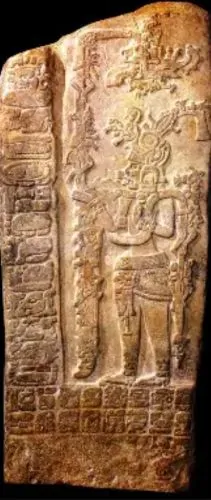
Long before the Dresden Codex was painted, Maya scribes were attaching lunar information to dates carved on monuments and incorporated into painted texts. The unprovenanced Hauberg Stela, conventionally dated to approximately 199 CE, contains an early form of lunar notation that anticipates components of the later Lunar Series. By the Classic period, rulers at Palenque, Copán, Tikal, Yaxchilán, Quiriguá, and numerous other cities commissioned inscriptions that located dynastic and ritual events within the changing age of the Moon. Lunar records survive on approximately two hundred monuments, demonstrating that this was neither an isolated courtly curiosity nor the invention of one regional school. Their placement beside Long Count dates made the Moon part of the temporal identity of an accession, dedication, birth, death, military victory, or commemoration. The Dresden eclipse table consequently emerged from a culture in which specialists had already spent centuries coordinating observed lunar change with written history.
The mature Lunar Series recorded several kinds of information within a compact sequence of hieroglyphs. Modern scholars assigned its components alphabetical names before their language and syntax were understood, and those conventional labels remain useful even though they do not reproduce Maya terminology. Glyphs D and E stated the Moon’s age by counting the days elapsed within the current lunation, while Glyph A indicated whether that lunar month was treated as twenty-nine or thirty days long. Glyph C identified the lunation’s position within a sequence of six months and associated that sequence with one of several divine patrons. Glyphs X and B supplied additional names or identities connected with a larger cycle of eighteen lunations formed from three six-month groups. No single component was merely decorative: numerals, deity heads, verbal expressions, and Moon signs worked together to place an observed phase within an ordered sequence. Because a true synodic month lasts slightly more than twenty-nine and one-half days, the alternation of twenty-nine- and thirty-day months permitted whole-number notation to follow the Moon with considerable accuracy. The eighteen-month organization may also have assisted specialists in recognizing intervals associated with eclipse recurrence, although the inscriptions themselves do not explain the full purpose of every lunar patron or sequence.
Long-range reckoning required more than a simple alternation of month lengths. The system reconstructed from Palenque inscriptions equated eighty-one lunations with 2,392 days, producing an average month of approximately 29.53086 days, remarkably close to the modern mean. Evidence from Copán supports another approximation in which 149 lunations occupied 4,400 days, yielding an average of about 29.5302 days. These ratios show that Classic Maya specialists could correct the accumulated error produced by an unvarying twenty-nine-and-thirty-day alternation. They also caution against imagining a single lunar standard imposed uniformly across the Maya world, since different cities and periods could employ related but not identical practices.
The most revealing evidence for the labor behind these records was discovered in Structure 10K-2 at Xultun in northeastern Guatemala. Excavation exposed a small Late Classic chamber whose walls carried portraits of seated and kneeling men, calendrical inscriptions, immense numerical counts, and more than fifty painted or incised mathematical microtexts. Several figures bear the title taaj, meaning “obsidian,” which appears to have distinguished members of a ranked body of courtly specialists. On the east wall, a lunar table advances through twenty-seven columns representing successive periods of 177 or 178 days, each approximately equal to six synodic months. The complete reconstructed array spans 4,784 days and 162 lunations, exactly twice the eighty-one-lunation Palenque ratio, and produces an average lunar month of approximately 29.53086 days. Deity heads placed above the columns connect the arithmetic with the patron figures known from Glyph C of monumental Lunar Series. The wall was not composed like a finished public inscription, for calculations were crowded into available spaces, placed over parts of the earlier mural program, and sometimes written on renewed patches of plaster. Different degrees of scribal skill, repeated replastering, corrections, and adjacent calculations suggest prolonged use by more than one practitioner. Implements associated with paper preparation found in the building and nearby contexts further support the identification of the complex as a place where codices could be manufactured or planned. Xultun preserves something almost entirely absent from royal monuments: not only the impressive result presented to a ruler or public audience, but traces of the experimentation, checking, teaching, and revision that made such results possible.
The specialists responsible for this work are no longer entirely anonymous. A reconstruction published in 2026 identified an attribution attached to Text 19 on the east wall of Structure 10K-2, naming Sak Tahn Waax, or “White-chested Fox.” Although Text 19 concerns the commensuration of calendrical units with cycles associated with Venus and Mars rather than the lunar table alone, it belongs to the same working environment and intellectual culture. Its formula arranges six calendrical and astronomical intervals within a span of 2,920 days, while its concluding phrase can be understood as “so says Sak Tahn Waax.” The wording may identify the person who devised and painted the calculation, or it may credit an authority whose work another scribe recorded. Either interpretation provides the only presently known direct attribution of a Classic Maya mathematical-astronomical formula to a named individual. The discovery gives human definition to a tradition too easily described through the impersonal language of “Maya achievement”: particular scholars observed, calculated, instructed, disputed, copied, and occasionally claimed recognition for their intellectual work.
Xultun does not prove that the Dresden eclipse table descended directly from a manuscript produced in Structure 10K-2. Several centuries, substantial political transformations, and important regional differences separate the Late Classic workspace from the surviving Late Postclassic codex. What Xultun establishes is the existence of institutional settings in which astronomical calculations were created, tested, taught, and prepared for preservation in books. Its walls show that numerical tables could be cumulative products, retaining inherited ratios while permitting local adjustment and new combinations. Monumental Lunar Series likewise demonstrate that lunar reckoning moved among courts and that its conventions changed as different scribal communities adopted them. When the Dresden table employed familiar groups of five and six lunations, intervals of 177 and 178 days, and a total compatible with multiples of the 2,392-day ratio, it drew upon intellectual resources already deeply rooted in Maya history. The continuity lay less in the mechanical copying of one immutable document than in a durable method: observe celestial recurrence, express it through whole-number intervals, coordinate it with calendrical cycles, and transmit the result through trained communities. The Dresden Codex is the lone surviving manuscript witness to a scholarly world that was once populated by many practitioners, workshops, calculations, and books.
Many Calendars, One Computation: The Architecture of Maya Time

The calculations preserved in the Dresden Codex rested upon a conception of time more intricate than the operation of any single calendar. A given day could occupy a position within a 260-day divinatory cycle, bear a month-and-day designation within a 365-day year, stand at a precise distance from an established chronological origin, and coincide with a particular phase of the Moon or appearance of a planet. These identities did not compete with one another; they described different properties of the same moment. Maya specialists could move between ritual recurrence, seasonal reckoning, historical chronology, and astronomical periodicity while retaining the distinctions among them. The eclipse table became possible because these multiple temporal systems could be coordinated through a shared language of whole numbers and counted days.
Maya numerical notation supplied that language with remarkable economy. A dot represented one, a bar represented five, and combinations of the two expressed the numbers from one through nineteen. A sign often resembling a shell denoted zero, allowing an empty position to be distinguished from an omitted or unknown quantity. Numbers could be written positionally, with each successive level representing a larger power of twenty, although calendrical notation modified strict vigesimal progression at one crucial point. One k’in equaled a single day, twenty k’in formed a winal, and eighteen winal, rather than twenty, formed the 360-day tun. Twenty tun produced a 7,200-day k’atun, while twenty k’atun produced a 144,000-day b’ak’tun. The departure from pure base twenty brought the tun into rough correspondence with the solar year without making it identical to the 365-day calendar. Scribes could combine these units into enormous totals, subtract one recorded date from another, or use Distance Numbers to project a stated interval forward or backward. Their arithmetic did not depend upon decimal fractions: carefully selected integer ratios allowed fractional astronomical periods to be represented with enough accuracy for long-range calendrical work.
The cycle conventionally called the Tzolk’in combined thirteen numerical coefficients with twenty named day signs, both advancing by one position each day. Because thirteen and twenty share no common factor, the same number-and-sign combination returned only after 260 days. The count was not a schematic solar year or a direct representation of the lunar month; it ordered days according to a sequence employed in divination, naming, ritual scheduling, and the interpretation of human and communal circumstances. Each position inherited associations from its coefficient, day sign, and relationship to neighboring days, making recurrence qualitative as well as numerical. Colonial and modern Indigenous daykeeping traditions illuminate the importance of those qualities, although they cannot be projected unchanged onto every Classic or Postclassic Maya community.
Alongside the 260-day count operated the 365-day calendar generally known as the Haab. It consisted of eighteen named periods of twenty days followed by the five-day interval called Wayeb, producing a schematic year without regular intercalation. A Haab date joined a numbered day to a named period, but that designation alone did not specify a unique historical year. Pairing it with a Tzolk’in date created what modern scholars call a Calendar Round date. Because 260 and 365 have a least common multiple of 18,980, a particular combination of the two calendars recurred after fifty-two Haab years, equivalent to seventy-three complete Tzolk’in cycles. The Calendar Round distinguished a day within a span of approximately fifty-two years, a duration long enough to frame much ritual and social memory but too short to establish an unambiguous place in dynastic history. Its structure also demonstrates a central feature of Maya calendrical thought: cycles of unequal length could generate a much larger cycle through their eventual return to a shared starting position. The result was not simply a convenient date label, for the conjunction brought together the ritual identity of the Tzolk’in day and the annual identity of the Haab position.
Historical anchoring was supplied most visibly by the Long Count. Rather than naming only a recurring position, it stated the number of days elapsed from a remote era base represented in many inscriptions as 13.0.0.0.0 and associated with the Calendar Round date 4 Ajaw 8 Kumk’u. Classic-period scribes used this count to locate royal births, accessions, wars, deaths, period endings, and dedications within a chronology extending far beyond a human lifetime. They could also calculate backward into mythic antiquity or forward to anniversaries lying centuries beyond the inscription’s dedication. The Long Count joined linear accumulation to cyclical recurrence: its total advanced continuously, while its component periods reached endings that invited commemoration and renewal. Disagreement over the exact correlation between Maya and European chronologies complicates modern historical conversion, but it does not alter the internal coherence of the recorded calculations.
The coordination of these systems depended upon commensuration, the search for intervals at which independently generated cycles approached or attained a common position. The Calendar Round offers the clearest exact example, since 18,980 days completes both fifty-two 365-day years and seventy-three 260-day cycles. Astronomical periods rarely yielded such perfect relationships because the observed synodic month and planetary cycles contain fractions that cannot be expressed exactly as whole days. Maya specialists addressed the problem by choosing large integers whose ratios approximated the celestial period with very little accumulated error. The eclipse table’s canonical span of 11,960 days exemplifies this practice. That total equals exactly forty-six repetitions of the 260-day divinatory calendar and approximates 405 synodic lunations with an error of only a fraction of a day. It also equals five repetitions of the Classic Maya ratio that assigned 2,392 days to eighty-one lunar months. After the completion of the table, the Moon returned extremely close to the same phase while the Tzolk’in returned exactly to the same numbered day sign. The Haab did not return to its initial position, revealing that the interval was selected to coordinate the lunar and divinatory cycles rather than to force every calendar into simultaneous agreement. Through that choice, a long lunar sequence acquired a stable ritual architecture: dates separated by the full span could possess the same Tzolk’in identity even as they belonged to different annual and historical settings.
This architecture made Maya time neither wholly circular nor simply linear. Days returned through named cycles, but each recurrence occurred at a different Long Count position, under changing political conditions, and within celestial cycles that required continued observation and adjustment. A table could consequently preserve a formal sequence while remaining open to recalibration against the sky. Its operator needed to understand not only how many days had elapsed, but which kind of cycle was relevant to the question being asked. In the Dresden eclipse pages, lunar arithmetic identified recurring opportunities for darkness, the 260-day calendar assigned those opportunities recognizable ritual positions, and chronological counts allowed the sequence to be anchored and renewed. The table’s astronomical power emerged from this integration: Maya specialists made the movements of the heavens computable by placing them within an already interconnected temporal world.
The Astronomical Problem: Why Eclipses Recur but Do Not Simply Repeat
An eclipse requires more than the appropriate lunar phase. A solar eclipse can occur only at new moon, when the Moon passes between Earth and the Sun, while a lunar eclipse requires a full moon, when Earth stands between the Sun and Moon. If the Moon orbited Earth in precisely the same plane that Earth follows around the Sun, one solar and one lunar eclipse would occur during nearly every synodic month. Instead, the lunar orbit is inclined by approximately 5.1 degrees to the ecliptic, so the new or full moon ordinarily passes above or below the necessary alignment. Eclipses become possible only when the Moon reaches the correct phase sufficiently near one of the two points at which its orbit crosses the ecliptic. Modern astronomers call these intersections the ascending and descending nodes, although using that vocabulary to explain the Dresden table does not imply that Maya specialists described the geometry in identical terms.
The positions of the nodes do not remain fixed against the stars. They move slowly westward around the ecliptic, completing a revolution in approximately 18.6 years and causing the Sun to encounter successive nodal regions at intervals averaging about 173.3 days. Each encounter produces an eclipse season, a period of several weeks during which new and full moons may fall close enough to a node for eclipses to occur. Because 173.3 days equals slightly less than six synodic months, one season is ordinarily followed by another after either five or six lunations. Five mean lunations occupy approximately 147.7 days, while six occupy approximately 177.2 days, explaining why eclipse-warning sequences can advance through intervals close to 148, 177, or 178 days. A season may contain both solar and lunar eclipses, and under favorable circumstances it can include more than one eclipse of the same kind. What repeats is not one isolated event at a perfectly regular interval but a shifting opportunity created by the temporary convergence of lunar phase and nodal position. Recognizing that rhythm would have allowed an observer to identify periods of eclipse possibility without calculating an orbit or representing an invisible node geometrically. The intervals written in the Dresden Codex encode precisely this practical regularity.
Recurrence nevertheless falls short of exact repetition because the principal lunar cycles do not divide evenly into one another. The synodic month measures the return from one new moon to the next, the draconic month measures the Moon’s return to the same node, and the anomalistic month measures its return to perigee, where it is nearest Earth. After 223 synodic months, approximately eighteen years and eleven days, the three cycles approach their former relationship closely enough to generate a similar eclipse, but the match is imperfect and the interval contains roughly an additional eight hours beyond a whole number of days. Each recurrence consequently shifts in geography and changes slightly in magnitude, duration, and position relative to the node, while an entire sequence eventually begins with marginal eclipses, develops toward central ones, and disappears again.
Geographical visibility makes the problem still more complicated. A lunar eclipse occurs when the Moon enters Earth’s shadow and can be seen from most of the terrestrial hemisphere where the Moon is above the horizon, making the same event available to observers spread across an enormous region. A solar eclipse casts the Moon’s shadow upon Earth, but totality or annularity is confined to a comparatively narrow moving path, while a much larger surrounding area experiences only a partial eclipse. An alignment capable of producing a dramatic solar eclipse somewhere on Earth might produce no visible effect at all in Yucatán, Petén, or another Maya region. Even an eclipse geometrically visible from part of the Maya world might occur below the horizon, be obscured by clouds, or remain imperceptibly small at a particular community. “Predicting an eclipse” can describe several distinct accomplishments: identifying a lunation in which an eclipse is astronomically possible, determining that the event may be visible within a broad territory, forecasting its appearance at one locality, or calculating its path, magnitude, and duration. The Dresden table most securely operated at the first level, although competing reconstructions argue that its structure could also have been calibrated to favor solar eclipses visible somewhere within Maya territory. Such a system inevitably produced warnings that were not confirmed by local observation, but those apparent false alarms were a rational consequence of using a regional recurrence scheme for events governed by narrow and changing paths. Exact local visibility demanded information and geometrical methods different from those required to identify dangerous eclipse seasons.
The historical importance of the table does not depend upon crediting its makers with modern celestial mechanics. Repeated observation could reveal that eclipse opportunities clustered after characteristic groups of lunations, while written arithmetic could preserve and extend those relationships far beyond any individual observer’s lifetime. Maya specialists needed neither a diagram of orbital planes nor a physical explanation of nodal regression to construct a reliable conditional statement: during certain lunar stations, an eclipse might occur. That limited prediction was nevertheless socially and intellectually consequential because it transformed an apparently irregular celestial disruption into a scheduled possibility requiring observation, interpretation, and perhaps ritual preparation. The appropriate measure of the Dresden table is not whether it named every locally visible eclipse without error, but whether it organized the recurrence of celestial danger well enough to make uncertainty actionable.
Opening the Table: How to Read Pages 51a–58b
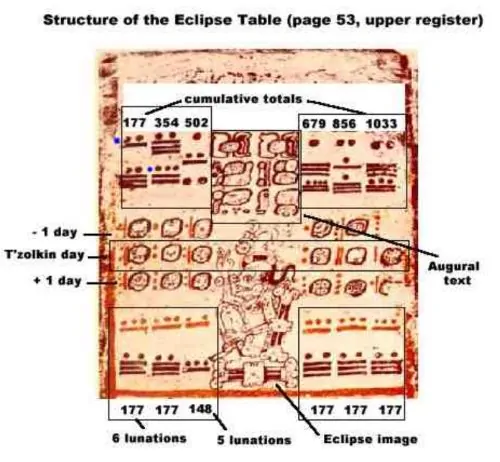
The eclipse table does not follow the page-by-page sequence that a modern reader might instinctively expect. Scholars divide each page into an upper register, designated “a,” and a lower register, designated “b.” The sequence begins by moving across the upper halves of pages 51 through 58 and then returns to page 51 to continue across the lower halves through page 58b. This arrangement made practical sense in an accordion-fold manuscript, where several leaves could be opened together and read as a continuous horizontal field. What now appears to be a series of separate pages originally functioned as one extended computational surface.
Pages 51a and 52a form a preface rather than the regular body of the table. They contain chronological and numerical materials that situate the calculation within linear time, relate its base to the Long Count, and connect the table’s 11,960-day span with larger multiples of that interval. Page 52a also includes a vertical series of thirteen red thirteens and several intertwined red and black numbers whose precise functions remain disputed. Some scholars have interpreted these elements as devices for extending, resetting, or recalibrating the table, while others have connected them with cosmological symbolism or more specialized numerical procedures. The accompanying hieroglyphic passages do not provide a straightforward set of instructions that resolves the issue. These pages nevertheless announce that the sequence was designed for repeated use rather than as a record of one isolated group of eclipses. They establish a chronological framework before the operator enters the succession of lunar stations beginning on page 53a.
The principal table consists of sixty-nine narrow columns, each marking a lunar station within the full span of 405 lunations. Every column combines several kinds of information: a short hieroglyphic caption, an interval from the preceding station, a cumulative count from the base, and a group of three Tzolk’in dates defining the calendrical position of the warning. Nine portions of the sequence expand beyond this compact format to include longer texts and painted figures. The result is not a continuous prose explanation but a repeated visual grammar through which a trained reader could move from one anticipated celestial window to the next.
A representative column can be read from its recurring components. Near its top, a short glyphic caption identifies or characterizes the station, although many of these compressed expressions remain only partly understood. A prominently written cumulative number states how many days have elapsed since the table’s starting point, allowing the operator to locate the station within the complete sequence. A separate interval number, normally 148, 177, or 178, records the distance from the preceding column. Below or alongside these numbers appears a sequence of three positions in the 260-day calendar, providing a narrow range of ritually identified days associated with the eclipse possibility. The colors help distinguish functions: cumulative totals are commonly emphasized in red, while interval counts and other numerical components appear in black, though the distinction is not perfectly consistent throughout the manuscript. The operator could add the interval to the previous cumulative total, compare the result with the written total, and verify that the corresponding Tzolk’in dates advanced correctly. A column was not merely a date but a bundle of mutually reinforcing information linking lunar recurrence, elapsed time, calendrical identity, and divinatory meaning.
The station intervals reveal immediately that the table does not list every new moon. An interval of 148 days represents five schematic lunar months, while 177 or 178 days represents six, advancing the reader from one eclipse-capable region of the lunar sequence to another. The difference between 177 and 178 days accommodated the fact that six actual lunations could not always be represented adequately by the same whole-number total. Because the Maya counted months as twenty-nine or thirty days, small variations in their distribution were necessary to prevent the modeled Moon from drifting too far from observation. The columns consequently form a selective itinerary through the lunar calendar, preserving those stations needed to maintain the table’s cadence rather than recording every phase along the way.
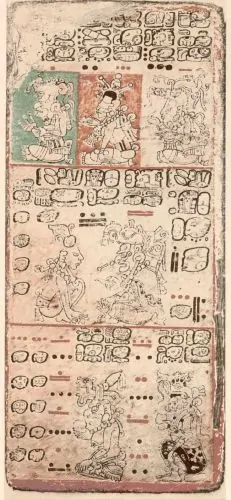
The manuscript’s pictures interrupt and organize this numerical progression. On nine occasions, a run of compact columns is followed by a larger caption and an image, visually distinguishing groups of stations while associating them with particular celestial or divine conditions. Figures appear beneath sky bands containing solar, lunar, day, night, or darkening signs, and some images portray celestial bodies threatened, covered, or approached by serpentine or monstrous beings. At page 57b, for example, the imagery joins the darkened Sun with a creature poised to engulf it, while the accompanying text also refers to the disappearance of Venus as evening star. Such combinations warn against assuming that every picture illustrates only one astronomical event. The images supplied ritual and environmental consequences to the dates, while their placement created recognizable pauses within a long series of nearly identical numerical columns. Red numerals, black calculations, repeated day signs, open spaces, extended captions, and painted beings together provided visual landmarks that helped an experienced user retain a position within the table. Its design was operational: page architecture performed part of the intellectual work that a modern table might assign to headings, grid lines, symbols, and explanatory notes.
Not every component was copied or fitted together perfectly. Certain totals imply the addition of 178 days even where the displayed interval appears to read 177, while cramped additions, damaged signs, uneven spacing, and probable corrections reveal the difficulties of transferring a long computational sequence into a finished manuscript. These irregularities do not make the table unusable, because its repeated layers of information allowed a knowledgeable operator to recognize many discrepancies by checking intervals against totals and calendrical dates. Pages 51a–58b consequently preserve more than a sequence of eclipse warnings: they expose a working document in which computation, scribal transmission, visual organization, and ritual interpretation had to remain aligned.
The Arithmetic of the Moon: Twenty-Nine, Thirty, and 11,960 Days
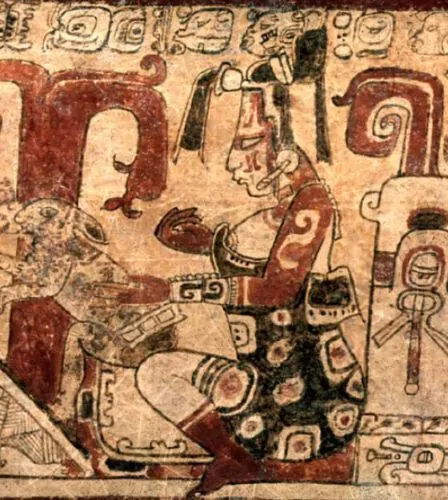
The Moon does not organize its phases into an integral number of days. A mean synodic month, the interval from one new moon to the next, lasts approximately 29.53059 days, while individual lunations vary slightly because the Moon’s orbital speed and distance from Earth are not constant. Maya calendar specialists nevertheless worked within a day-based notation that required each schematic month to receive a whole-number length. By assigning twenty-nine days to some lunations and thirty to others, they converted an incommensurable celestial period into a sequence that could be written, added, checked, and projected. The apparent simplicity of those two integers concealed the more difficult task of distributing them so that the calculated Moon did not drift steadily away from the observed one.
A strict alternation of twenty-nine- and thirty-day months produces an average of 29.5 days, too short to remain accurate indefinitely. Maya specialists had to interrupt the regular alternation by occasionally assigning thirty days where a twenty-nine-day month would otherwise have occurred. The effects of those adjustments become visible in the packets used by the Dresden table. Five actual lunations average approximately 147.65 days and are consistently represented by intervals of 148 days. Six average approximately 177.18 days and can be represented by either 177 or 178 days. An ordinary 177-day group can be divided into three twenty-nine-day and three thirty-day months, while a 178-day group requires four thirty-day months and only two twenty-nine-day months. The extra day in the latter group functions as an intercalation, correcting some of the shortfall created by the basic alternation. Each interval remained easy to manipulate with integers, yet the sequence approximated the fractional lunar period far more closely than any individual schematic month could do.
The full table contains sixty six-lunation intervals and nine five-lunation intervals. Its underlying count is 60 x 6 + 9 x 5 = 405 lunar months, organized into sixty-nine computational groups. Seven of the six-month groups contain 178 days, while the remainder contain 177; all nine shortened groups contain 148 days. This arrangement allowed the operator to move selectively from one eclipse-capable lunation to another without losing the continuous lunar count beneath the selected stations.
Several closely related totals must be distinguished when reading the manuscript. The station intervals imply 11,959 elapsed days, but the final cumulative number was copied as 11,958, an error detectable by adding the preceding intervals and comparing the accompanying Tzolk’in dates. The complete lunar-calendar cycle is conventionally stated as 11,960 days because one additional day carries the count from the final station to the calendrical return that completes the sequence. That total can be expressed through 215 thirty-day months and 190 twenty-nine-day months: 215 x 30 + 190 x 29 = 11,960. Dividing 11,960 by 405 produces a mean schematic lunation of approximately 29.530864 days. The difference between 405 modern mean synodic months and the Maya total is only about 0.111 day, or approximately two hours and forty minutes, across nearly thirty-three years. Such accuracy did not result from treating every observed lunation as identical. It arose from distributing small corrections through a long integer sequence until positive and negative discrepancies nearly canceled. The table’s written error of one day is distinct from the accuracy of the astronomical ratio embodied in its overall design. A flawed numeral within the surviving copy does not erase the far more systematic computation that makes the flaw recognizable.
The choice of 11,960 also coordinated lunar reckoning with other Maya temporal structures. It equals exactly forty-six revolutions of the 260-day divinatory calendar, so completion of the cycle returned the count to the same Tzolk’in coefficient and day sign. It is also five times 2,392 days, the interval that Classic-period evidence from Palenque associates with eighty-one lunations. Five such groups produce 405 months, linking the Dresden total with a ratio already embedded in earlier Maya lunar computation. The correspondence does not prove that the Dresden scribes copied a formula directly from Palenque, but it demonstrates that the table belonged to a much older mathematical tradition. Recent reconstruction further proposes that the 405-month structure began as a general lunar calendar and was only later adapted to isolate eclipse-warning stations. Under that interpretation, eclipse prediction emerged from sustained lunar reckoning: once successive schematic new moons had been tabulated, the recurrence of eclipses among particular positions could be recognized and preserved.
Accuracy across one passage did not make the table perpetually self-correcting. Because 11,960 days exceeds 405 mean synodic months by roughly one-ninth of a day, repeatedly restarting the sequence at its terminal point would accumulate about one day of lunar error after nine passages, or nearly three centuries. Eclipse timing would drift more seriously because the relationship between lunar phase and the moving nodal cycle was not restored exactly by 405 lunations. The newest reconstruction consequently replaces the older image of endlessly repeated identical cycles with overlapping tables begun from empirically advantageous stations before their predecessors expired. Whatever precise renewal procedure was used, observation remained indispensable: arithmetic extended knowledge beyond a lifetime, but comparison with the sky disclosed when inherited numbers required adjustment. The achievement of the Dresden table lay in balancing those two forms of authority. Twenty-nine and thirty made the Moon writable, 177 and 178 kept its modeled phases close to experience, and 11,960 joined lunar recurrence to ritual time without pretending that the heavens ever repeated themselves perfectly.
From Lunar Calendar to Eclipse Warning System
For more than a century, scholars generally approached the Dresden pages as a finished eclipse table whose peculiar length and internal intervals had been chosen expressly for forecasting celestial darkenings. Its sequence of 148-, 177-, and 178-day intervals certainly identifies lunations near recurring eclipse seasons, making that interpretation fundamentally sound at the level of the surviving manuscript. A recent reconstruction by John Justeson and Justin Lowry proposes that the table acquired this specialized purpose through several stages rather than being invented in its final form. In their model, the 405-lunation structure first served as a continuous lunar calendar before selected positions were extracted and reorganized as eclipse-warning stations. Eclipse forecasting developed through the adaptation of an existing calendrical instrument whose original task was to coordinate the Moon with the 260-day divinatory count.
The proposed precursor listed 405 successive schematic lunar months, each represented by twenty-nine or thirty whole days. Over one complete passage, those months occupied 11,960 days and returned the Tzolk’in to precisely the same position after forty-six revolutions. Because the calendrical identity of each lunation could be projected in advance, specialists could compare observed celestial events with recurring positions in the combined lunar and divinatory sequence. The table did not initially need to encode eclipse geometry or distinguish invisible orbital nodes. It supplied a stable framework within which observations made decades apart could be treated as members of the same repeating pattern. After several passages through the lunar calendar, eclipses would have appeared disproportionately near particular groups of lunations separated by recognizable intervals. Sequences of five or six months could then be associated with the return of eclipse possibility, while longer gaps disclosed occasions when an expected season produced no useful regional event. What began as a comprehensive account of every lunation could consequently become a selective map of those lunations that required heightened attention.
The conversion did not preserve all 405 months as equally significant. The surviving table compresses them into sixty-nine stations, most separated by five or six lunations, and the recent reconstruction distinguishes between fifty-five intended warning stations and fourteen constructed positions needed to maintain the sequence’s calendrical organization. Intervals of 148 days represented five lunations, while those of 177 or 178 days represented six, allowing the selected stations to remain close to successive eclipse seasons without listing every intervening new moon. The resulting structure was neither a chronicle of observed eclipses nor a claim that an eclipse would occur at every station; it was a screening device that isolated the dates on which an eclipse was sufficiently possible to justify observation and ritual concern.
Selection alone could not make the warning system permanently reliable. After each 405-month span, the modeled lunar phase returned very close to its starting relation with the Tzolk’in, but it did not return exactly to the same relationship with the nodal cycle governing eclipses. Simply beginning every new table where its predecessor ended would allow small discrepancies to accumulate until some genuine eclipses fell outside the designated stations and some warnings became increasingly misplaced. Justeson and Lowry propose that successive tables began instead at internal positions 223 or 358 lunations after the preceding base, causing the old and new sequences to overlap. Modern astronomy recognizes approximately 223 lunations as a saros and 358 as an inex, but the numerical effectiveness of these intervals does not demonstrate that Maya specialists conceptualized them through the same categories or terminology. Beginning a replacement table at one of these empirically favorable stations realigned its warnings before the older table had ceased to be useful. Modeling a pattern dominated by 358-month transitions but periodically corrected through a 223-month transition produced a sequence capable of including every solar eclipse calculated to have been visible somewhere in Maya territory between approximately 350 and 1150 CE. That result reveals the potential power of the method, although the transition procedure remains a scholarly reconstruction rather than an instruction explicitly preserved in the surviving codex.
Once transformed, the table did not tell its operator that the Sun would certainly disappear from a specified city at a stated hour. It identified clusters of three Tzolk’in dates surrounding selected new moons, thereby marking windows in which an eclipse belonged to the range of celestial possibilities. A specialist could prepare for that interval, watch the sky, interpret the outcome, and use the observation when maintaining or recalibrating later versions. The absence of a visible eclipse did not necessarily invalidate the warning, since the event might occur below the horizon, outside the Maya region, or along a narrow path that missed the observer’s community. Nor should every darkened solar or lunar sign in the accompanying imagery be read as a literal diagram of an eclipse, because some such signs referred more broadly to darkness, rain, and dangerous atmospheric conditions. The completed system joined numerical discrimination to divinatory interpretation: arithmetic narrowed uncertainty to particular days, while texts and images explained the dangers associated with celestial obscuration. In that transformation, a lunar calendar became something more consequential, a multigenerational warning system capable of converting accumulated observation into scheduled vigilance.
Dates That Move
A numerical table becomes historically useful only when its intervals are attached to a particular day. The Dresden eclipse table complicates that apparently simple requirement because its preface contains several kinds of starting point whose functions need not have been identical. A formal base could define the arithmetic structure of the table, a primordial base could connect that structure with the beginning of the Long Count, and a historical base could place a working version near an observed eclipse. Treating every recorded date as the literal first day of the surviving table creates contradictions that disappear once these different roles are separated. The dates “move” not because Maya chronology was unstable, but because the same computational architecture could be projected from different anchors as observation and ritual purpose required.
The best-known formal base is Long Count 9.16.4.10.8, accompanied by the Tzolk’in date 12 Lamat and generally reconstructed with the Haab position 1 Muwan. It appears within a group of three dates spaced fifteen days apart: 9.16.4.10.8 12 Lamat, 9.16.4.11.3 1 Ak’bal, and 9.16.4.11.18 3 Etz’nab. Read astronomically, the sequence could represent two successive new moons surrounding a full moon, or two possible solar-eclipse stations with a possible lunar-eclipse station between them. Yet under widely used correlations between Maya and European chronology, the first date falls in November 755 CE at an unfavorable position relative to the lunar node. This weakness has generated a long dispute over whether 9.16.4.10.8 was an observational base, a calculated “throwback” from a later working date, or one member of a set of concurrently usable entry points. The manuscript itself does not label the date with a modern distinction such as “formal” or “historical.” Its placement and numerical relationships nevertheless suggest that it supplied a canonical point of departure whose importance was not exhausted by its immediate astronomical accuracy.
The table traces this formal date back to an even deeper temporal origin. Its preface invokes 13.0.0.0.0 4 Ajaw 8 Kumk’u, the Long Count era base, and then counts eight days to 13.0.0.0.8 12 Lamat. The interval from that primordial 12 Lamat to the formal base at 9.16.4.10.8 amounts to 1,412,840 days, factorizable as 11 x 13 x 19 x 520. Because 520 days equals two complete Tzolk’in cycles and functioned as a useful canonical eclipse interval, the immense span appears deliberately constructed to give the formal base an arithmetically meaningful ancestry.
That ancestry did not require the table proper to describe the decades immediately following 755 CE. Maya astronomical manuscripts offer a precedent in the neighboring Venus table, whose formal base can be distinguished from later dates that place its stations closer to the actual behavior of Venus. Applying the same reasoning to the eclipse pages allows 9.16.4.10.8 to remain their formal base while a later date supplied the historical anchor for a particular working table. A major reconstruction proposed 10.12.16.14.8 12 Lamat, corresponding under a Goodman-family correlation to April 19, 1083 CE, as the most likely historical base. That date lies exactly ten table lengths, 10 x 11,960 days, after the formal base and coincided with an annular solar eclipse whose path crossed the Yucatán Peninsula. A table beginning there would extend through early 1116 CE and would place its stations within a period rich in solar eclipses observable from Maya territory. More recent analysis retains 1083–1116 as a strong possibility but identifies three other astronomically viable placements: approximately 1043–1076, 1076–1108, and 1116–1148. The 1083 and 1116 bases are attractive because tables beginning on those dates would both open and close with solar eclipses visible somewhere in the Maya region. These alternatives demonstrate the difference between reconstructing the table’s mathematics and proving the exact historical occasion on which the surviving version was prepared.
A working table could not remain accurate merely by completing all 405 lunations and beginning the identical sequence again. Starting every replacement 405 months after its predecessor would progressively displace the warning stations from the lunar nodes, even though the Tzolk’in and modeled lunar phase returned to a close agreement. The recently proposed solution is to begin a successor before the existing table ended, using favorable stations 358 or 223 lunations after the preceding base. The resulting tables would overlap by forty-seven or 182 lunations respectively, preserving continuity while shifting the historical anchor to a new observed alignment. In modern terminology, 358 lunations approximate an inex and 223 a saros, although Maya specialists need not have named or theorized those intervals in the same way. Modeling four 358-month transitions for every 223-month transition limits cumulative drift and produces a sequence capable of warning of every solar eclipse calculated to have been visible somewhere in Maya territory between approximately 350 and 1150 CE. Recalibration was not an occasional repair to a defective system; it was the procedure that allowed a finite table to remain predictive across generations.
No surviving caption explicitly instructs an operator to replace one table after 358 months, alternate that transition with a 223-month adjustment, or select among the proposed eleventh- and twelfth-century anchors. Those procedures are reconstructions derived from the numerical design, the distribution of warning stations, and comparisons with modern eclipse calculations. Uncertainty over the precise Maya–European calendar correlation adds another limit to apparently exact CE conversions. Even so, the distinction among primordial, formal, and historical bases explains why a manuscript could preserve an ancient canonical date while remaining responsive to contemporary skies. The preface gave the table continuity with sacred and computational origins; observation determined where a working sequence should begin; and recalibration allowed inherited knowledge to move forward without severing its connection to the past. Maya prediction was consequently neither the mechanical repetition of an immutable cycle nor the improvised response to each eclipse, but the disciplined renewal of a numerical tradition.
The Darkened Sun
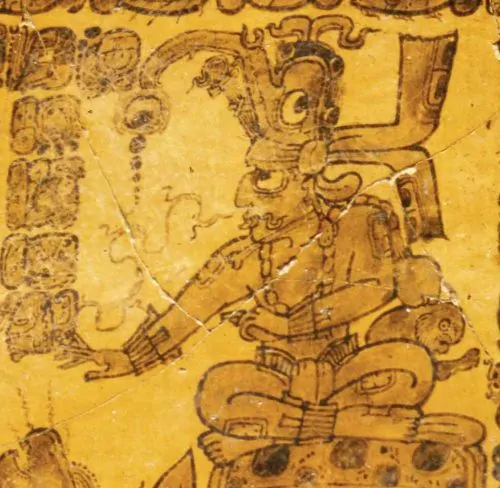
The eclipse table did more than identify dates on which celestial obscuration might occur. Its numbers isolated potentially dangerous lunar stations, but its glyphs and pictures translated those stations into conditions that could be interpreted within the inhabited world. Sky bands, darkened celestial signs, suspended figures, falling water, deities, and threatening creatures gave visible form to consequences that arithmetic alone could not express. These elements should not be dismissed as decoration added to an otherwise scientific document, because they formed part of the table’s practical meaning. Maya specialists calculated when darkness might become possible and then employed an established divinatory vocabulary to consider what that darkness could signify.
One of the table’s most recognizable signs consists of a solar, lunar, day, or night element placed between two flanking fields, frequently one light and the other dark. Early researchers naturally connected this sign with the eclipse intervals written on the same pages and began calling it the “eclipse glyph.” The label became so firmly established that it influenced the interpretation of similar signs elsewhere in the Dresden, Madrid, and Paris codices. Within the eclipse table, the association sometimes appears compelling: a darkened solar sign hangs beneath a sky band while a deity, victim, or creature occupies the space below. Yet the sign does not portray the physical geometry of the Moon crossing the Sun or entering Earth’s shadow. It represents the perceptible condition of a celestial light becoming covered, concealed, or darkened. That condition could be produced by an eclipse, but it could also arise from thick cloud, violent weather, horizon haze, smoke, or the disappearance of a luminary into night. Calling it an eclipse glyph is convenient as a history of scholarship but misleading when treated as a complete translation.
Bruce Love’s survey of the sign throughout Maya codices demonstrated that many examples occur in contexts explicitly concerned with rain and in calendrical sequences whose intervals cannot describe actual eclipses. Some almanacs repeat the sign after periods such as 104 days, when neither lunar phase nor nodal recurrence could consistently generate eclipse opportunities. Classic-period antecedents also suggest that its semantic core may have been “darkened” or “darkening,” possibly represented by the proposed reading yihk’in, rather than the modern astronomical category “eclipse.” The revision does not remove eclipse imagery from pages 51–58; it shows that the scribes selected a broader sign of obscuration because an eclipse was one ominous form of a more general celestial darkness. Love’s study provides the principal argument for this reinterpretation.
Rain is consequently not an accidental intrusion into an astronomical table. Captions accompanying several images refer to water, sky, and rainfall even when the numerical columns identify genuine eclipse-warning stations. On page 56, a longer caption begins with paired darkened-sun and darkened-moon signs and concludes with a phrase interpreted as “great rain on earth and town.” Elsewhere in the codex, water streams directly from the same kind of darkened celestial signs, sometimes in scenes that plainly concern storms or flooding rather than eclipses. The great inundation pictured on page 74 provides the most dramatic example, placing torrents beneath obscured signs as an aged goddess overturns a vessel and the sky monster releases destructive water. Such scenes made visual sense because dense storm clouds could extinguish the ordinary brightness of day, while an eclipse could resemble the sudden arrival of a cosmic storm. Rain itself was not uniformly harmful in a society dependent upon seasonal water for maize cultivation. Its absence threatened drought and hunger, but its excess could destroy fields, homes, roads, and political stability. A darkened sky belonged to an unstable field of possibilities in which fertility and devastation remained dangerously close. The imagery connected eclipse warnings with that larger environmental uncertainty without asserting that an eclipse mechanically caused every predicted storm.
Other pictures make the danger more violent. On page 57b, an open-mouthed serpentine creature approaches or appears ready to swallow a solar sign suspended beneath a celestial band. The accompanying passage has been read as referring both to the covering of the Sun and to the disappearance or descent of Venus from its evening-star visibility. This combination resists any attempt to isolate each image as a diagram of one celestial event, since the page coordinates solar darkness, planetary disappearance, and monstrous attack within a shared language of loss. The devouring creature transforms obscuration into aggression: the Sun does not merely become faint but is threatened by a being capable of consuming its light. Yet the image occupies a table whose arithmetic genuinely tracks eclipse possibilities, so Love’s broader reading of the darkened sign does not require denying an eclipse context here. It instead reveals how an astronomical event could be understood through images that also applied to cloud, nightfall, planetary disappearance, and other forms of celestial concealment.
The female figure hanging by her neck from the sky band on page 53b provides an instructive case of interpretive danger. Twentieth-century commentary connected her with Ix Tab, the “suicide goddess” described in colonial literature, but that identification originated in a modern scholarly comparison rather than in a surviving name glyph beside the figure. A wider iconographic review found no persuasive evidence for an ancient Maya suicide deity and concluded that the woman is more plausibly a celestial or lunar figure subjected to violence during obscuration. Her closed eye, suspended body, and position between day and night communicate death, affliction, or the temporary defeat of a celestial power, even though her precise identity remains uncertain. The scene demonstrates why context must govern interpretation: a striking figure can embody eclipse danger without serving as a literal record of suicide, a named goddess, or a prescribed ritual act. Reyes-Foster and Kangas’s reassessment traces how the unsupported identification became entrenched.
The captions and images do not yield a single standardized doctrine of eclipse effects. They present a repertoire of darkness, rain, celestial disappearance, bodily suffering, monstrous attack, and threatened cosmic order through which each warning station could acquire augural force. The same sign could denote a darkened Sun in an eclipse-capable lunation, a Moon hidden by clouds, or a rain-filled sky because Maya writing organized these events through perceived relationships rather than modern taxonomic boundaries. Numerical precision and semantic breadth were complementary rather than contradictory. The arithmetic told the specialist when to become vigilant, while the imagery defined the range of dangers for which vigilance was required. A forecast did not eliminate uncertainty; it gathered uncertainty into a scheduled moment that could be watched, interpreted, and ritually addressed. The Sun’s darkness became socially meaningful because the table placed its possible afflictions (celestial, meteorological, agricultural, and human) beside the numbers that foretold its return.
From Warning to Action
An eclipse-warning table acquired social force only when someone interpreted its dates and persuaded others to respond. Pages 51–58 did not mechanically announce themselves to an entire community; they required a reader capable of recognizing numerical intervals, calculating accumulated days, understanding the Tzolk’in positions, and relating written stations to the observed Moon. Because the table marked possibilities rather than guaranteed local events, that reader also had to judge what kind of warning should be communicated and how urgently it should be treated. Astronomical knowledge became practical through this act of mediation. The movement from warning to action depended upon a specialist whose authority joined technical competence, ritual knowledge, and social recognition.
“Daykeeper” provides a useful English name for such a specialist, but it should not be treated as a single Maya office unchanged across centuries and regions. Colonial Yucatec sources refer to the aj k’in, literally a person associated with the day, Sun, or time, whose responsibilities could include calendrical calculation, divination, ritual direction, and instruction. Contemporary K’iche’ communities preserve the distinct title ajq’ij for practitioners who maintain and interpret the 260-day count, but their work cannot simply be projected backward onto the makers of the Dresden Codex. Classic inscriptions, Postclassic manuscripts, colonial descriptions, and modern ethnographies reveal related traditions rather than one perfectly continuous institution. The specialist who copied a table need not have been the same person who maintained observations, interpreted its auguries, or conducted the resulting ceremonies. A manuscript of this complexity may instead record collaboration among scribes, calculators, skywatchers, and ritual authorities working within a courtly or temple-centered intellectual community. “Daykeeper” is consequently best understood as a functional category identifying those who made calendrical knowledge socially operative. It reminds the reader that Maya astronomy was practiced by trained people occupying particular institutional positions, not by an abstract civilization collectively gazing at the sky.
Operationally, the specialist had to connect a working table with the current count, advance through its cumulative intervals, and recognize when one of its three-day warning groups approached. Observation could then test whether the calculated lunar phase remained accurate, while the Sun’s position, weather, horizon, and local visibility determined what people actually saw. The table’s redundant totals, interval numbers, and Tzolk’in dates allowed the reader to check the calculation before announcing a dangerous period. Its principal practical advantage was lead time: an eclipse ceased to be wholly unexpected and became a celestial possibility for which attention, consultation, and ritual resources could be assembled.
What happened after that warning remains much less certain than how the dates were calculated. The eclipse pages portray darkened celestial bodies, falling water, afflicted figures, monstrous attack, and threatened order, but they do not supply a written sequence of ritual instructions. No surviving caption tells the reader to make a specified offering on the first warning day, perform a particular ceremony during obscuration, or conclude it if the eclipse fails to appear. Broader Maya sources nevertheless reveal a substantial repertoire for confronting dangerous times. Priests and diviners directed fasting, sexual abstinence, prayer, confession, incense burning, food and drink offerings, bloodletting, processions, vigils, and sacrifices in calendrically prescribed settings. Codical almanacs frequently joined ominous dates to gods, offerings, weather, illness, agriculture, and ritual actions, making it reasonable to assume that an eclipse warning could activate practices drawn from this larger repertoire. Preparation might involve the specialist consulting additional almanacs, determining which supernatural powers were implicated, selecting an appropriate time and place, and advising political or household authorities. The precise response may have varied according to whether the anticipated danger concerned rain, crops, bodily affliction, a ruler, or the wider community. Some observances may have been public, while others could have occurred within elite compounds, temples, caves, household shrines, or restricted priestly settings. The evidence supports organized ritual preparation, but it does not justify inventing one standardized Maya eclipse ceremony and assigning it indiscriminately to every city and period.
Ethnographic accounts of highland Maya daykeepers clarify the social logic of such preparation without furnishing a direct transcript of Postclassic practice. In communities studied during the twentieth century, specialists maintained the 260-day count, interpreted the qualities of particular days, advised clients, performed divinations, and conducted offerings at sacred places. Their work demonstrates how calendrical expertise can connect an abstract sequence of days with decisions about health, agriculture, travel, marriage, conflict, and communal obligation. Centuries of colonial violence, Christian influence, regional divergence, and cultural adaptation prevent these practices from being treated as unchanged survivals from the Dresden Codex. They nevertheless show why identifying a dangerous date mattered: a warning created time in which people could seek counsel, prepare offerings, alter conduct, and negotiate their relationship with powers believed to be active in the event.
The ability to anticipate celestial danger also carried political consequences. A specialist who could announce that the Sun might darken after a known sequence of lunar stations possessed knowledge unavailable to anyone who merely witnessed the eclipse when it arrived. That advantage could strengthen confidence in the institutions that trained skywatchers, preserved manuscripts, and sponsored ritual action. In Postclassic and colonial Yucatán, calendrical learning was closely intertwined with religious and political office, while Maya rulership more generally depended upon claims that rulers and their attendants could maintain proper relations among human communities, ancestors, gods, and cosmic cycles. Eclipse prediction could support elite authority without reducing the table to an instrument of cynical manipulation. Its forecasts were conditional, and a locally invisible eclipse did not necessarily expose the specialist as a fraud because the dangerous alignment might have occurred elsewhere or passed below the horizon. Even so, authority required maintenance: observations had to be compared with inherited numbers, errors recognized, tables recalibrated, and explanations made persuasive. The codex embodied institutional memory precisely because no individual observer could accumulate the centuries of experience needed to design its warning sequence alone. Control of the manuscript concentrated expertise, but it did not eliminate household knowledge, local ritual traditions, or the possibility that different specialists contested an omen’s interpretation.
The Dresden eclipse table was an instrument of action even though it recorded possibilities rather than commands. It allowed trained readers to transform long numerical recurrences into moments of heightened vigilance, and it gave ritual authorities time to interpret dangers before celestial darkness appeared. Calculation did not displace divination; it made divination anticipatory, repeatable, and capable of institutional transmission. Ritual did not merely decorate astronomy; it supplied the social means through which astronomical knowledge could guide conduct. By deciding when a community should watch, prepare, and respond, Maya daykeepers converted the uncertain return of darkness into an exercise of both care and authority.
Rediscovering the Table: From Förstemann to Digital Ephemerides

The Dresden eclipse table had to be rediscovered twice: first as a physical manuscript and then as an intelligible work of calculation. Johann Christian Götze acquired the codex in Vienna in 1739 for the Royal Library at Dresden, but eighteenth- and early nineteenth-century observers lacked the linguistic and calendrical knowledge needed to understand its contents. Reproductions issued by Alexander von Humboldt and Lord Kingsborough made portions of the manuscript better known, yet its densely arranged bars, dots, day signs, and deity figures remained largely opaque. The decisive change came when scholars stopped treating those elements primarily as exotic pictures and began analyzing them as components of a coherent numerical system. Rediscovery was not a single moment of decipherment but a cumulative process in which improved copies, comparative inscriptions, arithmetic analysis, and astronomical testing gradually made the table legible.
Ernst Förstemann supplied the essential foundation for that process. As librarian at Dresden, he had direct access to the manuscript and published a high-quality facsimile in 1880 that allowed scholars elsewhere to examine its pages systematically. He demonstrated that Maya numerals employed a vigesimal place-value system, identified calendrical cycles within the codex, and showed that many apparently isolated numbers belonged to extended computations. On pages 51–58, the repeated intervals, cumulative totals, and returns of particular day signs revealed deliberate mathematical organization rather than a miscellaneous collection of omens. Förstemann connected the sequence with eclipses and lunar recurrence even though Maya writing had not yet been substantially deciphered and the distinction among formal bases, historical anchors, and warning stations remained unclear. His achievement depended largely upon internal pattern recognition: additions could be checked against later totals, intervals could be compared across columns, and calendrical positions could be followed without knowing the full phonetic value of the accompanying glyphs. That method established an enduring principle of codical astronomy, the numbers could disclose part of the table’s function before its texts could be read.
Early twentieth-century scholars refined the numerical interpretation by treating the manuscript as a recoverable computational instrument. Charles Bowditch clarified Maya calendrical arithmetic, while Carl Guthe’s 1921 study traced the numerical series across the eclipse pages and confronted discrepancies among intervals, cumulative totals, and day positions. John Teeple’s analysis of lunar reckoning in inscriptions supplied a wider historical context for the alternating twenty-nine- and thirty-day months and for ratios capable of keeping schematic lunations close to observation. These studies made it possible to understand the 148-, 177-, and 178-day intervals as groups of five or six lunations and the complete 11,960-day structure as a carefully balanced lunar cycle. Their reconstructions were necessarily incomplete because many captions remained unread and the surviving table was often assumed to have operated through simpler repetition than later research would support.
The manuscript’s physical history made accurate reproduction important. During the bombing of Dresden in 1945, the codex survived in protective storage, but water entered its glass enclosure and damaged portions of the painted surface. Förstemann’s facsimile consequently preserves details that are now faded, displaced, or more difficult to distinguish in the original. Later photographs, color reproductions, and digital scans have allowed researchers to enlarge individual signs, compare red and black numerals, inspect corrections, and move across the accordion-fold sequence without repeatedly handling the fragile artifact. Yet digital clarity does not eliminate scribal ambiguity: a magnified mark may still be damaged, incorrectly copied, or capable of more than one reading. Advances in phonetic decipherment after the mid-twentieth century also transformed the captions from mute accompaniments into partially recoverable statements about darkness, rain, celestial bodies, and affliction. J. Eric S. Thompson’s 1972 commentary assembled much of the older numerical and iconographic scholarship, while later epigraphers revised readings that had hardened into convention. The so-called “eclipse glyph,” for example, proved to belong to a broader vocabulary of celestial darkening rather than functioning as an exclusive label for eclipses. Digital study has worked most effectively when combined with historiography, epigraphy, and comparison among successive facsimiles rather than when treated as a technologically neutral view of the original page.
Computer-generated ephemerides introduced a different form of evidence. Researchers can now calculate ancient conjunctions and oppositions, measure the Moon’s distance from its orbital nodes, estimate eclipse magnitude, and determine whether an event could have been visible within Maya territory. Such calculations allow proposed Long Count bases to be tested against actual eclipse opportunities and permit the table’s warning stations to be evaluated across centuries rather than through a few famous events. They also expose the limits of apparent precision. Converting a Maya date into a CE date requires selecting a calendar correlation, while reconstructing the terrestrial path of a very early eclipse depends upon estimates of changes in Earth’s rotational speed. Uncertainty in delta-T can shift a calculated path across the surface of Earth even when the occurrence of the eclipse itself is secure. A digital ephemeris can show that a reconstruction is astronomically plausible or implausible, but it cannot by itself prove which base date a Maya specialist used, what an obscuration meant, or how a warning was ritually interpreted.
The strongest recent scholarship combines these computational tools with close analysis of the manuscript’s internal architecture. Harvey and Victoria Bricker tested the table against astronomical circumstances while situating it among other codical and inscriptional forms of Maya celestial prediction. John Justeson’s cyclic-time model treated its stations as structured warning windows, and the reconstruction published by Justeson and Justin Lowry in 2025 proposed that the surviving system developed from a continuous 405-lunation calendar through successive stages of selection and recalibration. Digital modeling enabled them to test overlapping tables, alternative historical placements, and transitions separated by 223 or 358 lunations across many centuries of calculated eclipses. The effectiveness of a reconstructed procedure does not prove that every step was explicitly conceptualized by Maya specialists in modern astronomical terms, but it reveals what their preserved numbers were capable of accomplishing. Modern understanding has consequently advanced through correction rather than simple revelation: facsimiles preserved damaged evidence, arithmetic exposed structure, decipherment widened meaning, and ephemerides tested historical possibilities. In an unexpected parallel with the table itself, its rediscovery has depended upon repeated comparison among inherited records, observed discrepancies, and models revised whenever the numbers and the sky cease to agree.
A Predictive Instrument or a Modern Reconstruction of One?
The following video from Tomás A discusses to the tools of Maya astronomy:
The strongest challenge to interpreting the Dresden eclipse table as a predictive instrument is that the manuscript never explicitly explains how its users operated it. No surviving instruction identifies an observational base, distinguishes warning stations from constructed stations, or commands a successor table to begin after either 223 or 358 lunations. The surviving pages are damaged, contain copying errors, and preserve only one late version of what may have been a much older computational tradition. Even familiar terms such as “eclipse table,” “formal base,” and “recalibration” belong to modern analysis rather than to translations of Maya labels. Scholars have reconstructed procedures by combining numerical patterns, calendrical relationships, and modern eclipse calculations. There is consequently a danger that a system appearing extraordinarily coherent today partly reflects the ingenuity of its interpreters.
That danger becomes serious when researchers attempt to attach the table to particular historical eclipses. Converting Long Count positions into CE dates requires choosing among correlations that can shift every proposed event, while reconstructing ancient eclipse paths also depends upon uncertain estimates of Earth’s changing rotational speed. The date 10.12.16.14.8 is attractive because it corresponds under a commonly used correlation to an annular eclipse visible in the Yucatán in 1083 CE, but other placements can also produce astronomically plausible sequences. If one may choose among several base dates, distinguish formal from historical anchors, select different entry stations, and alternate intervals of 223 and 358 lunations, the reconstruction acquires considerable flexibility. That flexibility may represent the adaptability of the original Maya system, but it can also make a modern model difficult to falsify. A procedure optimized with digital ephemerides will inevitably fit calculated eclipse patterns better than a simple repeated cycle. Its success demonstrates what the preserved numbers could accomplish, not necessarily what every Maya compiler consciously intended. The distinction is crucial because mathematical possibility, historical use, and explicit indigenous theory are three different levels of evidence.
The imagery supplies an additional reason for caution. The so-called eclipse glyph can signify celestial darkening more broadly, including darkness associated with cloud, rain, storms, or the disappearance of a luminary, and not every interval accompanying it corresponds to an actual eclipse. Nor does the table provide an unambiguous catalogue of events visible from a single Maya city. Many warning stations would have produced no locally observable obscuration because the eclipse occurred elsewhere, below the horizon, or not at all within the relevant three-day window. If “prediction” means forecasting a particular eclipse at a particular place and hour, the surviving table does not satisfy that definition.
Yet these objections do not reduce pages 51–58 to a modern astronomical fantasy imposed upon an arbitrary divinatory almanac. The internal structure remains too systematic to be explained by retrospective enthusiasm alone. Its 148-, 177-, and 178-day intervals represent coherent groups of five or six lunations; its cumulative numbers track those intervals across the manuscript; and its Tzolk’in dates provide an independent means of checking the additions. The complete 11,960-day scheme coordinates 405 lunar months with forty-six revolutions of the 260-day count while maintaining a remarkably accurate mean lunation. More important, the surviving sequence does not list every new moon but privileges stations separated by intervals characteristic of returning eclipse seasons. Scribal mistakes are detectable precisely because the surrounding arithmetic is consistent enough to expose them. Although modern ephemerides reveal how effectively the system could have corresponded with ancient skies, its lunar and calendrical organization can be recovered from the manuscript itself. The case for prediction rests first upon indigenous numerical architecture and only secondarily upon computer-generated confirmation. What remains provisional is not whether the pages organized eclipse-related warning periods, but exactly how particular historical operators anchored, renewed, and interpreted them.
The challenge requires a narrower understanding of what a predictive instrument was in this setting. The Dresden table was not an eclipse canon comparable to a modern ephemeris, and it did not promise that darkness would occur at every station. It functioned more plausibly as a conditional warning system that identified lunations during which solar or lunar obscuration deserved heightened attention. Its predictive power lay in reducing a continuous expanse of time to a limited sequence of dangerous windows, thereby allowing observation and ritual preparation to begin before an event appeared. The overlapping-table model of Justeson and Lowry offers a powerful explanation of how such warnings could have remained useful across centuries, but it should remain a testable reconstruction rather than be presented as a recovered Maya instruction manual. Alternative historical bases and renewal procedures must remain open wherever the manuscript does not decide among them. Properly qualified, the table still bears witness to a sophisticated predictive tradition, one whose surviving numbers reveal its capacities more securely than they reveal every stage of its use.
Conclusion: The Mathematics of Sacred Uncertainty
The Dresden eclipse table reveals a form of astronomical knowledge built neither upon unstructured omen reading nor upon prediction in the modern deterministic sense. Its makers recognized that eclipses clustered around recurring relationships among the lunar phase, the Sun, and the Moon’s path, even though the manuscript does not express those relationships through geometric models or an explicit theory of orbital nodes. They converted accumulated observations into a sequence of restricted warning periods, thereby making celestial darkness partially foreseeable without pretending that every warning would culminate in a locally visible event. Mathematics narrowed the domain of uncertainty, while divination interpreted what remained. The result was a system in which calculation and sacred meaning strengthened one another because both addressed different dimensions of the same dangerous sky.
That achievement depended upon an extraordinary coordination of cycles. The table arranged 405 schematic lunations across 11,960 days, balanced twenty-nine- and thirty-day months to approximate the Moon’s actual synodic period, and synchronized the completed sequence with forty-six revolutions of the 260-day Tzolk’in. Its stations, usually separated by 148, 177, or 178 days, isolated groups of five or six lunations associated with the return of eclipse possibility. Formal dates connected the computation to canonical origins, while historical anchors could bring a working version into closer agreement with observed celestial events. If the recently reconstructed use of overlapping tables and 223- or 358-lunation transitions approximates Maya practice, then recalibration allowed the system to remain effective without abandoning its inherited calendrical structure. Even if that specific procedure remains unproven, the manuscript shows unmistakably that its compilers understood prediction as the disciplined management of recurrence rather than the passive repetition of a fixed cycle. Copying, correction, observation, and renewal were parts of the table’s intellectual life. A codex page preserved more than a finished answer: it preserved a framework through which generations of specialists could compare the received count with the changing sky.
The imagery surrounding those numbers establishes why such labor mattered. Darkened celestial signs, violent creatures, falling water, afflicted bodies, and references to rain placed eclipse possibility within a wider field of environmental, political, and supernatural danger. These scenes do not document one universal eclipse doctrine or prescribe a standardized ceremony, but they show that obscuration could be understood as a disruption demanding attention. Daykeepers, scribes, observers, and ritual authorities transformed that scheduled danger into counsel, preparation, offerings, vigilance, and claims to specialized authority.
Modern scholarship has recovered this achievement only gradually, from Förstemann’s recognition of Maya arithmetic to epigraphic reinterpretation and the testing of possible bases through digital ephemerides. That history of rediscovery also counsels humility. Terms such as “eclipse table,” “warning station,” and “recalibration” are analytical tools, while some of the most persuasive operational models remain reconstructions rather than translated Maya instructions. Yet caution does not diminish the sophistication visible in the manuscript; it locates that sophistication where the evidence is strongest. Pages 51–58 demonstrate that Maya intellectuals could transform long records of celestial behavior into a durable instrument for identifying dangerous times, preserving knowledge, and organizing collective response. They did not conquer uncertainty by reducing the heavens to certainty. They made uncertainty calculable, communicable, and ritually actionable, and in doing so created one of the most remarkable surviving monuments of Indigenous American mathematical astronomy.
Bibliography
Affiliate disclosure: Amazon links on this site are paid links. As an Amazon Associate I earn from qualifying purchases.
- Aveni, Anthony F. Skywatchers: A Revised and Updated Version of Skywatchers of Ancient Mexico. Austin: University of Texas Press, 2001.
- Bittinger, Christa, Antje Trautmann, Manfred Mayer, and Gerhard Banik. “Codex Dresdensis: Zustandsbeschreibung, Aufbewahrungs- und Ausstellungsbedingungen, Transportkonzeption.” PapierRestaurierung 2, supplement (2001), 15–20.
- The Book of Chilam Balam of Chumayel. Edited and translated by Ralph L. Roys. Carnegie Institution of Washington Publication 438. Washington, DC: Carnegie Institution of Washington, 1933.
- Bowditch, Charles P. The Numeration, Calendar Systems and Astronomical Knowledge of the Mayas. Cambridge: Cambridge University Press, 1910.
- Bricker, Harvey M., and Victoria R. Bricker. Astronomy in the Maya Codices. Memoirs of the American Philosophical Society 265. Philadelphia: American Philosophical Society, 2011.
- —-, et.al. “Classic Maya Prediction of Solar Eclipses.” Current Anthropology 24:1 (1983), 1–23.
- —-. Astronomy in the Maya Codices. Memoirs of the American Philosophical Society 265. Philadelphia: American Philosophical Society, 2011.
- —-. Lunar Calendars of the Pre-Columbian Maya. Transactions of the American Philosophical Society 109, part 1. Philadelphia: American Philosophical Society Press, 2020.
- Codex Dresdensis. Late Postclassic period. Mscr.Dresd.R.310. Sächsische Landesbibliothek—Staats- und Universitätsbibliothek Dresden.
- Coe, Michael D., and Justin Kerr. The Art of the Maya Scribe. New York: Harry N. Abrams, 1997.
- Deckert, Helmut, and Ferdinand Anders. Codex Dresdensis: Sächsische Landesbibliothek Dresden (Mscr. Dresd. R. 310): Vollständige Faksimile-Ausgabe des Codex im Originalformat. Codices Selecti 54. Graz: Akademische Druck- und Verlagsanstalt, 1975.
- Edmonson, Munro S. The Book of the Year: Middle American Calendrical Systems. Salt Lake City: University of Utah Press, 1988.
- Espenak, Fred, and Jean Meeus. Five Millennium Canon of Solar Eclipses: –1999 to +3000 (2000 BCE to 3000 CE). NASA/TP–2006–214141. Greenbelt, MD: National Aeronautics and Space Administration, Goddard Space Flight Center, 2006.
- —-. Five Millennium Canon of Lunar Eclipses: –1999 to +3000 (2000 BCE to 3000 CE). NASA/TP–2009–214172. Greenbelt, MD: National Aeronautics and Space Administration, Goddard Space Flight Center, 2009.
- Förstemann, Ernst. Commentary on the Maya Manuscript in the Royal Public Library of Dresden. Translated by Selma Wesselhoeft and A. M. Parker. Papers of the Peabody Museum of American Archaeology and Ethnology 4, no. 2. Cambridge, MA: Peabody Museum, Harvard University, 1906.
- Götze, Johann Christian. Die Merckwürdigkeiten der Königlichen Bibliotheck zu Dreßden, ausführlich beschrieben, und mit Anmerckungen erläutert. Dresden: George Conrad Walther, 1743.
- Guthe, Carl E. A Possible Solution of the Number Series on Pages 51 to 58 of the Dresden Codex. Papers of the Peabody Museum of American Archaeology and Ethnology 6,2. Cambridge, MA: Peabody Museum, Harvard University, 1921.
- Hauberg Stela. Maya, approximately 199 CE. Limestone. Princeton University Art Museum, Princeton, NJ, accession no. 1999-232.
- Iwaniszewski, Stanislaw. “Eclipse Prediction and the Length of the Lunar Month in Mayan Astronomy.” Cosmovisiones/Cosmovisões 5:1 (2024), 241–250.
- —-. “The Lunar Series and Eclipse Cycles at Palenque, Chiapas, Mexico.” Estudios Latinoamericanos 40 (2020), 61–86.
- Justeson, John. “A Cyclic-Time Model for Eclipse Prediction in Mesoamerica and the Structure of the Eclipse Table in the Dresden Codex.” Ancient Mesoamerica 28:2 (2017), 507–541.
- Justeson, John, and Justin Lowry. “The Design and Reconstructible History of the Mayan Eclipse Table of the Dresden Codex.” Science Advances 11:43 (2025), eadt9039.
- Landa, Diego de. Landa’s Relación de las Cosas de Yucatan. Translated and edited by Alfred M. Tozzer. Papers of the Peabody Museum of American Archaeology and Ethnology 18. Cambridge, MA: Peabody Museum, Harvard University, 1941.
- Lounsbury, Floyd G. “Maya Numeration, Computation, and Calendrical Astronomy.” In Dictionary of Scientific Biography, vol. 15, edited by Charles Coulston Gillispie, 759–818. New York: Charles Scribner’s Sons, 1978.
- Love, Bruce. “The ‘Eclipse Glyph’ in Maya Text and Iconography: A Century of Misinterpretation.” Ancient Mesoamerica 29:1 (2018), 219–244.
- Makemson, Maud W. “The Astronomical Tables of the Maya.” Contributions to American Anthropology and History 42 (1943), 185–221.
- Milbrath, Susan. Star Gods of the Maya: Astronomy in Art, Folklore, and Calendars. Austin: University of Texas Press, 1999.
- Palenque, Temple of the Foliated Cross Tablet and Temple of the Sun Tablet. Late Classic period. Palenque, Chiapas, Mexico.
- Quiriguá, Stela C. 775 CE. Sandstone. Quiriguá, Izabal, Guatemala.
- Reyes-Foster, Beatriz M., and Rachael Kangas. “Unraveling Ix Tab: Revisiting the ‘Suicide Goddess’ in Maya Archaeology.” Ethnohistory 63:1 (2016), 1–27.
- Rice, Prudence M. Maya Calendar Origins: Monuments, Mythistory, and the Materialization of Time. Austin: University of Texas Press, 2007.
- —-. Maya Political Science: Time, Astronomy, and the Cosmos. Austin: University of Texas Press, 2004.
- Rossi, Franco D., David Stuart, and Heather Hurst. “The Identification and Work of an Eighth-Century Maya Mathematician.” Antiquity, published online July 14, 2026, 1–16.
- Rossi, Franco D., William A. Saturno, and Heather Hurst. “Maya Codex Book Production and the Politics of Expertise: Archaeology of a Classic Period Household at Xultun, Guatemala.” American Anthropologist 117:1 (2015), 116–132.
- Saturno, William A., David Stuart, Anthony F. Aveni, and Franco Rossi. “Ancient Maya Astronomical Tables from Xultun, Guatemala.” Science 336:6082 (2012), 714–717.
- Tedlock, Barbara. Time and the Highland Maya. Albuquerque: University of New Mexico Press, 1982.
- Teeple, John E. “Maya Astronomy.” Contributions to American Archaeology 1:2 (1930), 29–115. Washington, DC: Carnegie Institution of Washington.
- Thompson, J. Eric S. A Commentary on the Dresden Codex: A Maya Hieroglyphic Book. Memoirs of the American Philosophical Society 93. Philadelphia: American Philosophical Society, 1972.
- Vail, Gabrielle, and Christine Hernández. “The Construction of Memory: The Use of Classic Period Divinatory Texts in the Late Postclassic Maya Codices.” Ancient Mesoamerica 22:2 (2011), 449–462.
- Valencia, Rogelio. “The Deities of Glyph C of the Maya Lunar Series as the Patron Gods of the Phases of the Moon.” Ancient Mesoamerica 37:1 (2026), 70–93.
- Zender, Marc. “A Study of Classic Maya Priesthood.” PhD diss., University of Calgary, 2004.
Originally published by Brewminate, 08.13.2026, under the terms of a Creative Commons Attribution-NonCommercial-NoDerivatives 4.0 International license.
About the Author