Across Mesoamerica, rulers, judges, councils, elders, and communities used law to preserve authority, resolve disputes, protect property, and maintain social order.

By Matthew A. McIntosh
Public Historian
Brewminate
Introduction: Justice in the Painted Courtroom
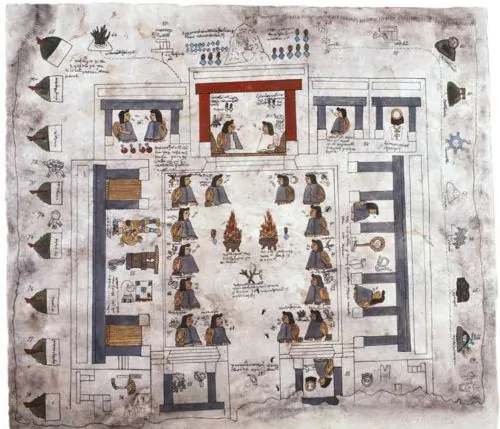
On the central leaf of the Mapa Quinatzin, justice appears not as an abstract principle but as an inhabited palace. Painted by Nahua artists at Texcoco around 1542, the scene places the rulers Nezahualcoyotl and Nezahualpilli within an elevated chamber while fourteen subordinate lords occupy the courtyard below. Councils, officials, tributary communities, and judicial activity are arranged within a carefully ordered architectural space, and elsewhere on the leaf two judges converse during a formal stage of legal deliberation. Scale, posture, speech, and physical position distinguish those who command from those who advise, petition, or obey. The palace is simultaneously a royal residence, an administrative center, a repository of political memory, and a place where disputes become judgments. Yet this is not a neutral courtroom sketch taken from life. Produced approximately two decades after the Spanish conquest, the painting is also a retrospective assertion that Texcoco had once possessed a disciplined government in which legitimate authority flowed through rulers, councils, judges, and dependent communities.
The painted court poses a deceptively simple question: what did it mean to receive a trial in a society without attorneys representing opposing parties, juries of citizens, printed statutes, or a judiciary constitutionally separated from political rule? Such absences do not imply the absence of procedure. Litigants could bring complaints, answer accusations, produce witnesses, present painted records or material evidence, and submit to questioning by specialist judges. Decisions might be reviewed by superior authorities, preserved by scribes, and enforced through restitution, humiliation, loss of office, enslavement, corporal punishment, or death. Institutional complexity must not be confused with a modern regime of individual rights, for Mesoamerican courts existed principally to restore order, protect recognized relationships, and vindicate the authority of the community and its rulers.
Nor did those courts belong to a single legal civilization extending uniformly across Mesoamerica. Mesoamerica was a cultural region containing numerous languages, political traditions, city-states, kingdoms, confederations, and empires rather than one jurisdiction governed by a common code. The strongest evidence for formal judicial hierarchy comes from the Nahua states of the Basin of Mexico, especially Mexica Tenochtitlan and Acolhua Texcoco during the Late Postclassic period. Maya, Mixtec, Zapotec, and Purépecha societies also possessed authorities who heard disputes, protected land and dynastic claims, demanded compensation, punished wrongdoing, and enforced communal obligations, but their procedures survive in different and often less complete forms. Even within central Mexico, household heads, neighborhood organizations, market officials, temples, military institutions, noble houses, local rulers, and imperial authorities could exercise overlapping powers. Jurisdiction followed political membership, social position, occupation, residence, kinship, and tributary affiliation rather than a single territorial sovereignty in the modern sense. We must resist converting the best-documented Texcocan or Mexica arrangements into a universal Mesoamerican constitution. Comparison is essential, but it must reveal differences as well as recurring institutional solutions to accusation, injury, disputed property, and broken obligation.
The central argument of this study is that several Mesoamerican societies, and most demonstrably the Mexica and Acolhua states, created durable institutions for presenting claims, questioning parties, evaluating testimony, consulting records, delivering judgments, and enforcing sentences. These institutions were neither rudimentary substitutes for European courts nor early approximations of modern due process. They belonged to political worlds in which law, rulership, tribute, religion, social rank, and communal discipline remained inseparable. Judicial procedure could restrain arbitrary conduct, punish corrupt officials, and provide recognized means of settling conflict, yet it also reproduced hierarchy and made sovereign power visible. The Mapa Quinatzin captures both dimensions: its painted courtroom preserves evidence of sophisticated legal thought while idealizing the orderly dominion that Texcoco wished to remember. Ancient Mesoamerican justice must accordingly be understood as both a method of resolving disputes and an architecture of rule.
The Problem of Evidence: Reconstructing Law after the Conquest

Any reconstruction of ancient Mesoamerican law begins with a profound archival absence. The Spanish-led conquest shattered governments, killed rulers and specialists, dispersed political communities, and accelerated the destruction or abandonment of repositories in which legal and historical knowledge had been preserved. No complete preconquest central Mexican law code, archive of judicial decisions, or transcript of an actual hearing survives. Nearly every detailed description of Mexica and Acolhua courts was written, painted, translated, or recopied after 1521, often several decades after the institutions described had ceased to operate in their earlier form. Even apparently precise claims about named tribunals, judicial hierarchies, prescribed punishments, and avenues of appeal reach the historian through colonial acts of remembrance. The problem is not simply whether a source is accurate or inaccurate, but how conquest, translation, political interest, and genre shaped the truths it was capable of preserving.
The written narratives emerged from markedly different projects. Bernardino de Sahagún assembled the Florentine Codex through sustained collaboration with Nahua elders, writers, interpreters, and painters, whose descriptions of rulers and government appear most fully in Book 8. Their testimony preserves Indigenous concepts and vocabulary unavailable to an outside observer, but Sahagún organized the inquiry within a Franciscan intellectual program intended partly to expose and eradicate pre-Christian beliefs. Alonso de Zorita, an experienced royal judge in New Spain, questioned Indigenous authorities and consulted earlier accounts while investigating government, tribute, landholding, and the destructive consequences of colonial exploitation. His legal training made him unusually attentive to institutions, yet it also encouraged him to describe Nahua authority through categories recognizable to the Spanish Crown. Diego Durán drew upon Indigenous histories and oral accounts while interpreting the past as a Dominican chronicler convinced that Mesoamerican religion had to be understood before it could be defeated. Fernando de Alva Ixtlilxochitl, writing in the early seventeenth century as a descendant of the Texcocan royal house, preserved traditions unavailable elsewhere while presenting Texcoco as an exemplary kingdom of wise rulers, ordered courts, and ancient Christian-like morality. These authors cannot be combined as though they were independent witnesses giving identical testimony, because each selected and arranged the past for a different colonial audience.
Pictorial manuscripts offer a separate but equally complicated body of evidence. The Codex Mendoza, probably prepared under viceregal patronage during the early 1540s, joined Indigenous pictorial conventions to Spanish glosses in order to explain Mexica conquest, tribute, education, social discipline, and punishment to European readers. The Mapa Quinatzin represented Texcoco’s palace, rulers, subordinate communities, judges, and offenses, but it also idealized the dynasty’s former authority at a moment when its descendants were renegotiating their position under Spanish rule. Genealogies, boundary maps, tribute lists, cadastral records, and painted histories may preserve institutions and claims with preconquest origins, yet their colonial makers deployed that knowledge to defend land, office, ancestry, and corporate privilege in the present. Such images must be interpreted as purposeful legal and political arguments rather than transparent pictures of vanished institutions.
Translation creates an additional layer of uncertainty because Nahua and Spanish political vocabularies did not divide authority in equivalent ways. Colonial writers used terms such as juez, tribunal, audiencia, ley, and apelación to render offices and practices that might combine judicial, administrative, military, tributary, and ceremonial functions. Conversely, Nahuatl words such as tlatoani, cihuacoatl, teccalli, and tlacxitlan carried associations that cannot be exhausted by translating them respectively as ruler, chief justice, courthouse, or high court. A political council could hear disputes without constituting a specialized appellate court, while a noble household or palace office might exercise jurisdiction without belonging to a judiciary separate from government. Alphabetic Nahuatl records from the colonial period provide invaluable evidence about complaints, testimony, land, inheritance, debt, municipal authority, and communal memory, but they were produced after Indigenous litigants had begun adapting to Spanish forums, Christian institutions, notarial conventions, and new definitions of property and status. Practices that appear traditional may already have been transformed, while seemingly Spanish procedures could have been appropriated to pursue older communal objectives. The colonial archive consequently records neither untouched continuity nor complete replacement; it preserves encounters in which multiple legal traditions were being translated and remade.
Responsible reconstruction depends upon comparison among sources whose limitations do not arise from precisely the same circumstances. Historians must ask when a document was produced, who supplied its information, who recorded or translated it, what dispute or commission occasioned it, and what audience its creators hoped to persuade. Agreement among Nahuatl terminology, pictorial representations, Spanish administrative descriptions, Indigenous histories, archaeological settings, and early colonial practice can support the existence of institutionalized adjudication even when no single source provides a complete account. Contradictions must remain visible because they may reveal differences between Tenochtitlan and Texcoco, changes across generations, rival dynastic memories, or the imposition of European constitutional order upon more fluid arrangements.
Silence is equally important: the abundant documentation of rulers, nobles, tribute, and land does not mean that the household disputes and local hearings of ordinary people were unimportant, only that they were less likely to enter surviving records. The resulting history cannot be a recovered statute book or a seamless diagram of courts. It must instead be a measured reconstruction of probable institutions, recognized procedures, and contested legal memories preserved through the very colonial transformation that made their recovery so difficult.
No Single “Mesoamerican Law”
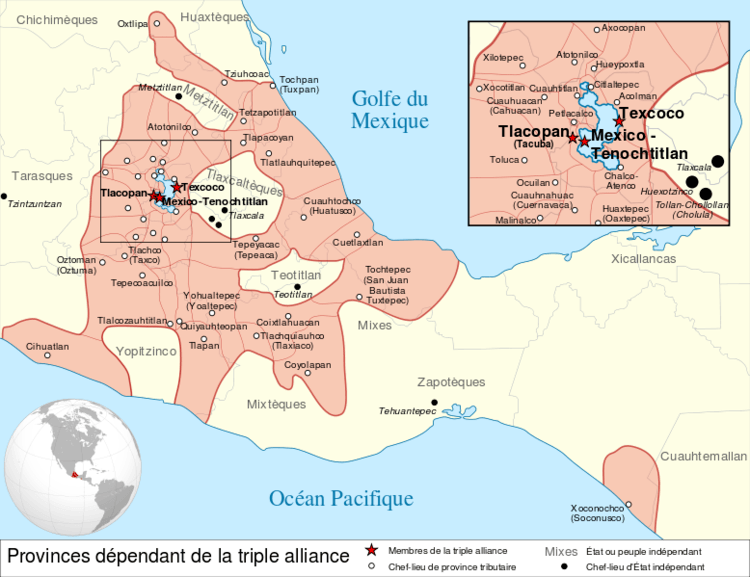
“Mesoamerica” names a cultural and historical region, not a state, nation, or unified jurisdiction. Paul Kirchhoff developed the term to identify societies sharing such features as maize agriculture, calendrical systems, ritual practices, forms of writing, market exchange, and related conceptions of sacred time and political authority. Those commonalities supported extensive communication across central and southern Mexico and northern Central America, but they did not produce a common legislature, supreme tribunal, or body of law binding the entire region. Political authority remained divided among hundreds of communities whose inhabitants spoke different languages, honored distinct dynasties, and organized land, tribute, office, and social rank according to local histories. Nor did these arrangements remain static across the long interval separating the first complex societies from the Spanish conquest. “Mesoamerican law” is useful only as a comparative category for examining related legal cultures, not as the name of a single legal system.
In central Mexico, the most consequential political unit was ordinarily the altepetl, a community commonly translated as city-state but encompassing a ruler, a capital or ceremonial center, dependent settlements, lands, deities, offices, and a population claiming a shared political identity. The Triple Alliance of Tenochtitlan, Texcoco, and Tlacopan constructed an empire by imposing its authority upon many such communities, yet imperial expansion did not usually dissolve them into provinces administered according to one uniform law. Subject rulers frequently remained in office so long as they delivered tribute, supported imperial military objectives, and refrained from rebellion. Local authorities continued to regulate landholding, inheritance, household relations, markets, communal labor, and many ordinary disputes, although the empire could intervene in strategically important territories, punish disloyal rulers, alter tribute obligations, or install more dependable officials. Imperial power consequently rested upon a changing combination of negotiation, intimidation, dynastic alliance, military supervision, and selective administrative control. Even the alliance itself distributed conquest revenues and political authority among three capitals, however dominant Tenochtitlan became during the final decades before 1521. An inhabitant of a tributary city might be governed simultaneously by local custom, the commands of a neighborhood or corporate authority, the judgment of an altepetl ruler, and obligations enforced by the imperial center. The resulting order was hierarchical, but it was not equivalent to a unitary territorial state.
Differences among Nahua states further undermine the habit of treating “Aztec law” as an internally uniform code. Texcoco developed a powerful reputation for learned judges, elaborate palace administration, and the laws attributed to Nezahualcoyotl, while Tenochtitlan’s institutions reflected its own dynastic history, military ascendancy, and relationship with the Cihuacoatl and the Mexica ruler. Tlaxcala, Cholula, Huexotzinco, and other independent or intermittently hostile polities possessed councils, noble houses, community authorities, and political customs that did not derive their legitimacy from the Triple Alliance. Shared language and recognizable political concepts made practices mutually intelligible without making them jurisdictionally identical.
Pluralism also existed within individual communities. Household heads exercised disciplinary authority over dependents, while kin groups managed marriage, inheritance, property, and obligations that might be resolved before they became matters for a palace court. Neighborhood or calpolli authorities supervised land, tribute, communal labor, education, and local conduct, although the organization and political importance of such units varied considerably among cities. Noble houses possessed jurisdictional privileges connected to rank, office, and dependent populations. Marketplace officials could investigate commercial misconduct and punish violations committed within the market, while priests, military commanders, schools, and occupational associations disciplined their own members without necessarily constituting fully separate court systems. A person’s legal position could depend upon residence, kinship, gender, age, occupation, noble or commoner status, tributary affiliation, enslavement, and the location or character of the alleged offense. These jurisdictions did not have to fit into a perfectly ordered hierarchy, and surviving sources rarely explain how every conflict of authority was resolved. Legal pluralism describes this coexistence of partly overlapping normative orders more accurately than the image of a single code administered downward through an integrated judiciary.
The Maya world presents an even clearer warning against transforming cultural relationship into legal unity. Classic Maya civilization consisted of numerous dynastic kingdoms whose rulers formed alliances, fought wars, contracted marriages, subordinated lesser lords, and sometimes claimed supremacy over distant polities, but no Maya sovereign established permanent jurisdiction over the entire region. Inscriptions document royal accessions, captives, tribute, dynastic conflict, and political subordination far more readily than ordinary hearings, leaving the legal work of households and local communities particularly difficult to recover. Postclassic and early colonial accounts from Yucatán identify offices such as the halach uinic and the batab, yet the authority attached to these titles varied across provinces and changed under the pressures of conquest. Maya communities shared broad assumptions about rulership, restitution, household responsibility, land, and communal order, but a proceeding in northern Yucatán cannot be treated as a surviving model for courts at Classic-period Tikal, Palenque, or Copán.
Oaxaca and western Mexico reveal still other political arrangements. Mixtec, or Ñuu Dzaui, society was organized around numerous dynastic communities whose ruling houses used genealogy, marriage, warfare, ritual alliance, and territorial memory to assert claims over towns and dependent lands. Painted manuscripts such as the Codex Nuttall record the histories of particular dynasties rather than legislation for all Mixtec-speaking peoples. Zapotec political organization also varied across time and space, from the regional power once centered upon Monte Albán to later city-states, noble houses, and local communities preserving distinct territorial identities. In both Mixtec and Zapotec regions, boundaries, genealogies, offices, and relationships among communities could provide the substance of legal claims, but political fragmentation ensured that authority remained closely connected to a particular ruler, lineage, or place. The Purépecha state centered at Tzintzuntzan formed a more consolidated territorial power under the cazonci, supported by provincial officials, tribute administrators, military leaders, priests, and public ceremonies of judgment. Even there, centralized administration coexisted with local communities, subordinate lords, occupational groups, and regional differences rather than erasing them. The existence of a stronger royal apparatus changed the balance among jurisdictions without creating a universal Mesoamerican form of law.
Recognizing this pluralism changes the questions that can responsibly be asked about trials and courts. Instead of searching for a pan-Mesoamerican criminal code, the historian must identify which community, ruler, corporate body, or imperial authority possessed jurisdiction over a particular person, property, obligation, or offense. Similar practices (witness testimony, restitution, judicial questioning, painted proof, public punishment, or review by a superior lord) may reflect sustained regional interaction without demonstrating identical rules or institutions. Mesoamerican legal history is consequently a history of related but distinct jurisdictions through which households, communities, city-states, dynastic kingdoms, and empires made competing claims to govern conduct and define authoritative justice.
The Altepetl as a Legal Community

In central Mexico, law acquired practical authority within the altepetl, the politically organized community whose name joined the Nahuatl words for water and mountain. Scholars conventionally translate altepetl as “city-state,” but the term encompassed far more than an urban settlement enclosed by recognizable territorial borders. An altepetl united a named people, a ruler, a patron deity, agricultural lands, water sources, tributary obligations, offices, temples, marketplaces, and dependent settlements within a shared political identity. Some possessed densely populated capitals, whereas others consisted of dispersed communities oriented toward a ceremonial and administrative center. Membership could survive migration, conquest, dynastic displacement, and changes in physical settlement because it rested partly upon collective history and allegiance. The altepetl formed a legal community: it identified the authorities entitled to judge, the population obliged to obey, and the lands, offices, and relationships over which jurisdiction could be asserted.
At the center of this community ordinarily stood the tlatoani, literally the “speaker,” whose authority gave political form to the tlatocayotl, or rulership. The ruler was not simply a judge occupying the highest position in an otherwise independent judiciary. He combined judicial, military, tributary, diplomatic, ceremonial, and religious responsibilities, all of which expressed his obligation to preserve the community’s ordered existence. His palace, or tecpan, could function simultaneously as residence, council chamber, treasury, administrative center, and place of judgment. Senior nobles, experienced officials, and specialist judges acted under the ruler’s authority even when they exercised considerable discretion in particular cases. The ruler confirmed offices, received tribute, settled conflicts among subordinates, protected recognized property arrangements, and punished conduct believed to endanger political order. Major disputes concerning noble succession, tribute, territorial allegiance, or serious crime could consequently become questions about the constitution of the altepetl itself. Judicial authority remained public and institutionalized, but it was legitimized through rulership rather than separated from it.
The altepetl was internally divided into smaller social and territorial units commonly identified as calpolli or tlaxilacalli, although colonial sources and modern scholars do not always use these terms consistently. Such units might organize neighborhood residence, communal land, tribute collection, labor service, military recruitment, education, ritual observance, and the selection of local officers. Their leaders and elders could address disagreements involving land use, household conduct, unpaid obligations, or communal duties before those conflicts required intervention by palace authorities. Reports of local magistrates and neighborhood hearings support the existence of adjudication below the ruler’s court, but the evidence does not justify imagining an identical courthouse within every ward. Local authority varied with the history, size, wealth, and political organization of the particular community.
Landholding made the jurisdictional character of the altepetl particularly visible. Agricultural plots were not merely interchangeable private commodities but parts of a political landscape shaped by conquest, inheritance, office, noble privilege, communal membership, and tributary responsibility. Different lands might support the ruler, noble houses, temples, military offices, neighborhood communities, or individual households, while ultimate claims remained embedded within collective arrangements. A boundary dispute could concern much more than the location of a field: it might determine which community collected tribute, which lord commanded labor, which lineage possessed inherited rights, or which settlement owed allegiance to another. Painted maps, genealogies, tribute lists, and remembered boundary markers helped communities convert territorial memory into evidence. Local officials who knew the history of possession could participate as witnesses, custodians of records, or representatives of the corporate group. Inheritance likewise affected the continuity of households and offices as components of the larger polity. Debt, marriage, adoption, migration, and abandonment could alter an individual claim without necessarily extinguishing the interests asserted by the community. Legal personality arose partly from belonging, because access to land and protection depended upon recognized placement within a web of reciprocal rights and duties. The courts defended property, but the property they defended was inseparable from political membership.
That membership did not make inhabitants equal before a uniform body of law. Nobles, commoners, merchants, priests, warriors, dependent laborers, enslaved persons, women, children, and resident outsiders occupied different positions within the same political community. A noble house might possess dependent lands and its own internal authority, while marketplace officers regulated commercial behavior and temple or military superiors disciplined those subject to their institutions. Household heads and neighborhood officials handled matters that palace judges might encounter only after local settlement failed or a conflict implicated broader public interests. The appropriate forum could depend upon the parties’ status, the place of the offense, the property involved, and the authority whose obligations had been violated. Overlapping jurisdictions were an ordinary feature of government rather than evidence that no legal order existed. The altepetl unified these differentiated relationships under a common political authority without dissolving the corporate bodies from which much everyday regulation emerged.
Imperial conquest added another jurisdictional layer without normally eliminating the altepetl as a legal community. The Triple Alliance demanded tribute, military obedience, and political loyalty from conquered polities, but subject rulers and local officers often retained authority over land, inheritance, household relations, and ordinary disputes. Imperial rulers could depose rebellious dynasties, redistribute land, impose officials, or reserve consequential cases for superior judgment, making autonomy contingent rather than absolute. Even so, tribute registers and conquest histories identified subject peoples principally through their corporate communities, demonstrating that the empire governed by subordinating altepemeh rather than by reducing all inhabitants to undifferentiated imperial subjects. The durability of the altepetl helps explain why Indigenous towns remained powerful legal actors after the Spanish conquest: colonial institutions transformed their offices and boundaries, but communities continued to litigate, preserve records, defend lands, and speak collectively through an older political identity. To understand trial procedure in central Mexico, the court must be located within the community that endowed its judges, claims, and judgments with meaning.
From Neighborhood Hearing to Palace Court: The Mexica Judicial Hierarchy
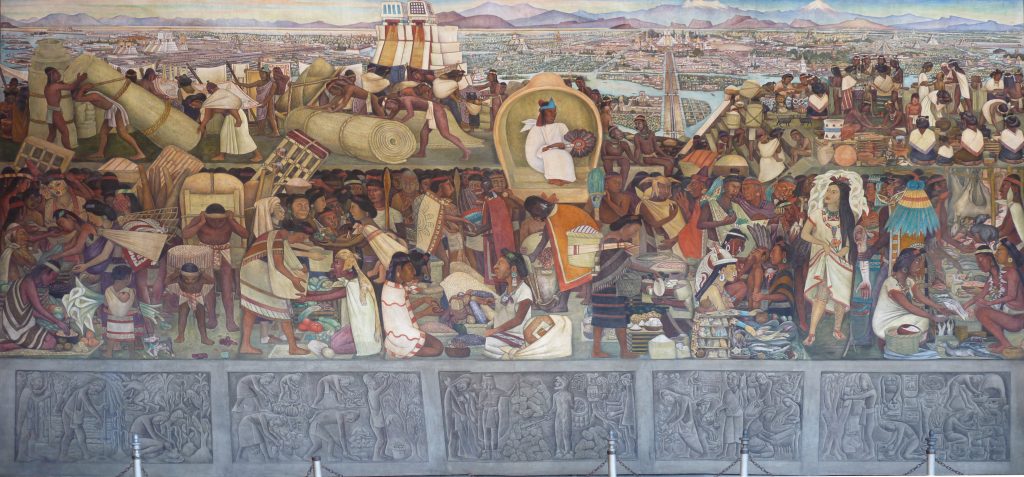
Later colonial descriptions of Mexica justice tempt the modern reader to imagine a tidy pyramid of courts through which every dispute advanced in a prescribed sequence. The surviving evidence instead reveals a hierarchy whose levels were recognizable but whose jurisdictions could overlap according to locality, subject matter, and social rank. A disagreement over household property or neighborhood land might first be addressed by kin, elders, or ward officials, whereas homicide, treason, official corruption, and other grave offenses could enter a higher forum immediately. Failed settlement, disputed authority, the involvement of nobles, or the seriousness of a penalty could move a case toward the ruler’s palace. Merchants, priests, warriors, and other corporate groups might also answer to officials exercising jurisdiction over particular places or occupations. The judicial hierarchy was a set of pathways connecting local communities to sovereign power rather than a single appellate ladder available in identical form to every litigant.
The authorities closest to ordinary residents belonged to the smaller units from which the city was constituted. Within calpolli and tlaxilacalli communities, officeholders supervised land, tribute, communal labor, education, and neighborhood discipline, giving them both the knowledge and the authority necessary to hear minor complaints. Elders and local leaders could intervene in quarrels involving possession, debt, family obligation, boundaries, minor violence, or failures of communal service. Such intervention should not automatically be dismissed as informal mediation, because the same officers who attempted reconciliation could represent the community, summon parties, preserve local memory, and transmit unresolved matters to superior authorities. A complainant’s first hearing might occur in a neighborhood building, a noble residence, or an assembly of officials rather than in a structure devoted exclusively to judicial business. Local knowledge served an evidentiary purpose: neighbors knew who had cultivated a plot, inherited an obligation, paid tribute, or repeatedly disturbed communal order. Resolution at this level reduced the need for palace intervention while reaffirming the authority of the ward over its members. Yet surviving sources do not demonstrate that every Mexica neighborhood possessed an identically staffed tribunal or that all local judgments could be appealed through the same formal procedure. Household discipline, conciliation by elders, administrative enforcement, and judicial decision remained distinguishable in principle but closely connected in practice.
When local authority proved inadequate, a case could be brought before courts associated with lords and the royal palace. The word teccalli, literally “lord-house,” could denote a noble establishment, an administrative seat, or a place in which judicial authority was exercised, and its meaning varied with context. Tlacxitlan, whose literal associations include the foot or base of something, appears in colonial accounts as the name of an important place or tribunal of judgment. Some reconstructions distinguish the teccalli as a court serving commoners from the tlacxitlan as a superior tribunal handling nobles, serious crimes, or appeals, but the sources do not sustain this division with complete consistency. The safest conclusion is that Tenochtitlan possessed differentiated palace forums staffed by specialist judges, even though their precise jurisdictions cannot be recovered as a modern organizational chart.
At the summit of Mexica adjudication stood authorities whose judicial power was inseparable from the government of the state. Colonial accounts frequently assign the Cihuacoatl, the highest official beneath the tlatoani, a commanding role in the administration of justice and the supervision of senior judges. His responsibilities extended well beyond judging, encompassing government, military affairs, tribute, ritual obligations, and continuity of rule when the sovereign was absent. The tlatoani retained ultimate political authority and could participate personally when a case involved capital punishment, rebellion, high office, or the security of the polity. The tlatocan, a council composed of leading nobles and officials, likewise deliberated upon public matters and could exercise judicial functions without being exclusively or consistently a supreme court. Colonial writers also describe a high body of twelve judges in Tenochtitlan, a report often repeated as evidence of a formally constituted supreme tribunal. That number should be retained as part of the historical testimony rather than converted into an uncontested constitutional rule, because accounts differ over the composition, leadership, and relationship of senior judicial bodies. Reports of broader judicial assemblies held at eighty-day intervals suggest that unresolved or exceptionally difficult cases could receive collective review before the highest authorities. Such gatherings may also have enabled rulers to inspect the work of subordinate judges, correct delay, and punish corruption. Review by a higher court existed, but it did not necessarily amount to an individual right of appeal detached from the discretion of officials. At the highest level, judgment became an act of government through which the palace asserted that local conflict, public crime, and official misconduct remained subject to sovereign correction.
Texcoco offers the richest parallel evidence, although its institutions cannot simply be substituted for those of Tenochtitlan. The Mapa Quinatzin places rulers, subordinate lords, judges, and political communities within the spatial order of the Texcocan palace, presenting adjudication as one component of dynastic government. Traditions surrounding Nezahualcoyotl and Nezahualpilli attribute to Texcoco specialist judges, several councils, defined judicial responsibilities, and procedures for referring difficult cases upward. Subordinate lords retained authority within their own communities, but disputes involving noble privilege, territorial claims, serious offenses, or contested judgments could reach the capital. Texcocan historical writers later emphasized the severity with which corrupt judges and delinquent officials were punished, making disciplined adjudication evidence of the dynasty’s moral fitness to rule. Some of this apparent regularity may reflect postconquest idealization by descendants seeking to defend Texcoco’s prestige before Spanish authorities. Nevertheless, the combination of pictorial representation, Indigenous terminology, and independent narrative testimony strongly supports the existence of several judicial levels, even if their precise relationship changed across reigns and jurisdictions.
Movement through the Mexica judicial hierarchy consequently reflected the widening significance of a conflict. A neighborhood dispute became a palace matter when local settlement failed, superior property or political interests were implicated, the parties possessed elevated status, or the alleged offense threatened the ruler’s order. Entering a higher forum also brought litigants before officials with greater coercive power, access to broader political knowledge, and authority to impose more severe or final penalties. The palace court was not an isolated institution standing above society but the point at which neighborhood government, noble authority, corporate jurisdiction, tribute administration, and sovereign command converged. Mexica justice began close to the social relationships that produced a dispute, yet its hierarchy ensured that the ruler could claim the final word when conflict exceeded the community’s power to contain it.
The Official People of the Court
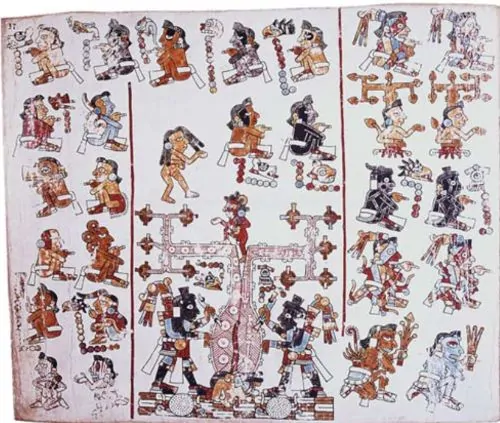
A Mesoamerican court was constituted by people before it was defined by a building or an abstract body of law. Judges heard accusations and evaluated proof, scribes made claims and decisions visible, constables compelled attendance and enforced orders, while rulers endowed the entire proceeding with political authority. Councillors, messengers, witnesses, local officials, custodians, and executioners could enter the process according to the character of the dispute. These functions were differentiated, but they did not belong to independent branches of government protected from one another by constitutional boundaries. The same palace official might possess judicial, tributary, military, ceremonial, and administrative responsibilities. A trial was a coordinated act of rule in which several officeholders converted a spoken conflict into an enforceable judgment.
Judges were specialist officials expected to possess knowledge, experience, self-command, and a reputation for integrity. Nahua descriptions of the good judge praise one who listened carefully, examined both sides, resisted gifts, spoke with deliberation, and decided without favoring kin or powerful litigants. The corresponding portrait of the bad judge emphasizes bribery, drunkenness, partiality, haste, and the deliberate distortion of testimony or established rights. Such moral contrasts reveal the standards by which judicial conduct could be judged, even if they also served as idealizing lessons about proper government. Senior judges were commonly drawn from politically experienced and socially elevated men whose education and service had prepared them for office, but judicial ability was not reducible to hereditary rank alone. Appointment depended upon the ruler or authorities acting in his name, and judges could receive maintenance through palace resources, assigned lands, tribute, or other official support. This material provision was supposed to permit continuous service while reducing dependence upon payments from litigants. Reports that corrupt judges could be removed, disgraced, or even executed demonstrate how seriously misconduct was represented, particularly in Texcocan traditions. Those severe accounts may magnify the exemplary justice of famous rulers, yet their underlying principle is clear: a judge who sold a decision injured the sovereign order whose authority he exercised.
Adjudication was frequently collective rather than the work of a solitary magistrate. Judges could sit beside experienced councillors, consult other officeholders, question parties in one another’s presence, and refer an uncertain matter to a superior tribunal. Collective hearing allowed knowledge of local custom, genealogy, tribute, landholding, and political rank to be brought into the same deliberation. It also made the court resemble the broader councils through which Mesoamerican rulers governed, because counsel and judgment were complementary exercises of public authority. These officials were not a jury of citizens standing apart from the state; they were participants in government whose deliberation was intended to produce an authoritative institutional voice.
Scribes made that institutional voice durable. The Nahuatl term tlacuilo, commonly rendered as painter-scribe, designated a trained specialist capable of communicating through pictorial, graphic, numerical, and conventional signs whose meanings were explained within an oral performance. In a judicial setting, scribes could identify litigants, depict disputed lands, trace genealogies, record tribute obligations, preserve boundary relationships, and represent the outcome of a case. Their work did not ordinarily produce a word-for-word transcript comparable to that of a modern court reporter. Instead, it selected the people, places, objects, quantities, relationships, and decisions that authorities considered necessary to preserve. A painted record became fully intelligible through knowledgeable explanation, and the parties or community officials presenting it could speak to matters that the image condensed. Scribes also served government outside the hearing by maintaining tribute accounts, dynastic histories, property records, and lists of dependent communities. After the conquest, Indigenous writers increasingly combined pictorial conventions with alphabetic Nahuatl, Spanish glosses, notarial formulas, and European materials. That transformation makes colonial records invaluable but complicated evidence, since a document could preserve an older territorial memory while presenting it in forms designed for a Spanish judge. Whether painted or alphabetic, scribal work gave temporal reach to judgment by allowing future authorities to recall who had claimed, possessed, inherited, owed, or been ordered to perform something.
The enforcement officers conventionally called bailiffs or constables occupied a less celebrated but indispensable position. Nahua sources use titles such as achcauhtli and, notably in colonial settings, topilli or topile for officials who could carry summonses, guard prisoners, maintain order, make arrests, escort accused persons, and execute judicial commands, although these terms did not describe identical duties in every period or community. Their staffs, clothing, or association with the palace marked them as bearers of delegated authority rather than private agents of a complainant. A court without such personnel could announce a decision, but it could not reliably compel appearance, secure a dangerous defendant, recover property, collect a penalty, or deliver a condemned person for punishment.
Other subordinate personnel connected the courtroom to the places and communities over which it claimed authority. Messengers transmitted orders to neighborhood leaders and subject towns, guards held accused persons before judgment, and local officers produced parties or supplied knowledge about land, tribute, conduct, and reputation. Officials assigned to markets watched transactions and could detect fraud or theft before a private complaint was presented. In serious cases, agents of the ruler might investigate wrongdoing, seize evidence, or initiate proceedings concerning corruption, treason, or disorder that threatened the polity. Executioners carried out the gravest sentences, making the final stage of adjudication publicly visible. These roles should not be forced into modern categories of police, prosecutor, sheriff, and corrections officer, because responsibility could shift with the forum and offense. Nor did every case activate the full apparatus: many civil disagreements required record-keeping and authoritative settlement without arrest, detention, or corporal punishment. The court’s personnel expanded or contracted according to what was necessary to transform a particular dispute into compliance.
Above this body of specialists stood the ruler, even when he never personally heard the litigants. The tlatoani remained the ultimate source of public jurisdiction, while in Tenochtitlan the Cihuacoatl supervised major governmental and judicial responsibilities and could preside over senior forums. Councils and experienced judges absorbed much of the daily work, but difficult disputes, allegations against powerful officials, threats to the state, and capital cases could rise toward sovereign consideration. Royal participation did not represent an intrusion into an otherwise independent judiciary; it expressed the political foundation upon which judicial office rested. Yet delegation mattered because repeated hearings, record maintenance, local knowledge, and the evaluation of evidence required specialists rather than occasional acts of personal command. Judges, scribes, constables, councillors, and rulers consequently formed an interdependent institution through which authority learned about conflict, pronounced its resolution, remembered what had been decided, and compelled the social world to conform.
Bringing a Case and Due Process
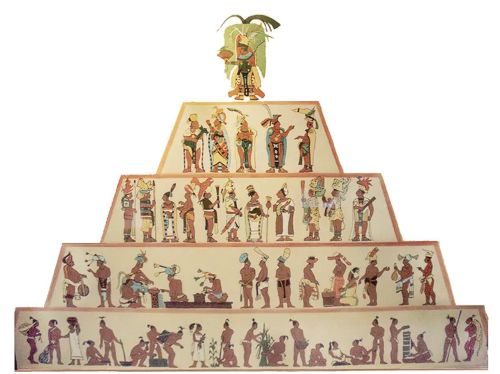
Bringing a dispute before a Mesoamerican court required transforming an injury known within a household, neighborhood, marketplace, or political community into a claim recognized by an authority competent to judge it. The terms “complaint,” “accusation,” “summons,” and “arrest” are useful for describing stages of that transformation, but they derive largely from Spanish legal vocabulary and should not be mistaken for exact translations of universal Indigenous procedures. Surviving sources rarely preserve a complete case from its first report through final judgment, and they say far more about serious offenses and exemplary punishments than about routine disagreements settled locally. Nevertheless, they indicate that litigants could approach officials, state a grievance, identify an opposing party, and request intervention. Proceedings could also begin when market supervisors, tribute officers, neighborhood authorities, or agents of the ruler discovered conduct that violated the obligations entrusted to them. The path into court depended upon who reported the wrong, which authority possessed jurisdiction, and whether the matter threatened a private relationship, a corporate interest, or the ruler’s order.
An ordinary complaint most likely began near the social setting in which the dispute had arisen. A claimant could present the matter to household elders, neighborhood officers, a local lord, or judges associated with the palace, depending upon the parties and the seriousness of the grievance. No surviving evidence suggests that entry into court normally required an attorney, a written petition employing technical formulas, or the payment of professional advocates. The complainant instead described the injury and might support the account with witnesses, painted records, tribute lists, genealogical knowledge, boundary memories, or the disputed object itself. Claims involving land, inheritance, debt, unpaid tribute, damage to property, broken agreements, or family obligations often implicated more people than the individual who first spoke. Relatives might defend household interests, while community officials could pursue rights belonging collectively to a calpolli, tlaxilacalli, or altepetl. Local authorities could attempt reconciliation or restitution before forwarding an unresolved matter to a superior forum. Once accepted by a judge, the complaint ceased to be merely a quarrel between neighbors and became a demand for an authoritative determination. The complainant initiated the process, but court officials controlled the questioning, evaluation of proof, and enforcement of the eventual decision.
Accusations concerning violence, theft, adultery, official corruption, treason, military misconduct, or other grave offenses do not fit neatly into the modern distinction between private prosecution and prosecution by the state. An injured person, relative, witness, or local officer might report the alleged offense, but authorities could take a more active role when the conduct endangered communal discipline or sovereign interests. Marketplace supervisors, for example, were positioned to detect fraudulent transactions or theft, while tribute and palace officials could discover embezzlement, disobedience, or abuse of office through their administrative responsibilities. A notorious act or an offense committed openly could become a public matter without waiting for a formally drafted accusation from an individual victim. Yet denunciation alone did not necessarily establish guilt, because judges were expected to hear opposing accounts, question witnesses, and examine whatever corroborating evidence could be produced. An accusation was the beginning of authoritative inquiry rather than a verdict pronounced by the accuser.
When the opposing party was not already present, court personnel had to compel or secure an appearance. Officials conventionally described as constables, bailiffs, or messengers carried judicial commands from the palace into neighborhoods and dependent communities. Nahua titles such as achcauhtli and topilli covered duties that could include delivering summonses, maintaining order, guarding prisoners, escorting accused persons, and enforcing judgments, although their precise meanings varied by place and period. A summons communicated that the recipient was now answerable to an authority whose command extended beyond the original complainant. In a land or inheritance dispute, local officeholders could help identify the parties and bring before the judges those who possessed relevant knowledge. Commands sent to subordinate towns might pass through their rulers or community officers, thereby preserving the political hierarchy through which jurisdiction operated. The surviving accounts do not provide a uniform schedule of response periods, procedural notices, or penalties for every failure to appear, and it would be hazardous to invent such regularity from later colonial practice. What can be established is that specialist personnel connected the hearing place to the population, making judicial attendance an obligation backed by the ruler’s coercive power.
Summons and arrest were not interchangeable responses to an allegation. Ordinary property or obligation disputes did not necessarily require physical seizure, whereas a person accused of a grave offense, discovered in the act, considered likely to flee, or believed capable of further disorder might be taken into custody and brought under guard before superior officials. Arrest could secure the accused for questioning and punishment, but the fragmentary sources do not reveal a single Mesoamerican law of detention, a general presumption favoring release, or a standardized distinction between pretrial confinement and penal imprisonment. Custody should be understood as one instrument within a broader process of compulsion, employed according to the alleged offense, the defendant’s position, the forum’s authority, and the danger that a command to appear would prove insufficient.
Social rank affected every stage without making nobles categorically immune from accusation or punishment. A commoner’s complaint against a powerful person presented obvious risks, while accusations involving nobles or officeholders could bypass local settlement and demand palace attention because they implicated the credibility of government itself. Texcocan traditions insisted that judges and officials who accepted gifts or falsified decisions could receive exceptionally severe punishment, turning proceedings against them into demonstrations of royal justice. Beyond central Mexico, sources concerning Maya and Purépecha government likewise describe local authorities, messengers, lords, and royal agents who received reports and compelled alleged wrongdoers, although the available evidence cannot establish an identical sequence across those societies. Complaint, accusation, summons, and arrest are best treated as analytical stages rather than components of a common Mesoamerican procedural code. Together they reveal how courts drew conflicts out of their immediate social settings and placed persons, testimony, property, and conduct before officials authorized to decide. Bringing a case was the moment when a grievance became a matter of governance.
A Court Without Lawyers: Litigants and Judicial Questioning
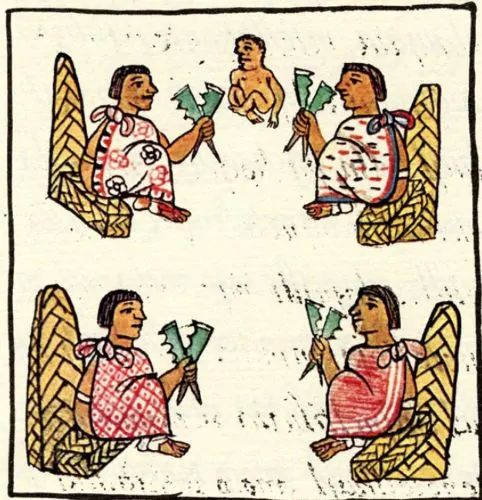
A Mexica hearing apparently lacked a professional class of privately retained lawyers comparable to advocates in later European courts. No surviving source describes an independent legal profession that monopolized courtroom speech, prepared technical pleadings, or represented clients for a fee. Claimants ordinarily brought their own grievances before the judges, while accused persons or opposing litigants answered the allegations made against them. Both sides could produce witnesses, objects, painted records, and persons possessing authoritative knowledge of the disputed relationship. Relatives, neighborhood officers, noble-house representatives, or community leaders might assist a party or speak for a collective interest, so self-representation did not require every individual to appear in complete social isolation. A “court without lawyers” means the absence of a specialized profession standing between litigants and judges, not the absence of advice, assistance, or representative speech.
The litigant’s oral account gave the court its initial understanding of the dispute. A complainant had to identify the injury, connect it to the opposing party, and explain why the judges possessed authority to intervene. In a case involving land, this might require recounting inheritance, cultivation, conquest, migration, tribute obligations, or remembered boundaries rather than citing an abstract rule of property. A person claiming repayment could describe the agreement, the consideration exchanged, and the failure to fulfill an obligation, supported by witnesses or records if available. Defendants answered in the same immediate setting, disputing the alleged facts, offering another interpretation of the relationship, or challenging the claimant’s right to demand relief. Speech was evidence as well as advocacy, because the parties were among the court’s principal sources of knowledge. Their statements could be compared with witness testimony, material proof, local memory, tribute records, genealogies, or painted maps. Repetition and contradiction exposed points requiring further inquiry, while failure to answer convincingly could damage a party’s credibility. Yet eloquence alone was not supposed to determine the result, since the good judge was represented as one who looked beyond persuasive speech and resisted favoritism. The court’s task was to convert competing narratives into an authoritative account of what had occurred and what obligations followed from it.
Judges did not merely listen while two parties conducted an adversarial contest according to rules enforced from the bench. They questioned litigants and witnesses directly, isolated inconsistencies, requested corroboration, and directed attention toward the facts they regarded as decisive. This active role compensated partly for the absence of lawyers by enabling judges to clarify claims that had not been organized into technical pleadings. It also concentrated enormous power in the tribunal, since the judges determined which questions would be asked, which answers appeared credible, and when the inquiry had become sufficient for judgment. Collective deliberation among several judges could restrain individual whim, but it did not eliminate the imbalance between an experienced palace tribunal and an inexperienced litigant standing before it.
Representation nevertheless appeared when when the interests at stake belonged to a group or when social circumstances made solitary appearance impractical. A ruler, noble house, neighborhood community, or dependent town could speak through an officeholder whose authority derived from the body he represented rather than from professional admission to legal practice. Elders might explain communal boundaries, relatives might defend inherited household claims, and tribute officials could describe obligations recorded within administrative accounts. Knowledgeable speakers could consequently acquire considerable practical expertise in presenting claims even though the evidence does not establish a separate bar of professional advocates. Social position undoubtedly affected a litigant’s ability to command such assistance. Nobles and officials had greater access to records, politically influential witnesses, and persons familiar with palace institutions, whereas commoners faced the danger that rank and patronage might shape whose words received attention. Women could possess, inherit, transfer, and defend property, but household relationships and gendered expectations influenced how their interests were presented and who appeared with them. Collective claims could protect vulnerable members by placing community authority behind their words, yet they could also subordinate individual interests to those of male relatives, elders, or officeholders. Judicial ideals condemning bribery, kinship favoritism, and intimidation make sense precisely because unequal access to influence was a recognized threat to justice.
It would be misleading to classify this procedure simply as either, since both terms arise from legal traditions that organized accusation, proof, prosecution, and judicial office differently. Litigants initiated many proceedings and carried much of the burden of producing witnesses and supporting evidence, but judges actively investigated the dispute rather than serving as passive referees. Serious public offenses could draw officials into accusation, custody, and inquiry, yet there is little evidence for a permanent prosecutorial profession distinct from the judiciary and palace administration. Direct questioning may have made justice accessible without the expense of counsel, but it also left litigants dependent upon the competence and impartiality of officials who controlled both inquiry and judgment. The absence of lawyers simplified the institutional structure without necessarily equalizing the courtroom. Mexica adjudication rested upon an encounter between speaking parties and questioning authorities, with justice depending upon whether judges could distinguish truthful testimony and persuasive proof from status, fear, deception, and political pressure.
The Credibility of Testimony
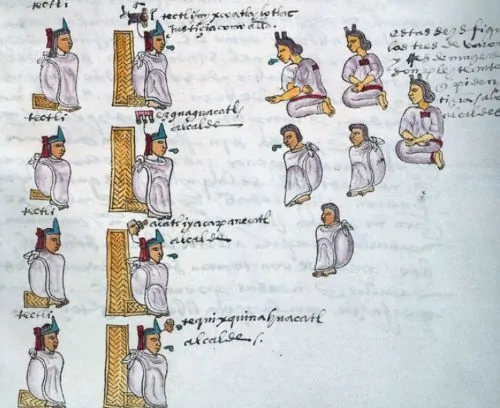
Testimony stood at the center of Mesoamerican adjudication because judges usually encountered disputed events through the words of people who had seen, heard, remembered, or participated in them. In Mexica courts, litigants presented their competing accounts while witnesses supplied knowledge concerning conduct, possession, inheritance, boundaries, agreements, reputation, and communal obligations. Yet the surviving sources do not preserve a comprehensive law of evidence specifying who could testify, how many witnesses were required, or which statements were legally inadmissible. Indigenous testimony appears most clearly in early colonial lawsuits, where older practices of collective memory and oral explanation operated within Spanish procedural forms. Those records illuminate continuities but cannot be projected unchanged into the period before 1519. A witness was consequently both a source of factual information and a socially situated person whose relationship to the parties affected how the court evaluated the statement.
The kinds of knowledge expected from witnesses varied with the dispute. A neighbor might recall who had cultivated a field, a relative could explain a line of inheritance, and a tribute official might identify the community responsible for a particular payment. Elders possessed special authority in territorial controversies because they remembered boundaries, migrations, political submissions, and agreements made by an earlier generation. Marketplace officials could testify about transactions or misconduct occurring under their supervision, while palace officers supplied information about tribute, officeholding, or governmental commands. Witnesses might also accompany painted maps, genealogies, or account records, explaining conventional signs whose meaning was not fully contained in the image itself. This oral performance prevented pictorial evidence from functioning as a self-interpreting document. Several mutually reinforcing statements could establish a pattern of possession or obligation even when no single witness knew the entire history. Conversely, kinship, dependency, hostility, or personal interest might weaken a statement without necessarily disqualifying the speaker altogether. The evidence does not support a universal rule barring women, commoners, dependents, or other social categories from giving testimony, although rank and gender undoubtedly affected whether their words received equal attention. Credibility emerged from the relationship among the speaker, the claim, the community’s memory, and whatever corroborating proof could be produced.
Formal oath-taking remains more difficult to reconstruct. Nahua religious and diplomatic traditions associated truthful speech and solemn commitment with sacred consequences, and gestures such as touching or symbolically eating earth could invoke divine powers as witnesses to a declaration. Moral discourse likewise represented deliberate falsehood, broken promises, and deceptive speech as threats to personal and communal order. These practices demonstrate that truth could be guaranteed through more than secular punishment, but they do not prove that every courtroom witness performed a standardized oath comparable to swearing upon a Christian Bible. Spanish writers translated Indigenous solemnities through familiar words such as “oath,” while colonial courts introduced formulas that could alter the practices they purported to record.
Confession supplied another potentially powerful form of proof, especially when an accused person’s admission confirmed testimony or circumstances already before the judges. Direct judicial questioning gave officials repeated opportunities to press a defendant, expose contradiction, and seek acknowledgment of the alleged act. Nevertheless, confession should not be understood automatically as the indispensable objective of every proceeding or as proof that Mexica adjudication followed the same logic as European inquisitorial justice. Nahua religion possessed its own forms of confession, particularly traditions associated with Tlazolteotl and the disclosure of moral or sexual transgressions, but ritual purification was not identical to an admission made before a secular tribunal. The sources also do not establish a standardized system of judicial torture employed routinely to extract confessions in ordinary cases. Detention, fear of severe punishment, deference to authority, and forceful questioning could still make an admission coercive even without a formally prescribed torture procedure. A confession that conflicted with witnesses, records, physical circumstances, or communal knowledge could remain suspect, whereas one containing verifiable details carried greater persuasive force. Nor is there evidence for a general privilege against self-incrimination: an accused person brought before questioning judges was expected to answer, and silence cannot safely be interpreted as the exercise of a recognized legal right.
Judges assessed credibility by bringing different forms of knowledge into relation rather than by mechanically applying a surviving code of evidentiary rules. Consistency mattered, as did firsthand knowledge, reputation, corroboration, the speaker’s opportunity to observe, and the compatibility of testimony with painted or material proof. Social standing could enhance credibility because nobles, elders, and officeholders possessed recognized authority, but rank also created opportunities for intimidation and favoritism. Nahua descriptions of the corrupt judge who twisted words, accepted gifts, or favored powerful parties reveal an awareness that testimony could be manipulated by the very officials responsible for evaluating it. Collective hearing and consultation among judges offered some protection by exposing contradictions to several experienced listeners, although they could not eliminate shared political interests or social prejudice. Oaths and confessions strengthened claims by placing a speaker’s truthfulness under sacred, moral, or judicial pressure, but neither displaced the need to compare words with other evidence. The credibility of a case rested upon whether the tribunal could assemble testimony, memory, records, circumstances, and admissions into an account authoritative enough to justify judgment.
Material Evidence and Painted Proof
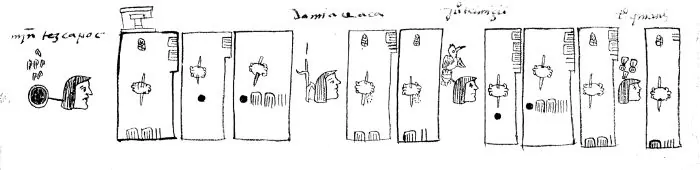
Mesoamerican courts operated within cultures in which authoritative knowledge could be painted, embodied, recited, and physically located rather than preserved only as alphabetic prose. Trained painter-scribes represented persons, places, dates, quantities, offices, commodities, journeys, conquests, and lines of descent through conventional signs that knowledgeable viewers could interpret. These records were not decorative illustrations appended to an otherwise complete oral case. They organized information, preserved selected relationships, and enabled claims to travel beyond the memory or presence of a single speaker. Yet a painted manuscript rarely functioned as self-sufficient proof, because its meaning emerged through explanation by scribes, elders, officials, or litigants who knew the history it compressed. Evidentiary force consequently arose from the agreement among image, oral exposition, social memory, and the material world to which the record referred.
The modern word “codex” conceals the diversity of manuscripts that could preserve legally significant knowledge. Some recorded tribute, others dynastic history, ritual cycles, calendrical calculations, migrations, conquests, landholding, or the internal organization of particular communities. A court did not consult a universal law book in which offenses and remedies had been arranged as numbered provisions. Instead, a relevant manuscript might establish that a ruler had conquered a place, a lineage had founded a settlement, a community owed specified goods, or a household possessed particular fields. The tlacuilo selected graphic elements that made such relationships visible without reproducing every word spoken about them. Place signs could identify communities, footprints could indicate movement, cords or connecting lines could express relationships, and numerical signs could quantify tribute or land. Color, spatial arrangement, costume, posture, and relative placement also communicated distinctions of identity and status. The surviving manuscripts were frequently produced or recopied after the Spanish conquest, and their forms sometimes combined Indigenous conventions with alphabetic glosses, European paper, Christian chronology, and colonial administrative purposes. They preserve evidence of earlier intellectual practices, but they cannot be treated as untouched photographs of a preconquest archive.
Maps were powerful because jurisdiction and property depended upon relationships among people, communities, cultivated fields, water, roads, mountains, temples, and remembered boundaries. Indigenous maps did not ordinarily seek to reproduce territory through consistent scale, compass orientation, and geometric projection. They arranged significant places according to political, historical, and relational importance, using place glyphs, paths, waterways, footprints, buildings, vegetation, and boundary signs to construct an intelligible landscape. Their accuracy lay less in visual resemblance to the view from above than in their ability to identify who belonged where and how one place related to another. When interpreted by witnesses familiar with the terrain, a painted map could transform local geographical memory into evidence capable of examination by distant judges.
Genealogies performed a related function by locating rights within time. Dynastic authority, noble office, inherited land, tributary privilege, and the control of dependent communities could rest upon descent from a recognized ancestor or marriage into an entitled lineage. Pictorial genealogies represented these claims through named figures, marriage connections, descent lines, houses, thrones, place signs, and symbols of office. Women appeared prominently when succession or property passed through them, when marriage joined ruling houses, or when their ancestry gave legitimacy to descendants. A genealogy was not merely a record of biological relationship but an argument about continuity, entitlement, and political identity. Competing branches of a family might construct the past differently, omit inconvenient relatives, emphasize particular marriages, or disagree over whether an ancestor had possessed a right personally or in an official capacity. Judges still required knowledgeable speakers to identify the figures and explain the consequences of their relationships. Mixtec screenfold histories demonstrate with particular clarity how genealogy, warfare, marriage, and territorial rule could be woven into a single political narrative. Central Mexican manuscripts such as the Codex Xolotl and Mapa Quinatzin likewise joined dynastic history to the organization of communities and offices. Genealogical proof did not simply discover an uncontested past; it made the past available for legal and political dispute.
Tribute lists and cadastral records supplied more quantitative forms of painted evidence. The Matrícula de Tributos and Codex Mendoza identify subject communities and the goods expected from them, demonstrating how graphic notation supported imperial administration even though the surviving manuscripts are not courtroom exhibits in the narrow sense. Early colonial records from the Acolhua region, including the Códice de Santa María Asunción and Codex Vergara, identify household members, parcels, measurements, soil characteristics, and assessments through combinations of pictorial and numerical notation. Such documents reveal an exacting capacity to associate named people with defined resources and obligations. They could help authorities determine whether tribute had been assessed properly, whether a household controlled the land it claimed, or whether an inheritance altered the distribution of property. Administrative records acquired evidentiary force because government had created them to remember relationships that could later become disputed. Their survival from the colonial period cannot establish that every preconquest community maintained identical registers, but it makes the widespread use of specialized land and tribute records difficult to doubt.
Material evidence anchored these painted and spoken claims in things that judges could inspect, recognize, or order others to examine. A disputed field contained canals, terraces, crops, trees, houses, and paths that disclosed patterns of labor and occupation, while mountains, springs, ruins, temples, and stones could preserve remembered boundaries. In a theft or commercial dispute, the contested goods, their quantity, their ownership marks, or their recovery from an accused person might corroborate testimony. Weapons, damaged property, wounds, clothing, and bodies could likewise reveal circumstances that oral accounts attempted to explain, although the sources provide no comprehensive rules governing their presentation. Officials and community witnesses could visit a place, identify landmarks, or report physical conditions to a superior tribunal. Possession itself left material traces because cultivation, construction, irrigation, and maintenance required sustained labor that neighbors could observe. Such traces were seldom unambiguous: planting a field might demonstrate lawful possession, recent encroachment, tenancy, or labor performed for another household. Physical evidence depended upon testimony that placed an object or landscape feature within a history of recognized relationships. Painted maps could guide that explanation by identifying the significant features, while genealogies and tribute records explained why particular people claimed authority over them. Modern archaeology provides historians with an additional body of material evidence about settlement, administration, craft production, and political organization, but archaeological remains should not be confused with objects known to have been introduced in a specific preconquest hearing. The evidentiary world of the court joined things and words because neither could reliably settle a dispute without the other.
Spanish conquest changed the settings in which painted proof was produced and judged without immediately extinguishing its authority. Indigenous communities presented pinturas, maps, genealogies, tribute accounts, and boundary histories in colonial courts, sometimes creating new manuscripts expressly to defend land, office, status, or exemption. Spanish judges and notaries demanded translations, glosses, sworn explanations, and written summaries, thereby converting pictorial evidence into hybrid legal records. This colonial archive is indispensable precisely because it shows Indigenous communities adapting older methods of remembering rights to an unfamiliar jurisdiction. It is also hazardous, since manuscripts prepared for colonial lawsuits responded to new legal categories, political pressures, and opportunities for strategic reconstruction. Painted proof was neither an inferior substitute for writing nor an unquestionable image of the truth. Its authority rested upon the ability of litigants, scribes, witnesses, and judges to connect a visible record with credible memory and a material landscape.
Recording the Case: Scribes and the Judicial Archive
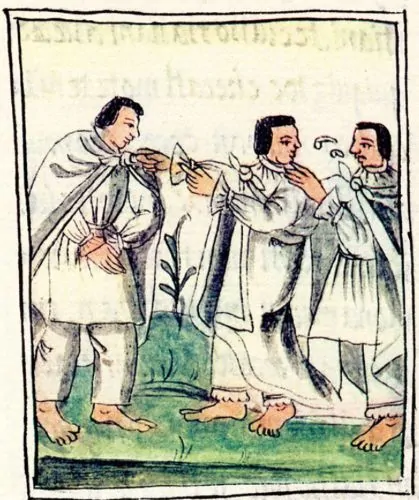
A judicial decision acquired lasting authority only if rulers, officials, and communities could remember what had been decided. Mexica courts depended upon forms of record-making that joined painted notation, oral explanation, administrative knowledge, and collective memory. Their archives did not resemble modern collections of consecutively numbered case files containing pleadings, transcripts, exhibits, and published opinions. No surviving preconquest dossier preserves every stage of a single lawsuit from complaint through enforcement. Instead, legally significant information was distributed among pictorial manuscripts, tribute accounts, genealogies, territorial records, official memories, and the knowledge retained by litigants and communities. Recording a case meant preserving enough of its persons, claims, evidence, and outcome to make the judgment intelligible when it was later invoked.
Painter-scribes could serve the court by reducing a complex oral proceeding to selected visible relationships. They might identify the litigants through personal names or signs, associate them with houses and communities, depict a contested field or object, and indicate quantities of land, tribute, or goods. Genealogical connections could establish inheritance, while footprints, paths, boundary features, or place signs situated a controversy within a political landscape. A judgment might be represented through the disposition of property, the imposition of an obligation, the punishment of an offender, or the confirmation of an office or status. Such notation was necessarily selective because it did not reproduce every question, hesitation, contradiction, and spoken argument heard by the judges. The scribe’s choices determined which elements of the proceeding would remain visible after the participants departed. Those choices were shaped by the purposes of the record: an account intended to enforce tribute required different information from one preserving a boundary or dynastic succession. Judges and senior officials could supervise what was recorded, while knowledgeable speakers supplied the explanations that connected its signs to the dispute. The resulting manuscript was not a stenographic transcript but a structured memory of the case.
Human recollection supplied what the painted record omitted. Elders, local officeholders, scribes, and witnesses remembered the circumstances under which an agreement had been made, a boundary recognized, or a right inherited. Their knowledge could preserve earlier judgments even when no separate manuscript survived or when a painted image required interpretation. Judicial memory was social and performative: the record became operative when an authorized person explained how its visible signs related to remembered events.
Preservation also depended upon the wider administrative institutions of palace, temple, noble house, and community. Nahua society maintained repositories of manuscripts, conventionally associated with the amoxcalli, or “house of books,” although the evidence does not permit every such repository to be classified as a specialized judicial archive. Dynastic histories, tribute lists, cadastral records, genealogies, and accounts of conquest could all become relevant when officials needed to determine jurisdiction, obligation, status, or possession. A palace court could draw upon records created for governmental purposes rather than maintaining an entirely separate documentary collection for litigation. Communities likewise preserved territorial and historical knowledge through their own scribes, elders, and ruling houses. This distributed archive allowed a local claim to be compared with the administrative memory of a superior authority. Earlier decisions might influence later controversies by establishing who had been recognized as an heir, officeholder, tributary, or possessor, but this did not create a doctrine of binding precedent comparable to that of common-law courts. The authority of the earlier judgment rested upon the status of the officials who had rendered it and the credibility of those who remembered or recorded it. Access was correspondingly unequal, because rulers, nobles, and corporate communities possessed greater resources for preserving favorable accounts than isolated individuals did. Records could be lost through warfare, political succession, deliberate destruction, deterioration, or the displacement of the institutions that maintained them. The surviving evidence consequently represents only fragments of a much larger documentary and mnemonic world.
Spanish conquest transformed that world by inserting Indigenous records into courts governed by alphabetic writing, notarial authentication, Christian oaths, and Spanish legal categories. Painter-scribes continued to prepare maps, genealogies, tribute accounts, and territorial histories, but these were increasingly accompanied by Nahuatl or Spanish glosses explaining their meaning to colonial officials. Indigenous litigants dictated petitions, produced witnesses, requested copies of decisions, and preserved documents issued by Spanish judges alongside older community records. Alphabetic texts could record questions and testimony more fully than pictorial notation, yet they also filtered Indigenous claims through interpreters, notaries, legal formulas, and unfamiliar concepts of ownership and jurisdiction. Communities responded by creating hybrid archives in which painted manuscripts, alphabetic annals, land titles, council records, and colonial judgments supported one another. These collections reveal important continuities in local memory while also documenting adaptation to a legal regime created by conquest. They cannot simply be read backward as exact replicas of preconquest judicial practice.
The judicial archive was not merely a passive storehouse assembled after judgment. It helped determine which claims could be demonstrated, which relationships became officially recognizable, and whose version of the past would guide future decisions. Scribes exercised power by selecting what deserved preservation, while judges gave recorded relationships enforceable meaning. Elders and communities retained a parallel authority because their explanations could authenticate, challenge, or reinterpret what a manuscript displayed. Records protected rights by extending memory beyond an individual lifetime, but they could also consolidate inequality when politically dominant groups controlled the production and custody of documents. Much of the preconquest archive disappeared, and much of what survives passed through colonial hands, translations, and institutions. Even in fragmentary form, it demonstrates that Mesoamerican adjudication depended upon the deliberate conversion of conflict into an official memory capable of outliving the hearing.
Judgment and Appeal
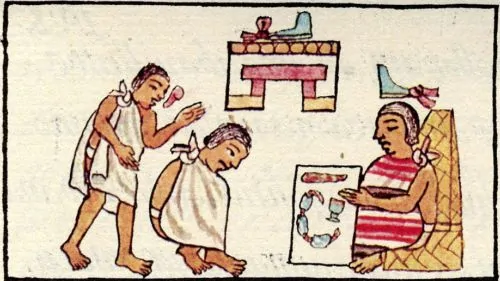
Judgment was not merely the instant at which a judge announced which litigant had prevailed. It was the institutional conclusion produced by comparing testimony, confessions, painted records, material evidence, communal memory, and the judges’ knowledge of recognized obligations. Contradictory statements had to be questioned, unfamiliar signs explained, and the political consequences of a decision considered. Deliberation linked the evidentiary hearing to the exercise of sovereign authority. When several judges or councillors sat together, discussion allowed them to test one another’s interpretations and present the outcome as the judgment of an office rather than the preference of one man. The legitimacy of the result depended as much upon disciplined consideration as upon the power available to enforce it.
Time was indispensable to this process, although the surviving accounts provide only an incomplete picture of judicial calendars. Descriptions of Mexica government portray judges as officials engaged in sustained daily service rather than nobles convened only when a spectacular crime demanded attention. A hearing could be prolonged while additional witnesses were summoned, local officers consulted, records retrieved, or questions referred to persons possessing territorial and genealogical knowledge. Difficult cases involving distant communities required messengers to travel and parties to appear before a superior tribunal. Deliberation could accordingly extend across multiple sessions without indicating institutional failure. Excessive delay nevertheless threatened litigants, weakened memory, prolonged detention, and invited judges to solicit payments for accelerating or obstructing a decision. Early colonial descriptions and later reconstructions frequently associate Mexica procedure with an eighty-day limit, corresponding to four twenty-day periods and to periodic gatherings at which difficult unresolved matters could be considered. That figure should not be converted into a universally enforced statute governing every court and every type of case, because the sources do not identify uniform rules for calculating the period or consequences for exceeding it. It is better understood as evidence that timely judgment formed part of the judicial ideal and that superior authorities periodically required subordinate judges to account for unfinished business.
Once the judges considered the inquiry sufficient, they pronounced a judgment identifying the right, obligation, injury, or offense established by the evidence. There is no reason to assume that every decision was issued as an alphabetic-style written opinion explaining rules and findings in sequence. Civil judgments could confirm possession, order restitution, recognize an heir, require payment, establish a boundary, or restore a violated communal entitlement. Criminal decisions could impose compensation, enslavement, loss of office or property, corporal punishment, banishment, or death according to the offense, status of the parties, and governing political tradition. Oral pronouncement remained decisive, while scribes and officials preserved or enacted those portions of the judgment necessary for future recognition and enforcement.
Appeal existed within the judicial hierarchy, but it did not necessarily resemble a modern right to review for legal error upon a closed written record. A dissatisfied litigant might seek the intervention of a superior court, while a lower judge could refer a difficult, politically sensitive, or jurisdictionally uncertain matter upward before issuing a final decision. Neighborhood and local tribunals stood beneath palace courts, and provincial authorities could remain answerable to senior institutions at Tenochtitlan, Tetzcoco, or another capital. Cases involving nobles, important tributary communities, official misconduct, or severe punishment were likely to attract higher scrutiny because their consequences reached beyond the immediate parties. Superior judges could reconsider testimony, consult records, question litigants again, or examine the conduct of the officials who had heard the dispute below. Such proceedings were capable of becoming renewed inquiries rather than narrowly confined examinations of procedural mistakes. Market, military, merchant, and community jurisdictions complicated the route of review because specialized forums possessed relationships to political authority that cannot be arranged within one universal appellate ladder. Nor does the evidence establish that every minor judgment could pass successively through several courts at the demand of either party. Access depended upon the matter, the litigants’ position, the willingness of officials to transmit the case, and the superior court’s recognition that further consideration was warranted. At the summit, a senior council, the Cihuacoatl, or the ruler could participate in judgments whose seriousness made sovereign attention necessary. A decision rendered at that level was final because no higher earthly authority existed within the polity to revise it.
Review could correct corruption, local favoritism, factual mistake, or an inferior judge’s inability to resolve a difficult conflict, but hierarchy was not an impersonal guarantee of fairness. Powerful litigants possessed greater ability to reach palace officials, mobilize respected witnesses, and preserve the records required to challenge an adverse result. Commoners and dependent communities could nevertheless use higher authority against abusive local officeholders, particularly when rulers wished to demonstrate that their justice protected the political order from corruption. Appeals and referrals served litigants while also allowing central authorities to supervise judges, discipline subordinate rulers, and draw important disputes into the palace. Time likewise possessed two faces: careful delay enabled investigation, whereas obstructive delay exposed parties to expense, uncertainty, and coercion. The good judge was expected neither to decide recklessly nor to postpone judgment for personal advantage. Deliberation, timeliness, judgment, and appeal formed a connected process through which Mesoamerican courts sought to make decisions credible, enforceable, and worthy of remembrance.
Courts of the Market
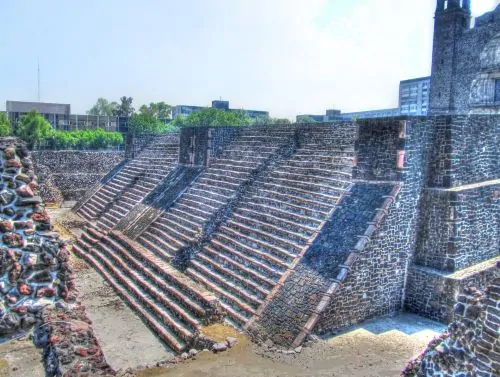
Mesoamerican adjudication was distributed among institutions whose authority arose from different forms of social and political responsibility. Markets, palaces, temples, and military organizations each maintained order within activities entrusted to their supervision, although none possessed jurisdiction in the precisely bounded sense of a modern specialized court. The same conduct could have commercial, religious, political, and criminal implications, allowing several authorities to claim an interest in its resolution. A theft in the market concerned exchange and public order, while theft of sacred property could become an offense against both temple and ruler. Military misconduct threatened discipline but might also constitute disobedience to sovereign command. Specialized courts are best understood as parts of an interconnected governmental order rather than autonomous branches applying separate bodies of law.
The market offered the clearest example of justice administered where regulated activity occurred. Major marketplaces such as Tlatelolco gathered thousands of sellers, buyers, porters, brokers, inspectors, and visitors whose transactions required supervision beyond ordinary neighborhood authority. Hernán Cortés reported that officials were continually present to inspect goods and measures, punish misconduct, and resolve disputes arising from trade. Market judges could hear complaints concerning theft, fraudulent exchange, false measures, defective goods, disputed prices, and violations of the rules governing where particular commodities were sold. Their physical presence allowed misconduct to be detected quickly and witnesses to be questioned before the participants dispersed. Inspectors and constables supported adjudication by observing transactions, maintaining order, and bringing offenders before the responsible officials. Judgment could follow closely upon the act, especially when an accused person had been caught stealing or cheating in public. Severe cases might be referred to palace authorities because market officials exercised delegated power rather than sovereignty independent of the ruler. Merchants also maintained corporate institutions capable of disciplining members and addressing conduct arising from long-distance expeditions, credit relationships, and the custody of valuable goods. The market court joined consumer protection, criminal enforcement, administrative inspection, and political control within a single institution essential to urban life.
The palace provided the central setting in which judicial hierarchy became visible. Within the tecpan, judges heard substantial civil disputes, serious criminal accusations, appeals or referrals from subordinate forums, and cases implicating nobles, officeholders, dependent communities, or the ruler’s interests. Tenochtitlan possessed tribunals conventionally identified as the tecalli and tlacxitlan, although colonial descriptions do not always define their respective jurisdictions consistently. Senior judges, councillors, and the Cihuacoatl could participate in higher adjudication, while the ruler retained ultimate authority in matters requiring sovereign judgment. The palace also brought records, scribes, messengers, constables, tribute officials, and custodial personnel into proximity, enabling the court to summon parties and enforce its commands. In Tetzcoco, later accounts attributed an elaborate judicial organization to Nezahualcoyotl and his successors, including councils concerned with different classes of disputes and periodic review of unresolved cases. Such descriptions may idealize royal order, but they demonstrate that justice was represented as a defining function of legitimate government rather than an occasional personal favor dispensed by the ruler.
Temple jurisdiction is more difficult to isolate because sacred and governmental authority were deeply interwoven. Priestly superiors disciplined members of temple institutions, supervised ritual obligations, and punished violations committed by youths educated in the calmecac or by religious personnel subject to demanding standards of conduct. Neglect of ceremonial duty, sexual misconduct, intoxication, theft of sacred property, or misuse of ritual office could consequently provoke internal discipline as well as intervention by secular officials. Temples also possessed lands, labor obligations, stored goods, and dependent personnel that could generate disputes requiring palace enforcement. Nevertheless, the sources do not establish a uniform and autonomous priestly judiciary comparable to a later ecclesiastical court. An offense against the gods was simultaneously a danger to the polity, making cooperation or overlap between priests, judges, and rulers more plausible than a clear jurisdictional boundary.
The army likewise required mechanisms capable of judging conduct under conditions in which hesitation, disobedience, or private appropriation could endanger an entire campaign. Commanders evaluated cowardice, desertion, insubordination, abandonment of formation, false claims to martial distinction, and failures in the custody of captives or tribute. Military rank depended upon demonstrated achievement, especially the taking of captives, so fraudulent claims affected both individual honor and the integrity of the hierarchy. Disputes over captures, insignia, promotions, or the division of spoils could require testimony from warriors who had witnessed the fighting. Punishments for grave misconduct were severe because martial discipline supported imperial expansion, tributary collection, and the public reputation of the ruler. The cuauhcalli, commonly translated as the “Eagle House,” appears in accounts of military and judicial activity, but the evidence does not justify treating every institution bearing that name as a standardized military courthouse throughout central Mexico. Elite warrior societies, commanders, palace councils, and rulers shared authority according to the accused person’s rank and the political significance of the offense. Merchants serving as intelligence gatherers or undertaking armed expeditions further blurred the boundary between commercial and military jurisdiction. As in the market, specialized knowledge made insiders valuable judges of conduct, but the coercive force behind their decisions belonged to the state.
These jurisdictions reveal a legal order organized around institutions and obligations rather than a single courthouse open to every kind of claim. The appropriate forum depended upon where the conduct occurred, what duty had been violated, who the parties were, and which authority bore responsibility for restoring order. A dispute could move from a specialized setting to the palace when it involved severe punishment, official corruption, noble status, political danger, or uncertainty about jurisdiction. Specialization made adjudication more informed and immediate, but overlapping authority also allowed rulers to supervise institutions whose independence might otherwise threaten central power. Market officials protected exchange, priests guarded ritual discipline, commanders maintained military obedience, and palace judges connected each sphere to sovereign justice. Courts mapped the structure of Mesoamerican government itself, placing judgment wherever organized power met the activities it was expected to regulate.
The Civil Work of the Courts
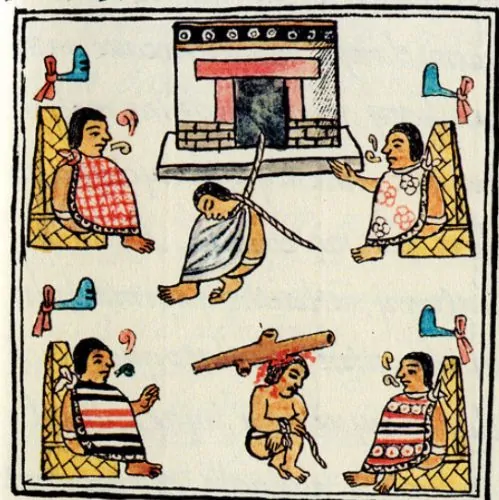
Much of the daily work of Mesoamerican courts concerned conflicts that arose from ordinary social relationships rather than spectacular crimes against ruler, temple, or community. Disputes over fields, houses, inheritance, marriage, loans, labor, tribute, and commercial agreements required authoritative settlement because they affected the productive foundations of household and polity. The modern category of “civil law” is useful for distinguishing these controversies from prosecutions for grave offenses, but it should not be imposed as a rigid Indigenous division between private and public wrongs. A boundary dispute could disrupt tribute collection, a broken marriage could alter the disposition of property, and an unpaid debt could place dependents or cultivated land under another household’s control. Courts intervened not merely to compensate an injured individual but to restore relationships upon which social order depended. Their civil work reveals justice operating as a continuous feature of economic and family life.
Land disputes were consequential because rights to cultivation existed within overlapping structures of household possession, community membership, noble authority, public office, conquest, and tribute. Nahua terminology distinguished several forms of landholding, but colonial descriptions often systematized those categories more rigidly than local practice probably allowed. Some lands supported rulers, palaces, temples, warriors, or public offices, while community lands were allocated among member households that cultivated them and contributed labor or tribute. Nobles could exercise hereditary claims over estates and dependent cultivators, yet even powerful possessors remained situated within political relationships that defined the source and extent of their authority. Courts might be asked to determine whether a field had been inherited, granted, purchased, abandoned, wrongfully occupied, or cultivated on behalf of another person. Witnesses recalled earlier possession, elders identified boundaries, and painted maps or cadastral records associated parcels with named households and obligations. Visible labor (irrigation, planting, terracing, building, and maintaining boundary features) could strengthen a claim without necessarily establishing absolute ownership in the modern sense. Women could inherit, possess, transmit, and defend land, particularly when it belonged to their natal family or passed through a marriage, although status, locality, and household structure affected the practical reach of those rights. A judgment might confirm possession, order the return of a parcel, redefine a boundary, recognize an heir, or reassign cultivation while preserving the tribute owed from the land. Adjudicating territory consequently meant deciding not only who could use the soil but also which household, community, office, or ruler could claim the benefits generated from it.
Credit allowed households and merchants to manage shortages, finance exchange, and coordinate obligations that could not be fulfilled immediately. Loans might involve cacao, cloth, maize, tools, luxury goods, or other forms of value, while payment could be promised through commodities, labor, or later delivery. Because no single currency governed every transaction, judges had to reconstruct what the parties had actually exchanged and what performance they had contemplated. Witnesses, account records, pledged objects, and admissions could establish the existence and terms of an obligation. Failure to pay was not necessarily treated as simple theft, but persistent default could expose property, labor, or personal dependency to judicial enforcement.
Debt dependency demands particular caution because Spanish observers described several forms of Nahua servitude through European categories of slavery. A tlacotli occupied a subordinate status and could owe labor because of debt, punishment, poverty, or an agreement involving the person’s household, yet this condition was not identical to the hereditary chattel slavery familiar from other societies. Dependents could possess property, maintain families, and in some circumstances obtain release, while children did not invariably inherit a parent’s status. The ability to bind one’s labor or that of a family member reflected severe material inequality and could subject vulnerable people to coercion. Judicial supervision mattered because creditors might exaggerate the obligation, seize more than had been pledged, or attempt to convert a limited debt into permanent control. Courts could determine whether an agreement existed, whether payment had already been made, and whether the creditor’s remedy corresponded to the obligation. Regulations associated with the ruler Itzcoatl reportedly restricted the sale of persons into servitude and required repeated formal acts before an incorrigible dependent could be sold, although such retrospective accounts should not be mistaken for a complete or uniformly enforced code. Debt cases stood at the boundary between contract, household survival, labor discipline, and personal freedom. Their resolution demonstrated how economic enforcement could preserve exchange while also reproducing differences of wealth and power.
Family disputes were equally important because the household organized property, production, inheritance, education, tribute, and care across generations. Courts or governing authorities could address contested marriages, separation, adultery, maintenance, succession, guardianship, and disagreements over goods brought into or accumulated during a union. Marriage joined families as well as individuals, and relatives frequently participated in negotiations or attempted reconciliation when the relationship deteriorated. Divorce appears to have been possible, although accounts differ regarding its procedures and consequences, and judges could encourage reconciliation before recognizing a permanent separation. Inheritance did not always follow a single rule of primogeniture: children, spouses, daughters, sons, collateral relatives, and designated successors could advance claims shaped by status, local custom, the character of the property, and the wishes of the deceased. Women’s capacity to control and transmit property gave them real legal interests, but it did not remove the constraints imposed by gendered labor, household authority, and political rank. By settling these controversies, courts reconstituted households after death, insolvency, conflict, or separation and ensured that land, labor, dependents, and tribute obligations remained attached to socially recognized claimants. Civil adjudication was not a lesser counterpart to criminal justice; it was one of the principal means by which Mesoamerican society reproduced itself from one generation to the next.
Crimes against People and the State
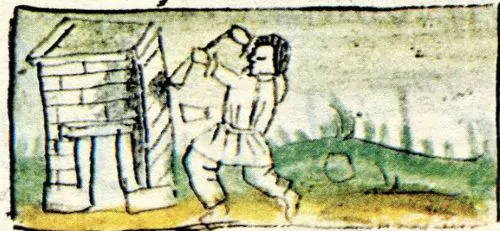
Criminal adjudication addressed conduct believed to injure not only an immediate victim but also the household, community, political hierarchy, or sacred order within which the injury occurred. Theft threatened possession and exchange, violence disturbed public peace, prohibited sexual conduct destabilized recognized relationships, and treason attacked the authority that made judgment possible. These categories are useful for analysis, but surviving Nahua sources do not present them as divisions within a comprehensive criminal code. The same act could assume different legal meanings according to the offender’s status, the victim’s identity, the place of commission, and the obligations violated. Colonial writers frequently converted such distinctions into concise lists of offenses and penalties that made Mexica law appear more uniform than the evidence permits. Courts instead evaluated wrongful conduct within a social world in which property, rank, family, tribute, religion, and political loyalty remained inseparable.
Theft ranged from the unauthorized taking of household goods or crops to attacks upon the resources of markets, temples, palaces, and tributary institutions. Judges needed to determine whether the accused had taken an object deliberately, possessed some prior claim to it, received it from another person, or merely failed to return property entrusted for a particular purpose. Ownership could be established through witnesses, possession, recognized marks, account records, or the recovery of the goods from the accused. Value mattered, but so did context: stealing maize from a field did not carry the same political significance as diverting tribute, taking military equipment, or removing sacred property. Market theft received severe attention because dense commercial exchange depended upon confidence that goods could be displayed without constant private protection. Officials who witnessed a theft or apprehended an offender with the goods could bring the matter rapidly before market judges. Restitution or compensation was possible in some property disputes, while serious, repeated, or institutionally threatening theft could produce servitude, loss of property, corporal punishment, or death. Early accounts sometimes attach a specific penalty to each stolen object or circumstance, yet such catalogs combine practices from different cities, periods, and social settings. The criminality of theft consequently rested not only upon material loss but upon the offender’s repudiation of a recognized relationship of possession, custody, exchange, or public obligation.
Violence required courts to convert physical injury and private retaliation into an authoritative public judgment. Homicide was treated as a grave offense, commonly associated in the sources with capital punishment, but judges still had to distinguish deliberate killing from accident, battlefield conduct, lawful official force, and deaths arising from less clearly intended assaults. Wounds, weapons, witnesses, threats, prior hostility, and the conduct of the accused after the event could help establish responsibility. Violence against parents, rulers, judges, messengers, or officeholders carried an aggravated meaning because it attacked a relationship of obedience as well as a human body. By judging assault and homicide, political authorities restricted the ability of households to answer injury through unregulated vengeance and asserted that serious violence disturbed the ruler’s peace.
Sexual conduct formed one of the most heavily moralized and least securely reconstructed areas of Mesoamerican criminal law. Nahua communities did not prohibit sexuality as such, and recognized social roles included marriage, courtship, concubinage, and the ahuiani, a woman associated with public entertainment and erotic companionship. What attracted legal intervention was often the violation of a particular relationship, status, institution, or obligation. Adultery was represented as a serious offense because it threatened marriage alliances, household property, inheritance, and the legitimacy of descent, and several sources report death for both participants when the accusation was proved. Such severity did not authorize uncontrolled private revenge, since personal suspicion differed from a judgment reached through witnesses, confession, or compelling circumstances. Sexual coercion, incest, and misconduct involving protected or dependent persons could likewise provoke grave sanctions, although the surviving descriptions are too fragmentary to establish a uniform law governing every altepetl. Priests, noble youths, and students in institutions such as the calmecac were held to disciplines connected to their offices, making sexual activity a breach of institutional duty as well as personal morality. Nobles could face harsher punishment than commoners when their conduct contradicted the exemplary restraint expected from persons of rank. Spanish missionaries also described same-sex acts through Christian concepts of “sodomy,” often using them to demonstrate Indigenous depravity or justify conquest, which makes it hazardous to translate their denunciations directly into preconquest statutes. Nahua language and imagery recognized forms of gender and sexual difference, but the evidence does not reveal one consistently defined criminal category corresponding to modern sexual identity. The legal significance of sexual conduct depended upon who acted, with whom, under what obligations, and with what consequences for household and political order.
Crimes against the state were offenses in which disobedience became a direct challenge to organized authority. Treason, conspiracy, rebellion, espionage, assistance to enemies, desertion during war, and disclosure of strategically valuable information threatened the survival of rulers and subject communities. Refusal of tribute or armed resistance could be represented as criminal defiance, although conquered peoples might understand the same conduct as defense of local autonomy. Officials committed a related form of political injury when they embezzled tribute, falsified accounts, accepted bribes, abused delegated power, or deliberately misreported conditions to the ruler. Unauthorized use of insignia, clothing, titles, military distinctions, or offices could also become punishable because visible rank communicated rights that the political order reserved for recognized persons. A false claim to captured enemies, noble ancestry, or official appointment appropriated more than prestige; it attempted to seize a place within the governing hierarchy. Severe punishment, confiscation, destruction of the offender’s house, or consequences for dependents are associated with some treason cases, but retrospective narratives may exaggerate collective penalties to dramatize royal power. “Crimes against the state” must consequently include both genuine threats to collective security and the ruler’s political designation of resistance as criminal.
These offenses demonstrate why Mesoamerican criminal justice cannot be reconstructed as a simple table matching prohibited acts with automatic punishments. Taking food, diverting imperial tribute, and stealing sacred objects were all forms of appropriation, yet they endangered different relationships and could draw different authorities into the case. An assault became more serious when directed against a judge, just as sexual misconduct assumed political importance when it endangered dynastic succession or violated a priestly office. Rank could aggravate wrongdoing by imposing higher expectations, but it could also give an accused person greater influence over witnesses and judges. Spanish descriptions concentrated upon executions and spectacular penalties because severity supported competing portraits of Mexica government as admirably disciplined or exceptionally tyrannical. The ordinary work of criminal courts was broader: they determined what had occurred, identified the obligations violated, restrained private retaliation, and decided when an injury had become a danger to the governing order itself.
Sentencing as Repair and Sovereign Power
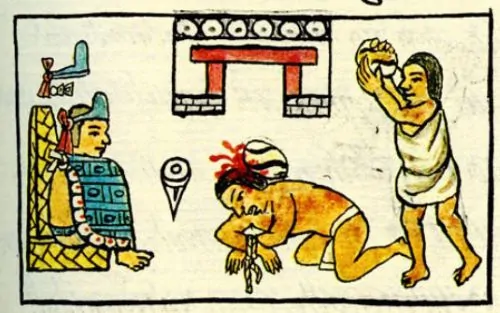
Sentencing converted a court’s determination of responsibility into a command capable of altering property, status, bodily freedom, or life. The modern term is useful, but it should not suggest that Mesoamerican judges selected punishments from a uniform statutory scale after calculating a precisely defined offense. Available responses included restitution, compensation, confiscation, compulsory labor or servitude, removal from office, public humiliation, corporal punishment, banishment, and death. The chosen consequence reflected the injury committed, the relationships violated, the status and obligations of the parties, and the political authority of the tribunal. Some judgments attempted to repair a disrupted arrangement, while others sought to warn observers or eliminate a person represented as dangerous to the community. A single sentence could perform all three functions simultaneously.
Repair was most visible in disputes over land, goods, labor, inheritance, and debt. Courts could order the return of a field, recognize a rightful heir, restore stolen property, require payment, redefine a boundary, or compel the fulfillment of an agreement. These remedies did more than compensate an individual because property and labor supported households, tribute obligations, temples, offices, and community institutions. Confiscation could reverse an illicit gain, but it could also transfer resources to a ruler or reduce an offender’s family to insecurity. A debtor unable to satisfy an obligation might enter a condition of dependency or compelled service, making economic enforcement inseparable from differences of wealth and power. Restitution likewise had limits when goods had been consumed, land altered, or an injury made physically irreparable. Judges could substitute labor, property, status, or punishment for what could no longer be returned. These measures should not be romanticized as an Indigenous equivalent of modern restorative justice, since they could be coercive and could preserve unequal relationships. Repair meant placing people, resources, and obligations into an officially recognized order, not necessarily reconciling the parties as social equals.
Other sentences communicated through fear and spectacle. Public beating, degradation, removal of insignia, destruction of property, enslavement, or execution demonstrated that misconduct produced consequences extending beyond the private experience of the condemned. The punishment of thieves in a marketplace warned participants that exchange remained under official protection, while penalties imposed upon corrupt judges or disobedient nobles affirmed that office carried exemplary obligations. Colonial accounts often arrange such punishments into dramatic catalogs in which adultery, theft, intoxication, treason, and official misconduct appear to receive automatic and frequently capital penalties, but these lists may preserve moral instruction, remembered royal decrees, and political idealization alongside actual practice. Deterrence depended not simply upon severity but upon making punishment intelligible as the consequence of violating a recognizable duty.
Every sentence also displayed sovereign power because only an accepted authority could transform injury into legitimate coercion. Households could accuse, communities could testify, merchants could discipline members, and military commanders could restrain warriors, but the power to impose the gravest penalties ultimately derived from rulers and the institutions governing in their name. Judges exercised delegated authority, while constables, executioners, tribute officials, and local officeholders enacted their decisions. Punishment of a corrupt judge was significant because bribery converted public authority into private advantage and threatened confidence in every judgment issued by the court. Status complicated this structure rather than producing one consistent rule of privilege. Nobles and officeholders could be punished more harshly when their misconduct violated the exemplary discipline expected from rank, and loss of office or insignia struck directly at the identity their status conferred. Commoners, dependents, and conquered peoples nevertheless possessed fewer resources with which to contest accusations or seek intervention from superior authorities. Treason and rebellion could provoke confiscation, destruction of houses, death, and reported penalties affecting an offender’s dependents, although accounts of collective punishment may magnify royal severity for political or didactic purposes. Capital punishment represented the most irreversible claim of sovereignty, but banishment, servitude, and civic degradation could also remove a person from the relationships that had defined social belonging. Sentencing made hierarchy visible by declaring who possessed the authority to judge, whose conduct endangered the polity, and what forms of coercion counted as lawful. Yet legitimate rulership ideally required disciplined judgment, because arbitrary punishment could reveal a ruler’s injustice as clearly as measured punishment demonstrated his power.
Mesoamerican sentencing cannot be placed upon a simple scale running from humane restitution to cruel execution. Spanish missionaries, conquerors, and colonial administrators emphasized severe penalties for different reasons, sometimes admiring the order they appeared to create and sometimes using them to depict Indigenous government as tyrannical. The severity was not wholly invented, for Nahua political thought associated social stability with disciplined conduct and accepted bodily and capital punishment for grave violations. Nevertheless, the daily work of courts also included returning property, enforcing obligations, restoring status, protecting exchange, and resolving conflicts before they became enduring feuds. A sentence addressed the immediate parties while instructing the wider community about possession, obedience, rank, and acceptable behavior. It repaired a damaged relationship when possible, warned others when rulers believed example necessary, and demonstrated that judgment possessed force beyond persuasion. Sentencing was the point at which legal reasoning became an exercise of government over bodies, households, resources, and collective memory.
Equal Judgment in an Unequal Society
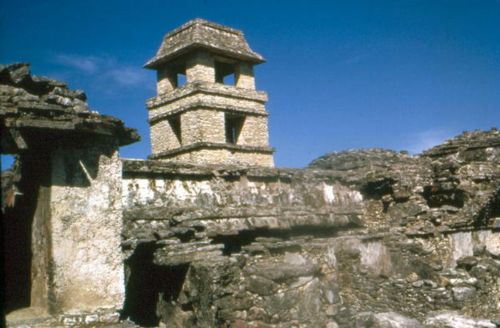
Claims of impartial judgment possessed special importance in a society structured by distinctions of rank, occupation, gender, community, and political dependence. Judges were expected to hear competing claims without accepting bribes, favoring relatives, or allowing wealth to determine the outcome openly. This judicial ideal should not be confused with the modern principle that all persons possess identical rights before a uniform law. Mesoamerican courts recognized different duties, privileges, punishments, and forums according to the social identities of those appearing before them. Equal judgment meant applying accepted obligations faithfully and restraining officials from distorting them for private advantage. Because those obligations were themselves unequal, courts could oppose personal favoritism while continuing to enforce hierarchy. Justice promised impartial treatment within the existing social order rather than emancipation from that order.
Rank provided the most visible test of this distinction. Nobles occupied political offices, controlled substantial resources, preserved genealogical records, and could bring their disputes before palace institutions familiar with elite claims. Commoners generally approached justice through neighborhood, community, market, or local authorities before a matter reached higher tribunals. Dependent cultivators, tributaries, servants, and debt-bound persons possessed still less freedom to mobilize witnesses or resist those who exercised authority over their labor. Yet noble status did not formally place every elite offender beyond punishment. Nahua accounts repeatedly insist that rulers, judges, warriors, and other officeholders could be punished severely because their elevated position imposed exemplary responsibilities. A noble convicted of intoxication, corruption, sexual misconduct, or abuse of office might suffer loss of rank, property, insignia, or life, making punishment an assertion that privilege required discipline. Such accounts formed part of a political ideal and do not establish that elite accountability was consistently achieved in practice. Nobles had greater access to rulers, scribes, influential witnesses, and records capable of supporting their interpretation of a dispute. Commoners could nevertheless appeal to superior authority against a corrupt local official, particularly when the ruler wished to present himself as protector of subjects against aristocratic predation. Courts could constrain powerful individuals without challenging the broader concentration of land, office, tribute, and political influence from which their power arose.
Gender produced another mixture of recognized legal capacity and structural disadvantage. Women could possess and inherit property, transmit household goods, appear in disputes, provide testimony, seek separation, and defend the interests of children or deceased relatives. Widows and other women acting as household heads could have substantial economic responsibilities that courts were required to acknowledge. Their claims were not simply extensions of male legal personality, although relatives and household alliances often shaped their ability to pursue them. Men nevertheless dominated rulership, senior judicial office, warfare, and the institutions through which coercive authority was exercised. Rules concerning marriage, adultery, sexuality, labor, and household obedience also subjected women to expectations that reflected patriarchal concerns about descent and property. Legal recognition consequently afforded women meaningful avenues of action without placing them on equal political or social terms with men.
Judicial ethics attempted to prevent these inequalities from becoming unlimited licenses for predation. Descriptions of the good judge emphasized composure, careful listening, resistance to gifts, truthful speech, and refusal to favor either a rich litigant or a powerful relative. The corrupt judge represented the opposite of lawful authority because he converted a public office into a source of private profit. Bribery, deliberate delay, false reporting, and manipulation of evidence could attract removal, disgrace, or severe punishment. Higher courts and periodic reviews allowed rulers to inspect unresolved cases and discipline officials whose conduct threatened confidence in government. These mechanisms created real possibilities for correcting local favoritism, especially when several judges deliberated together or when a community could document longstanding possession and obligation. They did not remove the practical advantages produced by literacy, record custody, travel, wealth, political connections, and freedom from dependency. A noble house could preserve genealogies and territorial histories more effectively than an isolated cultivator, while a corporate community could mobilize elders and painted records unavailable to an individual claimant. Persons living under tributary domination might obtain relief from an abusive collector yet remain obligated to support the conquering polity. Even testimony was socially unequal because the standing, reputation, and institutional affiliation of a witness affected how persuasive that person appeared. The judicial ideal sought to discipline the exercise of hierarchy, but the resources needed to invoke that ideal were unevenly distributed. Equal judgment was an ethical demand placed upon officials, not a description of equal power among litigants.
Recognizing these limitations does not reduce Mesoamerican courts to theatrical instruments of elite domination. Courts settled genuine conflicts, protected recognized possession, punished corrupt officials, restrained private vengeance, and sometimes allowed people of lower status to challenge those immediately above them. Their interventions mattered precisely because hierarchy did not make every act of exploitation lawful. Nevertheless, the protection they offered remained relational: a person was judged as a household member, tributary, noble, merchant, woman, warrior, dependent, officeholder, or subject of a particular ruler. Colonial observers could praise such discipline as evidence of admirable government or condemn it as proof of Indigenous tyranny, and both interpretations simplified the relationship between judicial ideals and social experience. The surviving sources reveal neither universal equality nor completely arbitrary power, but institutions struggling to distinguish authorized hierarchy from corrupt abuse. Mesoamerican justice could demand that judges treat litigants without personal favoritism while still assigning those litigants unequal rights, duties, credibility, and access. Its central contradiction was not that impartiality was absent, but that impartial judgment was expected to preserve a profoundly unequal world.
Texcoco and Nezahualcoyotl: The Reputation of a Lawgiving Kingdom
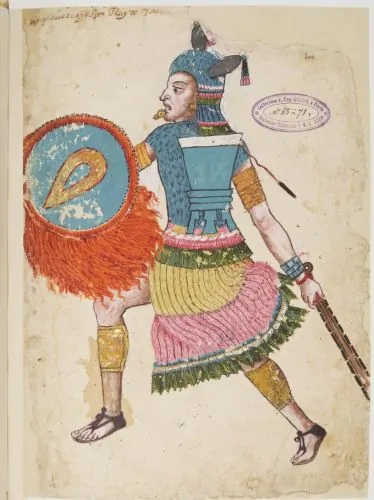
Among the capitals of the Triple Alliance, Texcoco acquired the most enduring reputation as a city governed by learning, orderly institutions, and unusually sophisticated law. Its fame became inseparable from Nezahualcoyotl, the fifteenth-century ruler remembered as warrior, engineer, poet, philosopher, and lawgiver. Later narratives portrayed him as a sovereign who gathered wise councillors, established courts, issued laws, punished corruption, and submitted even his own household to impartial justice. This image helped distinguish Texcoco from Tenochtitlan, which colonial and modern writers more often characterized through conquest, tribute, and human sacrifice. The contrast is misleading when treated as a simple opposition between a civilized Acolhua kingdom and a militaristic Mexica empire. To understand Texcoco’s legal significance, it is necessary to examine both the governmental institutions associated with Nezahualcoyotl and the historical process through which his reputation was constructed.
Nezahualcoyotl inherited neither a secure throne nor an intact kingdom. His father, Ixtlilxochitl, was killed during the expansion of Tepanec power, and the young heir spent years under threat before the overthrow of Azcapotzalco enabled him to recover Texcoco. His restoration occurred through alliance with the Mexica rulers of Tenochtitlan, among whom he had lived for a substantial period. After returning to Texcoco, he reconstructed a polity disrupted by warfare, elite displacement, and challenges from other Acolhua centers. This context makes his association with law politically intelligible, because restoring courts, tribute administration, offices, and recognized obligations was essential to transforming military recovery into durable rulership. Texcoco’s subsequent participation in the Triple Alliance brought conquered communities, tributary resources, and competing local authorities within its sphere. Legal organization helped coordinate this expanding political structure, but it also legitimized Nezahualcoyotl’s supremacy over communities whose previous independence had been curtailed. The “kingdom” attributed to him was consequently not a compact territorial monarchy ruled everywhere through identical institutions. It was a layered domain in which local rulers, noble houses, communities, and imperial officers retained differing powers while acknowledging Texcocan authority. Nezahualcoyotl’s achievement lay less in creating government from nothing than in rebuilding, consolidating, and extending institutions capable of holding that unequal domain together.
Colonial accounts describe councils that divided responsibility for justice, warfare, tribute, government, and intellectual or ceremonial activities. Juan Bautista de Pomar emphasized councils of justice and war, whereas Fernando de Alva Ixtlilxochitl presented a more elaborate arrangement of four principal councils concerned with government, war, finance, and music or learned culture. These descriptions agree that senior authority was organized around groups of officials rather than exercised through the ruler’s solitary judgment. They also indicate that the heads of important councils often belonged to the ruling dynasty, revealing how institutional specialization remained embedded within noble kinship. Differences between the accounts warn against treating either arrangement as an exact constitutional diagram, but the underlying evidence supports the existence of a substantial palace administration capable of hearing disputes, supervising officials, and transmitting decisions through a hierarchy of courts.
Nezahualcoyotl’s greatest legislative achievement was said to be the promulgation of eighty laws, a number repeated so often that it has sometimes been treated as the contents of a recovered Texcocan code. No complete contemporary text of eighty enactments survives. The regulations attributed to him instead appear in colonial narratives and pictorial materials describing treason, theft, homicide, adultery, drunkenness, misuse of inherited property, military misconduct, official corruption, and other violations. The Mapa Quinatzin depicts judges, rulers, wrongful acts, punishments, and procedures associated with political authority, providing Indigenous visual evidence that law occupied an important place in Texcocan historical memory. It does not identify Nezahualcoyotl unambiguously as the personal author of every rule represented within it. Some practices assigned to him closely resemble those reported for Tenochtitlan, Tlacopan, and other central Mexican polities. Even procedures connected with imperial warfare belonged to the collective operations of the Triple Alliance rather than to Texcoco alone. Shared offenses and punishments may reflect a broad Mesoamerican legal inheritance, political borrowing among neighboring cities, or later attempts to concentrate established customs within the biography of an exemplary ruler. Nezahualcoyotl could have issued decrees, reorganized tribunals, clarified penalties, and restored rules disrupted by Tepanec domination without composing a comprehensive code in the modern sense. His legislative reputation preserves a genuine association between rulership and legal reform while magnifying that association into an image of individual authorship. The eighty laws are best approached as a tradition about the disciplined completeness of his government, not as eighty statutory provisions whose original wording and universal application can now be reconstructed.
Stories of the ruler enforcing law against nobles and members of his own family gave this tradition its moral force. Nezahualcoyotl was represented as a father willing to accept the punishment of a son whose sexual misconduct violated both law and dynastic order. Whether every detail of such episodes can be treated as historical is less important than the conception of rulership they communicated. The sovereign demonstrated justice by refusing to allow affection, kinship, or rank to suspend a recognized penalty. These accounts placed extraordinary severity at the center of good government, presenting death as evidence of consistency rather than inviting consideration of mercy or proportionality. The ruler’s submission to his own law was also partly theatrical, because he remained the source of the authority that condemned his relative and the principal beneficiary of the order thereby displayed. Tales of painful impartiality made Nezahualcoyotl an ideal judge while teaching nobles that privilege carried obligations whose violation could threaten the entire hierarchy.
Texcoco’s reputation was preserved most powerfully by writers connected to its colonial Indigenous nobility. Pomar, Alva Ixtlilxochitl, and other historians drew upon oral accounts, songs, genealogies, pictorial manuscripts, and family traditions that preserved information unavailable in Spanish narratives. Their works cannot be dismissed simply as inventions, yet they were composed after conquest within struggles over land, status, political memory, and the recognition of noble descent. Alva Ixtlilxochitl had particular reason to magnify the achievements of his royal ancestors and to present Texcoco as the intellectual and governmental center of central Mexico. His Nezahualcoyotl resembled an exemplary monarch familiar from biblical and classical history: wise like Solomon, morally reflective, protective of learning, and severe but impartial in judgment. Later descriptions of Texcoco as the “Athens of Anáhuac” extended the same contrast by making the city a center of refinement beside a supposedly harsher Tenochtitlan. Such comparisons translated Nahua rulership into categories that European readers could admire while supporting the claims of Texcocan descendants to honor and privilege under colonial rule. They also obscured Nezahualcoyotl’s participation in conquest, tributary domination, and the shared religious and political culture of the Triple Alliance. Historical memory did not merely preserve Texcocan law; it fashioned law into evidence that Texcoco had possessed a civilization worthy of survival and recognition.
The lawgiving kingdom was neither a transparent description of preconquest Texcoco nor a legend without institutional foundations. Texcoco governed a complex Acolhua domain, maintained councils and tribunals, preserved legal knowledge, and became sufficiently respected that some accounts describe difficult cases being referred there for judgment. Nezahualcoyotl’s reconstruction of the city made him a plausible symbol of this order, even when later chroniclers credited him with customs and institutions whose origins extended beyond his reign. His reputation joined historical accomplishment to dynastic advocacy, colonial translation, and the universal appeal of the ruler who places justice above personal desire. Recognizing that construction does not require reducing him to a fictional philosopher-king. It instead reveals how Texcoco turned judicial administration into political memory and how political memory transformed a successful restorer of government into Mesoamerica’s preeminent lawgiver.
Maya Legal Worlds: Local Lords and Community Authority

Maya-speaking peoples inhabited numerous kingdoms, towns, confederations, and rural communities extending across the Yucatán Peninsula, Guatemala, Belize, western Honduras, and parts of Chiapas and Tabasco. They did not share a single judicial hierarchy or comprehensive “Maya law” that remained constant from the Classic period through the Spanish conquest. Political authority was distributed among royal courts, local lords, lineage heads, community officers, priests, military leaders, and household elders whose powers varied by region and period. Legal practice emerged from the obligations connecting these authorities to subjects, dependents, allies, and neighboring communities. Disputes were often resolved near the relationships they threatened, with intervention by higher lords when local settlement failed or political interests were involved. Maya legal worlds were plural, intensely local, and embedded within the exercise of community government.
Reconstructing those worlds presents difficulties different from those encountered in central Mexico. Classic Maya inscriptions record accessions, dynastic marriages, wars, tribute, captive taking, territorial claims, and royal rituals, but they rarely describe the procedures through which ordinary disputes were heard. Painted vessels and monumental scenes depict rulers receiving petitioners, tribute, or captives, yet their ceremonial character makes them uncertain guides to daily adjudication. The fullest narrative accounts come from the sixteenth and seventeenth centuries, when Spanish clergy and officials described Maya customs through European categories such as judge, governor, crime, punishment, property, and slavery. Indigenous-language petitions, land records, wills, council documents, and historical titles preserve Maya concepts more directly, but they were produced within colonial institutions that had already altered political authority. Evidence from Yucatán cannot automatically be extended to the K’iche’, Kaqchikel, Itza, or Classic lowland kingdoms. Even within Yucatán, communities followed related but not necessarily identical practices. Any reconstruction must consequently combine archaeology, inscriptions, colonial testimony, and Indigenous records without forcing them into a single timeless legal system.
Local lords occupied the center of adjudication because political authority and judicial responsibility were closely connected. In Postclassic and early colonial Yucatán, the batab governed a town and its dependent settlements, supervised tribute and labor, maintained order, and heard disputes among community members. Higher rulers or regional dynasts could intervene in conflicts involving several towns, noble houses, warfare, or challenges to established authority. Councillors, lineage leaders, and other respected men assisted the lord by recalling custom, identifying parties, and advising on an appropriate resolution. Their participation made adjudication a collective political act even when the final command was attributed to a single ruler. The legitimacy of judgment rested upon the lord’s capacity to preserve established relationships, enforce obligations, and prevent conflict from dividing the community.
Restitution and negotiated settlement appear to have played an important role in cases involving theft, damaged property, personal injury, debt, and household conflict. Goods could be returned, losses compensated, labor required, or agreements reformulated under the supervision of local authorities. An offender’s relatives might contribute to payment because responsibility and economic capacity belonged partly to the household rather than exclusively to an autonomous individual. Lesser injuries could be resolved by restoring value and repairing relations before hostility expanded into retaliation between families or lineages. Serious theft, repeated misconduct, homicide, adultery, sorcery accusations, treason, and offenses against rulers could produce enslavement, corporal punishment, confiscation, or death, although Spanish descriptions probably exaggerate the regularity with which fixed penalties were imposed. Even when a severe punishment occurred, it communicated the lord’s responsibility for removing danger and restoring collective equilibrium. Settlement was not necessarily merciful, and restitution could burden dependents who had little control over the original offense. Its purpose was to make an injured social relationship governable again, not to vindicate an abstract doctrine of individual rights. A successful judgment allowed exchange, cultivation, marriage, tribute, and neighborhood cooperation to continue despite the wrong that had occurred.
Community authority was important in disputes over land and water. Fields were cultivated by households, but claims to them were frequently grounded in descent, residence, community membership, grants from rulers, and continued performance of tribute or service. Boundaries might be remembered through hills, caves, trees, wells, pathways, ruins, or other features embedded within histories of migration and settlement. Elders and lineage representatives could testify about who had cleared, inherited, cultivated, transferred, or abandoned a parcel. Indigenous historical titles from highland Guatemala similarly connected territorial possession to ancestral journeys, conquests, alliances, and grants made by founding lords. A land judgment confirmed more than access to soil; it affirmed which lineage or community possessed a recognized place within the political landscape. Because territory sustained tribute, ritual responsibilities, and collective identity, disputes between neighboring towns could endure across generations and eventually require intervention by regional rulers or colonial courts.
Spanish conquest disrupted these institutions without eliminating the communities that sustained them. Colonial governments installed cabildos, Indigenous governors, alcaldes, and other municipal officers, sometimes assigning Spanish titles to men whose authority also rested upon Maya lineage, reputation, and local support. Town councils heard minor complaints, supervised communal lands, distributed labor, collected tribute, recorded transactions, and represented the community before Spanish officials. Maya litigants learned to use written petitions, notarial records, maps, wills, and testimony while continuing to frame claims through ancestry, customary possession, reciprocity, and communal obligation. They could appeal beyond local authorities to corregidores, governors, audiencias, and ecclesiastical courts, especially when rival officers or neighboring towns blocked settlement. This expansion of legal options did not place Indigenous litigants on equal terms with Spaniards, clergy, encomenderos, or colonial officials. Litigation required interpreters, scribes, travel, fees, witnesses, and access to documents, while colonial law subordinated Maya political institutions to imperial sovereignty. Local elites could manipulate council offices, labor drafts, and land records for their own benefit, just as Spanish authorities could exploit jurisdictional uncertainty. Nevertheless, Maya communities used colonial courts to defend corporate lands, challenge excessive tribute, contest forced labor, recover property, and preserve local officeholding. The result was neither the simple survival of preconquest law nor its complete replacement, but a legally hybrid order in which Maya practices persisted through institutions transformed by conquest.
The contrast with the better-documented courts of Tenochtitlan and Texcoco should not become an opposition between centralized Nahua law and informal Maya custom. Major Maya kingdoms possessed powerful rulers, administrative specialists, tributary systems, and traditions of public judgment, even though their judicial arrangements are less explicitly preserved. What stands out most clearly is the durability of local authority: lords, councils, elders, lineages, and households remained essential to identifying obligations and making settlements enforceable. Restitution drew its force from a community’s ability to recognize that an injury had been repaired, while severe punishment depended upon rulers claiming the power to defend the political order. Community judgment could protect land and restrain violence, but it could also reinforce noble privilege, gender hierarchy, dependency, and tribute. Maya law was consequently neither merely customary mediation nor a centralized system of royal commands. It was a collection of local legal worlds in which authority became effective by reconnecting people, property, ancestry, and place.
Mixtec, Zapotec, and Purépecha Justice
The societies conventionally identified as Mixtec, Zapotec, and Purépecha demonstrate how differently justice could be organized beyond the Nahua and Maya regions. None possessed a surviving law code that permits the direct reconstruction of offenses, procedures, and penalties across every community or historical period. Mixtec and Zapotec political landscapes consisted of numerous interacting kingdoms, towns, noble houses, and dependent settlements, whereas the Late Postclassic Purépecha state developed a more centralized territorial administration. In all three regions, judicial authority remained connected to rulership, landholding, tribute, kinship, warfare, and religious obligation. Pictorial histories, archaeological evidence, colonial descriptions, and Indigenous-language documents reveal institutions for resolving conflict without preserving a complete account of their daily operation before conquest. Comparison must begin with distinct political worlds rather than with an imagined pan-Mesoamerican system of law.
Among Mixtec communities, the ñuu, or named territorial polity, formed a central framework for political membership and adjudication. Each ñuu possessed its own history, sacred places, ruling dynasty, dependent settlements, and relationships with neighboring polities. Lords and ladies derived authority from descent, marriage, conquest, alliance, and possession of a recognized seat of rule, making genealogical knowledge essential to political justice. The surviving Mixtec screenfolds record marriages, accessions, wars, journeys, sacrifices, and transfers of authority rather than statutes, but these histories could establish why a dynasty claimed a town or territory. Disputes over succession consequently required more than identifying the nearest biological heir, since eligibility could depend upon the rank of both parents, marital alliances, prior designation, and the political support available to a claimant. Noblewomen occupied important positions within these systems because marriages transmitted rights between dynasties and women could inherit or convey claims to land and office. Local rulers also judged conflicts concerning cultivation, tribute, theft, debt, violence, and household property, generally with the assistance of nobles, elders, or officers familiar with community custom. Settlement could restore goods, confirm possession, require compensation, or redefine obligations, while grave attacks upon rulers and political order could provoke severe punishment. Mixtec justice protected both the corporate continuity of the ñuu and the dynastic relationships through which authority over it was expressed.
Zapotec-speaking peoples likewise inhabited no unified judicial state. The Valley of Oaxaca, the Isthmus, and the northern and southern sierras contained polities with different languages, political histories, and degrees of dependence upon larger centers. Local rulers and noble houses exercised authority over land, tribute, marriage, markets, labor, and public order, while councils and community elders preserved knowledge of boundaries and customary obligations. Genealogical monuments, lienzos, maps, and historical titles connected legitimate government to founding ancestors, migrations, conquests, and grants of territory. Such records did not function as law books, but they provided authoritative accounts that could determine who possessed the right to rule or occupy contested land. Judicial action relied upon social memory as well as coercive power. A successful judgment affirmed the history through which a community understood its place among neighboring peoples.
The Purépecha kingdom presents a contrasting concentration of judicial authority. By the early sixteenth century, the ruler known in colonial sources as the cazonci governed from Tzintzuntzan through an extensive hierarchy of nobles, tribute officers, military commanders, priests, artisans, and provincial administrators. Conquered communities retained local leaders and practices, but their obligations were subordinated to a state that demanded tribute, labor, military service, and recognition of the cult of Curicaueri. The Relación de Michoacán portrays government as a sacred trust established through conquest and maintained by disciplined service to the ruler and the gods. Its most distinctive judicial figure is the petámuti, the senior priest who administered general justice in the ruler’s name during the festival called Equata Cónsquaro. Lords and officials assembled while accusations involving theft, adultery, sorcery, disobedience, neglect of duty, and other serious misconduct were examined. The ceremonial retelling of Purépecha history placed judgment within a narrative explaining how the ruling dynasty had acquired its authority and what subject peoples owed in return for protection and order. Punishment could include confiscation, degradation, bodily penalties, or death, particularly when misconduct was understood as a repudiation of political and religious obligation. This festival should not be mistaken for the only occasion on which disputes were heard, since local officers and provincial authorities necessarily dealt with conflicts throughout the year. It instead concentrated serious judgment into a public demonstration that the ruler’s authority extended across households, temples, armies, offices, and conquered territories. Purépecha justice consequently combined administration with ritual, making obedience to government inseparable from fidelity to a divinely sanctioned political history.
Spanish conquest transformed all three traditions while preserving some of the communities, dynasties, and territorial memories upon which they had rested. Indigenous governors, alcaldes, regidores, and town councils received offices recognized by colonial law, yet they often exercised authority through local knowledge and relationships inherited from earlier government. Mixtec and Zapotec litigants became particularly adept at combining pictorial documents, alphabetic texts in Indigenous languages, witness testimony, genealogies, and Spanish legal formulas. They brought disputes over boundaries, inheritance, tribute, officeholding, labor, and communal resources before Indigenous councils, Spanish magistrates, and the audiencias. Judicial inspections could carry litigation into the disputed landscape, where officers, litigants, and witnesses walked boundaries and identified springs, hills, trees, paths, and cultivated fields. Purépecha communities likewise used maps, titles, testimony, and memories of grants attributed to earlier rulers to defend land and political privileges. These strategies did not merely preserve preconquest law, because colonial courts altered jurisdiction, property categories, punishments, and the language through which claims had to be expressed. They nevertheless allowed Indigenous people to make older histories legally consequential within an imposed imperial order.
The contrast among these regions cannot be reduced to fragmented Mixtec and Zapotec custom on one side and centralized Purépecha law on the other. Mixtec and Zapotec rulers could exercise formidable coercive power, while Purépecha administration continued to depend upon local officers, noble houses, and community cooperation. In each tradition, justice determined who could govern, possess land, demand labor, collect tribute, inherit status, and invoke collective authority against an opponent. Restitution and negotiated settlement restored workable relationships, whereas public and corporal punishments warned that certain injuries threatened the wider political order. Colonial sources reveal these functions imperfectly because they translated Indigenous institutions into Spanish categories while recording societies already being transformed by conquest. What survives is not three complete legal systems, but evidence of three legal worlds in which judgment made history, territory, hierarchy, and sovereignty enforceable.
Conquest in the Courtroom: Survival and Transformation Under Spanish Rule
Spanish conquest did not replace Mesoamerican legal institutions in a single legislative act. The defeat of Indigenous states removed or subordinated their highest sovereign authorities, but Spanish conquerors lacked the personnel, knowledge, and local legitimacy required to govern millions of people without Indigenous assistance. Warfare, epidemic disease, forced migration, evangelization, and the destruction of ruling dynasties nevertheless disrupted the communities in which legal authority had previously operated. Early colonial government consequently developed through negotiation among royal officials, encomenderos, missionaries, Indigenous nobles, municipal officers, household heads, and corporate communities. Preconquest practices survived neither as untouched traditions nor merely as secret resistance to foreign law. They entered colonial courtrooms as remembered custom, local procedure, documentary evidence, and political argument, becoming transformed as Spanish institutions determined which Indigenous claims would receive legal recognition.
The Crown organized much of Indigenous society through the república de indios, a corporate jurisdiction that distinguished native towns from Spanish municipalities without granting them political independence. Indigenous cabildos acquired governors, alcaldes, regidores, fiscales, scribes, and other officers whose titles derived from Castilian municipal government. In central Mexico, hereditary tlatoque and nobles initially occupied many of these positions, allowing established ruling houses to convert dynastic authority into offices recognized by the colonial state. Similar accommodations occurred among Maya, Mixtec, Zapotec, and Purépecha communities, although the relationship between older lords and newly constituted councils differed greatly by region. Local officers heard minor civil disputes, investigated complaints, supervised markets, guarded communal resources, collected tribute, organized labor, and enforced standards of public conduct. They also represented their towns before Spanish magistrates and assembled witnesses when conflicts crossed community boundaries. This arrangement preserved a sphere of Indigenous adjudication close to the people whose landholding, kinship, and customary obligations were at issue. It simultaneously redirected that authority toward colonial purposes, particularly tribute collection, labor recruitment, Christian discipline, and the consolidation of dispersed populations into supervised settlements. Elections and appointments gradually weakened some hereditary dynasties while creating new political families skilled in municipal procedure. Spanish confirmation of office meant that even leaders chosen locally exercised power under an alien sovereign. The Indigenous council became both a vehicle of community survival and an instrument through which conquest entered everyday government.
Spanish law acknowledged Indigenous custom, but only conditionally. Royal legislation and colonial jurisprudence permitted native usages that did not contradict Christianity, natural law, or the king’s commands, leaving Spanish judges considerable power to decide what counted as a legitimate tradition. Customs governing inheritance, cultivation, communal land, household property, water, local office, and reciprocal obligation could consequently remain influential. Human sacrifice, Indigenous religious jurisdiction, ritual punishments, elite polygyny, and practices classified by Spaniards as idolatry or unlawful slavery were suppressed, criminalized, or forced beyond official view. Custom survived by becoming a proposition that litigants had to prove before authorities empowered to redefine or reject it.
Indigenous people responded to the new order by learning how to make their interests intelligible within colonial procedure. Plaintiffs submitted petitions, initiated lawsuits, answered interrogatories, produced witnesses, requested inspections, and appealed unfavorable decisions to higher officials. Nahuatl, Maya, Mixtec, Zapotec, and Purépecha scribes adapted alphabetic writing to local political and legal purposes, while pictorial maps, genealogies, tribute lists, and territorial histories continued to support claims. In land cases, litigants guided judges across fields and boundaries, identifying hills, springs, trees, roads, temples, ruins, and other landmarks whose meanings were preserved through community memory. Indigenous notaries recorded sales, debts, elections, testaments, council decisions, and settlements, creating archives that could protect a claim but could also expose communal affairs to greater colonial supervision. Wills reveal men and women distributing houses, fields, clothing, tools, devotional objects, and inherited possessions through combinations of Christian formulas and Indigenous concepts of family obligation. Women used courts to defend property, collect debts, contest abusive marriages, and protect children, although gender, wealth, language, and household support continued to shape their chances of success. Communities appealed to the audiencias and sometimes directly to the Crown when encomenderos, clergy, Spanish settlers, neighboring towns, or their own governors threatened corporate resources. Interpreters, procurators, notaries, and bilingual intermediaries became indispensable because they could translate not only words but entire constructs of ownership, evidence, and political legitimacy. Their expertise enabled Indigenous litigation while giving them opportunities to manipulate access, meaning, and documentary authority. Adoption of Spanish legal forms did not amount to passive cultural surrender. The colonial courtroom became a contested arena in which Indigenous actors placed ancestry, community memory, and customary obligation inside documents designed for an imperial legal system.
Access to royal justice could not erase the coercion upon which colonial society rested. Encomienda, tribute, compulsory labor, resettlement, land seizure, and ecclesiastical discipline placed Indigenous communities under demands they had not freely accepted. Spanish corregidores, alcaldes mayores, priests, landowners, and merchants could exploit their positions, delay proceedings, intimidate witnesses, or force towns to spend years defending resources already recognized as theirs. Travel, translation, fees, document production, and prolonged appeals imposed burdens that wealthy corporations and noble families could bear more easily than isolated individuals. Crown jurists frequently treated Indigenous people as legally protected dependents entitled to simplified procedures and special assistance, but this paternal protection also represented them as subjects requiring supervision. The General Indian Court established in New Spain near the end of the sixteenth century offered a relatively accessible forum for complaints against officials, settlers, and other Indigenous parties, yet favorable judgments still depended upon enforcement by colonial authorities. Ecclesiastical courts and campaigns against idolatry added another jurisdiction in which confession, marriage, sexuality, ritual practice, and religious knowledge could become objects of investigation. Law provided languages of protection while simultaneously organizing the labor, tribute, conversion, and political subordination demanded by Spanish rule.
The most decisive transformation concerned sovereignty. Before conquest, local lords, councils, and imperial rulers judged in the name of political orders whose legitimacy rested upon ancestry, sacred history, warfare, tribute, and reciprocal obligation. Under Spanish rule, Indigenous officers could continue resolving disputes, but their jurisdiction was formally derived from the Crown and remained subject to Spanish review. Capital punishment and the gravest criminal cases increasingly belonged to royal authorities, while Christian courts claimed power over marriage, morality, and religious practice. Older institutions persisted after losing the independent authority that had once made their judgments final. Yet Indigenous communities preserved lands, offices, family property, and collective identities precisely by adapting their legal knowledge to the institutions of conquest. They did not simply choose between resistance and assimilation; they selected, translated, concealed, revised, and redeployed practices according to changing dangers and opportunities. Spanish rule transformed Mesoamerican justice by imposing new sovereigns, jurisdictions, documentary forms, and moral prohibitions, but it could not govern without the local knowledge and corporate organization inherited from the societies it conquered. Survival occurred through transformation, and the courtroom became one of the principal places where conquest was both enforced and contested.
A Legal System or a Colonial Reconstruction?
The following video is a History Channel documentary about the growth of the Aztec Empire:
The most serious challenge to any account of Mesoamerican law is that the apparent system may be partly an artifact of colonial reconstruction. Almost all detailed descriptions of courts, judges, offenses, procedures, and punishments were recorded after Spanish conquest, often decades after the institutions they claimed to describe had lost their sovereignty. Spanish investigators selected the questions, supplied many of the administrative categories, and decided which answers deserved preservation. Indigenous nobles and informants contributed knowledge unavailable to Europeans, but they also spoke within struggles over status, land, tribute, and the reputation of their ancestors. Later historians then arranged scattered statements into hierarchies of local courts, appellate tribunals, legal codes, and specialized jurisdictions that may appear more uniform than they ever actually were. What looks like a coherent legal system may combine preconquest institutions, Indigenous political memory, Spanish juridical expectations, and modern scholarly classification. The problem is not whether the sources contain truth, but what kind of truth colonial conditions allowed them to preserve.
The surviving accounts were produced for different purposes, and none offers a neutral institutional survey. Bernardino de Sahagún and his Nahua collaborators recorded speeches, offices, moral expectations, and judicial conduct within a missionary project intended to understand and transform Indigenous culture. Alonso de Zorita questioned Indigenous elders while attempting to explain native government, tribute, and lordship to Spanish imperial authorities. Diego Durán sought both to recover Indigenous antiquity and to expose religious practices that he believed remained concealed beneath Christian observance. The Codex Mendoza organized tribute, conquest, education, and punishment for a colonial audience interested in how the defeated empire had governed. Fernando de Alva Ixtlilxochitl elevated Texcoco and Nezahualcoyotl through histories inseparable from his family’s dynastic claims, while the Relación de Michoacán represented Purépecha government through conversations mediated by a Franciscan author and elite Indigenous informants. Maya evidence presents comparable difficulties because accounts by Diego de Landa and other clerics emerged from evangelization, persecution, translation, and the destruction of native religious authority. Informants could idealize earlier rulers, attribute established customs to famous lawgivers, suppress practices dangerous to reveal, or describe institutions through concepts they believed Spaniards would recognize. Spaniards, in turn, frequently translated rulers as kings, community authorities as magistrates, customary decisions as laws, and political punishments as provisions of a criminal code. The resulting archive preserves indispensable knowledge, but it also transforms the worlds it describes.
Even the term “law” can conceal assumptions that the evidence does not sustain. Nahuatl, Maya, Mixtec, Zapotec, and Purépecha concepts divided authority, obligation, wrongdoing, settlement, and judgment in ways that did not correspond neatly to European distinctions among law, religion, morality, politics, and custom. A ruler’s command could simultaneously concern tribute, ritual duty, social discipline, household order, and loyalty to the gods. Calling such commands components of a legal system may imply fixed jurisdiction, consistent procedure, and institutional separation that existed only partially or not at all. Yet refusing the term altogether would create a different distortion by suggesting that Indigenous societies possessed merely informal customs rather than recognized authorities capable of hearing claims, evaluating evidence, restoring property, and imposing coercive judgments.
Colonial mediation does not mean that Mesoamerican law was invented after conquest. Pictorial manuscripts, monuments, archaeological settings, dynastic records, and early testimony provide evidence that political communities possessed established offices, recognized forums of judgment, territorial rules, tribute obligations, and accepted sanctions before Spanish arrival. The Mapa Quinatzin places rulers, judges, wrongdoing, and punishment within an Indigenous visual history of Texcocan government. The Codex Mendoza depicts forms of education and discipline that cannot be reduced to Castilian judicial categories, even though its production answered colonial demands. Mixtec screenfolds preserve genealogies, marriages, conquests, and transfers of rulership whose political significance preceded Spanish courts, while Maya inscriptions demonstrate the antiquity of dynastic authority, territorial rivalry, tribute, and captive taking. Early colonial litigation also depended heavily upon Indigenous elders, boundaries, offices, records, and customary claims that Spanish officials could neither have fabricated nor governed without local assistance. Native-language wills, municipal records, petitions, and land documents reveal continuities in household property, community membership, inheritance, and collective possession despite their adaptation to colonial forms. Regional differences further resist the theory of wholesale Spanish invention: Nahua appellate traditions, Maya local lordship, Mixtec dynastic politics, and Purépecha ceremonial judgment do not reproduce a single European template. Spaniards suppressed some punishments and religious jurisdictions precisely because those practices possessed authority independent of colonial rule. Indigenous litigants also contested Spanish interpretations, selectively invoking custom when it strengthened their claims and avoiding it when royal law offered better protection. These converging forms of evidence make it unreasonable to dismiss preconquest legal institutions merely because their fullest descriptions survive through colonial texts. They permit reconstruction, but not the confident recovery of a uniform constitutional order in every detail.
The strongest conclusion lies between treating the sources as transparent records and treating Mesoamerican law as a colonial fiction. There was no single Mesoamerican legal system, and even the institutions attributed to Tenochtitlan, Texcoco, or Tzintzuntzan probably varied across time, jurisdiction, and political circumstance. There were nevertheless durable practices through which rulers, councils, judges, priests, elders, and communities defined obligations, heard disputes, evaluated claims, restored losses, and punished conduct considered dangerous. Colonial authors preserved those practices selectively while recasting them within new languages of kingship, criminality, evidence, property, and civilized government. Modern terms such as court, appeal, code, and legal system remain useful only when they identify recurring functions without pretending to reproduce Indigenous categories exactly. The surviving account is both a history of preconquest justice and a history of how conquered peoples, colonial officials, and later scholars reconstructed that justice for their own purposes. Recognizing the reconstruction does not dissolve Mesoamerican law; it makes the limits, silences, and political labor of recovering it part of the historical argument.
Conclusion: Law as the Architecture of Mesoamerican Order
Across Mesoamerica, law was not an autonomous sphere standing apart from government, religion, economy, and social life. It gave durable form to relationships among rulers and subjects, nobles and commoners, households and communities, human beings and sacred powers. In Nahua cities, courts and judges connected neighborhood government to royal authority, while tribute, education, market regulation, family discipline, and criminal punishment reinforced a hierarchical vision of collective order. Among Maya, Mixtec, and Zapotec peoples, local lords, councils, elders, and dynastic houses resolved disputes through institutions grounded in ancestry, territorial memory, and community recognition. The Purépecha state joined provincial administration to ceremonial judgment, presenting obedience as a duty owed simultaneously to ruler, polity, and gods. Law was architectural because it arranged unequal people and communities within structures of authority that made political life comprehensible and enforceable.
That architecture was constructed as much through obligations as through prohibitions. Landholding depended upon cultivation, descent, tribute, service, grants, and membership in a recognized community rather than upon an unrestricted individual right to dispose of territory. Marriage organized inheritance, alliance, household labor, sexual conduct, and the transmission of rank, making domestic relationships matters of political concern. Markets required supervision because exchange affected subsistence, taxation, public peace, and confidence in established measures and prices. Judicial offices demanded honesty because a corrupt judge did not merely injure one litigant but weakened the ruler’s claim to uphold order. Restitution could restore property and repair relations, while public punishment marked offenses that authorities represented as threats to the wider community. Yet restoration and severity were never distributed equally. Nobles, commoners, women, dependents, enslaved people, conquered populations, and tributary communities encountered law from sharply different positions of power. Some punishments imposed upon elites dramatized the ideal that rank did not place even the privileged entirely beyond judgment, but hierarchy remained embedded within jurisdiction, evidence, penalty, and access to rulers. Mesoamerican law protected communities from violence and disorder while also preserving tribute demands, gendered authority, hereditary privilege, religious discipline, and imperial domination. Its capacity to produce stability cannot be separated from its capacity to compel obedience.
No single system encompassed all these societies, and the surviving evidence cannot support a uniform catalogue of Mesoamerican crimes, courts, or penalties. Tenochtitlan, Texcoco, Maya towns, Mixtec and Zapotec polities, and the Purépecha kingdom differed in political scale, institutional concentration, territorial organization, and the balance between local and central authority. Colonial authors further reshaped Indigenous practices by translating rulers as kings, customs as laws, councils as courts, and remembered judgments as components of formal codes. Nevertheless, pictorial manuscripts, native-language records, archaeological evidence, dynastic histories, and early testimony converge upon the existence of recognized authorities empowered to hear claims, determine obligations, confirm possession, order restitution, and impose sanctions. Historical caution requires acknowledging colonial reconstruction without mistaking imperfect preservation for the absence of Indigenous jurisprudence.
Spanish conquest dismantled independent sovereignty but did not erase the local knowledge through which Mesoamerican societies governed themselves. Indigenous councils, officers, scribes, litigants, elders, and communities carried elements of earlier legal life into municipal government, land litigation, inheritance, petitions, and negotiations with colonial authorities. They entered an imperial order that subordinated custom to Christianity, royal legislation, and Spanish judgments about legitimate practice. The resulting colonial law simultaneously defended some Indigenous lands and offices, extracted tribute and labor, suppressed religious authority, and provided forums in which conquest could be contested. What survived was neither an untouched preconquest inheritance nor a wholly Spanish creation, but a changing body of practices through which Indigenous actors defended continuity under altered conditions. Mesoamerican law had always connected authority to place, ancestry, household, labor, ritual, and political memory; after conquest, those connections became resources for surviving a new and unequal sovereignty. Its deepest historical significance lies not in whether it resembled a modern legal system, but in how thoroughly judgment organized the worlds people inhabited. Law made Mesoamerican order visible, reproduced its hierarchies, repaired its fractures, and established who possessed the power to decide what justice required.
Bibliography
- Acuña, René, ed. Relaciones geográficas del siglo XVI: Antequera. 2 vols. Mexico City: Universidad Nacional Autónoma de México, 1984.
- Alcalá, Jerónimo de. Relación de Michoacán. Coordinated by Moisés Franco Mendoza. Zamora, Michoacán: El Colegio de Michoacán; Morelia: Gobierno del Estado de Michoacán, 2000.
- Alva Ixtlilxochitl, Fernando de. Obras históricas. Edited by Alfredo Chavero. Mexico City: Universidad Nacional Autónoma de México, Instituto de Investigaciones Históricas, 1891.
- Anderson, Arthur J. O., Frances Berdan, and James Lockhart, eds. Beyond the Codices: The Nahua View of Colonial Mexico. Berkeley: University of California Press, 1976.
- Avalos, Francisco. “An Overview of the Legal System of the Aztec Empire.” Law Library Journal 86:2 (1994), 259–276.
- Benavente, Toribio de, known as Motolinía. Motolinía’s History of the Indians of New Spain. Translated and edited by Francis Borgia Steck. Washington, DC: Academy of American Franciscan History, 1951.
- Berdan, Frances F., et.al. Aztec Imperial Strategies. Washington, DC: Dumbarton Oaks Research Library and Collection, 1996.
- —-. The Aztecs of Central Mexico: An Imperial Society. 2nd ed. Belmont, CA: Wadsworth, 2004.
- Berdan, Frances F. and Patricia Rieff Anawalt. The Codex Mendoza. 4 vols. Berkeley: University of California Press, 1992.
- Bernardino de Sahagún. Florentine Codex: General History of the Things of New Spain. Translated by Arthur J. O. Anderson and Charles E. Dibble. Santa Fe: School of American Research, 1950.
- Boone, Elizabeth Hill. Stories in Red and Black: Pictorial Histories of the Aztecs and Mixtecs. Austin: University of Texas Press, 2000.
- Boone, Elizabeth Hill, and Walter D. Mignolo, eds. Writing without Words: Alternative Literacies in Mesoamerica and the Andes. Durham, NC: Duke University Press, 1994.
- Borah, Woodrow. Justice by Insurance: The General Indian Court of Colonial Mexico and the Legal Aides of the Half-Real. Berkeley: University of California Press, 1983.
- Brokaw, Galen, and Jongsoo Lee, eds. Fernando de Alva Ixtlilxochitl and His Legacy. Tucson: University of Arizona Press, 2016.
- Burkhart, Louise M. The Slippery Earth: Nahua-Christian Moral Dialogue in Sixteenth-Century Mexico. Tucson: University of Arizona Press, 1989.
- Byland, Bruce E., and John M. D. Pohl. In the Realm of 8 Deer: The Archaeology of the Mixtec Codices. Norman: University of Oklahoma Press, 1994.
- Calnek, Edward E. “The Internal Structure of Tenochtitlan.” In The Valley of Mexico: Studies in Pre-Hispanic Ecology and Society, edited by Eric R. Wolf, 287–302. Albuquerque: University of New Mexico Press, 1976.
- Carrasco, Pedro. The Tenochca Empire of Ancient Mexico: The Triple Alliance of Tenochtitlan, Tetzcoco, and Tlacopan. Norman: University of Oklahoma Press, 1999.
- Caso, Alfonso. Interpretación del Códice Bodley 2858. Mexico City: Sociedad Mexicana de Antropología, 1960.
- Chimalpahin Quauhtlehuanitzin, Domingo Francisco de San Antón Muñón. Annals of His Time: Don Domingo de San Antón Muñón Chimalpahin Quauhtlehuanitzin. Edited and translated by James Lockhart, Susan Schroeder, and Doris Namala. Stanford, CA: Stanford University Press, 2006.
- Christenson, Allen J., trans. Popol Vuh: The Sacred Book of the Maya. Norman: University of Oklahoma Press, 2007.
- Clendinnen, Inga. Aztecs: An Interpretation. Cambridge: Cambridge University Press, 1991.
- The Codex Nuttall: A Picture Manuscript from Ancient Mexico. Introduction by Arthur G. Miller. New York: Dover Publications, 1975.
- Cortés, Hernán. Letters from Mexico. Translated by Anthony Pagden. New Haven: Yale University Press, 1986.
- Dibble, Charles E., ed. Códice Xolotl. 2 vols. Mexico City: Universidad Nacional Autónoma de México, 1980.
- Diel, Lori Boornazian. “The Mapa Quinatzin and Texcoco’s Ideal Subordinate Lords.” In Texcoco: Prehispanic and Colonial Perspectives, edited by Jongsoo Lee and Galen Brokaw, 117–145. Boulder: University Press of Colorado, 2014.
- Douglas, Eduardo de J. “Figures of Speech: Pictorial History in the ‘Quinatzin Map’ of about 1542.” The Art Bulletin 85:2 (2003), 281–309.
- —-. In the Palace of Nezahualcoyotl: Painting Manuscripts, Writing the Pre-Hispanic Past in Early Colonial Period Tetzcoco, Mexico. Austin: University of Texas Press, 2010.
- Durán, Diego. The History of the Indies of New Spain. Translated by Doris Heyden. Norman: University of Oklahoma Press, 1994.
- Edmonson, Munro S., trans. The Ancient Future of the Itza: The Book of Chilam Balam of Tizimin. Austin: University of Texas Press, 1982.
- Espejel Carbajal, Claudia. La justicia y el fuego: Dos claves para leer la Relación de Michoacán. 2 vols. Zamora, Mexico: El Colegio de Michoacán, 2008.
- Farriss, Nancy M. Maya Society under Colonial Rule: The Collective Enterprise of Survival. Princeton, NJ: Princeton University Press, 1984.
- Garza, Mercedes de la, et.al., eds. Relaciones histórico-geográficas de la gobernación de Yucatán: Mérida, Valladolid y Tabasco. 2 vols. Mexico City: Universidad Nacional Autónoma de México, 1983.
- Gibson, Charles. The Aztecs under Spanish Rule: A History of the Indians of the Valley of Mexico, 1519–1810. Stanford: Stanford University Press, 1964.
- Haskett, Robert. Indigenous Rulers: An Ethnohistory of Town Government in Colonial Cuernavaca. Albuquerque: University of New Mexico Press, 1991.
- Hassig, Ross. Aztec Warfare: Imperial Expansion and Political Control. Norman: University of Oklahoma Press, 1988.
- Hill, Robert M., II. Colonial Cakchiquels: Highland Maya Adaptations to Spanish Rule, 1600–1700. Fort Worth, TX: Harcourt Brace College Publishers, 1992.
- Hodge, Mary G. Aztec City-States. Ann Arbor: Museum of Anthropology, University of Michigan, 1984.
- Houston, Stephen, and Takeshi Inomata. The Classic Maya. Cambridge: Cambridge University Press, 2009.
- Joyce, Arthur A. Mixtecs, Zapotecs, and Chatinos: Ancient Peoples of Southern Mexico. Malden, MA: Wiley-Blackwell, 2009.
- Joyce, Rosemary A. Gender and Power in Prehispanic Mesoamerica. Austin: University of Texas Press, 2000.
- Kellogg, Susan. Law and the Transformation of Aztec Culture, 1500–1700. Norman: University of Oklahoma Press, 1995.
- Kirchhoff, Paul. “Mesoamérica: Sus límites geográficos, composición étnica y caracteres culturales.” Suplemento de la revista Tlatoani Núm. 3 (1960).
- Kirchhoff, Paul, Lina Odena Güemes, and Luis Reyes García, eds. Historia tolteca-chichimeca. Mexico City: Instituto Nacional de Antropología e Historia, 1976.
- Landa, Diego de. Landa’s Relación de las Cosas de Yucatán. Translated and edited by Alfred M. Tozzer. Cambridge, MA: Peabody Museum of American Archaeology and Ethnology, Harvard University, 1966.
- Lee, Jongsoo. “Reexamining Nezahualcoyotl’s Texcoco: Politics, Conquests and Law.” Estudios de Cultura Náhuatl 37 (2006), 231–257.
- Lockhart, James. The Nahuas after the Conquest: A Social and Cultural History of the Indians of Central Mexico, Sixteenth through Eighteenth Centuries. Stanford: Stanford University Press, 1992.
- Mapa Quinatzin. ca. 1542–1548. Leaves 1–2, Fonds Mexicain 11–12; leaf 3, Fonds Mexicain 396. Bibliothèque nationale de France, Paris.
- Merry, Sally Engle. “Legal Pluralism.” Law & Society Review 22:5 (1988), 869–896.
- Mohar Betancourt, Luz María. Códice Mapa Quinatzin: Justicia y derechos humanos en el México antiguo. Mexico City: Miguel Ángel Porrúa, 2004.
- Mundy, Barbara E. The Mapping of New Spain: Indigenous Cartography and the Maps of the Relaciones Geográficas. Chicago: University of Chicago Press, 1996.
- Nuttall, Zelia, ed. The Codex Nuttall: A Picture Manuscript from Ancient Mexico. Introduction by Arthur G. Miller. New York: Dover Publications, 1975.
- Offner, Jerome A. “Law before European Contact: Mesoamerica.” In A Companion to Latin American Legal History, edited by M. C. Mirow and Victor M. Uribe-Uran, 29–48. Leiden: Brill Nijhoff, 2024.
- —-. Law and Politics in Aztec Texcoco. Cambridge: Cambridge University Press, 1983.
- Oudijk, Michel R. Historiography of the Bènizàa: The Postclassic and Early Colonial Periods (1000–1600 A.D.). Leiden: Research School of Asian, African, and Amerindian Studies, Leiden University, 2000.
- Owensby, Brian P. Empire of Law and Indian Justice in Colonial Mexico. Stanford, CA: Stanford University Press, 2008.
- Paredes, Julián de, ed. Recopilación de leyes de los reynos de las Indias. 4 vols. Madrid: Julián de Paredes, 1681.
- Pollard, Helen Perlstein. Taríacuri’s Legacy: The Prehispanic Tarascan State. Norman: University of Oklahoma Press, 1993.
- Pomar, Juan Bautista de. “Relación de Tezcoco.” In Poesía náhuatl, vol. 1, edited by Ángel María Garibay K. Mexico City: Universidad Nacional Autónoma de México, 1964.
- Quezada, Sergio. Maya Lords and Lordship: The Formation of Colonial Society in Yucatán, 1350–1600. Translated by Terry Rugeley. Norman: University of Oklahoma Press, 2014.
- Quiñones Keber, Eloise, ed. Representing Aztec Ritual: Performance, Text, and Image in the Work of Sahagún. Boulder: University Press of Colorado, 2002.
- Recinos, Adrián, and Delia Goetz, trans. The Annals of the Cakchiquels. Norman: University of Oklahoma Press, 1953.
- Restall, Matthew. The Maya World: Yucatec Culture and Society, 1550–1850. Stanford: Stanford University Press, 1997.
- Restall, Matthew, Lisa Sousa, and Kevin Terraciano, eds. Mesoamerican Voices: Native-Language Writings from Colonial Mexico, Oaxaca, Yucatan, and Guatemala. Cambridge: Cambridge University Press, 2005.
- Rojas, José Luis de. Tenochtitlan: Capital of the Aztec Empire. Gainesville: University Press of Florida, 2012.
- Roys, Ralph L., trans. The Book of Chilam Balam of Chumayel. Norman: University of Oklahoma Press, 1967.
- —-. The Political Geography of the Yucatan Maya. Washington, DC: Carnegie Institution of Washington, 1957.
- Ruiz Medrano, Ethelia. Mexico’s Indigenous Communities: Their Lands and Histories, 1500–2010. Boulder: University Press of Colorado, 2010.
- Schroeder, Susan. Chimalpahin and the Kingdoms of Chalco. Tucson: University of Arizona Press, 1991.
- Schroeder, Susan, Stephanie Wood, and Robert Haskett, eds. Indian Women of Early Mexico. Norman: University of Oklahoma Press, 1997.
- Sharer, Robert J., and Loa P. Traxler. The Ancient Maya. Stanford: Stanford University Press, 2006.
- Sigal, Pete. The Flower and the Scorpion: Sexuality and Ritual in Early Nahua Culture. Durham, NC: Duke University Press, 2011.
- Smith, Mary Elizabeth. Picture Writing from Ancient Southern Mexico: Mixtec Place Signs and Maps. Norman: University of Oklahoma Press, 1973.
- Smith, Michael E. Aztec City-State Capitals. Gainesville: University Press of Florida, 2008.
- Spores, Ronald. The Mixtecs in Ancient and Colonial Times. Norman: University of Oklahoma Press, 1984.
- Terraciano, Kevin. The Mixtecs of Colonial Oaxaca: Ñudzahui History, Sixteenth Through Eighteenth Centuries. Stanford: Stanford University Press, 2001.
- El Título de Totonicapán. Translated by Robert M. Carmack and James L. Mondloch. Norman: University of Oklahoma Press, 1983.
- Torquemada, Juan de. Monarquía indiana. 7 vols (1723). Edited by Miguel León-Portilla. Mexico City: Universidad Nacional Autónoma de México, Instituto de Investigaciones Históricas, 1975–1983.
- van Zantwijk, Rudolf. The Aztec Arrangement: The Social History of Pre-Spanish Mexico. Norman: University of Oklahoma Press, 1985.
- Warren, J. Benedict. The Conquest of Michoacán: The Spanish Domination of the Tarascan Kingdom in Western Mexico, 1521–1530. Norman: University of Oklahoma Press, 1985.
- Whitecotton, Joseph W. The Zapotecs: Princes, Priests, and Peasants. Norman: University of Oklahoma Press, 1977.
- Williams, Barbara J., and H. R. Harvey. The Códice de Santa María Asunción: Households and Lands in Sixteenth-Century Tepetlaoztoc. Salt Lake City: University of Utah Press, 1997.
- Wood, Stephanie. Transcending Conquest: Nahua Views of Spanish Colonial Mexico. Norman: University of Oklahoma Press, 2003.
- Yannakakis, Yanna P. The Art of Being In-Between: Native Intermediaries, Indian Identity, and Local Rule in Colonial Oaxaca. Durham, NC: Duke University Press, 2008.
- Zorita, Alonso de. Life and Labor in Ancient Mexico: The Brief and Summary Relation of the Lords of New Spain. Translated by Benjamin Keen. Norman: University of Oklahoma Press, 1994.
Originally published by Brewminate, 08.04.2026, under the terms of a Creative Commons Attribution-NonCommercial-NoDerivatives 4.0 International license.
About the Author