The East India Company’s crisis drew Parliament into Bengal’s government in 1773. Reform raised a lasting question: who could make a commercial ruler answer to the people it governed?

By Matthew A. McIntosh
Public Historian
Brewminate
Introduction: The Ruler That Could Not Pay Its Bills
In 1772, the East India Company sought financial assistance from the British government despite its command of substantial revenues in eastern India. The corporation maintained armies and exercised extensive political authority, yet its directors faced demands in London that its available resources could not satisfy. Bills drawn in Bengal had exceeded the limits imposed from Britain, while administrative expenditure and military commitments strained expectations of territorial income. The wider credit crisis intensified these difficulties without accounting for all of them. The request for assistance exposed an uncomfortable relationship between the Company’s power to exact payments from others and its ability to discharge its own obligations.
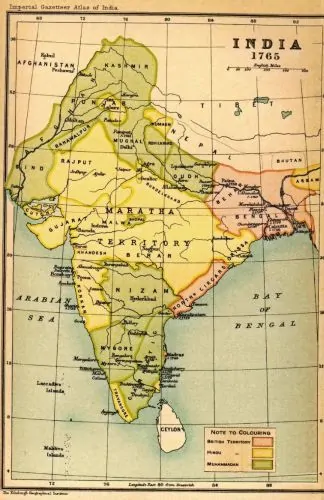
Long before this emergency, the Company had acquired responsibilities that extended beyond buying and selling goods. Its overseas settlements developed institutions of government, and successive grants of authority supported the exercise of jurisdiction, diplomacy, and armed force. The expansion into Bengal enlarged these activities rather than introducing political power into an otherwise exclusively commercial organization. Military victories at Plassey in 1757 and Buxar in 1764 helped establish the circumstances in which the Mughal emperor Shah Alam II granted the Company the diwani of Bengal, Bihar, and Orissa in 1765. This authorization to collect territorial revenues operated within an existing political order whose offices, legal practices, and administrative knowledge remained indispensable to the new beneficiaries. It did not erase the obligations historically associated with rulership, including the provision of justice and protection against oppression. Nevertheless, the incorporation of provincial revenues into the Company’s operations created possibilities for financing trade and maintaining military power that encouraged British observers to anticipate extraordinary returns. Those expectations rested on the assumption that resources extracted in India could sustain commitments made elsewhere, an assumption increasingly difficult to reconcile with the expense and uncertainty of governing.
Responsibility for this expanding authority was distributed among institutions whose interests overlapped without becoming identical. The Court of Directors had to preserve the corporation’s credit and supervise distant officials, while shareholders assembled in the Court of Proprietors could press their claims through votes and struggles over leadership. Employees in India possessed opportunities to accumulate personal wealth through activities that might undermine the Company’s commercial position or injure those subject to their influence. British ministers approached Indian affairs with fiscal expectations of their own, and the state’s dependence on Company commerce and payments complicated any claim to impartial supervision. The resulting disputes concerned more than the division of profits; they affected appointments and decisions about the resources available for government. For inhabitants of Bengal, the institutions empowered to determine these matters were largely beyond their reach. Indian officials and petitioners continued to invoke established expectations of lawful authority, using administrative proceedings to defend rights and seek remedies, but such participation offered no equivalent to the influence exercised by proprietors over corporate leadership. The famine of 1769–1770 made questions about the Company’s governing priorities urgent in India before its financial difficulties became an emergency in Britain. Understanding the subsequent intervention requires attention to how different injuries acquired political weight, and to the unequal means available for compelling a response.
Parliament’s settlement in 1773 addressed this difficulty through legislation that altered corporate management and reconstructed parts of the Company’s government in India. The Regulating Act’s preamble identified abuses at home and overseas that had caused “manifest injury of the public credit,” explicitly connecting administrative failure with British financial concerns. Its provisions established a governor-general and council in Bengal and authorized a new Supreme Court at Calcutta, creating consequential mechanisms through which governing conduct might be constrained. These measures did not resolve every dispute over jurisdiction or eliminate the commercial purposes of Company rule. Nor did parliamentary intervention place the people governed in a position to determine how that authority should operate. The crisis reveals how a corporation’s internal arrangements could become inadequate to its political responsibilities, while the government attempting to reform it remained implicated in the benefits of imperial expansion.
A Corporation Already Equipped to Govern

Elizabeth I’s charter of December 31, 1600, established an organization capable of issuing commands to people who entered its service. The governor and governing committee could make ordinances for conducting Company affairs, subject to the requirement that these remain consistent with English law. Membership consequently entailed submission to an institutional discipline that extended across voyages and beyond the immediate supervision of investors. Royal authorization also protected the Company’s exclusive commercial privileges, making their enforcement a concern shared with the English government. Its earliest constitution combined opportunities for collective investment with powers to regulate conduct, establishing an organizational basis for authority before the possession of extensive territory became an objective.
Permanent settlements brought a different population within the reach of that authority. At Madras, established in 1639 through an agreement with a local South Indian ruler, the Company’s commercial prospects depended on attracting merchants and producers who supplied goods, maintained connections with inland markets, and supported the settlement’s growing economy. Fort St. George provided a defended center, but the community surrounding it required arrangements for occupying land and financing local administration. Decisions about customs and other receipts affected residents whose relationship with the Company arose from where they lived or conducted business. The settlement’s administration acquired responsibilities that employment contracts alone could neither define nor discharge. Bombay’s transfer from the Crown to the Company in 1668 further demonstrated how the management of an overseas possession could be assigned to a commercial corporation. Maintaining the island involved expenditure on defenses and the organization of civilian government, bringing the Company into continuing relationships with inhabitants who had never joined its commercial enterprise. These developments depended on agreements and privileges that differed between settlements, making local conditions fundamental to the practical extent of Company power. Coastal establishments became places where possession, residence, and commercial necessity generated forms of government that exceeded the regulation of a trading workforce.
Armed protection likewise required decisions about political relationships outside the settlements. Charles II’s charter of 1661 authorized the Company to make war and peace with non-Christian princes and peoples, providing an English legal warrant for activities ordinarily associated with rulers. The religious qualification reflected the unequal categories through which overseas authority was conceived, while leaving Asian governments to judge Company conduct according to their own interests and claims. Authorization from England could support corporate action without securing its acceptance by those against whom it was directed. The Company’s unsuccessful confrontation with the Mughal Empire in the late 1680s exposed this limitation; its forces and privileges could not overcome the superior resources available to imperial authorities. Continued access to commerce required accommodation with powers capable of restricting or restoring its operations.
Within the settlements, jurisdiction developed through similarly uneven arrangements. Europeans and Indians encountered different procedures according to their status, the character of a dispute, and the authority claimed by the officials hearing it. Company tribunals operated alongside local practices and officers, requiring governors to negotiate relationships among institutions rather than simply reproduce an English legal system overseas. Madras’s municipal corporation, inaugurated in 1688, gave this experiment a revealing form by establishing a mayor and aldermen within a settlement already governed by the Company. The inclusion of Indian participants acknowledged the importance of local commercial society, although institutional membership followed selective criteria and operated under the Company’s superior influence. Civic organization provided a means of dealing with urban affairs through another corporate body, demonstrating how the legal form used to organize merchants could also organize inhabitants and offices of government. Its creation expressed an ambition to establish a functioning political community, even where disputes over powers, resources, and cooperation made that ambition difficult to realize. The resulting institutions placed Company officials in positions from which they could adjudicate claims and influence the conditions of ordinary residence. Assessing their authority consequently requires attention to the people and activities they administered, rather than accepting the commercial identity of their employer as a sufficient description of what they did.
Administrative continuity also depended on an organization that could survive changes in its personnel. The establishment of a permanent joint stock in 1657 strengthened the financial basis for maintaining operations across successive voyages, supporting enduring establishments whose affairs could not be concluded with the sale of a single cargo. Instructions and accounts traveled between these establishments and London, allowing decisions to be recorded as acts of the corporation rather than disappear with the departure of a particular servant. Such communications supported supervision, but their usefulness depended on the judgment of officials who interpreted orders under circumstances that distant correspondents could only imperfectly understand. Overseas governors exercised substantial discretion within a system that continued to insist on obedience and documentation. Corporate government acquired a recognizable administrative life through this combination of durable resources and locally exercised command. The Company’s later territorial advance drew upon practices already developed in these smaller jurisdictions, where governing institutions had become necessary to sustain commercial settlements and the communities gathered around them.
From Political Intervention to Bengal’s Revenues, 1757–1765
Bengal’s wealth belonged to a political order with its own institutions and competing centers of influence. Although its nawabs acknowledged Mughal imperial supremacy, they exercised considerable independence in managing a province whose agricultural receipts and commercial networks sustained an influential regional government. The death of Alivardi Khan in 1756 brought his grandson, Siraj ud-Daulah, to power amid disputes over succession and the loyalty of senior officials. His confrontation with the English Company concerned matters that directly challenged a ruler’s authority, including unauthorized fortification and the protection afforded to people who had incurred his displeasure. The capture of Calcutta in June 1756 was an assertion of provincial power against an establishment whose conduct the nawab considered unacceptable. English forces recovered the settlement early in 1757, but the resulting accommodation remained insecure as Anglo-French warfare increased the strategic importance of Bengal’s European establishments. Commercial security had become entangled with questions about who could command obedience within the province.
The decision to support Siraj ud-Daulah’s removal emerged from negotiations linking Company representatives with opponents inside his government. Robert Clive participated in arrangements through which Mir Jafar Ali Khan, a senior military commander, would succeed to the nawabship with English assistance. The Jagat Seth banking house figured in the political maneuvering, demonstrating the importance of financial interests within Bengal’s ruling circles. These participants approached the proposed change from different positions. Company officials sought compensation and dependable privileges, while Indian associates pursued advantages within provincial politics. Their cooperation depended on promises whose fulfillment would become a source of continuing pressure on the successor government. At Plassey on June 23, 1757, the effectiveness of this agreement rested partly on the withholding of forces by commanders associated with the conspiracy, although other elements of the nawab’s army fought. The victory cannot consequently be explained through a comparison of European and Indian military techniques alone; the disposition of men who possessed authority within the defeated government was central to the outcome. Mir Jafar’s installation brought substantial payments to the Company and personal rewards to British participants, making the alteration of a provincial succession immediately profitable. It also created a relationship in which English military support carried expectations that the new nawab would supply resources and uphold concessions. The settlement gave Company officials unusual leverage over a government whose treasury had already been subjected to heavy demands.
Mir Jafar’s difficulties in meeting those expectations weakened his position with the men who had supported his accession. In 1760, the Calcutta administration accepted a new arrangement under which his son-in-law, Mir Qasim Ali Khan, replaced him. The agreement transferred the revenue-bearing districts of Burdwan, Midnapore, and Chittagong to the Company, supplying resources intended to support its military establishment. Company intervention had advanced from obtaining money through a succession bargain to securing territorial receipts through another change of ruler. This transaction made the fiscal capacity of particular districts a direct element in the maintenance of English power.
Mir Qasim attempted to establish a more effective government capable of operating with greater independence from Calcutta. His relocation of the capital to Munger accompanied efforts to strengthen military organization and improve control over provincial resources. A particularly consequential dispute concerned the use of dastaks, passes associated with the Company’s privileged commerce. Company employees applied such protections to private transactions, allowing goods to move without charges imposed on other traders and reducing the nawab’s ability to enforce his customs arrangements. The problem extended beyond the loss of particular payments. Officials collecting duties encountered merchants who claimed exemption through association with an armed organization capable of challenging the government. Governor Henry Vansittart sought a compromise with Mir Qasim, but resistance within the Calcutta council frustrated attempts to regulate the servants’ inland trade. In 1763, the nawab abolished internal duties more generally, attempting to remove the unequal advantage enjoyed by traders operating under English protection. That decision threatened the commercial benefits derived from exemption, even though it addressed the disparity by relinquishing revenue that the nawab’s government itself needed. The confrontation demonstrates how a measure intended to restore consistency within a provincial fiscal system could be treated by Company representatives as an attack on their position. Warfare followed, Mir Jafar was restored to the nawabship, and Mir Qasim’s defeats drove him toward alliances beyond Bengal. A conflict over the exercise of commercial privilege had become a contest over the survival of a government.
The struggle then extended into the politics of Awadh and the Mughal imperial court. Mir Qasim sought support from Shuja ud-Daulah, the nawab of Awadh, while Emperor Shah Alam II also became involved in opposition to the Company’s advance. By the time of the decisive encounter, relations between Mir Qasim and his prospective allies had deteriorated, and he was no longer directing the coalition’s operations. At Buxar on October 23, 1764, Company forces commanded by Hector Munro defeated the armies associated with Shuja ud-Daulah and the emperor. This victory provided a stronger basis for regional coercion than the succession agreement that had followed Plassey, bringing the Company into negotiations with authorities whose claims extended outside Bengal.
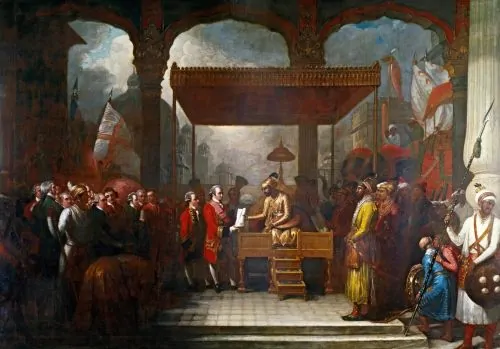
Clive returned to India in 1765 and participated in the settlements concluded at Allahabad, where military advantage was converted into formal arrangements recognized through existing political titles. Shuja ud-Daulah recovered most of his dominions subject to conditions that included a substantial indemnity, while the emperor received provisions for his territorial establishment and financial support. On August 12, Shah Alam II granted the Company the diwani of Bengal, Bihar, and Orissa, authorizing it to receive and administer the revenues attached to that office. The Company undertook an annual payment of twenty-six lakhs of rupees to the emperor, embedding its acquisition within an arrangement that preserved an imperial financial entitlement. Its expanding position received legal expression through a Mughal grant negotiated under circumstances decisively shaped by Company arms.
The terms of the diwani require careful interpretation because they concerned an office within a provincial constitution, rather than a simple conveyance of land as commercial property. Revenue administration had connections with civil adjudication and depended on an established apparatus for assessing claims and collecting payments. Responsibilities associated with the nizamat, including criminal justice and policing, formally remained connected to the nawab, although English influence substantially constrained his freedom of action. Nor did the reference to Orissa mean that the Company suddenly possessed every territory within the boundaries of the modern Indian state bearing that name. The grant authorized claims whose practical reach had to be understood through contemporary jurisdiction and possession.
For the Company, the decisive development was that provincial collections could now be directed through an office held by the corporation itself, subject to stipulated payments and the expenses of administration. The proceeds were consequently available within a system whose commitments included commercial purchases and the upkeep of its forces. Between 1757 and 1765, successive interventions had produced an increasingly durable command over the resources of government, culminating in a recognized fiscal position whose responsibilities would prove harder to define than its anticipated benefits.
Revenue Rights and the Obligations of Rule
Collecting Bengal’s revenues required the Company to enter a working administration whose authority reached far beyond the treasury. District assessments depended on information supplied through Indian offices, and receipts passed through arrangements connecting provincial officials with people responsible for particular localities. After 1765, much of this business continued under Indian supervision, even as the Company determined how a substantial share of the proceeds would be employed. The description “dual government” identifies the division between the Company’s fiscal position and the continuing nawab’s establishment, but it can suggest a separation more complete than the arrangements actually permitted. The personnel conducting revenue affairs also participated in the political relationships through which provincial government functioned. Authority at the highest level could be apportioned by agreement, while the daily work of administration remained dependent on offices whose responsibilities intersected.
Muhammad Reza Khan occupied a particularly influential position within this system, combining leading responsibilities in Bengal’s revenue administration with authority associated with the nawab’s government. In Bihar, Raja Shitab Rai performed substantial duties that likewise made him indispensable to the Company’s operations. Their importance arose from experience and connections that English officers could not quickly reproduce, including knowledge of provincial accounts and the standing of people upon whom collection depended. Decisions about acceptable demands required judgments concerning earlier settlements and the circumstances behind disputed payments. The Company could communicate an expected return, but obtaining it involved negotiations with officials who understood where a demand might be resisted or its calculation challenged. These men consequently exercised judgment within institutions that retained recognizable features of Mughal administration, although their positions increasingly depended on Company approval. Their ability to operate through established relationships helped English officials secure resources while avoiding the immediate expense of constructing an entirely new provincial service. It also made the deputies conspicuous targets when complaints arose or collections failed to meet expectations. Responsibility could be attributed to their management even where the pressures under which they worked originated in decisions taken above them. The arrangement placed Indian administrators between the Company’s demands and the claims of people who continued to approach government through familiar offices.
Assessment itself was an assertion of entitlement that had to be translated into payment. Zamindars held positions combining fiscal responsibilities with claims rooted in local standing, and their relationship to cultivators cannot be reduced to a uniform model of private landownership. The sums recorded as payable rested on arrangements whose histories could become subjects of dispute. A provincial account represented a judgment about what could legitimately be required from a locality, rather than money already available for expenditure. Enforcing that judgment affected the capacity of cultivators to maintain production and the resources of those expected to answer for their payments.
Persianate ideas of government supplied standards against which these demands could be criticized. A ruler’s legitimacy involved the treatment of subjects, and the preservation of cultivation gave moderation in revenue affairs a political importance as well as a financial one. Claims for relief or the correction of an assessment could draw upon expectations that officials should investigate circumstances before enforcing an exaction. Such expectations did not guarantee benevolent administration. Earlier governments had imposed burdens and permitted abuses, while access to remedies depended heavily on influence and resources. Nevertheless, the language of just rulership gave complainants a basis for describing particular conduct as a failure of government. Company officials who claimed to preserve established institutions encountered these obligations through the offices they retained and the representations submitted to them. British explanations of provincial disorder frequently emphasized misconduct by Indian intermediaries, encouraging the view that improvement required closer supervision of those agents. That diagnosis could obscure the consequences of the demands those agents were instructed to fulfill. Contemporary accounts by Harry Verelst and William Bolts must accordingly be read as interventions in a dispute over responsibility, with their descriptions of Bengal shaped by different interests in defending or condemning Company administration. Recovering the standards invoked by Indian claimants helps prevent that British controversy from becoming the sole measure of what legitimate government required.
Petitions made these expectations administratively consequential. Landholders and merchants presented claims supported by accounts of earlier transactions, asking officials to recognize entitlements or investigate alleged interference. Resolving such matters required inquiries into documents and testimony, through which the government assembled knowledge about the property and payments it sought to regulate. The process connected revenue administration with adjudication because deciding what someone owed could depend on deciding whose claim should be accepted. Robert Travers’s research demonstrates how the Company appropriated established Persianate practices of petitioning and inquiry while reshaping the authority under which decisions were delivered. These encounters gave some Indian subjects opportunities to press demands upon the emerging colonial government, although the surviving records make influential claimants more visible than many people whose grievances lacked comparable support. Translation and official selection further shaped what entered the documentary record. Petitioning provided a means of calling administrators to account in particular disputes, but its effectiveness remained contingent on procedures and officers whose powers the Company increasingly controlled.
A reorganization in 1772 made that control more explicit. Under Warren Hastings, the Company assumed closer direction of revenue business and displaced the deputy administration from its previous central position. English collectors took on enlarged responsibilities, while a new revenue settlement sought to secure payments through farming arrangements. The movement of the central revenue establishment from Murshidabad to Calcutta concentrated business around the Company’s principal seat of authority. The reconstituted khalsa, descended from the Mughal provincial revenue office, also served as a venue for receiving petitions and investigating disputes over land and taxation. Its activities reveal how the transfer of administrative power involved taking possession of procedures through which subjects had long sought recognition of their claims. English officers continued to require Indian expertise, but they increasingly determined the regulations under which that expertise would be used and the form in which its conclusions would be recorded. The changes altered who could authorize a decision without eliminating dependence on the administrative inheritance of the province. They also weakened the plausibility of treating the Company merely as a recipient of revenues gathered by another government. By directing assessment and organizing remedies for contested demands, its servants undertook duties inseparable from the treatment of the people expected to pay. The consequences of their decisions had become matters for which the corporation itself could be held responsible.
Who Could Make the Company Answer?

The twenty-four members of the Court of Directors conducted Company business through meetings and specialized committees at East India House in London. Their responsibilities included issuing instructions to overseas administrations and examining accounts submitted from its establishments. Before the reforms of 1773, annual elections required directors to renew their authority through the votes of qualified proprietors. This electoral dependence gave the Company’s owners a means of rewarding or displacing those responsible for management, while also making continuity vulnerable to organized challenges. Directors exercised substantial powers, but their position within the corporation depended on maintaining support among people whose interests could diverge from their own judgments about its affairs.
The General Court, commonly described as the Court of Proprietors, provided the principal forum in which that support could be tested. Its members could question the directors and introduce resolutions, bringing disputes about policy before an assembly whose rights arose from stock ownership. The qualification for decisive votes excluded people without a sufficient holding, making the composition of this body a product of investment rather than of the populations affected by Company government. Debate could be vigorous within that boundary, and the directors faced an audience capable of challenging their proposals or decisions. Proprietors were interested in dividends and the value of their holdings, but investment could also confer opportunities to influence appointments and the distribution of favors. Writing in 1776, Adam Smith treated access to Company patronage as an important reason for acquiring stock, distinguishing the advantages of influence from a concern for the enduring prosperity of the enterprise. His account was a critical interpretation rather than a comprehensive description of investor motives, and many proprietors plainly had substantial financial interests in competent management. Nevertheless, it identified a difficulty within the Company’s constitution. Ownership supplied powers whose usefulness to an individual could exceed their usefulness to the organization. Voting expressed preferences formed through several relationships, with the same stockholder potentially acting as an investor, a relative of an applicant for employment, or an associate of a candidate seeking office.
Competition for the directorate made these relationships politically effective. During the 1760s, Clive and Laurence Sulivan became prominent figures in struggles to organize support within the Company’s electorate. Their rivalry involved competing groups of candidates and efforts to assemble reliable votes, drawing upon connections extending outside the formal business of the General Court. Clive’s reputation and resources acquired in India strengthened his ability to participate in British public life, while Sulivan’s experience in Company affairs supported a different network of influence. Such contests affected who would examine an overseas official’s conduct and how sympathetically that official’s explanation might be received. They also made electoral organization an instrument through which returned servants could shape the policies of the institution that had employed them. These factions were subject to changing alliances and cannot be treated as permanent parties possessing consistent programs. Their importance lay in the capacity to place particular people in positions where personal association and managerial responsibility met.
Recruitment created another route through which Company authority could be influenced. Entry into the civil service, often through appointment as a junior “writer,” depended heavily on recommendations and access to those entitled to nominate candidates. Families consequently approached directors as people capable of opening careers whose prospects included advancement in an increasingly powerful overseas establishment. Successful applicants carried obligations arising from these relationships alongside the duties assigned to them by their employer. Experience and demonstrated ability remained important to promotion, especially where effective administration required knowledge accumulated over years, but sponsorship could affect the opportunities through which such experience was obtained. Directors supervised a service that they also helped populate through personal connections. This combination complicated discipline because a judgment against an employee could reflect upon the person who had recommended him or provoke opposition from associates defending his interests. Overseas servants could appeal to supporters in London, seeking to shape the interpretation of allegations before the corporation reached a final decision. Returned employees might subsequently strengthen these networks through investment and participation in Company elections, increasing the possibility that the supervised would become influential among their supervisors. Patronage was a normal feature of eighteenth-century institutions, and its presence alone does not establish that an appointment was improper or an inquiry compromised. Its significance here concerns the dependencies it created within an organization whose officers exercised powers over people unable to enter the same relationships on comparable terms.
Creditors possessed a more narrowly defined means of exerting pressure. Holders of Company obligations expected payment according to their terms, and difficulties in meeting those obligations could threaten the availability of further finance. The need to preserve credit gave their demands an urgency that directors could recognize through the corporation’s established commercial responsibilities. Such pressure might expose poor management and force corrective action, yet the obligation being enforced concerned payment, leaving the effects of provincial administration to enter the dispute indirectly through their consequences for the Company’s resources.
British ministers approached the organization through a broader combination of legal authority and financial interest. Company privileges rested on arrangements that Parliament could examine or revise, giving politicians powers beyond those exercised by proprietary voters. The state simultaneously derived substantial income from the commerce conducted through the Company, and the administration of its imports supplied capacities that government officials themselves could not easily reproduce. Research on customs collection shows that Company accounts and warehouse procedures helped sustain British fiscal operations, making its organizational effectiveness useful to the public Treasury. The financial agreements of the 1760s further connected expectations about Indian revenues with payments sought by ministers in Britain. Parliamentary scrutiny consequently developed within a relationship in which government could benefit from the returns whose pursuit required scrutiny. Some members of Parliament also held Company stock or maintained connections with directors, bringing corporate interests into the institution authorized to judge them. Ministerial intervention raised an additional concern about patronage. Transferring control over Company appointments could enlarge the resources available to the Crown and its political supporters. Disagreement about reform involved judgments about the consequences for Britain’s own distribution of power as well as assessments of administration in India. A proposal to strengthen supervision could be opposed because of the authority it might confer upon ministers, even by people prepared to acknowledge serious faults in Company management.
These several channels of influence gave the corporation a contested constitutional life. A director could be challenged at an election, an employee subjected to investigation, or a financial decision reconsidered under pressure from creditors or Parliament. Each procedure gave particular claims a recognized route toward a decision, and the grounds on which that decision could be demanded varied with the claimant’s position. Buying Company goods or supplying its commercial operations did not itself confer the voting rights attached to qualifying stock, just as suffering injury from an administrative measure did not establish standing within the General Court. Grievances arising in Bengal might reach London through official correspondence or the interventions of interested advocates, but their reception depended on people authorized by relationships formed for other purposes. Those people could investigate abuses sincerely and sometimes impose meaningful restraints, while remaining responsive to pressures that gave different matters greater urgency. The existence of active debate cannot by itself establish adequate oversight of every power exercised in the Company’s name. Its constitutional arrangements must be assessed through the capacity of particular grievances to secure examination and the force that an adverse judgment could carry against the officials responsible.
Private Fortunes Made through Public Authority
Personal commerce had long formed part of the economic life of Company service. Limited salaries encouraged employees to seek supplementary earnings, and private trading could operate within permissions recognized by their employer. Such activity sometimes supported the Company’s business by sustaining networks through which information and goods circulated. The acquisition of political influence changed the opportunities available to those engaged in it because an employee’s commercial position could now be reinforced by powers exercised in an official capacity. The distinction between authorized enterprise and misconduct increasingly depended on how a profit was obtained and whose authority had made it possible.
Payments described as presents exposed the difficulties involved in drawing that distinction. Gifts formed an established part of diplomatic and political exchange in South Asia, where their presentation could acknowledge rank or accompany the negotiation of a relationship. English participants entered this environment with expectations of their own concerning rewards for exceptional service. These conventions supplied recognizable explanations for transfers that enriched individuals involved in Company affairs. Yet the circumstances surrounding a payment mattered more than the description attached to it. A provincial ruler dependent on English military support negotiated from a position in which refusal might carry consequences for his security. An officer receiving money could invoke the customary character of a present while benefiting from pressure generated by the corporation’s forces. The recipient might consider the resulting wealth a personal entitlement, although the capacity to obtain it depended on resources maintained for Company purposes. Funds distributed among employees also reduced the resources available to the government making the payment, giving private rewards effects beyond the fortunes of those who received them. Contemporary criticism of presents consequently concerned the conversion of institutional leverage into advantages that could be retained by particular participants.
Clive’s acquisition of a jagir in 1759 provided a clear example of this conversion. Mir Jafar granted him the right to receive revenue payments associated with the Twenty-Four Parganas, where the Company already possessed revenue-bearing rights. The arrangement made Clive the private beneficiary of an obligation that the corporation had previously owed to the provincial government. Its subsequent disputes required the directors to confront a claim established by one of the servants most closely associated with the expansion of their power. Recognition under Indian political arrangements did not settle whether an officer should personally enjoy income derived from the relationship between his employer and a ruler sustained by its assistance. The controversy illustrates how a successful intervention could produce a durable private asset whose validity the Company later had to judge.
Commercial procurement created further opportunities to attach coercion to personal advantage. Company business depended heavily on Indian agents, commonly described as gomasthas, who arranged purchases and maintained relationships with producers. An agent could advance funds to a weaver or negotiate deliveries, performing functions familiar within an economy in which manufacture often depended on credit. Advances could support production and provide an assured purchaser, but disagreements over the obligations they created acquired a different character when an agent could claim the backing of Company officials. Pressure to accept particular prices or continue supplying a purchaser might then be reinforced through restrictions on a producer’s freedom to deal with someone else. Bolts’s account described abuses in which demands for goods were accompanied by confinement or physical intimidation, presenting the enforcement of commercial arrangements as an exercise of oppressive power. His experience as a merchant gave him knowledge of these practices, while his disputes with the Company shaped the accusations he chose to publish. The evidentiary task is to assess the conduct described and the relationships that permitted it, without assuming that every transaction followed the same pattern. Producers continued to make choices where circumstances allowed, and neither Company procurement nor the commerce of its servants operated identically across all districts. Nevertheless, an official connection could alter the terms upon which a disagreement was resolved, particularly where a complainant encountered authorities associated with the purchaser. An arrangement appearing in commercial records as a delivery obligation might consequently involve pressures that the account of its price did not reveal.
Corporate and individual gains could diverge within these arrangements. A servant pursuing private purchases might compete with his employer for goods or employ influence in ways that complicated the Company’s own commercial plans. Directors had reasons to restrain such activity because it could increase costs and weaken their ability to direct procurement. But their objections did not necessarily extend to every use of political authority that advantaged commerce. The Company itself could benefit from conditions that reduced the bargaining strength of suppliers, making injury to producers compatible with an improvement in its accounts. Correcting an employee’s unauthorized intervention might preserve an advantage for corporate transactions rather than restore freedom to the people involved. This distinction prevents the corporation’s interest in controlling private enterprise from being equated automatically with the interests of those supplying its goods. The records of personal enrichment and the records of Company profitability must be examined together, since an abuse could injure the employer, benefit it, or distribute advantages between the institution and its servants.
Attempts to regulate these opportunities preceded the parliamentary settlement. The directors sought covenants restricting the acceptance of presents, and Clive’s return to Bengal in 1765 brought renewed efforts to enforce limits upon conduct that had become entrenched among employees. Requiring formal undertakings provided a basis for treating certain gains as violations of service obligations, although the effectiveness of a prohibition depended on identifying transactions and securing compliance. Compensation remained a difficult issue because removing accustomed opportunities threatened expectations attached to an Indian career. The Society of Trade, established under Clive’s administration in 1765, attempted to address that difficulty through a regulated commercial arrangement involving salt, betel nut, and tobacco. Its proceeds were distributed according to official standing, linking the remuneration of senior servants to an organized exercise of commercial privilege. The scheme sought to replace less controllable practices with authorized earnings, but it retained a close connection between holding office and benefiting from restrictions imposed on markets. London’s directors opposed the arrangement and ordered it brought to an end, demonstrating that reform in Bengal could itself become the subject of disagreement within the corporation. Arguments about regularity and adequate reward could justify privileges that other Company authorities considered unacceptable. The problem extended beyond discovering concealed payments. Officials and directors also disputed what forms of enrichment should be permissible.
Enforcement required standards capable of distinguishing the duties of office from the advantages available through it. A covenant could make an unauthorized present actionable, but its existence did not establish how effectively an officer’s commercial relationships would be examined. Nor did the prevention of a private payment answer questions about the purposes for which Company authority was otherwise employed. An administrator might observe restrictions on gifts while enforcing a purchasing arrangement whose consequences fell heavily on producers. Evaluating the conduct of servants required attention to the use of coercive power as well as the destination of income. Personal honesty mattered, but the treatment of people affected by official decisions remained a separate measure of the government those employees helped conduct.
Famine and the Meaning of a Revenue Government
The failure of the rains in 1769 brought an agricultural emergency into a province whose administration had recently undergone profound political change. Poor harvests depleted grain supplies, while the scarcity that intensified during 1770 disrupted livelihoods across extensive parts of Bengal and Bihar. The severity of the disaster varied considerably between districts, according to their crops, reserves, transport connections, and access to alternative supplies. Such differences matter because Bengal cannot be treated as a single, uniformly affected agricultural landscape. Nevertheless, the scale of the crisis placed an immediate obligation upon those exercising authority over its revenues; they had to decide how far the preservation of the population should alter the ordinary demands and expenditure of government.
Food shortages became lethal through the circumstances in which different households encountered them. Cultivators who lost their harvest also lost the means of feeding their families, satisfying creditors, and preparing for another agricultural season. Laborers faced a related difficulty as shrinking employment reduced their earnings while the price of grain rose. Artisans and other people who depended upon exchanging their work for food could suffer severely even when they possessed no fields of their own. Rajat Datta’s scholarship on Bengal’s rural economy helps establish the importance of examining these relationships within an active commercial society, where agricultural production, credit, and markets were closely connected. Later famine analysis, particularly that associated with Amartya Sen, supplies a useful distinction between the quantity of food available and the ability of particular groups to obtain it. Applied cautiously to eighteenth-century Bengal, this approach directs attention to the interaction between an unmistakable harvest failure and the loss of purchasing power among vulnerable households. Grain remaining in circulation could sustain people with sufficient resources while others exhausted their possessions and became destitute. The existence of commerce during the emergency consequently reveals little by itself about the adequacy of subsistence for the population.
Revenue collection could intensify this deterioration when demands continued after the resources needed to meet them had disappeared. Company correspondence described the difficulty of obtaining payments from districts suffering depopulation and interrupted cultivation, while also recording the continued pursuit of substantial receipts. Maintaining collections under these circumstances could require pressure upon survivors and local revenue intermediaries to compensate for losses elsewhere. A household compelled to sell cattle, agricultural implements, or reserves intended for sowing might satisfy an immediate demand at the expense of its capacity to recover. Fiscal extraction had consequences extending beyond the famine season, because the disposal of productive assets could obstruct the restoration of cultivation after the rains returned. Hastings’s subsequent discussion of revenue obtained through coercive measures makes clear why figures showing sustained collections require scrutiny. The apparent resilience of government income could conceal a serious weakening of the society supplying it.
Relief presented a different set of administrative choices. Contemporary evidence records charitable distributions and local attempts to alleviate distress, so an account of the catastrophe should allow for officials and other inhabitants who recognized suffering and acted upon it. Some supervisors also questioned the feasibility of demands imposed upon devastated districts. These efforts operated within an administration that possessed far more developed procedures for collecting money and provisioning troops than for sustaining large numbers of impoverished civilians. Military supply attracted organized attention because the maintenance of armed forces remained an urgent institutional requirement. Provisioning soldiers demonstrated an ability to identify certain needs, secure resources, and authorize expenditure, although the reach of that capacity varied and cannot be assumed sufficient to feed the entire affected population. Decisions about grain for the army nevertheless formed part of the allocation of scarce supplies and belonged within the history of the famine. Restrictions upon trade, purchases by officials, and intervention against suspected hoarding also required judgments about how grain would reach people in need. Measures intended to keep food within a locality could have uneven consequences if they discouraged merchants from bringing additional supplies or obstructed movement between differently affected districts. Effective assistance depended upon knowledge of local conditions, cooperation with traders, and arrangements that enabled destitute households to obtain food. The emergency demanded a sustained administrative undertaking whose beneficiaries could offer little immediate financial return.
Information reaching London introduced further uncertainty into the assessment of these decisions. As John Lidwell-Durnin shows through Company correspondence, the directors sought explanations that distinguished environmental scarcity from shortages aggravated by human conduct. Their inquiries were shaped by delayed reports, incomplete knowledge, and suspicion that servants or local intermediaries had concealed misconduct. Accusations concerning grain monopolies carried considerable political force, since they suggested that people connected with government had profited from an emergency they were obligated to address. Yet an allegation of monopoly cannot establish how much grain was withheld, where the practice occurred, or its contribution to mortality. Officials defending their conduct also had reasons to emphasize failed rains and other circumstances beyond their control. The surviving exchanges require interpretation as attempts to explain the catastrophe, distribute responsibility, and influence subsequent administrative decisions.
Even the number of people who died resists confident reconstruction. Contemporary statements about the loss of a third of the population rested upon estimates rather than a comprehensive enumeration of inhabitants before and after the famine. The frequently repeated figure of ten million deaths inherits uncertainties about both the original population and the proportion lost. Reports of abandoned villages, deserted holdings, and diminished labor supplies provide compelling evidence of devastation, but migration could also contribute to the disappearance of residents from particular districts. Uncertainty over an aggregate death toll requires precise language while leaving ample grounds for recognizing an extraordinary human disaster.
The aftermath placed the meaning of recovery at the center of the problem. Bringing land back into cultivation required surviving households, labor, animals, seed, and credit; these resources could remain depleted long after an improvement in the weather. An administration chiefly concerned with restoring collections might recognize such needs through their effects upon revenue and still assign insufficient resources to meeting them. Famine made that ordering of priorities consequential because the people requiring assistance had also become less capable of paying. The Company inherited substantial agricultural vulnerabilities and cannot reasonably be credited with the power to prevent every consequence of a severe environmental shock. Its conduct must nevertheless be assessed through the demands it maintained, the supplies it directed, and the assistance it organized within the authority available to it. Those decisions connected institutional priorities to the prospects of survival and reconstruction. Bengal’s catastrophe consequently belongs at the center of the Company’s development as a government; it exposed how the protection of taxable resources could receive administrative attention while the preservation of the people who produced them remained inadequately secured.
Why Territorial Wealth Did Not Prevent Financial Crisis

The value of the Company’s possessions offered an unreliable guide to the money it could produce at a particular moment. Assessments upon cultivated land, anticipated commercial earnings, and goods awaiting sale represented different kinds of resources, each subject to its own conditions of realization. Meanwhile, obligations became payable on specified dates, often in places far removed from the revenues expected to support them. Rupees available in Bengal could finance expenditure there without immediately supplying the sterling needed in London. Understanding the emergency requires distinguishing the Company’s capacity to generate income over time from its ability to meet particular payments when they fell due.
Moving the proceeds of Indian taxation into the Company’s British accounts involved an extended commercial process. Revenue could purchase goods for export, allowing territorial receipts to support the procurement of textiles and other merchandise that would eventually be sold in Europe. Such purchases nevertheless placed money into transactions whose completion depended upon production, shipment, and the availability of buyers. Freight and insurance added expenses before the proceeds of a London sale became available. Funds drawn from Bengal also supported establishments and operations elsewhere in the Company’s Asian network, so the destination of a receipt could differ considerably from the location where it originated. Financial planning had to coordinate these movements across a system in which information traveled slowly and circumstances could change before instructions arrived. Directors consequently worked with forecasts that combined reports of collections, estimates of expenditure, and expectations about future sales. A favorable projection could encourage commitments in Britain even though the resources upon which it rested were already needed for other purposes. The commercial machinery connecting India with London created opportunities for profit while imposing delays that made inaccurate forecasting costly.
Territorial administration also consumed a substantial portion of the resources its acquisition appeared to promise. Maintaining troops required regular expenditure, and campaigns could enlarge commitments beyond the ordinary cost of an establishment. The war fought by the Madras government against Haidar Ali between 1767 and 1769 exemplified the military obligations arising across the Company’s possessions, whose finances cannot be understood through Bengal alone. Civil administration likewise required continuing payments that restricted the amount available for commercial investment or transmission to Britain. The directors’ efforts to establish an exigency fund in October 1769 reflected concern about disappointing territorial returns and increasing expenditure well before the decisive disruption of British credit. Famine subsequently complicated expectations about the durability of Bengal’s resources, although sustained collections could temporarily obscure the damage to their economic foundations. Estimates based upon the apparent productivity of a province required careful revision as the costs of holding and administering it became clearer.
Bills of exchange introduced a more immediate connection between money received in India and payments demanded in Britain. Company treasuries could accept funds from servants and others wishing to transfer their wealth to London, issuing bills that promised payment there. This arrangement supplied the Indian establishments with money they could use locally, while placing a corresponding obligation upon the directors at home. It also provided a recognized means of remittance within a commercial system that depended heavily upon credit. The difficulty arose when the volume of bills exceeded the provision made for honoring them. H. V. Bowen’s reconstruction shows the Company’s liabilities for bills of exchange increasing from approximately £297,000 in 1770–1771 to about £1.58 million in 1771–1772. Those figures reveal the scale of the demand arriving in London, rather than a comparable increase in money immediately available there. Directors faced an uncomfortable choice when bills had already been issued beyond authorized limits. Refusal might damage confidence in the Company, while acceptance required finding the funds to pay them. Their decision in July 1771 to accept such bills sought to protect its credit and commercial standing. An accommodation intended to prevent an immediate injury increased the payments for which the London management had to provide.
Other commitments narrowed the room for adjustment. Dividends distributed money to proprietors, while agreements with the British government had established an annual Treasury contribution of £400,000, subject to the conditions of the arrangements then in force. These payments made substantial claims upon resources whose timing and availability remained uncertain. Large quantities of unsold merchandise, especially tea, compounded the difficulty by retaining capital in warehouses instead of returning it through completed sales.
The Company possessed goods with an expected commercial value, but their accumulation could place additional pressure upon borrowing while current obligations continued to mature. Retrenchment eventually changed part of this position. In late December 1772 the proprietors reduced the annual dividend to 6 percent, a decision that also removed the requirement to make the £400,000 Treasury payment under the existing agreement. The connection between those two adjustments illustrates how statutory arrangements and corporate distributions interacted within the Company’s finances. Reducing them eased expenditure without resolving the accumulated demands or immediately converting stored goods into cash.
The banking failures and contraction of credit in Britain during 1772 made these difficulties harder to manage. Firms accustomed to meeting uneven payments through renewed borrowing encountered lenders whose willingness to extend funds had diminished. The Company entered that disruption with pressures already visible in its expenditure, remittances, and commercial stocks, so the wider crisis intensified a vulnerable position rather than creating it from nothing. Its appeal for assistance cannot adequately be explained through a single failed harvest, an isolated act of dishonesty, or the sudden disappearance of the wealth associated with Bengal. Those explanations compress several interacting processes into one cause and obscure the sequence through which commitments exceeded available means of payment. The decisive problem concerned the coordination of a commercial and territorial enterprise whose different operations generated income and demands upon different schedules. Access to British government support offered a possible means of meeting the immediate emergency, but it also required examination of the assumptions supporting the Company’s requests. A parliamentary loan would depend upon judgments about future receipts and expenditure, making the credibility of its financial administration a matter extending beyond its directors and proprietors.
Parliament Investigates a Power in Which Britain Had a Stake
Parliament’s investigations in 1772–1773 developed from an unresolved argument over the constitutional status of the Company’s Indian acquisitions. Negotiations in 1767 had secured a financial contribution to the British government while leaving fundamental questions about territorial ownership unsettled. Ministers had asserted claims upon gains obtained under British authority, while Company representatives defended the rights associated with their charter and agreements in India. The resulting accommodation allowed money to pass to the Treasury without establishing a comprehensive constitutional settlement for the possessions producing it. When parliamentary scrutiny intensified, members encountered arrangements in which public entitlement had already been asserted and partly translated into financial obligations. Any revision could affect the distribution of imperial resources within Britain as well as the exercise of authority overseas.
The select committee associated with John Burgoyne brought the conduct of the Company’s Indian affairs under sustained examination during the spring of 1772. Its inception places the inquiry within an existing debate about reform that subsequently acquired greater urgency through the financial emergency. Witnesses and documentary evidence enabled members to investigate the circumstances in which territorial authority had been acquired and used. Company correspondence could establish which decisions had received instructions from London, which had originated in India, and how directors had responded after learning of them. This method gave considerable importance to the sequence of authorization, action, and retrospective approval. An undertaking initially represented as necessary in a local emergency might later have been accepted because it produced advantages that the directors wished to retain. Equally, an instruction expressing disapproval might coexist with continued dependence upon the officer whose conduct had prompted it. The committee’s work exposed these relationships to examination by people who possessed legislative powers over the institution supplying the records. Responsibility became a matter that could be reconstructed through successive decisions, extending beyond the immediate actors in a disputed transaction.
A Committee of Secrecy appointed later in 1772 concentrated more closely upon the Company’s financial condition. Its work served the immediate needs of Frederick North’s ministry, which required information about the liabilities and resources of an institution seeking assistance. Such examination involved assessing the credibility of estimates and determining how the proposed use of public funds related to existing obligations. This financial inquiry intersected with Burgoyne’s investigation without reproducing its emphasis upon conduct in India. The committees brought different forms of evidence into the parliamentary debate, making it possible to examine administrative responsibility alongside the prospects of repayment. Their coexistence is a reminder that intervention developed through several purposes. Members could support closer scrutiny while disagreeing about the authority that should follow from its findings.
Clive became the most prominent individual around whom these disputes gathered. His examination and the Commons debates of May 1773 connected the acquisition of personal wealth with the larger question of entitlement to the proceeds of conquest. Members considered the proposition that acquisitions obtained through military force or treaties with foreign rulers properly belonged to the state, a principle with implications reaching beyond any particular payment to an officer. Applied broadly, it challenged assumptions about the Company’s own possession of territorial advantages as well as the private appropriation of benefits by its servants. Clive’s defenders could nevertheless appeal to the considerable expansion of British influence associated with his career. The Commons ultimately recorded his receipt of substantial sums while affirming that he had rendered “great and meritorious services to his country.” These parliamentary resolutions supplied a political assessment whose combination of acknowledgment and praise requires careful reading. Service to Britain became an important consideration in judging transactions that had enriched an individual through the exercise of Company power. Nicholas B. Dirks interprets the treatment of Clive within a broader process through which imperial scandal could be concentrated upon particular people while the expansion they helped accomplish acquired national legitimacy. That interpretation draws attention to the political work performed by the language of public service, although disagreement among members prevents the proceedings from being reduced to a single agreed strategy of vindication. The debate demonstrates how scrutiny could expose the circumstances of enrichment and still preserve an honored place for the officer responsible. Its standards gave considerable weight to the benefits of territorial expansion for Britain.
Company representatives also possessed constitutional arguments with which to contest intervention. Chartered privileges and the security of invested property carried substantial authority within British political debate, especially when legislative proposals threatened to alter established arrangements. Misconduct by particular servants could justify punishment or revised instructions while leaving open the separate issue of how extensively Parliament should reconstruct the corporation’s government. The Company’s need for assistance weakened its negotiating position without extinguishing those claims. Members consequently had to consider the relationship between exceptional intervention and the expectations attached to other legally constituted commercial bodies.
Disagreement over a proposed supervisory commission made the contest about institutional authority concrete. An earlier attempt to send supervisors with extensive powers to India had failed when the ship carrying them, the Aurora, disappeared after sailing from Britain in 1769. The loss deprived the directors of an intended means of examining and correcting administration through officers appointed under Company authority. A renewed proposal in 1772 again offered the prospect of intervention organized from East India House. Parliament restrained that initiative while its own examination of Company affairs proceeded, making the timing and form of corporate reform subject to legislative decision. The dispute concerned who would be permitted to undertake an investigation with executive consequences in India. Directors had reasons to preserve their ability to select the personnel and define the powers of such a mission, while parliamentary intervention established that their choice could be suspended during consideration of a wider settlement. This episode gave practical substance to the assertion of public authority over the Company before the principal legislation of 1773 was completed. Investigation had begun to influence the measures the corporation could take in response to its difficulties.
The reports gave controversies about Company rule an official documentary form that could support subsequent criticism and legislation. By assembling testimony and records, the committees made important aspects of its administration available for examination beyond the bodies that ordinarily managed its business. The significance of that achievement must be assessed alongside the conditions under which evidence reached Westminster. Indian experiences entered much of the examination through correspondence, translated materials, and explanations supplied by people connected with Company affairs; those channels shaped the questions that members could readily pursue.
Parliamentary discussion accorded particular importance to matters recognizable within British political life, including the security of property and the disposition of resources claimed for the nation. Scrutiny could consequently reveal serious abuses while judging remedies through interests that Britain itself possessed in the continuation of Company power. The investigations established stronger grounds for legislative action, but the meaning of reform remained contested as members moved toward deciding how financial assistance and changes in government should be connected.
The Bargain of 1773: Financial Rescue and Political Control
The settlement enacted during the parliamentary session of 1773 connected support for the Company’s finances with changes in the legal conditions under which it operated. North’s ministry had to assemble support among people who disagreed about the extent of reform and the security owed to existing corporate rights. Bowen’s reconstruction of the negotiations shows how shifting proposals and political pressures shaped the legislation, complicating any interpretation of it as the execution of a settled ministerial plan. Urgency gave the government considerable leverage, but obtaining parliamentary approval still required choices about how much authority the Company would retain. The measures preserved its continuing operations while placing important decisions under statutory restrictions. Separate acts addressed financial assistance, commercial opportunities, and the organization of government, giving the settlement several mechanisms through which its purposes might be pursued.
The loan legislation authorized assistance amounting to £1.4 million, financed through Exchequer bills. Its preamble recorded that the Company had requested £1.5 million, or as much of that sum as proved necessary, and subsequently declared that it would endure its difficulties rather than accept assistance upon the conditions offered. Parliament nevertheless proceeded on the grounds that the consequences of withholding support would extend to creditors and public finance. The statute expressly sought to prevent the General Court of Proprietors from obstructing assistance by withholding its consent, making the rescue an exercise of legislative authority over corporate resistance. It also prescribed the application of the money, directing payments toward outstanding public obligations and claims held by the Bank of England. Restrictions upon distributions established a further order of priorities. While the public advance remained unpaid, the Company could provide an annual dividend of no more than 6 percent, with the remaining clear surplus applied toward repayment and associated charges. After that advance had been repaid, dividends could reach 7 percent while surplus income continued to reduce the Company’s bond debt until it stood at £1.5 million. These provisions converted the disposal of future profits into a legally defined sequence, limiting the discretion previously exercised within the corporation. Acceptance of bills drawn from India also became subject to Treasury consent above a prescribed annual limit of £300,000, with specified exemptions. Parliament intervened directly in the creation of obligations as well as the allocation of money available to discharge them.
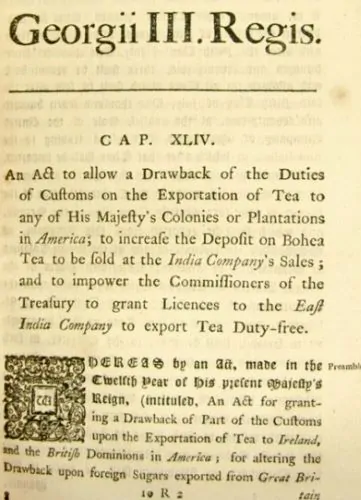
The Tea Act supplied a commercial remedy through a different route. Passed in May 1773, it enlarged the arrangements for recovering British customs duties on tea exported to America and empowered the Treasury to license Company shipments from its warehouses without the ordinary requirement of a preceding public sale. Direct export offered a means of reducing accumulated stocks while changing the role of merchants who ordinarily purchased Company tea in Britain for onward shipment. The arrangement was intended to make legally imported tea more competitive and improve the Company’s prospects of turning merchandise into receipts. The existing Townshend duty remained payable in the American colonies, connecting the commercial concession with Parliament’s disputed claim to tax colonial subjects. Opposition combined concern about that constitutional claim with objections to privileged trading arrangements and their effects upon established livelihoods. The politics of consumption, examined extensively by T. H. Breen, helps explain why an anticipated advantage in price could fail to secure acceptance of the policy. Protesters who destroyed Company tea at Boston in December attacked cargo associated with a measure intended to assist its recovery. A remedy devised for financial difficulties had become entangled in another dispute about imperial authority.
The Regulating Act, enacted in June, addressed the constitution through which Company power was exercised. It revised arrangements in London and provided for a governor-general and council in Bengal, together with the establishment of a Supreme Court under royal authority. These provisions attached the conduct of government more explicitly to offices and procedures established by Parliament. Directors and proprietors continued to exercise important powers within an organization whose legal framework had been altered. The statute also required the directors to supply ministers with relevant correspondence. Material concerning revenues went to the Treasury, while information about civil and military affairs went to a principal secretary of state. Such requirements made the transmission of information an obligation within the new settlement, furnishing government departments with evidence through which Company administration could be examined. The practical value of that evidence would depend upon its completeness and the action ministers were prepared to take upon receiving it.
Public support carried a financial exposure that the loan statute itself anticipated. Exchequer bills issued for the rescue were to be discharged through Company payments, but the legislation provided for remaining liabilities to be met from public resources if those payments proved insufficient. The government undertook commitments whose satisfactory completion depended upon the future performance of the enterprise it was assisting.
Recovering the advance required the production of a surplus after the expenses recognized by the statute had been met. This arrangement strengthened the incentive for ministers to examine expenditure and prevent the accumulation of further uncontrolled liabilities. It also made the generation of income available for repayment an explicit objective of the settlement. Administrative economy and reliable accounts could serve that objective, while decisions about the demands placed upon Indian resources still required judgments about the proper conduct of rule. The state’s participation consequently introduced a further financial claim into an administration already responsible for allocating revenue between competing uses.
Implementation would test how these conditions operated through the authorities entrusted with political control. The legislation assumed that a reorganized Company could continue trading and administering territory while meeting obligations imposed from Britain. Its financial provisions identified recipients of payments and established limits upon distributions, whereas its governing provisions required decisions to pass through institutions whose relationships would have to work in practice. Reporting to ministers could expose a disputed measure without determining how quickly it would be corrected or which authority should direct the correction. The resistance also recorded in the loan statute shows that the language of a bargain must accommodate the unequal power exercised in bringing it into effect. The Company received support under conditions that Parliament could impose despite objections from within its own constitution. Its continued existence supplied the organization through which reform was to proceed, making the allocation of authority within and above that organization central to the settlement’s eventual results.
Reforming the Company’s Constitution in London

Parliament sought to strengthen the authority of the directors by changing the frequency with which their positions came before the electorate. The Regulating Act expressly attributed instability in Company policy to the short duration of directorial office under the existing annual system. Its remedy retained a board of twenty-four directors while introducing staggered terms that would ordinarily last four years. At the transitional election, six directors were to be chosen for one year, six for two years, six for three years, and six for four years. Thereafter, six places would fall vacant annually, with replacements elected for four-year terms. Directors completing their terms could not immediately be chosen again at that election. This arrangement combined continuity with scheduled turnover, allowing most members of the board to remain while a quarter of its regular membership changed. Longer tenure was intended to give the executive greater consistency in forming instructions and assessing their results across the extended timescale of Indian administration.
The franchise underwent a substantial redistribution of power. The previous qualification of £500 in Company stock gave way to a minimum holding of £1,000, excluding proprietors whose investments fell between those amounts. Additional votes accompanied larger holdings: £3,000 qualified its owner for two votes, £6,000 for three, and £10,000 or more for four. These figures referred to nominal capital stock, so the actual cost of purchasing a qualifying holding depended upon its market price. The resulting scale gave wealthier proprietors greater electoral weight while limiting the number of votes that any individual could exercise. A proprietor holding £10,000 possessed ten times the qualifying capital of someone holding £1,000 but received four times as many votes. Ownership consequently operated as both an entrance requirement and a graded measure of influence. The statute’s language also recognized eligible female proprietors as holders of votes, referring explicitly to stock possessed in their own right. Corporate participation followed the legal possession of qualifying property, producing an electorate whose boundaries and internal distribution of authority were defined through investment.
Collusive transfers received particularly elaborate treatment because they could create apparent proprietors for electoral purposes. Stock transferred under a private agreement that it would later be restored to its original owner allowed voting strength to be increased through people whose ownership was temporary or dependent. The act attacked that arrangement by treating a fraudulent transfer as absolute against the person making it and invalidating agreements intended to secure the stock’s return. An owner attempting to manufacture votes could lose the enforceable right to recover the property used in the scheme. A recipient who voted through such a transfer and subsequently returned the stock under the prohibited arrangement faced a forfeiture of £1,000, half of which could go to the person bringing the action. The legislation supplemented these deterrents with a longer qualifying period. Subsequent transfers generally required twelve months of ownership, subject to transitional provisions and exceptions covering specified forms of family succession or settlement. Voters also had to swear, or affirm in the case of Quakers, that their stock genuinely belonged to them and that they received its benefits for their own use. This declaration addressed beneficial ownership as well as the appearance of a name in the Company’s books. False declarations brought the existing law of perjury into corporate elections, joining property rules with procedures through which evasions might be exposed and punished.
Service in India imposed a further condition upon eligibility for the directorate. Anyone employed there in a civil or military capacity, or claiming or exercising authority there, had to return to England and reside for two years before becoming eligible for appointment or election as a director. The wording extended beyond a narrow definition of Company employment, reaching the exercise of jurisdiction as well as formally designated offices. It interrupted the immediate progression from administering affairs overseas to joining the executive responsible for directing and examining that administration from London. Former officials who possessed qualifying stock could still participate as proprietors during the interval, preserving opportunities to influence Company affairs while their eligibility for directorial office remained suspended.
Judgments about the General Court require greater discrimination than the language of electoral abuse alone supplies. Bowen’s study of the institution questions the unfavorable reputation perpetuated by later accounts, including the influential portrayal associated with Thomas Babington Macaulay. Contemporary descriptions varied considerably, and evidence of disorder coexisted with favorable assessments of the quality and conduct of debate. The proprietors constituted an existing political forum capable of scrutinizing management, even though its participants pursued interests grounded in their relationships with the Company. Restricting membership changed the scope of an institution that could question directors as well as elect them.
Meanwhile, the staggered system reduced the number of seats exposed to the ordinary annual ballot, allowing directors to act with greater security between elections. The resulting balance deserves careful assessment. Continuity could improve the execution of policy, while a narrower electorate and less frequent individual contests could reduce opportunities to sanction managers through regular voting. The statutory objective of strengthening the executive consequently involved a choice about the relative authority of management and the proprietary assembly.
Written communications supplied an additional means of making the London executive answerable beyond its electorate. The act required relevant Indian correspondence to be forwarded to ministers within fourteen days of its receipt, with the copies signed by at least two directors. These formalities established a deadline and attached identifiable responsibility to the transmission of records. Because the period began upon arrival in London, its immediate purpose concerned the handling of information already available at East India House. The same legislation required the governor-general and council in Bengal to obey orders from the Court of Directors, preserving the board’s position within the chain of executive authority. The electoral reforms affected the selection and tenure of people whose instructions continued to possess legal force in territorial government. Parliament had reorganized the body through which Company policy was formed in Britain, giving its members greater continuity while subjecting their communications and qualifications to statutory requirements. The effects of that arrangement would be felt through the decisions sent overseas and the institutions expected to carry them out.
The Government Parliament Established in Bengal

Parliament organized Bengal’s executive around a governor-general and four councillors, collectively entrusted with the presidency’s civil and military government and the management of the Company’s territorial acquisitions and revenues in Bengal, Bihar, and Orissa. Hastings assumed the new office of governor-general of Fort William in Bengal when these arrangements took effect in October 1774. His title denoted seniority within a governing body whose other members possessed authority under the same statute. Revenue administration and the deployment of armed power belonged to this collective executive, making its deliberations consequential for both provincial affairs and relations with neighboring states. The legislation established a government centered in Bengal, while separate provisions assigned it specific supervisory responsibilities over other Company settlements.
The selection of Hastings’s colleagues made parliamentary intervention immediately tangible. John Clavering and George Monson brought military experience to the council; Richard Barwell had an established career in the Company’s Bengal service, and Philip Francis had worked in British government administration. Parliament named these men in the act itself, determining the initial composition of the executive rather than leaving the appointments to the Company’s ordinary procedures. The five officeholders were to serve for five years from their assumption of the new government, subject during that period to removal by the Crown upon a representation from the Court of Directors. Vacancies among the councillors could be filled through nomination by the directors with royal consent. A councillor consequently possessed a tenure that the governor-general could not terminate merely because their views diverged. Compensation received similarly explicit treatment. The statute assigned the governor-general an annual salary of £25,000 and each councillor £10,000, payable from the revenues of the territorial acquisitions. These substantial allowances were intended to replace other emoluments attached to office and accompanied prohibitions on presents and private commerce. Parliament prescribed both the personnel of the new administration and an authorized basis for their official income, charging the cost of that establishment to the resources collected in India.
In a fully attended council, three votes could override the governor-general. Each member possessed an ordinary vote, while the presiding governor-general received a casting vote when opinion divided equally. Clavering, Monson, and Francis frequently acted together against Hastings, who generally found support in Barwell. Their arrival brought challenges to existing appointments, investigations of accusations against the governor-general, and disputes over the conduct of relations with Indian rulers. Through these proceedings, questions about an incumbent’s behavior could become matters for decision within the executive itself, with disagreements preserved in its official consultations. The council nevertheless had to conduct continuing administrative business while its members contested the reliability of evidence and the purposes of policy, creating difficulties for officials expected to execute its orders. Monson’s death in 1776 altered this balance. Divisions among the four remaining members could leave Hastings able to determine the outcome through his casting vote. The practical strength of his office depended partly on the council’s changing composition, giving the survival and participation of individual members considerable political importance.
Authority over the other presidencies followed a more limited design. Madras, Bombay, and Bencoolen, the Company’s settlement on Sumatra’s western coast, came under Bengal’s supervision in matters of war and diplomacy, and their governments ordinarily required its approval before initiating hostilities or concluding treaties with Indian powers. Imminent necessity could justify action before that approval arrived, while special orders issued directly by the Company supplied another exception. The governor-general and council could suspend a presidency government that disobeyed these provisions, giving their supervisory role an enforceable sanction. Civil administration in the other settlements retained its separate organization, and their continuing connection with the directors meant that Bengal’s authority operated within a network containing several sources of instruction.
Royal authority acquired a more immediate institutional presence through the Supreme Court of Judicature at Fort William, established by charter in 1774 under the powers conferred by the act. Its bench comprised a chief justice and three other judges appointed by the Crown, with Elijah Impey serving as the first chief justice. The legislation required judicial appointees to have at least five years’ standing as barristers in England or Ireland, identifying professional legal qualification as a condition of office. Replacing Calcutta’s Mayor’s Court, the new tribunal received civil and criminal jurisdiction together with authority in admiralty and ecclesiastical matters. Its reach included British subjects in Bengal, Bihar, and Orissa; provisions governing civil proceedings also encompassed people serving the Company or British subjects, and certain contractual disputes in which the parties had accepted the court’s jurisdiction. These arrangements furnished a means of bringing claims involving Company servants before judges whose appointments the directors did not control, although the judges’ salaries also came from the territorial revenues. Professional adjudication under a royal commission supplied an additional basis for examining conduct that might previously have been addressed principally through Company discipline or its own judicial institutions. The governor-general and councillors nevertheless enjoyed an important statutory protection: they were exempt from the court’s criminal jurisdiction for offenses other than treason or felony. Judicial supervision entered Bengal’s government with an express restriction on the prosecution of its highest executive officers.
Company tribunals continued to operate alongside the royal court. Hastings’s judicial arrangements of 1772 had organized courts for provincial civil and criminal business, drawing English supervisors into institutions that also depended on Indian judicial personnel. In specified matters, including marriage and inheritance, those arrangements directed the application of Hindu law to Hindus and Muslim law to Muslims. Pandits and Muslim legal officers supplied interpretations through which these traditions entered decisions made under Company supervision. Recognizing such law involved choices about authoritative texts and qualified interpreters, while efforts to make their knowledge accessible to English officials encouraged the compilation and translation of legal materials. As Nandini Bhattacharyya-Panda’s scholarship demonstrates, the construction of Anglo-Hindu jurisprudence involved the selective transformation of textual traditions into rules usable by the colonial administration. Bengal consequently accommodated a royal tribunal grounded in British legal institutions and Company courts whose legitimacy depended partly on administering inherited Indian laws. A litigant’s position could vary with the institution hearing the dispute and the legal principles it recognized, making relations between the courts a practical concern for those seeking judgments as well as those administering the provinces.
The Supreme Court also received a role in the making of government regulations. The governor-general and council could issue rules for the civil government of Fort William and its subordinate factories and places, provided those measures did not conflict with the laws of the realm. Their validity depended on registration and publication in the Supreme Court with its consent and approval, placing judicial scrutiny between an executive decision and its acquisition of binding legal force. Registration could occur only after twenty days of public notice, with a copy displayed conspicuously at the courthouse. Persons in India or England could appeal registered regulations to the King in Council within prescribed periods, although lodging an appeal did not itself suspend their operation.
The Crown also possessed a power of disallowance, and the council had to transmit copies of its regulations to a secretary of state. These procedures made publication and review components of the exercise of governing authority, while giving the judges responsibilities that extended beyond resolving disputes already brought before them. The production of enforceable rules consequently required the executive and the court to work together, making the limits of judicial approval an issue with direct consequences for administration. Parliament’s settlement established several institutions capable of asserting legally grounded authority within Bengal, and their capacity to govern depended on how those powers could be exercised in relation to one another.
What Regulation Left Unsettled

Nandakumar’s execution in 1775 brought the relationship between criminal justice and political accusation into sharp focus. Earlier that year, he had accused Hastings of receiving improper payments, and the governor-general’s opponents in the council had taken up those allegations despite his objections. Nandakumar subsequently faced prosecution in the Supreme Court for forgery arising from an earlier financial transaction. An Indian adversary brought the complaint, a jury returned a conviction, and the judges imposed the capital punishment prescribed by the English statute they considered applicable; he was hanged on August 5. The sequence benefited Hastings by removing an accuser, but that consequence does not by itself establish that he arranged the prosecution or controlled its outcome. Scholarly disagreement over the episode requires attention to the evidence connecting political interests with judicial proceedings, rather than treating their proximity as sufficient proof of coordination. A separate difficulty concerned the legal basis of the punishment. The applicability of the English forgery statute in Calcutta depended on disputed understandings of how English criminal law had entered the settlement through successive charters. The tribunal’s recent creation consequently intersected with unresolved questions about the laws it could enforce against Indian residents. His execution made those questions inseparable from a struggle over the conduct of Bengal’s principal administrator, exposing how a royal court could acquire political significance even while proceeding through recognizable judicial forms.
Provincial litigation revealed further uncertainty about the court’s reach. In the Cossijurah confrontation of 1779–1780, an attempt to execute judicial process against a landholder developed into a contest between the Supreme Court and the Bengal government. Hastings and the council opposed the court’s intervention, and Company troops drove off the sheriff’s party. A civil claim had produced a situation in which the executive used armed force to obstruct officers acting under judicial authority. Behind the confrontation lay a consequential problem of classification. Involvement in land revenue connected a person to Company government, but the nature of that connection did not automatically settle whether the person belonged within the court’s jurisdiction. An expansive interpretation could carry the royal tribunal into provincial relationships essential to revenue collection, bringing landholders and intermediaries before an institution whose procedures they might find costly or disruptive. Other proceedings demonstrated that intervention could also provide substantive relief. In the Patna case, the Supreme Court awarded substantial damages to an Indian plaintiff against personnel involved in provincial judicial administration. These disputes involved competing possibilities for Indian litigants, including redress against local officials and exposure to unfamiliar forms of compulsory process. Determining jurisdiction meant deciding where remedies would be available, which officials could be called to account, and how far the Company could defend provincial administration against interference from Calcutta.
Military commitments supplied another test of the settlement. Bombay’s government concluded the Treaty of Surat with Raghunath Rao in 1775, promising support for his claim to the Maratha peshwaship in exchange for concessions to the Company. The Bengal council rejected that engagement and pursued a different arrangement, embodied in the Treaty of Purandhar in 1776. Subsequent support from the directors for Bombay’s earlier course complicated Bengal’s efforts to control intervention during the First Anglo-Maratha War of 1775–1782. The supervising government and the directors could consequently pull policy in different directions, while agreements already negotiated by a presidency created obligations that could not be erased merely by issuing contrary instructions. Effective coordination required decisions about existing commitments and the political costs of abandoning them, as well as obedience to the supervisory provisions Parliament had enacted.
The amending legislation of 1781 addressed several of the judicial difficulties by drawing firmer boundaries around the Supreme Court. It protected the governor-general and council from that tribunal’s jurisdiction for actions undertaken in their public capacity, although the exemption did not extend to orders affecting British subjects. Matters concerning revenue, including collection conducted according to recognized local practice or government regulations, were excluded from the court’s jurisdiction. The legislation also specified that holding land or participating in revenue arrangements did not, by itself, make someone subject to the tribunal, curbing the possibility that fiscal connections could become a general basis for extending its reach. It strengthened the position of the Company’s provincial judicial system and recognized the governor-general and council’s appellate role within that arrangement. For Indian inhabitants of Calcutta, provisions concerning inheritance and private dealings directed attention to their own laws and usages, giving statutory support to the protection of established legal practices. These were meaningful corrections to a system whose operation had exposed litigants and administrators to uncertainty about applicable law and compulsory jurisdiction. Yet the protection of customary arrangements accompanied restrictions on judicial intervention in the central business of government, particularly taxation. For anyone seeking relief against the highest executive officers, the classification of conduct as public administration now carried an explicit jurisdictional consequence. Parliament improved the allocation of judicial responsibilities while also specifying areas in which the royal court’s capacity to examine governing decisions would be constrained.
A further redistribution of power followed under Pitt’s India Act of 1784. The new Board of Control brought ministers into the supervision of the Company’s civil, military, and revenue affairs, strengthening the British government’s capacity to examine and direct territorial policy. The directors continued to manage commerce and exercise substantial appointment powers, placing ministerial supervision alongside the Company’s continuing organization and patronage. This arrangement made political direction more explicitly a responsibility of government in Britain, while leaving much of administration to officers working through corporate institutions. The measures of 1781 and 1784 addressed different problems inherited from 1773: one clarified judicial boundaries, while the other increased ministerial control over territorial affairs. Their significance lay in the particular powers redistributed and protected, since a stronger capacity to direct Company government did not automatically determine the remedies available to people injured by its conduct.
Was the Problem Corporate Rule or Imperial Government?
The following video from FINAiUS is a documentary about the rule of the East India Company:
The strongest challenge to a corporate explanation concerns causation. Governments ruled by monarchs could also extract resources from conquered populations and fail to control distant officials. Military expenditure, aggressive revenue collection, and dependence on intermediaries were features of many eighteenth-century political systems, including those with no shareholders. Establishing that these practices occurred under the Company leaves a further question about how much its commercial organization explains their character or severity. Stern’s account of corporate sovereignty makes this objection particularly significant, because it places the Company within a historical world in which chartered corporations possessed recognized governing powers. Its political responsibilities belonged to an institution whose constitution had long accommodated jurisdiction and armed force, complicating any interpretation that treats government as an accidental departure from commerce. From this perspective, the legislation of 1773 reorganized an imperial order in which corporate and state institutions already participated. The distinction between private enterprise and public government remains useful, but its application requires attention to the overlapping sources of authority that contemporaries recognized. A convincing argument about corporate failure must identify the consequences of particular arrangements for ownership and decision-making, rather than assuming that commercial identity itself accounts for the failures of rule.
Appointment by the Crown would have left several pressures intact. Royal administrators also needed revenue and credit, pursued strategic objectives, and depended on subordinates whose local conduct could be difficult to supervise. Britain’s simultaneous conflicts in North America, examined alongside India in Marshall’s comparative history, demonstrate how imperial fiscal demands could generate disputes over authority and consent beyond Company government. British subjects in India could invoke protections unavailable to many others, but the population governed there had no electoral means of selecting the ministers who claimed responsibility for imperial policy. The practical test of an alternative administration would consequently concern its enforceable obligations and the remedies available against its officers, as well as the institution issuing their commissions.
A stronger reason for retaining corporate organization in the explanation emerges from Smith’s analysis of the relationship between commercial monopoly and territorial revenue. As a revenue-collecting ruler, the Company had an interest in the productive prosperity of its territories, because expanding output and valuable exchange could support a durable fiscal income. As a privileged merchant, it could seek advantages through limiting competition and lowering the prices paid to Indian suppliers. Smith argued that these roles generated conflicting priorities, with habits formed through monopoly commerce encouraging policies that could restrict the prosperity on which sovereign revenue depended. This supplies a specific mechanism through which commercial privileges and governmental authority might work against one another, going beyond the general observation that officials sought wealth. His assumption that a sovereign’s interests naturally coincided with those of the governed nevertheless idealized rulers whose taxation and military ambitions could also damage productive life. The Company likewise possessed reasons to preserve agriculture and trade over time, making immediate commercial advantage only one element in its calculations. Corporate institutions mattered because they provided procedures through which investors could press claims upon the organization’s resources, while responsibility for maintaining its territories was exercised through a different and geographically distant set of relationships. The resulting conflicts depended on how those claims were reconciled, what information decision-makers accepted, and which obligations carried sufficient force to alter policy. Corporate rule helps explain the organization of competing interests, while the outcomes require investigation beyond an assumption of uniformly destructive profit-seeking.
Parliamentary reform presents an equally important complication. Dirks’s interpretation of imperial scandal shows how condemnation of misconduct could help authorize a more assertive British imperial government, allowing scrutiny of particular actors to coexist with renewed confidence in Britain’s right to govern. This reading does not require dismissing reformers’ convictions or treating every allegation as a calculated device; it asks what political authority the exposure of wrongdoing helped establish. Edmund Burke’s criticism in 1783 recognized the difficulty of attacking abuses exercised through Britain’s own power and connected with benefits enjoyed within British society. His account made the domestic acceptance of fortunes acquired in India part of the problem, extending responsibility beyond an allegedly corrupt corporate administration. Yet his appeal sought a vigorous correction of British government in India through institutions capable of imposing obligations upon its agents. Concern for the governed could sustain demands for substantial restraint while remaining compatible with continued imperial authority. The historical significance of public intervention lies partly in this combination. Reform challenged abuses, redistributed responsibility, and supplied arguments for the legitimacy of the governing order being repaired.
This makes corporate rule an essential part of the explanation while limiting the claims that can be made for it. The Company’s constitution gave commercial expectations an institutional form and joined privileged trading activity to powers over territory and population. Imperial government supplied additional pressures and established the broader political conditions within which those powers were exercised, including the British state’s interest in sustaining overseas dominion. Neither organizational continuity nor a transfer of authority to ministers can establish, by itself, whether a reform improved the position of those subject to rule. That judgment requires examining which duties became enforceable, who could invoke them, and how governing institutions responded when compliance conflicted with their immediate objectives. The strongest interpretation locates the crisis in the interaction between corporate arrangements and imperial purposes, preserving the importance of the Company’s commercial character while recognizing that the public authorities regulating it shared responsibility for the government they continued to support.
Conclusion: Answerable to Whom?
The settlement of 1773 made the Company’s administration of acquired territories subject to a more extensive set of parliamentary requirements. Its continuing exercise of government now rested within arrangements that prescribed the composition of senior offices and imposed obligations upon those holding them. The financial emergency supplied an opportunity to demand these changes, revealing how an organization commanding substantial resources in India depended on decisions it could not determine through its own corporate procedures. Territorial possession gave the Company considerable coercive capacity, while maintaining its operations required credit, privileges, and political support negotiated in Britain. Parliament used that dependence to extend its intervention into the organization through which Bengal was governed. The resulting legislation acknowledged that the conduct of territorial administration warranted attention beyond the Company’s management of commercial affairs. Its achievement was consequential precisely because the enterprise continued to exercise political power. Parliamentary action altered the conditions under which that government operated and the authorities entitled to examine its conduct.
An answer demanded by Parliament carried different consequences from an objection submitted by a person in Bengal. British legislators could attach conditions to financial assistance and enact changes that the Company was legally obliged to accept, while ministers acquired information through required transmissions of Indian business. Investors retained corporate procedures through which they could influence the selection of directors and press expectations about the organization’s performance. These avenues gave interests located in Britain recognizable means of translating their concerns into decisions affecting government overseas. The capacity to insist upon a response depended heavily on possessing a claim that the governing constitution acknowledged and an institution able to give that claim practical force.
For people in the territories, the possibilities were more varied than either complete exclusion or effective protection would suggest. Indian petitioners used Company institutions to pursue grievances, and the administration’s dependence on local knowledge and established rights gave some of their demands considerable weight. Travers’s work on complaints and Mughal law demonstrates how these interactions helped shape British government, making the governed participants in the production of administrative authority. Access nevertheless differed according to social position and the resources available for pursuing a dispute; a substantial landholder could command assistance and recognition that a cultivator might struggle to obtain. The new royal court added another possible route to a judgment, with outcomes that could provide relief or impose unfamiliar burdens. Such proceedings established that individual actions might be examined under legal standards, but the division of jurisdiction also determined which grievances a particular tribunal could entertain. Success in a lawsuit did not confer a corresponding place in the institutions setting the wider direction of taxation or territorial policy. The history consequently requires attention both to the agency exercised through particular claims and to the constitutional inequalities that restricted how far those claims could change the purposes of government.
Corporate organization helps explain those inequalities because it connected governing resources with commercially defined interests and located formal participation principally within the ownership of the enterprise. Imperial government deepened the problem by giving British institutions reasons to preserve the territorial regime and by making national supervision compatible with continued rule over populations outside Britain’s political constituency. The act of 1773 enlarged the Company’s exposure to legally authorized demands from beyond its own management, establishing an important basis for further intervention. Judging that achievement also requires asking what those demands sought to secure: the stability of credit, the control of officials, and the protection of the governed involved obligations that could pull policy in different directions. The Company became more susceptible to direction from authorities capable of sustaining or reorganizing it, while the people supporting its government through their labor and property continued to seek protection through narrower and unequal channels. A ruler able to recover its finances and defend its administrative powers still had to justify what it required from those whose lives made its rule possible.
Bibliography
- Bhattacharyya-Panda, Nandini. Appropriation and Invention of Tradition: The East India Company and Hindu Law in Early Colonial Bengal. New Delhi: Oxford University Press, 2008.
- Bolts, William. Considerations on India Affairs: Particularly Respecting the Present State of Bengal and Its Dependencies. Vol. 1. London: J. Almon, 1772.
- Bowen, H. V. The Business of Empire: The East India Company and Imperial Britain, 1756–1833. Cambridge: Cambridge University Press, 2005.
- —-. “The ‘Little Parliament’: The General Court of the East India Company, 1750–1784.” The Historical Journal 34:4 (1991), 857–872.
- —-. Revenue and Reform: The Indian Problem in British Politics, 1757–1773. Cambridge: Cambridge University Press, 1991.
- Breen, T. H. The Marketplace of Revolution: How Consumer Politics Shaped American Independence. Oxford: Oxford University Press, 2004.
- Burke, Edmund. The Writings and Speeches of Edmund Burke. Vol. 5, India: Madras and Bengal, 1774–1785. Edited by P. J. Marshall. Oxford: Clarendon Press, 1981.
- Charles II. Charter granted to the East India Company. April 3, 1661.
- Chaudhuri, K. N. The Trading World of Asia and the English East India Company, 1660–1760. Cambridge: Cambridge University Press, 1978.
- Cobbett, William, ed. The Parliamentary History of England, from the Earliest Period to the Year 1803. Vol. 17, 1771–1774. London: T. C. Hansard, 1806.
- Datta, Rajat. Society, Economy and the Market: Commercialization in Rural Bengal, c. 1760–1800. New Delhi: Manohar, 2000.
- Dirks, Nicholas B. The Scandal of Empire: India and the Creation of Imperial Britain. Cambridge, MA: Belknap Press of Harvard University Press, 2006.
- Elizabeth I. Charter granted to the East India Company. December 31, 1600.
- Erikson, Emily. Between Monopoly and Free Trade: The English East India Company, 1600–1757. Princeton, NJ: Princeton University Press, 2014.
- Gilding, Ben Joseph. “British Politics, Imperial Ideology, and East India Company Reform, 1773–1784.” PhD diss., University of Cambridge, 2019.
- Great Britain. “An Act for Establishing Certain Regulations for the Better Management of the Affairs of the East India Company, as Well in India as in Europe.” 13 Geo. III, c. 63 (1773).
- —-. East India Company Act. 21 Geo. III, c. 70. 1781.
- —-. East India Company Act. 24 Geo. III, sess. 2, c. 25. 1784.
- —-. East India Company Loan Act. 13 Geo. III, c. 64. 1773.
- —-. Regulating Act. 13 Geo. III, c. 63. 1773.
- —-. Tea Act. 13 Geo. III, c. 44. 1773.
- Hooker, M. B. “The East India Company and they Crown 1773-1858.” Malaya Law Review 11:1 (1969), 1-37.
- Hoppit, Julian. Risk and Failure in English Business, 1700–1800. Cambridge: Cambridge University Press, 1984.
- Hutková, Karolina, et.al. “Company-State at Home: The East India Company and the Fiscal System in Eighteenth-Century Britain.” Past & Present 271:1 (2026), 93–132.
- Ilbert, Courtenay. The Government of India: Being a Digest of the Statute Law Relating Thereto. Oxford: Clarendon Press, 1915.
- Khan, Abdul Majed. The Transition in Bengal, 1756–1775: A Study of Saiyid Muhammad Reza Khan. Cambridge: Cambridge University Press, 1969.
- Lidwell-Durnin, John. Explaining Famine in the British Empire: Agricultural Science, Food Security, and the Rise of Statistics. Oxford: Oxford University Press, 2026.
- Marshall, P. J. Bengal: The British Bridgehead, Eastern India 1740–1828. Cambridge: Cambridge University Press, 1987.
- —-. “British Society in India under the East India Company.” Modern Asian Studies 31:1 (1997), 89-108.
- —-. “Early British Imperialism in India.” Past & Present 106 (1985), 164-169.
- —-. East Indian Fortunes: The British in Bengal in the Eighteenth Century. Oxford: Clarendon Press, 1976.
- —-. The Impeachment of Warren Hastings. Oxford: Clarendon Press, 1965.
- —-. The Making and Unmaking of Empires: Britain, India, and America c. 1750–1783. Oxford: Oxford University Press, 2005.
- Sen, Amartya. Poverty and Famines: An Essay on Entitlement and Deprivation. Oxford: Clarendon Press, 1981.
- Sen, Sudipta. Empire of Free Trade: The East India Company and the Making of the Colonial Marketplace. Philadelphia: University of Pennsylvania Press, 1998.
- Shah Alam II. Farman granting the diwani of Bengal, Bihar, and Orissa to the East India Company. August 12, 1765.
- Smith, Adam. An Inquiry into the Nature and Causes of the Wealth of Nations. Edited by R. H. Campbell, A. S. Skinner, and W. B. Todd. 2 vols. Oxford: Clarendon Press, 1976.
- Stern, Philip J. The Company-State: Corporate Sovereignty and the Early Modern Foundations of the British Empire in India. Oxford: Oxford University Press, 2011.
- Sutherland, Lucy S. The East India Company in Eighteenth-Century Politics. Oxford: Clarendon Press, 1952.
- Travers, Robert. Empires of Complaints: Mughal Law and the Making of British India, 1765–1793. Cambridge: Cambridge University Press, 2022.
- —-. Ideology and Empire in Eighteenth-Century India: The British in Bengal. Cambridge: Cambridge University Press, 2007.
- Verelst, Harry. A View of the Rise, Progress, and Present State of the English Government in Bengal: Including a Reply to the Misrepresentations of Mr. Bolts, and Other Writers. London: J. Nourse, 1772.
- Ward, J. R. “The Industrial Revolution and British Imperialism, 1750-1850.” The Economic History Review 47:1 (1994), 44-65.
Originally published by Brewminate, 10.05.2026, under the terms of a Creative Commons Attribution-NonCommercial-NoDerivatives 4.0 International license.
About the Author