
At Deir el-Medina, skilled workers built royal tombs while managing household debts and family disputes. Their records reveal the daily demands behind Egypt’s monuments to eternity.

By Matthew A. McIntosh
Public Historian
Brewminate
One of the men who helped prepare an Egyptian king’s tomb missed work because he was drinking with Khonsu. The explanation survives on a limestone attendance register from the reign of Ramesses II, alongside entries concerning illness and deaths in the family. It comes from Deir el-Medina, where royal tomb builders lived with their households. Someone tracking the king’s workforce wrote down these interruptions, leaving an unusually intimate record of the lives behind the finished monuments.
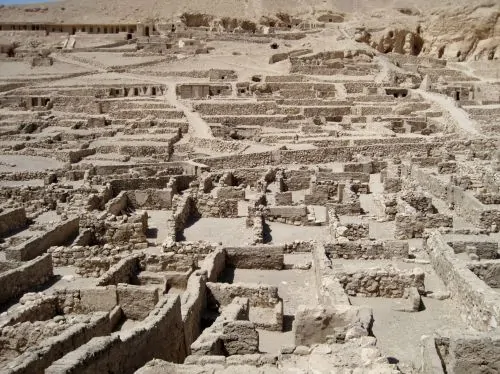
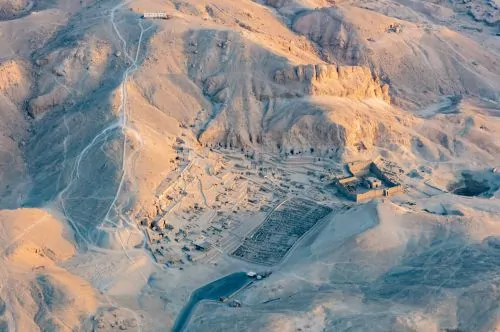
The settlement occupied a small desert valley on the west bank of the Nile opposite Thebes, near modern Luxor. Established early in the New Kingdom, probably under Thutmose I around 1500 BCE, it placed skilled workers within reach of the royal burial grounds now known as the Valley of the Kings and Valley of the Queens. Cutting a tomb into limestone and covering its chambers with precisely arranged religious imagery required experienced people working together. Royal administration supported a resident community whose expertise could serve successive rulers. Work crews generally numbered several dozen men, divided into left and right teams under foremen, with scribes keeping accounts. Their families lived in a walled village, while rougher accommodation near the tombs allowed workers to stay closer to a project instead of returning home every day. Employment could also run through families: the craftsman Sennedjem had sons who followed him into the royal crew. Housing workers together helped sustain the specialized workforce on which these demanding projects depended.
Payday brought grain rather than coins. Regular allocations formed the core of the workers’ compensation, and royal administration supplied other necessities, including fuel and materials for the job. Supporting households in this dry location required an organized flow of provisions; the village could not simply grow everything it needed around its houses. Yet state employment did not absorb every economic relationship. Residents made private purchases and owed one another payments. One surviving account records a guard buying a bull from a crew member with goods that included linen shirts and oil, their values reckoned in copper units. Prices could be expressed in a common measure even when payment consisted of several goods. Written accounts established what had changed hands and what the parties considered it worth, giving a purchase a record that could outlast the conversation.
Much of this evidence survives on ostraca, pieces of limestone or broken pottery used as writing surfaces. Stone fragments were plentiful around tomb-cutting sites, making them convenient for notes that did not require a roll of papyrus. The surviving material includes household business as well as official accounts, and its variety makes Deir el-Medina unusually revealing. A dispute over hiring a donkey appears among records of debts and property arrangements; another text preserves a husband’s accusation against his wife. These are glimpses of particular conflicts, not proof that village life consisted of constant quarreling. Nor does an accusation establish that its target was guilty. More substantial documents let us follow some family tensions further. In the twelfth century BCE, a woman named Naunakhte declared that some of her children should receive none of her property because they had failed to care for her in old age. Her statement brought an expectation of family support into a formal proceeding over inheritance. A community maintained to serve the monarchy thus also had to address questions familiar within households far beyond the royal cemetery: what grown children owed a parent, and who should receive property when that relationship failed.
The limits of royal support became especially visible in year 29 of Ramesses III, during the twelfth century BCE. When grain payments fell behind, tomb workers stopped working and staged protests around the funerary temples on Thebes’s west bank. The account preserved in the Turin Strike Papyrus describes repeated confrontations with officials and efforts to obtain overdue supplies. Deliveries could ease the immediate problem without ending the dispute; further stoppages followed. Often described as the earliest documented labor strike, the episode matters beyond its place in a chronological ranking. These workers understood provisions as something due for their service and acted together when the administration failed to deliver. Their specialized employment gave them a shared grievance and a recognizable group through which to pursue it. The surviving account also resists a simple victory story: securing grain on one occasion did not guarantee the next payment. Maintaining royal burial work depended on an agreement that officials had to keep honoring.
The craftsmen also prepared tombs for themselves in the cemetery beside the village, applying their skills to their own hopes for an afterlife. Sennedjem’s family burial, with its painted chamber, makes that connection particularly vivid. The same community that negotiated private payments and contested inheritances created images of an ordered existence beyond death. Its residents cannot stand for every Egyptian household: their access to royal employment and the exceptional survival of their records make them a distinctive group. But those records restore people to monuments usually discussed through kings. A royal tomb required years of skilled work, and the village sustained the households that made those years possible.
Originally published by Brewminate, 10.19.2026, under the terms of a Creative Commons Attribution-NonCommercial-NoDerivatives 4.0 International license.
About the Author