You walk onto a trade show floor and within ten steps you’re hit by a wall of light. Not just from the overhead rigging, but from the booths themselves. A seven foot LED wall loops a product demo. A touchscreen kiosk pulls up spec sheets. A hanging sign the size of a minivan rotates slowly above a crowd that’s already three deep at the aisle. If you’ve been to a hardware show, a medical convention, or a tech expo in the last five years, you’ve seen it. The humble 10×10 with a folding table and a bowl of branded pens is effectively extinct.
That shift didn’t happen because exhibitors suddenly got more money. It happened because the basic math of a trade show changed. Buyers now walk the floor with a phone in hand, ten tabs open, and a mental shortlist already forming before they reach your aisle. The booth has to do more than sit there looking clean. It has to pull people in, hold them for an extra ninety seconds, and give them something to remember past the cocktail hour. That’s a technology problem as much as a design one.
From Silk Road Tables to LED Walls: A Short History
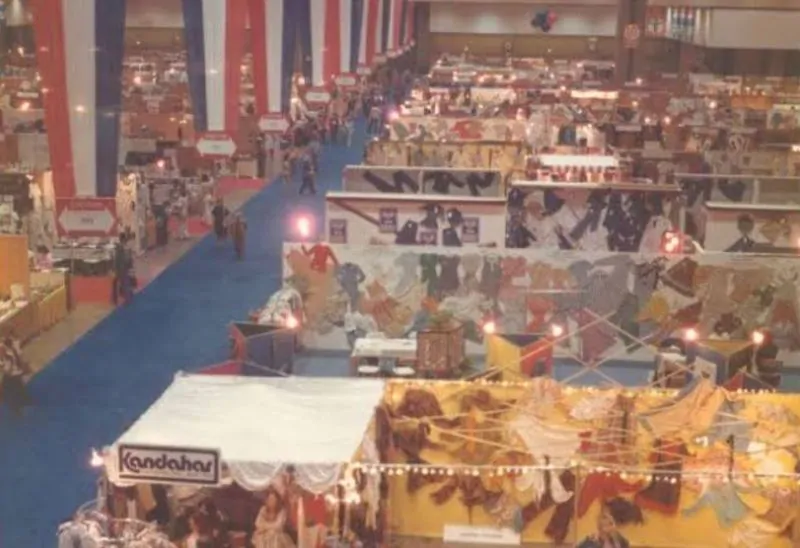
Long before Javits Center carpet and badge scanners, merchants set up stalls along trade routes and inside exhibition halls to show what they carried. The Smithsonian’s documentation of exhibition history traces how world’s fairs and industrial expositions turned temporary displays into a serious craft. Vendors built multi-story pavilions, commissioned custom structures, and hired lighting crews. The goal was the same as it is now: stop traffic, communicate value fast, and make the brand feel bigger than the booth next door.
What changed in the last two decades is the toolkit. A 1964 World’s Fair pavilion needed months of construction and a small army of union labor. Today’s exhibitor can rent an LED video wall, hang a lightbox the size of a garage door, and pack it all in a case that ships on a Tuesday. The barrier dropped from “build a building” to “book the right vendor.” That’s when the design conversation moved from architecture to technology.
And that’s the part most first time exhibitors miss. They think the booth is the point. It’s not. The booth is the interface. The point is the conversation it earns you.
What Technology Actually Does on a Show Floor
Technology on an exhibit isn’t decoration. It’s a filter. Every screen, kiosk, and digital display you install is doing one of four jobs, whether you planned it that way or not.
- Interruption. A moving image or an LED wall catches peripheral vision in a way a static banner never will. That’s your first half second won.
- Qualification. A looping product demo tells the wrong buyers to keep walking and the right ones to stop. That’s a feature, not a bug.
- Memory. People who interact with an exhibit recall the brand far more than people who only received a brochure.
- Data. Badge scans, lead capture forms, and kiosk analytics tell you who actually stopped, not just who walked by.
Most exhibitors invest in the first one and forget the other three. I’d rather see a modest booth with one outstanding demo station than a giant structure with five screens nobody can explain. Screens are easy to buy. The story they tell is the hard part.
A Framework You Can Actually Use
I call it the Three Second Rule, and it isn’t about website loading times. It’s about what a stranger perceives in the first three seconds of looking at your exhibit from the aisle.
Second one: What is this? The visitor should know the category before their foot moves. If they’re guessing, you’ve already lost them.
Second two: Is this for me? The booth should announce its audience. Medical buyers, retail buyers, and enterprise software buyers all need different signals.
Second three: Should I stop? There needs to be a reason to break stride. A demo, a giveaway, a person making eye contact, a screen showing something they can’t see anywhere else.
Run that test on your current booth design, or on the one you’re planning. If a friend who doesn’t work in your industry can’t answer the three questions in three seconds from twenty feet away, you have a problem you can fix before the show opens. That’s a much cheaper conversation than rebuilding on site.
Why Booth Design Is Sector Specific
An exhibit that works for a medical device company will fall flat at a consumer electronics show, and vice versa. That’s because the buying behavior is different, not just the aesthetic.
| Industry | What the Booth Needs to Do | Common Mistake |
| Medical and Life Sciences | Signal credibility, support educational sessions, create quiet space for consultations | Overloading the booth with entertainment that undercuts the serious tone |
| Technology and SaaS | Enable hands-on demos, show live product, support a stage for short talks | Building a booth that looks great in photos but has nowhere to actually sit down with a buyer |
| Retail and Fashion | Draw traffic through visual merchandising and tactile display | Treating the exhibit like a pop up shop instead of a lead engine |
| Industrial and Manufacturing | Communicate scale, showcase equipment, make technical specs legible from the aisle | Assuming visitors will read long spec sheets instead of scanning visuals |
The pattern here is that booth design is a translation layer. You’re translating your company’s value into something a tired stranger can absorb in a few seconds while their feet hurt and their phone is buzzing. That’s why good exhibition booth design rarely starts with the structure. It starts with the buyer’s decision process.
The Practical Checklist Before You Commit
Before you sign a contract or book freight, walk through these questions. They’ll save you money, and they’ll save you the humiliation of discovering a flaw on setup day.
- What’s the one thing you want a visitor to remember? If you can’t answer in a sentence, the booth can’t either.
- Who staffs the booth, and where do they stand? Design the circulation before you design the graphics. Aisles, meeting areas, and storage all compete for the same square footage.
- What’s your power and rigging reality? LED walls, lightboxes, and digital signage all have electrical and weight requirements. Confirm them with the venue before the design is locked.
- What’s your install window? Rapid turnaround exhibits exist for a reason. If your show opens at 9 a.m. on a Tuesday, you don’t want a build that needs three days.
- How does it ship? Crates, cases, and drayage add cost fast. A booth that travels well is worth more than a booth that photographs well.
- What’s reusable? Modular elements that adapt to 10×20, 20×20, and larger footprints pay for themselves over multiple shows. Custom one-offs rarely do.
Every one of these is a technology question disguised as a logistics question. Power, rigging, shipping, and install time all constrain what you can build. The exhibitors who win are the ones who treat the booth as a system, not as a shopping trip.
Where This Is Going Next
The next decade of trade show exhibits is going to be shaped by two things: experiential technology that’s cheaper than it’s ever been, and tighter sustainability expectations from venues and buyers alike. The IEEE has documented decades of display and lighting innovation that keeps pushing what’s possible on a show floor, and every cycle gets more accessible to mid-sized exhibitors.
What won’t change is the human part. A booth still has to earn attention from a person who is tired, distracted, and only half looking your way. All the technology in the world doesn’t fix a message nobody understands. But when the message is sharp and the booth is built around it, the results compound fast.
So before your next show, think about the booth as a technology product, not a furniture rental. Ask what it needs to do, then design backwards from there. The exhibitors who get that right aren’t the ones with the biggest budget. They’re the ones who knew exactly what they wanted a stranger to feel in the first three seconds. What’s your three second pitch right now? If you can’t say it out loud in one breath, that’s the first thing to fix, and it doesn’t cost a dollar.
About the Author