Project Daedalus paired fusion propulsion with a rapid stellar flyby, exposing the technological demands and social assumptions behind reaching another star within a human lifetime.

By Matthew A. McIntosh
Public Historian
Brewminate
Introduction: What Would Count as Reaching Another Star?
In August 2012, Voyager 1 crossed the heliopause and entered the interstellar medium beyond the region dominated by the solar wind. The achievement extended direct scientific observation into an environment that no functioning spacecraft had previously investigated, but it did not bring another stellar system within practical reach. Entering interstellar space and conducting a mission to another star were different accomplishments. The former required a vehicle capable of continuing outward after its planetary encounters; the latter demanded a means of traversing several light-years within a scientifically useful period. Long before Voyager 1 crossed that boundary, members of the British Interplanetary Society had attempted to specify what such an undertaking would require. Their investigation, Project Daedalus, made the duration of the journey a governing condition of its design.
Conducted between 1973 and 1978, Daedalus examined an uncrewed probe intended to reach a nearby star within a working human lifetime. Its designers sought to remain within established physics and technologies they regarded as available or susceptible to reasonable extrapolation. The final report, published in 1978, presented a two-stage vehicle powered by repeated fusion reactions, with Barnard’s Star, approximately six light-years away, serving as the reference destination. Calculations envisaged a cruise velocity exceeding 12 percent of the speed of light and a flight lasting roughly fifty years. These figures gave the proposal a specificity absent from general assertions that humanity might eventually visit the stars, although they described the expected behavior of a proposed machine. The mission also embodied an important restriction; its surviving spacecraft would pass through the destination system without slowing into orbit. Dispensing with deceleration reduced the propulsion demands but confined close observations to a rapid encounter, even though scientific investigation could begin during the approach. Arrival meant an opportunity to obtain measurements while continuing onward, followed by the additional interval required for signals to carry the findings back to Earth. The study’s working-lifetime requirement influenced both the speed of the vehicle and the kind of knowledge its instruments could acquire.
Calling this journey feasible nevertheless left an important ambiguity. Established physical laws could permit a flight for which a sufficiently reliable propulsion system had never operated. Describing how individual functions might be performed could support an engineering argument without establishing that the complete vehicle would perform them together. Daedalus requires a distinction between specifying the conditions under which a stellar mission could succeed and demonstrating the capabilities needed to satisfy those conditions.
That distinction should inform the historical assessment without becoming a reason to dismiss the undertaking. The study group was conducting a volunteer engineering investigation, and its report must be understood within a tradition of astronautical research that examined unfamiliar possibilities before construction became practicable. As Oliver Tristan Dunnett’s history of British space culture demonstrates, such projections also incorporated expectations about the society that would undertake them, including its access to extraterrestrial resources. Daedalus depended on a future industrial capacity that extended far beyond the manufacture of one spacecraft, while its long operating life required substantial advances in autonomous maintenance. Identifying these dependencies was itself a useful result. The proposal allowed subsequent investigators to challenge certain assumptions and calculate the consequences of changing them. Yet the authority of a detailed design could exceed the strength of the evidence supporting its least developed elements. The central argument is that Daedalus established a conditional engineering case whose value lay in making interstellar exploration open to systematic examination. Its historical achievement must be judged through the requirements it clarified, alongside the unresolved relationship between a calculable journey and a machine capable of completing it.
Beyond Apollo: The British Interplanetary Society and the Interstellar Question
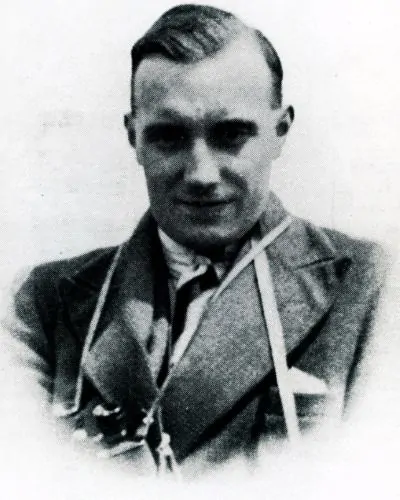
The organization that sponsored Daedalus had been discussing travel beyond Earth for forty years. Founded in Liverpool in 1933 under the leadership of Philip Ellaby Cleator, the British Interplanetary Society developed through the efforts of people whose interest in astronautics preceded the existence of an operational spacecraft. Its membership brought enthusiasts into contact with amateur and professional engineers, while subscriptions and small donations supported publications through which their ideas could circulate. The Journal of the British Interplanetary Society, established in 1934, gave this activity a continuing forum. Correspondence with researchers abroad connected the organization to an international movement concerned with rocket propulsion and its possible applications. Dunnett’s archival research nevertheless cautions against treating these aspirations as politically detached. Hopes for international cooperation subsequently coexisted with expectations of British leadership and the opportunities associated with Commonwealth territory. The Society occupied a distinctive position between technical discussion and advocacy, drawing authority from specialist knowledge while attempting to influence what others regarded as a worthwhile future.
Its lunar spaceship investigation supplied an important institutional precedent. In 1938, the Society’s Technical Committee examined a vehicle intended to carry three people to the Moon, support a stay of approximately two weeks, and return them to Earth. H. E. Ross described the proposal in the journal in January 1939, placing a specified expedition before readers who could examine its assumptions. The exercise required attention to the relationship between propulsion and the equipment needed by the passengers, extending the discussion beyond the proposition that rockets might eventually leave Earth. Its unusual arrangement of numerous rocket motors also showed how strongly a proposed solution could reflect the capabilities its authors believed available. The subsequent Apollo landings did not establish that this earlier vehicle would have performed as intended, and similarities between the objectives should not obscure the differences in engineering. What persisted within the Society was an organizational practice. Members selected a demanding destination and divided the associated problems into subjects for investigation. Such work gave participants reasons to exchange calculations and challenge one another’s judgments even when they lacked the resources for a development program.
Apollo’s conclusion altered the setting in which this practice continued. The final lunar expedition returned in December 1972, shortly before the first public discussions of Daedalus, but space exploration continued through other kinds of missions. During 1973, Skylab supported extended human activity in Earth orbit, while Pioneer 10 conducted the first close reconnaissance of Jupiter. These developments combined conspicuous achievement with changing governmental priorities. Matthew D. Tribbe’s account of American responses to Apollo further demonstrates that technological accomplishment did not guarantee agreement about what should follow it. Daedalus emerged within this unsettled environment, although its timing alone cannot establish that disappointment over the end of lunar landings caused the study.
An open Society meeting in London in January 1973 reveals how the investigation initially acquired an audience. Alan Bond, Anthony R. Martin, and other contributors presented aspects of the proposed undertaking to approximately 120 people, discussing problems that included navigation and the hazards of the journey. Questions from those attending made the occasion an opportunity to expose the proposal to criticism before its eventual configuration had been settled. Bond became the leading designer, while Martin played a central role in coordinating the work and editing its final report. Robert C. Parkinson contributed to the investigation of propellant acquisition and to the broader discussion of the resources a starship would demand. Other participants supplied studies of specific systems, making the project dependent on collaboration across subjects that could not be resolved by propulsion expertise alone. Describing the contributors as volunteers identifies the circumstances of their participation; it does not establish that they approached the work without professional competence. Their calculations and meetings were undertaken alongside other commitments, within an association that could assemble expertise without commanding the laboratories or manufacturing facilities of a national space agency. This arrangement afforded considerable freedom in selecting a problem, but it also shaped the evidence the group could produce. Much of its work necessarily proceeded through analysis and the exchange of technical papers.
Publication connected these meetings to a wider community. Martin’s later recollection places the beginning of the journal’s dedicated Interstellar Studies issues in April 1974, while Kenneth Gatland’s “New Frontiers” series in Spaceflight provided another outlet for discussions of advanced possibilities. The importance of these publications extended beyond announcing a proposed spacecraft. They allowed contributors interested in different aspects of interstellar activity to encounter one another’s arguments and develop disputes over shared questions. Research into communication with extraterrestrial intelligence belonged to this environment, although detecting a signal and dispatching a probe imposed markedly different requirements. The Society could accommodate both because its interests extended beyond the immediate mission schedules of existing space agencies. A specialist readership helped sustain subjects for which there was little prospect of an early launch, giving interstellar research continuity through successive papers and conferences.
Debate over extraterrestrial visitation gave this community an additional reason to scrutinize the difficulty of travel between stars. Enrico Fermi’s familiar question originated in a conversation in 1950, but the arguments subsequently gathered under the name “Fermi paradox” developed over time. Michael Hart’s 1975 paper asserted that the absence of extraterrestrials on Earth was difficult to reconcile with the existence of other civilizations capable of spreading through the Galaxy. David Viewing’s contribution to the Society’s journal that year likewise connected expectations of widespread intelligence with the lack of observed manifestations of it. These publications appeared after Daedalus had begun and belong to its developing intellectual surroundings rather than serving as sufficient explanations of its inception. On April 5, 1977, the Society devoted a conference session to discussion of the paradox, demonstrating how closely questions of engineering and extraterrestrial intelligence had become associated. A credible account of stellar travel could weaken the claim that distance necessarily prevented contact, but it could establish neither how frequently technological societies arose nor whether they would undertake expansion. The relevance of Daedalus exceeded the scientific objectives of its proposed probe. Within the Society’s discussions, the ability to cross interstellar distances had become one disputed premise in arguments about humanity’s place among possible civilizations.
Setting the Problem: How the Study Defined a Feasible Mission
The study’s brief placed boundaries around both its methods and its conclusions. Its proposed vehicle was to employ contemporary technology or developments that could reasonably be anticipated from it, restricting the freedom to solve difficult problems by invoking unspecified discoveries. Arrival had to occur within a working human lifetime, while the design needed sufficient flexibility to accommodate different target stars. These requirements selected a field of investigation before the group had completed its assessment of possible vehicles. A proposal could be physically conceivable yet unsuitable for Daedalus because it demanded an excessively long voyage or depended on capabilities too remote from contemporary research. Conversely, satisfying the brief would establish an answer to the problem the group had chosen, without exhausting the possibilities of interstellar exploration.
The stipulation concerning technological development required careful interpretation. Some equipment could be discussed through experience already accumulated in aerospace engineering, whereas other systems depended on advances whose eventual performance remained uncertain. A near-contemporary assessment in NASA’s Advanced Automation for Space Missions distinguished comparatively conventional elements of the structure, communications equipment, and scientific payload from the projected intelligence and adaptive maintenance capabilities. That distinction reveals why the permission to extrapolate mattered. Requiring every component to have operated successfully before the study began would have excluded much of what its authors wanted to investigate, but allowing an unrestricted succession of breakthroughs would have deprived their estimates of an identifiable technical foundation. The difficult judgment concerned the relationship between an existing research direction and the performance assigned to its future application. Increasing the dimensions of familiar equipment and obtaining a capability not yet demonstrated posed different evidential questions, although even enlargement could introduce unfamiliar stresses or manufacturing difficulties. Nor did the reference to foreseeable developments amount to a promise that departure would follow shortly after publication. The report envisaged construction by a substantially wealthier community operating throughout the Solar System, probably during the later twenty-first century. Its technological rule concerned what the investigators considered defensible to project; the supporting circumstances could require a much longer transformation.
A limit derived from human working lives introduced a different kind of judgment. Nothing in the physics of stellar distances made a slower robotic expedition inherently meaningless, provided its equipment survived and someone remained interested in receiving the results. Daedalus nevertheless treated a more immediate relationship between undertaking and outcome as desirable. The lifetime condition expressed a preference about the organization of research, rather than a universal threshold below which exploration possessed no value. It made velocity a requirement imposed on the vehicle and directed attention toward propulsion capable of meeting it. Extending the permitted duration would have changed the range of acceptable solutions, so the study’s demanding speed should be understood partly as a result of how its question had been framed.
Without human passengers, the designers could concentrate the spacecraft’s accommodation on instruments and the machinery supporting them. They did not have to provide an inhabited environment or establish that people could remain healthy throughout the expedition. This choice reduced important demands, but its impacts extended beyond the removal of life-support equipment. Work that astronauts might perform had to become unnecessary, be anticipated in advance, or be assigned to onboard mechanisms. Selecting robotic exploration changed the location of technical difficulty. The vehicle could dispense with human habitation while acquiring unusually demanding requirements for independent operation. The relevant measure of survival also became more exacting than the continued existence of an object on its intended course. Instruments needed to remain useful, and the spacecraft had to preserve the ability to conduct its observations when circumstances at the destination became clearer. These were functional obligations arising from its scientific purpose. They help explain why a mission without a crew could be described as relatively simple in comparison with human transportation while still requiring capabilities beyond those exercised by existing probes.
Adaptability to several stars protected the investigation from becoming wholly dependent on one astronomical circumstance. Barnard’s Star supplied a worked example through which distances and encounter requirements could be made concrete, but the broader purpose demanded that the reasoning remain relevant elsewhere. This did not mean that the same completed hardware could be redirected toward any destination without alteration. A more distant star would change the relationship between propulsion performance and the permitted travel time, while different scientific opportunities could justify a different payload. The generality sought by the group resided in an approach whose principal relationships could be recalculated. Its strength depended partly on whether modest changes in the destination produced manageable revisions or destroyed the usefulness of the proposed arrangement. This requirement also gave uncertain astronomical knowledge a methodological significance. If the case for one destination weakened, an investigation designed around transferable principles could retain value without preserving every feature of the original mission.
Evidence about the proposed vehicle’s development status must be assessed separately from compliance with these initial requirements. In a later technical appraisal, Kelvin F. Long characterized Daedalus as a preliminary design, extending beyond an initial concept but falling short of a detailed engineering definition. That classification is useful as a retrospective assessment, rather than a formal stage that should automatically be attributed to the original investigators. An initial concept can identify an operating principle without establishing the equipment needed to implement it. Preliminary work advances the investigation by assigning masses and expected performance, allowing the consequences of component choices to be calculated. A detailed design would require substantially more definition of the hardware and its interfaces, supported by the testing necessary to justify confidence in operation. Daedalus’s papers gave many aspects of the mission quantitative treatment, yet their supporting evidence was uneven because some projected systems had no demonstrated counterpart. Consistency also demanded more than an adequate estimate within each specialist contribution. Additional protection would affect mass; altered electrical requirements could change power equipment and heat rejection; modifications intended to improve reliability could impose further burdens elsewhere. These interactions made the spacecraft’s combined performance an object of investigation in its own right. The presence of a technical answer under each subject heading could not settle whether the resulting allocations remained compatible throughout the mission.
Several meanings of feasibility can be distinguished when interpreting the study, provided they are identified as analytical distinctions rather than presented as its authors’ formal terminology. Physical possibility concerns compatibility with established natural laws. Engineering credibility asks whether the required performance can be supported by sufficiently convincing accounts of the equipment, while operational adequacy concerns its ability to perform the assigned work over the necessary interval. Scientific usefulness introduces another assessment, since a successful transit need not yield observations commensurate with the effort involved. Affordability and institutional support require evidence about the society expected to provide the resources. Daedalus engaged with these questions to different degrees, and its assumptions about future industry make it misleading to describe economics as wholly absent. Its conclusions become more precise when each claim is matched to the kind of support offered for it.
Choosing Barnard’s Star: A Destination under Dispute
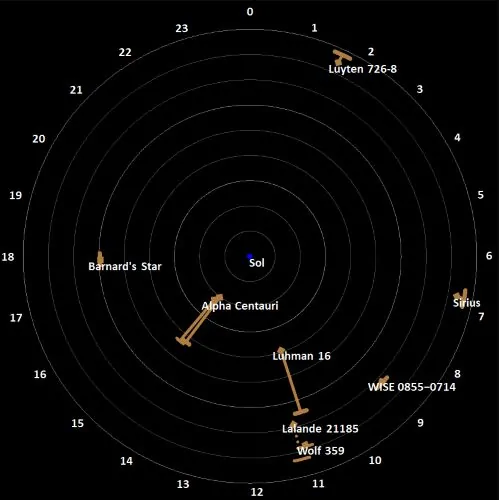
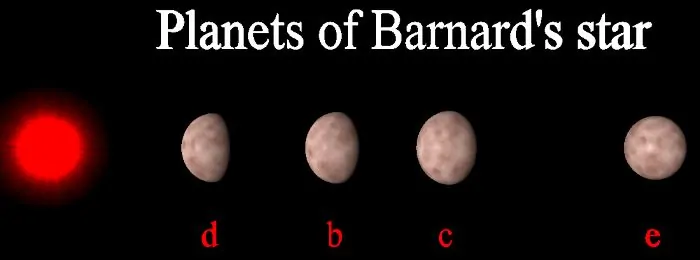
Barnard’s Star offered Daedalus a destination whose attraction depended on more than proximity. The Alpha Centauri system lay closer, making the selection of a star almost six light-years away something that required explanation. A faint red dwarf observable from northern latitudes, Barnard’s Star had received sustained attention from astronomers investigating the motions of nearby stars. Its relative accessibility to the observational community with which the British Interplanetary Society was connected helped make it familiar. In addition, published measurements appeared to suggest that it possessed planetary companions. These reports gave a proposed expedition the prospect of investigating another planetary system, although the evidence supporting that prospect became increasingly contested while the spacecraft study proceeded.
The original claim rested on astrometry, the measurement of celestial positions and their changes over time. Peter van de Kamp, working at Swarthmore College’s Sproul Observatory, examined photographic records for departures from the motion expected of Barnard’s Star. Such an investigation required separating its movement across the sky from the annual displacement produced by Earth’s changing observing position. A further periodic deviation could indicate that an unseen companion was causing the visible star to move around their common center of mass. The principle was sound, but detecting a planetary influence required extraordinary care because the apparent displacement was extremely small. Van de Kamp’s 1963 paper interpreted the measurements as evidence of a companion with a mass comparable to Jupiter’s. The inference drew authority from a long observational record and the established use of stellar motions to investigate unseen objects. Nevertheless, the planet itself had not been photographed; its existence depended on the interpretation of minute positional differences, leaving the result vulnerable to errors that repeated observations with the same equipment might preserve.
By 1969, even the proposed arrangement of the system admitted competing interpretations. Van de Kamp published an extended single-companion solution and, in a separate paper later that year, an alternative involving two bodies. The latter assigned them periods of approximately twenty-six and twelve years, with estimated masses of 1.1 and 0.8 times Jupiter’s respectively. These were alternative explanations of the astrometric record, rather than the independent observation of two planetary objects. His August paper acknowledged that the residual errors did not permit a decisive choice between the single-planet and two-planet interpretations, while also recognizing the possibility of systematic effects. That qualification matters because it establishes uncertainty within the original analysis, before the subsequent objections are considered. Some discussions within the Society nevertheless developed a more elaborate picture from the proposed companions. In a 1970 article, Anthony T. Lawton compared their inferred arrangement with the Solar System and considered whether smaller inner planets might accompany them. His diagram distinguished the supposed outer bodies from conjectural worlds nearer the star, but the comparison encouraged readers to imagine an organized planetary neighborhood. As Dunnett observes, astronomical measurements acquired additional meaning through such representations. An unexplained movement became evidence around which a potentially visitable place could be constructed.
Two investigations published in 1973 raised different objections to the observational foundation. In June, John L. Hershey reported an analysis of another field photographed with the Sproul refractor, centered on the star AC +65°6955. He identified positional discontinuities associated with the history of the telescope’s objective lens, including changes around 1949 and adjustments during 1957–1958. Related behavior appeared among reference stars, providing evidence that apparent celestial movements could originate in the instrument. Hershey’s paper did not directly reanalyze Barnard’s Star, and its significance should not be enlarged into a finding it had not made. It demonstrated a problem with the stability of measurements produced by the same observing system. In October, George Gatewood and Heinrich Eichhorn published an independent search using photographic material from the Allegheny and Van Vleck observatories that failed to confirm the proposed planetary companion of Barnard’s Star. Their result challenged the reproducibility of the claimed motion, while Hershey’s investigation supplied grounds for questioning whether long photographic sequences were as consistent as their interpretation required. Both papers appeared during Daedalus’s opening year, placing substantial objections within the information available as the project developed.
The disagreement continued beyond these initial challenges. Wulff D. Heintz’s 1976 examination of suspected companions found that corrections to older Sproul positions removed the original long-period signal attributed to Barnard’s Star. Remaining apparent movements resembled systematic trends found in other stars, weakening the case for interpreting them as a separate planetary influence. Van de Kamp continued to defend planetary explanations, so the dispute did not end with immediate agreement among the observers. Yet the accumulated objections increasingly concerned the reliability of the supposed detection itself, rather than adjustments to the properties of an accepted companion. They did not establish that the star lacked planets of every possible mass or orbit.
For Daedalus, this changing evidence created a distinction between retaining a destination for engineering calculations and relying on an account of what would be found there. The 1978 report continued to use Barnard’s Star, but its astronomical contributions included separate examinations of the companion evidence and the star’s measured properties. Martin and Bond also explored possible planetary environments through arguments about stellar evolution and the significance of the red dwarf’s low luminosity. Such analysis could identify conditions worth investigating, although estimates of an environment did not independently establish the existence of the body assigned to it. A mission intended to discover the contents of an unfamiliar system could accommodate uncertainty about its eventual observations; a predetermined itinerary past specified planets required much stronger information. Rejection of van de Kamp’s giant companions would weaken one prominent justification for the destination without making the star inaccessible or scientifically empty. It would also increase the importance of obtaining better astronomical observations before committing instruments to certain encounters. The historical difficulty is that the attractive planetary interpretation helped organize interest in the expedition before independent measurements had secured it. Distance could be entered into a trajectory calculation with considerably greater confidence than the planetary itinerary.
Buying Speed: Propulsion Choices and the Cost of Stopping
Covering approximately six light-years in half a century required an average velocity close to 12 percent of the speed of light. Because acceleration would occupy part of the journey, the eventual cruising speed had to exceed that average. The spacecraft did not need its main engine to operate throughout the crossing. Once accelerated, it could coast through most of the intervening distance. The propulsion problem concerned imparting the necessary motion to the equipment that would survive the powered phase. Raising the intended speed increased the energy requirement, but the burden of carrying the material needed to produce thrust made the relationship between vehicle size and performance more severe than an energy calculation alone suggested.
For a rocket carrying its own propellant, the governing relationship was expressed by the classical ideal rocket equation. Here, the available change in velocity depends on the effective exhaust velocity and the natural logarithm of the ratio between initial and final mass. Initial mass includes the propellant as well as the vehicle and its payload; final mass means everything remaining after the specified expenditure, rather than scientific instruments alone. The logarithm is important because increasing the required velocity change demands an exponential increase in mass ratio when exhaust performance remains fixed. Adding more propellant produces diminishing gains because the engine must first accelerate material that will subsequently be expelled. A spacecraft can travel faster than its exhaust, so exhaust velocity does not impose a simple upper speed limit. Instead, a comparatively slow exhaust makes the mass required for a very large velocity change prohibitive. This relationship gave the Daedalus investigators a means of identifying propulsion arrangements that might appear promising in isolation but became unsuitable when assigned the complete mission.
Chemical propulsion encountered this difficulty immediately. The energy released by chemical reactions could generate effective exhaust velocities of a few kilometers per second, far below the scale relevant to the proposed stellar journey. Increasing the size of a chemical rocket would not remove the unfavorable relationship between its propellant load and the surviving vehicle. Nuclear energy offered much greater resources, although its usefulness depended on the mechanism through which that energy produced thrust. In a NERVA-type nuclear thermal engine, a fission reactor heated propellant before its expansion through a nozzle, leaving exhaust performance constrained by the working fluid and allowable temperatures. The Daedalus assessment considered the resulting propellant requirement impractical for its reference mission. Nuclear-electric propulsion presented a different difficulty. Electrical power could accelerate expelled particles efficiently, but the generating equipment contributed substantial mass and restricted the acceleration achievable by the complete spacecraft. An engine with an attractive exhaust velocity could remain unsuitable if attaining the desired cruising speed consumed too much of the available journey.
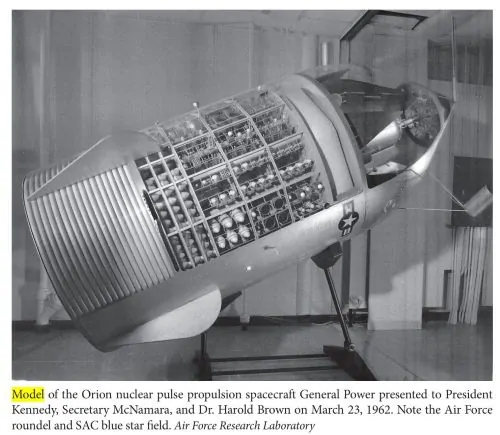
Other proposals attempted to change where the vehicle obtained its energy or reaction material. Beaming power from an external laser installation could reduce the generating machinery carried aboard, although the Daedalus review judged the energy transfer available under its assumptions insufficient for the required acceleration. Robert W. Bussard’s interstellar ramjet proposed collecting diffuse hydrogen during flight, potentially avoiding an enormous departure load. That apparent advantage depended on difficult intake and fusion processes, including the collection and control of material across immense magnetic structures. Nuclear pulse propulsion offered another route, already investigated through Project Orion’s proposed use of explosions acting on a massive pusher plate. Freeman J. Dyson’s 1968 discussion extended such thinking to interstellar vehicles using thermonuclear explosions, demonstrating that the relevant historical distinction cannot be reduced to fission for Orion and fusion for Daedalus. The later study favored much smaller fusion events whose products could be redirected magnetically. Its authors also considered a continuous fusion rocket capable of performing the reference mission, but selected the pulsed arrangement because they judged it a more manageable technological extrapolation. Their preference rested on an assessment of competing engineering burdens. It did not follow from a demonstration that every alternative violated a physical limit.
The selected arrangement used two powered stages and assigned approximately 50,000 metric tons to propellant. About 46,000 tons belonged to the first stage and 4,000 to the second, compared with a scientific payload of roughly 450 tons. This asymmetry reflected the work required early in the flight, when the first stage had to accelerate the remaining propulsion equipment and its still-unconsumed supply. Discarding exhausted hardware then allowed the second stage to continue without carrying the entire earlier structure. Staging improved the use of the available propellant by reducing the mass that later thrust had to accelerate. It also made clear how much of the initial vehicle existed to deliver a comparatively small surviving fraction to its intended speed.
Stopping introduced an additional obligation that the flyby configuration deliberately avoided. A vehicle arriving at interstellar cruising speed would need to shed almost all of that motion relative to the destination before undertaking ordinary orbital exploration. Rocket braking required propellant that had accompanied the spacecraft during departure and acceleration, increasing the earlier propulsion burden before it could perform its eventual function. The penalty could not be represented simply by doubling the propellant assigned to a one-way acceleration. An idealized example illustrates the relationship; if one maneuver required an initial-to-final mass ratio of ten, adding an equally demanding braking maneuver at the same exhaust velocity would raise the combined ratio to one hundred. The first maneuver would accelerate the supply subsequently consumed by the second, so the ratios multiply. This is a simplified constant-exhaust-velocity example, not a numerical reconstruction of a redesigned Daedalus. A real stopping mission would require new calculations for staging and the additional structures needed to carry its supplies. Gravitational attraction alone offered no automatic escape from the difficulty, since a passage around an isolated star could bend an unbound trajectory without converting it into a bound orbit.
Accepting a flyby allowed the design to allocate its major propulsion expenditure to outward acceleration. That choice preserved a substantial instrument complement without requiring the much larger departure system needed to bring the same equipment nearly to rest at the destination. A stopping mission remained conceivable, but its designers would have had to reconsider the relationship between payload and departure mass, perhaps also accepting a longer flight. Conversely, reducing the encounter speed would have increased the time available for close observations and widened the investigations that instruments could attempt. The engineering comparison involved scientific capability as well as transit performance. Later analyses using Daedalus as a baseline have continued to examine how changing stage arrangements and mass allocations alters the payload that can be delivered. The original vehicle represented one selected compromise among such possibilities. Its economy depended partly on relinquishing an operational advantage, extended access to the destination, that additional propulsion capacity might otherwise have purchased.
The Fusion Engine: From Nuclear Reactions to Sustained Thrust
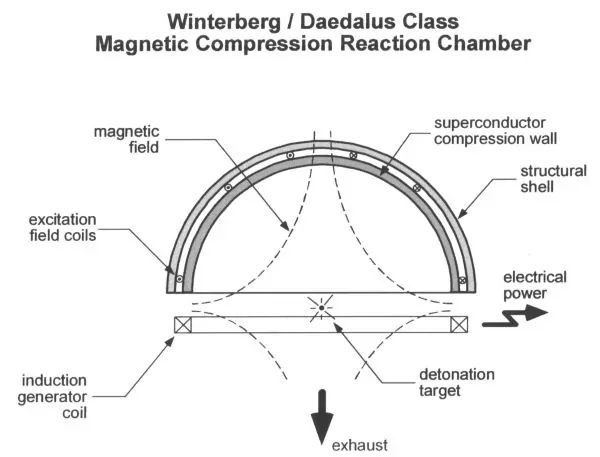
Daedalus’s engine depended on a succession of brief nuclear events, each contributing a small increment to the spacecraft’s motion. Sustained propulsion would emerge from repeating that sequence rapidly and reliably throughout the acceleration period. An important antecedent was Friedwardt Winterberg’s 1971 proposal for igniting thermonuclear microexplosions with intense electron beams and directing their products magnetically. Related research was also developing within the emerging field of inertial confinement fusion. In a widely discussed 1972 paper, John Nuckolls and his colleagues argued that laser compression could raise small quantities of fuel to densities favorable for thermonuclear burning. These investigations gave the Daedalus group a research foundation, although translating their physical principles into a propulsion system required decisions about fuel, ignition, energy recovery, and the handling of each expanding explosion.
The selected fuel mixture combined deuterium, a heavy isotope of hydrogen, with helium-3. Their principal fusion reaction produces a helium-4 nucleus and a proton, releasing energy chiefly through the motion of these electrically charged particles. That characteristic offered a substantial advantage for propulsion because magnetic fields could influence the reaction products and help direct their momentum into an exhaust. Deuterium–tritium fusion, the more accessible reaction for terrestrial fusion research, releases most of its energy through neutrons, which cannot be redirected by a magnetic nozzle. Choosing helium-3 reflected the requirements of the spacecraft as a whole, particularly the desire to obtain useful exhaust energy while limiting radiation burdens. The advantage came with a demanding physical qualification: deuterium–helium-3 fuel requires more severe ignition conditions than deuterium–tritium fuel. Daedalus adopted a reaction attractive for its eventual products while accepting greater difficulty in producing those products in the first place. Fuel selection joined the nuclear physics of ignition to the engineering of momentum transfer, rather than allowing either problem to be optimized independently.
Within the proposed machinery, the fuel would be stored as small, preformed pellets at cryogenic temperatures and delivered individually to the reaction chamber. A thin superconducting shell around each pellet would permit its acceleration by an electromagnetic injector, whose successive coils produced a traveling magnetic field. The pellet then had to arrive at a prescribed location at the moment the ignition equipment fired. Daedalus specified powerful electron beams for this task, drawing on a different driver technology from the lasers associated with much contemporary fusion research. Their energy would rapidly remove material from the pellet’s exterior, generating pressure that compressed and heated the remaining fuel. The essential operation was an implosion. Sufficient density and temperature had to develop before the compressed material dispersed. Inertial confinement described the short interval during which the fuel’s own inertia allowed reactions to proceed despite the enormous pressure driving its expansion. The outcome depended on the spatial distribution and timing of energy deposition, since an uneven implosion could disrupt compression and reduce the fusion yield. Later specialist treatments, including John Lindl’s account of ignition physics, demonstrate why symmetry, instability, and the sequence of compression remained central problems in evaluating such targets. For Daedalus, each pellet was an engineered component whose manufacture, preservation, injection, and irradiation all influenced the performance attributed to the engine.
After ignition, the rapidly expanding plasma would interact with the chamber’s magnetic field. Its expansion displaced and compressed that field, allowing electromagnetic forces to transfer momentum to the conducting chamber and its supporting structure. The field geometry would then guide the escaping material toward the rear of the vehicle. This arrangement reduced the need for the hottest products to strike a solid surface directly, while retaining a physical connection between the explosion and the spacecraft receiving its impulse. The chamber, coils, and structural attachments still had to bear the resulting forces, and their ability to survive those forces was integral to the proposed nozzle’s operation.
A further requirement concerned the energy needed to initiate the next explosion. The design proposed recovering energy from the expanding plasma through an induction loop near the chamber’s exit and using electrical transmission lines to supply the succeeding ignition pulse. This feedback arrangement made the propulsion cycle dependent on a successful relationship between fusion yield, energy recovery, storage, and electron-beam production. An initial supply of energy would necessarily be required before that sequence could maintain itself, and continued operation would depend on losses remaining within the assumed limits. Several quantities that can appear interchangeable in general descriptions of fusion must be distinguished. The proportion of a pellet that undergoes fusion measures fuel burn-up; the fusion energy released relative to the energy delivered to the target measures a different aspect of performance. The electricity consumed in producing the beam introduces another efficiency, while the fraction of released energy contributing to directed exhaust concerns propulsion itself. A favorable result at one stage could coexist with an unacceptable requirement elsewhere in the cycle. For example, a target yielding substantially more energy than it absorbed could still impose excessive demands if the equipment generating its ignition beams wasted too much electricity. The report’s energy accounting connected laboratory target behavior to machinery whose own performance determined whether repeated firing could continue.
The specified repetition rate brought these relationships sharp focus. At 250 firings per second, only four milliseconds separated successive pellets. The first stage was assigned approximately 2.05 years of powered operation and the second approximately 1.76 years, giving a combined acceleration period of about 3.8 years. At the nominal firing rate, those durations imply roughly thirty billion pellets, a scale reproduced in the later technical reassessment by Kelvin Long, Richard Obousy, and Andreas Hein. Across that succession of events, the injectors had to maintain delivery, the drivers had to provide appropriately timed pulses, and the chamber had to accommodate repeated changes in electromagnetic and mechanical loading. Assessing acceptable reliability would require distinguishing occasional reductions in yield from disturbances that interrupted ignition, damaged equipment, or prevented recovery of the next pulse’s energy. The large number of firings alone does not determine how many imperfect events could be tolerated, but it makes that tolerance an essential design question. Endurance testing would have to establish both the behavior of individual components and the results of their deterioration for the continuing sequence.
Radiation complicated the expectation that magnetic handling could protect the propulsion equipment. Although the principal deuterium–helium-3 reaction produces charged particles, deuterium can also react with itself, generating neutrons through one reaction branch and tritium through another. Subsequent reactions involving that tritium can produce additional neutrons. Describing the proposed engine as neutron-free would conceal processes that the designers themselves needed to include in their calculations. The plasma would also emit electromagnetic radiation, including X-rays, creating further paths by which energy could reach surrounding hardware. Because the engine’s total power was enormous, even a comparatively small fraction deposited in the spacecraft could create a substantial thermal burden. Materials exposed to that environment had to retain useful mechanical and electrical properties, while nearby superconducting equipment required protection compatible with its much colder operating conditions. These requirements connected radiation transport to shielding, cooling, structural mass, and ultimately the performance available from the propulsion system. The choice of a fuel with favorable primary reaction products reduced difficulties, but its practical benefit depended on the complete radiation environment and the equipment needed to withstand it.
By 1978, the study had assembled these processes into an intelligible operating sequence: deliver a target, compress it, obtain a fusion burn, direct the expanding products, and recover sufficient energy to repeat the operation. The historical significance of that sequence lies partly in the experimental questions it made identifiable. Tests of target ignition would have to be followed by investigations of energy recovery and momentum transfer, then by repeated operation under conditions capable of revealing cumulative damage. Results from one driver technology or fuel mixture would also need careful interpretation before being transferred to the specific electron-beam and deuterium–helium-3 arrangement proposed for Daedalus. The appropriate measure of progress would include how closely an experiment reproduced the engine’s required operating conditions and how many linked functions it tested together. The propulsion papers outlined an extensive program of investigation whose results could have forced changes to the vehicle’s dimensions, operating schedule, or projected performance. They also located an extraordinary concentration of technological demands within the opening years of a mission otherwise dominated by a long coast. The spacecraft’s eventual arrival depended on billions of closely coordinated events during its departure.
Before Departure: Helium-3 and the Industrial Solar System
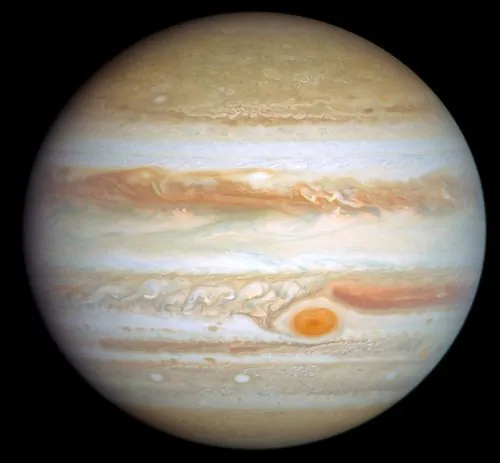
The fuel requirement gave Daedalus a second destination before its journey to Barnard’s Star could begin: the atmosphere of Jupiter. Of the approximately 50,000 metric tons of main propulsion fuel, roughly 30,000 would be helium-3 and 20,000 deuterium. These quantities turned the selection of a nuclear reaction into a problem of industrial supply. Deuterium could be separated from terrestrial water, but helium-3 was unavailable on Earth in anything approaching the quantities contemplated. Robert C. Parkinson’s investigation of propellant acquisition extended the study well beyond the spacecraft, examining how an extraterrestrial resource could become a stock of usable fuel. The departure inventory depended on equipment and transportation services that would have to operate elsewhere before the interstellar engine could perform its assigned task.
Parkinson considered several possible sources, including the production of helium-3 through nuclear reactions and radioactive decay. Tritium decays into helium-3, offering a route whose physical basis was established, but obtaining the required quantity would demand an enormous production program and the management of substantial radioactive inventories. Moving production to a lunar installation could relocate some associated hazards while leaving the underlying material and energy requirements to be met. Collection from the solar wind presented a different difficulty. Helium-3 travels outward from the Sun, but its low concentration in that stream implied collecting structures of extraordinary dimensions. Parkinson judged these demands in relation to the broader capabilities they would require, recognizing that a society able to construct such facilities might reconsider its propulsion options. His comparison also helps prevent an anachronistic reading of the lunar alternative. Manufacturing helium-3 at an installation on the Moon would be a different undertaking from extracting solar-wind deposits from lunar soil. The preferred Jovian scheme emerged from this assessment of competing production systems, each bringing its own requirements for energy, equipment, and transport.
Jupiter offered a vast atmospheric reservoir from which both helium-3 and deuterium could, in principle, be extracted. The proposed collection facilities were aerostats, floating factories supported within the atmosphere by balloon structures. Descriptions of Parkinson’s arrangement envisaged reactor heat providing buoyancy, while processing equipment separated the desired isotopes from the surrounding gases. The central industrial operation was concentration, since the presence of a resource throughout an immense atmosphere did not make that resource available as a ready supply. Large quantities of gas would have to pass through machinery that retained a much smaller quantity of useful product. A twenty-year acquisition program was contemplated, implying an average helium-3 output of approximately 1,500 metric tons annually. Its success would depend on the operating availability of the factories as well as their nominal processing capacity, making maintenance interruptions and equipment replacement consequential to the schedule. Planning also required knowledge of Jupiter’s atmospheric circulation and the conditions at suitable operating depths. The Pioneer encounters of 1973 and 1974 supplied new observations of the Jovian environment during the study’s development, bringing recently acquired planetary knowledge directly into an otherwise speculative industrial proposal.
Once separated, the fuel still had to leave Jupiter. An ascent ferry would collect the accumulated product from an atmospheric factory and carry it into orbit for transfer to a waiting tanker, then return for another collection cycle. The balloon installation and the orbital transport vehicle performed distinct functions within the supply system. Jupiter’s gravity made that connection demanding, because the usefulness of an atmospheric extraction plant depended on the performance of the vehicles removing its output. Later atmospheric-mining studies by Bryan Palaszewski gave greater attention to Uranus and Neptune partly because reaching orbit from those planets required less energy. Those investigations reinforce a qualification already implicit in Parkinson’s problem. The largest reservoir does not necessarily offer the most favorable supply route once the complete transportation operation is considered.
The economic rationale for establishing such a route rested on an anticipated demand larger than that of a single spacecraft. Bond and Martin envisaged helium-3 imports supporting terrestrial fusion power, placing the starship’s fuel requirement within a prospective energy trade. They estimated that an annual extraterrestrial supply of approximately 1,000 metric tons could support energy consumption at contemporary world levels, subject to the reactor performance assumed in their calculation. Against that projected industry, acquiring about 1,500 metric tons annually for Daedalus appeared as a substantial expansion of activity with an existing purpose. This reasoning connected the project to 1970s concern over energy provision, when fusion could be presented as a means of accommodating future consumption while reducing some disadvantages associated with other sources. Nevertheless, the proposed market remained a forecast. A successful fusion industry using other fuels would not automatically create demand for Jovian helium-3, and the existence of demand would not establish that imports could be delivered economically. The anticipated relationship between terrestrial reactors and extraterrestrial extraction depended on technological and commercial developments occurring together. Stephen Baxter’s later reconstruction of the “Daedalus future” identifies this relationship as one of the report’s central assumptions about the society capable of undertaking the mission.
Construction introduced another set of connections between the inner and outer Solar System. The mission profile allowed assembly in the inner Solar System, with the precise location depending on where manufacturing facilities eventually developed, and contemplated fueling in lunar or Jovian orbit according to the helium-3 source. Bill Dillon’s illustration of construction near Callisto gave a more visual form to that industrial setting. Specialized vehicles attended the spacecraft, while a wheel-shaped habitat and an astronaut conveyed the human presence supporting the operation. Callisto also appeared in Parkinson’s discussion as a possible base because its position offered advantages in relation to Jupiter’s hazardous radiation environment. The mission’s geographical arrangements combined a preferred extraction scheme with flexibility over manufacturing and final preparation. As Oliver Tristan Dunnett emphasizes, such representations made the Solar System into a connected environment of human activity, with planets and moons assigned roles within an expanded economy. The uncrewed character of the departing probe belonged within this larger setting, which could include workers, habitats, and extensive support services at its places of construction and supply.
The twenty-year fuel program also establishes a boundary around the frequently cited half-century journey. Collection could overlap spacecraft manufacture and testing, so the relevant schedules cannot simply be added together to produce a reliable total project duration. More fundamentally, the acquisition interval assumed that the machinery and transport capacity needed to sustain production could be provided. Developing that capacity introduced a preparatory history for which the mission’s flight time offered no measure. This has a direct bearing on how the study’s timetable should be interpreted. The clock governing travel to another star began after a substantial industrial undertaking had already delivered its results. Parkinson made those requirements visible by examining procurement as an engineering problem with its own operations and constraints. His contribution showed how a favorable propulsion fuel could move a major share of the challenge into the circumstances of departure. Daedalus was conceived as a product of an economy already conducting sustained business between planets, and its projected journey relied on that economy having learned how to keep distant facilities supplied and working.
Surviving the Crossing: Structure, Power, and Interstellar Matter
Assembly in space allowed the Daedalus team to dispense with the launch loads that shape an Earth-launched rocket. The complete vehicle, approximately 190 meters long, could organize its major components around a relatively slender structural spine because it would begin operating beyond the stresses of atmospheric ascent. Its low acceleration also permitted a lighter framework than its enormous departure mass might initially suggest. The structure nevertheless had to transmit engine thrust through a changing arrangement of fuel tanks and equipment, then remain serviceable after staging. Once acceleration ended, its responsibilities shifted toward preserving the physical relationships among the scientific instruments, protective surfaces, and supporting machinery. The structural problem extended beyond holding the departing vehicle together; it included maintaining the configuration needed for observations and communications decades later.
Material selection reflected the different conditions within that configuration. J. A. Parfitt and A. C. A. White examined metals according to their intended functions, giving attention to availability alongside their mechanical properties. Their willingness to accept some additional mass in exchange for abundant materials, including aluminum, placed practical limits on the pursuit of minimum structural weight. Components near the propulsion equipment faced requirements different from those of relatively cool supporting members, while cryogenic storage introduced another thermal environment during the powered flight. Such differences made the connections between components important. Materials expanding or contracting by different amounts could impose stresses on joints even when each individual part remained within its permitted temperature range. An assessment of the assembled structure would need to examine fabrication tolerances and the behavior of connections through the transition from acceleration to cruise. The long coast reduced some loading demands, but it extended the period over which small defects or changes in alignment could matter to the mission’s later work.
Electrical generation continued after the main propulsion system stopped firing. During acceleration, energy could be recovered from the fusion pulses, but Daedalus also included auxiliary nuclear fission power supplies, with a reactor assigned to each stage. The retained second-stage installation would provide power during the interstellar cruise. This distinction prevents the spectacular performance attributed to the fusion engines from obscuring the separate requirements of the spacecraft’s electrical equipment. Computers needed energy to supervise the vehicle, instruments required it for measurements, and communications imposed demands that would change with the mission phase. The power system had to accommodate different operating conditions while preserving capacity for the encounter and the transmission of results afterward. Its endurance involved the complete generating and distribution installation, including components whose deterioration could restrict the electricity available even while nuclear fuel remained.
Thermal control imposed a related requirement throughout those years. The vacuum surrounding the spacecraft offered no atmosphere into which equipment could discharge heat by convection, so unwanted heat ultimately had to leave through radiation. A working reactor and its associated machinery would establish temperatures determined by heat production and disposal, rather than simply approaching the temperature of interstellar space. Radiating surfaces needed adequate area and a clear view outward, while sensitive equipment required protection from nearby heat sources. Power generation and temperature control had to be designed together, with the geometry of the vehicle helping determine which operating conditions could be maintained.
At cruising speed, the matter encountered outside the spacecraft became another source of energy deposition. Interstellar gas is exceptionally tenuous, but its atoms would strike the advancing vehicle at a substantial fraction of the speed of light. Their relative motion would make them a stream of energetic particles capable of damaging exposed materials. Solid grains presented a more concentrated hazard because they delivered the energy of many atoms within a small impact region. For scale, an object weighing one microgram, a millionth of a gram, would carry approximately 0.7 megajoule of kinetic energy at the proposed cruising velocity. This illustrative calculation does not establish how frequently such objects would be encountered, but it explains why very small masses demanded attention. An impact could excavate material or generate a rapidly expanding plume, with damage depending on the grain’s composition and the properties of the surface struck. The relevant environment had to be described through more than an average density. The distribution of matter among individual grains could substantially alter its results.
Martin’s investigation of interstellar bombardment treated progressive erosion as a quantity that could be estimated and accommodated. The proposed vehicle carried a forward beryllium shield, assigned approximately fifty metric tons in the Daedalus inventory. Beryllium’s low density and comparatively high specific heat made it attractive for protection where shielding mass was significant. Its function allowed material to be lost during the journey while preserving the equipment behind it. Calculations related that loss to the assumed surrounding medium and the conditions of flight, producing estimates of several kilograms eroded per square meter over a journey of roughly six light-years at one-tenth of light speed. These were conditional exposure calculations, with their results changing as the environmental assumptions changed. They also made the protected frontal area significant. Increasing that area increased the amount of shielding required for a given allowance per square meter. But a reserve sufficient for distributed erosion would still require separate examination against an unusually energetic individual impact.
Passage through the destination system introduced a different protection problem, addressed in Bond’s paper on encounter hazards. His proposal placed an artificial cloud of fine particles ahead of the spacecraft, supplied by auxiliary vehicles commonly described as “dust bugs.” Incoming material would collide with that cloud before reaching the main vehicle, allowing larger bodies to be disrupted and their products to spread. The arrangement was associated with protection during the target-system encounter; it should not be interpreted as a cloud maintained in front of Daedalus throughout the entire crossing. Its operation depended on the cloud’s position and density, together with the distance available for collision products to disperse. Vaporizing an incoming grain would preserve its energy in another form, making the subsequent expansion of the debris essential to the intended protective effect. The system required a satisfactory account of what would reach the spacecraft after interception. Protecting a high-speed probe in this way involved controlling the location and distribution of impacts, with the solid shield still relevant to the material that continued toward the vehicle. The proposal added an active operation to a mission whose exposure could not be addressed entirely through a fixed allowance of protective mass.
Later observations sharpened the uncertainty surrounding that exposure. In his 2011 reassessment of the local interstellar medium, Ian Crawford distinguished measurements of the common small-grain population from the less securely constrained abundance of larger particles. Those rarer objects could contribute disproportionately to damage, while estimates of their frequency remained sensitive to extrapolation beyond the strongest observational evidence. Crawford also cautioned that gas and dust need not remain uniformly mixed, limiting the extent to which a gas-density estimate could stand in for the complete hazard along a trajectory. These findings identified measurements needed to revise the earlier protection calculations without making the 1978 assumptions interchangeable with later knowledge. For a prospective mission, the engineering response would include allowances for uncertainty as well as estimates of expected erosion. The distinction is substantial. Predicting how much shielding would ordinarily be consumed and estimating the probability of a destructive encounter are different tasks. Daedalus’s survival provisions brought both into view, making the physical condition of the intervening space part of the specification of the spacecraft itself.
A Spacecraft Beyond Immediate Help: Computers and Robotic Repair
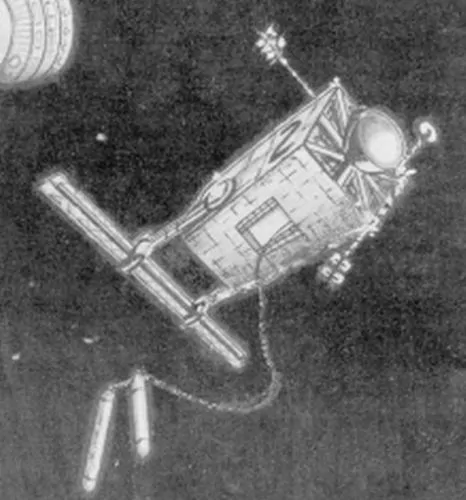
An equipment failure near Barnard’s Star would become known on Earth only years after it occurred. Any instructions sent in response would arrive after another prolonged interval, potentially overtaken by changes aboard the spacecraft. Engineers could continue to offer advice, but the vehicle would need to manage urgent problems while that exchange proceeded. T. J. Grant’s studies of computing and maintenance addressed this interval between recognizing a difficulty and receiving outside assistance. Their central concern was the authority and competence required aboard a machine expected to remain operational through circumstances its designers could anticipate only imperfectly. Decisions ordinarily shared among spacecraft controllers and specialists on the ground would have to be made within the departing vehicle’s own computational and mechanical resources.
Grant organized those responsibilities through a hierarchy of computing functions. Routine control required rapid responses to known conditions, while supervision involved interpreting the state of equipment and deciding how its operation should change. Scientific work introduced further demands because observations could reveal circumstances that required adjustment of an earlier plan. These activities depended on representations of the spacecraft and its surroundings that the computers could use in selecting actions. A stored instruction sequence could handle a predictable transition, but an unfamiliar malfunction might require the system to compare possible explanations before choosing an intervention. Greater processing capacity could assist that reasoning without establishing whether the available information supported a reliable diagnosis. Later analysis by Andreas Hein and Stephen Baxter usefully distinguishes the breadth of tasks assigned to an autonomous system from its performance within specific tasks. Applied to Daedalus, that distinction directs attention toward what the proposed computers had to understand about a changing spacecraft, alongside estimates of their speed and storage capacity. The difficult cases lay where incomplete observations had to support decisions with impacts extending beyond the component immediately under examination.
Reliability calculations made maintenance a material concern as well as a computational one. Providing duplicate equipment could preserve a function after an initial failure, but a mission lasting decades might consume successive replacements. Under the assumptions used in his analysis, Grant estimated that a replacement-based approach could require approximately 739 metric tons of spares, exceeding the spacecraft’s assigned 450-metric-ton payload. That figure described an alternative investigated during the study, rather than the inventory ultimately adopted. The preferred strategy sought to recover defective equipment and return it to service, reducing the need to carry enough replacements for every projected failure. Repair and replacement could operate together. An available spare might restore a function promptly while the removed unit underwent work elsewhere. This arrangement made the replenishment of usable components part of the spacecraft’s continuing operation.
Two mobile maintenance robots, designated “wardens,” supplied the physical means for carrying out that work. Equipped with manipulators and tools, they would move to equipment requiring attention and interact with repair facilities and replacement stores. Their responsibilities extended from locating a defective component to establishing whether an intervention had restored its useful function. Grant anticipated cases in which access itself would require planning, especially when a component had never previously failed or the surrounding equipment no longer matched its original arrangement. The wardens would need information about the ship’s current physical condition, including changes introduced by earlier work. Manipulation also brought requirements that an abstract repair plan could leave unresolved, such as controlling contact forces and securing a part while disconnecting it. Local discretion was built into the proposal, with the main computer retaining authority to override a warden’s actions. Such an organization would need coordination between immediate maintenance activities and the vehicle’s broader operating priorities. A repair that consumed scarce resources or interrupted another essential function could affect the mission even when the intervention succeeded at its immediate task.
Grant illustrated this problem through a proposed response to a cracked structural member. Welding a reinforcing plate over the damaged area might restore strength while obstructing access to equipment behind it. A subsequent failure could then require a different route through the structure or a revision of the original repair. The computers would have to consider those later results when choosing how to address the crack, connecting a local physical alteration to future maintenance requirements. Software describing accessible components and permissible movements would also need to reflect the changed arrangement. The example gave adaptive behavior a concrete engineering meaning. Accumulated repairs could transform the conditions under which the next repair had to be planned.
Contemporary robotics provides a useful comparison for assessing the scale of that expectation. At the Stanford Research Institute, the Shakey project of 1966–1972 had brought perception, planning, and movement together in a mobile experimental machine. Shakey could reason about a goal and select actions within an environment containing simple objects and obstacles, demonstrating an advance beyond the execution of a fixed movement sequence. Participant histories describe the considerable work required to connect symbolic descriptions of that environment with physical actions. These achievements offered grounds for investigating more capable robots, while their controlled surroundings bounded what had been demonstrated.
Daedalus assigned its wardens unfamiliar defects in machinery whose condition could deteriorate and whose arrangement could change through their own interventions. The challenge included recognizing relevant features despite damage, then applying tools successfully to equipment whose continued operation mattered to other systems. Smaller computers and improved sensors could contribute to that effort, but the resulting machine would still require evaluation as an integrated repair system. The comparison locates Grant’s proposal within an active research field while preserving the considerable distance between experimental planning and the maintenance duties specified for the starship.
A near-contemporary response made that distance explicit. NASA’s Advanced Automation for Space Missions, published in 1982, identified Daedalus’s machine-intelligence controller and adaptive repair capabilities among the technologies its designers expected from subsequent decades. Its discussion connected interstellar ambitions to demonstrations within the Solar System, including a proposed program of autonomous exploration at Titan. This approach supplied an intermediate setting in which machines could encounter unexpected conditions while their performance remained more accessible to investigation. For repair, meaningful demonstrations would need to examine how a system handled uncertain diagnoses and assessed the results of its own actions. Success on a selected set of faults would also need to be related to the range of failures assumed in the mission’s reliability calculations. A further complication concerned the maintenance system itself, since damaged sensors or computing equipment could corrupt the information used to judge another component. Grant’s proposal placed a demanding obligation on the spacecraft’s internal checks; they had to provide grounds for trusting an intervention even when parts of the machinery responsible for observing and evaluating it might also be deteriorating.
Decades of Travel, a Brief Encounter: Designing the Science
At the proposed cruising velocity, Daedalus would cover the average distance between Earth and the Sun in approximately sixty-eight minutes. That scale made the duration of an “encounter” dependent on the observation being attempted. A passage through an extended stellar environment could support measurements over a substantial interval, while a close approach to a planet compressed the opportunity for detailed investigation into a much shorter period. For observations made within distances comparable to a planetary radius, the useful interval could fall below a second. G. M. Webb’s payload study addressed the resulting problem of distributing scientific work across the journey and among separate observing platforms. The observing program had to make those different opportunities productive while accommodating the geometry imposed by the spacecraft’s motion.
Scientific operations would begin long before arrival. Instruments traveling between the stars could measure the surrounding material directly, establishing how its properties changed along the route. Observations of particles and magnetic fields offered information that astronomical measurements from the Solar System could obtain only indirectly or integrate across a much longer line of sight. Repeated sampling would give the crossing a spatial record, relating measurements to successive positions rather than treating interstellar space as a uniform background. Yet the vehicle itself could disturb the conditions being measured through electromagnetic interference or the release of material. The original study contemplated placing some experiments well away from the main spacecraft, including using mobile auxiliary vehicles to carry observing equipment. Such arrangements made separation from the vehicle part of the experiment’s design. The cruise program also provided a scientific return that did not depend on finding a particular kind of planet at the destination. Its investigations concerned the physical environment through which Daedalus traveled, with their value emerging from observations accumulated across the crossing.
The changing vantage point also offered possibilities for astronomy. Webb identified distance measurement using the long baseline between the traveling spacecraft and the Solar System as a cruise-phase objective. Comparing apparent positions from widely separated locations could extend the geometry available for determining distances to astronomical objects. The magnitude of the benefit would depend on the direction of the baseline relative to each object, together with knowledge of the spacecraft’s position and the precision of its instruments. These requirements connected navigation and calibration to the scientific interpretation of observations. They also gave the onboard telescopes potential work beyond preparing for the destination, although their comparative value would remain subject to developments in astronomical instrumentation elsewhere.
Approach observations would gradually turn the payload toward the immediate requirements of exploring Barnard’s Star and its possible companions. Two proposed five-meter optical reflectors would search for planets and help establish their orbits, supplying information needed to direct the encounter program. Discovery alone would provide an incomplete basis for interception. Successive observations would be required to determine where a moving target would be when a probe reached it. The same approach could support increasingly detailed investigation of the star, whose emitted light and surrounding environment offered questions independent of the presence of planets. Instrument selection had to accommodate several purposes within the available resources. The payload allocation included the equipment supporting scientific operations as well as the observing instruments themselves, so its quoted mass cannot be read as an inventory of detectors and telescopes alone. Webb’s analysis treated those supporting requirements as a substantial part of the provision for science. Crawford’s later work on the Icarus payload retained this distinction, emphasizing the additional equipment needed to deploy scientific probes and receive their results. The observing program depended on that supporting machinery throughout the approach and passage.
Separate probes offered a means of reaching targets away from the main vehicle’s path. A near-contemporary account described provision for up to eighteen instrumented subprobes, allowing investigations to be distributed among selected objects and trajectories. Their release would create a set of encounters with geometries different from that of the carrier spacecraft. An early maneuver could accumulate a substantial lateral displacement over the remaining travel time, making deployment timing important even when the available velocity change was modest. Early commitment also required sufficient confidence in a target’s predicted position, while later observations might identify opportunities that had not justified a probe assignment beforehand. The observing plan involved a continuing relationship between improved orbital information and the resources still available for interception. Subprobe propulsion expanded the area that could be examined, but the close approaches would still occur at very high relative velocities.
One illustrated encounter sequence made the coordination of these operations concrete. For a hypothetical planet with two satellites, the study set out preparations that included releasing inert material and chemical tracers, followed by active investigation using radar and laser techniques. Smaller deployable instruments would contribute observations while the larger probe continued through its assigned passage. Controlled releases introduced material whose subsequent behavior could be observed, adding an experimental intervention to measurements of naturally occurring conditions. Interpreting the response would require a dependable account of where and when that material had been released. The scenario was an exercise in organizing mutually supporting observations around an assumed planetary arrangement, giving the payload proposal a sequence of operations against which timing and equipment requirements could be examined.
Closest approach placed stringent demands on the acquisition of evidence. As a probe passed a nearby object, the direction toward that object would change rapidly, requiring its instruments to track the target or obtain useful measurements within a restricted field of view. Short exposures could reduce image motion but also limited the light collected, making detector performance and pointing accuracy important to the resolution actually achieved. Different instruments would have different preferred observing conditions, potentially creating competition within the most valuable interval. Their measurements then had to be preserved with enough information about the probe’s trajectory and instrument state to support interpretation. The main vehicle was intended to collect transmissions from the subprobes, process their records, and retain the resulting information for subsequent communication to Earth. That arrangement connected the local observing schedule to the opportunities for transferring data between moving spacecraft. A probe could successfully acquire a measurement yet contribute little to the mission if its record failed to reach the carrier. Designing the science included defining how observations would survive beyond the brief physical circumstances that made them possible.
The contemporary history of planetary exploration supplied good reasons to value such opportunities. During Mariner 10’s Mercury encounter in March 1974, magnetic measurements revealed a magnetosphere-like region and supported a preliminary interpretation that the planet possessed an intrinsic magnetic field. A passing spacecraft could provide evidence with major implications for planetary interiors. Daedalus nevertheless raised a more demanding question about what its much faster encounters could establish, especially after allowing for decades of improvement in observations from the Solar System. In his later assessment, Crawford argued that the scientific case had to compare a rapid flyby with the knowledge likely to be obtainable without dispatching an interstellar vehicle.
Detailed mapping and repeated observations of changing conditions would remain difficult within the short close-approach interval, while evidence of potentially habitable conditions would leave much about any biology unresolved. The design’s scientific scope was strongest where a trajectory supplied direct measurements or a viewing geometry unavailable from home. Its success would have depended on selecting questions that those passing observations could answer decisively, while preserving a clear account of the uncertainties they left behind.
Bringing the Results Home: Communication and the Human Lifetime
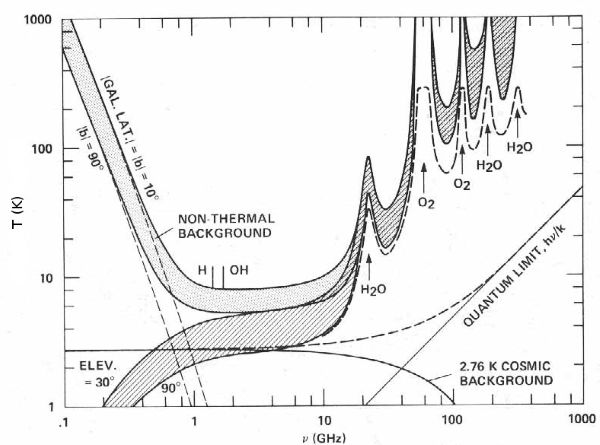
A. T. Lawton and P. P. Wright’s communications design gave the second-stage fusion chamber another purpose after its propulsive work had ended. Its approximately forty-meter structure would serve as the spacecraft’s transmitting antenna, directing microwave signals toward the Solar System. The proposed system operated at about 2.6 gigahertz, with a radio-frequency output of one megawatt and a calculated maximum transmission rate of 864,000 bits per second under the assumed receiving conditions. These specifications described a substantial communications installation whose mass could be accommodated partly by assigning successive functions to the same structure. That arrangement also connected the performance of systems often considered separately. A chamber that had completed its propulsion duties still had to retain the geometry and electrical characteristics required for radio transmission. Producing the microwave output would require continued electrical generation, while directing it home demanded a functioning attitude-control system. The end of acceleration changed the requirements placed upon major components without necessarily ending their contribution to the mission. The communications proposal extended the useful life of the propulsion structure into the period when scientific information became the vehicle’s principal export.
The receiving installation was an equally consequential part of the scheme. Even a directed radio beam spreads as it travels, leaving a receiver several light-years away able to intercept only a small fraction of the transmitted energy. Whether that fraction could support useful communication depended on collecting area, receiver sensitivity, background noise, and the rate at which information was sent. Lawton and Wright considered a Solar System Receiving Station, which might be situated on Earth or in space nearby. Their discussion drew upon Project Cyclops, the earlier American investigation of a large antenna array for detecting extraterrestrial intelligence. Published in 1972, the Cyclops report examined antenna systems, signal processing, search strategies, and the resources required for a sustained listening program. Its relevance to Daedalus arose from the shared technical problem of extracting intelligible information from extremely weak electromagnetic signals. The comparison also linked two approaches to interstellar investigation that could otherwise appear separate, the search for transmissions from other civilizations and the reception of measurements from humanity’s own spacecraft. Nevertheless, citing Cyclops supplied a design precedent rather than an existing receiving capability. The Daedalus authors allowed for construction of the receiving station during the outward journey and anticipated that large arrays might also develop for other purposes. This distributed the required construction across different periods, while making the eventual scientific return dependent on facilities outside the departing vehicle. The quoted transmission rate belonged to an assumed combination of spacecraft and receiver; evaluating either end alone could not establish the performance of the complete connection.
Signal travel time imposed a separate limit that greater transmitting power could not remove. Information sent from the vicinity of Barnard’s Star would require approximately six years to reach Earth, irrespective of how quickly successive bits left the antenna. On the study’s approximate fifty-year flight schedule, observations transmitted near closest approach would become available around fifty-six years after departure. Measurements sent during the crossing could arrive earlier, so this calculation should not be mistaken for a period without scientific returns. Nor would the first encounter transmission necessarily contain the complete record. Receiving the full collection would take longer, according to the volume retained aboard and the duration of subsequent broadcasting.
The vehicle’s continued movement made that broadcasting period an operating phase with its own changing conditions. After passing the target, Daedalus would keep increasing its distance from the receiving station, progressively weakening the signal available to a fixed receiving system. Maintaining a given rate would become more demanding unless improvements at the receiving end compensated for the growing separation. Reducing the rate could improve the prospects of recovering information from a weaker transmission, but would extend the time needed to deliver a specified quantity of observations. This created a further connection between the scientific program and the communications design. The value of an observation depended partly on whether sufficient transmitting capacity remained to convey it. A reasonable implication is that scheduling the downlink would require priorities among records, rather than treating every measurement as equally urgent. Valuable observations might warrant additional protection against transmission errors, although that requirement should not be confused with evidence that the 1978 study had validated a complete modern coding system. Storage, power, thermal regulation, antenna alignment, and the transmitter would all have to remain serviceable throughout the selected transmission period. Once a signal had been emitted successfully, its journey to Earth no longer depended on the spacecraft’s survival. A final transmission could still be traveling through interstellar space years after the equipment that produced it had ceased operating. The useful service life of the vehicle and the period of reception on Earth had different endpoints.
The phrase “within a human lifetime” becomes more precise when these endpoints are distinguished. Departure, closest approach, reception of the principal observations, and completion of their analysis would occur at different dates. Relativistic time dilation offered little relief at the proposed cruising speed. At approximately twelve percent of light speed, the difference between elapsed time aboard the spacecraft and in the Solar System would remain below one percent during uniform cruise. The people awaiting the results would experience essentially the full outward journey followed by the additional signal delay. A researcher aged twenty-five at departure, for example, would be approximately eighty-one when encounter signals first arrived under the rounded fifty-plus-six-year schedule. That illustration is an arithmetic consequence of the proposal, rather than evidence that every participant could expect to witness its principal discoveries.
Institutional succession was part of the route by which observations would become scientific knowledge. Stephen Baxter’s later examination of mission longevity for Project Icarus explicitly considered the impacts of technological and cultural change for an interstellar spacecraft’s relationship with its ground support. That discussion concerned a successor study with potentially longer durations, but it provides a useful retrospective question for Daedalus. What would receiving organizations have to preserve while their own equipment and personnel changed? Applied to the 1978 proposal, the answer includes knowledge of the spacecraft’s signal formats, operating conventions, and design assumptions, alongside the physical capacity to detect its transmissions. Replacement computers on Earth could become vastly more capable while still needing to interpret messages generated by equipment whose underlying design had been fixed decades earlier. Scientists joining the project late in the crossing would also need access to the reasoning behind decisions that the original investigators had made before departure. These are implications of the proposed schedule, rather than evidence that the study supplied a comprehensive plan for maintaining such continuity. The receiving system could be renewed, expanded, and reorganized during the flight, provided that the connection to the distant vehicle remained intelligible. In this respect, the long duration created an opportunity unavailable aboard the spacecraft. Substantial parts of the supporting apparatus could improve while the mission was already underway. Realizing that advantage required a succession of people able to preserve compatibility while revising their own methods. The human achievement envisaged by Daedalus would extend beyond the investigators who selected its instruments to those who eventually received, checked, and interpreted their records.
Who Could Undertake It?
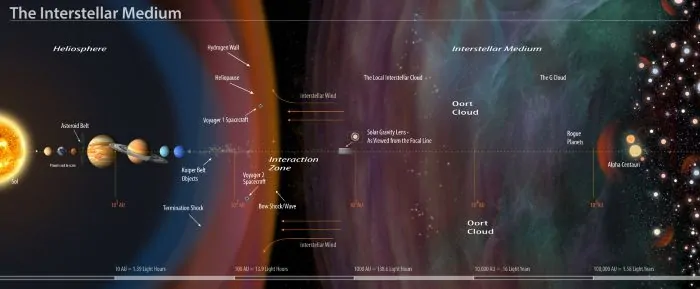
Parkinson addressed the financing of interstellar flight before the Daedalus group completed its vehicle design. His 1974 paper, “The Starship as an Exercise in Economics,” approached the problem through a model of society’s capacity to support exceptionally expensive manufactured products. One of its significant conclusions concerned the difference between increasing total economic output and raising real income per person. Within the model, the latter offered a more effective basis for financing advanced technological undertakings. A larger economy would not necessarily possess proportionately greater resources available for discretionary projects if its expansion also brought increased demands upon production. Parkinson associated the capacity to construct an interstellar vehicle with extensive prior experience in interplanetary flight, bringing accumulated technical knowledge into the economic argument. His analysis concerned the characteristics of a prospective sponsoring society, rather than simply the amount of money that a government might announce for a spectacular undertaking. The distinction matters because the study’s imagined prosperity represented productive capabilities and experience that expenditure alone could not immediately create.
Establishing a price for Daedalus would also have required deciding where the project’s accounts began. The vehicle’s material requirements could be estimated more directly than the financial burden of supplying them in an economy whose principal supporting industries remained hypothetical. If interplanetary transportation and large-scale extraterrestrial resource extraction already served substantial markets, an interstellar mission might purchase their products while bearing only a portion of the costs that had established those industries. If those activities developed principally to supply the mission, much more of their expense would belong to its preparation. The same spacecraft could appear as either a demanding customer within an established industrial system or the reason for creating an extensive new productive apparatus. This accounting distinction follows from the report’s assumptions; it cannot be resolved by multiplying the mass of the proposed vehicle by a contemporary price for aerospace hardware. Such arithmetic would leave unanswered how much development was required before components could be manufactured reliably, and what facilities had to be built specifically for their production and testing. Nor would an estimate of construction expenditure alone capture the complete commitment, which included preparation well before departure and continued operations afterward. A defensible financial assessment would have needed to state which capabilities were inherited, which were developed for Daedalus, and how their costs were distributed among other users.
Contemporary European space planning illustrates the institutional work concealed within any general appeal to scientific ambition. During the years of the Daedalus study, the European Space Research Organisation and its successor, the European Space Agency, were selecting missions under substantial financial constraints. The science allocation established in the 1971 agreement remained restricted in real terms even as demand for more ambitious projects increased. European participation in NASA’s Space Telescope received approval in 1976, followed in 1977 by the joint Out-of-Ecliptic mission. These decisions emerged through advisory committees, technical studies, and negotiations over available resources. They provide a contemporary comparison for the responsibilities that an eventual Daedalus sponsor would have faced. Agreement on exploration’s general importance still required procedures for choosing investigations and accepting their financial obligations.
Bond and Martin’s introductory account connected extensive interplanetary activity with the achievement of “reasonable political stability.” That expectation deserves examination as a historical assumption about development. Productive expansion might make a costly mission easier to supply, but it did not establish who would control the resulting resources or how competing claims upon them would be settled. The historical geographer Oliver Tristan Dunnett places the proposal within a broader culture that imagined humanity extending an economy of extraction and consumption across the Solar System. His interpretation draws attention to the political content of an environment that the engineering calculations could otherwise make appear simply available for use.
The envisioned industrial future required decisions about ownership and access, even though the report did not specify the institutions through which those decisions would be made. Its reference to a community extending across the Solar System should not be converted into a detailed constitutional proposal or a demonstrated requirement for world government. Several forms of organization might conceivably coordinate such an undertaking, with different arrangements for authority and the distribution of benefits. The evidence supports identifying a presumption of sufficient cooperation to sustain the project, while leaving the organization of that cooperation largely unresolved.
Scientific support would likewise have depended on comparison with other uses of the same resources. A community capable of constructing Daedalus might also possess the means to undertake a substantial program of observatories and investigations within the Solar System. Choosing the interstellar mission would require assessing what its expected discoveries justified foregoing elsewhere. Concentrating resources in a single vehicle introduced a problem of risk. A failure affecting the principal spacecraft could compromise several investigations together, whereas a program distributed among independent missions could retain substantial value after an individual loss. The significance of that difference would depend on the uniqueness of the observations Daedalus could obtain and the alternatives available when a funding decision arose. Those alternatives could change during the period required to prepare an interstellar expedition. A persuasive scientific case would need periodic reassessment as knowledge developed, rather than resting indefinitely on the importance assigned to the destination in the 1970s. This is an implication of the proposal’s long preparation and operating periods, rather than evidence that a contemporary agency formally ranked Daedalus against a specified package of competing missions.
The possibility of useful technological advances offered an additional rationale for preparatory research. Improvements in fusion systems or robotic maintenance could have applications beyond a specific stellar expedition, giving organizations with different interests reasons to support some of the same work. Those prospective benefits nevertheless required assessment in their own right, including whether the proposed development route served other users effectively. Research valuable to an energy program, for example, would not automatically establish the merits of the eventual spacecraft. Claims about wider benefits could strengthen stages of development while leaving the justification for construction open to further judgment.
The mission profile itself envisaged an extensive program of engineering mockups and flight-test vehicles before the final probe was assembled. That provision suggests an undertaking whose institutional demands would change substantially as it progressed. Early research could involve relatively limited commitments, while integrated demonstrations would require organizations willing to accept much greater expense and responsibility. Each stage would produce evidence that could alter the next decision, including whether the original objectives remained worth pursuing. Later work for Project Icarus by Andreas M. Hein, Andreas C. Tziolas, and Richard Osborne explicitly investigated the different interests whose support might sustain an interstellar program, treating scientific and political motivations as matters requiring analysis. Their approach helps identify what the Daedalus social scenario left comparatively general. Possessing the requisite industrial capacity would still leave the practical task of assembling support for expenditures. Participants might favor a preliminary technology program for reasons that did not extend to financing a departure for Barnard’s Star. Successful experiments would create opportunities to continue, while also giving sponsors grounds to revise the mission or redirect its technologies. An interstellar expedition would have to survive those successive decisions, earning renewed commitment as its costs and prospects became better understood.
Publishing a Starship: The 1978 Report and Its Afterlife
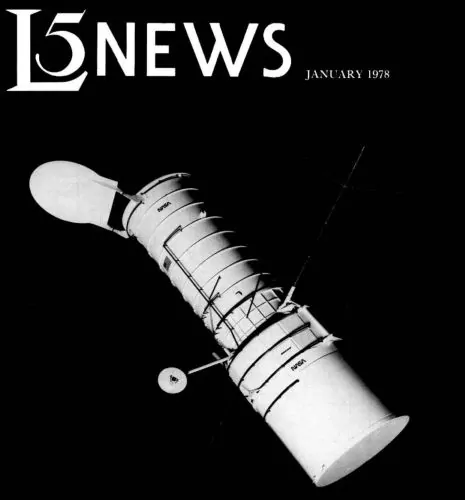
The January 1978 issue of L5 News offered readers an opportunity to reserve the forthcoming Daedalus report for eight dollars, including postage. The British Interplanetary Society’s advertisement anticipated publication in April and urged advance orders because available funds would permit only a limited printing. Appearing in an American organization’s newsletter, the notice placed the British study within a wider network of readers interested in space development. The completed publication, Project Daedalus: The Final Report on the BIS Starship Study, appeared as a supplement to volume 31 of the Journal of the British Interplanetary Society, extending to 192 pages. Its publication preserved the work in a form that could circulate beyond the meetings and correspondence through which the design had developed. Individually attributed contributions allowed readers to identify responsibility for calculations and pursue disagreements at the level of specific assumptions. The collected format also made relationships between those contributions available for examination. A reader could investigate whether requirements established in one part of the study were adequately accommodated elsewhere. Publication gave the project a durable identity while retaining evidence of the separate investigations from which it had been assembled.
Television supplied a different means of presenting that identity. Nigel Calder’s 1978 BBC2 series Spaceships of the Mind featured Daedalus in its third installment, “Seeding the Universe,” including an interview with Bond. Drawing on production records, Dunnett describes how the visual-effects designer and BIS member Mat Irvine constructed a model following consultation with Bond. Painted astronomical scenery and a simulated stellar background placed the recognizable vehicle within an imagined journey. Such techniques made the design comprehensible through its overall appearance and movement, allowing viewers to encounter a coherent spacecraft without working through the report’s calculations. Bond also situated the probe within the much longer prospect of humanity spreading beyond the Solar System, giving the immediate scientific mission a place in a narrative of eventual settlement. That enlarged interpretation mattered because the report’s uncrewed expedition could now represent ambitions extending far beyond its own payload or destination. The broadcast’s historical significance lies partly in this translation between forms. Engineering specifications supplied the object, while television production established the setting through which a broader audience could imagine its significance.
The original investigators continued to assess their achievement after publication. In “Project Daedalus Reviewed,” published in 1986, Bond and Martin returned to the study and discussed work undertaken since its completion. Their retrospective judgment was that it had made a “reasonably convincing case” for the feasibility of interstellar probes, wording that preserved an element of qualification. The report had become an identifiable reference against which subsequent arguments could be situated. Its continued usefulness depended partly on that fixed historical position. Later investigators could establish which conclusions belonged to the original study and which arose from further analysis.
A more organized return began with Project Icarus, introduced at the BIS symposium “Daedalus after 30 years” on September 30, 2009. Its founding paper proposed a successor design study that would use Daedalus as the starting point for an improved interstellar vehicle. The relationship was deliberately comparative, retaining a principally fusion-powered scientific probe while reopening important mission requirements. Icarus allowed a journey lasting up to a century and called for some deceleration to extend the encounter, creating room to reconsider the balance between transit time and investigation at the destination. This did not necessarily require the complete spacecraft to enter orbit; the introductory discussion included the possibility of slowing detached probes while the main vehicle continued onward. Those proposals reveal how an inherited design could structure inquiry without determining every later decision. They also complicate any straightforward account of technical improvement. A successor mission with a longer permitted duration and different encounter objectives would have to be evaluated against those revised requirements, rather than judged solely by whether it exceeded the earlier vehicle’s speed. The Icarus authors identified direct comparison with Daedalus and the assessment of propulsion maturity among their purposes, alongside encouraging another generation of designers. Through this reuse, the 1978 publication became material for a new research exercise whose participants could explain precisely where their questions departed from those of their predecessors.
That inheritance included detailed criticism of the original machinery. In a 2013 contribution to the Icarus study, J. R. French questioned whether disturbances produced by one fusion detonation could interfere with the magnetic conditions needed to focus the electron beams for the next. The objection concerned the interaction between successive events, making the proposed engine’s rapid repetition a problem that could not be assessed through an isolated ignition calculation. French also raised concerns about target delivery and timing, together with the possibility of damaging mechanical oscillations in the engine structure. These were arguments about unresolved behavior, rather than results from operating a Daedalus propulsion system. Their appearance within the successor project demonstrates that an acknowledged intellectual debt could accommodate substantial disagreement about the earlier design. The published specifications supplied enough detail to identify mechanisms requiring further investigation and to consider whether different approaches should replace them. The report’s afterlife cannot be measured simply by counting favorable references or noting the persistence of its name. Following its use across later studies reveals a more informative history of selected requirements being retained and solutions being challenged. Daedalus remained useful because subsequent authors could return to a documented design and make their departures from it explicit.
Did Daedalus Need to Be Buildable to Succeed?
The following video from SciShow Space is an overview of Project Daedalus:
Judging Daedalus principally by whether its proposed spacecraft could have been constructed risks imposing the wrong standard upon the investigation. The study examined a prospective technological undertaking whose supporting circumstances were explicitly projected beyond those of the 1970s. Bond and Martin’s account of a future industrial community made that distance part of the argument, rather than an omission that later criticism needed to uncover. A contemporary reader could accept the project’s exploratory purpose without believing that construction should begin immediately. Writing in Electronics Today International in November 1979, Phil Cohen described its function as providing a framework for further studies, distinguishing that undertaking from completely designing an executable mission. His interpretation supplies evidence that this understanding was available close to the report’s publication. From that perspective, repeatedly emphasizing unavailable technologies could obscure the intended contribution: investigating a difficult possibility before the capabilities necessary to realize it had matured. The relevant historical question would concern the quality of that investigation and the knowledge it generated.
The strongest version of this objection gives analytical design work substantial authority of its own. Construction cannot be the only means of learning about a proposed machine, since decisions about whether construction merits consideration necessarily depend on earlier reasoning. A sufficiently developed calculation can reveal that a requirement is exceptionally demanding or that changing one objective would substantially alter the resources needed to achieve it. Such findings remain informative even when the configuration under examination is subsequently abandoned. Daedalus also made a broad assertion about interstellar travel answerable through specific engineering objections. Someone maintaining that useful stellar exploration was categorically impossible could be asked to identify where the proposed relationships failed, rather than relying upon the apparent enormity of the distance. That did not make the study a conclusive counterexample to every impossibility argument, but it increased the precision expected of the discussion. Furthermore, discovering that an essential mechanism could not perform as assumed would itself constitute a meaningful result of pursuing the design. The investigation’s value could survive the rejection of its proposed spacecraft. On this reading, demanding confidence in eventual construction before recognizing an achievement would exclude precisely the exploratory reasoning through which an initially uncertain subject becomes susceptible to technical assessment.
Scholarship on unrealized space missions supports a broader understanding of such achievements. Lisa Messeri and Janet Vertesi’s 2015 study of Mars Sample Return and Terrestrial Planet Finder examined how anticipated missions organized scientific communities despite their repeated deferral. They argued that a shared destination for future work could shape present research and professional commitments before the proposed mission flew. Their cases concerned NASA projects, and applying that interpretation to Daedalus requires an explicit comparison rather than treating their findings as research on the BIS. Dunnett makes that connection in his discussion of the future-oriented practices surrounding Daedalus. The resulting interpretation assigns historical significance to the work undertaken around an anticipated spacecraft, including activity that would remain significant if its design never reached construction.
That defense nevertheless requires limits because Daedalus sought to establish something about feasibility. Its objectives cannot be reduced retrospectively to stimulating discussion whenever a technical claim proves difficult to sustain. A proposal’s capacity to organize research establishes an effect upon a community; evaluating the adequacy of its engineering conclusions requires examining the evidence supporting them. The same distinction applies to conditional calculations. Establishing the impacts of an assumed engine performance can be valuable while leaving the attainability of that performance unresolved. The condition becomes troublesome when it is treated as a result, or when every objection is answered by extending the technological capacities assigned to the future. Under those circumstances, the investigation would become difficult to challenge because its supporting society could always be granted whatever additional capability the design required. A shared reference design can also direct attention so effectively that alternatives receive less consideration, making influence an uncertain measure of intellectual benefit. These concerns strengthen the case for judging exploratory studies through the clarity of their assumptions and their responsiveness to adverse findings. They also preserve the importance of the original feasibility question. Producing an influential research agenda would not, by itself, answer it.
Daedalus’s unbuilt status should carry little weight as evidence against its success as an investigation, because completing a spacecraft was never the activity the study group undertook. Its analytical findings deserve assessment individually, according to what their reasoning established and how strongly they depended on unresolved premises. A later objection to one mechanism need not invalidate every relationship examined elsewhere in the study, although a sufficiently important objection could undermine confidence in the complete vehicle. This approach grants preliminary engineering work a legitimate capacity to produce knowledge while retaining demanding standards for claims about system performance. It also allows a proposal to succeed through identifying a difficulty that defeats its preferred solution, provided that the difficulty remains visible in the resulting account. Daedalus warrants recognition for substantive inquiry whose historical achievement does not depend on a future replica departing for Barnard’s Star. The extent to which its spacecraft could actually have fulfilled the proposed mission remains a further question, requiring evidence that intellectual productivity alone cannot supply.
Conclusion: What an Unbuilt Starship Made Knowable
The Daedalus investigation gave substance to a question that distance alone could neither answer nor dismiss. Between 1973 and 1978, its participants examined what would follow from attempting to obtain scientific observations near another star within approximately half a century. Their chosen mission connected the duration of the journey to decisions about what investigators could expect to learn upon arrival. The high-speed encounter illustrates the result. Preserving a short transit meant accepting restricted opportunities for observation, with substantial responsibility assigned to instruments operating beyond timely direction from Earth. That relationship made scientific ambition part of the engineering problem from the outset. The proposed probe embodied a selection among possible purposes, each carrying different demands upon the vehicle and its supporting resources. Its specifications allowed those demands to be examined in relation to one another, giving subsequent discussion a more exact basis than a general judgment about whether the stars were accessible.
The resulting account also exposed how much depended on circumstances that the study could describe more confidently than it could establish. Its propulsion calculations required an operating system whose repeated performance had yet to be achieved, while the mission’s dependence on autonomous maintenance extended beyond the capabilities demonstrated by contemporary robots. These uncertainties affected confidence in the complete expedition even where individual calculations rested on familiar physical principles. Beyond the vehicle, the proposed fuel supply assumed substantial industrial activity across the Solar System, bringing the anticipated development of an economy into the explanation of a spacecraft. That economy would still need institutions willing to allocate resources to stellar investigation and people prepared to sustain the scientific undertaking. Returning information added another measure of duration to a mission commonly characterized by its outward travel time. These dependencies prevent a satisfactory assessment from ending at the moment the probe reaches its destination. They also show why the report’s social expectations deserve examination alongside its technical assumptions. The future community imagined by the designers helped determine which resource demands appeared reasonable, and which configuration could be presented as a credible prospect.
The counterpoint requires that these qualifications be weighed without making eventual construction the sole measure of achievement. Exploratory design can produce reliable understanding of relationships even when confidence in the proposed machine remains incomplete. Daedalus deserves credit for the reasoning that withstands examination, including findings that might help explain why a preferred solution should be changed or abandoned. Its failure to become a flight program does not settle the quality of that reasoning. Equally, the research it encouraged cannot settle whether the vehicle would have performed as specified. A fair assessment must accommodate substantial intellectual accomplishment alongside unresolved engineering claims, without allowing either judgment to erase the other.
Placed in the history of exploration, Daedalus draws attention to the work required to define a journey before undertaking it. Voyager’s exploration of the outer Solar System and its later measurements beyond the heliosphere supplied observations of environments that spacecraft actually reached; the BIS investigation considered the additional commitments involved in making another stellar system the destination of a deliberate scientific mission. Their relationship clarifies the scale of the question while establishing no inevitable sequence from one achievement to the other. Daedalus’s historical significance includes the expectations through which its designers approached that question. Confidence in future industrial expansion accompanied demanding limits on how long investigators should wait for results. Those expectations shaped the proposed expedition as decisively as the choice of propulsion. What the study made knowable was how a specified ambition generated obligations extending from preparation to the reception of observations, and where evidence remained insufficient to support confidence in their fulfillment. That was a substantive result of the 1973–1978 inquiry. The journey itself remained dependent on turning those obligations into capabilities, with each consequential assumption still answerable to further investigation.
Bibliography
Affiliate disclosure: Amazon links on this site are paid links. As an Amazon Associate I earn from qualifying purchases.
- Baxter, Stephen. “Project Icarus: The Challenges of Mission Longevity.” Journal of the British Interplanetary Society 63:11-12 (2010), 426–433.
- Bennett, Gary L. “Travel to the Stars.” American Scientist 99:3 (2011), 181.
- Bond, Alan, and Anthony R. Martin. “Project Daedalus: The Mission Profile.” Journal of the British Interplanetary Society, supplement (1978), S37–S42.
- —-. “Project Daedalus Reviewed.” Journal of the British Interplanetary Society 39 (1986), 385–390.
- British Interplanetary Society. “Project Daedalus Report.” L5 News 3, no. 1 (January 1978): 13.
- Bussard, Robert W. “Galactic Matter and Interstellar Flight.” Astronautica Acta 6 (1960), 179–194.
- Crawford, Ian A. “The Astronomical, Astrobiological and Planetary Science Case for Interstellar Spaceflight.” Journal of the British Interplanetary Society 62:11-12 (2009), 415–421.
- —-. “Project Icarus: Preliminary Thoughts on the Selection of Probes and Instruments for an Icarus-style Interstellar Mission.” Journal of the British Interplanetary Society 69 (2016), 4–10.
- —-. “Project Icarus: A Review of Local Interstellar Medium Properties of Relevance for Space Missions to the Nearest Stars.” Acta Astronautica 68:7–8 (2011), 691–699.
- Davies, John I. “The Interstellar Downlink: Principles and Current Work.” Principium, 31 (November 2020), 28–41.
- Dunnett, Oliver Tristan. Earth, Cosmos and Culture: Geographies of Outer Space in Britain, 1900–2020. Abingdon: Routledge, 2021.
- —-. “Geopolitical Cultures of Outer Space: The British Interplanetary Society, 1933–1965.” Geopolitics 22:2 (2017), 452–473.
- Dyson, Freeman J. “Interstellar Transport.” Physics Today 21:10 (1968), 41–45.
- Freitas, Robert A., Jr. “A Self-Reproducing Interstellar Probe.” Journal of the British Interplanetary Society 33 (1980), 251–264.
- Freitas, Robert A., Jr., and William P. Gilbreath, eds. Advanced Automation for Space Missions. NASA Conference Publication 2255. Washington, DC: National Aeronautics and Space Administration, 1982.
- Gatewood, George, and Heinrich Eichhorn. “An Unsuccessful Search for a Planetary Companion of Barnard’s Star (BD +4°3561).” Astronomical Journal 78 (1973), 769–776.
- Gilster, Paul. “Autonomy and the Interstellar Probe.” Centauri Dreams, March 19, 2013.
- Grant, T. J. “Project Daedalus: The Computers.” In Project Daedalus: The Final Report on the BIS Starship Study, edited by A. R. Martin, S130–S142. London: British Interplanetary Society, 1978.
- —-. “Project Daedalus: The Need for On-Board Repair.” In Project Daedalus: The Final Report on the BIS Starship Study, edited by A. R. Martin, S172–S179. London: British Interplanetary Society, 1978.
- Graubard, Stephen R. “’Dædalus’: Forty Years On.” Daedalus 128 (1999), 1-112.
- Hart, Michael H. “An Explanation for the Absence of Extraterrestrials on Earth.” Quarterly Journal of the Royal Astronomical Society 16 (1975), 128–135.
- Hein, Andreas M., and Stephen Baxter. “Artificial Intelligence for Interstellar Travel.” Journal of the British Interplanetary Society 72:4 (2019), 125–143.
- Heintz, W. D. “Systematic Trends in the Motions of Suspected Stellar Companions.” Monthly Notices of the Royal Astronomical Society 175 (1976), 533–535.
- Hershey, John L. “Astrometric Analysis of the Field of AC +65°6955 from Plates Taken with the Sproul 24-inch Refractor.” Astronomical Journal 78 (1973), 421–425.
- Krige, John, Arturo Russo, and Lorenza Sebesta. A History of the European Space Agency, 1958–1987. Vol. 2, The Story of ESA, 1973 to 1987. ESA SP-1235. Noordwijk: ESA Publications Division, 2000.
- Kuipers, Benjamin, et.al. “Shakey: From Conception to History.” AI Magazine 38:1 (2017), 88–103.
- Lindl, John D. Inertial Confinement Fusion: The Quest for Ignition and Energy Gain Using Indirect Drive. New York: Springer, 1998.
- Long, Kelvin F. Deep Space Propulsion: A Roadmap to Interstellar Flight. New York: Springer, 2012.
- Long, Kelvin. F., et.al. “Project Icarus: Son of Daedalus—Flying Closer to Another Star.” Journal of the British Interplanetary Society 62, nos. 11–12 (2009): 403–14.
- Long, Kelvin. F., and R. K. Obousy. Project Icarus: Project Programme Document. May 12, 2010.
- Long, Kelvin. F., R. K. Obousy, and A. Hein. “Project Icarus: Optimisation of Nuclear Fusion Propulsion for Interstellar Missions.” Acta Astronautica 68 (2011), 1820–1829.
- Martin, Anthony R. “The Origin of the ‘Fermi Paradox.’” Journal of the British Interplanetary Society 71 (2018), 200–206.
- —-, ed. Project Daedalus: The Final Report on the BIS Starship Study. London: British Interplanetary Society, 1978.
- Messeri, Lisa, and Janet Vertesi. “The Greatest Missions Never Flown: Anticipatory Discourse and the ‘Projectory’ in Technological Communities.” Technology and Culture 56:1 (January 2015), 54–85.
- National Aeronautics and Space Administration. “Interstellar Mission.” NASA Science. Accessed October 20, 2026.
- Ness, N. F., et.al. “Magnetic Field Observations near Mercury: Preliminary Results from Mariner 10.” Science 185:4146 (1974), 151–160.
- Nuckolls, John, et.al. “Laser Compression of Matter to Super-High Densities: Thermonuclear (CTR) Applications.” Nature 239 (1972), 139–142.
- Obousy, Richard. “Project Icarus: A Technical Review of the Daedalus Propulsion Configuration and Some Engineering Considerations for the Icarus Vehicle.” Presentation at the Advanced Space Propulsion Workshop, 2010.
- Oliver, Bernard M., and John Billingham, eds. Project Cyclops: A Design Study of a System for Detecting Extraterrestrial Intelligent Life. NASA CR-114445. Moffett Field, CA: NASA Ames Research Center, 1972.
- Palaszewski, Bryan. Atmospheric Mining in the Outer Solar System: Resource Capturing, Exploration, and Exploitation. NASA/TM–2015–218096. Cleveland, OH: NASA Glenn Research Center, 2015.
- Parfitt, J. A., and A. C. A. White. “Project Daedalus: Structural Material Selection.” Journal of the British Interplanetary Society 31, special supplement (1978), S97–S103.
- Parkinson, Bob, ed. Interplanetary: A History of the British Interplanetary Society. London: British Interplanetary Society, 2008.
- Parkinson, R. C. “Project Daedalus: Propellant Acquisition Techniques.” In Project Daedalus: The Final Report on the BIS Starship Study, edited by A. R. Martin, S83–S89. London: British Interplanetary Society, 1978.
- Tribbe, Matthew D. No Requiem for the Space Age: The Apollo Moon Landings and American Culture. New York: Oxford University Press, 2014.
- van de Kamp, Peter. “Alternate Dynamical Analysis of Barnard’s Star.” Astronomical Journal 74 (1969), 757–759.
- —-. “Astrometric Study of Barnard’s Star from Plates Taken with the 24-inch Sproul Refractor.” Astronomical Journal 68 (1963), 515–521.
- von Hoerner, Sebastian. “The General Limits of Space Travel.” Science 137:3523 (1962), 18-23.
- Webb, G. M. “Project Daedalus: Some Principles for the Design of a Payload for a Stellar Flyby Mission.” Journal of the British Interplanetary Society 31, special supplement (1978), S149–S161.
- Wenz, John. The Lost Planets: Peter van de Kamp and the Vanishing Exoplanets around Barnard’s Star. Cambridge, MA: MIT Press, 2019.
- White, A. C. A., and J. A. Parfitt. “Project Daedalus: The Structure.” Journal of the British Interplanetary Society 31, special supplement (1978), S104–S115.
- Winterberg, Friedwardt. “Rocket Propulsion by Thermonuclear Micro-Bombs Ignited with Intense Relativistic Electron Beams.” Raumfahrtforschung 15 (1971), 208–217.
Originally published by Brewminate, 10.23.2026, under the terms of a Creative Commons Attribution-NonCommercial-NoDerivatives 4.0 International license.
About the Author