Project Mohole aimed to reach Earth’s mantle. Its cancellation in 1966 exposed disputes over scientific priorities, even as its experimental work helped shape the future of ocean drilling.

By Matthew A. McIntosh
Public Historian
Brewminate
Introduction: Basalt from Beneath the Pacific
In the spring of 1961, a drill suspended from the vessel CUSS I penetrated the seabed near Guadalupe Island, off the Pacific coast of Mexico, and brought samples of the oceanic crust to the surface. The deepest hole at the Guadalupe site extended approximately 183 meters beneath a seafloor lying some 3,570 meters below the ship. Those measurements described different accomplishments. Reaching the bottom required controlling equipment through an immense water column, while advancing beneath it demanded successful drilling through sediments and into basalt. The recovered rock belonged to the crust, and the mantle remained far below. Nevertheless, the operation established that an unanchored vessel could maintain its position sufficiently well to drill and retrieve geological material in deep ocean water. It was an experimental achievement with implications extending beyond the specimens themselves. Project Mohole had demonstrated a means of investigating environments that previously lay beyond the reach of sustained scientific drilling, while leaving unresolved the much greater difficulty of penetrating the crust completely.
Presidential recognition followed quickly. On April 8, 1961, John F. Kennedy congratulated the institutions and personnel responsible, presenting their accomplishment as a source of national pride and an achievement of publicly supported basic research. Mohole’s origins preceded Sputnik’s launch in October 1957, but its development unfolded amid heightened expectations of what American science and engineering could accomplish. The comparison with space exploration gave ocean drilling a readily understood public significance. A project directed downward could participate in the same culture of exploration that made distant destinations demonstrations of national capability.
The scientific case for reaching the mantle required more than an appealing analogy. Seismologists had identified the Mohorovičić discontinuity through changes in the behavior of earthquake waves, establishing a major boundary within Earth without physically traversing it. Drilling promised to connect such measurements with rocks recovered from known positions, allowing researchers to investigate the material basis of a structure already supported by substantial indirect evidence. The attraction lay in bringing different kinds of observation into a closer relationship. Yet that ambition did not dictate a single research program. Scientists could reasonably disagree about whether the most productive next step was one exceptionally deep penetration or a geographically distributed series of shallower holes. Sedimentary cores offered evidence about the history of ocean basins and could provide useful results while drilling capabilities developed. Concentrating resources on a mantle hole promised a distinctive achievement, but it also risked making the program dependent on solving difficult engineering problems before securing much of its anticipated scientific return. As Mohole expanded, disagreement over those alternatives became inseparable from questions about who would determine its priorities and how an experimental undertaking should be managed.
Between its conception in 1957 and the termination of further congressional funding in 1966, Mohole exposed the difficulties of making an inaccessible scientific environment the destination of a major federal project. Its history shows how commitment to a conspicuous objective could advance faster than agreement about the steps required to reach it. Scientific divisions affected the project’s direction, while uncertain engineering requirements complicated estimates of its eventual cost and duration. Administrative decisions and political relationships shaped how those difficulties were handled, but doubts about feasibility also gave criticism substantive force. Cancellation demands an assessment of the undertaking that supporters were asking the government to continue, alongside the decisions that had weakened confidence in it. The development of scientific ocean drilling beyond Mohole, already taking shape before its demise, further complicates the meaning of failure. The mantle objective was abandoned, while techniques and competing research possibilities continued to attract support. Understanding that divergence reveals how the pursuit of physical access could transform Earth science even when the destination that first attracted attention remained unreached.
The Mantle before the Drill: Evidence from an Inaccessible Earth
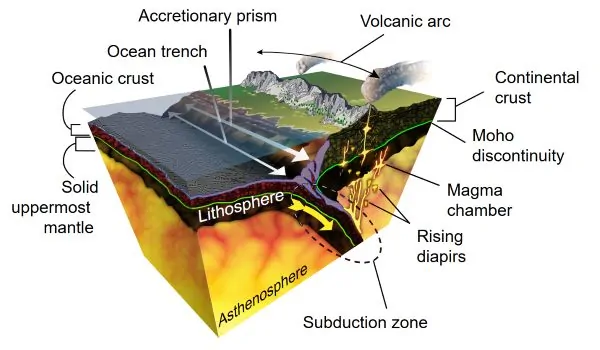
The earthquake that struck the Kupa Valley south of Zagreb on October 8, 1909, supplied Andrija Mohorovičić with evidence of a boundary deep beneath the surface. Comparing recordings from stations at different distances, he identified arrivals that could not be satisfactorily explained by waves traveling through an Earth whose properties changed only gradually downward. Some seismic energy had followed a deeper route through material in which it traveled faster, allowing it to overtake waves confined to shallower levels despite covering a greater distance. The relationship between arrival time and distance contained information about structures that no observer could inspect directly. In his analysis, published in 1910, Mohorovičić inferred a pronounced increase in seismic velocity at depth, subsequently associated with the division between crust and mantle. Later investigations established that the boundary bearing his name occurred beneath widely separated regions, although its depth varied considerably. By the time Mohole was proposed, the discontinuity belonged to an extensive body of measurements whose interpretation had developed over several decades.
Identifying the rocks responsible required a further investigation. Seismic velocity depends on a material’s elastic properties as well as its density, and neither quantity translates automatically into a unique chemical composition. Francis Birch’s experiments on rock specimens under pressures reaching ten kilobars helped establish the comparisons necessary to relate laboratory materials to conditions inferred underground. These measurements also demonstrated why surface observations required correction. Cracks and other features could affect a specimen’s behavior differently as pressure increased. Geophysicists evaluated candidate materials through experiments that constrained interpretation without reproducing every condition prevailing inside Earth.
Among the explanations under discussion was the possibility that the Moho separated rocks with substantially different bulk compositions. In an oceanic setting, this could mean basaltic or gabbroic material above a mantle rich in peridotite, an assemblage dominated by minerals containing abundant magnesium and iron. Another interpretation located the decisive change in the mineral structures produced by pressure. John F. Lovering argued in 1958 that basaltic material might become an assemblage represented by eclogite, producing different physical properties without requiring a comparably large change in overall chemistry. Such a transformation involved the formation of different minerals within solid rock; it did not imply that the crust rested on an ocean of liquid magma. The hypothesis also carried significance for understanding vertical movements of Earth’s surface, because changes in the depth of a transformation could alter the distribution of dense material. Edward C. Bullard and David T. Griggs challenged the explanation in 1961, questioning whether it could account for the observed relationship between heat flow and boundary depth. They also doubted that a rock containing several chemical components would transform across a sufficiently narrow interval to explain the sharp seismic discontinuity. The disagreement made the proposed drilling scientifically consequential. A recovered succession might disclose whether a velocity change coincided with different chemical constituents or with the reorganization of broadly similar material.
Geologists already possessed specimens that could plausibly have originated below the discontinuity. Peridotitic inclusions enclosed within volcanic rocks offered possible fragments of deeper material carried upward during eruptions. Harry H. Hess’s 1954 discussion of oceanic crust explicitly treated such inclusions as evidence bearing on the composition beneath the Moho. Their existence qualified any claim that drilling would provide humanity’s first encounter with rock from the mantle. What remained difficult was establishing the original setting of certain specimens and their relationship to the larger structures inferred geophysically. An inclusion transported in magma had become detached from the surrounding rocks that might explain its position, while alteration could complicate the interpretation of material exposed at the surface. Laboratory examination could determine what a specimen contained, but reconstructing where it had formed and how it had arrived required additional reasoning. The scientific advantage of a borehole lay partly in preserving relationships among successive rock units that isolated fragments could not supply.
Marine seismic surveys gave this investigation a promising geographical setting. Measurements across ocean basins indicated a crust substantially thinner than that beneath the continents, making the distance through rock appear comparatively manageable. Russell W. Raitt’s 1956 study of the central equatorial Pacific reported an average crustal thickness of approximately 6.31 kilometers for stations characteristic of the deep basin, while also identifying thicker structures elsewhere. Such results discouraged treating the ocean floor as a submerged continuation of familiar continental geology. They also gave a numerical basis for estimating how much drilling an attempt on the mantle might require. Yet a section reconstructed from seismic velocities remained a physical model whose rock units had to be inferred, and its apparent simplicity could conceal variation within those units. A boundary at roughly the same depth across numerous profiles did not establish that every intervening layer consisted of identical material or had formed through the same processes. Selecting an oceanic target meant choosing a location where existing measurements made a geological interpretation sufficiently plausible to warrant an unusually demanding test. These questions developed while the history of the ocean basins remained unsettled. Continental drift had advocates, but the integrated explanation later supplied by plate tectonics had not been established when Mohole took shape in 1957. Whether oceanic structures were enduring features or products of processes capable of creating and replacing seabed affected how researchers understood the rocks they hoped to recover. Even a successful penetration across the Moho would have answered those questions only partially, since the significance of its specimens would depend on comparisons with other regions and with experimental results. A local chemical boundary could not establish that every seismic discontinuity elsewhere had the same origin. Mohole’s geological rationale included a task extending beyond the recovery of unfamiliar material. Researchers needed to determine how observations from one narrow passage through the crust could improve their interpretation of an Earth already investigated on a much larger scale.
An Informal Proposal Becomes a Federal Undertaking, 1957–1960
Walter Munk encountered the opportunity to propose mantle drilling while participating in the machinery through which federal research support was distributed. Accounts of Mohole’s beginnings place the decisive discussion around a March 1957 meeting of the National Science Foundation’s Earth Sciences review panel, where Munk and Hess considered whether the field should attempt something more ambitious than the projects before them. Their recollections emphasized dissatisfaction with the scale of conventional proposals and the possibility of organizing an investigation whose demands exceeded the resources of an individual researcher. These accounts differ in detail, and their presentation of a sudden inspiration should be read as participants’ reconstructions rather than a transcript of the occasion. Nevertheless, the institutional setting matters. The proposal emerged among scientists already advising the government about research priorities, with access to colleagues who could evaluate its prospects and help secure support. Munk and Hess were well placed to bring an unconventional undertaking into discussions where federal money and professional judgment already met.
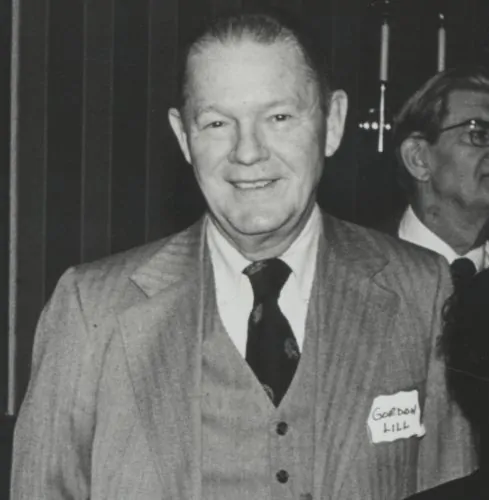
The group that adopted the idea possessed an unusually informal identity. The American Miscellaneous Society, generally abbreviated AMSOC, had developed in 1952 around Gordon Lill and colleagues associated with the Office of Naval Research, taking its name from proposals that resisted convenient classification. Its subsequent activities depended on personal contacts rather than the permanent organization suggested by the word “society,” and an April 1957 breakfast at Munk’s La Jolla home became a remembered occasion in Mohole’s early history. The informality allowed established researchers to entertain a difficult proposal without first obtaining a place for it within an existing institution’s research program.
Federal financing required a more definite administrative home. In April 1958, the AMSOC committee, chaired by Lill, became a recognized unit within the National Research Council’s Division of Earth Sciences, bringing the undertaking under the National Academy of Sciences. This arrangement connected the group’s initiative to an organization capable of accepting responsibility for a grant. NSF supplied $15,000 in June for a feasibility study, beginning with a limited investigation of what the proposed drilling would entail. The Academy–Research Council supplied the institutional base, while committee members contributed the expertise through which the project’s objectives and practical requirements would be examined. These were distinct responsibilities. Receiving public funds through the Academy did not turn AMSOC into an operating office of the Foundation. Nor did the initial award constitute approval of every expenditure that mantle drilling might eventually require. Its immediate significance was to finance preparatory work and give that work an accountable organizational setting. The Foundation’s willingness to consider Mohole belonged to a broader expansion of federally supported geophysics. NSF’s responsibility for American participation in the International Geophysical Year of 1957–1958 had already required coordination across disciplinary boundaries and support for research conducted far from ordinary laboratories. Oceanographers also brought experience acquired through longstanding relationships with naval research programs, which had helped sustain vessels and specialized instruments. Mohole could draw on capabilities accumulated for purposes broader than the drilling proposal itself. Experience coordinating a collection of investigations did not settle how the Foundation should oversee an undertaking increasingly dependent on the development of expensive equipment. The agency’s familiar relationship with investigators receiving research grants provided a starting point, but the growing proposal required decisions about obligations extending beyond the work of any one scientific institution.
Much of the practical coordination fell to Willard Bascom, who became AMSOC’s executive secretary in 1958 while employed by the Academy and subsequently directed the technical work. His position differed from that of committee members whose contributions had to fit around their principal appointments; he could devote sustained attention to the preparations needed between meetings. By 1959, the committee’s advisory work was organized around drilling techniques, site selection, and scientific objectives and measurements. These divisions made the undertaking easier to examine, although their subjects remained closely connected. A proposed measurement could create an equipment requirement, while a limitation of available machinery could change the choice of location. An additional NSF award of $80,500 to the Academy–Research Council in fiscal year 1959–1960 supported expanded feasibility investigations, including examination of surveys from Lamont and Woods Hole and assessment of existing drilling vessels. The work considered CUSS I and other industrial craft as possible resources for preliminary operations, placing commercial experience alongside academic advice. Bascom’s article in Scientific American in April 1959 also gave the developing undertaking its memorable public name, Mohole, while explaining its objectives and proposed means to a wider readership.
The committee’s 1959 report, Drilling Thru the Earth’s Crust, gave the preliminary investigation a formal statement of purpose and feasibility. It treated existing marine drilling vessels as useful for testing, allowing the program to advance without first constructing the equipment envisioned for the complete attempt. By 1960, preparations involved a more immediate decision than selecting every component of a future mantle-drilling system. The participants needed to establish what an experimental operation at sea could accomplish. Academy sponsorship and successive Foundation grants had made it possible to carry that question beyond discussion among interested colleagues. Responsibility for the next stage would now include organizing paid technical work and obtaining access to industrial facilities, adding operational commitments to the advisory relationships through which Mohole had begun.
Making Industrial Equipment Do Scientific Work
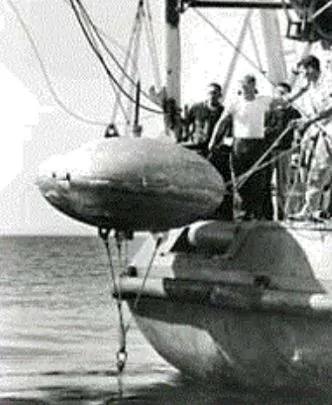
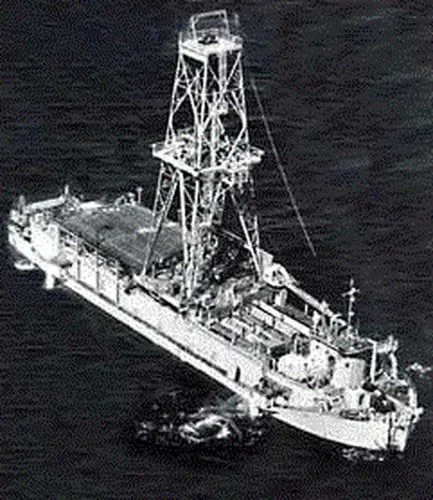
The initials in CUSS I preserved the vessel’s industrial ancestry: Continental, Union, Shell, and Superior, the oil companies associated with its development for offshore drilling. Converted from a former Navy barge, it carried a derrick over an opening through the hull, allowing the drill pipe to descend near the vessel’s center rather than over its side. This arrangement offered advantages in managing the movements of a floating rig, but it had been developed for operating conditions substantially different from those Mohole would impose. Petroleum exploration supplied machinery and accumulated operating experience that the research program could adapt. It also supplied knowledge of geological sampling, since commercial drilling already employed cores to investigate underground formations. Mohole’s distinctive requirement was to extend these practices into much deeper water while obtaining material suitable for questions unrelated to the discovery of a productive reservoir. The modifications involved decisions about which industrial procedures could be retained and where the proposed investigation required a different approach.
One major departure concerned the conduit connecting a conventional offshore well to the vessel. A marine riser provides a return route for circulating drilling fluid and cuttings, adding equipment that must be supported and managed through the water column. Mohole’s experimental operations proceeded without that enclosing connection, simplifying what hung beneath the ship while limiting the circulation and well-control arrangements available. Riserless drilling still required fluid circulation through the drill pipe, and it did not exclude the use of casing within or near the hole. Its suitability depended on the geological target and the specific operations planned.
Four steerable Harbormaster propulsion units gave CUSS I a means of resisting displacement without anchoring the vessel to the seabed. Position information came from reference buoys, using radar and acoustic observations to indicate where the barge lay relative to the drilling location. Operators at a central console could adjust the propellers to counter movement caused by wind and currents. This manually controlled arrangement required someone to interpret the observations and apply corrective thrust; it did not possess the automatic control associated with later dynamically positioned drillships. Nor did successful positioning mean that the hull remained motionless at one mathematically exact point. The acceptable operating area depended on the angle and bending stresses that the suspended pipe could tolerate, and currents could make an offset position preferable to a location directly over the borehole. Positioning accuracy and drill-string behavior had to be considered together. The operator needed information about the ship’s movement, but engineers also had to determine how much movement the equipment beneath it could accommodate. A navigation problem became part of the mechanical design of the drilling system, with human judgment connecting the observations to the propellers.
Bending presented an immediate danger where the pipe passed through the vessel. A long drill string suspended in open water lacked the continuous lateral support that the walls of a borehole would provide over an equivalent distance underground. Rolling or lateral displacement could concentrate curvature near the ship, placing excessive stress on a short section of pipe. The experimental installation addressed this problem with a downward-flaring guide shoe, approximately forty feet long, whose broadening shape spread the bend over a greater distance. Its function was to control the pipe’s curvature as the barge moved, reducing the risk created by an abrupt change in direction at the hull. Flexible casing near the seabed addressed a related problem at the lower point of entry. These devices required calculations of the loads and deformations that existing pipe could withstand under an unfamiliar arrangement of support. Adapting industrial components involved reconsidering their behavior as parts of a much longer suspended system.
Vertical movement remained a separate difficulty. Propellers that corrected lateral drift could not remove the rise and fall of the vessel in waves, while a guide shoe controlled bending without isolating the bit from longitudinal motion. Engineers accordingly investigated how oscillations would travel through the string and affect its contact with the bottom. The load at the cutting face mattered because effective drilling required pressure sufficient to cut rock without subjecting the equipment to destructive impacts. Horizontal control of the barge left another set of motions to be analyzed and managed during drilling.
Recovering a useful specimen imposed requirements beyond advancing the bit. Coring equipment had to cut around a central cylinder of material, retain it, and deliver it to the deck with enough of its original character preserved for examination. Wireline methods allowed an inner core barrel to be raised through the drill pipe, reducing the need to withdraw the entire string whenever a sample was recovered. This saved work in handling long lengths of pipe, although replacing a worn bit or dealing with certain failures still required more extensive withdrawal. The choice of coring apparatus also depended on the material being penetrated. A procedure appropriate for firm rock could damage soft sediment or fail to retain it. Scientific personnel needed records distinguishing the interval drilled from the amount actually recovered, since an incomplete core could otherwise give a misleading impression of the succession underground. Handling after retrieval deserved comparable attention. The project’s equipment included a special device for cutting sediment-core liners without the vibration produced by ordinary sawing, protecting material intended for measurements of sediment strength. Such provisions brought experimental requirements into apparently minor operations on deck. A specimen’s usefulness depended partly on what happened to it between leaving the seabed and reaching the person who would analyze it.
The resulting workplace relied on expertise distributed across the ship. Mechanics maintained equipment whose reliability affected both drilling and sample recovery, while roughnecks handled pipe and the associated machinery under conditions requiring practiced coordination. Seamen operated the vessel and its supporting systems, and scientists determined what observations and specimens the investigation required. The technical report’s acknowledgments explicitly included these workers, together with the cooks who sustained the shipboard complement. Their contributions reveal how much practical work stood between a research objective and a specimen available for study. A scientific request had to be translated into an operation that the drilling crew could perform, while a mechanical limitation could require the research staff to change its immediate plans. Bascom’s technical organization occupied this shared working environment, where decisions about machinery and evidence continually affected one another. The forthcoming trials would test the equipment through the coordinated actions of people responsible for keeping a vessel working at sea.
The 1961 Trials: Demonstration and Remaining Uncertainty
At 2:06 a.m. on March 9, 1961, the drill bit descending from CUSS I reached the bottom of the San Diego Trough in 3,111 feet of water. The vessel had departed for the La Jolla tests two days earlier, beginning an experimental sequence in which the first location served as preparation for operations farther offshore. Its relatively accessible position allowed the participants to examine equipment behavior before committing the expedition to much deeper water near Guadalupe Island. Five preliminary holes were drilled during the following week, providing opportunities to observe how the assembled machinery performed under working conditions. The deepest penetration reached 1,035 feet beneath the seabed, considerably farther into the bottom than the expedition would subsequently advance at Guadalupe. That comparison matters because the two locations tested different combinations of water depth and geological conditions. Progress through soft strata offshore California could provide experience without reproducing the demands of drilling through a substantial thickness of oceanic basalt.
La Jolla also exposed difficulties that a penetration figure alone would conceal. At the deepest stage, three attempts to retrieve the core barrel proved unsuccessful, according to the expedition’s technical narrative. Advancing the hole had produced a situation in which the next necessary operation could not be completed as intended. The episode brought retrieval procedures into the assessment of performance. An apparatus capable of reaching a specified depth still had to permit the repeated recovery of samples and the continuation of work afterward.
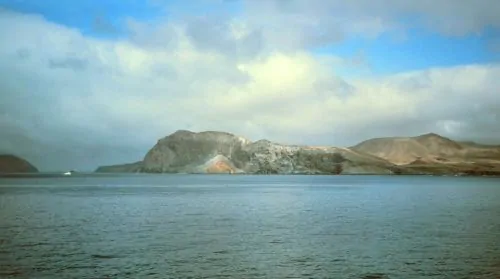
The bit first reached the Guadalupe seafloor on March 28, beneath approximately 11,700 feet of water. This move placed the experiment in a deep-ocean setting where the suspended equipment had to function across a water column almost four times that encountered off La Jolla. Operations proceeded through several nearby holes, allowing different attempts and recovered intervals to contribute to the investigation of the site. The distinction between a drilling campaign and one uninterrupted borehole is important here. Difficulties in a hole could lead to another attempt, while observations from separate penetrations might be compared to reconstruct the local succession. Such flexibility suited an exploratory trial whose objectives included learning how to work in an unfamiliar setting. It also meant that the resulting geological account had to be assembled from records whose completeness and reliability varied, rather than read from a single continuous cylinder extending downward from the sediment surface.
Bascom’s contemporary telegram placed the passage into basalt at 4:00 p.m. on April 1, in a hole begun the previous evening. Above the rock lay gray-green clay identified as Miocene in age, giving the recovery an immediate stratigraphic setting. The deepest Guadalupe hole eventually reached approximately 183 meters, including about 170 meters of sediment and thirteen meters of basalt. These were penetration measurements, not the lengths of an unbroken sequence delivered to the deck. Nevertheless, obtaining solid volcanic rock beneath the sedimentary cover gave the expedition a result that could be examined petrographically and chemically. Its significance rested on the ability to investigate material reached by drilling beneath a deep-ocean site, with observations of the surrounding succession available to inform its interpretation.
The relationship between the sediment and basalt required caution. Identifying volcanic rock did not establish that the drill had entered the upper surface of an immense, uniformly basaltic foundation extending beneath the entire region. A basalt body could occupy a more complicated position within a sedimentary succession, and the scientific account considered whether sediment might occur beneath an upper basalt layer. Drilling complications prevented that possibility from being resolved securely. Fragments recovered with the basalt also raised questions about their original position, since material displaced during operations could enter a sample without preserving its former relationship to the rock. Microfossils in the clay supplied evidence for dating the sediment, but that age could not simply be transferred to every volcanic fragment recovered nearby. Celeste G. Engel and A. E. J. Engel’s examination of the basalt belonged to a continuing investigation of its composition and significance. The expedition had obtained geological evidence whose interpretation required the same attention to alternative explanations that had motivated drilling in the first place. Recovery narrowed some uncertainties while introducing detailed questions that the preliminary holes could not settle.
Attempts to make measurements within the holes produced a similarly uneven record. Instruments offered a way to investigate conditions that would change when material was brought aboard, making downhole observations a necessary complement to the specimens. But geophones lowered into the borehole encountered noise transmitted from the ship through the drill pipe, preventing the intended sensitive measurements. Other logging and measurement work yielded information, so the geophone problem should be treated as a specific limitation within a broader experimental program. It showed that placing an instrument beneath the seabed did not automatically separate its signal from the activities of the platform supporting it.
Laboratory investigations extended the scientific work after the vessel’s operations ended. The initial publications distinguished drilling performance from coring and logging, making the expedition available for examination through several kinds of technical record. Subsequent studies pursued questions that the simple announcement of basalt recovery could scarcely encompass. K. J. Murata and R. C. Erd, for example, analyzed thirty-four sediment samples chemically and mineralogically, investigating variations in the constituents accumulated at the Guadalupe site. Such work could relate the recovered deposits to processes of marine sedimentation, while physical-property studies examined characteristics relevant to understanding how sediments behaved. These investigations depended on careful selection and comparison of material whose disturbance and incomplete recovery had to remain visible in the analysis. Their results gave the experimental campaign a scientific output distinct from its demonstration of drilling capability. Evaluating the expedition requires attention to the research undertaken with its specimens, alongside the performance of the vessel and equipment.
Experimental drilling concluded on April 12, leaving a body of observations from which proposals for further work could be developed. Edward E. Horton’s published operational assessment explicitly conditioned its broader conclusions on the assumption that future locations would present environmental conditions resembling those encountered at Guadalupe. That qualification limited how readily experience at the test site could justify confidence elsewhere. Sustaining work through kilometers of hard rock would expose equipment to demands that the comparatively short basalt penetration had scarcely begun to test, while a different environment could alter the operating conditions already examined. The trials supplied practical grounds for proceeding, but decisions about the next stage still required estimates of performance under circumstances extending well beyond the expedition’s observations.
Presenting Inner Space to the Nation
Lill and Arthur E. Maxwell’s 1959 presentation of Mohole placed geological research within a contest over the uses of national wealth. Comparisons with rockets and atomic weapons made the anticipated cost of drilling appear modest beside expenditures the government already accepted for other purposes. The argument sought recognition for a field whose most important objects of investigation could be difficult to display, even when their significance was substantial. AMSOC’s declaration that the ocean’s bottom deserved attention comparable to the Moon’s far side supplied a memorable expression of that claim. Its humor made the comparison accessible while asserting that the earth sciences should receive a larger share of public interest and federal support. Inner space could be presented as an exciting destination close to home, offering discoveries about the planet on which the money was being spent. Advocates could borrow the appeal of space exploration while questioning the distribution of attention that had made such borrowing useful. Their publicity connected disciplinary ambitions to a vocabulary already prominent in American political life.
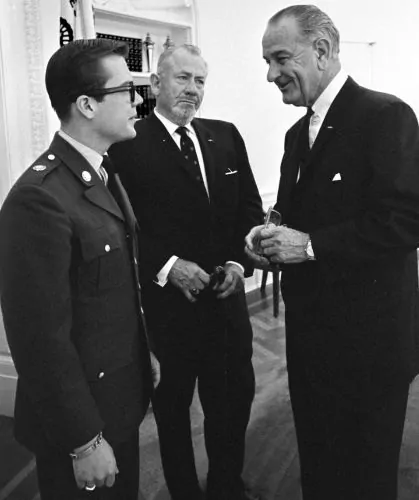
John Steinbeck’s presence aboard CUSS I gave that presentation an eyewitness narrator familiar to readers far beyond professional science. His account appeared in Life on April 14, 1961, accompanied by Fritz Goro’s photographs, under the headline “High Drama of Bold Thrust through Ocean Floor.” The novelist and photographer could show an undertaking that would otherwise have reached most readers through diagrams or reports of measurements made far below the sea. Pictures of the vessel and people examining recovered material gave the expedition a visible setting, while Steinbeck’s participation supplied a recognizable observer through whom readers could approach its unfamiliar work. His longstanding engagement with marine life and scientific inquiry also gave the assignment a connection to interests extending beyond the immediate news event. The magazine presented the recovery as preparation for the larger Mohole objective, organizing a limited experiment within a story whose most impactful episode still lay ahead. Steinbeck’s criticism of lavish attention to space reinforced the case for investigating the oceans. Yet the presentation also exposed a difficulty inherent in communicating the project. The tangible material available for photographs came from the preliminary operations, while the destination giving those operations their larger public significance remained beyond reach.
Kennedy’s congratulatory message supplied a different kind of authority. Its wording recognized the achieved penetration into volcanic formations and praised Americans for supporting basic scientific exploration, without claiming that mantle drilling had already become practicable. The president also named the Academy, NSF, and Global Marine alongside those working aboard the expedition’s vessels, giving public recognition to the collaboration behind the result. This was an endorsement of an accomplishment and of the research activity that had produced it. It did not specify how much the government should subsequently spend or commit Congress to financing the complete undertaking.
International comparisons gave Mohole another route into public discussion, although the underlying relationships were more complicated than a straightforward race. At the International Union of Geodesy and Geophysics meeting in Toronto in September 1957, a resolution supported investigation of the possibilities and costs of reaching the mantle, while a Soviet participant announced interest in a comparable undertaking. The setting brought cooperation and rivalry into the same conversation. Scientists could regard a problem as internationally important while also considering which country might solve it first. Subsequent reports of Soviet drilling intentions strengthened the competitive interpretation available to American advocates. Such reports require attention to what was actually being proposed. Deep drilling from land into continental crust could be ambitious and scientifically valuable without reproducing Mohole’s attempt to cross thin oceanic crust from a floating platform. Nevertheless, both could be described as advances into inner space, making technically different programs appear comparable as demonstrations of national capability. The analogy created urgency more readily than it established equivalent objectives.
The June–July 1963 issue of Saudi Aramco World illustrates how an anticipated achievement could become the organizing scene of popular explanation. Its unsigned article, “The Secrets of Inner Space,” opened by imagining researchers clustered around a newly recovered mantle specimen, then acknowledged that the episode belonged to a hoped-for future. This was a forecast presented through the conventions of an eyewitness scene, inviting readers to picture the moment before it existed. The account went on to recognize substantial technical hazards and projected completion in 1967, combining descriptions of unresolved problems with a confident account of the knowledge the final sample might yield. Its appearance also shows why Mohole’s public reputation should not be reduced to a simple progression from enthusiasm to ridicule. Promotional coverage continued while criticism was developing elsewhere. Different publications could emphasize different aspects of the undertaking, and an account sympathetic to the objective could describe difficulty as part of its attraction. These presentations gave Mohole several public meanings without establishing one settled basis for supporting it. A novelist’s account could invite curiosity about the oceans, while an official statement could affirm the value of publicly financed research. Competitive comparisons offered a further justification, especially to audiences concerned with American standing. David K. van Keuren’s history places the undertaking within NSF’s effort to establish leadership in oceanography, showing how publicity also served institutional purposes. The resulting visibility could help advocates explain why the project merited attention, but it supplied no reliable measure of agreement about its scientific priorities. A reader persuaded that Earth’s interior deserved investigation had not necessarily endorsed the concentration of resources on one mantle penetration. As the program developed, its supporters would have to connect the compelling destination they had publicized to a research plan that could retain scientific and political backing.
One Deep Hole or Many Cores? A Disagreement about Scientific Value
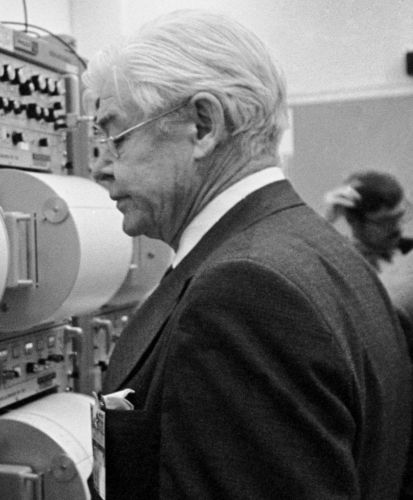
Maurice Ewing’s preference for drilling at numerous locations accompanied Mohole from its early planning. As director of Lamont Geological Observatory, he approached the proposed undertaking with questions that extended across ocean basins. How old were their floors, what lay beneath their sedimentary deposits, and how reliably did seismic interpretations describe that buried material? He recommended penetrating the sediment cover at several sites before attempting the much greater descent to the mantle. Such operations would provide experience with drilling in deep water while producing geological information that had value independently of the final penetration. Existing marine cores had already supported important research, but longer sections reaching underlying rock promised access to intervals beyond the reach of conventional sampling. Ewing’s proposal assigned preliminary drilling two purposes whose relationship would remain contentious. It could prepare equipment and personnel for the ultimate attempt, and it could sustain a geographically extensive investigation with its own criteria of success.
The surprisingly thin sediment cover of much of the deep ocean gave this alternative considerable explanatory importance. If ocean basins had persisted through immense spans of geological time, their relatively modest accumulations required an account of deposition, preservation, and removal. Longer cores could help distinguish changes in sediment supply from interruptions in accumulation, while fossils within successive layers could establish a chronology against which those processes might be assessed. Comparisons among locations would reveal whether a sequence represented a regional development or circumstances peculiar to one place. These questions also acquired new significance as explanations of ocean-basin formation changed during the project’s lifetime. In his 1962 “History of Ocean Basins,” Hess proposed the continuing creation and eventual removal of ocean floor, predicting young sediments near ridge crests and older deposits farther away. He drew on the Guadalupe drilling when considering sedimentation rates, demonstrating that a leading advocate of mantle penetration also recognized the importance of evidence obtained well above that destination. His argument made geographically distributed observations potentially decisive for evaluating a changing ocean floor. Researchers could disagree about his explanation while sharing an interest in the measurements needed to assess it; support for extensive coring did not require agreement on a single geological theory.
Penetrating to the mantle nevertheless offered an investigation that additional sediment cores could not reproduce. Its distinctive promise lay in examining the succession of materials across a boundary identified through geophysical measurements. A collection of shallower holes might become exceptionally informative about basin development while leaving that relationship unresolved. Judging the competing programs required attention to the importance of the questions answered, alongside the quantity and geographical range of the samples recovered. Scientific value could favor an unusually demanding observation if it established a cause-and-effect relationship unavailable through more numerous, accessible measurements.
Hollis D. Hedberg gave the case for an intermediate program a forceful formulation. A petroleum geologist associated with Gulf Oil and Princeton University, he brought experience in stratigraphy and industrial exploration to his leadership of the AMSOC Committee after the experimental trials. His position combined concern about expenditure with an argument about how investigation should proceed under uncertain conditions. In testimony printed in the Congressional Record in December 1963, he described moderate-depth drilling as an integral part of an orderly approach to the eventual investigation of the mantle. A vessel designed for that work could move readily between regions, begin producing results sooner, and generate experience useful in deciding the requirements of a more powerful successor. Hedberg expected the resulting knowledge to improve the prospects of the deeper undertaking and potentially reduce its eventual cost, although those savings remained a forecast. His approach also made continued commitment dependent on what earlier operations disclosed. Research would help determine the appropriate scale and direction of subsequent construction, rather than merely supply observations during an engineering program whose ultimate requirements had already been fixed.
AMSOC’s own position paper following the 1961 trials shows how difficult it was to translate these overlapping purposes into an agreed course of action. The document affirmed mantle sampling as the project’s principal objective while recognizing the considerable scientific importance of exploring sediments and upper crustal layers. It recommended that this broader exploration receive separate scientific and financial consideration, yet also endorsed an intermediate drilling program beginning in fiscal 1962. Its proposed budget assumed the use of an intermediate ship. The same statement allowed the technical advisers, working with the project staff and eventual contractor, to conclude that a separate intermediate vessel was unnecessary and that construction of the ultimate ship should begin immediately. Hedberg subsequently emphasized the endorsement of the intermediate program and its associated budget; NSF’s leadership emphasized the discretion retained over the vessel. Daniel S. Greenberg’s contemporary reporting reproduced these provisions and exposed the conflicting interpretations they supported. An intermediate program and an intermediate ship were distinct commitments, leaving the sequence of construction conditional on further judgment even where the committee had expressed agreement about conducting additional investigations.
An intermediate vessel nevertheless carried costs and uncertainties of its own. Constructing or adapting one ship before completing another could duplicate expenditure, prolong preparation, and commit substantial resources to equipment unable to perform the deepest operation. Conversely, building the ultimate platform immediately could fix expensive design choices before practical experience had adequately informed them. These alternatives placed different demands on prediction. Advocates of staging had to show that useful results and improved decisions justified the added undertaking, while advocates of proceeding directly had to explain why existing knowledge sufficiently supported the larger commitment. Feasibility alone could not settle which sequence offered the better scientific return.
By 1963, NSF director Leland J. Haworth was receptive to sediment coring as a companion undertaking, and the foundation’s autumn congressional testimony expressed willingness to support a separate program if funding became available. This possibility gave institutional expression to the independent scientific purposes that had accompanied the intermediate proposal. Separation could allow mantle penetration and geographically distributed sampling to develop around different operating requirements, although both would still require costly equipment, coordination, and sustained public support. NSF’s practice of seeking additional appropriations for major ventures also meant that arguments over resources concerned the direction of federal scientific investment as well as competition within existing research budgets. The disagreement reached beyond calculating how many cores a given expenditure might purchase. It concerned how readily a nationally prominent undertaking should revise its priorities when technical experience and geological reasoning opened other promising investigations. A project organized around reaching a specified depth could accommodate such work, but agreement was needed about whether its results were supporting evidence, independent achievements, or grounds for changing the larger plan. Determining who possessed the authority to make that judgment would become inseparable from determining what Mohole was for.
Who Directed Mohole? Scientific Advice and Contractual Authority
During 1961, AMSOC sought to retain influence over Mohole while withdrawing from the daily responsibilities of operating it. Its members recommended employing a prime contractor for the larger undertaking and preserving the experienced staff assembled around Bascom. The Academy would continue to supply scientific guidance, but NSF would assume responsibility for the principal industrial contract. This arrangement separated functions that had remained closely connected during the experimental work, when a relatively compact organization could bring scientific objectives into direct discussion with practical decisions. Committee membership would no longer provide the same proximity to operations, and recommendations would have to pass through institutions with different obligations. The resulting difficulty concerned how the scientists who had conceived Mohole could continue to direct its intellectual development while another organization controlled the work required to carry it forward.
The cost-plus-fixed-fee contract that NSF entered into with Brown & Root in March 1962 assigned the company extensive responsibilities. It covered planning and coordination, together with the provision of services, equipment, and facilities for drilling, sampling, and logging a hole through the crust. The contractor would organize much of the necessary development through subcontracts, while NSF remained the responsible federal agency. AMSOC’s recommendations could inform that relationship, but they could not independently amend its terms. A scientific proposal acquired practical force through decisions about authorized work, expenditure, and the contractor’s instructions.
Selecting Brown & Root reflected NSF’s understanding of the managerial demands involved. The July 1961 invitation requested proposals explaining how prospective contractors would organize the undertaking; it expressly did not require estimates of the project’s total cost, because important technical requirements remained undecided. Brown & Root placed fifth in the initial numerical assessment, behind organizations with stronger concentrations of directly applicable skills. Further evaluations considered broader qualifications, and the final panels judged all three remaining candidates competent while dividing over which should receive the award. NSF director Alan T. Waterman selected Brown & Root under authority delegated by the National Science Board, emphasizing its management capabilities and record of completing complex projects. Its substantial marine-engineering experience also distinguished it from an organization entering the subject without relevant industrial knowledge. In a June 1962 review, Comptroller General Joseph Campbell found negotiated procurement permissible and reported no demonstrated abuse of NSF’s contracting authority that justified additional statutory restrictions. This finding left open the question of whether the foundation had assigned appropriate weight to general management experience when choosing an organization to conduct an unfamiliar scientific enterprise. The award embodied a significant judgment about which capabilities could be supplied through recruitment and subcontracting, and which needed to reside within the directing organization from the outset.
Continuity with the experimental team proved difficult to preserve. Bascom and his associates left the Academy’s employment and organized Ocean Science & Engineering, which briefly served as a consultant to Brown & Root. According to Greenberg’s contemporary investigation, that relationship deteriorated within two months, after which the group advised NSF on the contractor’s performance for approximately ten months before the foundation terminated the arrangement. These successive changes removed the original technical staff from the project, although their reports and experimental results remained available. By 1963, Brown & Root had assembled a Mohole staff of seventy to eighty people, including engineers and geoscientists, so the departure did not leave an undertaking staffed entirely by general construction personnel. Yet it did interrupt the participation of people whose experience included making the earlier equipment function at sea. Their departure also complicates any account organized around a simple opposition between academic science and commercial management. Bascom’s group had itself become a private company, and the disagreement involved rival judgments about competence and the authority that experience should confer.
Inside NSF, responsibility followed several channels. The managing coordinator’s office was attached to the director’s office, but the coordinator reported through the associate director for administration. Scientific guidance came from the Academy, with an Earth Sciences officer serving as the foundation’s science coordinator, while an internal committee provided policy guidance. Sandra Toye’s administrative history identifies this division as a major weakness in the arrangement, although the titles alone cannot establish how every individual decision was handled. A more revealing episode occurred around the conclusion of the Brown & Root contract, when Geoffrey Keller, NSF’s assistant director for mathematical, physical, and engineering sciences, proposed appointing a scientific director within the foundation. That officer would make necessary scientific decisions under NSF policies informed by AMSOC and other advisers. Hedberg protested that responsibility for scientific guidance should remain within AMSOC and questioned whether he could usefully continue as chairman under the proposed arrangement. NSF subsequently abandoned the appointment. The episode demonstrates that authority developed through resistance and negotiation. The foundation could retreat from a proposed concentration of power while remaining accountable for the contract that the committee sought to influence.
Congressional hearings in 1963 exposed a further disagreement over the representation of scientific opinion. Hedberg’s criticism of Mohole’s direction brought a reprimand from Academy president Frederick Seitz, who objected that the chairman had presented formal testimony without first obtaining clearance. Seitz also sought prior consultation over external communications and raised the possibility of reconsidering Hedberg’s chairmanship. Hedberg replied that he had attempted to consult the president and had made clear that his testimony expressed his personal position; he then resigned. Their exchange revealed competing obligations within the advisory institution itself, since an Academy committee chairman possessed both an individual scientific judgment and a position that could lend institutional weight to his statements. Seitz’s concern about representation and Hedberg’s insistence on expressing criticism became incompatible at precisely the moment when congressional scrutiny made their disagreement meaningful.
Early in 1964, Haworth strengthened the foundation’s direction of Mohole by bringing Lill into NSF as project director. The Academy discharged its AMSOC Committee and established separate advisory committees on site selection and scientific objectives. Scientific consultation continued through bodies with more specifically defined responsibilities, while executive responsibility became more clearly concentrated within the sponsoring agency. This reorganization addressed the difficulty of allowing a committee associated with the project’s conception to retain broad influence after relinquishing operational management. Its effectiveness would nevertheless depend on how scientific recommendations affected the work authorized under the contract. A decision about the observations worth obtaining could change equipment requirements, and a technical limitation could require scientists to reconsider what they expected from the proposed hole. Formal divisions between advice and execution could organize those exchanges, but they could not remove their interdependence. The redesigned management structure now had to turn them into specifications for a drilling system whose most demanding capabilities still required development.
Designing the Full Attempt: The Engineering beyond the Demonstration
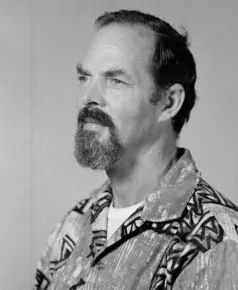
In January 1965, NSF approved a proposed drilling location in the Hawaiian Arch north of Maui, following investigations that connected local geology to the requirements of the drilling system. Seismic surveys by George G. Shor Jr. and Dwight D. Pollard had identified substantial differences in the depth of the mantle across the surrounding region. Their 1964 study placed the discontinuity at approximately 10.5 kilometers beneath sea level under the arch, descending farther beneath the neighboring deep and ridge. Such variations mattered because additional rock increased the work demanded of the drilling equipment, while water depth affected the length of the suspended apparatus. The selected locality still required operating through more than four kilometers of ocean before beginning the substantial penetration beneath it. Engineers had to accommodate a long connection between the vessel and the seabed alongside the equipment working inside the crust. Site selection converted a general geological ambition into a combination of distances and mechanical loads, although the subsurface estimates remained subject to further investigation.
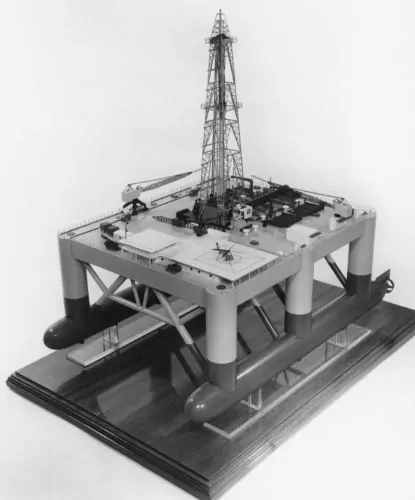
The vessel designed for this task departed substantially from the converted barge used in 1961. Gibbs & Cox, working with Brown & Root, completed the platform’s design and specifications in December 1964, with invitations to shipyards following in March 1965. The proposed structure carried its working platform above six columns attached to two submerged hulls, a configuration intended to reduce the movements that interfered with drilling. Its proportions allowed designers to adjust its response to waves more freely than a conventional ship’s hull permitted. Model-basin investigations and wind-tunnel experiments examined how the structure would behave under environmental forces, providing an experimental basis for calculations that could not yet be checked aboard the completed vessel. The resulting specifications distinguished conditions under which drilling should continue from more severe conditions under which the platform merely had to survive. GAO’s later account described intended drilling operations in waves approximately twenty-eight to thirty feet high, with substantially greater survival requirements. These figures expressed the conditions engineers sought to accommodate. Establishing them in specifications was a necessary step toward construction, while demonstrating dependable performance would require trials of the finished platform and its equipment.
Keeping that platform over its hole demanded sustained coordination between acoustic observations and propulsion. The planned automatic system would calculate position from underwater signals and translate departures from the desired location into changes in propeller thrust and direction. Backup arrangements were intended to preserve useful position information if a principal reference failed, while the propulsion units required provision for inspection and repair. Even the permissible distance from the hole involved uncertainty. Lill acknowledged in 1965 that the operating limit rested partly on the restricted experience obtained during the Guadalupe trials. Further operations would have to establish how far the vessel could move without imposing unacceptable bending stresses on the equipment below.
The connection through the water introduced another major engineering undertaking. The proposed riser would surround the drill pipe and provide a return passage for drilling fluid, allowing circulation from the surface down through the drill string and back upward outside it. This arrangement would carry cuttings toward the vessel while cooling and lubricating the cutting equipment. It also offered a guided route for ordinary movements of tools into and out of the borehole. Supporting such a long assembly required attention to its submerged weight and its response to currents, together with the forces transmitted by the platform. Buoyancy elements were intended to relieve the riser’s suspended load, and telescoping joints near its upper end would accommodate vertical movement. These provisions made the riser an engineered system with its own support and maintenance requirements. Its usefulness depended on keeping the passage serviceable while the connected equipment experienced forces that varied along thousands of feet of water.
Hard-rock drilling received practical investigation on land, where some tools could be tested without simultaneously confronting the entire ocean environment. At Uvalde, Texas, drilling in a basaltic volcanic plug continued until December 1964 and produced a hole more than 3,400 feet deep. The program evaluated coring devices and bits, as well as instruments intended to monitor operations and examine the hole. An important development was the coring turbodrill, which used fluid-driven machinery to apply rotation near the bit, avoiding the need to rotate the whole drill string to produce the cutting action. NSF reported improvements in drilling speed and in the expected service life of the turbocorer’s bearings. The tests supplied evidence that equipment could be improved through repeated operation in a relevant rock type, and they generated cores for scientific examination. Their relevance nevertheless depended on the relationship between the Texas formation and the unknown succession beneath the selected ocean site. Performance in that plug could inform expectations about basalt drilling, but it could not establish the behavior of every formation encountered during a long descent, or demonstrate the same equipment’s reliability when operated from a moving platform.
Repeated access to the borehole was equally important. A connected riser could guide routine trips, but a system intended for prolonged offshore work also needed arrangements for locating the entrance and restoring access after disconnection. Engineers developed plans involving a landing base and reentry cone, supported by acoustic guidance for bringing equipment back to the appropriate position. Such provisions would protect the investment already made in a deep hole when maintenance or adverse conditions interrupted operations. By the project’s end, NSF described sonar reentry as a designed method, and the retractable diamond coring bit intended to simplify bit replacement had reached the prototype stage. Neither description established a dependable sequence of repeated operations at the proposed mantle-drilling location.
Scientific instruments imposed requirements extending beyond the recovery of rock. William P. Schneider’s contemporary account of the measurement program described logging equipment that would need to handle approximately 40,000 feet of cable, including a reserve beyond the anticipated operating depth. The moving platform created a problem of measurement as well as mechanical endurance. An instrument’s position in the hole had to be known accurately enough for its readings to be associated with the correct interval. A cable-compensation device was being designed to reduce the transmission of vessel movement to the instruments. The program also contemplated digital recording, allowing measurements to be retained for subsequent analysis rather than depending entirely on the immediate interpretation of a graphical record. Temperature presented another constraint because instruments developed for existing logging operations possessed finite operating limits. Schneider expected early heat-flow observations to inform the assessment of the location and envisaged modifying the instruments and measurement program if later estimates indicated higher temperatures. Obtaining useful evidence from depth would require repeated checks on whether the apparatus remained capable of measuring the conditions the drilling revealed.
The engineering plan acknowledged that additional testing had to precede the final penetration. NSF’s account for fiscal 1964 specified an initial period of intermediate-depth drilling during which the platform and drilling systems would be tested and operating procedures developed. This provision incorporated further experimentation into the proposed full undertaking, even as disagreement continued over the equipment and organizational arrangements best suited to that work.
By 1966, construction of the platform remained at an early stage, while individual components had progressed through different combinations of design, fabrication, and testing. The outstanding requirement was to demonstrate that those components could function together throughout a sustained campaign, including interruptions that required recovery and renewed access. A successful land test could settle questions about a cutting tool while leaving its offshore handling unresolved; favorable model results could support a hull design while leaving the complete drilling operation to be demonstrated. Completing Mohole would require paying for that remaining development and learning how much operating time the combined system actually demanded.
Rising Estimates and Declining Credibility
The $46.7 million estimated project cost recorded in the 1962 prime contract rested on assumptions that subsequent engineering work substantially altered. It envisaged converting a government-furnished T2 tanker and drawing extensively on conventional drilling equipment. NSF’s preliminary projection in April 1961 had placed the contemplated drilling effort at approximately $15–20 million, but that figure preceded the detailed development of the larger undertaking. These estimates represented successive judgments about requirements that remained unsettled. As the proposed operation acquired a specially designed platform and increasingly elaborate supporting systems, its financial basis changed along with its machinery. Comparing the figures requires attention to what each was supposed to purchase, while preserving the central historical difficulty. Federal officials had committed themselves to pursuing an objective before they could reliably specify the resources needed to achieve it.
Questions about financial disclosure emerged almost immediately after the contractor’s selection. In March 1962, Los Angeles Times correspondent John H. Averill reported NSF’s refusal to provide the rough cost information he sought about the competing proposals or to explain the award’s basis in sufficient detail. His account situated the decision within the political connections surrounding Brown & Root, including its associations with Vice President Lyndon B. Johnson and Representative Albert Thomas of Houston, whose appropriations subcommittee controlled NSF funding. The article presented the award as part of a broader question about the movement of prominent federal undertakings to Texas. Averill nevertheless explicitly acknowledged that his investigation had uncovered no evidence of political influence in the Mohole award. That qualification is essential to understanding what the reporting established. Connections and suspicions were documented, but intervention in the selection was not demonstrated. The disclosure dispute possessed significance independently of whether favoritism had occurred, because readers were being asked to accept assurances about a public expenditure whose comparative financial terms remained difficult to examine. NSF’s explanations had to address the procedures through which confidence in its judgment could be earned, alongside the technical qualifications of the chosen firm.
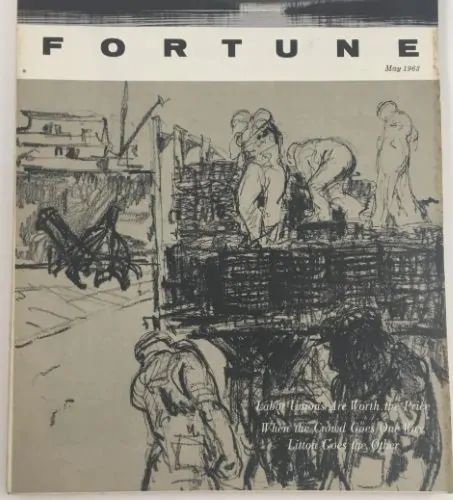
By spring 1963, uncertainty had prompted intervention from the Bureau of the Budget, the executive institution responsible for helping control federal expenditure. A warning reproduced in Greenberg’s contemporary reporting recalled the movement from anticipated costs of $15–20 million to discussion of approximately $50 million, followed by NSF’s description of that larger amount as a minimum. The bureau urged the foundation to withhold approval of further financial commitments until the situation had been clarified, explicitly connecting uncertain costs with technical questions and administrative problems. Its concern reached beyond whether the latest number exceeded an earlier one. An amount previously discussed as the approximate scale of the undertaking had ceased to provide a dependable indication of its upper cost. Critical coverage was meanwhile extending the controversy beyond official correspondence and committee proceedings. Newsweek published “Project No Hole?” while Herbert Solow’s May 1963 Fortune article appeared under the title “How NSF Got Lost in Mohole.” Those formulations made the competence of the sponsoring organization a prominent subject of coverage, giving the project’s difficulties a public identity distinct from the scientific questions it was intended to investigate.
Shipyard competition later supplied a more concrete measure of one major requirement. The winning proposal for constructing the platform approached $30 million, which Clyde W. Burleson’s history of offshore development places roughly $10 million above an earlier Brown & Root estimate for that component. Even competitive procurement could produce a price substantially higher than the figure used during preliminary planning. By June 1966, the estimated cost of completing Mohole had reached $127.1 million, excluding approximately $2.2 million in NSF administrative costs. A contemporary breakdown included $39 million for three years of drilling operations, illustrating how much of the forecast concerned activity beyond constructing the platform itself. The anticipated duration had also expanded from approximately five years at the time of the prime contract to about eight and a half years. These differences make a simple comparison between the shipyard price and the overall completion estimate misleading, since the two figures covered different work. They nevertheless reveal the growing burden on the project’s defenders. Increasingly specific prices and schedules were displacing earlier expectations without yet establishing an operating record for the complete system. Continued sponsorship required confidence that the latest assessment offered a sufficiently sound basis for another commitment. The distinction between commitments and expenditure is important when assessing the amounts already attached to Mohole. For the period from March 1962 through the end of fiscal 1966, NSF reported approximately $54.5 million obligated and $19.3 million expended. Obligations recorded commitments against available funds, including contractual work whose payment could lie ahead. Expenditure measured money actually disbursed within the reported accounting period. These figures describe different dimensions of the government’s involvement, and neither should be substituted for the much larger forecast of completing and operating the project. A history that treats all three categories as money already consumed exaggerates the immediate expenditure while obscuring the obligations that further decisions had to address.
GAO’s subsequent assessment located the forecasting problem in the decision to contract for the integrated undertaking before resolving fundamental engineering questions. Its proposed alternative involved successive, limited commitments, allowing the agency to establish requirements and assess their cost before authorizing later procurement and operations. This recommendation supplied a substantive fiscal criticism without requiring the assumption that every upward revision represented waste. Investigation can reveal that useful work demands more resources than expected; the difficulty for a public sponsor is determining how much it should promise before obtaining that information. Mohole’s repeated revisions made that distinction increasingly important because each new request arrived with a history of earlier assurances that had proved inadequate. The project could point to engineering accomplishments, but those accomplishments did not automatically establish the reliability of the next completion estimate. Its credibility now depended partly on showing how new knowledge had changed the calculation and what uncertainty still remained. Congress would confront the continuation of a scientifically significant undertaking whose eventual cost and delivery schedule NSF had repeatedly revised.
Congress Ends the Attempt, 1966
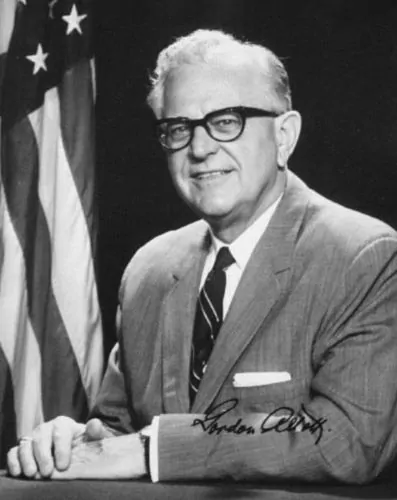
Albert Thomas’s death in February 1966 deprived Mohole of an influential defender at an unfavorable moment. As chairman of the House Appropriations Subcommittee on Independent Offices, Thomas had occupied a position from which sustained interest could help a disputed undertaking survive successive budget reviews. His importance became conspicuous after his death. A May editorial in the Washington Post identified the disappearance of Mohole’s principal congressional champion as one reason its critics now enjoyed greater freedom of action. Scientific distinction and presidential encouragement could attract attention, but obtaining another appropriation required legislators willing to defend the expenditure against competing demands. Thomas’s absence helps explain the project’s increased vulnerability, although it cannot by itself explain the decisions that followed.
The House Appropriations Committee made its position explicit on May 5, declining to provide the $19.7 million requested for Mohole in fiscal year 1967. Its explanation combined dissatisfaction with the project’s progress and prospective expense with an insistence that national priorities required reconsideration. The committee also maintained that NSF could employ its resources more advantageously elsewhere, placing the dispute within the allocation of scientific support as well as the larger federal budget. The House passed the appropriation bill without the requested Mohole funding on May 10. Johnson then intervened publicly on May 18, using his transmission of the National Oceanographic Program to urge Congress to support construction of the drilling platform. His letter joined questions about the crust and ocean basins to the development of techniques for investigating seabed resources, presenting the proposed expenditure as an investment with several possible returns. This intervention established that the administration continued to support Mohole after the House’s refusal; it did not resolve the disagreement over whether those prospective returns warranted another commitment. Presidential sponsorship had to compete with congressional judgments about the relative urgency of the undertaking.
Restoration nevertheless retained substantial support in the Senate, whose Appropriations Committee recommended returning the $19.7 million to the bill. During debate on August 10, Senator Gordon L. Allott of Colorado sought to remove that provision, connecting his objections to NSF’s administration with a preference for acquiring further drilling experience through a less ambitious program. His argument brought an existing scientific disagreement into the appropriation process. Legislators could favor oceanographic investigation while disputing the immediate justification for a mantle penetration. Senator Warren G. Magnuson of Washington defended continuation, even while acknowledging the accuracy of the cost figures Allott presented. Their disagreement extended beyond the arithmetic to the significance of the work already undertaken and the value of completing the proposed capability. Money committed earlier could support opposing judgments, depending on whether a senator regarded it as preparation whose benefits still required completion or expenditure that offered insufficient reason for assuming further liabilities. The Senate rejected Allott’s amendment by thirty-seven votes to forty-six, preserving the requested funding in its version of the legislation. That result prevents the eventual cancellation from being represented as a congressional consensus already settled by early August. Mohole still possessed enough support to survive a direct challenge in one chamber, while lacking the agreement between chambers necessary to secure its continuation.
The House maintained its refusal when the disputed appropriation returned from conference. On August 18, a motion to accept the Senate’s restoration failed on a division vote, with fifty-nine members supporting it and 108 opposing it; the House subsequently insisted on its position without objection. Magnuson moved on August 24 that the Senate abandon its insistence on the Mohole provision, acknowledging that withholding additional money effectively terminated the undertaking. The Independent Offices Appropriation Act, approved September 6, completed this funding outcome. The decisive legislative action concerned continued financial support for the existing project, leaving unanswered the geological questions that its unfinished drilling program had been intended to investigate.
Implementing the decision required further judgments about contracts, equipment, and the preservation of research. In explaining the Senate’s retreat, Magnuson distinguished between stopping the platform subcontract, which was only beginning, and completing advanced work that might retain value for the government. NSF subsequently terminated its prime contract with Brown & Root only in part, allowing selected activities to continue while ending the remainder. Its report for fiscal year 1967 specified that design and equipment-fabrication subcontracts more than 95 percent complete could be finished. The agency also authorized engineering summaries and other technical reports to preserve the research and development accumulated during the full-scale undertaking. These measures complicate the image of an abrupt shutdown in which the appropriation decision immediately extinguished every activity. They also establish the practical limits of what could be retained. Completed studies and individual components could survive, while the integrated platform and drilling operation needed to reach the mantle remained unrealized. Congress’s refusal brought the proposed penetration to an end, while the subsequent closeout treated parts of the work as resources that deserved to remain available for other investigations.
What Continued: Scientific Drilling beyond the Mantle Objective
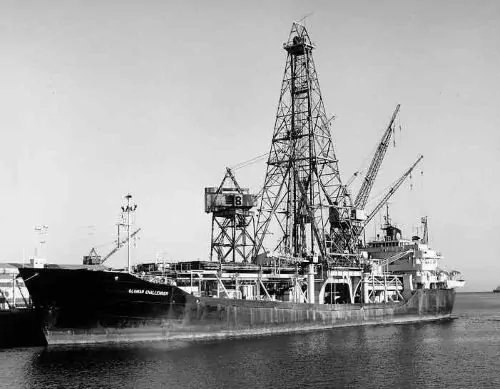
A separate organization for ocean drilling had begun operating while Mohole still commanded federal support. In May 1964, Lamont Geological Observatory, the University of Miami’s Institute of Marine Sciences, Scripps, and Woods Hole established the Joint Oceanographic Institutions for Deep Earth Sampling, known as JOIDES. Their cooperation produced a drilling expedition aboard Caldrill I off northeastern Florida in April and May 1965, investigating the continental margin and Blake Plateau. Lamont managed the operation, which took advantage of the vessel’s availability between commercial assignments; Pan American Petroleum’s willingness to cover transit costs helped make the arrangement possible. The cruise recovered sedimentary sections for regional geological investigation, with penetrations ranging from 120 to 320 meters beneath the seabed. An institutional partnership and an operating example of collaborative coring preceded Congress’s final refusal to continue the mantle attempt. e
Federal sponsorship subsequently gave this collaboration a vessel and an extended program of operations. On June 24, 1966, NSF signed a contract with the University of California for the undertaking that became the Deep Sea Drilling Project, or DSDP, with Scripps responsible for its management. The agreement’s timing places the new commitment within the final months of the Mohole controversy, when support for different forms of scientific drilling was already following separate courses. Scripps subcontracted with Global Marine for the ship and drilling services, while JOIDES supplied scientific guidance through panels concerned with research objectives and the selection of locations. The resulting Glomar Challenger began scientific drilling operations in August 1968. Its program initially envisaged eighteen months of drilling, organized into voyages, or “legs,” that brought different scientific parties aboard for successive investigations. Laboratories on the vessel allowed preliminary examination of recovered material, while subsequent analysis could continue in institutions ashore. This arrangement made a substantial research facility available to changing groups of investigators, allowing the scientific itinerary to develop through successive proposals and results. Its continuation depended on further reviews and contractual extensions, through which an initially bounded undertaking became a sustained program.
The technological inheritance becomes clear in the later development of borehole reentry. Mohole’s engineers had designed equipment for locating an existing hole after the drill string had been withdrawn, but DSDP subsequently developed that approach into an operational capability. The introduction to the report on Leg 15 explicitly identified its reentry system as based on the Mohole design, using a large seabed cone and sonar to guide the returning equipment. Successful testing took place off New York in June 1970, followed by deployment during Caribbean drilling later that year. This development addressed a practical limitation encountered during earlier DSDP work, when resistant chert layers defeated available bits and prevented investigators from reaching deeper objectives. Being able to replace a worn bit and resume work in the same borehole extended the useful life of an excavation that would otherwise have been abandoned. The connection to Mohole involved identifiable design work carried forward through additional engineering and trials; the successful operations belonged to the later program’s achievements.
Between December 1968 and January 1969, Glomar Challenger obtained significant evidence during Leg 3 in the South Atlantic. Seven sites used to investigate spreading across the Mid-Atlantic Ridge reached basalt, providing sediment samples immediately above the underlying volcanic rock. Fossils in those basal sediments supplied ages that generally increased with distance from the ridge. Those ages agreed closely with predictions previously developed from marine magnetic anomalies, giving investigators a test based on a different kind of evidence. The expedition report estimated an average spreading half-rate of approximately two centimeters per year, while discussing discrepancies and the limits of the dating methods. These were principally ages assigned to sedimentary material through paleontology, so their relationship to the formation of the underlying crust required geological interpretation. Agreement across several locations made the result persuasive, while departures from the predicted pattern exposed questions requiring further investigation. The drilling entered an existing debate with observations capable of testing its quantitative expectations. Its contribution to the emerging account of ocean-basin formation arose from the relationship among samples distributed across the ridge.
Sedimentary sections also extended research into the history of ocean conditions. In 1975, Nicholas J. Shackleton and James P. Kennett published oxygen and carbon isotope analyses from three DSDP sites in the subantarctic region, combining overlapping sequences into a record spanning much of the Cenozoic. Their investigation used microscopic fossil shells to examine changes in ocean temperatures and Antarctic glaciation over millions of years. Such work connected the depth of a recovered specimen to its position within a dated environmental sequence, giving relatively small samples significance beyond their immediate location. As these records accumulated, scientific drilling became an important means of investigating the interaction of ocean circulation and climate, with research questions that extended well beyond identifying the rocks beneath marine sediments.
Making those investigations possible required arrangements for sharing both the work and its material results. Scientists from outside the United States participated in DSDP expeditions before their governments entered formal agreements to contribute financial support. Those agreements developed over several years. West Germany and the Soviet Union joined through arrangements effective in January 1974, followed by Japan and Britain in 1975 and France in January 1976. The resulting cooperation connected an American-funded initiative to a wider community with responsibilities extending into laboratories after each cruise. Access to the recovered cores nevertheless remained an administrative problem requiring active attention. A 1972 GAO review found that delays in publishing preliminary core descriptions had also delayed the distribution of samples to researchers outside the shipboard parties. Because the distribution policy tied wider availability to publication, preparing reports affected who could begin detailed investigations and when they could do so. The findings show why drilling performance alone provides an incomplete measure of a program’s scientific effectiveness. Specimens had to be described and made accessible through procedures that allowed researchers beyond an expedition’s immediate participants to investigate them.
The experimental Mohole cores themselves acquired a further research history. In a study published in 2026, Margaret A. Morris and her colleagues examined surviving Guadalupe material using X-ray fluorescence scanning, magnetic susceptibility measurements, and digital imaging. Their measurements supported broad compositional patterns identified in the original investigations while permitting finer distinctions within the sedimentary sequence. Storage had also changed the specimens. Shifts toward redder colors were consistent with oxidation, and the researchers had to account for disturbance and uncertainties in the recorded depths. The surviving cores required critical assessment as physical objects with histories of recovery and preservation. Comparing their present condition with older descriptions allowed the investigators to distinguish persistent geological information from changes that had occurred after collection. More than six decades after the expedition, the same material could support both a reassessment of earlier findings and observations at a resolution unavailable in the original published analyses.
Was Ending Mohole the More Defensible Scientific Choice?
The following video from PeriscopeFilm documented the Mohole expedition:
The strongest challenge to an interpretation centered on national ambition is that ending Mohole may have been a defensible choice about research priorities. Establishing the importance of its geological question did not establish how urgently that question should be pursued, or what expenditure its investigation warranted. Georges Pardo’s memoir of Hedberg places doubts about the value of a single mantle penetration within the scientific advisory community itself, where its prospective contribution had to be assessed against its exceptional demands. From this perspective, cancellation becomes an exercise of judgment about the distribution of research resources. Scientific sponsors could reasonably decline another commitment while acknowledging that successful penetration would produce valuable information. The historical question concerns whether continued support remained justified under the circumstances of 1966, rather than whether reaching the mantle would have been an achievement.
The engineering record gives this objection considerable force. NSF’s report for fiscal year 1966 described substantial developmental accomplishments while distinguishing tested equipment from systems whose performance remained dependent on design studies and modeling. That distinction left an important uncertainty about whether the complete operation could deliver the observations for which it was being assembled. Individual advances supplied reasons for further investigation, but the appropriation request also required confidence in the effort needed to bring them into reliable service together. The subsequent GAO review identified premature commitment as a central administrative problem. NSF had undertaken responsibility for completing the project before sufficiently resolving what completion would require. Read as an argument about scientific choice, this criticism reaches beyond the accuracy of budget forecasts. A research institution needs opportunities to reconsider an objective when the means of attaining it become better understood, including circumstances in which promising development reveals a substantially more demanding undertaking. The case for stopping Mohole rests partly on the proposition that learning more about its requirements could legitimately reduce its priority.
Later drilling experience strengthens that concern, although it must be used with chronological care. Writing in 2000, Edward L. Winterer judged it highly unlikely that the proposed attempt would have penetrated more than a small fraction of the oceanic crust, explicitly grounding that assessment in three subsequent decades of experience. His participant perspective offers a serious challenge to optimistic accounts of what additional funding might have accomplished. It cannot establish that legislators and scientists in 1966 possessed equivalent knowledge, or that the eventual difficulties of crustal drilling had already made the outcome predictable.
A defense of cancellation must nevertheless account for the scientific opportunity that it surrendered. The original feasibility study treated mantle penetration as a means of testing fundamental interpretations of Earth’s structure, and Lill continued to place that objective within a broader program of planetary investigation in 1965. Recovering an intact section across the seismic boundary could have connected changes in measured physical behavior with the rocks responsible for them. Neither successful sediment coring nor a persuasive account of seafloor spreading supplied that evidence. More generally, judging research entirely by the results obtainable with established capabilities would systematically disadvantage proposals intended to make unfamiliar environments accessible. Their potential contribution includes discoveries whose significance cannot be specified confidently before access is achieved. That consideration supports accepting substantial uncertainty, while leaving the permissible scale of commitment open to debate. GAO’s proposed alternative of limited, sequential commitments addressed this difficulty by preserving occasions for reassessment, although NSF accepted its applicability to Mohole only with qualifications. Such an approach might have supported continuation, redirection, or withdrawal as evidence accumulated; the review demonstrated no guaranteed route to an affordable mantle penetration.
Ending the undertaking available for approval in 1966 is easier to defend than a sweeping judgment that mantle drilling never deserved public investment. The congressional decision emerged from conflicting positions, and it should not be credited retrospectively with a unified scientific assessment that the legislative record does not reveal. Nevertheless, doubts about priority and operational readiness provided substantive grounds for withholding further support, independently of accusations about contractors or dissatisfaction with NSF. This modifies the emphasis placed on spectacular national projects. The difficulty involved sustaining freedom to revise a commitment whose scientific justification could change as its practical requirements became clearer. Mohole’s cancellation belongs within the history of scientific judgment because disagreement persisted over how much uncertainty research sponsors should accept to obtain that specific kind of evidence.
Conclusion: Access to Earth’s Interior and the Purposes of Exploration
In the early Space Age, Mohole made the familiar planet beneath human feet appear as a place that still required an expedition. Proximity offered little assurance of access. The desired material remained beyond established research capabilities despite lying far closer than any extraterrestrial destination. The comparison with space exploration had an intellectual basis as well as a public purpose. Both enterprises raised questions about what scientists might learn by taking instruments into environments previously investigated from a distance. Mohole’s challenge was that its destination, a boundary identified through seismic measurements, also embodied an unresolved explanation of Earth’s structure.
Making that encounter scientifically useful required decisions that could rarely be classified as exclusively technical or intellectual. The selection of a platform involved judgments about the conditions under which observations could be repeated, while recovery equipment affected the relationship between the specimens obtained and the geological section they were intended to represent. Commercial drilling experience supplied indispensable capabilities, and scientific requirements redirected their application toward investigating the planet’s development. Acquiring evidence depended on cooperation among people whose responsibilities extended from constructing equipment to interpreting its results. Federal sponsorship made that cooperation possible on a scale beyond the resources of an individual laboratory, but it also required officials to authorize expenditure before the complete operation had been demonstrated. The resulting obligations gave practical results to expectations that further investigation could substantially change. Mohole exposed the difficulty of supporting exploration through arrangements that demanded confidence about an undertaking whose requirements were themselves still being discovered.
The termination of funding left an incomplete record of the proposed operation’s feasibility. Its organizers never delivered the mantle penetration for which they had secured support, and the full drilling system received no opportunity to establish its capabilities at sea. Later experience helps identify the seriousness of the obstacles, without supplying a complete account of what continued work under different arrangements might have accomplished. Historical judgment must preserve that uncertainty alongside the documented administrative problems and the substantive scientific grounds for reconsidering the expenditure.
The longer history of ocean drilling provides another measure of Mohole’s consequences. Its experimental accomplishments and developmental work entered a research practice that could be applied across different geological settings, alongside initiatives already pursuing objectives of their own. That practice supported investigations whose significance emerged through comparisons among locations and through laboratory work extending well beyond the original voyages. Its durability depended on retaining specimens and making the resulting evidence available for further examination, so that an expedition’s findings could acquire meanings its initial participants had not established. Such continuity gives the exploration of Earth’s interior a history extending beyond the success or abandonment of any named project. Mohole occupies a significant place in that history because it helped enlarge the possibilities of direct investigation while leaving its defining geological question unresolved.
Bibliography
Affiliate disclosure: Amazon links on this site are paid links. As an Amazon Associate I earn from qualifying purchases.
- Atkinson, Richard C. “Foreword.” In Initial Reports of the Deep Sea Drilling Project, vol. 37, by Fabrizio Aumento, William G. Melson, et al., v. Washington, DC: Government Printing Office, 1977.
- Averill, John H. “Another Big Scientific Job Goes to Texas Firm—California-Based Combine Fails to Keep Project Mohole; Some Eyebrows Raised.” Los Angeles Times, March 18, 1962. Reprinted in Congressional Record 108, June 20, 1962.
- Bascom, Willard. A Hole in the Bottom of the Sea: The Story of the Mohole Project. Garden City, NY: Doubleday, 1961.
- —-. “The Mohole.” Scientific American 200:4 (1959), 41–49.
- Becker, Keir, et.al. “50 Years of Scientific Ocean Drilling.” Oceanography 32:1 (2019), 17-21.
- Birch, Francis. “The Velocity of Compressional Waves in Rocks to 10 Kilobars: 1.” Journal of Geophysical Research 65:4 (1960), 1083–1102.
- Bullard, E. C., and D. T. Griggs. “The Nature of the Mohorovičić Discontinuity.” Geophysical Journal of the Royal Astronomical Society 6:1 (1961), 118–123.
- Burleson, Clyde W. Deep Challenge: Our Quest for Energy beneath the Sea. Houston: Gulf Publishing Company, 1999.
- Campbell, Joseph. Letter to Thomas H. Kuchel, June 18, 1962. Congressional Record 108 (June 20, 1962), 11148–11149.
- Charam, Philip, and Francis X. Fee. “GAO Review of Project Mohole.” GAO Review, Summer 1968, 21–29.
- Cochrane, Rexmond C. The National Academy of Sciences: The First Hundred Years, 1863–1963. Washington, DC: National Academy of Sciences, 1978.
- Edgar, N. T., J. B. Saunders, et al. Initial Reports of the Deep Sea Drilling Project. Vol. 15. Washington, DC: Government Printing Office, 1973.
- Engel, Celeste G., and A. E. J. Engel. “Composition of Basalt Cored in Mohole Project.” AAPG Bulletin 45:11 (1961): 1799.
- Foster, K. W. “Dynamic Anchoring of Floating Vessels.” In Exploiting the Ocean: Transactions of the Second Annual Marine Technology Society Conference and Exhibit, June 27–29, 1966, 158–172. Washington, DC: Marine Technology Society, 1966.
- Greenberg, Daniel S. “Mohole: Aground on Capitol Hill.” Science 153:3739 (1966), 963.
- —-. “Mohole: The Project That Went Awry—II.” Science 143:3603 (1964), 223–227.
- —-. “Mohole: The Project That Went Awry (III).” Science 143, no. 3604 (January 24, 1964): 334–37.
- Hess, Harry H. “Geological Hypotheses and the Earth’s Crust under the Oceans.” Proceedings of the Royal Society of London. Series A, Mathematical and Physical Sciences 222:1150 (1954), 341–348.
- —-. “History of Ocean Basins.” In Petrologic Studies: A Volume to Honor A. F. Buddington, edited by A. E. J. Engel, Harold L. James, and B. F. Leonard, 599–620. New York: Geological Society of America, 1962.
- Horton, Edward E. “Preliminary Drilling Phase of Mohole Project I. Summary of Drilling Operations.” AAPG Bulletin 45:11 (1961), 1789–1792.
- Johnson, Lyndon B. “Letter to the President of the Senate and to the Speaker of the House Transmitting the National Oceanographic Program for Fiscal Year 1967.” May 18, 1966. In Public Papers of the Presidents of the United States: Lyndon B. Johnson, 1966. Book 1. Washington, DC: Government Printing Office, 1967.
- Kennedy, John F. “Message to Detlev W. Bronk and Alan T. Waterman Regarding the Success of the First Phase of Project Mohole.” April 8, 1961.
- Kerr, Richard A. “Pursued for 40 Years, the Moho Evades Ocean Drillers Once Again.” Science 307:5716 (2005), 1707.
- Lovering, John F. “The Nature of the Mohorovicic Discontinuity.” Transactions, American Geophysical Union 39:5 (1958), 947–955.
- McLelland, Jack I. “Preliminary Drilling Phase of Mohole Project III. Summary of Logging Operations.” AAPG Bulletin 45:11 (1961), 1800.
- Mohorovičić, Andrija. “Earthquake of 8 October 1909.” Geofizika 9:1 (1992), 3–55. English translation of the original 1910 study.
- Morris, Margaret A., et.al. “Project Mohole Results Enhanced with Modern XRF Core Scanning and Imaging.” Geochemistry, Geophysics, Geosystems 27:3 (2026), e2025GC012706.
- Morsberger, Robert E. “Steinbeck under the Sea at the Earth’s Core.” In Steinbeck and the Environment: Interdisciplinary Approaches, edited by Susan F. Beegel, Susan Shillinglaw, and Wesley N. Tiffney Jr., 266–278. Tuscaloosa: University of Alabama Press, 1997.
- Murata, K. J., and R. C. Erd. “Composition of Sediments from the Experimental Mohole Project (Guadalupe Site).” Journal of Sedimentary Petrology 34:3 (1964), 633–655.
- National Research Council. Scientific Ocean Drilling: Accomplishments and Challenges. Washington, DC: National Academies Press, 2011.
- National Research Council, AMSOC Committee. Drilling Thru the Earth’s Crust: A Study of the Desirability and Feasibility of Drilling a Hole to the Mohorovicic Discontinuity. Publication 717. Washington, DC: National Academy of Sciences–National Research Council, 1959.
- —-. Experimental Drilling in Deep Water at La Jolla and Guadalupe Sites. Publication 914. Washington, DC: National Academy of Sciences–National Research Council, 1961.
- National Science Foundation. Twelfth Annual Report for the Fiscal Year Ended June 30, 1962. Washington, DC: Government Printing Office, 1962.
- —-. Thirteenth Annual Report for the Fiscal Year Ended June 30, 1963. Washington, DC: Government Printing Office, 1963.
- —-. Fourteenth Annual Report for the Fiscal Year Ended June 30, 1964. Washington, DC: Government Printing Office, 1965.
- —-. Fifteenth Annual Report for the Fiscal Year Ended June 30, 1965. Washington, DC: Government Printing Office, 1966.
- —-. Sixteenth Annual Report for the Fiscal Year Ended June 30, 1966. Washington, DC: Government Printing Office, 1967.
- Oreskes, Naomi. The Rejection of Continental Drift: Theory and Method in American Earth Science. New York: Oxford University Press, 1999.
- Pardo, Georges. “Hollis Dow Hedberg.” In Biographical Memoirs 61:215–44. Washington, DC: National Academy Press, 1992.
- Prodehl, Claus, Brian Kennett, Irina M. Artemieva, and Hans Thybo. “100 Years of Seismic Research on the Moho.” Tectonophysics 609 (2013), 9–44.
- Rabbitt, Mary C., and Clifford M. Nelson. Minerals, Lands, and Geology for the Common Defence and General Welfare. Vol. 4, 1939–1961. Reston, VA: U.S. Geological Survey, 2015.
- Raitt, Russell W. “Seismic-Refraction Studies of the Pacific Ocean Basin: Part I: Crustal Thickness of the Central Equatorial Pacific.” Geological Society of America Bulletin 67:12 (1956), 1623–1640.
- Riedel, W. R., et.al. “Preliminary Drilling Phase of Mohole Project II. Summary of Coring Operations.” AAPG Bulletin 45:11 (1961), 1793–1798.
- Schlee, John, and Robert Gerard. Cruise Report and Preliminary Core Log, M/V Caldrill I—17 April to 17 May 1965. JOIDES Blake Panel Report. NSF Grant GP-4233. August 1965.
- Schneider, William P. “Deep Hole Scientific Instruments and Measurements for Project Mohole.” In Drilling for Scientific Purposes: Report of the International Upper Mantle Symposium, Ottawa, 2–3 September, 1965, edited by D. C. Findlay and C. H. Smith, 94–107. Geological Survey of Canada Paper 66-13. Ottawa: Department of Mines and Technical Surveys, 1966.
- “The Secrets of Inner Space.” Saudi Aramco World 14:6 (June–July 1963), 11–13.
- Shackleton, N. J., and J. P. Kennett. “Paleotemperature History of the Cenozoic and the Initiation of Antarctic Glaciation: Oxygen and Carbon Isotope Analyses in DSDP Sites 277, 279, and 281.” In Initial Reports of the Deep Sea Drilling Project 29:743–55. Washington, DC: Government Printing Office, 1975.
- Shipboard Scientific Party. “Summary and Conclusions.” In Initial Reports of the Deep Sea Drilling Project 3:441–71. Washington, DC: Government Printing Office, 1970.
- Shor, Elizabeth Noble. Scripps Institution of Oceanography: Probing the Oceans, 1936 to 1976. San Diego: Tofua Press, 1978.
- Shor, George G., Jr., and Dwight D. Pollard. “Mohole Site Selection Studies North of Maui.” Journal of Geophysical Research 69:8 (1964), 1627–1637.
- Steinbeck, John. “High Drama of Bold Thrust through Ocean Floor.” Life, April 14, 1961.
- Tonking, W. H. “Status and Accomplishments of the Mohole Project—Phase II.” In Drilling for Scientific Purposes: Report of the International Upper Mantle Symposium, Ottawa, 2–3 September, 1965, edited by D. C. Findlay and C. H. Smith. Geological Survey of Canada Paper 66-13. Ottawa: Department of Mines and Technical Surveys, 1966.
- Toye, Sandra. “Ocean Sciences at the National Science Foundation: An Administrative History.” In 50 Years of Ocean Discovery: National Science Foundation 1950–2000, 96–106. Washington, DC: National Academy Press, 2000.
- United States. Independent Offices Appropriation Act, 1967. Public Law 89-555. September 6, 1966. 80 Stat. 663–89.
- U.S. Congress. House. Congressional Record. 89th Cong., 2nd sess. August 18, 1966. Vol. 112, 19918–19926.
- U.S. Congress. Office of Technology Assessment. Ocean Margin Drilling: A Technical Memorandum. Washington, DC: U.S. Government Printing Office, 1980.
- U.S. Congress. Senate. Congressional Record. 89th Cong., 2nd sess. August 10 and 24, 1966. Vol. 112, 18916–18925, 20492–94.
- U.S. General Accounting Office. Achievements, Cost, and Administration of the Ocean Sediment Coring Program. B-171989. Washington, DC: General Accounting Office, November 1, 1972.
- van Keuren, David K. “Building a New Foundation for the Ocean Sciences: The National Science Foundation and Oceanography, 1951–1965.” Earth Sciences History 19:1 (2000), 90–109.
- Washington Post. “Project Mohole Stymied.” May 9, 1966. Reprinted in Congressional Record 112, May 9, 1966, 10089.
- Winterer, Edward L. “Scientific Ocean Drilling, from AMSOC to COMPOST.” In 50 Years of Ocean Discovery: National Science Foundation 1950–2000, 117–27. Washington, DC: National Academy Press, 2000.
- “World Study to Explore Earth’s Crust Progresses.” The Science News-Letter 81:16 (1962), 245.
Originally published by Brewminate, 10.21.2026, under the terms of a Creative Commons Attribution-NonCommercial-NoDerivatives 4.0 International license.
About the Author