Changing compass readings led Edmond Halley to propose worlds inside Earth. Astronomy helped make them conceivable, but their supposed inhabitants remained beyond the evidence.

By Matthew A. McIntosh
Public Historian
Brewminate
Introduction: The Moving Needle and the Unseen Earth
Among the observations Edmond Halley assembled for his 1692 account of terrestrial magnetism was a striking sequence of measurements made at London. A reading dated 1580 placed the compass needle eleven degrees and fifteen minutes east of geographical north; Halley’s own observation in 1692 placed it six degrees west. Across 112 years, its recorded direction had changed by more than seventeen degrees. These measurements came from different observers, and their precision required scrutiny, but the accumulated evidence presented a problem that could not readily be attributed to an isolated defective instrument. Comparisons from other locations likewise indicated that the angle between magnetic and geographical north altered over time. For anyone seeking to explain the compass through the properties of Earth, the difficulty concerned the physical constitution of the planet itself. Something capable of influencing the needle appeared to change while the ground beneath the observer remained apparently undisturbed.
Halley’s response was to propose an internal arrangement that could accommodate movement beneath a stable exterior. In the paper he published in the Philosophical Transactions in 1692, following presentations to the Royal Society beginning the previous year, he described an outer magnetic shell enclosing a detached magnetic globe. A fluid medium separated the two bodies, allowing a small difference between their rotational rates to accumulate into a gradual alteration of their relative positions. This mechanism addressed difficulties within his earlier account of magnetic variation, including his inference that the observed directions required four principal magnetic poles. Yet the construction eventually illustrated in his paper extended beyond that initial arrangement. Additional concentric bodies created intervening regions that he considered capable of supporting living creatures, provided that suitable illumination and other necessary conditions existed. The distinction between these stages matters. A proposed source of changing magnetic influence became the basis for describing environments whose possible inhabitants had played no part in the observations that prompted the investigation. Halley acknowledged the boldness of the undertaking, anticipated objections, and left future investigators considerable work to perform before its claims could be assessed adequately.
Astronomy supplied important resources for defending this unfamiliar Earth. Saturn’s surrounding ring offered Halley an observable example of separated structures sharing a center, while Isaac Newton’s estimate of the Moon’s density provided another argument favoring cavities within the terrestrial globe. These comparisons brought distant bodies into an investigation of what lay immediately beneath humanity’s inhabited surface. Their evidential reach nevertheless remained uncertain. An arrangement visible around another planet could establish a precedent for considering an unusual structure without demonstrating that the same physical conditions existed underground or that the proposed interior would remain stable.
The possibility of life below also drew upon expectations about the purposes of creation. Halley reasoned that matter might be arranged to provide extensive surfaces for living beings, making the interior useful in ways that exceeded its service to creatures above. Such arguments belonged to a learned culture in which physical explanation could incorporate judgments about divine wisdom, although their presence does not settle the question of his personal religious motives. In 1716, when an extraordinary auroral display demanded explanation, he returned to the possibility of luminous material enclosed within Earth and suggested that its escape might contribute to the lights overhead. The earlier conjecture had acquired a further application without becoming an observed subterranean reality. Understanding its historical significance requires attention to the unequal strength of its connected claims. Halley’s hollow Earth shows how astronomical knowledge could authorize increasingly detailed descriptions of an inaccessible environment, even as the evidence available to distinguish that environment from competing possibilities remained limited.
When Magnetic North Would Not Stay Still
Steering by a compass required a navigator to distinguish the direction indicated by the instrument from bearings established through astronomical observation. The relevant quantity was magnetic declination, measured horizontally between the needle’s alignment and the geographical meridian. Observations of the Sun or appropriate stars supplied an independent reference against which that alignment could be checked. Applying the resulting correction allowed a course expressed in compass bearings to be related to geographical direction. Knowledge of declination entered ordinary navigational practice before anyone possessed an adequate explanation of its behavior. Its usefulness depended on determining the correction appropriate to a certain location, which made geographical differences in compass readings a matter of immediate practical concern.
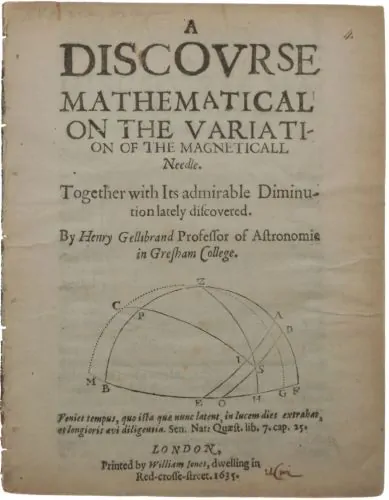
The recognition that this correction also changed with time emerged through investigations conducted decades before Halley’s publications. Henry Gellibrand, professor of astronomy at Gresham College, announced the phenomenon in his Discourse Mathematical of 1635, describing it as a “variation of the variation.” His account reveals how much effort went into deciding whether discrepancies between measurements represented an alteration in nature. Gellibrand acknowledged that he and others had initially been too ready to attribute the disagreement to errors in earlier observations. An important stimulus to renewed investigation came from John Marr, an instrument maker whose examination of a needle previously used by Edmund Gunter suggested that the earlier direction could no longer be recovered. Gellibrand and his associates subsequently returned to the observing location at Deptford, conducting trials in 1633 and again in 1634. Their equipment included a large quadrant for measuring solar altitudes and several magnetic needles, among them Gunter’s surviving instrument. Agreement between the needles helped address the possibility that their manufacture or preparation accounted for the discrepancy; Gellibrand also tested whether touching a needle with a different lodestone altered the result. Establishing magnetic change depended partly on preserving connections between successive observations. Marr’s practical knowledge and the availability of an older instrument made those connections more persuasive than a comparison of printed numbers alone could have been.
Longitude gave these inquiries an additional attraction. A ship’s latitude could be investigated through celestial altitudes, but determining its position east or west remained substantially more difficult. If magnetic declination followed a sufficiently regular geographical distribution, a navigator who knew the latitude might use a compass observation to help constrain the vessel’s longitude. Such a procedure required more than finding that the needle pointed differently in different waters. The relationship had to be known accurately enough to distinguish possible positions. Repeated values across widely separated locations could introduce ambiguity, while alteration over time meant that an observation had to be compared with information appropriate to its date. The discovery of temporal change complicated magnetic navigation without eliminating the incentive to pursue it. A dependable account of the changes might preserve the practical value of observations that otherwise risked becoming obsolete.
Halley’s 1683 paper approached the subject by assembling a geographical body of evidence substantially wider than the English comparisons. His table brought observations from northern Atlantic waters into relation with readings along the coasts of South America and across the Indian Ocean. Entries recorded location and date alongside the reported angle, allowing readers to inspect differences that a general description might conceal. The compilation was necessarily uneven. Some places contributed successive measurements, whereas others appeared through an isolated visit, and observations separated by decades occupied the same table. Its geographical reach depended on voyages undertaken for purposes extending well beyond magnetic research. Published accounts preserved information that Halley could reuse, while maritime contacts offered the prospect of obtaining readings unavailable in print. He wanted reports from Spanish voyages between Manila and Acapulco and information gathered by Dutch observers near Japan. Those requests expose the limits of his coverage as clearly as the table displays its extent. The Pacific remained a striking gap, and Halley sometimes extrapolated into regions where the necessary observations had not reached him. His proposed general account rested on an expanding collection whose distribution reflected established routes of travel and access to other people’s records.
Evidence from India also prevented the changes from being reduced to a uniform westward turning of every needle. At Cape Comorin, Halley reported a decline in westerly variation from fourteen degrees and twenty minutes in 1620 to seven degrees and thirty minutes in 1688. The direction remained west of geographical north, but its movement between those dates was eastward. Around southern Africa, meanwhile, the comparisons he assembled indicated increasing westerly variation. A convincing explanation had to accommodate these opposed tendencies, rather than assume that the behavior familiar in European observations occurred identically elsewhere.
Comparison across such distances required attention to how the readings had been obtained. Halley selected observations partly through judgments about the competence and reliability of their makers, but an observer’s reputation could not remove every uncertainty in the procedure. Determining the astronomical bearing against which a needle was checked introduced its own calculations and corrections. In 1692, for example, he criticized a practice of observing the Sun’s rising or setting direction when its center appeared at the visible horizon without making the necessary allowance for atmospheric refraction and the observer’s height above the sea. He stressed that the resulting error became significant at high latitudes, where the Sun crossed the horizon obliquely. This was a specific procedural problem capable of introducing disagreement between otherwise conscientious observers. Halley’s earlier paper had also called for careful observations ashore, recognizing that records accumulated during navigation did not always provide the precision needed for theoretical calculation. The collection of more readings and the improvement of observing methods were connected tasks. Without the latter, a larger table could multiply uncertainties alongside information.
Regularity remained Halley’s objective, even when the available records resisted a precise rule. In 1683 he discussed the work of Henry Bond, a teacher of navigation who had attempted to calculate variation but restricted his procedure to London. Halley regarded that restriction as a substantial limitation because a rule applicable to one city could not supply the general account needed by voyagers. He likewise objected to explanations that assigned compass differences to the accidental distribution of iron deposits and lodestones, regarding their appeal to uncertain local circumstances as a discouragement to further inquiry. That criticism expressed his demand for an explanation with wider reach; it did not establish that local magnetic influences were absent.
By 1692, the geographical extent of the reported changes strengthened his case that isolated movements of magnetic material could not account for the whole phenomenon. An adequate theory had to explain the distribution of directions across Earth together with the unequal rates, and sometimes opposite tendencies, of their alteration. The accumulated observations imposed these requirements while leaving considerable freedom over the physical structure invoked to satisfy them.
A Magnetic Planet with an Inaccessible Interior
William Gilbert’s De Magnete, published in 1600, offered a way to investigate the terrestrial globe through materials that could be handled and tested. Its governing claim made magnetism a property of Earth as a whole, giving the familiar behavior of needles a significance extending far beyond the instrument itself. Gilbert regarded lodestone and iron as substances closely related to the planet’s underlying nature. Their distinctive powers supplied evidence about matter beneath the altered and heterogeneous materials encountered at the surface. This argument drew upon an extensive investigation of minerals, including their responses to heat and their capacity to acquire or impart magnetic properties. The deep Earth could become an object of experimental reasoning even where direct examination was impossible. Gilbert’s opening address to readers explicitly connected the study of accessible substances with his ambition to disclose the globe’s internal constitution.
The spherical lodestone, or terrella, gave this undertaking an effective experimental form. Gilbert could identify its poles, mark an equator, and move small magnetized pieces of iron through different positions around it. These arrangements allowed him to examine how direction depended on location relative to the entire stone. Other experiments investigated magnetic dip. The inclination of suitably balanced iron above or below a horizontal plane, a movement distinct from the sideways departure considered in navigational variation. Across a spherical magnet, the changing tilt of an iron indicator supplied an intelligible counterpart to differences associated with terrestrial latitude. Gilbert also worked with imperfect specimens whose surfaces or magnetic strengths were unequal. Small indicators placed near their stronger and weaker regions departed from the alignment found on a more regular sphere, providing an experimental basis for his explanation of geographical variation. He attributed the terrestrial departures to inequalities within the globe’s magnetic constitution, especially those associated with extensive continental regions. His account depended on the combined action of the whole body and its unequal parts. Reproducing these effects on a stone made the planetary comparison compelling, although the experiment directly disclosed the behavior of the specimen rather than the arrangement of substances thousands of miles underground.
Gilbert assigned this magnetic constitution a further role in celestial motion. He connected it with Earth’s daily rotation and the maintenance of its axial orientation, incorporating his experiments into a broader natural philosophy. The activity displayed by terrestrial matter helped him challenge accounts that treated elemental earth as essentially passive. As Stephen Pumfrey has emphasized, the cosmological ambitions of Gilbert’s work belong within an interpretation of its experimental achievements. His small instruments supported an argument about the kind of body Earth was and the powers it could exercise among other celestial bodies. The extension from a tested magnetic effect to a cause of planetary movement nevertheless required reasoning beyond what the apparatus itself visibly performed.
Practical experience underground imposed limits that Gilbert recognized plainly. He described the flooding of deep workings, difficulties in supplying breathable air, and the expense of removing water as obstacles to further penetration. Even exceptional mining depths exposed only a minute portion of a globe whose dimensions vastly exceeded human excavations. Minerals recovered from these workings could be examined in detail, but their accessibility did not make them a continuous sample of the material extending to the center. Gilbert faced the problem of deciding which properties of familiar substances represented the deeper Earth and which arose from conditions near its exterior.
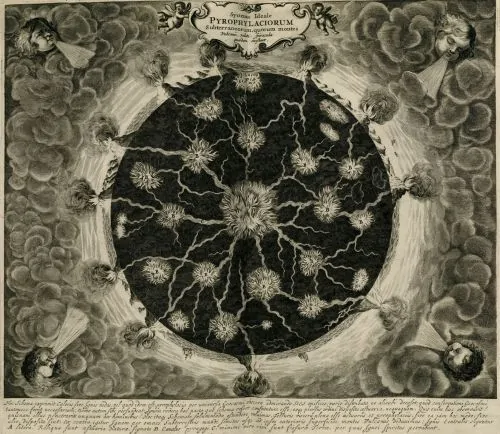
Athanasius Kircher approached subterranean nature through a different combination of evidence and reconstruction. His Mundus subterraneus, in the 1665 edition, connected volcanic activity and other regional phenomena through an extensive architecture of internal reservoirs and passages. Cavities containing fire communicated with volcanic outlets, while underground water systems linked seas with sources beneath mountainous regions. Air participated in the operations of this terrestrial system, helping to account for movements and disturbances whose causes escaped ordinary inspection. Kircher’s illustrations allowed readers to consider these connections together, displaying relations that no single journey could reveal. Their detailed appearance should be understood alongside their explanatory purpose. Mark A. Waddell’s study places the work’s imagery and narrative within Jesuit practices of contemplating probable arrangements of the natural world, recovering an intellectual setting in which visual reconstruction could help readers apprehend unseen causes. Kircher also assembled reports and observations concerning certain places; the global sections gave those dispersed phenomena a proposed physical relationship. His cavernous Earth supplied a setting for interacting processes rather than the independently moving concentric bodies Halley would describe. The comparison establishes the variety of subterranean reconstructions available during the seventeenth century without requiring the assumption that Halley borrowed Kircher’s architecture.
Halley encountered difficulty in extending the analogy between an ordinary magnet and the terrestrial body. In 1692 he emphasized that the lodestones known to him retained their poles in fixed positions within the material, whereas his reconstruction of terrestrial observations required magnetic changes relative to the ground. The compact hardness of such stones made a gradual internal displacement difficult for him to envisage. He also reported that he knew of no fluid substance possessing the magnetic properties needed for his explanation. These statements reveal how the available examples constrained his reasoning. A material could provide a model for Earth’s magnetic action while appearing unable to accommodate the movement he sought to explain. Large displacements within the planet introduced further concerns about the balance of its mass and the stability of its rotation. Accepting a magnetic Earth left unresolved the physical conditions under which its influence could alter. Halley’s revision would have to specify how magnetic matter could change its relationship to the inhabited surface while respecting the restrictions he associated with terrestrial substances.
Four Poles and Two Bodies: Reconstructing the Magnetic Mechanism
Halley’s four-pole arrangement began as an interpretation of the geographical distribution of compass directions. In 1683, he challenged the sufficiency of a single magnetic axis inclined to Earth’s rotational axis, drawing attention to reports of opposed variations at roughly comparable longitudes in northern and southern Atlantic waters. He organized the observations around two northern centers of magnetic influence and two southern ones, assigning each a region in which its effect predominated. These positions remained approximate, as he acknowledged that the available information did not permit their exact geometrical determination. His northern assignments distinguished a pole associated chiefly with European observations from another governing much of the North American region. In the Southern Hemisphere, he likewise separated an American influence from one associated with Asia and the Indian Ocean. The proposed points gave him a framework for discussing how competing tendencies could produce the direction registered by a needle. Their number and locations were conclusions drawn from that framework, with observations at certain places supplying the evidence against which it had to be judged.
Dividing the planet into two separately magnetized constituents gave this arrangement a physical interpretation. Each constituent could possess its own pair of poles, allowing the four terrestrial centers Halley inferred to arise from two magnetic bodies. The outer enclosure carried one pair; an internal globe carried the other. A needle at the surface would respond to their combined influence, with the relative importance of the poles depending on the observer’s position. Halley’s earlier discussion had already allowed one influence to counterbalance another, especially in regions where several had to be considered together. The new construction supplied distinct material bearers for those influences. It also preserved the two-pole organization familiar from ordinary magnets while making the terrestrial system more complicated through the conjunction of separate bodies.
The geometry of their relationship was crucial. Halley placed the internal globe at the same center as the enclosing Earth and gave both the same axis of daily rotation. This rotational axis had to be distinguished from the positions of their magnetic poles, which lay away from it. Otherwise, turning the nucleus around the common axis would not produce the changing geographical relationships his explanation required. He also insisted that the internal component be detached from the exterior. A rigid connection would compel both to turn together and prevent the relative displacement on which the mechanism depended. The intervening “fluid medium” supplied the separation necessary for independent movement, although its precise constitution remained unspecified at this stage of the argument. By keeping the internal mass centered, Halley sought to permit motion without the substantial redistribution of weight that might disturb the planet’s balance. Concentricity performed an immediate explanatory task within the proposal. It allowed him to describe a changing magnetic arrangement inside an exterior whose general position remained stable, while leaving the physical maintenance of that arrangement to be defended separately.
A small inequality between the rotational rates would make the internal poles gradually change position relative to the surface. Halley initially allowed the inner globe to turn either slightly faster or slightly slower than its enclosure, then selected the slower case in developing his interpretation. Both participated in the daily rotation, but the nucleus lagged sufficiently for its poles to appear to migrate westward to an observer carried with the exterior. He conjectured that the original rotational impulse had been imparted to the outside and communicated inward without producing exact equality of speed. That suggestion provided an additional account of the inequality he required, rather than an independent demonstration of its origin.
Choosing which poles belonged to which component involved another reading of the observations. Halley assigned the northern American pole to the enclosure and the northern European pole to the moving nucleus. His principal comparison concerned the relatively slow changes reported around Hudson Bay alongside more rapid alteration in European readings. He considered this difference significant because his American pole lay farther from the rotational axis than the European one; the contrast encouraged him to distinguish their motions instead of treating both as members of a single rotating arrangement. For the southern pair, comparatively slow changes around Java supported his decision to place the Asian pole in the exterior, leaving the American southern pole attached to the nucleus.
The resulting assignments connected the American northern and Asian southern poles to the surface-bearing body, while the European northern and American southern poles moved with the interior. Halley acknowledged the limitations of the geographical evidence, including his lack of reports from important southern waters. Nevertheless, he regarded the comparisons as sufficient to propose an arrangement. The argument proceeded from differences in the behavior of surface needles to differences in the movement of hidden magnetic constituents, with each assignment depending on the explanatory system already adopted.
Local departures required a further distinction within that system. Halley reported that the needle at Paris had remained approximately a degree and a half more easterly than at London, although he thought the general geographical pattern should have produced the opposite relationship. The readings in the two cities appeared to undergo similar changes simultaneously. He attributed the persistent discrepancy to an unequal distribution of magnetic material in the outer enclosure, which could modify the direction produced by the larger arrangement. Such material remained fixed relative to the observer, while the internal globe introduced an influence that altered with time. The mechanism combined lasting regional differences with a changing contribution from below. This division gave Halley a way to accommodate nearby observations that failed to agree exactly without abandoning the wider movement he believed they shared. It did not yet supply a calculation capable of determining the size of each contribution.
Time offered a prospective test of the relationship between the two bodies. If the nucleus moved uniformly relative to an otherwise unchanged enclosure, its magnetic configuration would eventually return to its earlier position, and the associated sequence of variations should recur. Halley attempted a rough estimate of this relative revolution through historical changes in southern Atlantic and Indian Ocean observations. From the reported movement of regions exhibiting magnetic conditions, he conjectured a westward displacement of the American southern pole and suggested a complete period of approximately seven hundred years. This was the time required for the nucleus to recover its orientation relative to the shell, while continuing to participate in Earth’s daily rotation. The estimate depended on inferred pole movement and on records covering only a fraction of the proposed cycle. Halley also recognized that short-range irregularities obstructed an exact mathematical treatment of the changing directions. His construction specified a possible cause of gradual variation and a consequence by which it might ultimately be examined, but it remained far from a complete predictive theory. Its most striking expectation concerned a sequence that no contemporary observer could have followed through an entire revolution.
Saturn beneath the Surface: An Astronomical Precedent
A detached internal globe introduced a danger that the magnetic mechanism alone could not resolve. Even if its movement accounted for changing compass directions, the nucleus still had to remain clear of the surrounding enclosure. Halley anticipated the objection that it might leave its central position and strike the shell, damaging the structure on which ordinary life depended. He also recognized a related challenge to the proposal’s credibility: readers might object that nature supplied no example of such an arrangement. These objections required different answers. An astronomical precedent could challenge the assumption that separated concentric bodies were impossible, while the prevention of collision demanded an explanation of the forces maintaining their relationship. Halley turned to Saturn in an attempt to address both.
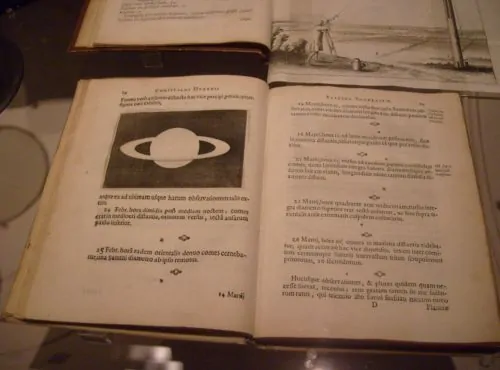
The ring around Saturn had itself become intelligible through an interpretation of puzzling observations. Earlier telescopic views had presented changing appendages whose appearance resisted a consistent explanation. Christiaan Huygens’s Systema Saturnium, published in 1659, explained these forms through a thin ring inclined to the plane of the ecliptic and separated from the planet. A structure retaining its shape could present different profiles as its orientation relative to terrestrial observers changed. Seen obliquely, the ring appeared as an ellipse; viewed nearly edgewise, its breadth became difficult to discern. Huygens brought these appearances into a geometrical account that could relate successive observations and anticipate others. As Albert Van Helden’s work on early telescopes emphasizes, the solution involved reasoning about the physical arrangement responsible for the images, rather than simply receiving an unmistakable picture through the instrument. By Halley’s time, the ring furnished a persuasive example of a substantial celestial structure surrounding another body without being joined to its surface.
Huygens had also considered how such a detached structure could maintain its position. His discussion placed Saturn within a vortex of celestial matter and associated the planet’s center with the tendency of heavy bodies toward it. He argued that the ring’s parts pressed equally toward this center, thereby preserving an arrangement in which the surrounding body remained equidistant from the globe. To make this unfamiliar construction more comprehensible, he invoked an imagined terrestrial counterpart. A continuous arch built all the way around Earth might sustain itself without an external support. The example remained a supposition, but it supplied a recognizable way of thinking about the coherence of a surrounding structure. Read alongside Halley’s later proposal, the passage reveals an exchange of comparisons in both directions. An imagined construction around Earth helped Huygens defend a celestial configuration; the configuration around Saturn subsequently helped Halley defend an imagined construction within Earth. The resemblance between these discussions does not establish that Halley borrowed Huygens’s argument. It does show that the possibility of unsupported surrounding bodies had already entered learned discussion through the interpretation of Saturn.
Halley’s geometrical adaptation was straightforward to visualize. If Saturn’s ring were turned about one of its diameters, he argued, it would describe the concave spherical form he required for the terrestrial enclosure. This was an operation performed in thought, distinct from the motion astronomers attributed to the actual ring. Its purpose was to turn an accepted celestial shape into a representation of the proposed shell. The ring’s relationship with the planet supplied the starting arrangement, while an imagined rotation produced the enclosing surface. What remained to be established was whether the physical properties allowing the first configuration could also sustain the second.
Gravity supplied Halley’s answer to that further question. He maintained that, once the two globes had been adjusted to the same center, the parts of the enclosure would press equally toward the internal body. This equality, he reasoned, should continue until an external agency disturbed it. His explanation then became more emphatic. The nucleus would have to ascend whichever way it departed from the center, overcoming the gravitational tendency that kept it there. The enclosing shell also appeared to him to protect the inner globe against disturbing external impulses. These claims made concentricity seem more than a convenient initial condition. Halley represented it as a position that gravity would preserve, allowing the nucleus to undergo the relative rotation required by his magnetic explanation without wandering into the surrounding material. The apparent regularity of Saturn’s arrangement supported his confidence, although it did not independently demonstrate the terrestrial force relationships he described. The distinction between a balanced position and a position protected against displacement exposes a difficulty in this reasoning. Under inverse-square gravitation, a uniform spherical shell exerts no resultant gravitational force on a body anywhere within its cavity. Newton had established the relevant result in proposition 70 of the first book of the Principia, published in 1687. For the ideal spherical enclosure, cancellation occurs away from the center as well as at it. A nucleus displaced within that cavity would receive no gravitational restoring force from the shell that privileged its former position. The mathematical result does not imply that a perfectly centered, undisturbed arrangement must immediately break apart or that collision is inevitable. It does undermine Halley’s claim that departure necessarily amounted to an ascent resisted by gravity. Magnetic interactions or effects arising from the intervening medium would require their own investigation before they could supply the missing guarantee. This is a comparison between his argument and mathematical resources available in his own period, rather than evidence of a documented contemporary confrontation over the proposal.
Saturn nevertheless served a substantial purpose in Halley’s defense. Its surrounding ring challenged a restriction on the forms that natural bodies could take, giving his readers a concrete case against which to judge an unfamiliar terrestrial arrangement. The transfer depended on selecting features of that case: separation, concentricity, and continued coexistence. Changing the surrounding structure from a ring into a sphere also changed the distribution of matter whose forces had to be explained. The geometrical transformation was easier to accomplish than the corresponding mechanical demonstration. Astronomy had furnished Halley with a precedent that weakened an objection based on strangeness; establishing the security of his internal Earth still required an argument specific to the structure he proposed.
The Moon’s Density and the Argument for Empty Space
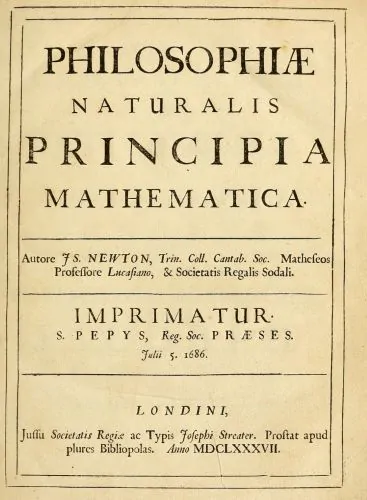
Newton’s estimate of lunar density offered Halley a numerical reason to assign a substantial proportion of Earth’s volume to cavities. In the first edition of the Principia, the Moon’s average density exceeded Earth’s by approximately nine to five. This comparison concerned the amount of matter within equal volumes, rather than the total masses of the two bodies. Halley treated the difference as an indication that the larger globe might contain less material than its external dimensions appeared to allow.
The estimate emerged from Newton’s investigation of the tides, which connected movements of terrestrial water with the gravitational influence of distant bodies. In proposition 37 of the third book, he attempted to determine the Moon’s tide-producing force through its relationship with the corresponding solar effect. The distinction between spring and neap tides supplied observational evidence for that comparison. The combined lunar and solar effects reinforced one another at some configurations and partially opposed one another at others. Newton used reports from near Bristol and from Plymouth, applying geometrical corrections in an effort to separate the contributions. The two sets of observations produced different estimates, and he adopted an intermediate value provisionally, pending more accurate information. He also recognized that ports and channels could amplify the movement of water, so the calculation cannot fairly be described as proceeding in complete ignorance of coastal complications. From the estimated relative forces and the apparent angular sizes of the Sun and Moon, he inferred their relative densities. Connecting that result with his comparison of solar and terrestrial density yielded a lunar-to-terrestrial ratio of 680 to 387, which he expressed approximately as nine to five. Halley drew upon a conclusion reached through several linked stages of physical interpretation and calculation.
His conversion of this ratio into a cavity fraction was readily understandable. Suppose that equal volumes of lunar and terrestrial material had comparable densities, and that the Moon was substantially filled with such material. A terrestrial globe whose average density stood at five against the Moon’s nine could then be represented as containing five-ninths of the matter needed to fill its entire volume at the lunar standard. The remaining four-ninths would constitute the allowance for cavities, provided their contents contributed comparatively little mass. Halley proposed that this space lay within and between the internal spheres. The fraction described an approximate allocation of the globe’s total volume; it did not specify a depth beneath the surface or determine the thickness of an individual shell.
Several assumptions made this interpretation possible. Newton’s comparison supplied average densities, while Halley proposed a reason for their difference. He invited readers to imagine the smaller Moon filled with ordinary terrestrial substances and Earth composed of the same general materials, distributed around extensive intervening spaces. That resemblance of composition was additional to the astronomical calculation. The tidal observations contained no inventory of lunar substances or information about their proportions. Even an accurate comparison of average densities would leave differences in constituent materials available as another explanation. Halley instead made the presumed fullness of the Moon a standard against which Earth appeared deficient in matter. His use of “cavity” also needs to be understood alongside the medium separating his internal bodies. Such regions could contain extremely tenuous matter, and his subsequent discussion assigned them atmospheres capable of serving internal environments. Their contribution to the average density could be small without their being absolute vacuums. A total allowance for low-density space would also leave its distribution unresolved. The same aggregate figure could be divided among differently sized regions and would establish neither their concentricity nor their freedom to move. The lunar comparison offered a possible constraint on the quantity of material in Halley’s construction, while its arrangement continued to depend on arguments developed for other purposes.
The numerical premise eventually proved mistaken. The Moon’s mean density is substantially lower than Earth’s. Halley nevertheless reproduced the estimate available in Newton’s 1687 text correctly. The failure lay upstream of his proposed volume calculation, in the lunar value obtained from the tidal argument. Four-ninths remained a result of the adopted ratio and associated material assumptions, rather than an independently established measurement of subterranean space.
A postscript to Halley’s paper gave the density difference a further application, extending the proposed cavities into a discussion of motion through interplanetary space. He considered the possibility that an aether offered resistance to bodies passing through it and that this resistance accumulated into a perceptible effect over long periods. Under the reasoning he adopted, a smaller body required greater density to experience retardation compatible with that of a larger companion. A partially hollow Earth could help explain how the Moon continued to accompany it, because reducing terrestrial density would alter the relationship between the bodies’ responses to the resisting medium. Halley presented this as another possible use for the cavities, claiming that otherwise Earth might leave its satellite behind. As Dmitri Levitin has emphasized, the argument departed significantly from Newton’s treatment of interplanetary resistance as negligible. Acceptance of a result from the Principia did not commit Halley to every part of its account of celestial motion. His postscript also stopped short of calculating a satisfactory history of the gravitationally coupled Earth–Moon system under the proposed resistance. The construction first advanced to explain magnetic behavior had acquired an additional task; its distribution of matter was now enlisted to preserve a relationship between bodies traveling through space.
Multiplying the Interior: From a Magnetic Nucleus to Nested Worlds
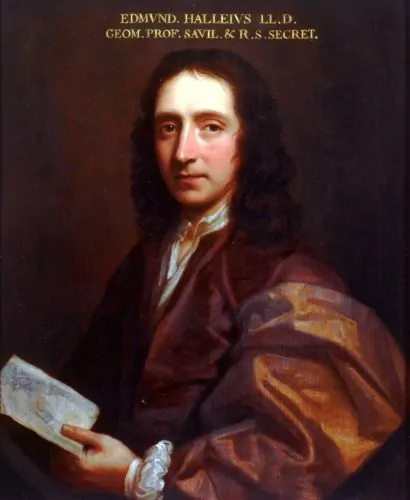
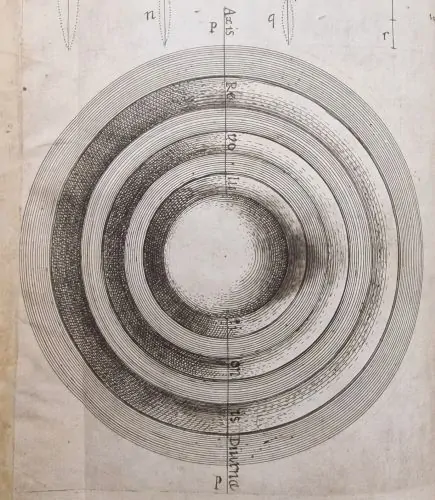
The extra spheres enter Halley’s account after its magnetic problem had already received a possible solution. A detached nucleus and a surrounding shell supplied the two magnetic bodies needed for his interpretation of four poles. Yet the illustration appended to the 1692 paper contained a more elaborate arrangement: Earth’s exterior shell, two additional hollow spheres, and a solid central globe. This enlargement occurred within a single published argument and requires us to distinguish the mechanism Halley initially considered sufficient from the more extensive construction he subsequently invited readers to contemplate.
Read as a section through the proposed Earth, the diagram organized the interior into three substantial enclosing layers surrounding a central ball. Each shell possessed an outward surface, a thickness of solid material, and an inward boundary facing an intervening space. The central body brought this repeated arrangement to an end because Halley expressly designated it solid. Alternating hatching helped readers distinguish the structures, while the line marked p–p established their common rotational axis. Their concentric arrangement meant that each internal body occupied the center of the shell enclosing it; their separation allowed them to move independently. These were more than subdivisions within a continuous mass of terrestrial material, since the spaces between them were essential to their proposed behavior. Peter W. Sinnema’s attention to the relationship between Halley’s exposition and his accompanying schema is useful here. The drawing gathered several propositions into a coherent arrangement that could be inspected at once. It made the additional bodies intelligible as components of one construction, even though neither their individual existence nor their dimensions had been established through magnetic observation.
The names Venus, Mars, and Mercury gave these internal bodies a recognizable sequence of decreasing magnitude. Halley described their sizes as approximately proportionate to those planets, using familiar astronomical objects to specify the scale of unfamiliar terrestrial ones. These comparisons did not place the actual planets underground or require the enclosed globes to reproduce their materials and surface conditions. Instead, the planetary names served as convenient identifiers for bodies whose relative dimensions might otherwise remain difficult to follow. Astronomy contributed something different from the Saturnian precedent: a vocabulary of comparative size through which the reader could distinguish several large structures contained within a still larger Earth.
For the dimensions of the whole arrangement, Halley began with an Earth approximately eight thousand English miles in diameter. He allotted five hundred miles to the thickness of its outer shell and another five hundred miles to the interval separating that shell’s concave surface from the first internal globe. Because these distances occurred on both sides of a diameter, the first enclosed body would measure approximately six thousand miles across. Repeating the same allowance for its shell and the space beneath it produced a second internal body approximately four thousand miles in diameter. One further repetition left a central globe two thousand miles across, corresponding to the solid body Halley associated with Mercury. The resulting construction contained three successive intervals, each five hundred miles deep, between the enclosing shells and the bodies within them. These generous separations provided ample clearance for independent rotation while furnishing the spaces Halley assigned to internal atmospheres. The repeated measurements also made the scheme unusually easy to reconstruct. Once the reader understood the first pair of allowances, the remaining dimensions followed by subtraction. Nevertheless, the numerical regularity belonged to Halley’s chosen arrangement, since he presented no observations that selected five hundred miles as the required thickness of either shell or interval. His measurements supplied a consistent example of how several bodies could fit inside Earth, giving the proposal a determinate scale without demonstrating that nature had adopted those proportions.
Structural survival imposed another requirement upon every hollow shell. Halley associated the concave portions of his arches with magnetic matter, extending his earlier suggestion that mutual attraction could prevent material from breaking loose and falling inward. Magnetism acquired two responsibilities within the enlarged construction: contributing to the behavior of the compass and preserving the integrity of the enclosing bodies. This combination gave the same substance an economical explanatory role, although the ability of magnets to attract and support material did not establish that an arch thousands of miles across would possess the required strength.
Rotation supplied a further connection between the simpler mechanism and the multiplied interior. In describing the diagram, Halley retained a common axis and stated that an outer sphere moved somewhat faster than the one within it. Applied across the nested arrangement, this introduced a succession of slightly different rates, allowing the enclosed structures gradually to change their positions relative to one another. The extension was straightforward to state geometrically, but its magnetic consequences demanded more information than the diagram supplied. Each additional magnetic body raised questions about the position and strength of its poles, the rate at which they moved, and their contribution to the direction registered at any place on the surface. Halley did not assign a separate numerical rotation period to every globe or work through their combined effects as a complete system. His original division between an exterior magnet and an interior magnet remained more closely connected to the four poles he believed the observations supported. The elaborate construction preserved the principle of differential rotation while leaving much of the work needed to turn its additional components into a determinate magnetic explanation unfinished.
An earlier passage in the paper had already allowed for an increase in the number of internal spheres. Halley proposed that, if later observations failed to show the expected recurrence of magnetic variations, investigators should conclude that more spheres and more than four magnetic poles were involved. This was a provision for revising the explanation in response to future evidence, accompanied by an acknowledgment that the available observations could not settle the number of bodies. It also shows why the illustrated arrangement should not be treated as an observational discovery of precisely three internal globes. The hypothesis permitted multiplication before it possessed the means to determine how far that multiplication should proceed.
With three intervening atmospheres, the proposal also changed the character of the spaces that Halley had introduced to permit motion. Each interval lay between the outward surface of an enclosed globe and the concave underside of the shell above it, producing a succession of extensive settings with their own ground and overhead boundary. Venus, Mars, and Mercury could function as more than convenient labels for magnetic masses; they identified additional surfaces to which the attributes of a world might be assigned. Halley’s specification of an atmosphere for the first enclosed globe made this environmental interpretation explicit, although its depth alone could establish little about the conditions within it. The multiplication of shells increased the number of possible places for living beings without supplying corresponding evidence that those places existed or could sustain them. This distinction matters because a habitable interior required a different kind of argument from one concerning the movement of magnetic matter. By assigning size, separation, and surrounding space to his subterranean globes, Halley gave that further inquiry definite objects, leaving their illumination and suitability for life to be explained.
Light without Sunlight: Making the Internal Worlds Habitable
Halley conceded that the Sun could provide the enclosed globes with neither light nor heat. His proposed spaces lacked the most conspicuous source of the conditions familiar at Earth’s surface. Although he treated darkness as an objection to the production of animals and plants, he refused to equate the absence of sunlight with the absence of every possible source of illumination. His response made the character of light itself a problem, asking how much a philosopher could infer about environments beyond the reach of ordinary experience.
Before identifying substitute lights, Halley explained why unfamiliar conditions should leave open the possibility of unfamiliar inhabitants. Earth’s recognition as a planet encouraged comparisons with other celestial bodies, which he regarded as reasonably supposed habitable even though their animals remained unknown. This placed his discussion within the broader debate over the plurality of worlds, whose development Steven J. Dick has traced through the changing relationship between astronomy and assumptions about life elsewhere. Halley then turned to differences that readers could observe much closer to home. Fish lived in surroundings unsuitable for terrestrial animals, while flying creatures occupied the air in ways that would seem incredible without everyday experience. Such examples made the observer’s familiarity with an environment an unreliable measure of the limits of living nature. The argument allowed him to acknowledge ignorance about subterranean organisms while resisting the claim that their existence was inherently absurd. His language specified neither human inhabitants nor recognizable societies: the diversity of known animals supplied grounds for admitting possibilities whose biological specifics he left undetermined.
One proposed source of illumination was the intervening medium itself, which Halley suggested might remain luminous after the manner of ignes fatui. These wandering lights, traditionally reported above marshy ground, furnished a terrestrial comparison for brightness appearing without the ordinary presence of the Sun. Their usefulness depended on the reported phenomenon rather than on a demonstrated account of its production, and Halley supplied no composition or process that would make an entire subterranean atmosphere glow continuously. Nevertheless, light produced by unusual materials was already a subject of experimental investigation. Robert Boyle’s experiments with shining wood and fish, published in 1668, examined how their luminosity changed when air was withdrawn and admitted again. These investigations gave natural philosophers luminous substances to manipulate, making the production of light under unexpected circumstances an experimental question. Boyle’s work provides contemporary context for Halley’s suggestion, although Halley did not identify those experiments as its source. The difference in scale remained considerable. A fragment of luminous wood could be brought into a receiver and repeatedly examined, whereas the proposed atmospheric medium had been assigned a property that no observer could test directly. Extending such phenomena to an enduring source of illumination throughout an enclosed world required assumptions about persistence and extent for which the comparison supplied no measurements. Even so, the existence of diverse luminous effects gave Halley a reason to challenge the confidence with which a critic might declare every sunless environment necessarily dark.
A separate suggestion transferred the comparison from terrestrial lights to the luminous surface of the Sun. Halley proposed that portions of the concave arches might shine with a substance resembling whatever invested that celestial surface. This treated luminosity as a property that could potentially occur in another location, allowing the enclosing material to contribute light to the globe beneath it. The proposed shining patches would occupy positions overhead, making the physical boundary of an internal region serve an additional environmental function. Halley offered no account of their distribution or brightness, and his wording preserved the suggestion as one among several alternatives. He also admitted the possibility of other internal luminaries whose nature remained entirely unknown. Declaring such sources impossible, he argued, would display a confidence unbecoming a philosopher faced with the incomplete knowledge of light production. This appeal to intellectual restraint limited the force of an objection, although it could establish neither the existence of a luminary nor its capacity to support living beings. The published account left readers with several ways of imagining illumination and no settled explanation of which, if any, operated underground.
Literary recollection supplied a more vivid precedent. Halley quoted the sixth book of Virgil’s Aeneid and the second book of Claudian’s De raptu Proserpinae, where lower regions possessed celestial lights of their own. His correction of “infernal” to “internal” redirected the association toward the physical spaces under discussion. Patricia Fara’s work on the fluid relationships between natural philosophy and imaginative writing helps situate this conjunction of astronomical speculation and classical poetry. Halley nevertheless expressly denied that the quotations constituted an argument, preserving a distinction between an evocative description and reasons for accepting a claim about nature.
Warmth received less development, although evidence from Halley’s earlier presentation prevents us from treating it as an overlooked difficulty. As Dmitri Levitin notes, the record of his address to the Royal Society on November 25, 1691, included an appeal to the “continuall temperature deep underground.” That statement offered reassurance that subterranean conditions could possess a thermal steadiness independent of immediate exposure to sunshine. It supplied neither a temperature for the proposed inhabited regions nor an explanation of how their conditions would be maintained across the extensive spaces he imagined. His suggestions about illumination introduced further differences from ordinary terrestrial experience. A continuously luminous atmosphere, for example, would not automatically reproduce the alternation of daylight and darkness associated with Earth’s rotation. Halley did not investigate how organisms might live under such circumstances, leaving the relationship between their requirements and their surroundings largely unspecified. His appeal to the diversity of familiar creatures allowed considerable latitude in imagining that relationship, while providing little guidance for choosing among possible inhabitants. Habitation remained an invitation to consider what unfamiliar arrangements might permit, with the physical description stopping well short of an account of how life there would actually proceed.
The Purposes of Creation and the Problem of Religious Motive
The closing explanation of Halley’s 1692 paper identifies an audience for its inhabited worlds. He had introduced their possible occupants “designedly,” he wrote, for readers inclined to ask cui bono and to be persuaded by arguments from final causes. Such arguments concerned the purposes an arrangement served, giving its existence a justification beyond the physical processes responsible for its operation. Halley’s acknowledgment makes religious reasoning an explicit part of his presentation, while leaving historians to determine how far that presentation discloses the convictions that guided his investigation.
The appeal to divine wisdom gave the enlarged interior a purpose proportionate to its extraordinary extent. Halley questioned whether Earth’s enormous quantity of matter should do little more than support the surface already inhabited by familiar creatures. A provident arrangement might employ that material to furnish additional living surfaces, increasing the opportunities for habitation within the available volume. His comparison was strikingly domestic. People crowded into cities constructed several stories above one another, accommodating more inhabitants on the same ground. The analogy made the multiplication of terrestrial worlds resemble an intelligible economy of space, with divine ingenuity accomplishing on a planetary scale something human builders practiced under ordinary constraints. Halley nevertheless qualified the enlargement by the convenience and security of the whole construction, so his argument did not require an unlimited multiplication of shells. Elsewhere, the same confidence in a wise Creator supported his expectation that apparent structural difficulties might admit natural solutions. The intricate provisions sustaining individual organisms encouraged him to expect comparable ingenuity in the materials composing their planetary habitation. His proposed mineral processes for sealing breaches belonged to a world whose ordinary substances had been suitably arranged for preservation. Divine purpose supplied a reason to expect that such provisions existed, even where the composition responsible for them remained conjectural.
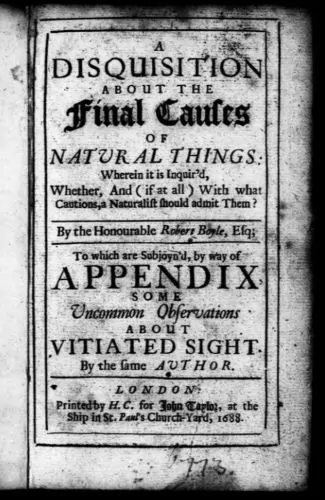
A distinction between purposes and physical operations was available within contemporary natural philosophy itself. Boyle’s A Disquisition about the Final Causes of Natural Things, published in 1688, defended inquiry into intended uses while warning that it should never displace investigation of efficient causes. His watch analogy made the distinction concrete. Recognizing that an instrument existed to tell the time did not explain the construction and interaction of its parts. Halley could similarly assign magnetic matter a protective purpose while still owing readers an account of the attractions through which that protection worked. John Ray’s The Wisdom of God Manifested in the Works of the Creation, published in 1691, offered another prominent expression of reasoning from natural arrangements to divine intelligence. These publications establish a contemporary setting in which references to providential design could carry philosophical weight, although they do not by themselves demonstrate borrowings by Halley.
Sinnema interprets Halley’s attachment to the hollow Earth through his commitment to a divinely ordered natural economy. This reading gives proper weight to the argument that material should furnish the greatest practicable accommodation for living creatures. It also explains why an interior containing additional inhabitants could seem more satisfactory than one whose significance ended with its magnetic effects. Yet Halley’s express identification of readers receptive to final causes introduces a further consideration. An argument could reflect convictions he accepted while receiving emphasis because of its anticipated persuasive force.
Oxford politics made religious reputation a pressing concern during the development of the proposal. In 1691 Halley sought the Savilian Professorship of Astronomy following Edward Bernard’s decision to relinquish the chair. Writing to Abraham Hill on June 22, he asked for intervention with Archbishop John Tillotson to delay the election long enough for him to answer an accusation that he asserted the eternity of the world. A beginningless cosmos challenged the doctrine of creation, making the allegation significant for an appointment overseen by ecclesiastical authorities. The letter establishes that Halley knew the charge threatened his prospects; it does not establish that he held the position attributed to him. The Royal Society recommended his scientific qualifications in November, but David Gregory had been elected by Christmas Eve. During the intervening weeks, Halley presented his magnetic hypothesis on November 25 and discussed divine provision for internal illumination on December 2. The expanded account was ordered for publication on January 27, 1692, after the appointment had been settled. This sequence prevents a straightforward identification of the published paper with an attempt to secure an undecided election, although concerns about reputation could readily survive an unsuccessful candidacy. The circumstances made professions of providential order potentially useful, but usefulness alone cannot establish that those professions were insincere or explain the origin of the magnetic investigation.
The interpretation of Halley’s religious position has itself undergone substantial revision. Simon Schaffer’s influential 1977 study sought consistency across his public and private work, emphasizing the application of natural-philosophical criteria to questions that also carried theological ramifications. Levitin subsequently challenged a crucial part of that account through a different reading of Halley’s lecture of October 18, 1693. The disagreement concerns whether Halley acknowledged a continuing absence of a natural demonstration that Earth had begun and would end, or announced an investigation intended to supply the demonstration previously lacking. Levitin favors the latter interpretation, supported by the Royal Society’s contemporary summary of the lecture. On that reading, Halley hoped to establish a conclusion compatible with creation through physical reasoning, rather than declaring such a conclusion permanently unsupported. Levitin also distinguishes evidence that Halley entertained an Earth much older than conventional biblical chronologies allowed from evidence of belief in its eternity. Departures from prevailing interpretations of Genesis could be considerable without amounting to the doctrine invoked against him in 1691.
Reading the hollow-Earth paper through these distinctions allows its theology to be taken seriously without making it the explanation for every feature of the hypothesis. Confidence in divine provision helped Halley answer objections concerning the preservation and usefulness of the enclosed globes. His comments about readers show that he also recognized differences in what audiences would find persuasive. Neither observation requires a choice between an entirely candid expression of private belief and a calculated performance emptied of conviction. More securely, the text shows how an expectation about creation could enlarge the range of arrangements worth considering. Additional surfaces appeared valuable because they might support lives inaccessible to human observation. That expectation encouraged assent to features for which magnetic measurements supplied little guidance. The historian can identify this contribution with greater confidence than any single religious motive behind Halley’s work, locating the force of providential reasoning in the claims it helped him advance.
Publishing an Interior: Diagrams and Provisional Knowledge
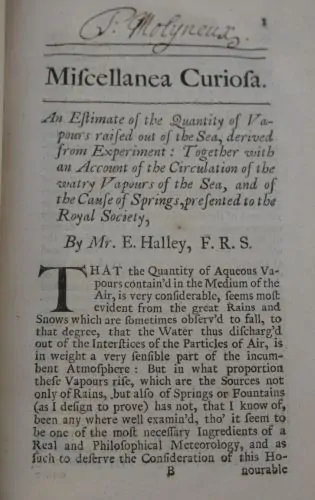
Publication in the Philosophical Transactions gave Halley’s proposal an audience beyond those present at the Royal Society’s meetings. The journal maintained close connections with the Society, whose officers and proceedings supplied much of its material, while responsibility for compilation still rested substantially with individual editors. Halley had himself performed that work as the Society’s clerk, participating directly in the arrangements through which natural-philosophical investigations reached print. An instruction to publish his paper documents a decision to circulate its arguments, without establishing collective agreement that the proposed interior existed.
Halley prepared readers for an unusual proposal through an account of intellectual frustration. He recalled having abandoned an investigation that seemed unlikely to succeed before an accidental conversation suggested a way forward. This introductory narrative presented the hypothesis as an answer to difficulties encountered during sustained inquiry, giving its novelty a history within his own work. He then acknowledged that it might appear “Extravagant or Romantick,” anticipating a judgment that could prevent readers from considering the explanation seriously. His request was for a suspension of censure until they had examined the strength and number of the arguments supporting it. The sequence mattered. Magnetic observations established the problem before the discussion introduced increasingly unfamiliar arrangements beneath the surface. Readers were asked to assess the accumulated case, allowing considerations developed later in the paper to affect their judgment of a supposition that might initially seem unacceptable. Near the conclusion, Halley also challenged dissatisfied readers to acquaint themselves with the observations and offer a simpler explanation, or at least one they considered less absurd. That challenge gave his conjecture a comparative standing, since its adequacy would partly depend on the alternatives available for explaining an acknowledged phenomenon.
The engraving made the proposal easier to discuss by providing a common visual reference for its otherwise inaccessible relationships. A reader could return from a statement to the same figure, checking how an assigned property or motion belonged within the arrangement. Yet the verbal commentary repeatedly marked the author’s responsibility for what the image displayed. Halley wrote that he supposed particular materials and allowed particular dimensions. Those expressions identified choices entering the construction, qualifications that the finished lines could not communicate by themselves. The figure required its accompanying prose to establish the standing of its contents. Considered together, they offered a representation whose components could be examined separately, allowing a critic to question an assumption without losing track of the larger proposal.
The objections Halley rehearsed also require careful identification. His expectation that critics would challenge the construction records difficulties he anticipated, rather than a transcript of responses received after publication. Likewise, his opening statement that an earlier discourse had been favorably received referred to the magnetic account preceding the hollow-Earth proposal. Reading either passage as evidence of the new hypothesis’s actual reception would turn Halley’s management of his argument into an unsupported account of what other people thought.
Provisionality nevertheless involved more than the careful wording of individual claims. Halley expressly left later investigators the authority to revise his explanation, recognizing that the temporal reach of the proposed motions exceeded the history of dependable observations available to him. His own contribution would become part of an inquiry whose decisive comparisons might belong to people he could never meet. This gave the preservation of observations of importance. Records needed to retain enough credibility for distant successors to use them against expectations advanced in the present. His appeal for observations to be communicated to the Royal Society assigned an institution the task of gathering material that scattered individuals could not assemble within one lifetime. Print performed a complementary function by preserving an identifiable statement of the explanation those observations might eventually challenge. Halley called his proposal a “rough Draft” and made further refinement conditional on a favorable reception, acknowledging that the published account represented a stage in its development. Such language should not automatically be taken as a precise measure of how readily he would abandon the idea, since a declaration of revisability could also encourage readers to grant it a hearing. But it did leave a public record that the author had invited correction, making subsequent amendment compatible with the terms under which he first circulated the proposal.
The paper’s appearance in the second edition of Miscellanea Curiosa in 1708 shows how republication could place those qualifications within a more confident presentation. The collection assembled selected investigations from the Society’s extensive published proceedings, promising to bring valuable work to readers who might otherwise overlook it. Its prefatory address asserted that the collected theories and discourses had already passed the judgment of the learned world and had been acknowledged as satisfactory accounts of nature. That assurance concerned the collection as a whole; it cannot serve as independent evidence that Halley’s subterranean globes had won general acceptance. Within this promotional setting, his account retained its admissions of uncertainty and its invitation to future examination. A reader encountered two distinct assessments of its standing: the compiler’s recommendation of an established contribution and the investigator’s presentation of an unfinished explanation. The reprint documents continued selection and availability, giving the argument another setting in which it could be read and evaluated. It also illustrates how a conjecture could acquire the authority of a collected scientific work while continuing to state, in its own text, that important questions remained unresolved.
Mapping the Surface: Magnetic Voyages and Their Evidential Limits
Naval support gave Halley an opportunity to conduct the extensive observations he had urged others to supply. In 1698 he received command of the Paramore for an expedition whose instructions included improving knowledge of longitude and compass variation. These objectives connected his investigations with the practical concerns of an Admiralty responsible for ships navigating distant waters. The resulting voyages made a substantial magnetic survey possible, although the observations required for navigation would not necessarily resolve the questions Halley had raised about Earth’s internal construction.
The first expedition demonstrated how readily the production of scientific knowledge could depend on circumstances outside the investigator’s control. The Paramore began its outward passage in the autumn of 1698, but unfavorable conditions delayed its departure from the English coast until late November. Slow progress and the need to replenish water subsequently disrupted Halley’s intended southern itinerary. Relations with Lieutenant Edward Harrison also deteriorated, producing a dispute over command that Halley described bitterly in correspondence with the Admiralty. His letter from Plymouth on June 23, 1699, explained the return through both the advancing southern winter and the damage Harrison’s conduct had done to his authority. Treating the voyage simply as a mutiny would obscure the combination of difficulties recorded by Halley himself. A second expedition, beginning in September 1699 and continuing until September 1700, achieved a much more extensive passage through the Atlantic. It carried the survey beyond fifty-two degrees south, where enormous bodies of ice complicated the interpretation of what appeared on the horizon and contributed to Halley’s decision to turn northward. The route also took him through widely separated Atlantic regions, extending the geographical range of observations gathered under his direction. A third voyage in 1701 concentrated on the English Channel, where the study of tides pursued another connection between natural philosophy and the requirements of navigation.
A magnetic observation acquired geographical significance only when its position could be established. Halley’s records joined readings of compass variation to the work of determining where the vessel or observing station lay. Latitude could be obtained astronomically, while longitude frequently depended on reckoning from previous positions through estimated courses and distances. An entry concerning Fernando de Noronha, for example, recorded a variation observed ashore and separately identified longitude as obtained by reckoning from London. These distinctions matter because uncertainty in the placement of an observation differed from uncertainty in the angular reading itself. A misplaced position could distort the geographical pattern assembled from otherwise useful compass measurements, making the chart dependent on the quality of both magnetic observation and navigation.
The Atlantic chart published in 1701 transformed those measurements into a form that mariners could consult across a broad geographical area. Its principal innovation lay in curves connecting places assigned the same compass variation, now generally called isogonic lines. A line representing ten degrees of westerly variation indicated that the compass departed by that amount from geographic north at the places through which it passed. The distinguished line of no variation separated regions of easterly and westerly departure. These curves represented equal measured values; they were neither the vessel’s tracks nor paths traced by magnetic forces. Halley explained that a navigator could use the chart to allow for the compass’s departure when correcting a course, especially when cloudy weather prevented a fresh astronomical determination. Converting scattered observations into continuous curves nevertheless required judgments about the intervening regions. Lori L. Murray and David R. Bellhouse have investigated how the chart might have been constructed, emphasizing that Halley left no explanation sufficient to establish his exact procedure. Their reconstruction explores methods available to him, but the historical uncertainty remains. The finished engraving preserves the result more completely than the decisions through which individual readings became a continuous geographical pattern.
The date attached to that pattern was essential to its meaning. Although the Atlantic chart appeared in 1701, it represented compass variation associated with the year 1700. Halley explicitly warned that continuing changes would eventually require alteration of the arrangement shown, so a discrepancy encountered later could reflect the passage of time as well as an imperfect original observation. The chart was useful as a dated account of conditions, with its future revision built into the instructions for reading it.
A world chart issued in 1702 enlarged the geographical presentation beyond the waters surveyed during the Paramore expeditions. Its additional coverage depended on information extending beyond Halley’s own Atlantic routes, bringing the problem of evaluating other observers back into the finished work. Yet the broader map did not pretend to possess equally adequate magnetic information everywhere. In an inscription over the Pacific, Halley explained that he had declined to draw its curves because accounts were lacking. The ocean traditionally called the South Sea remained a conspicuous limit within a chart bearing a global title. This was an impactful choice about what the representation could responsibly include. Familiar coastlines could be engraved even where the magnetic information needed for comparable curves was insufficient. The absence of lines made that difference visible, rather than allowing the geographical completeness of the underlying map to imply completeness in the phenomenon being mapped. Compared with the speculative freedom exercised in constructing his terrestrial interior, the restraint here arose from a more immediate task, in which specific curves were offered for navigators to compare against readings at sea. Their usefulness depended on geographical accuracy that could be checked at the places represented.
The surveys supplied a stronger description of the phenomenon any magnetic explanation needed to address. They did not directly establish the detached shells or inhabited regions proposed in 1692, and their short duration could not disclose the many-century revolution Halley had conjectured. To make the chart a discriminating test of his mechanism would have required sufficiently definite predictions from the positions and strengths of the proposed magnets, followed by comparison with the observed directions. The published curves supplied no such demonstration of the nested arrangement. Their practical success cannot be transferred automatically to every claim in the earlier account of the interior. Equally, their limited power to identify that construction should not diminish the observational achievement. Mariners could correct courses without settling the source of the magnetism involved. Halley had produced records against which subsequent explanations could be judged, giving future investigators grounds for retaining his observations while revising the causes he assigned to them.
The Aurora of 1716: Observing an Unexpected Sky
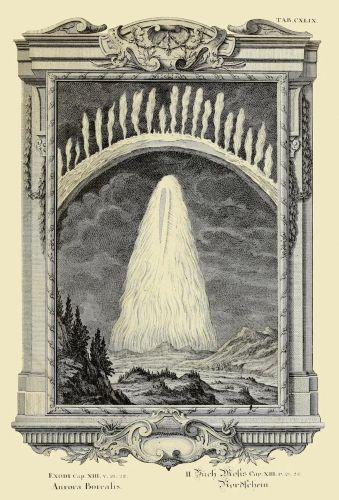
On the evening of March 6, 1716, Old Style, corresponding to March 17 in the Gregorian calendar, an extraordinary display of light appeared across British skies. For Halley, this was his first personal encounter with a phenomenon he had long wished to observe. The Royal Society received numerous reports and asked him to prepare a general account alongside an explanation of its appearances. His resulting paper assembled an event that had astonished experienced observers, whose knowledge of the heavens had not prepared them for its rapidly changing forms.
The opening spectacle reached Halley through other people’s descriptions. According to the reports he collected, luminous streaks began rising from the northeastern horizon around seven o’clock, emerging above a dusky region edged with reddish-yellow brightness. The illumination spread westward along the northern sky, while some rays appeared to approach one another overhead, briefly producing what Halley called a corona. He regretted missing this early phase. He had been visiting a friend and received no notice of the display until between nine and ten. Looking through windows facing south and southwest, he initially encountered an unusual illumination that made the smaller stars difficult to distinguish. Soon afterward, he moved to a position commanding the northern horizon, where the spectacle assumed a different appearance. Two roughly horizontal luminous bands remained visible while shorter columns appeared and vanished between them, changing too quickly for him to determine whether they rose or descended. A conspicuous, pointed beam subsequently traveled westward across the circumpolar stars. After eleven, the cold encouraged him to return home, but he continued watching from an upper window until nearly three in the morning. By then, much of the activity had subsided into a comparatively persistent northern brightness, punctuated by brief fluctuations. His published chronology combined testimony about a missed beginning with observations made from several positions during the later hours.
Witnesses described the lights through objects and spectacles they already knew. Halley recorded comparisons with the interior of St. Paul’s dome and with shimmering illumination reflected from disturbed water, using these analogies to communicate forms that ordinary astronomical terminology could not adequately convey. William Whiston’s separate collection included accounts resembling armies in motion, and Halley himself acknowledged how the sudden columns might suggest a battle. Fara’s study of the display cautions against treating such descriptions as transparent evidence of a single popular response. A comparison could describe an appearance without necessarily asserting its prophetic meaning. Halley’s own expressions of astonishment also prevent an easy division between an unmoved philosopher and an exclusively frightened public.
Historical comparison qualified the impression that an entirely new occurrence had entered the heavens. Halley consulted the accounts of William Camden and John Stow concerning lights seen during two successive November nights in 1574, finding recognizable similarities to the recent spectacle. He also examined continental descriptions, including Michael Maestlin’s reports of repeated appearances in Germany around 1580. These sources allowed unfamiliarity within an observer’s lifetime to be distinguished from the absence of earlier examples. More recent records complicated any simple narrative of a long disappearance. Halley included observations from 1707 and a brief display reported near London in 1708. He recognized that weather and moonlight could prevent an occurrence from being noticed, while the uneven survival of descriptions imposed another limitation upon historical comparison. Reports of the 1716 event nevertheless gave him evidence of an extensive geographical reach, stretching, as he understood it, from western Ireland toward the borders of Russia and Poland. Their distribution made a merely local occurrence difficult to sustain as an explanation of the whole display. The observational problem included both a succession of changing appearances and the need to understand why related phenomena had been reported over such widely separated places.
Determining where the lights stood above Earth proved harder than establishing that they had appeared. Halley used familiar stars to describe their positions and noted that stars remained visible through regions initially resembling dark clouds, which he interpreted as clear sky rendered unusually black by the neighboring brightness. Such observations helped him assess appearances, but they supplied no dependable measurement of height. The prominent moving beam suggested a possible method. Had observers in London and Oxford recorded its position among the stars at precisely the same moment, their differing views might have permitted a geometrical determination of its distance. The necessary coordinated observations had not been made, and Halley acknowledged that the event had caught astronomical observers unprepared. He proposed a specific procedure for future displays, asking observers to adjust their clocks for differences of meridian so that their records referred to a common apparent time at London. At exact half-hour intervals, they should note conspicuous features, especially the bearings of tall beams likely to be visible from distant stations. Astronomy supplied a prospective means of measuring the unfamiliar appearance, while the omissions of that night prevented the proposed operation from being completed. The aurora had become a richly described occurrence whose position in space, and important constraints upon its physical explanation, remained uncertain.
Magnetic Light and the Return of the Hollow Earth
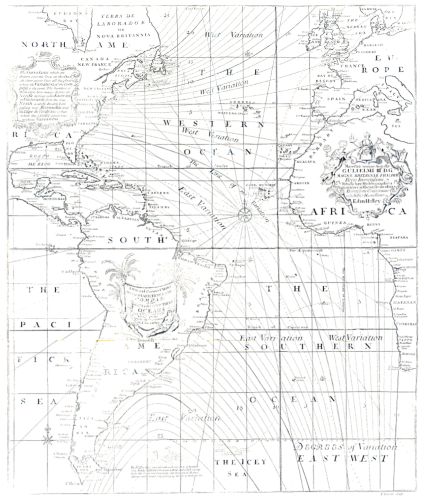
Halley’s first proposed cause of the aurora belonged to an existing explanation of subterranean disturbances. Water encountering underground fires might produce luminous vapors, which could escape through Earth’s pores without accumulating sufficient force to cause an earthquake. He supported the possibility of shining vapor by recalling an experiment involving heated gunpowder fumes that he had witnessed at Oxford. The geographical extent of the recent display seemed too great for such an eruption to explain, while its northern predominance required a more specific account of where the luminous material appeared.
Magnetism offered Halley a substance whose supposed behavior could operate across these larger distances. He envisaged exceedingly fine material circulating through Earth and around it, passing through solid bodies that would obstruct ordinary vapors. Magnetic action through intervening substances supplied grounds for imagining such penetration, although the particles themselves remained invisible. Descartes had previously proposed streams of specially shaped particles adapted to the pores through which they traveled, and Halley acknowledged that account while declining to defend its detailed sufficiency. Instead, he directed attention to a demonstration using a spherical magnet and steel filings distributed around it. Gentle tapping allowed the filings to arrange themselves in recognizable patterns, forming curves whose orientation changed with their position relative to the magnetic poles. The apparatus, which he indicated could be demonstrated using materials in the Royal Society’s repository, made those arrangements available for examination. To Halley, they displayed the courses followed by circulating magnetic matter, providing a model that could be transferred from the magnet to Earth. What the experiment directly exhibited was the disposition of the filings; the continuous passage of invisible atoms through the spaces they marked remained an interpretation of that disposition. Its explanatory attraction lay in giving the terrestrial phenomenon an organized circulation extending beyond the solid body from which it proceeded.
Producing light required an additional supposition, since the magnetic circulation was ordinarily imperceptible. Halley suggested that an unusual concurrence of circumstances might occasionally make its material luminous, perhaps through an increase in density or speed. Bodies rendered electrical by vigorous rubbing provided an analogy for matter emitting light under some conditions. He also allowed a different possibility. Magnetic effluvia might carry other light-producing particles out of Earth, rather than becoming luminous themselves. These alternatives left the mechanism of illumination unsettled, but they gave the persistent magnetic circulation a way to generate an intermittent visible appearance. Nothing in this argument required friction between the rotating internal globes, whose relative motions belonged to his earlier explanation of changing compass directions.
The proposed circulation supplied Halley with several ways to connect the aurora’s appearance to the organization of terrestrial magnetism. He associated reports from Greenland and Iceland with the position of the magnetic poles, recognizing that geographical proximity to the rotational pole did not alone determine where the lights should be prominent. The changing inclinations of curves around the spherical magnet also offered a comparison for luminous beams standing nearly upright in some directions and leaning in others. Geometry and perspective carried further explanatory weight. Beams that appeared pointed might possess approximately parallel sides, with their apparent convergence arising from the same principles that made the borders of a straight avenue seem to meet in the distance. Halley nevertheless treated the early corona partly as a physical concourse of effluvia, whose mixing could produce a strong, wavering illumination. He even proposed that its greater height might have carried it beyond Earth’s shadow, allowing direct sunlight to contribute to the colors reported by witnesses. His account admitted a limited solar role alongside the light generated by the terrestrial material. More ambitiously, he interpreted westward movement among the beams as an effect of the rotating observer moving eastward beneath rarefied matter that failed to keep pace with Earth. This interpretation made the aurora an argument for terrestrial rotation, although it depended on assumptions about the material’s motion at heights he had been unable to determine.
Within this magnetic explanation, Halley briefly reaffirmed his earlier terrestrial architecture. Earth might be considered one great magnet, he wrote, or more properly two, with one enclosing the other as a shell enclosed its kernel. Yet he immediately added that “to our present Purpose the Result is the same.” That qualification establishes an important limit upon the connection. The circulation invoked to explain the aurora could operate in his argument without requiring the detached internal globe. The phenomenon gave him an opportunity to recall the hollow Earth, but its principal explanation did not depend upon that construction.
A more specific return to an illuminated interior appeared near the paper’s conclusion, accompanied by a fresh astronomical precedent. Halley referred readers to the opening contribution in the same issue of the Philosophical Transactions, his account of nebulae or luminous patches observed among the stars. There he interpreted extended celestial brightness as evidence of a medium shining through considerable regions of space. The absence of a discernible central illuminating body in some appearances, together with the irregular forms of others, encouraged him to regard their luminosity as a property of the distributed material itself. These observations had implications beyond the classification of telescopic objects. Halley explicitly connected light existing without an illuminating Sun to the Mosaic account of light preceding the solar luminary. In the aurora paper, the same interpretation made a shining medium between terrestrial globes seem less exceptional. Astronomy had supplied another resource for describing the interior, now through observations of extended luminous matter rather than through the dimensions or arrangement of planetary bodies. The inference nevertheless contained two separate judgments. Halley first interpreted what the telescopic patches consisted of, then proposed that material with comparable properties might occupy an entirely different environment underground. The luminous appearances were observed; their constitution, and the placement of similar matter beneath Earth’s surface, required further reasoning.
If such a medium existed within the hollow Earth, Halley suggested, rare escapes through the enclosing cortex might furnish material for an aurora. This preserved the proposed permanent illumination of the internal regions while allowing occasional outward manifestations. He further reasoned that Earth’s flattened polar figure made its cortex thinner near the poles and more readily penetrated there. That conclusion depended on assumptions about the inner boundaries of the shell, since the exterior figure alone could not establish how its thickness varied. Halley gave this closing suggestion less argumentative weight than the preceding magnetic discussion, expressly cautioning readers against pressing the “conceit” beyond what it could support. Its conditional form matters. An internal reservoir could contribute luminous matter if the proposed cavity and its contents were granted. The qualification leaves that subterranean source as an additional possibility within an auroral explanation that Halley had already stated could proceed without deciding between a single terrestrial magnet and his enclosing bodies.
Did Astronomy Explain the Interior or Make It Easier to Imagine?
The following video from “EadsyAstronomy” is a brief biography of Edmond Halley:
Astronomy may have contributed less to the credibility of Halley’s interior than the preceding discussion suggests. Changing compass observations supplied the problem, while his interpretation of them suggested distinct magnetic bodies capable of relative movement. Celestial comparisons could then help defend an architecture already imaginable through magnetic reasoning. The published paper records how Halley justified his construction to readers; its sequence cannot securely establish how indispensable those comparisons were to its conception. Their prominence in the exposition could encourage a historian to overstate their explanatory importance.
More substantially, the astronomical materials did not constitute a single body of evidence for the proposed interior. Saturn supplied an example of separated matter sharing a center, but an example establishes little unless the properties responsible for its behavior also apply to the new case. The lunar density estimate had a different status; it introduced a numerical premise that could support terrestrial cavities only after additional assumptions about composition and the Moon’s solidity had been accepted. Even under those assumptions, a calculated deficit of matter would leave multiple possible distributions of that matter inside Earth. The luminous regions discussed in 1716 addressed another difficulty by suggesting that illumination need not depend upon direct sunlight, without locating such a substance beneath the ground. Each comparison answered a limited objection to some part of Halley’s construction. Their accumulation could make the account more comprehensive while leaving its distinctive architecture weakly determined. An argument that removes several reasons for rejecting a hypothesis has achieved something significant, especially when the proposed region cannot be visited, yet it has not necessarily supplied a positive reason to prefer that hypothesis over competing explanations. The considerable range of Halley’s astronomical reasoning should invite scrutiny of what each inference established, rather than allowing the apparent convergence of its conclusions to substitute for that assessment.
Newtonian gravitation provides a demanding test because it brings the criticism into Halley’s own intellectual setting. The shell theorem already available in the 1687 Principia gave a uniform spherical shell no net gravitational attraction upon a body wholly within its cavity. Gravity would supply no restoring force to return a displaced nucleus to the common center. An initially concentric arrangement might persist under ideal conditions, so the theorem does not establish the impossibility of every hollow configuration. It nevertheless undermines the claim that the proposed distribution of matter would itself secure the position Halley needed. Constructing a spherical surface from a ring could succeed geometrically without transferring a workable mechanism of stability. This was a mathematical vulnerability available to contemporary scrutiny, although its availability alone does not establish that a contemporary critic actually pressed it against Halley. Historical assessment can identify a serious weakness through resources accessible to him, without importing the discoveries of modern geomagnetism.
The auroral discussion also limits how far explanatory success could strengthen the earlier proposal. Halley’s acknowledgment that the immediate magnetic explanation worked with either one terrestrial magnet or two made that explanation compatible with competing architectures. His optional introduction of luminous material escaping from below expanded what the hollow Earth might explain without establishing that the additional machinery was required. Even a convincing magnetic interpretation of the display would leave the internal divisions and their supposed inhabitants carrying separate burdens of justification.
Taking these objections seriously narrows my thesis while making it more historically precise. Astronomy furnished resources through which Halley could assess and elaborate an inaccessible construction; the surviving evidence supports that role more securely than a claim that celestial discoveries dictated its form. The magnetic investigations emphasized by Cook remain essential to explaining why a divided Earth became attractive, while Sinnema’s attention to the proposal’s imaginative expansion helps explain why the published account exceeded the demands of compass variation. Recognizing that difference also prevents every component of the 1692 paper from acquiring the same explanatory necessity. Its central mechanism could be debated separately from the further commitment to inhabited surfaces, and both could be questioned without denying the reality of magnetic change. Yet reducing the astronomical comparisons to ornament would overlook their contribution to answering objections and supplying premises that readers could examine. The revised interpretation concerns the uneven authority of reasoning across fields. A precedent could justify entertaining an arrangement, and a calculation could constrain its possibilities, while neither established the arrangement’s existence. Halley’s interior shows how a proposal could acquire greater explanatory reach through such connections without a corresponding increase in evidence for everything it contained.
Conclusion: What Could Be Known Beneath Our Feet?
Dated compass readings were among the most durable products of Halley’s investigations. Their value did not depend on accepting the concealed structures he proposed, and subsequent observations could be compared with them as magnetic directions continued to change. His voyages and charts extended the geographical scope of that comparison far beyond what an observer could examine from a single station. Explaining the changes remained a separate undertaking, vulnerable to assumptions that the measurements themselves did not establish. The historical record preserves an important difference between extending knowledge of Earth’s behavior and correctly identifying its internal causes, even when both ambitions belonged to the same research.
Placing Earth among the planets also changed the questions that could be asked about its interior. Celestial observations supplied arrangements of matter and numerical estimates that Halley could introduce into discussions otherwise restricted by the shallow extent of human excavation. These comparisons helped him confront difficulties, although their force depended on assumptions about the properties shared by different bodies. A planetary precedent could establish that an unfamiliar arrangement merited consideration without determining whether that arrangement existed below the crust. The expansion toward inhabited spaces made this distinction meaningful, because an account of magnetic movement supplied few constraints on the environments that might surround its supposed sources. Once Halley entertained residents, his paper had to consider how existence could be sustained under conditions unlike those familiar at the surface. Illumination acquired importance beyond the immediate requirements of the magnetic mechanism, while expectations about divine provision encouraged consideration of otherwise unobserved possibilities. Those passages explain something about how he presented a habitable interior, although they cannot settle questions about the religious convictions behind his entire scientific career. By connecting physical operation with the provision for life, the published hypothesis became an account of possible environments whose descriptive ambitions considerably exceeded the observations that had prompted it.
During the auroral investigation of 1716, the subterranean spaces of 1692 acquired a possible connection with an event visible across the sky. Their reuse shifted the question from what might illuminate a concealed habitat to what might supply matter for a luminous display. Halley continued to qualify that suggestion, distinguishing the appearance he had witnessed from the origin he proposed for it. Across the two papers, the imagined environment entered a different explanation while retaining its conjectural standing.
An inaccessible region could become an object of disciplined argument without becoming equally well known in every respect. Confidence in the existence of magnetic change could coexist with substantial uncertainty about the bodies responsible for it. Halley’s detailed interior did not remove that uncertainty, and his willingness to discuss objections did not guarantee that his answers were sufficient. Nevertheless, readers could assess the proposal through its consequences at the surface and the consistency of its physical reasoning, allowing criticism to proceed even where inspection was impossible. Astronomy enlarged the resources for that assessment while enabling some of the extrapolations that most needed scrutiny. A fair historical judgment must preserve the differences between these claims, including the limits Halley acknowledged and the difficulties his qualifications could not resolve. His account demonstrates how much could be attempted through reasoning about hidden causes, alongside the evidential demands created by each additional assertion. Earth’s inaccessible interior could be investigated through its effects, while the inhabited worlds imagined there remained beyond what his observations could establish.
Bibliography
Affiliate disclosure: Amazon links on this site are paid links. As an Amazon Associate I earn from qualifying purchases.
- Beech, Martin. Going Underground: The Science and History of Falling through the Earth. World Scientific, 2019.
- Boyle, Robert. A Disquisition about the Final Causes of Natural Things. London: H. C. for John Taylor, 1688.
- —-. “New Experiments concerning the Relation between Light and Air (in Shining Wood and Fish).” Philosophical Transactions 2 (1668), 581–600.
- Briggs, J. Morton, Jr. “Aurora and Enlightenment: Eighteenth-Century Explanations of the Aurora Borealis.” Isis 58:4 (1967), 491–503.
- Cook, Alan. “Edmond Halley and the Magnetic Field of the Earth.” Notes and Records of the Royal Society of London 55:3 (2001), 473–490.
- Dick, Steven J. Plurality of Worlds: The Origins of the Extraterrestrial Life Debate from Democritus to Kant. Cambridge: Cambridge University Press, 1982.
- Fara, Patricia. “Hidden Depths: Halley, Hell and Other People.” Studies in History and Philosophy of Science Part A 38:3 (2007), 570–583.
- —-. “Lord Derwentwater’s Lights: Prediction and the Aurora Polaris.” Journal for the History of Astronomy 27:3 (1996), 239–258.
- Gellibrand, Henry. A Discourse Mathematical on the Variation of the Magneticall Needle. Together with Its Admirable Diminution Lately Discovered. London: William Jones, 1635.
- Gilbert, William. On the Magnet, Magnetick Bodies Also, and on the Great Magnet the Earth. Translated by Silvanus P. Thompson. London: Chiswick Press, 1900. Originally published in Latin in 1600.
- Halley, Edmond. Correspondence and Papers of Edmond Halley. Edited by Eugene Fairfield MacPike. Oxford: Clarendon Press, 1937.
- —-. “An Account of the Cause of the Change of the Variation of the Magnetical Needle; with an Hypothesis of the Structure of the Internal Parts of the Earth.” Philosophical Transactions 17 (1692), 563–578.
- —-. “An Account of the Late Surprizing Appearance of the Lights Seen in the Air, on the Sixth of March Last; with an Attempt to Explain the Principal Phænomena Thereof.” Philosophical Transactions 29 (1716), 406–428.
- —-. “An Account of Several Nebulae or Lucid Spots Like Clouds, Lately Discovered among the Fixt Stars by Help of the Telescope.” Philosophical Transactions 29 (1716), 390–392.
- —-. A New and Correct Sea Chart of the Whole World Shewing the Variations of the Compass as They Were Found in the Year M.D.CC. London: Mount and Page, 1702.
- —-. A New and Correct Sea Chart of the Whole World Shewing the Variations of the Compass as They Were Found in the Year M.D.CC. London: Mount and Page, 1702.
- —-. “A Theory of the Variation of the Magnetical Compass.” Philosophical Transactions 13 (1683), 208–221.
- Huygens, Christiaan. Systema Saturnium. The Hague: Adriaan Vlacq, 1659.
- Kircher, Athanasius. Mundus subterraneus, in XII libros digestus. 2 vols. Amsterdam: Joannes Janssonius and Elizeus Weyerstraten, 1665.
- Kollerstrom, Nicholas. “The Hollow World of Edmond Halley.” Journal for the History of Astronomy 23:3 (1992), 185–192.
- Levitin, Dmitri. “Halley and the Eternity of the World Revisited.” Notes and Records of the Royal Society 67:4 (2013), 315–329.
- Miscellanea Curiosa. 2nd ed. Vol. 1. London: F. M. for R. Smith, 1708.
- Moxham, Noah. “Fit for Print: Developing an Institutional Model of Scientific Periodical Publishing in England, 1665–ca. 1714.” Notes and Records 69:3 (2015), 241–260.
- Murray, Lori L., and David R. Bellhouse. “How Was Edmond Halley’s Map of Magnetic Declination (1701) Constructed?” Imago Mundi 69:1 (2017), 72–84.
- National Aeronautics and Space Administration. “Moon Fact Sheet.” NASA Space Science Data Coordinated Archive. Accessed October 18, 2026.
- Newton, Isaac. Philosophiæ Naturalis Principia Mathematica. London: Joseph Streater, 1687.
- Pumfrey, Stephen. “‘O tempera, O magnes!’: A Sociological Analysis of the Discovery of Secular Magnetic Variation in 1634.” The British Journal for the History of Science 22:2 (1989), 181–214.
- —-. “William Gilbert.” In Cambridge Scientific Minds, edited by Peter Harman and Simon Mitton, 6–20. Cambridge: Cambridge University Press, 2002.
- Ray, John. The Wisdom of God Manifested in the Works of the Creation. London: W. Innys, 1743.
- Roos, Dave. “The Bizarre 19th-Century Push for a ‘Hollow Earth’ Expedition.” HISTORY. Last modified January 8, 2026.
- Schaffer, Simon. “Halley’s Atheism and the End of the World.” Notes and Records of the Royal Society of London 32:1 (1977), 17–40.
- Sinnema, Peter W. “‘We Have Adventured to Make the Earth Hollow’: Edmond Halley’s Extravagant Hypothesis.” Perspectives on Science 22:4 (2014), 423–448.
- Standish, David. Hollow Earth: The Long and Curious History of Imagining Strange Lands, Fantastical Creatures, Advanced Civilizations, and Marvelous Machines below the Earth’s Surface. Boston: Da Capo Press, 2006.
- Van Helden, Albert. “The Beginnings, from Lipperhey to Huygens and Cassini.” Experimental Astronomy 25 (2009), 3–16.
- Waddell, Mark A. “The World, As It Might Be: Iconography and Probabilism in the Mundus subterraneus of Athanasius Kircher.” Centaurus 48:1 (2006), 3–22.
- Wakefield, Julie. Halley’s Quest: A Selfless Genius and His Troubled Paramore. Washington, DC: Joseph Henry Press, 2005.
- Whiston, William. An Account of a Surprizing Meteor, Seen in the Air, March the 6th, 1715/16, at Night. London: J. Senex and W. Taylor, 1716.
- Whitsel, Brad. “Walter Siegmeister’s Inner-Earth Utopia.” Utopian Studies 12:2 (2001), 82-102.
Originally published by Brewminate, 10.21.2026, under the terms of a Creative Commons Attribution-NonCommercial-NoDerivatives 4.0 International license.
About the Author