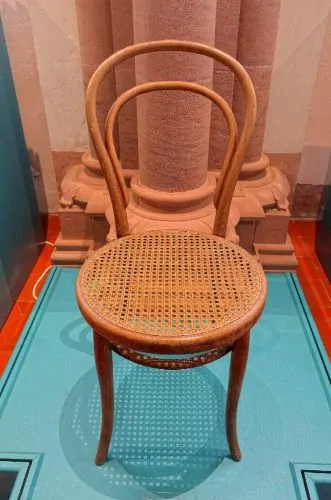
An eight-person workshop in western Michigan has made the same bentwood side chair since 1994, about 900 a year, and until this autumn it had never had a 3D file of it. A hotel group in Chicago asked for one on 22 September so its designer could place 140 of the chairs in a dining room plan. The workshop’s owner spent the next three weeks finding out how a chair becomes a file, tried four ways on chair number 7 from that week’s batch, and sent the hotel a .skp on 14 October. What follows is what the three weeks found.
1859, the first version of the problem
Michael Thonet had the same customer problem a century and a half earlier and solved it with a woodcut. His No. 14 chair left the factory in Moravia from 1859 as six pieces of steam-bent beech, ten screws and two nuts, packed thirty-six chairs to a one cubic meter crate, with a catalogue drawing so that a shopkeeper in Buenos Aires or Cairo could see what was coming. Around fifty million had been sold by 1930. The drawing gave a buyer the width, the height and the price, and gave a workshop enough to make another one.
The Michigan workshop had the modern equivalent, a dimensioned PDF from 2011 and 240 product photographs, and the Chicago designer could use neither. Her plan was in SketchUp. She needed a chair she could drop in 140 times.
Week one, 60 photographs and a free program
The owner’s first attempt was photogrammetry, a method with a longer history than most people expect. Aimé Laussedat was measuring from photographs in France in the 1850s and Albrecht Meydenbauer coined the word in 1867 while recording Prussian buildings. The free desktop software the owner installed on 24 September does the same job with a computer: it finds the same corner of the chair in dozens of overlapping photographs and works out where that corner sits in space.
Chair 7 went on a turntable in the workshop’s spray booth, which has the most even light in the building, and got photographed 60 times at 6 degree intervals from two heights with a 2019 mirrorless camera. Processing took 48 minutes on the office computer. The seat, a flat beech panel with visible grain, came out exact. The bent back hoop, round in section and finished in dark lacquer, came out as a lumpy tube with two gaps where the lacquer had reflected the booth lights. The underside of the seat was missing, since the camera never went there. Thirty minutes of repair in Blender produced a chair the owner described on 26 September as “right where you can see it and a guess where you can’t”, which is the trade on every photogrammetry model of a glossy object.
| Attempt | Photographs or passes | Time to a model | Cost | What came out wrong on chair 7 |
| Photogrammetry, free software | 60 photos | 48 min processing plus 30 min repair | $0 beyond the camera | Lacquered hoop lumpy, two gaps, no underside |
| Handheld structured-light scanner, borrowed | 14 passes | 70 min | Borrowed, $2,400 to buy | Hoop clean, lacquer still patchy, 1.2 GB file |
| Single-photo AI service | 1 photo | 4 min | Free trial | Underside invented, seat 6 mm too deep until scaled |
| Drawn by hand in SketchUp | 0 | 5 hours over two evenings | The owner’s time | Nothing, and it took five hours |
Week two, a borrowed scanner
A furniture maker two counties over lent a handheld structured-light scanner on 1 October. It projects stripes onto the chair and reads how they bend, and fourteen passes over 70 minutes produced a surface with the back hoop properly round and the underside captured. The lacquer still confused it in two places. The file was 1.2 GB, about four hundred times what the Chicago designer could use in a plan with 140 chairs in it, and reducing it to something sensible took the owner’s nephew most of an evening. The scanner costs $2,400 to buy, and the workshop makes 31 products. The owner wrote the sum on the whiteboard and left it there.
Week three, one photograph
On 8 October the owner tried the newest route. Research systems published in 2023 and 2024 had learned from millions of existing 3D objects what the far side of a chair generally looks like, and services built on that research take one photograph and return a complete model. He uploaded product photo DSC_0417.jpg, a three-quarter view of chair 7 against the booth’s grey wall, to furnimesh.com at 10:20 am and had a textured model back at 10:24, with a download menu of GLB, OBJ, SKP and BLEND and a free trial good for about ten chairs.
The hoop was round and the lacquer was lacquer. The underside existed and was plain, since the service had guessed it. The seat measured 6 mm deeper than the real chair until the owner typed the real seat height, 445 mm, into the model and let the rest scale to it, after which width and depth were both within 3 mm of the 2011 PDF. He described this one on the whiteboard as “a good sketch of chair 7”, next to the scanner’s price.
Why the file had to be .skp
The Chicago designer works in SketchUp, as a large share of interior designers and architects do. The program dates from 2000 and a 2026 release still opens files saved in the 2017 format, which is the one the single-photo service exports. The hotel’s web agency, separately, asked for a GLB for the room’s booking page, where a visitor can tap and see the chair on their own floor through a phone. The same generation produced both files.
| File sent | To whom | Size | Used for |
| chair7.skp | Hotel’s interior designer | 3.4 MB | 140 chairs in a dining room plan |
| chair7.glb | Hotel’s web agency | 2.1 MB | AR preview on the booking page |
| chair7.obj | Workshop’s own renderer | 4.0 MB | Catalogue render for 2027 |
What happened to the other 30 products
By 14 October the owner had run the three-quarter product photo of every piece in the catalogue through the same service, 31 models in two afternoons, each scaled from one real dimension off the 2011 PDFs. The photogrammetry attempt stays on the office computer as the file to use if a customer ever needs the seat grain exact. The scanner went back on 15 October with a thank-you and a case of the workshop’s wax. Thonet’s shopkeeper in Buenos Aires in 1870 knew the chair from a woodcut. The hotel in Chicago knew chair 7 from a photograph taken on a Tuesday and a file that came back before the coffee was poured.
About the Author