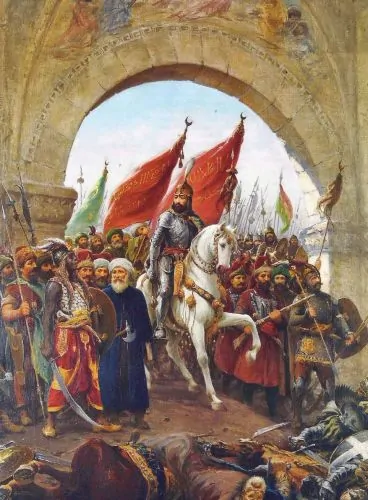
Had Constantinople survived the siege of 1453, Byzantium might have gained a fragile reprieve. Its future would depend on Ottoman restraint and the costly search for outside protection.

By Matthew A. McIntosh
Public Historian
Brewminate
Constantinople’s walls did not collapse all at once. Even after weeks of Ottoman bombardment, defenders repaired damaged sections and turned back assaults. On 29 May 1453, resistance finally broke. Emperor Constantine XI died during the city’s fall, and Sultan Mehmed II captured the capital of the Byzantine Empire. It was an enormous symbolic victory over a state that had already lost most of its power. Constantinople stood amid Ottoman territory, while the emperor’s relatives governed a separate Byzantine foothold in the Peloponnese. Saving the capital would preserve something precious, but it would leave that geography largely intact. The useful question is how another successful defense might have bought the city a future, and what its rulers could realistically have done with the time.
A workable divergence begins with Giovanni Giustiniani, the Genoese commander responsible for a crucial sector of the defenses. During the final assault, he was badly wounded and withdrew; his departure helped unravel resistance where Ottoman pressure was greatest. Suppose he escapes that injury and keeps his men together long enough to repel the attack. Other positions would still need to hold, so his survival alone cannot guarantee victory. Our scenario also requires a political choice. After another costly failure, Mehmed accepts his grand vizier Çandarlı Halil Pasha’s advice to negotiate an end to the siege. Halil actually urged withdrawal, and Constantine explored an accommodation that would preserve his possession of the city under Ottoman supremacy. In this alternative, those possibilities become a settlement. The emperor accepts tribute and restrictions on his freedom of action, while the sultan withdraws his army and claims to have secured submission. Mehmed might instead have continued fighting, and accepting a compromise would have carried political risks for him. Nevertheless, an advocate for negotiation already existed within his government. This scenario asks a battlefield setback to strengthen that position sufficiently to change the decision, while leaving Ottoman military superiority intact.
For the inhabitants, the reprieve would have an immediate value that grand strategy can obscure. People killed or enslaved during the historical sack would have a chance to remain in their homes. Hagia Sophia would continue as a Christian cathedral. Yet Constantine’s first demands would probably concern provisions and repairs, with tribute adding another burden. The capital would still have too few inhabitants and too little revenue to defend its extensive walls comfortably. Keeping a household intact might be the great victory of 1453; keeping the state solvent would be the struggle afterward.
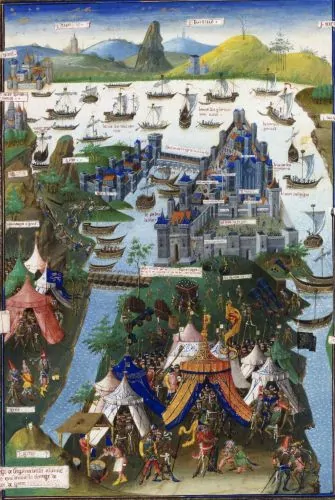
Securing help from overseas would become more urgent once the celebrations ended. Venice had commercial reasons to support a surviving Constantinople, but also strong reasons to avoid a costly war with the Ottomans. Genoese interests were divided among communities whose merchants needed workable relations with the sultan. Assistance might arrive as supplies or a limited naval presence, with privileges demanded in return. A permanent commitment to defend the city would be harder to obtain. Religious politics would complicate bargaining further. The union of the Greek and Latin churches proclaimed in Constantinople in December 1452 had been intended to help secure Western assistance, but it remained deeply divisive. Survival could allow supporters to claim that cooperation had saved the capital, while opponents might credit divine protection and resist further concessions. Constantine would have to manage that dispute while asking foreign powers for money. A larger Western garrison could improve his defenses, yet admitting it might alarm the Ottomans and jeopardize the settlement that had made rebuilding possible. His diplomatic problem would be how to obtain meaningful protection without giving either his protector or his overlord control of the city.
Mehmed’s setback could also alter politics inside the Ottoman government. Halil would gain standing if negotiation achieved what repeated assaults had failed to secure. The sultan’s supporters would lose the prestige that conquest historically brought them, perhaps slowing his consolidation of authority. None of this requires his deposition or the fragmentation of his empire. Ottoman armies would retain their recruiting grounds and tax base, along with positions on both sides of the straits. Rumeli Hisarı, the fortress Mehmed had built on the Bosporus, would remain an instrument of pressure on shipping. A surviving emperor could be made to pay more for peace or face renewed blockade when demands went unmet. The danger would persist even if Mehmed turned to another campaign first. A failed siege might make Ottoman policy temporarily more cautious while leaving the strategic incentives for capturing Constantinople almost undiminished.
What could endure under those conditions was a diminished imperial court and a living center of Greek scholarship. Avoiding the sack would preserve households and institutions whose value cannot be measured by the size of the emperor’s army. Some scholars might remain who otherwise left, although Byzantine learning had been reaching Italy well before 1453. Constantinople’s survival would reshape those exchanges without making the Renaissance depend on a single battle. Its longer political future would remain open. A durable tributary arrangement was possible if successive rulers found it useful; another siege was equally credible if the balance shifted against compromise. Survival for decades would require repeated bargains that this one victory could not guarantee. The city’s actual fall combined a contingent military collapse with a profound imbalance of resources. Imagining a successful defense helps separate those things. Byzantium could have survived that morning without recovering the power to decide what happened next.
Originally published by Brewminate, 11.01.2026, under the terms of a Creative Commons Attribution-NonCommercial-NoDerivatives 4.0 International license.
About the Author