
Democratic victories in Congress, Texas and Alabama transformed the 2026 midterms into a judgment on Trump’s government, testing MAGA’s claim to represent America’s political will.

By Matthew A. McIntosh
Public Historian
Brewminate
Introduction: When a Claim to Speak for America Met the Electorate
The Republican defeats of November 2026 reached from the United States Capitol into state governments long associated with conservative dominance. Democratic victories delivered incoming majorities in both chambers of Congress, while Republican-held governorships and state legislative chambers changed hands across the country. The scale of the reversal continued to emerge after election night. On November 11, the Associated Press called Mississippi’s Senate contest for Scott Colom, adding Cindy Hyde-Smith’s defeat to a succession of Republican losses extending well beyond conventional battlegrounds. The electorate substantially altered the institutional conditions under which Donald Trump would exercise presidential power. These results challenged the administration’s assertion that its earlier victory expressed a national determination to carry the MAGA program forward.
That assertion had been explicit when Trump began his second term. His inaugural address presented the 2024 election as authorization for sweeping change and declared that “the entire nation is rapidly unifying behind our agenda.” Such language transformed a successful candidacy into a claim about the political wishes of the country. Robert A. Dahl’s critique of presidential mandates identifies the difficulty with that transformation, since an election establishes entitlement to an office without necessarily demonstrating public agreement with the policies its occupant subsequently pursues.
Texas exposed the distance between Republican command of government and continuing electoral support with unusual force. Gina Hinojosa defeated Greg Abbott for governor, while Vikki Goodwin displaced Dan Patrick as lieutenant governor. James Talarico’s Senate victory connected the state’s reversal directly to the struggle for congressional control, and Democratic gains in the Texas House dismantled an additional component of Republican institutional dominance. The survival of a Republican state Senate majority left a divided government whose internal conflicts would help determine the practical reach of the Democratic victories. Alabama supplied a different but equally revealing encounter between established political expectations and the choices of a constituency. Allison Montgomery defeated Republican incumbent Phillip Rigsby in House District 25 to become the legislature’s first openly transgender member. Her campaign emphasized public education and healthcare access while Republican opponents attacked her transgender identity. Understanding that result requires attention to the community that elected her, including the possibility that voters evaluated representation through concerns which exclusionary appeals failed to override.
Interpreting these outcomes as a repudiation of Trump’s governing coalition requires explaining how distinct electoral decisions acquired a common political effect. Daniel Hopkins’s scholarship on the nationalization of American politics helps clarify why state contests can become judgments on presidential leadership, although that relationship must be demonstrated through campaign records and local evidence. Economic dissatisfaction could converge with objections to executive conduct, while grievances rooted in state government gave voters additional reasons to remove Republican officeholders. Comparisons with 1994 and 2006 place this convergence within a longer history of midterm elections that disrupted presidential ambitions. The argument advanced here is that the breadth of the 2026 defeats deprived Trump and his allies of a credible claim to continuing electoral approval across the institutions they had controlled. Explaining the sweep also requires recognizing the varied motives within the coalition that produced it, whose members could agree on removing Republican officials while differing substantially about what their replacements should do.
From the Victory of 2024 to the Governing Claims of 2026

The certified returns of 2024 gave Republicans substantial grounds for confidence, while placing clear limits on descriptions of their achievement. Trump won 312 electoral votes against Kamala Harris’s 226, securing the presidency through victories in every major battleground state. His national popular-vote share was approximately 49.8 percent, compared with Harris’s 48.3 percent, a difference of roughly 1.5 percentage points. That result represented a significant Republican recovery from defeat four years earlier, but it remained a plurality rather than a majority of votes cast. The Electoral College converted closely contested state victories into a more imposing national tally, magnifying the apparent distance between the candidates. Republican leaders could reasonably celebrate their success without the returns supporting descriptions of an unprecedented public endorsement. The distinction mattered because the administration would repeatedly use the apparent magnitude of its achievement to justify the magnitude of its proposed changes.
The composition of Trump’s support also deserves closer examination. Pew Research Center’s study of validated voters found that his coalition had become more racially and ethnically diverse, including improved performance among Hispanic and Black voters. Much of the change reflected differences in participation, alongside a comparatively smaller contribution from people switching between the major parties. Trump benefited from stronger retention of his previous voters and an advantage among those who had not participated in 2020. These findings identify an electoral achievement dependent on who voted, making the participation of less consistent voters an essential question for subsequent elections.
Trump began assigning a broader meaning to that achievement before the count had concluded. Speaking in Palm Beach on November 6, he announced that America had delivered an “unprecedented and powerful mandate,” connecting his own success with Republican Senate gains and the anticipated retention of the House. The movement, its presidential candidate, and Republican victories elsewhere were presented as components of a shared popular demand. This interpretation served an immediate organizational purpose. Julia Azari’s scholarship on mandate rhetoric shows how presidents invoke electoral instructions to manage competing forces within their parties and confront resistance from political opponents. In that setting, describing a policy as something voters had already required could raise the political cost of Republican hesitation. An official questioning the president’s priorities might be accused of obstructing the very electorate responsible for the party’s return to power. The language of popular instruction could help establish presidential leadership within a coalition whose members had won different offices through separate elections.
Stephen Miller expressed the representative claim with exceptional clarity at a White House briefing on February 20, 2025. Defending presidential direction of the federal bureaucracy, he declared that “the whole will of democracy is imbued into the elected president.” His explanation treated national election as the foundation for imposing presidential priorities on executive officials. By identifying bureaucratic resistance with resistance to democracy itself, Miller gave disputes about administrative authority a broader moral meaning, narrowing the space between disagreement with Trump and defiance of the public.
An executive order issued two days before that briefing translated related reasoning into administrative requirements. Executive Order 14215, “Ensuring Accountability for All Agencies,” argued that regulatory independence weakened accountability because agencies exercised power without sufficient presidential supervision. It directed independent regulatory agencies to submit significant regulatory actions for White House review and expanded the mechanisms through which presidential priorities would shape their work. Its provisions also assigned the president and attorney general authoritative roles in determining the executive branch’s interpretation of law. The document acknowledged congressional elections and an independent judiciary as elements of constitutional accountability, while preserving a monetary-policy exception for the Federal Reserve. Those qualifications prevent reading it as a literal declaration that every public institution derived its authority from Trump personally. Its governing logic nonetheless made presidential supervision the principal means of connecting administrative power to the electorate. In this formulation, concentrating control in the White House was presented as a democratic remedy, giving the mandate claim practical significance beyond campaign speeches.
The dispute over what voters had authorized became publicly visible during Trump’s address to Congress on March 4. After invoking his electoral performance, the president emphasized Republican success on a county map whose predominantly red appearance suggested overwhelming territorial support. Such a map could display geographic reach, but counting counties could not measure the balance of individual preferences because county populations differed enormously. Representative Al Green interrupted with the objection that Trump had “no mandate to cut Medicaid,” challenging the application of the election result to a specific program. Speaker Mike Johnson ordered Green’s removal after repeated warnings about decorum, allowing the address to continue. The confrontation brought two different propositions into the same proceeding: the president’s assertion of broad permission to act and an opponent’s insistence that a contested policy required a more specific justification.
Public opinion during the administration’s opening weeks provides an independent basis for evaluating those propositions. A Pew survey released in February 2025 found that 35 percent of adults supported all or most of Trump’s policies and plans, while 47 percent supported only a few or none. These figures described the public as a whole rather than the subset that had voted for Trump, but they demonstrate why an election result could not substitute for evidence about the reception of a developing agenda. George C. Edwards III’s subsequent study of the 2024 mandate claim similarly distinguished support for changing the country’s direction from approval of the administration’s individual decisions. His analysis concerned the original election and early governing period, establishing weaknesses in the claim before the midterm campaign rather than retrospectively explaining the 2026 outcome. The relevance to that later contest lies in the responsibility the administration assumed when it represented its decisions as the execution of settled public instructions. Once policies were implemented, their operation supplied new grounds for judgment, including among people whose earlier support had rested on different expectations. Republican candidates approaching 2026 faced an electorate able to compare the promised benefits of presidential leadership with a record produced under its asserted authority.
Making Separate Elections into a National Reckoning

A national electoral judgment had to be communicated through contests offering voters different candidates and different opportunities to change government. Congressional campaigns could connect an incumbent’s legislative decisions directly to presidential policies, while challengers for state office needed to establish why dissatisfaction should extend to officials exercising other responsibilities. Party identification supplied an initial connection, but campaigns could strengthen that association or compete against it with evidence of independence. Daniel Hopkins’s research on political nationalization helps explain the conditions under which these appeals operated. As national political information occupies more of voters’ attention, candidates for other offices increasingly encounter expectations formed around presidential leadership. Their task becomes partly one of explaining their relationship to that leadership, even when the office they seek has limited authority over the controversies dominating public discussion.
During the earlier stages of the cycle, Republican advertisers often treated association with Trump as an advantage. The Wesleyan Media Project reported in June that more than 70 percent of broadcast television spots from Republican House and Senate candidates mentioned him, examining advertising aired since January 2025. By October, the comparative advertising record looked markedly different. An Associated Press analysis published October 16 found that, since September 1, Democratic candidates and allied groups had spent more than $163 million on advertisements mentioning Trump, compared with approximately $11 million on the Republican side. These snapshots cannot trace every candidate’s changing strategy, but they reveal how differently the parties were choosing to present the president as the general election approached.
National party organizations helped turn these choices into sustained campaigns across separate constituencies. On September 8, the Democratic Congressional Campaign Committee announced $1.6 million in coordinated television advertising for seven competitive districts, including seats in Alabama and Texas. Its description of the initiative explicitly joined candidates’ individual backgrounds and district priorities to arguments about affordability and corruption. Criticism of the Trump administration formed part of a broader effort to explain what electing particular Democrats would accomplish. The organizational significance lay in the combination of common themes with recognizable local representatives. A national committee could finance their presentation while allowing each candidate to appear through an account of experience relevant to the constituency. Coordination in this instance was a documented spending arrangement between the committee and campaigns, rather than an inference drawn merely from similarities in their language.
The committee’s Colorado advertising supplies a concrete example of how that combination worked. Released on September 22, “Your Corner” introduced Manny Rutinel through his mother’s employment and the family’s reliance on Medicaid, giving a federal program a place in the candidate’s personal history. The advertisement then presented Republican Gabe Evans as a congressman whose loyalty to Trump had displaced his obligations to constituents. Its allegations about health coverage and rising expenses encouraged viewers to connect presidential priorities with a specific representative’s choices. Those assertions were campaign advocacy, requiring separate examination before they could be accepted as complete descriptions of Evans’s record. Their function within the advertisement was nonetheless clear. The audience was offered a choice between a candidate who understood dependence on public provision and an incumbent depicted as serving presidential interests. The companion Spanish-language advertisement, “Sin Ventajas,” emphasized Rutinel’s background and presented his legislative work as evidence of practical assistance to families. The spots translated a national dispute into competing accounts of who would act for the district.
Republican candidates also attempted to define that relationship on their own terms. Ashley Hinson’s September advertisement “Aisle” presented bipartisan cooperation as a qualification for representing Iowa. She cited work with Democrats on veterans’ mental healthcare while also claiming collaboration with Trump against large health insurance companies. Her campaign sought to make presidential association one element of a wider record of service, preserving its advantages while offering voters additional reasons to support her.
Outside organizations created further connections between presidential politics and individual races through the allocation of money. In Texas, MAGA Inc., the principal pro-Trump super PAC, placed a $10 million advertising buy in September, dividing the expenditure between support for Ken Paxton and attacks on James Talarico. Its intervention made the presidential organization a material participant in the Senate contest, with tax-policy messages intended to shape Texans’ understanding of their choice. Democratic outside spending employed its own combination of national policy and constituency interests. Senate Majority PAC’s October advertisement “The Two Ds” attacked Cindy Hyde-Smith’s Medicaid record and linked allegations about special-interest influence to household costs in Mississippi. The organization identified the campaign as independent expenditure, expressly disclaiming candidate authorization. These distinctions matter because national involvement operated through several organizations with different relationships to candidates, rather than through a single command directing every message. Their expenditures still helped place geographically separate elections within competing national projects for controlling Congress.
State campaigns could contribute to the wider reversal through arguments centered squarely on their own governments. Hinojosa’s September advertisement “The Truth” accused Abbott of serving wealthy donors and presented her candidacy through promises of affordability and lower taxes. Trump did not appear in its transcript. The appeal instead asked Texans to evaluate the governor’s relationship with the people affected by his decisions. Its resemblance to Democratic arguments elsewhere came through the proposed explanation of government failure, in which powerful interests received attention while ordinary households bore the expense. Such an approach allowed state grievances to converge with national dissatisfaction without requiring a gubernatorial advertisement to become a discussion of the presidency.
The campaign record also shows why presidential association cannot be treated as an adequate summary of every Republican candidate’s conduct. The Associated Press found that Democratic advertising in Pennsylvania’s First District repeatedly invoked Trump despite Brian Fitzpatrick’s opposition to tariffs and unilateral presidential war powers concerning Iran. That discrepancy exposes an important feature of nationalization. Campaigns sought to persuade voters to assign collective responsibility even where an individual record contained departures from the party’s leadership. Gary Jacobson’s scholarship on campaigns provides a framework for investigating how such messages communicate choices and influence participation, while keeping their effects distinct from the intentions of those who financed them. Advertising documents the alternatives presented to voters; determining which appeals changed decisions requires further evidence. Across the 2026 contests, campaigns supplied several means of connecting dissatisfaction to an available electoral action, from challenging an incumbent’s loyalties to presenting a challenger’s experience as a reason for trust. The national reckoning acquired practical form through those choices about certain officeholders, each offering a constituency a way to alter the government it encountered.
Measuring the Sweep across Congress and the States
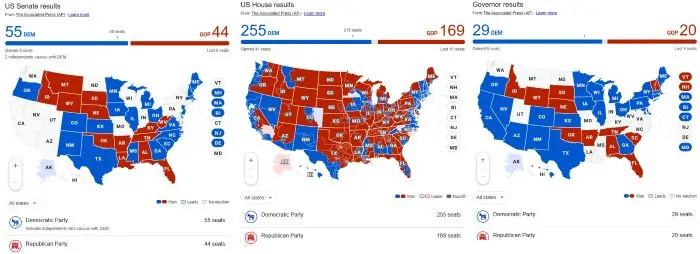
By the evening of November 11, the House results displayed by ABC News, using Associated Press data, showed 255 Democratic victories and 169 Republican victories, with eleven contests unresolved. Democrats had already exceeded the 218 seats required for a majority by a substantial margin. Further counting could change the size of that majority, while the question of which party would organize the next House had been settled. The gains also reached officeholders with considerable experience and organizational standing. Richard Ojeda defeated Richard Hudson in North Carolina’s Ninth District, removing the chairman of the National Republican Congressional Committee, while Kristina Knickerbocker defeated longtime representative Mike Turner in Ohio’s Tenth. Such results placed prominent participants in Republican congressional government among the defeated. Open seats contributed to the change as well, including Nebraska’s Second District, where Denise Powell won a constituency Republicans had previously represented. Separating these categories identifies two forms of electoral failure: the removal of sitting members and the inability to retain their party’s seats when incumbents departed.
The balance of party changes was sharply unequal. Roll Call’s tracker of AP calls recorded forty-four Republican House seats moving to Democrats and two Democratic seats moving to Republicans by November 11, a net Democratic gain of forty-two among those transfers. Republican Brent Taylor’s victory in Tennessee’s open Ninth District supplied one countervailing result. Including such outcomes prevents the scale of Democratic success from obscuring the constituencies where the movement ran in the opposite direction.
The Senate returns widened the geographical meaning of the defeat. Republicans had entered the election with a fifty-three-to-forty-seven organizing advantage, and Vice President J. D. Vance’s tiebreaking vote made an evenly divided chamber sufficient for them to retain control. Eight Republican-held seats had been called for Democrats, distributed across Maine, North Carolina, South Carolina, Ohio, Iowa, Kansas, Texas, and Mississippi. Some victories removed incumbents, including Susan Collins in Maine and Roger Marshall in Kansas; others occurred in open contests, as in Iowa and North Carolina. These different routes produced the same change in party representation, although they involved distinct relationships between voters and the officials seeking their support. Democratic defenses were also essential to the result. Jon Ossoff retained Georgia’s seat, while the party held open seats in Michigan and New Hampshire, preventing Republican gains from offsetting its own expansion. Colom’s Mississippi victory brought the prospective Democratic caucus, including its independent members, to at least fifty-five seats, against forty-four Republican seats, with Alaska still unresolved. The caucus figure describes the group positioned to organize the chamber rather than fifty-five senators all elected under the Democratic label. The margins also varied considerably. Talarico’s reported Texas advantage exceeded twelve percentage points, whereas Colom led by roughly half a point when Mississippi was called. The accumulation of these victories combined successful Democratic retention with gains of markedly different sizes across Republican constituencies.
Five Republican-held governorships had changed party in the called results: Georgia, Iowa, Nevada, Ohio, and Texas. Hinojosa and Aaron Ford defeated sitting governors in Texas and Nevada, whereas the other three victories came in open contests. Democrats had secured at least twenty-eight governorships, enough to establish a national majority before Alaska and Kansas were resolved. Kansas would represent a Democratic hold if the party prevailed there, while Alaska offered an additional pickup. Keeping these categories separate distinguishes the removal of incumbents from the broader failure of a governing party to reproduce its control.
At the state legislative level, Democrats gained control of twelve chambers in nine states. Eleven had been Republican-controlled; Minnesota’s House had previously been tied, making its Democratic capture a different kind of institutional change. Both chambers changed hands in Arizona, New Hampshire, and Wisconsin, while single-chamber gains occurred in Georgia, Michigan, Minnesota, North Carolina, Pennsylvania, and Texas. Several ended Republican tenures extending well beyond one presidential administration. Ballotpedia identified five newly lost Republican chambers that the party had controlled for more than twenty years, including the Arizona House, where its winning sequence began with the 1966 election. The results reached institutions whose partisan identities had acquired an appearance of continuity across very different national circumstances. Jacob Grumbach’s research on state politics explains why these changes belong within an assessment of national governing power. State institutions have become important vehicles for national party agendas, translating partisan control into substantial differences in public policy. Losing a chamber could interrupt that process even where Republicans retained another part of the government. These transfers altered the distribution of policymaking authority as well as the number of elected Democrats, with effects shaped by the other institutions each new majority would encounter.
Six states acquired or regained unified Democratic government: Arizona, Michigan, Minnesota, Nevada, Pennsylvania, and Wisconsin. Each combined Democratic legislative majorities with a Democratic governor, although the electoral changes producing that combination differed. Georgia and Texas instead moved from Republican trifectas to divided government, with Democrats winning the governorship and House while Republicans retained the Senate. Ending exclusive Republican control and establishing a Democratic trifecta were separate outcomes, giving the victors different capacities to pursue their programs.
Seat totals must still be read alongside the electoral arrangements that produced them. Gary King and Robert Browning’s work on congressional representation distinguishes the responsiveness of seats to changing votes from partisan bias in how votes translate into representation. That distinction is useful when assessing a wave because the size of a legislative reversal need not match the size of the underlying change in vote shares. Several narrow victories across competitive districts can transfer many seats, while larger advances concentrated in already secure constituencies may produce little additional representation. Senate contests add another complication, since their staggered schedule places different combinations of states before voters in different cycles. Comparisons across years also require attention to district boundaries rather than assuming that an unchanged district number denotes an unchanged electorate. A defensible measurement combines party transfers with margins and the distribution of votes across comparable geographical units. The evidence already established a large redistribution of offices in 2026; further analysis would determine how much electoral movement lay behind it and how institutional arrangements shaped its expression.
Republicans still retained important executive positions. Byron Donalds won Florida’s governorship, Tommy Tuberville won Alabama’s, and Kelly Ayotte secured reelection in New Hampshire. The New Hampshire outcome placed a Republican governor opposite newly Democratic legislative chambers, demonstrating that the same statewide election could yield divergent results across branches. These survivals define the territorial and institutional boundaries of the Democratic advance. Its scale is best established by recording both the offices Republicans lost and the authority they successfully defended, leaving an uneven national distribution of power after a decisive change in its overall balance.
The Cost of Living and the Judgment of Governing Performance
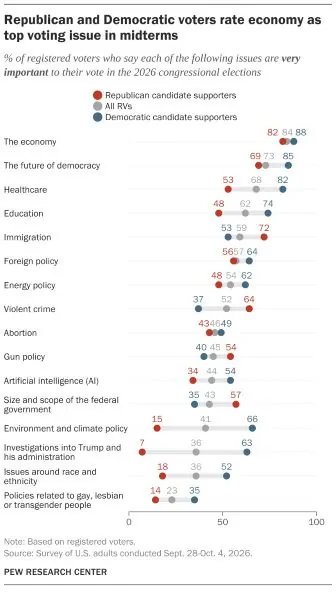
Affordability had been an explicit undertaking of the Republican campaign that returned Trump to office. The party’s 2024 platform promised lower everyday expenses and reductions in housing and healthcare costs, making relief from financial pressure a standard against which its subsequent record could be assessed. This commitment created expectations extending beyond growth in national output or gains in financial markets. A household expecting essential purchases to become easier to afford could judge the administration by the demands those purchases continued to make on its income. Before the midterms, Pew Research Center found that 84 percent of registered voters considered the economy very important to their congressional choice. The corresponding figures among Republican and Democratic candidate supporters were 82 and 88 percent, indicating considerable agreement about the subject’s importance despite disagreement about its political meaning. Michael Lewis-Beck and Mary Stegmaier’s review of economic voting locates this kind of assessment within a well-established pattern of rewarding or punishing governments for performance. The analytical task in 2026 is to identify how an issue important to both sides became damaging to the party exercising power.
Price levels and inflation rates describe different aspects of that pressure. Slower inflation means that prices rise less rapidly, leaving earlier increases embedded in the amounts households must pay. In September 2026, the Consumer Price Index stood 3.7 percent above its level a year earlier, while gasoline prices increased 9.1 percent during that month alone. Whether earnings and other resources could absorb such expenses remained a separate question from the direction of the inflation rate.
Responsibility for these conditions was contested, and the disagreement cannot be reconstructed from economic statistics alone. An AP-NORC survey released on October 1 found that 65 percent of adults attributed higher-than-usual prices to Trump’s policies, while 67 percent of Republicans attributed them to factors outside his control. These answers describe competing explanations of the same public problem. Their partisan division shows why rising prices do not automatically produce a common judgment about the government. Yet the survey also found that 69 percent of adults considered Trump’s handling of living costs worse than expected, including 52 percent of Republicans. Disappointment could extend into the president’s party even where its members remained inclined to protect him from direct responsibility for inflation. The questions measured different things: an explanation of why prices were high and an assessment of whether the administration had delivered anticipated relief. Reporting on the AP Voter Poll likewise identified tariffs and the Iran war among the policies voters associated with their economic difficulties. Those associations require distinction from an independent calculation of each policy’s effect on prices. They identify a politically important process through which government choices became explanations for hardship, giving dissatisfaction a target rather than leaving it as a generalized complaint about conditions.
In the Texas Senate contest, roughly two in ten voters reported that inflation had imposed severe hardship on their families. About three-quarters of that group supported Talarico. Approximately another six in ten described moderate hardship, and he won a majority of those voters as well. His support across these categories connects the statewide defeat of the Republican nominee with financial strain experienced at different levels of severity.
An economic judgment could also reach beyond the respondent’s own immediate circumstances. Donald Kinder and D. Roderick Kiewiet’s research on sociotropic voting distinguishes assessments of the national economy from evaluations of personal finances, emphasizing the electoral importance of the former. The AP-NORC findings make that distinction relevant to 2026. More than half of adults described the national economy as worse off since Trump’s return, while 46 percent said the same about their families’ situation. Those aggregate responses should not be substituted for a direct comparison of individual respondents, but they establish that the two questions elicited different distributions of answers. A voter whose employment remained secure could still conclude that prevailing conditions threatened the community’s prospects. Concern about a child’s ability to establish an independent household, for example, could influence political evaluation without an immediate reduction in the parent’s income. This possibility matters when explaining how economic objections could extend across people with different levels of personal security. The category of economic discontent encompasses judgments about the country’s direction as well as difficulty meeting an individual bill, allowing shared concerns to develop from experiences that were far from identical.
Election-time questioning connected these evaluations more directly to candidate choice. About two-thirds of voters in the AP Voter Poll said Trump’s policies had made the economy worse, and approximately eight in ten within that group supported the Democratic House candidate. This association is stronger evidence of an economic judgment against the administration than the finding that voters merely considered the economy important. It does not isolate economics from every other consideration shaping their decisions. It does show that an adverse assessment of presidential stewardship was closely aligned with choosing representatives from the opposition, making the congressional ballot a practical means of seeking a different response to financial pressure.
Presidential Power and the Demand for Restraint
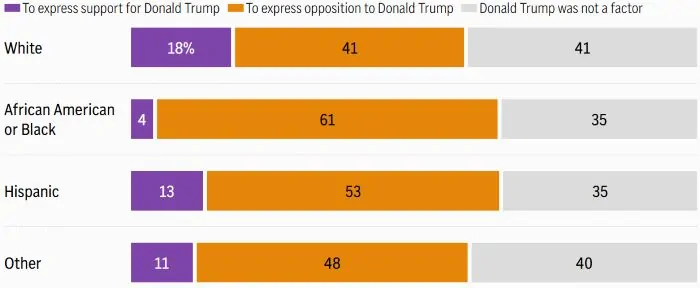
A desire for stronger limits on presidential conduct emerged in voters’ assessments of Congress itself. Approximately seven in ten participants in the AP Voter Poll said the legislature was providing insufficient checks and balances, including about four in ten Republicans. This finding identifies a complaint about how an institution performed its constitutional responsibilities, extending beyond dissatisfaction with any single administration policy. It also makes congressional conduct part of the explanation for congressional defeat. Representatives could be judged for permitting decisions they possessed some authority to question, even when they had not initiated those decisions themselves. Guillermo O’Donnell’s distinction between electoral accountability and accountability exercised by public institutions clarifies the relationship. Elections allow citizens to reward or remove officeholders, while effective institutional supervision requires bodies capable of examining and restraining other officials between elections. In 2026, the ballot offered a means of changing the people expected to exercise that supervision. The resulting demand concerned the relationship between branches of government as well as the direction of federal policy.
Those survey answers should not be assigned a meaning broader than the questions establish. Republicans seeking additional congressional checks did not necessarily support Democratic candidates or favor impeachment. Among voters naming democracy as the country’s leading issue, roughly eight in ten supported Democratic House candidates, while approximately two in ten supported Republicans. A shared vocabulary of constitutional concern could accompany different diagnoses of what required protection.
Control over appropriated money supplied a concrete institutional dispute before the election. On September 25, 2026, the administration proposed rescissions affecting eleven appropriation accounts and withheld the amounts concerned from obligation. Four days later, the Government Accountability Office concluded that the Impoundment Control Act did not authorize withholding those funds beyond their expiration at the close of the fiscal year. Unless Congress enacted the rescissions, the money had to be made available within the applicable legal limits. This was the legal conclusion of Congress’s auditing institution, rather than a court judgment, and GAO expressly separated its findings from any preference about the programs involved. That separation is central to understanding the dispute. A voter could favor reducing expenditure while still objecting to an executive procedure that displaced the legislature’s authority over enacted appropriations. Permitting funds to expire through withholding could achieve a policy result without obtaining the congressional decision required to authorize it. The controversy concerned who could alter an existing legal settlement, as well as whether spending should rise or fall. It offers a documented example of the institutional questions encompassed by demands for presidential restraint, without establishing that every voter concerned about oversight knew this dispute.
Individual rights presented another reason for maintaining independent review. In April 2025, the government acknowledged that Kilmar Abrego Garcia had been removed to El Salvador despite an order prohibiting his removal there. The Supreme Court upheld the requirement that officials facilitate his release while directing clarification of the lower court’s broader instruction. The episode demonstrated that immigration enforcement remained subject to legal obligations whose application required judicial scrutiny. Favoring stricter enforcement did not resolve whether officials had followed the law in an individual case.
Congressional willingness to act depended partly on relationships that crossed the formal boundaries between branches. Daryl Levinson and Richard Pildes’s scholarship on the separation of parties explains why legislators sharing a president’s political interests may cooperate with executive leadership rather than consistently defend institutional prerogatives against it. Yet cooperation was neither complete nor unchanging during the period preceding the midterms. On March 5, 2026, the House rejected a resolution seeking withdrawal from hostilities with Iran by 212 votes to 219. On June 3, it adopted another withdrawal resolution by 215 votes to 208, with four Republicans joining the majority. The later vote recorded House opposition without itself establishing that Congress had terminated the conflict. These proceedings show both the possibility of resistance under Republican control and the difficulty of assembling it. They qualify any account in which congressional Republicans simply disappeared as independent actors throughout Trump’s second term. The electoral question was whether the existing arrangement produced enough resistance when it was needed, and whether different majorities would approach presidential requests with different incentives. Divided party control could strengthen those incentives without guaranteeing disinterested or effective scrutiny.
Concern about corruption added a further reason for wanting an assertive legislature. More than half of AP Voter Poll respondents described government corruption as crucial to their congressional vote. Investigation could give practical form to that concern by requiring explanations and exposing decisions to examination, although suspicion alone did not establish criminal wrongdoing. The distinction between demanding an inquiry and assuming its verdict matters because legitimate oversight must be capable of testing allegations rather than merely confirming partisan expectations.
Nancy Bermeo’s work on democratic backsliding places these questions within a broader interpretive framework. Executive aggrandizement can proceed through successive changes that weaken restraints while preserving elections and the formal appearance of constitutional government. Assessing that process requires evidence about the independence and effectiveness of institutions; energetic presidential action or electoral unpopularity alone cannot establish it. The disputes over spending authority and legal review provide specific grounds for examining how presidential preferences encountered established limits. The opposition victories of 2026 demonstrated that electoral competition could still produce a substantial change in governing personnel, while the demand for stronger checks concerned what those personnel should do between elections. The constitutional significance of that demand lay in seeking greater independence for institutions charged with making presidential conduct answerable to authorities beyond the presidency.
Turning Discontent into Votes

Between an unfavorable judgment of government and a completed ballot lay decisions that Democratic organizers could influence. Citizens needed an acceptable alternative, but they also had to make voting a priority amid obligations outside politics. Steven J. Rosenstone and John Mark Hansen’s research on mobilization places these decisions within the activity of parties and civic organizations, whose recruitment helps determine which citizens participate. Personal approaches can make a measurable difference. Alan S. Gerber and Donald P. Green’s randomized study of the 1998 election in New Haven found that nonpartisan canvassing increased turnout. That experiment provides evidence for a mechanism through which contact encourages participation, although its findings cannot measure the contribution of any operation conducted twenty-eight years later. For the Democrats of 2026, the practical task was to reach people whose dissatisfaction supplied a reason to vote while giving them a direct invitation to act on it.
Organizational preparation also concerned the alternatives available on the ballot. On September 15, the Democratic Congressional Campaign Committee announced that its Red to Blue program had expanded to forty candidates, with participants receiving staff resources and fundraising assistance alongside strategic guidance. Such support gave challengers access to expertise that an inexperienced campaign might otherwise struggle to obtain. The announcement documented a deliberate effort to equip campaigns in Republican-held districts for the closing stages of the election.
Mississippi’s organizing drew on institutions with an established place in Black political life. At an August 25 NAACP luncheon in Jackson, hundreds of attendees gathered with faith leaders and political organizers to hear Representative Bennie Thompson and Senate candidate Scott Colom. Reporting from the event, Michael Goldberg described workers distributing voter-engagement packets and directing participants toward their local churches for information about getting involved. The arrangement connected a large gathering to smaller communities through which participants could continue organizing after the speakers had departed. Thompson also explained that a Democratic House majority could put six Black members in charge of congressional committees, giving his appeal a tangible account of what participation might accomplish. His argument linked the effort required of individual voters to positions from which their representatives could exercise authority. Viewed through the scholarship on recruitment, the gathering illustrates how organizations can make political action familiar and provide opportunities to undertake it with others. The contribution of church networks to this campaign belongs within that institutional history, with Black Mississippians understood as people making political choices through associations they had helped sustain.
In the Rio Grande Valley, LUPE Votes concentrated on new and infrequent voters. The organization, the political arm of La Unión del Pueblo Entero, conducted a canvassing campaign from August through Election Day. Its civic-engagement director, Michael Mireles, told the Texas Tribune that canvassers had knocked on 90,000 doors and reached more than 100,000 people. Those were the organization’s reported activity totals, which could include contact with people who would have voted anyway. They document an effort to approach residents beyond the dependable electorate that campaigns can most easily identify. The same reporting described Talarico’s repeated appearances with Bobby Pulido, whose familiarity in the region political scientist Álvaro Corral considered valuable in introducing the statewide candidate. Doorstep conversations and appearances alongside a known local figure provided different opportunities for voters to question a prospective representative and consider whether supporting him served their interests.
Participation figures place these efforts in perspective. A November 4 Texas Tribune analysis of preliminary state data reported approximately 9.8 million ballots, representing 51.6 percent of registered Texans, compared with the official 2022 rate of 45.85 percent. The provisional 2026 percentage remained below the roughly 53 percent registered-voter turnout of 2018, even though the raw number of ballots was larger. An expanding registration roll made those measures diverge, so the Democratic victory requires attention to who participated and whom they supported, alongside the total number voting.
Identifying the people behind that change requires evidence capable of distinguishing movement between parties from movement into or out of the electorate. Pew Research Center’s validated-voter research demonstrates the value of following the same respondents across elections and checking reported participation against official records. Its analysis found that 89 percent of Trump’s 2020 voters returned in 2024, compared with 85 percent of Biden’s, showing how unequal retention could alter the electorate even when most people remained loyal to their preferred party. That finding describes the presidential contest and supplies a question for investigating 2026, rather than an answer about the midterm electorate. A higher Democratic share in a county formerly carried by Trump could reflect returning voters choosing different candidates or participation by residents who had skipped the presidential election. Republican abstention could contribute as well, while newly eligible citizens would change the population from which voters were drawn. The 2026 SSRS Voter Poll combined interviews at voting locations with telephone and online surveys, providing substantial evidence about those who voted that year. Comparing its subgroup percentages with a separate 2024 survey does not reproduce a study tracking the same individuals across both elections. Establishing the relative weight of persuasion and participation requires that additional longitudinal work, with ballot choice remaining survey-reported even when turnout can be verified.
Persuading a Republican to change candidates and encouraging a Democratic sympathizer to vote were different campaign achievements. Joshua L. Kalla and David E. Broockman’s study of forty-nine field experiments found an average persuasive effect near zero for the general-election interventions examined, with gains emerging under limited conditions. Their findings concern changes in candidate preference, leaving room for contact to encourage an already sympathetic citizen to participate. They also do not measure the cumulative effect of governing experience on political judgments across a presidential term. The organizational evidence from 2026 documents practical means through which dissatisfied citizens were invited to become electoral participants. Understanding the Democrats’ success requires examining that interaction between a favorable political environment and sustained efforts to organize within it, while preserving the distinction between campaign activity and its independently measurable effects.
Texas and the Appearance of Republican Permanence
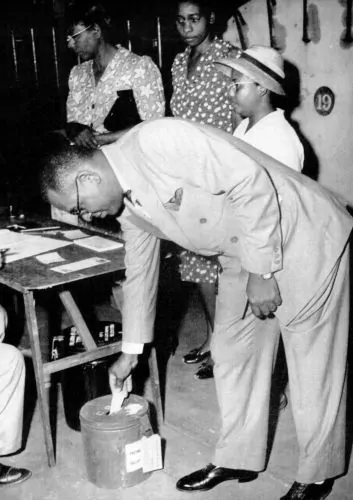
“Texas will never turn blue,” Ken Paxton declared after the Republican victories of November 2024. His confidence rested on a formidable record, with no Democrat having won a statewide election since 1994 and Republicans repeatedly renewing their control of the governorship. For candidates entering public life during those decades, statewide Republican victories formed the ordinary background of political competition. The reversals of 2026 acquired their historical significance against that accumulated experience of Democratic defeat and Republican renewal.
The earlier history of Texas makes any identification of its people with one enduring party affiliation difficult to sustain. During the earlier twentieth century, Democratic predominance operated through a severely restricted electorate. The white primary excluded Black Texans from contests that usually decided who would hold office, while the poll tax imposed an additional barrier to participation. Donald S. Strong’s contemporary research documented the expansion of Black voting after the Supreme Court invalidated the white primary in Smith v. Allwright in 1944, alongside the continuing obstacles confronting prospective voters. Democratic control survived the dismantling of those restrictions, as the meaning of participation continued to be contested. The party itself contained competing projects for changing the distribution of political power. Max Krochmal’s history of the civil rights era reconstructs alliances through which Black and Mexican American activists worked with white labor and liberal organizations to contest entrenched authority. Their struggles for representation establish that the state possessed substantial democratic traditions that Republican dominance never erased. Sean P. Cunningham’s account of the modern right similarly treats partisan realignment as a process of political conflict, rather than the eventual disclosure of an essentially conservative Texas. These histories locate political allegiance within struggles over inclusion and the purposes of government, making both the older Democratic order and its Republican successor products of historical circumstances.
Republican advances reached different offices on separate timetables. John Tower’s Senate victory in 1961 and Bill Clements’s election as governor in 1978 established important precedents well before Republicans controlled the Legislature. Even George W. Bush’s defeat of Ann Richards in 1994 left Democrats winning other statewide contests, including Bob Bullock’s reelection as lieutenant governor. Republican control of the state Senate followed the 1996 election, while the House majority secured in 2002 produced an eighty-eight-member Republican House caucus when the 2003 session opened. Unified control emerged through those successive gains, each requiring an electorate to authorize a further extension of the party’s power. The completed arrangement could look settled to later observers even though its construction had occupied decades.
Making Republican government appear integral to Texas identity also involved a cultural achievement. Jeff Roche’s study of West Texas conservatism traces how regional business practices and ideas about community became associated with the cowboy imagery circulating through modern mass media. His account encompasses cities such as Amarillo and Lubbock alongside smaller settlements, complicating a familiar equation between conservatism and an undifferentiated rural population. A political movement rooted in identifiable institutions could acquire the appearance of expressing a much older regional character. That association helped give conservative politics cultural resources reaching beyond policy proposals or the appeal of individual candidates. The constituencies sustaining Republican victories still changed, as political scientist Brandon Rottinghaus explained in a 2026 interview with The Texas Newsroom. He described the coalition around 2000 as bringing business conservatives and evangelical Christians together with suburban voters, while identifying a stronger populist and nationalist emphasis in the later party. Those categories overlapped within communities and individual households, leaving ample room for disagreements about which priorities should govern a shared partisan commitment. Republican durability depended on managing those relationships even when election results made the coalition appear more cohesive than its constituent interests.
Continuous Republican control accumulated influence between elections. Governors selected appointees to boards and commissions, with most such nominations requiring confirmation by the state Senate. Repeated terms enabled Republican administrations to shape institutions whose work continued across legislative sessions, while legislative majorities influenced the boundaries within which district elections occurred. These powers extended the significance of winning beyond possession of the offices immediately contested. Statewide elections still required candidates to secure support across Texas, where district boundaries could not determine the winner.
Changes in the state’s population supplied grounds for expecting greater competition, but they offered an unreliable timetable for a partisan reversal. Texas grew from approximately 25.1 million residents in 2010 to 29.1 million in 2020, an increase of 15.9 percent. The expansion was geographically uneven. The state comptroller’s regional analysis reported that 143 of the 254 counties lost population during that decade, while the Dallas–Fort Worth and Houston metropolitan areas together contained slightly more than half the state’s residents. These patterns changed where political representation had to accommodate growth, without assigning the newcomers a common political identity. Metropolitan expansion had already formed part of the history of conservative advancement, so its continuation could support competing projects. Electoral experience also resisted a simple account of Republicans steadily approaching defeat. In 2018, Ted Cruz defeated Beto O’Rourke by 2.56 percentage points, a result that demonstrated the possibility of a close statewide Senate contest. Six years later, the certified presidential returns gave Trump approximately a 13.7-point advantage over Kamala Harris in Texas. Although these were different offices contested under different conditions, their sequence showed that a narrow Republican victory could be followed by a much broader one. The breakthrough of 2026 requires explanation through the circumstances of that election, including the governing choices made after 2024.
Expectations of another Republican victory were already being questioned before November. In September 2026, Eleanor Klibanoff reported that Republican consultants themselves recognized a level of statewide competition unusual in their recent experience. Matt Mackowiak acknowledged the possibility of an exceptionally competitive election, while forecasters had revised assessments that formerly treated Republican victories as more secure. The same reporting preserved a contrary judgment from Republican strategist and pollster Ross Hunt, who expected the party’s established support to survive the difficulties facing its ticket. This disagreement matters because it places uncertainty inside the campaign, where participants had to decide how much confidence the past warranted. A retrospective account that describes the result as unimaginable would suppress warnings that were visible while the outcome remained unsettled. The evidence instead shows a long-standing expectation of Republican success being tested against information suggesting that familiar loyalties might prove insufficient. The appearance of permanence weakened through that argument before the returns conclusively demonstrated its limits.
Long tenure also concentrated responsibility for the direction of state government. By 2026, Abbott and Patrick represented an established leadership whose record could be judged across successive legislative sessions. Their experience supplied a basis for claiming competence, while making the governing decisions associated with their offices readily attributable to Republican leadership. Their defeats reached a state establishment with a history of electoral strength that predated Trump, showing how the national rejection of his governing project could also become a judgment against leaders who had helped define its operation in Texas.
Removing Abbott and Patrick
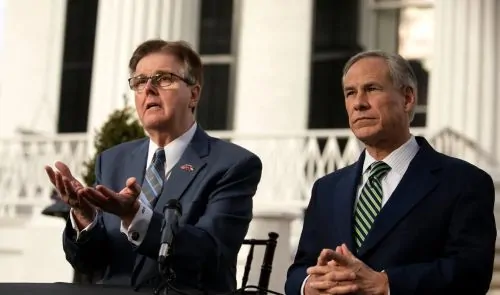
Texas’s governor and lieutenant governor were defeated by substantial statewide margins. In the secretary of state’s unofficial November 4 tally, Gina Hinojosa led Greg Abbott by 706,262 votes, while Vikki Goodwin’s advantage over Dan Patrick stood at 598,929. Both Republicans had sought fourth terms, and both were defeated by women serving in the Texas House. The outgoing officeholders would remain in their positions until January, when the election would translate into a formal transfer of authority.
Texas voters made those decisions through separate contests for offices with distinct responsibilities. The lieutenant governor is independently elected and constitutionally presides over the Senate, giving the position a legislative identity that its title can obscure. The governor possesses veto authority, including the power to reject individual appropriation items, and can call special sessions whose permissible business is defined by the gubernatorial proclamation. Patrick’s influence operated through additional powers granted by Senate rules, including committee assignments and the referral of legislation. Under the rules adopted in January 2025, the presiding officer selected committee chairs and appointed the Senate’s members of conference committees negotiating disagreements with the House. These procedural resources helped determine which proposals received serious consideration and who participated in resolving disputes over them. Removing Abbott changed the person able to approve or obstruct legislation from the governor’s office, while defeating Patrick displaced the individual who had organized much of its passage through the upper chamber. The paired outcomes reached different stages of the governing process, making their combined significance greater than the replacement of two prominent Republican personalities.
Education supplied a concrete record against which both incumbents could be judged. Abbott had intervened in Republican nomination contests in 2024 to help secure a House willing to enact private-school subsidies after earlier resistance from rural Republicans and Democrats. Following the runoffs, his campaign announced that voucher opponents could “no longer ignore the will of the people,” treating success in those contests as evidence of broader public authorization. On May 3, 2025, he signed Senate Bill 2, establishing education savings accounts with spending capped at $1 billion for the 2026–27 fiscal biennium. Patrick shared publicly in celebrating that accomplishment, identifying the measure with his own legislative career. Their education record also included House Bill 2, which provided an additional $8.5 billion for public education over the biennium. That separate appropriation gave the Republicans a substantial answer to any suggestion that their government had simply abandoned public-school spending. The disagreement concerned which institutions should receive support and how their needs should be weighed, alongside the adequacy of the overall investment. By making vouchers an achievement they had personally fought to secure, Abbott and Patrick also made the program an identifiable part of the record their challengers contested.
Hinojosa approached that dispute with experience as an Austin school-board president and a legislator focused on education. Her campaign pledged to end vouchers and return districts under state control to their local communities. She also promised to replace Education Commissioner Mike Morath with an educator, connecting a change in the governor’s office to a change in administrative leadership. Her emphasis on local control challenged how the Republican administration had distributed authority between Austin and the communities whose schools it supervised.
Patrick brought a direct organizational connection to the national MAGA movement, having led Trump’s three presidential campaigns in Texas. His departure would remove a presidential ally whose political work had extended across state and national contests. Goodwin’s platform gave voters a different account of what the lieutenant governor should pursue through legislation. Beyond public education, she emphasized housing costs and the availability of healthcare, with an explicit commitment to Medicaid expansion. Her support for comprehensive reproductive healthcare also challenged restrictions sustained by Republican leaders, linking the contest to decisions about access to treatment as well as its cost. She proposed a state-administered health-insurance program, presenting access to coverage as a responsibility Texas government could assume. The platform located the Senate’s work within questions about the provision of essential services, connecting household difficulties to choices about the state’s responsibilities. The financing and implementation of these proposals would require scrutiny after the election, yet their presence in the campaign established that replacing Patrick involved choosing a prospective legislative agenda. The result demonstrated that association with Trump and command of Senate business had failed to protect Patrick against a challenger arguing for different public priorities.
The first steps toward governing showed Goodwin preparing to work across existing partisan divisions. On November 10, she announced a transition team that included former Republican senators Kel Seliger and Tommy Williams alongside Democratic officeholders and experienced legislative aides. Seliger had been a Patrick opponent, while Williams had advised Abbott on fiscal matters. Their participation brought knowledge of Republican state government into the incoming administration without demonstrating agreement on Goodwin’s full program. The appointments suggest an effort to translate an electoral coalition into working relationships capable of supporting a different Senate leadership.
The authority available to the winners would still depend on institutions that the election had left divided. Thad Kousser and Justin H. Phillips’s research on American governors distinguishes bargaining over budgets from securing changes in substantive policy, showing why an executive’s leverage varies with the decision being negotiated. Hinojosa’s veto could affect future voucher appropriations, while repeal of the statutory program would require legislative agreement. Goodwin faced an additional uncertainty because Republicans retained nineteen of the Senate’s thirty-one seats. Senators could revise the chamber rules that had furnished Patrick with extensive procedural control, and November 5 reporting already identified that possibility as a Republican response to defeat. The November reports described possible restrictions, leaving open whether the next session would adopt them. The returns removed the two incumbent leaders, but the distribution of their successors’ practical influence remained subject to negotiation. The debate over Goodwin’s powers would test whether procedural arrangements accepted under Republican leadership would survive a change in the party holding the office.
James Talarico and the Senate Contest

The Republican nomination had already given the Senate contest a clear connection to Trump’s leadership. On May 19, the president endorsed Ken Paxton over John Cornyn, praising the attorney general as a “true MAGA Warrior”; Paxton defeated the incumbent senator in the May 26 runoff. The endorsement recognized a relationship demonstrated during an earlier struggle over presidential power. In December 2020, Paxton had used his office to ask the Supreme Court to block presidential results in four states won by Joe Biden from determining those states’ electoral votes. The Court denied Texas permission to proceed because the state lacked standing to challenge how other states conducted their elections. Paxton’s subsequent nomination placed that record of loyalty before a statewide electorate choosing its next representative in Washington. Trump had publicly committed himself to the Republican candidate who would face Talarico, making the general-election result a judgment with implications for the president’s political authority as well as the future of Texas representation.
Before seeking federal office, Talarico had taught sixth-grade language arts in San Antonio and entered the Texas House in 2018. His campaign biography presented those experiences as encounters with poverty and the difficulties confronting working families. He developed that account into an argument that concentrated wealth distorted public decisions, connecting household financial pressures to the influence of major political donors. Proposals to prohibit congressional stock trading and restrict political money gave this criticism an institutional focus, making changes in the exercise of power part of his economic appeal.
Religious conviction supplied another foundation for that appeal. A Presbyterian seminarian studying to become a pastor, Talarico connected Christian obligation with the defense of church–state separation and the equal freedom of people outside his faith. His campaign explicitly included neighbors who did not pray, making shared citizenship independent of shared religious practice. Andrew L. Whitehead and Samuel L. Perry’s research helps clarify the distinction at issue by treating Christian nationalism as an ideology concerning political authority and social boundaries, rather than a synonym for Christian identification. Talarico was disputing the governmental implications claimed for Christianity while continuing to describe his own commitments in theological language. Philip Gorski’s history of American civil religion examines a longer, contested tradition of religiously informed democratic criticism, including its expression in the civil rights movement. That history supplies a context for understanding how biblical language could be used to criticize governing authorities and demand wider inclusion. This was a substantive disagreement about the relationship between religious commitments and the treatment of fellow citizens, extending beyond the familiar question of whether a candidate appeared sufficiently devout. Talarico’s platform paired this reasoning with support for paid family leave and affordable childcare, giving his interpretation of family responsibility a concrete policy expression. Citizens could assess those proposals through their anticipated effects on working households without accepting his Christian reasons for defending them.
Paxton’s campaign tried to turn that religious vocabulary into a liability. A September 8 advertisement used an artificial-intelligence depiction of Talarico to assemble statements about Christianity and gender into a simulated performance. Comparing the advertisement with the original recordings, FactCheck.org found omitted context and phrases that Talarico had not actually spoken. The treatment of his remarks about Christianity was revealing because the underlying conversation combined frustration with organized religion and continued attraction to Jesus’s teachings. Paxton also offered voters a religious account of his own survival in office, describing himself as having been delivered by God through struggles that included his 2023 impeachment. The Senate’s acquittal of the sixteen articles it tried in 2023 had left him in office. His interpretation of that survival formed part of the campaign’s presentation of his suitability for further office. The attack advertisement and Paxton’s account of his own record show competing uses of religious language to establish a candidate’s fitness to govern.
The statewide returns reveal variation within the Democratic victories. Talarico’s 5,444,982 votes exceeded Paxton’s 4,249,373 by approximately 12.1 percentage points in the unofficial state count posted November 4. He received 214,193 more votes than Hinojosa and 361,401 more than Goodwin, placing his performance above those of the other two Democratic challengers examined here. Those differences establish that support varied among the contests, while leaving the identities and reasons of the voters responsible for the variation unresolved.
Alan I. Abramowitz’s research on Senate elections offers a useful way to hold the competing explanations together, distinguishing candidate characteristics from state political conditions and national pressures. His findings concern an earlier electoral period, but the analytical distinction remains valuable when interpreting a race with an unusually controversial Republican nominee. Paxton’s record and Talarico’s campaign could have enlarged the Democratic advantage, while the victories over Abbott and Patrick show that Republican losses extended beyond this pairing. A claim that Cornyn would have prevailed remains a proposition about an election that never occurred. Nor can the size of Talarico’s majority establish how much his religious language contributed to it. The firmer conclusion concerns the authority transferred through the result. Texas elected a Democratic senator who had openly challenged both concentrated political wealth and the association of Christian identity with Republican rule. His six-year term would carry that choice beyond the scheduled end of Trump’s presidency, giving the midterm verdict a longer representative life. The nominee Trump endorsed had prevailed within the party and failed before the larger electorate, bringing a clear defeat to the presidential project Paxton had promised to advance.
The Texas House and the Geography of Republican Loss
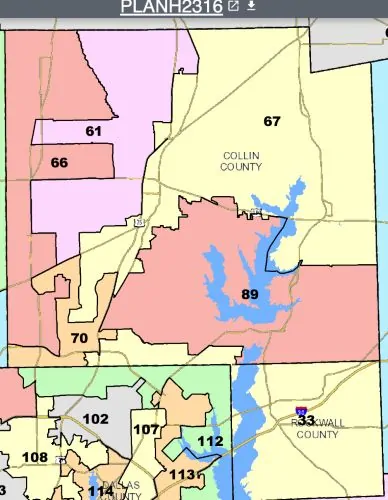
Capturing the Texas House required Democratic gains across constituencies that statewide totals could not identify. The chamber opened its 2025 session with sixty-two Democrats and eighty-eight Republicans, leaving Democrats fourteen net gains short of a majority in the 150-member body. The secretary of state’s November 4 preliminary returns showed Democratic candidates leading in eighty-three districts and Republicans in sixty-seven. The significance of that prospective twenty-one-seat gain lay in its distribution across several regions, where Republican representatives lost constituencies that had helped sustain the party’s legislative control.
Comparisons between elections must begin with the correct boundaries. The Texas Legislative Council identifies PLANH2316 as the state House map used in 2026, continuing the boundaries under which the 2022 and 2024 elections had been conducted. The Republican redraw undertaken in 2025 concerned U.S. congressional districts, whose results belong to a different institutional geography. Keeping that distinction clear permits comparisons of earlier presidential and legislative returns within the same House constituencies, although the participants in the elections were not identical. Joshua Blank’s comparison for the Texas Politics Project showed how the 2021 boundaries placed Trump ahead in eighty-five districts using the 2020 presidential vote, compared with seventy-six under the previous lines. Jonathan Rodden’s research explains why this geographic precision matters for interpreting legislative power. When a party’s supporters are concentrated in a smaller number of districts, overwhelming victories there cannot compensate for losing a larger number of constituencies elsewhere. Democratic control required enough additional district pluralities, regardless of the size of the party’s statewide advantage. District boundaries structured how changing support could become legislative seats, without predetermining every result. This framework directs attention toward the places where Republican advantages actually disappeared, while keeping the causes of those changes open to investigation through evidence about the communities concerned.
Northern Dallas County offers a revealing example in House District 112. The Legislative Council’s 2024 report shows Angie Chen Button winning 53.9 percent of the House vote, while Trump received 50.4 percent in the presidential contest and Democrat Colin Allred narrowly carried the Senate vote. This was an already competitive constituency in which the Republican House result remained stronger than the party’s presidential and Senate performances. Zach Herbert’s approximately 7.1-point lead over Button in 2026 crossed that remaining threshold, reversing her earlier 7.7-point House advantage. The North Texas gains extended to Denise Wooten’s defeat of Ben Bumgarner in Denton County and Democratic pickups in Tarrant County’s Districts 94, 96, and 97. Their distribution placed the losses across several parts of the metropolitan region, weakening a legislative position that had survived earlier periods of Democratic competitiveness.
The South Texas reversals followed a more pronounced Republican advance in the preceding election. In District 37, covering parts of the Rio Grande Valley, the Legislative Council recorded Trump and Republican Representative Janie Lopez each receiving approximately 55 percent in their respective 2024 contests. Two years later, Oziel Ochoa Jr. led Lopez by roughly sixteen points in the preliminary House returns. The comparison identifies a constituency that had recently supported Republican candidates in both contests before choosing a Democratic state legislator. District 80 supplies an even sharper test because the House nominees were unchanged. Trump had received 61.3 percent there in 2024, while Don McLaughlin defeated Cecilia Castellano by approximately nineteen points. In their 2026 rematch, Castellano led by about 5.5 points, a change of roughly 24.5 points in the partisan margin. McLaughlin entered the second contest with the incumbency acquired through his first victory, yet that additional standing did not preserve his seat. These outcomes carried the Democratic advance into South Texas constituencies whose recent voting offered Republicans substantial grounds for confidence, extending the reversal beyond districts where Democrats had already approached victory.
Northwest Houston contributed another conversion of a substantial Republican legislative margin. Lacey Hull had won District 138 with 57 percent in 2024, running ahead of Trump’s 53.3 percent within those boundaries. Tyler Smith’s approximately 3.8-point lead in the 2026 preliminary returns represented a change of nearly eighteen points in the partisan margin. The district’s change of representation shows that Democratic gains reached beyond constituencies where the previous House election had been narrowly decided.
Nearby Republican survival clarifies the uneven limits of these advances. Reporting from Denton County, Micah Pearce described Wooten’s victory alongside the reelection of Republican representatives Richard Hayes, Andy Hopper, and Mitch Little. Hopper’s District 64 result makes the importance of boundaries unusually visible. He trailed Democrat Julie Evans by nearly 10,000 votes in the Denton County portion, but his Wise County support supplied enough votes to retain the whole district. The county’s Democratic movement could coexist with continued Republican representation in a constituency extending beyond it. Dallas County also returned Republican Morgan Meyer in District 108 by a double-digit margin, even as Button lost elsewhere in the county. These differences prevent a metropolitan label from substituting for examination of the electorate within each legislative boundary. Republican strength persisted in adjoining constituencies, but it no longer supplied enough victories across the full map to preserve control of the House.
The resulting majority would bring that geographic diversity into decisions about legislative leadership. By November 5, Democrats Senfronia Thompson of Houston and Eddie Morales Jr. of Eagle Pass had announced bids for speaker, illustrating the different regional careers represented within the party gaining control. Choosing a presiding officer would require agreement among members elected from established Democratic districts and those who had just displaced Republicans. Their victories supplied a basis for organizing the chamber, while the priorities of their constituencies would still have to be reconciled through its work. The importance of the House result lies in that conversion of dispersed electoral decisions into collective authority. Opposition strong enough to change the statewide ticket had also reached enough individual districts to determine who could organize one of Texas’s principal governing institutions.
Allison Montgomery’s Constituency before Its Historic First

The political community that elected Allison Montgomery to the Alabama House lay mainly in Madison County, with a smaller portion in neighboring Limestone County. House District 25 belonged to the Huntsville metropolitan area, where engineering and federal employment helped shape the local economy. American Community Survey estimates for 2024 placed its population at approximately 53,000 and its median household income at $110,131, well above Alabama’s statewide figure of $63,999. Among residents aged twenty-five and older, an estimated 58.7 percent held at least a bachelor’s degree, compared with 28.4 percent statewide. These figures described the district’s residents, including people who did not vote, rather than the composition of Montgomery’s electoral coalition. The regional importance of public institutions was equally striking. A December 2024 City of Huntsville report put Redstone Arsenal’s workforce at about 45,500 and described the transportation demands accompanying its expansion. Although those employment figures covered the Arsenal rather than the legislative district, they illuminate the setting in which debates about government spending acquired local significance. Public expenditure supported skilled employment while growth required investment in the services and infrastructure surrounding it.
Montgomery’s biography situated her within that environment. Born in Huntsville and raised in Madison, she attended Bob Jones High School before earning a computer engineering degree at the University of Alabama in Huntsville and becoming a software engineer supporting Redstone Arsenal. Her campaign presented this experience as preparation for analyzing difficult problems and working collaboratively on legislation. She also brought experience in civil rights advocacy, including examining bills and presenting committee testimony, giving a first-time candidate an existing familiarity with the institution she sought to enter.
Public education supplied the clearest connection between that background and her proposed work in state government. Montgomery advocated increasing the Education Trust Fund and improving teachers’ pay, linking those commitments to the schools that had prepared her for university and employment. Her platform also identified her nieces and nephews as members of the next generation relying on public education, especially Madison City Schools. That reference placed educational provision within a continuing relationship between families and local institutions. Her opposition to the CHOOSE Act gave the campaign a specific dispute through which to express that relationship. Enacted in 2024, the program provided education savings accounts for approved expenses, including tuition; its income eligibility ceiling applied through the 2026–27 academic year and was scheduled to disappear in 2027–28. Montgomery sought repeal, while proposing to retain the income restriction if repeal proved unattainable. The approaching expansion made the allocation of educational subsidies a question about the state’s future obligations, extending beyond the immediate administration of an existing benefit. Read alongside the district’s concentration of educational qualifications, her program offered a defense of institutions that could sustain professional opportunity across generations. That reasoning treated educational provision as a shared asset in a comparatively prosperous community, with benefits extending beyond households currently enrolling children.
Healthcare widened the campaign’s understanding of local interdependence. In an April interview with the Alabama Reflector, Montgomery argued that hospital closures in surrounding rural counties could increase pressure on Huntsville’s medical system, making the condition of neighboring communities relevant to metropolitan residents. She supported Medicaid expansion and investment in the training of healthcare workers. Rigsby also offered a substantive account of medical access, drawing on his work as a pharmacist and his legislative record. He had carried Democratic senator Billy Beasley’s Community Pharmacy Relief Act in the House, helping enact a measure regulating pharmacy benefit managers and establishing minimum reimbursement provisions for independent pharmacies. His argument for another term emphasized relationships with local officials and the practical importance of recruiting and retaining healthcare providers. Their competing proposals allowed residents to compare approaches to public services from candidates who both claimed professional experience relevant to governing. Those credentials gave Rigsby a concrete claim to continued representation, which Montgomery had to overcome alongside the advantages of incumbency.
The preliminary returns reproduced by the Alabama Political Reporter recorded 12,456 votes for Montgomery and 10,929 for Rigsby, a margin of 1,527. Four years earlier, the certified canvass had given Rigsby 10,813 votes against Democrat Mallory Hagan’s 7,837. The incumbent received 116 more votes in 2026, while the Democratic total increased by 4,619, producing a substantial reversal despite the Republican candidate’s modest numerical gain. Those totals establish the extent of the electoral change, although they cannot identify which individuals changed preferences or entered the electorate.
Richard Fenno’s distinction between a geographical constituency and the narrower constituency supporting a representative’s reelection helps clarify the responsibility Montgomery’s victory created. The district encompassed residents whose interests would require attention regardless of their participation or partisan allegiance. Hanna Fenichel Pitkin’s analysis of representation adds another dimension by distinguishing the significance of who occupies an office from the activity of acting for others. Montgomery’s election as Alabama’s first openly transgender legislator altered who could visibly exercise public authority, while her policy commitments established standards against which constituents could assess her conduct. Speaking after her victory, she emphasized continuing conversations with residents to learn what they needed and serving people regardless of how they had voted. Such statements outlined an intended relationship of accountability; their fulfillment would depend on her subsequent work in a House still governed by a Republican supermajority. The historical importance of the result includes the obligations accompanying it, extending from attention to local services to explaining choices made within an institution where her party remained a minority. District 25 had selected a neighbor with an articulated governing program, and the office would require her to represent people whose support she had never secured.
When Exclusion Failed to Determine Representation

Phillip Rigsby made preventing the election of a transgender legislator an explicit purpose of his closing campaign. Addressing the Madison County Republican Party’s annual barbecue on October 20, he repeatedly warned that his defeat would give Alabama its first transgender representative. He then asked listeners to imagine a fourth-grade daughter visiting that lawmaker’s office during a school trip to the capital. The example introduced apprehension into an encounter that would otherwise constitute an ordinary exercise in civic education. Although Rigsby acknowledged his opponent’s freedom to live as she wished, he argued that transitioning would affect her entire approach to policymaking. Private permission and public authority occupied different places in this account. Accepting someone’s existence did not entail accepting her suitability to govern. His appeal sought to make a personal characteristic override the competing judgments through which voters normally assessed a candidate. The threatened development was the arrival of a transgender woman inside an institution authorized to act for the public.
An earlier intervention by the state party chairman presented the objection more bluntly. Speaking to the Eastern Shore Republican Women in Fairhope on October 8, Scott Stadthagen described Montgomery and fellow Democratic candidate Terri Osborne as men with “mental disorders.” That characterization supplied a categorical allegation of unfitness in place of an examination of either woman’s proposals. Bringing both candidacies under the same denunciation invited Republican audiences to understand their participation as a problem requiring a partisan response, despite the different communities and contests involved.
Rigsby subsequently defended his comments by emphasizing policy disagreement. During an October 29 interview on WVNN’s The Yaffee Program, he pointed to Montgomery’s earlier testimony against legislation concerning sex definitions and access to restrooms, presenting her advocacy as evidence voters should consider. Her public interventions were legitimate subjects for electoral scrutiny, and constituents could reasonably ask how those commitments would inform her legislative decisions. The interpretive difficulty lay in the movement from examining stated positions to treating transgender identity as a comprehensive explanation of political conduct. Philip Edward Jones and Paul R. Brewer’s experimental research identifies a mechanism through which that movement can occur. In two studies, information identifying a candidate as transgender affected perceived ideology and judgments about whether the candidate would represent respondents. These inferences persisted when party affiliation was supplied, although responses varied across participants. The research helps clarify the shortcut encouraged by identity-centered campaigning. An argument about a specific proposal could be answered through evidence and debate; a presumption that identity determined the whole legislator placed every proposal under suspicion before its contents received consideration.
Montgomery answered by contesting the relationship between her identity and the problems Republicans claimed to address. Responding to Stadthagen, she asked how her transition could account for rising household expenses and challenged the governing usefulness of his fixation on it. Her rebuttal attempted to return responsibility to officeholders whose decisions were subject to public judgment. She also explained her transgender-rights advocacy as a defense against government intervention in ordinary life, rejecting the suggestion that protecting those rights exhausted her political purposes. This response joined opposition to discrimination with an argument about the proper allocation of political attention. The Alabama Democratic Party’s October 15 statement publicly defended both nominees, framing their candidacies around their proposed contributions to government. Montgomery’s election-night statement went further, attributing divisive cultural disputes to interests benefiting from conflict among people with overlapping material concerns. That explanation expressed her own interpretation of the campaign’s success, while offering supporters a reason to understand equality and economic reform as compatible commitments.
The result places a clear limit on the exclusionary appeal, although its psychological effects remain uncertain. A candidate can win while suffering an electoral penalty associated with prejudice, and support for that candidate can coexist with disagreement over policies affecting transgender people. Research by Jones and his colleagues distinguishes attitudes toward transgender individuals, their rights, and their candidacies, demonstrating why these judgments require separate examination. The uneven returns within Alabama reinforce that caution. In Baldwin County’s House District 96, Osborne, who had been targeted in the same Stadthagen speech, lost to Republican Danielle Duggar; preliminary county figures gave Duggar approximately 64.1 percent against Osborne’s 35.7 percent. Differences between the constituencies and candidates prevent that comparison from isolating an effect of gender identity. Elsewhere, voters in Washington and Colorado approved restrictions on transgender participation in school sports during the same election that brought Democratic gains nationally. These outcomes arose from different electorates and different questions, making them poor substitutes for evidence about Montgomery’s supporters. They do establish that the election produced no uniform settlement of transgender equality. District 25 demonstrated the possibility of electing a targeted candidate amid continuing restrictions and hostility, with no warrant for assuming that every supporter attached the same meaning to her victory.
Institutional reactions immediately exposed the distance between electoral recognition and personal acceptance. On November 4, Alabama House Speaker Nathaniel Ledbetter acknowledged that the district’s choice belonged to its voters, despite his disagreement with their decision. He said he would address Montgomery as Representative, while using male pronouns and emphasizing that existing laws and internal policies would apply to her. His response placed the next dispute inside the legislature’s treatment of an incoming colleague whose right to hold the seat he recognized.
For the national argument, Montgomery’s election reveals a failure of political control more specific than a wholesale transformation of public attitudes. Republican campaigners attempted to give gender identity overriding significance, associating the Democratic challenger’s presence with dangers that would supposedly follow her into office. A winning coalition formed despite that effort, leaving the incumbent unable to preserve his position through the boundary his campaign had emphasized. Her arrival would turn someone repeatedly discussed as an object of regulation into a participant in legislative debate. Colleagues could continue to oppose her positions, but they would confront an elected representative empowered to answer them within the institution. That change gives the Alabama contest its place in the wider defeat of a MAGA governing project that treated the identification of threatening outsiders as a source of political cohesion. The strategy had supplied a reason to mobilize against Montgomery; it had failed to reserve governing authority for those declaring her unsuitable to exercise it.
The Revolution of 1994 with the Partisan Direction Reversed
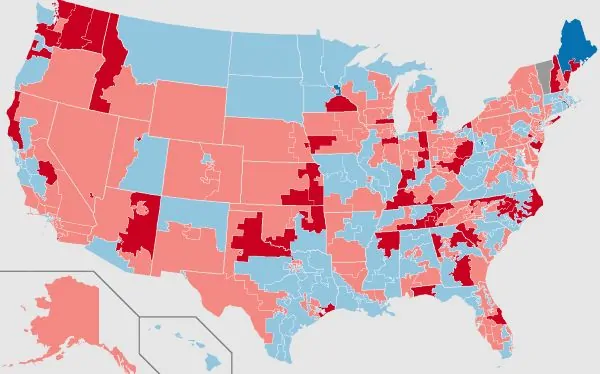
November 8, 1994, brought an end to a congressional arrangement that several generations of voters had known as normal. Republicans gained fifty-four House seats, winning 230 against the Democrats’ 204, with one seat held by an Independent. Their simultaneous gain of eight Senate seats transferred control of both chambers to the opposition and terminated forty years of uninterrupted Democratic House majorities. The defeated included Speaker Thomas Foley, whose position at the institution’s summit had offered no protection against the verdict in his Washington State district. Long-serving committee chairmen also disappeared, including Jack Brooks of Texas and Dan Rostenkowski of Illinois. Their removal gave the election a meaning that extended beyond the president’s approval rating, because the accumulated authority of congressional leadership had itself become vulnerable. Comparing that outcome with 2026 brings the institutional character of the Democratic sweep into sharper focus. In each election, a party occupying the presidency lost the congressional majorities through which it had expected to govern, while powerful incumbents discovered the limitations of their established standing.
The grievances producing the earlier result emerged from Clinton’s troubled effort to turn his 1992 victory into an effective reform presidency. His healthcare initiative collapsed without passage, allowing opponents to attack an ambitious proposal while supporters confronted the administration’s failure to deliver its promised security. Theda Skocpol’s account of that defeat emphasizes the interaction between organized opposition and weaknesses in the reform coalition, challenging a simple explanation in terms of excessive liberal ambition. Economic recovery supplied no automatic political protection. An October Times Mirror survey found improving assessments of Clinton’s economic management alongside an overall approval rating of only 41 percent. The gap suggests why a presidential reckoning could develop from judgments about competence and the purposes of government even as economic conditions improved.
Newt Gingrich and his allies gave Republican challengers a common language through the Contract with America, unveiled on September 27. Signed by hundreds of Republican House members and candidates, it connected opposition to Clinton with an indictment of congressional practices sustained through decades of Democratic control. Its promises distinguished immediate changes to House procedures from legislation scheduled for consideration during the first hundred days. Among the procedural commitments were an independent audit and limits on committee chairmanships; the legislative program included a balanced-budget amendment and changes to welfare. The pledge concerned floor debate and votes on ten proposals, a distinction that matters when evaluating later claims about whether Republicans fulfilled their undertaking. The document also presented a prospective majority as an organized alternative capable of beginning work immediately. Scott Meinke’s research on congressional election agendas helps explain this institutional purpose, showing how leadership-developed platforms can shape legislative attention after a party takes control. The Contract provided a device for coordinating expectations within the Republican coalition, as well as a public statement against which its subsequent behavior could be assessed.
Its fame in later accounts should not obscure its limited recognition before the election. Among registered voters surveyed by Times Mirror on October 20–24, only 29 percent reported having heard of the Contract. Seven percent said it made them more likely to vote Republican, compared with six percent who said less likely. Those findings weaken an interpretation of the Republican victory as an informed endorsement of the entire document, while leaving room for its organizational importance among candidates and party activists.
The Republican advance also extended well beyond Washington. The party emerged with thirty governorships, and legislative elections researcher Tim Storey later counted twenty newly acquired chamber majorities and more than five hundred additional Republican state legislators in the 1994 election. These gains created new centers of governing initiative that possessed their own electoral foundations. They also demonstrate why the comparison with 2026 requires attention to state institutions alongside Congress. A national opposition could acquire authority over public services and state budgets while its congressional members confronted the president. The resulting expansion of party power was geographically extensive, although its distribution varied across offices and did not amount to the immediate disappearance of Democratic influence. For Republicans, the significance of 1994 lay partly in the ability to challenge Democratic control through several distinct institutions within the same electoral cycle. The Democratic victories of 2026 produced a comparable multiplication of opportunities to govern, giving the rejection of the presidential party practical expression beyond federal legislative obstruction.
Longer developments make the two elections less symmetrical than their reversed partisan outcomes initially suggest. Gary Jacobson’s study of the 1994 House contests found pronounced nationalization alongside substantial variation associated with incumbency and the strength of challengers. Such findings help explain how a shared political climate could break a longstanding majority through contests whose immediate circumstances remained different. Alan Abramowitz and Kyle Saunders examined another dimension, interpreting the Republican successes of 1994 and 1996 through a longer ideological realignment of party loyalties. Using national election surveys spanning 1976 to 1994, together with a panel following the same respondents from 1992 to 1994, they connected changes in party identification to increasingly clear ideological differences between the parties. Their analysis identified important changes among white Southerners, many of whom had inherited Democratic attachments increasingly at odds with their policy preferences. From that perspective, Clinton’s difficulties helped expose a weakening structure of partisan allegiance that his administration had not created. The midterm became a point at which accumulated changes achieved a decisive expression in officeholding. A claim of comparable realignment after 2026 would require evidence extending beyond the election just completed, including whether Democratic gains survived later contests. This difference separates the immediate defeat of a governing coalition from the establishment of a durable replacement. The historical analogy is strongest when it explains the overthrow of assumptions about secure control, while the longer trajectory of the new Democratic majorities remains an open question.
Clinton publicly accepted responsibility on November 9, acknowledging that unified Democratic government had been held accountable. The Republican Congress subsequently confronted a president who retained the veto, and conflict over spending contributed to two government shutdowns during the 104th Congress. In 1996, voters reelected Clinton while preserving Republican control of both congressional chambers. Presidential recovery and congressional displacement could coexist, demonstrating that the judgment delivered in a midterm could remain effective in one institution while being revised in another.
The value of describing 2026 as a partisan reversal of 1994 lies in this capacity to disrupt established expectations of party control. Republicans had turned opposition to Clinton into control of institutions long administered by Democrats, then used their victory to claim authority for a different approach to government. Three decades later, Democrats deprived Trump’s party of institutions through which it had advanced its own governing project. The substantive arguments differed, with the earlier Republican campaign emphasizing constraints on government and the later Democratic challenge demanding restraint on presidential conduct alongside more effective public provision. Treating these positions as interchangeable would obscure the political choices at issue in each election. The comparison instead identifies a recurring vulnerability of presidential leadership, whose authority depends on an electoral coalition capable of sustaining power across offices it cannot command by assertion. In 2026, as in 1994, the defeated party confronted more than disapproval expressed at a distance. Voters had authorized opponents who would be able to alter the conduct of government.
The Shorter Comparison with 2006
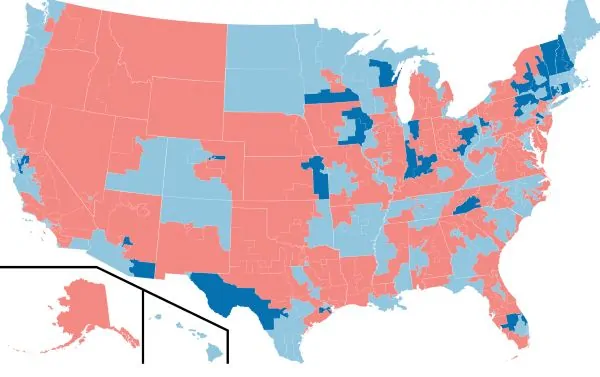
The Democratic victory of 2006 offers a closer parallel in presidential timing, occurring during the second term of a Republican administration whose leadership had become deeply unpopular. On November 7, voters ended twelve years of Republican House control, producing a final division of 233 Democrats and 202 Republicans. The Senate returned forty-nine members from each major party, with two independents joining the Democratic caucus to establish a 51–49 governing majority. George W. Bush faced opposition control of Congress for his remaining two years in office. Gary Jacobson interprets the result as a judgment on Bush, Iraq, and the Republican Congress, emphasizing how dissatisfaction overcame advantages that had helped Republicans defend their congressional position.
Iraq supplied the most sustained challenge to the administration’s account of its own competence. Bush had presented the conflict as integral to protecting Americans, but continuing violence raised doubts about whether the strategy advanced the security it promised. Declassified judgments from an April 2006 National Intelligence Estimate acknowledged successes against al-Qaeda’s leadership while warning that the Iraq conflict was cultivating support for the wider jihadist movement. Such an assessment complicated any straightforward claim that persistence in the existing war strategy necessarily reduced the terrorist threat. Opposition to the administration could draw on criticism emerging from the government’s own intelligence apparatus, alongside accounts of military sacrifice. The electoral significance of those losses also varied across communities. Christian Grose and Bruce Oppenheimer’s study of the House contests found that shifts in Republican-held districts were sensitive to the number of local Iraq war deaths and, less strongly, to representatives’ votes on the war resolution. Their findings connect the international conflict to the uneven burdens borne by the districts choosing the next Congress. A national controversy acquired a local dimension through the deaths of servicemembers from those communities. These findings locate electoral accountability within places experiencing unequal costs from a common military policy.
Congressional corruption supplied a separate, reinforcing indictment. Lobbyist Jack Abramoff pleaded guilty in January 2006 to offenses involving corruption and fraud, and Republican representative Bob Ney pleaded guilty that October to conspiracy and making false statements to the House. These connected cases documented exchanges in which public influence served private advantage. Samuel Best, Jeffrey Ladewig, and Danielle Wong find that Democratic efforts to associate the scandal with the Republican Party produced electoral effects extending beyond members individually linked to Abramoff-related contributions. Political responsibility spread through the reputation of the congressional majority, even though criminal responsibility remained a matter of individual conduct.
The relative importance of war and scandal requires care because contemporary surveys asked different questions. In the national exit poll, 42 percent rated corruption extremely important to their vote, compared with 36 percent for Iraq, with respondents allowed to assign importance to each issue separately. Pew subsequently asked voters to select the single issue that mattered most from the same list, producing 30 percent for Iraq and 10 percent for corruption. The first measure captured the breadth of concern, while the second required respondents to establish a priority. When a separate group answered without an issue list, Iraq again led, although the proportion naming it fell to 17 percent. The unprompted answers were more dispersed than those produced by the list. The findings support an account of overlapping grievances whose rankings changed with the task respondents were given. They also help explain why an election dominated by the Iraq debate could inflict damage through allegations about congressional integrity.
Recruitment and financial support helped Democrats field moderate or conservative candidates in constituencies where, as Jacobson explains, more liberal nominees faced obstacles. The winning party expanded by accommodating differences within its prospective congressional membership. Only 22 percent of Americans in Pew’s postelection survey thought Democratic leaders had a clear Iraq plan. Replacing Republican management had become a more widely shared objective than agreeing on precisely what should follow, leaving the incoming majority to negotiate differences that victory had not resolved.
Committee control gave that dissatisfaction an immediate investigative outlet. Douglas Kriner documents a roughly fourfold increase in the average monthly number of days devoted to critical Iraq oversight hearings after Democrats took charge. Inquiries addressed military equipment and the treatment of wounded veterans, bringing the administration’s conduct before committees with stronger incentives to investigate it. Hearings created repeated occasions to compare official assurances with evidence about conditions in the field. That process could increase the political costs of continuing a policy even when Congress could not compel its replacement. Changing the war itself proved more difficult. Bush vetoed legislation containing a timetable for beginning withdrawal on May 1, 2007, and later that month signed a replacement funding measure without the mandatory timetable. The new majority had expanded public scrutiny while failing to secure the withdrawal requirement it had initially advanced. Its achievement in exposing government performance and its difficulty compelling a different military course belonged to the same history of electoral change.
The additional lesson of 2006 concerns the vulnerability of a party on the grounds it had claimed as its strengths. Republican appeals to national security encountered a war whose management had become a political liability, while corruption cases damaged congressional leaders’ claims to responsible stewardship. Bush-era Republicanism and the MAGA project require separate treatment, given their different leadership and governing commitments. Their electoral defeats expose how an administration’s preferred justification for authority can become a standard against which citizens find it wanting. In 2026, Trump’s assertions of exceptional governing capacity faced assessments of material conditions and presidential conduct that his earlier victory could not settle in advance. The 2006 case makes the testing of governing claims central to understanding how established political advantages became liabilities.
What the Election Changed about Governing Power

The election altered who would exercise public powers after the prescribed transfers of office. New congressional terms would begin on January 3, 2027, while Trump’s presidential term would continue until January 20, 2029. Democratic victories would become operational through the organization of the incoming chambers, including the selection of congressional leaders and committee assignments. This interval matters because a result announced in November changes political expectations before it changes the officials legally entitled to make decisions. The incoming arrangement would require a Republican president to contend with a Congress whose majorities had acquired their authority by defeating his party.
Control of the House would give Democrats substantial influence over which proposals received legislative consideration. Gary Cox and Mathew McCubbins distinguish the majority party’s ability to prevent unwanted measures from reaching the floor from its efforts to advance an affirmative program. Applied to 2026, that distinction identifies a form of power that could matter before Democrats enacted replacement policies. Further statutory support for Trump’s agenda would have to pass through a chamber whose leadership could decline to advance it. Democrats could also organize consideration of alternatives, making their priorities subjects of legislative work. Through the Rules Committee, a House majority can shape the terms under which important bills are debated, including the amendments permitted on the floor. That capacity would give Democratic leaders influence over the choices presented to members, even when a proposal ultimately attracted support from both parties. Committee leadership would bring related authority over investigative staff and the scheduling of testimony. Existing congressional powers of inquiry would pass into the hands of politicians with different reasons to use them, potentially changing which administrative decisions received sustained examination. Obtaining information could still require negotiations over executive privilege or enforcement through legal proceedings. The institutional gain lay in the ability to initiate and direct that work, with its results depending on what inquiries established and what responses they secured.
The Senate victory added a different source of influence over the administration’s future personnel. Democrats could refuse confirmation to presidential nominees requiring the chamber’s consent, affecting Trump’s options for filling judicial and executive vacancies. Current precedents allow a majority to end debate on nominations, and confirmation likewise ordinarily requires a majority, making chamber control directly relevant to their disposition. Texas presented a reciprocal constraint. Hinojosa would nominate appointees while a Republican Senate retained a confirmation requirement of two-thirds of senators present. The same election could strengthen Democratic resistance to presidential appointments in Washington while requiring Democratic accommodation of Republican senators in Austin.
Financial authority would make the new balance important when existing appropriations required renewal. Congressional Democrats could seek conditions on future spending and bargain over the purposes for which public money would be available. Such conditions would have to become law, giving Trump an opportunity to accept a settlement or exercise his veto. Keith Krehbiel’s analysis of pivotal votes helps explain why a working legislative majority differs from a coalition capable of overcoming every obstacle to enactment. Under current Senate procedures, ending debate on most legislation normally requires sixty votes, even though final passage generally requires a simple majority. Overriding a presidential veto requires two-thirds votes in both chambers. These requirements give bargaining importance to legislators outside the majority party when their support is needed to advance a contested measure. Existing statutes and spending authorizations would continue according to their terms until changed through the relevant processes. Democrats had gained the ability to participate decisively in future fiscal decisions, including the power to deny agreement, while Trump retained instruments with which to contest their preferred settlement.
Texas’s healthcare debate quickly exposed the distance between newly acquired office and completed policy. Hinojosa and Goodwin favored Medicaid expansion, and a Democratic House gave its advocates a prospective legislative base, while the Republican Senate retained the ability to block legislation. Terri Langford’s November 9 reporting identified the state’s legislative-approval requirement as an obstacle, while noting uncertainty about whether Hinojosa could independently direct submission of an expansion plan to federal authorities. Democratic legislators were also discussing a trigger bill that would link expansion to changes in federal restrictions. That proposal connected the state victory to the congressional one, because the affordability of a Texas initiative could depend on decisions made in Washington. Federal statutory changes would themselves encounter the presidential bargaining described above. The emerging discussion demonstrates how electoral success opened a policy process involving several governments without resolving the agreements it would require.
Implementation would also unfold against existing appointments and spending commitments. The University of Texas System’s nine regents serve staggered six-year terms, with three ordinarily expiring in February of odd-numbered years, giving an incoming governor a succession of appointment opportunities rather than an entirely vacant board. The next Texas biennial budget, negotiated during 2027, would cover fiscal years 2028–29, beginning September 1, 2027. Such arrangements placed different parts of the state’s administration on different transition schedules, so the replacement of elected leaders would produce changes through a sequence of decisions.
Democrats would also enter a new relationship with the demands they had helped mobilize. James Curry and Frances Lee’s research on congressional lawmaking shows how majority parties commonly secure legislation through broader coalitions and concessions, even amid intense partisan conflict. Their account locates legislative achievement in the ability to assemble agreements around selected priorities, often by revising the original proposal. For the incoming Democrats, governing would involve deciding which proposals to pursue and which agreements preserved enough of their purposes to justify enactment. Those choices would become part of their own public record, alongside their decisions to oppose the president. Trump would confront institutions with an independent electoral foundation, while their leaders would acquire obligations that a campaign against him could leave unresolved. The election redistributed the responsibility to govern as well as the capacity to resist.
Was This a Rejection of MAGA or a Coalition against Incumbents?
The following video from Wire Desk discusses a split between Trump and Republicans in the wake of the Democratic victories:
The most serious challenge to the idea that the election was a rejection of MAGA is that 2026 may have joined voters in a temporary sanction against Republican management without producing comparable agreement against MAGA’s political ideas. The relevant incumbency was the party’s control of the presidency and Congress, which made its candidates answerable for conditions experienced under Republican government. A voter could retain conservative views about immigration while judging the administration economically unsuccessful. Someone concerned about presidential discretion could prefer divided government without wanting Democrats to exercise unconstrained authority. Christopher Achen and Larry Bartels’s critique of electoral mandates gives this objection scholarly substance. Their account emphasizes the role of social attachments and assessments of recent conditions in choices that cannot reliably be translated into detailed instructions about public policy. They warn that electoral sanctions can turn on short-term experiences whose causes voters may attribute imperfectly to officeholders. Applied here, their argument challenges the inference that a decisive Democratic victory disclosed a correspondingly unified political philosophy among those who produced it.
Postelection opinion provides evidence for that alternative. The Economist/YouGov survey conducted November 4–6 found that 44 percent of registered voters viewed the Democratic Party favorably and 51 percent unfavorably. Among respondents who reported voting Democratic for the House, 15 percent still expressed an unfavorable opinion of the party. Republicans also retained a 43–38 percent advantage on which party would better handle immigration. The immigration question measured confidence in party management, leaving open which enforcement practices respondents actually favored. These findings demonstrate why the returns cannot simply be read as acceptance of a complete Democratic platform. Alan Abramowitz and Steven Webster’s research on negative partisanship supplies a related distinction between positive attachment to a party and hostility toward its opponent. They connect this hostility to increasingly aligned social and ideological divisions, making their account a study of organized partisan loyalties as well as displeasure with political leaders. Opposition can sustain consistent voting even when enthusiasm for the beneficiaries remains limited. Choosing a disliked alternative can be a deliberate strategy for imposing costs on the party judged responsible for current conditions. In 2026, an economically frustrated conservative and a committed progressive could select the same Democratic candidate while expecting very different things from the resulting government. The coalition’s electoral effectiveness would then conceal unresolved disagreements about the direction and extent of subsequent reform.
Midterm dynamics supply a second reason for caution. Joseph Bafumi, Robert Erikson, and Christopher Wlezien interpret the recurring movement toward opposition parties during midterm campaigns as consistent with voters seeking policy moderation. Under this explanation, support for congressional restraints can arise among people who continue to approve important presidential objectives. A demand to check Trump could accordingly express a conventional preference for divided power, with the depth of opposition to MAGA remaining a separate question.
These objections complicate an ideological reading, but substantial evidence still directs the judgment toward Trump’s governing coalition. MAGA had become a program exercised through public office, making its actual decisions legitimate objects of assessment alongside its broader aspirations. Economic dissatisfaction could attach to policies prominently adopted by the president, giving punishment for poor performance a substantive political object. In North Carolina, the AP Voter Poll found that about six in ten Senate voters considered Republican nominee Michael Whatley too supportive of Trump. That response identified alignment with the president as a liability for a candidate seeking election to the Senate. It connects the national leadership to an individual contest without requiring the assumption that every opponent rejected every conservative position. More broadly, explaining the mechanism of defeat and interpreting its political meaning are separate tasks. An election can follow familiar patterns of retrospective judgment while decisively interrupting a specific administration’s program. The incumbency explanation helps account for the concentration of responsibility on Republicans; it does not remove the political significance of voters withdrawing support from the party through which MAGA governed.
The stronger conclusion concerns the withdrawal of governing authorization, while leaving ideological unity unproven. The description of the defeat as comprehensive refers to the range of offices Republicans lost, not to the disappearance of every belief associated with their coalition. Democratic victories also supplied no warrant for replacing Trump’s expansive claims of national consent with an equally unrestricted claim on behalf of his opponents. The winners acquired defined offices and opportunities to act, supported by constituencies whose agreement could weaken once decisions required choosing among competing remedies. Their immediate unity lay in determining who should lose power, while their future cohesion would depend on choices not yet made. This qualification preserves the central interpretation of 2026 as a repudiation of MAGA government while rejecting premature declarations of a permanent ideological transformation. The election’s democratic significance rests on the capacity to revoke established claims to authority without requiring the public to acquire a single political mind.
Conclusion: The Limits of Claiming the Country
The 2026 midterms denied Trump a persuasive electoral basis for equating the MAGA movement with the country’s prevailing political will. Democratic gains across Congress and state government subjected that assertion to decisions made in separate constituencies, with results that substantially reduced Republican control. Like the reversals of 1994 and 2006, the election made discontent with presidential leadership effective through offices beyond the presidency. Trump would remain in the White House, but the institutions surrounding his administration would include new majorities elected against his party. His supporters’ earlier success could no longer provide an adequate account of the country’s current electoral choices. Claims about what Americans wanted would now encounter officials chosen to challenge the way his administration governed.
Places long associated with Republican strength gave the reversal much of its historical force. In Texas, Gina Hinojosa and Vikki Goodwin displaced leaders whose careers had helped connect state Republican dominance with the national movement surrounding Trump. James Talarico’s election to the U.S. Senate and the Democratic capture of the Texas House widened the reach of that change, bringing different offices into the same reconsideration of partisan allegiance. Continued Republican control of the state Senate preserved a contested distribution of power, making the result substantial without making it institutionally complete. Alabama supplied another measure of what established political expectations could conceal. Allison Montgomery won a legislative seat after Republican campaigners had urged voters to treat her transgender identity as evidence of unfitness for public responsibility. Her success emerged from a candidacy addressing the needs of a specific constituency, including the services on which its residents depended. It also occurred within a state government that remained Republican, demonstrating the importance of examining changes at the scale where they actually happened. These cases gave the national outcome a concrete social foundation, showing communities making choices that neither inherited partisan habits nor hostile portrayals of candidates could predetermine.
The authority acquired through those choices remained temporary. Adam Przeworski’s account of democracy emphasizes that defeat leaves political competitors able to organize and seek a different outcome under continuing rules. Democrats would face that possibility themselves, with their subsequent conduct furnishing new grounds for public assessment. The election settled who would occupy specified offices while leaving Americans’ disagreements available for further political contest.
The deepest limit on claiming the country concerns the status of people who oppose its government. Jan-Werner Müller’s analysis of exclusive representation identifies the danger in treating a movement’s supporters as the only authentic public. An electoral victory establishes no entitlement to make everyone else politically alien. Montgomery offered a different formulation in her election-night promise to work for people hostile to her, explaining that “they deserve a better Alabama as much as anyone.” That pledge expressed an obligation extending beyond the people responsible for her success, a principle against which her future service could be judged. It also clarifies the democratic significance of the wider result without requiring a claim that the nation’s conflicts had ended. The Americans who defeated Republican candidates had exercised their place in the country, and the Americans who supported those candidates retained theirs. What failed in 2026 was the attempt to treat one coalition’s ascendancy as proof that it alone could speak for America.
Bibliography
Affiliate disclosure: Amazon links on this site are paid links. As an Amazon Associate I earn from qualifying purchases.
- Abbott, Greg. “Certificate of Ascertainment.” State of Texas, November 25, 2024.
- ABC News. “2026 US House Election Results: Live Map.” Updated November 11, 2026.
- Abramowitz, Alan I. “Explaining Senate Election Outcomes.” American Political Science Review 82:2 (1988), 385–403.
- Abramowitz, Alan I., and Kyle L. Saunders. “Ideological Realignment in the U.S. Electorate.” Journal of Politics 60:3 (August 1998), 634–652.
- Abramowitz, Alan I., and Steven Webster. “The Rise of Negative Partisanship and the Nationalization of U.S. Elections in the 21st Century.” Electoral Studies 41 (March 2016), 12–22.
- Achen, Christopher H., and Larry M. Bartels. Democracy for Realists: Why Elections Do Not Produce Responsive Government. Princeton, NJ: Princeton University Press, 2016.
- Alabama Democratic Party. “Expressing Support for Allison Montgomery and Terri Osborne.” October 15, 2026.
- Alabama Department of Revenue. “Creating Hope and Opportunity for Our Students’ Education Act of 2024: The CHOOSE Act.” Accessed November 12, 2026.
- Alabama Legislature. Act 2025-136, Community Pharmacy Relief Act. April 15, 2025.
- Alabama Political Reporter. “2026 Alabama State House 25 Results.” Accessed November 12, 2026.
- Alabama Secretary of State. “2026 General Election Statewide Results.” Updated November 4, 2026.
- —-. “Final Canvass of Results, November 8, 2022.” Certified November 28, 2022.
- AP-NORC Center for Public Affairs Research. “Most Blame President Trump for Higher Prices and Are Unhappy with How He Is Handling the Economy.” October 1, 2026.
- Ashby, Ellie. “Paxton, Talarico Tap Contrary Versions of God and Christianity in Appeal to Texas Voters.” Texas Tribune, August 13, 2026.
- Ashley Hinson for Iowa. “Hinson Releases New Ad: ‘Aisle.’” September 15, 2026.
- Associated Press. “2026 U.S. Senate Election Results.” Accessed November 11, 2026.
- Azari, Julia R. Delivering the People’s Message: The Changing Politics of the Presidential Mandate. Ithaca, NY: Cornell University Press, 2014.
- Bafumi, Joseph, Robert S. Erikson, and Christopher Wlezien. “Balancing, Generic Polls and Midterm Congressional Elections.” Journal of Politics 72:3 (July 2010), 705–719.
- Baldwin County Probate Judge’s Office. “November 3, 2026 General Election Summary Unofficial Results.” November 3, 2026.
- Barrett, Anna. “Alabama Democrats Flip Four Legislative Seats in 2026 Midterms.” Alabama Reflector, November 4, 2026.
- —-. “In Potentially Competitive Huntsville-Area House Seat, Candidates Look to Healthcare, Education.” Alabama Reflector, April 28, 2026.
- Bermeo, Nancy. “On Democratic Backsliding.” Journal of Democracy 27:1 (2016), 5–19.
- Best, Samuel J., Jeffrey W. Ladewig, and Danielle C. Wong. “Owning Valence Issues: The Impact of a ‘Culture of Corruption’ on the 2006 Midterm Elections.” Congress & the Presidency 40:2 (2013), 129–151.
- Birenbaum, Gabby. “Ken Paxton Defeats John Cornyn for U.S. Senate GOP Nomination.” Texas Tribune, May 26, 2026.
- —-. “MAGA Inc. Cavalry Arrives for Paxton in Texas Senate as Trump’s PAC Places $10 Million Ad Buy.” Texas Tribune, September 5, 2026.
- —-. “Trump Endorses Ken Paxton in Senate GOP Runoff.” Texas Tribune, May 19, 2026.
- Blank, Joshua. “Comparing Trump-Biden Vote Shares in Old and New Texas House Districts.” Texas Politics Project, University of Texas at Austin, January 10, 2022.
- Boak, Josh, Hyojin Yoo, and Humera Lodhi. “How Trump and Republicans Lost the 2026 Midterm Elections, According to the AP Voter Poll.” Associated Press, November 4, 2026.
- Bush, George W. “Message to the House of Representatives.” May 1, 2007. White House Office of the Press Secretary.
- —-. “President’s Statement on Congressional Passage of the War Supplemental.” May 25, 2007. White House Office of the Press Secretary.
- Census Reporter. “State House District 25, AL.” American Community Survey 2024 Five-Year Estimates. Accessed November 12, 2026.
- Clinton, William J. “Press Conference by the President.” White House Office of the Press Secretary, November 9, 1994.
- Congressional Research Service. Congressional Oversight Manual. RL30240. Updated March 27, 2026.
- —-. Senate Consideration of Presidential Nominations: Committee and Floor Procedure. RL31980. Updated October 1, 2025.
- Cox, Gary W., and Mathew D. McCubbins. Setting the Agenda: Responsible Party Government in the U.S. House of Representatives. Cambridge: Cambridge University Press, 2005.
- CQ Roll Call Staff. “Key Midterm Election Results.” Roll Call, November 3, 2026. Updated November 11, 2026.
- Colvin, Jill, and Aaron Kessler. “Trump Wants the Midterms to Be All about Himself. Judging by the Ads, Democrats Are Happy to Oblige.” Associated Press, October 16, 2026.
- Cunningham, Sean P. Cowboy Conservatism: Texas and the Rise of the Modern Right. Lexington: University Press of Kentucky, 2010.
- Curry, James M., and Frances E. Lee. The Limits of Party: Congress and Lawmaking in a Polarized Era. Chicago: University of Chicago Press, 2020.
- Dahl, Robert A. “Myth of the Presidential Mandate.” Political Science Quarterly 105:3 (1990), 355–372.
- Davis, Julianne. “House Speaker Ledbetter on Transgender Lawmaker Allison Montgomery: ‘Same Laws and Internal Policies Will Apply to Him as They Would to Any Other Member.’” 1819 News, November 5, 2026.
- DeGuzman, Colleen, Berenice Garcia, and Alejandro Serrano. “After Supporting Trump in 2024, Texas Border Counties Fueled Democrats’ Big Night.” Texas Tribune, November 4, 2026.
- Democratic Congressional Campaign Committee. “DCCC Goes Up on Air in Seven Districts with First Coordinated TV Ads.” September 8, 2026.
- —-. “DCCC Releases First Two TV Ads in CO-08: ‘Your Corner’ and ‘Sin Ventajas.’” September 22, 2026.
- Downey, Renzo. “Texas Democrats Already Angling to Be the Next House Speaker.” Texas Tribune, November 5, 2026.
- —-. “Democrats Flip Texas House amid Generational Wave.” Texas Tribune, November 3, 2026. Updated November 4, 2026.
- Edwards, George C., III. “Did Donald Trump Receive a Mandate for Sweeping Change in 2024?” PS: Political Science & Politics 59:3 (2026), 493–499.
- Erikson, Robert S. “The Puzzle of Midterm Loss.” The Journal of Politics 50:4 (1988), 1011–1029.
- Fechter, Joshua, with data analysis by Alex Ford and Apurva Mahajan. “Surge in Voter Turnout in Urban, Border Counties Carried Texas Blue Wave.” Texas Tribune, November 4, 2026.
- Federal Election Commission. Federal Elections 2006: Election Results for the U.S. Senate and the U.S. House of Representatives. Washington, DC: Federal Election Commission, 2007.
- —-. “Official 2024 Presidential General Election Results.” 2025.
- Fenno, Richard F., Jr. “U.S. House Members in Their Constituencies: An Exploration.” American Political Science Review 71:3 (September 1977), 883–917.
- Gainey, Blaise. “What Does It Mean to Be a Texas Republican in 2026? It Depends Who You Ask.” Texas Public Radio, August 27, 2026.
- Gattis, Paul. “Redstone Arsenal: Driving Economic Impact and Shaping Huntsville’s Future.” City of Huntsville, December 13, 2024.
- Gerber, Alan S., and Donald P. Green. “The Effects of Canvassing, Telephone Calls, and Direct Mail on Voter Turnout: A Field Experiment.” American Political Science Review 94:3 (2000), 653–663.
- Gina Hinojosa for Texas Governor. “New Ad: ‘The Truth,’ Hinojosa Works for Families, Abbott Works for Donors.” September 23, 2026.
- —-. “Save Texas Public Schools.” Accessed November 12, 2026.
- Goldberg, Michael. “Thompson and Colom Urge Black Voters to Turn Out in November amid Redistricting Fight.” Mississippi Today, August 25, 2026.
- Goodwin, Vikki. “Comprehensive Healthcare.” Accessed November 12, 2026.
- —-. “Priorities.” Accessed November 12, 2026.
- Gore, D’Angelo. “Paxton’s AI-Heavy Ad Leaves Out Context of Talarico Remarks about Christianity.” FactCheck.org, September 15, 2026.
- Gorski, Philip S. American Covenant: A History of Civil Religion from the Puritans to the Present. Princeton: Princeton University Press, 2017.
- Grose, Christian R., and Bruce I. Oppenheimer. “The Iraq War, Partisanship, and Candidate Attributes: Variation in Partisan Swing in the 2006 U.S. House Elections.” Legislative Studies Quarterly 32:4 (November 2007), 531–557.
- Grumbach, Jacob M. Laboratories against Democracy: How National Parties Transformed State Politics. Princeton, NJ: Princeton University Press, 2022.
- Guo, Kayla. “Gov.-elect Gina Hinojosa Pledges Bipartisan Administration in First Public Appearance since Win.” Texas Tribune, November 5, 2026.
- Guo, Kayla, Taylor Goldenstein, and Terri Langford. “Democrat Gina Hinojosa Topples Greg Abbott to Become First Latina Governor of Texas.” Texas Tribune, November 3, 2026.
- Hartig, Hannah, et.al. Behind Trump’s 2024 Victory, a More Racially and Ethnically Diverse Voter Coalition. Washington, DC: Pew Research Center, June 26, 2025.
- Holmes, Jacob. “How Did Allison Montgomery Become Alabama’s First Trans Lawmaker? By Running on the Issues, She Says.” Alabama Political Reporter, November 5, 2026.
- —-. “Huntsville House Candidate Fires Back at Republican Opponent’s Attack on Trans Identity.” Alabama Political Reporter, October 26, 2026.
- Hopkins, Daniel J. The Increasingly United States: How and Why American Political Behavior Nationalized. Chicago: University of Chicago Press, 2018.
- Jacobson, Gary C. “The 1994 House Elections in Perspective.” Political Science Quarterly 111:2 (1996), 203–223.
- —-. “How Do Campaigns Matter?” Annual Review of Political Science 18 (2015), 31–47.
- —-. “Referendum: The 2006 Midterm Congressional Elections.” Political Science Quarterly 122:1 (Spring 2007), 1–24.
- Jones, Philip Edward, et.al. “Explaining Public Opinion toward Transgender People, Rights, and Candidates.” Public Opinion Quarterly 82, no. 2 (Summer 2018): 252–278.
- Jones, Philip Edward, and Paul R. Brewer. “Gender Identity as a Political Cue: Voter Responses to Transgender Candidates.” Journal of Politics 81:2 (April 2019), 697–701.
- Kalla, Joshua L., and David E. Broockman. “The Minimal Persuasive Effects of Campaign Contact in General Elections: Evidence from 49 Field Experiments.” American Political Science Review 112:1 (2018), 148–166.
- Kiley, Jocelyn, et.al. “Economy Ranks as Top Issue in Midterms for All Voters, but Partisans Differ over the Importance of Other Issues.” Pew Research Center, October 8, 2026.
- Kinder, Donald R., and D. Roderick Kiewiet. “Sociotropic Politics: The American Case.” British Journal of Political Science 11:2 (1981), 129–161.
- King, Gary. A Solution to the Ecological Inference Problem: Reconstructing Individual Behavior from Aggregate Data. Princeton, NJ: Princeton University Press, 1997.
- King, Gary, and Robert X. Browning. “Democratic Representation and Partisan Bias in Congressional Elections.” American Political Science Review 81:4 (1987), 1251–1273.
- Klibanoff, Eleanor. “‘Uncharted Territory’: Two Months from Election Day, Democrats in Texas Are Truly Competitive.” Texas Tribune, September 17, 2026.
- Kousser, Thad, and Justin H. Phillips. The Power of American Governors: Winning on Budgets and Losing on Policy. Cambridge: Cambridge University Press, 2012.
- Krehbiel, Keith. Pivotal Politics: A Theory of U.S. Lawmaking. Chicago: University of Chicago Press, 1998.
- Kriner, Douglas. “Can Enhanced Oversight Repair ‘The Broken Branch’?” Boston University Law Review 89:2 (April 2009), 765–793.
- Krochmal, Max. Blue Texas: The Making of a Multiracial Democratic Coalition in the Civil Rights Era. Chapel Hill: University of North Carolina Press, 2016.
- Langford, Terri. “Gov.-Elect Hinojosa Wants to Expand Medicaid in Texas. An Executive Order Won’t Make That Happen.” Texas Tribune, November 9, 2026.
- Leggio, Zach. “Democrats Dominate in Tarrant County, a Key Battleground.” Texas Tribune, November 3, 2026.
- Levinson, Daryl J., and Richard H. Pildes. “Separation of Parties, Not Powers.” Harvard Law Review 119:8 (2006), 2311–2386.
- Lewis-Beck, Michael S., and Mary Stegmaier. “Economic Determinants of Electoral Outcomes.” Annual Review of Political Science 3 (2000), 183–219.
- McCollum, Cliff. “Democrats Call Out Republican’s Arrest as ALGOP Chair Says Transgender Candidates Have ‘Mental Disorders.’” AL.com, October 11, 2026.
- McIntire, Mary Ellen. “Colom Elected Mississippi’s First Black Senator since Reconstruction.” Roll Call, November 11, 2026.
- Meinke, Scott R. The Origins and Consequences of Congressional Party Election Agendas. Cambridge: Cambridge University Press, 2023.
- Montgomery, Allison. “About Allison.” Allison Montgomery for District 25. Accessed November 12, 2026.
- “Election Night Statement.” Allison Montgomery for District 25. November 3, 2026.
- —-. “My Platform.” Allison Montgomery for State House District 25. Accessed November 6, 2026.
- Müller, Jan-Werner. What Is Populism? Philadelphia: University of Pennsylvania Press, 2016.
- National Governors Association. “Governors’ Party Affiliations, 1900–2019.” Accessed November 12, 2026.
- —-. “Gubernatorial Elections.” Accessed November 11, 2026.
- National Intelligence Council. “Trends in Global Terrorism: Implications for the United States.” National Intelligence Estimate, April 2006. Declassified key judgments.
- Noem v. Abrego Garcia. No. 24A949. U.S. Supreme Court, April 10, 2025. Order.
- O’Donnell, Guillermo. “Horizontal Accountability in New Democracies.” Journal of Democracy 9:3 (1998), 112–126.
- Office of the Texas Governor. “Governor Abbott Signs Landmark School Choice Legislation into Law.” May 3, 2025.
- Owens Hubler, Katy. “2026 State Legislative Elections: The Results and What They Mean.” National Conference of State Legislatures, November 6, 2026.
- Pearce, Micah. “Election Results: Denton County Republicans Hold Their Own amid Blue Wave across Texas.” Cross Timbers Gazette, November 4, 2026.
- Pew Research Center. Behind Trump’s 2024 Victory, a More Racially and Ethnically Diverse Voter Coalition. June 26, 2025.
- —-. “Economy Ranks as Top Issue in Midterms for All Voters, but Partisans Differ over the Importance of Other Issues.” October 8, 2026.
- —-. “Public Cheers Democratic Victory.” November 16, 2006.
- —-. “Trump’s Second Term: Early Ratings and Expectations.” February 7, 2025.
- Pitkin, Hanna Fenichel. The Concept of Representation. Berkeley: University of California Press, 1967.
- Platoff, Emma. “U.S. Supreme Court Throws Out Texas Lawsuit Contesting 2020 Election Results in Four Battleground States.” Texas Tribune, December 11, 2020.
- Przeworski, Adam. Democracy and the Market: Political and Economic Reforms in Eastern Europe and Latin America. Cambridge: Cambridge University Press, 1991.
- Republican Members of the U.S. House of Representatives. “The Republican Contract with America.” September 27, 1994.
- Republican Party. “2024 Republican Party Platform.” July 8, 2024. The American Presidency Project.
- Roche, Jeff. The Conservative Frontier: Texas and the Origins of the New Right. Austin: University of Texas Press, 2025.
- Rodden, Jonathan A. Why Cities Lose: The Deep Roots of the Urban-Rural Political Divide. New York: Basic Books, 2019.
- Rosenstone, Steven J., and John Mark Hansen. Mobilization, Participation, and Democracy in America. New York: Macmillan, 1993.
- Salhotra, Pooja. “Republicans Reassert Their Dominance in Texas.” Texas Tribune, November 6, 2024.
- Sanders, Linley, and Humera Lodhi. “What Motivated Voters in the 2026 Midterm Elections, According to the AP Voter Poll.” Associated Press, November 4, 2026.
- Sanders, Linley, Humera Lodhi, and Amelia Thomson-Deveaux. “Young Voters Led a Sharp Shift toward Democrats in the 2026 Midterms, the AP Voter Poll Finds.” Associated Press, November 4, 2026.
- Scherer, Jasper. “In Private School Voucher Push, Gov. Abbott Breaks Through by Playing Hardball.” Texas Tribune, April 17, 2025.
- Senate Majority PAC. “New Ad: Cindy Hyde-Smith Does Nothing for Mississippi. Scott Colom’s Ready to Fight Back.” October 20, 2026.
- Serrano, Alejandro. “Democrat Vikki Goodwin Declares Victory over Dan Patrick to Become Texas Lieutenant Governor.” Texas Tribune, November 3, 2026.
- —-. “GOP State Senators Could Emerge as Last Protectors of Party Power in Texas.” Texas Tribune, November 5, 2026.
- —-. “Lt. Gov.-elect Vikki Goodwin Taps Bipartisan Transition Team as She Prepares to Lead a GOP-majority Senate.” Texas Tribune, November 10, 2026.
- Shipley, Austen. “‘It Changes Everything’: Rigsby Says Dem Opponent’s Legislative Policy Decisions Would Be Dictated by Transgender Identity.” 1819 News, October 22, 2026.
- Skocpol, Theda. Boomerang: Clinton’s Health Security Effort and the Turn against Government in U.S. Politics. New York: W. W. Norton, 1996.
- SSRS. “The Voter Poll by SSRS 2026 Methods Statement.” 2026.
- Storey, Tim. “GOP Makes Historic State Legislative Gains in 2010.” Rasmussen Reports, December 10, 2010. Originally published by Sabato’s Crystal Ball.
- Strong, Donald S. “The Rise of Negro Voting in Texas.” American Political Science Review 42:3 (1948): 510–522.
- Talarico for Texas. “Corruption & Democracy.” Accessed November 12, 2026.
- —-. “Freedom, Family & Faith.” Accessed November 12, 2026.
- —-. “Meet James Talarico.” Accessed November 12, 2026.
- Texas. Constitution. Article IV, sections 8, 14, and 16.
- Texans for Greg Abbott. “Governor Abbott Statement on Texas’ Historic House Republican Primary Runoff Victories.” May 29, 2024.
- Texas Comptroller of Public Accounts. Texas Statewide Overview: 2022 Regional Report. 2022.
- Texas Education Agency. “House Bill 2: Historic School Finance Bill.” Annual Report 2025. Accessed November 12, 2026.
- Texas Legislative Council. “Current Districts.” Accessed November 12, 2026.
- —-. District Election Report: House District 37, PLANH2316, 2024 General Electionhttps://data.capitol.texas.gov/dataset/planh2316/resource/88ca3280-ae34-4a64-9f0c-040774c9f786. Red-226. February 25, 2025.
- —-. District Election Report: House District 112, PLANH2316, 2024 General Election. Red-226. February 25, 2025.
- Texas Legislative Reference Library. “Political Party Statistics.” Accessed November 12, 2026.
- —-. “Texas State Budget.” Accessed November 12, 2026.
- Texas Legislature. “Senate Bill 2: Enrolled Bill Summary.” Eighty-Ninth Legislature, Regular Session, 2025.
- Texas Secretary of State. “1994 General Election: Race Summary Report.” November 8, 1994.
- —-. “2018 General Election: Race Summary Report.” November 6, 2018.
- —-. “Election Results—Tuesday, November 3, 2026.” Updated November 4, 2026.
- Texas Senate. “Paxton Acquitted.” September 16, 2023.
- —-. Senate Rules, Adopted by the Eighty-Ninth Legislature, January 15, 2025. Austin: Texas Senate, 2025.
- Times Mirror Center for the People & the Press. Democrats Recover but GOP’s Turnout Edge Looms Large. October 28, 1994.
- Trump, Donald J. “Address Before a Joint Session of the Congress.” March 4, 2025. The American Presidency Project.
- —-. Executive Order 14215, “Ensuring Accountability for All Agencies.” February 18, 2025. Federal Register 90, no. 35 (February 24, 2025): 10447–49.
- —-. “Inaugural Address.” January 20, 2025. The American Presidency Project.
- —-. “Remarks Accepting Election as the 47th President of the United States in Palm Beach, Florida.” November 6, 2024. The American Presidency Project.
- Tufte, Edward R. “Determinants of the Outcomes of Midterm Congressional Elections.” American Political Science Review 69:3 (1975), 812–826.
- U.S. Bureau of Labor Statistics. “Consumer Price Index: September 2026.” October 14, 2026.
- U.S. Department of Justice. “Congressman Robert W. Ney Pleads Guilty to Charges Involving Corruption and False Statements.” October 13, 2006.
- U.S. Government Accountability Office. “Impoundment Control Act of 1974: Review of the President’s Special Message of September 25, 2026.” B-338788, September 29, 2026.
- U.S. House of Representatives, Office of the Clerk. “Roll Call 85: H.Con.Res.38.” March 5, 2026.
- —-. “Roll Call 199: H.Con.Res.86.” June 3, 2026.
- —-. Statistics of the Congressional Election of November 8, 1994. Washington, DC: Government Printing Office, 1995.
- U.S. House of Representatives, Office of the Historian. “104th Congress, 1995–1997.” Accessed November 12, 2026.
- —-. “105th Congress, 1997–1999.” Accessed November 12, 2026.
- —-. “Please Pass the Gavel.” June 23, 2014.
- U.S. Senate. “Party Division.” Accessed November 12, 2026.
- United States. Constitution. Article I, sections 5, 7, and 9; article II, section 2; amendment XX.
- United States Supreme Court. Texas v. Pennsylvania et al. No. 22O155. Order, December 11, 2020.
- University of Texas System. “Board of Regents.” Accessed November 12, 2026.
- Wesleyan Media Project. “Midterm Ad Discussion Revolves around Trump.” June 18, 2026.
- White House. “Press Briefing by Press Secretary Karoline Leavitt, Deputy Chief of Staff Stephen Miller, National Economic Council Director Kevin Hassett, and National Security Advisor Mike Waltz.” February 20, 2025. The American Presidency Project.
- Whitehead, Andrew L., and Samuel L. Perry. Taking America Back for God: Christian Nationalism in the United States. Oxford: Oxford University Press, 2020.
- Yaffee. “‘Know What You’re Voting For’: Rigsby Says Democrat Opponent Lobbied Montgomery to Kill Bill Keeping Boys out of Girls’ Bathrooms.” Yellowhammer News, October 30, 2026.
- YouGov. The Economist/YouGov Poll. November 4–6, 2026. Tables 57 and 61.
Originally published by Brewminate, 11.13.2026, under the terms of a Creative Commons Attribution-NonCommercial-NoDerivatives 4.0 International license.
About the Author