In a letter to Heliodoros, Nearchos tells of sailing upriver and carving names at sacred sites. His account offers a rare look at how a private traveler could see Egypt’s ancient monuments.

By Matthew A. McIntosh
Public Historian
Brewminate
Introduction: The Names Nearchos Left Behind
The names Nearchos meant to preserve are the very ones his letter leaves us wanting to know. Somewhere on his travels through Roman Egypt, he cut the names of people dear to him into sacred monuments. He told Heliodoros what he had done, calling it a proskynema, an act of reverence that he hoped would be remembered. The surviving Greek gives us his words for those people, but their identities have fallen out of the story. What remains is an unexpected detail in a traveler’s account. A man who had gone upriver to see places already ancient in his day found a reason to add the names of people from his own life to the writing he encountered there.
The British Library dates the damaged sheet to 90–133 CE, the span of the dated documents in the archive with which it is associated. The date of Nearchos’s departure remains unknown, and the opening is too fragmentary to recover the circumstances in which he set out. His account becomes clearer when he names Syene, near modern Aswan, and speaks of a place from which the Nile was supposed to flow. He also says that he reached Libya, where Ammon gave oracles, a reference generally understood to mean the sanctuary at Siwa. The journey to the oasis would have required travel beyond the river valley, though the surviving lines leave his route uncertain. Even the places he names pose a problem of interpretation, since the Egypt he describes bears traces of a country already familiar from older Greek writing. The back of the sheet supplies a detail of a different order. It bears the address to Heliodoros, whom scholars identify with a son of a prosperous landowning family in the Hermopolite nome. That identification gives the letter a place in the life of a provincial household and lets us ask what company a man like Nearchos kept, even when his own circumstances are harder to recover.
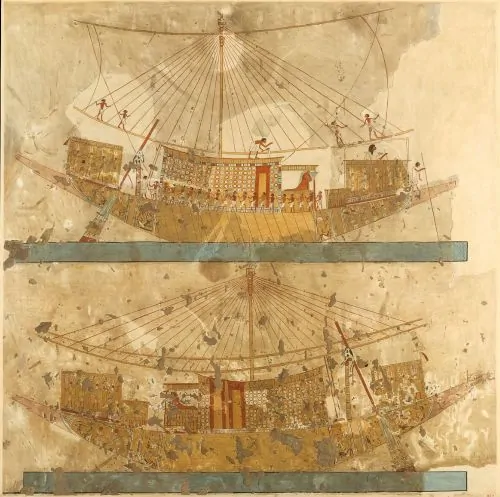
For anyone planning such a journey, the first business was finding a boat. A letter from the reign of Augustus gives that problem a human scale. Its writer urges Athenodoros to intervene for the release of a vessel because Athenodoros’s sister wants to sail upriver aboard it. The episode shows how one person’s plans could depend on securing space on a boat that was already engaged in other business. A river that carried tax grain toward Alexandria and moved private consignments between towns offered opportunities to passengers as well. What a traveler could do with those opportunities depended on when a vessel was available and how much time the traveler could spend ashore before arranging the next stage. The surviving records tell us considerably more about the work that kept boats moving than about the arrangements Nearchos himself made. They give us grounds for asking how far someone could travel on personal business by making use of the same traffic that supplied Egypt’s towns and served the Roman state.
At Thebes, Germanicus could have a senior Egyptian priest explain what the inscriptions said about the wealth and conquests of an earlier kingdom. Visitors to the Colossus of Memnon made the stone carry accounts of their own encounters, sometimes recording the hour at which they heard the statue’s voice. Nearchos’s letter brings the journey into a more intimate circle. Heliodoros could learn about the visit wherever the papyrus reached him, while anyone who encountered an inscription had to come to the place where it stood. Those named in the stonework might never read it themselves. Their place in the story depended on a traveler remembering them at a moment when he had something of his own to leave at a sacred site.
The Letter in the Archive of Sarapion
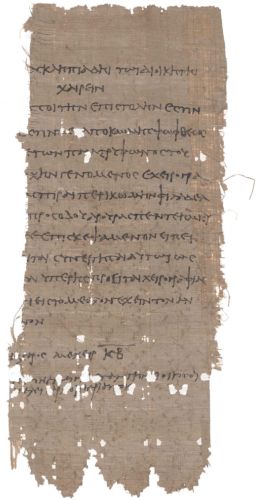
The name of Nearchos’s correspondent is clearest on the side of the papyrus that once faced outward. A single line survives there, with the name in the Greek dative, Hēliodōrōi, meaning “to Heliodoros.” The front presents a more difficult reading. Part of the upper edge is gone, and holes and abrasion interrupt the twelve lines the British Library records on a fragment measuring a little over twelve centimeters each way. The address on the back gives editors a basis for restoring Heliodoros’s name in the damaged greeting on the front, where the two men’s names would conventionally have appeared together.
The archive in which the letter is now read took shape first within a family and later across several collections. Papers associated with Sarapion and his household accumulated over decades, and his son Eutychides appears to have been their last ancient keeper. Among them are declarations of property and accounts of agricultural operations in the Hermopolite district. The family cultivated land of its own and also dealt in leases, which gave its members reasons to retain documents drawn up for particular transactions. In 125 CE, for instance, Anubion, a son of Sarapion, leased three plots for a year. One part of the surviving contract is in London and another in Heidelberg. The two pieces make unusually concrete what it means to reconstruct an archive whose contents entered modern collections separately. The British Museum received Nearchos’s letter in 1900 among a group of papyri presented by the executors of William Joseph Myers. The association with Sarapion’s papers gives the undated letter its approximate chronological setting and offers a way to identify its recipient. Why someone in the household originally kept an account of the voyage remains open.
Another letter in the collection shows Heliodoros receiving news of a more familiar kind. His brother Eutychides wrote to inquire after his health, using seven lines across the upper part of a sheet that still shows vertical folds and traces of sealing. In that better-preserved example, the outward address can be understood in relation to the sheet as it was folded for delivery. Eutychides’s letter also names the relationship between the two correspondents, giving substance to the identification of Nearchos’s addressee as a son of Sarapion. Other papers suggest that Heliodoros spent time away from Hermopolis, probably at Memphis. A letter that eventually came to rest among family records could have reached him while he was living elsewhere. The archive gives him a family and a local setting, while the address itself leaves his whereabouts at the time of delivery unresolved.
Nearchos’s identity has proved harder to establish. The papyrologist Gabriella Messeri drew attention to how often the name occurs in the Hermopolite district and proposed a possible connection with another family known through papyri associated with Kôm Kâssûm. One document in that group names a Nearchos who had a daughter called Demetria. A woman of that name and parentage also appears in a document from Sarapion’s archive. The two references offer a possible connection between the households, but identifying the traveler would require establishing that the records concern the same father and daughter. Messeri also suggested that Nearchos may have penned the surviving letter himself. Heliodoros’s handwriting can be identified with greater confidence because scholars have more material for comparison, including documents in which he appears to have written on behalf of his father or brothers. Writing was among the services he performed for his family, and receiving a composed account of a voyage was another use of a skill that already had a place in his everyday affairs. If the attribution of the hand to Nearchos is right, the sheet preserves an exchange between two men who could each put his own Greek prose on papyrus. The evidence for that shared practice is more substantial than the evidence for a precise kinship between them.
The transition to the narrative of the voyage falls in one of the damaged passages. The verb describing the inspection of works made by human hands is in the third person plural. Nearchos then moves into the first person, at a point where editors have supplied different verbs. One restoration has him follow the course taken by others, while the first editors understood him to say that he sailed past. The choice changes how his decision to go upriver reads, and the fragment leaves much of the preceding explanation to conjecture. Once the narrative reaches Syene and evokes the oracle of Ammon, the names supply a more secure basis for asking what kinds of places Nearchos chose to tell Heliodoros about.
Upriver to Syene and West to Ammon
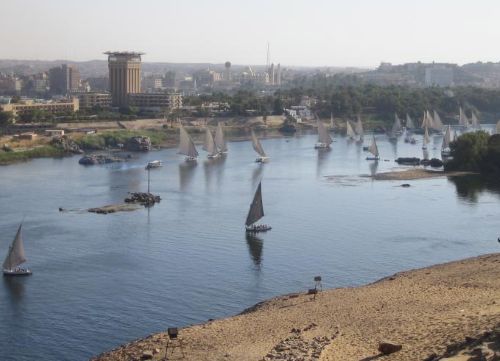
The Greek word Nearchos uses for his voyage, anaplous, gives the journey a direction. On the Nile, sailing upstream meant going south, and the first town he names is Syene, on the east bank at modern Aswan. Across a channel lay Elephantine, an island settlement near the northern end of the First Cataract. Here granite outcrops and smaller islands divided the river into passages that could differ sharply in depth and current. The place where Nearchos says he arrived was also a place where boatmen had to reckon with how much farther a particular vessel could go.
Strabo describes boatmen working their way upstream along the sides of a rocky drop, then running their boats down over it as a display for Roman prefects. When he traveled from Syene to Philae, his party took wagons for the overland stretch and used a small boat to make the final crossing to the island. The two episodes show how much could depend on choosing a means of travel suited to a short stretch of the river. Syene and Elephantine also handled traffic between Egypt and Nubia, and local red granite went north through their ports. Roman authority had extended south of the cataract into Lower Nubia, even as these settlements retained their standing as places of entry into Egypt. On Elephantine, Strabo describes a stone-lined well that rose and fell with the Nile. Marks inside it allowed the height of the flood to be measured and reported, information that helped people downstream prepare for the inundation. The river at the cataract could be a difficult passage for a boat and a means of gauging what the agricultural year would bring.
Nearchos introduces a different idea about the river when he says that he reached Syene and the place from which the Nile flows. His wording puts that place in the vicinity of Syene while leaving its precise location open. Herodotus had heard from a temple treasury scribe at Sais that the river rose in bottomless springs between two peaks near Syene and Elephantine. He doubted his informant and distinguished what he claimed to have seen as far as Elephantine from what he had learned about the river farther south. Strabo rejected the account of the springs and the notion of a bottomless channel in the same vicinity. The association of the cataract with the Nile’s beginning nevertheless had a life outside Greek geographical writing. A fragmentary inscription from Elephantine associates rites performed by Ptolemy IX in 115 BCE with a place identified as a source of the Nile. The inscription shows that the idea could be given a physical setting and acted upon there. Irene Pajón Leyra reads Nearchos’s phrase as a claim about the river’s physical origin and places it within the reception of older Greek descriptions of Egypt. The local inscription helps explain why this stretch of the river could have acquired such significance, while the letter leaves open how the idea reached Nearchos.
Ammon’s oracle belonged to a different landscape. The sanctuary usually identified with the one in the letter stood at Siwa, an oasis in the Western Desert, in the region Nearchos calls Libya. To reach it from the Nile Valley, a traveler had to cover ground that offered no continuous supply of water. Strabo gives five days from Apis, a coastal village near the harbor of Paraetonium, to Ammon’s temple. Pliny gives twelve days from Memphis to the oracle, measuring the journey from a city on the Nile. On routes between the coast and the oasis, cisterns and places where travelers and their animals could shelter helped make crossings possible. These accounts give some substance to a journey Nearchos passes over in a few words. They leave his own point of departure for the desert and the route he took unsettled.
The distance made sense in light of the sanctuary’s reputation. Greek communities had long consulted the god they identified as Zeus Ammon, and Alexander’s visit in 331 BCE kept the oasis prominent in accounts of his expedition. By Strabo’s time, the geographer regarded the oracle as nearly abandoned and attributed the decline in part to Roman preferences for other kinds of divination. Plutarch gives a different view of what a visit could yield in the early empire. In his dialogue on the decline of oracles, the well-traveled Spartan Cleombrotus has recently visited Ammon and tells his companions what the priests said about the oil used by an ever-burning lamp. When asked about the oracle’s standing, he gives no reply, and the discussion turns to the decline of prophecy elsewhere. Plutarch is staging a philosophical conversation, but the episode suggests what could still be worth investigating at a sanctuary whose oracle had lost much of its former standing. There are also material indications of activity at Siwa around the time of Nearchos, including a stele reportedly found at Aghurmi that may attest to Roman involvement at the sanctuary under Hadrian. The evidence attests to continued interest in the place more securely than it establishes how often people sought answers there.
Nearchos says in the present tense that Ammon gives oracles to all people. His wording describes what the god does, and the surviving text leaves any personal consultation uncertain. For Heliodoros, Ammon’s reputation could explain why an oasis far from the Nile belonged in an account of places worth visiting. Of the means that brought Nearchos to the destinations he names, the one he specifies is the voyage upriver, a passage he shared with people whose reasons for traveling were often recorded in the ordinary paperwork of river traffic.
The Nile as a Working River
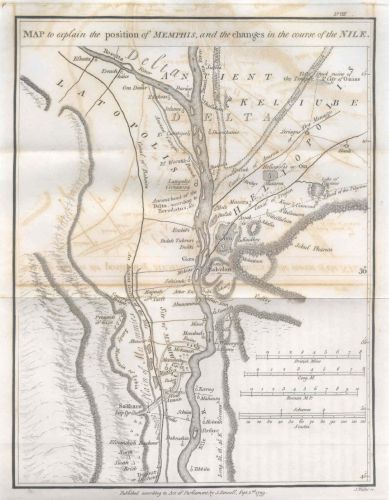
With a northerly wind behind it, a boat under sail could make its way south against the Nile’s current. A northbound vessel could use the current itself, although bends in the river and changes in the wind still called for adjustments by the crew. The annual rise of the Nile altered the depth of channels and the landing places accessible to a loaded boat. A stretch that was passable at one level could require a different approach when the water fell. The distance a vessel could cover before it had to put in depended on the conditions its crew encountered along the way.
Some of those conditions entered the agreements by which boats were hired. A bank register from the winter of 139–140 CE preserves a charter involving a man named Tryphon and a vessel with a rated capacity of six hundred artabas, a unit used to measure grain. The agreement called for delivery to the harbor of Lithine in the Saite district. It also laid out who would supply the crew and equipment and required the vessel to moor at designated safe places at suitable hours. A penalty for failure to deliver gave the charterer a means of enforcing the bargain. The agreement could fix the destination and assign responsibility for the cargo, while the crew still had to judge how far it was prudent to go on any given day.
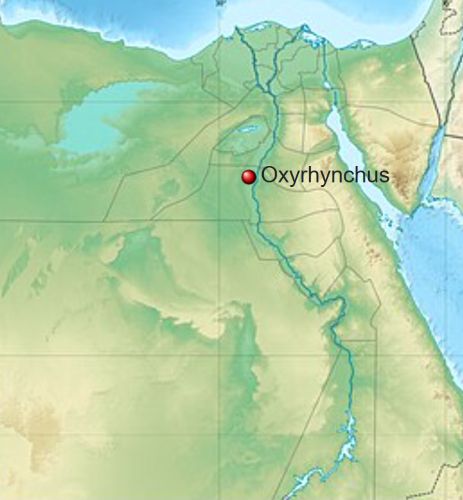
A first-century papyrus from Oxyrhynchus records a journey in stages from the perspective of the people making it. The surviving sequence opens with Nikopolis near Alexandria and names a place called Hermopolis early in the account, generally identified here with Hermopolis Minor in the Delta. Farther on, Babylon and Memphis appear in succession, on opposite sides of the main river. This alternation between banks is one reason scholars reconstruct the journey as a voyage. After Memphis, the recorded stops point toward waterways linked to the Fayum and the Bahr Yusuf. Oxyrhynchus is a plausible destination, though the broken text leaves the end of the journey uncertain. The writer numbers successive stages and several times records that the party bathed. One entry says that they bathed and stayed, giving a measure of the journey in time spent ashore as well as in distance covered. The papyrus makes it possible to recover part of a route from the places where these travelers chose, or found it convenient, to stop.
Schedia lay at one of the junctions through which an inland journey from the vicinity of Alexandria could pass. Strabo describes the canal leading to it and the station where the boats used by prefects for voyages to Upper Egypt were berthed. Officials there collected duties on goods moving in both directions. The place thus served people whose business took them beyond the city and officials whose authority depended on keeping track of what went through it. Excavations have identified a probable storage building constructed in the late first century CE, near the beginning of the date range assigned to Nearchos’s papyrus. Its nine halls opened toward the river. Their arrangement gives a physical sense of how much space a port could devote to receiving and holding goods at the point where they came off the water.
Tax wheat shows how much work had to be done before a loaded vessel could leave a harbor. Officials received grain and accounted for it in local granaries, from which it might reach a loading point by pack animal or by canal. A receipt from December 127 CE records wheat coming in sacks by animal convoy for loading aboard boats. On the first recorded day, eighteen convoys delivered 1,056 artabas. Over nine days the amount recorded came to a little more than ten thousand. The document identifies the public measure to be used and specifies the quality of the wheat being received, down to the requirement that it be free of barley and clods of earth. These details mattered because the person taking charge of the shipment had to account for the grain by quantity and condition. The wheat in this case came from a harvest two years earlier, so the operation extended well beyond the immediate movement of a new crop. The convoy figures rise and then fall as the work proceeds, giving some indication of how the pace of delivery could change even within a single consignment. The boats depended on people ashore bringing wheat to the water in quantities the crews could receive and load. An official commission could also depend on arrangements initiated by the man who controlled the vessels. In 118 CE, a shipper named Papiris wrote to Apollonios, the strategos, or district administrator, of the Apollonopolite Heptakomia. Papiris said that he had asked for the assignment to that district and had been granted it with a boat rated at about four thousand artabas. A further obligation imposed by the procurator detained him, so he asked Apollonios to assist the men he was sending. He also claimed access to enough space on other boats to carry another eighty thousand artabas, an offer that gives some idea of the scale on which he presented himself as able to act. The letter shows how a naukleros, a man responsible for arranging river shipments, could direct the work through others. Officials allocated commissions, and the people who undertook them could ask for particular assignments and offer additional capacity. The Roman administration secured the service of privately owned vessels through arrangements of this kind, drawing on people who could assemble crews and make boats available where they were needed.
The costs of commercial shipping come into view in two accounts for vessels carrying wheat through Memphis. One boat carried 550 artabas and the other 540. The accounts are assigned to the late first or early second century, close to the period of Nearchos’s letter. Both include an expense for a rudder, alongside payments connected with inspection, documentation, and services rendered at the port. A banker and an interpreter appear in the accounts, evidence of the work that could attend a shipment even when the boats were already under way. Colin Adams reads the principal amounts as Memphis harbor dues and treats the papyrus as a record of operating expenditure. The dues also suggest that the wheat was moving in private commerce, since those on state business could claim exemption. From the viewpoint of the person paying for the journey, the cost of a shipment accumulated through a series of transactions, some concerned with keeping the vessel in service and others with getting the goods through the port. The river made a bulk consignment practicable, and every transfer of responsibility along the way brought its own expenses.
The surviving accounts record the river where someone had to count a delivery or answer for an expense. Read together, they show why boats and crews were available along so much of the valley and why their availability varied from one landing to the next. Someone such as Nearchos could make use of that traffic even when his reasons for going had little to do with the business that kept it moving. The practical question for a traveler was how to turn the presence of a boat into a place aboard it.
How a Private Traveler Found Passage
A boat at the landing was useful only if it was going where a traveler needed to go and could leave when the traveler was free. The people who could bring those circumstances together were often elsewhere. A letter asking someone to release a boat or send money catches a journey at a stage that disappears from Nearchos’s account. Before there was a visit to describe, someone had to make the departure possible.
In 7 BCE, a man named Stilbon wrote to Athenodoros after being seized near the tower of Thaubarion in the Herakleopolite district. He said that he had been beaten and taken into town. The boat on which he depended was being held as well, and he wanted Athenodoros to write to a man named Skaliphos to secure their release. According to Stilbon, Skaliphos had already complained that he had received no word from Athenodoros. An intervention from the person he expected to hear from might bring the detention to an end. Stilbon gave Athenodoros a reason to act promptly. His sister wanted to sail upriver aboard that particular vessel. The letter then turns to other business involving boatmen, placing her proposed journey among the commercial dealings that occupied the writer. The result of the appeal is unknown, and the papyrus leaves the woman still waiting to go. What it makes unusually clear is that her plans rested on the availability of a specific boat and on someone close to her being in a position to intervene.
A later invitation from Oxyrhynchus shows how much of the arrangement could fall to the person expecting the traveler. Petosiris urged Serenia to come on the twentieth for a god’s birthday and asked her to say whether she wanted to go by boat or by donkey so that the appropriate transport could be sent. She was to make the choice, and he would see to providing what she needed. The date of the celebration made the exchange practical as well as courteous, since he needed her answer in time to act. The letter leaves the distance and the outcome uncertain. It preserves the offer of a form of help that could turn an invitation into a trip.
The papers of Heliodoros’s family preserve an account of what happened when a traveler needed money away from home. Sarapion wrote to Selene that he had sailed downstream on a matter he wanted to see settled before he left. He hoped to make the trip upriver after the fifteenth. Meanwhile, he wanted her to see that the younger members of the household attended to the sowing and dealt carefully with the cultivators, especially those at Hyphanton. His absence required the family to take care of affairs at home while he dealt with his own obligations elsewhere. It also required him to borrow from friends. Selene had sent two hundred drachmas through Heliodoros, and Sarapion explained what had become of part of the money. In Jacques Schwartz’s edition of the letter, eighty-four drachmas had gone on dues and fares for upstream and downstream travel. Since Sarapion gives those charges together, the figure cannot tell us what he paid for either passage. It does show that transport absorbed more than two fifths of the sum sent through his son, even in a household that could draw on money from home and credit from friends.
Eutycheis ran into a different problem on a journey toward the Oxyrhynchite district. The camel drivers were unwilling to go there, so she went to Antinoopolis to find a boat and found none available. She wrote to her mother that she meant to have her baggage brought to Antinoopolis and wait until she could sail. Changing from land to water gave her another way to pursue the journey, with a delay she had to explain to the person expecting her.
For Herodes, an architect working under the direction of Apollonios, an opportunity came when building work stopped. The steward had suspended it after his daughter’s death, and Herodes asked permission to use the interval for a personal visit by boat involving his brother Hierakion. He reckoned the journey in days and explained that making it on foot at another time would be difficult because the district had been devastated. The request appears in a letter that also discusses doors, sawn timber, and the progress of the work. It was in the course of accounting for those duties that Herodes could ask for some time away from them. A separate letter puts him in Alexandria after a hurried downstream journey in small boats for which he had paid what he regarded as a high fare. He had delivered a letter there and also managed to see Hierakion. Noah Hacham and Tal Ilan date that journey to an earlier period of unrest and distinguish it from the visit for which Herodes requested leave. The two letters preserve decisions made under different pressures, one about how to take advantage of a pause in work and the other about what it cost to reach Alexandria in a hurry.
Nearchos gives Heliodoros the account of a traveler who had already got away. The means by which he obtained passage and found time for the trip are lost. The other letters show how readily such arrangements belonged to the affairs of a household or a place of work, even when the purpose of a journey was personal. Once Nearchos could go, he had choices about where to put in and what merited his time ashore.
What Made a Place Worth Visiting?
Near the beginning of Nearchos’s letter, a damaged sentence preserves a clear purpose for travel. Someone was to go and examine things made by human hands. The Greek verb historeō can carry the sense of finding something out by going to see it, and its object here directs attention to workmanship. Elsewhere in the same letter, Nearchos identifies Ammon’s sanctuary by what the god was believed to do there. A place might warrant a journey for what people had built or for what a visitor expected to happen on arrival.
More than two centuries before the earliest date assigned to Nearchos’s letter, an official in Ptolemaic Egypt had to make those expectations practicable for a distinguished guest. In 112 BCE the Roman senator Lucius Memmius was expected to sail from Alexandria to the Arsinoite district in the Fayum to see its sights. Hermias forwarded a copy of the instructions to a man named Horos and charged him with seeing that they were carried out. Guest rooms were to be furnished, and the landing places serving them were to be made ready. The senator was to receive gifts as he disembarked. The instructions then turned to what he would see and do, calling for arrangements to view the Labyrinth and for the customary food to be supplied for Petesouchos and the other crocodiles. Provision for offerings and sacrifices belonged in the same order. The document records the work officials expected to do before Memmius arrived, leaving the visit itself to the imagination. Its details show how much local preparation might lie behind an eminent traveler’s opportunity to inspect a building or encounter a sacred animal. Memmius’s standing secured the attention of officials, whose instructions reveal services and knowledge that a short account of the resulting visit might easily have passed over.
Strabo describes what an encounter with a sacred crocodile actually involved at Arsinoe in the early Roman period. His host, a local official, brought cake, cooked meat, and wine mixed with honey from their meal to the lake, where the priests opened the animal’s jaws and administered each offering in turn. When another visitor arrived with food of his own, the priests went around the lake to reach the crocodile and repeated the procedure. Strabo gives the second visitor no name or standing, but his arrival establishes that the feeding was available on more than one person’s account that day. The crocodile might have been the reason a stranger came to Arsinoe, yet the encounter took the form it did because the priests cared for the animal and received what visitors brought.
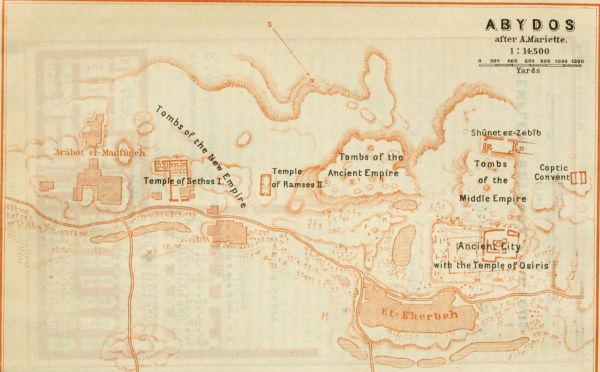
At Abydos the appeal of an old building and the reasons people continued to enter it can be traced in different kinds of evidence. Strabo describes a royal monument that he calls the Memnonion, the temple built by Seti I, in terms that draw attention to the scale and workmanship of its stone. He compares the construction with the Labyrinth and singles out the great blocks used in the vaulted descent to a deep source of water. In his account the surviving buildings bore witness to a city whose importance had diminished by his own day. Yet he also records a custom still observed in the worship of Osiris at Abydos, where singers and instrumentalists were forbidden to open the rites in the manner usual for other gods. A pair of inscriptions in Seti’s temple brings the continuing religious importance of the site down to the scale of one person’s visit. In 147 CE Demetrios son of Theon recorded that he had come to ask the gods to grant him good things. An inscription dated to the following day identifies him as the same man and makes the request more specific, asking that he remain free from illness for as long as he lived. Nearly thirteen centuries after the temple was built, Demetrios addressed its gods about the future of his own body. The age and workmanship that interested Strabo belonged to a place where a man could still come with a request he considered worth making twice.
At Philae, the buildings themselves help explain why people sought out different parts of a sanctuary. The birth house beside the temple of Isis housed rites associated with the birth of Horus, represented in reliefs that include the goddess nursing her son. Across the water on Biga lay a sanctuary at one of the places revered as the tomb of Osiris. The proximity of the islands gave a physical setting to the relationship of the two cults, and processions carried the image of Isis from Philae to the tomb.
A few words scratched on a door jamb at Philae establish how far one visitor got within the complex. Alexandros son of Ariston wrote in Greek that he had come to the lady Isis. The letter forms suggest a Roman-period date, and the inscription survives at the doorway leading onto the bridge between the towers of the First Pylon. Other markings in this elevated part of the gateway include inscriptions naming priests and drawings of gods and sacred animals, consistent with an area chiefly used by temple personnel. The bridge also served a public rite during the annual festival of Choiak. Priests brought a live falcon up to be crowned there and showed it to people assembled on the approach below. The ceremony made the bird visible to people who could take part from outside the gateway. Alexandros reached the upper level on some occasion, although his brief declaration leaves the circumstances of his access unknown. His inscription and the evidence for the festival together show how differently two people might experience the same temple, depending on when they came and where they were allowed to go.
Nearchos can be placed at Syene and, on his own account, at Ammon. Abydos and Philae offer comparisons for understanding what such a traveler might have sought at an Egyptian sanctuary. Their evidence helps explain why his interest in human workmanship could coexist with an account that also took the god’s oracular activity seriously. At a renowned place the age of a building gave a visitor something to examine, while the people who tended it sustained practices that gave others reason to come. Which of those things a traveler had the opportunity to observe, and what he understood of them, depended in part on the people he met there.
Germanicus at Thebes: Who Could Explain the Past?
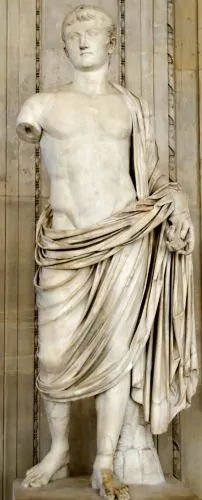
The man charged with explaining Thebes to Germanicus goes unnamed in Tacitus’s Annals. He was one of the senior Egyptian priests, and the historian gives him the most substantial account of what the Roman visitor had come to see. The masonry carried writing about Egypt’s former power, but its significance for Germanicus emerged only when someone interpreted it. Tacitus’s account thus makes it possible to examine a part of an ancient journey that Nearchos’s letter leaves largely out of view: how a traveler learned what he was looking at.
Germanicus came to Egypt in 19 CE while carrying out an imperial commission in the eastern provinces. He was Tiberius’s nephew and adopted son, and that position made even his reasons for traveling a matter of public interest. Tacitus assigns him a desire to see the country’s antiquities and reports that concern for the province was his stated reason for coming. The activities the historian describes readily accommodated both purposes. Germanicus opened the public granaries, lowering the price of grain, and appeared in Greek dress, walking without a military guard. A papyrus account of his reception in Alexandria also preserves a speech in which he refers to the commission his father had given him and presents his wish to see the city as a reason for his visit. Tiberius, according to Tacitus, took far greater offense at his entry into Alexandria without permission than at his dress or public conduct. The restriction attributed to Augustus applied to senators and equestrians of high rank, and Tacitus explains it through the danger that someone in possession of Egypt could cut off grain supplies to Italy. By the time Germanicus sailed upriver from Canopus, the historian says, he had yet to learn that the emperor disapproved of the journey.
A pottery sherd from Thebes records a payment connected with provisioning for Germanicus’s arrival. The five lines of Greek preserve a local transaction of the kind that disappears when Tacitus moves from one destination to the next. A copy of an edict issued during the visit gives some idea of the demands that accompanied such preparations. Germanicus had heard that boats and pack animals were being taken and that private people were being compelled to provide lodging. He gave his secretary Baebius sole authority to order requisitions and directed that owners be paid at prescribed rates for their vessels and animals. The edict sought to curb abuses while preserving the entourage’s ability to call on resources along the way.
At Thebes, Tacitus shifts from the physical size of the remains to the claims inscribed upon them. The Latin says that a senior priest was ordered to interpret his native language, although it leaves open who conveyed the order and in what language he answered. Tacitus reports the explanation in indirect speech. In it, Thebes had once contained seven hundred thousand men of military age, and a king called Rhamses had used that army to impose his rule across an immense territory. The reported conquests reached from Libya and Ethiopia to lands associated with the Persians, Bactrians, and Scythians. Tacitus then gives even more attention to what those subject peoples were said to have delivered. The account specifies weights of precious metals, numbers of horses and weapons, and amounts of grain and other supplies. Ivory and aromatics are singled out as gifts for the temples. The list gives the priest’s explanation a precision quite different from the first impression of immense buildings, turning the remains of Thebes into evidence, for the listener, of how a king once drew wealth from other lands.
The building at which this took place remains unidentified. The Egyptologist László Kákosy favored the temples of Luxor or Karnak on the east bank, reading Tacitus’s description of the ruins as more consistent with those complexes than with the royal temples across the river. At Karnak, the outer wall of the Great Hypostyle Hall still carries scenes of Ramesses II’s campaigns in Syria and Palestine. The reliefs establish that a visitor to Thebes could encounter the king’s wars on monumental stone, even though the precise text behind the priest’s explanation is lost to us.
Egyptian evidence also shows how far the memory of a king could travel from the events of his reign. The Bentresh Stela, found at Karnak, sets its story in the time of Ramesses II but was carved long after him. It tells of an eastern ruler who sought Egyptian help for his ailing daughter and of the image of the Theban god Khonsu being sent abroad to cure her. Kim Ryholt has suggested that the land named Bakhtan in the story was understood as Bactria, a region associated with Alexander’s campaigns. The identification is debated. If it is right, the stela places an Egyptian king’s influence in a region made famous by a much later conqueror. The story gives that influence a religious form, since it is the god from Thebes who accomplishes what the foreign ruler needs. It offers an Egyptian parallel for the far-reaching reputation of the Rhamses described to Germanicus. An interpretation given at a temple could draw on the history later generations had made of a pharaoh as well as on what had been inscribed during his reign. The account also bears the marks of the historian who transmitted it. Benjamin Kelly points out that Herodotus, in his story of Darius’s expedition against the Scythians, likewise brings together inscribed stone, a list of peoples, and a force of seven hundred thousand men. The resemblance makes it difficult to assign every detail of Tacitus’s account to the inscription or the priest. The inventory of tribute also recalls an earlier scene in the Annals, in which a statement of military strength and revenues drawn up by Augustus is read to the Senate after his death. Tacitus makes the connection with later empires explicit when he judges the Egyptian tribute as imposing as what Rome and Parthia exacted in his own day. His readers could recognize in the account of the pharaoh two measures of power familiar from their own world, the number of people a ruler could put under arms and the amount he could require others to pay.
Tacitus takes Germanicus as far as Elephantine and Syene, bringing him to a place Nearchos also says he reached. Their shared destination makes the difference between the surviving accounts more revealing. Nearchos tells Heliodoros what he did and identifies places by what made them significant to him. The surviving letter leaves open where he got his information or whom he might have asked to explain something unfamiliar. At Thebes, Tacitus records the act of interpretation while leaving the priest’s own words out of reach. Germanicus had the standing to call for an explanation, and the history he heard still depended on someone else’s knowledge of Egypt.
Hearing Memnon and Leaving a Record
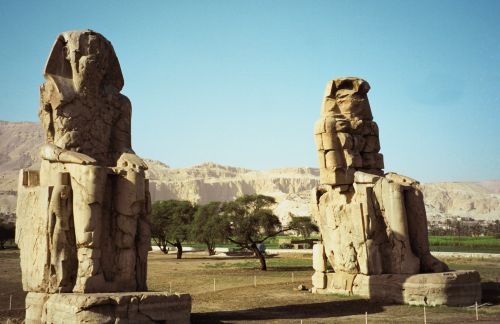
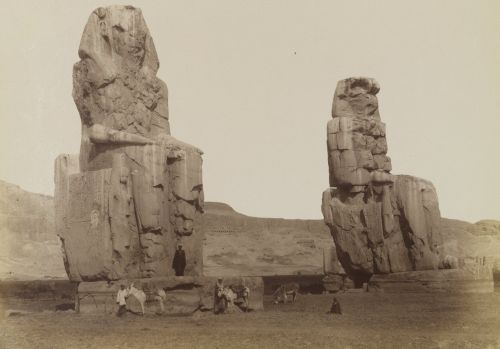
At Thebes, travelers gathered near daybreak beneath a statue that had lost its head and upper body. It was the northern of two seated colossi erected in the fourteenth century BCE at the entrance to the mortuary temple of Amenhotep III. Both figures represented the same pharaoh. The damaged one acquired a reputation for making a sound, and hearing it became an event people thought worth dating on the stone itself.
Strabo heard something at the colossus when he visited with the Roman prefect Aelius Gallus and his party in the late first century BCE. He passes on a report that an earthquake had brought down the upper part of the statue. At about the first hour of daylight, he heard a noise resembling a light blow. He considered the possibility that the sound came from the surviving stone or its base, or that someone in the crowd had produced it deliberately. Tacitus gives the phenomenon a different character in his account of Germanicus’s journey, describing a voice that emerged when sunlight touched the stone. His account leaves open whether Germanicus heard it himself. Pausanias, writing in the second century CE, likens the sound at sunrise to the snapping of a string on a lyre and attributes the damage to the Persian king Cambyses. The accounts preserve a recognizable occasion for listening even as they differ over what had happened to the statue and what kind of sound it made.
The Greek story of Memnon gave the timing of the sound a meaning. Memnon, the son of Dawn, had been killed by Achilles at Troy, and a sound at sunrise could be understood as his greeting to his mother. A Greek inscription by Gallus, a procurator of the Thebaid who had sailed upriver, links what he heard beside the Nile to the clang of Memnon’s armor at Troy. The association let a listener place the Egyptian stone within a story whose action belonged far away. Pausanias also records that Thebans called the figure Phamenoph, a reminder that the name familiar to Greek-speaking travelers was one of several in use.
More than a hundred Greek and Latin inscriptions survive on the colossus, many on its feet and lower legs. A brief entry could preserve the time and frequency of a hearing with considerable precision. The damaged Latin inscription of a man called Rufus records that he heard Memnon four times in February 121 CE. Decades earlier, the centurion Lucius Tanicius Verus of Vienne had recorded a series of hearings from November 80 to June 81 CE. His inscription begins with his origins and military affiliation, then follows his returns to the statue, supplying the hour for some of them. On one visit in June, he puts the sound as late as the fourth hour of daylight. That entry complicates the literary picture of a single cry at sunrise, just as Rufus’s count complicates the idea of a single sound on a given visit. The stone gave an arriving traveler a record of what others claimed to have heard at different times of the morning. A date or a count could make a hearing memorable even when its witness offered no explanation of the sound.
A district administrator named Celer included a silent encounter in the Greek inscription he left in 123 CE. He presents his first stop by the colossus as incidental to an outing undertaken to see a sacred place and pay his respects. The editors of the inscriptions have suggested that he was on his way to the nearby healing sanctuary at Deir el-Bahari. In Celer’s telling, Memnon understood the purpose of that first journey and remained silent. After two intervening days, Celer returned and heard what he called the god’s sound in the first hour. By preserving the earlier silence alongside the date and hour of the hearing, he gave the return visit a place in the record. His inscription shows how an encounter that began in passing could become a reason to come back.
Julia Balbilla’s four poems from the visit of Hadrian and Sabina in November 130 CE show how much a writer could make of the same few moments. In the poem headed with her name and the occasion of Hadrian’s hearing, the statue addresses the emperor before sunrise and gives two further cries later in the morning. Its departure from the expected time becomes a distinction accorded to Hadrian. The closing lines say that he left an account for posterity of what he saw and heard, even as the heading identifies Balbilla as the author of the words the reader has before them. Another poem explains an earlier silence as Memnon’s wish to see the beautiful Sabina return. In verses addressed to the statue in Sabina’s company, Balbilla also names her own grandfathers, the learned Balbillus and King Antiochus, and claims their piety as part of her inheritance. Her use of literary Aeolic, with forms associated with Sappho, gave her a recognizable poetic voice in a setting where many visitors wrote in a few formulaic lines. The colossus on which Rufus counted four sounds also carried Balbilla’s argument that the timing of a sound could reveal the gods’ favor toward an emperor.
Nearchos describes carving names at sacred places, although the surviving letter gives no evidence that he visited the speaking colossus. At Thebes, the dates and hours usually established the presence of the person who claimed to have heard the statue. In Nearchos’s account, the names selected for preservation were those of people dear to him. His choice opens a further question about what an inscription could accomplish on a journey. If someone’s name could be left at a sanctuary by another person, the reach of the visit need not end with those who had been there.
Carving the Names of the Absent
Nearchos gives himself the action of carving and gives the inscription to people dear to him. The verb enecharaxa, “I incised,” makes the first part explicit. The people whose names furnished the text are his philoi, a Greek word broad enough to include relatives as well as friends. Their relationship to him explains why he remembered them at the sanctuaries, while their whereabouts at the time of the carving remain open.
The adverb that follows Nearchos’s account of the carving expresses a wish for lasting remembrance. Near the damaged end of the passage stands the word proskynēma, which derives from the Greek verb for making obeisance. In the inscriptions of Roman Egypt, the noun could designate the written dedication that gave an act of reverence a continuing presence at a sanctuary. Adam Łajtar draws attention to an older Egyptian formula in which a visitor asks that a good name remain in that very place. Its wording helps explain why the site of the writing mattered. A name set down before a god remained associated with that sanctuary after the visitor had gone. In Greek inscriptions the act could extend to other people when the writer included their names in the dedication. The words might identify those people through their relationship to the visitor, giving the god the names of people the writer had a reason to remember. Nearchos’s surviving account speaks of remembrance in those terms, although the damaged passage leaves the precise relation of the proskynēma to the carving uncertain.
Two inscriptions from separate places show the choices a single traveler could make. At Philae, a man named Heliodoros identifies himself as the son of Zenon and as a native of Caesarea Panias. In a text generally dated to the beginning of the second century CE, he says that he came and made a proskynēma for his brothers Zenon and Aianos. The same name, patronymic, and hometown recur on the Colossus of Memnon, together with the names of both brothers. There Heliodoros says that he heard Memnon four times and remembered them. The act takes its wording from the occasion. At Philae he records the homage he performed, while at Thebes the brothers enter the account at the moment he recalls hearing the statue. The singular verbs tell us who came and who heard, and neither text locates the brothers. What the pair establishes is that the visitor chose to remember the same people twice, under different circumstances and at different sanctuaries. The additional particulars establish his identity across the two inscriptions, while his shared given name with Nearchos’s correspondent supplies no comparable basis for identification.
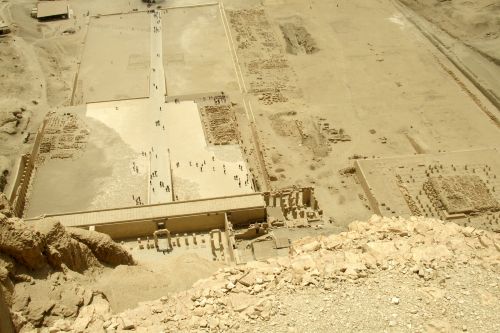
At Deir el-Bahari, an inscription dated to 86 or 87 CE was painted in dark red ochre between a relief of the enthroned Hatshepsut and an offering table. Athenodoros included his parents and brother in his proskynēma before the local gods, then extended it to two neighbors. The neighbors make visible the breadth of the relationships a visitor could bring into a sanctuary. A later inscription at the same temple records a proskynēma for Androphanes, a priest of Isis, made through a man named Erios. The person who cut the letters with flint adjusted the height of the lines to follow the shoulder of a royal figure already carved on the wall. The short phrase naming the intermediary and the surviving marks of the tool both show the work that could go into placing another person’s name before a god.
Some of the writing at Memnon expresses what people hoped their relatives would experience for themselves. In a short Greek text, Caecilia Trebulla says that hearing the sacred voice made her long for her mother and pray that she might hear it too. She addresses her mother directly, giving a few words on a monument the intimacy of speech between two people. Patricia Rosenmeyer hears a possible resonance with the story of Memnon himself calling to his mother, Dawn. A visitor named Achilles also says that he prayed for his brothers to hear the divine utterance. At the moment of departure he offers Memnon a voice of his own, describing his words as fixed in the rock and meant to be remembered. The sound he hoped his brothers would hear and the writing he could leave behind were different things, and his inscription makes room for both. The prayers of Achilles and Trebulla preserve the wish that another person might one day share the encounter. They leave that person’s experience in the future, where a dedication could ask for it but could hardly guarantee it.
The address on Nearchos’s papyrus gives us one name, Heliodoros, whose place in the account is secure. Irene Pajón Leyra suggests that the damaged closing phrase may have referred to a proskynēma on his behalf, supplying “for you” from a familiar formula in Greek letters. That restoration remains conjectural, and even if it is right, the recipient of the homage need not have been among the people whose names Nearchos carved. The letter establishes that Nearchos saw the engraving as something worth reporting to an acquaintance. Through the marks he describes, the people he remembered acquired a place in an act undertaken far from the familiar settings of their relationship.
A Letter to Heliodoros, a Name on Stone
The surviving address on Nearchos’s papyrus occupies one line on the back. Its beginning is damaged, and what remains is a Greek name in the dative, “to Heliodoros.” The account of the journey occupies the other face of the sheet, where a dozen lines survive with traces of another below them. Someone handling the letter could identify its recipient before reading a word about Syene or Ammon.
Writers of private letters in Roman Egypt generally had to arrange for someone to carry them. A short address could suffice when the bearer already knew the people involved or how to find them. Another letter from the same family papers shows what that arrangement could look like. Eutychides writes to his brother Heliodoros, repeating the name and the relationship on the back of the sheet. Vertical creases and traces of sealing still show how this letter was prepared for delivery. Inside, Eutychides says that he was glad to receive word that his brother was well and asks him to keep writing “to us” about his health. He speaks for himself when he acknowledges the earlier letter, then brings other people into the exchange he hopes will continue. The address gives the bearer one person to find, while the request inside shows that the news mattered to a wider circle.
A second-century letter from Ptolemaios makes the work of reaching its audience unusually explicit. Before greeting his mother Zosime and his sister Rhodous, he asks whoever reads the letter to translate its contents and pass them on to the women. He names the people for whom the message is intended and leaves the identity of the intermediary open. His opening acknowledges that delivery of the sheet was only one step in getting his words to the people who needed to hear them. For Nearchos’s letter, the address is the surviving evidence of whom he meant to reach, and the circumstances in which the words were received are unknown.
On the Colossus of Memnon, the Latin poet Maximus made a request of someone who might come along after him. In a couplet generally dated to the middle of the second century, he says that Memnon’s voice reached his ears too and calls on each reader to utter his name. The little word “too” puts his hearing among the experiences already claimed at the statue. The second line gives a stranger a part in commemorating it, since that reader could speak the poet’s name without having met him. Another inscription on the colossus shows how much control a writer could exercise over what such a stranger learned. A visitor named Loukios left his own name in ordinary Greek and used a cipher for the words identifying his wife Apollonarion, for whom he recorded a proskynēma. His name and the time of the act remained in unciphered text. The reason for the choice is uncertain. Its effect is clear enough, since a person able to read the rest of the inscription might still need help to identify the woman it honored.
Pardalas of Sardis shows how readily a traveler could write with several occasions for reading in mind. In a royal tomb at Thebes he records his arrival and says he remembered his son Celsus and his siblings. At the colossus he records two hearings and promises to mention Memnon in his books. The inscription gives no title, and the works in which he might have fulfilled that promise are unknown. Still, it is an explicit undertaking to tell readers elsewhere about something his words on the statue document at the place itself. Beside Pardalas’s two lines is a verse that reproduces the opening of an earlier poem by Paion of Side, written for the prefect Mettius Rufus. In Paion’s poem, the damage inflicted on the figure is the premise for the wonder that it can still speak. The exact circumstances in which that line was repeated are uncertain. Its recurrence shows that an earlier visitor’s words could become material for later writing at the same location.
Nearchos’s letter connects the two practices in a single report. He gives Heliodoros news of the journey and says he left names at places where others might encounter them. The carvings have never been securely identified with him, so the surviving evidence for that act is the account he sent away from the sites themselves. The sheet addressed to one person now lets later readers know what he claimed to have written elsewhere. How much of the journey can be recovered from it depends on how closely we read the words he chose for Heliodoros.
Did Nearchos Make the Journey He Describes?
The following video from Timeline – World History Documentaries discusses the importance of the Nile:
Syene is easy to place on a map. The difficulty begins with the words that follow it in Nearchos’s letter, where he says he reached the place from which the Nile flows. The surviving Greek leaves the precise relation between the two places open, although its sequence suggests that he associated the river’s source with the vicinity of the First Cataract. That was already a questionable claim in antiquity, and it raises the possibility that part of the journey came from what Nearchos had read.
The case for a journey composed from reading draws its force from the combination of details. In Herodotus, the account of the Nile rising between Syene and Elephantine comes from an official attached to the temple treasury at Sais. Herodotus doubts that the man was speaking seriously and distinguishes his own visit to Elephantine from inquiries about the country farther south. In Nearchos’s letter, the place where the river flows from appears among the places he says he reached. By the second century, Aelius Aristides could acknowledge the existence of springs in that vicinity and still reject the idea that they were the river’s source. Ammon presents a second difficulty. Nearchos says in the present tense that the god issues oracles for all people, although Strabo had already described the oracle as almost abandoned. Herodotus had given the Libyan shrine a place alongside Dodona in his account of the origins of both oracles. Irene Pajón Leyra argues that the Histories offers the closest surviving literary framework for these two features of the letter, together with its interest in works made by human hands. The parallels are chiefly in subject matter, leaving room for Nearchos to have encountered these accounts in excerpts or summaries as well as in Herodotus himself.
The argument for invention also turns on a damaged verb near the beginning of the account. Jacques Schwartz supplied letters that allowed him to read it as an admission that Nearchos had fashioned a story. Earlier editors had understood the same proposed verb to mean that he imitated the example of other travelers. T. C. Skeat favored a different completion, which Pajón Leyra understands as Nearchos saying that he followed in their footsteps. Patricia Rosenmeyer accepts that the letter uses literary language and finds the case for a fictional journey unpersuasive. The disagreement matters because the strongest apparent indication of invention depends on words no editor can read in full on the papyrus.
There are also reasons why a real visit might have produced just such an account. On the island of Sehel, the Egyptian inscription known as the Famine Stela locates the beginning of the annual inundation in the twin caverns associated with Elephantine. The stela was carved in the Ptolemaic period and tells its story in the name of the much earlier king Djoser. Its account concerns the release of the flood, which gave the cataract religious significance as a place of origin. The inscription leaves open whether Nearchos ever heard such a tradition locally, while showing that the association could have reached him through channels other than Greek books. At Siwa, Plutarch’s dialogue on the decline of oracles presents Cleombrotus as a recent visitor who heard an account from the priests of Ammon. Later in the same conversation, another speaker asks whether the oracle still commands its old influence, and Cleombrotus gives him no answer. The dialogue accommodates both a visit to the shrine and doubt about its standing. Nearchos could likewise have found a sanctuary worth visiting and described its god in terms drawn from the reputation that had brought him there.
An actual voyage remains credible, with the extent of the itinerary and the basis of individual claims open to question. The documents for river transport and the inscriptions of other visitors independently establish that people in Roman Egypt could arrange passage and leave records of their visits at sacred places. Nearchos’s letter gives those practices an individual account whose details carry different degrees of authority. His claim to have carved names deserves to be read alongside the surviving practice of doing so, just as his geography deserves to be tested against other accounts of the river. The uncertainty makes it more important to distinguish what enabled such travel from what a traveler expected to find and chose to tell someone at home.
Conclusion: What Nearchos Wanted Remembered
In Nearchos’s account, the work of remembering began while he was still away. He says that at sacred places he carved the names of people dear to him. When he wrote to Heliodoros, he included that act among the details worth reporting about his journey. What mattered to him about reaching a sanctuary included what he could do for someone else once he was there.
Private travel becomes easiest to see in the documents when somebody had to solve a problem. One correspondent needed to find a boat, while another had to reckon with the cost of passage among his other expenses. Each document records a decision or difficulty as it arose. Together they explain how someone with the means to travel could take advantage of an opening in traffic that was already carrying people and supplies along the Nile. The arrangements for Germanicus clarify what was distinctive about such an opportunity. The prince could authorize the requisition of vessels through his secretary, whereas a private traveler depended on finding someone willing and able to carry him. Once that arrangement was made, the place to which a boat happened to go could become a destination the passenger had his own reasons for wanting to reach. A visit to a sanctuary could arise from that decision about how to spend time ashore. The means of making such a journey are better documented than the arrangements of Nearchos himself, whose contribution is to say what made the opportunity worth using.
A destination brought its own questions about what a visitor could learn there. At Thebes, a priest’s account of a pharaoh’s tribute gave Germanicus a history to attach to the buildings before him. Other visitors listened for a sound from the colossus and used the stories they knew to explain what they heard. Nearchos’s account of the Nile and Ammon may owe some of its geographical confidence to inherited descriptions of Egypt. The extent of his own journey remains open, even though the conduct he describes is recognizable from what other visitors left behind. A person could be curious about how an ancient work was made or what a sanctuary was known for and still regard a gesture of devotion as part of the visit.
The people included in the remembrance might have had quite different relations to the place. At Philae, Heliodoros of Caesarea Panias performed an act of homage for his brothers and put their names into the record of his arrival. At Memnon, Maximus asked a person who might come along later to speak the poet’s name. One visitor named the people for whom he acted, while the other gave an unknown reader something to do. Nearchos’s report likewise distinguishes the people whose names he says he carved from the person to whom he sent news of the act. Heliodoros could learn of it wherever the letter reached him. The inscriptions, if they endured as Nearchos hoped, would have kept the names at the places he thought worth visiting. The clearest expression of what he wanted remembered is that he chose to give people dear to him a place in the account of what he had seen.
Bibliography
Affiliate disclosure: Amazon links on this site are paid links. As an Amazon Associate I earn from qualifying purchases.
- Adams, Colin. Land Transport in Roman Egypt: A Study of Economics and Administration in a Roman Province. Oxford: Oxford University Press, 2007.
- —-. “Nile River Transport under the Romans.” In Trade, Commerce, and the State in the Roman World, edited by Andrew Wilson and Alan Bowman, 175–208. Oxford: Oxford University Press, 2017.
- —-. “‘There and Back Again’: Getting Around in Roman Egypt.” In Travel and Geography in the Roman Empire, edited by Colin Adams and Ray Laurence, 138–166. London: Routledge, 2001.
- Aelius Aristides. The Complete Works. Vol. 2, Orations XVII–LIII. Translated by Charles A. Behr. Leiden: Brill, 1981. Oration 36.47–54.
- Baillet, Jules. Inscriptions grecques et latines des tombeaux des rois ou syringes à Thèbes. Mémoires publiés par les membres de l’Institut français d’archéologie orientale du Caire 42. Cairo: Institut français d’archéologie orientale, 1920–26. No. 1747.
- Bélanger Sarrazin, Roxanne, Jitse H. F. Dijkstra, Nicholas Hedley, and Sabrina C. Higgins. “New Greek Inscriptions from Philae.” Tyche 38 (2023), 1–12.
- Bergmann, Marianne, and Michael Heinzelmann. “Schedia: Alexandria’s Customs Station and River Port on the Canopic Nile.” In La batellerie égyptienne: Archéologie, histoire, ethnographie, edited by Patrice Pomey, 87–98. Alexandria: Centre d’Études Alexandrines, 2015.
- Bernand, André, and Étienne Bernand. Les inscriptions grecques et latines du colosse de Memnon. Bibliothèque d’étude 31. Paris: Institut français d’archéologie orientale, 1960. Nos. 23 and 67.
- Bernand, Étienne. Les inscriptions grecques et latines de Philae. Vol. 2, Haut et bas Empire. Paris: Éditions du Centre national de la recherche scientifique, 1969. No. 170.
- Brashear, William M., ed. The Archive of Athenodoros (and Assorted Documents of the Augustan Period). Ägyptische Urkunden aus den Staatlichen Museen zu Berlin, Griechische Urkunden 16. Berlin: Staatliche Museen zu Berlin–Preußischer Kulturbesitz, 1995. No. 2604.
- Brennan, T. C. “The Poets Julia Balbilla and Damo at the Colossus of Memnon.” Classical World 91:4 (1998), 215–234.
- British Library, London. Western Manuscripts. Papyrus 852, Papyrus 854, and Papyrus 863(A).
- Bülow-Jacobsen, Adam, and Vincent P. McCarren. “P.Haun. 14, P.Mich. 679, and P.Haun. 15: A Re-edition.” Zeitschrift für Papyrologie und Epigraphik 58 (1985): 71–79. Reprinted as SB 18.13867.
- Caputo, Clementina, and Nicoletta De Troia. “Ceramics Trade Networks.” In The Late Roman Settlement of Umm al-Dabadib: A Remote Investigation, edited by Corinna Rossi, 159–180. Leiden: Sidestone Press, 2025.
- Carucci, Margherita. “The Dangers of Female Mobility in Roman Imperial Times.” In The Impact of Mobility and Migration in the Roman Empire, edited by Elio Lo Cascio and Laurens E. Tacoma, 173–90. Leiden: Brill, 2017.
- Derda, Tomasz. “Waterway Fayum–Alexandria: A Note on P. Lille I 1 (= P. Zen. Pest., Appendix A).” Journal of Juristic Papyrology 36 (2006), 9–20.
- Dittenberger, Wilhelm, ed. Orientis Graeci Inscriptiones Selectae. Vol. 1. Leipzig: S. Hirzel, 1903. No. 168, lines 1–10.
- Frankfurter, David. “Abydos: Afterword.” In Abydos in the First Millennium AD, edited by Elisabeth R. O’Connell, 271–74. Leuven: Peeters, 2020.
- Geraci, Giovanni. “Ricerche sul Proskynema.” Aegyptus 51 (1971), 3–211.
- Grenfell, Bernard P., and Arthur S. Hunt, eds. The Oxyrhynchus Papyri. London: Egypt Exploration Society, 1920. No. 1650.
- Hacham, Noah, and Tal Ilan. “P. Brem. 48: A New Date and Context.” Zeitschrift für Papyrologie und Epigraphik 211 (2019), 180–83.
- Hennig, Dieter. “Zur Ägyptenreise des Germanicus.” Chiron 2 (1972), 349–365.
- Herodotus. Histories. Vol. 2, Books 3–4. Translated by Robin Waterfield. Oxford: Oxford University Press, 1998.
- —-. The Persian Wars, Vol. 1, Books 1–2. Translated by A. D. Godley. Cambridge, MA: Harvard University Press, 1922.
- Hunt, A. S., and C. C. Edgar, eds. and trans. Select Papyri. Vol. 2, Public Documents. Loeb Classical Library 282. Cambridge, MA: Harvard University Press, 1934. No. 423 (P.Giss. 1.11).
- Kákosy, László. “Germanicus in Theben.” Acta Antiqua Academiae Scientiarum Hungaricae 32 (1989), 129–136.
- Kehoe, Dennis P. Management and Investment on Estates in Roman Egypt during the Early Empire. Papyrologische Texte und Abhandlungen 40. Bonn: Rudolf Habelt, 1992. See 67–72.
- Kelly, Benjamin. “Tacitus, Germanicus and the Kings of Egypt (Tac. Ann. 2.59–61).” Classical Quarterly 60:1 (2010), 221–237.
- Kenyon, Frederic G., and H. Idris Bell, eds. Greek Papyri in the British Museum: Catalogue with Texts. Vol. 3. London: British Museum, 1907. No. 854, 205–206.
- Kockelmann, Holger. “Philae.” In UCLA Encyclopedia of Egyptology, edited by Willeke Wendrich. Los Angeles: University of California, Los Angeles, 2012.
- Krüger, Otto, ed. Papyri russischer und georgischer Sammlungen. Vol. 2, Ptolemäische und frührömische Texte. Tiflis, 1929. No. 18.
- Kuhlmann, Klaus P. “Roman and Byzantine Siwa: Developing a Latent Picture.” In Life on the Fringe: Living in the Southern Egyptian Deserts during the Roman and Early-Byzantine Periods, edited by Olaf E. Kaper, 159–180. Leiden: Research School CNWS, 1998.
- Łajtar, Adam. Deir el-Bahari in the Hellenistic and Roman Periods: A Study of an Egyptian Temple Based on Greek Sources. Journal of Juristic Papyrology Supplement 4. Warsaw: Institute of Archaeology, University of Warsaw, and Fundacja im. Rafała Taubenschlaga, 2006. Nos. 77 and 124. See also 90–91.
- Lichtheim, Miriam, trans. “The Famine Stela.” In Ancient Egyptian Literature: A Book of Readings. Vol. 3, The Late Period, 94–103. Berkeley: University of California Press, 1980.
- Messeri, Gabriella. “Noterelle onomastiche.” Aegyptus 89 (2009), 253–255.
- —-. “P.Flor. III 324 recto/verso e la famiglia del kôm Kâssûm.” Aegyptus 89 (2009), 239–251.
- Nearchos. Letter to Heliodoros. British Library, Papyrus 854. Edited in Jacques Schwartz, Les archives de Sarapion et de ses fils: Une exploitation agricole aux environs d’Hermoupolis Magna (de 90 à 133 P.C.), no. 101. Cairo: Institut français d’archéologie orientale, 1961.
- Pajón Leyra, Irene. “¿Viajando por Egipto con Heródoto? De nuevo sobre el papiro P.Lond. III 854.” Myrtia 40 (2025):,11–30.
- Parsons, P. J., ed. The Oxyrhynchus Papyri. Vol. 42. London: Egypt Exploration Society, 1974. No. 3052.
- Parsons, P. J., J. R. Rea, and E. G. Turner, eds. The Oxyrhynchus Papyri. Vol. 33. London: Egypt Exploration Society, 1968. No. 2670.
- Pausanias. Description of Greece. Vol. 1, Books 1–2. Translated by W. H. S. Jones. Cambridge, MA: Harvard University Press (Loeb Classical Library), 1918.
- Paz, Yakir, and Tzahi Weiss. “From Encoding to Decoding: The AṬBḤ of R. Hiyya in Light of a Syriac, Greek and Coptic Cipher.” Journal of Near Eastern Studies 74:1 (2015), 45–65.
- Perdrizet, Paul, and Gustave Lefebvre. Les graffites grecs du Memnonion d’Abydos. Nancy: Berger-Levrault, 1919. Nos. 630–31.
- Piejko, Francis. “The Relations of Ptolemies VIII and IX with the Temple of Chnum at Elephantine.” Bulletin of the American Society of Papyrologists 29:1-2 (1992), 5–24.
- Pliny the Elder. Natural History. Vol. 2, Books 3–7. Translated by H. Rackham et al. Cambridge, MA: Harvard University Press, 1938–1962.
- Plutarch. Moralia. Vol. 5. Translated by Harold Cherniss and William C. Helmbold. Cambridge, MA: Harvard University Press, 1957.
- —-. “The Obsolescence of Oracles.” In Moralia, vol. 5, translated by Frank Cole Babbitt, 347–501. Loeb Classical Library 306. Cambridge, MA: Harvard University Press, 1936. See 410A–B and 411E–F.
- Rembart, Laura. “Roman Influence on Pottery from the Ancient Town Syene (Upper Egypt).” Rei Cretariae Romanae Fautorum Acta 43 (2015), 617–622.
- Ritner, Robert K., trans. “The Bentresh Stela (Louvre C 284).” In The Literature of Ancient Egypt: An Anthology of Stories, Instructions, and Poetry, edited by William Kelly Simpson, 3rd ed., 361–366. New Haven, CT: Yale University Press, 2003.
- Rosenmeyer, Patricia A. “Greek Verse Inscriptions in Roman Egypt: Julia Balbilla’s Sapphic Voice.” Classical Antiquity 27:2 (2008), 334–358.
- —-. The Language of Ruins: Greek and Latin Inscriptions on the Memnon Colossus. New York: Oxford University Press, 2018.
- Rutherford, Ian. “Cross-Cultural Pilgrimage and Religious Change: Translation, Filial Cults, and Networks.” In What’s in a Divine Name? Religious Systems and Human Agency in the Ancient Mediterranean, edited by Alaya Palamidis and Corinne Bonnet, 801–824. Berlin and Boston: De Gruyter, 2024.
- —-. “Pilgrimage in Greco-Roman Egypt: New Perspectives on Graffiti from the Memnonion at Abydos.” In Ancient Perspectives on Egypt, edited by Roger Matthews and Cornelia Roemer, 171–89. London: UCL Press, 2003.
- Ryholt, Kim. “Imitatio Alexandri in Egyptian Literary Tradition.” In The Romance between Greece and the East, edited by Tim Whitmarsh and Stuart Thomson, 59–78. Cambridge: Cambridge University Press, 2013.
- Sarri, Antonia. Material Aspects of Letter Writing in the Graeco-Roman World: c. 500 BC–c. AD 300. Berlin and Boston: De Gruyter, 2018. See 266–267.
- Skeat, T. C. “A Note on P. Lond. 854.” Journal of Egyptian Archaeology 60 (1974), 259–260.
- Strabo. Geography. Vol. 8, Book 17. Translated by Horace Leonard Jones. Loeb Classical Library. Cambridge, MA: Harvard University Press, 1930.
- Tacitus. Annals. Books 1–3. Translated by John Jackson. Loeb Classical Library 249. Cambridge, MA: Harvard University Press, 1931. See 2.59–61.
- —-. Histories. Books 4–5. Translated by Clifford H. Moore. 2 vols. Loeb Classical Library 111 and 249. Cambridge, MA: Harvard University Press, 1925–1931.
- Török, László. “Between Egypt and Meroitic Nubia: The Southern Frontier Region.” In The Oxford Handbook of Roman Egypt, edited by Christina Riggs, 749–62. Oxford: Oxford University Press, 2012.
- Wilcken, Ulrich, ed. Die Bremer Papyri. Berlin: Verlag der Akademie der Wissenschaften, 1936. Nos. 15 and 48.
- —-. Grundzüge und Chrestomathie der Papyruskunde. Vol. 1, Historischer Teil. Part 2, Chrestomathie. Leipzig and Berlin: B. G. Teubner, 1912. No. 413.
Originally published by Brewminate, 11.23.2026, under the terms of a Creative Commons Attribution-NonCommercial-NoDerivatives 4.0 International license.
About the Author