Ancient Near Eastern scribes transformed fleeting sound into durable knowledge, preserving sacred song, tuning systems, and music’s earliest written memory.

By Matthew A. McIntosh
Public Historian
Brewminate
Introduction: When Sound Entered the Archive
Music is among the most fugitive of human arts. A voice rises, a string vibrates, a ritual begins, and then the sound is gone, surviving only in memory, habit, repetition, and the bodies of those trained to reproduce it. For most of human history, this was not a defect but the ordinary condition of music’s life. Songs lived because people sang them again. Melodies endured because communities remembered them, corrected them, and taught them to the next generation. Yet in the ancient Near East, sometime within the long scribal cultures of Mesopotamia and the Levant, music crossed a threshold of extraordinary consequence. It entered the archive. Sound, which had belonged primarily to performance, memory, and ritual presence, became something that could be described on clay, preserved in technical language, and transmitted beyond the immediate circle of singer, teacher, and hearer.
That change did not mean that written notation replaced oral tradition. It could not. No ancient tablet captured the full living force of a musician’s timing, tone, gesture, breath, tuning habit, or sacred setting. Even the most famous surviving example, the Hurrian Hymn to Nikkal from Late Bronze Age Ugarit, is not “sheet music” in the modern sense. It preserves a hymn text and musical instructions, but it does not give modern readers every detail needed to recreate the performance with certainty. Its notation assumes a world of trained performers who already knew how certain intervals sounded, how a lyre or harp should be handled, and how ritual song moved within communal practice. In that sense, the tablet is both revelation and remainder. It reveals that music could be written, theorized, and preserved, but it also reminds us that written signs depended on living musicians who supplied what the clay could not contain. That limitation matters because it protects the evidence from anachronism. The revolution was not that ancient scribes suddenly made music fully legible to us. The revolution was that they made music partially durable in a way that earlier performance alone could not. They created a written bridge between sound and system, between ritual song and technical knowledge.
The ancient Near Eastern evidence also unsettles a familiar historical habit. In many older narratives, systematic music theory begins with the Greeks, whose later writings shaped European intellectual traditions so deeply that they often became the assumed starting point for “theory” itself. But Mesopotamian scribes were already naming strings, describing tunings, classifying intervals, and preserving musical procedures centuries before Greek theorists became central to the inherited story. The Old Babylonian tuning texts and the later Hurrian musical tablets do not simply show that ancient people loved music. That would hardly be surprising. They show something more precise and more intellectually consequential: music had become an object of organized thought. It could be analyzed, categorized, taught, and written.
I treat ancient Near Eastern musical notation not as a quaint archaeological curiosity, nor merely as a “world’s oldest song” novelty, but as a profound cultural and intellectual development. To write music down was to claim that sound deserved memory beyond the moment of performance. It was to place song alongside law, ritual, mathematics, omen literature, administration, and sacred language within the great scribal project of making the world recordable. The tablets from Mesopotamia and Ugarit do not let us hear the ancient past exactly as its singers heard it. They do something almost as powerful. They show us that those singers, scribes, and ritual communities understood music as knowledge worth preserving, and that in pressing signs into clay, they gave sound one of its earliest archives.
Before Notation: Music, Ritual, and the Oral World of Early Mesopotamia
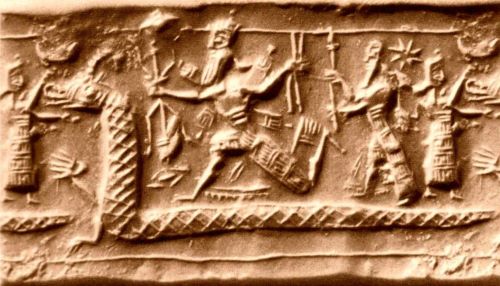
Before music entered the archive as notation, it already stood at the center of Mesopotamian religious, political, and communal life. The earliest cities of southern Mesopotamia did not treat music as an ornamental art added to society after more serious institutions had taken shape. Music belonged to the temple, the palace, the procession, the feast, the funeral, the lament, and the public performance of divine and royal order. It helped mark the difference between ordinary time and ritual time. It gave emotional force to praise, mourning, supplication, and celebration. Long before a scribe attempted to describe intervals or preserve a melody through technical writing, Mesopotamian communities already understood sound as a medium through which gods, kings, priests, mourners, and cities could be addressed.
That world was overwhelmingly oral and performative. Songs survived because trained singers, temple personnel, musicians, and ritual specialists carried them forward through memory, repetition, and practice. This does not mean the tradition was simple, unstable, or primitive. Oral transmission can be highly disciplined, especially when embedded in institutions that value continuity and correction. A hymn repeated in a temple setting, a lament performed during crisis, or a praise song attached to royal ideology did not depend on casual memory alone. It depended on training, social role, ritual authority, and repeated performance in settings where mistakes mattered. Music lived in bodies before it lived on tablets, and those bodies belonged to people who had learned when to sing, how to accompany, which words belonged to which occasion, and what emotional posture the performance required. The singer was not only a memory-keeper but a custodian of disciplined sound, someone whose art joined technique to obligation. In a world where literacy was specialized and restricted, oral performance remained one of the great technologies of continuity. It could preserve language, ritual sequence, emotional tone, and communal expectation without reducing them to written signs. The absence of notation, then, should not be mistaken for the absence of structure. It points instead to a musical culture in which structure was carried by people, institutions, and repeated sacred action.
The temple was one of the great homes of this musical world. Mesopotamian religion was not silent devotion. It was a sensory and ceremonial system in which offerings, images, incense, movement, recitation, and music worked together to sustain relations between human communities and divine powers. Hymns praised gods and goddesses, laments mourned destruction or divine absence, and ritual songs helped articulate the fragile dependence of the city on cosmic order. The sacred musician was not merely an entertainer. He or she could function as a mediator within a ritual economy, giving voice to the community’s dependence on the divine. Music was not separate from theology. It was theology sounded aloud.
The political world also depended on music. Kingship in Mesopotamia required display, and display required sound. Royal praise, victory, procession, banquet, and public ceremony all drew upon the capacity of music to magnify authority. The king’s power was not only written in inscriptions or enacted in law. It was also staged before bodies gathered in space, and music helped organize that staging. Instruments, singers, and rhythmic movement could make hierarchy audible. They surrounded royal presence with controlled emotion, public admiration, and sacred legitimacy. Music helped translate power into experience. It allowed political order to be felt as well as declared.
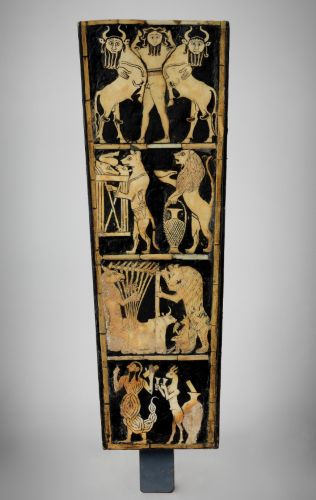
The material evidence makes clear that this musical culture was already sophisticated long before the surviving notation from Ugarit. The famous lyres and harps from the Royal Cemetery at Ur, dating to the third millennium BCE, show that elite Mesopotamian society possessed elaborate stringed instruments centuries before the known notated musical texts. Their decoration, burial context, and craftsmanship point to a world in which instruments had symbolic as well as sonic power. A lyre was not only a device for producing pitch. It was also an object of status, ritual association, and visual meaning. The bull-headed lyres of Ur, for example, joined music to animal imagery, precious materials, and funerary display, suggesting that sound belonged to the ceremonial imagination of death, power, and divine proximity. These instruments also remind us that musical complexity requires material preparation: wood had to be shaped, strings attached and tensioned, resonators formed, and the player trained to draw ordered sound from crafted matter. The existence of such instruments implies traditions of tuning, maintenance, pedagogy, and performance that long preceded the technical tablets that later make aspects of those traditions visible. In other words, the archive eventually preserves theory, but the grave goods from Ur show that practice came first. Music had already become a skilled art of hand, ear, object, and institution.
Yet music also exceeded elite display. Cuneiform literature preserves laments, hymns, love songs, cult songs, and compositions that point toward a broad range of emotional and social uses. These texts remind us that ancient Mesopotamian soundscapes were not limited to royal courts or temple interiors. Music could express grief over ruined cities, longing for divine favor, praise for deities, and the ordered splendor of kingship. It could also shape communal memory. A lament for a destroyed city did not simply describe disaster. It taught later generations how catastrophe should be remembered, how divine abandonment might be imagined, and how grief could be given formal public language. The written words of such compositions survive more fully than their melodies, but even without notation they reveal a culture in which song carried memory through form.
This pre-notational world matters because it prevents us from treating written music as the beginning of music itself. Notation did not create Mesopotamian musical culture. It emerged from it. The later technical tablets, tuning systems, and notated hymns were made possible by older habits of performance, older instruments, older ritual offices, and older expectations that sound could carry sacred and civic meaning. When music finally entered the archive in a more technical sense, it did so because Mesopotamian society had already made music worth preserving. The revolution of notation, then, began not with silence suddenly becoming song, but with song becoming recordable.
Instruments before Scores: Lyres, Harps, and the Material Architecture of Sound
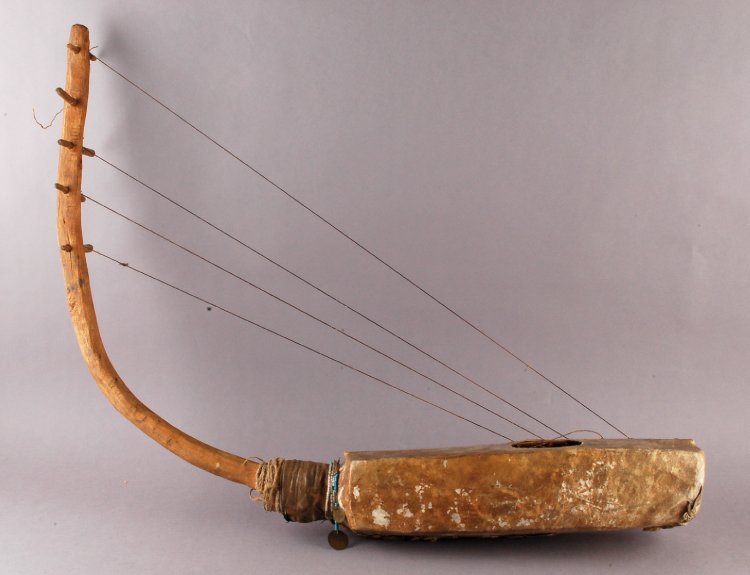
Before a melody could be written, sound had to be made orderly enough to describe. In ancient Mesopotamia, that order did not begin on the tablet. It began in wood, gut, metal, shell, bitumen, and carefully stretched strings. The lyre and harp were not passive objects waiting for notation to arrive. They were technologies of sound, built around tension, resonance, spacing, and touch. Their material design gave musicians a stable field in which pitch relationships could be learned, repeated, corrected, and eventually named. The later history of written musical theory cannot be separated from the older history of instruments, because the instrument was the first visible architecture of musical order.
The stringed instruments of early Mesopotamia reveal a culture already capable of technical musical discipline centuries before the surviving notated compositions. The lyres from the Royal Cemetery at Ur, dating to the third millennium BCE, remain among the most striking evidence. Excavated by Leonard Woolley in elite funerary contexts, they show that music belonged to ceremony, status, and sacred imagination as well as performance. Their bull-headed forms and rich materials joined sound to visual power, making the instrument itself a symbolic object before a single string was plucked. The British Museum’s lyre from the grave of Puabi, for example, was discovered with bodies, jewelry, vessels, and one woman whose hands, according to Woolley’s interpretation, lay near where the strings would have been. That burial context does not give us the music, but it does show that music, musicianship, and instrumental presence mattered profoundly in the social imagination of death and rank.
These instruments also demonstrate that musical knowledge had a practical and embodied foundation. A lyre is not merely a decorated object. It is a disciplined machine for producing relations among pitches. Its maker must understand how a resonating body amplifies sound, how strings differ in length and tension, how they are fixed, how they are tuned, and how they respond to the performer’s hand. Its player must learn not only which string to strike, but how sound changes with pressure, sequence, rhythm, damping, repetition, and accompaniment. This means that long before musical notation appeared in surviving texts, Mesopotamian musicians were working within repeatable systems of sonic difference. They knew that strings could be compared, ordered, and adjusted. That knowledge did not need to begin as abstract theory to be real. It could begin as craft knowledge, passed from maker to maker and player to player, embodied in the trained ear and the practiced hand. The musician who could tune an instrument, maintain its strings, and reproduce a ritual pattern already possessed a kind of technical intelligence, even if that intelligence had not yet been fully translated into written terminology. The theory preserved later in cuneiform did not invent these relationships. It gave written form to skills already developed through craft and performance.
The distinction between lyres and harps matters here because both reveal how instrument design shaped musical thought. A lyre generally presents strings across a frame, while a harp uses an angled relationship between neck and body. Both forms make pitch visible in a way that voice alone does not. The player sees an ordered set of strings and learns sound spatially, through position and sequence. Such instruments turn music into a kind of physical map. Once strings can be counted, named, and arranged, they can also become objects of written description. The instrument prepares the mind for notation by making pitch relations stable enough to discuss apart from any single performance.
This is why scholastic work on the names, numbers, and significance of Mesopotamian strings is so important. The terminology of strings is not a minor technical footnote. It is evidence that ancient scribes and musicians had already developed a language for instrumental order. To name a string is to isolate it conceptually. To number strings is to place them in sequence. To describe the relation between strings is to move from performance into theory. The instrument becomes an intellectual object. Once the lyre or harp is understood as a structured series of sounding elements, musical knowledge can be transferred from hand and ear into words and signs. This move from physical string to named string is crucial, because it shows how musical thought could become detachable from a single moment of performance. A named string can be discussed when the instrument is not sounding. A sequence of strings can be remembered, taught, corrected, and compared. A tuning can be treated as a procedure rather than a mystery. That is the beginning of music as a system of knowledge, not merely as a succession of beautiful sounds. The vocabulary of the instrument created the conditions under which notation could later make sense.
The later Old Babylonian tuning texts make sense only against this background of instrumental structure. Their instructions assume that music can be modified through deliberate changes in tuning. That is a revolutionary assumption because it treats music not as a fixed natural phenomenon, but as an adjustable system. A performer can retune. A scribe can describe the retuning. A teacher can transmit the procedure. A student can learn not only the sound but the method by which the sound is produced. The instrument becomes a laboratory of ancient music theory. It allows intervals to be tested, named, and reproduced. The tablet records the procedure, but the lyre or harp makes the procedure possible.
The materiality of these instruments reminds us that ancient music was never purely abstract. Modern readers may be tempted to rush from strings to scales, from scales to theory, and from theory to notation. But every one of those intellectual developments rested on objects that had to be built, repaired, tuned, carried, protected, and played. Climate, materials, craftsmanship, and ritual setting all mattered. A string could break. A wooden body could warp. A performer’s training could differ by institution or region. Musical order was always a negotiation between ideal system and physical practice. The scribal archive preserves the system, but the instrument belonged to the living world of touch, sound, labor, and maintenance. That tension matters because it keeps the history of music from becoming only a history of texts. The tablet may tell us that a tuning existed, but the instrument tells us that someone had to make that tuning audible. The written sign depended on the stretched string. The theoretical interval depended on vibration. The archive depended on the workshop, the temple, the musician’s body, and the daily habits of care that allowed an instrument to remain playable. Ancient musical knowledge was never simply written down. It was first made, handled, heard, adjusted, and only then preserved.
This is the crucial step between oral musical culture and written musical notation. Before there could be scores, there had to be instruments whose structures made sound durable enough to conceptualize. The lyre and harp did not preserve music in the way clay tablets later would, but they organized it. They transformed musical performance into a patterned field of strings, intervals, gestures, and tunings. When Mesopotamian scribes eventually wrote about music, they were not beginning from silence. They were translating the material intelligence of instruments into the durable intelligence of writing. The score, in that sense, was born from the instrument’s body.
The Old Babylonian Breakthrough: Tuning Texts and the Birth of Written Music Theory
The Old Babylonian period marks one of the most important turning points in the intellectual history of music. Here, the evidence moves beyond instruments as archaeological objects and songs as performed or literary compositions into something more explicitly technical: written instruction about how musical sound should be organized. This is the breakthrough. Mesopotamian scribes did not merely record that music existed, nor did they only preserve words that may once have been sung. They wrote about the internal ordering of musical sound itself. They made music available to the same scribal habits that shaped law, mathematics, lexical lists, ritual procedure, and administration. Music became something that could be analyzed, described, corrected, and transmitted through specialized written knowledge. That change matters because it marks a shift from music as remembered performance to music as structured procedure. A song could be heard and repeated, but a tuning instruction could explain the conditions that made certain musical relations possible in the first place. The tablet did not merely preserve sound after the fact. It preserved an intellectual framework for producing sound according to rule.
The tuning texts are especially significant because they assume that musical sound can be altered according to rule. They describe procedures for tuning a stringed instrument, usually understood in relation to a lyre or harp, by adjusting strings and identifying intervallic relationships. This is a major conceptual step. The instrument is no longer only an object of performance; it becomes a structured system whose parts can be named and manipulated. A string is not simply struck. It has a place, a relation, and a function within an ordered whole. The tuning text stands between practice and theory. It is practical because it tells someone how to produce a desired musical arrangement. It is theoretical because it depends on the idea that pitches relate to one another in intelligible and repeatable ways.
One of the key implications of these texts is that Mesopotamian musicians and scribes possessed a technical vocabulary for music centuries before the better-known Greek theoretical tradition. This does not mean that Old Babylonian music theory resembled later Greek theory in every respect, nor that it should be forced into modern categories of scale, mode, or harmony without caution. Its logic was its own. But the evidence is unmistakable in showing that ancient Near Eastern scholars had already developed a conceptual language for strings, intervals, and tunings. These cuneiform materials were not merely obscure lists or isolated technical oddities. They belonged to a coherent musical system. Later work has refined, debated, and complicated that system, but the basic historical consequence remains: music theory in written form is older and more geographically expansive than many traditional accounts once allowed.
The tuning texts also reveal the deep relationship between music and the scribal culture of classification. Scribes were trained to organize knowledge. They copied word lists, learned signs, preserved mathematical procedures, and mastered the formal language of administration and ritual. Musical tuning could enter that world because it, too, could be reduced to procedures, terms, and relationships. This does not mean that music became cold or abstract. Rather, the written text captured one layer of a larger musical reality. The scribe did not need to preserve every gesture of the performer to preserve something important. By recording how strings should be adjusted, the tablet preserved a method. Method is one of the great forms of intellectual durability. It allows knowledge to move from person to person without relying entirely on the memory of a single teacher.
This is why the material should be treated as a birth of written music theory rather than merely as a precursor to later notation. A notated hymn preserves a particular composition, but a tuning text preserves the logic that makes many performances possible. It does not simply answer the question, “What song should be sung?” It addresses the more technical question, “How should the instrument be ordered so that proper musical relations can be produced?” That difference matters. The tuning text is less dramatic than the survival of a hymn, but in some ways it is more theoretically profound. It shows that Mesopotamian scribes were interested not only in musical products, but in musical systems. They had begun to write down the conditions under which music could be made correctly.
The surviving evidence is fragmentary, and that fragmentary condition must remain central to interpretation. We do not possess a complete music textbook from Old Babylonian Mesopotamia. We have tablets and fragments, technical terms, debated readings, and scholarly reconstructions. The very difficulty of the evidence has produced competing interpretations, especially regarding the precise nature of the tuning system and its relation to later melodic notation. Yet the uncertainty does not weaken the historical importance of the material. On the contrary, it reveals how much intellectual labor was compressed into these small clay witnesses. Even when modern scholars disagree about details, they are disagreeing over a real technical tradition, not over whether one existed at all. The debate itself testifies to the density of the evidence. It also reminds us that ancient music theory survives unevenly, filtered through accident, excavation, damaged tablets, specialized vocabulary, and the limits of modern reconstruction. What remains is not the whole system as ancient musicians knew it, but enough of the system to prove that written musical thought had reached a remarkable level of sophistication. The fragments force caution, but they do not require skepticism about the larger achievement.
The breakthrough was not the invention of music, nor even the invention of sophisticated music. Those already existed. The breakthrough was the scribal recognition that music could be treated as organized knowledge. Strings could be named. Tunings could be described. Intervals could be conceptualized. Procedures could be transmitted in writing. This transformation made later notated compositions, including the Hurrian Hymn to Nikkal, historically intelligible. The hymn did not appear out of nowhere. It belonged to a longer Near Eastern tradition in which sound had already been disciplined by instrument, taught through practice, and finally drawn into the written systems of scribal culture. Before music could become a score, it had to become theory.
Sound, Number, and the Scribal Mind: Music as Ordered Knowledge
The tuning texts belong to a larger intellectual world in which knowledge was made durable by being ordered. Mesopotamian scribes did not simply write things down as isolated facts. They arranged, grouped, compared, classified, and transmitted them through repeated copying and formal training. Their tablets preserved lexical lists, mathematical procedures, astronomical observations, omen sequences, ritual instructions, administrative accounts, legal formulas, and literary compositions. Music entered this same scribal environment when it became describable as a system of named strings, intervals, and tunings. That movement from sound to order is the key point. Music was not merely heard. It was organized.
This scribal habit of ordering the world helps explain why music theory could emerge in written form in Mesopotamia. A culture that trained scribes to recognize patterns in language, number, divination, and ritual procedure was also capable of recognizing patterns in sound. The same intellectual discipline that could classify signs, calculate quantities, and preserve technical instructions could be turned toward the lyre or harp. The instrument offered a set of strings; the scribe’s mind offered a way to name, sequence, and relate them. Music became part of the broader Mesopotamian project of making specialized knowledge transmissible. What the ear knew through practice, writing could begin to preserve as procedure. This does not mean that scribes invented the musical knowledge they recorded. More likely, they captured and formalized traditions already maintained by musicians, temple personnel, and teachers. Yet that act of formalization mattered. Once a practice entered the scribal curriculum or technical archive, it could be copied, compared, stabilized, and moved beyond the immediate setting in which a performer had learned it. Writing did not replace the ear, but it gave the ear’s knowledge a second body.
Number was central to this transformation, though not always in the abstract way modern readers might expect. Mesopotamian musical theory was not simply a matter of mathematical speculation detached from performance. Its numerical quality lay in relation, order, and position. Strings could be counted. Their sequence could be established. Their pairings could be described. Tunings could be altered according to recognizable procedures. This was practical knowledge, but it also carried theoretical force. Once sound could be understood through ordered relations among strings, it became possible to think of music as something more than an event. It became a field of structured possibilities. The musician might still learn by ear and hand, but the scribe could now preserve the logic behind the arrangement.
This is where music intersects most clearly with the mathematical and technical culture of ancient Iraq. Mesopotamian mathematics developed within social institutions that required accounting, measurement, land management, distribution, construction, and pedagogy. It was not purely theoretical in origin, but its practical roots did not prevent it from becoming intellectually sophisticated. Music theory followed a similar pattern. It grew from the practical needs of tuning and performance, yet the act of recording those procedures elevated them into organized knowledge. The tablet did not remove music from the body, but it allowed one part of musical practice to be held apart, examined, and transmitted with unusual stability.
The scribal treatment of music also reveals how ancient intellectual cultures often refused the modern separation between art, science, ritual, and administration. To a modern reader, music theory may seem to belong to aesthetics, mathematics to science, and ritual to religion. In Mesopotamian scribal culture, these boundaries were far less rigid. A hymn could be sacred text, literary composition, ritual instrument, and musical performance at once. A tuning instruction could be both practical craft knowledge and theoretical reflection. The same archive could contain accounts of grain, incantations, astronomical observations, legal documents, and songs. Music entered this world not as a lesser art, but as one more form of ordered relation that mattered enough to preserve. This is one reason the history of notation should not be told as a narrow story of musical technique alone. It belongs to a wider history of how ancient societies organized reality. The same scribal culture that sought to classify stars, omens, words, measures, cities, gods, and obligations could also classify relations among sounds. Music, in that setting, was not opposed to knowledge. It was one of knowledge’s forms.
This helps explain why the invention of musical notation and written theory should not be understood only as a technical milestone. It was also a change in what kind of thing music could be. In oral performance, music existed in time, inseparable from the moment of sounding. In written theory, music could also exist as a set of relations before and after performance. It could be prepared, inspected, remembered, debated, taught, and corrected through signs. That does not mean writing was superior to performance. It means writing added a second mode of existence to music. A song could still live in the breath and hand of the performer, but its underlying order could now live in clay. This distinction is crucial because it prevents a false opposition between oral and written culture. The written tablet did not kill the living song. It preserved something different from the song itself: a framework, a set of instructions, a technical memory. The performance remained the moment when music became audible, but writing allowed musical order to survive beyond that moment and to be reactivated by trained readers and performers.
The scribal mind did not reduce music to numbers or signs. It gave one dimension of music a new durability. Sound remained physical, emotional, and ritual, but it could also be conceptual. The lyre’s strings, once named and ordered, became more than material objects. They became elements in a system. The tuning procedure, once written, became more than a habit of the trained musician. It became a teachable intellectual form. This is the deeper revolution behind the earliest musical texts from Mesopotamia and Ugarit. They show not only that ancient people made music, but that they understood music as knowledge: patterned, disciplined, transmissible, and worthy of preservation.
Ugarit and the Hurrian Hymn to Nikkal: The Earliest Substantial Written Music
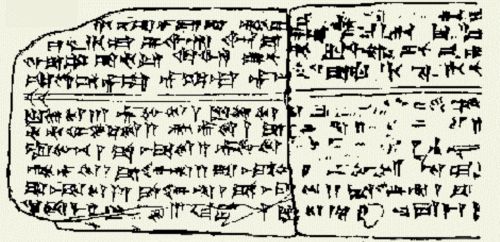
By the time the evidence shifts from Old Babylonian tuning texts to Late Bronze Age Ugarit, the history of ancient music enters one of its most remarkable surviving moments. Ugarit, located on the Syrian coast, was a cosmopolitan city where languages, peoples, and scribal traditions met. Its archives preserve texts in multiple languages and writing systems, reflecting a world linked to Mesopotamia, Anatolia, Egypt, Cyprus, and the wider eastern Mediterranean. Within that complex urban and diplomatic setting, scribes preserved a group of Hurrian songs that included musical instructions. Among them, the best known is the Hurrian Hymn to Nikkal, often identified as h.6, usually dated to around 1400 BCE. It is not the earliest evidence of music, nor even the earliest evidence of music theory, but it is widely treated as the earliest known substantially preserved written composition with musical notation.
The hymn’s importance lies in its combination of sacred text and technical instruction. It is a cult song addressed to Nikkal, a goddess associated with orchards and fertility, and its words are written in Hurrian. Yet the musical terminology attached to it belongs to the wider cuneiform technical tradition, linking the hymn to older Mesopotamian systems of tuning and instrumental order. This mixture matters. The tablet is not only a local religious artifact from Ugarit. It is evidence of cultural transmission across linguistic and regional boundaries. Hurrian lyrics, Akkadianized musical terminology, cuneiform writing, and a system of string relations converge in a single musical witness. The result is not simply a “song on a tablet,” but a compressed record of Late Bronze Age intellectual exchange.
The Hurrian Hymn to Nikkal also reveals how far the scribalization of music had developed. Earlier tuning texts showed that instruments could be ordered, adjusted, and discussed through technical language. The Ugaritic hymn goes further by attaching musical instructions to a specific sacred composition. This is a crucial step from theory toward notated performance. The text suggests that a trained performer could use written information to guide the realization of a song, likely in relation to a stringed instrument such as a lyre. It does not preserve every detail of rhythm, tempo, vocal delivery, or ceremonial context, but it preserves enough to show that melody, text, tuning, and ritual purpose could be brought together in writing. In that sense, the hymn occupies a middle position between technical handbook and living song. It is not merely a list of tunings, but neither is it a fully self-explanatory score. It assumes a musical culture in which performers already knew how to interpret terms, handle instruments, and fit written cues into embodied practice. That assumption is historically important because it shows that notation was not a substitute for musicianship. It was a supplement to it, a written aid that made sense only within an already trained community of singers, instrumentalists, and scribes. Music had moved beyond general procedure into the partial notation of a particular work, but the tablet still depended on the human arts of memory, interpretation, and performance.
The hymn’s fame has sometimes encouraged misleading simplifications. It is often called the “oldest song,” but that phrase can obscure more than it clarifies. Human beings had sung for millennia before Ugarit, and Mesopotamian instruments, hymns, laments, and tuning traditions all predate the Hurrian musical tablets. The hymn’s real distinction is more precise and more historically powerful: it is the oldest known substantial written music whose notation can be studied as part of a technical system. Even then, modern performances of it are reconstructions, not recoveries in the absolute sense. Scholars disagree over how the notation should be interpreted, how the intervals should be realized, and what the original performance may have sounded like. The clay preserves an extraordinary witness, but it does not return the living ritual whole.
That incompleteness makes the Hurrian Hymn to Nikkal more profound, not less. It stands at the boundary between presence and absence, between music as performed sound and music as archival trace. Ugarit itself was destroyed near the end of the Late Bronze Age, and the world that produced the hymn vanished as a living cultural formation. Yet the tablet remained. Pressed into clay, the song outlived the singers, the ritual setting, the spoken fluency of its language, and the city that preserved it. Its survival proves that ancient scribes had already imagined music as something that could cross time through writing. The hymn does not let us hear the Bronze Age exactly as it sounded. It lets us know that the Bronze Age wanted to be heard.
Notation as Preservation: Sacred Song, Memory, and Cultural Survival
The Hurrian Hymn to Nikkal matters not only because it preserves ancient music, but because it shows why music was worth preserving in the first place. Sacred song was never merely decorative. In the ancient Near East, hymns, laments, invocations, and ritual compositions helped communities address the divine, remember catastrophe, seek protection, and give formal shape to gratitude or fear. A song to a goddess was not simply an aesthetic object. It participated in a relationship between human vulnerability and divine power. To preserve such a song in writing was to preserve more than melody. It was to preserve a ritual possibility, a way of speaking to the sacred that could outlast the individual performer. The written hymn carried with it the assumption that sacred sound had consequence: that the right words, ordered in the right way and joined to the proper musical framework, could participate in divine attention, communal stability, and ritual continuity. Notation did not merely protect music from being forgotten. It protected a form of sacred action.
This is where notation becomes historically powerful. Oral tradition could carry sacred music across generations, especially within temples and trained ritual communities, but writing gave that memory another form. Clay could survive what bodies could not. It could endure after the singer died, after the temple’s personnel changed, after political authority shifted, and even after the language of performance lost its ordinary speakers. The written tablet did not replace ritual memory, but it protected a fragment of it from total disappearance. In that sense, notation expanded the life of sacred song. It allowed music to remain present as knowledge even when it was no longer present as living sound.
The preservation of sacred music also reveals the ancient Near Eastern archive as an act of cultural confidence. Scribes did not record everything. What entered the archive did so because it mattered to institutions, patrons, teachers, priests, or communities with access to scribal labor. The survival of a hymn with musical instructions suggests that certain songs were considered valuable enough to stabilize, copy, and transmit. This value was not purely musical in the modern sense. It was theological, ceremonial, educational, and cultural. The song preserved a relationship between deity and worshiper, between text and performance, between inherited tradition and future use. Notation, then, was not neutral storage. It was selection. It marked certain sounds as worthy of memory.
Yet preservation also introduces loss. The tablet survives, but the full performance does not. We do not have the voice that sang the hymn, the precise resonance of the instrument, the room in which it sounded, the gestures surrounding it, or the ritual mood that gave it force. We have signs, terms, and a text whose meaning must be reconstructed through scholarship. This gap should not be treated as failure. It is the nature of all ancient evidence, intensified by music’s dependence on sound. The archive preserves by abstraction. It saves something by separating it from the total living event. The Hurrian Hymn survives because it was written, but it survives as a trace, not as the complete return of a Bronze Age ceremony.
That trace is enough to reveal a profound continuity between sacred memory and written culture. In Mesopotamia and Ugarit, the act of writing music participated in the same larger impulse that preserved myths, prayers, laments, incantations, rituals, treaties, and royal inscriptions. Writing was a defense against disappearance. It allowed words and procedures to pass beyond the fragile limits of immediate performance. Sacred music benefited from that defense because it belonged to traditions that communities needed to repeat, remember, and authorize. A hymn written on clay could become a form of cultural survival, not because it froze religion in place, but because it allowed later singers, scribes, and readers to encounter an inherited pattern of devotion. This mattered especially in a world where cities could fall, dynasties could vanish, and languages could lose their speakers. The archive could not prevent destruction, but it could resist erasure. It could carry forward the evidence that a community had prayed, sung, mourned, praised, and taught through forms carefully enough valued to be written down. In the case of the Hurrian Hymn, the tablet preserved not only a sacred address to Nikkal but also a glimpse of the disciplined musical world that gave that address shape.
This is the deeper historical meaning of notation as preservation. It did not make music immortal in any simple sense. It did not save every detail, silence every uncertainty, or carry the full sound-world of Ugarit intact into the present. But it altered the fate of music. It allowed sacred song to cross the boundary between performance and archive, between the moment and the future. The clay tablet became a vessel for sound’s memory. In that vessel, ancient communities left evidence of their desire not merely to sing, but to be remembered as people who sang with order, devotion, and technical understanding.
Performer, Scribe, and Reconstruction: What Ancient Notation Can and Cannot Tell Us
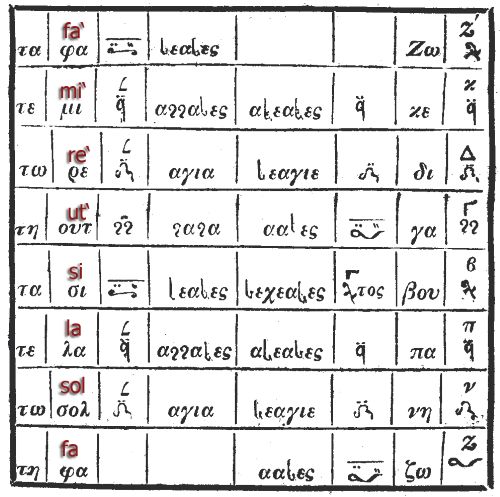
Ancient musical notation survives as one of the most tantalizing forms of evidence because it appears to promise sound while withholding the full experience of hearing. A tablet such as the Hurrian Hymn to Nikkal gives modern scholars words, technical terms, and clues about musical procedure, but it does not restore the complete performance. It cannot tell us the exact quality of the singer’s voice, the size and resonance of the performance space, the gestures of the musician, the emotional atmosphere of the ritual, or the habits of interpretation shared by a trained community. This is the central problem of reconstruction. Ancient notation is not silence, but neither is it sound itself. It is a written remainder of a musical event that once depended on living performers. Its signs point toward performance without becoming performance. They preserve structure without preserving presence. That tension makes the evidence both powerful and fragile, because every attempt to hear the ancient song again must pass through the distance between clay and sound.
The relationship between performer and scribe is crucial. The scribe did not necessarily need to record everything a musician knew, because much of that knowledge may have been assumed. Technical terms could function within a professional culture where trained performers already understood how to interpret them. A written instruction might tell a musician enough to guide performance, but not enough to teach an outsider the entire tradition from nothing. This is why ancient notation should not be treated like a modern score placed before a modern orchestra. It belonged to a world in which writing supplemented memory, training, and institutional practice. The tablet was part of the musical system, not the whole system.
Modern reconstructions of the Hurrian Hymn to Nikkal must be understood as scholarly interpretations. Scholars have offered readings of the evidence, sometimes agreeing on broad principles while disputing crucial details. Those disagreements are not signs that the tablets are useless. They are signs that the tablets preserve a dense but incomplete technical language. Scholars must decide how to understand string names, interval terms, tuning systems, and the relation between text and melody. Each reconstruction depends on philology, musicology, Assyriology, and informed judgment. The result is not a single recovered sound, but a range of plausible attempts to make ancient instructions audible again.
This interpretive difficulty is especially clear in debates over the relationship between Babylonian tuning theory and the Hurrian melodic texts. Some scholars have emphasized the coherence of the underlying tonal system, while others have questioned the placement, function, or interpretation of particular intervals. The problem is not simply that the tablets are damaged, although damage certainly matters. The deeper issue is that notation always presumes convention. A sign means what a trained community has learned it means. Once that community disappears, the sign survives without the full body of practice that once gave it life. Modern scholarship must reconstruct not only the notation, but the lost habits that made the notation usable. That work is necessarily comparative and inferential. It moves between technical vocabulary, tablet layout, instrument history, later theoretical parallels, and the practical question of what can actually be played on a stringed instrument. Every reconstruction contains an argument about ancient musicianship as well as ancient writing. To interpret the notation is also to imagine the performer who once knew what the notation did not need to say.
This does not make reconstruction arbitrary. The surviving tablets impose limits. They preserve real terms, real sequences, real relationships, and real connections to older tuning traditions. The strongest reconstructions are not acts of fantasy, but disciplined arguments built from the evidence. They compare cuneiform terminology, examine Old Babylonian tuning texts, analyze the structure of the Hurrian songs, and test how proposed interpretations might work on stringed instruments. Still, every performance offered today as the “Hurrian Hymn” should be heard with caution. It may be beautiful, and it may be learned, but it is not a direct recording from Ugarit. It is a modern realization of ancient evidence.
That distinction matters because it protects both the past and the present from false certainty. The past is not served by pretending we can recover more than the evidence allows. The present is not required to abandon reconstruction simply because certainty is impossible. Historical interpretation often lives between those poles. We reconstruct ancient buildings from foundations, ancient rituals from texts and objects, ancient economies from accounts and sealings, and ancient languages from inscriptions. Music is harder because its primary form is vibration in time, but the principle is similar. The task is not to resurrect the past perfectly. It is to interpret surviving traces responsibly. That responsibility requires humility, but not paralysis. It asks scholars and performers to admit uncertainty while still allowing the ancient evidence to speak as fully as it can. A reconstruction may not give us Ugarit’s actual soundscape, but it can make audible the structure of an ancient possibility. It can remind us that behind the damaged tablet stood musicians who did not experience their songs as fragments, puzzles, or museum pieces, but as living acts of skill, devotion, and memory.
Ancient notation, then, tells us both more and less than we might wish. It tells us that Mesopotamian and Ugaritic scribes possessed a technical musical vocabulary, that sacred songs could be paired with musical instructions, and that performers worked within systems of tuning and interval relations. It does not tell us exactly how those songs sounded in ritual space, how expressive choices were made, or how listeners experienced them. That limitation should not diminish the achievement. It should sharpen our understanding of it. The tablets are not complete performances trapped in clay. They are evidence that performance had become thinkable as knowledge, and that ancient people had begun to give sound a written afterlife.
Before Greece: Repositioning the Ancient Near East in the History of Music Theory
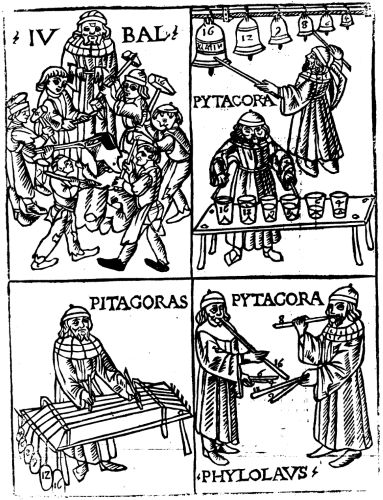
The history of music theory has often been told with Greece as its natural beginning. This is understandable, but it is also incomplete. Greek writings on music survived in forms that later European scholars could read, cite, translate, and place at the foundation of a classical intellectual inheritance. Pythagorean ratios, Plato’s moral anxieties about musical order, Aristoxenus’s attention to perception, and later theoretical traditions became part of the standard story of music as rational inquiry. Yet the Mesopotamian and Ugaritic evidence requires a wider chronology. Long before Greek theorists became central to later accounts, scribes in the ancient Near East had already developed technical vocabularies for strings, tunings, intervals, and musical procedure. The beginning of written music theory cannot be confined to the Greek world.
This does not mean that Greek music theory was unimportant. It was enormously influential, especially because it entered later philosophical, mathematical, and educational traditions with unusual force. Greek theorists asked questions about music’s relation to number, ethics, education, cosmology, and perception that shaped centuries of thought. Their surviving texts also offer sustained argument in ways that the fragmentary Mesopotamian evidence often does not. But influence is not the same as origin. The fact that Greek music theory became foundational for later Western intellectual history does not mean it was the first systematic thinking about music. The ancient Near Eastern materials force a distinction between what later traditions inherited most visibly and what earlier cultures had already achieved. That distinction matters because the archive itself is uneven. Some traditions become “foundational” not simply because they came first, but because their texts survived, were copied, entered schools, and became authoritative for later readers. Greek theory became central to later European music history partly through transmission. Mesopotamian and Ugaritic theory, by contrast, had to be recovered from damaged tablets, specialized terminology, and archaeological rediscovery. Its marginality in older histories reflects the modern shape of evidence as much as the ancient shape of knowledge.
The Old Babylonian tuning texts are especially important for making this distinction. They show that music had become a field of technical knowledge in Mesopotamia centuries before the classical Greek theorists. Strings could be named. Intervals could be described. Tunings could be adjusted by rule. Instruction could be written down. These are not casual observations about music, nor are they merely poetic statements about song. They are evidence of a practical and conceptual system. Even if the system was not framed in the later Greek language of mathematical ratio or philosophical speculation, it still deserves recognition as theory. Theory does not have to look Greek to be theory.
The Hurrian Hymn to Nikkal strengthens the point because it demonstrates that technical musical knowledge could be attached to a specific sacred composition in the Late Bronze Age. Ugarit was not an isolated musical curiosity. It stood within a wider eastern Mediterranean and Near Eastern world of scribal exchange, multilingual archives, and inherited technical terminology. The hymn’s combination of Hurrian language, cuneiform writing, and Mesopotamian musical vocabulary shows that musical knowledge could travel across cultural boundaries before it entered the later Greek philosophical record. This is not a claim that Greek theory simply borrowed from Mesopotamia in any direct or uncomplicated way. The evidence does not require that leap. The safer and stronger claim is chronological and conceptual: the ancient Near East had already made music a technical and written subject.
Repositioning the ancient Near East also changes how we understand the relationship between practice and theory. In many inherited narratives, theory appears when philosophers begin to abstract music into number and concept. The Mesopotamian evidence suggests a different path. Here, theory seems to grow from instrument practice, tuning procedure, scribal classification, and ritual performance. The lyre or harp was not merely a tool for making sound. It became the physical basis for technical description. Scribal theory did not float above performance as pure speculation. It emerged from the practical need to tune, teach, preserve, and reproduce musical relations. This gives Near Eastern music theory a different intellectual texture from later Greek materials, but not a lesser one. Its roots in craft and ritual make it especially revealing because they show theory developing from the pressure of use. Someone needed an instrument ordered correctly. Someone needed a procedure remembered. Someone needed a technical language that could make musical adjustment intelligible across time, teacher, student, and institution. The result was not philosophy in the Greek literary sense, but it was disciplined thought about sound. It was theory born from the workshop, temple, school, and performing body.
That difference is precisely why the Mesopotamian evidence should not be forced into Greek categories. It is tempting to ask whether Babylonian theory had “scales,” “modes,” or “harmony” in the same way later traditions did. Such questions can be useful if handled carefully, but they can also distort the evidence by measuring it against later systems. The better approach is to begin with the categories the tablets themselves preserve: strings, names, intervals, retuning procedures, and the relation between technical instruction and performance. Ancient Near Eastern music theory should be understood first on its own terms. Its significance lies not in how closely it anticipates Greece, but in how clearly it reveals an earlier way of making musical order intelligible. That means allowing the cuneiform evidence to set the questions before modern terminology rushes in with answers. A Mesopotamian tuning text need not correspond neatly to a Greek theoretical treatise to be intellectually serious. A Hurrian musical tablet need not function like later staff notation to count as notation. The danger is not comparison itself, which can be useful, but comparison that turns Greece into the standard by which all earlier evidence is judged. The older Near Eastern system deserves to be studied as a system, not as an imperfect version of someone else’s.
This broader chronology also matters because it challenges a Eurocentric habit of treating the eastern Mediterranean and Near East as background to a Greek foreground. Ugarit, Babylonia, and Mesopotamian scribal culture were not merely preludes to someone else’s intellectual achievement. They were centers of knowledge production in their own right. Their archives preserve sophisticated systems of language, law, mathematics, ritual, astronomy, administration, and literature. Music belonged within that same world of disciplined thought. To place ancient Near Eastern music theory before Greece is not to diminish Greece. It is to restore proportion. The Greek tradition remains crucial, but it should stand within a longer and more plural history of ancient musical intelligence.
The result is a richer history of music theory itself. Instead of beginning with abstract speculation and moving backward only as an afterthought, the story can begin with instruments, ritual communities, scribal schools, tuning procedures, and clay tablets. It can recognize that the desire to order sound arose in multiple contexts and for multiple reasons: sacred performance, pedagogy, technical craft, archival preservation, and intellectual classification. The ancient Near East shows that music theory did not begin when music became philosophical in Greece. It began earlier, when sound became describable, teachable, and durable in writing. That is the correction the tablets demand. They do not erase Greece from the history of music theory. They place Greece in a longer human story.
Was Written Notation a Revolution or Only a Scribal Shadow of Living Music?
The following video from TTM Academy covers a history of musical notation:
Calling written notation a revolution risks making writing appear more important than music itself. That danger is real. Music did not begin when scribes pressed signs into clay, and most ancient music was never written down in any recoverable form. It lived in the body, the ear, the instrument, the ritual setting, the trained memory of performers, and the expectations of communities who knew what a song was supposed to do. A temple hymn, royal praise song, lament, or cultic performance did not require notation to have structure, power, or continuity. Oral tradition was not the absence of order. It was one of the oldest and most durable systems by which human beings preserved complex cultural forms.
This is especially important because oral musical cultures can be extraordinarily precise. Repetition, apprenticeship, communal correction, institutional role, and sacred obligation can stabilize performance across generations. A singer trained in a temple tradition did not simply improvise from vague memory. A lamenter, instrumentalist, or ritual specialist could inherit highly disciplined forms of sound, gesture, timing, and expression. Written notation preserved one dimension of music, but oral transmission preserved others that writing could not capture: vocal color, bodily technique, emotional tone, ritual atmosphere, and the subtle interpretive habits shared by performers and listeners. If notation gave music an archive, performance gave it life. This means that oral tradition should be understood as a form of cultural technology in its own right, not as a deficient stage awaiting correction by writing. It trained memory, disciplined bodies, and created communities of recognition in which a song’s authority depended on more than written accuracy. A performer knew not only what to sing or play, but when the sound was appropriate, how it should be delivered, and what social or sacred weight it carried. Those dimensions of music could be transmitted with remarkable force without ever being fully converted into signs.
The ancient Near Eastern evidence should not be used to tell a triumphalist story in which writing rescues music from the supposed instability of oral culture. That would be too simple, and it would misrepresent the very tradition the tablets reveal. The Old Babylonian tuning texts and the Hurrian Hymn to Nikkal depended on living musicians. Their instructions assumed a world of trained performers who already knew how instruments were handled, how terms were interpreted, and how sacred song functioned. The tablet did not replace the teacher, the singer, or the instrumentalist. It stood beside them. Written notation was not an autonomous machine for producing music. It was a scribal extension of an embodied tradition.
Yet it would be equally mistaken to deny the revolutionary character of notation. Writing changed what music could become historically. It allowed certain aspects of sound to survive beyond the moment of performance and beyond the life of the performer. It made musical relations available for later study, comparison, and debate. It gave technical procedures a durability that oral transmission alone did not always guarantee, especially when cities fell, languages changed, institutions collapsed, or ritual communities disappeared. The tablet could not preserve the whole song as lived experience, but it could preserve enough to prove that a song, a system, and a theory had existed. That is not a small thing. It is one of the reasons the Hurrian Hymn can still matter more than three thousand years after Ugarit’s destruction. Notation gave music a new kind of historical body, one less complete than performance but more durable than memory alone. It made possible a form of survival that did not depend entirely on an unbroken chain of singers or teachers. Even when the tradition was broken, the tablet could remain as evidence that the tradition had once existed. That is the paradox of written music in the ancient world: it could not keep the song fully alive, but it could keep the song from vanishing without witness.
The better answer, then, is that notation was both revolutionary and partial. It was revolutionary because it created a new afterlife for music, allowing sound to enter the archive as knowledge. It was partial because it preserved only selected features of a larger performance world. The scribal trace was not the living song, but neither was it a mere shadow without substance. It was a compressed form of musical memory, shaped by institutional priorities, technical vocabulary, and the limits of writing. Its power lay precisely in that compression. A few lines on clay could carry evidence of tuning, text, sacred address, and intellectual order across millennia, even while leaving rhythm, timbre, gesture, and ritual presence beyond recovery.
This counterpoint matters because it keeps the history honest. Written notation deserves to be treated as one of the great intellectual developments in the history of music, but not because it made music more real than performance. Its achievement was different. It made some part of music durable, portable, and recoverable. It allowed ancient sound to become evidence. The living song disappeared, as all songs do when their final note is gone. But the tablet remained, carrying not the full voice of the past, but enough of its musical intelligence to show that ancient people had already wrestled with the same human problem that still haunts music today: how to make the fleeting endure.
Conclusion: The First Archive of Sound
The invention of written musical notation in the ancient Near East did not create music, and it did not replace the living worlds of voice, memory, ritual, instrument, and trained performance. Those worlds came first. Long before sound entered the archive, people sang to gods, mourned destroyed cities, praised rulers, marked ceremonies, and learned the disciplined habits of string, breath, and hand. The earliest surviving notational evidence belongs to a much older musical landscape. Its importance lies not in beginning music, but in changing music’s historical fate. Once sound could be described through technical signs, named strings, tunings, and performance instructions, it could survive in a new way. It could become not only an event, but a record.
That shift was revolutionary because it joined music to the great scribal project of ancient Mesopotamia and the Levant. The same cultures that organized law, ritual, mathematics, omens, administration, literature, and sacred speech also learned to organize sound. They treated music as something patterned enough to teach, technical enough to describe, and valuable enough to preserve. The Old Babylonian tuning texts reveal music as procedure and theory; the Hurrian Hymn to Nikkal reveals sacred song as notated memory. Together, they show a world in which music was not imagined as an ephemeral luxury, but as ordered knowledge. It could belong to temples, instruments, scribes, performers, and archives at once.
Yet the archive never gives everything back. The tablets preserve traces, not total performances. They do not restore the singer’s voice, the precise timbre of the instrument, the ritual room, the listeners’ expectations, or the full emotional force of sacred sound in its original setting. Modern reconstructions remain interpretations, disciplined but incomplete. That incompleteness is not a weakness in the story. It is part of the truth. Music is always more than its notation. The clay tablet could carry melody’s skeleton, but not its breath. It could preserve musical intelligence, but not the entire living act. The ancient Near Eastern achievement was both grand and humanly limited: it made the fleeting durable without making it fully recoverable.
Still, what endured is astonishing. A song to Nikkal survived the fall of Ugarit. Tuning procedures survived the disappearance of the communities that once knew their sound by ear. Clay outlasted singers, instruments, temples, languages, and cities. In those tablets, ancient musicians and scribes left behind one of humanity’s earliest archives of sound, not a recording, not a modern score, but a written testimony that music had become memory’s concern. They pressed into clay the belief that sound mattered enough to cross time. The final note vanished more than three thousand years ago. The desire to preserve it did not.
Bibliography
Affiliate disclosure: Amazon links on this site are paid links. As an Amazon Associate I earn from qualifying purchases.
- Black, Jeremy, Graham Cunningham, Eleanor Robson, and Gábor Zólyomi. The Literature of Ancient Sumer. Oxford: Oxford University Press, 2004.
- Borland, John E. “Modern Music and an Ancient Notation.” The Musical Times 77:1119 (1936), 404-407.
- British Museum. “Lyre.” Collection Online. Accessed May 30, 2026. https://www.britishmuseum.org/collection/object/W_1928-1010-1-a.
- Crocker, Richard L. “Mesopotamian Tonal Systems.” Iraq 59 (1997), 189–202.
- Duchesne-Guillemin, Marcelle. A Hurrian Musical Score from Ugarit: The Discovery of Mesopotamian Music. New York: Undena Publications, 1984.
- Finnegan, Ruth. Oral Poetry: Its Nature, Significance, and Social Context. Cambridge: Cambridge University Press, 1977.
- Foster, Benjamin R. Before the Muses: An Anthology of Akkadian Literature. 3rd ed. Bethesda, MD: CDL Press, 2005.
- Guerrant, Mary T. “Three Aspects of Music in Ancient China and Greece.” College Music Symposium 20:2 (1980), 87-98.
- Gurney, O. R. “An Old Babylonian Treatise on the Tuning of the Harp.” Iraq 30:2 (1968), 229–233.
- Kilmer, Anne Draffkorn. “The Cult Song with Music from Ancient Ugarit: Another Interpretation.” Revue d’Assyriologie et d’archéologie orientale 68:1 (1974), 69–82.
- —-. “The Discovery of an Ancient Mesopotamian Theory of Music.” Proceedings of the American Philosophical Society 115:2 (1971), 131–149.
- —-. “The Musical Instruments from Ur and Ancient Mesopotamian Music.” Expedition Magazine 40:2 (1998), 12–19.
- —-. “The Strings of Musical Instruments: Their Names, Numbers, and Significance.” In Studies in Honor of Benno Landsberger on His Seventy-Fifth Birthday, April 21, 1965, edited by Hans G. Güterbock and Thorkild Jacobsen, 261–268. Assyriological Studies 16. Chicago: University of Chicago Press, 1965.
- Kilmer, Anne Draffkorn, Richard L. Crocker, and Robert R. Brown. Sounds from Silence: Recent Discoveries in Ancient Near Eastern Music. Berkeley: Bit Enki Publications, 1976.
- Kilmer, Anne Draffkorn, and Stephen J. Tinney. “Old Babylonian Music Instruction Texts.” Journal of Cuneiform Studies 48:1 (1996), 49–56.
- Lawergren, Bo. “The Origin of Musical Instruments and Sounds.” Anthropology Today 4:4 (1988), 31–35.
- Lunn, Henry C. “The History of Musical Notation.” The Musical Times and Singing Class Circular 12:278 (1866), 261-263.
- Mathiesen, Thomas J. Apollo’s Lyre: Greek Music and Music Theory in Antiquity and the Middle Ages. Lincoln: University of Nebraska Press, 1999.
- Michalowski, Piotr. The Lamentation over the Destruction of Sumer and Ur. Mesopotamian Civilizations 1. Winona Lake, IN: Eisenbrauns, 1989.
- Mirelman, Sam, and Theo J. H. Krispijn. “The Old Babylonian Tuning Text UET VI/3 899.” Iraq 71 (2009), 43–52.
- Nougayrol, Jean, Emmanuel Laroche, Charles Virolleaud, and Claude F.-A. Schaeffer. Ugaritica V: Nouveaux textes accadiens, hourrites et ugaritiques des archives et bibliothèques privées d’Ugarit. Mission de Ras Shamra 16. Paris: Imprimerie Nationale, 1968.
- Ong, Walter J. Orality and Literacy: The Technologizing of the Word. London: Routledge, 1982.
- Rimmer, Joan. Ancient Musical Instruments of Western Asia in the Department of Western Asiatic Antiquities, British Museum. London: British Museum, 1969.
- Robson, Eleanor. Mathematics in Ancient Iraq: A Social History. Princeton: Princeton University Press, 2008.
- Van De Mieroop, Marc. Philosophy before the Greeks: The Pursuit of Truth in Ancient Babylonia. Princeton, NJ: Princeton University Press, 2015.
- Veldhuis, Niek. History of the Cuneiform Lexical Tradition. Münster: Ugarit-Verlag, 2014.
- West, M. L. Ancient Greek Music. Oxford: Clarendon Press, 1992.
- —-. “The Babylonian Musical Notation and the Hurrian Melodic Texts.” Music & Letters 75:2 (1994), 161–179.
- Williams, C. F. Abdy. “Ancient Greek Notation.” The Musical Times and Singing Class Circular 35:615 (1894), 343.
- Woolley, C. Leonard. Ur Excavations II: The Royal Cemetery. London: British Museum Press, 1934.
- Wulstan, David. “The Earliest Musical Notation.” Music & Letters 52:4 (1971), 365–382.
- —-. “The Tuning of the Babylonian Harp.” Iraq 30:2 (1968), 215–228.
Originally published by Brewminate, 06.03.2026, under the terms of a Creative Commons Attribution-NonCommercial-NoDerivatives 4.0 International license.
About the Author