
Across history, apocalyptic movements have emerged in times of crisis, revealing enduring patterns of belief, authority, and the human need to make sense of the end.

By Matthew A. McIntosh
Public Historian
Brewminate
Introduction: The Persistent Expectation of the End
Across recorded history, human societies have repeatedly imagined the end of the world as imminent, transformative, and morally decisive. These expectations, often described as apocalyptic or millenarian, are not confined to any one culture or era but emerge across diverse religious and historical contexts. From ancient sects anticipating divine intervention to modern movements predicting global catastrophe, the idea that the present world stands on the brink of radical change has proven remarkably persistent. Far from being marginal or irrational, such beliefs are deeply embedded within broader systems of meaning, offering a way to interpret uncertainty, suffering, and the apparent disorder of human existence.
Apocalyptic thought is typically characterized by a set of recurring features: a conviction that the current age is corrupt or declining, the expectation of a decisive transformation, and the belief that hidden truths about the world’s fate have been revealed to a select group. These elements are often accompanied by strong moral dualism, dividing humanity into the righteous and the condemned, and by the presence of charismatic leaders who claim insight into the unfolding of divine or cosmic plans. While modern discourse frequently labels such groups as “cults,” this term obscures important historical distinctions. Many ancient and medieval apocalyptic movements functioned not as isolated fringe groups but as sects within larger religious traditions, drawing on widely shared texts, symbols, and expectations.
The intensity of apocalyptic belief is closely tied to periods of crisis, when established social, political, or religious structures appear unstable or unjust. Under conditions of imperial domination, war, plague, or rapid social change, apocalyptic narratives provide a framework through which individuals and communities can make sense of disruption. They transform uncertainty into expectation, framing present suffering as a prelude to imminent resolution, and often reinterpreting political or environmental upheaval as signs that a divinely ordained turning point is near. In such contexts, apocalyptic movements frequently gain traction by offering not only explanation but also agency, positioning believers as participants in a cosmic drama rather than passive victims of circumstance. This dynamic can foster both resilience and radicalization, as adherents become increasingly invested in the belief that they are living at the threshold of history’s climax, a moment that demands commitment, sacrifice, and, in some cases, decisive action.
Tracing the development of apocalyptic movements across a wide chronological span, from the ancient world to the modern era, allows an examination of how these groups emerge, evolve, and respond to failure. By analyzing case studies across different historical periods, it seeks to identify recurring patterns in the formation and function of end-times movements, while also attending to the specific conditions that shape their expression. It argues that apocalypticism is not an aberration of belief but a recurring human response to crisis, one that reveals enduring concerns about justice, authority, and the possibility of renewal in a world perceived to be on the edge of collapse.
Conceptual Foundations: What Makes a Movement Apocalyptic?
Apocalyptic movements are best understood not as isolated aberrations but as structured systems of belief that share a recognizable set of conceptual features. At their core lies the conviction that history is moving toward an imminent and decisive transformation, one that will fundamentally reorder the world. This expectation is not merely speculative but is typically grounded in the belief that the timing and nature of this transformation have been revealed through divine or prophetic insight. Such movements often arise within broader religious traditions, drawing upon existing scriptures and interpretive frameworks, yet they distinguish themselves by the urgency with which they interpret the present moment as the threshold of the end. This sense of immediacy is crucial, as it transforms abstract doctrine into lived experience, compelling adherents to reorganize their priorities, behaviors, and social relationships in anticipation of what they believe to be an impending culmination of history.
Central to apocalyptic thought is a pronounced moral dualism that divides reality into opposing forces of good and evil. This binary framework extends beyond abstract theology into social and political interpretation, allowing adherents to identify themselves as part of a righteous remnant set apart from a corrupt or doomed world. The present age is frequently portrayed as irredeemably fallen, marked by injustice, moral decay, or spiritual blindness, while the coming transformation promises the vindication of the faithful and the destruction or judgment of their enemies. This dualistic lens simplifies complex realities, rendering them intelligible within a narrative that emphasizes conflict, resolution, and ultimate justice.
Another defining feature of apocalyptic movements is the role of revelation, often understood as the uncovering of hidden truths about the structure and destiny of the world. These revelations may take the form of visions, prophetic utterances, or reinterpretations of sacred texts, and they typically claim a level of authority that supersedes conventional religious or institutional hierarchies. The possession of such knowledge creates a sharp boundary between insiders and outsiders, reinforcing group cohesion and legitimizing the authority of those who claim to mediate or interpret these revelations. This dynamic often elevates charismatic leaders whose perceived access to divine truth grants them significant influence over their followers.
Closely related to revelation is the presence of charismatic authority, a sociological concept that helps explain the organizational structure of many apocalyptic groups. Leaders within these movements often present themselves as chosen instruments of divine will, capable of interpreting signs, predicting events, or guiding the community through the anticipated crisis. Their authority is not derived from institutional office but from perceived spiritual insight, which can lead to highly centralized and, at times, authoritarian structures. This concentration of authority can foster intense loyalty and commitment, shaping not only belief but daily life, social organization, and moral obligation within the group. It also creates a dynamic in which dissent is difficult to sustain, as disagreement may be framed not merely as intellectual divergence but as spiritual failure or opposition to divine will, thereby reinforcing the leader’s position and the movement’s internal cohesion.
Apocalyptic movements must also be distinguished from related but distinct concepts such as millenarianism and broader eschatological belief. While all three concern the end or transformation of the world, millenarianism specifically refers to the expectation of a coming golden age, often envisioned as a thousand-year reign of peace and justice, whereas eschatology encompasses a wider range of beliefs about death, judgment, and the afterlife. Apocalypticism, by contrast, emphasizes revelation and imminent transformation, often accompanied by vivid imagery and symbolic narratives. Recognizing these distinctions allows for a more precise analysis of historical movements and avoids the tendency to collapse diverse beliefs into a single, overly generalized category. It also clarifies how different movements prioritize different elements of end-time expectation, whether focusing on catastrophic upheaval, restorative transformation, or the unveiling of hidden truths, each of which shapes the movement’s structure, rhetoric, and social behavior in distinct ways.
Finally, apocalyptic movements function as mechanisms for meaning-making in contexts of uncertainty and crisis. By framing present conditions as part of a larger, divinely orchestrated narrative, they provide adherents with a sense of purpose and orientation. Suffering, instability, and perceived injustice are not random or meaningless but are interpreted as signs that the end is near and that transformation is inevitable. This interpretive framework can offer psychological comfort and communal solidarity, even as it intensifies commitment to beliefs that may place adherents at odds with broader society. Apocalypticism operates not only as a theological system but also as a social and psychological response to the enduring human need for meaning in the face of disruption.
Ancient World: Apocalypticism under Empire
The Essenes and Qumran

Among the earliest and most well-documented apocalyptic communities in the ancient world were the Essenes, a Jewish sect commonly associated with the settlement at Qumran near the Dead Sea. Flourishing between the second century BCE and the first century CE, this group separated itself from what it regarded as a corrupt Jerusalem priesthood and an impure religious establishment. Their withdrawal into a disciplined, communal life was not merely an act of protest but a theological response grounded in the belief that they were living in the final phase of history. The discovery of the Dead Sea Scrolls in the twentieth century has provided invaluable insight into their worldview, revealing a community deeply invested in interpreting sacred texts as prophetic guides to the imminent end.
Central to Essene belief was a stark dualism that divided humanity into opposing camps: the “Sons of Light” and the “Sons of Darkness.” This framework extended beyond metaphor into a fully developed apocalyptic expectation of a final cosmic war in which divine forces would decisively intervene on behalf of the righteous. Texts such as the War Scroll outline detailed scenarios of this anticipated conflict, complete with military organization, ritual preparation, and divine participation. For the Essenes, this was not a distant or symbolic event but an imminent reality that demanded constant vigilance, moral purity, and strict adherence to communal rules.
The community’s interpretation of time further underscores its apocalyptic orientation. The Essenes believed that history was unfolding according to a predetermined divine plan, one that had been partially revealed through inspired interpretation of scripture. Their use of pesher exegesis, a method of reading biblical texts as direct references to contemporary events, allowed them to situate themselves within this unfolding narrative. This interpretive approach transformed scripture into a living document, one that spoke directly to the present moment and confirmed the community’s place within a divinely scripted timeline. By identifying their own community as the faithful remnant and their opponents as agents of darkness, they reinforced both their sense of identity and their expectation that the culmination of history was near, while also deepening their conviction that separation from the broader society was not only justified but necessary for participation in the coming divine victory.
In addition to anticipating a final battle, the Essenes appear to have expected the arrival of multiple messianic figures, often described as priestly and royal messiahs who would lead and restore Israel. This dual messianism reflects a complex theological vision that combined political, religious, and cosmic expectations. The community’s strict rules regarding purity, communal ownership, and ritual practice were not simply markers of sectarian identity but preparations for participation in the coming transformation. The Essenes exemplify how apocalyptic belief can shape not only theological outlook but also the structure and daily life of a community oriented toward the end of the world.
Early Christianity as Apocalyptic Movement

Early Christianity emerged within a deeply apocalyptic Jewish environment in which expectations of divine intervention, messianic deliverance, and the imminent transformation of the world were already widespread. The message of Jesus of Nazareth was understood not simply as ethical teaching but as proclamation that the Kingdom of God was at hand. The earliest followers of Jesus interpreted his ministry, death, and resurrection as signs that the long-anticipated end was unfolding in their own time. This apocalyptic horizon shaped the language, urgency, and mission of the early Christian movement, situating it firmly within a broader tradition of Jewish eschatological expectation.
Central to early Christian belief was the expectation of the Parousia, the return of Jesus Christ in glory to judge the living and the dead. Many New Testament texts reflect a sense of immediacy regarding this event, suggesting that it would occur within the lifetime of the first generation of believers. Passages in the Synoptic Gospels and the letters of Paul convey a conviction that the present age was passing away and that the faithful must remain vigilant in anticipation of the coming transformation. This expectation was not merely theological but practical, shaping how early Christians understood time, community, and obligation, often encouraging detachment from worldly concerns and a focus on spiritual readiness. The urgency of the anticipated return also fueled missionary activity, as believers sought to spread the message quickly, convinced that the opportunity for repentance and salvation was limited by an approaching end.
The apocalyptic framework of early Christianity also included a strong emphasis on moral dualism and cosmic conflict. The world was understood as divided between forces aligned with God and those opposed to divine will, a theme that would later be elaborated in texts such as the Book of Revelation. This dualistic outlook reinforced the identity of early Christians as a distinct community set apart from the surrounding society, often in tension with both Jewish authorities and the Roman imperial order. Persecution and marginalization were interpreted not as signs of failure but as confirmation that the end was near and that the faithful were participating in a larger cosmic struggle.
As time passed and the anticipated return of Christ did not occur as expected, early Christian communities were forced to reinterpret their apocalyptic expectations. This process, sometimes referred to as the “delay of the Parousia,” led to theological developments that reframed the timing and nature of the end. Rather than abandoning apocalyptic belief, many Christian thinkers began to emphasize the unpredictability of the final moment and the need for continual readiness. This shift allowed the movement to endure beyond its initial generation, transforming an immediate expectation into a sustained eschatological outlook that could be maintained over time. It also prompted deeper reflection on the meaning of the Kingdom of God, with some interpretations emphasizing its present, spiritual reality alongside its future fulfillment, thereby expanding the scope of apocalyptic belief without relinquishing its core expectation of ultimate transformation.
Despite these adaptations, apocalypticism remained a defining feature of early Christianity, shaping its texts, rituals, and worldview. The belief that history was moving toward a divinely orchestrated culmination provided a powerful framework for interpreting both suffering and hope, linking the present struggles of the community to a future promise of vindication and renewal. Early Christianity illustrates how apocalyptic movements can evolve with changing circumstances while preserving the core conviction that the end of the present age is both certain and meaningful.
The Bar Kokhba Revolt
The Bar Kokhba Revolt (132–136 CE) represents one of the most dramatic instances in which apocalyptic expectation fused with political rebellion in the ancient world. Occurring under the reign of Roman Emperor Hadrian, the uprising was rooted in deep-seated tensions between Roman imperial authority and Jewish religious and cultural identity. Hadrian’s policies, including the refounding of Jerusalem as a Roman colony and restrictions on Jewish practices, intensified existing grievances and created conditions ripe for revolt. Within this charged environment, apocalyptic hopes for divine intervention and national restoration converged with militant resistance, transforming what might otherwise have been a localized rebellion into a movement imbued with cosmic significance.
Central to the revolt was the figure of Simon bar Kosiba, whom many followers hailed as the long-awaited Messiah. Rabbi Akiva, one of the most respected Jewish sages of the period, famously endorsed him, referring to him as “Bar Kokhba,” or “Son of the Star,” a title drawn from messianic interpretation of Numbers 24:17. This identification elevated the revolt beyond a mere political uprising, framing it instead as the fulfillment of prophetic expectation and the beginning of a divinely ordained transformation. The belief that Bar Kokhba would restore Israel and usher in a new era of sovereignty infused the movement with both religious fervor and a sense of historical urgency.
The revolt itself initially achieved notable success, with Jewish forces gaining control over significant portions of Judea and even establishing a provisional administration. Coins minted during this period bore inscriptions proclaiming the “redemption of Israel,” further underscoring the movement’s apocalyptic and messianic character. The Roman response was swift and devastating. Under the command of General Sextus Julius Severus, Roman forces systematically crushed the rebellion, employing tactics of attrition that resulted in widespread destruction, loss of life, and the depopulation of entire regions.
The catastrophic failure of the revolt had profound consequences for Jewish religious and political life. In the aftermath, Jerusalem was further transformed into the Roman city of Aelia Capitolina, and Jews were largely barred from entering it. The scale of the devastation forced a reevaluation of messianic expectations, as the apparent failure of a widely supported messianic claimant challenged assumptions about how and when divine intervention would occur. Rabbinic leadership, which would shape the future of Judaism, increasingly emphasized caution regarding messianic claims and redirected focus toward legal, communal, and interpretive traditions rather than apocalyptic militancy.
The Bar Kokhba Revolt illustrates both the power and the peril of apocalyptic belief when intertwined with political action. It demonstrates how messianic expectation can mobilize large-scale resistance and inspire profound commitment, while also revealing the devastating consequences that can follow when such expectations are not realized. In this case, the collapse of an apocalyptic movement did not eliminate eschatological hope but reshaped it, contributing to a more restrained and interpretive tradition within Judaism that would endure in the centuries to come.
Montanism
Montanism, which emerged in the mid-second century CE in the region of Phrygia in Asia Minor, represents one of the earliest Christian movements to intensify and radicalize apocalyptic expectation within an already eschatologically oriented tradition. Founded by a figure known as Montanus, along with prominent prophetesses such as Priscilla and Maximilla, the movement emphasized ongoing revelation through ecstatic prophecy. Unlike other Christian groups that increasingly looked to established texts and institutional authority, Montanists claimed that the Holy Spirit continued to speak directly through inspired individuals, revealing that the final stage of history was not merely approaching but had already begun.
Central to Montanist belief was the conviction that the New Jerusalem would soon descend upon the earth, specifically in the region of Phrygia. This localization of apocalyptic expectation distinguished the movement from broader Christian eschatology, which often framed the end in more universal or undefined terms. By identifying a concrete geographical setting for the culmination of history, Montanism created a heightened sense of immediacy and anticipation among its followers, encouraging pilgrimage, settlement, and communal concentration in the expected site of divine intervention. This expectation was accompanied by strict ethical demands, including ascetic practices, fasting, and a heightened emphasis on moral purity, all understood as necessary preparation for the imminent arrival of the divine kingdom. The movement’s moral rigor extended to issues such as remarriage, martyrdom, and discipline, reinforcing a vision of a community already living in the final age and bound to a higher standard of conduct.
The authority structure of Montanism further set it apart from emerging orthodox Christianity. The prominence of Montanus and his prophetesses reflected a model of charismatic leadership rooted in direct inspiration rather than ecclesiastical hierarchy. Their prophetic utterances were treated as authoritative declarations of divine will, often delivered in ecstatic states that were interpreted as evidence of the Spirit’s presence. This emphasis on continuing revelation challenged the growing authority of bishops and the consolidation of doctrinal boundaries, contributing to tensions between Montanist communities and the broader Christian church. It also raised fundamental questions about the nature of authority within Christianity, particularly whether divine revelation was ongoing or had been definitively established in earlier apostolic teaching. In elevating prophetic experience over institutional structure, Montanism not only disrupted emerging orthodoxy but also exposed the fragile and contested process by which authority, canon, and doctrine were being defined in the second-century church.
Montanism was condemned as heretical by church authorities, in part because of its claims to new revelation and its challenge to institutional control. Yet its significance lies not only in its eventual marginalization but in what it reveals about the diversity of early Christian apocalyptic thought. Montanism demonstrates how the expectation of the end could be intensified and localized, transforming abstract eschatological belief into a lived, immediate reality that shaped communal identity, authority, and practice. It highlights the persistent tension within apocalyptic movements between charismatic innovation and the stabilizing forces of institutional religion.
Medieval World: Fear, Plague, and Prophetic Crisis
The Year 1000 and Chronological Anxiety

The approach of the year 1000 has long been associated in popular imagination with widespread fear of the apocalypse, a moment when medieval Europe collectively anticipated the end of the world. While this image has been challenged and nuanced by modern scholarship, it remains clear that chronological milestones carried significant symbolic weight in medieval Christian thought. The turning of a millennium, particularly one associated with the birth of Christ, invited reflection on the passage of sacred time and the possibility that history itself was approaching its culmination. Even where explicit panic was absent, the period reflects a heightened sensitivity to eschatological themes embedded within Christian theology.
Medieval conceptions of time were deeply intertwined with biblical chronology, particularly interpretations of the Book of Revelation and other prophetic texts. Some thinkers attempted to calculate the duration of history based on scriptural frameworks, linking the passage of time to divine intention and constructing elaborate chronologies that sought to align sacred history with present experience. These calculations often drew on symbolic numbers and typological readings, interpreting historical events as part of a divinely ordered sequence moving toward fulfillment. Although there is limited evidence for universal panic in the year 1000 itself, certain regions and communities appear to have engaged more intensely with apocalyptic speculation, especially in the context of broader social and political instability. The significance of such chronological reflection lies not in mass hysteria but in the way it structured religious imagination, encouraged interpretive engagement with scripture, and reinforced the sense that time itself was meaningful and directed toward an ultimate conclusion.
The persistence of apocalyptic expectation in this period is better understood as part of an ongoing tradition rather than a single moment of crisis. Throughout the early medieval centuries, Christian communities regularly interpreted events such as famine, war, and natural disasters as potential signs of the approaching end. These interpretations were often localized and varied, shaped by regional conditions and the influence of particular religious leaders. The year 1000 functioned less as a singular focal point of fear and more as one node within a broader pattern of eschatological awareness that extended across centuries.
In addition to chronological speculation, the period saw an increase in religious activity that has sometimes been interpreted as evidence of apocalyptic concern. The growth of pilgrimage, monastic reform movements, and acts of piety such as donations to the Church can be read as expressions of heightened spiritual consciousness. While these behaviors do not necessarily indicate panic about an imminent end, they do reflect a cultural environment in which questions about salvation, judgment, and the fate of the soul were particularly salient. The intersection of timekeeping and religious practice created a framework in which the possibility of the end remained a meaningful and ever-present consideration.
Modern historians have largely moved away from the notion of a widespread “terror of the year 1000,” emphasizing instead the complexity and diversity of medieval eschatological thought. Scholars such as Richard Landes and Dominique Barthélemy have debated the extent to which apocalyptic expectation influenced behavior during this period, highlighting both the presence of eschatological motifs and the absence of uniform panic. This historiographical discussion underscores the importance of distinguishing between myth and evidence, while also recognizing that the anticipation of the end, whether immediate or distant, played a significant role in shaping medieval religious consciousness. Rather than viewing the year 1000 as a moment of collective fear, contemporary scholarship situates it within a broader continuum of apocalyptic reflection, one in which chronological milestones served as occasions for renewed interpretation rather than definitive endpoints, revealing a culture deeply engaged with the meaning of time, history, and divine purpose.
Flagellants and the Black Death
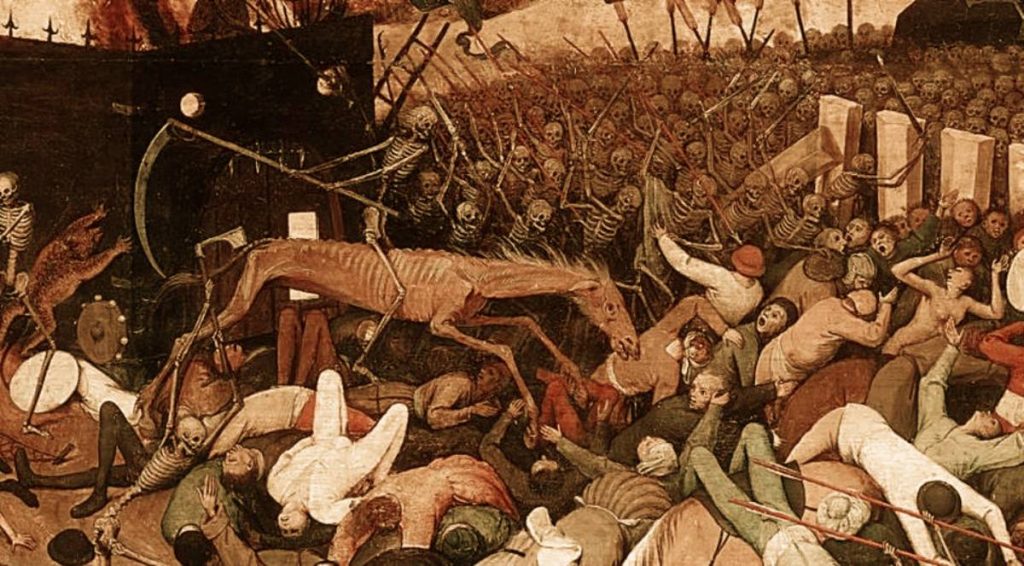
The outbreak of the Black Death between 1347 and 1351 created one of the most profound crises in medieval Europe, killing a significant portion of the population and destabilizing social, economic, and religious life. In the face of such devastation, many turned to apocalyptic interpretations, viewing the plague as a manifestation of divine wrath and a sign that the end of the world was imminent. Among the most striking responses to this crisis was the emergence of the Flagellant movement, groups of laypeople who traveled from town to town engaging in ritualized self-punishment as a means of atoning for the sins of humanity and appeasing God’s wrath.
Flagellant groups typically organized themselves into processions that followed strict routines of prayer, chanting, and public self-flagellation. Participants would strip to the waist and whip themselves in coordinated rituals, often in highly visible public spaces, drawing large crowds and inspiring both fear and fascination. These performances were highly structured, sometimes lasting for weeks, with participants adhering to fixed cycles of penance that dictated when and how the rituals were to be performed. The public nature of the processions turned them into communal spectacles, blurring the line between religious devotion and social theater, and amplifying their emotional impact on observers. These acts were not merely expressions of individual piety but collective performances rooted in the belief that the suffering of the faithful could avert divine judgment. The movement spread rapidly across regions of Germany, the Low Countries, and parts of Central Europe, fueled by both the scale of the catastrophe and the inadequacy of existing institutional responses.
The theological framework underlying the Flagellant movement was deeply apocalyptic, emphasizing the immediacy of divine judgment and the necessity of repentance. Many participants believed that the established Church had failed to address the spiritual causes of the plague and that extraordinary measures were required to restore divine favor. This perception contributed to tensions between Flagellant groups and ecclesiastical authorities, who increasingly viewed the movement as a challenge to their authority and as a potential source of disorder. The emphasis on direct, embodied acts of penance also bypassed traditional sacramental structures, further intensifying concerns among Church leaders.
By the mid-fourteenth century, the movement had grown sufficiently widespread and disruptive that it attracted formal condemnation. In 1349, Pope Clement VI issued a papal bull denouncing the Flagellants, citing concerns about heretical beliefs, unauthorized preaching, and the breakdown of ecclesiastical discipline. This intervention, combined with local suppression efforts, contributed to the decline of the movement, although sporadic revivals would occur in later periods. The Church’s response was not only theological but also political, as authorities feared the potential for mass movements operating outside institutional control to destabilize already fragile societies. The suppression of the Flagellants reflects a broader effort to reassert centralized authority and maintain doctrinal coherence in the face of widespread fear and uncertainty.
The Flagellant movement demonstrates how apocalyptic belief can manifest in intensely physical and communal forms, transforming abstract theological ideas into lived practices of suffering and repentance. It reflects a broader pattern in which catastrophic events are interpreted through a religious lens that emphasizes moral causation and divine response. In this case, the Black Death was not only a medical or demographic disaster but a spiritual crisis that demanded interpretation and action. The Flagellants’ response, though finally suppressed, reveals the powerful role of apocalyptic imagination in shaping human behavior during moments of extreme uncertainty and fear.
The Cathars

The Cathars, active primarily in southern France and northern Italy during the twelfth and thirteenth centuries, represented one of the most significant and controversial religious movements of the medieval period. Often labeled as heretics by the Roman Catholic Church, they developed a theological system that sharply diverged from orthodox Christianity, particularly in its dualistic understanding of the cosmos. While not always explicitly apocalyptic in the same manner as other movements, Cathar belief was deeply infused with a sense that the material world was fundamentally corrupt and destined for eventual dissolution, a perspective that aligns closely with broader apocalyptic frameworks of cosmic transformation.
At the heart of Cathar theology was a radical dualism that posited the existence of two opposing principles: a good, spiritual God associated with the realm of light, and an evil or inferior force responsible for the creation of the material world. This worldview rendered physical existence inherently flawed, trapping human souls within a corrupted reality from which they needed to escape. Salvation was understood not as the redemption of the world but as liberation from it, a process that would culminate in the triumph of the spiritual over the material. This orientation gave Cathar belief an implicit eschatological dimension, envisioning a final resolution in which the forces of good would prevail and the material order would be rendered irrelevant or destroyed.
The structure and practices of the Cathar community reflected these theological commitments. A distinction was maintained between the perfecti, who adhered to strict ascetic standards including celibacy and renunciation of material possessions, and the credentes, who supported the movement while living more conventional lives. The consolamentum, a ritual of spiritual purification often administered near death, was central to Cathar practice, marking the release of the soul from its material entanglement. These practices reinforced a worldview in which the present world was not to be reformed but transcended, further aligning the movement with apocalyptic notions of ultimate transformation.
The growth of Catharism posed a significant challenge to the authority of the Catholic Church, prompting a forceful and violent response. The Albigensian Crusade (1209–1229), launched by the papacy, sought to eradicate the movement through military means, resulting in widespread devastation across the Languedoc region. Entire cities, such as Béziers, were subjected to brutal massacres, illustrating the intensity with which the Church and its allies pursued the elimination of perceived heresy. This campaign was followed by the establishment of the medieval Inquisition, which systematically targeted suspected Cathars and sought to eliminate remaining adherents through interrogation, punishment, and forced recantation. The combination of military violence and institutional surveillance reflects the extent to which Catharism was viewed not only as a theological deviation but as a destabilizing force that threatened the unity and authority of the medieval Christian order.
The suppression of the Cathars did not erase their significance but rather highlights the broader dynamics of religious conflict and control in the medieval world. Their dualistic theology and rejection of material authority positioned them as both a spiritual and institutional challenge, while their implicit eschatological outlook placed them within a wider tradition of movements that viewed the present world as fundamentally flawed and awaiting transformation. The Cathars illustrate how apocalyptic ideas can be embedded within broader theological systems, shaping both belief and practice in ways that challenge established norms and provoke decisive responses from dominant institutions.
Prophetic Figures like Thiota
Alongside organized movements such as the Cathars or the Flagellants, medieval Europe also witnessed the emergence of individual prophetic figures who proclaimed the imminent end of the world. One such figure was Thiota, an otherwise obscure woman who rose to prominence in the mid-ninth century in the region of Mainz. Around the year 847, Thiota announced that she had received divine revelation concerning the precise timing of the Last Judgment, attracting a following among both laypeople and members of the clergy. Her case illustrates how apocalyptic expectation could coalesce around charismatic individuals whose authority rested not on institutional position but on claims of direct communication with the divine.
Thiota’s prophecy gained sufficient attention that it provoked a formal response from ecclesiastical authorities. Church leaders, concerned about the potential for disorder and doctrinal deviation, convened a synod to investigate her claims. According to contemporary accounts, Thiota was condemned as a false prophet, publicly punished, and silenced. This reaction reflects a broader pattern in medieval Christianity, in which prophetic enthusiasm was both tolerated and regulated, with institutional authorities seeking to maintain control over the interpretation of eschatological belief while preventing the spread of potentially destabilizing predictions.
The appeal of figures like Thiota can be understood in the context of the uncertainties and anxieties that characterized the medieval world. In societies where access to formal theological education was limited, charismatic individuals who claimed to possess special knowledge of divine plans could exert significant influence. Their prophecies offered clarity in times of ambiguity, providing a sense of certainty about the future and a framework for understanding present conditions. They also provided a sense of immediacy, collapsing distant theological concepts into urgent, lived reality and encouraging followers to prepare for what was believed to be an impending moment of judgment. Such figures often operated on the margins of established authority, creating tension between popular religious expression and institutional control, particularly when their claims attracted clerical support or challenged accepted interpretations of doctrine.
The case of Thiota highlights the fragility of prophetic authority in a context where legitimacy depended on both popular acceptance and ecclesiastical approval. While her movement was relatively short-lived, it exemplifies a recurring dynamic in the history of apocalyptic belief: the emergence of individuals who claim privileged access to divine knowledge, the rapid formation of followings around such claims, and the eventual intervention of established institutions to suppress or regulate these movements. Prophetic figures like Thiota serve as a reminder that apocalyptic expectation is not only a matter of doctrine or tradition but also a lived and contested phenomenon shaped by the interplay of charisma, belief, and authority.
Early Modern Period: Reformation, Revolution, and Radical End-Times Movements
The Münster Rebellion

The Münster Rebellion (1534–1535) stands as one of the most dramatic examples of apocalyptic belief merging with radical political action in the early modern period. Emerging in the context of the Protestant Reformation, the movement was shaped by religious upheaval, social unrest, and competing interpretations of Christian authority. The German city of Münster became the focal point of this experiment when radical Anabaptists seized control and declared it the site of the New Jerusalem. They transformed a theological expectation into a concrete political project, attempting to establish a divine kingdom on earth in anticipation of the imminent end.
Central to the rebellion was the leadership of Jan van Leiden, who rose to prominence after earlier Anabaptist leaders had laid the groundwork for the movement. Claiming prophetic authority, he proclaimed himself a divinely appointed ruler and sought to reorganize the city according to what he presented as biblical principles. This included the abolition of private property, the introduction of communal ownership, and the enforcement of strict religious discipline. As the movement intensified, more extreme measures were introduced, including the practice of polygamy, which van Leiden justified through scriptural interpretation. These policies reflected both the radical nature of the movement and the extent to which apocalyptic expectation could legitimize sweeping social transformation.
The theological framework of the Münster movement was deeply millenarian, centered on the belief that the faithful were living in the final days before the establishment of Christ’s thousand-year reign. This conviction created a sense of urgency that justified both the restructuring of society and the use of force to defend the emerging community. It also reshaped the internal dynamics of the city, as ordinary social hierarchies were replaced with a system grounded in perceived spiritual status and obedience to prophetic authority. The city was fortified in preparation for what was understood as an inevitable confrontation with external enemies, who were cast as agents of evil opposing the divine plan. The rebellion mirrored earlier apocalyptic movements in its dualistic worldview, but it differed in the degree to which it translated belief into organized political and military action, demonstrating how millenarian expectation could evolve into a fully realized, if short-lived, revolutionary state.
The response to the Münster Rebellion was swift and severe. Catholic and Protestant forces alike united to besiege the city, viewing the movement as a dangerous threat to both religious and social order. After a prolonged siege marked by starvation and internal strain, Münster fell in 1535. The leaders of the rebellion were captured, executed, and their bodies displayed publicly as a warning against similar movements. The suppression of Münster reinforced the boundaries of acceptable religious expression during the Reformation and contributed to the marginalization of radical Anabaptist groups.
The legacy of the Münster Rebellion is complex, serving both as a cautionary tale and as a revealing case study of apocalyptic belief in action. It illustrates how millenarian expectations can drive communities to attempt the realization of divine promises within historical time, often with dramatic and violent consequences. It highlights the broader context of religious transformation in which such movements emerged, reflecting the instability and possibility that characterized the Reformation era. In Münster, apocalyptic vision and political ambition converged, demonstrating the enduring capacity of end-times belief to reshape both thought and action.
The Fifth Monarchists
The Fifth Monarchists emerged in seventeenth-century England during a period of profound political upheaval marked by the English Civil War, the execution of King Charles I, and the temporary establishment of the Commonwealth. Rooted in a particular reading of the Book of Daniel, they believed that history was divided into a succession of four earthly empires, to be followed by a fifth and final monarchy, the divine reign of Christ. For adherents of this movement, the collapse of traditional political authority was not merely a historical accident but a sign that the final stage of history was unfolding. This conviction infused their political and religious activity with a sense of urgency, as they sought to prepare for and, in some cases, hasten the coming of Christ’s kingdom.
The movement drew its strength from a combination of scriptural interpretation and contemporary political experience. The turmoil of the Civil War and the breakdown of monarchical authority appeared to confirm the prophetic framework through which Fifth Monarchists understood history. Many of their leaders were drawn from radical Puritan circles, where intense engagement with biblical prophecy encouraged the belief that England played a central role in the unfolding of divine plans. This interpretive lens transformed political developments into signs of cosmic significance, reinforcing the idea that human action could align with and advance the divine timetable.
Fifth Monarchists were not content to await the coming kingdom passively. Instead, they often advocated for active intervention in political life to establish a godly order that would anticipate or prepare for Christ’s rule. This included calls for the enforcement of strict moral laws, the restructuring of government along biblical lines, and, in some cases, the removal of leaders deemed insufficiently committed to the divine cause. These proposals were not abstract ideals but practical programs aimed at reshaping society in accordance with what they believed to be divine mandates. The movement’s more radical elements went further, participating in plots and uprisings designed to overthrow existing authorities and accelerate the arrival of the prophesied kingdom. Such actions illustrate the extent to which apocalyptic belief could translate into direct political engagement, blurring the line between religious conviction and revolutionary activism.
The most notable expression of this militancy was the uprising led by Thomas Venner in 1661, shortly after the Restoration of the monarchy under Charles II. Venner and his followers attempted to seize control of London, convinced that their actions would initiate the final transformation of the world. The rebellion was quickly suppressed, and its leaders were executed, marking the effective end of the Fifth Monarchist movement as a significant political force. This failure underscored the dangers inherent in attempting to align human action with perceived divine timelines, particularly when such efforts involved confrontation with established power structures.
Despite its relatively brief prominence, the Fifth Monarchist movement reveals important aspects of early modern apocalyptic thought. It demonstrates how biblical interpretation could be mobilized to make sense of political upheaval and to justify radical action aimed at reshaping society. It also highlights how apocalyptic belief could foster a sense of historical participation, encouraging adherents to view themselves not merely as observers of prophecy but as agents within it, responsible for advancing divine purposes. It underscores the tension between expectation and realization that characterizes many apocalyptic movements, as the anticipated transformation failed to materialize despite intense belief and effort. The Fifth Monarchists illustrate both the power and the limits of apocalyptic ideology when brought into direct engagement with political reality.
Society of the Woman in the Wilderness
The Society of the Woman in the Wilderness, formed in the late seventeenth century and transplanted to colonial Pennsylvania in 1694, represents a quieter but no less revealing example of early modern apocalyptic expectation. Led by the German Pietist Johannes Kelpius, the group emigrated from Europe to the New World in anticipation of the imminent end of the world, which they believed would occur in or around the year 1694. Their movement was shaped by a combination of mystical theology, biblical interpretation, and millenarian expectation, reflecting the broader religious ferment of the post-Reformation period.
Unlike more militant apocalyptic movements, the Society of the Woman in the Wilderness emphasized withdrawal and contemplation rather than direct political action. Settling along the Wissahickon Creek near present-day Philadelphia, the group established a semi-monastic community dedicated to prayer, study, and spiritual preparation. Their interpretation of the “Woman in the Wilderness” from the Book of Revelation symbolized both their identity as a chosen remnant and their physical separation from what they perceived as a corrupt world. This withdrawal was not an act of disengagement but a deliberate effort to position themselves in readiness for the anticipated divine transformation.
The group’s practices combined elements of ascetic discipline with intellectual and mystical pursuits, including the study of astronomy, astrology, and esoteric writings. Kelpius and his followers believed that signs in the heavens could provide insight into the timing of the end, blending scientific observation with prophetic interpretation. Their engagement with celestial phenomena was not merely symbolic but systematic, involving careful observation and the construction of interpretive frameworks that sought to correlate astronomical events with biblical prophecy. This synthesis of mysticism and early scientific inquiry reflects the transitional nature of the period, in which older forms of religious knowledge coexisted with emerging intellectual frameworks. It also reveals how apocalyptic expectation could encourage a deeper engagement with the natural world, as believers sought evidence of divine intention in observable phenomena. Their community functioned as both a spiritual retreat and a site of interpretive engagement with the signs of the times.
Although the anticipated apocalypse did not occur as expected, the Society of the Woman in the Wilderness did not collapse in dramatic fashion. Instead, it gradually dispersed, with its members integrating into the surrounding colonial society or continuing their practices in less formal ways. This outcome illustrates a different trajectory for apocalyptic movements, one in which failure leads not to confrontation or catastrophe but to quiet adaptation and dissolution. The group provides a valuable contrast to more dramatic examples, demonstrating that apocalyptic belief can also manifest in forms of withdrawal, reflection, and enduring spiritual influence beyond the immediate moment of expectation.
Victorian Era: Modernity, Anxiety, and Prophetic Revival
The Millerites and the Great Disappointment
The Millerite movement, which emerged in the United States during the early nineteenth century, represents one of the most significant apocalyptic movements of the modern era. Founded on the teachings of William Miller, a Baptist lay preacher and former army officer, the movement centered on the prediction that Jesus Christ would return to earth in or around the year 1843–1844. Miller’s calculations were based on a detailed interpretation of biblical prophecy, particularly the Book of Daniel, which he believed contained a precise timeline for the end of the world. His message resonated widely in a period marked by religious revival, social change, and a growing interest in prophetic interpretation.
Miller’s approach to prophecy was methodical and, for many of his followers, compelling. He argued that the “2,300 evenings and mornings” referenced in Daniel 8:14 corresponded to a period of years that could be calculated to determine the timing of Christ’s return. Through a series of public lectures, pamphlets, and publications, Miller and his associates spread this interpretation across the northeastern United States and beyond, attracting tens of thousands of adherents. Camp meetings, revival gatherings, and print networks amplified the movement’s reach, creating a shared sense of expectation among geographically dispersed believers. The movement was characterized by a sense of urgency and anticipation, as believers prepared for the imminent end through acts of repentance, moral reform, and, in some cases, the abandonment of ordinary pursuits. This preparation was not merely internal but communal, as adherents encouraged one another, reinforced shared conviction, and participated in a broader culture of apocalyptic anticipation that permeated everyday life.
As the predicted date approached, expectations intensified, culminating in a widespread belief that Christ would return on October 22, 1844. Many followers engaged in acts of final preparation, settling debts, distributing possessions, and gathering in anticipation of the event, actions that reflected both faith and a willingness to detach from the material world. When this date passed without the anticipated event, the movement experienced what came to be known as the “Great Disappointment.” The emotional and psychological impact on adherents was profound, as the failure of the prophecy challenged the foundations of their belief. Reports from the period describe confusion, grief, and, in some cases, public ridicule directed at those who had confidently anticipated the end, revealing the social as well as personal consequences of failed apocalyptic expectation.
In the aftermath of the Great Disappointment, the Millerite movement fragmented, with different groups offering competing explanations for the failed prediction. Some abandoned apocalyptic belief altogether, while others reinterpreted the event in ways that preserved the underlying framework of prophecy. One influential interpretation suggested that the date had been correct but that the event itself had been misunderstood, proposing that a heavenly rather than earthly transformation had occurred. This process of reinterpretation allowed elements of the movement to survive and evolve, giving rise to new religious traditions, most notably the Seventh-day Adventist Church.
The Millerite experience illustrates a recurring pattern in the history of apocalyptic movements: the capacity to adapt in the face of failed prophecy. Rather than leading inevitably to collapse, the failure of an anticipated event can generate new forms of belief and organization, as adherents seek to reconcile expectation with experience. In this case, the Great Disappointment did not mark the end of apocalyptic expectation but its transformation, demonstrating how deeply rooted such beliefs can be and how they can persist even in the face of apparent disconfirmation.
Irvingites and Charismatic Renewal
The Irvingite movement, formally known as the Catholic Apostolic Church, emerged in the early nineteenth century in Britain and represents a significant development in modern apocalyptic and charismatic Christianity. Associated with the Scottish preacher Edward Irving, the movement was rooted in a renewed emphasis on spiritual gifts, particularly prophecy, speaking in tongues, and healing. These practices were understood not as extraordinary anomalies but as signs that the Church was entering its final phase before the return of Christ. The Irvingites combined apocalyptic expectation with a revival of charismatic experience, positioning themselves as participants in a renewed outpouring of the Holy Spirit.
Central to Irvingite belief was the conviction that the Church needed to be restored to its original apostolic structure in preparation for the Second Coming. This led to the establishment of a formal hierarchy that included apostles, prophets, evangelists, and pastors, reflecting what adherents believed to be the divinely ordained organization of the early Church. The reappearance of apostles was seen as a decisive sign that the end was near, as it suggested that God was actively reconstituting the Church to fulfill its final mission. This effort to reconstruct apostolic authority was not merely symbolic but organizational, involving the appointment of leaders who were believed to carry divine sanction and responsibility for guiding the community. The combination of restored offices and charismatic gifts created a hybrid structure in which institutional form and spiritual experience were closely intertwined, distinguishing the movement from both more traditional denominations and more loosely organized prophetic groups.
The role of prophecy within the Irvingite movement was especially significant, as it provided both theological direction and confirmation of apocalyptic expectation. Prophetic utterances, often delivered in ecstatic states, were treated as authoritative communications from the Holy Spirit, guiding the community’s beliefs and practices. These experiences were not confined to isolated individuals but became a central feature of communal worship, reinforcing the sense that the movement was uniquely attuned to divine revelation. The prominence of such practices generated controversy, as critics questioned both their authenticity and their compatibility with established doctrine.
The movement’s apocalyptic orientation was closely tied to its understanding of history as approaching a decisive culmination. Irvingites believed that the restoration of apostolic authority and the manifestation of spiritual gifts were preparatory signs of Christ’s imminent return. This expectation shaped both their theology and their communal life, encouraging a focus on spiritual readiness and obedience to perceived divine guidance. As the anticipated return did not occur as expected, the movement adapted by sustaining its structures and practices while reframing its sense of immediacy. The continued existence of apostles and prophets within the community came to be understood not only as signs of an imminent end but as enduring features of a Church living in an extended period of preparation, allowing the movement to maintain coherence despite the delay of fulfillment.
Despite its relatively limited size, the Irvingite movement had a lasting impact on the development of modern charismatic Christianity. Its emphasis on spiritual gifts, prophetic authority, and the restoration of apostolic structures anticipated later movements within Pentecostalism and other forms of charismatic renewal. It illustrates how apocalyptic expectation can coexist with institutional development, producing communities that are both highly structured and intensely experiential. The Irvingites occupy an important place in the history of apocalyptic movements, bridging the gap between earlier prophetic traditions and later forms of charismatic religious expression.
Joanna Southcott and Prophetic Legacy

Joanna Southcott, an English religious visionary active in the late eighteenth and early nineteenth centuries, represents one of the most distinctive figures in the history of modern apocalyptic movements. A domestic servant by background, Southcott claimed to receive divine revelations that identified her as a prophetic messenger chosen to announce the imminent end of the age. Her writings, which circulated widely in pamphlet form, attracted a substantial following across Britain, particularly among working- and middle-class adherents who were drawn to her message of divine intervention and cosmic transformation. Southcott’s authority rested not on institutional position but on her claimed access to direct revelation, positioning her within a broader tradition of charismatic prophetic figures.
Central to Southcott’s message was the belief that she played a unique role in the unfolding of the final divine plan. She identified herself with the “woman” described in the Book of Revelation, interpreting this symbol as a sign of her own prophetic significance in the last days. This self-understanding reached its most dramatic expression in 1814, when, at the age of sixty-four, she announced that she was miraculously pregnant with a messianic child known as “Shiloh,” who would inaugurate a new era of divine rule. The claim drew intense public attention, both from devoted followers who anticipated the fulfillment of prophecy and from skeptics who viewed it as delusion or fraud. Newspapers, physicians, and clergy became involved in assessing her condition, turning what had begun as a religious claim into a broader cultural spectacle that blurred the boundaries between faith, medicine, and public scrutiny. When Southcott died later that year without giving birth, the event created a moment of profound crisis for her movement, forcing adherents to confront the apparent failure of a prophecy that had been presented with extraordinary certainty.
Despite the apparent failure of this central prophecy, Southcott’s influence did not disappear. Instead, her followers developed a range of interpretations that preserved the validity of her revelations, often suggesting that the fulfillment of prophecy had been misunderstood or delayed. One of the most enduring elements of her legacy was the so-called “Southcott Box,” a sealed container said to contain prophetic writings that would only be opened at a moment of national crisis in the presence of the appropriate number of bishops. The continued existence of this object, and the repeated calls to open it during periods of upheaval, illustrate the persistence of apocalyptic expectation even after the death of the original prophet, as well as the capacity of such movements to sustain belief through symbolic continuity.
Southcott’s legacy extended well beyond her immediate circle of followers, influencing later movements such as the Panacea Society in the early twentieth century, which continued to promote her prophecies and advocate for the opening of the box. Her career highlights several recurring features of apocalyptic movements, including the central role of charismatic authority, the reinterpretation of failed prophecy, and the enduring power of symbolic artifacts. It underscores the importance of social context, as her message resonated in a period marked by political instability, economic change, and religious ferment. Joanna Southcott stands as a key figure in the broader history of apocalypticism, illustrating how prophetic movements can persist and evolve even in the face of apparent disconfirmation.
The Agapemonites

The Agapemonites, also known as the “Abode of Love,” emerged in mid-nineteenth-century England as one of the more controversial and sensational apocalyptic religious movements of the Victorian era. Founded by Henry James Prince, a former Anglican clergyman, the group combined elements of millenarian expectation with an unconventional approach to communal life and sexuality. Prince claimed a form of spiritual authority that elevated him beyond ordinary religious leadership, presenting himself as a vessel of divine presence and, eventually, as an embodiment of Christ. In a period marked by rapid industrialization, social anxiety, and religious ferment, the movement attracted attention both for its theological claims and for its departure from conventional moral norms.
Central to the Agapemonite worldview was the belief that the existing social and moral order was corrupt and nearing its end. Prince and his followers saw themselves as participants in a new spiritual dispensation, one that anticipated the transformation of society through divine intervention. This sense of living at the threshold of a new age justified, in their view, a radical reconfiguration of social relations within the community. Members were encouraged to relinquish personal property and submit to the spiritual authority of Prince, creating a tightly controlled environment that blurred the boundaries between religious devotion and personal allegiance.
The most controversial aspect of the movement was its approach to sexuality and marriage. Prince introduced the concept of “spiritual wives,” which effectively sanctioned relationships between himself and female followers under the guise of divine ordinance. These practices, which included forms of polygamy and what critics described as exploitative arrangements, drew intense scrutiny from both the public and the press. Newspapers of the period often sensationalized the group’s activities, portraying them as emblematic of moral decline and religious excess, while former members occasionally offered accounts that reinforced such perceptions. For adherents, these relationships were framed not as transgressive but as spiritually elevated, reflecting a belief that the imminent transformation of the world rendered conventional moral boundaries irrelevant. Obedience to Prince was equated with obedience to divine will, further consolidating his authority and deepening the commitment of followers to the community’s practices.
Public reaction to the Agapemonites was overwhelmingly critical, with the movement frequently portrayed in newspapers and popular discourse as a scandalous and dangerous sect. Legal challenges and social pressure further isolated the community, reinforcing its internal cohesion while also limiting its broader appeal. Despite these controversies, the movement persisted for several decades, maintaining a degree of continuity even as its more dramatic claims softened. The tension between external condemnation and internal conviction highlights a common dynamic in apocalyptic movements, where opposition from the wider society can both challenge and reinforce group identity.
The Agapemonites illustrate how apocalyptic belief can intersect with issues of authority, sexuality, and social organization in ways that challenge prevailing norms. Their history underscores the capacity of such movements to generate both intense devotion and equally intense opposition, particularly when their practices deviate sharply from accepted standards. The movement reflects broader patterns within Victorian religious culture, including a fascination with prophecy, a search for spiritual renewal, and a willingness among some individuals to embrace radical alternatives to established institutions. The Agapemonites occupy a distinctive place in the continuum of apocalyptic movements, demonstrating how expectations of the end can reshape not only belief but also the most intimate aspects of communal life.
Modern Apocalyptic Cults: Isolation, Control, and Catastrophe
People’s Temple (Jonestown)

The People’s Temple, led by Jim Jones, stands as one of the most infamous apocalyptic movements of the modern era, culminating in the mass death of over 900 individuals in Jonestown, Guyana, in November 1978. Originally founded in the 1950s in Indiana, the movement began as a racially integrated church with a strong emphasis on social justice, economic equality, and communal living. Jones attracted followers through a combination of charismatic preaching, promises of utopian community, and a critique of systemic injustice in American society. The movement evolved into a highly controlled and insular group, increasingly shaped by Jones’s authoritarian leadership and apocalyptic worldview.
Central to the transformation of the People’s Temple was Jones’s growing conviction that the world outside the community was irredeemably corrupt and on the brink of destruction. Influenced by Cold War anxieties, nuclear fears, and political unrest, he framed the external world as a hostile and dangerous environment from which his followers needed to be protected. This perspective justified the relocation of the community to Guyana, where Jonestown was established as an isolated settlement intended to serve as both refuge and model for a new form of society. Within this setting, the boundaries between external threat and internal cohesion became increasingly pronounced, reinforcing the group’s separation from broader social structures.
Life in Jonestown was characterized by strict discipline, collective labor, and constant ideological reinforcement. Jones exercised extensive control over daily activities, communication, and personal relationships, creating an environment in which dissent was difficult and often suppressed. Residents worked long hours under demanding conditions, often accompanied by loudspeaker broadcasts of Jones’s sermons that reinforced his authority and shaped the community’s worldview. Apocalyptic rhetoric played a central role in maintaining this control, as Jones repeatedly warned of imminent threats from external enemies, including governments and defectors, framing the outside world as both morally corrupt and actively dangerous. These warnings were reinforced through “White Night” rehearsals, during which members were instructed to prepare for collective suicide as a response to perceived attacks, sometimes being told they were drinking poison only to later discover it was a test of loyalty. Such practices gradually normalized the idea of self-destruction as a rational and even necessary response to persecution, embedding it within the psychological and social fabric of the community.
The final events of November 1978 were precipitated by the visit of U.S. Congressman Leo Ryan, who had come to investigate reports of abuse within the community. After several members expressed a desire to leave with Ryan, tensions escalated, culminating in the assassination of Ryan and others at a nearby airstrip. In the aftermath, Jones initiated what he termed a “revolutionary suicide,” urging his followers to consume a cyanide-laced drink. The resulting mass death, which included men, women, and children, remains one of the most shocking episodes in the history of modern religious movements, raising profound questions about authority, belief, and the limits of communal loyalty.
The tragedy of Jonestown illustrates the extreme potential of apocalyptic belief when combined with authoritarian leadership and social isolation. While the People’s Temple began with ideals rooted in equality and justice, its evolution demonstrates how such movements can become increasingly radicalized under conditions of pressure and control. The event underscores broader patterns in apocalyptic movements, including the construction of an external enemy, the intensification of internal cohesion, and the framing of self-sacrifice as a form of ultimate meaning. Jonestown is not an isolated anomaly but a stark manifestation of dynamics that have appeared, in varying forms, throughout the history of apocalyptic thought.
Branch Davidians
The Branch Davidians, led by David Koresh, represent one of the most widely scrutinized apocalyptic movements of the late twentieth century, culminating in the 1993 siege near Waco, Texas. Emerging from a schismatic tradition within the Seventh-day Adventist movement, the group developed a distinctive theological framework centered on biblical prophecy, particularly the Book of Revelation and the Seven Seals. Koresh, born Vernon Wayne Howell, claimed a unique role as the Lamb who could open these seals, positioning himself as the central figure in the unfolding of the final divine plan. His authority was rooted in a combination of scriptural interpretation and charismatic leadership, which drew followers who believed they were living in the last days.
Central to Branch Davidian belief was an intense focus on apocalyptic expectation, framed through a detailed reading of biblical prophecy. Koresh taught that current events were signs of an imminent cosmic conflict between good and evil, in which the faithful would play a decisive role. This interpretation fostered a sense of urgency and purpose among adherents, who saw themselves as participants in a divine narrative that would culminate in the return of Christ and the establishment of a new order. The community at Mount Carmel functioned as both a place of preparation and a symbolic center of this anticipated transformation, reinforcing the group’s collective identity.
Life within the Mount Carmel compound was structured around religious study, communal living, and adherence to Koresh’s teachings. Members devoted significant time to the interpretation of scripture, often under Koresh’s direct instruction, which reinforced his role as the sole authoritative interpreter of divine revelation. His sermons, sometimes lasting for hours, were treated as both theological instruction and direct insight into unfolding prophecy, shaping how followers understood not only scripture but their own place within it. His control extended beyond theology into the personal lives of followers, including controversial practices such as the “New Light” doctrine, which redefined marital relationships and centralized authority over reproduction within the community. Under this doctrine, Koresh claimed the exclusive right to form spiritual unions with multiple women, including those already married, presenting these arrangements as necessary for producing a chosen lineage tied to prophetic fulfillment. These practices, while justified by Koresh as essential to divine purpose, deepened both internal dependence on his authority and external perceptions of the group as coercive and authoritarian.
The confrontation between the Branch Davidians and federal authorities began in February 1993, when agents from the Bureau of Alcohol, Tobacco, and Firearms (ATF) attempted to execute a search warrant at the Mount Carmel compound. The resulting gun battle led to casualties on both sides and initiated a 51-day standoff involving the Federal Bureau of Investigation (FBI). Throughout the siege, Koresh continued to frame events in apocalyptic terms, interpreting the conflict as the fulfillment of prophecy and reinforcing the group’s expectation of a final confrontation. The standoff ended in April 1993 when a fire engulfed the compound, resulting in the deaths of 76 individuals, including Koresh.
The tragedy of the Branch Davidians highlights the complex interplay between apocalyptic belief, charismatic authority, and external intervention. While the movement was grounded in a long tradition of biblical interpretation, its development under Koresh illustrates how such frameworks can be intensified and personalized in ways that reshape both belief and practice. The events at Waco underscore the potential consequences of confrontation between insular religious communities and state authorities, raising enduring questions about religious freedom, governance, and the management of perceived threats. The Branch Davidians exemplify both the continuity and the transformation of apocalyptic movements in the modern world.
Aum Shinrikyo

Aum Shinrikyo, founded in Japan in 1984 by Shoko Asahara, represents one of the most extreme manifestations of modern apocalyptic movements, combining elements of Buddhism, Hinduism, Christianity, and esoteric thought into a highly syncretic and militant ideology. Asahara, born Chizuo Matsumoto, cultivated an image of spiritual authority, presenting himself as both a guru and a messianic figure with unique insight into the impending end of the world. The movement attracted a significant number of educated young followers, including scientists and engineers, who were drawn to its blend of spiritual promise and apocalyptic urgency. In a rapidly modernizing and technologically advanced society, Aum Shinrikyo offered an alternative framework that interpreted contemporary anxieties through a cosmic lens of destruction and renewal.
Central to Aum Shinrikyo’s worldview was the belief in an imminent global catastrophe, often framed as a final conflict that would destroy existing political and social systems. Asahara drew on a range of religious texts and traditions, reinterpreting them to support a narrative in which a purifying apocalypse was both inevitable and necessary. This belief was not merely theoretical but actionable, as the group increasingly came to see itself as an agent in bringing about this transformation. The idea that violence could serve a salvific purpose marked a significant departure from many earlier apocalyptic movements, introducing a proactive dimension in which adherents were encouraged to participate directly in the unfolding of the end times.
The most notorious expression of this ideology occurred in March 1995, when members of Aum Shinrikyo carried out a sarin gas attack on the Tokyo subway system. The attack, which killed thirteen people and injured thousands, was intended to destabilize society and hasten the onset of the predicted apocalypse. It demonstrated the extent to which apocalyptic belief, when combined with technological capability and centralized authority, could produce acts of mass violence with far-reaching consequences. The planning and execution of the attack reflected a high level of organization within the group, including the development and deployment of chemical weapons by members with scientific training. Laboratories within the movement had been dedicated to producing nerve agents, and the attack itself involved coordinated actions across multiple subway lines during peak commuting hours, maximizing both impact and visibility. The event also revealed the internal dynamics of the group, including strict hierarchical control, psychological manipulation, and the suppression of dissent, all of which contributed to the execution of such a coordinated and devastating act.
The case of Aum Shinrikyo highlights the evolving nature of apocalyptic movements in the modern world, particularly in their capacity to integrate advanced technology and globalized ideas into their belief systems. It underscores how apocalyptic narratives can be adapted to contemporary contexts, transforming traditional expectations of divine intervention into human-driven action. The movement illustrates enduring patterns, including charismatic leadership, the construction of an external enemy, and the framing of violence as a means of achieving transcendence. Aum Shinrikyo stands as both a continuation of historical apocalyptic traditions and a stark example of their potential to take new and dangerous forms in a modern, interconnected world.
Heaven’s Gate
Heaven’s Gate, led by Marshall Applewhite and Bonnie Nettles, represents one of the most unusual and technologically inflected apocalyptic movements of the late twentieth century. Emerging in the 1970s in the United States, the group combined elements of Christian millenarianism, New Age spirituality, and science fiction, creating a distinctive worldview centered on extraterrestrial salvation. Applewhite, known to followers as “Do,” taught that Earth was on the verge of being “recycled,” and that only those who transcended their human condition could ascend to a higher evolutionary level associated with an advanced extraterrestrial civilization. This framework reframed traditional apocalyptic themes in cosmic rather than strictly theological terms, reflecting broader cultural shifts in an era increasingly shaped by space exploration and technological imagination.
Central to the group’s belief system was the idea that human bodies were merely temporary “vehicles” that housed a higher consciousness capable of transformation. Salvation required detachment from earthly identity, including family ties, sexuality, and material attachments. Members lived communally, adopting a disciplined lifestyle that emphasized uniformity, obedience, and the suppression of individuality. This process of self-renunciation was presented not as loss but as preparation for transition to a higher plane of existence, reinforcing the group’s internal coherence and sense of purpose.
The culmination of Heaven’s Gate’s apocalyptic expectation occurred in 1997, when members interpreted the appearance of the Hale-Bopp comet as a sign that their opportunity for ascension had arrived. Applewhite taught that a spacecraft traveling in the comet’s wake would transport their consciousness to the next level, provided they shed their physical forms. In March of that year, thirty-nine members of the group participated in a coordinated act of suicide in Rancho Santa Fe, California, ingesting a mixture of substances in a ritualized process that reflected both planning and shared conviction. The event, widely covered in the media, shocked the public and drew attention to the group’s unusual synthesis of religious and technological ideas.
Heaven’s Gate illustrates how apocalyptic belief can adapt to changing cultural contexts, incorporating elements that resonate with contemporary understandings of science and the cosmos. While its core themes of transformation, salvation, and departure from a corrupt world echo earlier traditions, its framing of these ideas in terms of extraterrestrial evolution marks a significant departure from more conventional religious narratives. The movement reflects enduring patterns in apocalyptic groups, including charismatic leadership, communal isolation, and the reinterpretation of death as a gateway to a higher form of existence. Heaven’s Gate stands as a striking example of how ancient motifs of the end can be reimagined within the symbolic language of the modern world.
Order of the Solar Temple

The Order of the Solar Temple, active primarily in the late twentieth century, represents a transnational apocalyptic movement that blended elements of esotericism, New Age spirituality, and revived Templar mythology. Founded in the 1980s by Joseph Di Mambro and Luc Jouret, the group operated across Switzerland, France, and Canada, attracting followers through a synthesis of mystical teachings, ritual practice, and promises of spiritual transformation. Its ideology drew on a wide range of sources, including Rosicrucianism, Gnosticism, and chivalric symbolism, all framed within a narrative of impending cosmic transition. This eclectic framework allowed the movement to present itself as both ancient in lineage and modern in relevance, appealing to individuals seeking meaning in a rapidly changing world.
Central to the Order’s belief system was the concept of “transit,” a transformative passage from the physical world to a higher spiritual plane. Members were taught that the Earth was approaching a period of purification and that only those who embraced the group’s teachings would successfully transition to a more advanced state of existence. This belief was reinforced through elaborate rituals that emphasized secrecy, hierarchy, and symbolic rebirth, creating a sense of exclusivity and spiritual privilege among adherents. The idea that death could function as a gateway rather than an end became a defining feature of the movement’s apocalyptic outlook.
Between 1994 and 1997, a series of coordinated deaths associated with the Order shocked the international community. In Switzerland and Canada, dozens of members were found dead in what appeared to be ritualized murder-suicides, many of them arranged in symbolic formations and accompanied by ceremonial elements. Investigations revealed that some victims had been killed before the fires that consumed the properties, suggesting a complex and coercive dynamic within the group’s leadership. These events were interpreted by leaders as necessary acts of “transit,” reinforcing the belief that physical death was a deliberate and meaningful step toward spiritual advancement rather than a tragedy.
The Order of the Solar Temple illustrates how apocalyptic belief can be intertwined with esoteric tradition and ritualized practice in ways that intensify both commitment and risk. Its emphasis on secrecy, hierarchical authority, and symbolic action created a closed system in which dissent was limited and alternative interpretations were suppressed. The movement reflects broader patterns in modern apocalyptic groups, including the reinterpretation of death as transformation, the centralization of charismatic authority, and the framing of global crisis as a catalyst for spiritual evolution. The Order stands as a stark example of how apocalyptic narratives can be adapted to new cultural contexts while retaining their capacity for profound and sometimes devastating consequences.
Patterns Across Time: Crisis, Authority, and Belief
Across the long arc of history, apocalyptic movements have emerged with striking regularity in periods marked by instability, uncertainty, and perceived moral decline. Whether under imperial domination in antiquity, during the upheavals of the medieval and early modern worlds, or amid the technological and ideological anxieties of the modern age, such movements consistently arise in contexts where existing structures appear fragile or illegitimate. Crisis is not merely a background condition but a generative force that shapes both the content and urgency of apocalyptic belief. It provides the experiential framework through which adherents interpret their world as standing on the threshold of transformation.
Yet crisis alone does not produce apocalyptic movements; it must be interpreted, narrated, and given meaning. This interpretive work is typically carried out through symbolic systems drawn from religious tradition, scripture, or myth, which provide the language through which contemporary events are understood as signs of the end. Whether in the form of the “Sons of Light and Darkness” at Qumran, the prophetic timelines of William Miller, or the cosmic warfare envisioned by modern groups, these narratives translate lived experience into eschatological expectation. They transform diffuse anxiety into structured anticipation, allowing believers to situate themselves within a broader cosmic drama. This process also involves selective emphasis, in which certain texts or symbols are elevated while others are minimized, creating a coherent interpretive framework that aligns with the group’s immediate concerns. The result is a system of meaning that not only explains crisis but renders it purposeful, even necessary, within a larger divine or cosmic plan.
At the center of this process is the figure of authority, most often embodied in a charismatic leader who claims unique access to truth. From David Koresh and Jim Jones to Joanna Southcott and Shoko Asahara, such figures serve as interpreters of crisis, mediating between sacred text and contemporary reality. Their authority is rarely institutional in origin but is instead rooted in perceived revelation, insight, or spiritual power. This form of leadership allows for flexibility and innovation in doctrine, enabling movements to adapt rapidly to changing circumstances while maintaining a strong sense of internal coherence. It also fosters a dynamic in which the leader’s interpretations become the primary lens through which all events are understood, effectively centralizing meaning-making within a single individual. This concentration of authority is often reinforced through ritual, language, and social structure, creating an environment in which the leader’s perspective is not merely influential but definitive, shaping both belief and behavior in profound ways.
The relationship between authority and community is equally central, as apocalyptic movements tend to foster highly cohesive social structures that reinforce shared belief. Communal living, ritual practice, and the regulation of behavior all contribute to the creation of an environment in which alternative perspectives are limited and collective identity is intensified. In such settings, belief is not merely an individual conviction but a social reality, sustained through daily interaction and mutual reinforcement. This dynamic helps explain the persistence of apocalyptic expectation even in the face of failed prophecy, as the cost of abandoning belief is not only intellectual but social and emotional.
Another recurring pattern is the reinterpretation of disappointment. When predicted events fail to occur, apocalyptic movements rarely collapse outright; instead, they adapt by reconfiguring their understanding of what has taken place. The Great Disappointment of the Millerites, the unfulfilled prophecies of Joanna Southcott, and the delayed expectations of numerous other groups all demonstrate the resilience of belief systems that can absorb failure without dissolving. This capacity for reinterpretation reflects both the flexibility of apocalyptic frameworks and the depth of commitment among adherents, who often prefer revision to abandonment. In many instances, failed prophecy becomes a catalyst for theological development, prompting new interpretations that preserve the core structure of belief while adjusting its temporal or symbolic dimensions. This process not only sustains the movement but can also strengthen it, as the act of reinterpretation reaffirms collective identity and deepens the perceived significance of the group’s mission.
These patterns reveal that apocalyptic movements are not anomalies but recurrent responses to enduring human concerns. They arise at the intersection of crisis, meaning-making, authority, and community, drawing on shared symbolic resources to articulate visions of both destruction and renewal. While their specific forms vary across time and culture, their underlying dynamics remain remarkably consistent, suggesting that the expectation of the end is less a reflection of particular historical moments than a persistent feature of human attempts to understand a world in flux.
Failure and Adaptation: What Happens When the End Does Not Come
Apocalyptic movements are often defined by their expectation of a specific, transformative event that will decisively alter the structure of reality. Yet history demonstrates that such predictions frequently fail to materialize as anticipated. Rather than resulting in the immediate dissolution of belief, these moments of disconfirmation often initiate a complex process of reinterpretation and adaptation. The persistence of apocalyptic movements after failed prophecy challenges the assumption that belief is primarily dependent on empirical verification, revealing instead the deeply social and psychological dimensions of religious commitment.
One of the most influential frameworks for understanding this phenomenon is provided by Leon Festinger’s theory of cognitive dissonance. According to this model, individuals confronted with evidence that contradicts deeply held beliefs experience psychological discomfort, which they seek to resolve through reinterpretation rather than abandonment. In the context of apocalyptic movements, this often involves reexamining the meaning of the predicted event rather than rejecting the underlying framework. The failure of prophecy becomes an interpretive problem rather than a definitive refutation, allowing adherents to maintain coherence in their worldview while accommodating unexpected outcomes. This process is not merely intellectual but emotional, as believers must reconcile the tension between expectation and reality without losing their sense of identity or purpose. The strength of prior commitment frequently intensifies the need for reinterpretation, making belief more resilient rather than more fragile in the face of contradiction.
Historical examples illustrate this process with remarkable clarity. The Millerite movement, following the Great Disappointment of 1844, did not disappear but instead gave rise to new interpretations that preserved its core expectations. Similarly, the followers of Joanna Southcott continued to affirm her prophetic authority despite the failure of her most dramatic claim, reframing it within a broader narrative of delayed fulfillment. In each case, the reinterpretation of failure allowed the movement to persist, often in altered but still recognizable form. This pattern suggests that apocalyptic belief systems possess an inherent flexibility that enables them to survive moments of apparent contradiction.
Adaptation can take several forms, including temporal revision, symbolic reinterpretation, and the internalization of expected events. Temporal revision involves shifting the anticipated date of fulfillment, extending the timeline while preserving the expectation itself. Symbolic reinterpretation, by contrast, redefines the nature of the predicted event, suggesting that it occurred in a non-literal or spiritual sense. Internalization transforms the focus of expectation from an external, observable event to an inward or communal experience, reframing fulfillment as a process rather than a single moment. These strategies allow movements to maintain continuity while adjusting to new circumstances. Movements often employ multiple strategies simultaneously, layering reinterpretations in ways that reinforce rather than undermine belief. The flexibility of these approaches demonstrates that apocalyptic frameworks are not rigid systems but dynamic structures capable of shifting to both internal pressures and external realities.
The role of leadership is crucial in this process, as charismatic figures often guide the reinterpretation of failure in ways that reinforce their authority. By providing new explanations and maintaining a sense of purpose, leaders can prevent disillusionment from leading to fragmentation. The communal structure of apocalyptic movements supports adaptation by creating a shared interpretive environment in which revised beliefs can be collectively affirmed. Leaders frequently reframe failure as a test of faith, a misunderstood fulfillment, or even a necessary step in a longer divine plan, thereby preserving both their legitimacy and the coherence of the movement. This dynamic underscores the extent to which authority and belief are intertwined, as the ability to reinterpret events becomes a central component of maintaining influence and cohesion within the group.
The persistence of apocalyptic movements after failed prophecy underscores their resilience as forms of meaning-making. Rather than collapsing under the weight of unmet expectations, these movements demonstrate an ability to absorb and reinterpret failure in ways that sustain both belief and community. This adaptability reveals that apocalyptic expectation is not solely about predicting the future but about constructing a framework through which individuals and groups can navigate uncertainty, maintain identity, and find purpose in a world that often resists definitive resolution.
Conclusion: The End as a Human Constant
Across millennia and cultures, the expectation of the end has remained a persistent feature of human thought, adapting to new contexts while retaining its essential structure. From the sectarian communities of antiquity to the technologically infused movements of the modern world, apocalyptic belief has repeatedly emerged as a way of interpreting crisis, injustice, and uncertainty. These movements are not isolated aberrations but part of a broader pattern in which individuals and communities seek to impose meaning on experiences that might otherwise appear chaotic or incomprehensible. The idea of the end functions less as a prediction of a specific event and more as a framework through which the present is understood.
The enduring appeal of apocalyptic thinking lies in its capacity to provide both explanation and resolution. It offers a narrative in which suffering is not arbitrary but purposeful, situated within a larger cosmic struggle that will be resolved in favor of justice or renewal. This narrative can be profoundly empowering, particularly for those who experience marginalization or instability, as it transforms vulnerability into participation in a meaningful and even heroic drama. It can also justify extreme forms of belief and behavior, especially when coupled with charismatic authority and tightly bound communities that reinforce a singular interpretation of reality.
What emerges from this study is not a simple story of irrationality or error but a complex portrait of human meaning-making. Apocalyptic movements reveal how deeply individuals desire coherence, purpose, and transformation, particularly in moments when existing structures fail to provide them. They demonstrate the capacity of belief systems to adapt, persist, and even intensify in the face of contradiction, suggesting that the power of such ideas lies not in their empirical accuracy but in their emotional and social resonance. This persistence also reflects the way apocalyptic frameworks are embedded within broader cultural and religious traditions, allowing them to be reactivated and reinterpreted across generations. In times of crisis, these latent structures can be drawn upon to construct new narratives that resonate with contemporary concerns, ensuring that apocalyptic thinking remains both relevant and adaptable. The recurrence of such movements is not simply a repetition of past patterns but an ongoing process in which enduring themes are reshaped to meet the needs of each historical moment.
The expectation of the end reflects a paradox at the heart of human existence: the simultaneous awareness of fragility and the desire for permanence. Apocalyptic narratives resolve this tension by envisioning an ending that is also a beginning, a moment of destruction that gives way to renewal. Whether framed in religious, philosophical, or even technological terms, these visions continue to shape how individuals and societies imagine their future. The end is not merely something that is awaited but something that is continually reimagined, revealing as much about the present as it does about any anticipated conclusion.
Bibliography
Affiliate disclosure: Amazon links on this site are paid links. As an Amazon Associate I earn from qualifying purchases.
- Annales Fuldenses. Translated by Timothy Reuter. Manchester: Manchester University Press, 1992.
- Balch, Robert W., and David Taylor. Heaven’s Gate: America’s UFO Religion. New York: New York University Press, 2002.
- Barber, Malcolm. The Cathars: Dualist Heretics in Languedoc in the High Middle Ages. London: Longman, 2000.
- Barkun, Michael. Disaster and the Millennium. New Haven: Yale University Press, 1974.
- Barthélemy, Dominique. The Serf, the Knight, and the Historian. Ithaca: Cornell University Press, 2009.
- Capp, Bernard. The Fifth Monarchy Men: A Study in Seventeenth-Century English Millenarianism. London: Faber and Faber, 1972.
- Cartledge, Mark J. The Mediation of the Spirit: Interventions in Practical Theology. Grand Rapids: Eerdmans, 2015.
- Cassius Dio. Roman History. Translated by Earnest Cary. Cambridge, MA: Harvard University Press, 1914–1927.
- Chidester, David. Salvation and Suicide: Jim Jones, the Peoples Temple, and Jonestown. Bloomington: Indiana University Press, 1988.
- Cohn, Norman. The Pursuit of the Millennium: Revolutionary Millenarians and Mystical Anarchists of the Middle Ages. Oxford: Oxford University Press, 1957.
- Cohn, Samuel K. The Black Death Transformed: Disease and Culture in Early Renaissance Europe. London: Arnold, 2002.
- Collins, John J. The Apocalyptic Imagination: An Introduction to Jewish Apocalyptic Literature. 3rd ed. Grand Rapids, MI: Eerdmans, 1984.
- Ehrman, Bart D. Jesus: Apocalyptic Prophet of the New Millennium. Oxford: Oxford University Press, 1999.
- Eusebius of Caesarea. Ecclesiastical History. Translated by Kirsopp Lake. Cambridge, MA: Harvard University Press, 1926.
- Festinger, Leon, Henry W. Riecken, and Stanley Schachter. When Prophecy Fails: A Social and Psychological Study of a Modern Group That Predicted the Destruction of the World. Minneapolis: University of Minnesota Press, 1956.
- Flegg, Columba Graham. ‘Gathered under Apostles’: A Study of the Catholic Apostolic Church. Oxford: Clarendon Press, 1992.
- Fredriksen, Paula. From Jesus to Christ: The Origins of the New Testament Images of Jesus. 2nd ed. New Haven: Yale University Press, 2000.
- García Martínez, Florentino, and Eibert J. C. Tigchelaar, eds. The Dead Sea Scrolls Study Edition. 2 vols. Leiden: Brill, 1997–1998.
- Goodman, Martin. Rome and Jerusalem: The Clash of Ancient Civilizations. New York: Vintage Books, 2007.
- Hall, John R. Gone from the Promised Land: Jonestown in American Cultural History. New Brunswick, NJ: Transaction Publishers, 1987.
- Hall, John R., Philip D. Schuyler, and Sylvaine Trinh. Apocalypse Observed: Religious Movements and Violence in North America, Europe, and Japan. London: Routledge, 2000.
- Hill, Christopher. The World Turned Upside Down: Radical Ideas During the English Revolution. London: Penguin Books, 1972.
- Hopkins, A. D. A Woman to Deliver Her People: Joanna Southcott and English Millenarianism in an Era of Revolution. Austin: University of Texas Press, 1982.
- Horrox, Rosemary. The Black Death. Manchester: Manchester University Press, 1994.
- Kaplan, David E., and Andrew Marshall. The Cult at the End of the World: Incredible Story Of Aum. New York: Crown Publishers, 1996.
- Knight, George R. Millennial Fever and the End of the World: A Study of Millerite Adventism. Boise, ID: Pacific Press, 1993.
- Lalich, Janja. Bounded Choice: True Believers and Charismatic Cults. Berkeley: University of California Press, 2004.
- Landes, Richard. Relics, Apocalypse, and the Deceits of History: Ademar of Chabannes, 989–1034. Cambridge, MA: Harvard University Press, 1995.
- Lifton, Robert Jay. Destroying the World to Save It: Aum Shinrikyo, Apocalyptic Violence, and the New Global Terrorism. New York: Metropolitan Books, 1999.
- Mayer, Jean-François. The Order of the Solar Temple: The Temple of Death. London: Ashgate, 1998.
- McGinn, Bernard. Apocalypticism in the Western Tradition. Brookfield, VT: Variorum, 1994.
- —-. Visions of the End: Apocalyptic Traditions in the Middle Ages. New York: Columbia University Press, 1979.
- Moore, R. I. The War on Heresy: Faith and Power in Medieval Europe. Cambridge, MA: Belknap Press, 2012.
- Numbers, Ronald L., and Jonathan M. Butler, eds. The Disappointed: Millerism and Millenarianism in the Nineteenth Century. Knoxville: University of Tennessee Press, 1993.
- Palmer, Susan J. Aliens Adored: Raël’s UFO Religion. New Brunswick, NJ: Rutgers University Press, 2004.
- Reader, Ian. Religious Violence in Contemporary Japan: The Case of Aum Shinrikyo. Honolulu: University of Hawai‘i Press, 2000.
- Reavis, Dick J. The Ashes of Waco: An Investigation. New York: Simon & Schuster, 1995.
- Reiterman, Tim, with John Jacobs. Raven: The Untold Story of the Rev. Jim Jones and His People. New York: Dutton, 1982.
- Roper, Lyndal. Summer of Fire and Blood: The German Peasants’ War. New York: Basic Books, 2025.
- Rowe, David L. God’s Strange Work: William Miller and the End of the World. Grand Rapids: William B. Eerdmans Publishing Company, 2008.
- Sachse, Julius Friedrich. The German Pietists of Provincial Pennsylvania, 1694–1708. Philadelphia: P. C. Stockhausen, 1895.
- Schäfer, Peter. The Bar Kokhba War Reconsidered: New Perspectives on the Second Jewish Revolt against Rome. Tübingen: Mohr Siebeck, 2003.
- Shaw, Jane. Octavia, Daughter of God: The Story of a Female Messiah and Her Followers. London: Jonathan Cape, 2011.
- Southcott, Joanna. The Strange Effects of Faith: With Remarkable Prophecies. London, 1814.
- Stayer, James M. The German Peasants’ War and Anabaptist Community of Goods. Montreal: McGill-Queen’s University Press, 1991.
- Stewart, David Tabb. “The Branch Davidians and ‘The Bacchae’.” Soundings: An Interdisciplinary Journal 91:1/2 (2008), 63-87.
- Stone, Jon R. Expecting Armageddon: Essential Readings in Failed Prophecy. New York: Routledge, 2000.
- Tabbernee, William. Fake Prophecy and Polluted Sacraments: Ecclesiastical and Imperial Reactions to Montanism. Leiden: Brill, 2007.
- Tabor, James D., and Eugene V. Gallagher. Why Waco? Cults and the Battle for Religious Freedom in America. Berkeley: University of California Press, 1995.
- The Holy Bible, King James Version.
- Thompson, Leonard. “Cult and Eschatology in the Apocalypse of John.” The Journal of Religion 49:4 (1969), 330-350.
- Trevett, Christine. Montanism: Gender, Authority and the New Prophecy. Cambridge: Cambridge University Press, 1996.
- Ulman, Richard Barrett and D. Wilfrid Abse. “The Group Psychology of Mass Madness: Jonestown.” Political Psychology 4:4 (1983), 637-661.
- Vermes, Geza. The Complete Dead Sea Scrolls in English. London: Penguin Books, 2011.
- Wakefield, Walter L., and Austin P. Evans, eds. Heresies of the High Middle Ages. New York: Columbia University Press, 1991.
- Weber, Max. Economy and Society. Translated by Guenther Roth and Claus Wittich. Berkeley: University of California Press, 1978.
- Wessinger, Catherine. How the Millennium Comes Violently: From Jonestown to Heaven’s Gate. New York: Seven Bridges Press, 1999.
- Wilson, Bryan R. Magic and the Millennium: A Sociological Study of Religious Movements of Protest among Tribal and Third-World Peoples. New York: Harper & Row, 1973.
- Wokeck, Marianne S. Trade in Strangers: The Beginnings of Mass Migration to North America. University Park: Pennsylvania State University Press, 1999.
- Wright, N. T. The New Testament and the People of God. Minneapolis: Fortress Press, 1992.
- Zeller, Benjamin E. Heaven’s Gate: America’s UFO Religion. New York: New York University Press, 2014.
- Ziegler, Philip. The Black Death: A Masterly History of the Medieval Plague Pandemic and its Devastating Impact on Europe. New York: Harper & Row, 1969.
Originally published by Brewminate, 04.20.2026, under the terms of a Creative Commons Attribution-NonCommercial-NoDerivatives 4.0 International license.
About the Author