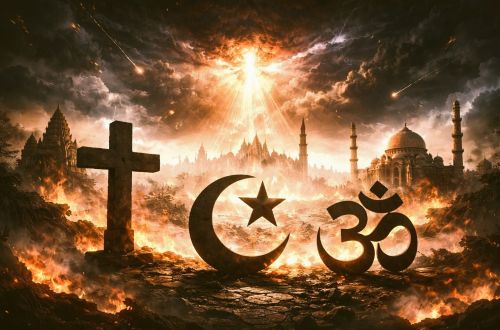
Across cultures and centuries, religions have imagined the end of the world in strikingly similar ways, revealing shared human anxieties, moral visions, and enduring hopes for renewal.

By Matthew A. McIntosh
Public Historian
Brewminate
Introduction: The Universality of the End
Human societies have long imagined the end of the world with remarkable consistency, framing it as both catastrophe and renewal. The study of eschatology, derived from the Greek eschatos meaning “last,” encompasses these visions of final things, from cosmic destruction to moral judgment and ultimate restoration. Far from being marginal or speculative, such narratives occupy a central place in religious thought, offering a framework through which communities interpret suffering, injustice, and the apparent disorder of history. The persistence of these themes suggests that eschatology is not merely about endings, but about meaning itself, a way of situating human experience within a larger moral and cosmic structure.
These end-time narratives frequently emerge at moments of crisis, when social, political, or environmental instability challenges existing systems of belief. Apocalyptic imagination becomes a response to uncertainty, projecting resolution into a future where chaos is overcome and order restored. Whether expressed through prophetic visions, mythological cycles, or doctrinal teachings, eschatological traditions provide reassurance that disorder is temporary and that a decisive transformation awaits. This dynamic reflects what scholars have identified as a broader pattern in religious consciousness, where the end of the world serves not as a termination of meaning but as its ultimate fulfillment.
Despite profound theological differences, many traditions share structural similarities in how they conceive the end. These often include a period of moral decline, the emergence of a savior or restorer figure, a climactic confrontation between opposing forces, and the establishment of a renewed or perfected world. Such recurring elements point to what may be understood as an archetypal narrative of destruction and rebirth, one that transcends cultural boundaries while adapting to specific historical and doctrinal contexts. The universality of these motifs invites comparative analysis, not to flatten distinctions, but to illuminate how diverse traditions grapple with common existential concerns.
Important divergences shape how different religions interpret the nature and purpose of the end. Some traditions, particularly within the Abrahamic sphere, envision history as linear, moving toward a definitive culmination marked by judgment and finality. Others, especially in South and East Asian contexts, understand time as cyclical, with destruction serving as a prelude to renewal in an ongoing cosmic process. These differing conceptions of time fundamentally influence the meaning of eschatology, whether as a singular endpoint or as part of an eternal rhythm. By examining these variations alongside shared patterns, a more nuanced understanding emerges of how humanity has imagined the end, not only as an event, but as a reflection of its deepest hopes and anxieties.
Linear Time and Final Judgment in the Abrahamic Traditions

The Abrahamic religions (Judaism, Christianity, and Islam) share a fundamentally linear conception of time, in which history unfolds according to a divine plan and moves toward a definitive culmination. Unlike cyclical cosmologies, where creation and destruction repeat indefinitely, Abrahamic traditions posit a beginning, a purposeful progression, and an ultimate end that resolves the moral and theological tensions of existence. This linearity imbues history with meaning, transforming it from a sequence of events into a narrative directed by divine intention. The end is not merely a termination, but the fulfillment of a process that has been unfolding since creation itself.
Central to this framework is the concept of divine judgment, which serves as the moral axis of eschatology in these traditions. Human actions are not confined to temporal consequences but are evaluated within an eternal perspective, where justice is rendered fully and finally. This expectation of judgment reflects a deep concern with ethical accountability, reinforcing the idea that history is not morally neutral. The end of time becomes the moment when hidden truths are revealed, wrongs are rectified, and the moral order of the universe is made manifest. Eschatology functions as both a warning and a promise, urging adherence to divine law while assuring ultimate justice. It also introduces a powerful ethical immediacy, in which present actions carry eternal significance, shaping not only individual destiny but the collective fate of humanity. The anticipation of judgment exerts a formative influence on religious life, encouraging moral discipline, communal responsibility, and a heightened awareness of accountability before a transcendent authority.
Within Judaism, Christianity, and Islam, this final judgment is often accompanied by resurrection, signaling not only the continuity of the soul but the restoration of embodied existence. The resurrection of the dead underscores the completeness of divine justice, extending beyond spiritual realms to encompass the physical world. It also affirms the inherent value of creation, suggesting that the material world is not discarded but transformed. While the specifics differ among the traditions, the shared emphasis on resurrection highlights a common conviction that the end involves renewal as much as reckoning.
Despite these shared foundations, each tradition articulates its eschatological vision with distinct theological emphases. Judaism tends to focus on the restoration of Israel and the establishment of a Messianic Age characterized by peace and righteousness, often placing less emphasis on apocalyptic destruction. Christianity, by contrast, intensifies the dramatic elements of the end, portraying it as a cosmic struggle between good and evil culminating in the return of Christ and the final defeat of sin. Islam presents a highly detailed account of the Day of Judgment, emphasizing both the terror and mercy of divine justice, and integrating prophetic signs that precede the end. These variations reflect differing historical experiences and theological priorities, even as they operate within a shared conceptual framework.
What unites these traditions most profoundly is the conviction that history is moving toward a moment of ultimate clarity and resolution. The ambiguities and injustices of the present are temporary, destined to be resolved through divine intervention. This belief has profound implications, shaping ethical behavior, communal identity, and responses to crisis. By framing the end as both inevitable and purposeful, Abrahamic eschatology offers a powerful narrative of hope, one in which the apparent chaos of the world is subsumed within a larger, divinely ordered design.
Judaism: Messianic Hope and the World to Come

Jewish eschatology differs in tone and emphasis from other Abrahamic traditions, placing greater focus on restoration and collective renewal rather than dramatic apocalyptic destruction. While elements of apocalyptic thought do appear in certain Second Temple texts, the dominant trajectory in Judaism centers on the coming of the Messianic Age, a period characterized by peace, justice, and the fulfillment of God’s covenant with Israel. This vision is less concerned with the end of the world in a catastrophic sense and more with the transformation of the world into a state of harmony and righteousness. The future is not an annihilation of the present order but its redemption.
At the center of this expectation is the figure of the Messiah (Mashiach), traditionally understood as a human leader descended from the line of King David who will restore Israel and establish an era of justice. Unlike the more cosmic or divine figures found in other traditions, the Jewish Messiah is often portrayed as a political and spiritual leader who brings about tangible change within history. This includes the ingathering of the Jewish diaspora, the rebuilding of Jerusalem, and the establishment of peace among nations. The Messianic Age reflects both national restoration and universal transformation, linking the destiny of Israel with a broader vision of global harmony. The emphasis on a human agent of change also underscores a key feature of Jewish thought: the interplay between divine promise and human responsibility in shaping the future.
Closely related to the Messianic Age is the concept of the “world to come” (Olam Ha-Ba), a term that carries multiple meanings within Jewish tradition. In some interpretations, it refers to a future historical era of peace and justice on earth, while in others it denotes a transcendent state following resurrection and judgment. This ambiguity reflects the diversity of Jewish thought, which resists rigid systematization in favor of interpretive flexibility. What remains consistent is the belief that the current state of the world is incomplete and that a future condition of fulfillment awaits. This expectation is often expressed not through detailed apocalyptic narratives but through prophetic visions of restoration, where justice flows and suffering is alleviated. The prophetic literature, particularly in texts such as Isaiah and Ezekiel, provides a rich imaginative vocabulary for this future, depicting a world reordered according to divine justice and harmony. In these visions, social inequities are overturned, exile is reversed, and the relationship between God and humanity is renewed in more immediate and tangible ways. The elasticity of Olam Ha-Ba allows it to function both as a historical hope and a metaphysical horizon, bridging the gap between lived experience and ultimate fulfillment.
Resurrection also plays a role in Jewish eschatology, particularly in later developments influenced by apocalyptic literature. The resurrection of the dead (techiyat ha-metim) affirms the continuity of life and the possibility of divine justice extending beyond death. While not uniformly emphasized across all periods of Jewish thought, it becomes an important element in rabbinic theology, reinforcing the idea that righteousness is rewarded. This belief complements the broader eschatological framework by ensuring that the moral order is not limited to earthly existence. Resurrection serves as both a theological affirmation and an ethical assurance, linking present conduct with future consequence.
What distinguishes Jewish eschatology most clearly is its orientation toward hope grounded in covenantal faith rather than fear of imminent destruction. The future is envisioned as a continuation and fulfillment of the relationship between God and Israel, rather than a radical rupture with the present. This perspective fosters a sustained engagement with the world, encouraging ethical action and communal responsibility as part of the unfolding of divine purpose. Rather than withdrawing from history in anticipation of its end, Jewish thought often emphasizes participation in its transformation. This orientation toward active engagement reinforces the idea that redemption is not solely a distant divine intervention but something that can be anticipated and, in some sense, prepared for through human action. Ethical conduct, adherence to the law, and communal solidarity all become expressions of eschatological hope, embedding the future within the practices of the present. Eschatology becomes not only a vision of what will be, but a guide for how to live in the present.
Christianity: Apocalypse, Antichrist, and Cosmic War
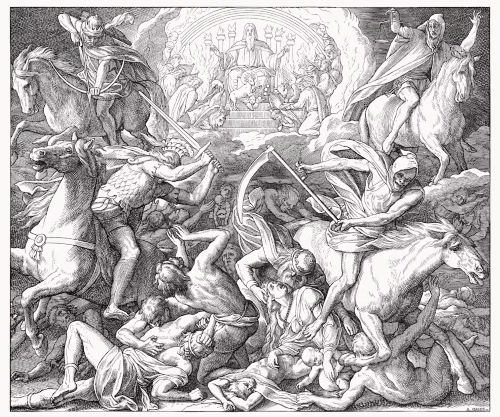
Christian eschatology presents one of the most vivid and symbolically charged visions of the end, centered on the return of Jesus Christ and the ultimate defeat of evil. Drawing heavily from the apocalyptic imagery of the Book of Revelation, as well as earlier prophetic traditions in the Hebrew Bible, Christianity frames the end of time as both a culmination of history and a cosmic confrontation between divine and demonic forces. This vision is not merely descriptive but theological, asserting that the apparent disorder of the world is temporary and that divine sovereignty will be decisively affirmed. The end is both an unveiling and a vindication, revealing the true nature of reality and restoring the moral order disrupted by sin.
At the heart of this eschatological drama lies the figure of the Antichrist, a symbolic and, in some interpretations, literal embodiment of opposition to Christ. While the term itself appears in the Johannine epistles, its fuller development emerges in later Christian thought, where it becomes associated with deception, tyranny, and false authority. The Antichrist represents more than an individual adversary; it signifies a broader pattern of corruption and rebellion that permeates human history. This figure often arises in times of crisis, reflecting the enduring concern that evil can masquerade as legitimacy, drawing followers through persuasion, coercion, or ideological appeal. As such, the Antichrist serves as a focal point for anxieties about power, truth, and the fragility of moral discernment.
The culmination of this conflict is commonly associated with Armageddon, a term derived from the Book of Revelation that has come to symbolize the final battle between the forces of good and evil. While interpretations vary widely, ranging from literal military confrontation to symbolic representation of spiritual struggle, the narrative consistently emphasizes the inevitability of divine victory. This battle is not fought on equal terms; it is the decisive assertion of divine authority over all opposing powers. The imagery of warfare, destruction, and judgment underscores the gravity of the moment, portraying the end as both catastrophic and redemptive. It draws on a rich symbolic vocabulary in which kings, beasts, angels, and cosmic signs converge to dramatize the collapse of unjust power and the exposure of false dominion. Armageddon is not merely a geographical or historical event but a theological climax, where the accumulated tensions of history are resolved in a single, decisive act of divine intervention. The language of battle conveys both the intensity of the struggle and the certainty of its outcome, emphasizing that evil, however formidable it may appear, is finite and subordinate to divine will.
Following this climactic confrontation, Christian eschatology envisions the establishment of a new heaven and a new earth, a transformed reality in which suffering, death, and sin are eradicated. This vision, articulated most clearly in Revelation 21–22, reflects a profound continuity with earlier biblical themes of restoration and covenant fulfillment. The new creation is not an abandonment of the old but its renewal, purified and perfected through divine action. This emphasis on transformation rather than annihilation reinforces the idea that creation itself retains value and purpose, even in its fallen state. The end becomes a beginning, marking the transition from a world marked by imperfection to one characterized by harmony and divine presence.
Christian interpretations of these eschatological themes have varied significantly across historical and theological contexts, reflecting differing attitudes toward scripture, authority, and historical experience. Early Christians often understood the end as imminent, shaped by persecution and the expectation of Christ’s return within their lifetimes. In later periods, particularly during the Middle Ages, apocalyptic imagery was frequently invoked in response to social upheaval, political instability, and perceived moral decline. More recent interpretations range from literalist readings that anticipate specific future events to symbolic approaches that understand Revelation as a timeless depiction of spiritual realities. These diverse perspectives demonstrate the adaptability of Christian eschatology, allowing it to remain relevant across changing historical circumstances.
Despite these variations, the core elements of Christian eschatology remain remarkably consistent, centering on the return of Christ, the defeat of evil, and the restoration of creation. These themes provide a powerful framework for understanding suffering, injustice, and hope, situating individual and collective experience within a larger narrative of redemption. The dramatic imagery of apocalypse and cosmic war serves not only to inspire awe but to reinforce ethical commitment, reminding believers that their actions participate in a broader struggle between good and evil. Christian eschatology continues to shape both theological reflection and lived experience, offering a vision of the end that is at once terrifying and profoundly hopeful.
Islam: Judgment, Restoration, and the Return of Isa
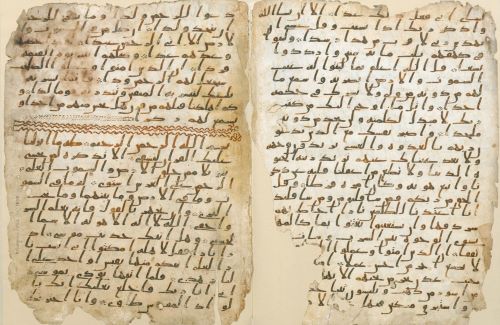
Islamic eschatology presents a detailed and structured vision of the end centered on the Day of Judgment (Qiyāmah), a moment when all creation will be brought before God (Allah) for final reckoning. Time, as in the broader Abrahamic framework, unfolds linearly toward this climactic event, where divine justice is rendered with absolute clarity. The Qur’an repeatedly emphasizes the certainty and imminence of this day, portraying it as both awe-inspiring and terrifying, marked by cosmic upheaval and the dissolution of the natural order. Yet alongside this imagery of destruction lies a profound assurance that God’s justice will prevail, correcting the imbalances and injustices of earthly existence.
A defining feature of Islamic eschatology is its integration of both moral accountability and divine mercy. Human beings are judged according to their deeds, intentions, and faith, with every action recorded and weighed. The concept of the scales (mīzān) and the bridge (ṣirāṭ) symbolizes the precision and seriousness of this judgment, underscoring the belief that no act, however small, escapes divine notice. Islamic theology consistently affirms God’s compassion, suggesting that mercy may temper justice in ways that transcend human understanding. This dual emphasis creates a dynamic tension between fear and hope, shaping religious life through both ethical vigilance and trust in divine grace. It also reinforces a broader theological principle that judgment is not arbitrary but deeply rooted in both divine knowledge and moral order, where intention (niyyah) carries significant weight alongside outward action. Islamic eschatology emphasizes not only what individuals do, but why they do it, extending the scope of accountability into the inner dimensions of human life. The anticipation of judgment becomes a continuous moral presence, encouraging reflection, repentance, and an ongoing alignment with divine guidance.
Preceding the Day of Judgment are a series of signs that signal the approach of the end, often divided into minor and major categories within Islamic tradition. Among the most significant of these is the appearance of the Dajjal, a deceptive and malevolent figure sometimes described as a false messiah who leads humanity astray. The Dajjal embodies the danger of illusion and moral corruption, representing a profound test of faith for believers. His emergence highlights a recurring theme in eschatological thought: that the end is preceded by a period of intense confusion and deception, in which truth becomes difficult to discern and allegiance is tested.
The resolution of this crisis is closely associated with the return of Isa (Jesus), who occupies a unique position in Islamic theology as both a prophet and an eschatological figure. According to widely accepted traditions, Isa will descend to defeat the Dajjal, restore justice, and reaffirm the worship of God alone. In many accounts, this restoration is accompanied by the appearance of the Mahdi, a leader who prepares the way for Isa and helps reestablish order. Together, these figures symbolize the triumph of truth over falsehood and the reassertion of divine guidance in a world that has drifted into disorder. This period is often depicted not merely as a moment of victory, but as a sustained era of moral and social restoration, during which justice is enacted in tangible, worldly terms. The defeat of the Dajjal marks not only the end of deception but the beginning of renewed clarity, where divine principles once again shape human society. In this restored order, oppression is removed, faith is reaffirmed, and the fragmentation of the world gives way to unity under divine authority.
Islamic eschatology culminates in the resurrection of the dead and the final division of humanity into those destined for paradise (Jannah) and those condemned to hell (Jahannam). This outcome reflects not only individual moral choices but the broader alignment of one’s life with divine will. The vivid descriptions of reward and punishment found in the Qur’an reinforce the seriousness of this judgment, while also providing a powerful vision of ultimate fulfillment for the righteous. Islamic eschatology integrates cosmic destruction, moral accountability, and divine mercy into a coherent narrative that affirms both the justice and compassion of God.
Cyclical Time in Hinduism: Destruction and Renewal
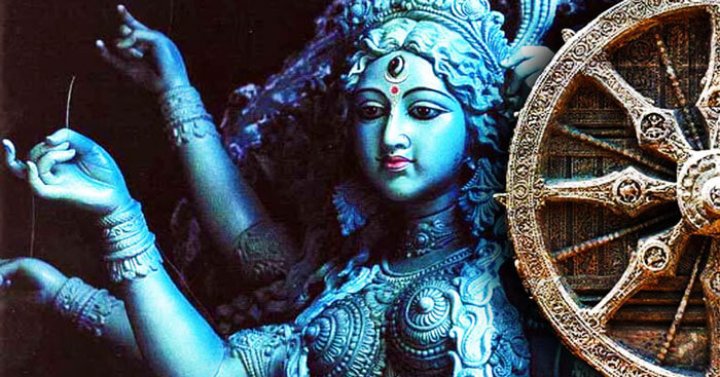
Hindu eschatology is grounded in a fundamentally cyclical understanding of time, in which creation, preservation, and destruction recur endlessly across vast cosmic ages. Unlike linear traditions that move toward a singular culmination, Hindu cosmology envisions the universe as undergoing continuous cycles known as yugas, which together form a larger cycle called a mahāyuga. This cyclical framework reflects a worldview in which time is not a straight path but a repeating pattern, governed by cosmic laws that ensure both decline and renewal. The end of the world is not an absolute termination but a transitional phase within an ongoing process of cosmic regeneration.
At the center of this cycle is the concept of the four yugas: Satya Yuga, Treta Yuga, Dvapara Yuga, and Kali Yuga. Each successive age represents a gradual decline in moral and spiritual order, known as dharma. The current age, Kali Yuga, is understood as the final and most degenerate phase, marked by moral decay, social disorder, and the erosion of truth. Texts such as the Mahabharata and various Puranas describe this age as one in which greed, violence, and ignorance prevail, signaling the nearing end of the cycle. This progressive decline establishes a framework in which the end is not sudden or arbitrary but the inevitable consequence of accumulated imbalance. The structure of the yugas also reflects a precise cosmological ordering, with each age decreasing in duration and virtue, reinforcing the sense of an ordered but deteriorating universe. This systematic decline provides a narrative rhythm to time itself, where moral and cosmic decay are intertwined, culminating in a necessary turning point that restores equilibrium.
The conclusion of Kali Yuga is marked by destruction, often depicted as both cosmic and purifying. This destruction is not merely catastrophic but necessary, serving to dissolve the corrupted order and prepare the ground for renewal. In many accounts, this process is associated with natural upheavals, including fire, flood, or other forms of dissolution that return the cosmos to a primordial state. Unlike apocalyptic traditions that emphasize final judgment, Hindu eschatology focuses less on moral reckoning at a singular moment and more on the restoration of cosmic balance through cyclical transformation. The end of one cycle becomes the beginning of another, reinforcing the continuity of existence across time.
A key figure in this process is Kalki, the tenth and final avatar of the god Vishnu, who is prophesied to appear at the end of Kali Yuga. Kalki is often depicted as a warrior riding a white horse, wielding a sword to destroy evil and restore righteousness. His role is not to judge individuals in the manner of a final tribunal, but to reestablish dharma by eliminating corruption and initiating a new Satya Yuga, or age of truth. This intervention represents the divine reassertion of order within the cyclical flow of time, ensuring that decline does not lead to permanent collapse but to renewal. The imagery associated with Kalki emphasizes both destruction and restoration, portraying him as a force that simultaneously ends an age and inaugurates another. Kalki functions not only as a divine agent but as a symbol of the inevitability of renewal embedded within cosmic decline. His appearance reinforces the principle that divine order is never permanently lost, only obscured, and that its restoration is woven into the very structure of time.
The cyclical nature of Hindu eschatology also reflects a broader metaphysical framework in which the universe itself is subject to periodic creation and dissolution, known as samsara on a cosmic scale. These cycles extend beyond human history, encompassing vast spans of time that dwarf ordinary temporal experience. Even gods participate in the rhythms of creation and destruction, underscoring the universality of these processes. The end of the world is not exceptional but intrinsic to the nature of existence, embedded within a system that continually regenerates itself.
This vision of cyclical destruction and renewal carries significant philosophical implications, shaping attitudes toward time, morality, and existence. Rather than focusing on a final resolution, Hindu eschatology emphasizes continuity and transformation, suggesting that endings are always provisional and that renewal is inevitable. This perspective encourages a different kind of ethical engagement, one that recognizes both the impermanence of the world and the enduring significance of action within it. The end becomes not a final judgment but a moment within an eternal rhythm, where destruction and creation are inseparable aspects of a larger cosmic order.
Buddhism: Impermanence, Cycles, and Maitreya
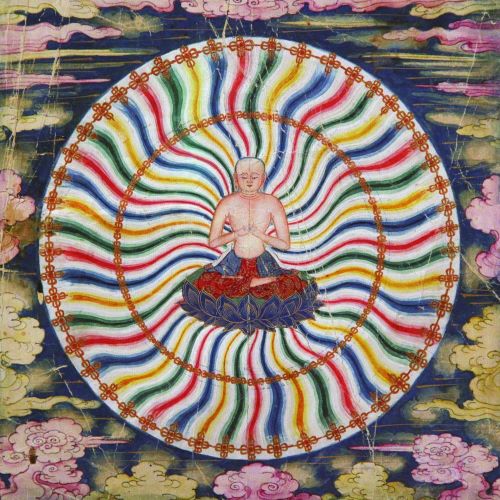
Buddhist eschatology is shaped not by a singular end of the world but by the broader doctrine of impermanence (anicca), which governs all existence. Rather than envisioning a definitive culmination of history, Buddhism situates the idea of endings within an ongoing cycle of arising and passing away. This cycle operates on both the individual level, through the process of rebirth (samsara), and the cosmic level, where entire worlds emerge, endure, and dissolve over immense periods of time known as kalpas. The end is not a final event but a recurring feature of existence, reflecting the fundamental instability of all conditioned phenomena.
Within this cyclical vision, the destruction of the world is described in various Buddhist texts as a natural and inevitable process rather than a moral reckoning imposed by a divine authority. These destructions may occur through fire, water, or other forces, depending on the phase of the cosmic cycle. Such events are not framed as punishment but as part of the inherent structure of reality, where all compounded things are subject to dissolution. This perspective reinforces the central Buddhist insight that attachment to permanence is misguided, as even the cosmos itself is transient. The emphasis is less on fearing the end and more on understanding its inevitability as a condition of existence. These cosmological dissolutions also function as illustrations of broader philosophical principles, demonstrating on a grand scale what is already true at the level of individual experience: that all phenomena arise dependent on conditions and pass away when those conditions cease. Cosmic destruction mirrors the impermanence observed in everyday life, reinforcing the universality of change across all levels of existence.
Despite this emphasis on impermanence, Buddhist traditions also articulate a forward-looking expectation in the figure of Maitreya, the future Buddha. According to canonical texts, Maitreya will appear in a distant age when the teachings of the historical Buddha, Siddhartha Gautama, have been forgotten. His role is not to judge or to destroy, but to rediscover and rearticulate the path to enlightenment, restoring the Dharma in a world that has lost its way. This expectation introduces an element of renewal within the broader cycle, suggesting that periods of decline are followed by moments of spiritual rediscovery. Maitreya’s anticipated arrival underscores the continuity of enlightenment across time, emphasizing that the truth of the Dharma is not extinguished but obscured, awaiting rediscovery under the right conditions. His role as a teacher rather than a judge reflects the broader Buddhist emphasis on knowledge and awakening as the means of liberation, distinguishing this vision sharply from traditions centered on divine intervention or final judgment.
The coming of Maitreya is often associated with a period of moral and spiritual decay, echoing patterns found in other religious traditions. As human lifespans shorten and ethical conduct deteriorates, the conditions for enlightenment become increasingly obscured. Maitreya’s appearance takes on significance, representing the reemergence of clarity and guidance. Unlike apocalyptic savior figures who bring about dramatic cosmic transformation, Maitreya’s role is pedagogical and restorative, emphasizing the transmission of knowledge rather than the imposition of judgment.
Buddhist cosmology integrates cycles of destruction with cycles of teaching and forgetting, creating a rhythm in which spiritual truth is periodically lost and recovered. This pattern reflects a broader philosophical orientation that prioritizes insight over finality, focusing on the conditions that give rise to suffering and the means by which it can be overcome. The end of a world system is less significant than the continuation of the cycle in which liberation remains possible. The emphasis remains on individual awakening rather than collective resolution. This cyclical loss and renewal of the Dharma also highlights the fragility of spiritual knowledge within historical time, suggesting that enlightenment requires continual rediscovery rather than passive inheritance. Buddhist eschatology places responsibility not on a future event but on the present capacity for understanding, reinforcing the immediacy of the path to liberation even within a world marked by decline.
Buddhist eschatology offers a distinctive approach to the idea of the end, one that avoids both the final judgment of linear traditions and the dramatic renewal of certain cyclical cosmologies. Instead, it presents a vision in which impermanence is the defining feature of existence, and where the ultimate goal is not to await the end but to transcend the cycle altogether through enlightenment (nirvana). The expectation of Maitreya provides a measure of hope, but it does not replace the central emphasis on personal transformation. The end is not something to be anticipated with fear or expectation, but something to be understood as part of the broader process from which liberation is sought.
Zoroastrianism: Cosmic Dualism and Final Renovation
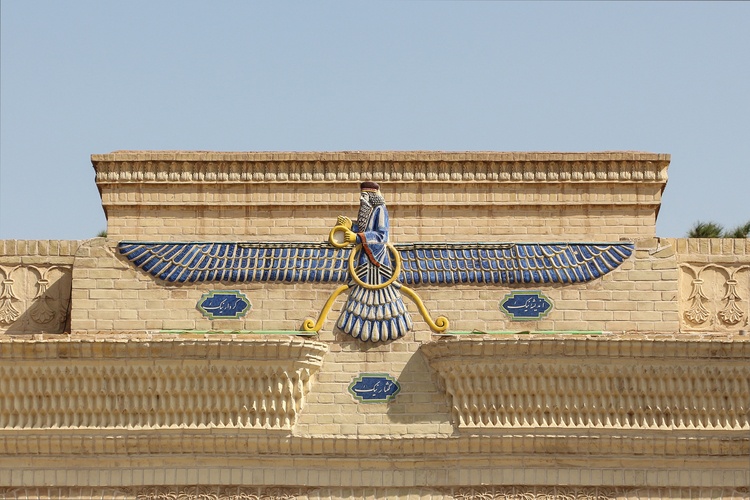
Zoroastrian eschatology presents one of the earliest and most influential visions of a cosmic struggle culminating in the ultimate triumph of good over evil. Rooted in the teachings attributed to the prophet Zarathustra (Zoroaster), this tradition is structured around a profound dualism between Ahura Mazda, the supreme god representing truth and order, and Angra Mainyu (Ahriman), the destructive force embodying chaos and falsehood. Unlike cyclical systems, Zoroastrianism advances a linear conception of time in which this cosmic conflict unfolds toward a definitive resolution. The end of the world is not a recurrence but a final victory, bringing the long-standing struggle between opposing forces to a decisive conclusion.
Central to this eschatological framework is the concept of Frashokereti, often translated as the “final renovation” or “making wonderful.” This event represents the ultimate restoration and perfection of the world, in which evil is eradicated and creation is renewed in its ideal form. Unlike traditions that emphasize destruction as an end in itself, Zoroastrian thought frames the end as a process of purification and transformation. The cosmos is not discarded but refined, restored to a state of harmony that reflects the original intention of Ahura Mazda. This vision underscores a deep optimism within Zoroastrian theology, affirming that the forces of good are not only resilient but victorious. It also reflects a sophisticated moral cosmology in which history is not cyclical or arbitrary, but directed toward a meaningful conclusion in which justice is fully realized. The process of renewal is both cosmic and ethical, aligning the structure of the universe with the moral order upheld by Ahura Mazda. Frashokereti represents not simply an end, but the fulfillment of creation’s intended purpose.
A key component of this final renovation is the role of a savior figure known as the Saoshyant, who is expected to emerge at the end of time to lead humanity through the final stages of renewal. The Saoshyant functions as both a restorer and a guide, assisting in the defeat of evil and the reestablishment of truth. This figure reflects a broader pattern within eschatological traditions, where a divinely guided individual plays a crucial role in bringing about the end. In Zoroastrianism the emphasis remains on cooperation between divine and human forces, suggesting that the final victory is not achieved through divine intervention alone but through the participation of the righteous. The Saoshyant embodies the culmination of a long process in which human beings actively align themselves with truth (asha) in opposition to falsehood (druj). His appearance signals not only the defeat of evil but the maturation of humanity’s moral responsibility, where collective action and divine purpose converge. This collaborative dimension distinguishes Zoroastrian eschatology from more strictly divine-centered models, highlighting the role of human agency within the unfolding of cosmic destiny.
The culmination of this process involves a final judgment, in which all souls are evaluated and purified. One of the most striking elements of this judgment is the imagery of a river of molten metal that flows across the earth, through which all individuals must pass. For the righteous, this experience is described as warm and purifying, while for the wicked it is painful and cleansing, removing the influence of evil. This universal purification reflects the distinctive Zoroastrian belief that even those aligned with evil are not eternally condemned but are restored. The end of the world becomes a moment of universal reconciliation, where all creation is brought into alignment with truth.
In its final vision, Zoroastrian eschatology depicts a world transformed into an eternal, incorruptible state, free from death, decay, and falsehood. Humanity exists in harmony with the divine, and the forces of evil are permanently neutralized. This culmination reflects a deeply moral universe, in which the struggle between good and evil is not endless but purposeful, moving toward a definitive and positive resolution. The concept of final renovation offers a powerful expression of hope, affirming that the imperfections of the present world are temporary and that a perfected reality awaits. Zoroastrian eschatology stands as a foundational model of linear, redemptive history, influencing later religious traditions while maintaining its own distinctive vision of cosmic renewal.
Norse Ragnarök: Catastrophe, Fate, and Renewal
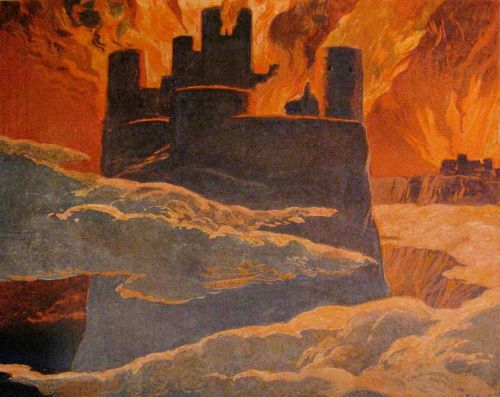
Norse mythology presents one of the most dramatic and vividly narrated visions of the end in the form of Ragnarök, a cataclysmic sequence of events that brings about the destruction of gods, giants, and the cosmos itself. Preserved primarily in the Poetic Edda and Prose Edda, these narratives describe a world destined for collapse through violence, fire, and chaos. Unlike traditions that emphasize moral judgment as the central feature of the end, Ragnarök is framed as an inevitable unfolding of fate, governed by forces that even the gods cannot escape. The end is not contingent on human behavior or divine decision, but is woven into the fabric of existence itself.
At the heart of Ragnarök lies a profound sense of inevitability, expressed through the Norse concept of fate (wyrd), which binds all beings, including the gods. Figures such as Odin and Thor are aware of the coming catastrophe, yet they continue to act with courage and determination despite knowing their ultimate defeat. This tension between knowledge and action gives Ragnarök a distinctive philosophical character, emphasizing valor and honor in the face of unavoidable destruction. The end becomes not merely a loss but a test of character, where the worth of individuals is measured by their response to fate rather than their ability to alter it. This fatalistic framework does not produce passivity but instead encourages a form of heroic resistance, where meaning is found in steadfastness rather than survival. The awareness of inevitable loss sharpens the ethical dimension of action, transforming even doomed efforts into expressions of integrity and courage.
The events leading up to Ragnarök are marked by a series of escalating crises that signal the breakdown of cosmic order. Among these is the Fimbulwinter, a prolonged and devastating winter that brings widespread suffering and social collapse. This period is followed by the release of monstrous forces, including the wolf Fenrir and the serpent Jörmungandr, who play central roles in the final conflict. The boundaries that once maintained order begin to dissolve, allowing chaos to spread across the world. These events reflect a broader theme of instability, where the structures that sustain existence gradually give way to disorder.
The climactic battle of Ragnarök brings together gods, giants, and other beings in a final confrontation that results in widespread destruction. Odin is devoured by Fenrir, Thor slays Jörmungandr but succumbs to its poison, and many other deities meet their end in violent encounters. The world itself is consumed by fire, often associated with the figure of Surtr, whose flames engulf the cosmos. This destruction is total, leaving little of the previous order intact. Yet even within this devastation, the narrative maintains a sense of continuity, suggesting that the end is not absolute but transitional. The imagery of fire and collapse underscores the fragility of even the most powerful structures, revealing that no force, divine or otherwise, is immune to the unfolding of fate. The persistence of certain figures and elements beyond the destruction introduces a subtle tension between finality and renewal, hinting that the annihilation of the old order is also the necessary precondition for the emergence of the new.
Following the destruction, Norse mythology describes a renewal of the world, in which the earth rises again from the sea, fertile and green. A small number of gods survive, and two human beings, Líf and Lífthrasir, emerge to repopulate the world. This rebirth introduces a cyclical dimension to Norse eschatology, contrasting with the linear progression of the events leading to Ragnarök. The new world is not identical to the old but represents a fresh beginning, free from the conflicts that led to the previous destruction. This element of renewal tempers the bleakness of the narrative, offering a measure of hope beyond catastrophe.
Ragnarök embodies a complex interplay between fate, destruction, and renewal, presenting a vision of the end that is both tragic and regenerative. The inevitability of destruction does not negate the value of action, but rather intensifies it, framing existence as meaningful precisely because it is finite. This perspective distinguishes Norse eschatology from traditions that emphasize ultimate justice or moral resolution, focusing instead on the dignity of endurance in the face of inevitable loss. The promise of renewal ensures that destruction is not the final word, but part of a larger pattern in which new life emerges from the remnants of the old.
Indigenous Traditions: Renewal without Finality

Indigenous eschatological traditions often resist the notion of a singular, definitive end of the world, instead emphasizing cycles of renewal, transformation, and continuity. These perspectives are deeply rooted in close relationships with the natural environment, where patterns of growth, decay, and regeneration are observed as ongoing processes rather than terminal events. Rather than framing the end as a catastrophic rupture or final judgment, many Indigenous traditions understand periods of destruction or upheaval as part of a larger rhythm of renewal. This approach reflects a worldview in which the cosmos is dynamic and interconnected, and where endings are inseparable from beginnings.
Among many Indigenous North American traditions, narratives of world renewal frequently involve moral or spiritual imbalance followed by corrective transformation. For example, in Hopi traditions, the world is said to have passed through multiple previous worlds, each destroyed due to human corruption or failure to live in harmony with spiritual laws. The transition between these worlds is not merely destructive but instructive, serving as a reminder of the consequences of imbalance and the necessity of living in accordance with sacred principles. Such narratives emphasize continuity across cycles, suggesting that humanity persists even as the world is remade.
A key feature of these traditions is the absence of a singular savior figure who resolves the end through decisive intervention. Instead, responsibility for maintaining balance often rests collectively with the community, highlighting the importance of ethical behavior, ritual practice, and environmental stewardship. The renewal of the world is not imposed from above but emerges through the restoration of harmony between human beings, the natural world, and the spiritual realm. This emphasis on relational balance distinguishes Indigenous eschatologies from traditions that center on divine judgment or cosmic battle. It also reinforces a participatory understanding of existence, in which individuals and communities are active agents in sustaining the conditions necessary for renewal. The responsibility for the future is distributed rather than centralized, embedded within daily practices and long-standing traditions that seek to preserve equilibrium across generations.
The role of the natural world is particularly significant in shaping Indigenous understandings of the end. Environmental signs, such as changes in climate, animal behavior, or ecological disruption, are often interpreted as indicators of imbalance and impending transformation. These signs do not necessarily point to a final destruction but to the need for realignment and renewal. The environment itself becomes both a participant in and a witness to the process of change, reinforcing the interconnectedness of all forms of life. The end is not external to the world but arises from within its own rhythms and relationships.
In many Indigenous traditions, time is understood as cyclical or spiral rather than linear, allowing for the coexistence of past, present, and future within a continuous flow. This conception of time supports a view of the end as recurring rather than final, where each cycle carries forward the lessons of those that came before. The emphasis is not on reaching an ultimate conclusion but on sustaining balance within an ongoing process of change. This perspective fosters resilience, as communities adapt to transformation while maintaining continuity with their cultural and spiritual foundations. It also situates human life within a broader temporal landscape in which ancestors, present generations, and future descendants are interconnected, creating a sense of responsibility that extends beyond immediate concerns. The cyclical understanding of time reinforces both continuity and accountability, ensuring that renewal is not only expected but actively cultivated.
Indigenous eschatologies offer a vision of the end that is grounded in renewal without finality, emphasizing continuity, responsibility, and balance over catastrophe and closure. The absence of a singular, climactic endpoint reflects a broader philosophical orientation in which existence is understood as an ongoing process rather than a finite narrative. By situating the end within cycles of transformation, these traditions provide a framework for understanding change as both inevitable and meaningful. They challenge more linear conceptions of eschatology and offer an alternative vision in which the end is not an ending, but a continuation of life in new forms.
Comparative Analysis: Shared Archetypes of the End
Across diverse religious traditions, eschatological narratives reveal striking structural similarities despite profound theological differences. Whether framed in linear or cyclical terms, many traditions converge on a common pattern in which the world undergoes a period of decline, followed by a decisive transformation that restores order. This recurring structure suggests the presence of shared archetypes that shape how human societies conceptualize the end. These archetypes do not eliminate the uniqueness of individual traditions, but they highlight common concerns about morality, disorder, and the possibility of renewal.
One of the most pervasive archetypal elements is the motif of moral decline preceding the end. In the Abrahamic traditions, this decline is often expressed through increasing injustice, corruption, and loss of faith, while in Hindu and Buddhist contexts it appears as the erosion of dharma or spiritual knowledge. Norse mythology similarly depicts a breakdown of social and cosmic order prior to Ragnarök, and many Indigenous traditions emphasize imbalance between human behavior and the natural world. This shared emphasis on deterioration reflects a widespread perception that the present world is unstable and that its decline signals the need for transformation. The end is not arbitrary but emerges as a response to accumulated disorder.
Another common feature is the presence of a transformative or restorative figure, often tasked with guiding the transition from disorder to renewal. This figure may take the form of a messianic leader, such as the Jewish Messiah, the Christian Christ, or the Islamic Mahdi and Isa, or appear as a divine avatar like Kalki in Hinduism. In Buddhism, Maitreya fulfills a similar role, though focused on teaching rather than judgment. Even in traditions where a singular savior is absent, such as many Indigenous cosmologies, the role of restoration is distributed across the community. These figures, whether individual or collective, embody the hope that transformation is possible and that disorder can be overcome. They also serve as focal points for collective expectation, shaping how communities interpret present conditions in light of anticipated change. These figures are not only future-oriented but also often reflective of present concerns, embodying ideals of justice, truth, and restoration that resonate within their respective cultural contexts.
The motif of a final confrontation or decisive turning point also appears across many traditions, though its expression varies significantly. In Christianity and Islam, this confrontation is often framed as a cosmic battle between good and evil, while in Zoroastrianism it takes the form of a final purification that resolves the dualistic struggle. Norse Ragnarök presents a more tragic version of this confrontation, where even the gods are subject to destruction. Hindu and Buddhist traditions tend to downplay a singular moment of conflict, emphasizing instead gradual transformation within a cyclical process. Despite these differences, the idea of a climactic transition remains a shared feature, marking the boundary between one state of existence and another.
Equally significant is the theme of renewal that follows destruction, suggesting that the end is rarely conceived as absolute. In many traditions, the world is restored, recreated, or transformed into a perfected state, whether through divine intervention or natural cycles. This renewal may take the form of a new heaven and earth, a restored age of righteousness, or the rebirth of the cosmos itself. Even in traditions that emphasize destruction, such as Norse mythology, elements of continuity persist, indicating that the end is part of a larger pattern rather than a final cessation. This recurring theme underscores a fundamental optimism embedded within many eschatological systems, where destruction serves as a precursor to regeneration. It also reveals a deeper philosophical commitment to the idea that existence is inherently ordered, even when it appears chaotic, and that this order will reassert itself. Renewal is not accidental but necessary, a structural feature of how these traditions understand the relationship between decay and restoration.
At the deepest level, these shared archetypes reflect enduring human concerns about meaning, justice, and the structure of time. Eschatological narratives provide a way of interpreting the apparent chaos of existence, offering frameworks in which suffering and disorder are ultimately resolved. Whether through divine judgment, cosmic cycles, or communal renewal, these traditions affirm that the end is not devoid of purpose. Instead, it functions as a moment of clarity, where the underlying order of the universe is revealed and restored. By examining these patterns comparatively, it becomes possible to see eschatology not merely as a set of isolated doctrines, but as a universal mode of human reflection on the nature of existence and its ultimate trajectory.
Conclusion: The End as a Mirror of Human Meaning
Eschatological traditions reveal far more than speculative visions of the future; they serve as reflections of how human societies understand meaning, morality, and the structure of existence itself. Whether expressed through linear narratives of judgment or cyclical patterns of renewal, these visions of the end are deeply rooted in present concerns, offering frameworks through which individuals and communities interpret suffering, injustice, and uncertainty. The end is not merely about what will happen, but about what matters, a symbolic horizon against which human values are defined and tested.
Across traditions, the persistence of shared themes such as moral decline, transformation, and renewal suggests that eschatology functions as a universal language for grappling with existential questions. These narratives articulate a common intuition that the current state of the world is incomplete, marked by disorder that demands resolution. Whether through divine intervention, cosmic cycles, or communal restoration, the end becomes a means of imagining a reality in which imbalance is corrected and meaning is fully realized. This convergence does not erase the distinctiveness of individual traditions, but it highlights a shared human impulse to seek coherence in the face of uncertainty.
The differences among these traditions underscore the diversity of ways in which human cultures interpret the nature of time, justice, and transformation. Linear models emphasize finality and moral reckoning, presenting the end as a decisive moment that resolves the tensions of history. Cyclical systems, by contrast, frame destruction as part of an ongoing process, where renewal follows decline in an unending rhythm. Indigenous perspectives often integrate these ideas into a relational framework that prioritizes balance and continuity over final resolution. These variations reflect not only theological differences but also broader cultural understandings of how the world operates and how human beings are situated within it. They also reveal differing assumptions about the role of human agency, whether individuals are primarily subjects of divine judgment, participants in cosmic cycles, or active stewards responsible for maintaining balance within their environments. Eschatological diversity reflects deeper philosophical orientations toward time, responsibility, and the possibility of transformation, shaping how each tradition understands both the present and the future.
Eschatology reveals as much about the present as it does about the future. The way a society imagines its end reflects its deepest anxieties, its highest hopes, and its fundamental assumptions about order and purposeThe end of the world is less a distant event than a mirror, reflecting the values and concerns that shape human experience. By examining these visions comparatively, it becomes clear that the end is not simply an ending, but a meaningful expression of how humanity understands itself, its world, and the possibility of transformation beyond the limits of the present.
Bibliography
Affiliate disclosure: Amazon links on this site are paid links. As an Amazon Associate I earn from qualifying purchases.
- Boyce, Mary. Zoroastrians: Their Religious Beliefs and Practices. London: Routledge, 1979.
- Collins, Adela Yarbro. Crisis and Catharsis: The Power of the Apocalypse. Philadelphia: Westminster Press, 1984.
- Collins, John J. The Apocalyptic Imagination: An Introduction to Jewish Apocalyptic Literature. 3rd ed. Grand Rapids, MI: Eerdmans, 1984.
- Cook, David. Studies in Muslim Apocalyptic. Princeton: Darwin Press, 2002.
- Davidson, H. R. Ellis. Gods and Myths of Northern Europe. London: Penguin Books, 1964.
- Deloria, Vine Jr. God Is Red: A Native View of Religion. 30th anniversary ed. Golden, CO: Fulcrum Publishing, 2003.
- Doniger, Wendy, trans. The Laws of Manu. London: Penguin Classics, 1991.
- Eliade, Mircea. The Myth of the Eternal Return: Cosmos and History. Princeton: Princeton University Press, 1949.
- Esposito, John L. Islam: The Straight Path. 5th ed. Oxford: Oxford University Press, 1988.
- Fixico, Donald L. The American Indian Mind in a Linear World: American Indian Studies and Traditional Knowledge. New York: Routledge, 2003.
- Flood, Gavin. An Introduction to Hinduism. Cambridge: Cambridge University Press, 1996.
- Gethin, Rupert. The Foundations of Buddhism. Oxford: Oxford University Press, 1998.
- Gill, Sam D. Native American Religions: An Introduction. Belmont, CA: Wadsworth, 1982.
- Harvey, Peter. An Introduction to Buddhism: Teachings, History, and Practices. Cambridge: Cambridge University Press, 1990.
- Hinnells, John R. Zoroastrianism. London: Penguin Books, 1981.
- Klostermaier, Klaus K. A Survey of Hinduism. 3rd ed. Albany: State University of New York Press, 2007.
- Koester, Craig R. Revelation and the End of All Things. 2nd ed. Grand Rapids, MI: Eerdmans, 2018.
- Larrington, Carolyne, trans. The Poetic Edda. Oxford: Oxford University Press, 2014.
- Lincoln, Bruce. Holy Terrors: Thinking about Religion after September 11. Chicago: University of Chicago Press, 2003.
- McGinn, Bernard. Antichrist: Two Thousand Years of the Human Fascination with Evil. New York: Columbia University Press, 1994.
- —-. Visions of the End: Apocalyptic Traditions in the Middle Ages. New York: Columbia University Press, 1979.
- Neusner, Jacob. Judaism: The Evidence of the Mishnah. Chicago: University of Chicago Press, 1981.
- O’Flaherty, Wendy Doniger, trans. Hindu Myths: A Sourcebook Translated from the Sanskrit. London: Penguin Classics, 1975.
- Pieterse, Jan Nederveen. “The History of a Metaphor: Christian Zionism and the Politics of Apocalypse.” Archives de sciences sociales des religions 36:75 (1991), 75-103.
- Rauch, Joseph. “Apocalypse in the Bible.” Journal of Jewish Lore and Philosophy 1:2 (1919), 163-195.
- Sarna, Nahum M. Exploring Exodus: The Heritage of Biblical Israel. New York: Schocken Books, 1986.
- Scholem, Gershom. The Messianic Idea in Judaism and Other Essays on Jewish Spirituality. New York: Schocken Books, 1971.
- Simek, Rudolf. Dictionary of Northern Mythology. Translated by Angela Hall. Cambridge: D. S. Brewer, 1993.
- Skjærvø, Prods Oktor. Introduction to Zoroastrianism. Cambridge, MA: Harvard University Press, 2012.
- Smart, Ninian. Dimensions of the Sacred: An Anatomy of the World’s Beliefs. Berkeley: University of California Press, 1996.
- Smith, Jane I., and Yvonne Y. Haddad. The Islamic Understanding of Death and Resurrection. Oxford: Oxford University Press, 1981.
- Snorri Sturluson. The Prose Edda. Translated by Jesse L. Byock. London: Penguin Classics, 2005.
- Strong, John S. The Buddha: A Short Biography. Oxford: Oneworld Publications, 2001.
- The Holy Bible, King James Version.
- The Qur’an. Translated by M. A. S. Abdel Haleem. Oxford: Oxford University Press, 2004.
- The Zend-Avesta. Translated by James Darmesteter. Oxford: Oxford University Press, 1880.
- Williams, Paul. Buddhist Thought: A Complete Introduction to the Indian Tradition. London: Routledge, 2000.
- Wright, N. T. The Resurrection of the Son of God. Minneapolis: Fortress Press, 2003.
Originally published by Brewminate, 04.20.2026, under the terms of a Creative Commons Attribution-NonCommercial-NoDerivatives 4.0 International license.
About the Author