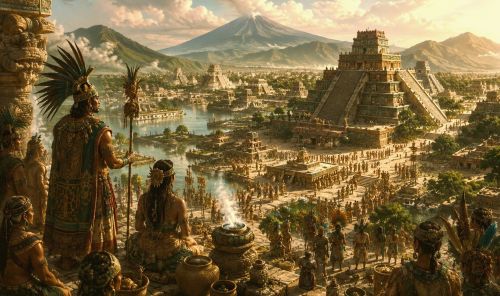
Mesoamerican patriotism emerged through sacred cities, local homelands, ancestral memory, and civic identity long before modern nationalism reshaped belonging.

By Matthew A. McIntosh
Public Historian
Brewminate
Introduction: Patriotism Before the Nation
To speak of patriotism in Mesoamerican history is to begin with a problem of language. Patriotism, in its modern sense, usually presumes a nation, a citizenry, a bounded territorial state, and a shared political identity imagined across people who will never personally know one another. That was not the world of the Olmec ceremonial centers, the Classic Maya kingdoms, the Postclassic altepetl, or the Mexica capital of Tenochtitlan. Mesoamerican peoples did not live inside nation-states, nor did they generally imagine political belonging through the later vocabulary of national sovereignty. Yet it would be equally misleading to conclude that they lacked powerful attachments to homeland, community, ancestry, ruler, deity, and sacred place. Their loyalties were not thin or incidental. They were often fierce, deeply ritualized, politically consequential, and historically durable.
The better question, then, is not whether Mesoamerica possessed nationalism before nationalism, but how its peoples understood belonging before the nation became the dominant political form. Across Mesoamerican history, identity was frequently organized around the local community, the sacred city, the ruling lineage, the patron deity, and the landscape that bound people to memory. In central Mexico, the Nahua altepetl, often translated imperfectly as “city-state,” joined water, mountain, land, ruler, temple, people, and communal obligation into a single civic-sacred unit. It was not simply a town under a chief, nor merely a territorial jurisdiction. It was a homeland made visible through ritual practice, agricultural dependence, political hierarchy, and sacred geography. Among the Maya, dynastic capitals such as Tikal, Calakmul, Palenque, Copán, and Yaxchilán cultivated local prestige through inscriptions, monuments, warfare, ritual, and royal genealogy. In both worlds, pride in place was not an abstraction. It was built in stone, sung in ritual, recorded in painted books, marked in tribute, and defended in war. These communities remembered themselves through origin stories and sacred obligations, but also through rivalry. A city’s honor could be sharpened by its enemies, its defeats, its victories, and its claims to antiquity. Local identity was not passive belonging. It was performed, contested, inherited, and renewed across generations.
I use “patriotism” as an analytical bridge rather than a literal equivalence. The term helps illuminate forms of attachment that were recognizably communal and political, even when they were not national. Mesoamerican patriotism was local before it was national, sacred before it was secular, and corporate before it was individualist. A person’s deepest political obligations were often directed not toward a broad ethnic nation, but toward a city, neighborhood, lineage, ruler, temple, or god. Empires could expand over these local loyalties, but they rarely erased them. The Mexica-led Triple Alliance demanded tribute and obedience from conquered communities, yet many subject polities retained their own rulers, landholding structures, ritual identities, and local histories. Imperial rule could command compliance, but it did not automatically produce emotional unity.
The chronological movement here follows that transformation from sacred locality to imperial ideology and then to colonial memory. Early Mesoamerican ceremonial centers established the pattern of place as sacred authority. Maya city-states turned dynastic rivalry into local glory. Central Mexican altepetl made homeland into a political and ritual community. Mexica Tenochtitlan converted local pride into imperial destiny, while subject peoples and rivals such as Tlaxcala defended their own autonomy against that expanding order. After the Spanish conquest, indigenous communities continued to preserve local identity through land claims, municipal institutions, native-language records, Christianized sacred geography, and communal memory. By the eighteenth century, Creole patriotism in New Spain reworked these older inheritances into a broader colonial pride that embraced ancient Mexico, sacred landscape, and the Virgin of Guadalupe as signs of a distinct American patria. Before Mexico became a nation, it had already been many homelands.
Sacred Centers and Collective Identity in Early Mesoamerica
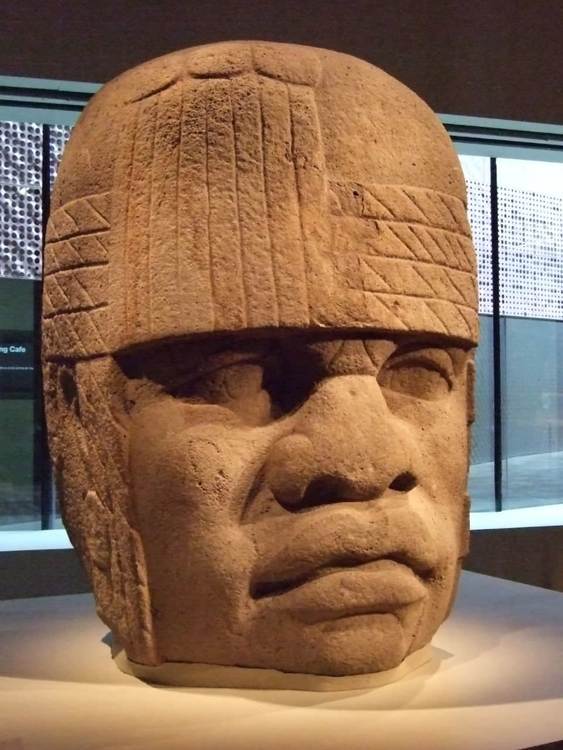
The earliest durable forms of Mesoamerican collective identity did not emerge from nations, borders, or ethnic unity in the modern sense. They emerged around sacred centers, ritual landscapes, elite authority, and the repeated public acts through which communities learned to see themselves as participants in a shared world. In the Formative period, especially among the societies conventionally grouped under the term Olmec, monumental centers such as San Lorenzo, La Venta, and Tres Zapotes reveal a political imagination already organized around place, ceremony, and visible expressions of power. These were not “patriotic” communities in the later civic or national sense, but they established one of the basic patterns that would endure throughout Mesoamerican history: belonging was anchored in a charged landscape where ritual, rulership, fertility, ancestry, and collective labor converged.
San Lorenzo, flourishing especially in the second millennium BCE, demonstrates how early political communities could bind people through monumental space. Its enormous basalt heads, carefully arranged platforms, water-control features, and sculptural programs suggest a society in which authority was made material and local identity was performed through construction. The colossal heads are not simple portraits in the modern sense, nor should they be reduced to isolated works of art. They were public statements of power, memory, and presence, likely connected to rulers or elite figures whose authority was tied to the community’s ritual center. To live within the orbit of such a place was to inhabit more than a settlement. It was to participate in a political and sacred order made visible by stone, earth, water, and ceremony.
La Venta expanded this pattern in ways that reveal the importance of sacred geography. Its ceremonial layout, offerings, buried mosaics, monumental sculpture, and pyramid-like earthen architecture suggest a center designed not only for residence or administration, but for cosmological performance. Early Mesoamerican communities repeatedly linked power to mountains, caves, water, fertility, and the vertical axis connecting the human world to divine or ancestral forces. La Venta’s built environment gave these ideas physical form, arranging sacred space in ways that made cosmic order tangible. Its massive earthen pyramid evoked the sacred mountain, while buried offerings and carefully placed greenstone mosaics suggest ritual acts meant to bind the community to forces beneath, above, and around the human world. The center was not simply a stage on which authority appeared. It was itself an active sacred landscape, a place where rulership, fertility, memory, and divine presence were fused. The community’s identity was not merely social or economic. It was spatial and ritual. People belonged because they gathered, labored, witnessed, offered, remembered, and recognized the center as a place where human life met sacred order. Through repeated ceremony, the community learned its place in the cosmos by returning to the same charged spaces, seeing the same monuments, and participating in the same symbolic geography.
This matters for the history of patriotism because early Mesoamerican belonging was already local, embodied, and emotionally charged, even if it was not yet civic in the later altepetl or city-state sense. The sacred center gathered people into a shared identity by giving them a common orientation in space. Rituals, monuments, feasts, offerings, and elite performances created a public language of membership. Those who participated in these acts did not need an abstract doctrine of nationhood to understand that their community had a special place in the world. Their attachment was likely to the center itself, to its ruling figures, to its gods or supernatural forces, to its surrounding lands, and to the obligations that tied households and lineages to a larger ceremonial order.
The Olmec case also cautions against imagining early Mesoamerican identity as static or uniform. “Olmec” is a modern scholarly category, not necessarily the name by which these peoples understood themselves. The societies associated with San Lorenzo, La Venta, and related centers were diverse, regionally varied, and historically changing. Yet the widespread influence of Olmec-style iconography, ritual objects, and elite symbolism shows that local identities could exist within broader cultural horizons. Communities might borrow, adapt, and recognize shared religious forms without becoming a single people or political unit. That layered pattern would reappear again and again in Mesoamerican history: local pride and wider cultural participation were not opposites. A community could be intensely rooted in its own sacred center while also participating in a larger symbolic world.
By the end of the Formative period, Mesoamerica had already developed several foundations for later forms of local patriotism: monumental centers, sacred landscapes, ruling lineages, public ritual, inherited memory, and the linking of political power to cosmic order. Later Maya dynastic cities, central Mexican altepetl, Mixtec lordships, and Mexica Tenochtitlan would develop these patterns in more elaborate and historically visible ways. But the underlying logic was already present in early Mesoamerica. Collective identity began not with the nation, but with the place where people gathered to make the world meaningful. The sacred center was homeland before homeland became a political abstraction.
Maya City-States: Dynastic Loyalty, Rivalry, and Local Glory

By the Classic period, especially from roughly 250 to 900 CE, Mesoamerican local identity becomes far more visible through the political worlds of the Maya lowlands. The Maya did not form a single empire or nation. They shared related languages, religious concepts, artistic conventions, calendrical systems, and elite traditions, but political life was organized through a landscape of competing kingdoms centered on cities such as Tikal, Calakmul, Palenque, Copán, Yaxchilán, Naranjo, Caracol, and many others. These cities were not simply population centers. They were dynastic stages, ritual capitals, ancestral repositories, and claims upon sacred time. Their rulers presented themselves not as administrators of a neutral territory, but as divine or semi-divine lords whose authority tied the community to gods, ancestors, warfare, sacrifice, and cosmic order. The city was not a passive container for political life. It was the visible body of local sovereignty, where plazas, temples, palaces, causeways, inscriptions, and royal tombs worked together to make belonging legible. Maya people may have recognized broader cultural affinities, but the most concrete political identity was often attached to the court and city that ordered their ritual calendar, claimed their labor, staged their ceremonies, and represented their place in the sacred history of the world.
Maya local patriotism, if the term is used carefully, was dynastic and civic rather than national. A city’s identity was inseparable from its ruling house, its emblem glyph, its sacred history, and its monumental memory. Kings and queens commissioned stelae, lintels, altars, stairways, temples, and painted programs that did more than record events. They taught the community how to remember itself. Accession rituals, period-ending ceremonies, military victories, captive displays, royal births, marriages, deaths, and ancestor veneration became part of a public archive carved into stone and arranged in civic space. To walk through such a city was to encounter a political theology of belonging. The city told its inhabitants and visitors who ruled, who had ruled before, whom the gods favored, and why this place mattered.
Rivalry sharpened this local identity. The Classic Maya world was filled with alliances, betrayals, dynastic marriages, hostage-taking, ritual combat, and warfare among cities whose prestige depended partly on the humiliation of rivals. Tikal and Calakmul became the most famous antagonists, but they were not alone. Secondary kingdoms and allied courts also participated in the wider struggle for status, security, and influence. A victory over an enemy ruler was not merely a military achievement. It elevated the victorious city’s sacred standing and exposed the defeated city’s vulnerability before gods and neighbors. Captives displayed in art and inscriptions were political symbols as much as human beings, because they embodied the transfer of honor from one polity to another. Lyalty to one’s city was intensified by the existence of other cities that claimed rival greatness.
This rivalry also reveals why Maya identity cannot be reduced to ethnicity or language. A noble court at Palenque, Tikal, or Yaxchilán could participate in a shared Maya cultural system while remaining fiercely committed to its own dynastic story. The shared world made competition possible because cities understood the symbolic language through which prestige was claimed. They used related calendars, royal titles, ritual forms, and artistic conventions, but they used them locally. Each polity placed itself at the center of sacred history. Each ruler claimed to renew cosmic order through ceremonies performed in a particular place. Maya civilization was not a single political body, but a competitive field of local worlds. The unity was civilizational; the loyalty was civic, dynastic, and sacred.
Royal women also played an important role in this political landscape, especially through marriage diplomacy, regency, ritual performance, and dynastic legitimacy. Their presence reminds us that local glory was not constructed by kings alone. Queens and noblewomen could bind courts together through alliance, transmit legitimacy across generations, and appear in public imagery as ritual actors. In some cities, women occupied positions of exceptional political visibility, especially when dynastic continuity required female authority or when royal marriages connected local courts to more powerful regional networks. At Palenque, for example, royal women were essential to dynastic continuity during moments of political vulnerability, while at Yaxchilán, carved lintels presented elite women as participants in bloodletting and visionary ritual, not merely as passive consorts. Their bodies, marriages, offspring, and ritual performances could make political continuity visible. This mattered for civic identity because dynasty was not simply a line of male rulers. It was a sacred household whose continuity gave the city historical depth. To honor the dynasty was to honor the city’s place in time. Through queens, mothers, wives, daughters, and ritual partners, Maya cities extended their claims across generations and across political boundaries, making family history inseparable from local memory.
The Classic Maya city-state offers one of the clearest early examples of homeland feeling before the nation. Its patriotism was not based on citizenship in a modern state, but on attachment to a local sacred polity whose honor lived in rulers, monuments, gods, ancestors, and remembered victories. A Maya city was a place of residence, but it was also a moral and cosmic claim. It said that this lineage mattered, this temple mattered, this plaza mattered, this history mattered. Later Mesoamerican societies would organize belonging through different institutions, including the central Mexican altepetl and the Mexica imperial capital of Tenochtitlan, but the Maya case already shows the deeper pattern. Before nationalism, there was the city that remembered itself in stone.
Teotihuacan, Tollan, and the Prestige of Ancestral Cities
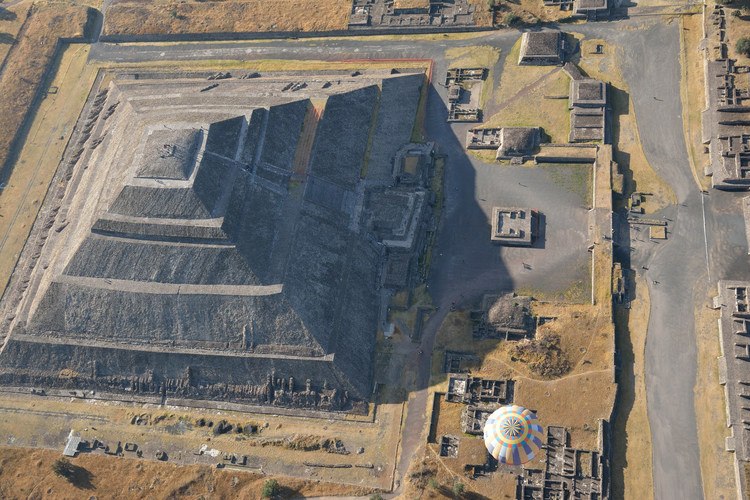
Between the Classic Maya city-states and the later Postclassic world of central Mexican altepetl, two great ancestral cities occupied an especially powerful place in Mesoamerican historical imagination: Teotihuacan and Tollan. Teotihuacan flourished centuries before the Mexica rise, reaching its height in the first half of the first millennium CE, while Tollan, associated archaeologically with Tula and culturally with the Toltec tradition, became a later model of prestigious rulership, artistry, order, and political legitimacy. Neither city functioned as a “nation” in the modern sense, yet both became more than cities. They became memories of civilization itself. Later peoples looked backward to them not simply as ruins or former capitals, but as sources of sacred authority, ancestral prestige, and political inheritance. Their significance lay partly in the fact that they allowed later communities to imagine themselves as heirs to something older, grander, and more authoritative than their immediate political circumstances. In a world where legitimacy often depended on origin, descent, divine favor, and remembered precedent, ancestral cities could serve as reservoirs of meaning. Teotihuacan and Tollan were not only places in the landscape. They were historical instruments through which later peoples made claims about who they were, where they came from, and why their own cities deserved honor.
Teotihuacan’s scale alone made it difficult for later Mesoamerican societies to ignore. Its monumental Avenue of the Dead, Pyramid of the Sun, Pyramid of the Moon, Ciudadela, apartment compounds, mural programs, and carefully planned urban grid created one of the most imposing urban landscapes in the ancient Americas. The city’s identity was not expressed through royal portraiture in the same way as the Classic Maya courts, and its political structure remains debated, but its built environment projected order with extraordinary force. The city made power collective, spatial, and cosmic. Its architecture organized movement, ritual, hierarchy, and spectacle. To inhabit or visit Teotihuacan was to encounter a city that seemed to place human society within a sacred geometry of mountains, avenues, temples, and celestial orientation.
Teotihuacan also projected influence far beyond its immediate valley. Its artistic styles, military symbols, ritual imagery, obsidian networks, and possible political interventions appeared in distant regions, including parts of the Maya world. The nature of that influence remains debated, and scholars rightly resist reducing it to a simple model of empire everywhere Teotihuacan-style imagery appears. Yet the city clearly became a civilizational reference point. It demonstrated that a place could become prestigious not only because people lived there, but because its forms traveled. Its imagery, objects, and urban model could be adopted, adapted, and reinterpreted by communities far from the Basin of Mexico. In that sense, Teotihuacan complicates the idea of local patriotism: it was intensely tied to place, but its prestige became translocal, allowing later peoples to claim connection to its power without belonging to it politically.
Tollan, or Tula, operated differently but with equal importance for later memory. By the Postclassic period, the Toltec past became a language of legitimacy. The term “Toltec” came to evoke refinement, skill, rulership, sacred knowledge, and ancestral greatness. Later Nahua traditions remembered Tollan as a place of abundance, artistry, political order, and religious significance, even when those memories blended history, mythology, and retrospective idealization. This blending should not be dismissed as mere error. It reveals how ancestral cities functioned in political imagination. A community did not need to possess a modern archival history of Tollan to use Tollan as a claim upon prestige. To associate oneself with the Toltec inheritance was to participate in a revered past that could authorize present authority.
The prestige of ancestral cities added a historical layer to Mesoamerican belonging. Local identity was not only rooted in immediate residence, land, and patron deity. It could also be strengthened by claims of descent from, imitation of, or symbolic connection to earlier centers of greatness. This mattered deeply for later central Mexican peoples, including the Mexica, who entered a landscape already crowded with powerful memories. Their rise did not occur in an empty historical field. Teotihuacan and Tollan stood behind them as monumental and legendary precedents. To become great in central Mexico was partly to speak the language of earlier greatness: sacred city, ordered space, ancestral authority, martial power, ritual knowledge, and civilizational inheritance. Such memories could be politically useful precisely because they were larger than any single community’s immediate past. They allowed ambitious cities to borrow the aura of antiquity, to present new power as restored order, and to frame local ascent as participation in a sacred historical sequence. The Mexica did not invent the prestige of urban greatness from nothing. They inherited a landscape where ruins, stories, names, and sacred associations already taught that political authority was strongest when it could claim continuity with ancient centers. Memory itself became a resource of rule, and ancestral cities became part of the grammar through which later communities expressed local pride.
This is important because it shows that Mesoamerican “homeland” feeling was not only immediate and local, but also retrospective. Communities could locate themselves in time as well as space. They could imagine their own identity through a remembered chain of cities, migrations, ruins, founders, and sacred predecessors. Before the nation, there was not only the city one defended, but also the ancestral city one remembered, claimed, feared, revered, or imitated. Teotihuacan and Tollan gave later Mesoamerican peoples a usable past. They helped transform local belonging into historical belonging, making memory itself one of the foundations of political identity.
The Altepetl: Homeland, Water-Mountain, and Civic Belonging in Central Mexico
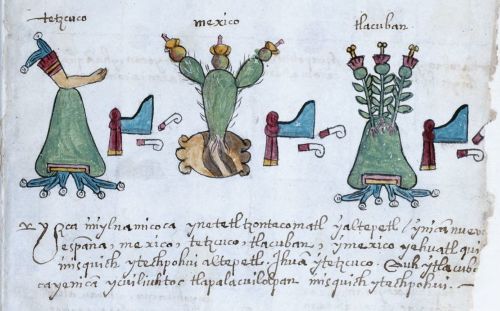
In central Mexico, the most important political and emotional container of belonging was the altepetl, a Nahuatl term often translated as “city-state,” though the translation is only partly adequate. Literally associated with “water” and “mountain,” the term joined ecological, sacred, political, and communal meanings into a single concept. An altepetl was not merely a town, a territory, or a government. It was a people rooted in land, organized around a ruler, attached to a patron deity, sustained by water and agriculture, and bound together through tribute, ritual, neighborhood divisions, and inherited memory. If modern patriotism imagines attachment to a nation, the altepetl suggests an older and more localized form of patria: the homeland as a sacred civic body.
This concept matters because it reveals how deeply local political identity remained in Postclassic central Mexico. People did not usually experience political belonging first as membership in a broad ethnic or imperial category. They belonged to a particular altepetl, with its own name, ruling dynasty, lands, temples, markets, obligations, and history. Even when communities shared the Nahuatl language or participated in wider central Mexican religious and political traditions, their most immediate loyalties were often local. The altepetl gave identity a place. It was where people farmed, worshiped, paid tribute, entered marriage networks, joined collective labor, and recognized the authority of rulers and nobles. Its boundaries were not only geographical. They were social, ritual, legal, and emotional. A person’s place in the altepetl could shape access to land, obligations to labor, participation in ceremony, and relationship to local authority. It could also determine how people understood the past, because local histories, migration memories, dynastic claims, and sacred narratives gave each altepetl its own personality. One community might trace prestige through ancient descent, another through alliance, conquest, ritual distinction, or the possession of a revered temple. In that sense, the altepetl was not just where people lived. It was the framework through which they knew who they were.
The symbolism of “water-mountain” expresses this fusion with unusual force. Water evoked agricultural life, fertility, irrigation, sustenance, and settlement, while mountain evoked sacred presence, origin, protection, and the connection between human communities and divine or ancestral powers. Together, they described a world in which political order could not be separated from landscape. The altepetl was not an abstract jurisdiction imposed upon passive land. It was a living civic ecology, a community imagined through the resources and sacred forms that made life possible. Central Mexican belonging was literally grounded. Homeland was not only where one was governed, but where one’s water flowed, crops grew, gods resided, ancestors were remembered, and collective obligations were renewed.
Within the altepetl, smaller corporate groups, often discussed under the term calpolli or calpulli, helped organize daily life and local membership. These units could be associated with neighborhoods, kin groups, landholding communities, occupational identities, or ritual obligations, depending on place and period. They remind us that local patriotism was layered. A person might simultaneously feel attachment to household, calpolli, altepetl, ethnic tradition, patron deity, and regional alliance. These loyalties did not necessarily cancel one another. Rather, they formed a nested structure of belonging. The altepetl stood as the larger civic frame within which smaller communal identities could function, compete, and cooperate.
The altepetl also explains why empire in central Mexico did not necessarily dissolve local autonomy. When powerful polities such as Tenochtitlan expanded, they generally ruled through existing local structures rather than replacing every community with direct centralized administration. Subject altepetl might owe tribute, military service, political submission, or ritual recognition to an imperial power, but many retained their own dynasties, local officials, lands, temples, markets, and internal hierarchies. This pattern made imperial expansion possible, because conquerors could extract wealth without rebuilding every conquered society from the ground up. Yet it also preserved the very local identities that made empire unstable. A subject community could obey while remembering itself as something separate.
For the history of patriotism before the nation, the altepetl is indispensable. It shows that homeland in central Mexico was civic without being national, territorial without being modern, sacred without being merely religious, and political without being bureaucratic in the later state sense. Loyalty attached to a place where land, water, deity, ruler, memory, and obligation converged. This was the world the Mexica entered, used, and eventually dominated, but never fully erased. Tenochtitlan itself was an altepetl before it was an imperial capital. Its later claims to cosmic and military supremacy grew from the same local grammar of belonging that shaped its neighbors and rivals. That point is crucial, because Mexica imperial ideology did not float above the older political landscape. It grew out of it, intensified it, and redirected it toward a more expansive project of domination. The same categories that made a local homeland meaningful could also be enlarged into claims about sacred centrality, tribute, warfare, and regional supremacy. Yet even at the height of Mexica power, the altepetl remained a stubborn fact of political life. Communities could be conquered, taxed, and disciplined, but they were not easily dissolved into a single imperial people. Before central Mexico could imagine empire, it imagined the water-mountain.
Mexica Identity Before Empire: Migration, Election, and the Making of Tenochtitlan
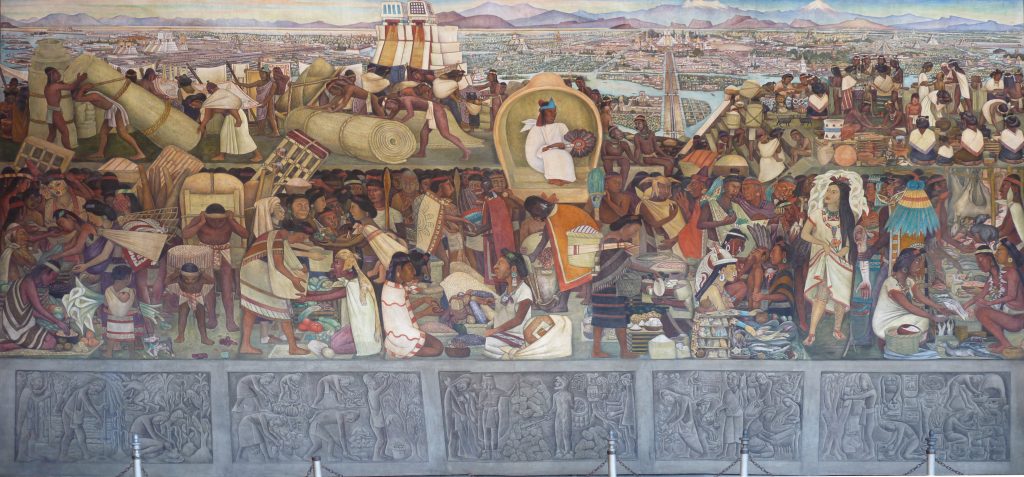
Before the Mexica became imperial rulers, they remembered themselves as migrants, outsiders, dependents, and chosen people. Their later greatness was built upon stories of movement, hardship, humiliation, divine guidance, and eventual settlement in the Basin of Mexico. These narratives cannot be read simply as straightforward chronicles, because they blend history, sacred memory, political legitimation, and retrospective explanation. Yet their significance lies precisely in that blending. They told the Mexica who they were supposed to be. Long before Tenochtitlan became the dominant power of central Mexico, Mexica identity was shaped by the memory of not yet belonging, of wandering through a landscape already occupied by older and more prestigious peoples, and of waiting for the sign that would transform exile into destiny.
The migration tradition from Aztlan and the guidance of Huitzilopochtli gave Mexica identity a sacred trajectory. The Mexica did not imagine their origins merely as geographic movement from one place to another. They remembered migration as election, discipline, and separation. Huitzilopochtli was not simply one deity among others in this account. He was the divine force who directed movement, demanded obedience, and marked the Mexica as a people with a special future. The very instability of the migration story mattered. A people without a settled homeland could turn displacement into proof of chosenness. Their suffering was not only weakness. It became preparation. Their marginality could be remembered as the condition through which divine favor would eventually be revealed.
This remembered outsider status also shaped the meaning of Tenochtitlan itself. The foundation of the city on an island in Lake Texcoco, traditionally associated with the sign of the eagle on the cactus, converted a marginal and difficult environment into sacred center. The place was not obvious imperial territory when the Mexica first occupied it. It had to be made meaningful. Through labor, chinampa agriculture, temple building, military service, and political maneuvering, the Mexica transformed watery settlement into civic identity. Tenochtitlan became more than a refuge. It became proof that their god had chosen well, that hardship could become splendor, and that a people once treated as subordinate could build a city worthy of fear, admiration, and tribute. Its island setting mattered because it made the city both vulnerable and powerful: enclosed by water, dependent on engineering, and yet capable of becoming a controlled sacred landscape. Causeways, canals, fields, temples, and marketplaces turned the lake itself into part of the city’s identity. The Mexica did not merely settle in a place; they remade that place until it became inseparable from their own story. The city’s very difficulty became evidence of destiny. What might have looked like marginal land became, through labor and ritual imagination, the center from which a once-dependent people could claim a new place in the world.
The making of Tenochtitlan also required negotiation with the older political order of the Basin of Mexico. The Mexica entered a world of established altepetl, noble lineages, regional rivalries, marriage politics, and inherited claims to Toltec prestige. Their rise depended not only on divine ideology but on practical adaptation. They served stronger powers, formed alliances, married into prestigious houses, learned the political language of the region, and gradually positioned themselves within a landscape where legitimacy had to be recognized as well as asserted. This is important because Mexica identity was not born fully imperial. It developed through dependence before dominance. Their later ideology of supremacy concealed, but did not erase, the earlier reality that Tenochtitlan had to earn, borrow, and construct legitimacy in a crowded political world. The Mexica could not simply announce themselves as chosen and expect others to accept the claim. They had to acquire titles, relationships, military reputations, ritual standing, and dynastic connections that made their city intelligible within central Mexican political culture. Their own homeland identity was shaped by both defiance and imitation. They distinguished themselves through Huitzilopochtli and their migration story, but they also sought recognition through older forms of prestige associated with Culhuacan, Tollan, noble descent, and regional diplomacy. Tenochtitlan’s rise was not a rejection of the altepetl world. It was an ambitious entry into it, followed by an effort to master its language of legitimacy.
That process gave Mexica local patriotism a distinctive emotional force. Tenochtitlan was not simply one more altepetl. In Mexica memory, it was the place where migration ended, divine command became urban form, and humiliation was reversed. Loyalty to the city could be imagined as loyalty to a sacred story. Its temples, canals, markets, causeways, palaces, and ceremonial precinct were not only features of urban life. They were material signs of collective transformation. The city embodied the people’s passage from wandering to rootedness, from dependency to sovereignty, from obscurity to centrality. This helps explain why later Mexica imperial ideology would invest Tenochtitlan with such cosmic weight. The city’s power rested not only on military success, but on a narrative of destiny fulfilled in place.
Mexica identity before empire belongs at the heart of any history of patriotism before the nation. It shows how local attachment could be formed through migration memory as much as through ancient rootedness. Unlike communities that claimed legitimacy through long occupation or ancestral prestige, the Mexica fashioned belonging out of arrival, struggle, and divine election. Their patria was made, not merely inherited. Tenochtitlan became homeland because story, ritual, labor, and power converged there. Before the Mexica could demand tribute from others, they first had to imagine themselves as a people worthy of a city. Before Tenochtitlan became an imperial capital, it was the answer to a wandering people’s question: where has our god brought us, and what are we now meant to become?
The Triple Alliance and Imperial Loyalty: Tenochtitlan, Texcoco, and Tlacopan
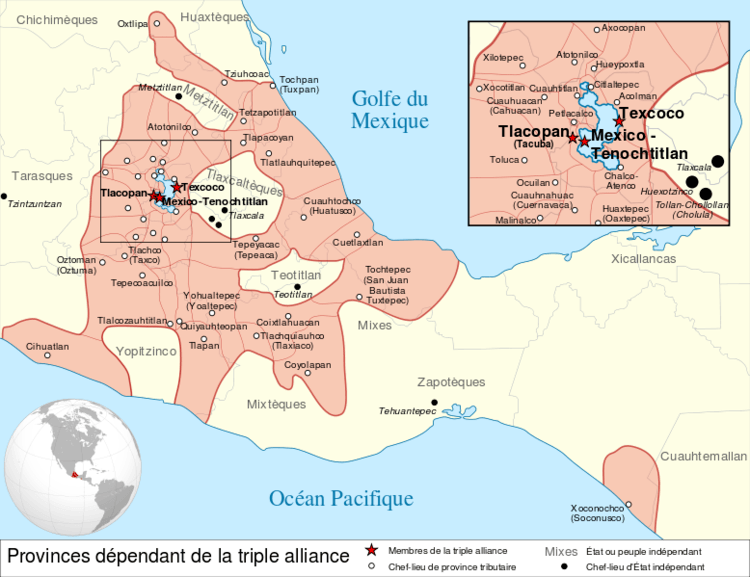
The Mexica rise to imperial power did not begin as solitary conquest. It emerged from the political reordering of the Basin of Mexico after the defeat of Azcapotzalco and the formation of the Triple Alliance among Tenochtitlan, Texcoco, and Tlacopan in the fifteenth century. This alliance created the political structure that later observers often call the Aztec Empire, though the term can obscure as much as it reveals. The empire was not a centralized nation-state governed by a uniform bureaucracy. It was an expanding system of tribute, military coercion, dynastic negotiation, commercial advantage, and sacred prestige, anchored by three allied altepetl but increasingly dominated by Tenochtitlan. Imperial power did not erase the older grammar of local belonging. It enlarged it, weaponized it, and subordinated many local communities to a new regional order.
Each member of the Triple Alliance brought a distinct political identity to the imperial project. Tenochtitlan supplied growing military force, ideological ambition, and eventually the strongest claim to imperial leadership. Texcoco, associated especially with the Acolhua tradition and later remembered through figures such as Nezahualcoyotl, carried its own prestige as a center of law, poetry, dynastic authority, and elite refinement. Tlacopan was the junior partner, receiving a smaller share of tribute, but its participation mattered because the alliance’s legitimacy depended on more than brute Mexica expansion. It presented conquest as a collective political arrangement among recognized powers of the Basin of Mexico. That arrangement gave imperial growth a structure others could understand, even if subject peoples experienced it as domination. It also reveals that imperial power in central Mexico did not emerge from a single civic identity suddenly expanding outward. It was assembled through older rivalries, negotiated status, inherited prestige, and the practical need to make conquest appear legitimate within a world of altepetl. Tenochtitlan may have become the dominant partner, but its supremacy was initially framed through alliance rather than simple unilateral rule. This gave Mexica ambition a political form that could draw upon the authority of Texcoco and Tlacopan while gradually concentrating power in the hands of Tenochtitlan’s rulers.
Imperial loyalty within this system was layered and often conditional. Conquered altepetl were usually not absorbed into a single imperial citizenry. Instead, they were expected to pay tribute, provide goods or services, accept political subordination, and avoid rebellion. Many retained their local rulers, noble houses, temples, markets, landholding patterns, and internal identities. This was not accidental leniency. It was a practical method of imperial rule. The Triple Alliance could expand rapidly because it did not need to administer every conquered community directly. It could demand cloth, maize, cacao, feathers, warriors’ costumes, precious goods, labor, and obedience while leaving much of local life formally intact. The result was a system in which imperial power depended on the survival of the very local communities it dominated.
That arrangement created a sharp difference between compliance and identification. A subject altepetl might be loyal in the sense that it paid tribute, sent representatives, obeyed demands, or refrained from revolt. But that did not mean its people imagined themselves as part of one common Aztec homeland. Their primary attachment could remain local, dynastic, ethnic, or regional. Some elites benefited from imperial connections, gaining access to prestige goods, political protection, trade opportunities, or confirmation of authority. Others experienced imperial rule as extraction, humiliation, and threat. The empire produced loyalty as a political behavior more reliably than loyalty as an emotional identity. It could command public submission without generating a unified patriotic consciousness across its subject world. This distinction is vital because it prevents the tribute empire from being mistaken for a nation in embryo. The Triple Alliance could create obligations, hierarchies, and dependencies, but it did not necessarily create shared belonging. Its subjects could participate in imperial ceremonies, send tribute to the capitals, and acknowledge Mexica supremacy while still remembering their own local histories and guarding their own communal dignity. Loyalty was frequently less a declaration of love than a calculation of survival, advantage, or temporary necessity.
The Triple Alliance is essential because it shows how Mesoamerican imperialism grew out of local patriotisms rather than replacing them. Tenochtitlan, Texcoco, and Tlacopan each remained altepetl with their own histories and identities, even as they acted together as conquerors. Subject communities likewise remained attached to their own local worlds while navigating the demands of empire. The imperial system created a hierarchy of homelands: the victorious capitals at the top, tributary communities below, and resistant rivals outside or at the edges. Tenochtitlan’s later ideological claims would try to present Mexica power as cosmic necessity, but the political reality remained more unstable and negotiated. The empire was powerful because it mastered the altepetl world. It was vulnerable because it never dissolved it.
Tlacaelel, Huitzilopochtli, and the Ideology of Mexica Greatness
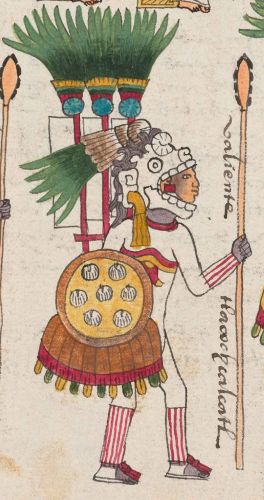
If the Triple Alliance created the political framework of empire, Mexica ideology gave that empire a sacred language of destiny. Later historical traditions give particular prominence to Tlacaelel, the powerful counselor and statesman associated with the reigns of several fifteenth-century Mexica rulers. He appears in colonial accounts as a kind of architect of Mexica greatness, a figure who helped elevate Huitzilopochtli, reorganize historical memory, and sharpen Tenochtitlan’s sense of imperial mission. This portrait must be handled carefully. Tlacaelel’s remembered role was shaped by later Nahua and colonial narratives, and scholars have long debated how much individual agency should be assigned to him. Yet even if the tradition magnified his personal responsibility, it preserves something historically important: Mexica power came to depend not only on armies and tribute, but on a persuasive story about why Tenochtitlan deserved supremacy.
At the center of that story stood Huitzilopochtli, the Mexica patron deity whose guidance had already shaped migration memory and the foundation of Tenochtitlan. Under imperial conditions, his meaning expanded. He was no longer only the god who led a wandering people to their chosen city. He became the divine sponsor of conquest, sacrifice, tribute, and cosmic maintenance. Mexica political theology placed warfare within a sacred order, linking military expansion to the nourishment of the sun and the preservation of the world. This did not mean that every act of conquest was experienced by everyone as pure religious devotion. It means that the ruling elite could frame domination as obligation, violence as service, and imperial growth as the fulfillment of divine command. The patriotism of Tenochtitlan became inseparable from the service of Huitzilopochtli.
This ideological transformation also required control over memory. Mexica historical traditions suggest that the past itself could be revised, arranged, or emphasized in ways that served present power. Stories of migration, suffering, election, alliance, and victory did not merely explain the rise of Tenochtitlan after the fact. They taught Mexica nobles and commoners how to understand their city’s place in history. A people once marginal could be remembered as chosen; a difficult island settlement could become the center of the world; conquest could be presented as sacred necessity rather than ordinary ambition. Political memory became a form of civic education. It gave Tenochtitlan a usable past, one that fused humiliation and triumph into a single narrative of destined greatness.
The ideology associated with Tlacaelel and Huitzilopochtli represents a major intensification of local patriotism. Earlier forms of altepetl loyalty attached people to land, ruler, temple, water, mountain, and communal obligation. Mexica imperial ideology took that local grammar and magnified it into a claim of cosmic centrality. Tenochtitlan was not merely one homeland among others. It was presented as the city through which divine order was defended. Its temples, especially the Templo Mayor, embodied this claim in stone, ritual, and spectacle. The paired shrines to Huitzilopochtli and Tlaloc joined war, rain, fertility, conquest, and sustenance at the symbolic heart of the capital, making the city’s ceremonial center a compressed image of the world Mexica power claimed to maintain. Tribute from conquered communities did not simply enrich the capital; it dramatized the subordination of many local worlds to one sacred center. When goods, captives, warriors’ costumes, precious feathers, cacao, textiles, and other materials flowed into Tenochtitlan, they made visible the idea that the city stood at the summit of a divinely charged hierarchy. This was not patriotism as attachment to equal citizens under a shared national flag. It was patriotism as sacred supremacy: the conviction that one city’s destiny carried cosmic weight and that service to that city was service to the order of existence itself. The Mexica homeland, once imagined through migration and settlement, was now imagined as the axis around which conquered peoples, tribute routes, ritual calendars, and divine obligations revolved.
Yet this ideology had limits, and those limits are crucial. The Mexica elite could proclaim Tenochtitlan’s sacred destiny, but subject peoples did not necessarily share that emotional universe. For them, Huitzilopochtli’s greatness might appear less as cosmic truth than as the religious face of tribute extraction and military domination. Even within the Mexica world, imperial ideology was not simply spontaneous popular feeling. It was cultivated through ritual, education, monumentality, historical narration, and political discipline. That makes it powerful, but not universal. Tlacaelel’s importance, whether understood as personal achievement or symbolic memory, lies in what his tradition reveals about empire itself: Tenochtitlan needed more than victory. It needed a story that turned local pride into sacred supremacy. Before nationalism, this was one of Mesoamerica’s most ambitious forms of patriotic imagination.
Patriotism and Autonomy: Subject Peoples, Tribute, and Resistance
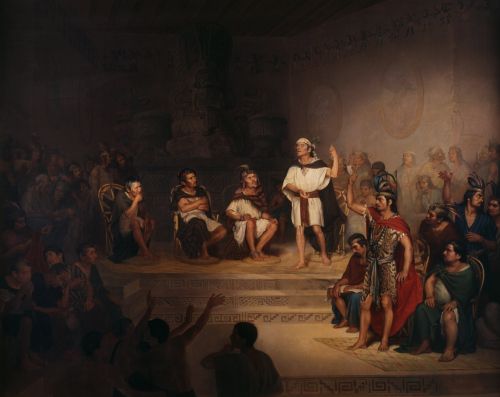
The Mexica imperial system reveals most clearly that loyalty and patriotism were not the same thing. Subject peoples could obey Tenochtitlan, send tribute, receive imperial officials, and participate in the political routines of domination without surrendering their own local identities. The Triple Alliance did not usually transform conquered altepetl into emotionally integrated members of a single imperial people. It created a hierarchy of obligation. Communities were expected to recognize superiority, provide goods, accept defeat, and avoid rebellion. Yet beneath that public compliance, they could continue to remember themselves through their own rulers, lands, gods, markets, histories, and communal interests. Imperial loyalty was often a posture required by power; local patriotism remained the deeper inheritance.
Tribute made this distinction visible. The goods that flowed into Tenochtitlan from subject provinces were not merely economic resources. They were signs of submission, reminders of conquest, and instruments of imperial theater. Cotton garments, cacao, maize, feathers, jaguar skins, warrior costumes, precious stones, rubber, paper, and luxury items all helped sustain the capital’s grandeur. They also carried political meaning because they marked the relationship between center and periphery. For the Mexica elite, tribute demonstrated the rightful ordering of the world under Tenochtitlan’s dominance. Tribute lists and imperial records turned conquered communities into visible contributors to the capital’s splendor, making the empire appear as a system in which distant lands naturally supplied the sacred center. For subject communities, tribute could be remembered as burden, humiliation, or the price of survival. The same object could signify imperial glory in the capital and local loss in the community that produced it. A feathered costume displayed in Tenochtitlan could proclaim victory and sacred hierarchy, while the labor required to produce it elsewhere could reinforce resentment, fear, or pragmatic resignation. Tribute converted local productivity into imperial symbolism, but it did not necessarily convert local feeling into imperial belonging.
This does not mean that all subject peoples experienced empire in the same way. Some local elites benefited from incorporation into the imperial order. Conquest could confirm their status, connect them to wider trade networks, protect them against regional enemies, or allow them to preserve authority under Mexica supervision. Others may have treated submission as a practical accommodation, preferable to destruction or repeated warfare. Loyalty was not necessarily false, but it was conditional and situational. A subject altepetl might cooperate because cooperation served its interests, not because it had ceased to value its own autonomy. The empire was sustained by a constantly shifting mixture of fear, advantage, calculation, prestige, resentment, and necessity.
Resistance shows the other side of this local patriotism. Tlaxcala is the most famous example, not because it stood outside all central Mexican political culture, but because it defended its autonomy against Mexica power with unusual persistence. Tlaxcalan identity was sharpened by rivalry with Tenochtitlan, by military pressure, and by the refusal to become another tributary community within the imperial system. The so-called “flower wars” and the long hostility between Tlaxcala and the Mexica should be understood not merely as ritualized violence or imperial strategy, but also as a political relationship that hardened local self-understanding. Tlaxcala’s independence gave its people a story about themselves: they were not simply unconquered, but a community whose dignity depended on remaining outside Mexica tribute. Its later alliance with Hernán Cortés and the Spaniards cannot be understood as simple betrayal of a Mexican nation that did not yet exist. Tlaxcala was not choosing foreigners over “Mexico” in the modern sense. It was acting as an altepetl and regional power pursuing survival, vengeance, advantage, and political independence in a world of dangerous rivals. Its decision was local, strategic, and rooted in its own patriotism. The fact that this choice later became morally and nationally charged in Mexican memory should not obscure the sixteenth-century reality: Tlaxcalans acted from within their own political world, not from inside a future nationalist framework.
Other communities also navigated Mexica power through strategies that complicate any simple picture of imperial unity. Some rebelled after conquest. Some shifted loyalties when opportunities appeared. Some offered cooperation to one powerful neighbor against another. Some preserved local traditions while outwardly accepting imperial demands. These patterns were not signs of political immaturity. They were the normal logic of a world in which sovereignty was plural, negotiated, and uneven. Local communities were not waiting to become part of a future nation. They were defending the terms under which they could continue to exist. Their patriotism lay in protecting land, rulers, sacred obligations, honor, and corporate memory, even when open resistance was impossible. A community might bend publicly while preserving inward distinction, or participate in imperial structures while quietly maintaining its own account of the past. Local identity could survive precisely because it did not always require open rebellion. It could endure in landholding, ritual practice, noble genealogy, market life, tribute negotiation, and the memory of former autonomy. Such persistence made subject peoples more than passive victims of empire. They were political actors operating under constraint, using compliance, delay, alliance, resistance, and memory as tools of survival.
For this reason, the fall of Tenochtitlan in the sixteenth century cannot be explained only by Spanish arms, disease, or technological advantage, though all mattered greatly. It also depended on the political fractures created by empire itself. The Triple Alliance had mastered the altepetl world without dissolving it, which meant that enemies, subjects, and rivals remained available as actors with their own agendas. When the Spaniards entered central Mexico, they encountered not a unified Aztec nation, but a political landscape full of local memories, resentments, ambitions, and fears. The patriotism of subject peoples did not look like modern nationalism, but it was powerful enough to shape the fate of an empire. Tenochtitlan could command tribute from many communities. It could not make all of them love its supremacy.
The Spanish Conquest and the Survival of Local Homeland

The Spanish conquest shattered the Mexica imperial center, but it did not erase the local worlds from which Mesoamerican political life had long been made. The fall of Tenochtitlan in 1521 ended the supremacy of the Triple Alliance, opened central Mexico to Spanish colonial rule, and reorganized power through monarchy, church, encomienda, tribute, labor demands, and municipal institutions. Yet beneath that enormous rupture, the altepetl persisted. Indigenous communities continued to understand themselves through land, lineage, neighborhood, ruler, saint, temple, memory, and obligation. The conquest destroyed an empire, but it did not dissolve the local homeland. In many places, Spanish rule had to operate through the very communities it sought to subordinate.
This continuity was not simple survival untouched by change. The altepetl became entangled with Spanish categories of government, especially the cabildo, the Indian republic, parish organization, tribute registers, and colonial law. Indigenous nobles often adapted to the new order by presenting themselves as legitimate local authorities under Christian monarchy, while commoners continued to pursue access to land, water, labor rights, and communal protections. Old political languages were translated into new legal and religious forms. A pre-Hispanic community could become a colonial pueblo; a patron deity might be replaced or overlaid by a patron saint; a temple-centered civic order might be reorganized around a church and town council. Yet the emotional and corporate core remained recognizable. People still belonged locally before they belonged imperially. They still defended the place that gave them identity.
Colonial documentation makes this persistence visible. Native-language annals, land records, wills, petitions, maps, títulos primordiales, and municipal records show communities working to preserve memory as a legal resource. To defend land in colonial court, a community often had to narrate its past, name its boundaries, identify its founders, describe its obligations, and prove its standing within the Spanish imperial order. Memory became evidence. Origin stories, genealogies, ancient possession, and sacred geography were recast into arguments legible to colonial authorities. This was not merely antiquarian nostalgia. It was practical patriotism. Communities preserved the past because survival depended on it. The homeland had to be remembered to be defended. A map could become a political weapon; a genealogy could become proof of rightful authority; an old boundary marker could become testimony against encroachment; a story of foundation could become a claim to land, water, and dignity. Indigenous writers and local officials learned to use alphabetic writing, pictorial tradition, Spanish legal formulas, and native-language testimony to make their communities visible within colonial systems that often threatened to dispossess them. The result was a new kind of historical labor. Communities did not simply inherit memory. They produced, curated, translated, and defended it before judges, friars, royal officials, neighboring towns, and rival claimants. Local homeland survived partly because people learned how to make the colonial archive speak in its favor.
Christianity altered this local identity, but it did not simply replace it. Saints, confraternities, feast days, churches, crosses, and processions became new ways of organizing communal belonging. The sacred geography of the altepetl did not vanish so much as shift into colonial religious forms. A town’s patron saint could become a focus of local pride, just as earlier divine patrons had marked communal identity. Church festivals gathered people into visible acts of belonging, while parishes and cofradías helped structure obligation, hierarchy, and participation. This Christianized local patriotism could be both deeply sincere and thoroughly indigenous. Conversion did not require the disappearance of place-based identity. It often gave local communities new symbols with which to defend old attachments.
The conquest also changed the scale of political imagination. Indigenous communities now had to define themselves within a much larger imperial world governed from Spain, administered through New Spain, and justified through Catholic monarchy. Yet this wider imperial frame did not create a single colonial identity that superseded local belonging. Instead, it produced layered identities. A person could be a Christian, a subject of the Spanish king, a resident of New Spain, a Nahua or Mixtec speaker, a member of a barrio or calpolli, and above all a person of a particular pueblo. Local attachment remained the most immediate and durable form of political identity. This is why colonial communities could petition the Crown, sue neighboring towns, negotiate with friars, resist Spanish officials, and preserve their own historical traditions without imagining themselves as modern national subjects.
The Spanish conquest marks not the end of Mesoamerican local patriotism, but one of its most important transformations. Before conquest, communities defended homeland through war, tribute negotiation, ritual, dynastic memory, and alliance. After conquest, they defended it through litigation, municipal office, Christian ceremony, native-language writing, land maps, and appeals to royal justice. The tools changed, but the underlying attachment to place endured. In that endurance lies one of the strongest continuities between pre-Hispanic and colonial Mesoamerica. The nation had not yet arrived, and the Mexica Empire had fallen, but local homelands remained. They survived because people kept naming them, mapping them, praying for them, working their lands, remembering their founders, and insisting that conquest had not erased who they were.
Creole Patriotism: New Spain, Antiquity, and the Indigenous Past
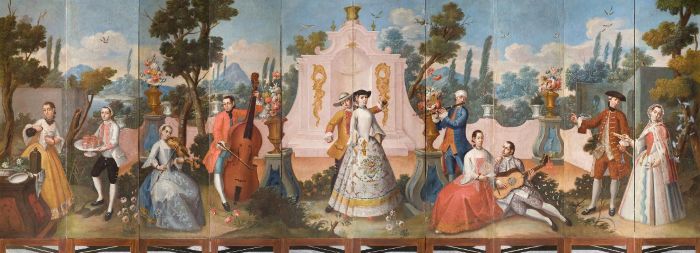
By the seventeenth and eighteenth centuries, the language of homeland in New Spain had begun to shift again. Indigenous communities continued to defend local pueblos, lands, saints, and memories, but another form of patria was emerging among criollos, people of Spanish descent born in the Americas. Creole patriotism did not yet equal modern Mexican nationalism, nor was it a democratic doctrine of popular sovereignty. It was a colonial form of pride, shaped by birthplace, rivalry with peninsular Spaniards, religious devotion, antiquarian curiosity, and resentment toward European assumptions that the Americas were inferior, immature, or culturally dependent. For Creole writers, New Spain was not simply a distant possession of the Spanish monarchy. It was their homeland, a land with its own antiquity, sacred history, natural abundance, intellectual life, and providential meaning. This was a significant transformation in the history of belonging because patria now began to operate at a scale larger than the town or altepetl while still retaining the emotional intimacy of birthplace. Creoles could speak as loyal subjects of the king and still insist that American soil had produced a distinct historical community. Their pride was not yet revolutionary in a simple sense, but it was increasingly defensive, self-conscious, and argumentative. It answered Europe’s condescension by claiming that New Spain had depth, dignity, and sacred importance of its own.
This Creole patriotism developed within empire rather than outside it. Many Creoles remained loyal to the Spanish Crown and Catholic monarchy, but they increasingly argued that American-born Spaniards possessed a dignity and historical inheritance that peninsular Spaniards failed to recognize. The word patria could still refer to a local birthplace, a city, a region, or the larger land of New Spain, rather than to a sovereign nation-state. Yet its emotional range widened. Creoles could identify with Mexico City, Puebla, or other local communities while also imagining New Spain as a distinct American world. Their patriotism was layered, much like earlier Mesoamerican identity, but now filtered through colonial hierarchy, Catholic universalism, imperial bureaucracy, and Atlantic intellectual debate. They did not reject Spain in every case, but they increasingly refused to see themselves as lesser Spaniards merely because they were born across the ocean.
The indigenous past became central to this argument. Ancient Mexico offered Creole intellectuals something Europe could not easily dismiss: depth. The ruins, pictorial histories, dynastic memories, calendars, monuments, and accounts of pre-Hispanic civilization allowed Creole writers to claim that New Spain possessed an antiquity comparable to the celebrated ancient worlds of Europe and the Mediterranean. This did not mean that Creole admiration for the Indigenous past translated into equality for living Indigenous people. Often it did not. Creole patriotism could praise ancient Mexica grandeur while maintaining colonial social hierarchies, tribute structures, racial distinctions, and paternalist assumptions about contemporary Indigenous communities. The ancient Indian could be exalted as ancestor, symbol, or antiquarian subject, while the living Indian remained marginalized within colonial society. That contradiction was not incidental. It was one of the defining tensions of Creole historical imagination.
Writers and antiquarians helped turn ancient Mexico into a usable past. Carlos de Sigüenza y Góngora, Fernando de Alva Ixtlilxochitl, Francisco Javier Clavijero, and Antonio de León y Gama, among others, contributed in different ways to the preservation, interpretation, and elevation of pre-Hispanic history. Their works did not all say the same thing, and they wrote under different circumstances, but together they helped make the Indigenous past available as a foundation for colonial pride. Sigüenza y Góngora’s use of Indigenous antiquity in political and ceremonial writing showed how pre-Hispanic memory could be placed in the service of Creole claims about virtue, antiquity, and local distinction. Alva Ixtlilxochitl, writing from within a world of Indigenous nobility and colonial translation, preserved histories that linked pre-Hispanic dynasties to post-conquest claims of status and legitimacy. Clavijero, writing from exile after the expulsion of the Jesuits, defended the intellectual and moral capacity of Indigenous peoples against European critics and presented ancient Mexico as a civilization worthy of serious historical respect. Gama’s study of the great Mexica stones found in Mexico City at the end of the eighteenth century likewise treated pre-Hispanic monuments not as curiosities, but as evidence of sophisticated knowledge and historical dignity. Through such work, antiquity became patriotic evidence. Ancient Mexico could now be cited, described, measured, translated, and defended as part of New Spain’s claim to historical seriousness. The past became a kind of archive of pride.
This transformation matters because it expanded the scale of homeland beyond the altepetl and the pueblo without fully replacing them. Earlier Mesoamerican local patriotism had attached identity to city, water-mountain, dynasty, patron deity, and sacred landscape. Creole patriotism reassembled some of those older materials into a broader colonial consciousness. Ancient Tenochtitlan, once the sacred capital of Mexica imperial power, could now be remembered as part of the antiquity of New Spain. Indigenous histories once rooted in particular altepetl became evidence for the dignity of the American land as a whole. The past was no longer only local memory or communal legal defense. It became a civilizational argument. New Spain could be imagined as a patria because it had a history older than conquest, a sacred landscape marked by divine favor, and a learned elite capable of narrating both to the world.
Yet Creole patriotism remained unstable and morally complicated. It could challenge European contempt while preserving colonial inequality. It could honor ancient Mexico while distancing itself from living Indigenous society. It could celebrate New Spain as a homeland while remaining formally loyal to Spanish monarchy. Its importance lies in this unfinished quality. It did not create Mexican nationalism by itself, but it supplied later nationalism with symbols, arguments, wounds, and memories. By claiming ancient Mexico as part of their own patria, Creole writers helped move homeland from local attachment toward historical consciousness on a larger scale. The nation had not yet arrived, but one of its future languages was being prepared: a language in which the land, its antiquity, its sacred signs, and its Indigenous past could be gathered into a shared story of belonging.
Guadalupe and the Sacred Homeland

The cult of the Virgin of Guadalupe gave Creole patriotism one of its most powerful sacred forms. If ancient Mexico supplied New Spain with antiquity, Guadalupe supplied it with divine favor. Her image, shrine, apparition narrative, and association with Tepeyac allowed colonial writers, clergy, and devotees to imagine the American land as chosen, protected, and spiritually meaningful in its own right. This did not simply create nationalism, nor did it erase older local devotions. Rather, Guadalupe helped join locality, sanctity, and patria into a broader religious imagination. A specific hill, image, and story became signs that New Spain was not merely a colonial extension of Spain, but a sacred homeland marked by providential distinction.
The importance of Tepeyac lay partly in its ability to gather layered meanings. It was a local shrine, but not only local. It was associated with an Indigenous visionary, Juan Diego, yet increasingly embraced by Creole clergy and intellectuals as evidence of New Spain’s spiritual election. It stood near Mexico City, the colonial capital built over the conquered Mexica world, and occupied a landscape already charged with memories of conquest, sacred geography, and political transformation. Guadalupe’s power came from this layering. She could be venerated as mother, intercessor, miracle, image, and sign of place. The American-born faithful could look to her and see not merely a universal Catholic devotion, but a sacred presence rooted in their own soil. The land itself seemed to have received a divine mark.
For Creole patriots, Guadalupe answered a deep colonial anxiety. If peninsular Spaniards claimed proximity to Europe, monarchy, and older Catholic centers, Creoles could claim that heaven had chosen New Spain directly. The apparition tradition made American sacred history independent of European approval. It placed divine revelation in the New World, before an Indigenous witness, through an image that came to be treated as miraculous and uniquely Mexican. This mattered because Creole patriotism was always partly defensive. It sought proof that New Spain was not inferior, derivative, or spiritually peripheral. Guadalupe provided that proof in devotional form. Her cult made homeland visible, not through political sovereignty, but through sacred intimacy. New Spain belonged to its people because it had been visited, marked, and loved by the Virgin.
Guadalupe also complicated the relationship between Creole identity and the Indigenous past. Unlike antiquarian admiration for ancient Mexico, the Guadalupan tradition placed an Indigenous figure within the sacred foundation of colonial patria. Juan Diego’s role gave the story a powerful claim to American rootedness, even when Creole and clerical interpreters shaped the devotion in ways that served their own purposes. The figure of the humble Indigenous visionary could symbolize divine favor toward the land while leaving colonial inequalities largely intact. As with Creole uses of pre-Hispanic antiquity, sacred inclusion did not necessarily produce social equality. Yet the symbolic consequences were enormous. Guadalupe made it possible to imagine a homeland in which Indigenous memory, Catholic devotion, colonial city, and American sacred geography could be gathered into one image. She was not simply a religious icon. She became a way of thinking about belonging.
By the late colonial period, Guadalupe had become one of the most flexible and enduring symbols in New Spain’s political and religious life. She could serve local devotion, Creole pride, ecclesiastical authority, communal identity, and eventually insurgent nationalism. Her later use in the independence movement did not exhaust her meaning, but it revealed how deeply she had entered the language of patria. In the long history of patriotism before the nation, Guadalupe marks a decisive shift: homeland was no longer only the altepetl, the pueblo, the ancestral city, or the imperial capital. It could now be imagined as a sacred land under a shared maternal sign. Before Mexico became a nation, Guadalupe helped make it emotionally imaginable as a holy homeland.
From Local Patriotism to Mexican National Memory
The following video from “History Time” covers the history of the Maya:
The movement from Mesoamerican local patriotism to Mexican national memory was not a straight line from ancient identity to modern nationhood. It was a long process of selection, reinterpretation, and symbolic reassembly. The altepetl, the Maya city-state, Mexica Tenochtitlan, Tlaxcalan autonomy, colonial pueblos, Creole antiquarianism, and the cult of Guadalupe did not naturally merge into one political consciousness. They belonged to different historical worlds and different scales of belonging. Yet later Mexican nationalism drew upon all of them. It transformed local homelands, sacred geographies, imperial ruins, Indigenous antiquity, Catholic devotion, and colonial grievances into a broader story of national origin. What had once been city, dynasty, god, land, pueblo, and patria became the raw material of “Mexico.”
This transformation required both memory and forgetting. National narratives elevated certain symbols while muting others. Tenochtitlan could be remembered as the magnificent Indigenous foundation of Mexico City, while the Mexica Empire’s domination of other peoples was often softened or absorbed into a broader story of pre-Hispanic grandeur. Tlaxcala could be condemned in later nationalist memory for alliance with the Spaniards, even though its sixteenth-century choices were rooted in local autonomy rather than betrayal of a nation that did not yet exist. Guadalupe could become a mother of the Mexican people, even though her earlier meanings were local, devotional, Creole, Indigenous, ecclesiastical, and colonial before they were national. The making of national memory did not simply preserve the past. It reorganized the past into a moral and political narrative suited to a later community.
Independence sharpened this reorganization. The crisis of Spanish monarchy, the insurgency beginning in 1810, and the eventual creation of an independent Mexico gave older symbols new political force. Miguel Hidalgo’s use of Guadalupe as an insurgent banner revealed how a sacred image rooted in colonial devotion could become a sign of collective mobilization. Creole patriotism, long expressed within monarchy, could now be redirected toward sovereignty. Indigenous antiquity, long used to defend the dignity of New Spain against European contempt, could be folded into the ancestry of a new nation. Yet the new national framework did not erase older inequalities. Indigenous communities continued to defend local lands and rights, often against liberal reforms and state-building projects that invoked the nation while weakening corporate protections. National memory could praise the Indigenous past while pressuring living Indigenous peoples to fit new models of citizenship, property, and cultural unity.
The nineteenth century intensified the symbolic work of turning Mesoamerican history into national heritage. Antiquities, codices, ruins, museums, public monuments, school histories, and political rhetoric helped construct a usable ancient past. The nation could present itself as heir to the grandeur of Anahuac, the drama of conquest, the sanctity of Guadalupe, and the struggle for independence. This did not mean all Mexicans understood that inheritance in the same way. Conservatives, liberals, clerics, secular intellectuals, regional elites, Indigenous communities, and later revolutionaries drew different lessons from the past. Some emphasized Catholic providence; others celebrated republican sovereignty, Indigenous antiquity, or mestizo synthesis. But across these differences, one pattern persisted: the nation repeatedly reached backward to older forms of belonging to authorize itself. Ancient cities, sacred images, and local memories became national symbols because they carried emotional weight older than the state itself. The museum case, the schoolbook narrative, the patriotic ceremony, and the public monument all performed the same kind of transformation: they moved objects and memories out of their older local, dynastic, ritual, or colonial settings and placed them inside a national frame. A Mexica stone sculpture, a Maya ruin, a Guadalupan image, or a colonial insurgent banner could become evidence that Mexico possessed historical depth, suffering, sacred legitimacy, and cultural grandeur. Yet that very process simplified the past. It made diverse Indigenous civilizations speak as ancestors of a single nation, even when those civilizations had never imagined themselves that way. National memory gained power by gathering fragments into unity, but it also created new tensions by turning plural histories into a shared inheritance that not everyone experienced equally.
The history traced here ends not with the disappearance of local patriotism, but with its partial absorption into Mexican national memory. The nation did not invent belonging from nothing. It inherited many homelands and rearranged them into a larger imagined community. Some of those older loyalties survived within the nation; others were appropriated, simplified, or overwritten. The result was powerful but unstable. Mexican national identity could draw strength from the depth of Mesoamerican and colonial memory, but it also carried unresolved tensions between ancient admiration and modern inequality, sacred unity and regional difference, national pride and local autonomy. Before Mexico could be imagined as one patria, it had been many: water-mountains, city-states, imperial capitals, resistant republics, colonial pueblos, sacred hills, and remembered ruins. National memory did not replace them entirely. It learned to speak through them.
Conclusion: The Homeland Before the Nation
Patriotism in Mesoamerican history must be understood as a problem of scale, language, and historical translation. The peoples of ancient and colonial Mesoamerica did not possess nationalism in the modern sense, nor did they imagine political belonging through the categories of the sovereign nation-state. Yet they possessed powerful forms of attachment that deserve to be taken seriously on their own terms. They loved, defended, remembered, and ritualized particular places. They honored cities, rulers, ancestors, gods, saints, dynasties, lands, waters, mountains, and founding stories. Their world was not empty of patriotism simply because it was not national. It was filled with homelands before the nation became the dominant language of belonging. To recognize that fact is not to project modern nationalism backward onto societies that organized identity differently. It is to admit that the emotional and political life of homeland has a deeper history than the modern state. Mesoamerican belonging was often more immediate, more sacred, and more locally embodied than nationalism, but it was not weaker for that reason. It was precisely the intimacy of city, land, deity, and memory that oftenmade these attachments so durable.
The long history traced here shows that Mesoamerican homeland feeling was never static. In the Formative period, sacred centers such as San Lorenzo and La Venta gathered communities through ritual space, monumental labor, and cosmological order. Classic Maya city-states transformed dynastic memory, royal spectacle, rivalry, and monumental inscription into local glory. Teotihuacan and Tollan became ancestral cities whose prestige later peoples could claim, imitate, and reinterpret. The central Mexican altepetl joined water, mountain, deity, land, ruler, and people into a civic-sacred body. Mexica Tenochtitlan then intensified that local grammar into imperial ideology, presenting one city’s destiny as a cosmic necessity while subject peoples continued to guard their own local identities beneath tribute and coercion.
The Spanish conquest did not end this pattern. It shattered the Mexica imperial center, but it did not erase local homeland. Indigenous communities adapted older forms of belonging to colonial conditions, defending land, memory, saints, municipal rights, genealogies, and corporate dignity through litigation, maps, native-language records, and Christian ceremony. Later, Creole patriotism expanded patria beyond the pueblo and altepetl, claiming New Spain as a land with antiquity, sacred favor, and historical dignity. Guadalupe then gave that larger homeland a devotional form, making the American land visible as a sacred place under a shared maternal sign. By the time Mexican nationalism emerged, it did not invent belonging from nothing. It inherited older attachments, rearranged them, simplified them, and gave them a new political frame.
The homeland before the nation was plural. It was the Maya city remembering itself in stone. It was the Nahua water-mountain binding land and people. It was Tenochtitlan rising from migration memory into imperial splendor. It was Tlaxcala defending autonomy against domination. It was the colonial pueblo preserving its boundaries in court. It was Tepeyac becoming a sacred sign of American belonging. It was ancient Mexico transformed into national ancestry. Before Mexico became one patria, it was many homelands, each with its own gods, wounds, claims, memories, and obligations. The nation did not erase those older worlds completely. It learned to speak through them, and they continued to echo beneath the modern language of Mexican identity.
Bibliography
Affiliate disclosure: Amazon links on this site are paid links. As an Amazon Associate I earn from qualifying purchases.
- Alberto, Lourdes. “Nations, Nationalisms, and Indígenas.” Critical Ethnic Studies 2:1 (2016), 107-127.
- Alva Ixtlilxochitl, Fernando de. History of the Chichimeca Nation. Translated and edited by Amber Brian, Bradley Benton, Pablo García Loaeza, and Peter B. Villella. Norman: University of Oklahoma Press, 2019.
- Alvarado Tezozómoc, Hernando. Crónica Mexicana. Edited by Jose M. Vigil. Mexico City: Editorial Porrúa, 1878.
- Anderson, Benedict. Imagined Communities: Reflections on the Origin and Spread of Nationalism. Revised ed. London: Verso, 1983.
- Berdan, Frances F. The Aztecs of Central Mexico: An Imperial Society. 2nd ed. Belmont, CA: Wadsworth, 2004.
- Berdan, Frances F., and Patricia Rieff Anawalt. The Codex Mendoza. 4 vols. Berkeley: University of California Press, 1992.
- Berdan, Frances F., Richard E. Blanton, Elizabeth Hill Boone, Mary G. Hodge, Michael E. Smith, and Emily Umberger. Aztec Imperial Strategies. Washington, DC: Dumbarton Oaks Research Library and Collection, 1996.
- Boone, Elizabeth Hill. Stories in Red and Black: Pictorial Histories of the Aztecs and Mixtecs. Austin: University of Texas Press, 2000.
- Brading, D. A. The First America: The Spanish Monarchy, Creole Patriots, and the Liberal State, 1492–1867. Cambridge: Cambridge University Press, 1991.
- —-. Mexican Phoenix: Our Lady of Guadalupe: Image and Tradition Across Five Centuries. Cambridge: Cambridge University Press, 2001.
- Brumfiel, Elizabeth M. “Huitzilopochtli’s Conquest: Aztec Ideology in the Archaeological Record.” Cambridge Archaeological Journal 8:1 (1998), 3–13.
- Burkhart, Louise M. Before Guadalupe: The Virgin Mary in Early Colonial Nahuatl Literature. Albany: University at Albany, Institute for Mesoamerican Studies, 2001.
- Cañizares-Esguerra, Jorge. How to Write the History of the New World: Histories, Epistemologies, and Identities in the Eighteenth-Century Atlantic World. Stanford: Stanford University Press, 2001.
- Carrasco, David. City of Sacrifice: The Aztec Empire and the Role of Violence in Civilization. Boston: Beacon Press, 1999.
- —-. Religions of Mesoamerica: Cosmovision and Ceremonial Centers. 2nd ed. Long Grove, IL: Waveland Press, 2014.
- Carrasco, David, Lindsay Jones, and Scott Sessions, eds. Mesoamerica’s Classic Heritage: From Teotihuacan to the Aztecs. Boulder: University Press of Colorado, 2002.
- Carrasco, Pedro. The Tenochca Empire of Ancient Mexico: The Triple Alliance of Tenochtitlan, Tetzcoco, and Tlacopan. Norman: University of Oklahoma Press, 1999.
- Chimalpahin Quauhtlehuanitzin, Domingo. Codex Chimalpahin: Society and Politics in Mexico Tenochtitlan, Tlatelolco, Texcoco, Culhuacan, and Other Nahua Altepetl in Central Mexico. Edited and translated by Arthur J. O. Anderson and Susan Schroeder. 2 vols. Norman: University of Oklahoma Press, 1997.
- Clark, John E. “The Arts of Government in Early Mesoamerica.” Annual Review of Anthropology 26 (1997), 211-234.
- Clavijero, Francisco Javier. The History of Mexico. Translated by Charles Cullen. 2 vols. London: G. G. J. and J. Robinson, 1787.
- Clendinnen, Inga. Aztecs: An Interpretation. Cambridge: Cambridge University Press, 1991.
- —-. “The Cost of Courage in Aztec Society.” Past & Present 107 (1985), 44-89.
- Coe, Michael D. and Richard A. Diehl. In the Land of the Olmec. 2 vols. Austin: University of Texas Press, 1980.
- Coe, Michael D. and Stephen Houston. The Maya. 10th ed. London: Thames & Hudson, 2022.
- Cortés, Hernán. Letters from Mexico. Translated by Anthony Pagden. New Haven: Yale University Press, 1986.
- Cowgill, George L. Ancient Teotihuacan: Early Urbanism in Central Mexico. Cambridge: Cambridge University Press, 2015.
- Davies, Nigel. The Toltecs: Until the Fall of Tula. Norman: University of Oklahoma Press, 1977.
- Díaz del Castillo, Bernal. The True History of the Conquest of New Spain. Translated by Alfred Percival Maudslay. London: The Hakluyt Society, 1910.
- Diehl, Richard A. The Olmecs: America’s First Civilization. London: Thames & Hudson, 2004.
- Durán, Diego. The History of the Indies of New Spain. Translated by Doris Heyden. Norman: University of Oklahoma Press, 1994.
- Earle, Rebecca. “Creole Patriotism and the Myth of the ‘Loyal Indian.’” Past & Present 172 (2001), 125–145.
- Florescano, Enrique. National Narratives in Mexico: A History. Norman: University of Oklahoma Press, 2006.
- Gibson, Charles. The Aztecs under Spanish Rule: A History of the Indians of the Valley of Mexico, 1519–1810. Stanford: Stanford University Press, 1964.
- —-. Tlaxcala in the Sixteenth Century. New Haven: Yale University Press, 1952.
- Gillespie, Susan D. The Aztec Kings: The Construction of Rulership in Mexica History. Tucson: University of Arizona Press, 1989.
- Graham, Ian. Corpus of Maya Hieroglyphic Inscriptions, Volume 1: Introduction. Cambridge, MA: Peabody Museum of Archaeology and Ethnology, Harvard University, 1974.
- Haskett, Robert. Indigenous Rulers: An Ethnohistory of Town Government in Colonial Cuernavaca. Albuquerque: University of New Mexico Press, 1991.
- Hassig, Ross. Aztec Warfare: Imperial Expansion and Political Control. Norman: University of Oklahoma Press, 1988.
- —-. Mexico and the Spanish Conquest. 2nd ed. Norman: University of Oklahoma Press, 2006.
- Hobsbawm, Eric J. Nations and Nationalism since 1780: Programme, Myth, Reality. 2nd ed. Cambridge: Cambridge University Press, 1992.
- Houston, Stephen D., and Takeshi Inomata. The Classic Maya. Cambridge: Cambridge University Press, 2009.
- Karttunen, Frances, and James Lockhart, eds. The Art of Nahuatl Speech: The Bancroft Dialogues. Los Angeles: UCLA Latin American Center Publications, 1987.
- Keen, Benjamin. The Aztec Image in Western Thought. New Brunswick, NJ: Rutgers University Press, 1971.
- Lafaye, Jacques. Quetzalcoatl and Guadalupe: The Formation of Mexican National Consciousness, 1531–1813. Translated by Benjamin Keen. Chicago: University of Chicago Press, 1976.
- León y Gama, Antonio de. Descripción histórica y cronológica de las dos piedras. Mexico City: Imprenta de Don Felipe de Zúñiga y Ontiveros, 1792.
- Lockhart, James. The Nahuas after the Conquest: A Social and Cultural History of the Indians of Central Mexico, Sixteenth through Eighteenth Centuries. Stanford: Stanford University Press, 1992.
- Lomnitz, Claudio. Deep Mexico, Silent Mexico: An Anthropology of Nationalism. Minneapolis: University of Minnesota Press, 2001.
- Martin, Simon. Ancient Maya Politics: A Political Anthropology of the Classic Period 150–900 CE. Cambridge: Cambridge University Press, 2020.
- Martin, Simon, and Nikolai Grube. Chronicle of the Maya Kings and Queens: Deciphering the Dynasties of the Ancient Maya. 2nd ed. London: Thames & Hudson, 2008.
- Mastache, Alba Guadalupe, Robert H. Cobean, and Dan M. Healan. Ancient Tollan: Tula and the Toltec Heartland. Boulder: University Press of Colorado, 2002.
- Mathews, Peter, and Gordon R. Willey, eds. Corpus of Maya Hieroglyphic Inscriptions, Volume 2: Naranjo. Cambridge, MA: Peabody Museum of Archaeology and Ethnology, Harvard University, 1985.
- Matthew, Laura E., and Michel R. Oudijk, eds. Indian Conquistadors: Indigenous Allies in the Conquest of Mesoamerica. Norman: University of Oklahoma Press, 2007.
- Miller, Mary Ellen, and Karl Taube. An Illustrated Dictionary of the Gods and Symbols of Ancient Mexico and the Maya. London: Thames & Hudson, 1993.
- Muñoz Camargo, Diego. Descripción de la ciudad y provincia de Tlaxcala. Edited by René Acuña. Mexico City: Universidad Nacional Autónoma de México, 1981.
- Nichols, Deborah L., and Christopher A. Pool, eds. The Oxford Handbook of Mesoamerican Archaeology. Oxford: Oxford University Press, 2012.
- Offner, Jerome A. Law and Politics in Aztec Texcoco. Cambridge: Cambridge University Press, 1983.
- Pagden, Anthony. Spanish Imperialism and the Political Imagination: Studies in European and Spanish-American Social and Political Theory 1513-1830. New Haven: Yale University Press, 1990.
- Phelan, John Leddy. “Neo-Aztecism in the Eighteenth Century and the Genesis of Mexican Nationalism.” In Culture in History: Essays in Honor of Paul Radin, edited by Stanley Diamond, 760–770. New York: Columbia University Press, 1960.
- Pool, Christopher A. Olmec Archaeology and Early Mesoamerica. Cambridge: Cambridge University Press, 2007.
- Poole, Stafford. Our Lady of Guadalupe: The Origins and Sources of a Mexican National Symbol, 1531–1797. Tucson: University of Arizona Press, 1995.
- Proskouriakoff, Tatiana. Historical Data in the Inscriptions of Yaxchilan. Washington, DC: Carnegie Institution of Washington, 1963.
- Restall, Matthew. The Maya World: Yucatec Culture and Society, 1550–1850. Stanford: Stanford University Press, 1997.
- —-. Seven Myths of the Spanish Conquest. Updated ed. New York: Oxford University Press, 2021.
- Sahagún, Bernardino de. Florentine Codex: General History of the Things of New Spain. Translated by Arthur J. O. Anderson and Charles E. Dibble. Santa Fe: School of American Research, 1950.
- Sánchez, Miguel. Imagen de la Virgen María, Madre de Dios de Guadalupe. Mexico City: Viuda de Bernardo Calderón, 1648.
- Schele, Linda, and David Freidel. A Forest of Kings: The Untold Story of the Ancient Maya. New York: William Morrow, 1990.
- Schele, Linda, and Mary Ellen Miller. The Blood of Kings: Dynasty and Ritual in Maya Art. New York: George Braziller, 1986.
- Sharer, Robert J., and Loa P. Traxler. The Ancient Maya. Stanford: Stanford University Press, 2006.
- Sigüenza y Góngora, Carlos de. Teatro de virtudes políticas que constituyen a un príncipe. Mexico City: Viuda de Bernardo Calderón, 1680.
- Smith, Michael E. The Aztecs. 3rd ed. Malden, MA: Wiley-Blackwell, 2011.
- —-. Aztec City-State Capitals. Gainesville: University Press of Florida, 2008.
- —-. “The Aztecs Paid Taxes, Not Tribute.” Mexicon 36:1 (2014), 19-22.
- —-. “Life in the Provinces of the Aztec Empire.” Scientific American 277:3 (1997), 76-83.
- Taube, Karl A. Olmec Art at Dumbarton Oaks. Washington, DC: Dumbarton Oaks Research Library and Collection, 2004.
- Taylor, William B. Shrines and Miraculous Images: Religious Life in Mexico Before the Reforma. Albuquerque: University of New Mexico Press, 2010.
- Tenorio-Trillo, Mauricio. Mexico at the World’s Fairs: Crafting a Modern Nation. Berkeley: University of California Press, 1996.
- Terraciano, Kevin. The Mixtecs of Colonial Oaxaca: Ñudzahui History, Sixteenth Through Eighteenth Centuries. Stanford: Stanford University Press, 2001.
- Townsend, Camilla. Fifth Sun: A New History of the Aztecs. New York: Oxford University Press, 2019.
- Wood, Stephanie. Transcending Conquest: Nahua Views of Spanish Colonial Mexico. Norman: University of Oklahoma Press, 2003.
Originally published by Brewminate, 05.14.2026, under the terms of a Creative Commons Attribution-NonCommercial-NoDerivatives 4.0 International license.
About the Author