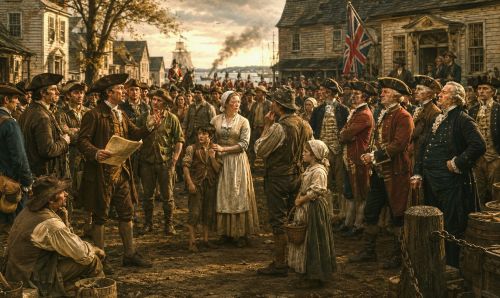
Patriotism in the American Revolution was never unanimous, emerging instead through contested loyalty, organized power, coercion, neutrality, and civil conflict.

By Matthew A. McIntosh
Public Historian
Brewminate
Introduction: A Revolution Without Unanimity
The American Revolution is often remembered as the uprising of a people who discovered, almost as one body, that they were no longer British and must become American. That memory is powerful, but it is not the same thing as the Revolution’s lived reality. Between the imperial crisis of the 1760s and the end of the War for Independence in 1783, allegiance remained contested, uneven, and often dangerous. Many colonists embraced the Patriot cause with conviction, sacrifice, and ideological seriousness. Others remained loyal to the Crown, not simply from cowardice or corruption, but because they believed rebellion was illegal, destructive, socially destabilizing, or morally wrong. Still others tried to avoid firm public commitment for as long as possible, especially when armies moved nearby, neighbors watched one another, and the cost of choosing the losing side could be imprisonment, confiscation, exile, or death. The Revolution was not born from unanimity. It was born from conflict over loyalty itself.
The old habit of dividing the population into neat thirds, one Patriot, one Loyalist, and one neutral, captures the atmosphere of division but not its complexity. Allegiance was not a census category. It was a shifting combination of belief, behavior, fear, opportunity, geography, military pressure, local rivalry, religion, economic interest, and coercion. A man might oppose parliamentary taxation but hesitate at independence. A merchant might resent imperial regulation but fear the destruction of Atlantic trade. A farmer might support local committees when Patriot neighbors controlled the county, then retreat into silence when British troops arrived. A Loyalist might remain quiet in a rebel town, while a supposed neutral might pay revolutionary taxes, sell supplies, or serve militia duty because refusal was too dangerous. The Revolution’s political landscape was not a clean map of fixed identities. It was a moving field of public choices made under pressure.
To describe Patriots as a committed minority is not to diminish their importance or pretend that the Revolution was merely the work of a fringe. The Patriot movement was broad, organized, and capable of attracting intense support across many communities, especially where imperial policy, local grievances, religious language, militia culture, and resistance institutions converged. But its strength lay less in universal agreement than in mobilization. Committees of correspondence, provincial congresses, local associations, militias, printers, clergy, crowd actions, and revolutionary governments gave Patriot politics an institutional life before independence and a coercive reach after it. Patriots did not simply persuade. They organized. They enforced. They claimed to speak for “the people,” and then built mechanisms that made public neutrality increasingly difficult. A colonist did not have to possess a fully developed theory of republican independence to be drawn into Patriot power; he might be summoned to militia service, pressured to sign an association, expected to boycott British goods, required to pay taxes to revolutionary authorities, or watched by neighbors who had decided that silence was suspicious. In that sense, Patriotism became both an ideology and a civic discipline. It asked for belief, but it also demanded performance. That is one of the central paradoxes of the Revolution: a movement that spoke in the language of liberty also depended on discipline, surveillance, and pressure to survive.
The American Revolution succeeded not because all colonists became Patriots, but because enough Patriots became active, organized, and locally powerful enough to overcome Loyalist resistance and neutral hesitation. Patriotism during the War for Independence was regional, social, racial, religious, and military, not abstract or uniform. It looked different in Massachusetts than in New York, different in Virginia than in the Carolina backcountry, different for enslaved people seeking freedom than for slaveholding revolutionaries defending property, different for Native nations facing settler expansion than for frontier settlers who feared British-Indian alliances. To recover this divided world is not to weaken the Revolution’s significance. It is to make it historically real. The United States was not born from one people speaking with one voice. It was born from a civil struggle over empire, liberty, authority, property, race, sovereignty, and the terrifying question of what loyalty required.
Before Independence: Protest, Imperial Rights, and the Making of Patriot Politics
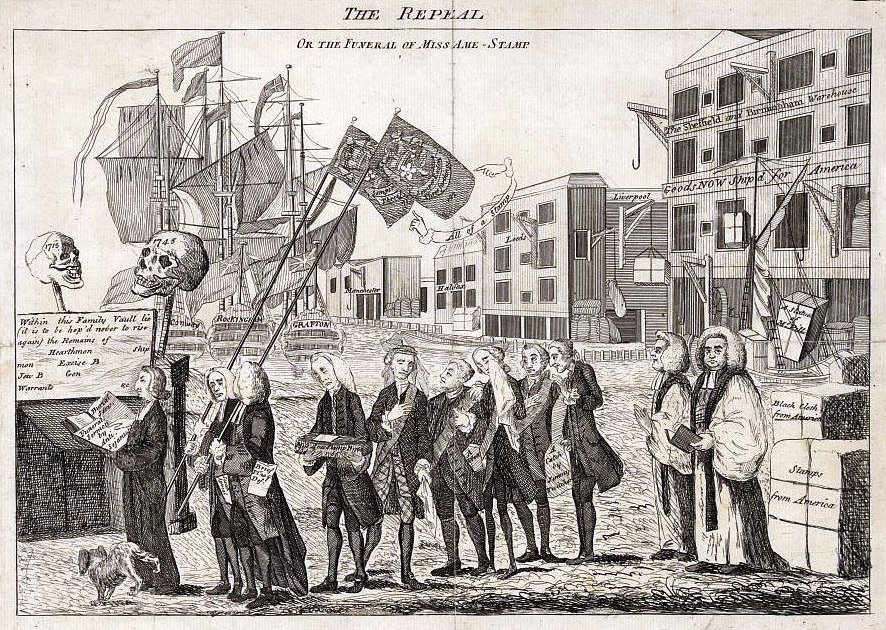
Before independence became a declared objective, Patriot politics emerged from a dispute over empire. Most colonial protesters in the 1760s did not begin by rejecting British identity. They claimed it. They argued that they were entitled to the rights of Englishmen, the protections of constitutional liberty, and the security of property against taxation imposed without consent. The Stamp Act crisis of 1765 exposed the central problem: Parliament claimed authority to legislate for the colonies, while colonial opponents increasingly insisted that internal taxation required representation. At this stage, resistance was still framed as loyalty properly understood. Protesters could denounce ministers, revenue schemes, customs officials, and parliamentary overreach while professing fidelity to the king and the British constitution. That tension, between imperial belonging and colonial resistance, gave early Patriot politics its power.
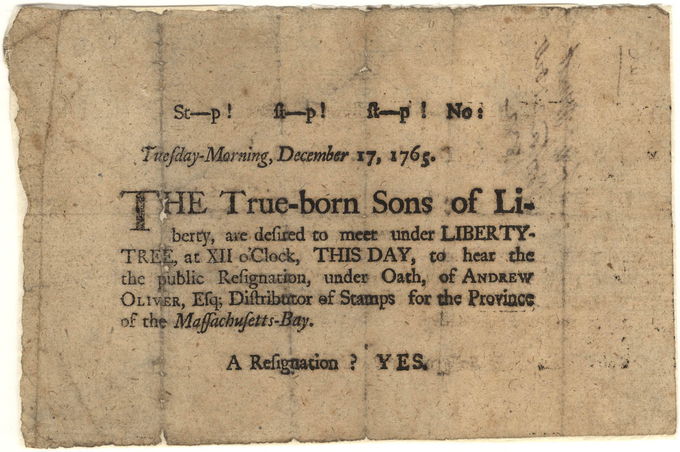
The Stamp Act also revealed that resistance required organization, not merely opinion. Colonial assemblies protested formally, but popular mobilization gave the movement force in streets, taverns, print shops, waterfronts, and county meetings. Groups such as the Sons of Liberty used ritual, crowd action, intimidation, public celebration, and symbolic politics to turn constitutional arguments into public pressure. Stamp distributors resigned under threat; effigies appeared; merchants coordinated nonimportation agreements; newspapers circulated arguments across colonies that had often regarded one another as separate political worlds. The resistance was not yet a national movement, but it was becoming intercolonial. The essential development was not that all colonists suddenly agreed, but that activists learned how to connect local outrage to a broader imperial crisis. They also learned that politics could be performed as public theater. A crowd gathered around an effigy, a procession through town, a printed broadside, a merchant’s signed agreement, or a public resignation could all become declarations of communal judgment. These acts pressured uncertain colonists to decide how they wished to be seen by neighbors. Even before formal revolution, Patriot politics was acquiring one of its defining features: the ability to turn private hesitation into public exposure. Resistance became a community drama in which loyalty, cowardice, corruption, and liberty were named before an audience.
The Townshend duties, customs enforcement, and the Boston Massacre deepened this process by making imperial authority appear both intrusive and violent. The issue was not simply the amount of money being taxed. Indeed, many of the disputed duties were modest in financial terms. The deeper question was constitutional and political: who had the right to decide? Colonial resistance writers warned that accepting small taxes would concede the principle of parliamentary supremacy over colonial property. In this climate, Patriotism was built through vigilance. The colonist who refused taxed goods, attended meetings, read political essays, or joined a local association was not merely expressing preference. He was participating in a culture of resistance that treated liberty as something preserved through public discipline. Consumer politics became political education, and everyday choices became tests of allegiance. Tea, paper, glass, paint, and imported goods could become symbols of submission or resistance, turning household consumption into a political arena. Women, though formally excluded from most voting and officeholding, played a crucial role in this world of boycotts, homespun production, and domestic discipline, because the politics of consumption entered kitchens, parlors, shops, and marketplaces. The imperial crisis widened political participation even before it created independence. It taught colonists that liberty could be defended through habits, purchases, refusals, and public conformity. That lesson would matter later, when revolutionary authorities demanded not only belief but visible participation.
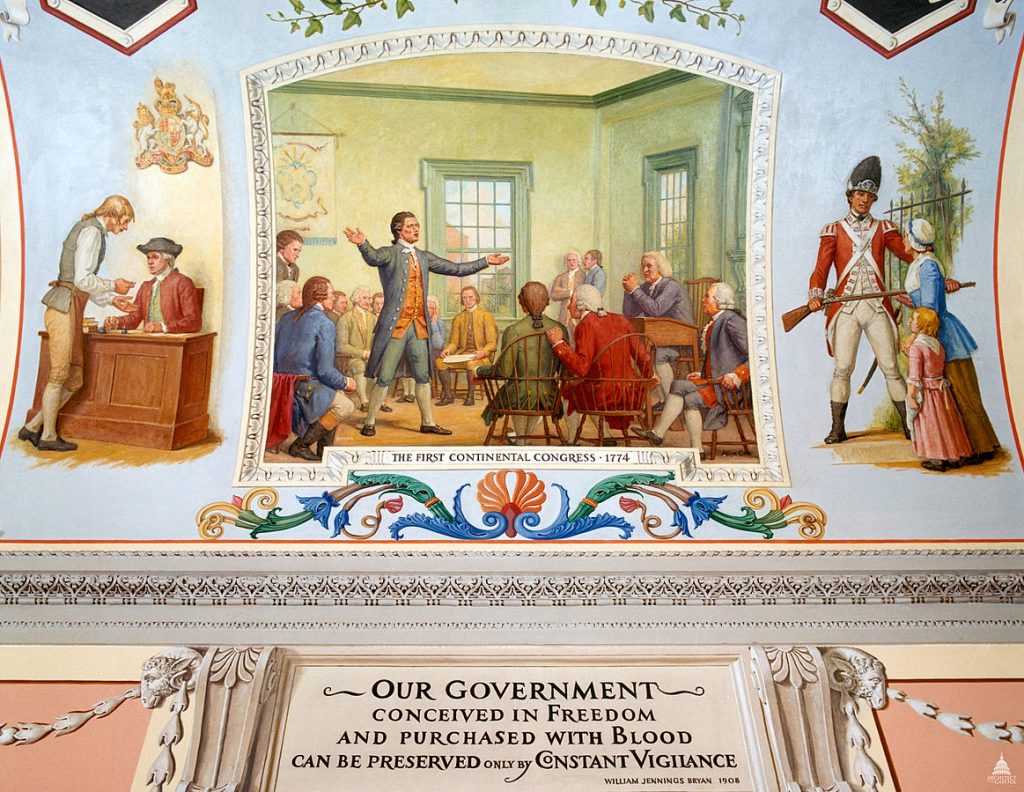
The Boston Tea Party and the Coercive Acts transformed protest into a more radical confrontation. The destruction of tea in December 1773 was not a spontaneous tantrum against taxation, but a carefully staged act against monopoly, parliamentary authority, and the appearance of colonial submission. Britain’s punitive response, especially the closing of Boston’s port and the alteration of Massachusetts government, convinced many colonists outside New England that the issue was no longer merely Boston’s disorder. If Parliament could remake government in Massachusetts, it might do so elsewhere. The First Continental Congress of 1774 was a decisive institutional moment. It did not declare independence, but it gave colonial resistance a continental form, coordinating grievances, recommending boycotts, and asserting that imperial policy had violated constitutional rights.
Yet the creation of Patriot politics depended on enforcement as much as persuasion. The Continental Association of 1774 required local committees to monitor imports, exports, consumption, merchants, suspected violators, and public behavior. These committees did not simply reflect public opinion. They shaped it. They made resistance visible, disciplined, and local. A colonist could now be judged not only by what he privately believed, but by whether he complied with collective rules. Refusing to join nonimportation, continuing trade with Britain, criticizing Congress, or appearing too friendly to royal officials could invite exposure, boycott, harassment, or worse. Patriot politics became governmental before independence. It claimed legitimacy from the people while creating mechanisms that compelled people to act as if the Patriot cause already spoke for them.
By 1775 and early 1776, the movement had crossed a threshold. Lexington and Concord turned resistance into war, but war did not automatically make independence inevitable. Many colonists still hoped for reconciliation, while others concluded that bloodshed had made the old imperial relationship impossible. Thomas Paine’s Common Sense helped shift the argument by attacking monarchy itself and presenting independence as both practical necessity and moral liberation. Still, independence was not the beginning of Patriot politics. It was the result of a decade of organized resistance, escalating confrontation, and institutional experimentation. Before Americans declared themselves a separate people, Patriot activists had already built much of the political machinery required to make that declaration meaningful. The Revolution began not with unanimous national feeling, but with committees, associations, boycotts, pamphlets, crowds, assemblies, and the hardening belief that loyalty to liberty might require resistance to empire.
The “Thirds” Myth and the Problem of Measuring Allegiance
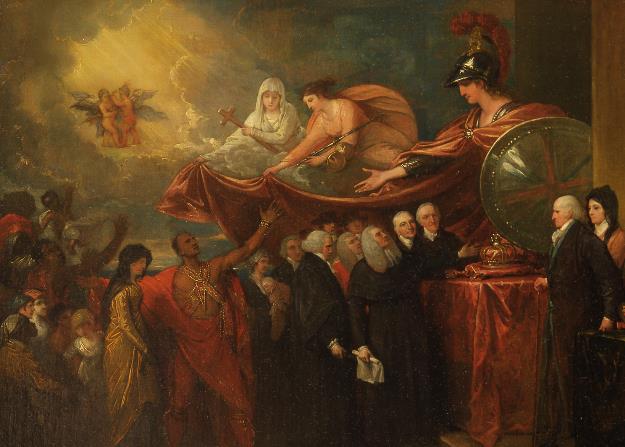
Few claims about the American Revolution have been repeated more confidently, or more carelessly, than the idea that the colonists divided neatly into thirds: one-third Patriots, one-third Loyalists, and one-third neutral. The formula has the appeal of simplicity. It gives the Revolution a clean arithmetic of division and suggests a population evenly balanced among rebellion, loyalty, and hesitation. But the claim is more useful as a warning than as a statistic. It captures the important truth that the Revolution was deeply contested, but it distorts the way allegiance actually worked. Colonists did not stand still long enough to be counted in such categories, and the categories themselves were unstable. Patriot, Loyalist, and neutral were not fixed identities stamped permanently onto individuals in 1775. They were positions people occupied, performed, concealed, revised, or abandoned under changing political and military conditions. The neatness of the “thirds” formula also hides the uneven geography of the Revolution. A town in Massachusetts, a manor district in New York, a Quaker community in Pennsylvania, a plantation county in Virginia, and a backcountry settlement in South Carolina did not experience allegiance in the same way. The Revolution was not divided into three equal columns. It was a landscape of pressure points, contested loyalties, local fears, and shifting calculations.
The problem begins with the difference between belief and behavior. A person might privately sympathize with resistance to Parliament while publicly avoiding Patriot meetings. Another might dislike rebellion but pay taxes to revolutionary authorities because Patriot committees controlled the county. A merchant might sign a nonimportation agreement out of fear of boycott rather than conviction. A farmer might sell provisions to whichever army was near enough to threaten his property. A Loyalist might remain quiet for years, then declare himself only when British troops arrived. A supposed neutral might never write a political tract, join the Continental Army, or attend a congress, yet still support the Revolution through militia duty, local taxes, supplies, or silence in the face of Patriot enforcement. Measuring allegiance by ideology alone misses the practical ways people were drawn into revolutionary power. Measuring it by behavior alone risks mistaking coercion for belief.
This is why the familiar numbers must be used cautiously. Historians have often estimated that Loyalists made up perhaps 15 to 20 percent of the white population, while active or broadly sympathetic Patriots may have represented a larger share, perhaps around 40 to 45 percent. But these figures are approximations built from fragmentary evidence, not census totals. They also exclude or badly distort the political choices of enslaved people, free Black communities, Native nations, women, and others whose relationship to the Revolution did not fit the categories of white male electoral or military participation. Enslaved people who fled to British lines in pursuit of freedom were not simply “Loyalists” in the same sense as royal officeholders. Native nations that aligned with Britain often did so to resist settler expansion, not from abstract devotion to Parliament. Women enforced boycotts, managed households, supplied armies, endured occupation, wrote political correspondence, and shaped community opinion, yet their allegiance rarely appears in the same records used to count male political actors. The arithmetic of allegiance is not only uncertain. It is socially incomplete.
The “three percent” claim is even more misleading. In its common modern form, it suggests that only a tiny fraction of colonists supported the Revolution, usually by confusing formal military service with political allegiance or by reducing revolutionary support to a narrow subset of armed men. That mistake misunderstands how revolutions work. The Patriot cause required soldiers, but it also required printers, farmers, artisans, merchants, teamsters, militia officers, committee members, tax collectors, legislators, clergy, sailors, spies, camp followers, and households willing or compelled to sustain the war. Revolutionary mobilization was not limited to the Continental Army. It extended through local government, county committees, state militias, supply networks, household production, crowd action, and political enforcement. A woman spinning homespun, a farmer delivering grain, a printer publishing resolutions, a county committee investigating suspected Loyalists, a militia company mustering for local defense, or a town meeting enforcing the Continental Association could all contribute to revolutionary power without appearing in a narrow count of Continental Army enlistments. Political support in a revolution is not measured only by who carries a musket in a regular army. It is also measured by who feeds the army, legitimizes the cause, disciplines dissent, spreads information, raises money, enforces boycotts, and accepts the authority of new governments. A movement can be driven by a committed minority without being tiny. The Patriots were not everyone, but they were far more than a marginal three percent.
The deeper issue, then, is not finding a perfect percentage but understanding allegiance as a wartime process. Support for the Revolution rose, fell, hardened, or disappeared depending on military occupation, local intimidation, British strategy, Patriot enforcement, religious conviction, economic pressure, family ties, racial status, and expectations of victory. A colonist’s allegiance could look different in 1765, 1774, 1776, 1778, and 1781. The “thirds” myth freezes that fluid world into a static diagram. The Revolution was not a schoolroom pie chart. It was a long crisis in which people chose, avoided choosing, were forced to choose, or tried to survive the choices made by others. Its success depended not on unanimity, and not on a tiny revolutionary sect, but on the ability of active Patriots to make their cause organized, visible, enforceable, and increasingly difficult to resist.
Geography of Patriotism: New England, Virginia, New York, and the Lower South

Patriotism in the American Revolution was never evenly distributed across the colonies. It developed through local institutions, regional economies, religious cultures, settlement patterns, military geography, and the specific ways imperial policy touched daily life. New England, especially Massachusetts, became the symbolic and organizational center of early resistance because the imperial crisis there moved quickly from constitutional protest to armed confrontation. Town meetings, militia traditions, Congregational political culture, dense print networks, and memories of local self-government helped make resistance unusually visible and organized. Lexington and Concord did not create Patriotism from nothing, but they confirmed for many New Englanders that imperial conflict had become a war over coercion, rights, and local authority. In that world, Patriot identity could become almost inseparable from community defense. To stand against British troops was not only to oppose imperial policy. It was to defend the town, the meetinghouse, the militia company, and the local political order that many believed Britain had violated.
Virginia produced a different but equally important geography of Patriotism. Its revolutionary leadership came heavily from the gentry, men who spoke the language of liberty while living within a slave society built on unfreedom. That contradiction did not weaken Virginia’s political importance; it made it central to the Revolution’s moral complexity. Virginia Patriots objected to parliamentary taxation, imperial interference, debt pressures, and threats to colonial self-government, but their understanding of liberty was deeply shaped by property, household authority, westward expansion, and local hierarchy. The imperial crisis also intersected with frontier conflict and slavery. Lord Dunmore’s Proclamation in 1775, which offered freedom to enslaved people who escaped Patriot masters and joined British forces, hardened many white Virginians against the Crown by turning imperial power into a perceived threat to slaveholding property and social order. Patriotism in Virginia combined constitutional argument, elite leadership, local mobilization, land hunger, racial fear, and genuine revolutionary conviction in a volatile mixture. It also exposed how revolutionary allegiance could be intensified by threats to existing power as much as by aspirations toward liberty. For enslaved Virginians, British lines could represent possibility, while for many white slaveholders, those same promises made Britain appear dangerous and subversive. The meaning of Patriotism depended sharply on social position. The same event that pushed white planters toward rebellion could push enslaved people toward the British, not because either side possessed a simple monopoly on liberty, but because liberty itself was being defined through competing experiences of power, property, and survival.
New York reveals the opposite problem: a colony where Patriotism was powerful but deeply contested. Its strategic location, commercial ties to the British Empire, ethnic diversity, tenant-landlord conflicts, Anglican influence, and eventual British occupation made allegiance especially unstable. New York City became the major British military base after 1776, giving Loyalism a protected urban center and making open Patriot activity dangerous within occupied areas. In the Hudson Valley and surrounding counties, local divisions could be fierce, shaped by land disputes, family networks, religious affiliation, and the presence or absence of military power. New York reminds us that Patriotism did not simply spread wherever revolutionary arguments were printed. It had to compete with imperial loyalty, economic caution, social hierarchy, and the practical reality of British force. Geography mattered because proximity to armies could determine whether people spoke boldly, stayed silent, fled, collaborated, or shifted public behavior.
The Lower South, especially the Carolinas and Georgia, became the region where the Revolution most openly resembled civil war. Loyalist strength was significant in parts of the backcountry, where ethnic settlement patterns, resentment of coastal elites, religious differences, recent immigration, and local grievances complicated the Patriot cause. British commanders believed southern Loyalists could help restore imperial control, and for a time that hope seemed plausible. Yet the southern war also showed how quickly allegiance could be reshaped by violence. Raids, reprisals, confiscations, militia warfare, and British inability to protect Loyalist supporters turned communities into battlegrounds of revenge and survival. Patriotism in the South often hardened not through abstract ideology alone, but through occupation, plunder, retaliation, and the brutal knowledge that neutrality might no longer be possible. The same neighbor who had once been merely politically suspect could become an armed enemy.
These regional differences show why the Revolution cannot be understood as a single wave of patriotic awakening. New England resistance drew strength from town-based political culture and early confrontation with British troops. Virginia Patriotism emerged through elite leadership, constitutional argument, slavery, and frontier anxiety. New York remained contested because commerce, occupation, ethnic complexity, and Loyalist organization complicated revolutionary mobilization. The Lower South exposed the civil war hidden inside the struggle for independence. Across all these regions, Patriotism was not simply believed; it was made locally. It grew where institutions could sustain it, where British action radicalized the uncertain, where local grievances could be joined to imperial protest, and where revolutionary authorities could make allegiance visible. It also weakened where British protection seemed more immediate, where Loyalist networks had deep roots, where pacifist religion discouraged public commitment, or where ordinary people feared that either side might punish them for choosing poorly. The geography of Patriotism was also a geography of risk. To be a Patriot in Massachusetts in 1775, a Loyalist in occupied New York, a hesitant farmer in Pennsylvania, or a backcountry militiaman in South Carolina meant inhabiting very different political worlds. The Revolution may have declared universal principles, but its Patriotism was built county by county, town by town, and sometimes household by household.
Class, Religion, Ethnicity, and the Social Logic of Allegiance
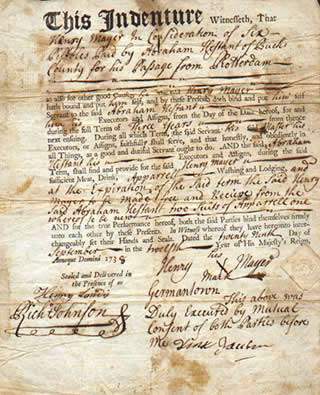
Allegiance in the American Revolution followed no single social formula. Patriots, Loyalists, and neutrals could be found among elites and ordinary farmers, merchants and artisans, clergy and dissenters, recent immigrants and long-established families. Still, social position mattered because people judged the Revolution through the worlds they inhabited. A royal officeholder, a coastal merchant, a backcountry farmer, an Anglican minister, a Quaker pacifist, an enslaved man in Virginia, a Mohawk leader in the northern borderlands, and a German-speaking farmer in Pennsylvania did not confront the imperial crisis from the same place. Patriotism was not simply a matter of abstract ideology arriving in identical form to every household. It was filtered through property, debt, church, language, labor, kinship, race, region, and fear.
Class shaped allegiance, but not mechanically. Wealthy merchants could support resistance when British taxation, customs enforcement, or imperial regulation threatened colonial autonomy and commercial self-direction, yet others feared that rebellion would destroy trade, credit, and social stability. Artisans and mechanics often became energetic participants in urban Patriot politics because boycotts, public meetings, street demonstrations, and local committees gave them a larger political voice than the imperial order had normally allowed. Farmers could be drawn toward the Patriot cause through resentment of taxes, debt pressures, local militia culture, or hostility to distant authority, but they could also resist revolutionary demands when those demands meant military service, requisitions, taxes, or disruption of household survival. Patriotism often looked most compelling when it promised to defend local rights; it looked less attractive when revolutionary government began making its own claims on labor, property, and obedience.
Religion also gave allegiance a social logic. Anglican clergy and many officeholders were disproportionately Loyalist because their institutions, salaries, ordinations, and political assumptions were tied closely to the British Empire. For them, rebellion could appear not as liberty but as disorder, oath-breaking, and an attack on legitimate authority. Dissenting Protestants, especially in New England and parts of the Middle Colonies, often proved more receptive to Patriot arguments because they already possessed traditions of suspicion toward hierarchy, bishops, court influence, and centralized power. Yet religious identity never produced automatic political allegiance. Some Anglicans became Patriots, some dissenters remained cautious, and pacifist groups such as Quakers, Mennonites, and Moravians frequently tried to avoid both military service and revolutionary compulsion. Their neutrality was not necessarily Loyalism. It was often rooted in conscience, discipline, and a refusal to turn political conflict into bloodshed. This made pacifist neutrality especially vulnerable, because revolutionary governments increasingly treated refusal to participate as a political problem regardless of motive. A Quaker who would not bear arms or swear an oath might understand that refusal as obedience to God, while Patriot authorities might interpret it as dangerous noncooperation in a war for survival. Religion shaped allegiance not only through doctrine, but through institutional relationships, communal discipline, oath-taking, military obligation, and the moral meaning of violence itself.
Ethnicity and immigration further complicated the Revolution’s political map. German-speaking communities, Scots-Irish settlers, Highland Scots, Dutch communities, and other groups entered the conflict through different histories of migration, settlement, language, church life, and relationship to local power. Recent immigrants might feel less attached to colonial resistance networks and more wary of rebellion against a government under which they had recently settled. Some Highland Scots in the Carolinas, still shaped by the memory of defeat after the Jacobite rising of 1745 and by oaths to the Crown, leaned Loyalist. Scots-Irish backcountry settlers, by contrast, often became strong Patriots in some regions, especially where anti-imperial feeling merged with frontier militancy and resentment of coastal elites. Ethnicity did not determine allegiance, but it shaped networks of trust. People often followed neighbors, kin, ministers, landlords, patrons, or militia leaders whose authority carried more immediate weight than distant political theory.
The Revolution’s language of liberty became most contested when enslaved and free Black people confronted it. For enslaved people, the question was rarely whether Parliament or Congress had the better constitutional theory. The question was where freedom might be found. Dunmore’s Proclamation and later British emancipation policies gave thousands of enslaved people a reason to flee Patriot masters and seek protection behind British lines. Their choices exposed the limits of Patriot rhetoric in a slaveholding society. To white revolutionaries, British promises of freedom could seem like tyranny, incitement, and social catastrophe. To enslaved people, they could appear as opportunity. Free Black people also navigated a dangerous political world, sometimes serving in Patriot forces, sometimes seeking security through local arrangements, and always confronting a Revolution that proclaimed natural rights while leaving racial hierarchy largely intact. Allegiance here cannot be reduced to loyalty or treason. It was a struggle over whose liberty counted.
Native nations likewise judged the Revolution through survival, land, and sovereignty rather than through the Patriots’ self-description. Many Native leaders saw British power as an imperfect but necessary counterweight to settler expansion. The Proclamation Line of 1763, however unevenly enforced, had at least suggested that imperial authority might restrain colonial land hunger. Patriot victory, by contrast, threatened to unleash a settler republic hungry for western lands. Native communities were not uniform. Some allied with the British, some split internally, some pursued neutrality, and some made local calculations based on diplomacy, trade, military geography, and old rivalries. Their decisions remind us that Patriotism was not a universal moral category. For many settlers, the Patriot cause meant liberty and western opportunity. For many Native peoples, that same cause threatened dispossession. The Revolution’s social logic depended not only on who opposed Britain, but on what different peoples feared would happen if Britain lost. This is why Native allegiance cannot be treated as a side note to the Revolution’s “main” political conflict. It was central to the war’s continental meaning. The struggle over empire was also a struggle over land, borders, treaty obligations, and the future balance of power between Native nations and expanding settler societies. If Patriotism promised self-government to colonists, it often promised insecurity to Native communities whose homelands lay in the path of colonial expansion. The same Revolution could appear as liberation, rebellion, civil war, slaveholders’ defense of property, or settler conquest depending on where one stood.
Neutrality, Fear, and the Politics of Fence-Sitting
Neutrality during the American Revolution was not a simple absence of conviction. It could mean fear, caution, pacifism, economic calculation, political confusion, family division, or the desire to survive in a war whose outcome remained uncertain. Many colonists did not rush to define themselves publicly as Patriots or Loyalists because public identity carried risk. To choose too early, too loudly, or in the wrong place could invite punishment from whichever side gained control. A farmer with crops in the field, a shopkeeper dependent on credit, a widow managing a household, a pacifist bound by conscience, or a tenant caught between landlord and committee might find neutrality less an expression of indifference than an attempt to protect family, property, faith, and life. Fence-sitting was not always cowardice. Often it was a rational response to a world in which politics had become dangerous.
Yet revolutionary war made neutrality hard to sustain. Both sides needed more than private sympathy. Patriots needed taxes, militia service, supplies, labor, oaths, intelligence, public compliance, and recognition of revolutionary authority. British commanders needed Loyalist mobilization, local guides, provisions, intelligence, and visible demonstrations that royal government still had supporters. A colonist who wished only to be left alone could be read by Patriots as secretly Loyalist and by British authorities as insufficiently loyal to the Crown. Refusal itself became suspicious. The very act of not choosing could be treated as a choice, because wartime governments and armies rarely tolerate ambiguity for long. Neutrality was most plausible where neither side could enforce full compliance; it became least plausible where one side held local power and demanded proof of allegiance. The problem was that revolutionary authority did not operate only through formal law. It worked through neighbors, committees, militia captains, creditors, ministers, printers, and local reputations. A person who avoided politics could still be pulled into politics by a demand for supplies, a summons to muster, a loyalty oath, a boycott agreement, a tax bill, or a rumor whispered in town. War made private life porous. The household, marketplace, church, tavern, and county court all became places where neutrality could be tested and found wanting.
The politics of neutrality were especially intense because the Revolution reached into ordinary life. Allegiance was not confined to battlefield service or formal officeholding. It appeared in whether one signed an association, accepted Continental currency, attended militia musters, sold goods to soldiers, paid taxes, concealed deserters, hosted officers, joined a crowd, repeated rumors, or refused to drink a toast. In small communities, these acts were visible. Neighbors remembered who complied and who hesitated. Local committees could publish names, investigate behavior, demand explanations, and treat reluctance as evidence of political danger. A person might privately wish the conflict would end without caring deeply who won, but public life left fewer hiding places as the war continued. The Revolution transformed social behavior into political evidence.
Fear also shaped the timing of allegiance. British victories could bring Loyalists into the open and send Patriots into hiding. Patriot military recovery could reverse the pattern just as quickly. In occupied cities such as New York, Loyalism could operate under the protection of British arms, while Patriot activity became clandestine or exiled. In rebel-controlled countryside, Loyalists might keep silent, flee, or risk confiscation and imprisonment. In contested regions, especially parts of the Middle Colonies and the South, people might adapt their public behavior repeatedly as armies moved through. This shifting allegiance did not necessarily prove moral emptiness. It reflected the brutal uncertainty of civil war. When no one knew who would prevail, survival often required flexibility, silence, and careful attention to who held power that week.
Religious neutrality presented a particularly difficult case. Quakers, Mennonites, Moravians, and other peace churches often refused military service and oath-taking because of conscience, not because of loyalty to Britain. But revolutionary authorities struggling to build a state at war could not easily distinguish principled pacifism from political obstruction. Oaths of allegiance, militia fines, property seizures, and suspicion of noncombatants placed pacifist communities under pressure. Their position exposed a contradiction in Patriot politics. The Revolution claimed to defend liberty, including rights of conscience, yet it often demanded public acts that violated the conscience of those who refused to bear arms or swear political loyalty. For pacifists, neutrality was a moral discipline. For many Patriots, it looked like dangerous noncooperation. The difference mattered enormously because conscience was inward, while revolutionary politics demanded outward proof. A peaceable refusal to fight could be interpreted as sympathy for the enemy; a refusal to swear could appear as refusal to recognize legitimate authority; a refusal to pay war taxes could seem less like religious consistency than active obstruction. Pacifist communities revealed how quickly the Revolution’s language of liberty could become coercive when survival seemed to require unity. They did not fit comfortably into the categories of Patriot, Loyalist, or neutral, and that very discomfort made them vulnerable.
Neutrality matters because it helps explain how a committed Patriot minority could become politically dominant without universal enthusiasm. Revolutions do not require every person to become an ideologue. They require enough organized activists to make compliance easier than resistance and silence safer than opposition. Many neutrals eventually became functional supporters of the Patriot cause because they paid taxes, followed local regulations, avoided British contact, or accepted revolutionary authority as the power most able to govern their community. Others leaned Loyalist when British troops seemed secure nearby. Neutrality was less a stable middle ground than a contested zone of pressure. The Revolution did not merely persuade the undecided. It narrowed the space in which undecided people could safely remain.
Patriot Power: Committees, Oaths, Militia, and Revolutionary Coercion
Patriotism became politically effective because it did not remain only an idea. It became a system of local power. By the mid-1770s, committees of correspondence, committees of inspection, committees of safety, provincial congresses, militia companies, and revolutionary conventions created an alternative structure of authority that increasingly displaced royal government. These bodies did not merely express resistance to Britain. They governed in the name of resistance. They monitored trade, enforced boycotts, collected intelligence, regulated public conduct, organized militia service, and identified those whose behavior seemed dangerous to the cause. Patriot power was built from below as well as declared from above. Before independence was formally announced, revolutionary institutions were already teaching colonists that authority could move from king and Parliament to committees, counties, towns, and congresses claiming to speak for “the people.”
The committees were especially important because they brought revolutionary politics into daily life. The Continental Association of 1774 required local enforcement if nonimportation and nonconsumption were to mean anything. Someone had to watch merchants, inspect cargoes, expose violators, discourage luxury consumption, and determine whether neighbors were complying with the common cause. In many communities, committees became the practical face of Patriot authority. They summoned suspects, investigated rumors, demanded explanations, published names, and recommended sanctions. Their power could be informal, but informality did not make it weak. Public shame, commercial boycott, social exclusion, and reputational damage could be as effective as formal prosecution. A colonist who violated the association or spoke too warmly of royal government might not face a courtroom at first. He might face his neighbors.
Oaths of allegiance deepened this pressure by turning political uncertainty into a demand for public declaration. Revolutionary governments needed to know who could be trusted, especially as the war expanded and British armies occupied major cities. Oaths forced colonists to make allegiance visible. To swear loyalty to a new state or to the United States was to cross a line that many had tried to avoid. Refusal could mark a person as suspicious, even when refusal came from religious scruple, fear, or reluctance to abandon old obligations. Oath-taking reveals the Revolution’s coercive edge. It transformed patriotism from sympathy into performance, and performance into evidence. The state at war did not want merely private agreement. It demanded signs of obedience that could be recorded, remembered, and used to distinguish insiders from enemies. Once sworn, a person’s allegiance became not only a matter of conscience but a matter of public accountability, because an oath created a record against which future behavior could be judged. If he aided British troops, traded with Loyalists, refused militia duty, or criticized revolutionary authorities after taking the oath, his conduct could be treated not simply as dissent but as betrayal. For those who refused, the consequences could also be severe: fines, disqualification from office, loss of civil standing, seizure of property, or suspicion that spread through a community faster than formal law. Oaths worked as instruments of classification. They sorted neighbors into the reliable, the doubtful, and the dangerous, giving revolutionary governments a way to convert ambiguous allegiance into administrable categories.
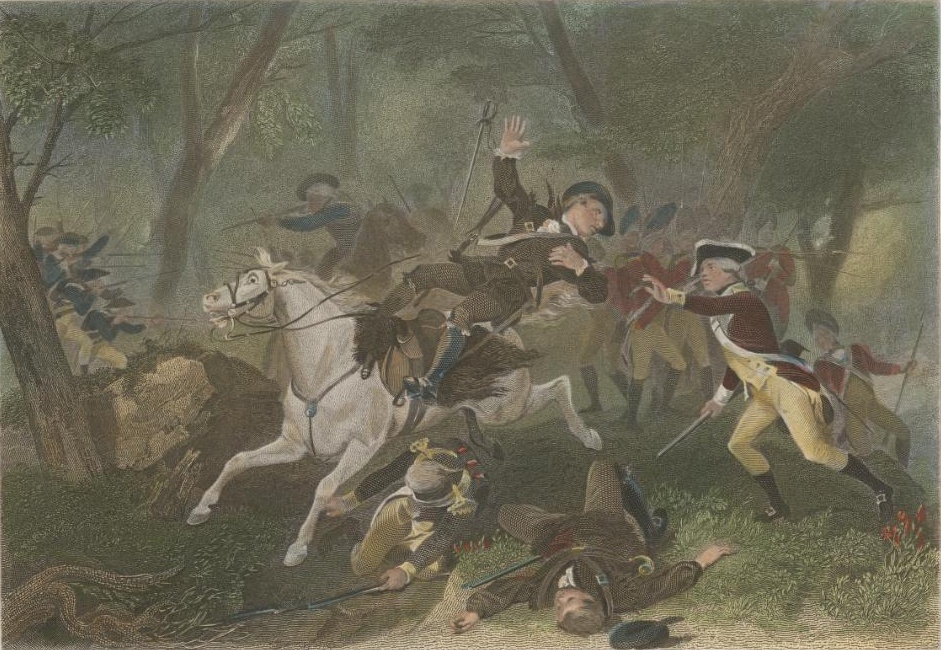
Militia service performed a similar function. The militia was not only a military institution; it was a civic test. In many communities, enrollment, mustering, patrolling, guarding prisoners, suppressing Loyalists, and responding to alarms made political allegiance visible through bodily presence. Men who failed to appear could be fined, suspected, or stigmatized. Militia organization allowed Patriot leaders to project force locally even when the Continental Army was distant or weak. It also blurred the line between soldier, neighbor, and political enforcer. The same men who gathered for local defense might also disarm suspected Loyalists, seize supplies, intimidate dissenters, or compel obedience to revolutionary regulations. Patriot power worked because it was intimate. It did not always arrive as an army from elsewhere. It often wore the face of men one already knew.
The coercive side of Patriotism could be harsh. Tarring and feathering, crowd intimidation, forced resignations, property confiscation, imprisonment, exile, disarming, loyalty tests, and public humiliation all belonged to the revolutionary landscape. These measures were not constant everywhere, nor were they the whole story of Patriot politics. Ideology, persuasion, sacrifice, and genuine commitment mattered deeply. But the Revolution cannot be understood honestly if coercion is treated as an embarrassment outside the main narrative. Revolutionary movements often survive by making opposition costly. Patriots claimed legitimacy from liberty and popular sovereignty, yet they also punished those who resisted the political community they were creating. That contradiction does not make the Revolution meaningless. It makes it historical. A new order was being born, and birth was neither gentle nor unanimous.
Patriot coercion also has to be placed within the wider violence of imperial breakdown. British forces, Loyalist militias, and irregular fighters also used intimidation, plunder, imprisonment, confiscation, and terror. The war was not a morality play in which one side used coercion and the other did not. Still, Patriot coercion mattered in a distinctive way because it helped convert a divided population into a functioning revolutionary polity. Committees, oaths, militias, and local sanctions narrowed the space for neutrality and made Loyalism dangerous in rebel-controlled areas. This was how a committed Patriot movement became stronger than its raw numbers alone might suggest. It built institutions that could persuade, punish, mobilize, and govern. The Revolution succeeded not because every colonist freely and enthusiastically chose independence, but because Patriot power made independence locally enforceable.
Loyalists: More Than Traitors, Less Than a Silent Majority
Loyalists occupied a complicated place in the American Revolution because they were both central to the conflict and later pushed to the margins of national memory. Patriot victory made Loyalism appear, in retrospect, like a failed and morally suspect attachment to tyranny. But Loyalists were not a single class of villains, cowards, aristocrats, or British puppets. They included royal officials, Anglican clergy, merchants tied to imperial commerce, tenant farmers, enslaved people seeking freedom, Native allies resisting settler expansion, recent immigrants, cautious conservatives, and ordinary colonists who believed rebellion would bring disorder rather than liberty. Some defended monarchy on principle. Others feared civil war, mob rule, economic ruin, religious disorder, or the collapse of familiar authority. Their Loyalism was not always heroic, but neither was it always contemptible. It was one way colonists made sense of a crisis in which obedience, liberty, law, property, and survival no longer pointed in the same direction.
The Loyalist position was strongest where imperial institutions, commercial networks, religious loyalties, ethnic communities, or British military power gave it protection. New York became the most important Loyalist refuge after British occupation, while parts of the Carolinas, Georgia, and the Hudson Valley also contained significant Loyalist strength. Anglican clergy often remained attached to the Crown because their ecclesiastical identity was tied to royal authority and imperial hierarchy. Merchants dependent on Atlantic trade could view rebellion as a threat to credit, shipping, insurance, and long-established economic relationships. Some rural people became Loyalists because they resented local Patriot elites, feared committee power, or believed that revolutionary government had become more intrusive than imperial rule. In other cases, Loyalism was less ideological than circumstantial. Where British troops appeared strong, Loyalists could emerge publicly. Where Patriots controlled the locality, they often remained silent, fled, or disguised their views. This unevenness made Loyalism difficult to measure and even harder to mobilize. A colony might contain many people who disliked independence, yet those people were not automatically willing or able to take up arms, expose themselves to Patriot retaliation, or trust that British forces could protect them afterward. Loyalism often depended on timing, proximity, and confidence. It could flourish under occupation and collapse when British troops withdrew. It could appear bold in one county and nearly invisible in the next, not because belief changed overnight, but because the risks of expressing belief changed with military power.
Loyalism also exposed the limits of Patriot claims to speak for “the people.” If the Revolution had been unanimous, Loyalists would have been marginal anomalies. They were not. Their presence forced Patriots to define the people politically rather than simply count them demographically. Those who rejected independence could be branded enemies, traitors, conspirators, or dependents of arbitrary power. This was useful language for a revolution trying to survive, but it simplified the social reality. Many Loyalists understood themselves as defenders of constitutional order, not enemies of liberty. Some believed Parliament had overreached but thought armed resistance had gone too far. Others saw the Continental Congress and local committees as illegal bodies that used coercion while claiming to defend rights. Their critique mattered because it identified a real tension inside Patriot politics: revolutionary authority denounced tyranny while creating new mechanisms of compulsion. Loyalists did not need to be right about everything to notice that problem.
Yet Loyalists were never the silent majority of revolutionary America. Their numbers were substantial, but their political capacity was limited by geography, organization, and dependence on British military force. Patriot institutions took root more deeply in many local communities, while Loyalist organization often required the presence or expectation of British protection. This made Loyalism vulnerable. A Loyalist farmer in a rebel-controlled county might privately favor the Crown but lack any safe way to act. A merchant in occupied New York could speak more freely, but his influence outside British lines might be weak. British commanders repeatedly overestimated Loyalist willingness and ability to rise en masse, especially in the South, where support existed but could not reliably overcome Patriot militia resistance, local violence, and the British army’s inability to protect its friends. Loyalism suffered from a structural problem: it could be numerous enough to matter, but too scattered, exposed, and dependent to govern the revolutionary countryside. It also lacked a single mobilizing vision comparable to the Patriot language of independence, rights, and popular sovereignty. Loyalists defended empire, law, order, property, religious authority, commercial stability, or personal security, but these motives did not always combine into a unified program. Some Loyalists wanted imperial reform without rebellion; others wanted firm military suppression; still others simply wanted protection from local enemies. That diversity made Loyalism socially broad but politically fragile. The Patriots could rally around the claim that independence created a new people. Loyalists had to defend an older imperial order that many colonists still valued, but that wartime conditions made increasingly difficult to restore.
The tragedy of Loyalism became clearest after Patriot victory. Confiscation, exile, social ruin, migration, and political exclusion followed many who had chosen or been forced into loyalty to the Crown. Tens of thousands left the United States for Canada, Britain, the Caribbean, Nova Scotia, Sierra Leone, and other parts of the British world, carrying with them a different memory of the Revolution. Their displacement reminds us that independence produced winners and losers, citizens and exiles, patriots and refugees. To take Loyalists seriously does not require romanticizing empire or denying the Revolution’s achievements. It requires recognizing that the War for Independence was also a struggle over who had the right to define America. Loyalists lost that struggle, but their defeat should not be mistaken for their insignificance. They were more than traitors, less than a silent majority, and indispensable to understanding how divided the Revolution truly was.
The War as Civil War: Neighbor against Neighbor

The American Revolution was a war for independence, but in many places it was also a civil war. The phrase is not a metaphor added after the fact. It describes the lived reality of communities where Patriots and Loyalists knew one another, traded with one another, worshiped near one another, intermarried, shared roads and fields, and then found themselves divided by allegiance, fear, rumor, and violence. The imperial conflict did not descend upon a socially unified people from outside. It entered local worlds already shaped by debt, land disputes, ethnic rivalries, religious divisions, class resentments, family tensions, and memories of earlier conflict. Once war began, these older pressures could attach themselves to revolutionary language. A neighbor became a Tory. A rival became a rebel. A family quarrel became political evidence. A dispute over land, taxes, militia duty, or reputation could be transformed into a test of loyalty. This is why the civil war dimension of the Revolution was so corrosive: it made political conflict personal and made personal conflict politically dangerous. A man did not have to meet the British Army in battle to experience the Revolution as war. He could encounter it in the accusation of a neighbor, the arrival of a militia patrol, the seizure of a horse, the demand for an oath, the burning of a barn, or the sudden discovery that someone he had known for years now regarded him as an enemy of liberty or an enemy of the king.
This civil war character appeared in different forms across the colonies, but it was especially brutal in the South. In the Carolinas and Georgia, British strategy depended heavily on the expectation that Loyalists would rise in large numbers once royal troops offered support. That expectation was not imaginary; Loyalist strength in parts of the backcountry was real. Yet British commanders repeatedly underestimated how difficult it would be to protect Loyalists after encouraging them to reveal themselves. Once local men took sides, retaliation followed. Patriot and Loyalist militias raided farms, seized property, hunted opponents, executed prisoners, burned homes, and settled personal scores under political banners. Battles such as Kings Mountain and Cowpens were not simply clashes between imperial and revolutionary armies. They grew from a regional war in which local fighters understood the enemy as both political opponent and personal threat.
The violence of neighbor against neighbor made allegiance more rigid. Early in the conflict, many people hoped to remain quiet, ambiguous, or flexible. Civil war made that harder. Once a man joined a militia, informed on a neighbor, guided troops, accepted British protection, signed a Patriot oath, or participated in a raid, he entered a chain of memory and retaliation. Violence created evidence. Communities remembered who had ridden with whom, who had hidden supplies, who had named names, who had failed to appear, who had plundered, and who had watched silently. Politics became intimate and unforgiving. The Revolution’s ideological language of liberty and tyranny still mattered, but it was lived through the immediate moral geography of household, church, road, tavern, courthouse, and militia district. People did not merely choose between Britain and America. They chose, or were forced to choose, within a landscape of local consequence.
British military policy often intensified this local war. Occupation, foraging, impressment, plunder, and the use of Loyalist or irregular forces could alienate civilians who might otherwise have remained neutral. Patriot militia retaliation made Loyalism dangerous even where British hopes for support were strong. The result was a cycle in which coercion by one side drove people toward the other, while fear of retaliation hardened public commitment. In some communities, Patriotism grew not because everyone embraced republican theory, but because British actions or Loyalist raids made royal authority appear predatory. In others, Loyalism deepened because Patriot committees, militia officers, and revolutionary governments seemed oppressive or vindictive. Civil war does not produce clean ideological categories. It produces wounded memory, forced decisions, and political identities sharpened by danger.
To see the Revolution as civil war does not reduce it to local vendetta or deny its constitutional and ideological meaning. Rather, it restores the human scale on which revolutionary allegiance was often made. Independence was debated in pamphlets and congresses, but it was enforced and resisted in counties, farms, churches, towns, and backcountry settlements. The committed Patriot minority became powerful partly because it could organize this local world more effectively than Loyalists could, but that power came at a cost. The Revolution divided communities before it created a nation. It turned loyalty into a public test, neutrality into suspicion, and political disagreement into a question of survival. Its victory produced a new political order, but also exiles, confiscated estates, broken families, embittered survivors, and competing memories of what liberty had required. The war for American independence was also a war over who could remain at home, who would be cast out, and whose definition of loyalty would survive. That legacy mattered because the new republic inherited not only ideals of liberty and self-government, but also the scars of coercion, suspicion, and internal conflict. The mythology of unanimous Patriotism would later smooth over those wounds, but the war itself had been far more jagged. America was born not merely by separating from Britain, but by deciding, often violently and locally, which Americans would be allowed to belong to the future.
British Strategy, Native Alliances, and the Frontier Turn against Britain
On the imperial frontier, Patriotism often took shape through land, fear, and settler suspicion of British-Indian diplomacy. Many colonists west of the older coastal settlements did not experience the Revolution primarily as an abstract constitutional debate over parliamentary authority. They experienced it through the security of farms, forts, roads, kin networks, and contested borders. The Proclamation Line of 1763, issued after the Seven Years’ War, had attempted to restrict colonial settlement west of the Appalachians and stabilize relations with Native nations. To British officials, such restraint was a practical imperial policy meant to reduce conflict and expense. To many settlers, land speculators, and frontier communities, it appeared as an intolerable limit on expansion. Long before open war, then, British imperial authority could look less like the guardian of liberty than the obstacle standing between settlers and western land.
During the War for Independence, British alliances with Native nations hardened this perception in many frontier regions. Patriot writers and local leaders portrayed Britain as willing to unleash Native violence against innocent settlers, a claim that drew power from older colonial fears and from the brutal realities of frontier warfare. Raids, counterraids, burned settlements, prisoner-taking, militia retaliation, and rumors of massacre all made the frontier war emotionally explosive. For settlers already inclined to distrust imperial restraint, British cooperation with Native forces seemed to confirm that the Crown had chosen Native allies over British American subjects. This mattered politically because frontier Patriotism did not always grow from affection for Congress or philosophical commitment to republicanism. It often grew from the belief that Britain had become dangerous to settler survival.
Yet Native nations were not merely tools of British strategy. They faced their own crisis of sovereignty, land, and survival. For many Native communities, the choice between Britain and the Patriots was not a choice between tyranny and liberty, but between competing colonial threats. The British Empire had repeatedly failed to protect Native lands adequately, but it still offered a potential counterweight to the relentless expansion of settler populations. The Patriot cause, by contrast, was often tied directly to land hunger, western speculation, and the weakening of imperial limits on expansion. Native leaders made strategic choices within a catastrophic situation not of their making. Some allied with Britain because they believed a British victory might slow American settlement. Others tried to remain neutral, split internally, or pursued diplomacy with whichever side seemed most likely to preserve their communities. These decisions were often made under extreme pressure, because neutrality could be impossible when armies, militias, traders, missionaries, and settler communities all demanded clarity. Native leaders had to weigh not only ideology or old alliances, but food supplies, refugee movements, village safety, trade access, diplomatic obligations, and the danger of retaliation. A decision that looked like “Loyalism” from an American perspective might look, from within a Native community, like the least disastrous option in a war that threatened every available future. Their choices were political acts of survival, not passive obedience to British plans.
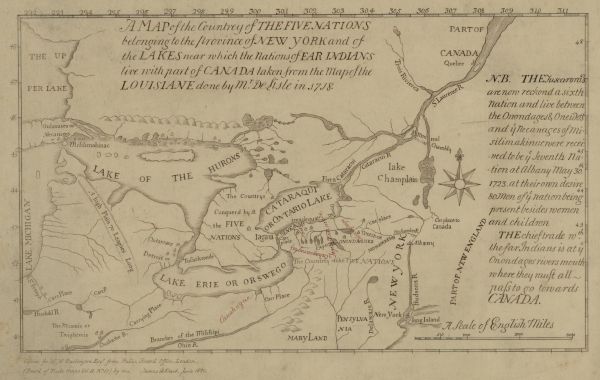
The Iroquois Confederacy, or Haudenosaunee, reveals the depth of this crisis. The war divided the confederacy, with Mohawk, Seneca, Onondaga, and Cayuga communities generally leaning toward the British, while many Oneida and Tuscarora supported or cooperated with the Americans. These divisions did not reflect simple loyalty to London or Philadelphia. They emerged from local diplomacy, missionary influence, trade relationships, older alliances, intercommunity debates, and assessments of danger. The result was devastating. The Sullivan-Clinton campaign of 1779, ordered by George Washington, targeted Iroquois towns and food supplies in western New York, destroying homes, crops, and orchards to break Native and Loyalist power. For many Native communities, the Revolution was not a distant war over colonial rights. It was a direct assault on homeland, food security, political autonomy, and the future of their people.
British strategy also suffered from a contradiction. British commanders hoped Native alliances and frontier pressure would weaken Patriot resistance, stretch American military resources, and encourage Loyalists to mobilize. In some cases, that strategy produced real military pressure. But politically it could backfire. Reports of Native raids, whether accurate, exaggerated, or propagandized, helped Patriot leaders depict Britain as cruel, uncivilized, and willing to destroy its own subjects. Frontier settlers who might have distrusted eastern Patriot elites could still rally against what they saw as a British-Indian threat. The alliance that made strategic sense to British officials and Native nations seeking survival could be interpreted by settlers as proof that reconciliation with Britain was impossible. In that way, frontier war helped convert fear into Patriot commitment.
This frontier dynamic exposes one of the Revolution’s deepest moral contradictions. What strengthened Patriotism among many settlers often threatened Native dispossession. The same anti-British anger that could be described as love of liberty also carried an expansive settler ambition that endangered Indigenous homelands. For frontier colonists, Patriot victory promised land, security, and local autonomy. For many Native nations, it promised a more aggressive settler republic freed from imperial restraint. The Revolution’s geography of allegiance cannot be understood only as a division between Americans and Britons. It was also a conflict over who had the right to occupy land, define sovereignty, and imagine the future of the continent. British-Native alliances pushed some frontier settlers toward the Patriot cause, but they did so because the meaning of liberty on the frontier was inseparable from conquest, settlement, and fear. This does not mean frontier Patriots were insincere when they spoke of rights, security, or self-government. It means their Patriotism was embedded in a settler world where freedom and expansion often reinforced one another. The same imperial restraint that Native nations sometimes saw as inadequate protection could be seen by settlers as oppression. The same British alliance that Native communities saw as a possible shield could be seen by frontier Patriots as a mortal danger. The frontier turned anti-British not simply because colonists loved independence, but because British imperial policy and Native diplomacy appeared to threaten the settler future they hoped to build. The tragedy was that one people’s Patriotism could become another people’s dispossession.
Military Fortune and the Fluctuating Meaning of Patriotism
Patriotism during the American Revolution did not remain fixed from 1775 to 1783. It rose, fell, hardened, weakened, and changed shape according to military events. The Revolution began with dramatic Patriot energy after Lexington, Concord, and Bunker Hill, but enthusiasm alone could not guarantee endurance through years of scarcity, defeat, inflation, occupation, and uncertainty. When Patriot forces seemed strong, independence could appear inevitable, even providential. When British armies captured major cities, scattered Continental troops, or occupied strategic regions, the same cause could look reckless or doomed. Allegiance was tied not only to ideology but to expectations. People asked not simply which side was right, but which side would survive.
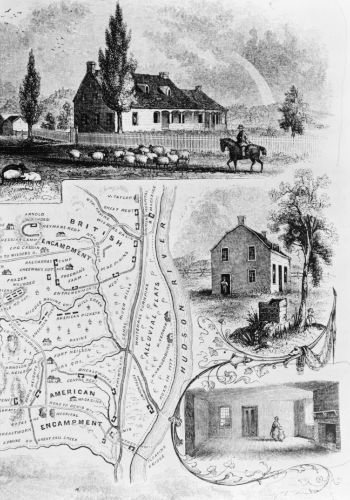
British occupation made this instability especially visible. New York City, held by the British for most of the war, became a Loyalist refuge, military headquarters, prison system, commercial hub, and symbol of royal endurance. Philadelphia’s occupation in 1777 and Charleston’s fall in 1780 likewise changed the public meaning of allegiance in their regions. Under occupation, Loyalists could speak more openly, Patriots might flee or conceal their views, and neutrals could be pressured to accept British protection. Yet occupation also carried risks for Britain. Soldiers needed food, housing, transport, and control. Foraging, plunder, military discipline failures, refugee pressures, and the sheer burden of hosting an army could alienate civilians who had not been strongly committed before. A British victory on the map could produce political resentment on the ground. Occupation made royal power visible, but visibility was not the same thing as legitimacy. Civilians who had once imagined British authority as distant, lawful, and stabilizing might experience it instead through requisitions, crowded streets, damaged property, military courts, imprisonment, disrupted trade, and the presence of refugees or prisoners. The longer an occupation lasted, the more it tested the promise that imperial rule meant order. British commanders could capture cities more easily than they could restore trust, and every failure of protection weakened the political value of military success.
Patriot fortunes also shaped public confidence. The defeats around New York in 1776 threatened the Revolution’s survival, while Trenton and Princeton revived morale by proving that British success was not inevitable. Saratoga in 1777 transformed the war’s diplomatic meaning by helping secure French alliance, giving the Patriot cause an international future it had lacked before. Valley Forge, often remembered through suffering and endurance, also exposed the problem of sustaining commitment through deprivation. Later, the southern campaigns showed how quickly the war could swing from apparent British resurgence to Patriot recovery through militia resistance, Continental adaptation, and British overextension. In each phase, Patriotism was tested by the question every revolution must answer: can belief survive when victory is uncertain?
For ordinary people, these shifts were not abstract. Military fortune affected whether taxes were paid, militia service was resisted, goods were hidden, Loyalists came forward, enslaved people fled, merchants reopened trade, and local committees acted boldly or cautiously. A farmer near a British column might sell provisions under pressure, while the same farmer might later claim Patriot loyalty when revolutionary authority returned. A family in occupied territory might outwardly cooperate with British officials while secretly aiding Patriots, or do the reverse when circumstances changed. Such behavior could look opportunistic, and sometimes it was. But it also reflected the reality of war in a society where armies moved through civilian space. Patriotism was not always a clean declaration made once and held forever. It could be a daily negotiation between conviction, fear, survival, and the visible balance of power.
The Revolution’s eventual success gave Patriotism a retrospective solidity it did not always possess in the moment. After Yorktown and the Treaty of Paris, the Patriot cause could be remembered as the destiny of a people who had always meant to be free. During the war itself, that outcome was never guaranteed. The meaning of Patriotism was made under pressure, through defeat as much as victory, through occupation as much as declaration, through local survival as much as public ideology. Military fortune did not create revolutionary commitment by itself, but it shaped when people dared to express it, how strongly they acted on it, and whether neutrality or Loyalism seemed safer. The Patriot minority prevailed not because its support was constant everywhere, but because it endured long enough, adapted often enough, and survived enough crises to make independence real. That endurance mattered because revolutions are judged differently before and after success. What later appeared as principled persistence could feel, in the bleakest moments, like desperation. What later became national founding could appear, during British advances, as rebellion on the edge of collapse. Military fortune turned Patriotism into a test of patience as well as belief. To remain committed when victory seemed possible was one thing; to remain committed when the army was retreating, money was failing, enlistments were expiring, and neighbors were hedging was something else. The Revolution survived because enough Patriots kept acting as though independence remained possible until events made it so.
The Dedicated Minority and the Problem of Revolutionary Success
The following video from “Reading Through History” is a brief overview of Patriots and Loyalists:
The American Revolution succeeded not because every colonist became a committed Patriot, but because enough Patriots became active, organized, persistent, and locally powerful. This distinction is essential. A revolutionary movement does not need unanimous enthusiasm to transform political life. It needs institutions, discipline, communication, legitimacy, and the capacity to make its claims operational. Patriots supplied those things with unusual effectiveness. They created committees, congresses, militias, associations, supply networks, newspapers, sermons, petitions, state governments, and military structures that could turn belief into action. Loyalists could be numerous in particular places, and neutrals could be widespread, but the Patriot movement more often possessed the machinery required to govern, pressure, recruit, tax, punish, and survive. Revolutionary success was not simply a matter of how many people privately favored independence. It was a matter of who could make political authority function.
This does not mean the Patriot minority was tiny or socially marginal. It was not a little club of conspirators dragging an unwilling continent into war. It included farmers, artisans, merchants, lawyers, clergy, planters, printers, sailors, soldiers, militia officers, women managing boycotts and households, and local leaders who gave the movement reach across communities. Its strength came from breadth as well as intensity. Yet the crucial point is that active commitment mattered more than passive sympathy. A hundred people willing to attend meetings, enforce boycotts, muster with militia, collect supplies, publish arguments, shame violators, and serve in local government could shape a community more than hundreds who preferred not to be involved. The Patriots won influence because they acted publicly and repeatedly. They made the Revolution visible in ordinary life.
The problem of revolutionary success is a problem of mobilization. Patriot leaders and local activists learned how to connect ideology to enforcement. They tied abstract claims about liberty, consent, and rights to concrete practices: signing associations, refusing British goods, serving militia duty, paying taxes, accepting Continental currency, swearing oaths, and recognizing revolutionary courts and legislatures. These practices converted political sympathy into social obligation. They also made evasion harder. A colonist could privately doubt independence, but if he paid revolutionary taxes, attended militia muster, and avoided aiding Loyalists, he became part of the functional Patriot order. This is how a committed movement expands beyond its ideological core. It creates habits of compliance that gradually make the new authority seem real. Revolutionary legitimacy, in other words, was not only argued in pamphlets or declared in congresses. It was enacted through repetition. Every committee meeting, militia drill, oath ceremony, tax collection, public fast, printed resolution, and local punishment helped teach communities that the Revolution was not merely an opinion but a governing reality. The more often people behaved as though revolutionary authority mattered, the more difficult it became to dismiss that authority as temporary rebellion. Mobilization created momentum, and momentum created a kind of political gravity. Even people who were cautious, doubtful, or exhausted could be pulled into the Patriot orbit because the institutions around them increasingly made participation normal and refusal costly.
British failures helped make this Patriot minority more effective. British commanders repeatedly misread the relationship between Loyalist numbers and Loyalist power. They often assumed that Loyalist sympathy would become Loyalist mobilization once troops appeared, but sympathy did not automatically produce durable local control. Loyalists needed protection, coordination, confidence, and a believable prospect of victory. When British forces withdrew, failed to protect supporters, relied on harsh occupation, or encouraged local conflict they could not manage, they weakened the very allegiance they hoped to activate. Patriot organizers, by contrast, were embedded in local communities for the long war. They could return after British columns passed, punish collaborators, rebuild committees, rally militia, and reassert authority. This gave the Patriot movement an advantage that was not always visible in battlefield terms: it could survive defeat because its political base was dispersed, local, and renewable.
The Revolution’s outcome challenges the myth that nations are born only when a united people rises as one. The United States emerged from a divided population because an active Patriot coalition succeeded in defining legitimacy, sustaining war, disciplining dissent, attracting allies, and outlasting imperial power. Its victory does not prove that most colonists were always fervent revolutionaries, nor does it reduce independence to coercion alone. It shows how revolutions actually work: through conviction and pressure, idealism and fear, persuasion and enforcement, sacrifice and calculation. The dedicated Patriot minority became historically decisive because it could make independence more than an idea. It made independence governable, defensible, and eventually irreversible.
Conclusion: Patriotism, Power, and the Myth of One People
The American Revolution was not the uprising of one united people moving with a single mind toward independence. It was a contested, uneven, often coercive struggle in which Patriot commitment, Loyalist resistance, neutral hesitation, enslaved people’s pursuit of freedom, Native nations’ defense of sovereignty, religious conscience, local grievance, and military uncertainty all collided. The later national memory of a people unanimously awakening to liberty has emotional force, but it smooths away the Revolution’s harder truth. Allegiance was regional, social, racial, religious, and situational. It was shaped in town meetings and taverns, churches and courtrooms, plantations and frontier settlements, occupied cities and militia districts. The Revolution’s language was universal, but its lived experience was profoundly local.
Patriotism succeeded because it became organized power. Patriots did not merely believe more intensely than their opponents; they built institutions that could act. Committees, congresses, associations, militias, oaths, newspapers, sermons, crowd actions, state governments, and supply networks translated ideology into authority. They made the Revolution visible in daily life and increasingly difficult to avoid. Loyalists could be numerous and sincere, but they were often scattered, dependent on British military protection, and unable to govern rebel-controlled localities. Neutrals could be widespread, but neutrality itself became unstable as war demanded taxes, service, supplies, silence, or public allegiance. The Patriot movement prevailed because it made independence practical before it was secure, enforceable before it was universally accepted, and legitimate enough to survive repeated military crises.
This reality does not diminish the Revolution’s importance. It deepens it. The Revolution’s achievement was not that every colonist became a Patriot, but that a committed and organized coalition managed to turn contested allegiance into a new political order. That process included courage, sacrifice, and genuine belief, but also intimidation, exclusion, confiscation, and civil violence. It promised liberty while leaving slavery intact. It invoked the people while punishing some people as enemies. It defended rights while pressuring dissenters, pacifists, and the uncertain to conform. Such contradictions do not make the Revolution meaningless. They make it human, political, and historically serious. Founding moments are rarely clean. They are made by people who act under pressure, often with ideals in one hand and power in the other. The Revolution must be understood as both a liberation movement and a struggle over authority, as both a defense of rights and a contest over who could practically define those rights. Its ideals were real, but they did not float above society untouched by property, race, gender, religion, violence, or local power. They were carried by people with interests, fears, ambitions, and blind spots. That is why the Revolution remains so compelling: not because it was pure, but because it forced enduring questions into the open. Who counts as the people? When does resistance become legitimate? How much coercion can a movement for liberty justify? What happens to those whose freedom is postponed, denied, or sacrificed to political victory?
The myth of one people obscures the Revolution’s central lesson: nations are often born from division before they are remembered as unity. The United States emerged from a war in which loyalty had to be argued, performed, enforced, and survived. Patriots won, Loyalists lost, neutrals were absorbed or forgotten, enslaved people and Native nations confronted bitter betrayals, and later generations turned a fractured struggle into a founding story. To recover the Revolution without unanimity is not to strip it of meaning. It is to see why it mattered. The Revolution created a republic not because all Americans agreed on liberty, but because enough Patriots seized the language, institutions, and power to define what American liberty would become.
Bibliography
Affiliate disclosure: Amazon links on this site are paid links. As an Amazon Associate I earn from qualifying purchases.
- Adams, John. The Works of John Adams, Second President of the United States. Edited by Charles Francis Adams. 10 vols. Boston: Little, Brown, 1850–1856.
- Anderson, Fred W. “The Hinge of the Revolution: George Washington Confronts a People’s Army, July 3, 1775.” Massachusetts Historical Review 1 (1999), 20-48.
- Babits, Lawrence E. A Devil of a Whipping: The Battle of Cowpens. Chapel Hill: University of North Carolina Press, 1998.
- Bailyn, Bernard. The Ideological Origins of the American Revolution. Cambridge, MA: Belknap Press of Harvard University Press, 1967.
- Breen, T. H. American Insurgents, American Patriots: The Revolution of the People. New York: Hill and Wang, 2010.
- —-. The Marketplace of Revolution: How Consumer Politics Shaped American Independence. New York: Oxford University Press, 2004.
- Brown, Wallace. The Good Americans: The Loyalists in the American Revolution. New York: William Morrow, 1969.
- Buchanan, John. The Road to Guilford Courthouse: The American Revolution in the Carolinas. New York: John Wiley & Sons, 1997.
- Calhoon, Robert M. The Loyalists in Revolutionary America, 1760–1781. New York: Harcourt Brace Jovanovich, 1973.
- Calloway, Colin G. The American Revolution in Indian Country: Crisis and Diversity in Native American Communities. Cambridge: Cambridge University Press, 1995.
- Chopra, Ruma. Choosing Sides: Loyalists in Revolutionary America. Lanham, MD: Rowman & Littlefield, 2013.
- Continental Congress. Journals of the Continental Congress, 1774–1789. Edited by Worthington Chauncey Ford et al. 34 vols. Washington, DC: Government Printing Office, 1904–1937.
- Cook, Scott A. and William Earle Klay. “George Washington and Enlightenment Ideas on Educating Future Citizens and Public Servants.” Journal of Public Affairs Education 20:1 (2014), 45-55.
- Dickinson, John. Letters from a Farmer in Pennsylvania, to the Inhabitants of the British Colonies. Philadelphia: David Hall and William Sellers, 1768.
- Dowd, Gregory Evans. A Spirited Resistance: The North American Indian Struggle for Unity, 1745–1815. Baltimore: Johns Hopkins University Press, 1992.
- Dunmore, John Murray, Earl of. “Dunmore’s Proclamation.” November 7, 1775. In The Statutes at Large; Being a Collection of All the Laws of Virginia, edited by William Waller Hening. Richmond: Samuel Pleasants, 1809–1823.
- Ferling, John. Almost a Miracle: The American Victory in the War of Independence. Oxford: Oxford University Press, 2007.
- Fischer, David Hackett. Paul Revere’s Ride. New York: Oxford University Press, 1994.
- Force, Peter, ed. American Archives: Consisting of a Collection of Authentick Records, State Papers, Debates, and Letters and Other Notices of Publick Affairs. 9 vols. Washington, DC: M. St. Clair Clarke and Peter Force, 1837–1853.
- Frey, Sylvia R. Water from the Rock: Black Resistance in a Revolutionary Age. Princeton: Princeton University Press, 1991.
- Galloway, Joseph. Historical and Political Reflections on the Rise and Progress of the American Rebellion. London: G. Wilkie, 1780.
- Graymont, Barbara. The Iroquois in the American Revolution. Syracuse: Syracuse University Press, 1972.
- Greene, Nathanael. The Papers of General Nathanael Greene. Edited by Richard K. Showman et al. 13 vols. Chapel Hill: University of North Carolina Press, 1976–2005.
- Gross, Robert A. The Minutemen and Their World. New York: Hill and Wang, 1976.
- Higginbotham, Don. The War of American Independence: Military Attitudes, Policies, and Practice, 1763–1789. Bloomington: Indiana University Press, 1971.
- Holton, Woody. Forced Founders: Indians, Debtors, Slaves, and the Making of the American Revolution in Virginia. Chapel Hill: University of North Carolina Press, 1999.
- —-. Liberty Is Sweet: The Hidden History of the American Revolution. New York: Simon & Schuster, 2021.
- Hoock, Holger. Scars of Independence: America’s Violent Birth. New York: Crown, 2017.
- Jasanoff, Maya. Liberty’s Exiles: American Loyalists in the Revolutionary World. New York: Alfred A. Knopf, 2011.
- Jefferson, Thomas. The Papers of Thomas Jefferson. Edited by Julian P. Boyd et al. Princeton: Princeton University Press, 1950.
- Johnson, Guy. The Papers of Sir William Johnson. Edited by James Sullivan et al. 14 vols. Albany: University of the State of New York, 1921–1965.
- Kammen, Michael. Colonial New York: A History. New York: Charles Scribner’s Sons, 1975.
- Lambert, Robert Stansbury. South Carolina Loyalists in the American Revolution. Columbia: University of South Carolina Press, 1987.
- Maier, Pauline. From Resistance to Revolution: Colonial Radicals and the Development of American Opposition to Britain, 1765–1776. New York: W. W. Norton, 1991.
- Massachusetts Provincial Congress. The Journals of Each Provincial Congress of Massachusetts in 1774 and 1775. Boston: Dutton and Wentworth, 1838.
- Mayer, Holly A. Belonging to the Army: Camp Followers and Community during the American Revolution. Columbia: University of South Carolina Press, 1996.
- Middlekauff, Robert. The Glorious Cause: The American Revolution, 1763–1789. Rev. ed. New York: Oxford University Press, 2005.
- Morgan, Edmund S., and Helen M. Morgan. The Stamp Act Crisis: Prologue to Revolution. Rev. ed. Chapel Hill: University of North Carolina Press, 1995.
- Nash, Gary B. The Unknown American Revolution: The Unruly Birth of Democracy and the Struggle to Create America. New York: Viking, 2005.
- Nash, Margaret A. “Contested Identities: Nationalism, Regionalism, and Patriotism in Early American Textbooks.” History of Education Quarterly 49:4 (2009), 417-441.
- Norton, Mary Beth. 1774: The Long Year of Revolution. New York: Alfred A. Knopf, 2020.
- —-. Liberty’s Daughters: The Revolutionary Experience of American Women, 1750–1800. Boston: Little, Brown, 1980.
- O’Shaughnessy, Andrew Jackson. The Men Who Lost America: British Leadership, the American Revolution, and the Fate of the Empire. New Haven: Yale University Press, 2013.
- Paine, Thomas. Common Sense. Philadelphia: W. and T. Bradford, 1776.
- Pennsylvania Council of Safety. Minutes of the Supreme Executive Council of Pennsylvania, from Its Organization to the Termination of the Revolution. Harrisburg: Theo. Fenn, 1852.
- Ranlet, Philip. The New York Loyalists. Knoxville: University of Tennessee Press, 1986.
- Raphael, Ray. The First American Revolution: Before Lexington and Concord. New York: New Press, 2002.
- —-. A People’s History of the American Revolution: How Common People Shaped the Fight for Independence. New York: New Press, 2001.
- Richter, Daniel K. Facing East from Indian Country: A Native History of Early America. Cambridge, MA: Harvard University Press, 2001.
- Royster, Charles. A Revolutionary People at War: The Continental Army and American Character, 1775–1783. Chapel Hill: University of North Carolina Press, 1979.
- Seabury, Samuel. Free Thoughts on the Proceedings of the Continental Congress. New York: James Rivington, 1774.
- Simcoe, John Graves. A Journal of the Operations of the Queen’s Rangers, from the End of the Year 1777 to the Conclusion of the Late American War. Exeter: Printed for the Author, 1787.
- Stallman, Alfreda K. “Patriotism: Roman and American.” The Classical Journal 52:8 (1957), 346-348.
- Tarleton, Banastre. A History of the Campaigns of 1780 and 1781, in the Southern Provinces of North America. London: T. Cadell, 1787.
- Taylor, Alan. American Revolutions: A Continental History, 1750–1804. New York: W. W. Norton, 2016.
- Van Tyne, Claude Halstead, ed. The Loyalists in the American Revolution. New York: Macmillan, 1902.
- Warren, Mercy Otis. Observations on the New Constitution, and on the Federal and State Conventions. Boston: Thomas and Andrews, 1788.
- Washington, George. The Papers of George Washington: Revolutionary War Series. Edited by Philander D. Chase et al. Charlottesville: University of Virginia Press, 1985.
- Wilson, David K. The Southern Strategy: Britain’s Conquest of South Carolina and Georgia, 1775–1780. Columbia: University of South Carolina Press, 2005.
- Wood, Gordon S. The Radicalism of the American Revolution. New York: Alfred A. Knopf, 1992.
Originally published by Brewminate, 05.14.2026, under the terms of a Creative Commons Attribution-NonCommercial-NoDerivatives 4.0 International license.
About the Author