A critical, evidence-based response to Patrick James examining pyramid conspiracies, pseudoscience, and lost civilization claims through rigorous historical and archaeological analysis.

By Matthew A. McIntosh
Public Historian
Brewminate
Introduction: Framing the Argument and the Video
In his video on the Great Pyramid of Giza, Patrick James presents a familiar but highly effective form of alternative-history argument: begin with a real archaeological question, amplify uncertainty into mystery, and then treat scholarly caution as proof of concealment. The structure is not accidental. James opens with the Queen’s Chamber shaft exploration and quickly expands that episode into a broader indictment of Egyptology itself, especially of scholars and officials associated with the Giza plateau. From there, the video shifts from specific puzzles to a general claim that mainstream explanations for the Great Pyramid are not merely incomplete, but fundamentally unreliable. That move is central to the argument. It allows James to transform gaps in public knowledge into evidence of institutional failure, and then to position speculation as a more honest alternative than disciplined historical method. Ancient monuments have long invited wonder, and even ancient authors described the pyramids in ways that mixed observation with marvel, but wonder is not the same thing as proof, and amazement at a structure’s scale does not license the abandonment of evidentiary standards.
That distinction matters because the Great Pyramid is already extraordinary without embellishment. Egyptologists have never denied its precision, logistical ambition, or ideological importance. On the contrary, the best scholarship has spent decades reconstructing the monument within the material, religious, and political world of the Fourth Dynasty, asking how royal power, labor organization, quarrying systems, survey methods, and funerary belief came together in a project of such magnitude. James frames scholarly explanation as a kind of dull orthodoxy that survives only by suppressing anomalies. The result is a false choice between mystery and dogma, as though one must either accept every speculative leap in the video or else cling uncritically to a rigid official story. Serious historical work proceeds neither way. It tests claims against context, compares possibilities, distinguishes stronger evidence from weaker evidence, and resists the temptation to convert every unresolved issue into a gateway for grand hidden theories.
James’s larger method depends especially on three recurring habits of pseudo-archaeological reasoning. First, he treats absence of definitive evidence as evidence for his preferred alternative. Second, he relies on argument from incredulity, repeatedly implying that because a feat seems difficult to modern viewers, ancient Egyptians could not have achieved it with the means available to them. Third, he folds disparate claims into a single cumulative impression, moving from shafts, quarrying, and missing mummies to Orion, sacred geometry, geodesic positioning, electromagnetic experiments, and cataclysmic prehistory as though adjacency creates coherence. Yet the accumulation of conjectures does not strengthen an argument when each claim remains weak on its own terms. The effect is rhetorical rather than analytical. James invites the viewer to feel that there are too many oddities for the conventional account to survive, but historical interpretation is not decided by atmosphere. It is decided by the quality, provenance, and explanatory power of the evidence.
I do not approach James’s video as harmless curiosity, nor as something to be dismissed with a sneer. I treat the video as an instructive example of how modern pseudohistory works, especially in digital media where confidence, montage, and selective quotation can create the appearance of depth without the discipline of scholarship. The aim is not to deny that the Great Pyramid still raises legitimate questions. It plainly does. The aim is to show that James’s interpretation of those questions repeatedly confuses uncertainty with suppression, possibility with probability, and fascination with evidence. What follows will examine the video’s major claims in sequence, not to defend a simplistic caricature of “mainstream” Egyptology, but to demonstrate that the historical and archaeological record is far stronger, more nuanced, and far more intellectually serious than James allows. The Great Pyramid deserves critical inquiry. It does not need conspiratorial framing to remain one of the most astonishing monuments in human history.
Manufactured Mystery and the Illusion of Suppression
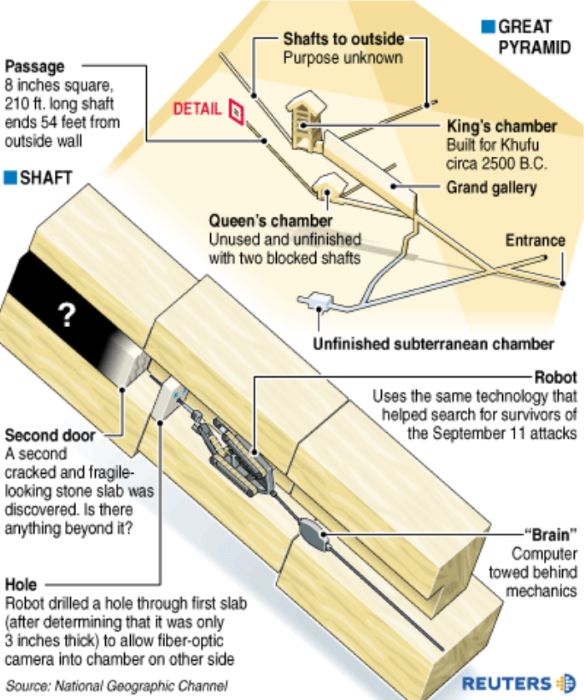
James’s argument begins by constructing a sense of hidden discovery abruptly curtailed by authority, centering on the exploration of the Queen’s Chamber shafts by the engineer Rudolf Gantenbrink in the early 1990s. The episode itself is real and well documented. A small robotic probe revealed a narrow shaft terminating in a limestone blocking stone fitted with copper elements, an unusual but not inexplicable feature within the broader context of pyramid architecture. What James emphasizes is not the discovery but the interruption. By presenting the cessation of Gantenbrink’s direct involvement as an act of suppression, he reframes an administrative and professional dispute as evidence of deliberate concealment. This move is rhetorically powerful because it transforms an ordinary feature of archaeological practice into the foundation of a conspiracy narrative.
That transformation depends heavily on the portrayal of Zahi Hawass, whom James presents as a gatekeeper figure suppressing inconvenient truths. There is no question that Hawass has been a controversial and highly visible figure in Egyptian archaeology, often assertive in defending institutional control over excavation and research, particularly in matters involving foreign teams and high-profile sites. His public persona, shaped by media appearances and strong rhetorical style, has made him an easy target for critics who conflate personality with policy. Yet James’s depiction collapses the distinction between authority and censorship in a way that obscures how archaeological governance actually functions. Archaeological work in Egypt, particularly at a site as globally significant as Giza, is governed by strict oversight, permitting systems, and national heritage laws designed to protect cultural patrimony from damage, exploitation, and unsupervised intervention. These frameworks emerged in part from a long history of colonial extraction and uncontrolled excavation, and they continue to shape how research is approved and conducted today. Disputes over methodology, credit, access, or interpretation are not uncommon in such an environment, but they occur within a regulated professional landscape rather than a clandestine system of suppression. To interpret administrative decisions or professional disagreements as evidence of a coordinated effort to silence alternative theories requires a leap that is not supported by the structure or documented practice of Egyptian archaeology.
The claim of suppression becomes even more tenuous when placed alongside the continued investigation of the very features James presents as hidden. Subsequent projects, including later robotic explorations and international collaborations, have revisited the Queen’s Chamber shafts using more advanced technology, producing new images and data while operating within formal research frameworks. The so-called “doors” and their copper fittings have been examined, drilled, and partially explored under controlled conditions. These efforts demonstrate that the shafts are not off-limits mysteries but active subjects of ongoing study. What James frames as a closed door is actually an open research question approached incrementally, as is typical in archaeology where preservation concerns and technical limitations shape the pace of inquiry.
James’s narrative also relies on a broader insinuation that mainstream Egyptology is built on fragile assumptions maintained through institutional pressure rather than evidence. This framing ignores the cumulative and self-correcting nature of archaeological knowledge, which develops through the aggregation of fieldwork, comparative analysis, and ongoing scholarly debate. Interpretations of the Great Pyramid are not the product of a single authority or a fixed orthodoxy, but of more than a century of excavation, documentation, and technological investigation conducted by researchers across different countries, institutions, and methodological traditions. Findings are regularly challenged, refined, and sometimes overturned as new data emerges, whether through improved dating techniques, non-invasive scanning, or renewed analysis of earlier discoveries. The idea that such a system persists only by suppressing dissent overlooks the degree to which disagreement is built into the scholarly process itself. Competing interpretations are not only permitted but expected, provided they are supported by credible evidence and transparent reasoning. To suggest that this entire framework operates as a mechanism of concealment requires more than isolated anecdotes or personality-driven critiques. It would require clear, consistent, and verifiable evidence of systematic exclusion across institutions and generations of scholars, something James does not offer.
What emerges instead is a familiar pattern in pseudo-archaeological discourse: the creation of an oppositional dynamic in which institutional control is equated with intellectual dishonesty. By positioning himself against an allegedly suppressive establishment, James elevates speculation into a form of resistance, inviting viewers to see skepticism toward scholarship as a mark of independent thinking. Yet this inversion obscures a crucial point. Critical inquiry does not reject expertise wholesale; it evaluates claims according to evidence, method, and reproducibility. The illusion of suppression in James’s presentation serves not to expose hidden truths, but to lower the evidentiary threshold required to accept extraordinary claims about the past.
Tomb Theory and Misuse of Absence
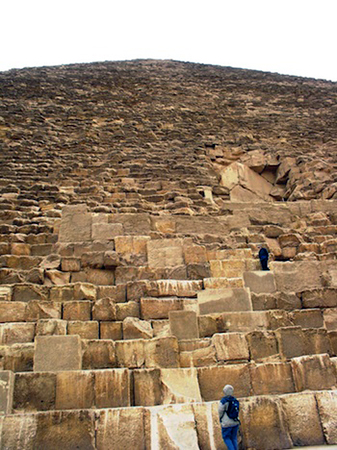
A central pillar of James’s argument is the claim that the Great Pyramid cannot have functioned as a tomb because no mummy has ever been found within it. This assertion is presented as a decisive contradiction of mainstream Egyptian studies, but it rests on a fundamental misunderstanding of how archaeological evidence operates. The absence of a mummy in the Great Pyramid is not surprising when viewed within the broader context of ancient Egyptian burial practices. Royal tombs, particularly those of the Old Kingdom, were subject to looting from a very early period, often within decades of their completion. Valuable grave goods, including the body itself when adorned with precious materials, were prime targets. The archaeological record across Egypt demonstrates that the overwhelming majority of elite burials were disturbed, reused, or emptied long before modern excavation began. To treat the absence of a mummy as evidence that the pyramid was never intended as a tomb is to ignore the historical reality of tomb robbery as a persistent and well-documented phenomenon.
James extends this reasoning by questioning the identification of the pyramid with Khufu, emphasizing that the inscriptions bearing the king’s name are painted rather than carved and could represent later graffiti. This argument selectively reframes standard archaeological evidence as inherently suspect. The red ochre quarry marks found in the relieving chambers above the King’s Chamber, including cartouches naming Khufu, are consistent with marks left by work crews during construction. Such inscriptions are not decorative or commemorative texts but practical labels, often hidden within internal spaces not intended for later access. Their placement and form align with similar markings found at other Old Kingdom sites, where labor teams identified themselves and their work assignments. The suggestion that these marks were added at a much later date would require not only access to sealed chambers but also a coordinated effort to fabricate evidence in locations that were unknown until modern exploration, a claim that lacks supporting proof.
The absence of elaborate hieroglyphic decoration within the Great Pyramid is likewise presented by James as evidence against its funerary purpose. Yet this argument imposes expectations derived from later periods onto an earlier architectural tradition. The richly inscribed pyramid texts that appear in Fifth and Sixth Dynasty pyramids were not part of the design of Fourth Dynasty monuments. The Great Pyramid belongs to an earlier phase in which internal decoration was minimal or absent, reflecting different religious and symbolic conventions that had not yet developed into the textualized funerary programs of later centuries. This is not an anomaly but a chronological reality, one that reflects the evolution of royal ideology rather than its absence. Funerary function in ancient Egypt was not defined solely by visible inscriptions but by the combination of architectural form, spatial arrangement, and ritual context, including the orientation of the structure, the placement of internal chambers, and the integration of the pyramid into a broader mortuary landscape that included temples, causeways, and subsidiary burials. The presence of a sarcophagus within the King’s Chamber, the pyramid’s precise alignment with cardinal directions, and its connection to the surrounding necropolis all reinforce its interpretation as a royal tomb. Moreover, the development of funerary texts in later pyramids suggests not a departure from earlier practice but an elaboration of it, indicating continuity in purpose even as expression became more explicit. To treat the absence of inscriptions in the Great Pyramid as evidence against its funerary role is to misunderstand both the chronological sequence of Egyptian religious expression and the multiple forms through which that expression was conveyed.
Underlying James’s treatment of these issues is a broader methodological problem: the conversion of uncertainty into disproof. By assembling a series of absences, no mummy, no carved hieroglyphs, no explicit construction records, he constructs the impression that the tomb theory collapses under scrutiny. Yet historical interpretation rarely depends on a single piece of definitive evidence. It relies instead on converging lines of data that provide the most coherent explanation available. In the case of the Great Pyramid, the cumulative evidence from archaeology, comparative architecture, and textual sources strongly supports its identification as a royal funerary monument. James’s argument does not overturn this conclusion. It highlights gaps that are already acknowledged within scholarship and then treats those gaps as if they invalidate the entire framework. Such reasoning does not strengthen historical understanding; it substitutes selective doubt for systematic analysis.
Engineering Feats and the Argument from Incredulity
One of the most persistent strategies in James’s video is the repeated insistence that the construction of the Great Pyramid is simply too difficult to be explained by the tools and techniques attributed to the ancient Egyptians. Massive stones, precise placement, and large-scale organization are presented not as challenges to be investigated, but as impossibilities that invalidate conventional explanations outright. This line of reasoning rests on what historians and philosophers of science recognize as an argument from incredulity: the assumption that because something appears implausible to a modern observer, it must be false. James does not demonstrate that Egyptian methods were incapable of producing the observed results. Instead, he invites the viewer to share in a sense of disbelief, substituting intuition for analysis and spectacle for evidence.
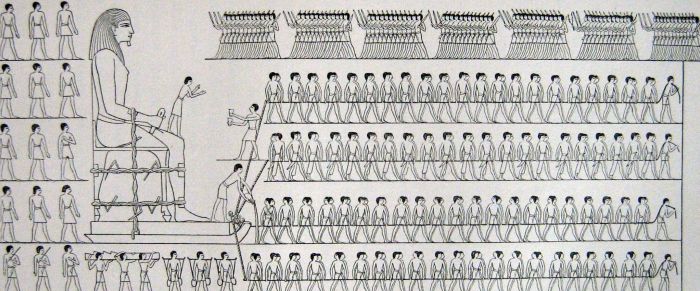
Central to this argument is the question of transporting and lifting large stone blocks, particularly those weighing tens of tons. James emphasizes the size of these stones and contrasts them with modern machinery to suggest that ancient methods would have been inadequate. Yet this comparison is misleading because it assumes that ancient builders attempted to solve the problem in the same way modern engineers might. Archaeological and experimental evidence indicates that the Egyptians employed a combination of sledges, lubricated surfaces such as wetted sand, and coordinated labor to move heavy loads with surprising efficiency. Wall reliefs, including those from the tomb of Djehutihotep, depict large statues being transported on sledges with workers pouring liquid in front to reduce friction. Experimental reconstructions have demonstrated that such techniques can significantly lower the force required to move heavy objects, making large-scale transport feasible without wheeled vehicles or advanced machinery.
James’s treatment of stone cutting follows a similar pattern. He highlights modern demonstrations in which copper tools appear ineffective against hard stone, presenting these results as proof that ancient Egyptians could not have achieved the precision observed in the pyramid’s construction. This argument oversimplifies both the materials involved and the techniques used. Copper tools were not used in isolation, but in conjunction with abrasive materials such as sand, which dramatically increase cutting efficiency by allowing the tool to act as a carrier for harder particles that actually perform the cutting. In addition, harder stones like dolerite were employed as pounders for rough shaping, especially in quarrying stages where precision was less critical than mass removal. Experimental archaeology has repeatedly shown that, while labor-intensive, these methods are capable of producing precise cuts over time, particularly when applied systematically by a large, organized workforce rather than by a handful of modern experimenters working under constrained conditions. The slow pace of modern demonstrations, often conducted as isolated tests with limited manpower and time, does not accurately reflect the scale, specialization, or cumulative labor force available to ancient Egyptian builders. Moreover, tool wear and replacement, which James presents as a limiting factor, would have been managed within a broader system of production in which tools were continuously repaired, reshaped, or replaced as part of an ongoing workflow. The apparent inefficiency of copper tools in controlled experiments does not demonstrate impossibility but rather highlights the difference between modern demonstration and ancient industrial practice.
The issue of precision itself is also exaggerated in James’s account. The joints between stones in the Great Pyramid are indeed impressive, but they are not uniformly perfect, nor do they require advanced or unknown technology to explain. Variations exist throughout the structure, and the highest levels of precision are typically found in areas of particular importance, such as internal chambers, rather than across the entire monument. Egyptian builders achieved this precision through careful planning, repeated measurement, and incremental adjustment, techniques well within the capabilities of a society with a strong tradition of practical geometry and large-scale construction. Similar levels of craftsmanship can be observed in other ancient contexts, suggesting that precision is not evidence of lost technology but of skilled labor and accumulated expertise.
James further reinforces his argument by appealing to construction timelines, asserting that the Great Pyramid could not have been built within the traditionally estimated period of roughly twenty years. His calculations rely on simplified assumptions that do not account for the scale of labor organization or the possibility of simultaneous work across different parts of the structure. Ancient Egyptian state projects mobilized large, rotating labor forces, often drawn from agricultural populations during periods when farming activity was low. Evidence from workers’ villages at Giza indicates a well-organized system capable of sustaining thousands of laborers with food, housing, and logistical support. When construction is understood as a coordinated, multi-phase process involving quarrying, transport, shaping, and placement occurring in parallel, the proposed timeline becomes far more plausible. James’s conclusion of impossibility arises not from the evidence itself, but from a model that fails to reflect how ancient large-scale projects were actually executed.
Precision, Mathematics, and Retroactive Meaning
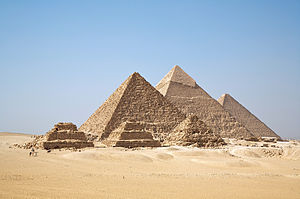
James advances his critique by turning from construction techniques to questions of mathematical sophistication, arguing that the Great Pyramid encodes advanced knowledge of constants such as pi and the golden ratio. These claims are presented as evidence that the structure reflects a level of scientific understanding far beyond what is attributed to ancient Egyptian civilization. At first glance, the numerical correspondences he highlights can appear striking. Ratios derived from the pyramid’s dimensions seem to approximate familiar constants, and these approximations are then interpreted as intentional design features. Yet the movement from numerical coincidence to deliberate encoding is neither straightforward nor justified without careful methodological scrutiny.
The central problem lies in the retrospective imposition of modern mathematical concepts onto an ancient structure. Pi and the golden ratio, as formally defined and symbolically understood today, are products of later mathematical traditions. While it is true that ancient Egyptians possessed practical knowledge of geometry, particularly in surveying and construction, there is no evidence that they conceptualized these constants in the abstract form required to intentionally encode them within monumental architecture. The mathematical texts that survive from ancient Egypt, such as the Rhind Mathematical Papyrus, demonstrate competence in arithmetic and practical problem-solving, including approximations of circular areas, but they do not indicate a theoretical framework involving irrational constants or symbolic mathematical relationships of the kind James describes.
Moreover, the apparent presence of these constants often depends on selective measurement and interpretive flexibility. The dimensions of the Great Pyramid are not perfectly uniform, and different choices about which measurements to use can yield different ratios. By adjusting base lengths, heights, or slopes within a reasonable range of variation, it becomes possible to produce values that approximate a wide array of mathematical constants. This process, whether intentional or not, introduces a form of confirmation bias in which only those ratios that align with expected values are emphasized, while discrepancies are minimized or ignored. The result is not a demonstration of encoded knowledge, but a reflection of the analyst’s expectations imposed upon the data.
James extends this reasoning further by invoking claims about precise alignment to true north and the supposed geodesic centrality of the pyramid’s location. The alignment of the Great Pyramid to the cardinal directions is indeed highly accurate, and it stands as a testament to the observational and surveying skills of its builders. This precision does not require advanced or unknown science. Techniques based on stellar observation, particularly the use of circumpolar stars, have been proposed and experimentally supported as plausible methods for achieving such alignment, including procedures involving the tracking of star pairs and the establishment of true north through repeated observation. These methods rely on careful observation and consistency rather than abstract mathematical theory. Similarly, the claim that the pyramid occupies the geodesic center of Earth’s landmass is based on a modern construct that depends on how landmasses are defined, measured, and mathematically modeled using global data sets unavailable in antiquity. Even slight variations in how coastlines are calculated or what constitutes a landmass can shift such a “center” significantly. It is not a concept that would have been meaningful or even accessible within the intellectual framework of ancient Egypt, and its application to the pyramid represents a projection of modern geographical thinking onto an ancient context rather than evidence of intentional placement.
The appeal of these arguments lies in their ability to transform impressive but explainable features into evidence of hidden knowledge. Precision becomes proof of advanced science, and coincidence becomes intention. Yet this transformation overlooks the difference between practical expertise and theoretical abstraction. Ancient Egyptian builders did not need to understand mathematical constants in the modern sense to achieve remarkable precision. Their achievements reflect a deep empirical knowledge developed through experience, observation, and iterative refinement. To attribute these accomplishments to lost or anachronistic scientific knowledge is to underestimate the capabilities of the society that actually built the pyramid.
James’s interpretation illustrates a broader tendency to read meaning backward into historical artifacts. By starting with modern concepts and searching for their echoes in ancient structures, he constructs a narrative in which the past appears to anticipate the present. This approach reverses the direction of historical inquiry. Instead of asking what the evidence reveals about the knowledge and intentions of ancient builders, it asks how closely those builders can be made to resemble modern thinkers. The result is a form of retroactive meaning-making that obscures rather than clarifies the historical reality of the Great Pyramid and the culture that produced it. It encourages the elevation of numerical coincidence into intentional design while minimizing the importance of cultural context, technological capability, and documented practice. More importantly, it shifts attention away from the actual achievements of ancient Egyptian society, replacing them with speculative constructs that are difficult to test and even harder to falsify. It not only misrepresents the past but also diminishes the intellectual rigor required to understand it, substituting imaginative projection for disciplined historical analysis.
Astronomy, Coincidence, and Pattern-Seeking
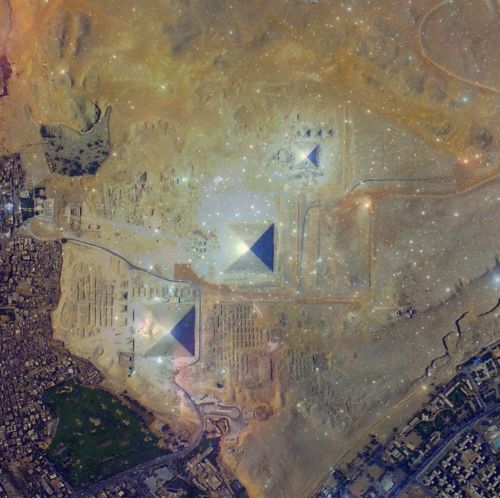
James expands his argument further by turning to astronomical claims, most notably the alleged alignment between the pyramids of Giza and the stars of Orion’s Belt. This idea, popularized in the late twentieth century, is presented as evidence of a deliberate and highly sophisticated celestial mapping that ancient Egyptians could not have achieved using conventional knowledge. In James’s framing, the correspondence is not approximate but exact, reinforcing the impression that the pyramid builders possessed advanced astronomical insight or inherited knowledge from an earlier, more sophisticated civilization. The visual appeal of this claim is undeniable, particularly when diagrams are overlaid to suggest a close match. Yet visual similarity alone does not establish intentional design, and the leap from resemblance to causation requires far more rigorous justification than James provides.
Scholarly evaluations of the Orion correlation theory have consistently demonstrated that the alignment is, at best, approximate and dependent on selective interpretation. The relative positions and sizes of the pyramids do not precisely match the stars of Orion’s Belt, and adjustments in scale, orientation, and perspective are often required to produce the desired correspondence. These adjustments are rarely acknowledged in popular presentations of the theory, where the emphasis is placed on the apparent fit rather than on the discrepancies. When the data is examined more critically, the supposed alignment becomes far less compelling, revealing itself as a constructed pattern rather than a definitive feature of the landscape. This does not mean that ancient Egyptians lacked interest in the stars. On the contrary, astronomical observation played an important role in their religious and cultural life. The issue is not whether the Egyptians observed the heavens, but whether the specific and highly precise correlations claimed by James can be supported by evidence.
James also invokes the orientation of internal shafts within the Great Pyramid, suggesting that they were designed to point toward specific stars, including those associated with Orion. While it is true that some scholars have proposed stellar alignments for these shafts, the evidence remains debated and far from conclusive. The shafts are narrow, irregular, and subject to structural constraints that complicate any straightforward interpretation of their purpose. Moreover, the precession of the equinoxes alters the apparent positions of stars over time, making precise alignment claims highly sensitive to chronological assumptions. By presenting these interpretations as settled fact, James simplifies a complex and ongoing scholarly discussion into a definitive statement that supports his broader narrative.
Beyond specific astronomical claims, James introduces a series of broader assertions about the pyramid’s global positioning, including the idea that it occupies a uniquely significant location on Earth. These claims rely on modern geographic frameworks and mathematical constructs that have no clear relevance to ancient Egyptian knowledge systems. The identification of a “center” of landmass, for example, depends on arbitrary definitions and computational methods that vary depending on how coastlines are drawn, which landmasses are included, and what projection is used to model the Earth’s surface. Even slight changes in these parameters can shift the calculated center by significant distances, undermining the notion of a single, fixed point of geodesic significance. To attribute such knowledge to the pyramid’s builders is to project contemporary concepts backward onto a historical context in which they did not exist, transforming modern analytical tools into imagined ancient intentions. This projection is not evidence of ancient insight, but of modern reinterpretation shaped by present-day assumptions, where meaning is imposed after the fact rather than derived from historically grounded evidence.
Underlying all of these arguments is a deeper cognitive tendency toward pattern-seeking, the human inclination to find meaningful connections even in random or loosely related data. This tendency is not inherently problematic. It is, in fact, a fundamental aspect of human cognition that allows for recognition, learning, and creativity. When applied without methodological restraint, it can lead to the identification of patterns that are not actually meaningful or intentional. In the case of the Great Pyramid, the combination of its geometric regularity, cultural significance, and global visibility makes it an especially fertile ground for such interpretations. James’s argument draws heavily on this tendency, encouraging viewers to see connections that feel compelling but are not supported by rigorous analysis. Visual overlays, numerical coincidences, and selective alignments create the impression of hidden order, yet they often rely on flexible criteria that allow patterns to emerge where none were deliberately designed. Without clear standards for distinguishing meaningful correspondence from coincidence, the process becomes self-reinforcing, confirming expectations rather than testing them.
The astronomical claims presented by James illustrate the difference between possibility and probability. It is always possible to draw connections between architectural features and celestial patterns, particularly when the criteria for similarity are flexible. The question is whether those connections are supported by independent evidence, consistent methodology, and historical context. In the case of the Great Pyramid, the evidence for precise and intentional alignment with Orion’s Belt or other specific celestial configurations remains unconvincing within the framework of established scholarship. What persists instead is a narrative shaped by visual appeal and interpretive freedom, one that reflects modern fascination with hidden knowledge more than it reveals the intentions of ancient builders.
Pseudoscience and Fabricated Authority
As James’s video progresses, the argument shifts from reinterpretation of archaeological evidence to the introduction of claims that fall outside the boundaries of established scientific inquiry. Figures such as Joe Parr are presented as independent researchers whose experiments reveal hidden properties of pyramid structures, including energy fields, radiation shielding, and even the ability to manipulate physical reality. These claims are not merely speculative extensions of existing evidence. They represent a transition into a form of reasoning that borrows the language of science while discarding its methodological foundations. The authority of the argument is constructed not through verifiable data or peer-reviewed research, but through the presentation of technical-sounding concepts that create the impression of legitimacy.
Central to this strategy is the use of scientific terminology without adherence to scientific standards. Terms such as “electromagnetic fields,” “frequency,” “radiation,” and “dimensions” are invoked in ways that suggest precision and rigor, yet they are not defined, measured, or tested according to accepted procedures. In James’s account, these concepts function rhetorically rather than analytically. They provide a vocabulary that signals scientific credibility to a general audience while avoiding the constraints that would accompany genuine scientific investigation. This selective use of language allows speculative ideas to be framed as discoveries, even when they lack empirical support or reproducibility.
The case of Parr’s experiments illustrates this pattern clearly. James describes a series of tests in which a pyramid model allegedly generates an energy field capable of blocking radiation, inducing levitation, and enabling objects to phase through matter. These claims are extraordinary in the strictest sense of the term, as they would require a fundamental revision of established physical laws if verified. Yet no credible documentation of these experiments exists within the scientific literature. There are no detailed methodologies, no independently verified results, and no replication by other researchers under controlled conditions. Without such evidence, the claims remain anecdotal at best, existing outside the framework of science despite their reliance on scientific language. More importantly, the internal logic of the claims themselves raises immediate concerns. Concepts such as radiation shielding, levitation, and matter-phase interaction are governed by well-established physical principles that require specific conditions, materials, and energy inputs, none of which are adequately described or demonstrated in the accounts James presents. The absence of quantifiable data, controlled variables, and transparent experimental design makes it impossible to evaluate the validity of these assertions in any meaningful way. What remains is not a body of evidence, but a narrative constructed from isolated claims that cannot be independently assessed or verified.
James reinforces these assertions by connecting them to broader concepts drawn from modern physics, including string theory and the existence of multiple dimensions. This association creates an illusion of theoretical support, suggesting that cutting-edge scientific ideas provide a foundation for the claims being made. This connection is superficial and misleading. Theoretical physics operates within a highly rigorous mathematical framework and is subject to strict standards of internal consistency and empirical testability. Concepts such as higher dimensions are not interchangeable with speculative claims about physical objects disappearing or traversing space in unconventional ways. By conflating these distinct domains, James blurs the boundary between legitimate scientific inquiry and imaginative extrapolation.
The appeal of this approach lies in its ability to present speculation as hidden knowledge waiting to be rediscovered. By positioning fringe claims alongside references to recognized scientific theories, James creates a narrative in which unconventional ideas appear not only plausible but suppressed or overlooked by mainstream institutions. This framing reinforces the earlier theme of institutional resistance, suggesting that the absence of acceptance within the scientific community is itself evidence of bias or concealment. Yet the standards that govern scientific acceptance are not arbitrary barriers. They exist to ensure that claims are supported by evidence that can be independently verified, tested, and reproduced. Without meeting these criteria, even the most intriguing ideas remain outside the domain of credible knowledge. The scientific community does not reject ideas because they are unconventional, but because they fail to meet these fundamental requirements. History offers numerous examples of initially controversial theories gaining acceptance once sufficient evidence was provided. By contrast, claims such as those attributed to Parr persist outside this process precisely because they lack the empirical grounding necessary to enter it.
The inclusion of pseudoscientific claims in James’s argument does not strengthen his critique of Egyptology. It undermines it by shifting the discussion from evidence-based analysis to speculative assertion. The Great Pyramid does not require appeals to unknown energies or unverified experiments to be understood as a remarkable human achievement. By relying on fabricated authority and unsupported claims, James replaces the complexity of historical and scientific inquiry with a simplified narrative in which mystery is preserved at the expense of explanation. Such an approach may be compelling in presentation, but it does not withstand the scrutiny required of serious scholarship.
Catastrophism and the Myth of Lost Advanced Civilization

In the later portions of his video, James shifts from questioning specific features of the Great Pyramid to proposing a far broader historical framework in which human civilization has undergone repeated cycles of destruction and technological regression. The pyramid becomes not simply an Egyptian monument, but a remnant of a lost, highly advanced civilization that existed prior to known history. This idea is presented as a plausible alternative to conventional archaeological timelines, supported by references to catastrophic events such as the Younger Dryas and by selective interpretations of sites like Göbekli Tepe. The argument is appealing in its scope, offering a sweeping explanation that connects disparate mysteries into a single narrative of forgotten knowledge.
At the center of this claim is the suggestion that a major global catastrophe, often linked to the Younger Dryas climatic event around 11,700 years ago, effectively “reset” human civilization. James presents this event as both well established and sufficient to erase an advanced technological culture, leaving only monumental traces such as the pyramids. While it is true that the Younger Dryas represents a significant climatic shift documented in paleoclimate records, the leap from environmental change to the existence of a lost global civilization is unsupported by archaeological evidence. The transition associated with the Younger Dryas reflects changes in climate, flora, and fauna, as well as adaptations in human subsistence strategies, not the collapse of an advanced technological society. There is no material record, no tools, infrastructure, or cultural remains that would indicate the prior existence of such a civilization on a global scale. Archaeological sequences from multiple regions of the world show continuity across this period, with gradual shifts in settlement patterns, subsistence practices, and social organization rather than abrupt, universal disruption. If a technologically advanced civilization had existed and then vanished during this event, its absence from the archaeological record across continents would require an implausible level of total erasure, inconsistent with what is known about how material evidence persists.
James further strengthens his argument by invoking Göbekli Tepe as proof that ancient humans were far more advanced than traditionally believed. The site is indeed remarkable, dating to the Pre-Pottery Neolithic period and featuring large, carefully constructed stone enclosures. Its significance lies in what it reveals about early social organization, ritual behavior, and the capacity for coordinated labor, not in evidence of lost high technology. The builders of Göbekli Tepe did not possess metal tools, writing systems, or complex machinery. Their achievements demonstrate that organized, large-scale construction predates the development of agriculture in some regions, but they do not support the existence of an advanced, technologically sophisticated civilization that later disappeared without trace. James’s interpretation transforms an important archaeological discovery into a cornerstone of a speculative narrative by extending its implications far beyond what the evidence can sustain.
The concept of repeated civilizational collapse also depends on the assertion that multiple large-scale cataclysms have occurred throughout human history, each resetting progress and erasing technological knowledge. While natural disasters have undoubtedly shaped human societies, the archaeological record does not support a pattern of complete global resets. Instead, it reveals continuity, adaptation, and regional variation. Cultural developments emerge gradually, influenced by environmental conditions, resource availability, and social dynamics. Even in cases of significant disruption, such as volcanic eruptions or climatic shifts, human populations adapt and rebuild, leaving behind evidence of both continuity and change. Stratigraphic records, settlement remains, and material culture sequences consistently show layers of occupation and transformation rather than abrupt, universal breaks. Where disruptions occur, they are localized and varied in their effects, not synchronized across the globe in a manner that would suggest a single, civilization-ending catastrophe. This cumulative evidence challenges the idea that human history has been repeatedly erased and restarted, instead pointing to a more complex and continuous process of development.
James’s argument also relies on a misunderstanding of what constitutes evidence in archaeology. The suggestion that an advanced civilization could have existed without leaving behind identifiable material traces assumes a level of disappearance that is inconsistent with what is known about preservation and material culture. Even relatively small or short-lived societies leave behind artifacts, settlement patterns, and environmental impacts that can be detected through modern methods. A civilization capable of constructing monuments like the Great Pyramid using advanced technology would have produced a wide range of material evidence, from tools and infrastructure to waste products and altered landscapes. The absence of such evidence is not a minor gap but a fundamental challenge to the hypothesis itself. Archaeological methodologies, including remote sensing, stratigraphic excavation, and material analysis, are specifically designed to detect traces of past human activity across a wide range of environments. The consistent failure to identify any such evidence for a lost advanced civilization is not due to oversight or suppression, but to the absence of data that would support the claim.
The appeal of catastrophism and lost civilization narratives lies in their ability to provide simple, dramatic explanations for complex historical questions. By attributing unexplained features to a vanished source of superior knowledge, James bypasses the need to engage with the incremental and often incomplete nature of archaeological evidence. Yet this approach replaces one set of unanswered questions with another, far more problematic set that lacks empirical support. The history of human civilization, as revealed through archaeology, is not a story of repeated erasure and rediscovery, but of gradual development, innovation, and cultural transmission. The Great Pyramid stands as a testament to that process, not as an isolated remnant of a forgotten world beyond the reach of evidence.
The Sphinx and Recycled Controversies

James extends his broader argument by turning to the Great Sphinx of Giza, presenting it as further evidence that established Egyptological timelines are fundamentally flawed. Central to this claim is the assertion that the weathering patterns on the Sphinx indicate significant water erosion, which, according to proponents of this view, would require a much earlier date of construction than the conventional attribution to the reign of Pharaoh Khafre in the Fourth Dynasty. James treats this interpretation as both persuasive and underappreciated, suggesting that it challenges the foundations of accepted chronology and points toward a deeper, more ancient origin for monumental construction in Egypt. The Sphinx becomes another focal point in his broader narrative of lost knowledge and suppressed evidence.
The argument for water erosion on the Sphinx, most prominently associated with Robert M. Schoch, has been the subject of extensive debate within both geological and archaeological circles. Schoch has argued that certain patterns of vertical weathering are consistent with prolonged exposure to heavy rainfall, conditions that would place the Sphinx’s construction in a much earlier, wetter climatic period. This interpretation is far from universally accepted. Many geologists and Egyptologists contend that the observed weathering can be more plausibly explained by a combination of wind erosion, salt crystallization, and the natural variability of the limestone layers from which the Sphinx was carved. These processes, acting over millennia, are sufficient to produce the features observed today without requiring a drastic revision of the monument’s date.
James presents the water erosion hypothesis as a neglected or marginalized perspective, reinforcing his broader theme of institutional resistance to unconventional ideas. Yet the debate surrounding the Sphinx has been widely discussed in academic and professional contexts, with multiple studies examining the geological evidence in detail. The issue is not one of suppression, but of competing interpretations evaluated through established methodologies. The majority view within the scholarly community remains aligned with the Fourth Dynasty dating, supported not only by geological considerations but also by archaeological context, including the relationship between the Sphinx, the surrounding quarry, and the associated temple complexes that can be securely linked to Khafre’s reign. These contextual associations are critical, as they situate the Sphinx within a broader architectural and cultural program that includes the Valley Temple and causeway, both constructed using stone quarried from the Sphinx enclosure itself. This integrated landscape provides a coherent framework that aligns geological, archaeological, and historical evidence. By isolating the Sphinx from this context and emphasizing a single line of interpretation, James’s argument overlooks the cumulative weight of evidence that supports the conventional dating and reduces a complex scholarly discussion to a simplified narrative of suppression and overlooked truth.
In addition to the question of erosion, James’s treatment of the Sphinx reflects a broader pattern of recycling longstanding controversies without engaging with the full scope of the evidence. Claims about hidden chambers, lost inscriptions, and alternative chronologies have circulated for decades, often reappearing in new media with little substantive development. These narratives tend to emphasize unresolved questions while overlooking the substantial body of research that addresses them. By focusing on anomalies and presenting them as decisive contradictions, James creates the impression of a field in disarray, when in fact the debates are part of an ongoing process of refinement and inquiry characteristic of any mature discipline.
The Sphinx serves in James’s argument as both symbol and support for a larger interpretive framework that prioritizes mystery over explanation. While the monument does raise important questions about construction techniques, environmental history, and cultural meaning, these questions are actively investigated within the framework of established scholarship. The persistence of alternative interpretations does not, in itself, invalidate the prevailing consensus, particularly when those interpretations rely on selective evidence and incomplete analysis. As with the pyramid, the significance of the Sphinx lies not in its ability to sustain speculative narratives, but in its capacity to be understood through careful, methodical study grounded in verifiable data.
Conclusion: Why These Narratives Persist
The arguments presented by James reveal less about the Great Pyramid or the Sphinx than they do about the enduring appeal of alternative historical narratives. Throughout the video, patterns of reasoning recur: the elevation of uncertainty into evidence, the selective use of data, and the framing of scholarly disagreement as institutional suppression. These elements combine to produce a narrative that feels revelatory, offering viewers the sense that they are accessing hidden knowledge overlooked or ignored by experts. Yet this sense of discovery is constructed through rhetorical techniques rather than through the careful accumulation of verifiable evidence. The persistence of such narratives is not simply a matter of misinformation, but of their capacity to engage curiosity and challenge authority in ways that resonate with a broad audience.
Part of this appeal lies in the nature of the monuments themselves. The Great Pyramid and the Sphinx are extraordinary structures, and their scale, precision, and longevity invite questions that are not always easily answered. In the absence of complete certainty, gaps in knowledge can become fertile ground for speculation. James’s argument operates within these gaps, transforming open questions into definitive claims and presenting ambiguity as proof of deeper mysteries. This process reflects a broader human tendency to seek meaning and coherence, even when the available evidence supports more limited or provisional conclusions. The desire for comprehensive explanations can make complex, incremental understandings seem unsatisfying by comparison.
Another factor contributing to the persistence of these narratives is the perception of expertise and authority. By positioning himself against established Egyptology, James aligns with a broader cultural skepticism toward institutions and specialized knowledge. This stance can be persuasive, particularly when it is framed as a challenge to orthodoxy or as a defense of independent inquiry. The rejection of expertise does not, in itself, constitute a valid alternative framework. Scholarly disciplines develop methods, standards, and bodies of evidence precisely to evaluate claims systematically and to distinguish between plausible interpretations and unsupported assertions. When these standards are set aside, the result is not a more open or inclusive form of inquiry, but a collapse of the criteria that allow knowledge to be assessed and refined. In such an environment, the distinction between evidence and speculation becomes increasingly blurred, allowing narratives to gain traction based on their coherence or appeal rather than their empirical support. This dynamic is further reinforced by modern media ecosystems, where engaging and provocative claims are more likely to be amplified than careful, methodical analysis. Arguments like those presented by James can circulate widely and gain credibility through repetition and visibility, even in the absence of substantive evidence. The authority of the claim becomes tied not to its methodological rigor, but to its reach and resonance.
The endurance of the ideas presented by James reflects a combination of cognitive tendencies, cultural dynamics, and the intrinsic fascination of the ancient past. These narratives persist because they offer compelling stories that prioritize mystery, coherence, and revelation over the slower, more methodical processes of historical and scientific investigation. Yet the true significance of monuments like the Great Pyramid lies not in their capacity to sustain speculative interpretations, but in the insight they provide into the capabilities, beliefs, and achievements of the societies that built them. To understand these structures is to engage with evidence, context, and method, recognizing that the absence of complete certainty does not justify the substitution of imagination for analysis.
Bibliography
Affiliate disclosure: Amazon links on this site are paid links. As an Amazon Associate I earn from qualifying purchases.
- Allen, James P. Middle Egyptian: An Introduction to the Language and Culture of Hieroglyphs. 2nd ed. Cambridge: Cambridge University Press, 2010.
- Arnold, Dieter. Building in Egypt: Pharaonic Stone Masonry. New York: Oxford University Press, 1991.
- Bar-Yosef, Ofer. “The Natufian Culture in the Levant, Threshold to the Origins of Agriculture.” Evolutionary Anthropology 6:5 (1998), 159–177.
- Bunge, Mario. Philosophy of Science: Volume 1, From Problem to Theory. New Brunswick, NJ: Transaction Publishers, 1998.
- Clagett, Marshall. Ancient Egyptian Science, Volume III: Ancient Egyptian Mathematics. Philadelphia: American Philosophical Society, 1989.
- Diodorus Siculus. Library of History. Translated by C. H. Oldfather. Cambridge, MA: Harvard University Press (Loeb Classical Library), 1957.
- Feder, Kenneth. Frauds, Myths, and Mysteries: Science and Pseudoscience in Archaeology. 11th ed. New York: Oxford University Press, 2020.
- Gillings, Richard J. Mathematics in the Time of the Pharaohs. Cambridge, MA: MIT Press, 1972.
- Gordin, Michael D. The Pseudoscience Wars: Immanuel Velikovsky and the Birth of the Modern Fringe. Chicago: University of Chicago Press, 2012.
- Hawass, Zahi. Mountains of the Pharaohs: The Untold Story of the Pyramid Builders. Cairo: American University in Cairo Press, 2006.
- Herodotus. Histories. Translated by Robin Waterfield. Oxford: Oxford University Press, 1998.
- Krupp, E. C. Echoes of the Ancient Skies: The Astronomy of Lost Civilizations. New York: Harper & Row, 1983.
- Lehner, Mark. The Complete Pyramids: Solving the Ancient Mysteries. London: Thames & Hudson, 1997.
- Lehner, Mark, and Zahi Hawass. Giza and the Pyramids: The Definitive History. Chicago: University of Chicago Press, 2017.
- Magli, Giulio. Architecture, Astronomy, and Sacred Landscape in Ancient Egypt. Cambridge: Cambridge University Press, 2013.
- Mithen, Steven. After the Ice: A Global Human History, 20,000–5000 BC. Cambridge, MA: Harvard University Press, 2003.
- Pigliucci, Massimo. Nonsense on Stilts: How to Tell Science from Bunk. Chicago: University of Chicago Press, 2010.
- Reader, Colin. “A Geomorphological Study of the Giza Necropolis, with Implications for the Development of the Site.” Archaeometry 43:1 (2001), 1–17.
- Reisner, George A. A History of the Giza Necropolis, Volume I. Cambridge, MA: Harvard University Press, 1946.
- Richardson, Robert, et.al. “The “Djedi” Robot Exploration of the Southern Shaft of the Queen’s Chamber in the Great Pyramid of Giza, Egypt.” Journal of Field Robotics 30:3 (2013), 323-348.
- Rossi, Corinna. Architecture and Mathematics in Ancient Egypt. Cambridge: Cambridge University Press, 2004.
- Ruggles, Clive. Ancient Astronomy: An Encyclopedia of Cosmologies and Myth. Santa Barbara: ABC-CLIO, 2005.
- Sagan, Carl. The Demon-Haunted World: Science as a Candle in the Dark. New York: Random House, 1996.
- Schmidt, Klaus. Göbekli Tepe: A Stone Age Sanctuary in Southeastern Anatolia. Berlin: Ex Oriente, 2012.
- Schoch, Robert M., and Robert Bauval. Voices of the Rocks: A Scientist Looks at Catastrophes and Ancient Civilizations. New York: Harmony Books, 1999.
- Shaw, Ian, ed. The Oxford History of Ancient Egypt. Oxford: Oxford University Press, 2000.
- Shermer, Michael. Why People Believe Weird Things: Pseudoscience, Superstition, and Other Confusions of Our Time. New York: Henry Holt, 1997.
- Stocks, Denys A. Experiments in Egyptian Archaeology: Stoneworking Technology in Ancient Egypt. London: Routledge, 2003.
- Van Andel, Tjeerd H., and Curtis N. Runnels. Beyond the Acropolis: A Rural Greek Past. Stanford: Stanford University Press, 1987.
- Verner, Miroslav. The Pyramids: The Mystery, Culture, and Science of Egypt’s Great Monuments. New York: Grove Press, 2001.
- Weiss, Harvey, and Raymond S. Bradley. “What Drives Societal Collapse?” Science 291:5504 (2001), 609–610.
Originally published by Brewminate, 04.16.2026, under the terms of a Creative Commons Attribution-NonCommercial-NoDerivatives 4.0 International license.
About the Author