In 1970, April Ashley’s marriage became a test of who could legally be a wife, exposing how judicial choices gave medical evidence authority over the life she had built as a woman.

By Matthew A. McIntosh
Public Historian
Brewminate
Introduction: A Marriage Declared Never to Have Existed
On February 2, 1970, the High Court of England and Wales declared April Ashley’s marriage to Arthur Corbett void from its inception. More than six years after their wedding in Gibraltar, Justice Roger Ormrod held that Ashley did not qualify as a woman for the purposes of marriage. His decision gave an interpretation of her bodily history authority over her eligibility to become a wife. The ceremony had occurred, and the relationship had produced obligations that the parties disputed, but the court denied that a valid marriage had ever existed. Ashley’s life became the setting for a judgment about which characteristics the law would recognize as decisive.
Ashley had confronted the practical difficulties of establishing a life as a woman long before those proceedings. Born in Liverpool in 1935, she moved through maritime employment and psychiatric treatment before finding work in France, where she performed at Le Carrousel in Paris. Her earnings helped make possible the surgery she underwent in Casablanca in 1960. Returning to Britain, she pursued modeling and encountered forms of administrative acceptance, including treatment as female for national insurance purposes. But newspaper exposure in 1961 demonstrated how precarious her control over her public identity remained. When she married Corbett in September 1963, he already knew her history; the subsequent litigation cannot be understood as his discovery of something she had concealed. Nor was Ashley simply attempting to preserve their relationship. She contested his assertion that she was male while advancing an alternative claim for nullity based on allegations concerning his capacity or willingness to consummate the marriage. Her legal position separated two matters that an account centered exclusively on marital breakdown might obscure: ending the relationship and accepting the classification through which Corbett sought to invalidate it.
Nine doctors gave evidence in proceedings that subjected Ashley’s medical history and postoperative body to extensive examination. Ormrod reported considerable agreement among the witnesses about scientific knowledge, alongside differences in the conclusions they drew from it. The essential historical issue concerns the passage from medical description to legal authority. For marriage, he selected chromosomal, gonadal, and genital characteristics, where congruent at birth, as controlling criteria. Psychological identification and the effects of treatment could not displace them under the rule he adopted. That hierarchy depended on his understanding of the institution whose boundaries he was determining. Medicine supplied evidence, but the judgment established which evidence would govern Ashley’s capacity to enter a legally recognized union.
Understanding that process requires keeping Ashley’s experience in view while examining the court’s reasoning on its own terms. The judgment expressly confined its determination to marriage, leaving the relationship between its immediate holding and its wider consequences to subsequent legal developments. Its influence must be traced through the decisions and administrative practices that adopted or extended its approach. Equally, the surviving judgment is an interested account of Ashley; it arranges testimony around disputed legal questions and records her responses through judicial assessments of relevance and credibility. Her published recollections and other accounts of her life offer necessary perspectives on events that the litigation organized around classification. These sources reveal how recognition could operate unevenly across institutions, permitting accommodation in one setting while withholding marital status in another. The argument that biology required interpretation does not depend on denying the physical findings accepted by the court. It rests on examining why those findings acquired decisive legal force, what conception of marriage justified that choice, and how its application constrained the woman whose relationship was being judged.
Becoming April

The Liverpool of Ashley’s childhood appears in her recollections through crowded housing and the punishments imposed on a child regarded as different. Her family moved from Pitt Street to the Norris Green council estate, exchanging their earlier accommodation for a house on the city’s outskirts. Within the household, she remembered persistent insecurity, including harsh treatment by her mother and the humiliation associated with being considered insufficiently masculine. School provided further occasions for bullying. These experiences survive principally through accounts composed after she had become publicly known, and their retrospective form matters; they describe childhood through the understanding she subsequently developed of herself. Yet they establish the importance of an environment in which other people repeatedly treated her appearance and behavior as grounds for correction. Long before medical specialists examined her, the demands attached to being raised as a boy had already acquired immediate ramifications.
Going to sea offered an occupation familiar within her family and a possible answer to those demands. Ashley later explained her decision to enter the Merchant Navy as an attempt to become the kind of person others expected. Shipboard employment instead intensified her difficulties, and a crisis during her time in California resulted in hospitalization. Her return to Britain brought further psychiatric intervention, connecting adolescent distress to institutions that possessed their own explanations for what she was experiencing.
At Walton Hospital in 1953, clinicians interpreted Ashley through categories that combined questions of sexual attraction with her wish to live as a woman. Records subsequently produced during the marriage proceedings documented interviews and examinations, including questioning conducted under drugs. A June 1953 letter characterized her as homosexual and located the source of her depression in that assessment. The importance of this formulation lies in the explanation it made available to those treating her. Her statements about womanhood became part of a psychiatric account organized around the presumed problems of a male patient. Ashley’s later descriptions of hospital treatment also recalled electroconvulsive therapy and interventions intended to masculinize her. The surviving materials preserve different kinds of evidence. Clinical records show how practitioners classified their patient, while her recollections describe what receiving that treatment meant to her. Neither can simply substitute for the other, and the hospital’s terminology should not become the historian’s unexamined description.
Service work subsequently gave Ashley opportunities to move between places and establish acquaintances beyond her family. Employment in London included work at a Lyons Corner House, while a season in Jersey formed another stage in the movements that eventually took her to France. These jobs belong within the history of her transition because wages and personal connections affected what she could attempt. Living away from Liverpool also brought encounters with people whose dress and relationships departed from the expectations surrounding her childhood. Through these associations, the prospect of a different existence acquired practical examples, even while accommodation and employment continued to require ordinary, sometimes exhausting work.
In Paris, Le Carrousel offered paid employment in a setting where feminine presentation could command attention and professional value. Ashley performed as Toni April, joining a company whose reputation attracted fashionable audiences and enabled touring engagements. The photographs associated with this period can make the cabaret appear to have supplied an effortless passage into glamour, but her memoir describes a more demanding working life. She recalled stage fright and difficulties with singing and dancing, sometimes judging her own performances with considerable severity. Clothing and makeup belonged to a theatrical production that required preparation, coordination with musicians, and the ability to face an audience. Colleagues provided instruction as she learned the work. The distinction matters because earning a living through performance gave her resources that admiration alone could not supply. It also placed her within a network where knowledge about changing one’s appearance and obtaining treatment circulated through personal experience.
Among those colleagues, Bambi and Coccinelle were important. Museum accounts identify Bambi as the friend who introduced Ashley to a Parisian doctor prescribing estrogen, while Coccinelle’s experience of surgery in Casablanca made another form of treatment imaginable. In a later interview, Bambi remembered the importance of watching friends undergo operations before deciding to proceed herself. Such exchanges reveal a community evaluating possibilities through the experiences of certain people. Information about a doctor’s work could travel through friendship long before it became readily available through a recognized referral system.
Ashley went to Casablanca in May 1960 to undergo surgery performed by Georges Burou at the Clinique du Parc. A gynecologist, Burou had developed an influential technique for constructing a vagina using inverted penile skin, contributing to a surgical history that extended back to earlier European experiments. His practice attracted patients from different countries, giving Casablanca a distinctive place in the geography of treatment. For Ashley, reaching that clinic required the accumulation of earnings and the willingness to travel abroad for a major operation. Her account of the aftermath combines profound relief with severe pain and a difficult recovery. The physical results resist any description of the procedure as an uncomplicated moment of transformation. Yet the significance she assigned to it should receive equal attention. She remembered an intervention she had actively sought and understood as answering a need that earlier treatment had failed to address.
By the time she prepared to return to Britain, Ashley had acquired experience in making decisions about her own circumstances. She had supported herself through several kinds of work and found people whose knowledge expanded the choices available to her. Those achievements depended on cooperation as well as determination, especially the assistance of performers who knew doctors and could discuss treatment from experience. Surgery changed what she could expect from her body, while the task of securing a livelihood continued beyond the clinic. The next stage would take her into British fashion and public visibility, carrying ambitions formed through years of employment and friendship before she became the subject of a celebrated legal dispute.
Living Publicly as a Woman
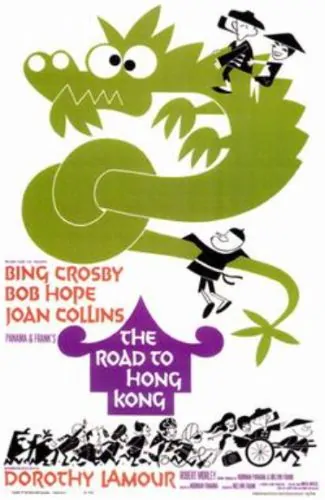
London fashion provided Ashley with opportunities to appear before the public without making her medical history the subject of the encounter. During 1960 and 1961, she obtained runway assignments and advertising work, including underwear modeling for British Vogue. A small part in The Road to Hong Kong, released in 1962, also suggested possibilities beyond fashion. These commissions placed her within businesses that selected women to embody desirable styles and sell certain products. Her employment demonstrated that she could meet those requirements, although continued bookings depended on decisions made by agents and clients whose acceptance could be withdrawn.
Knowledge of Ashley’s past circulated within this professional world before it reached a mass readership. Alex Nora Esculapio’s research on transgender models and the British press complicates the familiar account of complete concealment followed by sudden discovery. Drawing on Ashley’s later recollections, Esculapio describes her initial acceptance by Cherry Marshall’s agency and subsequent dismissal when information about her work at Le Carrousel reached its director. Another agency, Fashion Models, represented her with knowledge of that background. The contrast reveals differences among employers rather than a single industry policy. It also distinguishes selective disclosure from national publicity. People could know Ashley personally, or employ her with some awareness of her history, without turning that knowledge into a public announcement. Esculapio characterizes this arrangement as an “open secret,” emphasizing the unstable boundary between information acknowledged within a circle and information advertised beyond it. Ashley’s employment depended partly on the willingness of others to maintain that boundary.
Official paperwork offered a different means of establishing continuity between the name Ashley used and the transactions she needed to conduct. In 1961, she changed her name by deed poll and obtained a passport in that name, with Corbett’s assistance. The later judgment records both developments, together with an unsuccessful attempt to have her birth certificate changed. It also states that the Ministry of National Insurance issued her a woman’s insurance card and treated her as female for its purposes. Those distinctions require precision. A deed poll documented a change of name, while the passport enabled her to travel under it; the judgment does not establish the specific wording by which that passport described her sex. The insurance decision concerned an administrative classification, and the unchanged birth record preserved an entry that she had been unable to alter.
These documents had practical value even though they did not resolve every question another institution might ask. Producing papers consistent with her current name could reduce the need to explain herself during routine transactions. Hutton places such arrangements within a broader period when medical practice and administrative accommodation handled many questions that had received little explicit judicial attention. The difficulty arose when a different official required evidence whose contents had not been brought into agreement with the documents already obtained.
On November 19, 1961, the Sunday People published the revelation that transformed Ashley’s position within this system of selective knowledge. Its headline announced that her secret was out and presented her as an extraordinary case, making the newspaper’s disclosure the organizing event. That formulation encouraged readers to reconsider the model through information the paper claimed the authority to reveal. Ashley’s appearance now became an invitation to investigate her history. Adrian Bingham’s scholarship on the popular press helps locate this treatment within a commercial culture that made private sexuality a major source of news while continuing to claim the respectability of the family newspaper. Editors could attract readers through intimate disclosures and simultaneously present themselves as exposing matters the public ought to know. Ashley encountered a form of publicity whose value to the publisher depended on identifying her as exceptional. Professional visibility had helped her obtain work; this intervention attached a different meaning to being recognized.
The repercussions were substantial, but Ashley’s memoir preserves more than a record of universal rejection. She recalled canceled bookings and abusive telephone calls, alongside an employer who expected her to return and colleagues who welcomed her sympathetically. Their support could not prevent the ridicule she encountered beyond the dressing room. The distinction between those responses matters because it identifies the economic damage without erasing people who continued to regard her as a colleague. Her account describes a working environment disrupted by public scrutiny, with aftermath that personal kindness alone could not overcome.
Ashley subsequently entered negotiations to tell her story through the News of the World, a competitor in the same Sunday newspaper market. Beginning on May 6, 1962, “My Strange Life” appeared under her name, offering readers a narrative of her experiences rather than leaving the earlier disclosure unanswered. The opening installment centered on a reunion with her mother after a prolonged separation and described Ashley presenting herself as a daughter. It included her request that her mother use the name April, placing an ordinary form of personal acknowledgment within an emotionally elaborate account of family reconciliation. Photographs and descriptions of clothing reinforced the image of an adult woman participating in recognizable social relationships. News of her anticipated engagement to Corbett supplied another prominent element. These choices invited readers to understand her through affection and expectations of marriage, although the published account cannot be treated as an unmediated transcript of her intentions. Ashley later recalled that journalist Noyes Thomas produced the series, whose presentation she herself considered sensationalized.
Selling a personal narrative offered income and access to readers at a moment when other employment had become difficult. It also required Ashley to work with an editorial institution that retained control over how her account reached them. The byline gave her a public speaking position, while headlines and illustrations continued to frame what she said as remarkable. Her effort involved negotiation over the terms of exposure rather than the recovery of complete privacy. As the proposed engagement attracted attention, the press incorporated Corbett’s family position into the story, joining intimate expectations to the fascination surrounding her public identity.
Marrying Arthur Corbett: Intimacy and Social Position
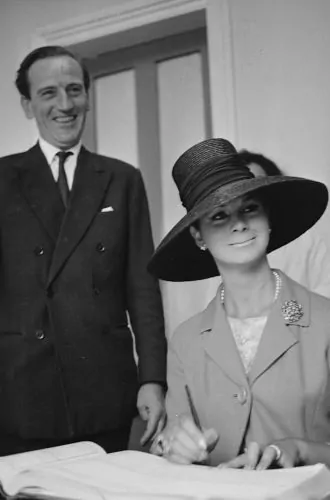
Arthur Corbett first met Ashley for lunch at the Caprice restaurant in London on November 19, 1960. He had sought an introduction through acquaintances familiar with the world in which she had performed, and he already knew about her history and surgery. Further conversations supplied additional details as they began seeing one another frequently. Corbett was then married and had four children, so the relationship developed within circumstances involving obligations that extended beyond the two people meeting in London. His knowledge is essential to understanding their subsequent marriage. Ashley’s background belonged to the relationship from its beginning, rather than emerging as an unexpected discovery after the wedding.
Corbett’s explanations of his attraction reveal expectations that were difficult to reconcile. In testimony, he connected his initial interest in Ashley with his own experiences of cross-dressing and admiration for an appearance he had wished to achieve himself. He subsequently described his feelings as those of a man in love with a woman. Ashley offered a less settled account of their attachment, recalling generosity alongside jealousy and demands that she found exhausting. These descriptions should remain attached to the people who supplied them. Corbett’s cross-dressing does not establish a retrospective gender diagnosis, while Ashley’s later dissatisfaction cannot disclose everything she felt during the courtship. The surviving correspondence also gives unequal access to their perspectives. The judgment records that nearly all Corbett’s letters remained available, whereas all but one of Ashley’s had been destroyed. His repeated declarations occupy more documentary space than her responses.
Marbella became the principal setting in which their expectations were tested. Corbett acquired a villa and the Jacaranda nightclub, and Ashley joined him in Spain in December 1961. Her visits were intermittent, with journeys elsewhere interrupting any prospect of continuous domestic life. During periods described in the judgment, she occupied the villa while he slept at the club. He provided substantial support, but proximity and financial assistance did not produce agreement about their future. The engagement continued through departures and reconciliations, with Ashley repeatedly resisting pressure to marry.
The prospect of becoming a wife also carried meanings shaped by Corbett’s family position. He was the son and heir of the second Baron Rowallan, and his letters imagined Ashley eventually becoming Lady Rowallan. That title remained prospective; she was not marrying a man who already held the barony. Corbett presented marriage through an anticipated place within a titled family, giving social position a prominent role in his expressions of devotion. Ashley’s memoir acknowledges that this possibility interested her. Looking back, she wondered whether the imagined title might offer a “security of identity” that other achievements had failed to guarantee. Her question permits an interpretation more careful than either romantic fulfillment or calculated advancement. Status could be attractive to someone whose place in society had repeatedly been challenged, while remaining insufficient to overcome doubts about the person offering it. Recognizing that attraction preserves her capacity to weigh advantages without reducing her decision to a single motive.
Material assurances required scrutiny of their own. Ashley remembered the Marbella villa as something Corbett had given her, although she had not received the documentation necessary to establish the ownership she understood herself to possess. Such a promise could encourage expectations of stability while leaving the recipient dependent on the giver’s continued acknowledgment. Financial arrangements were also discussed before the wedding, but the available accounts do not establish that every assurance became an enforceable agreement. Her circumstances involved a distinction between enjoying support within the relationship and possessing resources she could independently claim if it ended.
Corbett’s first marriage legally ended in June 1962, removing an immediate obstacle to another ceremony. More than a year of uncertainty followed before practical preparations advanced through a lawyer in Gibraltar. A special license was obtained, and the wedding took place on September 10, 1963. Ashley’s memoir describes reluctance persisting almost to the ceremony, an account that complicates any assumption that reaching the register office resolved the engagement’s difficulties. The judgment adds a significant qualification concerning the professional assistance they received; neither party sought or obtained advice specifically establishing the marriage’s legal validity. Arranging the ceremony and obtaining its license should not be treated as evidence that the questions later raised in court had already received an authoritative answer. They had completed a recognizable process for marrying without securing agreement about every legal implication of their circumstances.
Their married life consisted of brief encounters rather than an established household. After returning to Marbella, Ashley traveled to London to prepare for possible admission to drama school; Corbett subsequently spent about a week with her there in October. They later gave conflicting accounts of their sexual relations during this period, disagreements that would acquire significance beyond the immediate failure of the relationship. A further visit to Spain ended with Ashley’s departure in early December. The judgment’s estimate that they spent no more than fourteen days together after the wedding refers to time accumulated across these months, not to a marriage abandoned fourteen calendar days after the ceremony. In the December letter reproduced by the court, Ashley stated that she would not return and turned to the immediate problems of finding employment and cheaper accommodation. She also complained that marriage had left her feeling less secure and referred to promises Corbett had denied making. The separation left unresolved questions about property and personal commitments that the wedding itself had done little to settle.
Bringing the Marriage before the Court
A claim to the Marbella villa supplied the immediate reason for Ashley’s return to legal advisers. Stephen Gilmore’s reconstruction dates her attempt to enforce that claim to 1965, when she instructed the solicitor Terry Walton. The problem concerned securing property she maintained Corbett had given her, rather than initiating proceedings to obtain a general ruling on her identity. Difficulties serving the necessary proceedings outside the English jurisdiction complicated that objective. What became a celebrated case about sex and marriage began through efforts to obtain a material benefit Ashley believed had already been promised. The route her lawyers selected would make her position as a wife weighty in ways that a direct determination of ownership might not have required.
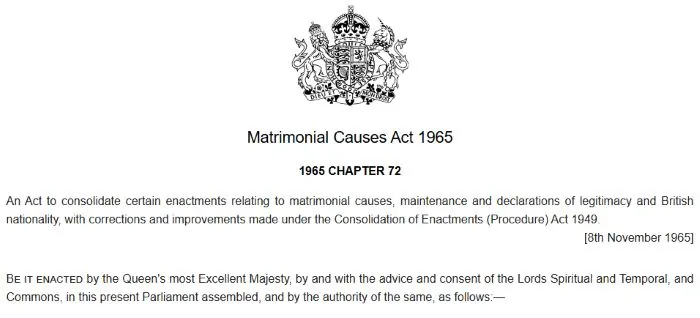
On February 16, 1966, Ashley’s solicitors issued an originating summons for maintenance under section 22 of the Matrimonial Causes Act 1965. That provision addressed neglect to maintain and empowered the court, subject to its jurisdictional requirements, to order payments where a husband had willfully failed to provide reasonable maintenance for his wife. An application under it did not require the applicant first to seek divorce or nullity. Ashley’s lawyers were invoking an existing matrimonial obligation as a substitute for proceedings directed immediately at the Spanish property. The distinction between the remedy requested and the underlying objective is important. The judgment records that she continued to assert her entitlement to the villa, while disclaiming an intention to seek financial provision during the later trial. Describing her simply as demanding alimony would obscure how procedural difficulties had redirected the dispute. Her claim had entered a statutory framework whose language assumed that the parties occupied the positions of husband and wife.
Corbett initially submitted an affidavit concerning his means without challenging the marriage’s validity. But on May 15, 1967, he filed the petition that placed Ashley’s qualification to marry at the center of the proceedings. He requested a declaration that the ceremony had been invalid because of her sex. Alternatively, he sought nullity on the ground that the marriage had not been consummated owing to her incapacity or willful refusal. These grounds required different inquiries, although both threatened to make intimate aspects of her life subjects of adjudication.
Ashley’s answer contested the classification on which the first claim depended. She maintained that she was female when the wedding took place and denied that she had been incapable of consummation or had deliberately refused it. Her pleading also advanced an alternative explanation of the marriage’s sexual difficulties, locating incapacity or refusal in Corbett. Through that argument, she sought a decree of nullity in her own favor. Alternative pleadings allowed her advisers to defend one proposition while preparing for the possibility that another issue would determine the result. Ashley could reject Corbett’s account of who she was without asking to resume life with him. The distinction gave her response a coherence easily lost when the proceedings are summarized as a husband seeking release from a marriage that his wife wished to preserve.
A further amendment, permitted late in the trial, attempted to make Corbett’s previous conduct a barrier to the declaration he requested. Ashley’s counsel pleaded estoppel, a legal argument that can prevent a person from advancing a position inconsistent with conduct on which another has relied. They also asked, separately, that the court exercise its discretion to withhold the declaration. Both submissions brought his informed participation in the wedding into legal focus. Why should someone who had known the relevant history and voluntarily married be permitted to invoke that same history against the union? The opposing position treated marital capacity as a question that the parties’ agreement could not conclusively determine. From that perspective, knowledge might answer an allegation of deception while leaving the validity of the marriage unresolved. Ashley’s defense required more than establishing Corbett’s awareness; it had to persuade the court that his conduct affected the relief available to him. The disagreement exposed a limit to the protective value of disclosure within a relationship, since complete openness did not necessarily prevent a later challenge to marital status.
The form of the eventual order also mattered independently of the competing descriptions of Ashley. A bare declaration of invalidity and a decree of nullity could produce different procedural consequences, especially concerning the court’s authority to entertain applications for financial relief. Preserving access to that jurisdiction would not guarantee an award, but it could keep a further claim available. Such distinctions make the proceedings difficult to understand solely as a confrontation between personal identity and medical classification. Property interests and the remedies available within matrimonial law helped determine which questions reached the judge. By the time the extensive medical evidence was heard, the pleadings had already made Ashley’s eligibility to be a wife a threshold issue in resolving the parties’ dispute.
Medical Evidence and the Terms of Recognition

On May 22, 1968, the court-appointed medical inspectors Leslie Williams and Josephine Barnes examined Ashley and recorded a satisfactory surgical result, including the absence of an anatomical impediment to sexual intercourse. They still recommended further investigation, requesting information about the Casablanca operation and an examination of her chromosomes. The resulting reports addressed different questions: one described her postoperative anatomy, while another supplied evidence about chromosomal characteristics. Neither document alone resolved the classification disputed in the proceedings. Ashley’s participation in the litigation required her to undergo examinations whose findings would acquire significance through the explanations other specialists supplied.
John Randell and Christopher Dewhurst, appearing for Corbett, approached surgical treatment through a distinction between relieving distress and changing sex. Their clinical work included recommending or participating in operations resembling the intervention Ashley had obtained abroad. They cannot adequately be described as physicians who opposed such treatment in every circumstance. The practice discussed in court required their patients to acknowledge that surgery would not alter their male sex, even when it was considered necessary to prevent deterioration in mental health. This was the consent framework used by their team, rather than evidence of what Ashley herself had signed in Casablanca. It made possible a medical position in which altering anatomy could be justified without accepting the patient’s preferred classification for marriage. Conversely, Martin Roth, called on Ashley’s behalf, expressed doubts about the therapeutic effectiveness of these procedures despite accepting that she should continue living socially as a woman. Recommendations about treatment and opinions about classification did not divide neatly along the opposing sides of the case.
For Ashley’s advisers, a more expansive understanding of intersex offered a potential basis for recognition. Charles Armstrong argued that her condition could fall within that category and that psychological considerations supported assigning her to the female sex. His use of the term encompassed matters beyond the congenital anatomical variations with which it is commonly associated today. Reading his testimony as confirmation of a present-day diagnosis would misrepresent both the argument and its historical vocabulary. David Andrew Griffiths’s research on British clinical thinking in 1969 shows how specialists were actively distinguishing bodily variation from psychological identity while continuing to encounter overlap between them. Ashley’s defense operated within those unsettled distinctions, seeking a classification that would allow medical authority to support her position.
Ivor Mills’s evidence pursued the possibility of a developmental or hormonal explanation, bringing Ashley’s earlier physical characteristics into renewed scrutiny. The suggestion that she might have had a condition resembling Klinefelter syndrome depended on information that the available record could not securely establish. Burou had not supplied the requested account of her preoperative anatomy, leaving the court without evidence that might have clarified some of the proposed explanations. Hormonal findings were also disputed. Urine tests had been conducted under conditions the judge considered insufficiently controlled, and a repeated test produced a different result. A psychological questionnaire attracted a related objection because its completion had not been supervised. Gilmore’s examination of the case emphasizes the contrast between the standing of the experts and the incomplete factual material on which parts of their reasoning depended. These deficiencies warranted caution about specific diagnostic claims without establishing that every broader interpretation advanced for Ashley was necessarily mistaken. They also illustrate the additional demands imposed when information obtained for clinical purposes was used as proof in contested proceedings.
The assistance available from sympathetic doctors carried conditions of its own. Ashley’s advocates could draw on professional interpretations that gave weight to her psychological experience, but those interpretations still depended on specialists deciding how that experience should be understood. A recommendation about the circumstances in which she ought to live did not necessarily entail recognition of every relationship she might enter. Griffiths and Katherine Hubbard’s work on the interaction between medicine and law places this difficulty within a longer history in which bodily variation complicated medical accounts without preventing institutions from demanding definite classifications. For Ashley, the immediate impact was that defending her position required more than describing the adult life she had established. Her lawyers had to present an account of that life through diagnostic categories whose scope, evidentiary requirements, and outcomes remained open to professional dispute.
Selecting the Decisive Body: Ormrod’s Rule for Marriage
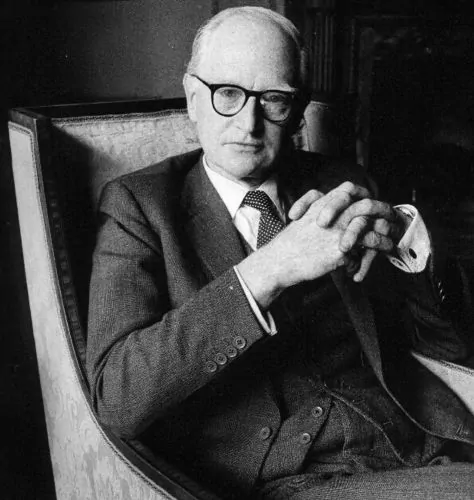
Ormrod’s legal analysis began by asking what distinguished marriage from other relationships regulated by law. He acknowledged that sex mattered little to many contractual obligations, while elsewhere it could affect the terms on which institutions dealt with individuals. Marriage occupied a different position in his reasoning because he understood its heterosexual character as constitutive of the relationship itself. Companionship and mutual support were important, but neither explained what made a union specifically matrimonial. He located that distinction in the participation of a man and a woman capable of what he regarded as natural heterosexual intercourse. This premise shaped his reformulation of the question before him: whether Ashley qualified as a woman within marriage, rather than whether the court should determine her classification for every legal purpose. Having stated that he knew of no directly applicable English authority, he presented the task as one requiring reasoning from principle.
The operative rule gave controlling weight to chromosomal, gonadal, and genital characteristics where they were congruent at birth. Surgical intervention was to be disregarded when applying that combination of criteria. Chromosomes did not constitute an independently sufficient test; the judgment relied on agreement among three specified features. Fixing their significance at birth also meant that Ashley’s eligibility depended on a reconstructed earlier bodily condition, rather than an assessment confined to her circumstances when she married. Subsequent treatment could change what doctors observed without changing the classification produced by the rule.
The treatment of cases involving discordant characteristics reveals the boundaries of this approach. Ormrod recognized that the three criteria might not always point in the same direction, but expressly left those circumstances for another decision. His suggestion that genital anatomy might then receive greater weight remained tentative. It should not be converted into a settled exception permitting recognition after particular operations. The distinction showed that the judgment did not exclude every possible medical revision of an earlier classification. A discovery that the original identification had been mistaken could be understood as correcting the record of an existing condition. Ashley’s treatment was placed outside that account because the judge accepted that her relevant characteristics had originally been congruent. The resulting division concerned the kind of change that medicine could establish. Correction of an earlier error remained conceivable, whereas the intervention she had sought could not acquire equivalent classificatory force. Scholarship emphasizing the biological and temporal dimensions of Corbett draws attention to this combination of selected characteristics and a legally privileged point in the individual’s history.
Hutton’s analysis identifies a further step within the apparently straightforward appeal to bodily facts. The judgment moved between descriptions of biological constitution and the category of “true sex,” allowing the latter to appear as the direct result of the former. Ormrod reported medical agreement about constitutional fixity, so the interpretation cannot rest on an assertion that he invented that agreement. The unresolved issue was why this conception of constitution should exhaust the meaning of womanhood relevant to marriage. Scientific findings could support statements about Ashley’s chromosomes or earlier organs without independently establishing the institutional significance those statements should receive. The language of an underlying truth helped make that additional judgment seem self-evident.
Ashley’s treatment and social circumstances failed to answer the question because Ormrod had defined its requirements in terms that excluded their decisive influence. He was aware that other authorities could accommodate her differently and offered an explanation for accepting those arrangements. Such bodies, in his account, could agree to treat an individual as female because their functions allowed it; marriage possessed characteristics that prevented comparable flexibility. His distinction between sex and gender supplied a rationale for limiting the significance of acknowledgments she had already obtained. This was a deliberate differentiation among institutions, whose adequacy depended on accepting his account of marriage. The historical criticism concerns that account and the rule constructed through it: why did entering this relationship require Ashley’s earlier anatomy to govern her eligibility so completely? By making those characteristics controlling, the court prevented evidence of her adult circumstances from altering the answer, however consequential those circumstances had been in the life she was seeking to have recognized.
Consummation and the Court’s Understanding of a Wife
Having concluded that the marriage was void, Ormrod examined the alternative ground concerning nonconsummation. For this part of the judgment, he provisionally assumed that the marriage was valid and that Ashley should be treated as a woman. The inquiry proceeded on a different footing from the classification already adopted. It asked whether the relationship could withstand Corbett’s further challenge even if the preliminary question were answered in her favor. The resulting discussion was conditional reasoning, unnecessary to the principal conclusion about validity, but revealing because it subjected her position to another standard. Recognition within the assumed category of woman did not resolve what the court required of a wife’s sexual capacity.
The parties’ conflicting descriptions of their encounters supplied one part of that inquiry. Ashley maintained that intercourse had occurred, while Corbett described her avoidance of sexual relations. Ormrod preferred his account, although he acknowledged difficulties in distinguishing deliberate refusal from psychological repugnance in their circumstances. His assessment favored refusal without making that distinction appear straightforward. The uncertainty concerned conduct and its explanation, rather than establishing a medical inability to permit penetration.
Earlier authority gave Ashley’s counsel a substantial argument against such a finding of incapacity. In S v. S (otherwise W) (No. 2), the Court of Appeal had considered a woman whose congenital vaginal condition could be corrected surgically. The availability of treatment meant that the existing condition did not necessarily establish the incurable incapacity required for nullity. Some observations went further, contemplating the possibility that constructing an entire vagina could enable consummation. Those passages mattered because they weakened any simple equation between surgically altered anatomy and inability to perform the legally relevant act. Ormrod distinguished the decision by emphasizing the earlier patient’s accepted status as a woman, her functioning ovaries, and the nature of her congenital condition. He treated the broader observations about a wholly constructed vagina as remarks extending beyond what that appeal required, thereby declining to give them controlling force in Ashley’s case.
The distinction became crucial when Ormrod considered the meaning of intercourse itself. The medical inspectors had identified no anatomical obstruction on Ashley’s part, so a finding of incapacity required something beyond their assessment of physical function. Drawing on older matrimonial authorities, he asked whether intercourse using her postoperative vagina could qualify as “ordinary and complete intercourse.” His answer depended on its origin and on his continuing description of the body in which it had been constructed. He compared its use with sexual practices that the law excluded from consummation, making anatomical location insufficient to establish the act’s matrimonial character. The conditional assumption that Ashley was to be treated as a woman did not prevent him from carrying his earlier account of her bodily history into this second inquiry. Surgical success could establish a capacity recognized by examining doctors while failing the legal definition he applied. The word “natural” performed substantial work in that separation, distinguishing qualifying intercourse from an act that could be physically possible and sexually meaningful to its participants.
The place of reproduction within this reasoning requires care. Ormrod’s reference to the earlier patient’s ovaries connected his distinction to reproductive anatomy, but he did not expressly impose an ability to conceive as a universal condition of marriage. As Gilmore observes, interpreting a woman’s essential marital role simply as procreation would encounter the established absence of such a requirement. The more immediate restriction concerned the form of intercourse the court accepted as consummation. Fertility and the legally recognized capacity for that act must remain distinct, even where the judgment’s language drew authority from assumptions about reproductive bodies.
Griffiths and Hubbard’s analysis helps explain why this dispute over sexual activity belongs within the history of classification rather than standing as a merely technical appendix to it. The law was determining both the participants’ status and which bodily practices counted within their relationship. For Ashley, the alternative reasoning meant that success against one objection would not necessarily protect the marriage from the other. Her advisers could point to medical evidence of functional capacity and to authority accepting corrective surgery, yet still encounter a distinction based on the history assigned to her anatomy. The court’s understanding of a wife involved more than placing her within a category; it also prescribed the kind of sexual participation through which that category could acquire matrimonial effect. Ashley’s postoperative body was subjected to a judgment about qualifying conduct that the clinical finding of no impediment could not, by itself, answer.
Ashley as Witness

Giving evidence placed Ashley in a position where her appearance could be assessed alongside the answers she supplied. The published judgment preserves both forms of scrutiny, moving between accounts of what she said and observations about how she looked or behaved. Early in his narrative, Ormrod announced that he would alternate between masculine and feminine pronouns according to context. That practice made the description of Ashley’s life part of the classificatory process rather than postponing classification until the legal reasoning appeared. The changing pronouns offered readers different ways of understanding the same person as the narrative proceeded. They also demonstrated the extent of the judge’s authority over the terms in which her testimony would survive.
Ormrod’s assessment of Ashley’s appearance developed through a similar movement between competing descriptions. He reported an initially convincing feminine impression, then explained that longer observation in the witness box brought her manner and gestures into association with professional impersonation. He also adopted Dewhurst’s characterization of her postoperative appearance as a “pastiche” of femininity. The term acknowledged the effectiveness of her presentation while positioning it as an imitation of something more authentic. Her earlier occupation supplied an available explanation for the qualities observers encountered, allowing evidence of accomplished femininity to be interpreted through theatrical artifice. These comments did not become an additional element in the formal rule governing marital sex. Their significance lies instead in how they organized the account of the person to whom that rule was applied. The judgment presented Ashley through an evaluative vocabulary that could recognize familiar feminine characteristics while withholding the meaning she attached to them.
The treatment of her responses to intimate questioning was more qualified. When Ashley declined to answer questions about her former genital anatomy and became distressed, Ormrod expressly refused to treat those responses as damaging her credibility generally. He accepted psychiatric evidence that such inquiries could provoke an intense emotional reaction. This acknowledgment matters because an account of uniformly punitive disbelief would misrepresent the record. He considered her answers unhelpful to the suggestion that her preoperative anatomy had been unusual. The distinction separated an explanation for her reluctance from the evidentiary effects of what remained unestablished. Distress could receive some protection against a general accusation of dishonesty without supplying the missing support for a specific medical argument.
Corbett’s evidence likewise received assessments that varied with its subject. Ormrod praised his apparent frankness and responsiveness, but questioned the quantity of the sexual experiences he claimed and doubted his usefulness as a measure of Ashley’s emotional responses. The judge’s criticism of Corbett’s fantasies coexisted with acceptance of his account on certain disputed events. Credibility operated through differentiated judgments rather than an uncomplicated decision to believe everything one party said. The imbalance in their eventual positions cannot be explained adequately by treating Corbett as a witness whose every statement passed without scrutiny.
Ashley’s recollections nevertheless faced a further difficulty because diagnostic descriptions could shape expectations about the reliability of her personal history. The judgment reported the characterization of people classified as transsexual as “selective historians,” supposedly inclined to emphasize experiences consistent with their identification. That was a claim about a diagnostic group, not an independently demonstrated conclusion about every statement Ashley made. The record contained specific discrepancies that mattered to the questions being investigated. Different accounts of when she began taking estrogen affected the proposed explanation of her physical development, and Ormrod treated them as relevant to the inference he could draw. Those disagreements required examination on their merits. A general diagnostic suspicion could not establish that every recollection was false, just as the possibility of ordinary uncertainty in remembering earlier events could not settle every disputed detail in her favor. The historian must preserve the difference between identifying a contradiction and allowing a category to predispose judgment about the speaker.
Her memoir describes the difficulty of anticipating how such scrutiny would operate. Before attending court, she recalled worrying that restrained clothing might appear masculine while greater femininity might be read as excessive effort. She also believed that her counsel placed too much confidence in the persuasive effect of her appearance. These recollections suggest that presenting herself involved decisions whose fallout she could neither predict nor control. The examinations generated another kind of strain. She remembered questions about her earlier body as painfully reopening experiences from which she had sought distance. Yet her account also records reassurance from doctors and appreciation of the assistance some provided. Written collaboratively years afterward, these passages give access to her later interpretation of the ordeal rather than an exact reconstruction of every feeling she experienced while it unfolded.
The relationship between memoir and judgment is important because the former expressly identifies many of its trial quotations as borrowed from the published law report. Their recurrence in Ashley’s book does not independently corroborate the reported exchanges. What the memoir adds is her retrospective assessment of the proceedings and the circumstances surrounding her participation. Grenfell’s analysis of legal narratives helps explain why these differences between sources matter. Adjudication organizes a person’s history around categories and disputes that require resolution, producing an account with an institutional purpose. Close reading can identify the assumptions embedded in that account without establishing that every adverse finding was mistaken or revealing the judge’s private motives. Ashley emerges more fully when her evidence is examined both as material evaluated by a court and as testimony given by someone who subsequently contested how that evaluation had represented her.
The Material Consequences
Financial questions remained unresolved after Ashley’s marriage had been declared void. In a separate judgment delivered on May 14, 1970, Ormrod considered the continuation of her maintenance and the allocation of legal expenses. The decree of nullity had preserved the court’s jurisdiction to entertain financial applications, giving practical significance to the form of order her lawyers had sought. Access to that jurisdiction left the outcome dependent on further assessments of need, conduct, and fairness between the parties. For Ashley, the aftermath of the principal decision involved additional proceedings in which support already obtained could be withdrawn and responsibility for the considerable expense of defending her position remained unsettled.
An order made on May 22, 1969, had provided Ashley with interim maintenance of £6 a week. Ordinarily, this allowance would have continued until the decree became absolute, but her notice of appeal postponed that stage and kept the existing order in operation unless the court intervened. Corbett’s counsel challenged the very authority under which the allowance had been granted, arguing that Ashley could never have qualified as a wife. Ormrod rejected that submission because the issue on which it depended had remained undetermined before trial. The court needed to make interlocutory orders while deciding the dispute, rather than assume its eventual answer when deciding whether assistance could be provided. This reasoning preserved an important procedural protection: losing the substantive argument did not establish that Ashley should have been denied support throughout the process of presenting it. Ormrod terminated the allowance with effect from the decree nisi. He relied on his finding that Ashley had not depended financially on Corbett after their wedding, the delay before her maintenance proceedings, and her disclaimer of financial claims in the witness box. Although he acknowledged that Corbett possessed substantial means and could afford the weekly payment, he treated continued liability as a question of reasonableness rather than capacity alone. The operative date matters. The order was discharged retrospectively to the decree nisi, rather than to its commencement in May 1969. The reported judgment contains no separate direction requiring repayment of every sum previously received.
Newspaper earnings supplied another element in this assessment, bringing Ashley’s attempts to obtain income through publicity directly into the financial proceedings. Ormrod recorded that the Sunday Mirror had paid £5,000 for interviews and photographs after the hearing, leaving £4,500 after commission. Her counsel explained that the money had gone to Freshrise Ltd, with which she had a service agreement providing an income of £60 a month, rising in stages to £200. That explanation presented an arrangement involving a company and future remuneration, rather than an unrestricted balance available for immediate personal expenditure. Ormrod preferred what he described as a “common sense” approach. Someone parting with £4,500 would ordinarily expect assets of corresponding value in return. He treated the transaction as evidence that Ashley no longer needed maintenance. The report establishes his inference, but its brief account does not independently demonstrate that the entire sum was accessible to her as private cash. The distinction between possessing an economic interest and having money available to meet current expenses received little sustained examination, although it was potentially momentous for a woman whose lawyers disputed the financial position attributed to her.
Responsibility for the expense of the hearing raised a different question. Corbett sought permission to amend his petition by adding a claim that Ashley should pay his costs, alleging that the conduct of her case had unnecessarily prolonged the proceedings. Ormrod accepted that greater cooperation over medical documents and expert preparation could have reduced expenditure, while acknowledging the difficulty of the case and the considerable achievement of counsel on both sides. He refused the amendment because Ashley had used opportunities permitted by the procedural rules, which did not provide sufficient grounds for imposing Corbett’s costs upon her. This decision gave substance to her ability to defend the proceedings. The court’s dissatisfaction with aspects of their preparation did not become an order transferring her opponent’s legal bill to her.
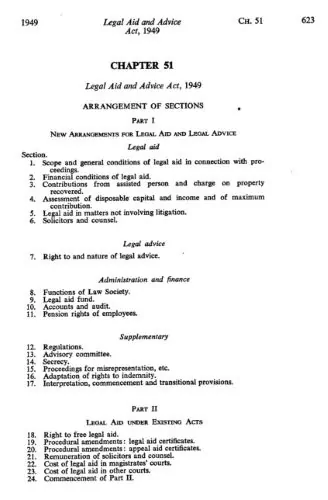
Behind the remaining costs dispute lay an older arrangement for financing matrimonial litigation. On July 9, 1969, Registrar Caird had ordered Corbett to provide £1,000 as security for Ashley’s costs, and the parties now contested what should happen to that deposit. Ormrod traced the practice of requiring a husband to secure his wife’s representation to circumstances in which married women’s property arrangements and limited independent resources could otherwise prevent them from obtaining legal assistance. In his account, protecting the solicitor’s prospect of payment had been essential to making representation possible. The Legal Aid and Advice Act 1949 had altered that practical situation by establishing public funding from which an assisted litigant’s lawyers could be paid. Where legal aid and security operated together, the deposit could benefit the legal-aid fund rather than protect a solicitor who would otherwise remain unpaid. Section 1(7)(b) preserved other parties’ rights and liabilities and the principles governing judicial discretion, but its application had produced disagreement about the survival of older costs practices. Ormrod held that the existing discretion could respond to changed circumstances, allowing the court to reconsider whether a successful petitioner should contribute to the other party’s expenses.
The resulting allocation exposes a significant limit to the protection Ashley had secured. Conduct that Ormrod considered insufficient to justify ordering her to pay Corbett’s costs became relevant when she sought a contribution toward her own. He reasoned that a litigant requesting such assistance should have taken every available step to simplify the hearing and reduce its expense. Having concluded that Corbett had already incurred avoidable costs, he declined to require any additional contribution, expressly stating that the parties’ relative financial positions did not determine this conclusion. The final order made no award of costs between the parties and directed that the £1,000 security be returned to Corbett’s solicitors. Ashley’s costs were to be assessed for legal-aid purposes, a process described in the judgment as taxation of costs. The deposit was neither compensation awarded to Ashley nor a statement of her total legal bill. Public funding continued to provide for the assessment of her representation, while the financial responsibility previously secured against Corbett was released.
Ashley’s later account places these arrangements alongside the difficulty of carrying the challenge further. In April Ashley’s Odyssey, she recalled an estimated appeal cost of £7,000, a substantial advance payment, and the additional expense of obtaining a transcript. She also described committing the newspaper money to a restaurant investment and disputed the accusation that she had deliberately disposed of resources to avoid paying legal costs. These recollections describe the funding obstacle as she experienced it, rather than supplying a complete account of the legal-aid decisions concerning a possible appeal. They draw attention to the distance between representation at the original hearing and the resources required to pursue another stage. Ashley had received meaningful procedural assistance, yet her ability to seek reconsideration still depended on assembling money, advice, and personal resolve after a demanding public trial.
Beyond the Marriage: How a Limited Rule Acquired Wider Authority
Ashley’s case acquired a significance that exceeded the question Ormrod had expressly undertaken to decide. His judgment concerned capacity to marry, but its detailed explanation of sex determination offered other courts a framework they could apply elsewhere. Christopher Hutton identifies this as a central paradox of Corbett: a decision disclaiming a comprehensive definition helped establish the expectation that legal sex required an authoritative bodily foundation. Its influence depended partly on the apparent comprehensiveness of the medical inquiry and on Ormrod’s standing as both judge and physician. Those features made the judgment persuasive beyond its immediate jurisdictional purpose. The subsequent history involved further decisions about the reach of Ashley’s case, through which reasoning developed around her marriage became a resource for determining the rights and liabilities of other people.
Pension adjudication provides an early example of that movement. Decisions reported in 1980 applied restrictive classifications when determining whether claimants living as women qualified for the female retirement age. In the decision identified as R(P) 2/80, the commissioner interpreted the statutory category of woman by reference partly to the capacity to contract a valid marriage with a husband. Marital eligibility supplied a reason for deciding entitlement under social-security legislation. The consequence concerned access to retirement income, illustrating how a definition associated with one institution could enter another through apparently familiar statutory language.
A more explicit extension followed in R v. Tan in 1983. The Court of Appeal applied Corbett when considering convictions under sex-specific legislation concerning prostitution, including convictions dependent on treating Gloria Greaves, a woman who had undergone gender reassignment surgery, as legally male. The judges invoked common sense and the desirability of certainty and consistency when rejecting different classifications for matrimonial and criminal purposes. That justification deserves attention because it supplied an additional legal argument rather than another medical discovery. Ormrod had explained why he considered particular characteristics decisive within marriage; the appellate court now treated consistency between legal settings as a reason to carry his approach further. Whether the purposes of the criminal provisions required the same definition was answered through a preference for continuity across the law. Ashley’s case had become an appellate authority whose impacts included exposure to criminal liability under provisions that distinguished between men and women.
Challenges before the European Court of Human Rights initially left substantial room for this approach to continue. In Rees v. the United Kingdom in 1986 and Cossey v. the United Kingdom in 1990, the Court found no violation of the Convention’s protections of private life or marriage arising from the United Kingdom’s refusal to provide the recognition sought. Its inquiry concerned the state’s obligations under the Convention, rather than simply the correctness of an English definition. The judgments allowed national authorities considerable discretion, taking account of differences between legal systems and the treatment of birth registration as a historical record. The Court emphasized the need to reconsider the position as relevant circumstances developed. These decisions prolonged the practical endurance of non-recognition while leaving its future justification open to renewed examination.
Employment protection developed through a different European legal route, demonstrating that wider authority did not produce uniform results. In P v. S and Cornwall County Council in 1996, the European Court of Justice held that dismissal on grounds of gender reassignment contravened the Equal Treatment Directive. Protection against that treatment could emerge without first resolving every question of civil status. The difficulty of reconciling these developments became visible when West Yorkshire Police rejected a transgender woman’s application to become a constable in 1998. The force’s reasoning treated her as legally male and unable to search women, while considering her appearance as a woman an obstacle to searching men. When the dispute reached the House of Lords in A v. Chief Constable of West Yorkshire Police in 2004, the judges upheld her discrimination claim through European Community equality law. The relevant provisions were interpreted to recognize her acquired gender in the circumstances before the court. This outcome exposed a limit to generalization from Corbett. Statutory interpretation directed toward equality could require a different answer from one derived from the assumption of an unchanging classification.
A broader reassessment had arrived in Christine Goodwin v. the United Kingdom on July 11, 2002. The European Court of Human Rights unanimously found violations of the rights to respect for private life and to marry. Its reasoning addressed the burdens created when a person’s established social identity conflicted with the status imposed by law, and questioned the coherence of publicly providing reassignment treatment while withholding recognition of its consequences. Congruent biological characteristics could no longer be treated as sufficient grounds for denying recognition to a person in Goodwin’s position. The judgment changed the balance between individual interests and the public justifications advanced for continued exclusion, while leaving states responsibility for devising an appropriate recognition process. The dispute Ashley had encountered was reconsidered through the obligations of government toward people living with the effects of its classifications.
Domestic change still required another institutional step. In Bellinger v. Bellinger in 2003, the House of Lords declined to declare Elizabeth Bellinger’s existing marriage valid through a revised interpretation of the statutory terms male and female. The judges considered that establishing conditions for recognition raised interconnected questions better addressed through legislation. They \declared the relevant provision of the Matrimonial Causes Act 1973 incompatible with the Convention because it failed to provide for recognition of gender reassignment. Bellinger obtained a formal acknowledgment of the law’s inadequacy without securing the declaration about her own marriage that she had sought. The decision preserved the existing domestic rule while placing its replacement within an expressly identified legislative responsibility.
The Gender Recognition Act 2004 supplied a statutory procedure through which a full certificate could establish an applicant’s acquired gender, subject to specified exceptions. Under its ordinary application route, recognition required supporting medical evidence, two years of living in the acquired gender, and an intention to continue doing so permanently. Surgery was not compulsory, a substantial departure from approaches that made some operations the necessary evidence of a legally acceptable transition. Institutional authorization remained essential, and the original legislation required married applicants to receive interim certificates until their existing marriages ended. Section 9 also limited the effect of recognition on events preceding the certificate’s issue. The legislation created possibilities for future legal relationships without retrospectively restoring Ashley’s marriage. Viewed across these developments, the authority attached to her case was neither confined to the intention stated in 1970 nor expanded by a single comprehensive ruling. It accumulated through decisions about statutory meaning, administrative entitlement, and the value of consistency, before sustained challenges required different grounds for recognition.
Ashley after the Judgment: Reclaiming the Account of Her Life
The years following the proceedings required Ashley to find work, sustain relationships, and make decisions that rarely enter accounts organized around the importance of Corbett. In her memoir, she dated the opening of AD8, the restaurant at 8 Egerton Gardens Mews, to March 2, 1970. Its fashionable atmosphere depended partly on her presence, but entertaining customers also involved demanding work and the continual preparation of an appearance they expected to encounter. Her account describes exhaustion and deteriorating relations with her business partners alongside the celebrated visitors. By September 1975, she had moved to Hay-on-Wye, where establishing herself brought further difficulties. These episodes complicate any assumption that public visibility supplied dependable independence. Ashley’s circumstances continued to change through employment and friendship, with the marriage proceedings occupying an increasingly distant place in a life that still required considerable practical invention.
Publication of April Ashley’s Odyssey in 1982 gave that subsequent life substantial space within her public account. The book emerged from a collaboration with Duncan Fallowell, whose later description of its production supplies evidence of Ashley’s initiative as well as his literary intervention. In a 2021 interview, Fallowell recalled that she had repeatedly asked him to write her story and had already settled on its title. He described extensive interviewing and research before composing the first-person narrative, while also explaining that his authorship received prominent credit by agreement. These recollections belong to a collaborator looking back on his own work, but they establish a more negotiated production than the simple transcription of remembered speech. Ashley brought the project into being through her requests, memories, and cultivated manner; Fallowell supplied decisions about prose and presentation. The resulting narrator could be caustic about acquaintances, amused by social pretension, and candid about disappointments. Giving those judgments room allowed Ashley to become an observer of other people and their conduct, extending the range of a public identity so often confined to what others found remarkable about her.
Photographs provided another means of arranging the relationship between Ashley’s past and present. Jay Prosser observes that the memoir’s captions describe adult social occasions differently from childhood pictures, which formally identify the person photographed by her earlier name. He interprets that contrast as creating distance between the adult autobiographer and an earlier representation of herself. This is a reading of the published arrangement, rather than proof of Ashley’s intentions toward every childhood memory. It nevertheless demonstrates how a photographic record could acquire meaning through its placement and accompanying language. The memoir also expressly distinguished explaining aspects of her experience from accepting an obligation to justify her right to live as she did.
Official acknowledgment arrived much later than the experiences that had made Ashley publicly recognizable. In 2005, she obtained legal recognition through the new statutory process and received a birth certificate recording her as female. Thirty-five years had passed since the judgment concerning her marriage. Her appointment as an MBE in the 2012 Birthday Honours acknowledged another dimension of her public life. The official citation identified her as an actress and campaigner and recognized services to transgender equality. The designation placed value on work she had undertaken for others, adding a form of national acknowledgment to the personal significance of obtaining the revised certificate.
A different opportunity to participate in presenting her history developed through Homotopia, the Liverpool arts organization that approached Ashley in 2007. Her agreement to contribute archival material helped make possible April Ashley: Portrait of a Lady, which opened at the Museum of Liverpool on September 27, 2013, and continued into 2015. Curated by Homotopia in partnership with National Museums Liverpool, the exhibition drew upon photographs and personal documents that could place familiar public episodes within a much broader account. Ashley also narrated a slideshow used in the exhibition, allowing her recorded voice to accompany its visual material. Visitors encountered a presentation to which she had contributed both possessions and recollections. This participation gave her a role in determining what entered a public institution as historical knowledge, although the completed display remained a collaborative production. The exhibition’s title also offered an affirmative public description, attaching the language of portraiture and social standing to a woman whose appearances had so frequently invited intrusive commentary.
The wider heritage project sought to connect that celebrated individual with people whose histories had attracted less attention. Its organizers recorded the experiences of twenty trans people, while young participants received training in working with archival material. Extracts from interviews conducted between October 2012 and July 2013 appeared in the project’s Our Stories publication. These activities made the exhibition an occasion for collecting testimony as well as displaying Ashley’s possessions.
Serena Iervolino has questioned the tendency of trans exhibitions, including this one, to privilege exceptional famous individuals in ways that can obscure the diversity of less prominent lives. Her criticism identifies a problem of selection rather than demonstrating that Ashley’s exhibition excluded all other experiences. The project’s collective testimony supplied opportunities to challenge the assumption that one recognizable biography could adequately represent a heterogeneous community. Ashley’s prominence could attract an audience, while the historical value of that encounter also depended on making space for people whose circumstances differed sharply from hers.
Following Ashley’s death in 2021, the preservation of her papers created further possibilities for understanding how she had represented herself and maintained connections with others. Her collection was deposited at Liverpool John Moores University in 2025 after discussions with her estate. The catalogue identifies diaries, correspondence, memoir manuscripts, recorded interviews, and material relating to political campaigns, including Rachel Horsham’s petition to the European Court of Human Rights. It also records fan mail to which Ashley responded, suggesting the importance of exchanges that extended beyond published books and formal appearances. The collection remains uncatalogued, with access to some material dependent on appraisal and restrictions protecting personal information, so its description cannot substitute for examination of individual documents. Even at this preliminary level, the surviving materials establish the breadth of the record she helped create. They make possible a history attentive to her continuing work of answering, remembering, and communicating during the decades after the court had delivered its decision.
Was Ormrod Applying the Law Available to Him?
This video from Liverpool Archive is April Ashley discussing her life:
The strongest objection to emphasizing judicial selection is that it can make Ormrod’s freedom of action appear greater than it was. He approached the proceedings within an established understanding of marriage as a relationship between a man and a woman, and neither party asked him to recognize a marriage between two men. Ashley’s claim required the court to accept her as a woman within that institution. Corbett’s knowledge of her history, however compelling as a matter of personal responsibility, could not by itself establish the legal capacity of either party to marry. Because marriage created a status with repercussions beyond the couple, the judge had reasons to resist treating informed consent as sufficient. A fair assessment must recognize that Ashley sought a determination within an inherited legal structure whose central assumptions substantially constrained the available arguments.
The medical record gives this defense additional weight. Ormrod reported considerable agreement among the witnesses about the biological constitution they understood to be established at birth, although they differed over the conclusions appropriate to Ashley’s circumstances. Doctors who supported her treatment or recommended recognition of her social position did not necessarily dispute the physical findings upon which he relied. An important part of Ashley’s case attempted to establish an intersex classification, making uncertainty about her earlier anatomy and the chronology of hormone treatment consequential to the argument actually presented. Stephen Gilmore’s reconstruction emphasizes these evidential difficulties when explaining why the proceedings offered an unpromising setting for securing recognition through that route. It would misrepresent the hearing to suggest that equally established medical conclusions were available and that Ormrod dismissed one solely because it favored Ashley. He could reasonably regard agreement about certain physical characteristics as a firmer foundation than disputed recollections or incomplete records. The substantial question is whether that evidential preference also justified making those characteristics decisive for marriage.
An earlier Scottish proceeding complicates the assessment of what alternatives were available. In December 1967, Lord Hunter considered Ewan Forbes-Sempill’s entitlement to succeed to a baronetcy descending to male heirs, using psychological and functional evidence alongside physical characteristics. As Gilmore explains, the case was argued and decided through an intersex classification, and its private proceedings produced a judgment that was not then publicly reported. Ormrod apparently remained unaware of it, and a Scottish decision concerning succession would in any event have supplied persuasive reasoning rather than a binding answer to Ashley’s marriage dispute. The comparison establishes that another evaluative approach existed at the time, while leaving substantial differences of jurisdiction, evidence, and legal purpose. It supports neither an accusation that Ormrod consciously ignored a controlling precedent nor confidence that access to Hunter’s reasoning would have changed the result. Yet these qualifications do not establish that the precise rule adopted in Corbett was already dictated by English law. Ormrod expressly acknowledged the absence of authority directly addressing the question and proceeded by reasoning from principle. An established requirement that spouses be a man and a woman did not itself resolve how someone with Ashley’s history should be classified. Recognizing her as a woman would have involved a different development of the law’s categories, rather than necessarily abandoning the requirement of different-sex marriage. Christopher Hutton’s analysis nevertheless introduces a further caution: an alternative approach centered on Ashley’s unchanged birth record might also have produced an adverse decision. Identifying interpretation cannot, on its own, demonstrate that a straightforward route to validating her marriage lay ready for adoption. What remains open to examination is the authority Ormrod assigned to particular findings, the institutional purposes offered for that assignment, and the breadth of the explanation he supplied.
I must give historical constraint its full explanatory force. Ormrod worked with an orthodox conception of marriage, substantial professional support for parts of his medical reasoning, and weaknesses in the evidence supporting Ashley’s proposed classification. Those conditions made his conclusion intelligible without turning the resulting definition into an automatic result of scientific observation. His judgment gave legal effect to a relationship between bodily history and marital capacity, while other evidence about Ashley carried less authority for that purpose. For her, the consequences arose through reasoning that could command professional acceptance within the institutions she confronted. The final interpretation must account for that compatibility between conventional adjudication and profound personal loss, locating the court’s interpretive work within the legal order that made it persuasive.
Conclusion: The Authority to Recognize a Wife
April Ashley’s marriage was judged through a question that the couple’s decision to marry could not settle. The proceedings placed authority over its validity in a court that had to determine what her history established about her capacity to become Corbett’s wife. Ashley presented a life lived as a woman, supported by treatment and acknowledged in significant areas of her dealings with others. Ormrod’s ruling made those circumstances insufficient for the marital status she claimed. By declaring the union void from its inception, the court gave that insufficiency an enforceable outcome. The significance of the decision lay in its power to determine whether an intimate relationship possessed a standing that other people and institutions would be required to respect.
Medical knowledge supplied much of the material from which Ormrod reasoned, but its legal significance depended on the question he asked it to answer. Evidence about bodily development could establish features of Ashley’s constitution and explain the effects of treatment. Determining which findings governed eligibility for marriage required an additional judgment about the institution itself. Ormrod’s understanding of marriage gave characteristics established at birth priority over subsequent alterations and experience, making the timing of bodily assessment significant to the outcome. That approach had substantial support in the professional evidence without representing the only conclusion doctors drew about how Ashley should live or be treated. The distinction matters because disagreement over legal recognition did not require denying the physical findings accepted at trial. It concerned the ramifications attached to those findings when the court defined the qualifications of a wife. The judgment’s force came from joining a medical account of Ashley to a legal account of marriage, with each helping to make the resulting classification authoritative.
The counterpoint places necessary limits on this interpretation. Established marriage doctrine narrowed Ormrod’s options, while uncertainty in the evidence weakened arguments advanced on Ashley’s behalf. His decision can be understood as a development within contemporary law, supported by assumptions that extended well beyond his courtroom. Yet the absence of directly applicable authority meant that reaching the result still required reasoning about classification; historical explanation cannot turn that reasoning into the mechanical application of a previously settled test.
Responsibility for the decision’s subsequent influence also belongs to the courts and authorities that carried its approach into other settings. Their actions enlarged the practical importance of Ashley’s case, just as later challenges exposed difficulties that its original reasoning had not resolved. Changes in recognition law eventually provided possibilities unavailable during her proceedings, while her own accounts preserved experiences that could not be adequately understood through the reported dispute alone. Those accounts also prevent the marriage from becoming the inevitable culmination of her biography. She continued to work and form relationships while participating in the presentation of her history. Her testimony alongside these judgments makes visible the difference between having a life extensively documented and having its significance accepted for a specific legal purpose. Her claim exposes the human consequences of a system capable of acknowledging how a woman lived while finding that knowledge insufficient to recognize her as a wife.
Bibliography
- A v. Chief Constable of West Yorkshire Police. [2004] UKHL 21; [2005] 1 AC 51.
- Adamson, Thomas. “From Outlaw to Icon: Bambi on Trans Survival, Fame, JK Rowling and the Fight That Isn’t Over.” Associated Press, May 22, 2025.
- Ashley, April. “My Strange Life.” News of the World, May 6, 1962. J 77/4536, The National Archives, Kew.
- Bellinger v. Bellinger. [2003] UKHL 21; [2003] 2 AC 467.
- Bingham, Adrian. Family Newspapers? Sex, Private Life, and the British Popular Press 1918–1978. Oxford: Oxford University Press, 2009.
- Cabinet Office. “Birthday Honours 2012.” 2012.
- Christine Goodwin v. the United Kingdom. Grand Chamber. Application no. 28957/95. July 11, 2002. ECHR 2002-VI.
- Corbett v. Corbett (otherwise Ashley). [1971] P 83; [1970] 2 All ER 33.
- Cossey v. the United Kingdom. Application no. 10843/84. September 27, 1990. Series A, no. 184.
- Esculapio, Alex Nora. “The Transfeminine Mystique: Transsexual Models and the UK Press, 1960–71.” Critical Studies in Fashion & Beauty 15:1 (2024), 23–47.
- Fallowell, Duncan, and April Ashley. April Ashley’s Odyssey. London: Jonathan Cape, 1982.
- —-. Interview by John Wisniewski. “Writer Duncan Fallowell: On the New Journalism Movement and Upcoming Projects.” AMFM Magazine, March 17, 2021.
- Gilmore, Stephen. “Corbett v Corbett—Once a Man, Always a Man?” In Landmark Cases in Family Law, edited by Stephen Gilmore, Jonathan Herring, and Rebecca Probert, 47–72. Oxford: Hart Publishing, 2011.
- Great Britain. Gender Recognition Act 2004. Chapter 7. Sections 2–5 and 9. As enacted.
- —-. Legal Aid and Advice Act 1949. 12, 13 & 14 Geo. 6, c. 51, sec. 1.
- —-. Matrimonial Causes Act 1965. 1965 c. 72, sec. 22.
- Grenfell, Laura. “Making Sex: Law’s Narratives of Sex, Gender and Identity.” Legal Studies 23:1 (2003), 66–102.
- Griffiths, David Andrew. “Disorders and Identities: Clinical Sex and Gender in Britain in 1969.” Culture, Theory and Critique. Published online June 16, 2026, 277-295.
- Griffiths, David A., and Katherine A. Hubbard. “Do You Have to Have Sex to Have Sex? Defining Sex in British Law and Medicine from the 1950s.” Sexualities 27:8 (2024), 1445–1460.
- Hage, J. Joris, Refaat B. Karim, and Donald R. Laub Sr. “On the Origin of Pedicled Skin Inversion Vaginoplasty: Life and Work of Dr Georges Burou of Casablanca.” Annals of Plastic Surgery 59:6 (2007), 723–729.
- Homotopia. “April Ashley—Narrated Video Slideshow.” March 19, 2014.
- Homotopia and National Museums Liverpool. April Ashley: Portrait of a Lady. Exhibition, Museum of Liverpool, September 27, 2013–March 1, 2015.
- Hutton, Christopher. “Legal Sex, Self-Classification and Gender Self-Determination.” Law and Humanities 11:1 (2017), 64–81.
- —-. The Tyranny of Ordinary Meaning: Corbett v Corbett and the Invention of Legal Sex. Cham: Palgrave Macmillan, 2019.
- Iervolino, Serena. “Co-curating with Trans People: The Challenges of Collaborating with Heterogenous Minoritised Communities.” Museum Management and Curatorship 38:2 (2023), 117–140.
- Kent, Jacqueline, and Tom Roberts. Bonjour, Mademoiselle!: April Ashley and the Pursuit of a Lovely Life. London: Scribe, 2024.
- Liverpool John Moores University, Special Collections and Archives. “April Ashley’s Personal Papers, c.1950–2021.” Collection AA. Collection-level catalogue description.
- The National Archives. “April Ashley: ‘Being Myself.’”
- National Lottery Heritage Fund. “April Ashley Exhibition and Heritage Education Project.” n.d.
- National Museums Liverpool. “April Ashley.” Et Alors? Magazine, March 25, 2014.
- P v. S and Cornwall County Council. Case C-13/94. [1996] ECR I-2143.
- Prosser, Jay. Second Skins: The Body Narratives of Transsexuality. New York: Columbia University Press, 1998.
- R v. Tan. [1983] QB 1053; [1983] 2 All ER 12.
- Rees v. the United Kingdom. Application no. 9532/81. October 17, 1986. Series A, no. 106.
- Sharpe, A. N. “English Transgender Law Reform and the Spectre of Corbett.” Feminist Legal Studies 10:1 (2002), 65–89.
- Thompson, Douglas. Inside Out: The Extraordinary Legacy of April Ashley. London: Ad Lib Publishers, 2024.
- Vickers, Emma. “’Dry Your Eyes, Princess’: Oral Testimony and Photography – a Case Study.” Oral History 48:1 (2020), 86-96.
Originally published by Brewminate, 10.30.2026, under the terms of a Creative Commons Attribution-NonCommercial-NoDerivatives 4.0 International license.
About the Author