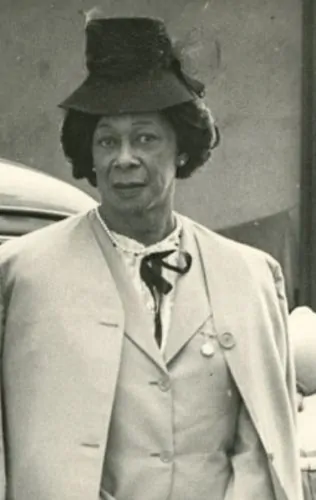
Lucy Hicks Anderson built a life as a Black woman in Oxnard. A compulsory medical examination in 1945 exposed her marriage and military spousal payments to criminal prosecution.

By Matthew A. McIntosh
Public Historian
Brewminate
Introduction: A Life Already Established
In 1923, Lucy Hicks Anderson won first prize for fruitcake at the Ventura County fair. The award belonged to a continuing record of culinary accomplishment through which she became familiar to residents of Oxnard, California. Having settled in the area in 1920, she supported herself through domestic employment and developed connections with prosperous households, including the family of banker Charles Donlon. Over the following years, she acquired property and operated businesses associated with prostitution and, during Prohibition, illicit alcohol. Those activities brought encounters with law enforcement, but they coexisted with charitable contributions and participation in local social life. Anderson’s position rested on relationships built through sustained work, within a community where personal familiarity could influence access to opportunity. Long before her marriage became a subject of prosecution, she had established a substantial life that cannot be understood solely through the proceedings that later threatened it.
The surviving evidence of that standing requires careful reading. A November 1945 profile in Time acknowledged Anderson’s contributions to charitable causes and her connections with local families while presenting her through racist caricature and ridicule. Its account preserved traces of community involvement even as its presentation invited readers to dismiss her womanhood. Such reporting documents both her place in Oxnard and the hostility through which a national audience encountered her. Neither affectionate recollection nor sensational publicity provides an uncomplicated measure of what her neighbors understood or accepted.
The confrontation intensified in 1945, when an investigation concerning venereal disease led to a compulsory medical examination. Anderson protested that she was the proprietor of the establishment under investigation rather than a sex worker, but the examination proceeded. The physician’s assessment supplied information that prosecuting authorities used to challenge her capacity to marry Reuben Anderson, a soldier whom she had wed the previous year. State proceedings alleged perjury in connection with the marriage application; federal authorities subsequently pursued charges concerning military spousal payments. These were distinct legal actions, each requiring decisions about how bodily characteristics related to eligibility and alleged deception. Their connection exposes the practical consequences of classification: once officials refused to recognize Anderson as a wife, declarations and payments associated with her marriage became grounds for criminal investigation. Yet anatomical assessment did not itself establish every element of an offense, and reconstructing the proceedings requires attention to the difference between disputed legal status and knowing falsehood. At stake was the authority to determine whether the woman who had conducted her life as Lucy could continue to claim the marital position recorded in her application.
Anderson’s experience belongs within an early documented history of Black transgender women whose lives challenge accounts organized primarily around later medical developments or more celebrated public figures. C. Riley Snorton’s scholarship establishes the importance of examining how racialization shaped the representation of transgender people and the preservation of their histories. That approach directs attention to the terms on which Anderson became visible in the record, including the contrast between recognition of her labor and ridicule of her person. Calling her a transgender woman describes her sustained identification as a woman without assuming that she possessed today’s vocabulary for it. Her history also requires distinguishing community standing from protections she could compel authorities to honor. Personal connections might provide assistance, but their existence did not settle what courts or federal administrators would recognize. The central problem is therefore how Anderson’s established life encountered institutions able to give a competing classification punitive force. Following that encounter makes it possible to examine the limits of her security while preserving her own understanding of herself as essential historical evidence.
Becoming Lucy

Lucy Lawson was born in 1886 in Waddy, a community in Shelby County, Kentucky. Census research summarized by the University of Kentucky Libraries places her family within a local economy of household service. In 1880, before her birth, her parents, Bill and Nancy Lawson, worked for the George Waddy family; the database’s account of the 1900 census finds Nancy and her youngest child still employed in that household. These details locate Anderson’s beginnings within a particular working environment, where a Black family’s livelihood depended on employment by another family. They also complicate biographies that move almost immediately from an assertion of childhood identity to departure for the West. The Kentucky years encompassed family obligations and the practical circumstances of growing up after emancipation, even though the available accounts preserve little of their daily texture.
Much of the familiar narrative about her childhood comes through Anderson’s recollections during the proceedings of 1945. According to newspaper reporting reproduced in later biographical writing, she described a family physician, identified as Dr. Jesse, whom her mother consulted when Lucy was about nine. Anderson recalled that the physician considered her more a girl than a boy and that her mother subsequently accepted her living as a girl. Accounts of her school years similarly describe her use of the name Lucy and her insistence on wearing dresses. These details convey how Anderson understood the duration of her womanhood when questioned decades afterward. They also place her mother within a remembered history of accommodation, a significant feature of an account sometimes reduced to solitary resistance. Yet the evidence reaches the historian through several stages: an adult’s recollection of childhood, a reporter’s selection of testimony, and subsequent retelling. The consultation can therefore be discussed as something Anderson remembered and publicly described, while the precise conversation and the physician’s reasoning remain beyond reconstruction.
The doctor’s reported advice requires particular care because its apparent familiarity can encourage anachronism. An accommodation concerning how a child should live does not establish a modern diagnosis or a course of medical treatment, and it supplies no reliable basis for retrospective anatomical speculation. Scholarship on transgender childhood, especially the work of Julian Gill-Peterson, demonstrates that young people’s experiences and demands preceded the clinical categories through which later institutions sought to explain them. Anderson’s recollection belongs within that longer history, while retaining its character as an account of a particular family’s response to a particular child.
Paid employment provides a different kind of continuity across the early biography. Most accounts place the end of Anderson’s schooling at about fifteen, followed by domestic work, although they do not establish an equally precise date for her departure from Kentucky. Leaving school and leaving the state should consequently remain separate events unless further documentation connects them. Her eventual employment in Texas has a firmer chronological anchor: the University of Kentucky Libraries identifies her as a hotel chambermaid in Pecos City in the 1910 census. That finding supports her presence there independently of later summaries that describe approximately a decade of hotel work. It also directs attention toward employment that can disappear beneath the more dramatic descriptions of her subsequent career. Chambermaid work meant maintaining rooms for paying guests, with the repetitive physical demands and dependence on employers that such service entailed. A wage could support movement and some degree of independence while leaving the worker with limited control over working conditions. The evidence does not reveal her earnings or allow a detailed reconstruction of her relationship with hotel management. Nevertheless, identifying her occupation restores a substantial period during which supporting herself was a continuing practical undertaking.
The journey through Texas and New Mexico should not be made to follow a predetermined story of western liberation. Peter Boag’s research into gender variance in the American West challenges the region’s retrospective image as an exclusively masculine, heterosexual environment, but it also reveals how communities and commentators interpreted unfamiliar lives through changing assumptions about sex and race. That scholarship makes room for Anderson’s experience without establishing why she chose each destination. Distance from Kentucky may have altered the people who knew her childhood history, but the surviving itinerary cannot demonstrate that anonymity was her purpose. Nor does relocation itself prove freedom from scrutiny. Her movement is better understood through the places where she found work and formed connections, with its personal motives left open wherever the evidence does not disclose them.
Silver City, New Mexico, becomes an important point in that itinerary because Anderson married Clarence Hicks there in 1920. The marriage introduced the surname under which she would become widely known in California and provides a dated event around which the less precise migration narrative can be organized. Biographical accounts generally place her earlier move to Texas in her twenties, but converting that broad statement into an exact departure year produces a certainty the evidence does not warrant. The same restraint applies to assigning a particular year to her arrival in New Mexico. Far less is known about the courtship or the couple’s domestic arrangements than about the existence of the marriage itself. Its significance cannot therefore rest on imagined conversations, assumptions about Clarence’s knowledge, or a confident explanation of what either spouse expected. It does establish that marriage formed part of Anderson’s adult experience before the union that authorities would challenge in the following generation. The couple’s subsequent movement to Oxnard brought that earlier history of employment and partnership into a new setting.
By the time Anderson reached California, she had already spent years earning a living beyond her birthplace. The uneven record permits firmer statements about some locations and occupations than about the circumstances of individual decisions. Reading it closely preserves that difference while allowing her choices to remain consequential. Kentucky supplied the family history she later recalled; Pecos offers evidence of sustained wage work; Silver City marks a marriage that preceded her California prominence. Oxnard would become the setting in which she expanded her economic position, moving beyond employment in other people’s establishments toward control of property and businesses of her own.
Making a Living in Oxnard
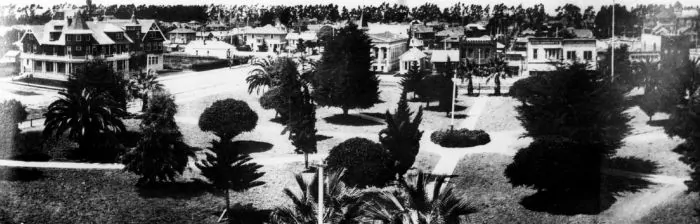
A Model T coupe provides an unusually concrete point of entry into Anderson’s working life in Ventura County. Drawing on a December 1922 newspaper report, Juniper Oxford identifies her residence near Seventh and B Streets in Oxnard and describes her commute to employment with the Donlon family in Hueneme. The arrangement placed her within a household economy that extended beyond the boundaries of her own neighborhood. Regular employment required travel, while maintaining a separate residence gave her a domestic space outside her employer’s home. Neither car ownership nor steady work establishes how comfortably she lived, but both complicate an image of household service conducted entirely under an employer’s roof. Anderson’s economic circumstances already involved some control over the movement between her own affairs and the work for which another family paid her.
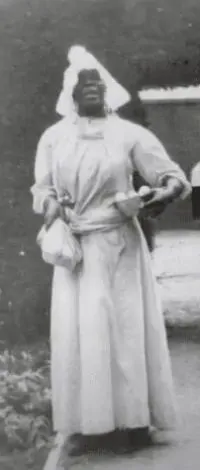
Her responsibilities also exceeded the preparation of meals. Oxford’s reconstruction includes childcare and gathering eggs among the tasks associated with her employment. A photograph preserved by the Museum of Ventura County shows Anderson outdoors holding two children, although their identities remain unknown. The museum tentatively locates the scene at the Donlon ranch and dates it approximately to 1925–1932. Its value lies in preserving a working association largely overshadowed by later publicity: caring for children belonged alongside cooking within the range of services she provided.
The distinction between possessing skill and receiving adequate compensation is essential here. Cynthia Donlon’s retrospective family history, quoted by Oxford, characterized the household’s predominantly immigrant employees as occupying poorly paid domestic positions; that description concerns the staff collectively and does not supply Anderson’s individual wage. It nevertheless places her employment within a hierarchy in which substantial responsibility could coexist with limited remuneration. Evelyn Nakano Glenn’s scholarship on the racial organization of domestic labor explains how employers’ access to household assistance depended on inequalities among women as well as between women and men. The time available to a prosperous woman could be purchased through another woman’s labor, with racial assumptions helping to determine whose services were inexpensive. Applying that framework to Anderson directs attention toward the economic relationship beneath descriptions of her exceptional usefulness. Her culinary ability might distinguish her from other applicants, but it operated within an occupation whose value employers could acknowledge without surrendering their control over pay or duties.
Cooking offered an additional means of making competence publicly legible. Anderson’s prizes for fig jam and crabapple jelly in 1926, followed by recognition for light rolls in 1927, extended the record of accomplishment beyond the fruitcake award already noted. These were results in judged competitions, giving her work a form of recognition independent of an employer’s private opinion. Such distinctions could support a reputation for reliability, although their precise effect on earnings cannot be calculated. They also reveal sustained proficiency across different preparations, rather than a reputation resting on one celebrated dish.
Property acquisition changed the relationship between Anderson’s labor and her income. Oxford describes earnings from household employment and prohibited commerce being invested in Oxnard real estate, eventually including multiple premises used for prostitution. The surviving accounts do not provide a complete sequence of purchases or establish what proportion of the purchase money came from each activity. A simple story in which domestic wages accumulated steadily until they purchased independence would therefore exceed the evidence. What can be identified is a diversification of her economic position: she continued to possess skills she could sell while acquiring premises from which she could derive other income. Ownership could reduce dependence on a particular employer, but it also created obligations that wages alone did not entail. Buildings required upkeep, and their profitability depended on continued use. Her advancement consequently involved managing assets and exposure to loss, not merely exchanging a subordinate occupation for an uncomplicated position of security.
The nature of the businesses matters as much as the fact that she owned them. Accounts identifying Anderson as a brothel proprietor place her within an economy in which income depended partly on providing premises for other women’s sexual labor. Time later described an operation spread across several buildings, suggesting a scale larger than an isolated room rented occasionally. Its sensational presentation cannot substitute for a detailed account of how the establishment functioned. The sources considered here reveal little about rental arrangements or the women’s control over their earnings. Those women nevertheless belong within the history of Anderson’s business success, even when reporting concentrates almost entirely on the proprietor. Her capacity to obtain revenue from their use of her property gave her an economic position different from the one she occupied when performing household duties for wages.
Prohibition added another source of revenue and another set of costs. Oxford’s account identifies several liquor-related court appearances and reports a 1931 discovery of whiskey and drinking glasses concealed behind a trap board in Anderson’s home. These encounters should remain distinct from the later proceedings concerning her marriage. They show that unlawful commerce could bring direct intervention well before officials challenged her classification as a woman. Arrest and prosecution could interrupt business while exposing accumulated resources to penalties. Accordingly, the existence of property and a continuing clientele cannot be treated as evidence that authorities simply overlooked her activities.
Personal connections could sometimes help her navigate those interruptions, though their operation is clearest in an anecdote rather than a complete legal record. Time recounted that Charles Donlon secured Anderson’s release after an arrest because a dinner party at his home depended on her cooking. The magazine supplied neither the date nor the charge, so the episode cannot securely be attached to a particular liquor case. Read cautiously, however, it illustrates an exchange in which assistance to an employee also served an employer’s immediate interests. Donlon’s ability to arrange bail and Anderson’s ability to prepare the occasion’s meal were different resources, brought together through employment. The story’s emphasis on his intervention can obscure the dependence that made intervention worthwhile. Anderson earned opportunities through abilities other people needed, even while those people retained greater access to money and institutional influence. That combination of usefulness and unequal power helps explain the economic foundations of the familiarity she developed in Oxnard.
A Place among Her Neighbors: Black Womanhood and Community Standing
Local social notices place Anderson within gatherings whose significance extended beyond the employment relationships examined above. Juniper Oxford identifies an item concerning a church social club in November 1925 and another reporting Anderson’s entertainment at a community center in August 1927. Such notices recorded her participation in occasions that residents considered suitable for public acknowledgment. Oxford also observes that women predominated among the named participants in accounts of her gatherings. Although these reports do not establish formal club membership or identify the racial composition of every audience, they document repeated association with women engaged in local social life. Anderson appeared in this coverage as someone who could organize an occasion and bring people together, exercising a role that depended on others’ willingness to attend and associate themselves with her hospitality.
Women’s informal exchanges offer another perspective on those connections. The 1945 Time profile described local women visiting Anderson to obtain recipes and recalled her assistance when their daughters prepared for parties. These details concern access to knowledge and participation in family occasions, extending the evidence beyond praise for food served at an employer’s table. A request for a recipe acknowledged expertise that another household wished to reproduce, while assistance with a daughter’s preparations placed Anderson close to an event carrying personal importance. The magazine presented these associations through an amused account of local incongruity, but the relationships it described were sufficiently familiar to require little explanation. Their historical value lies in showing how recognition could develop through ordinary consultation and repeated contact. Anderson’s inclusion in women’s activities took place through practices that connected households, even where the participants occupied markedly different positions within the town.
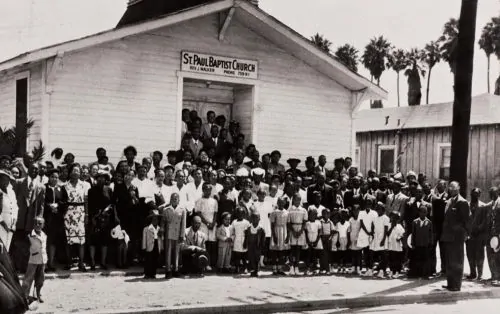
Oxnard’s Black residents also possessed institutions of their own, a circumstance easily obscured when Anderson’s biography centers exclusively on prominent white acquaintances. Saint Paul Baptist Church dates its organization to 1919 and identifies its first building at 318 West Seventh Street. Its establishment places an African American congregation within the city before Anderson’s arrival. The congregation’s history does not establish her membership, but it helps restore the broader setting in which her relationships developed. That setting was also shaped by organized racial exclusion. David G. García’s study of Oxnard demonstrates how unequal schooling and residential restrictions operated together, tracing both discrimination and resistance among Mexican American and African American residents. His findings make personal invitations an insufficient measure of the city’s racial arrangements. Anderson’s social access must consequently be understood within a place where residents could cross particular interpersonal boundaries while institutions continued to restrict opportunities according to race.
Charitable contributions brought her into additional relationships with organizations claiming to serve the public. Contemporary reporting identified donations to the Red Cross and Boy Scouts, along with her preparation of a welcoming barbecue for a new Catholic priest. These activities connected her resources to beneficiaries beyond the customers of her businesses. Preparing a parish celebration also placed her work within an occasion through which a religious community publicly welcomed a new member of its leadership. The evidence supports participation in such undertakings, while leaving her own denominational commitments and the organizations’ attitudes toward her largely unspecified.
During the Second World War, the reported forms of assistance became closely connected to the experiences of local families. Time described Anderson arranging farewell parties for young men entering military service and visiting households after news of a death in action. Its account caricatured her emotional expression, making the tone an unreliable guide to the character of those encounters. Nevertheless, the activities it reported placed her within the local experience of separation and bereavement. When Franklin D. Roosevelt died, the magazine noted, Oxnard newspapers published her reaction alongside comments from clergy and civic figures. The inclusion of her response suggests that editors considered her someone whose feelings about a national event belonged within the town’s public record. Here her role encompassed expressing a community’s concerns, as well as contributing labor or money to its occasions.
Later recollections preserve a more personal register of attachment. Interviewed for a local television report published in 2022, Leroy “Buddy” Gibson remembered that he and his sister had known Anderson as “Miss Lucy” when they were children. He recalled her checking on their welfare and bringing snacks and toys, details that gave her a continuing place in his account of childhood. He also remembered relatives preparing food for her parties, locating his family within the gatherings she organized. The recollection is specific in what it preserves: a familiar adult whose attentiveness remained memorable long after the events themselves.
Other memories require a different interpretation. Margaret Tatum, interviewed for the same report, recalled encountering Anderson on a bus and seeing activity around her business from nearby Saint Paul Baptist Church. Looking back, Tatum described aspects of Anderson’s appearance that she associated with masculinity. Such a retrospective judgment does not establish when she formed it, what she understood at the time, or whether she knew anything about Anderson’s childhood. Decades of publicity could supply an explanation for features previously understood in another way. Gibson’s affectionate recollections and Tatum’s observations therefore answer different historical questions; neither can stand for the knowledge of Oxnard’s population as a whole. The distinction matters because recognition of a familiar woman, awareness that she appeared unusual, and knowledge of the history later publicized by authorities were separate possibilities. The sources do not permit those possibilities to be collapsed into a single claim that everyone knew.
A later glimpse of political activity further complicates any assumption that public disclosure immediately ended Anderson’s ability to convene her neighbors. Local reporting reproduced by Kathryn S. Gardiner describes a voting barbecue in June 1946 at which women associated with the county Democratic organization addressed those assembled. Anderson declined to announce her preferred candidate while emphasizing the importance of going to the polls. Gardiner also reproduces a notice for a gathering at her home directed specifically toward Black voters. These events occurred after the initial marriage-related prosecution, making them evidence of continuing participation under altered circumstances. They show Anderson taking initiative in civic life, using familiar forms of hospitality to encourage her neighbors to exercise a political voice.
Becoming a Wife: Marriage and Everyday Recognition
A June 1944 wedding notice introduced a new relationship into the public record of Anderson’s life. The Oxnard Press-Courier item identified in Juniper Oxford’s research appeared on June 15 under the headline “Lucy Hicks Wed to L.A. Man.” Its treatment of the marriage contrasts with the scrutiny that followed the next year: Anderson appeared as a local woman whose wedding warranted an announcement. Her earlier marriage to Clarence Hicks had ended in divorce in 1929, so becoming Reuben Anderson’s wife followed a substantial interval during which she had conducted her affairs without a husband. The notice does not disclose the circumstances of their courtship or explain why they chose to marry. It does establish that the union entered local circulation through a familiar form of reporting, giving readers information about a relationship the couple had publicly formalized.
Military service complicated the arrangements through which they maintained contact. Oxford reports that they exchanged letters while Reuben was stationed in New York and that he visited Anderson during periods of leave. These reported practices preserve a glimpse of a marriage conducted across considerable distance. They suggest continuing involvement, although the correspondence itself has not been identified among the sources examined here. Their contents, and the private understandings through which the couple managed separation, consequently remain outside the account that can presently be reconstructed.
The significance of becoming a wife exceeded what a wedding announcement could convey. Nancy F. Cott’s history of American marriage shows how governments made marital relationships central to the allocation of responsibilities and civic standing. Within that history, the legal model of a husband providing for a dependent wife helped organize public policy, even when actual households operated differently. Anderson’s circumstances make that difference particularly important. She entered the marriage with substantial experience supporting herself and with economic interests of her own; the designation “wife” cannot therefore be used as evidence that Reuben maintained her financially. Nor does economic independence establish that marriage held little importance for her. The institution supplied a recognized relationship between two people whose respective resources and expectations did not have to conform precisely to its conventional household model. Understanding that distinction allows Anderson’s business activities and her marital position to coexist without requiring one to explain away the other.
California gave that relationship a prescribed legal form. In a later decision reconstructing the requirements applicable in 1945, the court in Estate of Abate described the ordinary process as involving a license, an authorized solemnization, and documentation returned for recording. The steps assigned responsibilities to officials as well as to the people marrying. A ceremony’s certification made information about the event available beyond those who had attended it. Although the statutory scheme contained exceptions, its ordinary procedures demonstrate why an announced wedding and a registered marriage involved different kinds of evidence. Neighbors could learn of the relationship socially, while a public record supplied a means of presenting it to institutions that had no personal acquaintance with either spouse.
Medical certification already formed part of California’s regulation of entry into marriage. A contemporary federal survey reported that the state enacted legislation requiring premarital examination for syphilis in 1939. The existence of that system makes it inappropriate to assume that Anderson’s 1944 application necessarily proceeded without medical paperwork. The sources considered here do not establish what examination she underwent, what certification accompanied the application, or whether an exception applied. A health requirement directed toward infectious disease must also be distinguished from an adjudication of an applicant’s sex or marital capacity.
The categories within the marriage process nevertheless carried assumptions about who could occupy each position. California’s legislation distinguished male and female parties, as period judicial discussions of marital capacity demonstrate, while prevailing interpretations understood marriage as joining a husband and wife. The clerk’s issuance of a license operated within that framework, but it was not equivalent to a judicial hearing resolving every possible objection to the applicants’ eligibility. This distinction becomes consequential when the later prosecutorial language is read closely. The allegation quoted by Oxford from October 1945 reporting asserted that Anderson could not have been the bride named in the license. Her position within the document was therefore central to the challenge: prosecutors sought to make their classification of her incompatible with the role in which she had married. The surviving account of that allegation should not be substituted for an inspection of her original signed declaration. It does, however, identify how a recorded marital relationship became vulnerable to a dispute about the qualifications officials attached to being a bride.
For Anderson, the paperwork also gave the relationship a form that could travel beyond Oxnard. Reuben’s military assignment placed them within circumstances where recognition could not depend entirely on appearing together before people who knew them. Documents allowed a marital connection to be asserted across that distance, translating a locally announced wedding into information usable elsewhere. This portability was one of marriage registration’s practical advantages: officials could act on a recorded relationship without reconstructing its courtship or observing its daily conduct. It also meant that another institution could examine the relationship under rules administered for its own purposes. By marrying a soldier, Anderson brought her position as a wife into contact with a federal system extending far beyond the county office that had authorized the wedding.
Wartime Oxnard: Military Expansion and the Policing of Sexual Commerce

The Advance Base Depot at Port Hueneme shipped 225,000 long tons of material in June 1945, according to the Navy’s official construction history. Work on the installation had begun in April 1942, when the demands of Pacific warfare required a major expansion of West Coast supply facilities. Warehouses and railway connections subsequently helped turn the port into a center for assembling and dispatching equipment overseas. The development brought military activity into the vicinity of businesses that had previously operated within a predominantly civilian economy. For nearby Oxnard, the consequences extended beyond the movement of freight. Servicemen entered commercial and recreational spaces whose conditions could now attract the attention of commanders concerned with the health of their personnel. Anderson’s establishment stood within this changing relationship between the port and its surrounding communities.
The older commercial districts already combined activities that outsiders could place under very different moral descriptions. Frank P. Barajas’s history locates entertainment and prostitution alongside shops, boardinghouses, and residential life within Oxnard’s multiracial neighborhoods. Residents used these areas to obtain provisions and maintain connections as well as to seek recreation. Their everyday geography was therefore considerably more complex than an official account organized around sites of vice would suggest. Wartime scrutiny could recast a familiar establishment according to its significance for military customers, bringing an additional set of institutional interests to bear on an existing business.
To military medical planners, sexually transmitted infections presented an operational problem involving illness, treatment, and personnel unavailable for duty. Prevention consequently encompassed medical supervision within the services and efforts to influence conditions outside military installations. The official Army history describes inspections and education alongside treatment and contact tracing, demonstrating that servicemen themselves were subject to an extensive medical program. Identifying civilian sexual contacts, however, could carry an investigation beyond the patient’s unit. Information supplied during treatment might direct attention toward a particular person or address, connecting a military medical record with civilian enforcement. Such information initiated inquiries; it did not independently establish the circumstances in which an infection had been transmitted. The investigative consequences could nevertheless be substantial for the people associated with the premises named.
Congress supplied a possible route to federal intervention through the May Act, approved on July 11, 1941. Its prohibitions covered prostitution and assistance to it, including brothel keeping and knowingly providing premises for the prohibited activities. They applied within areas that the secretaries of War or Navy determined necessary for military health and efficiency and formally designated through published orders or bulletins. Proximity to a base therefore did not automatically place every surrounding business within a federal prohibition created by the Act. The legislation also expressly withheld any new authority for military or Federal Security Agency personnel to conduct criminal investigations, searches, seizures, or arrests of civilians. It created a conditional federal offense while preserving important distinctions among the institutions involved in enforcement.
Implementation depended heavily on obtaining action from civilian authorities. Navy General Order No. 156, issued in October 1941, provided for gathering information about prostitution near naval activities and requesting enforcement of existing state and municipal laws before recommending a federal designation. This sequence allowed military concern to produce local action without requiring prosecution under the May Act itself. The Army’s retrospective account similarly reported only two formal wartime invocations, around Camp Forrest in Tennessee and Fort Bragg in North Carolina, while describing the threat of intervention as effective elsewhere.
No corresponding designation for Port Hueneme has been established in the sources considered here. Anderson’s exposure should accordingly be situated within the broader campaign for suppression, without assuming that her premises occupied a formally declared May Act zone. A commander’s request, a local police investigation, and a federal charge represented different exercises of power, even when directed toward a shared objective.
Civilian women encountered a further system of authority through public-health measures that could operate alongside criminal law. Scott Wasserman Stern’s research on the American Plan traces compulsory examination and confinement across a campaign whose origins preceded the Second World War. Women could become targets because officials suspected infection or regarded their sexual conduct as dangerous, without first obtaining a prostitution conviction. Under these arrangements, medical examination could itself become an instrument of control rather than a service the person examined had chosen. The relevant powers depended on public-health law and local practice; the May Act did not independently authorize compulsory examinations. This distinction matters for understanding the position of someone who owned premises used for prostitution but denied personally engaging in sex work. Commercial association could bring such a person within an inquiry whose demands were directed toward the body, even though the original concern involved a customer’s infection.
Japan’s surrender did not immediately dissolve the regulatory arrangements developed during mobilization. In May 1945, Congress had extended the May Act beyond its original expiration, linking its duration to a later deadline or a formally specified termination of hostilities. Military and civilian agencies also continued to discuss venereal-disease control during the autumn, as the official Army account records. The transition out of combat therefore left an operating network of medical officers and civilian authorities concerned with sexual commerce around installations. Within that setting, a serviceman’s reported infection directed attention toward Anderson’s establishment. The immediate inquiry concerned an alleged threat to military health, bringing wartime regulatory priorities into the circumstances of her compulsory examination.
The Compulsory Examination: From Health Investigation to Legal Evidence

Hilary R. Mangan’s involvement brought a local physician into an investigation directed at women associated with Anderson’s establishment. Juniper Oxford places an initial arrest on October 4, 1945, and identifies the examination as occurring afterward. The available chronology does not establish its precise date or show that Anderson remained continuously detained until the district attorney ordered another arrest later that month. What the accounts consistently describe is an examination undertaken despite her objections. Its compulsory character matters because Anderson had not approached Mangan seeking an assessment of her sex or assistance in interpreting her identity. She encountered him within an investigation whose demands were backed by official intervention. That setting gave the physician access to information she had not volunteered for consideration by prosecutors or the wider public.
Anderson’s reported objection concerned the distinction between operating the business and personally selling sexual services. She maintained that she was the proprietor, a position she considered relevant to whether she should undergo the examination demanded of the women working there. Time nevertheless reported that Mangan insisted on examining her as well. Her response therefore reveals an attempt to limit the inquiry according to her actual role in the establishment. It does not establish that she anticipated the subsequent marriage prosecution, and it should not be rewritten as evidence that she understood an examination to be a deliberate trap.
The information that became consequential differed from the medical question that had initiated the investigation. Officials were responding to a report of venereal infection, but the finding publicized afterward concerned Mangan’s classification of Anderson as male. The sources examined here do not supply a clinical record establishing that she carried an infection. They also do not reproduce sufficiently detailed examination notes to permit an independent reconstruction of the physician’s observations. An account announcing a discovery is a different source from a medical report explaining the procedures and criteria through which a conclusion was reached. Consequently, neither a retrospective diagnosis nor a detailed anatomical narrative can responsibly be extracted from the publicity surrounding the encounter. The historical evidence establishes that an assessment was made and acted upon; it leaves much of the examination itself undescribed. That limitation directs attention toward the finding’s institutional use, where the surviving record becomes more specific.
Mangan’s assessment reached the office of District Attorney Arthur Waite. Oxford quotes the October 19 reporting as describing the physician’s contribution as “Evidence in the case,” a phrase that identifies a prosecutorial use without specifying the form in which the information was supplied. No medical certificate, written report, or sworn statement documenting that transfer has been inspected for this account. On October 19, Waite ordered Anderson’s arrest and publicly characterized her longstanding life as a woman as a masquerade. The physician’s assessment and the prosecutor’s characterization were distinct acts. The latter attached a narrative of misconduct to information obtained through an examination, directing attention toward conduct that preceded the health investigation.
Subsequent proceedings expanded the medical authority presented against her. Reporting analyzed by C. Riley Snorton described testimony from five physicians supporting the classification used by the prosecution. This belongs to the later courtroom record and cannot be treated as proof that a five-doctor panel conducted the initial examination. Nor does the number of witnesses establish how many separate examinations occurred. The distinction is important because an accumulation of professional testimony could make a proposition appear decisively corroborated while leaving the circumstances of its first acquisition outside the account offered to readers. Medical agreement became part of the legal presentation of the case, with consequences extending beyond the original physician’s encounter with Anderson.
Snorton situates that elevation of medical judgment within a longer racial history of bodily inspection and the production of professional knowledge. His analysis draws attention to the unequal authority available to the person examined and those authorized to interpret the examination. Anderson’s account of herself entered proceedings in which physicians could present bodily classification as evidence carrying greater institutional weight. For a Black woman, that arrangement also belonged to a national history in which Black people had repeatedly been denied control over medical encounters and the uses made of their bodies. This connection does not establish every examiner’s personal motive or make all such encounters historically identical. It supplies a framework for considering whose knowledge officials regarded as authoritative and whose account required external verification. The examination’s consequences depended on that distribution of credibility: Anderson could describe her life, but professionals possessed channels through which their descriptions could become grounds for official action.
A further inference was required before bodily assessment could support an accusation of perjury. The examination concerned Anderson at the time officials inspected her; the prosecution alleged something about what she had knowingly represented when applying to marry in 1944. Moving between those propositions required an interpretation of marital eligibility and an argument about her earlier knowledge. Awareness of one’s bodily characteristics does not, by itself, establish an understanding that a particular declaration about legal capacity is false. Whether the prosecution could prove its allegation therefore depended on evidence and reasoning beyond Mangan’s assessment. By the time Anderson faced the marriage charge, information obtained during a health investigation had been assigned a new purpose: supporting a criminal account of her decision to become Reuben Anderson’s wife.
Prosecuting the Marriage: Perjury and the Meaning of a False Statement
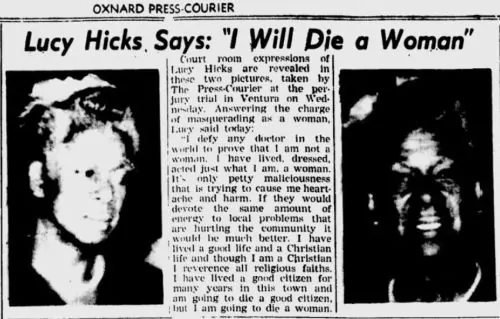
The prosecution in Ventura County’s Superior Court treated Anderson’s 1944 marriage application as a punishable act of misrepresentation. In the accusation quoted by Juniper Oxford from contemporary local reporting, District Attorney M. Arthur Waite designated her “John Doe Hicks” and asserted that she was “not capable of being the bride” named in the license. He further alleged that this incapacity was something “he, then and there well knew.” The wording combined a conclusion about marital eligibility with an allegation of deliberate falsehood, while its substituted name and masculine pronouns imposed the classification on which the charge depended. Anderson consequently faced an accusation that reached beyond whether officials would continue to recognize her marriage. Prosecutors sought punishment for her conduct in obtaining its authorization. Through the perjury charge, the application became the occasion for treating her decision to marry as an intentional violation of the obligations attached to a sworn declaration.
California law supplied a demanding definition of that offense. Penal Code section 118 required a legally authorized oath, a material statement, and willful falsity known to the person making it. In People v. Yecny (1942), an appellate court expressly recognized that an honestly mistaken belief in a statement’s truth prevented a perjury conviction. People v. Tolmachoff (1943) likewise affirmed the importance of knowledge and intent, although it also applied the rule that an unqualified assertion made with conscious lack of knowledge could support liability. These decisions concerned other defendants and circumstances; they establish the contemporary legal standards against which Anderson’s prosecution can be examined. Their relevance lies particularly in the distinction between believing oneself a woman, understanding the legal conditions of marriage, and knowingly misrepresenting compliance with those conditions. Anderson’s conviction cannot be assessed responsibly by collapsing those questions, and her sincerity about her womanhood does not automatically answer every question about her understanding of marital eligibility. Equally, the existence of an enforceable law against perjury does not establish that the evidence presented against her satisfied its requirements. Without the complete application, trial testimony, and instructions, the published accounts cannot settle precisely how the court and jury addressed those distinctions.
Reported questioning nevertheless extended into the details of Anderson’s appearance. In the Afro-American’s December 1945 account, examined by C. Riley Snorton, she explained her use of a wig as a matter of looking better. Her answer supplied an ordinary aesthetic explanation for something the questioning had made a subject of suspicion. The exchange suggests how proceedings concerning a sworn declaration could invite a broader judgment about whether familiar practices of feminine presentation indicated calculated deception.
Another entry complicates any interpretation that treats the marriage document as an uncomplicated expression of Anderson’s understanding of herself. Oxford reports that it recorded her age as forty-two, although she was in her late fifties. That discrepancy merits acknowledgment, particularly because an inaccurate biographical entry and a sincerely asserted identity could coexist on the same document. The available summaries do not establish the precise contribution of the age entry to the state’s charge, its presentation of evidence, or the verdict. Its existence therefore calls for a separate inquiry into accuracy, materiality, and knowledge, rather than an assumption that it either proved a comprehensive fraudulent scheme or had no possible significance. A historian can question the prosecution’s treatment of Anderson’s womanhood while recognizing that other representations associated with the application require scrutiny. Preserving that distinction makes the interpretation more accountable to an adversarial record that contains complications as well as evidence of coercion.
Her attorney’s anatomical argument pursued a different opening. According to the reporting analyzed by Snorton, counsel proposed that Anderson might possess internal organs supporting her position that would remain undiscovered until an autopsy. This was a speculative challenge to the completeness of the medical evidence, rather than a verified finding about her body. The proposal contested the physicians’ certainty by suggesting that the examinations on which they relied could leave something consequential unknown.
The relationship between this strategy and Anderson’s own account requires particular care. A lawyer seeking to defeat a criminal accusation could challenge the prosecution’s evidence without offering a complete explanation of the client’s understanding of herself. Counsel’s hypothesis invited uncertainty about the state’s classification, whereas Anderson’s reported answers expressed assurance about her womanhood. Those positions could serve the same immediate objective while asking the court to consider different propositions: whether prosecutors had established their accusation, and whether Anderson’s account of herself deserved belief. Nothing in the available reporting establishes that she opposed the argument, personally devised it, or entered a formal agreement concerning the examination of her remains. Nevertheless, identifying her position entirely with anatomical speculation would distort the basis on which she had already married. She had sought recognition as a wife without waiting for a hypothetical future discovery to authorize that choice. The defense illustrates how the practical work of answering a criminal charge could represent only part of what its defendant sought to preserve.
By the end of 1945, Anderson had been convicted of perjury and placed on ten years’ probation. That term subjected her future conduct to sustained judicial supervision, attaching a lengthy criminal consequence to the marriage application. The conviction established liability under California’s perjury law, although the surviving published summaries leave the verdict’s detailed evidentiary basis incompletely explained. For Anderson, the result gave punitive force to the official rejection of her claim to marry as Reuben’s wife. It also furnished newspapers with a decisive legal outcome around which to organize a much less settled account of sex, honesty, and the meaning of her life.
Making Lucy a Spectacle
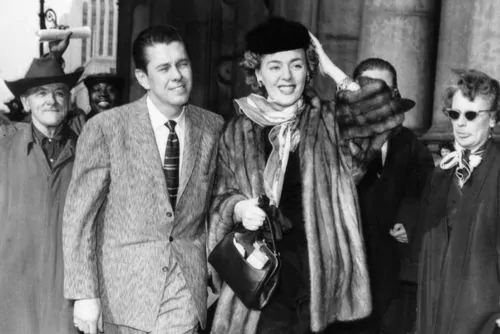
Time’s November 5, 1945, profile organized Anderson’s life around a disclosure withheld until its last line. After describing her activities in Oxnard, it closed with the declaration, “Lucy was a man.” The feature did not mention the pending perjury charge, leaving the medical examination to supply its decisive event. This arrangement offered readers a revelation for which the preceding descriptions of dress and local prominence had prepared them. It also encouraged a retrospective judgment: everything the magazine had presented could now be reconsidered as evidence of an unsuspected incongruity. The narrator’s final classification acquired authority over the social history the article itself had recorded. Anderson’s experience became a story whose apparent resolution depended on accepting the exposure as more revealing than her understanding of herself.
Racial caricature shaped the voice through which that story reached its audience. The profile’s sole direct quotation from Anderson appeared in stylized vernacular, introduced by a description of her “cackling happily.” Elsewhere, the writer compared her expression of grief to the noise of a distressed cow. These choices gave the narrator a position of cultivated amusement while making Anderson’s speech and emotions objects of entertainment. Her presence in print was substantial, but the article distributed dignity unevenly between the person described and the voice authorized to describe her. The racialized language helped determine how readers were invited to hear a Black woman before they encountered the concluding assertion about her sex.
The magazine later explained the editorial reasoning behind its interest. In his January 14, 1946, publisher’s letter, James A. Linen defended a category of human-interest reporting he called “significant trivia.” His argument was that apparently minor incidents could illuminate social conditions more effectively than major public events. That rationale deserves consideration: the category did not mean that Anderson’s experience was considered meaningless. Yet the letter also revealed how the magazine selected the significance her story would carry. Linen said an editor had discovered it in a Pacific Coast newspaper, and he emphasized the astonishment and embarrassment it supposedly caused her neighbors. His account located the drama in their discovery, leaving Anderson’s exposure to compulsory examination and criminal punishment largely outside its explanation of why the story mattered. A substantial public-interest inquiry could have examined the powers exercised against her. Instead, the publisher celebrated the editorial judgment that had recognized an arresting national story in a local report. The movement between those publications therefore involved decisions about whose experience would organize the case’s public meaning. The letter advertised the magazine’s ability to find revealing news while treating Anderson’s involuntary disclosure as evidence of that ability.
Audience participation extended the performance. Linen reported unusually heavy correspondence and said subscribers had proposed Anderson for the magazine’s Man of the Year designation. The letters themselves were not reproduced, so his account cannot establish every correspondent’s intention. His decision to publicize the suggestions nevertheless incorporated readers into the magazine’s gendered joke. The letter’s update about Army pursuit for alleged draft evasion also appeared with a caricature that Snorton describes as a bearded figure in a dress. Neither the update nor the illustration established a draft-evasion conviction; together, they presented another possible exercise of state power as an entertaining continuation of the story.
Black-owned journalism could employ related conventions while addressing a different readership. The December 1945 Afro-American report analyzed by C. Riley Snorton announced the outcome under the headline “Night Life Queen Guilty of Perjury in Sex Case.” An accompanying illustration showed a woman beside a sign declaring, “Beware. Not what you think it is.” The headline foregrounded sexual notoriety, while the warning positioned the reader as someone who might be deceived. Such presentation extended suspicion beyond the particular declaration at issue in the marriage prosecution. It encouraged an encounter with Anderson in which the first task was to detect what she supposedly concealed. Black ownership did not prevent the newspaper from invoking conventions of gendered suspicion. This article demonstrates how those conventions operated within a particular publication, without establishing a uniform position among Black journalists or their readers.
Nevertheless, the account also preserved answers that unsettled its framing. Asked whether her first husband, Clarence Hicks, was a man, Anderson reportedly replied that he was supposed to be. The response redirected uncertainty toward an assumption about another person, disturbing the premise that she alone required explanation. At the same time, the report placed quotation marks around feminine references to Anderson, allowing its surrounding narration to withhold recognition even while printing her words. Readers encountered an exchange in which the speaker’s replies and the editor’s grammatical choices offered competing instructions about how to understand her.
Studies of later publicity surrounding Christine Jorgensen help clarify the racial dimensions of these editorial practices. Emily Skidmore’s research shows how the greater mainstream visibility accorded to white trans women helped associate publicly recognizable transsexuality with whiteness and conventional gender norms. That framework identifies a hierarchy of representation, although Jorgensen’s emergence as a medical celebrity in 1952 differed substantially from Anderson’s appearance in criminal reporting. N. Claire Jackson further demonstrates that even Jorgensen’s comparatively favorable publicity could undermine her account through masculine references and renewed questioning of her womanhood. Racial advantage could shape the terms of attention while leaving a subject vulnerable to intrusive interpretation. The comparison directs attention to the unequal conditions under which someone could be represented as respectable, even when that representation remained conditional. Anderson’s coverage reveals a particular combination: the presentation of gender as deception worked through language that also diminished her as a Black woman. Understanding that combination requires examining how a publication assigned credibility and respect, alongside whether it made its subject visible.
Responses to such reporting could also exceed an editor’s intentions. Joanne Meyerowitz’s study of the popular press shows that some readers used sensational accounts of medical sex change to identify possibilities for themselves, even when journalists or advice writers discouraged that interpretation. The sources considered here do not establish comparable responses to Anderson’s publicity, and it would be speculative to assign it a uniformly liberating effect. Her words nevertheless circulated within accounts designed to make her suspect, giving audiences material whose possible meanings extended beyond the narrator’s explanation. The historical significance of that circulation includes the possibility of readers recognizing something the publication invited them to ridicule. Such possibilities coexisted with Anderson’s immediate predicament: her answers were becoming public entertainment while officials continued deciding what conduct they would punish.
A Soldier’s Wife before Federal Authorities
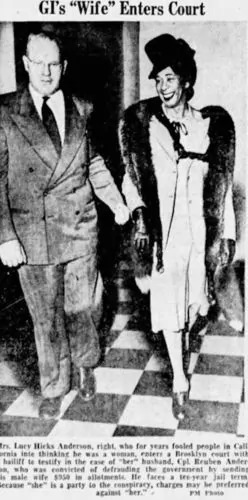
Eighteen fifty-dollar checks gave federal investigators a monetary record through which to pursue Anderson’s marriage. Juniper Oxford’s study of her criminal file identifies those payments, totaling $900, as the basis of eighteen fraud counts. What had arrived as recurring support for a soldier’s wife could be assembled into a sequence of allegedly unlawful receipts. The federal proceedings against her in Los Angeles in 1946 concerned participation in a benefit system, extending the accusation beyond the declaration used to obtain a marriage license. Counting the payments separately gave a duration and financial measure to the government’s case.
The payments belonged to the family-allowance program established by the Servicemen’s Dependents Allowance Act of 1942 and subsequently amended. Under the schedule applicable after the October 1943 legislation, an eligible wife without a child received fifty dollars monthly. In the ordinary arrangement, twenty-two dollars was charged against the serviceman’s pay and twenty-eight dollars came from the government. The check thus combined military earnings with federal assistance in a prescribed system of family support. A wife belonged to the statute’s Class A category, whose members did not have to establish actual financial dependence on the enlisted man. Anderson’s ability to earn money or hold property therefore did not itself defeat a claim under that category. The controlling statutory definition required a wife to be a lawful wife, directing attention to the validity of the marital relationship through which she received the allowance.
Administration required judgments about domestic relationships as well as the distribution of money. Writing in the Social Security Bulletin in 1943, Harry Grossman of the War Department’s Office of Dependency Benefits described the agency as functioning like a national court of domestic relations. Its work required interpretation of marriage and divorce laws across jurisdictions, including decisions about whether particular relationships qualified for recognition. Grossman also explained that the office lacked authority to determine eligibility by judging a beneficiary’s moral conduct or character. Indeed, he could describe certain wives as “undeserving” while acknowledging that allegations of infidelity or desertion did not, by themselves, cancel their entitlement. Those limits matter in Anderson’s case because the sexual notoriety attached to her business could encourage readers to mistake social disapproval for a statutory disqualification. The agency’s stated standard made lawful relationship decisive even where a serviceman disapproved of the recipient. Federal support consequently depended on an administrative assessment of marital standing that was supposed to operate within defined legal limits.
The legislation also distinguished receipt without entitlement from criminal fraud. Its penal provisions required fraudulent intent for obtaining allowances without entitlement or accepting them after entitlement ceased, and knowing falsity for material statements in claims or required documents. These provisions describe the law governing the program, without establishing which statutory sections appeared in Anderson’s indictment. They nevertheless demonstrate that an adverse eligibility decision and proof of criminal conduct involved distinct questions. The eighteen payments supplied transactions to investigate; identifying the representations, knowledge, and intentions attached to them required evidence about the conduct of the people involved.
Reuben’s separate prosecution in New York introduced testimony about the couple’s reasons for marrying. According to Oxford, he testified that Anderson had proposed marriage so that they could collect the spousal payments. That statement introduces financial calculation into a relationship whose surviving descriptions also include Anderson’s account of their having been together before the wedding. Those propositions are compatible: an existing attachment and an interest in obtaining financial support could both inform a decision to marry. His testimony deserves consideration as evidence, but its setting matters. Reuben was himself a defendant facing punishment, and the couple’s interests in answering their respective accusations need not have coincided. That circumstance requires evaluation of his account alongside other evidence, without supplying grounds for accepting or rejecting it wholesale. Nor does his explanation furnish complete access to either spouse’s private expectations. More fundamentally, the allowance system deliberately made marital status financially consequential. An expectation of receiving its benefits could be consistent with a lawful marriage. The relevant allegation therefore concerned whether the couple knowingly sought payments without entitlement, requiring the financial motive to be evaluated alongside the contested legal status of their union.
Anderson was brought into Reuben’s proceedings while in custody, requiring her participation in the case against the man she had married. The April 1946 newspaper coverage examined by Snorton described her detention in the men’s section of New York’s Federal House of Detention. It also reported that she continued wearing women’s clothing because, according to officials, she possessed no other clothes. Her clothing persisted within an institution that housed her under a male classification. During questioning about her sexual anatomy, she repeatedly declined to answer. Snorton interprets that refusal as withholding cooperation with the assumptions organizing the inquiry. Her appearance as a witness thus did not entail acquiescence in every demand for intimate information, even within proceedings over which she exercised little control.
The federal outcomes imposed different penalties on the two spouses. Oxford records Anderson’s sentence as one year in county jail, together with repayment of the $900 and a $2,500 fine. Oxford attributes the use of county custody to officials’ difficulty deciding between a men’s and a women’s federal institution, a placement problem distinct from the New York detention reported during Reuben’s case. County confinement carried out a federal sentence alongside the continuing consequences of her state conviction. Reuben received eighteen months in a federal penitentiary. For Anderson, repayment and the fine together amounted to $3,400, adding financial obligations to confinement. The judgments extracted money from her and deprived both partners of their freedom, placing additional pressure on the independence she had established before becoming Reuben’s wife.
Living under Supervision

In 1948, Anderson again faced proceedings in Ventura County’s Superior Court, this time over an alleged violation of probation. The confrontation concerned what officials said was happening at her Oxnard property after the earlier convictions. It brought her circumstances as a proprietor within the continuing reach of the criminal case. Her eventual departure followed this additional proceeding and a reported agreement concerning her remaining holdings. The interval matters because geographical removal emerged through a further exercise of supervisory authority, extending punishment into the conditions under which she could continue living in Oxnard.
Oxford’s reconstruction, drawing on later local reporting including Murray Norris’s 1967 retrospective, identifies the allegation as the presence of “loose women” around Anderson’s premises. That description records an accusation and its moral vocabulary; it does not independently establish a new prostitution offense or identify the exact probation condition supposedly breached. Its imprecision matters because a characterization of the people associated with a property could place its owner’s conduct under renewed suspicion. Anderson’s attorney obtained a postponement of approximately a month. The delay provided an opportunity for negotiation, although the account does not establish that the accusation was dismissed. Her response to supervision included continued efforts through counsel to alter the proceeding’s course, extending the work of defense beyond the trials that had attracted national attention.
Contemporary California law explains why a later allegation could have consequences for an earlier conviction. In People v. Schwartz (1947), the appellate court reproduced statutory provisions authorizing judges to set probation conditions and revoke probation during its term when they had reason to believe those conditions were being violated. The defendant in that case had been required to report regularly and refrain from gambling or bookmaking; a subsequent bookmaking conviction supported revocation. Those particular conditions belonged to Schwartz’s case, but the decision illustrates the authority that probation preserved. Living outside jail remained compatible with exposure to a renewed exercise of sentencing power through the original proceeding. An allegation concerning subsequent conduct could therefore reopen the practical question of confinement. For Anderson, the 1948 confrontation made that continuing authority consequential for her residence and property.
By November, according to Oxford, an agreement linked relief from supervision to selling Anderson’s remaining Oxnard property and leaving Ventura County. Oxford describes the disposition as a suspension of her ten-year probation. The reported bargain joined changes in her legal position to changes in where she could maintain a home and an economic base. Negotiation supplied a route toward relief, while its conditions required substantial action from her. Accepting those terms demonstrates a decision made under continuing legal pressure, rather than establishing that relocation represented her unrestricted preference.
Territorial exclusion was already subject to a significant legal limit. In In re Scarborough (1946), a California appellate court invalidated a condition requiring a defendant to leave Stockton and San Joaquin County for two years. It held that the prohibition against unauthorized banishment applied to cities and counties, and that violation of the condition could not justify revocation of probation. The court preserved the defendant’s underlying liability while ordering his release on probation, subject to lawful grounds for future revocation. Scarborough had also lacked notice of the departure requirement in the release document supplied to him and had not knowingly accepted it. Those circumstances deserve preservation when comparing his case with Anderson’s reported negotiation. Her original order and hearing record would be needed to determine the precise legal form of the arrangement and the application of that precedent. The decision nevertheless prevents treating county exclusion as an unquestioned power available to California judges in 1948. Legal restrictions existed alongside practices that could still induce a defendant to relocate, making the relationship between an announced safeguard and an individual outcome a substantive historical question.
The property transaction gave the agreement an economic consequence beyond the change of address. Oxford reports that Anderson sold to a local church, but the account supplies neither a sale price nor a valuation from which to calculate a financial loss. The pressure arose from making sale a condition of relief, even though the transaction could have preserved monetary value for her. Alison Rose Jefferson’s regional history of African American leisure and business sites emphasizes the importance of such places to community formation and Black economic initiative in Southern California. That perspective helps explain why Anderson’s agreement cannot be assessed through its possible cash return alone. Her established premises connected ownership with the ability to conduct business and sustain local relationships. Relocation could require finding another place from which to earn and developing new commercial connections, at a stage when she was already in her sixties. Those prospective demands belonged to the practical burden of departure, independently of whatever consideration she received for the sale.
The reported geographical restriction concerned Ventura County, extending beyond Oxnard’s municipal boundaries. Oxford notes that local coverage described an absence of at least a year and that Anderson subsequently made occasional brief visits. Those visits distinguish departure as a resident from an absolute inability ever to enter the area again. Her removal had lasting consequences without requiring the assumption of a formally perpetual ban or a complete severance of every local connection.
Anderson settled in Los Angeles, where Oxford places her until her death in 1954. The account leaves her work, housing, and friendships after the move much less clearly explained than the prosecutions. Reuben’s later household followed a different course: his Sacramento Bee obituary records a marriage to Cleota Rodgers in 1949 after his postwar move to New York. That evidence challenges accounts of the couple spending Anderson’s remaining years together in Los Angeles, while leaving the circumstances of their parting incompletely documented. The surviving information warrants restraint about her emotional condition and the support she may have found after relocation. What the departure agreement concretely changed was her capacity to remain an owner and resident in the place where she had established herself. It marked an enforced change of setting within a life that continued for several more years.
Remembering Anderson: Black Transgender History and the Surviving Archive
When Monica Roberts introduced Anderson to TransGriot readers in August 2011, she explicitly credited BlackPast and BlackAmericaWeb as the routes through which she had encountered the story. Her article belonged to an announced project of recovering African American transgender history. That acknowledgment makes the later circulation of Anderson’s name traceable through particular acts of selection and republication. Existing biographical material acquired another audience through a Black trans writer who understood historical knowledge as part of community life. The process involved connecting scattered accounts and directing readers toward a past they might otherwise have had little opportunity to encounter. Roberts’s contribution therefore belongs to the history of Anderson’s remembrance as well as to the journalism through which that remembrance expanded.
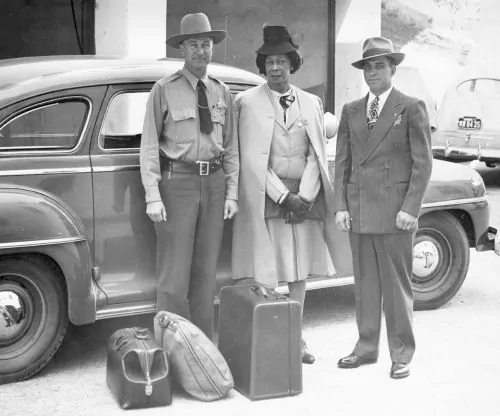
Museum records preserve a different stage in the history of that material. The Museum of Ventura County dates “Lucy Hicks with Deputy Sheriffs” to approximately 1945 and attributes its creation to the county sheriff’s office. Separate source entries bearing the years 1998 and 2002 belong to its cataloged provenance, rather than establishing when the scene was photographed. Distinguishing an image’s creation from its later collection history helps prevent a subsequent caption or catalog field from silently relocating an episode in Anderson’s life.
Finding such material also depends on the language through which institutions have made it searchable. K. J. Rawson’s work on transgender archival access demonstrates that descriptive practices shape both what researchers can locate and how they understand what they find. A modern category may connect dispersed materials, while older classifications can leave relevant documents among records identified principally through crime, employment, or another institutional concern. Oxford’s citations to Anderson’s federal file, for example, retain an imposed charging name and several aliases. Those labels assist identification while documenting the authorities’ handling of her identity. Their usefulness as finding tools gives them a different function from the name a historian uses in narrating her life. Rawson also warns that expansive contemporary terminology can obscure racial and class distinctions among the people it seeks to include. Access consequently requires attention both to inherited descriptions and to the assumptions introduced when collections are reorganized or reinterpreted.
Retrospective vocabulary can nevertheless serve a carefully defined historical purpose. Jules Gill-Peterson explains the deliberate use of trans terminology for earlier subjects while retaining older categories where their specific meanings affect interpretation. Calling Anderson a transgender woman follows that approach when grounded in her sustained identification and life as a woman. It does not require imagining that she understood herself through the political affiliations or medical vocabulary of later decades. The distinction preserves the historical specificity of her recorded claims while allowing historians to examine relationships among experiences described differently in their own periods.
The transmission of a quotation illustrates why sympathetic retelling still requires source criticism. Roberts attributes the familiar declaration beginning “I defy any doctor” to remarks Anderson made to reporters during the perjury trial. Moving those words into a fully reconstructed scene on the witness stand would require additional evidence. Their appearance in multiple later accounts likewise does not establish that each writer consulted an independent contemporary witness. Repeated publication increases circulation without necessarily increasing corroboration. Following an attribution backward helps distinguish a surviving report from the details subsequently attached to it. The statement remains important evidence of Anderson’s public insistence on womanhood, to be read alongside records showing how the conflict developed.
The 2016 documentary series We’ve Been Around offered another form of historical reconstruction. In Matt Warren’s interview with its creators, Rhys Ernst described an approach to the series as artistic portraits assembled through mixed media, while the discussion acknowledged the difficulty of condensing complex histories into short films. Anderson’s inclusion placed her within a broader public account of transgender history. Archival images, animation, and narration could make that account accessible through forms unavailable to a printed case study. Their combination also required decisions about sequence, emphasis, and the relationship between historical evidence and present-day performance. A narrated quotation does different evidentiary work from an original recording of its speaker, however strongly it conveys a sense of presence.
Saidiya Hartman’s “Venus in Two Acts” provides a demanding framework for considering the desires involved in recovering a life. Writing about enslaved people in the Atlantic world, Hartman examines the temptation to supply forms of intimacy and consolation that the surviving records cannot establish. Her exploration of speculative narrative includes an insistence on restraint and a refusal to force closure. Applied to an academic account of Anderson, that problem concerns how sympathy can influence the stories a historian wants the evidence to tell. Limited access to her private life in the materials examined here does not establish that personal papers never existed or that all have been lost. Decisions made under pressure can be studied through documented actions and available alternatives without supplying an interior monologue. Equally, leaving an experience uncertain need not surrender interpretation to the official who first described it. The historian can analyze the circumstances that produced a statement while declining to treat its wording as complete access to the person concerned. That discipline preserves a distinction between Anderson’s actions and the emotional resolution a later audience may desire.
Snorton’s Black on Both Sides further changes what Anderson’s inclusion contributes to transgender history. Its argument makes racial formation central to the field and challenges histories organized around medical transformation as a route toward freedom. Anderson’s experiences consequently enlarge the range of institutions and relationships through which that history can be investigated. The concentration of surviving documentation also helps explain her prominence, while providing no secure basis for declaring her the first Black transgender person to contest legal recognition. An unusually visible case cannot establish the absence of comparable lives that attracted less reporting or whose records remain difficult to find. Her particular history can carry analytical weight without requiring that chronological distinction. Remembering her on those terms leaves room for other people whose experiences were less likely to receive sustained historical attention.
How Much Recognition Had Anderson Actually Secured?
The following video from News Channel 3-12 remembers the legacy of Lucy Hicks Anderson:
The strongest objection is that Anderson’s local standing may be mistaken for a settled right to recognition on her own terms. Neighbors could know and treat her as a woman without knowing the history officials later invoked against her. Retrospective assertions that everyone had known cannot establish the knowledge or commitments of each person who encountered her. The evidence demonstrates familiar social roles more securely than it establishes a shared willingness to defend her status against an official challenge. A historian must therefore distinguish familiarity with Lucy from agreement about the standards by which her womanhood should be recognized.
Racialized domestic service makes that objection more substantial. Evelyn Nakano Glenn’s analysis shows how intimacy and interdependence within domestic employment could coexist with hierarchy and limited concern for a worker’s independent needs. Applied to Anderson, that framework raises the possibility that appreciation of her skills sustained relationships whose expectations remained unequal. Access to influential households could provide opportunities without establishing that those households accepted her as an equal or would support every claim she made. Yet treating usefulness as a complete explanation would also exceed the evidence. Her position included business initiative and ownership, and personal attachments need not have been insincere because they developed within unequal arrangements. Nor can employers’ motives stand for the attitudes of everyone with whom she participated in community life. Recognition was distributed across relationships with different purposes and capacities for support. A further interpretive risk follows: making her charitable contributions the reason she deserved protection would adopt a test of worthiness that leaves acceptance dependent on exceptional conduct. Her accomplishments help explain the stakes of the prosecutions; evaluating the powers exercised against her requires grounds beyond a judgment of personal merit.
Marriage presents a related institutional difficulty. Nancy Cott’s history emphasizes that personal consent operated within publicly defined terms that the couple could not independently determine. The issuance of Anderson’s license therefore did not necessarily represent a considered official acceptance of her understanding of sex when challenged by contrary medical evidence. Her documents had enabled practical consequences, including allowance payments, without guaranteeing that their underlying assumptions would survive later scrutiny. The prosecution could expose a contradiction that routine administration had previously left unresolved.
An explanation grounded in ordinary criminal enforcement also deserves consideration. Investigating a reported infection, a potentially false declaration, or unauthorized payments served recognizable governmental purposes. The surviving material does not establish that the original health inquiry was devised to expose Anderson’s history or that all participating authorities coordinated a single campaign. The period’s perjury law and the allowance legislation also required knowledge or fraudulent intent, making criminal liability a question beyond the classification of her body. Without fuller trial records, the convictions cannot simply be declared legally erroneous because Anderson understood herself as a woman. Likewise, the materials examined here do not provide a comparison capable of isolating race’s contribution to charging or sentencing. These limits narrow claims about official motives and discriminatory treatment. They leave intact the documented significance of classifying Anderson as incapable of being a bride or lawful wife. That premise helped determine whether her declarations and receipts would be examined as criminal conduct. The conventional form of the offenses therefore requires attention to how eligibility was defined and applied, alongside the evidence offered to establish deception.
The counterpoint supports an interpretation of recognition as specific to a relationship or legal purpose. Anderson’s earlier position had practical substance, and the law treated her as capable of owning property and securing representation even while officials challenged her marital status. Snorton’s account of her interventions in the proceedings also preserves her capacity to act within a situation of unequal authority. Personal regard, institutional acknowledgment, and protection against adverse judgment could diverge in the treatment of the same person. The central vulnerability lay in the uncertain connection among them. Her relationships and documents enabled important parts of her life, but they supplied no dependable answer when officials asserted a different basis for deciding whether she qualified as a wife. Sincere enforcement of those qualifications could still produce the vulnerability visible in her case. The prosecutions reveal how recognition effective in one setting could fail to protect her in another.
Conclusion: The Terms on Which She Could Remain Lucy
Lucy Hicks Anderson’s prosecution threatened the continuity of a life sustained through decades of work and personal commitment. The woman authorities examined in 1945 had already assumed responsibilities, made intimate choices, and participated in the affairs of her town. Those activities deserve historical weight as exercises of judgment through which she established a place for herself and affected the lives of others. Her insistence that she was a woman also helps explain why she contested the suggestion that her marriage rested on deception. The consequences of the proceedings must therefore be measured partly through the opportunities they restricted: to maintain a household, receive support as a wife, and continue living where she had invested her labor and resources.
Medical authority acquired its punitive significance through the uses other institutions made of it. The examination supplied a classification that prosecutors treated as grounds for questioning Anderson’s declaration when obtaining a marriage license and, subsequently, her entitlement to military family allowances. Marriage law and federal eligibility requirements gave that classification consequences reaching beyond the examining room. Yet the alleged offenses also required consideration of knowledge, belief, and fraudulent intent, matters that an anatomical assessment could not independently resolve. Anderson’s expressed certainty about her womanhood belongs in that inquiry, although it cannot substitute for the complete evidence and instructions presented at trial. The available sources support a careful reconstruction of the accusations and outcomes rather than a comprehensive judgment about the legal validity of every ruling. They nevertheless establish that officials made consequential choices about which descriptions of Anderson would govern her marital and financial position. Responsibility for what followed therefore extends across the professional and governmental decisions that connected bodily examination to criminal liability. This distribution of authority helps explain how an investigation undertaken for a public-health purpose could eventually threaten several foundations of her independence.
The counterpoint requires restraint in describing what Anderson possessed before those interventions. Her local standing provided practical advantages without establishing that neighbors shared a consistent understanding of her history or that public institutions had conclusively accepted her marital eligibility. The evidence also leaves individual motives and race’s precise contribution to particular decisions incompletely resolved. Her later property sale and required departure from Ventura County nevertheless demonstrate the material reach of the conflict: uncertainty about the intentions behind an action does not make its consequences for the person subjected to it uncertain.
Anderson’s place in Black transgender history rests on the depth of this documented encounter between a woman’s sustained understanding of herself and the powers exercised over her circumstances. Snorton’s scholarship makes it possible to situate that encounter within histories in which racial hierarchy helped organize whose labor was valued, whose appearance invited suspicion, and whose account of personhood received authority. Anderson’s experience gives those questions a specific setting without making her representative of every Black transgender life. Her decisions continued to matter within constraints she could neither fully anticipate nor control. Securing representation, answering accusations, and negotiating the conditions of departure show continued participation in determining what would happen to her, even as the range of available choices contracted. The surviving record warrants neither a triumphant ending nor an assumption that punishment exhausted the meaning of her remaining years. To conclude with Lucy is to acknowledge the woman who made those choices and the extent to which officials could alter the practical conditions under which she would continue to live.
Bibliography
Affiliate disclosure: Amazon links on this site are paid links. As an Amazon Associate I earn from qualifying purchases.
- Act of July 11, 1941 (May Act), ch. 287, 55 Stat. 583.
- Act of May 15, 1945, ch. 126, 59 Stat. 168.
- “Anderson, Reuben ‘Andy.’” Obituary. Sacramento Bee, October 29, 2002.
- Barajas, Frank P. Curious Unions: Mexican American Workers and Resistance in Oxnard, California, 1898–1961. Lincoln: University of Nebraska Press, 2012.
- Boag, Peter. Re-Dressing America’s Frontier Past. Berkeley: University of California Press, 2011.
- Cott, Nancy F. Public Vows: A History of Marriage and the Nation. Cambridge, MA: Harvard University Press, 2000.
- Encinas v. Lowthian Freight Lines, 69 Cal. App. 2d 156 (1945).
- Estate of Abate, 166 Cal. App. 2d 282 (1958).
- García, David G. Strategies of Segregation: Race, Residence, and the Struggle for Educational Equality. Oakland: University of California Press, 2018.
- Gardiner, Kathryn S. “Lucy Hicks Anderson.” League of Women Voters of Indiana, October 13, 2025.
- Gill-Peterson, Julian. Histories of the Transgender Child. Minneapolis: University of Minnesota Press, 2018.
- Glenn, Evelyn Nakano. “From Servitude to Service Work: Historical Continuities in the Racial Division of Paid Reproductive Labor.” Signs 18:1 (Autumn 1992), 1–43.
- Grossman, Harry. “Administration of the Servicemen’s Dependents Allowance Act of 1942.” Social Security Bulletin 6:7 (July 1943), 21–24.
- Hartman, Saidiya. “Venus in Two Acts.” Small Axe 12:2 (2008), 1–14.
- In re Scarborough. 76 Cal. App. 2d 648 (1946).
- Jackson, N. Claire. “‘There Is No Question about This and There Never Has Been for Eight Years’: The Public Reception of Christine Jorgensen.” Peitho 22:4 (2020).
- Jefferson, Alison Rose. Living the California Dream: African American Leisure Sites during the Jim Crow Era. Lincoln: University of Nebraska Press, 2020.
- Lehr, Tracy. “Lucy Hicks’ Transgender Legacy Remembered.” KEYT News Channel 3-12, June 2, 2022. Updated June 3, 2022.
- Leonard, Kevin. “Lucy Hicks [Tobias Lawson] Anderson (1886–1954).” BlackPast.org, June 27, 2007.
- Linen, James A. “A Letter from the Publisher.” Time, January 14, 1946, 13.
- Longoria, Rolando René, II. “The Body Branded: LGBT Hate Murder, Legal Personhood, and Social Responses in the Oxnard, California Case of Lawrence King.” PhD diss., University of California, Santa Barbara, 2014.
- Mariana, Andrea. “A Black Transgender Socialite: Lucy Hicks Anderson.” Andrea Mariana, February 14, 2025.
- Meyerowitz, Joanne. “Sex Change and the Popular Press: Historical Notes on Transsexuality in the United States, 1930–1955.” GLQ: A Journal of Lesbian and Gay Studies 4:2 (1998), 159–187.
- Navy Department. General Order No. 156, “The Control of Prostitution in Areas Adjacent to Naval Activities.” October 13, 1941.
- Navy Department, Bureau of Yards and Docks. Building the Navy’s Bases in World War II. Vol. 1. Washington, DC: Government Printing Office, 1947.
- Oxford, Juniper. “Draft Dodger, Soldier’s Wife: Trans Feminine Lives, Civic Duty, and World War II.” The Graduate History Review 12 (2023), 73–117.
- People v. Schwartz. 80 Cal. App. 2d 801 (1947).
- People v. Tolmachoff. 58 Cal. App. 2d 815 (1943).
- People v. Yecny. 53 Cal. App. 2d 474 (1942).
- Rawson, K. J. “Accessing Transgender // Desiring Queer(er?) Archival Logics.” Archivaria 68 (Fall 2009), 123–140.
- Roberts, Monica. “Black Trans History: Lucy Hicks Anderson.” TransGriot, August 2, 2011.
- Saint Paul Baptist Church of Oxnard. “Our History.” Accessed October 28, 2026.
- Skidmore, Emily. “Constructing the ‘Good Transsexual’: Christine Jorgensen, Whiteness, and Heteronormativity in the Mid-Twentieth-Century Press.” Feminist Studies 37:2 (2011), 270–300.
- Snorton, C. Riley. Black on Both Sides: A Racial History of Trans Identity. Minneapolis: University of Minnesota Press, 2017.
- “Some State Legislation in 1939 Affecting Public Health.” Public Health Reports 55:16 (April 19, 1940), 695–699.
- Stern, Scott Wasserman. The Trials of Nina McCall: Sex, Surveillance, and the Decades-Long Government Plan to Imprison “Promiscuous” Women. Boston: Beacon Press, 2018.
- Time. “California: Sin & Soufflé.” November 5, 1945.
- United States. Servicemen’s Dependents Allowance Act of 1942. Public Law 625, chap. 443, 56 Stat. 381. June 23, 1942.
- —-. An Act to Amend the Servicemen’s Dependents Allowance Act of 1942, as Amended, so as to Liberalize Family Allowances, and for Other Purposes. Public Law 174, chap. 281, 57 Stat. 577. October 26, 1943.
- University of Kentucky Libraries. “Hicks, Lucy L. [Tobias Lawson].” Notable Kentucky African Americans Database. Accessed October 28, 2026.
- Ventura County Star. November 26, 1945. Reporting on Anderson’s testimony, excerpted in Kathryn S. Gardiner, “Lucy Hicks Anderson,” League of Women Voters of Indiana, October 13, 2025.
- Warren, Matt. “How We Got Here: An Interview with the Creators of the Trans Web Doc Series ‘We’ve Been Around.’” Film Independent, June 24, 2016.
- “Waite Says ‘Lucy Hicks’ Is a Man.” Ventura County Star-Free Press, October 19, 1945. Quoted in Oxford, “Draft Dodger, Soldier’s Wife,” 93–95.
Originally published by Brewminate, 10.29.2026, under the terms of a Creative Commons Attribution-NonCommercial-NoDerivatives 4.0 International license.
About the Author