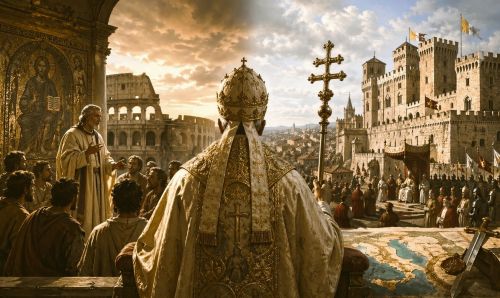
The papacy’s rise from Roman bishopric to territorial power unfolded through crisis, adaptation, and ambition, reshaping spiritual authority into political sovereignty in the early medieval world.

By Matthew A. McIntosh
Public Historian
Brewminate
Introduction: From Bishop to Power Broker
The office of the bishop of Rome emerged within the institutional and cultural framework of the Roman Empire, where ecclesiastical authority operated alongside, and often beneath, imperial power. In its earliest centuries, the Roman episcopate exercised influence primarily through doctrinal leadership, pastoral care, and its association with the apostolic legacy of Peter and Paul. This authority was persuasive rather than coercive, rooted in reputation, theological clarity, and the prestige of Rome itself as the former imperial capital. Even as Christianity gained imperial favor in the fourth century, the bishop of Rome did not possess independent political or territorial authority, functioning instead within a system in which emperors remained the ultimate arbiters of both civil and, at times, ecclesiastical affairs.
Yet the foundations of a broader conception of papal authority were already being laid. Appeals to Rome in doctrinal disputes, the articulation of Petrine primacy, and the gradual elevation of the Roman see above other episcopal centers all contributed to a growing sense that the bishop of Rome occupied a unique position within Christendom. This primacy remained largely spiritual and symbolic, dependent upon recognition rather than enforcement. The distinction between spiritual authority and temporal power would prove decisive, as later developments would hinge on the reinterpretation of this relationship rather than its outright invention.
The transformation of the papacy into a political force was neither sudden nor inevitable. It unfolded across the late antique and early medieval periods in response to profound structural changes, most notably the weakening and eventual collapse of Western imperial governance. As imperial institutions receded, particularly in Italy, the bishop of Rome increasingly assumed responsibilities that had once belonged to secular authorities, including the organization of food distribution, the maintenance of urban infrastructure, and the negotiation of peace in times of invasion. This shift was driven less by an explicit program of papal expansion than by necessity, as local populations required leadership, administration, and protection in the absence of effective imperial oversight. The instability of the peninsula, marked by Gothic wars, Lombard incursions, and the uneven reach of Byzantine control, created conditions in which the papacy became a focal point of continuity and order. These practical roles began to reshape the very nature of the papal office, transforming it from a primarily pastoral institution into one increasingly entangled with governance, diplomacy, and the realities of territorial responsibility.
The rise of papal temporal power was the result of a cumulative process in which theology, circumstance, and political opportunity converged. Figures such as Pope Leo I, Pope Gelasius I, Pope Gregory I, and Pope Stephen II illustrate successive stages in this transformation, from the articulation of spiritual primacy to the exercise of de facto governance and the establishment of territorial sovereignty. By tracing this development across late antiquity and the early Middle Ages, it becomes clear that the papacy’s evolution from bishopric to political authority was not a rupture with its past but an adaptation to a changing world in which spiritual leadership increasingly carried temporal consequences.
Late Roman Foundations: Authority without Territory (4th–5th Centuries)

The fourth and fifth centuries marked a decisive transitional phase in the development of the Roman episcopate, as Christianity moved from persecution to imperial patronage. With the conversion of Emperor Constantine and the subsequent legalization of Christianity, the Church became increasingly embedded within imperial structures. Bishops, including the bishop of Rome, gained visibility and influence, often serving as intermediaries between local populations and imperial authorities. They were drawn into civic responsibilities, arbitrating disputes, managing charitable distributions, and representing their communities before imperial officials. Yet this influence remained fundamentally non-territorial, dependent upon the cooperation of emperors and the broader administrative machinery of the Roman state rather than upon any independent base of political power. The bishop of Rome, while increasingly prominent, still operated within a system in which imperial authority defined the limits of ecclesiastical action.
During this period, the authority of the bishop of Rome was grounded primarily in theological prestige and ecclesiastical hierarchy. The claim to Petrine succession, rooted in the belief that the apostle Peter had been the first bishop of Rome, became a central pillar of Roman primacy. This claim was reinforced through participation in major doctrinal controversies, including the Arian crisis and the debates surrounding Christological orthodoxy. Roman bishops increasingly positioned themselves as guardians of doctrinal purity, issuing letters and judgments that were respected, though not always obeyed, by other Christian communities across the empire.
The expansion of papal influence was further shaped by the dynamics of ecclesiastical councils and the evolving relationship between church and empire. Councils such as Nicaea (325) and Chalcedon (451) established frameworks for doctrinal consensus while also highlighting the tensions between different centers of ecclesiastical authority. Although Rome enjoyed a position of honor, it did not possess direct jurisdiction over other major sees such as Constantinople, Alexandria, or Antioch. The Roman bishop’s authority depended on persuasion, precedent, and reputation rather than coercive enforcement, reflecting the continued dominance of imperial power in regulating ecclesiastical affairs. Even when Roman positions prevailed, as in the reception of Leo’s Christology at Chalcedon, this success relied on conciliar agreement and imperial backing rather than unilateral papal decree. The limitations of this system underscored the distinction between acknowledged influence and enforceable authority.
The pontificate of Pope Leo I (440–461) represents a critical moment in the articulation of papal authority during this era. Leo advanced a more explicit and systematic understanding of Petrine primacy, asserting that the authority of Peter continued in the person of the Roman bishop. His theological writings, particularly the Tome of Leo, played a decisive role in shaping the outcome of the Council of Chalcedon, where his Christological formulations were widely accepted. Leo’s actions during the political crises of his day, including his famous meeting with Attila the Hun in 452, demonstrated the potential for the papacy to act as a stabilizing force in the absence of effective imperial intervention.
Despite these developments, the papacy in this period remained firmly within the orbit of imperial authority. The Western Roman Empire, though weakening, still provided the framework within which ecclesiastical leadership operated. Even as imperial power declined in the fifth century, the bishop of Rome did not immediately assume direct political control. Instead, papal authority expanded incrementally, shaped by circumstance rather than deliberate institutional design. The absence of territorial sovereignty meant that the papacy’s influence continued to rely on networks of communication, theological argumentation, and the symbolic capital of Rome’s apostolic heritage. Appeals to Rome carried weight, but enforcement depended on local reception and, where available, imperial support. This dependency would become increasingly untenable as imperial structures eroded, setting the stage for a more autonomous exercise of authority in the centuries to follow.
The late Roman period established the essential foundations for the later rise of papal temporal power without yet realizing it. The bishop of Rome emerged as a figure of growing significance, capable of influencing both doctrinal outcomes and political events, but still lacking the institutional mechanisms necessary for sustained governance. This combination of expanding authority and structural limitation created the conditions under which subsequent popes would begin to transform influence into administration, and prestige into power, as the political landscape of the post-Roman world continued to evolve.
Leo I and the Performance of Authority (440–461)
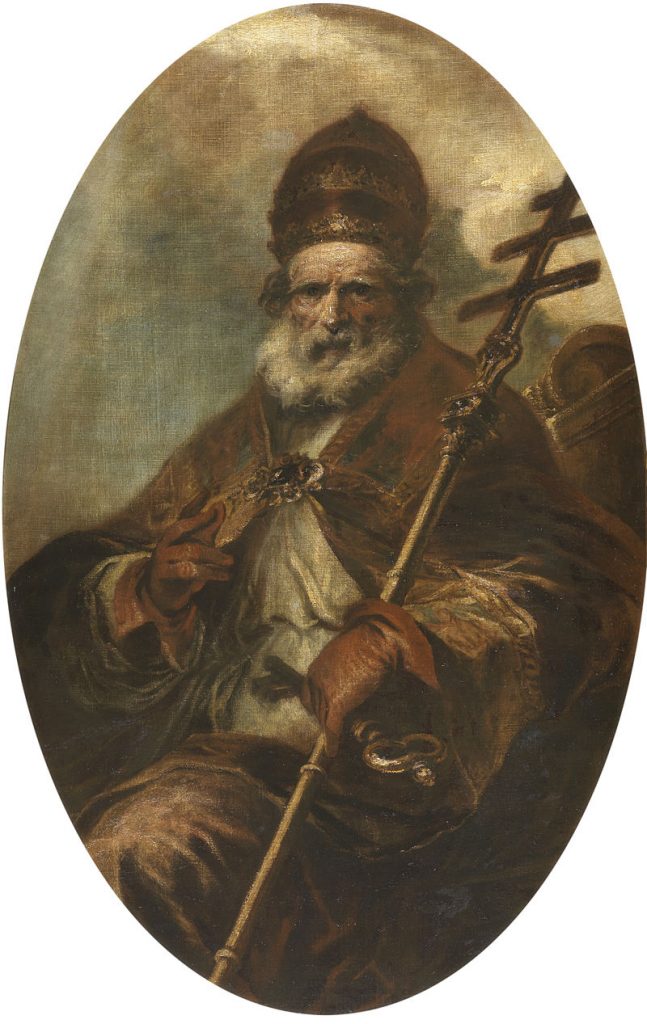
The pontificate of Pope Leo I marked a turning point in the development of papal authority, not because it created new structures of power, but because it articulated and performed authority in ways that would resonate for centuries. Leo operated in a context of profound instability, as the Western Roman Empire faced both internal fragmentation and external threats. The bishop of Rome was compelled to act with a visibility and decisiveness that exceeded earlier norms. Leo’s significance lies not only in what he claimed about papal authority, but in how he enacted it, presenting the Roman episcopate as a locus of both theological clarity and political responsibility.
Central to Leo’s conception of authority was his theology of Petrine succession. He argued that the apostle Peter continued to exercise his pastoral office through the bishop of Rome, thereby grounding papal leadership in apostolic continuity rather than mere institutional development. This claim was not entirely new, but Leo developed it with greater systematic clarity and rhetorical force. In his sermons and letters, he consistently emphasized that the authority of the Roman see derived from its unique relationship to Peter, whose role among the apostles was understood as both foundational and enduring. Leo framed this relationship not simply as historical succession, but as a living transmission of authority, in which the bishop of Rome acted as the ongoing custodian of Petrine responsibility for the universal Church. By presenting himself as both heir and instrument of Peter, Leo strengthened the conceptual bridge between apostolic origins and contemporary governance, encouraging other bishops to recognize Roman authority as intrinsic to the structure of Christian unity. This theological framing allowed Leo to extend influence beyond immediate jurisdiction, shaping expectations of papal leadership across diverse regions of the Christian world.
Leo’s theological authority found its most prominent expression at the Council of Chalcedon in 451. His Tome, a letter addressing the nature of Christ, was received by the council as a definitive statement of orthodoxy, famously greeted with the acclamation that “Peter has spoken through Leo.” While this reception depended on conciliar agreement and imperial support, it nonetheless reinforced the perception that the bishop of Rome possessed a unique capacity to define doctrinal truth. The event illustrates the delicate balance between papal influence and broader ecclesiastical structures, as Leo’s authority was both asserted and affirmed within a collective framework rather than imposed unilaterally.
Beyond theology, Leo’s pontificate demonstrated the practical dimensions of papal authority in a time of crisis. His meeting with Attila the Hun in 452, though shrouded in later legend, symbolized the capacity of the bishop of Rome to act as a representative of civic interests when imperial leadership faltered. Whether or not Leo’s intervention alone persuaded Attila to withdraw, the episode contributed to a growing perception of the papacy as a stabilizing force in the face of external threats. Similarly, Leo’s response to the Vandal sack of Rome in 455 reflected an effort to mitigate destruction and preserve the city’s population, further reinforcing his role as both spiritual leader and civic protector. These actions were not isolated moments but part of a broader pattern in which Leo stepped into roles that blurred the line between ecclesiastical and civic responsibility, negotiating with invading forces, advocating for the protection of noncombatants, and attempting to preserve a semblance of order amid the fragmentation of imperial authority. He modeled a form of leadership that combined symbolic authority with tangible action, strengthening the perception that the papacy could function as a central stabilizing institution in times of crisis.
Despite these developments, Leo’s authority remained fundamentally performative rather than institutionalized in a territorial sense. He did not govern a sovereign state, nor did he possess the administrative apparatus that would later characterize papal rule. Instead, his influence depended on persuasion, reputation, and the ability to act effectively in moments of crisis. Yet it was precisely through these performances of authority that the groundwork was laid for future developments. Leo’s pontificate demonstrated that the bishop of Rome could operate as more than a theological figure, embodying a form of leadership that bridged the spiritual and the political. He helped redefine expectations of the papal office in ways that would shape its evolution in the centuries to come.
Gelasius I and the Theory of Dual Authority (492–496)
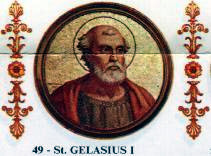
The pontificate of Pope Gelasius I represents a crucial intellectual turning point in the development of papal authority, as it provided one of the earliest systematic frameworks for understanding the relationship between spiritual and temporal power. Writing in the aftermath of the Western Roman Empire’s collapse, Gelasius confronted a world in which imperial authority had been weakened but not entirely extinguished, particularly through the continued influence of the Eastern Roman, or Byzantine, emperors. The bishop of Rome was compelled to define his position not only within the Church but also in relation to secular rulers who still claimed universal authority. Gelasius’s contribution lay in articulating a conceptual structure that both acknowledged imperial power and asserted the distinct and superior role of ecclesiastical authority in matters of ultimate concern.
This framework is most clearly expressed in Gelasius’s famous letter to Emperor Anastasius I, often referred to as the Duo sunt letter. In it, Gelasius argued that the world is governed by two powers, the sacred authority of priests (auctoritas sacrata pontificum) and the royal power (regalis potestas). While both were ordained by God, they operated in distinct spheres with different responsibilities. Crucially, Gelasius maintained that the authority of priests was ultimately greater, because they were responsible for the spiritual well-being of rulers as well as subjects, and would answer before God for their guidance. This argument did not deny the legitimacy of imperial rule, but it subordinated it within a broader theological hierarchy, establishing a principle that would shape medieval political thought for centuries.
Gelasius’s theory was not merely abstract but responded to concrete tensions between Rome and Constantinople. The Acacian Schism (484–519), a prolonged conflict between the Roman Church and the Eastern patriarchate, highlighted the limits of imperial attempts to control ecclesiastical affairs. Gelasius resisted efforts by the Byzantine emperor to impose doctrinal compromises, asserting the independence of the Roman see in matters of faith. He reinforced the idea that spiritual authority could not be subordinated to political expediency, even when backed by imperial power. His position underscored the growing willingness of the papacy to assert autonomy in the face of external pressure.
Gelasius did not claim direct political control or seek to establish the papacy as a governing power in the temporal realm. His formulation preserved a distinction between the two spheres, even as it elevated the importance of the spiritual. This balance allowed for cooperation as well as tension, providing a flexible model that could accommodate varying political circumstances. The theory of dual authority functioned as both a justification for papal independence and a framework for negotiating relationships with secular rulers, rather than as a blueprint for immediate institutional transformation.
The long-term significance of Gelasius’s thought lies in its capacity to legitimize the expansion of papal influence without requiring immediate territorial control. By establishing the superiority of spiritual authority in principle, he created an intellectual foundation upon which later popes could build more concrete claims to power. As political conditions evolved, particularly with the further decline of imperial structures in the West, the conceptual distinction he articulated would increasingly be interpreted in ways that expanded the practical role of the papacy. Gelasius did not create papal temporal authority, but he provided the theoretical language that made its later development both intelligible and justifiable.
Collapse and Opportunity: Italy after the Western Empire
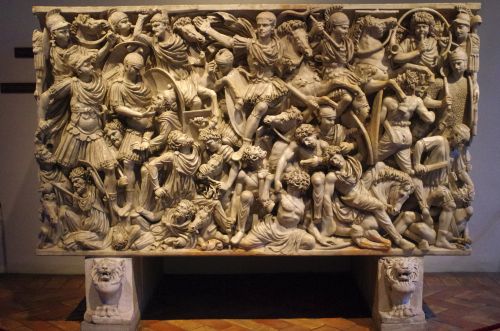
The collapse of the Western Roman Empire in 476 did not produce an immediate vacuum so much as a prolonged fragmentation of authority across Italy. Imperial administration did not vanish overnight, but its coherence and capacity were steadily eroded as successive regimes struggled to maintain control. The Ostrogothic kingdom under Theoderic the Great preserved many Roman institutions, including the Senate and elements of civil administration, creating a façade of continuity. Yet beneath this stability lay a fundamental shift, as political authority became increasingly localized and dependent on the strength of individual rulers rather than on a unified imperial system. The bishop of Rome remained a prominent civic figure, but one whose role was still defined in relation to external political powers.
The situation deteriorated dramatically during the Gothic Wars (535–554), when the Eastern Roman Empire sought to reclaim Italy under Emperor Justinian I. The protracted conflict devastated the peninsula, destroying infrastructure, depopulating cities, and undermining the economic foundations of urban life. Rome itself suffered repeated sieges and occupations, leaving its population vulnerable and its institutions weakened. Agricultural production declined sharply, trade networks were disrupted, and the urban fabric that had sustained Roman civic life for centuries began to unravel. Although Byzantine rule was formally reestablished after the war, it proved fragile and uneven, with imperial officials often unable to provide effective governance or defense. The gap between imperial authority in theory and its practical application became increasingly apparent, forcing local communities to adapt to conditions of insecurity and scarcity.
The Lombard invasion of 568 further compounded this instability, as large portions of Italy fell under the control of a new and often hostile power. The Lombards established duchies across the peninsula, while Byzantine authority was reduced to isolated enclaves such as Ravenna and parts of southern Italy. Rome, though nominally under Byzantine control, was increasingly isolated from effective imperial support. Communication with Constantinople was slow and uncertain, and imperial resources were stretched thin by conflicts elsewhere. This fragmentation created a landscape in which local actors were compelled to assume greater responsibility for their own survival and administration.
The papacy began to take on functions that extended beyond its traditional ecclesiastical role. The bishop of Rome became a key figure in organizing the distribution of food, maintaining public order, and negotiating with both Byzantine officials and Lombard leaders. These responsibilities were not formally assigned but emerged out of necessity, as the failure of secular authorities left a gap that needed to be filled. The Church’s existing networks of communication and its moral authority provided a foundation upon which these expanded roles could be built. These practical activities began to blur the distinction between spiritual leadership and civic governance. The papacy’s involvement in securing grain supplies, managing charitable relief, and coordinating defense efforts further embedded it in the daily life of the city, making it an indispensable institution for both survival and stability.
The transformation was gradual and uneven, shaped by the contingencies of local conditions rather than by a unified strategy. Popes did not initially seek to establish independent political authority, nor did they possess the resources to do so in a systematic way. Instead, their growing involvement in administrative and diplomatic matters reflected the realities of a world in which traditional structures of power had broken down. The accumulation of these responsibilities had long-term consequences, as it accustomed both the papacy and the populations of Italy to the idea that the bishop of Rome could act as a de facto leader in temporal as well as spiritual affairs.
The post-imperial landscape of Italy created the conditions for a redefinition of papal authority. The collapse of centralized governance did not immediately elevate the papacy to political dominance, but it provided opportunities for the expansion of its role in ways that would have been unthinkable under a strong imperial system. As the papacy increasingly assumed functions associated with governance, it began to develop the experience and institutional capacity necessary for more formal expressions of power. This period of fragmentation and adaptation laid the groundwork for the more explicit exercise of political authority that would emerge under later popes, most notably Gregory I, who would bring these developments into clearer focus.
Gregory I and the Exercise of De Facto Political Power (590–604)
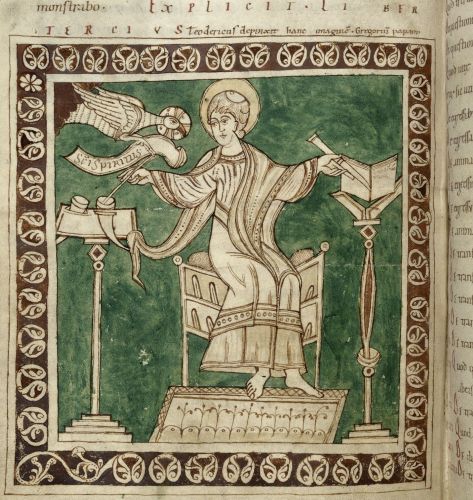
The pontificate of Pope Gregory I, known as Gregory the Great, marks a decisive moment in the transformation of the papacy from a primarily spiritual office into one that exercised tangible political authority. Ascending to the papacy in 590 amid famine, plague, and ongoing Lombard pressure, Gregory inherited a city and region in crisis. Unlike his predecessors, who had navigated authority within existing imperial frameworks, Gregory operated in a context where those frameworks had largely failed. The Byzantine exarch in Ravenna retained nominal authority over Italy, but his capacity to govern and defend Rome was limited. Gregory assumed responsibilities that extended well beyond traditional episcopal functions, effectively positioning himself as the central administrator and protector of the city.
Gregory’s exercise of authority was grounded in both necessity and institutional innovation. Drawing on the extensive landholdings of the Church, known as the patrimony of St. Peter, he organized the distribution of grain and other resources to sustain the population of Rome. These estates, spread across Italy and beyond, provided the economic foundation for papal activity, enabling Gregory to operate with a degree of independence from imperial support. He also implemented administrative reforms to ensure more efficient management of these resources, appointing officials to oversee local operations and insisting on accountability in the handling of Church revenues. Through these measures, Gregory transformed the papacy into an institution capable of sustained governance, rather than merely episodic intervention.
Diplomacy was another key arena in which Gregory exercised de facto political power. Faced with the threat of Lombard expansion, he entered into negotiations with Lombard leaders, including King Agilulf, seeking to secure peace and stability for Rome and its surrounding territories. These negotiations were conducted independently of Byzantine authorities, reflecting both the urgency of the situation and the inadequacy of imperial responses. Gregory’s willingness to act as a diplomatic agent underscored the practical reality that the bishop of Rome had become a primary actor in regional politics. His correspondence reveals a careful balancing of relationships, as he sought to maintain formal loyalty to the Byzantine Empire while pursuing policies that served local needs. At times, this meant navigating tensions between imperial expectations and local realities, as Gregory pursued truces and agreements that the exarchate might not have authorized but could not effectively prevent. This diplomatic independence signaled a subtle but important shift, as the papacy began to act not merely as a moral voice but as a negotiating power capable of shaping political outcomes.
Gregory’s role also extended to the defense and administration of the Duchy of Rome, a region that, while technically under Byzantine control, increasingly relied on papal leadership. He organized efforts to fortify the city, coordinated responses to external threats, and oversaw the maintenance of public order. These activities were not framed as claims to sovereignty, but they nonetheless constituted an exercise of authority that closely resembled that of a secular ruler. Gregory’s actions blurred the boundaries between ecclesiastical and political roles, demonstrating that effective leadership required engagement with both spheres simultaneously.
Gregory maintained a strong emphasis on the spiritual dimension of his office, presenting his expanded role as a form of pastoral responsibility rather than political ambition. His writings, including the Pastoral Rule, articulated an ideal of leadership grounded in humility, service, and moral accountability. This self-understanding allowed Gregory to reconcile the exercise of temporal authority with the theological principles of his office, framing his actions as necessary responses to the needs of his flock. He consistently portrayed himself not as a ruler seeking power, but as a servant compelled by circumstance to assume burdens that others could not or would not bear. This rhetorical framing was crucial, as it legitimized his expanded role within a Christian framework that traditionally emphasized spiritual over worldly authority. By integrating administrative competence with spiritual leadership, Gregory established a model of papal governance that would influence his successors and shape the expectations placed upon the papacy in times of crisis.
Gregory’s pontificate represents a critical stage in the evolution of papal power, in which the theoretical distinctions articulated by earlier figures such as Gelasius I began to take on concrete form. While he did not claim formal sovereignty, his actions effectively established the papacy as a governing authority within central Italy. The combination of economic resources, administrative organization, and diplomatic engagement created a foundation upon which later developments could build. Gregory did not simply respond to the conditions of his time; he reshaped the expectations of what the papacy could be, setting a precedent for the continued expansion of its political role in the early medieval world.
From Administration to Sovereignty: The Papacy and the Franks

By the eighth century, the papacy’s role as a regional administrator had matured into a position that invited more formal expressions of political authority. The weakening of Byzantine influence in Italy, combined with the persistent threat posed by the Lombards, created conditions in which the bishop of Rome could no longer rely on imperial protection. The exarchate of Ravenna, once the center of Byzantine governance in Italy, had become increasingly ineffective, and its eventual fall to the Lombards in 751 marked a decisive rupture. The papacy was compelled to seek new alliances capable of ensuring its survival and stability.
The Frankish kingdom emerged as the most viable partner for the papacy in this shifting political landscape. Under the leadership of the Carolingian dynasty, the Franks had consolidated power in Western Europe and demonstrated both military strength and a willingness to engage with the Roman Church. Pope Stephen II (752–757) played a pivotal role in forging this alliance, undertaking a journey across the Alps to meet with Pepin the Short, the Frankish king. This encounter represented a significant departure from earlier patterns of papal diplomacy, as it marked a direct appeal to a Western ruler for protection and support, bypassing the remnants of Byzantine authority. The journey itself carried symbolic weight, signaling the papacy’s willingness to redefine its political relationships and to seek legitimacy and security beyond the traditional structures of the Roman world. In aligning with the Franks, the papacy not only addressed immediate threats but also positioned itself within a new geopolitical framework that would shape Western Christendom for centuries.
The alliance between the papacy and the Franks was formalized through the so-called Donation of Pepin, in which Pepin granted territories in central Italy to the papacy following his campaigns against the Lombards. These lands, which formed the basis of the Papal States, provided the bishop of Rome with a territorial foundation for the exercise of political authority. Unlike earlier periods, in which papal influence had been exercised within existing political frameworks, this development created a new reality in which the papacy functioned as a sovereign entity with defined lands and administrative responsibilities. The transition from de facto governance to de jure territorial rule marked a fundamental transformation in the nature of papal power. It also required the papacy to develop new administrative mechanisms, including systems for managing land, collecting revenues, and maintaining order across diverse regions. This institutional evolution reflected the broader shift from reactive leadership to structured governance, as the papacy adapted to its new role as both spiritual authority and temporal ruler.
This new arrangement also reshaped the ideological relationship between the papacy and secular rulers. The papacy’s support for the Carolingians, including the legitimization of Pepin’s kingship and later the coronation of Charlemagne as emperor in 800, reinforced the idea that spiritual authority could confer political legitimacy. In return, the Franks provided military protection and upheld the territorial integrity of the Papal States. This reciprocal relationship created a framework in which the papacy and the Carolingian rulers were mutually dependent, each reinforcing the authority of the other in different domains.
The emergence of papal sovereignty introduced new challenges and tensions. The administration of territory required the development of more complex institutional structures, including systems of taxation, legal oversight, and local governance. The papacy, which had evolved primarily as a spiritual institution, now faced the practical demands of ruling land and people. This shift brought with it the potential for conflict, both internally and with external powers, as the boundaries between ecclesiastical and political authority became increasingly blurred. Managing relations with local elites, ensuring the loyalty of officials, and balancing spiritual responsibilities with temporal obligations required a level of administrative sophistication that had not previously been necessary. These challenges highlighted the difficulties inherent in maintaining a dual identity as both religious leader and territorial ruler.
The alliance with the Franks represents a culmination of earlier developments and a turning point in the history of the papacy. What had begun as a gradual expansion of influence in response to the collapse of imperial authority now resulted in the establishment of a territorial state. The papacy’s transformation into a sovereign power did not erase its spiritual mission, but it fundamentally altered the context in which that mission was pursued. By the end of the eighth century, the bishop of Rome had become not only a religious leader but also a political ruler, embodying a dual role that would define the papacy throughout the medieval period.
Stephen II and the Creation of the Papal States (752–757)

The pontificate of Pope Stephen II represents the moment at which the gradual expansion of papal influence crystallized into formal territorial sovereignty. Confronted by the aggressive expansion of the Lombards and the collapse of effective Byzantine protection in Italy, Stephen faced a crisis that could no longer be managed through diplomacy alone. The capture of Ravenna in 751 eliminated the last significant center of Byzantine authority in northern Italy, leaving Rome exposed and vulnerable. The papacy was forced to seek new sources of military and political support, setting the stage for a decisive realignment in its external alliances.
Stephen’s journey across the Alps to meet Pepin the Short marked a turning point not only in papal diplomacy but in the broader political landscape of Western Europe. Unlike earlier interactions with secular rulers, this was a direct appeal for intervention framed in both political and religious terms. Stephen anointed Pepin as king of the Franks, reinforcing the legitimacy of his rule and strengthening the bond between the papacy and the Carolingian dynasty. This act carried profound symbolic significance, as it demonstrated the papacy’s capacity to confer spiritual authority upon a secular ruler while simultaneously securing material support in return. The ceremony itself echoed earlier traditions of sacred kingship, but now with the papacy positioned as the central arbiter of legitimacy in the West. By performing this act, Stephen not only addressed an immediate military need but also helped redefine the relationship between spiritual and temporal authority, embedding the papacy within the very structure of Western kingship and political order.
The military campaigns that followed resulted in the transfer of territory from Lombard control to the papacy, formalized in what is known as the Donation of Pepin. These lands, encompassing key regions of central Italy, became the core of the Papal States and provided the papacy with a defined territorial base. For the first time, the bishop of Rome was not merely exercising influence within existing political structures but ruling over land in his own right. This development marked a fundamental shift in the nature of papal authority, transforming it from a position of dependence and adaptation into one of sovereignty and governance. The acquisition of territory also introduced a new level of permanence to papal power, as authority was now tied not only to office and reputation but to land, resources, and administrative control. This territorial foundation would shape the papacy’s political identity for centuries, anchoring its influence in a concrete geopolitical reality rather than in fluctuating networks of allegiance.
The creation of the Papal States also required the papacy to confront the practical realities of territorial rule. Administration, taxation, legal oversight, and defense all became central concerns, demanding new forms of organization and institutional development. The papacy had to balance its spiritual mission with the responsibilities of governance, navigating the tensions inherent in its dual role. This transformation did not occur without difficulty, as the structures necessary for effective administration had to be developed in a relatively short period and under conditions of ongoing political uncertainty.
Stephen II’s pontificate represents a decisive moment in the evolution of the papacy, in which the theoretical and practical elements of papal authority converged. The alliance with the Franks and the establishment of the Papal States provided a durable foundation for the papacy’s role as both spiritual leader and temporal ruler. While subsequent developments would refine and expand this dual identity, the essential framework was established during this period. The papacy had moved beyond the constraints of imperial dependence, emerging as a sovereign power in its own right and reshaping the political and religious landscape of medieval Europe.
Thematic Analysis: Patterns in the Rise of Papal Power

The rise of papal power from late antiquity through the early medieval period reveals a consistent pattern in which authority expanded not through sudden institutional revolution, but through gradual adaptation to political instability. At each stage, the papacy responded to the weakening or absence of external governance by assuming responsibilities that were initially provisional but became increasingly normalized. From the civic interventions of Pope Leo I to the administrative and diplomatic actions of Pope Gregory I, and finally to the territorial consolidation under Pope Stephen II, the papacy evolved by filling gaps left by declining imperial structures. This process underscores the extent to which papal authority was shaped by circumstance as much as by theological ambition.
A second pattern lies in the interplay between ideological development and practical necessity. The articulation of papal authority, particularly in the writings of figures such as Gelasius I, provided a conceptual framework that elevated the spiritual status of the papacy above secular rulers. These ideas alone did not create political power. It was only when combined with concrete actions, such as negotiating with invading forces or administering resources, that these theoretical claims acquired tangible force. The evolution of papal authority depended on the convergence of intellectual justification and real-world application, each reinforcing the other in a dynamic process of institutional growth.
The relationship between the papacy and external powers also emerges as a recurring theme. Throughout this period, the papacy’s position was shaped by its interactions with larger political entities, whether the Roman Empire, the Byzantine state, or the Frankish kingdom. These relationships were characterized by both dependence and negotiation, as the papacy sought to secure protection while maintaining a degree of autonomy. The alliance with the Franks represents the culmination of this pattern, transforming a relationship of necessity into one of mutual reinforcement. By aligning itself with a powerful secular partner, the papacy was able to convert influence into sovereignty, while simultaneously reshaping the political order of Western Europe. This alignment also signaled a broader realignment of power away from the Mediterranean-centered Roman world toward a distinctly Western political configuration, in which the papacy and the Carolingian rulers became central actors. The papacy’s ability to navigate these shifting alliances, leveraging its spiritual authority to influence political outcomes, was crucial in its transition from dependency to autonomy.
The rise of papal power reflects an ongoing tension between spiritual identity and temporal responsibility. As the papacy assumed greater political authority, it was continually required to reconcile its role as a religious institution with the demands of governance. This tension did not result in a simple shift from one identity to the other, but rather in the development of a dual role that combined elements of both. The papacy’s ability to navigate this tension, framing political action as an extension of spiritual duty, was crucial to its long-term success. The rise of papal power was not merely a story of institutional expansion, but of adaptation to a changing world in which the boundaries between the sacred and the secular were increasingly fluid.
Historiography: Interpreting Papal Power
The following video from “So Basically” is a complete history of the papacy:
Historians have long debated the nature and origins of papal temporal authority, producing a wide range of interpretations that reflect broader methodological and ideological shifts within the field. Earlier scholarship, influenced by confessional perspectives, often framed the rise of papal power as either a providential development or a corruption of an originally spiritual office. Catholic historians tended to emphasize continuity and legitimacy, presenting papal authority as a natural outgrowth of apostolic succession and ecclesiastical necessity. Many Protestant historians viewed the expansion of papal power as a deviation from early Christian simplicity, associating it with institutional overreach and political ambition.
Twentieth-century scholarship introduced more nuanced approaches, moving beyond confessional polemics to examine the papacy within its historical context. Scholars emphasized the development of papal ideology, particularly the articulation of hierocratic theory, as a key factor in the expansion of papal authority. The papacy consciously developed a legal and theological framework that justified its supremacy over secular rulers, interpreting those like Gelasius I as foundational in this process. This perspective highlighted the importance of intellectual continuity and institutional self-definition in shaping the trajectory of papal power.
Other historians have placed greater emphasis on social and political conditions rather than on ideological development alone. Religious historians have argued that the rise of papal authority must be understood within the broader context of the transformation of the late Roman world. From this perspective, the papacy’s expansion was less the result of deliberate institutional design and more a response to the collapse of imperial structures and the need for local leadership. The actions of leaders such as Gregory I are interpreted as pragmatic responses to immediate challenges rather than as steps in a predetermined program of expansion. This line of interpretation shifts attention away from abstract claims of authority and toward the lived realities of governance in a fragmented and often unstable environment. It emphasizes how economic disruption, demographic change, and the erosion of centralized control created conditions in which ecclesiastical institutions could assume roles traditionally reserved for secular authorities. By foregrounding these material and social dynamics, historians in this tradition highlight the adaptability of the papacy as an institution capable of responding to crisis with practical solutions rather than purely ideological assertions.
Recent scholarship has increasingly sought to integrate these approaches, recognizing that ideology and circumstance were mutually reinforcing rather than mutually exclusive. The articulation of papal authority provided a framework that enabled and legitimized the exercise of power, while the practical demands of governance shaped the development of that framework. This synthesis allows for a more comprehensive understanding of the papacy as an institution that evolved through both thought and action, adapting its claims to changing political realities while also shaping those realities through its interventions.
The historiography of papal power reflects broader trends in the study of medieval institutions, including a shift toward contextualization, interdisciplinarity, and the rejection of overly simplistic narratives. Rather than viewing the rise of the papacy as either inevitable or aberrant, contemporary historians tend to emphasize its contingent nature, shaped by a complex interplay of theological, political, and social factors. This approach not only provides a more balanced account of papal development but also highlights the ways in which institutions can evolve in response to changing circumstances, redefining their roles while maintaining continuity with their origins.
Conclusion: From Rome to Realm
The rise of papal power from late antiquity through the early medieval period reflects a transformation shaped less by sudden innovation than by cumulative adaptation to changing political realities. Beginning as a prominent episcopal office within the Roman imperial system, the papacy gradually assumed responsibilities that extended beyond its original spiritual mandate. Heads such as Leo I, Gelasius I, Gregory I, and Stephen II each contributed to this evolution in distinct ways, articulating authority, responding to crisis, and ultimately institutionalizing power. What emerges from this trajectory is not a linear ascent but a layered process in which theological claims, practical necessity, and political opportunity intersected.
At the heart of this transformation was the papacy’s ability to navigate the collapse of imperial structures while redefining its own role within a fragmented world. As secular authority weakened, the bishop of Rome stepped into positions of leadership that were initially provisional but became increasingly entrenched. The articulation of dual authority by Gelasius provided an intellectual framework that elevated the spiritual above the temporal, while the actions of Gregory demonstrated how that framework could be practically applied. These developments were not isolated moments but interconnected stages in a broader process, each building upon the limitations and opportunities of the previous era. The papacy’s growing involvement in administration, diplomacy, and defense reflected both the absence of effective secular governance and the increasing expectation that it would fill that void. By the time of Stephen II, these developments had culminated in the establishment of a territorial base, transforming the papacy into a sovereign power and anchoring its authority in both ideology and geography.
This transition from influence to governance fundamentally altered the nature of the papal office. No longer confined to doctrinal leadership and pastoral care, the papacy became an institution that wielded both spiritual and temporal authority. The creation of the Papal States and the alliance with the Frankish kingdom solidified this dual role, embedding the papacy within the political fabric of medieval Europe. This new identity brought both opportunities and challenges, as the demands of governance required the development of administrative structures and the negotiation of complex relationships with other powers.
The rise of papal power illustrates the capacity of institutions to adapt to shifting historical conditions while maintaining continuity with their foundational principles. The papacy did not abandon its spiritual mission as it acquired temporal authority, but rather reinterpreted that mission in light of new responsibilities. The journey from Rome to realm was not simply a story of political ambition, but of an institution responding to the needs of its time, reshaping itself in the process. This evolution would have lasting consequences, defining the papacy’s role in the medieval world and shaping its legacy in the centuries that followed.
Bibliography
Affiliate disclosure: Amazon links on this site are paid links. As an Amazon Associate I earn from qualifying purchases.
- Boorsch, Suzanne. “The Building of the Vatican: The Papacy and Architecture.” The Metropolitan Museum of Art Bulletin 40:3 (1982-1983), 4-64.
- Brown, Peter. The Rise of Western Christendom: Triumph and Diversity, AD 200–1000. 2nd ed. Malden, MA: Blackwell, 1996.
- Chadwick, Henry. The Early Church. Rev. ed. London: Penguin, 1993.
- Collins, Roger. Early Medieval Europe 300–1000. 3rd ed. Basingstoke: Palgrave Macmillan, 2010.
- Delph, Ronald K. “Polishing the Papal Image in the Counter-Reformation: The Case of Agostino Steuco.” The Sixteenth Century Journal 23:1 (1992), 35-47.
- Duffy, Eamon. Saints and Sinners: A History of the Popes. 4th ed. New Haven, CT: Yale University Press, 2014.
- Dvornik, Francis. Byzantium and the Roman Primacy. New York: Fordham University Press, 1979.
- Einhard. The Life of Charlemagne. Translated by Lewis Thorpe. London: Penguin, 1969.
- Gelasius I. “Letter to Emperor Anastasius Augustus (Duo sunt).” In The Letters of Gelasius I, translated selections in Brian Tierney, The Crisis of Church and State, 1050–1300. Toronto: University of Toronto Press, 1988.
- Gregory I. Registrum Epistolarum (Letters of Gregory the Great). Translated selections in John R. C. Martyn. Toronto: Pontifical Institute of Mediaeval Studies, 2004.
- Heather, Peter. The Fall of the Roman Empire: A New History of Rome and the Barbarians. Oxford: Oxford University Press, 2005.
- Leo I. Letters and Sermons of Leo the Great. Translated by Charles Lett Feltoe. Nicene and Post-Nicene Fathers, Second Series, Vol. 12.
- Markus, R. A. Gregory the Great and His World. Cambridge: Cambridge University Press, 1997.
- McBrien, Richard P. Lives of the Popes: The Pontiffs from St. Peter to Benedict XVI. New York: HarperCollins, 2006.
- McKitterick, Rosamond. The Frankish Kingdoms under the Carolingians, 751–987. London: Longman, 1983.
- Parker, Charles H. “Diseased Bodies, Defiled Souls: Corporality and Religious Difference in the Reformation.” Renaissance Quarterly 67:4 (2014), 1265-1297.
- Procopius. The Wars of Justinian. Translated by H. B. Dewing. Cambridge, MA: Harvard University Press, 1914.
- Richards, Jeffrey. Consul of God: The Life and Times of Gregory the Great. London: Routledge, 1980.
- Tierney, Brian. The Crisis of Church and State, 1050–1300. Toronto: University of Toronto Press, 1964.
- Ullmann, Walter. The Growth of Papal Government in the Middle Ages. 3rd ed. London: Methuen, 1970.
- Whitford, David M. “The Papal Antichrist: Martin Luther and the Underappreciated Influence of Lorenzo Valla.” Renaissance Quarterly 61:1 (2008), 26-52.
- Wickham, Chris. The Inheritance of Rome: A History of Europe from 400 to 1000. New York: Penguin, 2009.
Originally published by Brewminate, 04.23.2026, under the terms of a Creative Commons Attribution-NonCommercial-NoDerivatives 4.0 International license.
About the Author