Brenda Grilli has spent years thinking about how communities organise around uncertain outcomes. As a content strategist working across Spanish-speaking digital-entertainment audiences, she’s drawn less to the spectacle of prediction than to its architecture: who gets to make the forecast, how authority is conferred, what rituals make a prediction feel legitimate rather than arbitrary. Her conclusion, refined through years of editorial work, is that formalising prediction is the decisive act. A private wish to know the future is just anxiety. Give it structure, procedure, and a priestly class — or its secular equivalent — and it becomes something politically and socially consequential (f12).
From that vantage, she finds the modern parallel hard to miss. apuestas.guru now serves as an organised arena where Spanish-speaking audiences engage with formalised sports prediction, the same institutionalising impulse that once produced oracular temples now channelled through statistical models and structured platforms. Grilli observes this continuity from the outside, as someone who studies how communities build authority around forecasting, not as a participant in the wagers themselves.
The ancient world did something similar, and did it on a grand scale. Three civilisations separated by ocean and millennium — Greece, Rome, and the Aztec empire — each built elaborate, state-sanctioned institutions around the project of reading what the future held. The Delphic Oracle, the Roman college of augurs, and the Aztec tonalpohualli were not peripheral curiosities. They sat at the centre of governance, law, and collective life. Understanding how they worked, and why they worked the way they did, opens a window onto one of the deepest recurring patterns in human intellectual history.
The Pythia and the Mechanics of Oracular Consultation at Delphi
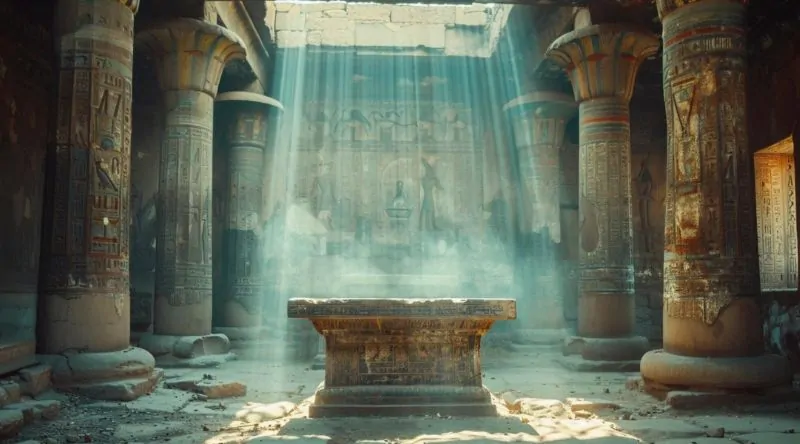
At the height of its influence, the Temple of Apollo at Delphi was the closest thing the ancient Greek world had to a shared political institution. The Pythia, the priestess who served as Apollo’s human mouthpiece, held a role with no real parallel in the modern world. She wasn’t a philosopher speculating about probabilities or a general reading tactical signs. She was the conduit, the point at which divine knowledge was believed to enter human speech.
The mechanics of the process were carefully managed. The Pythia delivered her pronouncements in a trance-like state, which ancient sources attributed to vapours or pneuma rising from a chasm beneath the temple sanctuary. Whether that altered state was chemically induced or ceremonially performed — or some combination of both — the institution made it central. The trance was the credential. It signalled that what followed came from somewhere beyond ordinary human perception.
What made the Oracle genuinely powerful was its client list. Greek city-states consulted it before going to war. Military commanders sought its counsel before major campaigns. Rulers asked about the wisdom of founding new colonies or codifying new laws. These were not casual inquiries. They were formal consultations on matters of state, and the Oracle’s responses were treated as authoritative guidance on precisely those questions. The replies themselves were characteristically ambiguous, formulated so they could be read more than one way, and they required priestly interpretation before anyone could act on them. That interpretive layer mattered enormously. It meant the Oracle never failed outright — it was always possible to argue, after the fact, that the pronouncement had been misread rather than wrong.
Roman Augury and the Bureaucratic Art of Reading Divine Signs
Rome took a different approach to the same epistemological problem: how do you know whether the gods favour a proposed course of action? The answer the Romans built was procedural in a way that even the Delphic system wasn’t. Roman augury wasn’t a consultation with an inspired individual. It was an administrative function carried out by a formal body.
The college of augurs was one of the four major priestly colleges of the Roman state religion, and its charge was precise: to interpret signs from the gods on behalf of the Roman people and Senate. The word “auspices” tells you everything about the method. It derives from the Latin “avis” (bird) and “specere” (to watch or observe), literally meaning one who observes birds. Augurs divided the sky into defined regions and watched what birds did within them: the direction of flight, the patterns of movement, the feeding behaviour of sacred chickens kept specifically for the purpose. Each observation was evaluated against a codified interpretive framework. This was not improvisation. It was, in spirit, closer to a regulatory procedure.
The legal weight attached to the results was substantial. Roman law and custom required that favourable auspices be formally taken before any major military campaign could begin, before a public legislative assembly could convene, and before consular elections could lawfully proceed. A negative omen didn’t just make an action inadvisable. It made it illegitimate. The augural system was embedded directly into Roman constitutional practice, giving priests formal authority to halt the machinery of the state. That authority was, in effect, a veto backed by divine sanction and legal force.
The Aztec Tonalpohualli and Destiny Written in Days
On the other side of the Atlantic, Aztec civilisation produced a divination system of extraordinary technical complexity, one that operated less through inspired individuals or formal observation than through mathematics and cyclical time. The tonalpohualli, a 260-day ritual calendar, assigned each day a unique identity formed by pairing one of thirteen numbers with one of twenty named day-signs. Because 13 and 20 share no common factor, the combination produced 260 distinct day-identities before the cycle repeated, each carrying its own set of meanings, associations, and prognostic weight.
Reading this calendar was a specialised profession. Priests called tonalpouhque were trained to interpret what a person’s birth date within the tonalpohualli meant for their destiny and to advise on auspicious timing for ceremonies, military actions, and major life events. This wasn’t a private service. It fed into collective decision-making at the highest levels of Aztec society, shaping when campaigns were launched and when rituals were performed.
The system’s full scope becomes clearer when you see how it interlocked with the 365-day solar calendar, known as the xiuhpohualli. The two cycles meshed together like gears of different sizes, producing a 52-year cycle called the Calendar Round, at the end of which the combined sequence began again. Every aspect of Aztec temporal life — personal, ceremonial, political — was mapped against this interlocking structure. Fate wasn’t a vague notion. It was calculated, recorded, and professionally administered.
Divination as Rational Epistemology Across Three Civilisations
It’s tempting to describe all three of these systems as superstition — as pre-scientific societies groping in the dark before empirical method arrived. That framing misses what was actually happening. Across Greece, Rome, and Mesoamerica, divination was understood by its practitioners as a legitimate epistemic method, a formalised technique for accessing knowledge about the future that ordinary human perception simply couldn’t supply (f12). The question each system was answering was real: how do you make high-stakes decisions under deep uncertainty? The answer, in each case, was to build a procedure.
The Delphic Oracle’s ambiguity wasn’t a design flaw. It was what allowed the institution to remain authoritative across centuries of consultation on questions no one could actually answer in advance (f4). Roman augury’s legal embeddedness meant that military commanders and legislators couldn’t simply ignore a bad omen — the system had teeth precisely because it had been written into the fabric of Roman constitutional procedure (f8). The Aztec tonalpouhque didn’t just advise; they operated within a calendrical logic so mathematically rigorous that the entire 52-year Calendar Round had to complete before the system reset, giving collective decision-making a temporal architecture that individual judgment could not override (f10).
What all three share is the act of institutionalisation. Private intuition about the future is ungovernable. Institutionalised prediction — with its specialists, its procedures, its interpretive rules, and its political authority — is a different thing entirely. That transformation, from anxiety about the unknown to formalised collective method for addressing it, may be the most persistent intellectual project in human history. It crosses ocean and epoch, and the civilisations that pursued it most seriously were not retreating from reason. They were, by their own lights, practising it.
About the Author