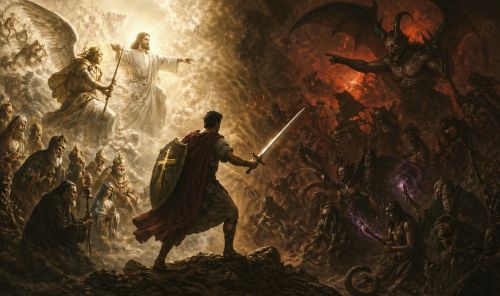
From its origins in early Christianity to its role in modern religious and political discourse, spiritual warfare reveals how believers have understood unseen conflict and moral struggle across time.

By Matthew A. McIntosh
Public Historian
Brewminate
Introduction: Invisible Conflict and the Language of Struggle
The concept of spiritual warfare occupies a central yet often ambiguously defined place within Christian thought, referring broadly to a perceived non-physical struggle between forces of good and evil. While commonly associated with dramatic expressions such as exorcism or demonic confrontation, its historical roots reveal a far more complex and evolving framework. At its core, spiritual warfare functions as a theological lens through which believers interpret suffering, temptation, and moral conflict, situating individual experience within a larger cosmic narrative. This framework has proven remarkably adaptable, capable of absorbing shifts in doctrine, culture, and intellectual paradigms while maintaining its essential structure of conflict and resolution. It is not merely a doctrine confined to formal theology, but a lived interpretive system that has shaped how individuals understand both personal adversity and collective crisis, giving meaning to experiences that might otherwise appear chaotic or inexplicable.
In its earliest formulations, spiritual warfare was inseparable from the apocalyptic worldview that shaped early Christianity, in which unseen powers were understood to exert real influence over human affairs. Yet even within this shared framework, interpretations varied significantly, ranging from literal encounters with demonic entities to more metaphorical understandings of internal moral struggle. These interpretations gave rise to distinct traditions, some emphasizing external confrontation and ritual authority, others focusing on introspection, discipline, and the cultivation of virtue. The language of warfare itself, drawn from both scriptural imagery and broader cultural metaphors of conflict, provided a powerful means of articulating these diverse experiences in a coherent and compelling way.
As Christianity developed across different historical contexts, the concept of spiritual warfare was repeatedly reshaped to address new challenges and concerns. In monastic settings, it became a disciplined practice of mental and spiritual vigilance, while in medieval and early modern periods it was closely tied to questions of sin, salvation, and ecclesiastical authority. The rise of modern evangelical and Pentecostal movements introduced new emphases on direct engagement with demonic forces, often accompanied by increasingly detailed systems of classification and strategy. In each case, spiritual warfare served not only as a theological construct but also as a practical framework for navigating the uncertainties of lived experience, reflecting broader shifts in how individuals and communities understood the nature of evil and their capacity to resist it. These transformations reveal that the concept has never been static, but has continually absorbed and reinterpreted new intellectual, cultural, and social influences, allowing it to remain relevant across vastly different historical moments.
In the contemporary period, the language of spiritual warfare has extended beyond strictly religious contexts, entering the realms of culture and politics where it is often deployed to frame ideological conflict in moral or even cosmic terms. This expansion has intensified debates over its meaning and implications, raising questions about the boundaries between metaphor and literal belief, as well as the potential consequences of framing social disagreements as manifestations of spiritual opposition. By tracing the historical development of this concept, it becomes possible to see spiritual warfare not as a static doctrine, but as a dynamic and contested tradition, one that continues to shape, and be shaped by, the changing contours of human thought and experience.
New Testament Foundations: Conflict Beyond Flesh and Blood

The foundations of spiritual warfare within Christian thought are rooted firmly in the New Testament, where the language of conflict between divine and demonic forces appears with striking clarity. The Gospels present Jesus not only as a teacher and healer, but as one who confronts and overpowers demonic entities, framing his ministry within a broader cosmic struggle. These encounters are not peripheral but central, signaling the inbreaking of divine authority into a world understood to be contested by hostile spiritual powers. Exorcism becomes both a sign and a mechanism of that authority, demonstrating the restoration of order through the expulsion of disruptive forces.
Among the most vivid accounts is the narrative of the Gerasene demoniac in the Gospel of Mark, where a possessed individual is described as inhabited by a “legion” of demons. The story emphasizes not only the intensity of the affliction but also the absolute authority of Jesus, whose command results in immediate submission. Such episodes illustrate a worldview in which demonic forces are both real and active, yet always subordinate to divine power. The dramatic nature of these encounters reinforces the perception of spiritual warfare as an ongoing and tangible reality, rather than a purely symbolic or abstract concept.
Beyond the Gospels, the writings of the Apostle Paul provide a more systematic articulation of spiritual warfare, particularly in his epistles to early Christian communities. In Ephesians 6:12, Paul famously describes the Christian struggle as one not against “flesh and blood,” but against rulers, authorities, and cosmic powers of this present darkness. This passage shifts the focus from specific instances of possession to a broader framework in which all believers are engaged in a continuous struggle against unseen forces. The metaphor of armor (truth, righteousness, faith, and salvation) translates this cosmic conflict into a practical ethical and spiritual discipline, linking belief with action.
Pauline theology also reflects the influence of Second Temple Jewish apocalyptic traditions, which depicted the world as a battleground between forces aligned with God and those opposed to divine order. Texts such as the Book of Daniel and later Jewish writings, including portions of 1 Enoch and the Dead Sea Scrolls, contributed to a cosmology populated by angels and demons, each playing a role in the unfolding drama of history. These traditions emphasized not only the existence of supernatural beings but also the expectation of an ultimate divine intervention that would decisively defeat the forces of evil. Early Christianity inherited and adapted this framework, integrating it into its understanding of salvation, judgment, and the person of Christ as the agent of that final victory. Spiritual warfare becomes not only a present reality but also part of a larger narrative that anticipates the ultimate defeat of evil, situating individual struggle within a cosmic timeline that stretches from creation to eschatological fulfillment.
The New Testament introduces an important tension between external and internal dimensions of this conflict. While the Gospels emphasize direct encounters with demonic forces, other passages suggest that spiritual warfare also takes place within the human heart and mind. Temptation, doubt, and moral failure are framed as arenas of struggle, where individuals must resist influences that lead them away from divine truth. This dual emphasis allows the concept to operate on multiple levels, accommodating both dramatic narratives of possession and more subtle experiences of ethical and spiritual challenge.
The New Testament establishes the essential contours of spiritual warfare as both a cosmic and personal phenomenon. It provides the language, imagery, and theological foundations that would shape subsequent Christian interpretations, while leaving room for diverse applications and emphases. Whether understood as literal confrontation with demonic entities or as an ongoing moral struggle, the concept emerges as a defining feature of early Christian identity, grounding the believer’s experience within a larger vision of conflict and redemption.
Early Church Fathers: Ritual, Doctrine, and Daily Struggle

As Christianity moved beyond its New Testament origins into the second and third centuries, the concept of spiritual warfare became more systematically articulated by early Church Fathers, who sought to define doctrine and practice in the face of both internal and external challenges. Theologians such as Tertullian, Origen, and Athanasius inherited the New Testament framework of cosmic conflict and expanded it into a more structured theology of demonic opposition. In their writings, spiritual warfare was not an occasional or exceptional phenomenon, but a constant condition of Christian existence, shaping both individual conduct and communal identity. This period marks the transition from narrative accounts of conflict to a more reflective and doctrinally grounded understanding of the believer’s ongoing struggle.
Tertullian, writing in the late second and early third centuries, emphasized the active presence of demons in pagan religious practices, portraying Christianity as a force that exposed and defeated these deceptive powers. For him, spiritual warfare was closely tied to the act of conversion, as the renunciation of paganism involved a decisive break with demonic influence. This understanding was reflected in early baptismal rites, which often included explicit exorcisms designed to cleanse the catechumen of any lingering spiritual contamination. These rituals were not merely symbolic but were understood as real acts of spiritual transformation, marking a transition from one realm of influence to another. The renunciations of Satan and his works, which became standard elements in early liturgical practice, reinforced the idea that entering the Christian life required active participation in a spiritual struggle. Baptism functioned as both initiation and confrontation, situating the new believer within a cosmic conflict that extended beyond the individual to encompass the broader religious and social environment.
Origen, one of the most influential theologians of the early third century, offered a more philosophical and allegorical interpretation of spiritual warfare, while still affirming the reality of demonic forces. He understood the struggle against evil as taking place not only in external encounters but also within the human soul, where competing influences shaped thought and action. Origen’s approach reflects a broader intellectual engagement with Hellenistic philosophy, integrating concepts of moral development and rational discipline into the framework of spiritual conflict. He helped to expand the concept of warfare beyond dramatic acts of exorcism, emphasizing the importance of internal vigilance and ethical formation.
By the fourth century, Athanasius of Alexandria provided one of the most enduring portrayals of spiritual warfare in his Life of Antony, a text that would profoundly influence Christian spirituality. In this work, the desert becomes a battleground where the monk Antony confronts a series of demonic assaults, both physical and psychological. These encounters illustrate the belief that withdrawal from society did not eliminate spiritual conflict but intensified it, as the individual became more directly engaged with unseen forces. The narrative also highlights the role of perseverance, prayer, and ascetic discipline as means of resistance, presenting spiritual warfare as a test of faith and endurance. Antony’s struggles were not isolated episodes but part of a sustained engagement with forces that sought to disrupt his spiritual focus, often appearing in forms designed to exploit fear, desire, or doubt. This portrayal contributed to a broader understanding of the ascetic life as one of continuous confrontation, where victory was achieved not through a single act but through ongoing discipline and unwavering commitment.
The experiences of the Desert Fathers more broadly contributed to the development of a practical theology of spiritual warfare centered on daily struggle and self-discipline. Their sayings and writings reveal a focus on temptation, distraction, and the management of thoughts, which were often interpreted as the subtle work of demonic influence. This emphasis on the interior life complemented the more public and ritualized aspects of exorcism, creating a comprehensive framework that addressed both the visible and invisible dimensions of conflict. Spiritual warfare became a continuous process rather than a discrete event, requiring constant attention and effort.
The contributions of the early Church Fathers established the foundations for later Christian understandings of spiritual warfare, combining ritual practice, doctrinal reflection, and personal discipline into a cohesive whole. They transformed the concept from a series of scriptural narratives into a fully developed theological system, one that could be applied across a wide range of contexts and experiences. This synthesis ensured the enduring relevance of spiritual warfare within Christian thought, providing a framework that would be adapted and reinterpreted in subsequent centuries.
Monastic Traditions: Interior Warfare and the Discipline of Thought

With the rise of monasticism in the fourth century, the concept of spiritual warfare underwent a significant transformation, shifting from outward confrontation with demonic forces to an increasingly interiorized struggle centered on thought, desire, and discipline. The deserts of Egypt, Syria, and Palestine became the setting for a new kind of battleground, where monks withdrew from society not to escape conflict, but to confront it more directly within themselves. Spiritual warfare was understood as a continuous engagement with forces that sought to disrupt the mind and weaken the will, making the cultivation of inner stability and vigilance a central goal of monastic life.
Among the most influential in shaping this interiorized model was Evagrius of Pontus, whose writings provided a systematic framework for understanding the dynamics of temptation. Evagrius identified a series of recurring thoughts, or logismoi, that he believed formed the basis of spiritual struggle, including gluttony, lust, avarice, sadness, anger, acedia, vainglory, and pride. These were not merely moral failings, but structured patterns of thought that could be traced, analyzed, and resisted. By categorizing these influences, Evagrius transformed spiritual warfare into a disciplined practice of observation and response, where the monk learned to recognize the onset of temptation and counter it with deliberate effort. His system also implied that spiritual conflict followed recognizable patterns rather than occurring randomly, allowing practitioners to anticipate and prepare for specific types of challenges. This analytical approach marked a significant development in Christian thought, as it framed the inner life as a space that could be studied, ordered, and eventually mastered through sustained effort and awareness.
Central to this practice was the technique known as antirrhēsis, or “talking back,” in which the monk responded to intrusive thoughts by reciting passages of scripture. This method reflected the belief that words carried spiritual power, capable of countering and neutralizing demonic suggestion. The use of scripture in this manner reinforced the connection between knowledge and resistance, as familiarity with sacred texts became an essential tool in the ongoing struggle. Rather than relying on dramatic acts of exorcism, the monk engaged in a quiet but persistent dialogue, confronting each thought as it arose and reasserting control through disciplined speech.
The influence of Evagrius extended beyond the Eastern monastic world through the writings of John Cassian, who transmitted these ideas to Western Christianity. Cassian’s Conferences and Institutes adapted the framework of the logismoi to a broader audience, emphasizing the importance of self-examination and spiritual direction. He presented the monastic life as a process of gradual refinement, in which the individual learned to distinguish between different kinds of thoughts and to respond appropriately. This approach helped to integrate the insights of the desert tradition into the developing structures of Western monasticism, ensuring their continued influence across centuries. Cassian also emphasized the role of community and mentorship, suggesting that spiritual warfare was not solely an individual endeavor but one supported by shared practice and guidance. His writings contributed to the formation of a disciplined spiritual culture in which introspection, accountability, and instruction worked together to sustain the ongoing struggle against disruptive influences.
The monastic emphasis on interior warfare did not entirely exclude the possibility of external demonic influence. Accounts of monks encountering visions, temptations, and even physical assaults by demons continued to circulate, reinforcing the belief that the spiritual realm remained actively engaged with human experience. Yet these narratives were often interpreted through the lens of internal struggle, suggesting that even external encounters were closely linked to the condition of the mind and the state of the soul. This integration of external and internal perspectives allowed monastic spirituality to maintain continuity with earlier traditions while developing a more nuanced understanding of the nature of conflict.
The monastic model of spiritual warfare established a durable framework that would shape Christian spirituality for generations. By emphasizing discipline, awareness, and the management of thought, it provided a practical and adaptable approach to dealing with the complexities of human experience. This interiorization did not diminish the seriousness of the struggle but rather relocated it to a domain where it could be engaged continuously and deliberately. Monastic traditions ensured that spiritual warfare would remain a central and evolving feature of Christian thought, capable of addressing both the visible and invisible dimensions of human life.
Medieval Christianity: Temptation, Salvation, and Moral Combat

In the medieval period, the concept of spiritual warfare became deeply integrated into the broader theological and social fabric of Christian Europe, where it was closely associated with the ongoing struggle between sin and salvation. Unlike the earlier monastic emphasis on internal discipline alone, medieval Christianity expanded the framework to encompass both personal morality and the collective life of the Church. The battle against evil was understood as constant and universal, affecting all believers regardless of status, and requiring vigilance in thought, action, and devotion. Spiritual warfare became a defining element of Christian existence, shaping how individuals interpreted temptation, suffering, and the path to redemption.
Theological developments during this period further systematized the nature of spiritual conflict, particularly through the work of scholastic thinkers such as Thomas Aquinas. Drawing on both scriptural sources and classical philosophy, Aquinas articulated a structured understanding of angels and demons, situating them within a hierarchical cosmology governed by divine order. Demons were seen as fallen angels whose influence operated primarily through temptation rather than direct possession, targeting the weaknesses of human nature. This emphasis on temptation as the primary mode of engagement shifted the focus of spiritual warfare toward moral decision-making, reinforcing the importance of free will and personal responsibility in resisting evil.
The institutional Church developed a wide range of practices designed to combat demonic influence and support the faithful in their spiritual struggles. Sacraments such as confession and the Eucharist were understood not only as means of grace but also as protective measures against sin and spiritual corruption. The use of sacramentals, including holy water, relics, and blessings, further extended this protective framework into everyday life, creating a tangible connection between the material and spiritual realms. These practices were not isolated acts but part of a broader system that reinforced the Church’s mediating role between humanity and the divine, offering both spiritual guidance and practical tools for resisting evil. By integrating these elements into regular worship and personal devotion, the Church ensured that spiritual warfare remained an active and accessible part of daily life, rather than an abstract theological concept reserved for exceptional circumstances.
Popular religious culture also played a significant role in shaping medieval understandings of spiritual warfare, often emphasizing vivid and dramatic depictions of demonic activity. Hagiographies and sermons frequently recounted encounters with the devil, presenting saints as exemplars of resistance and triumph. These narratives served both didactic and inspirational purposes, reinforcing moral lessons while also making the abstract concept of spiritual conflict more immediate and accessible. The figure of the devil became a central presence in the medieval imagination, embodying the forces of disorder and temptation that believers were called to resist.
The late medieval period saw an intensification of concern with demonic influence, particularly in relation to heresy, witchcraft, and social instability. While earlier centuries had focused primarily on individual temptation, this period increasingly framed spiritual warfare in collective and institutional terms, as the Church sought to defend orthodoxy and maintain social cohesion. The emergence of inquisitorial practices and the growing fear of diabolical conspiracy reflect a shift toward a more externalized and sometimes aggressive understanding of spiritual conflict. These developments were closely tied to broader anxieties about political fragmentation, economic hardship, and social unrest, which were often interpreted through a religious lens as manifestations of spiritual disorder. Spiritual warfare became not only a matter of personal piety but also a tool for enforcing conformity and addressing perceived threats to the stability of Christian society.
Despite these changes, the medieval conception of spiritual warfare retained its core emphasis on the moral and spiritual formation of the individual. Whether expressed through theological treatises, liturgical practices, or popular narratives, the struggle against evil remained fundamentally tied to the pursuit of virtue and the hope of salvation. The integration of doctrine, ritual, and daily life ensured that spiritual warfare was not an abstract concept, but a lived reality that permeated every aspect of medieval Christian experience. The period established a lasting synthesis that would influence both later religious developments and enduring cultural perceptions of the battle between good and evil.
Reformation and Early Modern Period: Conscience, Conflict, and Authority

The Reformation and early modern period brought significant transformation to the concept of spiritual warfare, as theological disputes and institutional fragmentation reshaped how Christians understood the nature of conflict between good and evil. While earlier medieval frameworks emphasized sacramental systems and ecclesiastical mediation, the Reformers redirected attention toward the individual believer’s relationship with God, placing greater emphasis on conscience, faith, and internal struggle. Spiritual warfare remained a central idea, but it was increasingly reframed as a battle within the self, where doubt, temptation, and sin were the primary arenas of engagement. This shift reflected broader changes in religious authority, as competing confessional traditions sought to define the proper means of resisting evil.
Martin Luther’s own experiences provide a vivid example of this reorientation, as he frequently described intense spiritual struggles, or Anfechtungen, in which he felt besieged by doubt, despair, and the perceived presence of the devil. For Luther, these experiences were not peripheral but central to the life of faith, revealing the depth of human vulnerability and the necessity of divine grace. His writings portray spiritual warfare as an ongoing confrontation with forces that seek to undermine trust in God, emphasizing the role of scripture and faith as primary weapons in this struggle. He frequently described the devil not only as an external adversary but as one who worked through internal fears and uncertainties, blurring the line between psychological and spiritual experience. Luther rejected many of the ritual practices associated with medieval exorcism, viewing them as insufficient or potentially misleading in addressing the deeper spiritual realities faced by believers. This rejection did not eliminate the reality of spiritual conflict in his theology, but rather redirected it toward a more immediate and personal struggle, grounded in the individual’s relationship with God and sustained through faith, prayer, and engagement with scripture.
John Calvin and other Reformed theologians further developed this inward focus, situating spiritual warfare within a broader theological framework that emphasized divine sovereignty and human dependence on grace. While Calvin affirmed the reality of demonic forces, he placed greater emphasis on the moral and spiritual discipline required to resist them, aligning the concept of warfare with the cultivation of a godly life. This approach reinforced the idea that the primary battleground was not external confrontation but the internal alignment of the believer’s will with divine purpose. Spiritual warfare became closely associated with ethical conduct, self-examination, and the pursuit of holiness.
The Catholic Counter-Reformation reaffirmed the importance of ritual and institutional authority in addressing spiritual conflict, maintaining practices such as exorcism while also emphasizing renewed spiritual discipline among clergy and laity. The Council of Trent and subsequent reforms sought to standardize and regulate these practices, ensuring their alignment with official doctrine. Catholic spirituality incorporated elements of introspection and personal devotion, reflecting a convergence of external and internal approaches to spiritual warfare. This dual emphasis illustrates the complex interplay between tradition and reform, as both Protestant and Catholic movements adapted inherited concepts to new theological and social realities.
The early modern period also witnessed the emergence of literary and allegorical representations of spiritual warfare, most notably in the works of John Bunyan. In The Pilgrim’s Progress, Bunyan presents the Christian life as a journey marked by continual conflict, where the protagonist must navigate a series of moral and spiritual challenges. This narrative encapsulates the broader shift toward internalization and individual experience, translating theological concepts into accessible and enduring forms. Through such works, the idea of spiritual warfare became embedded not only in doctrinal discourse but also in the cultural imagination, ensuring its continued relevance in an era of profound religious transformation.
Nineteenth-Century Revivals: Moral Conflict and Evangelical Expansion
The nineteenth century marked a significant reconfiguration of spiritual warfare within the context of evangelical revivalism, as rapid social change, industrialization, and expanding global missions reshaped religious life. In contrast to earlier theological systems rooted in institutional authority or monastic discipline, revivalist movements emphasized personal conversion, moral responsibility, and the immediacy of spiritual experience. Spiritual warfare during this period was increasingly framed as a struggle within the individual, where the forces of good and evil contended for the human soul through temptation, conviction, and transformation. This inward focus aligned with broader Protestant developments, reinforcing the idea that the primary battlefield of spiritual conflict was the human conscience.
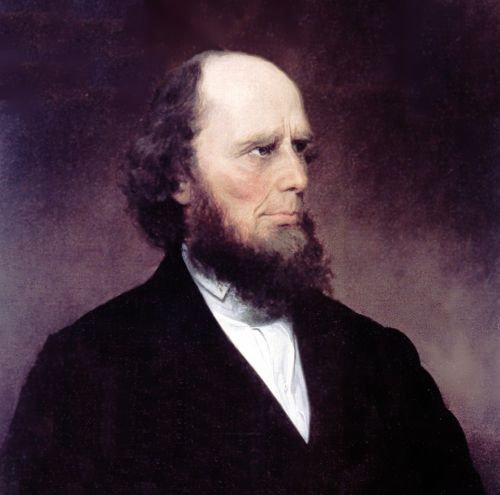
Central to this transformation was the rise of revival preaching, which sought to awaken individuals to their spiritual condition and prompt decisive action. Some such as Charles Grandison Finney emphasized the role of human agency in responding to divine grace, portraying the Christian life as an ongoing struggle against sin and moral weakness. Spiritual warfare was less about confronting external demonic forces and more about overcoming internal resistance to conversion and sanctification. The language of battle remained prominent, but its application shifted toward ethical and emotional struggle, reflecting the revivalist concern with personal renewal and moral reform.
The expansion of evangelical movements into global missionary contexts introduced new dimensions to the concept of spiritual warfare. Missionaries often encountered religious traditions that they interpreted through the lens of Christian demonology, framing their efforts as a confrontation between competing spiritual systems. This perspective reinforced the sense of participating in a broader cosmic conflict, even as the primary emphasis remained on conversion and the transformation of individual lives. The encounter with diverse cultural practices also contributed to the gradual reintroduction of more explicit references to demonic activity, particularly in regions where spiritual beliefs were understood in more direct and experiential terms.
The nineteenth century also witnessed the growing influence of holiness movements, which emphasized the possibility of achieving a higher level of spiritual purity through disciplined practice and divine empowerment. Within these movements, spiritual warfare was closely associated with the pursuit of sanctification, as believers sought to overcome not only overt sin but also deeper patterns of moral and spiritual weakness. This emphasis on inner transformation reinforced the continuity with earlier monastic traditions, while also adapting their insights to a broader and more accessible evangelical audience. Holiness preachers often framed the Christian life as a progressive victory over sin, in which the believer could experience successive stages of spiritual growth through surrender, discipline, and reliance on divine grace. This language of victory and struggle retained the imagery of warfare while recasting it in terms of personal advancement and moral refinement. Spiritual warfare became closely tied to the aspirational dimension of evangelical piety, encouraging believers to view their lives as ongoing journeys toward spiritual completeness rather than isolated moments of crisis or confrontation.
By the late nineteenth century, some such as Dwight L. Moody played a key role in popularizing evangelical approaches to spiritual warfare, combining revivalist fervor with a growing organizational structure. Moody’s emphasis on practical Christianity and moral discipline reflected the ongoing integration of spiritual warfare into everyday life, where the battle against sin was understood as a constant and personal responsibility. While less focused on detailed demonology than later movements, this period laid the groundwork for renewed interest in the active presence of demonic forces, particularly as evangelical theology continued to evolve.
Overall, the nineteenth-century revivalist context reshaped spiritual warfare into a concept that was both deeply personal and broadly expansive. It retained its roots in earlier Christian traditions while adapting to new social, cultural, and global realities. By emphasizing individual experience, moral struggle, and missionary engagement, revival movements ensured that the language of spiritual warfare remained relevant and dynamic, setting the stage for the more explicit and systematized forms that would emerge in the twentieth century.
Twentieth-Century Transformations: Demonology and Deliverance

The twentieth century marked a decisive shift in the development of spiritual warfare, as new theological movements and cultural conditions brought renewed emphasis to the active presence of demonic forces in everyday life. While nineteenth-century revivalism had largely framed spiritual conflict in moral and internal terms, emerging Pentecostal and later Charismatic traditions reintroduced a more literal and experiential understanding of demonic activity. This shift was not entirely unprecedented, but it represented a reconfiguration of earlier ideas into a more systematized and publicly visible form. Spiritual warfare increasingly became associated with direct confrontation, prayer-based intervention, and the expectation of tangible results in the lives of believers.
One of the early catalysts for this transformation was the work of Jessie Penn-Lewis, whose influential book War on the Saints (1903) offered a detailed exploration of demonic deception and spiritual conflict. Penn-Lewis argued that even committed Christians could be subject to demonic influence, a claim that expanded the scope of spiritual warfare beyond conversion and into the ongoing life of the believer. Her work introduced a more analytical approach to demonology, identifying patterns of influence and proposing strategies for resistance. Although controversial, her ideas resonated with a growing audience seeking to understand the complexities of spiritual experience in a rapidly changing world.
The rise of Pentecostalism in the early twentieth century further intensified this renewed focus on spiritual warfare, emphasizing direct encounters with the Holy Spirit and the ongoing reality of supernatural forces. Within these communities, practices such as speaking in tongues, healing, and deliverance became central expressions of faith, reinforcing the belief that spiritual conflict was both immediate and experiential. Deliverance emerged as a distinct practice aimed at expelling demonic influences through prayer and invocation, often conducted in communal settings that emphasized participation and shared belief. This development marked a return to more overt forms of confrontation, though now situated within a modern and global religious context.
As Pentecostal and Charismatic movements expanded throughout the mid-twentieth century, spiritual warfare became increasingly systematized, with leaders developing detailed frameworks for understanding and engaging with demonic forces. Concepts such as generational curses, spiritual strongholds, and levels of warfare gained prominence, providing believers with structured approaches to interpreting and addressing spiritual challenges. These frameworks often drew on both biblical interpretation and experiential testimony, creating a hybrid system that combined scriptural authority with personal narrative. Conferences, training materials, and specialized ministries further reinforced these ideas, contributing to their widespread adoption across diverse Christian communities. This process of systematization not only clarified the conceptual structure of spiritual warfare but also made it more accessible and transferable, enabling it to function as a practical guide for believers navigating perceived spiritual challenges in everyday life.
The development of deliverance ministries brought both visibility and controversy to the concept of spiritual warfare. Leaders such as Derek Prince and others advocated for the regular practice of deliverance as part of Christian ministry, emphasizing the need to identify and remove demonic influences that might hinder spiritual growth. These practices often operated alongside traditional church structures, sometimes creating tension between established institutions and more charismatic expressions of faith. Critics raised concerns about the psychological and theological implications of these approaches, while supporters argued that they addressed aspects of spiritual life that had been neglected in more formalized traditions. The debates surrounding deliverance ministries highlighted broader questions about authority, interpretation, and the limits of religious practice, as communities grappled with how to balance experiential claims with doctrinal consistency and pastoral responsibility.
By the late twentieth century, spiritual warfare had become a prominent and multifaceted feature of global Christianity, encompassing a wide range of beliefs and practices. Its transformation during this period reflects the interplay between tradition and innovation, as older concepts were reinterpreted in light of new experiences and cultural contexts. The renewed emphasis on demonology and deliverance not only reshaped religious practice but also influenced broader discussions about the nature of evil, the role of belief, and the boundaries between spiritual and psychological explanations. The twentieth century established a foundation for the continued evolution of spiritual warfare in the contemporary world.
Charismatic and Neo-Charismatic Movements: Systematizing the Invisible

In the latter half of the twentieth century, Charismatic and neo-charismatic movements further transformed the concept of spiritual warfare by introducing increasingly structured and systematized approaches to understanding the invisible realm. While earlier Pentecostal traditions emphasized direct experience and spontaneous expression, these later movements sought to organize spiritual warfare into identifiable categories, strategies, and methods. This development reflected both the expansion of global evangelical networks and the growing desire for clarity in navigating complex spiritual claims. Spiritual warfare was no longer understood merely as a general condition of Christian life, but as a domain that could be studied, mapped, and actively managed.
A central feature of this systematization was the emergence of multi-level models of spiritual warfare, often dividing conflict into categories such as personal, occult, and territorial engagement. Ground-level warfare focused on individual struggles with demonic influence, typically addressed through prayer and deliverance. Occult-level warfare extended this framework to practices perceived as spiritually dangerous, such as witchcraft or non-Christian religious rituals. Strategic-level warfare introduced the idea that entire regions or societies could be influenced by higher-ranking spiritual forces, often referred to as “territorial spirits.” These categories provided a conceptual structure that allowed practitioners to interpret a wide range of experiences within a unified framework, linking personal challenges to broader cosmic dynamics. By formalizing these distinctions, proponents of spiritual warfare created a vocabulary that could be taught, replicated, and adapted, reinforcing the sense that the unseen world operated according to identifiable principles rather than random or unknowable forces.
Influential people such as Michael Harper and later C. Peter Wagner played a key role in popularizing and refining these ideas, presenting spiritual warfare as both a theological concept and a practical ministry tool. Wagner advanced the notion of strategic-level warfare, encouraging believers to engage in prayer and spiritual action aimed at transforming entire communities or nations. These approaches were disseminated through books, conferences, and training programs, contributing to their rapid spread across diverse cultural contexts. The emphasis on identifiable strategies and measurable outcomes further distinguished neo-charismatic practices from earlier traditions, aligning them with broader trends in organizational and leadership development.
The global expansion of these movements facilitated the integration of local cultural beliefs into the framework of spiritual warfare. In many regions, particularly in Africa, Latin America, and parts of Asia, existing understandings of spirits, ancestors, and supernatural forces were incorporated into Christian interpretations, creating hybrid systems that blended indigenous and evangelical perspectives. This process of adaptation not only expanded the reach of spiritual warfare but also enriched its conceptual diversity, allowing it to resonate with a wide range of cultural experiences. In some cases, local cosmologies provided detailed explanations for spiritual phenomena that were then reinterpreted through Christian theology, resulting in practices that were both familiar and newly contextualized. This dynamic exchange illustrates how spiritual warfare has continued to evolve as a living tradition, shaped by ongoing interaction between global religious movements and localized systems of belief.
Despite its widespread adoption, the systematization of spiritual warfare has also generated significant debate, both within and outside Christian communities. Critics have questioned the theological basis of certain practices, as well as the potential for overextension in attributing social or personal problems to demonic influence. Others have raised concerns about the psychological and pastoral implications of these approaches, particularly when applied without sufficient discernment. Nevertheless, the continued prominence of Charismatic and neo-charismatic movements underscores the enduring appeal of a framework that offers both explanation and agency, enabling believers to engage actively with the perceived realities of the unseen world.
Modern Evangelicalism and Politics: Language, Power, and Conflict

In the late twentieth and early twenty-first centuries, the language of spiritual warfare expanded beyond theological and devotional contexts into the realm of political discourse, particularly within segments of modern evangelicalism. This shift did not abandon earlier theological foundations but rather extended them into new arenas, where cultural, social, and political developments were interpreted through the lens of cosmic conflict. Spiritual warfare became a framework for understanding not only personal and ecclesiastical challenges but also national and ideological struggles, recasting political disagreement as participation in a larger battle between good and evil.
This development was closely tied to the increasing political mobilization of evangelical communities, especially in the United States. As religious identity became more visibly intertwined with political affiliation, the language of spiritual warfare provided a powerful means of framing contemporary issues in moral and theological terms. Political opponents were sometimes described not merely as individuals with differing perspectives, but as representatives of forces opposed to divine order. This rhetorical shift intensified the stakes of political engagement, transforming debate into a form of spiritual confrontation and reinforcing a sense of urgency among believers. This framing often drew upon longstanding narratives of persecution and moral decline, further strengthening the perception that political participation was not simply civic duty but a form of spiritual resistance. Political identity and religious conviction became increasingly fused, shaping how communities understood both their place in society and their responsibilities within it.
Influential leaders and movements within neo-charismatic and “Third Wave” contexts contributed to the politicization of spiritual warfare by emphasizing the role of believers in shaping societal outcomes through prayer and spiritual intervention. Concepts such as territorial spirits and spiritual strongholds were applied to cities, governments, and institutions, suggesting that political and cultural conditions could be influenced by unseen forces. This perspective encouraged forms of engagement that combined traditional political activity with explicitly spiritual practices, blurring the boundaries between religious devotion and civic participation.
The use of spiritual warfare language in political contexts also reflected broader patterns of polarization, as societies experienced increasing division along ideological lines. By framing opponents as participants in a cosmic struggle, this rhetoric often reduced the space for compromise or mutual understanding, reinforcing binary categories of good and evil. Such framing could strengthen group cohesion and identity, but it also risked deepening social fragmentation by portraying disagreement as fundamentally moral rather than contingent or negotiable. Spiritual warfare functioned not only as a theological concept but also as a tool of social and political boundary-making.
Critics have argued that the extension of spiritual warfare into political discourse can obscure the complexity of social issues, encouraging simplistic interpretations that overlook structural, historical, and cultural factors. Others have expressed concern that such language may legitimize exclusionary or adversarial attitudes, particularly when it is used to delegitimize opposing viewpoints. Scholars of religion and politics have noted that this dynamic can contribute to a feedback loop in which heightened rhetoric produces heightened division, further reinforcing the very sense of conflict that the language of spiritual warfare describes. Supporters contend that spiritual warfare provides a necessary framework for understanding the moral dimensions of public life, offering a way to articulate deeply held convictions in the face of perceived cultural or ethical challenges. This tension between explanatory power and polarizing potential continues to shape debates about the role of religious language in political life.
The incorporation of spiritual warfare into modern evangelical politics illustrates the adaptability of the concept across different historical contexts. What began as a theological interpretation of spiritual struggle has evolved into a multifaceted framework that encompasses personal, communal, and political dimensions. Its contemporary usage reflects both the enduring power of religious language and the ongoing negotiation between faith and public life, revealing how ancient ideas continue to shape modern forms of identity, conflict, and engagement.
Comparative Analysis: Spiritual Warfare Across Traditions and Time
Across historical periods and religious traditions, the concept of spiritual warfare reveals a striking continuity in how human societies interpret conflict, suffering, and moral struggle. Whether expressed through ancient exorcistic rituals, monastic disciplines of thought, or modern deliverance practices, the underlying premise remains consistent: unseen forces are believed to influence human behavior and the course of events. This shared framework transcends specific doctrinal boundaries, suggesting that spiritual warfare functions as a broader interpretive lens through which individuals and communities make sense of disorder and seek restoration. Despite significant variation in practice and theology, the persistence of this concept points to enduring human concerns about agency, responsibility, and the nature of evil.
Important differences emerge in how spiritual warfare is conceptualized and enacted across traditions. In early Christianity and monastic contexts, the emphasis was often placed on internal struggle, where the primary battleground was the mind and the will. By contrast, modern Pentecostal and neo-charismatic movements frequently externalize this conflict, identifying specific demonic entities and advocating for direct confrontation through ritualized practices. Similarly, non-Western traditions often integrate spiritual conflict into broader cosmological systems that include ancestors, spirits, and communal relationships, creating models that differ significantly from the more individualistic frameworks of Western evangelicalism. These variations highlight the adaptability of spiritual warfare as a concept, capable of being reshaped to fit diverse cultural and theological environments. In many African and Indigenous contexts, for example, spiritual conflict is not confined to individual experience but is understood as a communal reality that affects families, villages, and entire regions, thereby requiring collective forms of response and mediation. Such differences underscore the importance of cultural context in shaping not only how spiritual warfare is understood but also how it is practiced and experienced.
Another point of comparison lies in the role of authority and expertise in mediating spiritual conflict. In some traditions, spiritual warfare is primarily the domain of specialized figures, such as priests, monks, or ritual specialists, who possess the knowledge and authority to confront spiritual forces. In others, particularly within modern evangelical and charismatic contexts, this authority is more widely distributed, with ordinary believers encouraged to engage directly in spiritual practices. This democratization reflects broader shifts in religious organization and emphasizes personal empowerment, but it also raises questions about interpretation, accountability, and the potential for misuse.
The relationship between spiritual warfare and social structures further illustrates its complexity as a historical phenomenon. The language of spiritual conflict has often been used to reinforce existing hierarchies or to legitimize particular forms of authority, whether ecclesiastical, political, or cultural. It has also served as a means of resistance, enabling marginalized groups to reinterpret their circumstances and assert alternative forms of meaning and agency. For instance, revivalist and charismatic movements have often emerged among populations experiencing social or economic marginalization, offering a framework through which individuals can reinterpret their struggles as part of a larger spiritual narrative that affirms their agency and significance. Conversely, institutional authorities have at times deployed the language of spiritual warfare to maintain doctrinal control or suppress dissent, framing opposition as spiritually dangerous rather than intellectually or politically motivated. This dual usage highlights how spiritual warfare can function both as an instrument of power and as a resource for challenging existing structures, depending on the historical and social context in which it is invoked.
The comparative study of spiritual warfare across traditions and time reveals less a single, unified doctrine than a dynamic and evolving set of practices and ideas. Its enduring presence reflects the human need to articulate the experience of conflict in ways that extend beyond the visible and the material, providing a framework for understanding the tensions that shape both individual lives and collective histories. By examining these patterns comparatively, it becomes possible to see spiritual warfare not only as a religious concept but also as a cultural and historical phenomenon that continues to adapt to new circumstances while retaining its core concern with the struggle between order and disorder.
Conclusion: The Persistence of Invisible Battle
Across centuries and cultures, the concept of spiritual warfare has demonstrated a remarkable capacity for adaptation while maintaining a consistent core premise: that human life unfolds within a broader, unseen struggle between forces of order and disorder. From the exorcistic encounters of the New Testament to the structured frameworks of modern charismatic movements, the language of invisible conflict has provided believers with a way to interpret suffering, moral tension, and uncertainty. This enduring framework reflects not only theological commitments but also a fundamental human impulse to locate meaning within experiences that resist purely material explanation.
The historical evolution of spiritual warfare reveals significant shifts in emphasis, shaped by changing social, cultural, and intellectual conditions. What began as a narrative of confrontation with external demonic forces gradually incorporated interior psychological dimensions, particularly through monastic traditions that emphasized the discipline of thought and the management of temptation. In later periods, especially during the Reformation and revivalist movements, these internal and external dimensions were rebalanced, with renewed attention to both personal moral struggle and broader cosmic conflict. By the twentieth century, this trajectory culminated in the re-emergence of highly systematized and externally focused frameworks within Pentecostal and neo-charismatic contexts, where demonic forces were again understood as active agents in everyday life. These transformations illustrate the fluid boundary between internal and external understandings of evil, as well as the ongoing negotiation between inherited tradition and contemporary experience, demonstrating how spiritual warfare has continually been reshaped to address the evolving concerns of religious communities.
The persistence of this concept also highlights its functional role within religious communities, where it operates as both an explanatory and a motivational framework. By framing challenges as part of a larger cosmic struggle, spiritual warfare can provide a sense of purpose, coherence, and agency, encouraging individuals to engage actively with their beliefs and practices. Its application can carry significant implications, particularly when extended into social or political domains, where it may shape perceptions of identity, conflict, and legitimacy. The tension between these constructive and potentially divisive uses underscores the complexity of spiritual warfare as both a theological idea and a social force.
The history of spiritual warfare reveals less a fixed doctrine than a living tradition, continually reinterpreted in response to new circumstances and needs. Its enduring presence across time suggests that the language of invisible battle remains a powerful means of articulating the human experience of conflict, offering both explanation and engagement in the face of uncertainty. As long as questions about the nature of evil, agency, and meaning persist, the concept of spiritual warfare is likely to remain a significant and evolving feature of religious thought and practice.
Bibliography
Affiliate disclosure: Amazon links on this site are paid links. As an Amazon Associate I earn from qualifying purchases.
- Anderson, Allan. An Introduction to Pentecostalism: Global Charismatic Christianity. Cambridge: Cambridge University Press, 2004.
- Aquinas, Thomas. Summa Theologica. Translated by Fathers of the English Dominican Province. New York: Benziger Bros., 1947.
- Athanasius of Alexandria. The Life of Antony. Translated by Robert C. Gregg. New York: Paulist Press, 1980.
- Bebbington, David W. Evangelicalism in Modern Britain: A History from the 1730s to the 1980s. London: Routledge, 1989.
- Brown, Peter. The Body and Society: Men, Women, and Sexual Renunciation in Early Christianity. New York: Columbia University Press, 1988.
- Budha, Victor L. “Intercultural Criticism of Spiritual Warfare (Ephesians 6:10–20).” HTS Teologiese Studies/Theological Studies 78:3 (2022).
- Bunyan, John. The Pilgrim’s Progress. London, 1678.
- Calvin, John. Institutes of the Christian Religion. Translated by Henry Beveridge. Peabody, MA: Hendrickson Publishers, 2008.
- Cassian, John. The Conferences. Translated by Colm Luibheid. New York: Paulist Press, 1985.
- Collins, Adela Yarbro. Mark: A Commentary. Minneapolis: Fortress Press, 2007.
- Council of Trent. Decrees of the Council of Trent. Translated by H. J. Schroeder. St. Louis: B. Herder, 1941.
- Cox, Harvey. Fire from Heaven: The Rise of Pentecostal Spirituality and the Reshaping of Religion in the Twenty-First Century. Reading, MA: Addison-Wesley, 1995.
- Evagrius of Pontus. The Praktikos and Chapters on Prayer. Translated by John Eudes Bamberger. Kalamazoo, MI: Cistercian Publications, 1972.
- Finney, Charles G. Lectures on Revivals of Religion. New York: Revell, 1868.
- Gorski, Philip S. American Covenant: A History of Civil Religion from the Puritans to the Present. Princeton: Princeton University Press, 2017.
- Harmless, William. Desert Christians: An Introduction to the Literature of Early Monasticism. Oxford: Oxford University Press, 2004.
- Harper, Michael. Spiritual Warfare. London: Hodder and Stoughton, 1970.
- Horsley, Richard A. Jesus and the Powers: Conflict, Covenant, and the Hope of the Poor. Minneapolis: Fortress Press, 2010.
- Hunter, James Davison. Culture Wars: The Struggle to Define America. New York: Basic Books, 1991.
- Kieckhefer, Richard. Magic in the Middle Ages. Cambridge: Cambridge University Press, 1989.
- Le Goff, Jacques. The Birth of Purgatory. Chicago: University of Chicago Press, 1984.
- Luther, Martin. Luther’s Works. Edited by Jaroslav Pelikan and Helmut T. Lehmann. Philadelphia: Fortress Press, 1955–1986.
- Maggi, Armando. “Christian Demonology in Contemporary American Popular Culture.” Social Research 81:4 (2014), 769-793.
- Marsden, George M. Understanding Fundamentalism and Evangelicalism. Grand Rapids: Eerdmans, 1991.
- Mathews, Donald G. “’Spiritual Warfare’: Cultural Fundamentalism and the Equal Rights Amendment.” Religion and American Culture: A Journal of Interpretation 3:2 (1993), 129-154.
- Moody, Dwight L. The Overcoming Life. Chicago: Fleming H. Revell, 1896.
- Noll, Mark A. The Rise of Evangelicalism: The Age of Edwards, Whitefield and the Wesleys. Downers Grove, IL: InterVarsity Press, 2003.
- Origen. On First Principles. Translated by G. W. Butterworth. Gloucester, MA: Peter Smith, 1973.
- Pagels, Elaine. The Origin of Satan: How Christians Demonized Jews, Pagans, and Heretics. New York: Random House, 1995.
- Penn-Lewis, Jessie, and Evan Roberts. War on the Saints. London: Overcomer Book Room, 1912.
- Prince, Derek. They Shall Expel Demons. Grand Rapids: Chosen Books, 1998.
- Robbins, Joel. Becoming Sinners: Christianity and Moral Torment in a Papua New Guinea Society. Berkeley: University of California Press, 2004.
- Russell, Jeffrey Burton. Lucifer: The Devil in the Middle Ages. Ithaca: Cornell University Press, 1984.
- —-. Satan: The Early Christian Tradition. Ithaca: Cornell University Press, 1981.
- Ryrie, Alec. Protestants: The Faith That Made the Modern World. New York: Viking, 2017.
- Smith, Christian. American Evangelicalism: Embattled and Thriving. Chicago: University of Chicago Press, 1998.
- Synan, Vinson. The Holiness-Pentecostal Tradition: Charismatic Movements in the Twentieth Century. Grand Rapids: Eerdmans, 1971.
- Tertullian. Apology. Translated by T. R. Glover. Cambridge: Harvard University Press, 1931.
- The Holy Bible, King James Version.
- Twibell, Simone. “Strategic Level Spiritual Warfare: a Theological Assessment of its Premises and Practices.” Journal of Religion in Africa 39:2 (2009), 137-157.
- Wagner, C. Peter. Confronting the Powers: How the New Testament Church Experienced the Power of Strategic-Level Spiritual Warfare. Ventura, CA: Regal Books, 1996.
Originally published by Brewminate, 04.22.2026, under the terms of a Creative Commons Attribution-NonCommercial-NoDerivatives 4.0 International license.
About the Author