For as long as people have fought, they have looked for ways to survive the blow. Body armor is one of humanity’s oldest technologies, shaped by every new weapon it had to stop.
Its story is a long contest between attack and defense, stretched across more than five thousand years. This is a short history of how personal protection evolved, and where it stands today.
Armor in the Ancient World
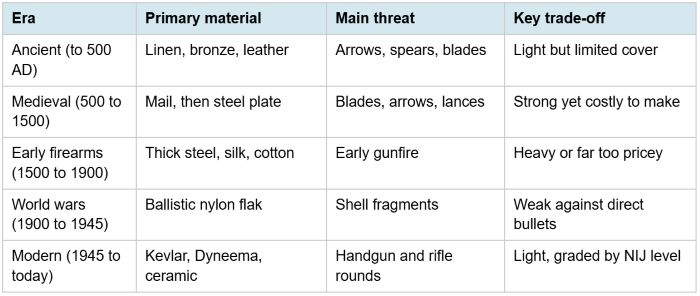
The earliest protection came from whatever nature offered: animal hides, leather, padded cloth, and wood. These simple defenses blunted clubs and arrows, if not much else.
The first known image of armor appears on the Stele of the Vultures in ancient Sumer, in what is now southern Iraq. In Egypt, soldiers around 3100 BC wore layered linen that absorbed and spread the force of incoming arrows.
Greek hoplites carried a far heavier kit. A bronze helmet, breastplate, and greaves shielded the body, while many wore the linothorax, a stiff corselet of glued linen. For a closer look at that panoply, Brewminate’s overview of Ancient Greek Warfare is a useful companion.
The Age of Mail and Plate
As ironworking improved, mail took over. Thousands of interlinked rings turned aside a slashing blow, though forging them was slow and expensive work.
After about 1300, European smiths moved to full plate. Water powered trip hammers made shaping steel faster and cheaper, which helped plate armor spread across the battlefield. Brewminate’s history of Knights in Medieval Europe traces how this gear came to define a warrior class.
A popular myth holds that plate armor left knights barely able to move. Specialists at the Metropolitan Museum of Art’s Department of Arms and Armor call that idea “untrue,” noting that a fitted harness spread its weight across the whole body. Brewminate explores more of these myths in Common Misconceptions about Medieval Arms and Armor.
Gunpowder Changes Everything
Gunpowder, refined by Chinese alchemists, reached Europe by the sixteenth century and rewrote the rules. Steel that could turn a sword failed to reliably stop a lead ball, so heavy plate slowly left the field.
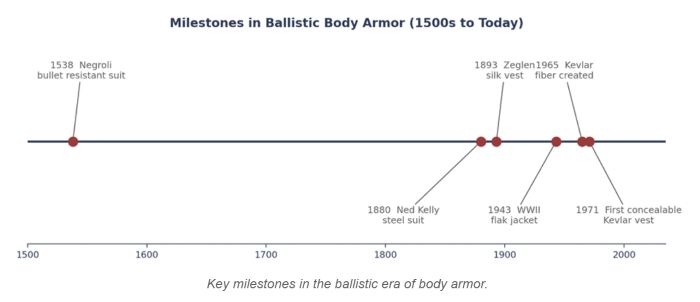
In 1538, the Duke of Urbino commissioned a bullet resistant suit from the Milanese armorer Filippo Negroli, one of the first attempts to beat gunfire with steel.
Improvised answers followed. The Australian outlaw Ned Kelly fought police in 1880 in a homemade plough steel suit. In 1893, the Polish inventor Casimir Zeglen built an early bulletproof vest from layered silk, light but far too costly to issue widely.
The Twentieth Century and Soft Armor
World War II brought the flak jacket, made of ballistic nylon. It caught shell fragments well, but it could not stop most rifle or pistol rounds.
The real breakthrough came in 1965, when the chemist Stephanie Kwolek created a remarkably strong fiber at DuPont. It was commercialized as Kevlar in 1971, the same era that produced the first concealable Kevlar vest. Soft armor had finally become practical for daily wear.
Modern Body Armor Today
Modern protection falls into two families. Soft armor stops most handgun rounds, while hard plates of ceramic, steel, or polyethylene defeat rifle fire.
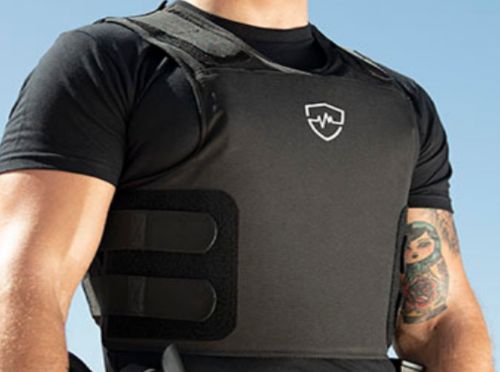
That split matters, because handguns are used in the large majority of shootings, so a soft vest already covers the most common threat.Comfort and coverage now weigh as heavily as raw stopping power. Brands such as safe life body armor build NIJ certified multi-threat vests from fibers like Dyneema, then add rifle plates when a higher level of protection is needed.
Watch: How Body Armor Evolved
For a quick visual tour from chain mail to ballistic fibers, this short documentary is a solid primer.
Watch: Body Armor Through the Ages (YouTube)
Frequently Asked Questions
When was the first bulletproof vest invented?
Casimir Zeglen patented a silk based bulletproof vest in 1893. Earlier soft armor experiments existed, but his design is the best known of that period.
Did medieval plate armor really slow knights down?
Not as much as films suggest. A well fitted harness spread weight across the body, letting trained knights run, climb, and mount a horse.
What are modern vests made from?
Soft armor uses aramid fibers like Kevlar, or ultra high molecular weight polyethylene such as Dyneema. Hard plates use ceramic, steel, or polyethylene.
What is the difference between soft and hard armor?
Soft armor is flexible, concealable, and rated to stop most handgun rounds. Hard plates are rigid and heavier, and they are rated to stop rifle rounds.
The Long Arc of Protection
The materials have changed beyond recognition, yet the goal has not. Each new weapon has pushed armor to adapt, and the cycle still turns today.
From bronze cuirass to woven fiber, body armor remains a quiet record of how people choose to survive.
About the Author