Demand for organic crop protection is surging. Farmers need millions of beneficial insects, predator mites, and parasitic pupae like Trichogramma. Breeding these biologicals is only half the battle. Mastering commercial biocontrol packaging is the actual operational roadblock preventing insectaries from scaling profitably.
Standard industrial machinery fails with live biologicals. You cannot package insects by weight because the moisture content of living organisms fluctuates wildly day to day. A batch weighed on Tuesday will have a different mass by Thursday. If you try forcing delicate pupae through standard vibratory packaging equipment, the mechanical impact crushes the shells. Hatch rates plummet.
To compensate for these inaccurate estimates and dead inventory, operators simply over-pack their vials. You give away valuable product for free. This destroys profit margins.
The solution requires a complete shift away from weight-based estimates. Precision optical counting allows operators to track individual units visually. By implementing specialized equipment, insectaries guarantee exact vial counts, eliminate product waste, and protect the structural integrity of every single pupa.
Why Weight-Based Packaging Fails for Live Insects
Packaging live insects by weight is inherently inaccurate because biological organisms constantly absorb and lose moisture. This unpredictable water weight renders standard scales useless, forcing insectaries to overfill containers to guarantee minimum viable counts.
Moisture content dictates the mass of a pupa. A batch of Trichogramma harvested in the morning weighs differently by the afternoon. When you rely on industrial scales to dose 500 pupae per vial, you are guessing. To avoid frustrated farmers and failed pest control programs, packaging operators routinely add a 10% to 20% margin of error into every container.
This practice creates massive inefficiencies across your insectary operations:
- Lost inventory: You give away thousands of viable insects for free every shift.
- Depleted profit margins: Over-packing scales linearly with production volume, eating directly into your revenue.
- Inconsistent field dosing: Farmers receive unpredictable quantities, which severely complicates their integrated pest management strategies.
The Danger of Standard Vibratory Equipment
Traditional vibratory packaging machines rely on high velocity and aggressive mechanical agitation. This brutal process crushes fragile shells, physically destroying live pupae and drastically reducing the final hatch rate before the product reaches the farm.
Live biologicals require gentle handling. Standard industrial packaging machines prioritize speed over biological preservation. When standard equipment attempts to singularize and count small items, it uses heavy vibration to force the objects down a metal feed channel.
This mechanical stress causes three distinct points of failure:
- High velocity collisions: Pupae slam into machine walls and each other at unnatural speeds.
- Microscopic shell fractures: Cracks expose the developing insect to the outside environment, causing rapid dehydration and death.
- Dead inventory: A vial might technically hold 500 units, but if mechanical trauma prevents 200 of them from hatching, the biocontrol application completely fails.
Scaling your commercial biocontrol facility requires abandoning these destructive methods. You must implement a handling mechanism that treats biologicals as fragile organisms rather than durable industrial hardware.
Strict Dosing Requirements for Integrated Pest Management
Farmers rely on exact predator-to-pest ratios to protect crops. Delivering unpredictable unit counts causes severe crop damage from under-dosing or wasted capital from over-application. Standardized vial counts transition your product into a reliable agricultural input.
Commercial agriculture treats biologicals with mathematical rigor. Agronomists calculate release rates down to the square meter based on pest pressure, canopy density, and crop type. Precise application metrics drive the entire industry.
Consider a commercial vineyard protocol dictating 2,000 predatory mites per acre. A 15% variance in your delivered vials destabilizes the entire Integrated Pest Management strategy. If a vial contains 300 fewer mites than advertised, the target pest population outpaces the predators. The crop suffers immediate damage. If the vial contains 300 extra mites, the farmer wastes labor and capital applying excess product.
Insectaries competing for large agricultural contracts must prove strict quality control. Corporate farming operations actively drop suppliers who ship inconsistent quantities. Your packaging floor directly dictates your market share. You must prove you can scale production without losing dosing accuracy.
Precision Optical Counting for Live Biocontrol
Precision optical counting uses visual sensors to track and verify every individual pupa. This guarantees exact package quantities without relying on fluctuating weight measurements or destructive mechanical vibration.
The shift from mass estimation to visual tracking fundamentally changes commercial biocontrol production. Operators switch from guessing based on average weights to confirming absolute numbers. This completely eliminates the need to over-pack vials. You package exactly 500 pupae. You bill for exactly 500 pupae. The farmer receives exactly 500 pupae.
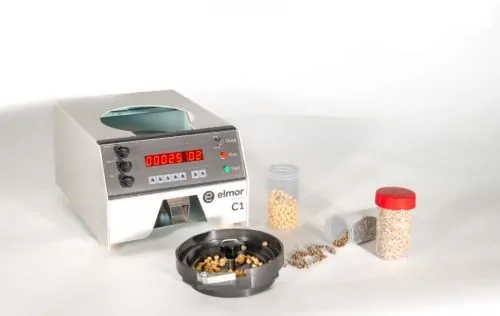
Optical systems like the Elmor C1 count each unit as it passes through the sensor zone. The machine registers the physical presence of the insect rather than its variable mass. This allows insectaries to standardise their output regardless of daily humidity changes or biological moisture content.
Intelligent Dosing Protects Hatch Rates
Intelligent dosing automatically slows the conveyor feed as it nears the target count. This prevents high-speed collisions and ensures fragile biologicals settle into the container safely.
The Elmor C1 is engineered specifically for the handling requirements of live insects and pupae. Standard machines run at a constant, aggressive speed until they hit a hard stop. The Elmor C1 monitors the real-time count continuously. As the vial approaches the target number, the machine intelligently reduces the feed rate. The final few pupae drop gently into the vial.
This deceleration eliminates the mechanical trauma that causes microscopic shell fractures. You preserve the structural integrity of the biologicals. You maintain the high hatch rates your agricultural customers expect. Scaling up production no longer means accepting massive inventory losses or sending dead product to the field.
Packaging Methods Compared
| Packaging Method | Count Accuracy | Biological Impact | Inventory Waste |
| Weight-Based Dosing | Low (fluctuates with moisture) | Minimal | High (requires 10% to 20% over-packing) |
| Standard Vibratory | Moderate | Severe (shell crushing) | Moderate (dead units upon arrival) |
| Elmor C1 Optical Counting | Exact Target | Zero (intelligent deceleration) | Eliminated (exact dosing) |
Securing Profitability in Commercial Insectaries
Scaling a biocontrol operation requires abandoning mass estimation techniques. Every crushed pupa and over-packed vial directly erodes revenue. Implementing precision optical counting with intelligent dosing eliminates these exact bottlenecks.
You protect the biological integrity of your product. Farmers receive the exact application rates required for effective organic pest control. You stop giving away live inventory for free.
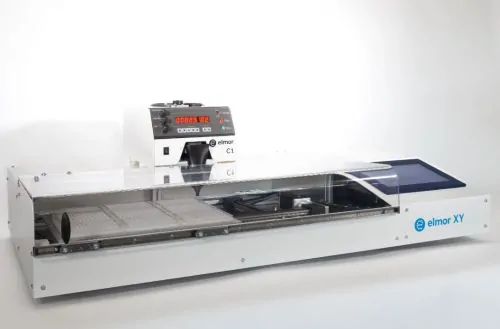
Ready to eliminate product waste and protect your field hatch rates? Contact our technical team today to see how the Elmor C1 optical counter integrates into your packaging line.
Frequently Asked Questions
Does optical counting work for all types of biocontrol insects?
Yes. Precision optical counting adapts to a wide variety of species, from microscopic predator mites to larger parasitic pupae like Trichogramma. Operators adjust the visual sensor parameters on the machine to recognize the specific size, shape, and profile of the target organism. This flexibility allows a single packaging line to handle multiple biocontrol products. You avoid the heavy capital expense of buying separate machines for different insect species.
How does fluctuating moisture content affect optical counting accuracy?
Moisture content has zero impact on optical sensor accuracy. Environmental humidity in rearing rooms constantly alters the mass of live insects, rendering industrial scales useless for exact counts. Optical machines ignore weight entirely. They verify the physical outline and shadow profile of the unit passing through the sensor zone. This guarantees exact unit quantities regardless of daily water weight fluctuations across different harvest batches.
Why is intelligent dosing critical for live pupae preservation?
Intelligent dosing prevents physical trauma by automatically slowing the conveyor feed rate just before reaching the target count. Standard packaging equipment runs at a constant, high speed, which causes damaging collisions as the product drops into the container. This deceleration minimizes kinetic energy at the point of impact. It stops the mechanical shock that causes microscopic shell fractures, ensuring you maintain maximum field hatch rates upon delivery.
What is the financial impact of over-packing biocontrol vials?
Over-packing directly destroys profit margins. When operators add a 10% to 20% buffer to compensate for inaccurate weight estimates, you give away valuable, viable inventory for free on every single order. Across thousands of vials, this represents a massive, compounding revenue loss. Implementing exact optical counting instantly recovers this lost product. It allows insectaries to package more sellable units from the exact same daily harvest volume.
About the Author