Confucius died in 479 BCE without political success. Accounts of his disciples’ long mourning helped transform the frustrated teacher into an enduring cultural ancestor over centuries.
By Matthew A. McIntosh
Public Historian
Brewminate
Introduction: Between a Brief Death Notice and a Monumental Afterlife
In the sixteenth year of Duke Ai of Lu, the transmitted annalistic record reduces the death of one of history’s most influential teachers to a terse notice: “Kong Qiu died.” There is no description of a crowded death chamber, no inventory of final teachings, and no suggestion that an intellectual age had ended. Yet at Qufu, where Confucius was buried, his physical and ceremonial presence eventually became difficult to escape. His grave stood within an expanding cemetery occupied by generations of Kong descendants, while the nearby temple and family mansion grew through repeated imperial patronage into distinct but interdependent institutions. Emperors sent offerings, officials inscribed stelae, students honored the exemplary teacher, and visitors approached the landscape as a material expression of civilized order. The distance between the brief death notice and that monumental afterlife is the historical problem at the center of this essay.
Confucius did not die as an obscure failure, but neither had he achieved the political transformation he desired. He had served in Lu, advised powerful men, traveled among competing states, and trained disciples who entered public life, yet no ruler had committed enduringly to government ordered according to his moral and ritual program. After returning to Lu during his final years, he possessed a reputation as a teacher without commanding the political authority of the sage-minister he hoped to become. His death in 479 BCE left his followers with more than personal bereavement: it confronted them with the question of whether a teaching centered on one living personality could survive that personality’s disappearance.
The surviving answers to that question must be read cautiously because the most affecting details come from substantially later texts. The Mencius, composed more than a century after Confucius’s death, recounts that the disciples remained together for three years and that Zigong returned to live near the grave for another three. The Book of Rites depicts the disciples uncertain about what mourning obligations they owed their master until Zigong proposed that they mourn him as they would a father, though without wearing the formal garments prescribed for sons. Sima Qian subsequently brought such traditions into a continuous Han-era biography that described the funeral, burial, grave-side community, preserved possessions, and early commemorative practices. These accounts may contain memories transmitted through generations of teachers, but they are not eyewitness reports whose every detail can be carried confidently back to 479 BCE. Nor can the received Analects be treated as minutes compiled immediately after the funeral, for it developed through a complicated process of collection, transmission, and revision among communities claiming Confucius’s inheritance. The lateness of these sources does not make them historically useless. It changes the question from whether every remembered action occurred precisely as described to why later custodians considered these particular images of mourning, loyalty, and irreplaceability essential to the identity of their tradition.
Confucius’s posthumous authority emerged through that continuing work of memory. The dead teacher was placed within a quasi-filial relationship that made him fatherlike without erasing the boundary between discipleship and blood kinship. His followers became custodians of sayings, practices, and exemplary stories even as their interpretations diverged, while the refusal to install an adequate successor preserved Confucius himself as the tradition’s absent center. Qufu gave that absence a permanent location, and the involvement of the Kong lineage allowed pedagogical memory to become entangled with ancestral descent. Imperial governments later enlarged the scale of commemoration by incorporating Confucius into state ritual, official education, and the political language of legitimate rule. To call him a cultural ancestor is not to claim that all Chinese people worshipped him as a biological forefather or understood him in identical religious terms. It is to recognize that a teacher who died without realizing his political ambitions was gradually made into an authoritative predecessor whose remembered life could define communities, institutions, and visions of civilization long after the world that produced him had disappeared.
The Journey That Seemed to End in Failure
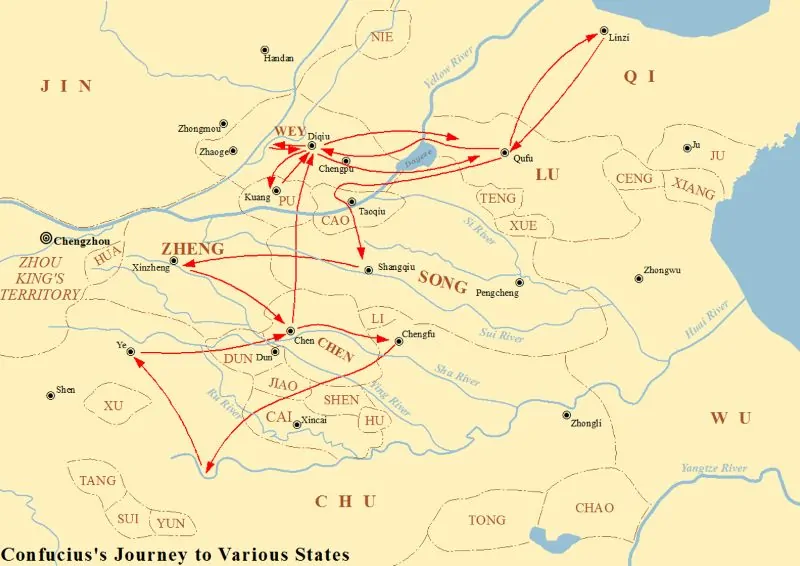
According to the received chronology, Confucius returned to Lu around 484 BCE after years of travel among courts that had listened to him without entrusting their governments to his direction. The homecoming was not that of a victorious statesman. Lu remained divided among its duke and powerful hereditary families, particularly the Ji house, whose authority exemplified the displacement of legitimate hierarchy that Confucius opposed. He was sufficiently respected for Duke Ai, Ji Kangzi, and other political figures to consult him, but consultation did not become sustained political power. By then, age and experience had narrowed the likelihood that another state would invite him to reorganize its institutions. The teacher who had spent much of his adult life seeking a ruler prepared to enact the Way entered his last years with recognition but without the political achievement that he considered most important.
Confucius did not regard public office as merely a route to wealth or personal advancement. Government offered the arena in which cultivated character, correct ritual relationships, and responsible leadership could restore order to a fractured society. His teachings assumed that moral example should move outward from the ruler and court, shaping officials before reaching the wider population. Without the participation of those who possessed power, his program could educate individuals but could not repair the political world on the scale he intended.
The extent of Confucius’s own official authority remains difficult to reconstruct because the sources offer different portraits. The Zuo Tradition places him within the political and ceremonial affairs of Lu, but it does not substantiate every elevated position later attributed to him. Sima Qian’s Han-era biography presents a more dramatic career in which Confucius advanced through several offices, exercised exceptional administrative influence, and at one point approached the power of a chief minister. That account reflects earlier traditions, yet it also shapes his life into a moral narrative about capable counsel repeatedly rejected by unworthy rulers. Rejecting every element of the later biography would be as unwarranted as accepting it without qualification. Confucius probably possessed meaningful experience in administration and court ritual, although the claim that he once effectively governed Lu may owe much to posthumous magnification. His disciples provide firmer evidence that his teaching was connected to practical government rather than isolated philosophical contemplation. Ran You served the Ji family, Zilu accepted administrative responsibilities, and Zigong acquired a reputation for diplomacy and political negotiation. Their careers extended Confucius’s influence indirectly, but they also placed his students inside institutions whose conduct he frequently criticized, creating tensions between moral instruction and the compromises required by service.
Personal losses darkened the years surrounding Confucius’s return. The Analects depicts him grieving intensely for Yan Hui, the disciple he admired most deeply and perhaps regarded as the most capable of sustaining his moral vision. When Yan Hui died, Confucius reportedly cried that Heaven was destroying him, while his other disciples wondered whether the force of his grief exceeded ritual moderation. He also objected when Yan Hui received a more elaborate burial than he believed appropriate, revealing how affection and ritual judgment could pull in different directions even within his own circle. Zilu’s violent death during political disorder in Wei followed near the end of Confucius’s life, removing another of his oldest and most distinctive companions. These deaths made the survival of the teaching less secure while establishing precedents that later texts would use when explaining how the disciples themselves mourned their master.
Later tradition credited Confucius’s final years with editing ancient texts and securing the classical inheritance, but those claims cannot be treated as straightforward biography. What can be said more confidently is that teaching had become the principal field in which he could still act. His disciples preserved conversations, recalled judgments, argued over conduct, and carried different understandings of his instruction into their own careers. Confucius could not have known that later generations would place his name above an imperial educational system or build a vast ceremonial culture around his memory. From the perspective of 479 BCE, he was an aging teacher whose political project remained unfinished and whose most promising followers had begun to die before him. Yet the failure was incomplete, because he had created relationships capable of outliving the political circumstances that had frustrated him. What survived his death was not a government already remade according to his principles, but a community compelled to decide what loyalty to a dead teacher required.
What Happened in 479 BCE? The Historical Death and Its Textual Afterlives
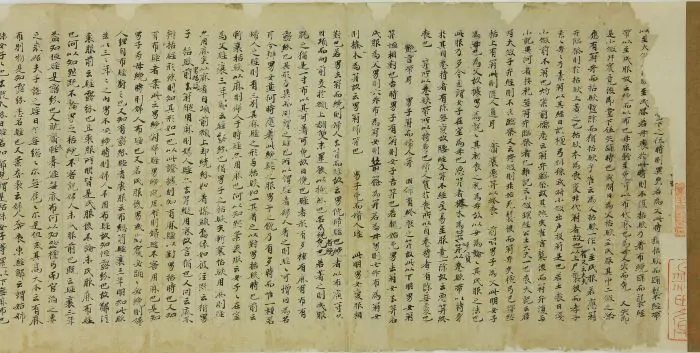
Of everything later generations claimed about Confucius, the year of his death belongs to the relatively secure historical core. The annalistic record preserved with the Zuo Tradition states simply that during the summer, in the fourth month of Duke Ai’s sixteenth year, on the day jichou, “Kong Qiu died.” It supplies neither a cause nor a final teaching and identifies no one who witnessed his last moments. At its earliest recoverable level, the death was an event worth recording in Lu, but not yet the sacred departure depicted by later tradition.
The Zuo Tradition would not leave that terse notice uninterpreted. Its accompanying narrative reports that Duke Ai lamented the loss of an elderly guide whom Heaven had not permitted to remain at his side. The duke addressed Confucius with language suggesting both affection and dependence, presenting the dead teacher as someone whose wisdom might have steadied the ruler and his state. Zigong responded not with gratitude for the tribute but with a criticism of its impropriety. Duke Ai had failed to employ Confucius while he lived, Zigong argued, and his elaborate mourning after the death violated the very ritual integrity he claimed to honor. The exchange transforms bereavement into an accusation against political power: the ruler recognizes the value of counsel only when recognition can no longer require obedience, reform, or sacrifice. It also gives Zigong an important posthumous role as the disciple who protects Confucius from being appropriated too easily by those who had neglected him. Yet the Zuo Tradition reached its received form well after 479 BCE, and its speeches characteristically convert political events into morally patterned narratives. Duke Ai’s lament and Zigong’s rebuke may preserve an early understanding of the death, but they cannot be accepted confidently as verbatim words exchanged immediately afterward.
The Book of Rites constructs a more intimate and symbolically complete final scene. Confucius appears walking with his staff and singing that Mount Tai must collapse, the supporting beam must break, and the wise man must wither. When Zigong approaches, the master explains a dream in which he was seated between two pillars, recognizes its connection to ancient burial customs, and concludes that his death is near. He also laments that no intelligent ruler has arisen to receive his teaching before he falls ill and dies several days later. The account allows Confucius to interpret his own approaching death through the ritual knowledge that defined his authority. Its carefully arranged symbols make it a theological and literary meditation upon the loss of a sage, not a neutral medical description of an elderly man’s final illness.
By the time Sima Qian wrote during the Han dynasty, approximately three centuries of transmission had accumulated around the death. He drew together annalistic records, remembered conversations, ritual anecdotes, accounts of political travel, and traditions maintained by communities that traced their learning to Confucius. The result was the first sustained chronological biography of a man whose surviving image had previously been dispersed across dialogues and exemplary stories. Sima placed the account among the “Hereditary Houses,” a category associated primarily with ruling lineages, even though Confucius had founded no state and transmitted no throne. That literary decision granted him a form of dynastic authority: what he lacked in political sovereignty was replaced by a lineage of teaching, ritual practice, and cultural memory. Sima’s account carries the story beyond the moment of death to the burial beside the Si River, the disciples’ prolonged mourning, the settlement of households near the grave, and the preservation of objects associated with the master. It also describes continuing sacrifices at Confucius’s former residence, making commemoration appear as the natural completion of the life rather than a later historical development. Sima then enters his own narrative, recalling how he visited Lu, viewed the temple, clothing, carriage, and ritual vessels, and watched students practicing ceremonial observances. He lingered at the site and found it difficult to leave, a confession that reveals how powerfully the material presence of Confucius affected even China’s most self-conscious early historian. In Sima’s biography, the adviser whom fifth-century rulers repeatedly declined to follow had already become a civilizational standard before which later rulers and scholars were expected to measure themselves.
The historical reconstruction must remain considerably more modest than any of these narratives. Confucius died in 479 BCE after returning to Lu, leaving disciples who regarded him as an exceptional teacher and remembered his political ambitions as unfinished. The cause of his final illness, the precise words of his last song, the prophetic dream, and the conversations surrounding his death cannot be established with comparable confidence. Even traditions concerning the original burial and its earliest commemorative practices survive principally through texts compiled long after the people who witnessed them had died.
The distance between event and account does not make the later evidence worthless; it makes the process of transmission part of the subject. The annalistic notice placed the death within the political record of Lu, while the Zuo Tradition turned it into a judgment against rulers who recognized wisdom too late. The Book of Rites presented Confucius as the authoritative interpreter of his own ritual passage, and Sima Qian gathered the expanding traditions into the life of a sage whose influence grew because his political hopes had remained unfulfilled. These versions do not form a simple progression in which reverence increased at a steady and inevitable rate. They show different communities selecting the death they needed: a political warning, a ritual exemplar, a biographical culmination, or an origin point for continuing institutions. The physical death remains visible only in outline, but its textual afterlives created the emotional and moral world in which the disciples’ long mourning could become one of the defining stories of Confucian memory.
Mourning a Teacher as a Father but Not as Kin

The death of Confucius created a ritual problem because his disciples could not locate their relationship to him within the ordinary structure of kinship. Sons knew the obligations owed to a father, and relatives could identify the mourning garments appropriate to their place within a family. Disciples possessed no comparably obvious rule for a teacher whose instruction had shaped their lives but whose ancestry they did not share. The Book of Rites preserves that uncertainty by stating directly that Confucius’s followers were perplexed about what they should wear.
Zigong reportedly resolved the problem by reasoning from Confucius’s own conduct. When Yan Hui died, the master had mourned him as though he had lost a son, yet he had not assumed the formal clothing of a bereaved father. He had responded similarly to the death of Zilu. Zigong proposed reversing the analogy: the disciples should mourn Confucius as they would mourn a father but should not wear the garments prescribed for sons. In early Chinese ritual, clothing did more than display an internal emotion. The material, cut, coarseness, and duration of mourning dress publicly identified the mourner’s relationship to the deceased and located both people within a hierarchy of obligation. To assume a son’s clothing would have made a genealogical claim that discipleship alone could not authorize. Mourning without that clothing did not necessarily signify weaker grief; it separated the intensity of devotion from the legal and ancestral structure of the family. The solution was conservative because it preserved the boundary of kinship, yet creative because it extended filial behavior into a relationship for which inherited ritual offered no exact script.
The Analects explains the three-year mourning period for parents through the dependence of an infant who requires years of parental care before leaving their arms. Its defense of mourning emphasizes gratitude and emotional transformation rather than mechanical obedience to a timetable. Extending a comparable period to a teacher implied that education could produce a debt analogous to nurture. Confucius had not given his disciples physical life, but he had formed their judgment and introduced them to a Way through which life acquired moral direction. The analogy made the teacher fatherlike while carefully refusing to make him a second biological father.
Later ritual vocabulary described this practice as “mourning in the heart,” a grief sustained for three years without the full external costume of filial bereavement. That formulation allowed early Confucian communities to speak of pedagogical descent without confusing it completely with ancestral succession. A disciple might inherit teachings, methods of interpretation, and an obligation to transmit the master’s example, but he did not thereby enter the Kong genealogy or acquire a place in its ancestral sacrifices. The distinction also contained a potential social conflict. If devotion to a teacher were identical to filial obligation, educational allegiance could compete directly with the authority of parents and lineage elders; by withholding the clothing, ritual acknowledged an extraordinary moral bond while keeping the family formally prior. The story consequently did more than describe private grief. It provided later teachers and students with a model of loyalty capable of joining people from different families and states into communities organized around shared instruction. Because the Book of Rites was compiled long after Confucius’s death from materials of different periods, the episode may reflect a later ritual solution projected back onto the founding disciples. Even so, its preservation of their perplexity is significant, for it portrays authoritative ritual not as automatic repetition but as reasoned adaptation when an unprecedented relationship demanded public recognition.
The disciples’ response transformed Confucius without turning him into something he was not. His biological descendants could approach him as an ancestor, whereas his students mourned a master whose moral authority resembled paternal authority but did not depend upon blood. Their grief created a lineage of memory alongside the Kong lineage of descent. Zigong became important because the tradition made him both interpreter of the proper response and its most demanding practitioner. Having explained how the disciples could mourn Confucius as a father, he would next demonstrate how far a disciple might carry that obligation beyond the customary three years.
Zigong Beside the Grave: Six Years and the Ideal Disciple
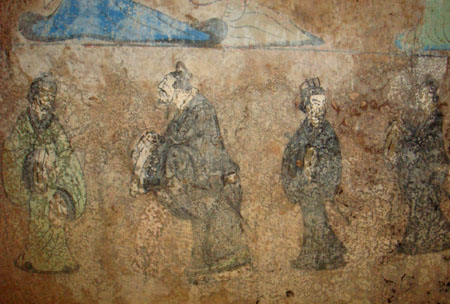
The most enduring account of Zigong’s extraordinary mourning appears in Mencius 3A.4, written more than a century after Confucius’s death. According to the passage, the disciples remained together until the completion of three years, then gathered their belongings and prepared to return to their homes. When they entered to take leave of Zigong, they looked upon one another and wailed until their voices failed. The others eventually departed, but Zigong returned to the place associated with the burial and built a dwelling there. He remained alone for another three years before finally leaving, extending the customary period into six years of fidelity to the dead master.
The episode does not appear in the Mencius as an isolated piece of biography. Mencius invokes it while condemning people who abandoned the teaching they had received and attached themselves too readily to a new intellectual authority. The disciples of Confucius serve as the opposite example: even after their master could no longer instruct, reward, or reproach them, they refused to treat his death as the termination of their obligation. Their final collective wailing expresses the difficulty of dissolving a community held together by one person’s presence. Zigong’s return intensifies the lesson because he chooses renewed separation from ordinary life after every recognized obligation has apparently been fulfilled. Mencius uses the mourning story as a moral argument about constancy, not as a detached attempt to reconstruct the funeral. The account tells its audience what loyalty to a true teacher should demand when a rival doctrine offers novelty or convenience. Its rhetorical purpose does not prove that the six-year residence was invented, but it warns against treating every narrative detail as though Mencius had recovered a contemporary grave-side record. What can be established is that by the later Warring States period, Zigong’s prolonged mourning had become a sufficiently authoritative tradition to function as the defining example of steadfast discipleship.
The additional three years made Zigong exceptional without condemning the disciples who left. They had completed the period understood as analogous to mourning a father, and their grief remained visible in the painful farewell. Zigong moved beyond shared obligation into an exemplary act that could be admired precisely because it was not required of everyone. The story converts duration into moral intensity: six years becomes a measure of the disciple’s unwillingness to let ritual completion dictate the end of attachment.
Zigong was a particularly effective figure through whom to construct that ideal. Known personally as Duanmu Ci, he appears in the Analects as intelligent, verbally agile, politically experienced, and more confident in worldly affairs than the quiet Yan Hui. Confucius sometimes corrects his quick judgments, but he also recognizes Zigong’s capacity to understand comparisons, defend positions, and communicate across social boundaries. Those abilities acquire new significance in Book 19, where Zigong repeatedly answers attempts to diminish Confucius’s reputation. When someone suggests that Zigong may be superior to his teacher, he compares his own learning to a low wall over which anyone can see, while Confucius’s wall rises so high that few people locate the gate and discover the buildings within. When Confucius is disparaged again, Zigong likens the master’s stature to the sun and moon, objects that human beings may attempt to escape but cannot injure. Such statements belong to a textual layer concerned with the disciples’ retrospective evaluation of Confucius, not necessarily to conversations recorded during his lifetime. They nevertheless reveal why later tradition remembered Zigong as more than a mourner: his rhetorical skill made him the guardian of the master’s public standing as well as the solitary guardian of his grave.
The historical setting of the six years remains difficult to recover. Mencius refers to Zigong building a dwelling at the ceremonial ground, while Sima Qian’s later biography connects the residence more explicitly to Confucius’s tomb. Archaeology cannot verify the hut, its duration of occupation, or the precise conduct of those who lived near the early grave. The surviving accounts may combine an older memory of disciples gathering at the burial place with an exemplary tradition that gradually concentrated devotion upon Zigong. Their uncertainty limits biographical confidence but does not diminish their importance for the history of Confucian memory.
Zigong’s ideal discipleship rested upon restraint as much as endurance. He stayed beside the dead teacher without claiming to become the new master, and his defenses of Confucius emphasized a height that he himself could not equal. The six-year vigil consequently enlarged Confucius rather than transferring authority to the mourner. It also made the grave a place where loyalty could be enacted physically, anticipating the later importance of Qufu without yet explaining the institutional development of its memorial landscape. When Zigong eventually departed, no office passed to him and no accepted succession followed. The disciple’s achievement was to preserve the absence, not to fill it. That distinction prepared the tradition for its next problem: whether anyone who resembled Confucius could legitimately receive the observances once directed toward him.
No Second Master: You Ruo and the Problem of Succession
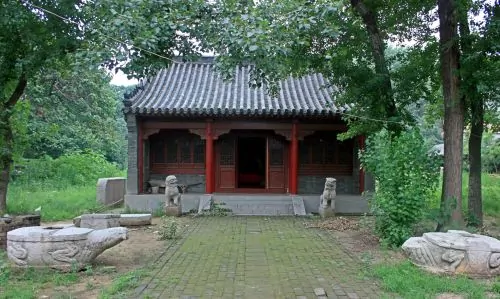
Confucius’s death left no office that could pass automatically to another person. His authority had rested upon teaching, reputation, and personal relationships rather than a throne, priesthood, or formally constituted school. Nevertheless, the disciples still faced the practical question of how their community might continue without the individual around whom it had formed. The Mencius preserves a revealing tradition in which some of them attempted to answer that question by elevating You Ruo.
Zixia, Zizhang, and Ziyou reportedly believed that You Ruo resembled Confucius and wished to direct toward him the same observances they had offered their master. The passage does not explain whether this resemblance was primarily physical, behavioral, intellectual, or some combination of them. What mattered was that You Ruo appeared capable of providing continuity where death had created a vacancy. The disciples’ proposal need not have amounted to the establishment of a formal leadership office; it may simply have meant arranging their conduct around him as they had once gathered around Confucius. Even that limited substitution encountered resistance. When the others attempted to compel Zengzi to participate, he refused and compared Confucius to something washed clean by the waters of the Jiang and Han and bleached beneath the autumn sun. Nothing, he declared, could add to such brilliance. The imagery did more than praise the dead teacher, for it denied that resemblance supplied an adequate basis for succession. You Ruo might reproduce recognizable features of the master, but imitation could not transfer the singular authority that the community had attached to Confucius.
The Analects offers indirect evidence that You Ruo possessed unusual standing among at least some early transmitters. He appears as “Master You,” an honorific form also applied prominently to Zengzi, rather than merely as another named participant in Confucius’s conversations. Several important statements in the opening book are attributed to him, including the claim that filial and fraternal conduct forms the root from which humane behavior develops. This placement may reflect the influence of students who transmitted You Ruo’s teachings or regarded him as an authoritative interpreter of Confucius. It does not prove that the disciples collectively installed him as their leader after 479 BCE. The composite nature of the Analects makes such editorial traces suggestive, but it prevents them from functioning as a straightforward institutional record.
Refusing a successor had far-reaching consequences for the shape of the emerging tradition. If You Ruo had been accepted as a second master, authority might have passed through a recognized sequence of living leaders whose judgments governed the community. Zengzi’s refusal instead preserved Confucius as the unsurpassable standard and made every subsequent teacher an interpreter rather than an equivalent replacement. Even Zigong, whose long mourning and eloquent defenses gave him exceptional prominence, never claimed that the master’s authority had descended upon him. Biological descent offered no simple alternative: members of the Kong family could preserve ancestral rites and family memory, but Confucius’s son and grandson did not inherit universal command over everyone who followed his teaching. Pedagogical succession consequently remained open, diffuse, and contestable. Different disciples could transmit distinct teachings without any one of them possessing an uncontested right to define the whole inheritance. The absence of a second master made fragmentation more likely, yet it also allowed rival communities to remain connected by their common submission to a founder whom none could supersede.
The historicity of the You Ruo episode cannot be demonstrated independently of the later tradition that preserves it. Mencius wrote long after the first generation of disciples had disappeared, and the story may encode later disputes among groups tracing themselves to You Ruo, Zengzi, or other prominent followers. Its value lies partly in showing how those disputes were resolved in cultural memory: no disciple was permitted to become another Confucius. The master’s death created a vacancy that the tradition chose to protect rather than fill. Once succession had been denied, the disciples could continue only as multiple custodians of an authority located in remembered words, exemplary conduct, and the permanently absent person of Confucius.
The Disciples Become Custodians: Rival Lineages and a Shared Ancestor
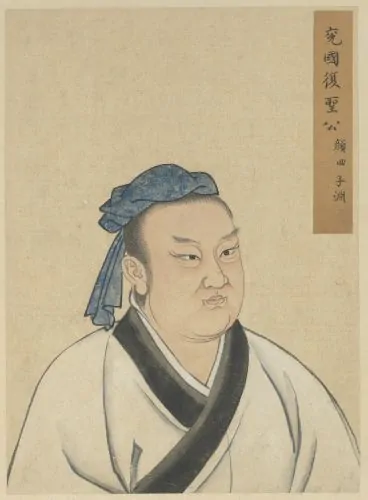
The refusal to recognize a second master did not leave behind a unified institution governed by unanimous disciples. Once the original circle dispersed, no headquarters, hereditary teaching office, or universally accepted council controlled the inheritance. Even the word “Confucianism” can mislead when applied too confidently to this early period, because it suggests a coherence that developed only through later classification. Custodianship began as a distributed responsibility claimed by people who had known different aspects of Confucius and remembered him for different reasons.
The received sources portray the disciples as a remarkably varied collection of personalities rather than interchangeable bearers of one doctrine. Yan Hui represented quiet moral receptivity, but his early death prevented him from becoming a long-term transmitter. Zigong combined intellectual quickness with diplomatic experience and became the great defender of Confucius’s stature. Zilu embodied courage, administrative energy, and a directness that repeatedly drew correction from the master. Later traditions associated Zixia with textual learning and teaching in Wei, while Zengzi became particularly important to discussions of filial conduct, self-examination, and disciplined transmission. Other disciples entered service under rulers or aristocratic houses whose policies did not always conform to Confucius’s standards. Their careers carried elements of his instruction into government, but political service also required adaptations that could generate disagreement over what fidelity to the master actually meant. These portraits were shaped by later communities and cannot be read as untouched biographical profiles, yet their very differences show why a single posthumous program was unlikely to emerge.
A teaching lineage in early China was not necessarily an organized school with fixed membership and a stable curriculum. It might consist of students who remembered a particular teacher, texts associated with his instruction, ritual expertise passed through practice, or later followers who claimed an authoritative chain of transmission. Genealogies connecting individual disciples to particular classics often became much more precise in later accounts than the early evidence allows. Such claims served to authenticate texts and interpretations by bringing them as close as possible to Confucius. “Lineage” is useful only if it describes a remembered route of authority rather than an institution whose membership can always be reconstructed.
By the later Warring States period, fragmentation among those associated with Confucius had become visible enough to attract criticism. The Han Feizi, writing from a hostile intellectual position, claimed that after Confucius’s death his followers divided into eight groups bearing the names of prominent disciples and later teachers. Its enumeration is schematic and polemical, and there is no reason to assume that the eight factions possessed clear boundaries or existed simultaneously in the form described. The accusation nevertheless depends upon an audience already familiar with competing groups that invoked Confucius while disagreeing with one another. The Xunzi likewise criticizes people who imitated the dress, speech, or mannerisms associated with particular disciples without grasping the ritual principles those appearances were supposed to express. Mencius, by contrast, presents his own teaching as a defense and continuation of Confucius’s Way, even though he stood several generations removed from the founding circle. Xunzi also claimed Confucian inheritance but developed positions on human nature, learning, and ritual that differed sharply from those associated with Mencius. Neither thinker believed that disagreement required abandoning Confucius. Their rivalry demonstrates how a shared master could authorize incompatible arguments rather than settle them.
Custodianship was consequently a creative activity rather than simple preservation. Every act of remembering selected certain conversations, elevated particular virtues, and applied inherited judgments to circumstances Confucius had never encountered. Transmitters could believe themselves faithful while rearranging the significance of what they received. The tradition survived because disciples and later teachers adapted it, but adaptation made competing versions unavoidable.
Confucius benefited from that competition even when his followers did not. Because no disciple possessed an uncontested succession, rival communities strengthened their own claims by appealing past one another to the master. A teaching associated with Zixia, Zengzi, Zizhang, or another disciple gained authority when presented as the best preservation of what Confucius had intended. The founder’s remembered words became common property whose meaning remained disputed. This relationship resembled ancestry without becoming biological descent: different pedagogical lines could treat Confucius as their shared origin while the Kong family maintained a separate claim based upon kinship and ancestral rites. The absence of central control permitted regional and intellectual variation, enabling the tradition to enter new political settings without waiting for authorization from Qufu. It also encouraged later writers to portray Confucius as more complete than any individual disciple, since each follower embodied only part of an inheritance that the master alone had supposedly unified. Fragmentation below produced elevation above.
The surviving divisions caution against imagining that one group of disciples preserved a single, settled body of teaching from which all later Confucian thought descended. What followed Confucius was an argumentative field populated by teachers who remembered, selected, and reorganized materials attributed to him. Their shared appeal to his authority connected them, but it did not erase differences of doctrine, ritual practice, or political strategy. Textual collections emerged from within this plural environment and inevitably carried traces of the communities that transmitted them. The Analects would eventually become the most authoritative of those collections, but its apparent unity was the product of compilation across the very rival custodianships that later tradition often concealed.
From Recollection to the Analects: Preserving a Voice after Death

Confucius did not write the Analects as a systematic statement of his philosophy. The received work consists largely of brief sayings, conversations, remembered incidents, and judgments attributed to him or to members of his circle. Its form presupposes a community that continued speaking about the master after he could no longer speak for himself. The text is both a record of teaching and a monument created by transmission.
A traditional account preserved in Han bibliography explains that the disciples recorded what they heard from Confucius and later assembled their notes after his death. That description gave the Analects a direct line of descent from the historical teacher and encouraged readers to imagine an early act of collective compilation. The received text does not support so simple a reconstruction. Its twenty books differ in vocabulary, thematic concentration, narrative style, and the prominence they give to particular disciples. Some passages present Confucius speaking directly, while others contain statements by later followers or describe debates that presuppose his established posthumous reputation. Book 19, for example, concentrates heavily upon disciples defending, evaluating, and interpreting the dead master. Modern scholars disagree about how individual layers should be dated, and attempts to assign each book to one disciple or generation remain contested. There is no compelling evidence that the followers gathered after the funeral and produced anything resembling the complete text now called the Analects. A more plausible model involves sayings and anecdotes circulating in smaller collections, being preserved by different teaching groups, and gradually entering larger compilations. The eventual work retained material of different ages because later editors valued inherited plurality more than the consistency expected of a treatise written by a single author.
Manuscript discoveries confirm that the Analects continued to exist in variant forms long after Confucius’s death. Fragments recovered from a tomb at Dingzhou, sealed in the first century BCE, parallel much of the received text while differing in wording, arrangement, and completeness. Texts discovered in the tomb of the Marquis of Haihun have also renewed interest in the lost Qi version known from Han bibliographical accounts. These manuscripts do not bring historians directly into the rooms where the first disciples remembered Confucius. They demonstrate instead that even during the Han dynasty, the textual inheritance had not been reduced everywhere to one entirely uniform edition. Stabilization was an achievement of continuing editorial and scholarly labor, not an original condition.
The literary form of the Analects helped it preserve something more compelling than a list of doctrines. Confucius appears responding to questions, correcting assumptions, teasing disciples, expressing disappointment, changing emphasis according to his audience, and occasionally refusing to provide the certainty a questioner seeks. Individual passages often begin in the middle of a situation whose larger context has disappeared. Names, gestures, and short exchanges create the impression that readers are overhearing moments once familiar to an intimate circle. The absence of extended exposition forces later readers to occupy the position of disciples, comparing statements and deciding how one answer modifies another. Contradictions that might have been eliminated from a systematic philosophical work instead reproduce the variability of oral instruction. The remembered voice remains personal because it does not sound like an impersonal code. Yet that effect was itself produced by selection and framing: editors determined which fragments of speech deserved preservation, how speakers would be identified, and what sequence would guide interpretation. The Analects makes Confucius seem present while keeping most of the people responsible for that presence invisible.
Source criticism prevents the immediacy of the text from becoming proof of verbatim authenticity. Some sayings may descend substantially from Confucius, while others may reflect reformulation by disciples, later transmitters, or communities seeking his authority for their own positions. In most cases, the available evidence cannot identify the exact stage at which a statement acquired its received wording. The historically responsible position lies between treating the entire work as stenographic record and dismissing it as wholesale fabrication.
Death made this ambiguity unavoidable and productive. A living teacher could explain an answer, correct a recollection, or respond to circumstances that exposed weaknesses in an earlier formulation. Once Confucius was gone, the custodians had to decide among remembered variants without access to a final arbiter. Their compilations converted a local relationship into a portable encounter that could be repeated wherever the text traveled. Later students who had never entered Confucius’s presence could address questions to his remembered words and imagine themselves within the continuing company of his disciples. The Analects consequently enlarged the master by preserving not an unchanging doctrine but the experience of interpretation around him. His grave fixed memory within the landscape of Qufu, while the collection attributed to his followers allowed his voice to move far beyond it.
The Tomb by the Si River: Fixing Memory in Place

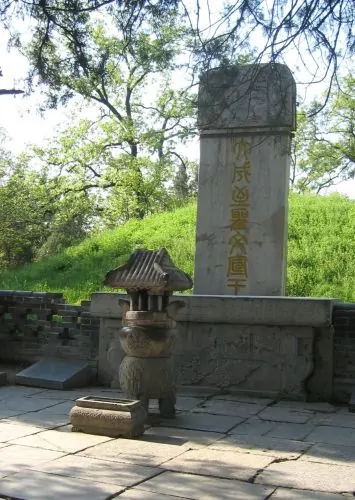
A remembered voice could travel, but a grave gave Confucius’s death a fixed location. Sima Qian states that he was buried beside the Si River, north of the capital of Lu in the vicinity of present-day Qufu. The placement connected the master permanently to the state whose political disorder had shaped his ambitions and whose rulers had failed to use him fully. From that point forward, followers could approach not only teachings attributed to Confucius but a landscape believed to contain his body.
Sima’s account makes the burial ground the center of an emerging community. The disciples reportedly mourned there before departing, while Zigong remained for the additional period that made him the exemplary guardian of the grave. Sima then states that disciples and inhabitants of Lu established homes near the burial place until the settlement numbered more than one hundred households. The resulting community became known as the Kong village, joining residence, commemoration, and the transmission of memory within one locality. This tradition suggests that attachment to Confucius’s body helped preserve relationships that might otherwise have dissolved when the disciples scattered. Those who remained near the grave could receive visitors, maintain observances, repeat stories about the master, and identify the physical spaces associated with his life. The burial place thereby acquired authority different from that of any text. Sayings could be rearranged, disputed, or attributed to rival lines of transmission, but the tomb offered one visible point toward which all such lineages might orient themselves. Its location did not resolve disagreements about doctrine, yet it asserted that every legitimate interpretation referred back to the same historical person. Qufu became the geographical counterpart to the absent center preserved in the disciples’ recollections.
The physical history of the earliest tomb is much less certain than Sima’s narrative continuity implies. No surviving mound, marker, platform, or surrounding structure can simply be identified as untouched fabric from 479 BCE. The river landscape changed, and successive generations repaired, enlarged, marked, and reinterpreted the burial site. Later descriptions of the mound’s original shape and its sacrificial platform preserve important traditions, but they do not substitute for contemporary archaeological documentation. The tomb’s historical authenticity rests primarily upon a remarkably durable identification of place and repeated commemorative use rather than the survival of an unaltered fifth-century monument.
It is also important not to describe the entire Qufu complex as though the grave itself expanded into a single enormous temple. The cemetery developed north of the city around the remembered burial place, while the principal temple arose separately at the site traditionally identified with Confucius’s former residence. The Kong Family Mansion eventually stood beside the temple as the administrative and residential center of the senior line of his descendants. These institutions became closely connected, but each embodied a different form of custodianship. The tomb and cemetery emphasized the body, ancestry, and continuity of the Kong lineage; the temple presented Confucius as a teacher and sage who could receive sacrifices from people unrelated to him by blood. The mansion supported descendants whose hereditary position allowed them to maintain both sites and mediate between family ritual and official patronage. As additional generations of the Kong family were buried around Confucius, the cemetery transformed an individual grave into a landscape of descent. Pedagogical followers could claim Confucius as the origin of their learning, but his biological descendants occupied the ground around him and converted proximity into a durable institutional privilege. The sacred landscape of Qufu emerged from the interaction of these claims rather than from one uninterrupted building project.
Fixing memory in place did not mean preserving it unchanged. Every repaired mound, new inscription, commemorative structure, and repeated ceremony added another historical layer to the original burial. The grave remained powerful because later communities believed they were returning to the same person even when the material setting around him had been transformed. Qufu offered a location where textual memory, ancestral descent, and ritual performance could converge without becoming identical. What began as the burial place of a respected teacher was capable of becoming a public center of authority. Imperial involvement would enlarge that authority dramatically, turning local and familial commemoration into a cult supported by the state.
From Household Veneration to Imperial Cult
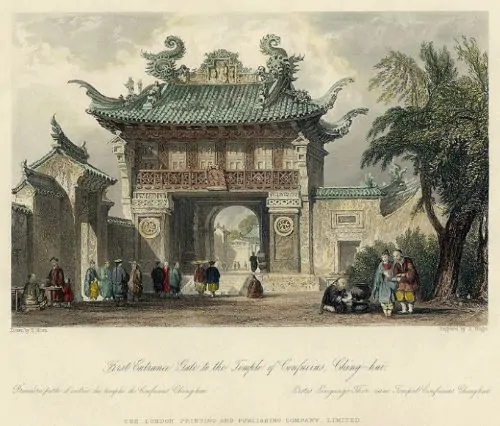
The earliest commemoration of Confucius appears to have remained local, personal, and closely connected to his descendants. A grave could attract disciples, but regular sacrifice required people who possessed the resources and recognized standing to maintain it. The Kong family occupied a position that pedagogical followers could honor but not inherit. Before Confucius became an imperial sage, he was a dead teacher remembered at Qufu within a landscape shaped by household and regional loyalties.
Sima Qian reports that Confucius’s former residence was used as a temple in which clothing, a cap, a musical instrument, a carriage, books, and other possessions associated with him were preserved. Later tradition attributed the establishment of this memorial place to the ruler of Lu shortly after the death. The arrangement resembled household ancestral veneration because objects connected to the deceased remained within his former domestic space and sacrifices continued across generations. Yet it also exceeded an ordinary family cult. Scholars and officials who possessed no blood relationship to Confucius could approach the residence as the home of an exemplary teacher whose authority concerned public conduct. The preserved objects presented his teaching as embodied in a life rather than contained only in remembered words. Clothing evoked proper comportment, musical instruments recalled ritual cultivation, and books connected the master to the classical inheritance later attributed to him. Sima’s description belongs to the Han period and cannot verify the condition of the house immediately after 479 BCE. It does show that by his own time, the Qufu memorial was understood as a place where domestic memory had opened outward to a larger community of educated visitors.
A decisive enlargement occurred in 195 BCE, when Han Gaozu traveled through Lu and offered a full great sacrifice to Confucius at Qufu. The founding emperor had risen through warfare and possessed little of the cultivated scholarly image later rulers preferred to project, which made his public deference significant. By honoring a teacher who had never ruled a state, Gaozu placed military victory beneath an older standard of civil and ritual authority. The ceremony did not instantly establish Confucianism as the exclusive ideology of the Han empire. It created a powerful precedent by demonstrating that an emperor could strengthen his own legitimacy through submission to Confucius’s cultural stature.
The growth of that precedent under the Han was gradual and institutionally uneven. Confucius benefited from increasing court support for classical scholarship, but the empire never governed through one philosophical doctrine alone. Administrators continued to use laws, bureaucratic techniques, cosmological theories, and inherited practices that could not be reduced to teachings preserved in the Analects. Under Emperor Wu, the appointment of specialists in the Five Classics and the expansion of the Imperial Academy gave classically educated scholars greater access to state service. These developments strengthened Confucius’s association with authoritative learning even when the classics themselves did not all originate with him. Imperial visits, repairs at Qufu, privileges for Kong descendants, and posthumous honors gradually connected the local cult to the dynasty. By the first century CE, sacrifices to Confucius were increasingly associated with educational institutions as well as his ancestral home. The state thereby changed the social meaning of commemoration: honoring Confucius became an act through which rulers endorsed civil learning and officials acknowledged the moral genealogy of their profession. None of this eliminated competing traditions at court, nor did it produce a single, stable definition of Confucian orthodoxy. The cult expanded because it could coexist with the practical diversity of imperial government while giving that government a language of cultivated legitimacy.
Calling this development a “cult” should not be mistaken for a claim that Confucius was simply transformed into a god in a familiar Western sense. Sacrifices addressed his spirit through offerings, music, bows, ritual vessels, and eventually tablets or images, making the ceremonies more than secular memorial exercises. Still, official ritual commonly honored ancestors, exemplary officials, natural powers, and culture-bearing figures without placing all recipients within one theological category. Confucius’s distinctive position was that of a deceased sage whose spirit received sacrifice because his teaching sustained the civilized order claimed by the state.
The connection between worship and education became still more systematic under later dynasties. In the Tang period, imperial policy extended temples or ritual spaces dedicated to Confucius through the network of government schools, allowing students and officials far from Qufu to participate in the cult. His posthumous rank rose through new titles, and the ritual community around him expanded to include selected disciples and later scholars. Their placement within the temple made intellectual history visible as a hierarchy organized around the master. The selection was never neutral, because including a commentator or teacher declared his interpretation worthy of state recognition, while exclusion could push a rival lineage beyond the accepted tradition. Under the Song, the growth of the civil examination system and renewed attention to classical learning intensified the association between Confucius, education, and bureaucratic service. Officials did not merely study texts attributed to his tradition; they performed reverence before entering the institutions that authorized their careers. The state cult converted pedagogical descent into public ritual and made Confucius the symbolic first teacher of an empire-wide scholarly class. A local memorial had become reproducible wherever the imperial school system reached.
State sponsorship never absorbed the Qufu cult completely. The emperor honored Confucius as sage and teacher, while Kong descendants continued to approach him through the obligations of ancestry and inherited custodianship. Those relationships overlapped, but they could produce disputes over who should conduct sacrifices, which forms were appropriate, and whether the family or the state possessed the stronger ritual claim. Their tension helped sustain the cult by giving both sides reasons to protect and enlarge it. Imperial recognition supplied wealth, rank, and geographic reach; the Kong lineage supplied continuity rooted in body, grave, and descent. The increasing convergence of those interests would be written into the architecture of Qufu as its temple, cemetery, and family mansion became a monumental landscape of imperial power.
Building Qufu
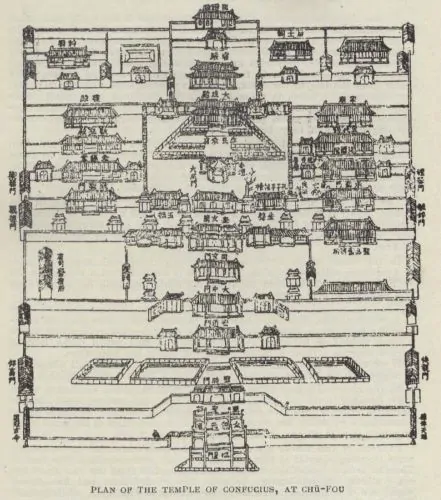
Qufu did not become a monumental center through the enlargement of one original structure. Its sacred landscape developed through three connected institutions: a temple honoring Confucius as teacher, a cemetery organized around his body and descendants, and a mansion occupied by the senior Kong lineage. Each served a different constituency while depending increasingly upon the others. Their eventual scale reflected centuries of negotiation between family custodianship and imperial power.
Tradition dates the first memorial use of Confucius’s former residence to shortly after his death, but the surviving temple is overwhelmingly the product of later reconstruction. Han rulers supported repairs and sacrifice at Qufu, while subsequent dynasties repeatedly enlarged the buildings as Confucius’s place within official culture rose. A major rebuilding under the Sui in the early seventh century effectively absorbed the remembered domestic residence into a purpose-built ceremonial complex. Tang patronage followed the empire-wide expansion of Confucius temples through government schools, making Qufu the original and most prestigious site within a much larger ritual network. Song emperors financed ambitious enlargements that added courtyards, halls, gates, and hundreds of rooms. Warfare and fire then damaged or destroyed substantial portions, requiring reconstruction under the Jin, Yuan, Ming, and Qing. An enclosure modeled upon imperial architectural forms appeared during the Yuan, while rebuilding after a catastrophic fire in 1499 gave the temple much of the scale associated with its late imperial appearance. Another major fire in 1724 prompted an expensive Qing reconstruction employing craftsmen and resources supplied through the imperial government. The resulting complex was not an untouched survival from the fifth century BCE but a cumulative statement that every dynasty wished to present itself as the legitimate protector of Confucius.
Architecture translated that protection into hierarchy. Visitors passed through successive gates and courtyards before reaching the principal ceremonial halls, a controlled progression that made proximity correspond to rank and ritual privilege. Imperial inscriptions and stelae placed the words of emperors within the master’s sacred space, while roof forms, colors, axial planning, and monumental dimensions associated the temple with the highest levels of political authority. The buildings did not merely shelter sacrifices; they instructed visitors in how Confucius should be approached. Qufu’s physical order made reverence spatial before any offering was performed.
North of the city, the cemetery expanded according to a different logic. Confucius’s grave remained the central point, but successive generations of Kong descendants transformed the surrounding land into an immense genealogy expressed through burial. By the second century CE, later site histories report that dozens of family tombs had already accumulated around the original mound. The number increased across the imperial centuries as recognized descendants sought burial within a landscape whose prestige derived from bodily proximity to the sage. Gates, sacrificial structures, stone figures, stelae, and ceremonial paths gradually formalized what had begun as a grave beside the Si River. Construction of substantial walls and entrances accelerated during the Yuan and continued under the Ming, when towers, arches, pavilions, and a processional route connected the cemetery more deliberately to Qufu. Trees and tombs filled the enclosed space until the burial ground resembled a separate ancestral domain. Eligibility for burial helped define membership in the lineage, giving genealogy a territorial boundary as well as a written record. The cemetery represented more than reverence for one famous man. It made the continuing fertility, antiquity, and social endurance of the Kong family visible around the ancestor from whom its privileges descended.
The Kong Family Mansion housed the living institution that administered this inheritance. It functioned simultaneously as an aristocratic residence, a ritual office, and the managerial center for lands, revenues, archives, servants, and ceremonies associated with the senior descendant. After the mansion was separated physically from the temple in the late fourteenth century, Ming expansion produced an imposing compound arranged between official offices and domestic quarters. Its location beside the temple allowed the Kong household to mediate continuously between family responsibilities at Qufu and commands arriving from the imperial court.
That mediation brought extraordinary advantages without making the Kongs independent of the state. Successive rulers granted Confucius’s descendants titles, land, exemptions, salaries, and ritual duties, culminating in the hereditary title Duke Yansheng that endured from the Song into the twentieth century. The senior descendant possessed status unmatched by most nonimperial families, yet his authority depended upon dynastic recognition and could be regulated from the capital. Emperors determined Confucius’s posthumous titles, established sacrificial forms, and decided which disciples or later scholars could occupy honored positions within official temples. The Ming ritual reforms of 1530 demonstrated this control by challenging aristocratic titles and sculptural images associated with the cult, replacing much of that representational language with spirit tablets and a stronger emphasis upon Confucius as first teacher. Such changes provoked tension because Qufu was both an official sanctuary and an ancestral site whose family custodians claimed authority older than the reigning dynasty. The Kongs could appeal to descent, local knowledge, and continuous service, while the court could supply or withhold the resources that maintained the complex. Neither side achieved complete control. Their uneasy partnership made Qufu durable because family interest and state legitimacy repeatedly converged upon its preservation.
The completed landscape was a historical palimpsest rather than a frozen ancient shrine. A visitor encountered a fifth-century grave through later mounds and markers, approached the teacher through halls rebuilt by imperial craftsmen, and met his living lineage within a mansion shaped by bureaucratic privilege. Fires, wars, reforms, and dynastic changes repeatedly altered the material site without breaking its identification with Confucius. Continuity depended upon reconstruction, and every reconstruction interpreted the past according to present political needs. By the end of the imperial era, Qufu had become one of China’s most authoritative sacred landscapes. Its survival beyond the dynasty would require another transformation, as imperial ritual gave way to contested ideas of national culture, historical preservation, and heritage.
From Imperial Sage to National Heritage
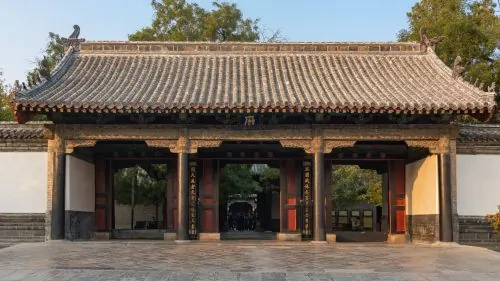
The fall of the Qing dynasty ended the political system that had sustained the official cult of Confucius for centuries. Imperial sacrifices, hereditary privilege, classical examinations, and the authority of the court had once reinforced one another, even when their relationship remained contested. The new republic inherited Qufu’s buildings and Kong lineage without inheriting an unquestioned reason to preserve their former status. Confucius now had to be justified within the language of nationhood rather than dynastic legitimacy.
That transition produced both rejection and reinvention. The abolition of the examination system in 1905 had already severed the strongest institutional connection between classical learning and advancement into government service. During the New Culture and May Fourth movements, reformers attacked Confucian morality as a defense of patriarchal authority, social obedience, and habits that had left China vulnerable to foreign power. Lu Xun’s fiction and essays exposed the cruelty that could hide beneath claims of ritual propriety and family virtue, turning reverence for inherited ethics into an object of suspicion. Confucius became shorthand for a social order that radicals believed modern citizenship had to overcome. Other intellectuals separated the historical thinker from the institutions later constructed in his name, presenting him instead as an educator, humanist, or philosopher whose ideas might survive the rejection of imperial orthodoxy. Republican governments likewise alternated between reducing old ritual privileges and employing Confucian symbolism in projects of moral reconstruction. In 1935, the hereditary title Duke Yansheng was replaced by the modern office of Sacrificial Official to Confucius, preserving a public role for the senior descendant while stripping it of its explicitly aristocratic form. The change did not abolish lineage custodianship. It translated an imperial inheritance into a national bureaucracy that could claim Confucius without restoring the dynasty.
After the establishment of the People’s Republic in 1949, official interpretation generally placed Confucius within the history of feudal class society. His teachings could be studied as part of China’s intellectual past, but reverence for him remained politically suspect. Even so, the government designated the Qufu complex as protected cultural property in 1961. That decision separated historical preservation from ritual assent: buildings associated with a condemned ideology could still possess national artistic and archaeological value. The distinction proved unstable because the monuments continued to embody authority more powerfully than the neutral language of cultural relics suggested.
During the Cultural Revolution, Qufu became a target precisely because its monuments preserved the hierarchy that revolutionary activists intended to destroy. In November 1966, Red Guards attacked the temple, mansion, and cemetery in a campaign against Confucius and the “old” culture associated with him. Statues and ritual objects were smashed, inscriptions were defaced, graves were opened, and the tomb traditionally identified as Confucius’s was leveled. The violence was not incidental damage inflicted upon an inconvenient archaeological site. Destroying the grave and humiliating the Kong dead enacted a rejection of ancestral privilege, while attacks on imperial stelae repudiated the long alliance between Confucian ritual and state power. The perpetrators treated architecture and burial as active political claims rather than inert remains. Subsequent campaigns, especially the movement to criticize Lin Biao and Confucius during the 1970s, continued to use the ancient teacher as a symbol of reactionary hierarchy. These events broke any defensible narrative of uninterrupted public veneration at Qufu. They also demonstrated the continuing potency of the site, because a memory considered truly irrelevant would not have required such theatrical destruction. Much of the complex survived, and the documentation, material fragments, and continuing identification of its spaces later made extensive restoration possible. The cultural ancestor could be attacked, but the landscape still supplied the coordinates through which he could be reconstructed.
After 1978, preservation policy and changing attitudes toward traditional culture brought sustained restoration to Qufu. The temple, cemetery, and mansion reopened increasingly as historic monuments, tourist destinations, and evidence of China’s long civilizational continuity. Their inscription on the UNESCO World Heritage List in 1994 placed the three sites within an international framework emphasizing architecture, material culture, historical influence, and conservation. UNESCO recognition did not restore the imperial cult. It supplied a new form of authority in which universal heritage replaced dynastic patronage as the principal public language of protection.
Contemporary Qufu nevertheless exceeds the category of museum. Ceremonies honoring Confucius have returned, descendants participate in lineage activities, visitors offer gestures of reverence, and government-sponsored festivals present the city as a birthplace of enduring Chinese values. Such practices do not reproduce one coherent tradition, for tourism, religious devotion, scholarship, local economic interest, and state cultural policy assign different meanings to the same spaces. Official promotion often presents Confucius as a source of harmony and educational respect while separating him from the coercive institutions criticized by twentieth-century reformers. The designation of national heritage allows the state to celebrate cultural continuity without conceding the authority once claimed by an imperial ritual order. In this setting, “cultural ancestor” becomes both more plausible and more complicated: Confucius can represent a shared civilizational past even for people who do not accept him as religious authority or philosophical guide. Qufu’s modern prominence is not the final stage of an uninterrupted ascent beginning with the disciples’ mourning. It is another reconstruction, shaped by revolutionary rupture, conservation policy, international recognition, and the changing needs of the modern Chinese nation.
Did the Disciples’ Mourning Really Make Confucius?
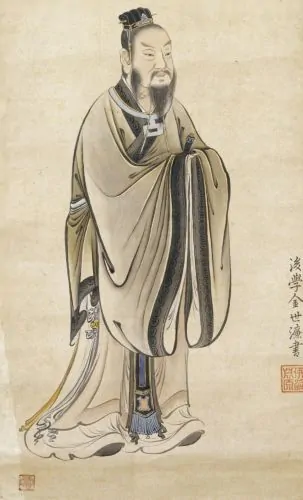
The strongest challenge here concerns the distance between Confucius’s death and the surviving descriptions of its aftermath. No eyewitness account records his funeral, identifies those present, or describes disciples constructing mourning huts beside his grave. The earliest recoverable annalistic notice states only that Kong Qiu died, whereas the emotionally elaborate stories of collective mourning appear in texts transmitted generations later. If those narratives projected later ritual ideals backward onto 479 BCE, then claiming that the disciples’ grief “made” Confucius risks turning retrospective legend into historical cause.
The chronology of the evidence gives this objection considerable force. The Mencius, composed more than a century after Confucius’s death, provides the earliest substantial surviving account of the disciples mourning for three years and of Zigong remaining for an additional three. That passage also contains the attempted elevation of You Ruo and Zengzi’s declaration that no disciple could equal their master, joining the funeral tradition to an argument about Confucius’s uniqueness. The “Tan Gong” chapters of the Book of Rites, compiled from materials of different periods, present another problem: the disciples reportedly wished to mourn Confucius as a father but did not know what garments they should wear, eventually honoring the emotional relation without treating it as literal kinship. Sima Qian, writing still later, enlarges the memorial landscape by describing disciples and other followers settling near the grave and preserving the master’s possessions in his former home. Such accounts may contain traditions reaching back toward the fifth century BCE, but the antiquity of a tradition cannot be established merely from the antiquity it claims for itself. Their ritual durations are also normatively charged, since “three years” designated the paradigmatic period of filial mourning rather than functioning only as a neutral measurement of elapsed time. Each version tells historians something about the community that transmitted it as well as about the death it purports to describe. The silence of earlier evidence does not prove that the disciples dispersed without mourning, but it prevents confident reconstruction of a unified vigil conducted exactly as later texts relate.
Even if the mourning narratives preserve a substantial historical core, a second objection concerns causation. The disciples’ actions did not by themselves produce a received canon, an imperial temple system, hereditary Kong institutions, state examinations, or a monumental cemetery. Confucius acquired supremacy through centuries of competition among teachers, textual communities, political theorists, ritual officials, emperors, lineage managers, and educational institutions. The later careers of the Analects and Qufu consequently cannot be derived from one funeral scene as though each successive development were already latent in the disciples’ grief.
Yet skepticism can become misleading if it assumes that a late memory is historically ineffectual. The relevant distinction is between evidence for an event and evidence for the cultural work performed by a representation of that event. Whether or not every disciple remained for the prescribed period, the Mencius presented collective mourning as the proper response to Confucius’s death and made Zigong’s prolonged vigil the highest expression of fidelity. Whether or not the disciples actually debated mourning garments in the manner described, the Book of Rites used their uncertainty to define a relationship that approached filial devotion while stopping short of genealogical identity. The succession episode performed complementary work: by allowing You Ruo to resemble the master and then refusing to accept him as an equivalent, it converted the absence of Confucius into a permanent condition. There would be transmitters, interpreters, and ritual heirs, but no second Confucius. These stories offered later communities a portable moral grammar through which pedagogical allegiance could be imagined as quasi-familial, continuity could coexist with doctrinal plurality, and an absent teacher could remain the center of collective authority. Temples, schools, lineage organizations, and states did not merely grow out of the funeral tradition; they selected, interpreted, and reenacted it for purposes that changed across time. The narratives’ effectiveness as origin stories can be studied without pretending that they constitute stenographic records of 479 BCE.
The disciples’ mourning did not “make Confucius” if that phrase means that one verifiable funeral observance directly caused his later elevation into an imperial sage and national cultural ancestor. It participated in making him because later communities repeatedly chose mourning as the scene through which his irreplaceability could be explained. The more defensible argument is not that a continuous cult unfolded naturally from six years beside a grave, but that accounts of grief supplied an influential model that subsequent textual, ritual, political, and architectural institutions repeatedly reworked. Confucius became a cultural ancestor through the interaction of remembered discipleship with canon formation, state patronage, hereditary stewardship, sacred space, and modern heritage construction. The evidentiary gap between the death and its narratives does not dissolve this interpretation; it reveals its central mechanism. What cannot be securely recovered as a complete funeral history can still be analyzed as a long process by which successive societies transformed the memory of a dead teacher into enduring authority.
Conclusion: The Cultural Ancestor Created after Death
Confucius’s death in 479 BCE was recorded with a brevity wholly disproportionate to the afterlife that followed. The earliest annalistic tradition preserves little more than the fact that Kong Qiu died, leaving the circumstances of his final illness, funeral, and immediate commemoration largely inaccessible. Later texts filled that silence with grieving disciples, disputed ritual obligations, an unsuccessful search for a successor, and Zigong’s solitary vigil beside the grave. The disparity between the sparse historical notice and the abundant memorial tradition is not an obstacle to understanding Confucius’s posthumous importance; it is the central fact that requires explanation. He did not enter posterity as a fully formed cultural ancestor. That status was constructed through the accumulated work of people who interpreted his absence.
The mourning traditions supplied one of the earliest and most emotionally powerful models for that work. By representing the disciples as mourning their teacher for three years, later writers placed Confucius near the position of a father while preserving the ritual boundary between pedagogical allegiance and biological kinship. Zigong’s additional three years transformed ordinary loyalty into exemplary devotion, making prolonged physical nearness to the grave an expression of fidelity to a master who could no longer speak. The failed attempt to elevate You Ruo was equally consequential within the remembered story. His resemblance to Confucius made succession imaginable, but Zengzi’s rejection made equivalence impossible: disciples might transmit the teaching, yet none could replace its source. Authority remained concentrated in an absent person rather than passing intact to a living institutional heir. This absence encouraged multiple custodians to preserve sayings, defend the master’s reputation, instruct later students, and develop competing interpretations while continuing to invoke the same exemplary center. The received Analects emerged from a longer and more complicated textual history than the traditional image of disciples immediately collecting their memories after the funeral suggests, but its dialogical form preserved the impression of access to Confucius’s voice. Death had ended his unsuccessful pursuit of political employment while freeing later communities to reinterpret that failure as evidence of moral independence, untimely wisdom, or a corrupt age’s inability to recognize the sage before it.
Memory also required a place. The tomb near Qufu fixed Confucius’s absence within a landscape that visitors could approach, maintain, and enlarge. His former residence became associated with ritual veneration, the cemetery gathered the graves of his descendants, and the Kong Family Mansion eventually housed the lineage administration that mediated between family privilege and state patronage. Imperial recognition added titles, sacrifices, buildings, and official interpretations, while modern governments converted much of the same landscape into protected national and international heritage. What endured was not an untouched monument or an uninterrupted cult, but the recurring reconstruction of Qufu as the place where Confucius remained present because he had been buried there.
The strongest conclusion must nevertheless remain narrower than the traditional story allows. It cannot be demonstrated that every disciple observed precisely the period of mourning later attributed to him, that Zigong’s vigil occurred exactly as narrated, or that these acts directly caused the imperial cult. The detailed accounts reveal the ritual and intellectual concerns of the communities that transmitted them as surely as they preserve possible memories of the fifth century BCE. “Cultural ancestor” must likewise remain an analytical description rather than a claim that Confucius became the literal or universally accepted ancestor of all Chinese people. His authority was repeatedly contested by rival thinkers, reformers, revolutionaries, and political movements, while even those who honored him disagreed about whether he should be remembered principally as sage, teacher, philosopher, ritual master, or emblem of civilization. Yet those disputes confirm how thoroughly his posthumous image had become a site upon which larger arguments about education, morality, political order, and cultural identity could be conducted. Confucius became ancestral not through one continuous act of reverence, but because successive communities repeatedly returned to his words, his disciples, and his grave when defining what deserved transmission. Kong Qiu died in 479 BCE; Confucius, the ancestral teacher of a civilization, had only begun to be made.
Bibliography
Affiliate disclosure: Amazon links on this site are paid links. As an Amazon Associate I earn from qualifying purchases.
- Ban Gu. The History of the Former Han Dynasty. Translated by Homer H. Dubs. 12 vols. Baltimore: Waverly Press, 1938–1955.
- Billioud, Sébastien, and Joël Thoraval. The Sage and the People: The Confucian Revival in China. Oxford: Oxford University Press, 2015.
- Brashier, K. E. Ancestral Memory in Early China. Cambridge, MA: Harvard University Asia Center, 2011.
- Brooks, E. Bruce, and A. Taeko Brooks. The Original Analects: Sayings of Confucius and His Successors. New York: Columbia University Press, 1998.
- Brown, Miranda. The Politics of Mourning in Early China. Albany: State University of New York Press, 2012.
- Chin, Annping. The Authentic Confucius: A Life of Thought and Politics. New York: Scribner, 2007.
- Confucius. Analects: With Selections from Traditional Commentaries. Translated by Edward Slingerland. Indianapolis: Hackett, 2003.
- Csikszentmihalyi, Mark, and Michael Nylan. “Constructing Lineages and Inventing Traditions through Exemplary Figures in Early China.” T’oung Pao 89:1–3 (2003), 59–99.
- Durrant, Stephen, Wai-yee Li, and David Schaberg, trans. Zuo Tradition/Zuozhuan: Commentary on the “Spring and Autumn Annals.” 3 vols. Seattle: University of Washington Press, 2016.
- Eno, Robert. The Confucian Creation of Heaven: Philosophy and the Defense of Ritual Mastery. Albany: State University of New York Press, 1990.
- Graham, A. C. Disputers of the Tao: Philosophical Argument in Ancient China. La Salle, IL: Open Court, 1989.
- Han Feizi. Han Feizi: Basic Writings. Translated by Burton Watson. New York: Columbia University Press, 2003.
- Hardy, Grant. Worlds of Bronze and Bamboo: Sima Qian’s Conquest of History. New York: Columbia University Press, 1999.
- Huang, Chin-shing. Confucianism and Sacred Space: The Confucius Temple from Imperial China to Today. New York: Columbia University Press, 2020.
- —-. “The Cultural Politics of Autocracy: The Confucius Temple and Ming Despotism, 1368–1530.” In On Sacred Grounds: Culture, Society, Politics, and the Formation of the Cult of Confucius, edited by Thomas A. Wilson, 267–296. Cambridge, MA: Harvard University Asia Center, 2002.
- Hunter, Michael. Confucius Beyond the Analects. Leiden: Brill, 2017.
- Hunter, Michael, and Martin Kern, eds. Confucius and the Analects Revisited: New Perspectives on Composition, Dating, and Authorship. Leiden: Brill, 2018.
- Ing, Michael David Kaulana. The Dysfunction of Ritual in Early Confucianism. New York: Oxford University Press, 2012.
- International Council on Monuments and Sites. “Temple of Confucius, No. 704.” Advisory Body Evaluation. Paris: ICOMOS, 1994.
- Jensen, Lionel M. Manufacturing Confucianism: Chinese Traditions and Universal Civilization. Durham, NC: Duke University Press, 1997.
- Lamberton, Abigail. “The Kongs of Qufu: Power and Privilege in Late Imperial China.” In On Sacred Grounds: Culture, Society, Politics, and the Formation of the Cult of Confucius, edited by Thomas A. Wilson, 297–334. Cambridge, MA: Harvard University Asia Center, 2002.
- Legge, James, trans. The Li Ki. 2 vols. Sacred Books of the East 27–28. Oxford: Clarendon Press, 1885.
- Lewis, Mark Edward. Writing and Authority in Early China. Albany: State University of New York Press, 1999.
- Li, Wai-yee, trans. and ed. The Confucius Chronicles: A Guide to the Texts That Made the Legend. New York: Columbia University Press, 2026.
- Loewe, Michael. The Government of the Qin and Han Empires: 221 BCE–220 CE. Indianapolis: Hackett Publishing, 2006.
- Lu Xun. Selected Works. 4 vols. Translated by Yang Xianyi and Gladys Yang. Beijing: Foreign Languages Press, 1980.
- Makeham, John. Lost Soul: “Confucianism” in Contemporary Chinese Academic Discourse. Cambridge, MA: Harvard University Asia Center, 2008.
- —-. Transmitters and Creators: Chinese Commentators and Commentaries on the Analects. Cambridge, MA: Harvard University Asia Center, 2003.
- Mencius. Mengzi: With Selections from Traditional Commentaries. Translated by Bryan W. Van Norden. Indianapolis: Hackett Publishing, 2008.
- Murray, Julia K. The Aura of Confucius: Relics and Representations of the Sage at the Kongzhai Shrine in Shanghai. Cambridge: Cambridge University Press, 2021.
- —-. “‘Idols’ in the Temple: Icons and the Cult of Confucius.” Journal of Asian Studies 68:2 (2009), 371–411.
- Nylan, Michael. The Five “Confucian” Classics. New Haven, CT: Yale University Press, 2001.
- Nylan, Michael, and Thomas A. Wilson. Lives of Confucius: Civilization’s Greatest Sage Through the Ages. New York: Doubleday, 2010.
- Pines, Yuri. Foundations of Confucian Thought: Intellectual Life in the Chunqiu Period, 722–453 B.C.E. Honolulu: University of Hawai‘i Press, 2002.
- Richter, Matthias L. The Embodied Text: Establishing Textual Identity in Early Chinese Manuscripts. Leiden: Brill, 2013.
- Schaberg, David. A Patterned Past: Form and Thought in Early Chinese Historiography. Cambridge, MA: Harvard University Asia Center, 2001.
- Schwartz, Benjamin I. The World of Thought in Ancient China. Cambridge, MA: Harvard University Press, 1985.
- Shryock, John K. The Origin and Development of the State Cult of Confucius. New York: Century Co., 1932.
- Sima Qian. Records of the Grand Historian: Han Dynasty. Translated by Burton Watson. New York: Columbia University Press, 1993.
- Steinhardt, Nancy Shatzman. Chinese Architecture: A History. Princeton: Princeton University Press, 2002.
- Sun, Anna. Confucianism as a World Religion: Contested Histories and Contemporary Realities. Princeton: Princeton University Press, 2013.
- UNESCO World Heritage Centre. “Temple and Cemetery of Confucius and the Kong Family Mansion in Qufu.” World Heritage List. Inscribed 1994.
- Van Norden, Bryan W., ed. Confucius and the Analects: New Essays. New York: Oxford University Press, 2002.
- Wang, Liang. “The Confucius Temple Tragedy of the Cultural Revolution.” In On Sacred Grounds: Culture, Society, Politics, and the Formation of the Cult of Confucius, edited by Thomas A. Wilson, 376–400. Cambridge, MA: Harvard University Asia Center, 2002.
- Wilson, Thomas A. “The Ritual Formation of Confucian Orthodoxy and the Descendants of the Sage.” Journal of Asian Studies 55:3 (1996), 559–584.
- —-. “Ritualizing Confucius/Kongzi: The Family and State Cults of the Sage of Culture in Imperial China.” In On Sacred Grounds: Culture, Society, Politics, and the Formation of the Cult of Confucius, edited by Thomas A. Wilson, 43–94. Cambridge, MA: Harvard University Asia Center, 2002.
- —-., ed. On Sacred Grounds: Culture, Society, Politics, and the Formation of the Cult of Confucius. Cambridge, MA: Harvard University Asia Center, 2002.
- Xunzi. Xunzi: The Complete Text. Translated and edited by Eric L. Hutton. Princeton, NJ: Princeton University Press, 2014.
- Zhou, Ze. “The Anti-Confucian Campaign during the Cultural Revolution, August 1966–January 1967.” PhD diss., University of Maryland, College Park, 2011.
Originally published by Brewminate, 08.31.2026, under the terms of a Creative Commons Attribution-NonCommercial-NoDerivatives 4.0 International license.
About the Author